


Abstract
Background/Objectives: Competitive esports players spend prolonged periods seated while performing under sustained cognitive demand, creating conditions that may adversely affect cerebrovascular function. Internal carotid artery (ICA) blood flow is a major determinant of cerebral perfusion and may be particularly relevant to the cognitive demands of competitive gaming. To date, no study has evaluated ICA hemodynamics during competitive gaming or the feasibility of repeated Doppler ultrasound assessment in this setting. Therefore, this pilot study aimed to (1) determine the feasibility of measuring ICA hemodynamics during competitive gaming and (2) generate preliminary data on the effects of a 6 min walking break on ICA blood flow velocity and volume. Methods: Eleven competitive esports players (20.8 ± 2.1 years; 9 male) completed two 2 h gaming sessions using a randomized crossover design: uninterrupted gaming (continuous condition) and gaming interrupted by a 6 min walking break at 60 min (walking condition). Doppler ultrasound measurements of left ICA blood flow velocity, blood flow volume, and vessel diameter were obtained at baseline and every 30 min. Heart rate and blood pressure were also assessed. Feasibility outcomes included recruitment, protocol adherence, and Doppler measurement success. Results: Fourteen participants were screened. Eleven (79%) met the eligibility criteria and completed both study visits, resulting in 100% protocol adherence. Doppler ultrasound acquisition was successful in 107 of 110 planned measurements (97.3%). Baseline ICA hemodynamics were similar between conditions. Repeated-measures analyses demonstrated no significant condition × time interactions for ICA mean blood flow velocity, blood flow volume, or vessel diameter. Under the walking condition, change in ICA blood flow volume was −41.0 ± 102.4 mL/min immediately before the walking break at 60 min, −5.9 ± 132.2 mL/min at 90 min, and −43.7 ± 75.9 mL/min at 120 min; however, between-condition differences were not statistically significant. Conclusions: Repeated Doppler ultrasound assessment of ICA hemodynamics during competitive gaming was feasible and well-tolerated. ICA blood flow volume demonstrated a preliminary temporal pattern following the walking break, but no significant post-intervention between-condition differences were detected. These pilot findings provide estimates of variability and effect magnitude to inform adequately powered studies of movement breaks during prolonged gaming.
1. Introduction
Competitive video gaming, esports, has become a global industry, with over 600 million viewers and hundreds of thousands of professional and semi-professional players who train for 8–12 h daily [1,2,3]. Unlike traditional sports, competitive gaming requires prolonged uninterrupted sitting while simultaneously performing rapid, high-frequency keyboard and mouse actions under sustained cognitive demand. Elite players may execute up to 500 actions per minute while maintaining continuous attention, rapid decision-making, and visuomotor precision [4]. This combination of prolonged sedentary behavior and intense cognitive engagement creates a unique physiological environment that may adversely affect cardiovascular and cerebrovascular function.
Prolonged uninterrupted sitting reduces shear stress in peripheral arteries, impairs endothelial nitric oxide production, and leads to measurable endothelial dysfunction within 1–3 h [5,6]. At the cerebrovascular level, prolonged sitting reduces internal carotid artery (ICA) blood flow, which correlates with decreased attention and cognitive fatigue [7]. Because the ICA supplies approximately 70–80% of cerebral perfusion, maintaining carotid blood flow may be particularly important during activities requiring sustained executive function and attention, such as competitive gaming.
Previous work from our laboratory demonstrated that interrupting gaming with a six-minute light-intensity walking break preserved popliteal artery blood flow and velocity during prolonged gaming [8]. Prior to that, we showed that the same intervention improved executive function without impairing gaming performance [9]. Together, these findings suggest that brief walking breaks provide simultaneous vascular and cognitive benefits during gaming. However, the physiological mechanism linking these observations remains unknown.
One study examined ICA hemodynamics during general prolonged sitting and found that blood flow was preserved with intermittent bodyweight exercise breaks (exercise snacks) [10]. A separate investigation reported that ICA shear-mediated dilation was not significantly impaired by 3 h of general sitting, despite clear peripheral vascular dysfunction, suggesting that the carotid circulation may have some resilience to routine sitting [11]. In a more recent study, Chandran et al. examined the effects of interrupting four hours of prolonged sitting with three-minute bouts of light-intensity walking or moderate-intensity stair climbing every hour. Although these activity breaks attenuated declines in executive function, neither intervention produced significant improvements in carotid artery hemodynamics, highlighting the need for further research on the cerebrovascular effects of brief movement breaks longer than three minutes [12].
However, these findings may not be generalizable to esports, where prolonged sitting is accompanied by sustained sympathetic activation, high cognitive workload, and continuous visuomotor demands.
To our knowledge, this is the first study to evaluate ICA hemodynamics during competitive esports participation and the first to examine the cerebrovascular effects of a structured walking break during gameplay. The present pilot study was designed to (1) evaluate the feasibility of measuring ICA hemodynamics during competitive gaming using Doppler ultrasound, and (2) generate preliminary data to inform the design of a fully powered randomized trial. We hypothesized that ICA blood flow would decline progressively during continuous gaming and that a 6 min walking break would attenuate this decline.
2. Materials and Methods
2.1. Study Design
This was a within-participant crossover pilot study. Each participant completed two separate 2 h gaming sessions in a randomized order using computer-generated randomization with sessions separated by at least 48 h: (1) continuous gaming with no break (continuous condition) and (2) gaming with a 6 min walking break conducted at the 60 min mark (walk condition). The crossover design was chosen to control for inter-individual variability and maximize statistical efficiency given the pilot sample size. The study was approved by the New York Institute of Technology Institutional Review Board and conducted in accordance with the Declaration of Helsinki. All participants provided written informed consent prior to enrolment.
2.2. Participants
A total of 14 potential participants were recruited from local collegiate gaming communities and social media platforms, including Discord and Twitch, and screened for eligibility. Three individuals did not meet the eligibility criteria, leaving 11 competitive esports players (9 male, 2 female; mean age 20.8 ± 2.1 years; BMI 23.1 ± 3.4 kg/m2) who were enrolled and completed both study sessions. Inclusion criteria required participants to be aged 18–30 years, self-identify as a competitive esports player with a ranked game account, and engage in gaming for at least 3 h daily. Exclusion criteria included known cardiovascular disease, carotid artery disease or surgery, current use of vasoactive medications, pregnancy, and any injury precluding 6 min of light walking.
2.3. Experimental Conditions
In the continuous condition, participants played their primary competitive game for 120 min without interruption. In the walk condition, participants played for 60 min, then completed a 6 min light-intensity walking break (target RPE 10–12 on the Borg 6–20 scale, corresponding to ‘light’ effort), followed by another 60 min of gameplay. The walking break was administered immediately adjacent to the gaming area on a flat surface. All participants used their own gaming setup to ensure validity. Sessions were conducted at the same time of day across conditions, and participants were instructed to maintain consistent dietary intake and hydration across visits. This was self-reported.
2.4. Outcome Measurements
Primary feasibility outcomes. Feasibility was assessed by: (1) recruitment rate, defined as the proportion of screened participants meeting eligibility and consenting; (2) protocol adherence, defined as completion of both sessions in full; (3) Doppler measurement success rate, defined as the proportion of planned measurements yielding a technically adequate waveform.
Carotid hemodynamics. All measurements were performed by the same trained and licensed sonographer across both experimental conditions. The ICA was assessed distal to the carotid bifurcation, and Doppler insonation angle maintained below 60° and angle correction applied during velocity acquisition.
ICA diameter was measured in the sagittal (longitudinal) plane using electronic calipers manually positioned on the vessel walls by the sonographer. At each scheduled time point, one Doppler assessment was obtained, with the ultrasound system automatically calculating time-averaged mean velocity over several cardiac cycles. The sagittal diameter, peak systolic velocity, end-diastolic velocity, and time-averaged mean velocity were recorded by the investigator. The sonographer was not blinded to the experimental condition. Blood flow volume was calculated using the sagittal diameter and time-averaged mean velocity according to the following formula:
Flow = π × (diameter/2)2 × mean velocity × 60
Vessel diameter was expressed in centimeters, mean velocity in centimeters per second, and flow volume in mL/min.
Changes from baseline were calculated for each participant to account for inter-individual variability in resting vessel diameter and blood flow.
Secondary outcomes. Heart rate (HR) was recorded at each time point using a validated pulse oximeter. Systolic blood pressure (SBP), diastolic blood pressure (DBP), and mean arterial pressure (MAP) were measured using an automated sphygmomanometer. ICA heart rate (beats per minute derived from the Doppler waveform) was also recorded. Missing data points (n = 3 across all measurements, <3% of total data) were due to technical acquisition issues.
Data Quality Control
All ultrasound data were reviewed for technical adequacy before analysis. Measurements were excluded if waveforms were incomplete, technically inadequate, or physiologically implausible based on predefined data-quality checks. One physiologically implausible diameter value was identified during data verification and excluded from diameter analyses. Missing data were minimal and resulted from technical acquisition issues.
2.5. Statistical Analysis
Data are presented as mean ± standard deviation unless otherwise specified. Feasibility outcomes are reported descriptively as frequencies and percentages. As in our previous hemodynamic study, all inferential statistical analyses were performed using change-from-baseline (delta) values to account for inter-individual variability in baseline physiological measurements [8]. Two-way repeated-measures analysis of variance (ANOVA) was used to evaluate the effects of condition, time, and the condition × time interaction. Sphericity was assessed using Mauchly’s test, with Greenhouse–Geisser correction applied when the assumption of sphericity was violated. Exploratory time-specific pairwise comparisons were adjusted for multiple comparisons using the Holm method. Effect sizes are reported as partial eta-squared (η2p) for ANOVA effects and Cohen’s d for pairwise comparisons. Statistical significance was set at p < 0.05. Analyses were performed using IBM SPSS Statistics version 28 (IBM Corp., Armonk, NY, USA) and JASP (Version 0.19.3; University of Amsterdam, Amsterdam, The Netherlands) [13].
3. Results
3.1. Feasibility Outcomes
Fourteen participants were screened; 11 (79%) met the eligibility criteria and provided written consent, yielding a recruitment rate of 79%. All 11 participants completed both sessions, achieving 100% protocol adherence with no dropouts or adverse events.
Across both study conditions, 110 Doppler ultrasound assessments were planned. Of these, 107 (97.3%) yielded technically adequate waveforms for analysis. Three measurements were unsuccessful because of technical acquisition difficulties during gameplay. These findings provide preliminary evidence supporting the feasibility of repeated ICA Doppler assessment during competitive gaming.
3.2. Participant Characteristics
Participant demographic data are presented in Table 1. The cohort was predominantly male (9/11, 82%) with a mean age of 20.8 ± 2.1 years. Primary game titles included first-person shooter (FPS) and multiplayer online battle arena (MOBA) formats. Mean daily gaming duration was 6.2 ± 1.8 h. All participants were classified as competitive or semi-professional based on ranked game account status.
Table 1.
Participant characteristics (n = 11).
3.3. Internal Carotid Artery Hemodynamics
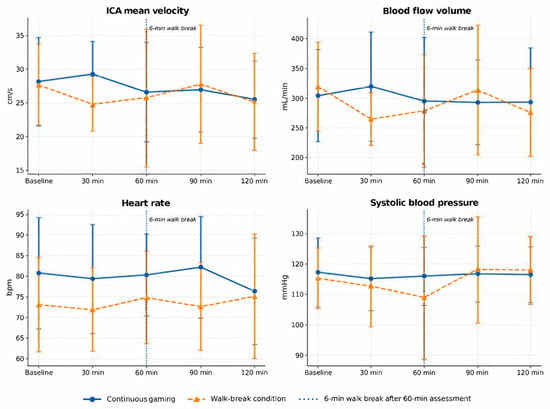
ICA hemodynamic measurements were successfully obtained throughout both experimental conditions, demonstrating the feasibility of repeated Doppler ultrasound assessment during competitive gaming. Mean ICA velocity, blood flow volume, and vessel diameter over time are presented in Figure 1.
Figure 1.
Carotid Hemodynamic Outcomes under Continuous Gaming and Walk-Break Conditions (n = 11).
Mean blood flow velocity. Mean ICA blood flow velocity was similar between conditions at baseline (continuous: 28.2 ± 6.6 cm/s; walking: 27.7 ± 6.0 cm/s; p = 0.82). Repeated-measures ANOVA of change-from-baseline values demonstrated no significant main effect of condition, F(1,10) = 0.20, p = 0.661, η2p = 0.020; time, F(3,30) = 1.27, p = 0.304, η2p = 0.112, or condition × time interaction, F(3,30) = 2.02, p = 0.133, η2p = 0.168. At 30 min, the change from baseline was +1.1 ± 4.8 cm/s during continuous gaming and −2.9 ± 3.3 cm/s during the walking condition; this between-condition difference was not statistically significant after Holm adjustment (p = 0.301). Following the 6 min walking break, changes in ICA blood flow velocity from baseline did not differ significantly between conditions at either 90 or 120 min (all p > 0.05) (Figure 1).
Blood flow volume. Mean ICA blood flow volume was similar between conditions at baseline (continuous: 304.4 ± 77.7 mL/min; walking: 319.7 ± 74.6 mL/min; p = 0.64). Because inferential analyses were performed on change-from-baseline values, ICA blood flow volume is reported as delta values. Repeated-measures ANOVA demonstrated no significant main effect of condition, F(1,10) = 1.26, p = 0.287, η2p = 0.112; time, F(3,30) = 0.41, p = 0.746, η2p = 0.040; or condition × time interaction, F(3,30) = 0.86, p = 0.471, η2p = 0.080. Under the walking condition, the change from baseline was −41.0 ± 102.4 mL/min at 60 min (immediately before the walking break), improved to −5.9 ± 132.2 mL/min 30 min after the walking break (90 min), and declined to −43.7 ± 75.9 mL/min at 120 min. In the continuous gaming condition, corresponding changes were −9.0 ± 98.2, −11.3 ± 52.8, and −10.9 ± 59.1 mL/min, respectively. No statistically significant between-condition differences were observed at any post-intervention time point (all p > 0.05). At 90 min, the between-condition difference in change from baseline was 5.4 mL/min (95% CI, −99.7 to 110.4), and at 120 min, it was −32.8 mL/min (95% CI, −99.0 to 33.4). These post-intervention differences were not statistically significant (Figure 1).
Carotid vessel diameter. Carotid vessel diameter. Repeated-measures ANOVA demonstrated no significant main effect of condition, F(1,9) = 0.23, p = 0.643, η2p = 0.025; time, F(3,27) = 0.69, p = 0.567, η2p = 0.071; or condition × time interaction, F(3,27) = 2.75, p = 0.062, η2p = 0.234.No significant between-condition differences were observed in ICA diameter at any time point (all p > 0.10). One physiologically implausible baseline diameter value was identified during data verification and excluded from diameter analyses according to the prespecified quality-control procedures. A sensitivity analysis retaining the excluded 51 mm baseline value did not alter the interpretation; the condition × time interaction remained nonsignificant, F(3,30) = 2.34, p = 0.094, η2p = 0.189.
3.4. Secondary Outcomes
Heart rate. Repeated-measures ANOVA of change-from-baseline values demonstrated no significant main effect of condition, F(1,10) = 0.17, p = 0.688, η2p = 0.017; time, F(3,30) = 0.36, p = 0.782, η2p = 0.035; or condition × time interaction, F(3,30) = 1.23, p = 0.315, η2p = 0.110.
Blood pressure and MAP. No significant between-condition differences were observed for SBP, DBP, or MAP at any time point (all p > 0.10). Both conditions showed physiologically normal and stable blood pressure profiles throughout the 2 h session.
Values are raw means; inferential analyses are performed on the change-from-baseline values.
4. Discussion
This pilot crossover study is, to our knowledge, the first to evaluate internal carotid artery hemodynamics during prolonged competitive gaming and the first to examine the feasibility of repeated Doppler ultrasound assessment throughout gameplay. The protocol showed high recruitment, complete protocol adherence, and a 97.3% Doppler acquisition success rate, providing preliminary support for the feasibility of this experimental approach. Although the study was not powered to detect definitive treatment effects, the findings characterize preliminary temporal patterns in ICA hemodynamics during prolonged gaming and support the feasibility of a larger randomized trial.
Repeated assessment demonstrated that left ICA hemodynamics could be successfully monitored during prolonged competitive gaming with minimal disruption to gameplay. ICA blood flow volume showed a temporal pattern following the walking break, with values closer to baseline at 90 min before declining again at 120 min. However, the condition × time interaction and post-intervention between-condition comparisons were not statistically significant; therefore, this pattern should be interpreted as exploratory rather than evidence that walking restored ICA blood flow.
In the walking condition, ICA blood flow volume decreased from baseline during the first 60 min of gaming. Following the 6 min walking break, the change from baseline was −5.9 ± 132.2 mL/min at 90 min compared with −41.0 ± 102.4 mL/min immediately before the break at 60 min, before declining to −43.7 ± 75.9 mL/min at 120 min. Although this temporal pattern is of interest, between-condition differences and the condition × time interaction were not statistically significant. The variability and temporal patterns observed in these pilot data provide useful information for designing and powering future studies evaluating the timing and frequency of movement breaks during prolonged gaming.
Heart rate did not demonstrate a significant condition × time interaction when analyzed using change-from-baseline values. Thus, the present findings do not provide evidence of a differential heart-rate response between conditions.
The absence of significant between-condition differences in blood pressure, ICA diameter, and blood flow volume at individual time points should be interpreted in the context of the pilot sample size (n = 11) and the substantial inter-individual variability observed in physiological measures (coefficient of variation, approximately 25–35%). This variability should be considered when estimating sample size for future adequately powered trials.
4.1. Comparison with the Existing Literature
Horiuchi et al. [10] previously demonstrated that 1 min intermittent half-squat exercises every 20 min preserved ICA blood flow during 3 h of general sitting in a non-gaming population. In the present study, ICA blood flow volume showed a temporal change following the 6 min walking break; however, the absence of a significant condition × time interaction prevents attributing this pattern to the intervention. Differences in the type, frequency, and timing of movement breaks may contribute to differences between studies and warrant investigation in larger trials. Saito et al. [11] reported that ICA shear-mediated dilation was not significantly impaired by 3 h of general sitting despite peripheral vascular dysfunction. Together, these findings highlight the need for additional research examining cerebrovascular responses specifically during prolonged competitive gaming.
Daniele et al. [14] recently reported that 2 h of uninterrupted sitting reduced anterograde blood flow in the common carotid artery in both young and older adults. These findings are consistent with our observation that carotid hemodynamic changes are detectable during prolonged gaming and reinforce the rationale for movement-based countermeasures. Similarly, Shen et al. [15] demonstrated that 12 weeks of aerobic exercise improved carotid wall shear stress and blood flow parameters in sedentary adults, further supporting the role of physical activity in maintaining cerebrovascular health.
4.2. Clinical Implications
Although preliminary, these findings support further investigation of structured walking breaks as a practical strategy to reduce the physiological consequences of prolonged gaming. Given the growing popularity of esports and the prolonged sitting required during competition and training, simple movement breaks may represent an easily implemented intervention worthy of evaluation in larger trials.
4.3. Strengths
This study has several strengths. First, it is the first investigation to directly evaluate ICA hemodynamics during competitive gaming. Second, the crossover design minimized between-subject variability by allowing each participant to serve as his or her own control. Third, repeated Doppler ultrasound assessments were successfully obtained throughout gameplay, demonstrating the feasibility of this methodology for future intervention studies.
4.4. Limitations
Several limitations must be acknowledged. First, the sample size of n = 11 limits statistical power for between-condition comparisons, and the analyses reported here should be considered exploratory. Second, mostly male participants provided carotid data, limiting generalizability to female esports players. Third, one data entry anomaly (subject 8, baseline diameter) and three technically inadequate Doppler measurements were identified, which should be addressed through enhanced operator training and standardized data recording in a full trial. Although all Doppler assessments were performed by the same sonographer, the operator was not blinded to experimental condition. Furthermore, only one Doppler assessment was obtained at each scheduled time point, and formal intraobserver and interobserver reliability testing was not performed. These factors may have contributed to measurement variability and should be addressed in future studies.
Fourth, cognitive and gaming performance outcomes were not collected in the present study; future research should examine carotid hemodynamics alongside executive function measures to establish the cerebrovascular-cognitive link. Finally, the crossover design does not account for potential carryover effects, although the 48 h washout period was considered sufficient given the transient nature of the hemodynamic outcomes. Because explicit numerical feasibility thresholds were not prospectively defined, recruitment, adherence, and Doppler acquisition success should be interpreted descriptively. The observed rates provide empirical estimates for defining progression criteria in a future trial.
5. Conclusions
This pilot study provides preliminary support for the feasibility of repeated Doppler ultrasound assessment of internal carotid artery hemodynamics during prolonged competitive gaming. Although ICA blood flow volume showed a temporal change following the 6 min walking break, no significant condition × time interaction or post-intervention between-condition differences were detected. These findings should therefore be considered exploratory and provide preliminary estimates of hemodynamic variability to inform adequately powered trials evaluating the timing and frequency of movement breaks during prolonged gaming.
Author Contributions
J.D.-D. conceived and designed the study, led data collection, performed primary analyses, and drafted the manuscript. H.Z. contributed to clinical oversight and manuscript review. All authors have read and agreed to the published version of the manuscript.
Funding
This study received no specific external funding.
Institutional Review Board Statement
This study was conducted in accordance with the Declaration of Helsinki and was approved by the New York Institute of Technology Institutional Review Board (protocol BHS-1664, 1 June 2021) All participants provided written informed consent prior to enrollment.
Informed Consent Statement
Informed consent was obtained from all subjects involved in the study.
Data Availability Statement
The datasets used and analyzed during the current study are available from the corresponding author on reasonable request.
Acknowledgments
The authors thank Arline Allera for research coordination support and the NYIT CyBears esports program for facilitating participant recruitment. Where Claude Opus 5.5 has been used for purposes such as generating. During the preparation of this manuscript/study, the authors prepared Figures using Python (matplotlib v3.x) with assistance from AI-based code generation (Claude Opus 5.5). The authors have reviewed and edited the output and take full responsibility for the content of this publication.
Conflicts of Interest
The authors declare no conflicts of interest.
Abbreviations
The following abbreviations are used in this manuscript:
| ICA | Internal carotid artery |
| HR | Heart rate |
| SBP | Systolic blood pressure |
| DSP | Diastolic blood pressure |
| MAP | Mean arterial pressure |
| FPS | First-person shooter |
| MOBA | Multiplayer online battle arena |
References
- Kumar, N. eSports Viewership Statistics 2026 (Growth & Demographics); DemandSage: Boston, MA, USA, 2026. [Google Scholar]
- Miller, J. Video Gamer Demographics 2026: Gaming Statistics Worldwide; SportingPost: Cape Town, South Africa, 2026. [Google Scholar]
- DiFrancisco-Donoghue, J.; Balentine, J.; Schmidt, G.; Zwibel, H. Managing the health of the eSport athlete: An integrated health management model. BMJ Open Sport Exerc. Med. 2019, 5, e000467. [Google Scholar] [CrossRef] [Scilit] [PubMed]
- Sousa, A.; Ahmad, S.L.; Hassan, T.; Yuen, K.; Douris, P.; Zwibel, H.; DiFrancisco-Donoghue, J. Physiological and Cognitive Functions Following a Discrete Session of Competitive Esports Gaming. Front. Psychol. 2020, 11, 1030. [Google Scholar] [CrossRef] [Scilit] [PubMed]
- Credeur, D.P.; Miller, S.M.; Jones, R.; Stoner, L.; Dolbow, D.R.; Fryer, S.M.; Stone, K.; McCoy, S.M. Impact of Prolonged Sitting on Peripheral and Central Vascular Health. Am. J. Cardiol. 2019, 123, 260–266. [Google Scholar] [CrossRef] [Scilit] [PubMed]
- Thosar, S.S.; Bielko, S.L.; Mather, K.J.; Johnston, J.D.; Wallace, J.P. Effect of Prolonged Sitting and Breaks in Sitting Time on Endothelial Function. Med. Sci. Sports Exerc. 2015, 47, 843–849. [Google Scholar] [CrossRef] [Scilit] [PubMed]
- Carter, S.E.; Draijer, R.; Holder, S.M.; Brown, L.; Thijssen, D.H.J.; Hopkins, N.D. Regular walking breaks prevent the decline in cerebral blood flow associated with prolonged sitting. J. Appl. Physiol. 2018, 125, 790–798. [Google Scholar] [CrossRef] [Scilit] [PubMed]
- DiFrancisco-Donoghue, J.; Borges, K.; Li, T.; Ballone, O.; Zwibel, H.; Douris, P.C. Reducing thrombotic risks in video gamers: Investigating the benefits of walking and compression sleeves on blood hemodynamics. Am. J. Physiol.-Heart Circ. Physiol. 2024, 326, H538–H547. [Google Scholar] [CrossRef] [Scilit] [PubMed]
- DiFrancisco-Donoghue, J.; Jenny, S.E.; Douris, P.C.; Ahmad, S.; Yuen, K.; Hassan, T.; Gan, H.; Abraham, K.; Sousa, A. Breaking up prolonged sitting with a 6 min walk improves executive function in women and men esports players: A randomised trial. BMJ Open Sport Exerc. Med. 2021, 7, e001118. [Google Scholar] [CrossRef] [Scilit]
- Horiuchi, M.; Pomeroy, A.; Horiuchi, Y.; Stone, K.; Stoner, L. Effects of intermittent exercise during prolonged sitting on executive function, cerebrovascular, and psychological response: A randomized crossover trial. J. Appl. Physiol. 2023, 135, 1421–1430. [Google Scholar] [CrossRef] [Scilit] [PubMed]
- Saito, S.; Dora, K.; Karaki, M.; Kunimatsu, N.; Tsukamoto, H.; Sugawara, J.; Iwamoto, E.; Ogoh, S. Prolonged sitting is not associated with altered shear-mediated dilation of the internal carotid artery, despite impairing lower limb endothelial function. Physiol. Rep. 2025, 13, e70097. [Google Scholar] [CrossRef] [Scilit] [PubMed]
- Chandran, O.; Shruthi, P.; Sukumar, S.; Kadavigere, R.; Chakravarthy, K.; Rao, C.R.; Chandrasekaran, B. Effects of physical activity breaks during prolonged sitting on vascular and executive function—A randomised cross-over trial. J. Taibah Univ. Med. Sci. 2023, 18, 1065–1075. [Google Scholar] [CrossRef] [Scilit] [PubMed]
- JASP. JASP Team [Internet]. University of Amsterdam; 2025. Available online: https://jasp-stats.org (accessed on 4 January 2023).
- Daniele, A.; Lucas, S.J.E.; Rendeiro, C. The Impact of Cocoa Flavanols in Modulating Resting Cerebral Blood Flow During Prolonged Sitting in Healthy Young and Older Adults. Nutrients 2025, 17, 2099. [Google Scholar] [CrossRef] [Scilit] [PubMed]
- Shen, B.; Zheng, H.; Liu, H.; Chen, L.; Yang, G. Differential benefits of 12-week morning vs. evening aerobic exercise on sleep and cardiometabolic health: A randomized controlled trial. Sci. Rep. 2025, 15, 18298. [Google Scholar] [CrossRef] [Scilit] [PubMed]

Disclaimer/Publisher’s Note: The statements, opinions and data contained in all publications are solely those of the individual author(s) and contributor(s) and not of MDPI and/or the editor(s). MDPI and/or the editor(s) disclaim responsibility for any injury to people or property resulting from any ideas, methods, instructions or products referred to in the content. |
© 2026 by the authors. Published by MDPI on behalf of the Swiss Federation of Clinical Neuro-Societies. Licensee MDPI, Basel, Switzerland. This article is an open access article distributed under the terms and conditions of the Creative Commons Attribution (CC BY) license.