


Abstract
Purpose: Loss of digital leverage can severely disrupt inverted pendulum mechanics and alter how mechanical work is distributed during walking. The biomechanical efficacy of prosthetic footwear in individuals with bilateral toe amputation remains poorly understood. This exploratory single-case study quantified the effects of custom prosthetic footwear on pendular recovery, mechanical work distribution, and functional mobility in a 52-year-old male with complete bilateral digital amputation (metatarsals preserved), while evaluating intervention effects relative to concurrent walking speed changes. Methods: Three-dimensional kinematic data were collected during barefoot and prosthetic footwear walking across 13 consecutive stride cycles (7 barefoot, 6 shod). Functional speed restoration was evaluated via the Locomotor Rehabilitation Index (LRI). Unadjusted condition differences were evaluated using Hedges’ g with bootstrap confidence intervals. To isolate intervention effects from walking velocity, a single-case multiple linear regression model incorporating a first-order autoregressive error structure [AR(1)] evaluated speed-adjusted intervention effects (β1) centered at grand mean speed (1.14 m/s). Results: Walking speed increased substantially from 0.88 ± 0.08 m/s barefoot (range: 0.76–0.98 m/s) to 1.45 ± 0.05 m/s with footwear (range: 1.38–1.52 m/s; Hedges’ g = 7.78), restoring size-controlled functional mobility (LRI increased from 57% to 94%). Unadjusted comparisons showed increases in pendular recovery (39% to 47%, g = 4.03); external mechanical work, Wext (0.460 to 0.608 J/kg/m, g = 4.85); forward work, Wf (0.286 to 0.627 J/kg/m, g = 5.92); and internal work, Wint (0.194 to 0.225 J/kg/m, g = 3.12). However, because walking speeds were distinctly separated with no overlap between conditions, parameter estimates at the mean speed rely on model extrapolation. When controlling for instantaneous stride speed via AR(1) regression (autocorrelation ρ = 0.38), speed-adjusted condition effects were non-significant for Wext (β1 = +0.085 J/kg/m, p = 0.265), Wf (β1 = +0.051 J/kg/m, p = 0.296), Wint (β1 = −0.007 J/kg/m, p = 0.680), and pendular recovery (β1 = +0.10%, p = 0.981), which is consistent with strong velocity dependence rather than intrinsic shifts in mechanical efficiency at a given speed. Vertical external work demonstrated a statistical trend toward elevation in the prosthetic condition (β1 = +0.162 J/kg/m, p = 0.062), which may reflect compensatory vertical body center of mass redirection to compensate for reduced distal forefoot lever propulsion during rollover. Conclusions: Prosthetic footwear substantially enhances functional gait mobility by enabling velocity restoration toward Froude-based optimal speed, although independent footwear and velocity effects cannot be fully decoupled without observations at overlapping speeds.
1. Introduction
The forefoot plays a critical biomechanical role during human walking, acting as a distal leverage arm that facilitates smooth body center-of-mass (BCoM) rollover and anterior propulsion during stance progression [1,2,3]. Complete digital amputation alters forefoot leverage, disrupts the inverted pendulum mechanism, and compromises the exchange between potential and kinetic energy [4,5]. Although previous studies have described kinematic alterations in walking [4,5,6] and gait initiation [7] following toe amputation, quantitative assessments of mechanical work partitioning, energy recovery, and footwear interventions in bilateral digital amputation remain scarce.
Furthermore, mechanical evaluations in amputee locomotion must account for altered segmental mass distributions resulting from tissue loss [7,8,9]. Conventional anthropometric models overestimate foot mass and incorrectly position the foot center of mass when applied to digital amputees, thereby introducing systematic errors into limb kinetic energy and BCoM work determinations. A second fundamental challenge in evaluating footwear interventions is the confounding influence of self-selected walking speed. Because mechanical work parameters, particularly forward external work (Wf) and total external work (Wext), are highly velocity-dependent [2,3,10,11,12,13,14], changes observed when introducing prosthetic footwear may reflect faster walking speed rather than altered mechanical efficiency as observed in speed-dependent adaptations on metabolic cost (COPD) [15] and mechanical work (Parkinson’s disease) [16,17]. Standard group-level statistical controls like ANCOVA are unsuitable for single-case designs due to serial autocorrelation across consecutive stride cycles [18,19]. Importantly, in single-subject designs, stride-to-stride variability represents trial consistency within a single individual rather than inter-individual population variance, requiring cautious statistical modeling and interpretation.
To address these limitations, the primary objectives of this exploratory single-case study were (1) to establish an adjusted inertial parameter framework for mechanical work calculation in complete bilateral toe amputation, (2) to evaluate the biomechanical effect of custom prosthetic footwear on spatiotemporal parameters, mechanical work distribution, and pendular recovery in a bilateral metatarsophalangeal amputee, and (3) to implement a stride-level single-case AR(1) Generalized Least Squares regression model to evaluate intervention effects while accounting for walking velocity.
2. Materials and Methods
2.1. Participant & Ethics
A 52-year-old male mountaineer (body mass: 82.3 kg; stature: 1.79 m) with complete bilateral digital amputation due to severe frostbite sustained at K2 Mountain (metatarsal heads fully preserved) participated in this study. Written informed consent was obtained prior to testing, and the study protocol was approved by the local ethics committee (approval number: 23/23). Case reporting adheres strictly to the CARE checklist guidelines (Supplementary Material S1).
2.2. Experimental Protocol & Custom Prosthetic Footwear Specifications
Walking trials were conducted along an 8 m flat overground walkway at self-selected walking speed under two randomized conditions: barefoot and shod (custom prosthetic footwear). The custom prosthetic footwear was specifically engineered to restore distal toe box volume and forefoot rollover mechanics. It featured a high-density molded ethyl-vinyl-acetate (EVA) toe filler shaped to the participant’s residual forefoot contour, an integrated full-length rigid carbon-fiber shank stiffener to bridge the missing distal lever arm, a 15-degree anterior rocker-bottom outsole, and a padded heel collar to ensure secure hindfoot retention (see Supplementary Material S2 for detailed engineering schematics which include references [20,21,22,23]). No standard commercial footwear control was included in this testing protocol.
Three-dimensional kinematic data were acquired at 100 Hz using an 8-camera optoelectronic motion capture system (BTS Bioengineering, Milan, Italy) with full-body reflective marker placement. A total of 10 walking trials were recorded per condition. After removing acceleration/deceleration trials (>5% speed variance; see Supplementary Material S3 for the complete stride-level database), a final set of 7 barefoot trials and 6 shod trials were retained for final analysis.
2.3. Rationale & Calculation of Mechanical Work with Adjusted Foot Inertial Parameters
Standard biomechanical calculations rely on generic anthropometric tables (e.g., Dempster, Zatsiorsky) assuming intact feet (~1.45% body mass per foot, corresponding to 1.19 kg per foot for an 82.3 kg individual). In complete bilateral digital amputation, the total loss of all phalangeal structures (~14.2% of total foot mass) reduces segment mass and shifts the foot center of mass proximally toward the metatarsal heads. Specifically, foot segment mass in the barefoot condition was reduced from 1.19 kg to 1.02 kg per foot, and the foot center of mass location was re-positioned proximally from 50% to 42% along the longitudinal heel-to-metatarsal vector. In the shod condition, the composite foot-plus-footwear segment mass was calculated as 1.43 kg (1.02 kg residual foot + 0.410 kg shoe), with the composite center of mass re-calculated at 48% of foot length based on mass-moment weighting (Supplementary Material S2).
Whole-body BCoM 3D position trajectories (r_BCoM) and instantaneous velocities (v_x, v_y, v_z) were derived from mass-weighted segmental centers of mass. Wext was calculated using the Fenn–Cavagna approach [1,2] by summing positive increments in BCoM energy curves, partitioned into forward (Wf) and vertical external work (Wv) components. Internal work (Wint) was computed from segmental kinetic energy fluctuations relative to the BCoM, and total work was defined as Wtot = Wext + Wint [1,2,3]. Pendular recovery (R) was calculated as:
R (%) = [(Wv + Wf − Wext)/(Wv + Wf)] × 100
Functional walking speed was normalized using the Locomotor Rehabilitation Index (LRI), defined as the ratio of self-selected walking speed to Froude-based optimal speed (Supplementary Material S2) [24,25].
2.4. Statistical Analysis & Single-Case AR(1) Regression Model Diagnostics
Unadjusted condition differences were first evaluated using Hedges’ g effect sizes with 95% bootstrap confidence intervals [18,19]. Because these metrics represent repeated stride cycles from a single participant rather than independent biological replicates, Hedges’ g effect sizes quantify standardized differences between conditions rather than population-level intervention magnitudes.
To statistically evaluate intervention effects while accounting for walking velocity across individual stride cycles, a single-case multiple linear regression model incorporating a first-order autoregressive error structure [AR(1)] was conducted using Generalized Least Squares (GLSAR) (Parker et al., 2011) [18]. The 13 stride cycles were analyzed as a consecutive time series. Autocorrelation function (ACF) and partial autocorrelation function (PACF) diagnostics confirmed stationary first-order autocorrelation across consecutive strides (speed lag-1 autocorrelation ρ = 0.38; vertical external work lag-1 autocorrelation ρ = 0.29; Wext lag-1 autocorrelation ρ = 0.34).
For each mechanical outcome variable (Wext, Wf, vertical external work, Wint, total work, pendular recovery), individual strides (i) were modeled as:
where Condition_i was dummy-coded (0 = barefoot, 1 = prosthetic footwear), and Speed_i was centered around the grand mean speed across all strides (v_mean = 1.14 m/s/4.10 km/h). Because barefoot (0.88 ± 0.08 m/s) and shod (1.45 ± 0.05 m/s) speeds did not overlap, centering speed at the grand mean allows parameter β1 to represent the model-estimated speed-adjusted intervention effect via linear extrapolation across the unobserved speed gap, while β2 quantifies the main velocity slope. Statistical significance was established at α = 0.05.
Y_i = β0 + β1 · Condition_i + β2 · (Speed_i − v_mean) + ε_i
3. Results
3.1. Spatiotemporal Parameters & Functional Gait Mobility
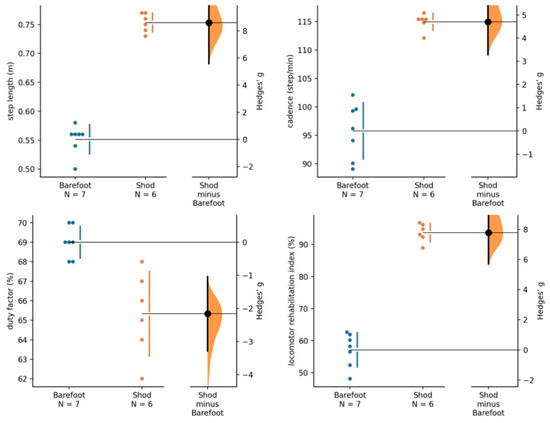
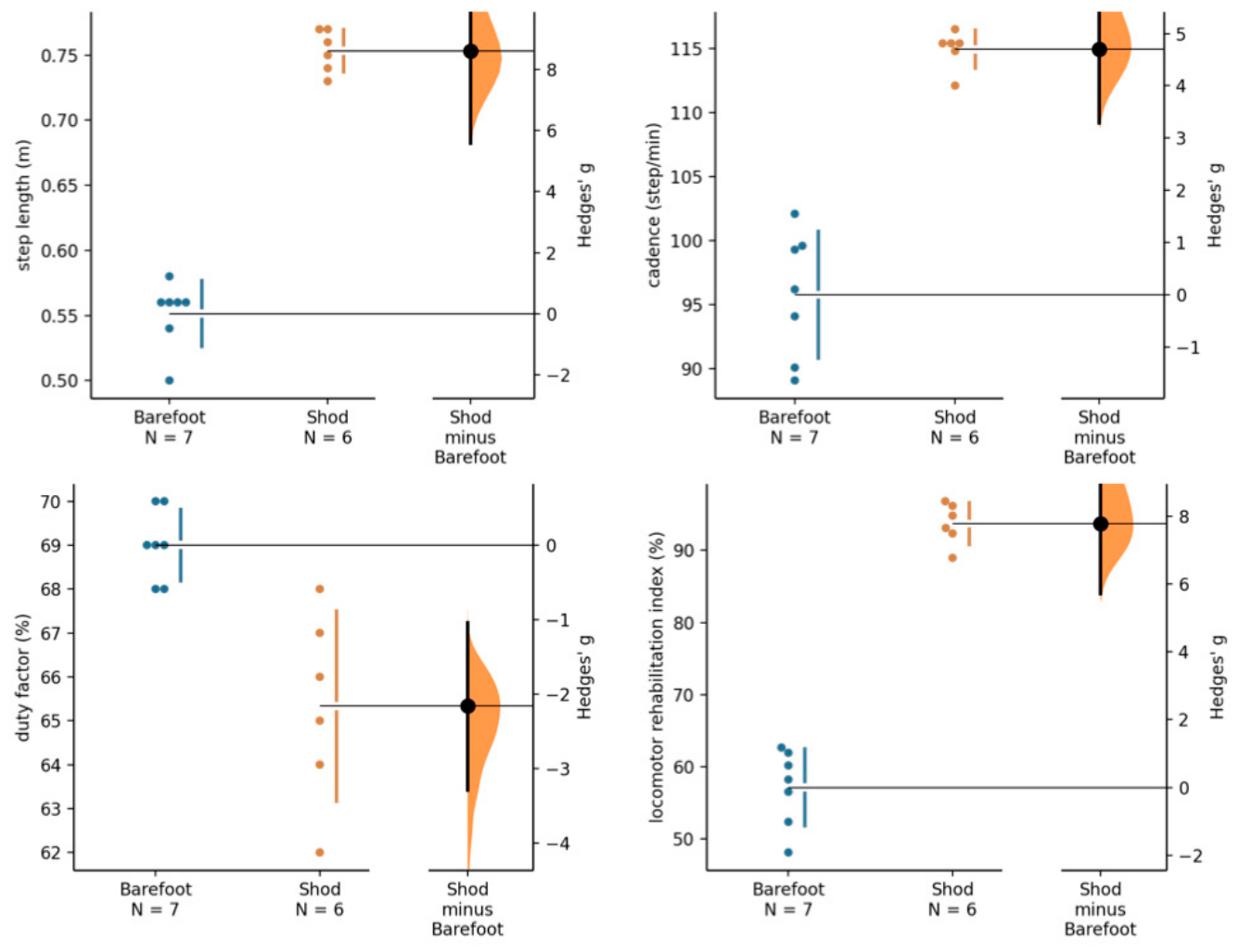
Self-selected walking speed increased substantially from 0.88 ± 0.08 m/s (3.13 km/h; individual stride range: 0.76–0.98 m/s) in the barefoot condition to 1.45 ± 0.05 m/s (5.20 km/h; individual stride range: 1.38–1.52 m/s) with prosthetic footwear (raw difference: +0.57 m/s, Hedges’ g = 7.78, 95% CI [5.72, 10.40]; Supplementary Material S3). LRI rose from 57% to 94% (g = 7.78), indicating near-complete restoration of size-controlled functional speed toward Froude optimal speed. Step length increased from 0.55 m to 0.75 m (g = 8.62), cadence rose from 96 to 115 steps/min (g = 4.70), and duty factor decreased from 68.9% to 65.3% (g = −2.16). Spatiotemporal parameters and joint range of motion values are presented in Table 1. Cumming estimation plots illustrating individual stride distributions, mean differences, and bootstrap confidence intervals for spatiotemporal parameters and LRI are shown in Figure 1.
Table 1.
Mean values and standard deviation of the spatiotemporal and rotational parameters for the shod and barefoot conditions, and the size effects and 95% CI between conditions.
Figure 1.
Comparison of barefoot (blue circles) and shod (orange circles) conditions for step length, cadence, duty factor, and locomotor rehabilitation index (LRI) using Cumming estimation plots. The points represent individual data with mean ±95% CI; on the right are the mean difference (shod—barefoot) with bootstrap distribution and effect size (Hedges’ g).
3.2. Mechanical Work & Pendular Recovery (Speed-Adjusted Analysis)
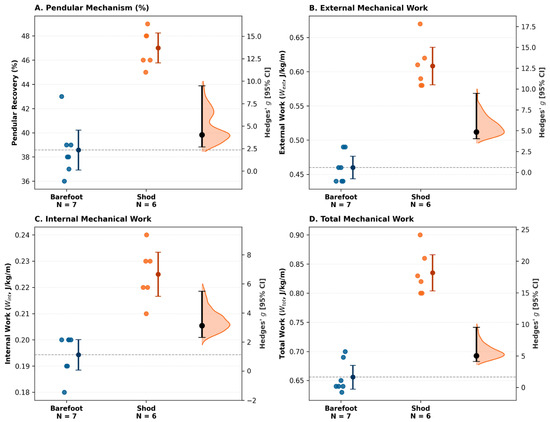
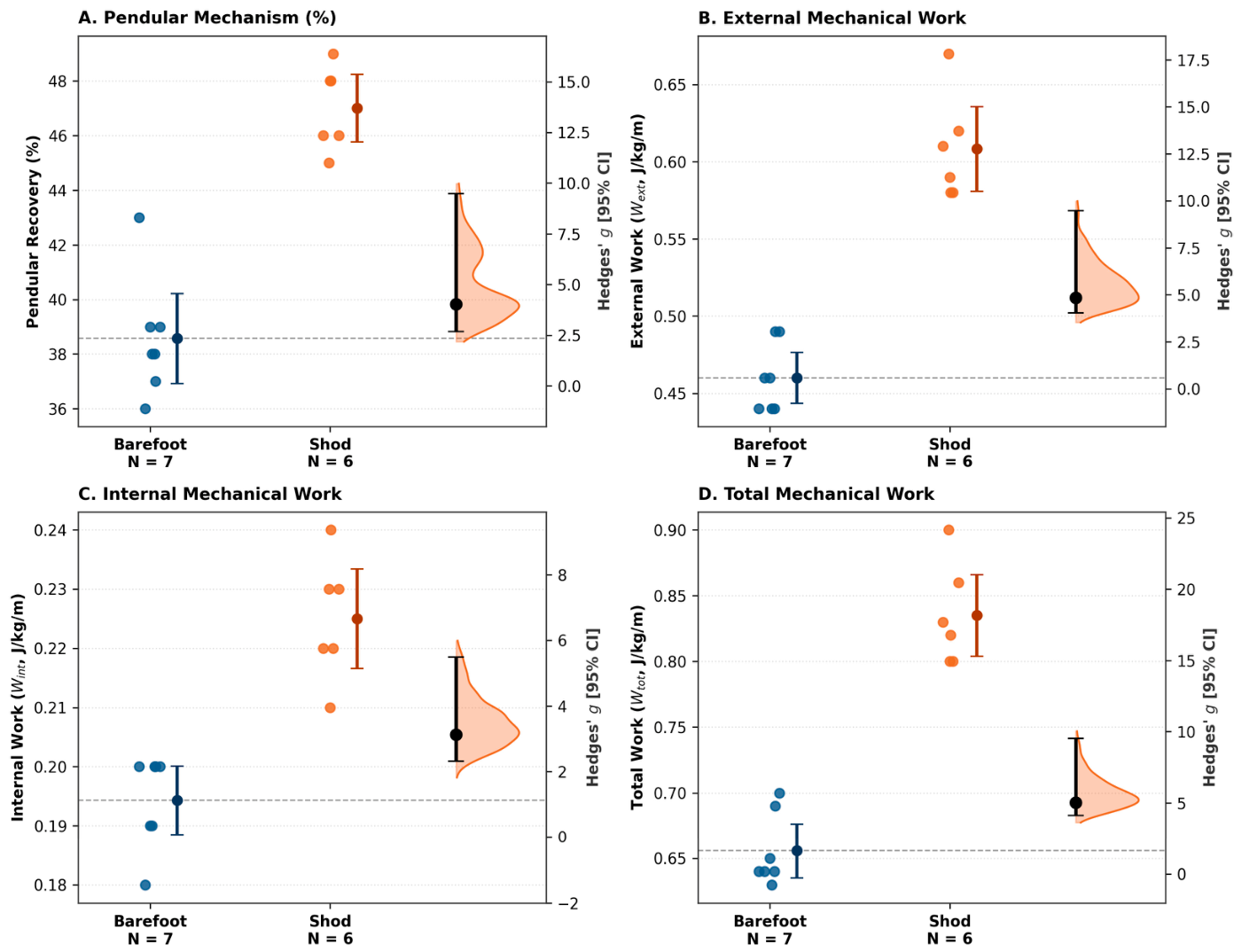
Unadjusted mean comparisons revealed higher values during prosthetic walking across Wext (0.460 to 0.608 J/kg/m; g = 4.85), Wf (0.286 to 0.627 J/kg/m; g = 5.92), Wint (0.194 to 0.225 J/kg/m; g = 3.12), total work (0.656 to 0.835 J/kg/m), and pendular recovery (39% to 47%; g = 4.03). Unadjusted estimation plots comparing mechanical work components and pendular recovery between conditions are presented in Figure 2 and Table 2.
Figure 2.
Comparison of barefoot (blue circles) and shod (orange circles) conditions for external mechanical work, internal mechanical work, total mechanical work, and pendular recovery using Cumming estimation plots. The points represent individual data with mean ±95% CI; on the right are the mean difference (shod—barefoot) with bootstrap distribution and effect size (Hedges’ g).
Table 2.
Mean values and standard deviations of the external (Wext), forward external (Wf), vertical external (Wv), internal (Wint), and total (Wtot) mechanical work and pendular recovery (Recovery %) parameters for the shod and barefoot conditions, and outcomes of the AR(1) GLSAR regression model.
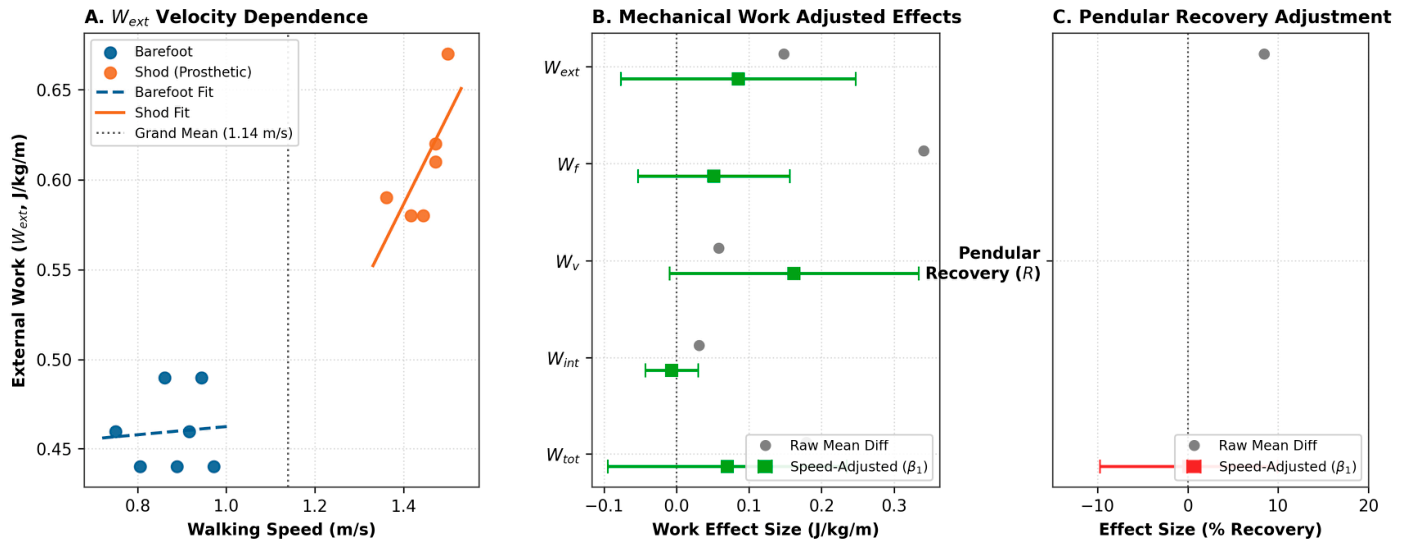
However, application of the single-case AR(1) GLSAR regression model centered at grand mean speed (1.14 m/s) demonstrated that these changes were consistent with speed dependence rather than intrinsic efficiency changes (Figure 3):
Figure 3.
Single-case GLSAR regression analysis for external mechanical work (Wext), forward external work (Wf), vertical external work (Wv), internal mechanical work (Wint), total mechanical work (Wtot), and pendular recovery (R) centered at grand mean walking speed (1.14 m/s). On the left are stride-level speed slopes; on the right are the raw mean differences compared to the speed-adjusted intervention effects with 95% CI and effect sizes.
- Wf: Wf exhibited a significant positive velocity dependence (β2 = +0.514 J/kg/m per m/s, p < 0.001, R2 = 0.995). When controlling for speed, the residual prosthetic effect was non-significant (β1 = +0.051 J/kg/m, 95% CI [−0.053, +0.156], p = 0.296).
- Wext: The speed-adjusted condition effect for Wext dropped to β1 = +0.085 J/kg/m (95% CI [−0.077, +0.247], p = 0.265; R2 = 0.942), confirming that the raw increase was consistent with velocity scaling.
- Vertical External Work: Vertical work showed an inverse relationship with speed (β2 = −0.178 J/kg/m per m/s, p = 0.183). Controlling for speed revealed a statistical trend toward higher vertical work in the prosthetic condition (β1 = +0.162 J/kg/m, 95% CI [−0.010, +0.334], p = 0.062; R2 = 0.534).
- Wint & Total Work: Wint scaled significantly with speed (β2 = +0.065, p = 0.045), but its adjusted condition effect was non-significant (β1 = −0.007 J/kg/m, p = 0.680). Total work showed no adjusted condition effect (β1 = +0.070 J/kg/m, p = 0.361; R2 = 0.959).
- Pendular Recovery: Pendular recovery displayed a non-significant velocity dependence (β2 = +14.63% per m/s, p = 0.084, R2 = 0.937). Speed adjustment probably reduced the condition difference (β1 = +0.10%, 95% CI [−9.72%, +9.93%], p = 0.981).
4. Discussion
4.1. Velocity Dependence and Single-Case Regression
A primary methodological challenge in evaluating single-case locomotion interventions is the confounding influence of self-selected walking velocity. We selected a design intended to optimize gait speed under functional, self-selected walking conditions as used in previous studies [15,16]. Indeed, walking speed increased substantially, from 0.88 m/s when barefoot to 1.45 m/s when wearing the custom prosthetic footwear. While unadjusted comparisons suggested marked increases in Wext, Wf, Wint, and pendular recovery, our stride-level GLSAR regression model clarifies that these changes are consistent with velocity-dependent adaptations rather than fundamental changes in intrinsic mechanical efficiency.
When evaluated at an equivalent grand mean speed (1.14 m/s), the speed-adjusted condition differences for Wext (β1 = +0.085 J/kg/m, p = 0.265) and Wf (β1 = +0.051 J/kg/m, p = 0.296) were non-significant. This is consistent with classical locomotion principles demonstrating that Wext and Wf scale strongly with forward velocity [2,3,26]. Rather than representing a mechanical drawback, the higher absolute work observed during shod walking reflects physiological adaptations to functional speed restoration—as evidenced by the normalization of LRI from 57% to 94%.
4.2. Pendular Mechanics and Vertical Work Compensations
Similarly, the unadjusted increase in pendular recovery from 39% to 47% was associated with speed (β2 = +14.63% per m/s, p = 0.084), yielding a speed-adjusted effect near zero (β1 = +0.10%, p = 0.981). This suggests that the enhanced pendular energy exchange using prosthetic footwear was probably due to the faster speed, rather than by altering the rate of potential-to-kinetic energy conversion at a given speed. Nevertheless, pendular recovery in the shod condition (47%) remained below physiological reference values for healthy adults (~55–65%) [1,10], reflecting persistent forefoot leverage constraints despite footwear restoration.
Interestingly, vertical external work demonstrated a statistical trend toward higher values in the prosthetic condition when controlling for speed (β1 = +0.162 J/kg/m, p = 0.062). Because vertical external work naturally decreases with walking speed (β2 = −0.178), velocity adjustment amplified the estimated footwear effect. This finding may reflect a compensatory mechanism wherein the participant relies on greater vertical BCoM redirection during stance to compensate for reduced distal forefoot lever propulsion during rollover [7,26], though future kinetic studies are required to directly confirm this hypothesis.
4.3. Confounding Between General Footwear and Custom Prosthetic Design Effects
A notable interpretive consideration in this study is the comparison between barefoot walking and custom prosthetic footwear without an intermediate control condition (e.g., standard off-the-shelf commercial footwear or non-prosthetic shod walking). Consequently, the observed functional improvements, including the substantial speed increase and LRI elevation, reflect the combined effect of general footwear enclosure benefits (e.g., outsole traction, heel cushioning, foot protection, and thermal insulation) alongside the specific mechanical contributions of the custom prosthetic features (forefoot length restoration, rigid shank lever arm, and rocker-bottom outsole). Disentangling the specific contribution of forefoot rocker geometry from general shod effects remains an important direction for future multi-condition evaluations.
4.4. Future Directions: Subject-Specific Computational Footwear Optimization
Beyond geometric forefoot volume restoration, the future development of prosthetic footwear for partial foot amputation should transition toward subject-specific biomechanical optimization. Recent advances in computational biomechanics have demonstrated the feasibility of personalizing footwear stiffness and cushioning profiles based on individual foot morphology, residual plantar tissue tolerance, and gait-induced pressure distributions. Specifically, finite element modeling (FEM) integrated with machine learning algorithms enables the design of parametric cushioning lattice insoles capable of locally tuning plantar pressure relief [27]. Furthermore, computationally tuned dual-layer lattice structures can be customized to match gait-induced pressure profiles [28], offering a promising framework for optimizing energy storage, pressure redistribution, and comfort in partial foot prostheses.
5. Limitations
This study presents inherent limitations. First, as a single-case investigation, the findings quantify intra-individual trial consistency and cannot be directly generalized to all individuals with digital amputations. Second, walking speed was not experimentally constrained (e.g., via a treadmill pace or audio metronome) during overground walking. Because self-selected barefoot (0.88 ± 0.08 m/s) and shod (1.45 ± 0.05 m/s) speeds were distinctly separated with no region of speed overlap, parameter estimates at the grand mean speed (1.14 m/s) rely on linear extrapolation across the unobserved speed gap. Although AR(1) regression provides statistical control, independent footwear and speed effects cannot be fully decoupled without empirical observations at overlapping speeds. Third, the absence of a standard commercial footwear condition precludes separating custom prosthetic design features from general shod effects. Fourth, metabolic energy cost was not directly assessed, preventing direct energetic validation of mechanical work calculations.
6. Conclusions
Prosthetic footwear substantially improves gait function in bilateral metatarsophalangeal amputation by restoring walking velocity toward Froude-based optimal speed (LRI increased from 57% to 94%). Despite the world-class caliber of the evaluated mountaineer, the presence of a complete metatarsophalangeal amputation resulted in pendular recovery and mechanical work values under both shod and barefoot conditions that fell below those documented in previous literature. Application of a single-case AR(1) GLSAR regression model demonstrates that the observed increases in Wext and pendular recovery are consistent with velocity-dependent adaptations rather than fundamental changes in intrinsic mechanical efficiency at a given speed. Decoupling speed effects via stride-level regression provides a starting-point framework for clinical gait evaluations in single-subject designs, though future research should incorporate overlapping speed conditions.
Supplementary Materials
The following supporting information can be downloaded at https://www.mdpi.com/article/10.3390/biomechanics6040096/s1, Supplementary Material S1: CARE Checklist of Study; Supplementary Material S2: Procedures for data processing and discussion; Supplementary Material S3: Database of the study.
Author Contributions
Conceptualization, G.G., M.O., J.L.S., P.C., L.d.L.A., L.C. and L.A.P.-T.; methodology, G.G., J.L.S. and L.A.P.-T.; formal analysis, G.G., M.O. and L.A.P.-T.; investigation, G.G., M.O., L.C. and J.L.S.; data curation, G.G. and M.O.; writing—original draft preparation, G.G., M.O. and L.A.P.-T.; writing—review and editing, J.L.S., P.C., L.d.L.A., L.C. and L.A.P.-T.; visualization, G.G. and L.A.P.-T.; supervision, L.C. and L.A.P.-T. All authors (excepted P.C., passed away) have read and agreed to the published version of the manuscript.
Funding
This research received no external funding.
Institutional Review Board Statement
The study was conducted in accordance with the Declaration of Helsinki and approved by the Ethics Committee of the University of Milan (protocol code 23/23).
Informed Consent Statement
Written informed consent was obtained from the participant involved in the study for data collection and publication of anonymized data.
Data Availability Statement
The complete stride-level dataset supporting the reported results is available within Supplementary Material S3.
Conflicts of Interest
The authors declare no conflicts of interest.
References
- Cavagna, G.A.; Thys, H.; Zamboni, A. The sources of external work in level walking and running. J. Physiol. 1976, 262, 639–657. [Google Scholar] [CrossRef] [Scilit] [PubMed]
- Peyré-Tartaruga, L.A.; Dewolf, A.H.; di Prampero, P.E.; Fábrica, G.; Malatesta, D.; Minetti, A.E.; Monte, A.; Pavei, G.; Silva-Pereyra, V.; Willems, P.A.; et al. Mechanical work as a (key) determinant of energy cost in human locomotion: Recent findings and future directions. Exp. Physiol. 2021, 106, 1897–1908. [Google Scholar] [CrossRef] [Scilit] [PubMed]
- Cavagna, G.A.; Kaneko, M. Mechanical work and efficiency in level walking and running. J. Physiol. 1977, 268, 467–481. [Google Scholar] [CrossRef] [Scilit] [PubMed]
- Forczek, W.; Ruchlewicz, T.; Gawęda, A. Kinematic gait analysis of a young man after amputation of the toes. Biomed. Hum. Kinet. 2014, 6, 40–46. [Google Scholar] [CrossRef] [Scilit]
- Iijima, H.; Eguchi, R.; Yamamoto-Kon, A.; Terabe, Y.; Takahashi, M. Compensatory gait mechanics in person with multiple toe amputation: A single case report. Clin. Case Rep. 2023, 11, e7675. [Google Scholar] [CrossRef] [Scilit] [PubMed]
- Doerks, F.; Gempfer, C.; Reulbach, M.; Jakubowitz, E. Gait characteristics of people with hallux and forefoot amputations—A case series. J. Clin. Med. 2025, 14, 2140. [Google Scholar] [CrossRef] [Scilit] [PubMed]
- Storniolo, J.L.; Farinelli, V.; Onesti, M.; Correale, L.; Peyré-Tartaruga, L.A.; Esposti, R.; Cavallari, P. Case report: New perspectives on gait initiation strategies from a case of full toes amputation in a professional mountain climber. Front. Hum. Neurosci. 2024, 18, 1463249. [Google Scholar] [CrossRef] [Scilit] [PubMed]
- McDonald, K.A.; Teater, R.H.; Cruz, J.P.; Kerr, J.T.; Bastas, G.; Zelik, K.E. Adding a toe joint to a prosthesis: Walking biomechanics, energetics, and preference of individuals with unilateral below-knee limb loss. Sci. Rep. 2021, 11, 1924. [Google Scholar] [CrossRef] [Scilit] [PubMed]
- Anderson, K.M.; Evans, R.E.; Connerly, C.E.; Pacha, M.; Wilken, J.M. Custom dynamic orthoses and physical therapist intervention for bilateral midfoot amputation: A case report. Phys. Ther. 2021, 101, pzab028. [Google Scholar] [CrossRef] [Scilit] [PubMed]
- Willems, P.A.; Cavagna, G.A.; Heglund, N.C. External, internal and total work in human locomotion. J. Exp. Biol. 1995, 198, 379–393. [Google Scholar] [CrossRef] [Scilit] [PubMed]
- Minetti, A.E.; Capelli, C.; Zamparo, P.; di Prampero, P.E.; Saibene, F. Effects of stride frequency on mechanical power and energy expenditure of walking. Med. Sci. Sports Exerc. 1995, 27, 1194–1202. [Google Scholar] [CrossRef] [Scilit]
- Kuo, A.D.; Donelan, J.M.; Ruina, A. Energetic consequences of walking like an inverted pendulum: Step-to-step transitions. Exerc. Sport Sci. Rev. 2005, 33, 88–97. [Google Scholar] [CrossRef] [Scilit] [PubMed]
- Gomeñuka, N.A.; Bona, R.L.; da Rosa, R.G.; Peyré-Tartaruga, L.A. Adaptations to changing speed, load, and gradient in human walking: Cost of transport, optimal speed, and pendulum. Scand. J. Med. Sci. Sports 2014, 24, e165–e173. [Google Scholar] [CrossRef] [Scilit] [PubMed]
- Gomeñuka, N.A.; Bona, R.L.; da Rosa, R.G.; Peyré-Tartaruga, L.A. The pendular mechanism does not determine the optimal speed of loaded walking on gradients. Hum. Mov. Sci. 2016, 47, 175–185. [Google Scholar] [CrossRef] [Scilit] [PubMed]
- Sanseverino, M.A.; Pecchiari, M.; Bona, R.L.; Berton, D.C.; de Queiroz, F.B.; Gruet, M.; Peyré-Tartaruga, L.A. Limiting Factors in Walking Performance of Subjects With COPD. Respir. Care 2018, 63, 301–310. [Google Scholar] [CrossRef] [Scilit] [PubMed]
- Gomeñuka, N.A.; Oliveira, H.B.; da Silva, E.S.; Passos-Monteiro, E.; da Rosa, R.G.; Carvalho, A.R.; Rocha Costa, R.; Rodríguez Paz, M.C.; Pellegrini, B.; Peyré-Tartaruga, L.A. Nordic walking training in elderly, a randomized clinical trial. Part II: Biomechanical and metabolic adaptations. Sports Med.-Open 2020, 6, 3. [Google Scholar] [CrossRef] [Scilit] [PubMed]
- Leal-Nascimento, A.H.; da Silva, E.S.; Zanardi, A.P.J.; Ivaniski-Mello, A.; Passos-Monteiro, E.; Martinez, F.G.; Carvalho, A.R.; Baptista, R.R.; Peyré-Tartaruga, L.A. Biomechanical responses of Nordic walking in people with Parkinson’s disease. Scand. J. Med. Sci. Sports 2022, 32, 290–297. [Google Scholar] [CrossRef] [Scilit] [PubMed]
- Parker, R.I.; Vannest, K.J.; Davis, J.L.; Sauber, S.B. Combining nonoverlap and trend for single-case research: Tau-U. Behav. Ther. 2011, 42, 284–299. [Google Scholar] [CrossRef] [Scilit] [PubMed]
- Cohen, J. Statistical Power Analysis for the Behavioral Sciences, 1st ed.; Academic Press: New York, NY, USA, 1977. [Google Scholar]
- Beyaert, C.; Henry, S.; Dautel, G.; Martinet, N.; Beltramo, F.; Lascombes, P.; André, J.M. Effect on balance and gait secondary to removal of the second toe for digital reconstruction: 5-year follow-up. J. Pediatr. Orthop. 2003, 23, 60–64. [Google Scholar] [CrossRef] [Scilit]
- Perry, S.D.; McIlroy, W.E.; Maki, B.E. The role of plantar cutaneous mechanoreceptors in the control of compensatory stepping reactions evoked by unpredictable, multi-directional perturbation. Brain Res. 2000, 877, 401–406. [Google Scholar] [CrossRef] [Scilit] [PubMed]
- Winter, D.A. Biomechanics and Motor Control of Human Movement, 4th ed.; John Wiley & Sons: Hoboken, NJ, USA, 2009. [Google Scholar] [CrossRef] [Scilit]
- Zatsiorsky, V.M. Kinetics of Human Motion; Human Kinetics: Champaign, IL, USA, 2002. [Google Scholar]
- Barboza, T.V.; Weizemann, C.; de Carvalho, A.R. Causal relationship between spatiotemporal parameters of walking and the locomotor rehabilitation index in healthy people. Gait Posture 2021, 90, 320–325. [Google Scholar] [CrossRef] [Scilit] [PubMed]
- Alexander, R.M. Optimization and gaits in the locomotion of vertebrates. Physiol. Rev. 1989, 69, 1199–1227. [Google Scholar] [CrossRef] [Scilit] [PubMed]
- Eggleston, J.D.; Conroy, K.E.; Moreno, A.G.; Travis, W.J.; Huskey, B.R.; Vanderhoof, H.R. The use of preferred footwear versus barefoot conditions in gait analysis: A methodological investigation. J. Biomech. 2023, 160, 111817. [Google Scholar] [CrossRef] [Scilit] [PubMed]
- Lu, Z.; Li, X.; Sun, D.; Song, Y.; Fekete, G.; Kovács, A.; András, K.; Gu, Y. Parametric cushioning lattice insole based on finite element method and machine learning: A preliminary computational analysis. J. Biomech. 2025, 184, 112674. [Google Scholar] [CrossRef] [Scilit] [PubMed]
- Lu, Z.; Li, X.; Sun, D.; Song, Y.; Fekete, G.; Kovács, A.; Gao, Z.; Zheng, J.; Xiang, L.; Gu, Y. Computationally tuned dual-layer lattice pads adapted to gait-induced pressure distribution. npj Adv. Manuf. 2025, 2, 43. [Google Scholar] [CrossRef] [Scilit]

Disclaimer/Publisher’s Note: The statements, opinions and data contained in all publications are solely those of the individual author(s) and contributor(s) and not of MDPI and/or the editor(s). MDPI and/or the editor(s) disclaim responsibility for any injury to people or property resulting from any ideas, methods, instructions or products referred to in the content. |
© 2026 by the authors. Licensee MDPI, Basel, Switzerland. This article is an open access article distributed under the terms and conditions of the Creative Commons Attribution (CC BY) license.