


Abstract
Newly discovered theropod footprints are described from collapsed rock blocks derived from the Lower Cretaceous Guantou Formation at the Shangantian tracksite in Dongyang City, Zhejiang Province, eastern China. The specimens are preserved in at least 18 natural molds on a single siltstone slab. The footprint assemblage is composed of minute-sized tridactyl tracks with lengths ranging between 6.8 cm and 8.8 cm. Morphologically, these tracks exhibit a relatively wide divarication angle between digits II and IV, a low length/width ratio, weak mesaxony, and a prominent, elongate metatarsophalangeal pad associated with digit IV aligned along the long axis of digit III. Based on these diagnostic traits, the new tracks are tentatively assigned to Jialingpus isp. The reduced mesaxony and incomplete expression of the medial metatarsophalangeal area behind digit II represent morphometric and preservation-driven variations characteristic of Cretaceous Jialingpus material. Kinematic estimates from three distinct single-step trackways indicate that the trackmakers were moving at slow walking speeds of 0.4–0.8 m/s (1.4–2.9 km/h). This discovery enriches the mid-Cretaceous dinosaur track diversity in Zhejiang Province and provides important ichnological insights into the evolution and morphometric variation of Jialingpus across the Jurassic–Cretaceous boundary.
1. Introduction
Zhejiang Province is located along the southeastern coast of China. Its Mesozoic tectonic evolution was primarily controlled by the subduction of the Paleo-Pacific Plate and its geodynamics, resulting in the widespread development of extensional basins and volcanic activity [1,2]. The Cretaceous is the most widely distributed Mesozoic stratum in Zhejiang Province, characterized mainly by an assemblage of red continental siliciclastic rocks and felsic volcanic rocks [3]. The Cretaceous red beds in Zhejiang and its adjacent areas can reach a thickness of several thousand meters, consisting predominantly of red mudstones, sandstones, and conglomerates. Their depositional environments encompass alluvial fans, rivers, lakes, and fluvial–lacustrine transitional systems, reflecting continental sedimentary processes under arid to semi-arid climatic conditions [4].
Tetrapod skeleton and track fossils are not uncommon in Zhejiang Province. Xing et al. [5] reviewed the tetrapod footprints from Zhejiang Province, noting that the track record comprises avian and non-avian theropod, sauropod, ornithopod, and pterosaur footprints. The footprint assemblage in Zhejiang shows a high degree of similarity to early Cretaceous assemblages in other regions of China, suggesting an extensive biogeographic connection among the dinosaur faunas of East China without distinct endemic divergence [5].
Dongyang City, located in central Zhejiang Province, China, at the margin of the eastern Zhejiang hills, represents a newly prominent Cretaceous tracksite in southern China. Its initial discovery dates back to 2008. The larger-scale site is the Fengchekou tracksite in Wushan Village, where an abundant footprint assemblage occurs in the brownish-red siltstones of the Upper Cretaceous Jinhua Formation of the Qujiang Group, including pterosaur, bird, and small non-avian theropod footprints, as well as possible ornithopod and sauropod footprints [5,6]. Among these, the non-avian theropod footprints are assigned to Jialingpus; the bird footprints belong to Koreanaornis and Uhangrichnus [7,8]; and the pterosaur footprints belong to Pteraichnus [9].
Shangantian Village is located in the western part of Nanma Town, Dongyang City, Zhejiang Province. On the morning of 23 March 2024, Hui Su, an engineer from the Zhejiang Central Geological Engineering Investigation Academy Co., Ltd., and his colleagues conducted a field survey for an urban geology project in Dongyang, discovering footprints near Shangantian Village for the first time. Approximately 20 theropod footprints are densely distributed on a rock slab measuring roughly 120 cm in length, 50 cm in width, and 30 cm in thickness. The footprints are tridactyl and measure 6–7 cm in length, and these fossils have been transferred to the Dongyang Museum for preservation.
On 9 May 2026, one of the co-authors of this paper, Zhanle Shi, from the Zhejiang Museum of Natural Geology, discovered another stone slab preserving dinosaur footprints in Shangantian Village. This specimen was transferred to the Zhejiang Museum of Natural Geology the following day and cataloged as DYF042026001. The main objective of the present study is to examine the specimens and provide a scientific description.
2. Methods
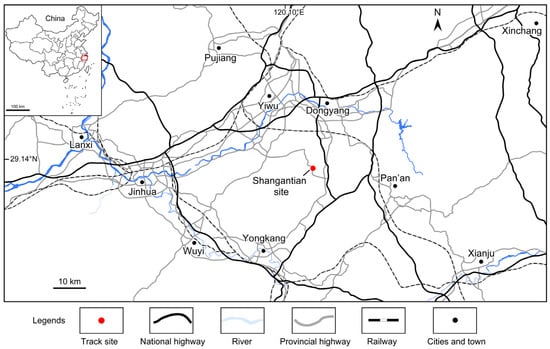
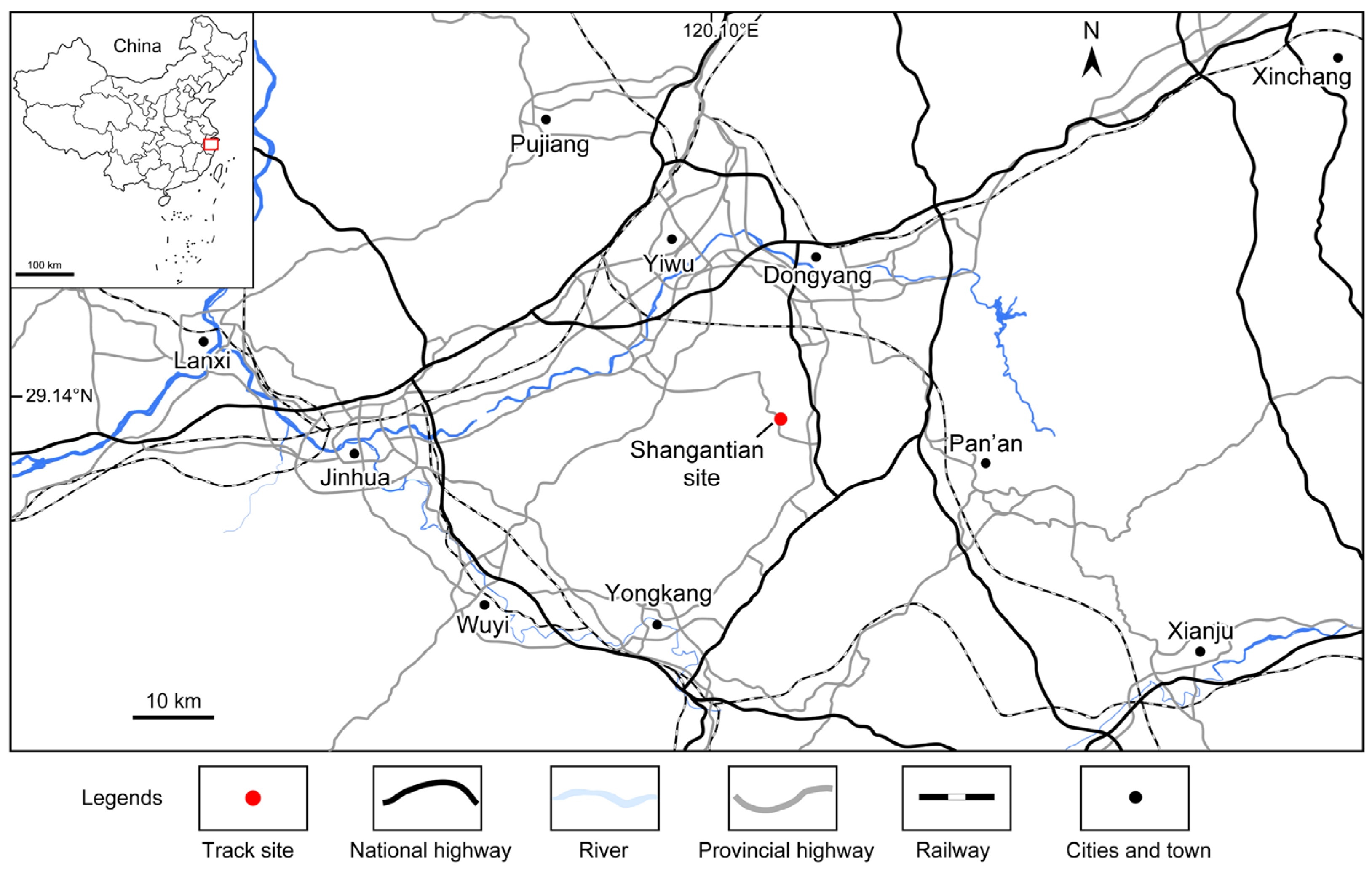
The outcrop at the Shangantian tracksite is approximately 10 m high, and the footprint-bearing rocks consist of collapsed blocks (Figure 1). Situated near agricultural fields and residential areas, the outcrop is heavily weathered, being influenced by vegetation cover, insect activity, and rainfall. All footprints are preserved as natural casts.
Figure 1.
Geographic location map of the Shangantian tracksite.
Morphological descriptions and locomotion of the Shangantian dinosaur tracks were captured via digital 3D imagery. Morphometric and kinematic variables—including maximum length (ML), maximum width (MW), divarication angle (II–IV), pace length (PL), stride length (SL), pace angulation (PA), and track rotation (R)—were quantified following the standard methodologies of Leonardi [10], Lockley and Hunt [11], and Lallensack et al. [12]. Furthermore, the mesaxony of tridactyl tracks was calculated according to Lockley [13] to evaluate the anterior protrusion of the central digit (III) relative to the medial (II) and lateral (IV) digits. Theropod tracks are classified into size categories following the criteria of Marty et al. [14,15].
For small theropods with a track length of less than 25 cm, hip height was calculated as approximately 4.5 times the track length according to Thulborn [16]. Locomotor modes were categorized as either walking or running based on the relative stride length metric of Alexander [17], using a threshold value of 2.0 for differentiation. Although absolute speeds were derived, these values are presented as tentative approximations due to inherent taphonomic and biological uncertainties discussed by Prescott et al. [18]. The terminology employed in this study aligns with Lallensack et al. [19].
To generate photogrammetrically derived models, individual footprints were documented from multiple angles using the Xiaomi 15 (Xiaomi Communications Co., Ltd., Beijing, China) equipped with a 50 MP Leica-engineered triple-camera system and a 23 mm equivalent main lens. The two theropod tracks were reconstructed from 79 photographs. Photogrammetric processing was performed by importing the imagery into Agisoft Metashape Professional (v.1.6.3). The resulting 3D virtual models were subsequently imported into MeshLab (v2020.06), where they were reoriented to the center of the Cartesian coordinate system. Finally, surface topographies were visualized using specialized filters in ParaView (v5.9.0) and CloudCompare (v2.10.2), following established protocols [19,20].
3. Geological Setting
According to the 1:50,000-scale regional geological map of the Nanma Town Quadrangle (H-51-97-C) published by the Regional Geological Survey Team of Zhejiang Province in 1995, the tracksite is stratigraphically located within the Guantou Formation. The Guantou Formation is widely distributed in the Yongkang, Nanma, and Shenze basins, with an exposure area of 196.4 km2. It is in conformable contact with the overlying Chaochuan Formation and in unconformable or fault contact with the underlying Gaowu, Xishantou, and Jiuliping formations.
The Guantou Formation in the Nanma Basin exhibits minor lithofacies variations and a simple lithological assemblage. The First Member of the Guantou Formation predominantly represents alluvial fans and shore–shallow lacustrine facies, whereas the Second Member consists of shallow lacustrine deposits. According to the Xilu geological section in Nanxi Township, Dongyang City, the First Member of the Guantou Formation is 64.0 m thick and can be further subdivided into upper and lower parts. The upper part, 21.1 m thick, consists of light grayish-purple rhyolitic breccia-bearing vitric welded tuff. The breccia clasts are composed of tuff and siltstone, exhibiting angular to sub-angular shapes with clast diameters ranging from 2 to 5 mm. The lower part, 42.9 m thick, comprises a suite of shore–shallow lacustrine deposits; its base is marked by a grayish-purple basal conglomerate and purplish-red pebbly siltstone, while the middle-to-upper portions consist of purplish-red thick-bedded calcareous siltstone displaying ripple cross-lamination. The First Member of the Guantou Formation unconformably overlies the Second Member of the underlying Xishantou Formation. The footprint-bearing rock slabs originated from the lower interval of the First Member of the Guantou Formation, and the lithology is characterized as siltstone.
The Guantou Formation is assigned to the Lower Cretaceous. It yields a diverse non-marine biota (the Yongkang Biota) comprising conchostracans, ostracods, bivalves, gastropods, fishes, and plants, and its volcanic interbeds have yielded isotopic ages of 113–103 Ma [21]. Zircon U–Pb SHRIMP dating of the volcanic interbeds further constrains the fossil-bearing horizons to the Aptian [22]. The footprint-bearing interval of the First Member is therefore assigned an Early Cretaceous (Aptian–Albian) age.
The First Member records the early infilling of a continental lake basin, with alluvial fan deposits passing into shore–shallow lacustrine facies, punctuated by explosive volcanism (the welded tuff of the upper part), and followed by lake expansion recorded in the shallow lacustrine Second Member. The purplish-red, ripple-cross-laminated calcareous siltstones indicate a low-energy, oxidizing lake margin under a warm, seasonally dry subtropical climate—consistent with the calcisols documented from the Guantou Formation elsewhere in Zhejiang [23] and with recurrent wildfires recorded by fossil charcoal at Xinchang [22]. In this setting, soft, water-saturated lakeshore substrates provided ideal conditions for the registration and preservation of tetrapod tracks.
4. Tridactyl Tracks
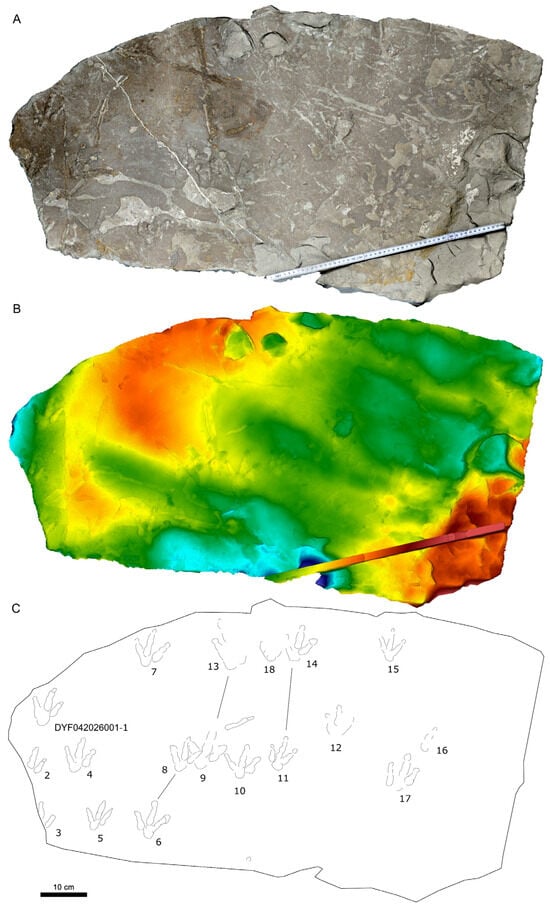
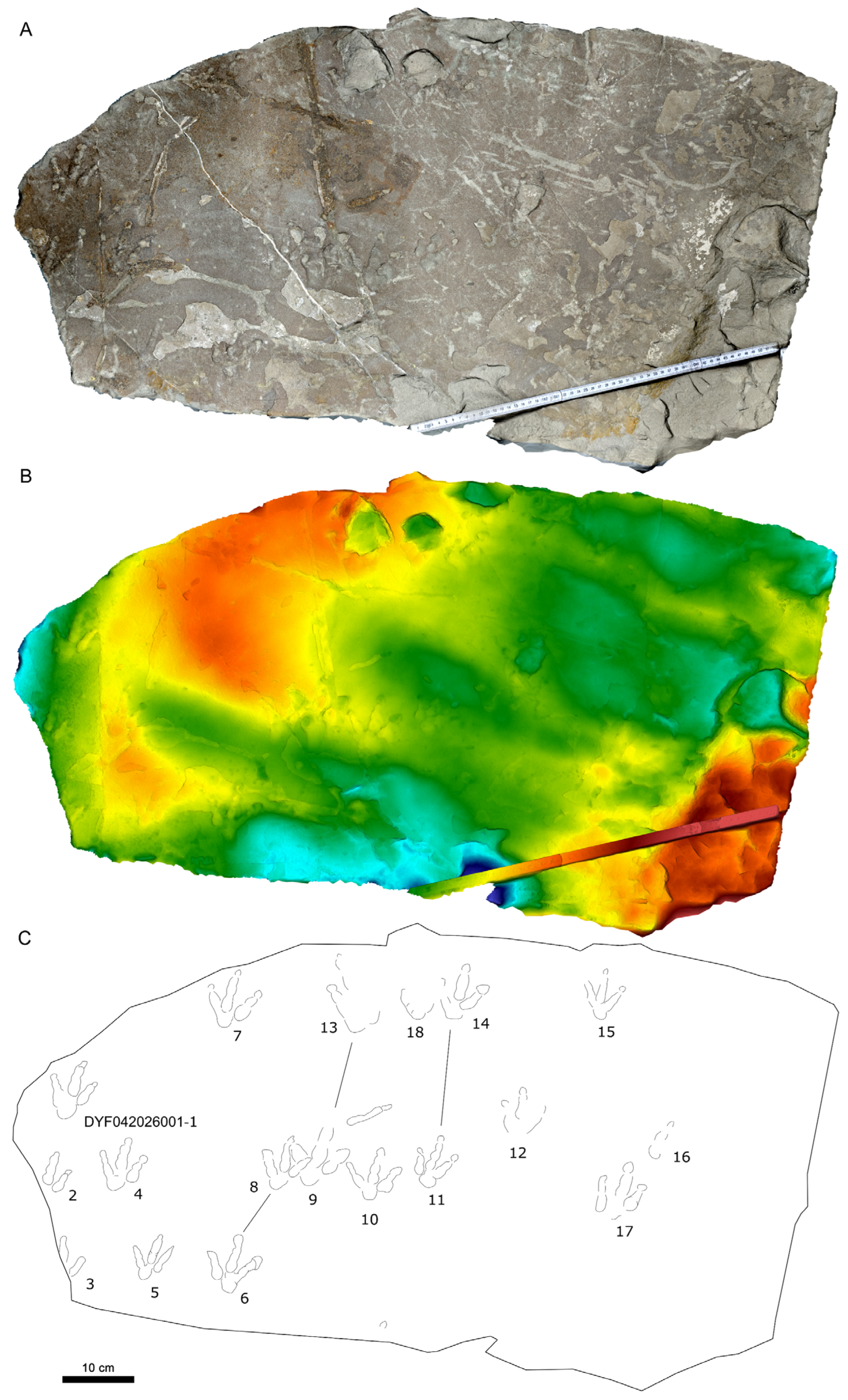
At least 18 natural theropod track molds are preserved on a single slab and are designated DYF042026001-T1–T18 (Figure 2). Except for several incomplete tracks represented by only one or two digit impressions, the tracks are tridactyl. With the exception of DYF042026001-T13, the measurable tridactyl tracks are generally consistent in morphology and fall within the minute size class. They range from 6.8 to 8.8 cm in length and have length/width ratios of 1.0–1.5 and divarication angles of 52–78° between digits II and IV. Anterior projection of digit III is weak, as indicated by mesaxony values of 0.30–0.50. Six tridactyl tracks form three pairs, with each pair defining a single pace, whereas the remaining tracks are isolated. No digit I impression is preserved.
Figure 2.
Color orthographic images (A), rainbow elevation images (B), and interpretive outline drawing (C) of tracks DYF042026001-T1–T18 from the Shangantian tracksite, Zhejiang Province, China.
According to the morphological preservation scale proposed by Marchetti et al. [24], DYF042026001-T1, T4, T5, T6, T8, T10, T11, T14, and T15 have morphological preservation grades (MP) of 2.0 and are relatively well preserved. Their digit impressions and metatarsophalangeal areas are nearly complete, although some claw marks and digital pad impressions are absent. The track margins are generally distinct, and only DYF042026001-T8 and T9 show slight overlap. DYF042026001-T7, T9, and T17 have MP grades of 1.5 and are suboptimally preserved. Their digit impressions and metatarsophalangeal areas remain relatively complete and recognizable, but sharply defined claw marks and some digital pad impressions are absent, and the track margins are comparatively indistinct. DYF042026001-T2, T3, T12, T13, T16, and T18 have MP grades of 1.0 and are poorly preserved. Although their digit impressions and metatarsophalangeal areas remain recognizable, they are incomplete, and most claw marks and digital pad impressions are absent. Some of these tracks are deformed, and most have indistinct margins.
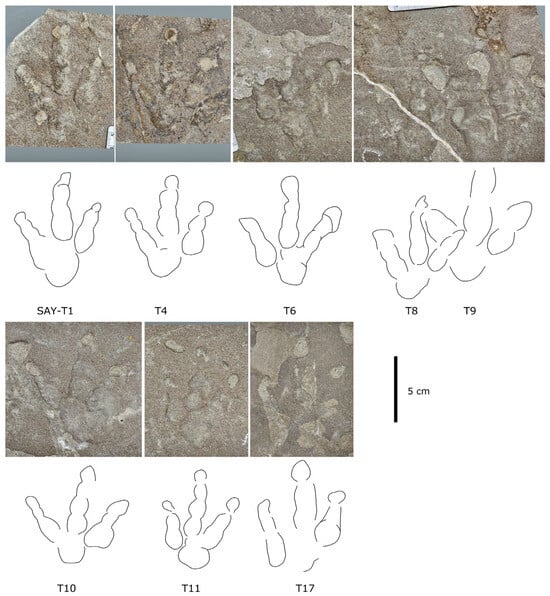
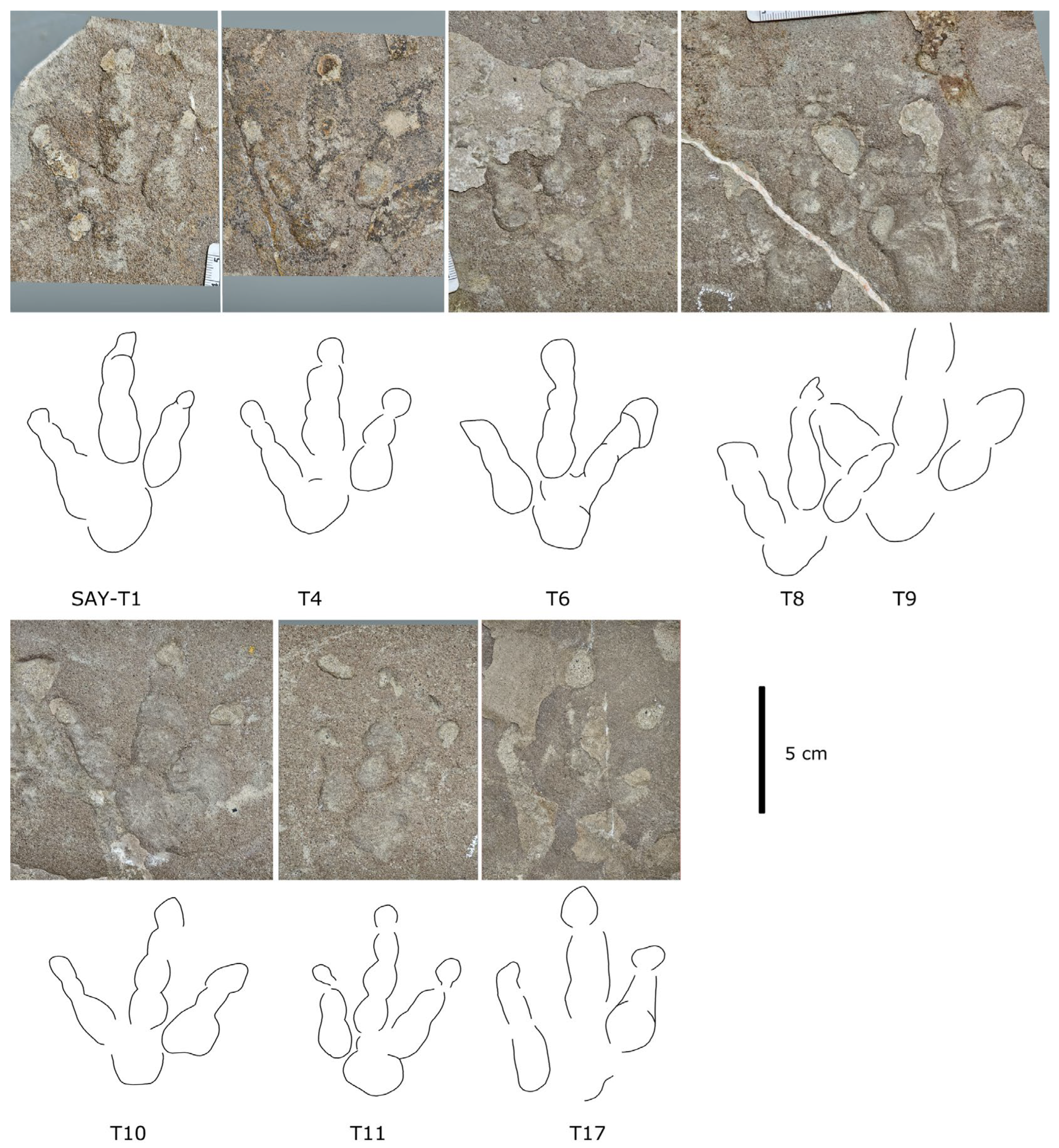
DYF042026001-T4 is the best-preserved track in the assemblage (Figure 3). It has a length/width ratio of 1.2 and a divarication angle of 60° between digits II and IV, with the angle between digits II and III being slightly smaller than that between digits III and IV. Its mesaxony value is approximately 0.41, indicating weak anterior projection of digit III (Table 1). The metatarsophalangeal area is dominated by a large pad impression associated with digit IV. This pad impression lies along the long axis of digit III and is separated from the proximal digital pads of digits II and III by distinct gaps. This impression is larger than any of the individual digital pad impressions. Digit III is directed anteriorly and is the longest, whereas digit II is shorter than digit IV. Digit II preserves two digital pad impressions, while digits III and IV each preserve three. However, the boundary between pads 2 and 3 of digit IV is indistinct. All three digit impressions terminate in blunt, subcircular claw marks, of which the digit II claw mark forms the deepest part of the track. Similar deep, rounded claw marks are also present in other relatively well-preserved tridactyl tracks, including DYF042026001-T1, T10, and T11. These claw marks may not directly reflect the claw anatomy of the trackmaker. In relatively soft sediment, the claw tips may initially have penetrated the substrate; as the foot sank further, continued penetration may have brought the thicker, subcircular proximal portions of the claws into contact with the sediment [25]. Sediment collapse and backfilling during foot withdrawal may have further obscured details of the claw tips. Consequently, such rounded claw marks commonly form the deepest areas within tracks [26]. These blunt, rounded claw marks are therefore more likely extramorphological features produced by the combined effects of substrate properties and foot–sediment interaction.
Figure 3.
Detailed photographs and interpretive outline drawings of tridactyl tracks from the Shangantian tracksite, Zhejiang Province, China.
Table 1.
Measurements (in cm and degrees) of element comparison of tridactyl tracks from the Shangantian tracksite, Zhejiang Province, China.
DYF042026001-T10 is the only complete tridactyl track that is wider than long; it also has a markedly greater total divarication angle than the other tracks. This difference may have resulted from substrate properties or uncertainty in delineating the track margins. DYF042026001-T2 preserves only two nearly parallel digit impressions, identified as digits II and III, both of which have relatively distinct margins. Digit III preserves three well-defined, rounded digital pad impressions and terminates in a blunt claw mark. Digit II preserves two rounded digital pad impressions, and its claw mark curves slightly away from digit III.
5. Discussion
5.1. Ichnotaxonomic Comparisons and Assignment
The principal theropod ichnogenera from East Asia characterized by a wide divarication angle and a well-developed proximal or metatarsophalangeal area include Asianopodus and Jialingpus [27,28,29]. The theropod tracks described herein exhibit a broadly similar combination of features and therefore show some overall morphological similarity to both ichnogenera. The relatively complete and measurable tracks are approximately 6.8–8.8 cm long. They are distinctly smaller than reported Asianopodus tracks, which are generally 20–30 cm long [30], and are also smaller than most Jialingpus tracks, which are approximately 10–20 cm long. In terms of size, however, they are closer to reported Jialingpus tracks than to Asianopodus tracks [28,29].
Jialingpus was originally erected on the basis of well-preserved tracks from the Penglaizhen Formation of Sichuan Province. Because its digit I and metatarsophalangeal traces were considered similar to those of Anomoepus, the ichnogenus was initially assigned to Anomoepodidae [27,31,32]. Gierliński [33] subsequently regarded Jialingpus as a junior synonym of Grallator. Later studies, however, reaffirmed its validity as a distinct ichnogenus based on its well-defined digital pad impressions, occasional digit I traces, and prominent, enlarged metatarsophalangeal area [34,35]. Following a re-examination of the type material and comparisons with relevant specimens, Xing et al. [34] revised the diagnosis of Jialingpus to include a track length/width ratio of 1.1–1.9, a divarication angle of 44–70° between digits II and IV, a mesaxony value of 0.70–0.93, and an elongate, enlarged metatarsophalangeal area. However, due to morphological similarities, Jialingpus is also considered a grallatorid-like track [34].
With the exception of DYF042026001-T10, which is anomalously broad and exhibits a relatively large divarication angle, the length/width ratios and divarication angles between digits II and IV of the new tracks described herein largely overlap the known ranges of Jialingpus. Their principal difference lies in their weaker mesaxony. The specimens have mesaxony values of 0.30–0.50, with a mean of 0.39, indicating a less pronounced anterior projection of digit III and a broader overall outline of the digital region than in typical Jialingpus. Nevertheless, weak mesaxony also occurs among specimens previously referred to Jialingpus. The lower limit of mesaxony values for specimens from Wuerho, Xinjiang, can reach 0.47 [36]. Despite the relatively weak anterior projection of digit III, both specimens possess an enlarged metatarsophalangeal area aligned with the long axis of digit III and were therefore considered morphologically closer to Jialingpus than to Grallator [34]. The mesaxony value of specimen DYF042026001-T4 is 0.41, slightly lower than those of B1 and C14; nevertheless, all three specimens exhibit a weakly projecting digit III and an enlarged metatarsophalangeal impression in the central part of the track. These shared features indicate that the new tracks described herein show morphological affinities with Jialingpus. Differences in mesaxony alone should therefore not be considered sufficient to rule out an affinity with Jialingpus.
In comparison, the mean mesaxony values of Jialingpus yuechiensis from the Penglaizhen Formation of Sichuan, Jialingpus isp. from the Tugulu Group of Xinjiang, the Luohe Formation of Shaanxi, and the specimens from Zhejiang described herein are 0.78 (range 0.70–0.93), 0.62 (range 0.47–0.80), 0.61 (range 0.54–0.68), and 0.39 (range 0.30–0.50), respectively, showing a progressive decrease arranged in approximate stratigraphic order from the Jurassic–Cretaceous boundary [37], through the Early Cretaceous (Berriasian–Albian in the Tugulu Group; Barremian based on biostratigraphic and regional correlation in the Luohe Fm.), to the late Early Cretaceous, which appears to exhibit a trend of increasing divarication angles. However, given the limited sample size, uncertainties in stratigraphic correlation, and differences in preservation and measurement methods among the materials, this phenomenon, while not to be ruled out, should be treated with caution until supported by further data.
Typical Jialingpus possesses an elongate and swollen metatarsophalangeal area positioned behind digit III and approximately aligned with its long axis. This area comprises a large metatarsophalangeal pad of digit IV and a smaller medial metatarsophalangeal pad positioned behind digit II and probably attributable to digit II. The entire metatarsophalangeal area is larger than any individual digital pad impression within the track [27,34]. DYF042026001-T4 likewise preserves a large metatarsophalangeal pad impression of digit IV aligned with the long axis of digit III, and this impression is larger than any individual digital pad impression within the track. In its position, relative size, and general outline, this structure resembles the principal component of the metatarsophalangeal area of Jialingpus. However, none of the currently available specimens preserves a clearly defined metatarsophalangeal pad impression behind digit II. Similarly, Jialingpus from Wuerho, Xinjiang, also features an enlarged metatarsophalangeal area distributed along the long axis of digit III but lacks the small metatarsophalangeal pad posterior to digit II [36]. Xing et al. [34] suggested that the apparent absence of this pad might be preservational, reflecting substrate conditions or insufficient track depth. The Huangyangquan specimen MGCM.H7 from Xinjiang is 14.9 cm long and has a divarication angle of 44° between digits II and IV. It preserves a composite metatarsophalangeal area comprising the metatarsophalangeal pads of digits IV and II, although the latter is indistinct, possibly reflecting substrate consistency or shallow foot penetration [34,36]. The large metatarsophalangeal pad impression of digit IV in the DYF042026001 tracks may therefore represent an incomplete or simplified expression of the Jialingpus-like metatarsophalangeal area.
In summary, the DYF042026001 tracks described herein are more similar to Jialingpus in overall size, length/width ratios, relatively wide divarication angles between digits II and IV, and the position, relative size, and elongate outline of the large metatarsophalangeal pad of digit IV. Although their weaker mesaxony and incompletely preserved metatarsophalangeal area differ from those of typical Jurassic Jialingpus, they resemble Cretaceous material. Therefore, we tentatively refer the new track specimens to Jialingpus isp.
5.2. Trackmaker Identity and Locomotion
The site preserves three single-step trackways, each represented by a pair of successive tracks. Because only one pace was preserved in each trackway, stride length (SL) was estimated as twice the measured pace length (PL). The track lengths are less than 0.25 m; hip height (h) was estimated as approximately 4.5 times track length [16]. Stride length (SL) was divided by hip height to calculate relative stride length (SL/h), with values below 2.0 indicating a walking gait [17]. The DYF042026001-T6–T8 step has an SL/h of 0.9 and an estimated speed of 0.4 m/s (1.3 km/h). The DYF042026001-T9–T13 step has an SL/h of 1.0 and an estimated speed of 0.5 m/s (1.8 km/h). The DYF042026001-T11–T14 step has an SL/h of 1.4 and an estimated speed of 0.8 m/s (2.9 km/h). Thus, all three steps represent walking gaits.
With footprint lengths of 6.8–8.8 cm, the trackmakers were small-bodied theropods with estimated hip heights of approximately 0.3–0.4 m, indicating a body size comparable to that of small-bodied theropods such as compsognathids. Small theropods of this body size are abundantly represented in the Early Cretaceous body-fossil record of eastern Asia, yet their footprint record remains disproportionately sparse, probably owing to the poor registration and preservation potential of lightweight trackmakers. All three estimated speeds (0.4–0.8 m/s) are consistent with slow, unhurried walking. The Shangantian material therefore provides rare direct evidence of the activity of small theropods along an Early Cretaceous lakeshore in southeastern China.
5.3. Significance of the Shangantian Ichnoassemblage
In a broader East Asian context, Jialingpus-like tracks constitute one of the most distinctive components of the region’s Jurassic–Cretaceous theropod ichnofaunas. Confirmed occurrences span the Upper Jurassic Penglaizhen Formation of the Sichuan Basin [24,27], the Lower Cretaceous Tugulu Group of the Junggar Basin in Xinjiang [33], the Luohe Formation of Shaanxi [32], and the Upper Cretaceous Jinhua Formation of Zhejiang [5,6]—a distribution extending over more than 3000 km from northwestern to southeastern China, with a temporal range from the Late Jurassic to the Late Cretaceous. The Shangantian assemblage is the first to bridge the Early Cretaceous interval in coastal southeastern China, demonstrating that grallatorid small theropod trackmakers persisted across the Jurassic–Cretaceous transition and occupied continental environments ranging from the inland basins of northwestern China to the volcanic-influenced lake basins of the southeastern coast.
The preservation of the Shangantian tracks is consistent with the shore–shallow lacustrine setting reconstructed for the lower interval of the First Member of the Guantou Formation: soft, water-saturated silty substrates along the lake margin, periodically exposed and subsequently buried by fine-grained sediment, provided conditions favorable for the registration and preservation of even small, lightweight trackmakers. The three single-step trackways, all recording slow walking, suggest that small theropods traversed the lake margin individually; probably no grouping is discernible among them.
From the perspective of the provincial track record, the Shangantian discovery carries significant stratigraphic and biogeographic implications. Xing et al. [5] reviewed the tetrapod footprint record of Zhejiang Province and showed that most documented tracksites are concentrated in the Upper Cretaceous (e.g., the Fengchekou and Guanyintang sites in the Jinhua Formation), whereas Lower Cretaceous footprint occurrences remain extremely sparse. Prior to this study, the only reported Lower Cretaceous tracks in the province were the sauropod tracks (Brontopodus) from the Xiaqiao site in the Shouchang Formation (or Chawan–Jiuliping Formations, Aptian) of Lishui City [5,38], and no dinosaur footprints had ever been reported from the Guantou Formation. The Shangantian site thus represents the first theropod tracksite from the Lower Cretaceous Guantou Formation in Zhejiang, filling a notable lithostratigraphic gap. It also extends the known distribution of Jialingpus-like small theropod tracks in the province downward from the previously reported Upper Cretaceous Fengchekou assemblage [5,6] into the Lower Cretaceous, suggesting a longer history of grallatorid trackmaker activity in eastern China than previously recognized.
Collectively, the Shangantian material and other Zhejiang tracksites outline an emerging evolutionary trajectory of Cretaceous dinosaur ichnofaunas in the province: the Lower Cretaceous assemblages are dominated by small theropods (Jialingpus) and sauropods (Brontopodus), whereas the Upper Cretaceous Jinhua Formation yields a more diverse association comprising theropod, ornithopod, ankylosaurian, sauropod, pterosaur, and avian tracks [5]. Morphologically, the weak mesaxony and relatively wide divarication of the Shangantian Jialingpus isp. more closely resemble the Early Cretaceous materials from the Luohe Formation (Shaanxi) and the Tugulu Group (Xinjiang) than the Late Jurassic type material from the Penglaizhen Formation (Sichuan), providing new evidence for the morphological evolution of Jialingpus-like trackmakers across the Jurassic–Cretaceous boundary and reinforcing the hypothesis of broad biogeographic connections among Early Cretaceous dinosaur faunas across eastern and northwestern China.
More practically, this first discovery of dinosaur tracks in the Guantou Formation demonstrates that the widespread Lower Cretaceous red-bed successions of the Jinhua–Quzhou and adjacent basins, long regarded as poor in vertebrate fossils, are promising targets for future footprint exploration.
6. Conclusions
The Shangantian tracksite yields the first dinosaur footprints reported from the Lower Cretaceous Guantou Formation in Zhejiang Province. At least 18 natural molds of minute-sized tridactyl theropod tracks (6.8–8.8 cm in length) are tentatively assigned to Jialingpus isp. based on their wide divarication angles and the presence of a distinct, elongate metatarsophalangeal pad of digit IV aligned with the axis of digit III. Their weak mesaxony (0.30–0.50, mean 0.39) and the absence of a clearly defined metatarsophalangeal pad behind digit II are interpreted as morphometric and/or preservational variations consistent with Cretaceous Jialingpus material.
The discovery fills a lithostratigraphic gap in the provincial track record: prior to this study, Lower Cretaceous dinosaur footprints in Zhejiang were known only from the sauropod tracks of the Xiaqiao site (Lishui City). The new material extends the known distribution of Jialingpus-like small theropod tracks in the province downward from the Upper Cretaceous Jinhua Formation (Fengchekou site) into the Lower Cretaceous Guantou Formation, suggesting a longer and more continuous history of grallatorid trackmaker activity in eastern China.
A comparison of mesaxony values across well-documented Jialingpus assemblages reveals a tentative chronological pattern of decreasing mesaxony and increasing divarication from the Late Jurassic type material of Sichuan (mean 0.78) through the Early Cretaceous materials of Xinjiang (mean 0.62) and Shaanxi (mean 0.61) to the late Early Cretaceous material of Zhejiang (mean 0.39). While this pattern is intriguing, it remains provisional given limited sample sizes, uncertainties in stratigraphic correlation, and variable preservation. Further discoveries of well-preserved, stratigraphically constrained Jialingpus trackways are required to test this hypothesis.
Author Contributions
L.X.: investigation, writing—original draft, funding acquisition, writing—review & editing, conceptualization, resources. Z.C.: investigation, data curation, writing—original draft. Z.S.: investigation, data curation, writing—original draft. J.L.: investigation, data curation, writing—original draft. Q.Q.: data curation, writing—original draft. All authors have read and agreed to the published version of the manuscript.
Funding
This research was funded by the National Natural Science Foundation of China (No. 42488201), the “Deep-time Digital Earth” Science and Technology Leading Talents Team Funds for the Central Universities for the Frontiers Science Center for Deep-time Digital Earth, China University of Geosciences (Beijing; grant 2652023001), the 111 project (B20011), and the Fundamental Research Funds for Central Universities (265QZ201903).
Data Availability Statement
The data presented in this study are available in the article.
Acknowledgments
We thank Lin Liu and Xinnan Yang from China University of Geosciences (Beijing) for their assistance with figure preparation and data measurement.
Conflicts of Interest
The authors declare no conflicts of interest. The funders had no role in the design of the study; in the collection, analyses, or interpretation of data; in the writing of the manuscript; or in the decision to publish the results.
References
- Zhou, J.; Jin, C.; Suo, Y.; Li, S.; Zhang, L.; Liu, Y.; Wang, G.; Wang, P.; Dai, L.; Santosh, M. The Yanshanian (Mesozoic) metallogenesis in China linked to crust-mantle interaction in the western Pacific margin: An overview from the Zhejiang Province. Gondwana Res. 2022, 102, 95–132. [Google Scholar] [CrossRef] [Scilit]
- Li, J.; Dong, S.; Cawood, P.A.; Thybo, H.; Clift, P.D.; Johnston, S.T.; Zhao, G.; Zhang, Y. Cretaceous long-distance lithospheric extension and surface response in South China. Earth-Sci. Rev. 2023, 243, 104496. [Google Scholar] [CrossRef] [Scilit]
- Li, J.; Ma, Z.; Zhang, Y.; Dong, S.; Li, Y.; Lu, M.; Tan, J. Tectonic evolution of Cretaceous extensional basins in Zhejiang Province, eastern South China: Structural and geochronological constraints. Int. Geol. Rev. 2014, 56, 1602–1629. [Google Scholar] [CrossRef] [Scilit]
- Song, H.Y.; Huang, X.D.; Jia, J.S.; Ma, T.S. Sedimentary facies and environments of the Cretaceous Qujiang Group in the Jinhua-Quzhou Basin, Zhejiang. Sediment. Geol. Tethyan Geol. 2012, 32, 14–22. [Google Scholar]
- Xing, L.; Chou, C.; Lockley, M.G.; Romilio, A.; Klein, H.; Li, N.; Persons, W.S., IV. Lower Cretaceous sauropod trackways from Lishui City and an overview of dinosaur-dominated track assemblages from Zhejiang Province, China. J. Palaeogeogr. 2018, 7, 9. [Google Scholar] [CrossRef] [Scilit]
- Lü, J.; Chen, R.; Azuma, Y.; Zheng, W.; Tanaka, I.; Jin, X. New pterosaur tracks from the Early Late Cretaceous of Dongyang City, Zhejiang Province, China. Acta Geosci. Sin. 2010, 31, 46–48, (In Chinese with English Abstract). [Google Scholar]
- Azuma, Y.; Lü, J.; Jin, X.; Noda, Y.; Shibata, M.; Chen, R.; Zheng, W. A bird footprint assemblage of Early Late Cretaceous age, Dongyang City, Zhejiang Province, China. Cretac. Res. 2013, 40, 3–9. [Google Scholar] [CrossRef] [Scilit]
- Buckley, L.G.; McCrea, R.T.; Lockley, M.G. Analysing and resolving Cretaceous avian ichnotaxonomy using multivariate statistics: Approaches and results. In Dinosaur Tracks: The Next Steps; Falkingham, P.L., Marty, D., Richter, A., Eds.; Indiana University Press: Bloomington, IN, USA, 2016; pp. 258–308. [Google Scholar]
- Chen, R.; Lü, J.; Zhu, Y.; Azuma, Y.; Zheng, W.; Jin, X.; Noda, Y.; Shibata, M. Pterosaur tracks from the Early Late Cretaceous of Dongyang City, Zhejiang Province, China. Geol. Bull. China 2013, 32, 693–698. [Google Scholar]
- Leonardi, G. (Ed.) Glossary and Manual of Tetrapod Footprint Palaeoichnology; Departamento Nacional da Produção Mineral: Brasília, Brazil, 1987.
- Lockley, M.G.; Hunt, A.P. Dinosaur Tracks and Other Fossil Footprints of the Western United States; Columbia University Press: New York, NY, USA, 1995. [Google Scholar] [CrossRef] [Scilit]
- Lallensack, J.N.; Leonardi, G.; Falkingham, P.L. Glossary of fossil tetrapod tracks. Palaeontol. Electron. 2025, 28, a8. [Google Scholar] [CrossRef] [Scilit] [PubMed]
- Lockley, M.G. New perspectives on morphological variation in tridactyl footprints: Clues to widespread convergence in developmental dynamics. Geol. Q. 2009, 53, 415–432. [Google Scholar]
- Marty, D. Sedimentology, taphonomy, and ichnology of Late Jurassic dinosaur tracks from the Jura carbonate platform (Chevenez-Combe Ronde tracksite, NW Switzerland): Insights into the tidal-flat palaeoenvironment and dinosaur diversity, locomotion, and palaeoecology. GeoFocus 2008, 21, 1–278. [Google Scholar]
- Marty, D.; Belvedere, M.; Razzolini, N.L.; Lockley, M.G.; Paratte, G.; Cattin, M.; Lovis, C.; Meyer, C.A. The tracks of giant theropods (Jurabrontes curtedulensis ichnogen. & ichnosp. nov.) from the Late Jurassic of NW Switzerland: Palaeoecological and palaeogeographical implications. Hist. Biol. 2018, 30, 928–956. [Google Scholar] [CrossRef] [Scilit]
- Thulborn, R.A. Dinosaur Tracks; Chapman & Hall: London, UK, 1990. [Google Scholar]
- Alexander, R.M. Estimates of speeds of dinosaurs. Nature 1976, 261, 129–130. [Google Scholar] [CrossRef] [Scilit]
- Prescott, T.L.; Griffin, B.W.; Demuth, O.E.; Gatesy, S.M.; Lallensack, J.N.; Falkingham, P.L. Speed from fossil trackways: Calculations not validated by extant birds on compliant substrates. Biol. Lett. 2025, 21, 20250191. [Google Scholar] [CrossRef] [Scilit] [PubMed]
- Lallensack, J.N.; Buchwitz, M.; Romilio, A. Photogrammetry in ichnology: 3D model generation, visualisation, and data extraction. EarthArXiv 2020. [Google Scholar] [CrossRef] [Scilit]
- Xing, L.; Lockley, M.G.; Jia, C.; Klein, H.; Niu, K.; Zhang, L.; Qi, L.; Chou, C.; Romilio, A.; Wang, D.; et al. Lower Cretaceous avian-dominated, theropod, thyreophoran, pterosaur and turtle track assemblages from the Tugulu Group, Xinjiang, China: Ichnotaxonomy and palaeoecology. PeerJ 2021, 9, e11476. [Google Scholar] [CrossRef] [Scilit] [PubMed]
- Luo, Y.D.; Yu, Y.W. Discussion on the age of the Yongkang Group and its regional stratigraphic correlation. Geol. China 2004, 31, 395–399, (In Chinese with English Abstract). [Google Scholar]
- Zhang, F.Q.; Chen, H.L.; Batt, G.E.; Li, Z.X.; Yang, S.F. Early Cretaceous Aptian charcoal from Xinchang Petrified Wood National Geopark of Zhejiang Province, eastern South China. Palaios 2014, 29, 325–337. [Google Scholar] [CrossRef] [Scilit]
- Li, X.H.; Chen, S.D.; Cao, K.; Chen, Y.H.; Xu, B.L.; Ji, Y.N. Paleosols of the Mid-Cretaceous: A report from Zhejiang and Fujian, SE China. Earth Sci. Front. 2009, 16, 63–70, (In Chinese with English Abstract). [Google Scholar] [CrossRef]
- Marchetti, L.; Belvedere, M.; Voigt, S.; Klein, H.; Castanera, D.; Díaz-Martínez, I.; Marty, D.; Xing, L.; Feola, S.; Melchor, R.N.; et al. Defining the morphological quality of fossil footprints: Problems and principles of preservation in tetrapod ichnology with examples from the Palaeozoic to the present. Earth-Sci. Rev. 2019, 193, 109–145. [Google Scholar] [CrossRef] [Scilit]
- Wilson, J.A.; Marsicano, C.A.; Smith, R.M.H. Dynamic locomotor capabilities revealed by early dinosaur trackmakers from southern Africa. PLoS ONE 2009, 4, e7331. [Google Scholar] [CrossRef] [Scilit] [PubMed]
- Xing, L.; Peng, G.; Ye, Y.; Lockley, M.G.; McCrea, R.T.; Currie, P.J.; Zhang, J.; Burns, M.E. Large theropod trackway from the Lower Jurassic Zhenzhuchong Formation of Weiyuan County, Sichuan Province, China: Review, new observations and special preservation. Palaeoworld 2014, 23, 285–293. [Google Scholar] [CrossRef] [Scilit]
- Zhen, S.N.; Li, J.J.; Zhen, B.M. Dinosaur footprints of Yuechi, Sichuan. Mem. Beijing Nat. Hist. Mus. 1983, 25, 1–19, (In Chinese with English Abstract). [Google Scholar]
- Matsukawa, M.; Shibata, K.; Kukihara, R.; Koarai, K.; Lockley, M.G. Review of Japanese dinosaur track localities: Implications for ichnotaxonomy, paleogeography and stratigraphic correlation. Ichnos 2005, 12, 201–222. [Google Scholar] [CrossRef] [Scilit]
- Xing, L.; Díaz-Martínez, I.; Lallensack, J.N.; Kim, K.S.; Buckley, L.G.; Romilio, A.; Piñuela, L.; Wang, D.; Chen, Q.; Yang, Q.; et al. Cretaceous vertebrate tracks. In Vertebrate Ichnology; Lucas, S.G., Hunt, A.P., Klein, H., Eds.; Elsevier: Amsterdam, The Netherlands, 2024; pp. 479–747. [Google Scholar] [CrossRef] [Scilit]
- Xing, L.; Niedźwiedzki, G.; Lockley, M.G.; Zhang, J.; Cai, X.; Persons, W.S., IV; Ye, Y. Asianopodus-type footprints from the Hekou Group of Honggu District, Lanzhou City, Gansu, China and the “heel” of large theropod tracks. Palaeoworld 2014, 23, 304–313. [Google Scholar] [CrossRef] [Scilit]
- Zhen, S.N.; Li, J.J.; Rao, C.G.; Mateer, N.J.; Lockley, M.G. A review of dinosaur footprints in China. In Dinosaur Tracks and Traces; Gillette, D.D., Lockley, M.G., Eds.; Cambridge University Press: Cambridge, UK, 1989; pp. 201–207. [Google Scholar]
- Yang, X.L.; Yang, D.H. The Dinosaur Footprints from the Mesozoic of Sichuan Basin; Sichuan Scientific and Technological Publishing House: Chengdu, China, 1987; p. 110. (In Chinese) [Google Scholar]
- Gierliński, G. Early Jurassic theropod tracks with the metatarsal impressions. Przegl. Geol. 1994, 42, 280–284. [Google Scholar]
- Xing, L.; Lockley, M.G.; Klein, H.; Gierliński, G.D.; Divay, J.D.; Hu, S.; Zhang, J.; Ye, Y.; He, Y. The non-avian theropod track Jialingpus from the Cretaceous of the Ordos Basin, China, with a revision of the type material: Implications for ichnotaxonomy and trackmaker morphology. Palaeoworld 2014, 23, 187–199. [Google Scholar] [CrossRef] [Scilit]
- Lockley, M.G.; Li, J.; Li, R.; Matsukawa, M.; Harris, J.D.; Xing, L. A review of the tetrapod track record in China, with special reference to type ichnospecies: Implications for ichnotaxonomy and paleobiology. Acta Geol. Sin. Engl. Ed. 2013, 87, 1–20. [Google Scholar] [CrossRef] [Scilit]
- Xing, L.; Harris, J.D.; Jia, C.; Luo, Z.; Wang, S.; An, J. Early Cretaceous bird-dominated and dinosaur footprint assemblages from the northwestern margin of the Junggar Basin, Xinjiang, China. Palaeoworld 2011, 20, 308–321. [Google Scholar] [CrossRef] [Scilit]
- Huang, D. Jurassic integrative stratigraphy and timescale of China. Sci. China Earth Sci. 2019, 62, 223–255. [Google Scholar] [CrossRef] [Scilit]
- Matsukawa, M.; Hayashi, K.; Zhang, H.C.; Zhen, J.S.; Chen, P.J.; Lockley, M.G. Early Cretaceous sauropod tracks from Zhejiang Province, China. Bull. Tokyo Gakugei Univ. Div. Nat. Sci. 2009, 61, 89–96. [Google Scholar]

Disclaimer/Publisher’s Note: The statements, opinions and data contained in all publications are solely those of the individual author(s) and contributor(s) and not of MDPI and/or the editor(s). MDPI and/or the editor(s) disclaim responsibility for any injury to people or property resulting from any ideas, methods, instructions or products referred to in the content. |
© 2026 by the authors. Licensee MDPI, Basel, Switzerland. This article is an open access article distributed under the terms and conditions of the Creative Commons Attribution (CC BY) license.