


Abstract
To illustrate the importance and complexity of considering “task–technology fit”, as well as users’ roles and purposes, when studying AI adoption within any occupation, we present findings from a 2023-25 mixed-method study about professional musicians’ uses and perceptions of AI in music-making. The initial interviews conducted with a diverse group of 42 U.S. musicians suggested that individual levels of interest in and adoption of AI in their music-making depended on the specific task considered, whether the task was perceived as “core” versus “supportive” to one’s professional role, and the intention of using AI to “assist” versus “replace” one’s work. Responses to a subsequent 2025 survey, designed to further explore these insights, as well as to collect additional information about musicians’ AI adoption, confirmed the value of eliciting respondents’ interest, uses, and feelings about using AI for specific tasks rather than in general terms. Exploring the impact of the respondents’ professional roles and purpose proved to be more challenging. Nevertheless, role-based differences were documented, several statistically significant. The study has methodological implications for studies of AI adoptions across fields.
1. Introduction
Consistent with the recognition that “superintelligence is as much a societal challenge as a technological one” ([1], p. 1), we can expect that the extent to which any type of artificial intelligence (AI) will transform specific occupations will depend not only on technological advances but also on AI adoption patterns. This, in turn, calls for a better understanding of the factors that may impact AI adoption within specific occupations, and, indeed, there have been many recent studies addressing this need (e.g., [2,3,4,5,6,7,8,9,10,11,12]). Several of these studies across fields have employed the concept of perceived usefulness, derived from the Technology Adoption Model (TAM) [13]; however, participants are often asked about their perceived value of AI in general. A complementary theory developed to study the adoption of technological innovations, the “Task–Technology Fit” (TTF) theory [14,15], suggests, instead, that perception of usefulness is task-specific, as it will depend on the value an individual associates with how the technology in question may contribute to the performance of specific tasks—thus suggesting the value of employing more nuanced research designs to explore potentially different perceptions of usefulness across possible tasks that may be affected by AI. Previous studies across fields have also suggested that perceptions are influenced by whether AI is used to “replace” versus “assist” human performance in specific tasks (e.g., [16,17,18,19,20,21,22,23]).
In this article, we argue that identifying and explaining an individual’s perceived usefulness of AI for their work is even more complex, as it will depend not only on the tasks considered but also on their professional roles, responsibilities and purpose for using AI in each specific task. To illustrate the value of exploring both task-specific and role-related factors in AI adoption studies, in this article we share and derive implications from the selected findings of a mixed-method study of professional musicians’ AI uses and perceptions, which our interdisciplinary team conducted as part of a “Future of Work at the Human-Technology Frontiers” interdisciplinary project funded by the U.S. National Science Foundation (NSF).
This study consisted of a first set of interviews with 42 U.S. professional musicians, followed by a survey distributed through several national U.S.-based music groups/societies and professional networks that yielded 226 responses. Our survey design, which was informed by preliminary findings from the interviews, differed from other recent surveys of musicians’ AI uses and perceptions (e.g., [24,25,26,27,28]) in that it purposefully targeted primarily professional musicians in the U.S. and included questions explicitly designed to ascertain musicians’ uses and perceptions about AI applications on tasks that could be considered “core” versus “supportive” by musicians playing different functions within music-making in order to address the following research questions:
How does (a) a musician’s role as a composer, arranger, performer and/or producer and (b) the nature of the specific tasks for which AI could be used impact the following:
- Their openness to using AI in music-making?
- Their current use of AI in music-making?
- Their feelings about using AI in music-making?
Addressing these questions involved some interesting methodological challenges that we believe are relevant to researchers in other fields interested in designing more nuanced studies of AI adoption among their target populations. Therefore, this article also aims to address the following more general methodological question:
How can researchers design AI adoption research studies that take into consideration differences due to (a) how AI may be used in specific tasks and (b) whether those tasks are perceived as “core” to one’s professional identity?
1.1. Conceptual Framework and Related Literature
1.1.1. Technology Adoption Model and Task–Technology Fit Theory
History has taught us that realizing the benefits of any new technology will depend heavily on the decisions individuals make about whether to use it. This consideration is what has motivated the many studies about technology adoption across fields, including the one reported in this article.
Among the many theories and frameworks that have been proposed to study specific technology adoptions (including AI), the Technology Adoption Model (TAM) [13] has been the most widely used so far. At the core of TAM is the assumption that individuals’ willingness to adopt a new technology will depend mainly on their perceived ease of use and perceived usefulness. Several recent AI adoption studies have used TAM, especially in relation to ChatGPT and generative AI. For example, Lai and colleagues [2] used a TAM-based framework to examine undergraduate students’ acceptance of ChatGPT for active learning, while Liu and Ma [3] used TAM to study English-language learners’ perceived ease of use, perceived usefulness, attitude, behavioral intention, and actual use of ChatGPT for informal digital English learning. Zhou and colleagues [4] used a TAM-based model to examine Chinese music enthusiasts’ behavioral intention to use generative AI for music composition, focusing on perceived usefulness, perceived ease of use, perceived AI risk, perceived trust, content quality, social influence, and perceived enjoyment.
While building on TAM, the Task–Technology Fit (TTF) theory [14,15] extends it by considering that, in most cases, users will evaluate a new technology’s perceived usefulness not in general terms but rather with respect to specific tasks it can help them perform. For example, the same musician may strongly object to employing AI to generate an entire song while having no problem using AI-powered tools when recording. TTF has also been employed in several recent AI adoption studies, often in combination with TAM. For example, Al-Mamary and colleagues [5] used TTF to examine university students’ intentions to use ChatGPT, showing that task characteristics, technology characteristics, and individual characteristics shaped task–technology fit, which in turn influenced behavioral intention. Soodan and colleagues [6] used TTF to study academicians’ continued use of AI chatbots, while Wang and colleagues [7] connected TTF with perceived usefulness and responsible generative AI use among university students.
At the same time, as discussed in more detail below, TTF does not necessarily take into account that perceived value may also depend on how AI may be used in a specific task. Furthermore, individuals’ professional roles may also lead to differences in the use of the same AI tools for the same task and, therefore, the opportunities and risks (i.e., perceived usefulness) they think AI may offer for that task.
1.1.2. AI to Assist Versus Replace Humans
Since early on, the AI literature has made a major distinction between using AI as an “assistant” and using it as a “replacement” for human performance. As early as 2020, a seminal paper from MIT [16] urged readers to “move away from thinking of AI as a tool for replacing humans by automating tasks, to thinking of AI as a tool for augmenting humans by collaborating with them more effectively” [16] p. 21. Brynjolfsson [17] warned that AI designed mainly to imitate and replace human labor can lead to the “Turing Trap”, whereas augmentation can expand human capabilities. Jarrahi [18] conceptualized human–AI symbiosis as a division of strengths: AI contributes analytical and computational capacity, while humans retain contextual, intuitive, and holistic judgment. Similarly, Raisch and Krakowski [19] argued that automation and augmentation are not fully separable but interdependent ways of using AI in organizations.
Several empirical studies across fields support the importance of this distinction. For example, ChatGPT has been shown to improve speed and quality in professional writing tasks [20]; higher education student advisors were reported to welcome AI tools that could support routine aspects of their jobs such as scheduling or gathering information but not wanting to outsource their one-on-one conversations with students to a chatbot [21]; school leaders were found to have no qualms about using ChatGPT to write memos and prepare presentations but were hesitant to use AI to support their decision-making [22]; and Dell’Acqua and colleagues [23] reported that AI improved performance on tasks within its capability frontier but reduced performance on tasks beyond it.
At the same time, a consideration not yet addressed in the current literature is that individuals in the same occupation may perceive the same task as either “core” or “supportive” to their work, depending on their primary professional roles and responsibilities. Music-making provides a great context to study these differences, as musicians identifying as composers, arrangers, performers, or producers focus on different components of the music-making process. While it may be difficult to precisely define the core creative tasks that characterize each of these roles, given that these tasks are not rigid and often overlap based on an individual’s agency during the creative process, we will use the following definitions for each role informed by Auvinen’s work [29]:
- Composer/arranger: creates and organizes musical material, including lyrics, melody, harmony, rhythm, instrumentation, form, texture, voicing, and underlying musical concept;
- Performer: realizes and interprets musical material in sound and time through timing, phrasing, articulation, dynamics, feel, improvisation, and interaction;
- Producer: selects, directs, captures, constructs, and sonically shapes the recorded realization through performance direction, recording, sound selection, editing, processing, mixing, and other aesthetic or technical decisions.
Given these definitions, we can expect that musicians identifying with each of these roles will be likely to identify a different set of music-related tasks as “core” to their work. For example, producing a quality recording of a musical performance will be considered “core” by the music producer in charge of the recording, while the performers are likely to consider it a “supportive” task.
1.1.3. Contributions and Limitations of Current Surveys of Musicians
Since the development of generative AI (GenAI) tools for music, a few surveys of musicians’ uses and perceptions of AI have been conducted in the context of industry reports, including most notably Ditto Music’s 2023 survey of over 1200 independent musicians using their product [24], LANDR’s 2025 study of 1241 music-makers from their global community [25], and Sonarworks survey of 1194 music creators worldwide, conducted in November 2025 in partnership with Sound on Sound [26]. It is important to note that the population surveyed in these industry reports drew significantly from users of their products, of which professional musicians represent only a small portion. None of these reports constitute peer-reviewed research, nor do they articulate a conceptual framework informing their survey, although they include both general questions about the uses and perceptions of AI and more specific questions about the use of specific AI tools for music.
Findings from these surveys support the claim that perceived usefulness is task-specific. For example, LANDR reported that 87% of the respondents used AI somewhere in their music workflow but only 29% used song generators [25], and Sonarworks reported substantial differences in the use of AI audio restoration (58%) versus mixing assistants (38%) or mastering services (34%) among respondents who had used at least one category of AI tool [26]. Respondents in the Sonarworks survey also consistently described valuing AI for automating tedious tasks like vocal tuning, drum editing, and corrective equalization while reserving creative direction and aesthetic judgment for themselves [26].
Peer-reviewed research involving surveys to examine AI adoption in music has been more limited and focused primarily on China. In addition to the already-mentioned survey of 429 Chinese music enthusiasts by Zhou and colleagues [4], a survey of 345 Chinese music creators with experience using AI in music identified perceived innovativeness, performance expectancy, and effort expectancy as significant factors associated with intentions to use AI music technologies [27]. Another survey of 385 music professionals in China identified the perceived benefits of ChatGPT for music production such as increased accessibility and opportunities for new forms of creativity, alongside concerns about its use, including, most notably, risks of overreliance on AI, homogenization of music products, loss of human elements, and copyright/ethical issues [28].
Interestingly, though, none of these survey-based research studies, nor industry reports, have so far investigated how musicians who play different roles within the music-making process—most notably music composers, arrangers, performers, or producers—may perceive the potential usefulness of AI for specific aspects of their work. Our survey study was designed to shed light on this dimension, as well as focus on professional musicians rather than amateurs, given our interest in better understanding the factors influencing AI adoption within an occupation.
2. Methods
This study is derived from a larger mixed-method research project about U.S. musicians’ uses and perceptions about AI and their implications for the music field, which included an interview study followed by a nationally distributed survey, as described in detail in this section. The research team included researchers with experience in audio-music engineering, composition, music performance, music leadership, education research, and ethics.
2.1. Interview Study
To begin to develop insights and themes that would inform the design of the survey, in 2023 we first conducted semi-structured Zoom interviews with a varied set of professional musicians, starting with individuals we knew who had some engagement with music technology followed by snowball sampling, along with checking on information about suggested participants on their websites or social media whenever possible. The 42 musicians we interviewed engaged in over 20 music genres in total, played a variety of roles (composer, songwriter, performer, music educator, music technology developer, business owner, administrator, and content creator), varied in years of experience in the field (from less than 3 years to more than 30) and musical training (from self-taught to holders of doctoral degrees), and represented different genders (about ¾ males, ¼ females, and 1 non-binary).
Given that GenAI tools were just beginning to be introduced at the time of these interviews, the interview protocol purposefully included a set of 11 open-ended questions about their music-making practice and how they thought technology and automation more generally (rather than AI specifically) could support it, with the expectation that the interviewers would ask follow-up questions related to AI as appropriate. Interviewers were also given the liberty to deviate from the protocol whenever the subject volunteered interesting information relevant to our research questions.
Interview data were analyzed using a reflective thematic analysis approach [30,31], following the recommended stages of familiarization, coding, iterative theme generation and refinement, and reporting. The familiarization phase included, in addition to reading through all the interviews, an in-depth discussion of a set of 8 interviews by the entire research team to identify key topics of interest. After, interview data were parceled into “stanzas”, and then each stanza was coded by two team members using the previously identified key topics of interest as a priori codes. Different team members were then tasked to analyze all the stanzas under each specific code to begin to identify possible themes to be shared and discussed with the rest of the team. Most relevant to the focus of this article, a team member analyzed all the stanzas coded as related to “musicians’ AI uses” to generate a first set of themes accompanied by a rich set of related quotes; this document was shared and discussed with the entire team to benefit from team members’ complementary disciplinary backgrounds and expertise to evaluate and refine the proposed themes. Informed by this discussion, the same team member articulated the finalized set of themes, providing a detailed description along with a reduced set of the most illustrative quotes, which was once again discussed and finalized with the entire team.
2.2. Survey Study
2.2.1. Survey Design
The design of the musicians’ survey was informed by the conceptual framework articulated earlier together with the preliminary findings from the interview study.
Given our explicit goal of identifying task-specific perceptions of AI usefulness by musicians playing different roles within the music-making process, an important step in designing the survey was the identification of specific tasks within the composing/arranging, performance, and production stages of music-making that may be affected by AI uses, as well as AI tools that may be helping with some of those tasks. A member of our team with expertise in music technology used his knowledge of the field, as well as insights gained from the interviews, to identify the list of tasks, as shown in Table 1.
Table 1.
Key music-making tasks identified a priori.
For each of these tasks, we asked respondents, “What is your level of interest in technological tools that can assist you in [that task]”, using a 6-point Likert scale (1 = not at all interested; 2 = slightly interested; 3 = somewhat interested; 4 = moderately interested; 5 = very interested; and 6 = extremely interested). “N/A” was also provided as an option.
In addition, given the increasing number of specific AI tools for music-making and their evolving features, rather than mentioning specific commercial tools in our survey questions, the same team member identified the following categories of tools intended to perform specific functions within music-making, along with a few examples, as follows:
- Source separation (e.g., Moises, Fadr, and BandLab);
- Sample generation (e.g., Emergent Drums, and TextToSample);
- Music generation (e.g., Udio, Suno, MusicLM, and Riffusion);
- Effect plug-ins (e.g., iZotope, Dreamtonic Synthesizer, and BabyAudio);
- Instrument plug-ins (e.g., drums, bass, melody, and chord);
- Mastering (e.g., Logic Pro Mastering Assistant, Landr, Waves, and Masterchannel);
- Automatic music transcription (e.g., AnthemScore and Transcribe!).
For each of these categories, respondents were asked the following two questions:
- To what extent have you engaged with each of the following categories of music-related AI tools? (scale: 1 = not at all; 2 = in a very limited way; 3 = some/on occasion; 4 = regularly; and 5 = frequently);
- How would you rate your feelings towards current and/or potential uses of each of these music-related AI tools in your music-making? (scale: 1 = very negative; 2 = negative; 3 = slightly negative; 4 = slightly positive; 5 = positive; and 6 = very positive).
To allow for a comparison, we also included the following “general” questions: “Are you interested in learning to use AI tools? (YES/NO)”; “Have you actively experimented with AI for music-making? (YES/NO)”; and “How much of an opportunity do you think AI presents for your music-making? (1 = no opportunity; 2 = minimal opportunity; 3 = low opportunity; 4 = moderate opportunity; 5 = high opportunity; and 6 = very high opportunity)”.
Questions were also included in the survey to capture respondents’ backgrounds and occupations, including most notably the question, “What functions/roles do you engage in as part of your music creation?”. For this question, respondents were directed to select all that applied among the following categories: arranger/editor; composer/songwriter; educator; performer; producer; student; other (please explain).
The survey was pilot tested for content, clarity, and length and revised based on feedback from a group of 15 music educators and students attending courses at the Eastman Institute of Music Leadership, which represented diverse musical backgrounds and experiences. Given the exploratory nature of our study, we did not seek to validate our survey instrument.
2.2.2. Survey Administration
The survey was developed in Qualtrics and administered online beginning in February 2025 using an anonymous link that was distributed widely via listservs and/or paid marketing throughout a range of U.S.-based music groups/societies, including the Audio Engineering Society, Association for Technology in Music Instruction, College Music Society, Musical America and the Network of Music Career Development Officers, as well as the research team members’ social media and LinkedIn channels, and emails to individuals. As such, most respondents were likely from the U.S., although they should not be considered a nationally representative sample.
The survey was closed in early May 2025. In total, 226 musicians completed the survey and are included in the analysis. Responses to each question were not forced, so the number of responses varies, as indicated in the results reported below. The 226 respondents represented a very diverse sample of musicians with respect to career stage (16% students; 14.2% early career (1–10 years); 27.1% mid-career (11–30 years); 39.6% late career (30 years+ or retired); 3.1% other), music genre (representing over 30 genres), and sources of income (with 26% reporting 100% of their income being derived from music, 20% reporting less than 10% of their income derived from music, and the rest somewhat evenly distributed in between). Most important for the study reported in this article were participants’ responses regarding the roles they played in music creation, as reported in Table 2. (Several respondents also indicated playing the role of “educator”, “student”, or “other”; however, the analyses reported in this article focused only on roles played in music-making/music creation more specifically.)
Table 2.
Respondents’ role(s) in music creation.
2.2.3. Survey Data Analysis
For all the Likert-scale items highlighted in the Survey Design section, we first calculated and examined the descriptive statistics for the respondents overall, including frequency distributions, means, and standard deviations, using SPSS 30. For survey items that included a “Not Applicable” (N/A) response option, the means and standard deviations were calculated, excluding N/A responses. Inferential analyses of the differences in the responses by role included chi-square tests, Fisher’s exact tests, Mann–Whitney U tests, logistic regression, and ordinary least squares regression (OLS), as appropriate. For analyses involving binary outcomes, effect sizes were reported using Cramér’s V. For analyses based on ordinal attitude ratings, effect sizes were reported using the rank-biserial correlation (r). Statistically significant differences across the response distributions for items within each question were examined using the non-parametric, repeated measures Friedman test and pairwise comparisons with the Dunn–Bonferroni correction [32]. The Friedman test was based only on those who responded to all items within each question.
As most respondents identified playing more than one role in music creation (as documented in Table 2), the roles of composer, arranger, performer, and producer could not be analyzed as mutually exclusive categories. As a result, we had to analyze these roles as overlapping binary variables (i.e., all respondents that indicated they engaged in music composition [role = yes] vs. all respondents that indicated NOT engaging in music composition [role = no]).
Additional details regarding the specific analyses used for each research question are provided in Section 3 (Results).
3. Results
3.1. Key Insights and Questions Generated by the Interviews
Our interviews confirmed that the musicians could envision using AI quite differently in the composition/arrangement, performance, and production stages of the music-making process, as illustrated by the following quotes:
(Composition) [B]eing able to hear all of my changes in real time with a decently realistic sound … helps the composition process in so many ways.
(Performance) I wanna improvise. I wanna say, here’s the theme and I’m going for it. And there’s like, you know, I’m reacting to the audience. So I would love for the software to be able to react with me in some way.
(Production) Ozone is a mastering software … it can listen to the track and then automatically give suggestions and makes changes to the track … it saves me a bunch of time and work.
The list of tasks reported in Table 1 was informed primarily by the varied examples of the current and desired uses of AI suggested by the musicians we interviewed. That list enabled us to include items in the survey to explore musicians’ varying levels of interest in using technology (including AI) across these tasks.
Interview data also provided anecdotal evidence in support of the importance of distinguishing the uses of AI to “assist” versus “replace” humans in core musical tasks, also captured in the following quote:
I’m not interested in [a] computer writing a whole song, but I am really interested in … what could a composer do using AI as a tool to make the production faster or to come up with a whole bunch of new creative ideas or fill in a bunch of parts and stuff in ways they wouldn’t have thought of.
At the same time, some of the interviews raised questions about what a musician may consider “core” tasks they would not want to offload to AI (such as “writing a whole song” in the previous quote) and whether the same use of AI could be perceived differently by musicians playing different roles. For example, we questioned whether a performer would share the same enthusiasm about AI’s ability to perform a composition as expressed by a composer in the following quote:
You want a trumpet? You find one of the programs that has great trumpet sounds, grab it up, play the trumpet notes you want on the keyboard. There you go. You have a trumpet, you have a whole orchestra just like that. … You don’t have to have session musicians … you don’t have to hire anybody.
Some interviews also made us aware of the multiple roles that the same musician may play once a new technology (like AI) opens up the possibilities to execute tasks that previously were outsourced to others, as suggested by the following quote:
My songwriting background really started in a more acoustic world. I used to write songs just with piano accompaniment and then guitar accompaniment. But my tastes were always leaning toward a much more production heavy sound. So once I started learning how to use Logic Pro a lot of my writing and production began to happen at the same time. At first with the songs I was writing on, my main instruments being the groundwork for the music, I used different elements within Logic Pro to sort of build a track from scratch with some programs, drums, and simulators to run my guitar through. And then build off of that with more synthesizers and special effects. Now, as I’ve gotten more involved in production and engineering and mixing a lot of what I’m making, the full songs are created and end all in the DAW where I’ll be using my production tools to just experiment and create a track right off the bat. And now a lot of the guitar work and songwriting work that happens outside of the box is like supplemental and goes along with what I’m creating with the technology.
Situations like this one led us to decide to give survey respondents the opportunity to choose multiple options when asked about the roles played in the music-making process, although we were surprised by the high extent of role overlap their responses revealed.
3.2. Survey Findings
In this section, we report selected findings from our survey that shed light on musicians’ interest/openness to using specific AI tools and the feelings about those tools as complementary elements that can contribute to measuring the level of adoption of AI within this occupation.
3.2.1. Musicians’ Openness to Using AI in Music-Making
Musicians’ openness to using AI tools in music-making was explored through a series of questions, starting with the direct general question, “Are you interested in learning to use AI tools?”, to which 69% of the respondents said “yes”. To explore the potential differences due to their professional roles, we compared the responses to this question (N = 223) by composers vs. non-composers, arrangers vs. non-arrangers, performers vs. non-performers, and producers vs. non-producers, as reported in Table 3. Chi-square tests were used to assess the differences in interest in learning AI tools among groups. Because respondents could select multiple roles, logistic regression was also used to examine the relationship between each role and interest in learning AI tools while accounting for overlap among roles [33]. Composer, arranger, performer, and producer were entered simultaneously as binary predictors in the logistic regression model. No additional covariates were included. Model diagnostics indicated no substantial concerns regarding multicollinearity, influential observations, model convergence, or potential separation.
Table 3.
Differences in interest in learning AI tools across roles.
As shown in Table 3, differences in the responses to this general question by professional roles were generally modest and with no statistically significant difference, with one notable exception in the case of music producers, who reported higher interest in learning AI tools (75.0%) compared with musicians not engaging in music production (63.41%). While the chi-square test approached but did not reach conventional significance (p = 0.087), the multivariable logistic regression, which accounted for overlapping professional roles, indicated that producers were approximately twice as likely to express interest in learning AI tools than non-producers (OR = 2.07, 95% CI [1.06, 4.03], p = 0.033).
Musicians’ responses to “What is your level of interest in technological tools that can assist you in [a specific task]”, as reported in Table 4, Table 5 and Table 6, showed much more widespread reactions depending on the task being considered. It is worth noting that we chose to probe about openness to AI by asking about their interest in technological tools more generally (rather than AI specifically) to assist in specific tasks to avoid generating a lot of N/A responses from musicians who might have felt unfamiliar with AI tools for music-making. Responses to this broader question, however, are still informative about musicians’ willingness to consider AI as one of the possible technical solutions.
Table 4.
Levels of interest in using technology for “composing/songwriting/arranging” tasks.
Table 5.
Levels of interest in using technology for specific “performing” tasks.
Table 6.
Levels of interest in using technology for specific “recording/producing” tasks.
As shown by the overall descriptive results reported in Table 4, Table 5 and Table 6, the same task elicited a wide set of responses with respect to the six levels of interest musicians could choose from, thus revealing a greater variety of opinions than what may be captured by a yes/no question. In addition to these variations in the levels of interest within each task, we found several statistically significant differences in the distributions of interest responses across the tasks using the non-parametric repeated measures Friedman test described earlier. The results of the Friedman test are reported in the footer of each table. The Statistically Different column of each table indicates the results from the post hoc Dunn–Bonferroni pairwise comparisons, which show from which other tasks the given task differs at the p < 0.05 level. For example, within the “composing/songwriting/arranging” tasks (Table 4), respondents’ interest in task 7 (co-composing with AI) and task 8 (having AI compose an entirely new piece of music) was significantly different (lower) than for nearly all other tasks. For “performing” tasks (Table 5), respondents’ level of interest in using AI for task 1 (supporting improvisation) was significantly lower compared with all of the other tasks, with the exception of task 5 (performance preparations), for which there was no significant difference. Likewise, Table 6 shows a number of significant differences in respondents’ interest in using technology for tasks related to “recording/producing”, with task 3 (producing high-quality recordings with AI) and task 6 (automated mixing) garnering lower interest than nearly all other tasks. Most importantly, the results in Table 4, Table 5 and Table 6 demonstrate the need to consider task-specific uses of AI rather than AI use more generally as perceptions differ significantly depending on the task.
Some interviews made us question whether musicians might be less open to using AI for tasks perceived as “core” to their role. To explore this question, we looked at whether composers/arrangers reported lower interest in technology support in tasks within the composing/arranging domain, performers in tasks within the performing domain, and producers in tasks within the producing domain by computing composite mean interest scores (1–6 scale; excluding N/A) for each domain. Because these composite scores averaged responses across multiple six-point items and, therefore, had substantially more possible values than the individual ordinal items, they were treated as approximately continuous and analyzed using ordinary least squares regression models. The four professional-role indicators were entered simultaneously in each model to account for respondents’ overlapping roles, and no additional covariates were included. Model diagnostics indicated no substantial concerns regarding multicollinearity, homoscedasticity, or influential observations, although some departures from residual normality were observed in the performing and producing models. As a sensitivity analysis, the models were re-estimated using HC3 robust standard errors, with no change in the pattern of statistical significance. Table 7 reports the results of this analysis.
Table 7.
Musicians’ interest in technology for music-making tasks in domains they identified/did not identify with.
Table 7 shows that musicians who engaged in composing, arranging, and performing showed consistently lower interest in using technology in tasks related to their domain than musicians that did not identify with those roles. Producers, however, were the exception, as their interest in using technology in music production tasks was greater than non-producers—a finding we will discuss in detail in Section 4 (Discussion). These differences did not reach statistical significance in the multivariable regression models after accounting for the respondents’ overlapping professional roles.
3.2.2. Musicians’ Uses of AI in Music-Making
While in the previous section we reported on the survey questions that had been designed to elicit information about the musicians’ interest/openness to using AI in music-making, in this section we focus on questions about their actual use of AI.
Participants’ responses to the “general” question “Have you actively experimented with AI for music-making?” indicated that only about a quarter (27%) of all respondents had so far used AI in their music-making—less than half compared with those who had expressed an interest in learning to use AI tools. However, responses to the set of questions about “To what extent have you engaged with each of the following categories of music-related AI tools?” told a more nuanced story, as shown in Table 8.
Table 8.
Musicians’ uses of AI tools serving specific functions within their music-making process.
Table 8 reveals an interesting discrepancy among the responses to these questions about tool-specific AI use and those provided for the more general question “Have you actively experimented with AI for music-making?”, as close to 40% of the respondents indicated having engaged with three categories of AI tools (effect plug-ins, instrument plug-ins, and mastering), at least to some extent, in contrast to only 27% of the respondents reporting having experimented with AI in their music-making in the general question.
In addition, a Friedman test indicated a statistically significant difference in the response distributions across these categories of AI tools (ꭕ2(6, n = 221) = 127.75, p < 0.001) with the results from the pairwise Dunn–Bonferroni comparisons shown in the Significantly Different column in the table. Music generation tools, which have been the most controversial uses of AI and could be perceived as “substituting” rather than “assisting” humans in music creation, were among the least used together with sample-generation and automatic music-transcription tools. In contrast, respondents reported more frequent use of effect plug-ins and instrument plug-ins, as well as mastering tools, which can be interpreted as assisting rather than substituting the creative process in music.
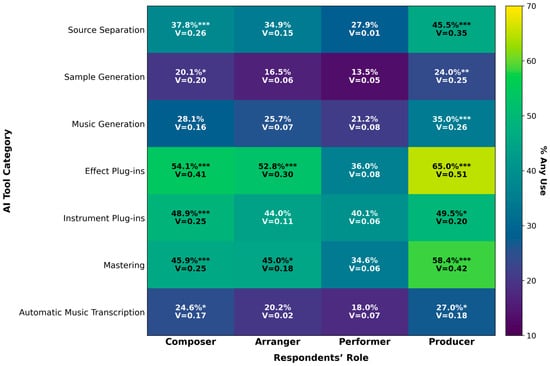
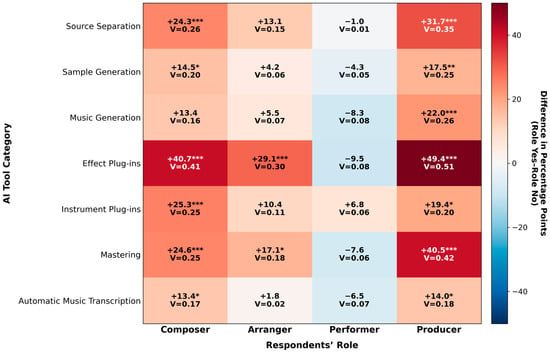
To explore whether and how the respondents’ roles as composers, arrangers, performers and/or producers might affect their current use of AI, the five response categories were collapsed into a binary measure because several of the higher-frequency use categories contained very small numbers of respondents for individual tools, producing sparse role-by-use contingency tables and unstable comparisons across the original five categories. The binary measure also provided a substantively interpretable distinction between whether respondents had engaged with a given AI tool at all and had not engaged with it, as follows: no use = “not at all”; any use = “in a very limited way”, “some/on occasion”, “regularly” or “frequently”. This dichotomization necessarily reduces information about frequency of use and was, therefore, used only for the role-based adoption comparisons. For each professional role (composer, arranger, performer, and producer), the respondents who selected that role were compared with those who did not with respect to “no use” vs. “any use”. The respondents who did not answer the professional role question were excluded from these comparisons. Then we used chi-square tests of independence (or Fisher’s exact tests when expected cell counts were small) to assess whether AI tool adoption differed among groups. To account for the 28 role-by-tool comparisons, p-values were adjusted using the Benjamini–Hochberg false discovery rate (FDR) procedure. Effect sizes were calculated using Cramér’s V, where values around 0.10 indicate a small association, 0.30 a moderate association, and 0.50 a large association. The heatmaps reported in Figure 1 and Figure 2 were then created to display the adoption rates, differences between role and non-role groups, effect sizes, and FDR-adjusted statistical significance.
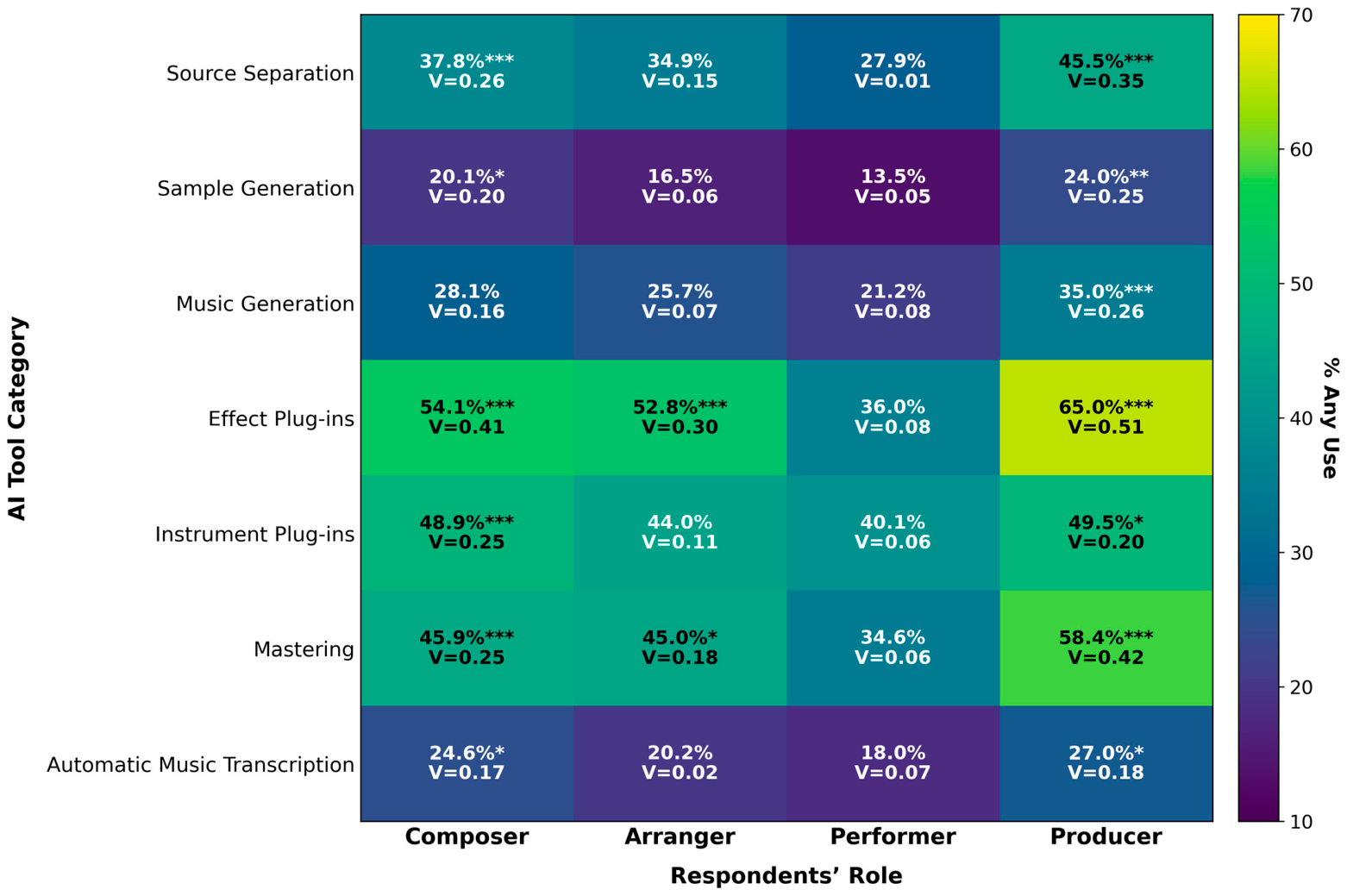
Figure 1.
Heatmap reporting the use of specific types of music-related AI tools by role. Note: Analytic Ns ranged from 222 to 224 across AI tool categories because of item-level missing responses. Respondents who did not answer the professional-role question were excluded from role comparisons. V = Cramér’s V. Asterisks indicate significance based on Benjamini–Hochberg false discovery rate (FDR)-adjusted p-values: * p < 0.05, ** p < 0.01, and *** p < 0.001.
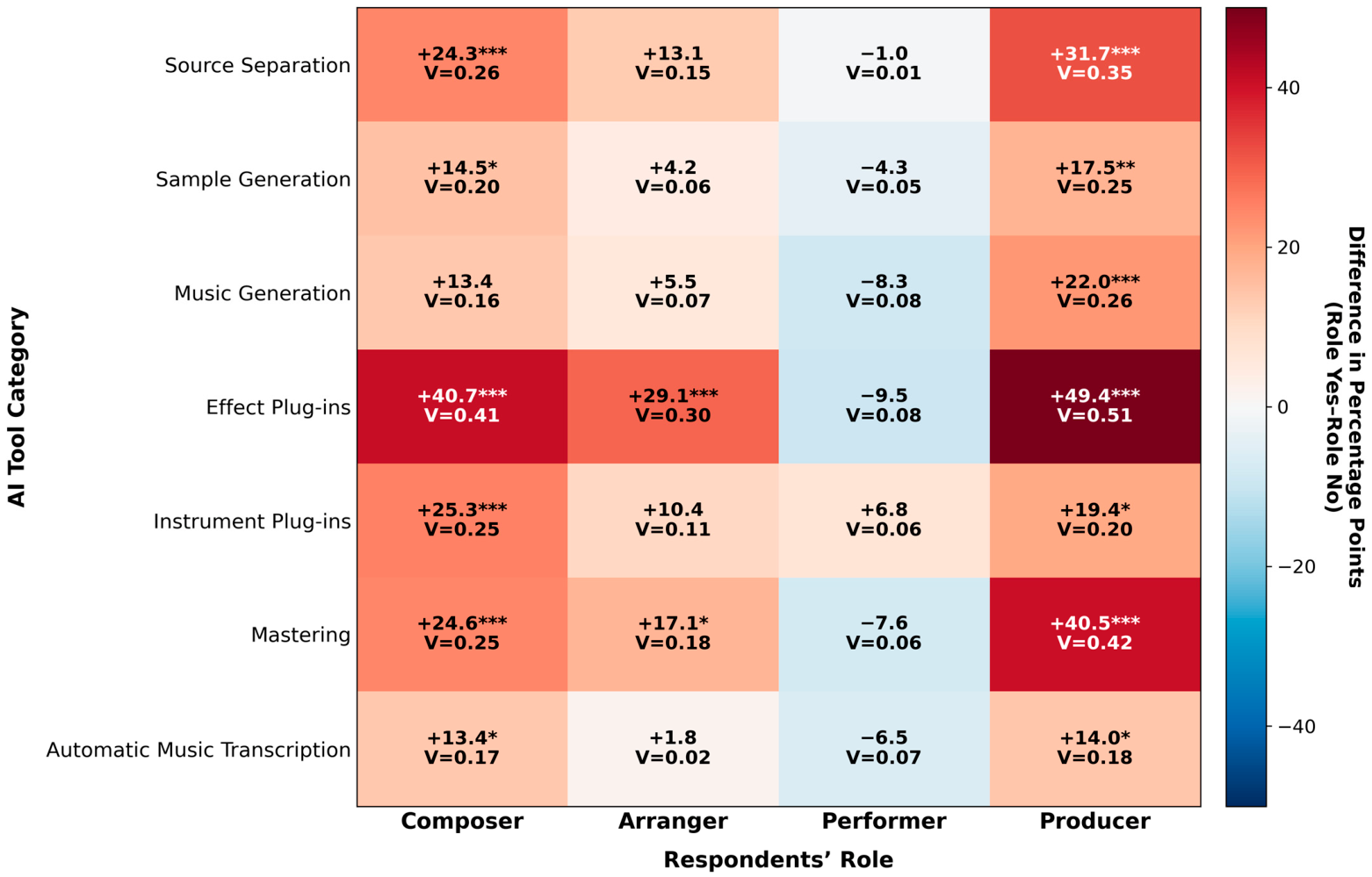
Figure 2.
Heatmap of the differences in the use of specific types of AI tools by role. Values represent the percentage-point differences (Role Yes−Role No). V = Cramér’s V. Asterisks indicate significance based on Benjamini–Hochberg false discovery rate (FDR)-adjusted p-values: * p < 0.05, ** p < 0.01, and *** p < 0.001.
The two heatmaps combined indicate some differences in AI use between composers, arrangers, performers, and/or producers. More specifically, producers exhibited the highest AI adoption rates; significant differences were observed for every AI tool category examined after the FDR adjustment. Figure 1 shows that the strongest effects were found for effect plug-ins (65.0%, V = 0.51); mastering (58.4%, V = 0.42); and source separation (45.5%, V = 0.35). Compared with non-producers, producers reported substantially higher adoption of AI tools. Figure 2 shows that the largest differences were observed for effect plug-ins (+49.4 percentage points) and mastering tools (+40.5 percentage points), indicating markedly greater engagement with production-oriented AI technologies.
Composers also demonstrated consistently higher AI adoption than non-composers across all seven tool categories, with significant differences for six after adjustment for multiple comparisons. The highest adoption rates occurred for effect plug-ins (54.1%, V = 0.41); instrument plug-ins (48.9%, V = 0.25); and mastering (45.9%, V = 0.25). The largest gap was found for effect plug-ins (+40.7 percentage points). Although composers also reported higher use of music-generation tools than non-composers (+13.4 percentage points, V = 0.16), this difference was not statistically significant after the FDR adjustment.
Arrangers showed a more selective pattern of AI engagement. Significant differences were found for effect plug-ins and mastering after adjustment for multiple comparisons. Effect plug-ins showed the largest difference (+29.1 percentage points, V = 0.30), followed by mastering (+17.1 percentage points, V = 0.18). Although arrangers also reported higher use of source-separation tools than non-arrangers, this difference was not statistically significant after the FDR adjustment. Overall, the associations for arrangers were generally weaker and less consistent than those observed for composers and producers.
Performers, instead, did not exhibit statistically significant differences in AI adoption for any tool category. Adoption rates were generally lower than those observed among composers and producers, and most differences were slightly negative when compared with non-performers, with Cramér’s V ranging from 0.01 to 0.08.
3.2.3. Musicians’ Feelings About Using AI in Music-Making
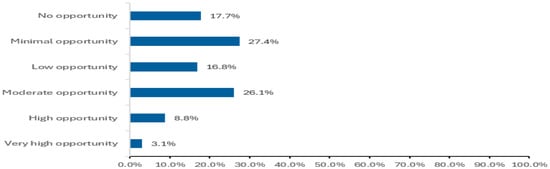
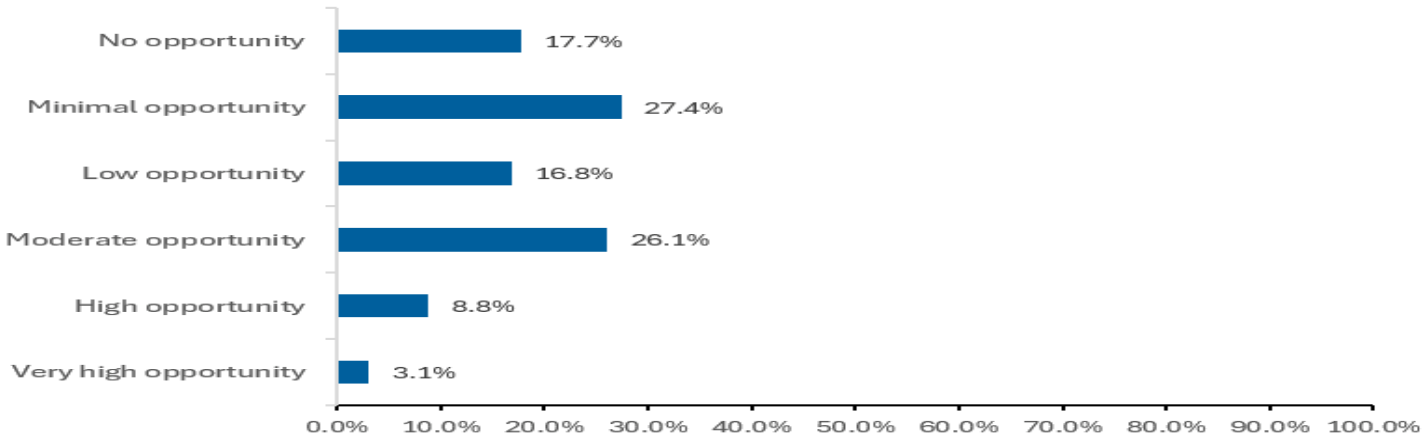
Once again, we start with comparing musicians’ responses to the broad question “How much of an opportunity do you think AI presents for your music-making?” to responses about their feelings about using specific types of AI tools. As shown in Figure 3, the general question elicited a wide distribution of opinions, with 38% recognizing a moderate to very high opportunity and 62% identifying no to low opportunity. This is surprising given that 69% of respondents showed interest in learning to use AI tools and shows only a slightly more optimistic look at AI adoption than the usage discussed in the previous section.
Figure 3.
Musicians’ perceptions of the opportunity presented by AI for their music-making.
When asked, “How would you rate your feelings towards current and/or potential uses of each of these music-related AI tools in your music-making?”, however, while still widely distributed, the overall responses differed across the tool categories (see Table 9). Somewhat more positive perceptions (means of 3.44 to 4.15 on the six-point scale, with slightly more than half to almost three-quarters reporting positive feelings) were reported for all types of tools, with only one exception: music-generation tools (mean of 2.66 with 72.6% reporting negative feelings). A Friedman test with post hoc pairwise comparisons revealed a significant difference in response distributions across some tool categories (ꭕ2(6, n = 203) = 313.77, p < 0.001) with pairwise differences reported in the second to last column in Table 9. Similar to the comparisons in Table 8, results in Table 9 demonstrate significant differences, especially between sample-generation, music-generation, and automatic-transcription tools compared with effect plug-ins and instrument plug-ins with respondents responding more favorably to the plug-in tools.
Table 9.
Musicians’ feelings towards uses of AI tools within their music-making process.
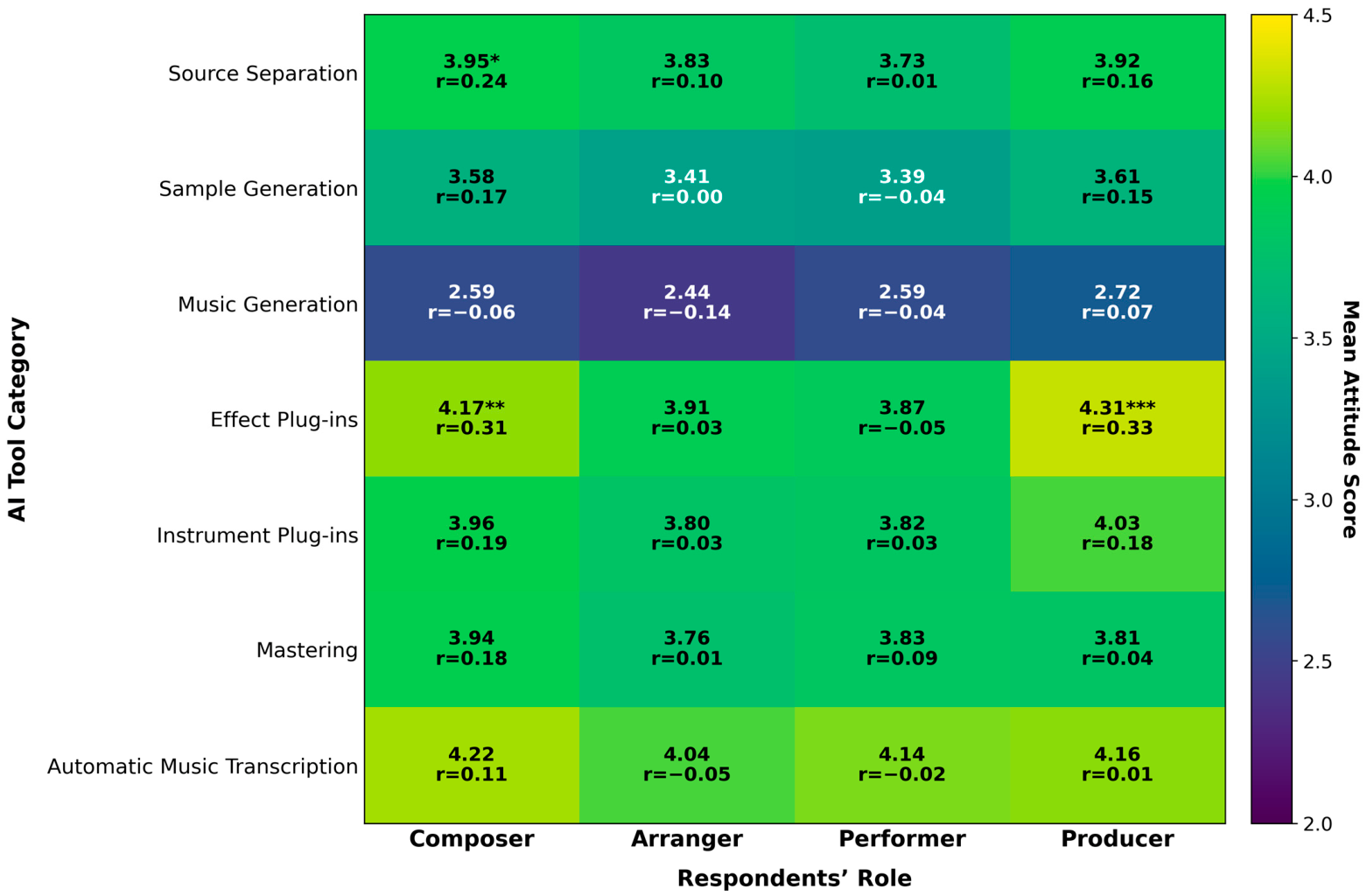
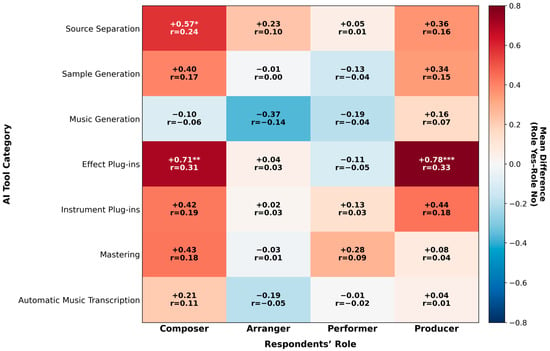
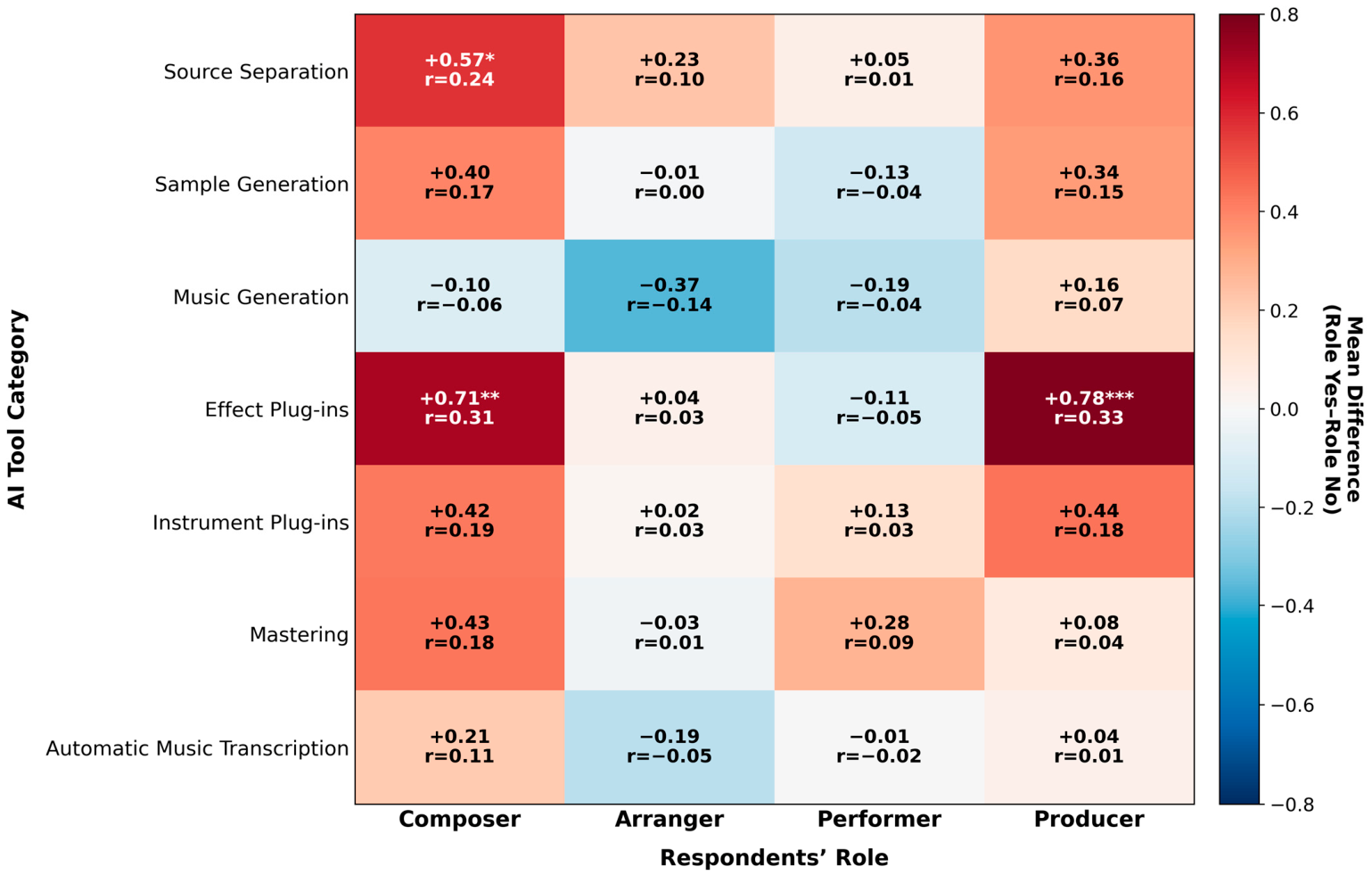
To explore the impact played by a musicians’ role on these feelings, we once again created heatmaps, as presented in Figure 4 and Figure 5. To retain the information provided by the six-point scale used in this set of questions, mean attitude scores were calculated for each role and AI tool category, and the differences between respondents who identified with a given role and those who did not were evaluated using Mann–Whitney U tests. Effect sizes were calculated using the rank-biserial correlation (r), where values of approximately 0.10, 0.30, and 0.50 can be interpreted as small, medium, and large effects, respectively. To account for the 28 role-by-tool comparisons, p-values were adjusted using the Benjamini–Hochberg false discovery rate (FDR) procedure. Adjusted significance levels and effect sizes are displayed in the heatmaps.
Figure 4.
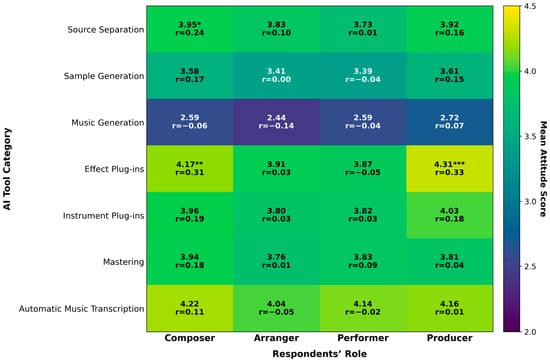
Mean feelings towards AI tools playing specific functions by role. Analytic Ns ranged from 208 to 213 across AI tool categories because of item-level missing responses. Respondents who did not answer the professional-role question were excluded from role comparisons. Values represent the mean attitude scores among respondents identifying with each professional role on a 1–6 scale (1 = very negative, 6 = very positive). r = Rank-biserial correlation. Asterisks indicate significance based on Benjamini–Hochberg false discovery rate (FDR)-adjusted p-values: * p < 0.05, ** p < 0.01, and *** p < 0.001.
Figure 5.
Differences in mean feelings towards AI tools playing specific functions by role. Values represent the differences in mean attitude scores between respondents identifying and not identifying with each professional role (Role Yes−Role No); positive values indicate more positive attitudes among respondents identifying with that role. Asterisks indicate significance based on Benjamini-Hochberg false discovery rate (FDR)-adjusted p=values: * p < 0.05, **p < 0.01, and *** p < 0.001.
Across most AI tool categories, mean attitude scores fall between approximately 3.4 and 4.3 on the six-point scale, indicating attitudes that are, generally, neutral-to-slightly positive rather than strongly positive or strongly negative. An exception is music generation, which received the lowest ratings across all roles (means ranging from 2.44 to 2.72), suggesting greater skepticism towards generative AI music tools than towards assistive or production-oriented AI applications. In contrast, automatic music transcription and effect plug-ins received some of the highest mean ratings across roles.
Some differences were also observed across professional roles, although only three of the 28 role-by-tool comparisons were statistically significant after adjusting for multiple comparisons. Composers reported significantly more positive attitudes than non-composers towards source separation (M = 3.95; mean difference = +0.57, r = 0.24) and effect plug-ins (M = 4.17; mean difference = +0.71, r = 0.31). Producers also reported significantly more positive attitudes than non-producers towards effect plug-ins (M = 4.31; mean difference = +0.78, r = 0.33). No statistically significant differences were found for arrangers or performers after the FDR adjustment.
Overall, these findings suggest that professional role may be associated with musicians’ attitudes towards some specific AI tools, rather than with consistently more positive or negative attitudes towards AI tools across categories. Across all roles, music-generation tools received the least favorable evaluations, suggesting greater reservations towards this particular type of AI tool.
4. Discussion
The findings reported in the previous section serve the dual purpose of this article: they offer substantive insights into professional musicians’ uses and perceptions of AI while also illustrating why studies of AI adoption within any occupation will benefit from more nuanced research designs that take into consideration specific tasks where AI could be used, as well as the professional roles of the people performing those tasks. We discuss these two complementary aspects separately in this section.
4.1. Insights Gained About Musicians’ AI Adoption
How AI Is Used within Music-Making Matters. Since our survey respondents were not explicitly asked about their perceptions regarding AI uses to support versus replace their core functions—as we were concerned that questions to that effect would be too “leading”—we can only make conjectures based on the patterns of their responses indicating interest about using AI in specific tasks (Table 4, Table 5 and Table 6) and usage, as well as feelings about specific types of AI tools (Table 8 and Table 9), using our own interpretation about which tasks could more likely be considered to be “assisting” versus “replacing”. In terms of openness (Table 4, Table 5 and Table 6), the tasks that drew the most positive responses were those that automate time-consuming or technical work (editing out unwanted sounds, producing high-quality recordings on one’s own, transcribing music, and helping solve technical problems), while the tasks that drew the least interest were those that would hand core creative judgment to a machine (having AI compose an entirely new piece of music, co-composing with AI, and automatic arrangement). The same ordering appears in use (Table 8), where assistive, production-oriented categories of AI tools, such as effect plug-ins, instrument plug-ins, and mastering, were the most frequently used, while music-generation tools (the category most likely perceived as substituting for human creativity) were among the least used. The same pattern appears once more in feelings (Table 9), where most tool categories elicited neutral-to-slightly positive attitudes, while music generation stood apart as distinctly negative (with almost three-fourths of respondents reporting negative feelings). The fact that a single category, music-generation tools, ranked lowest on openness, use, and feelings simultaneously suggests that what musicians resist is not AI in general but the prospect of AI displacing the creative core of music-making. Importantly, our interview data also suggest that this distinction is not reducible to the kinds of tasks in which AI may be used in music-making but also relates to how AI is positioned within a task. Combined with our interview findings, this suggests that perceived usefulness, in the TAM/TTF sense, is mediated by a prior judgment about agency, whether the human or the tool is understood to be doing the creative work, and this further suggests that the same tool applied to the same task may be welcomed or rejected depending on how that boundary is drawn.
Professional Roles Shape Adoption. Our interviews led us to question whether musicians would be more reluctant to adopt AI for tasks that are perceived as core to their professional roles. The survey largely bears this out. As shown in Table 7, composers, arrangers, and performers each reported lower interest in technology support for tasks in their own domain than did musicians who did not identify with those roles, although these differences did not reach statistical significance in the multivariable regression models. The notable exception is producers, who showed greater interest in technology solutions for their own domain and in the adoption analyses (Figure 1 and Figure 2), markedly higher use of AI tools—significantly higher than non-producers across every tool category examined, with the largest effects for effect plug-ins and mastering. Producers were also roughly twice as likely as non-producers to express general interest in learning AI tools. This exception is illuminating rather than contradictory. A first explanation could be that producers may see their craft as less creative and more supportive. Yet some of our interview data suggest that not all producers may feel this way, as they may, instead, see themselves as contributing in a unique way to the quality of the final musical product through their sense of aesthetic and unique expertise, as captured in the following interview quote:
I was mastering a bluegrass record … I ran it through the mastering assistant to see if it had a different opinion than I did. And it did. … Some of its opinions were really good, so I kept those. But some of them I found sort of asinine … it doesn’t understand aesthetics yet. You’re still bringing out that human component, which is really exciting.
Another possible explanation is that, unlike other components of music-making, music production has been a technologically mediated craft for decades, as the digital audio workstation (DAW), software instruments, and algorithmic processing are already constitutive of the work. For music producers, then, AI may be seen more as the latest increment in a long line of tools that define rather than threaten their expertise, making the “core” of their role to be bound up with using technology well rather than with resisting it as potentially threatening their advantage as experts. This interpretation is supported by the following interview quote:
We’ve used technology forever in music production. The question is, … [is AI] just an advancement or is it a whole paradigm shift? I don’t know.
Taken together, our interview and survey data suggest that whether a task feels safe to delegate to AI depends not only on its centrality to one’s role but also on whether the professional culture surrounding that role has already normalized technological mediation. Composers, the other comparatively high-adopting group, may occupy an intermediate position for similar reasons, as contemporary composition increasingly takes place within software environments.
AI May Increase the Blurring of Professional Roles. A striking feature of our survey sample is that most respondents identified with more than one role in music creation (Table 2). In addition to creating challenges for our statistical analyses, the extent of this overlap is a finding in its own right. As described in the interview quote reported at the end of Section 3.1, acquiring production tools enables songwriting and production to “happen at the same time”, collapsing what had once been a division of labor among several people into a single workflow with a single person—a finding that is also consistent with other studies (e.g., [29]). AI is likely to accelerate this blurring more than earlier technologies did, because it lowers skills barriers to tasks that musicians previously outsourced, letting a performer produce, a producer compose, or a composer engrave without specialist help—as suggested in some of our interviews. Therefore, we should expect that the boundaries among music composers, arrangers, performers, and producers will continue to soften as advances in AI technology provide increasingly sophisticated tools.
There Is a Notable Gap between Interest, Perceived Opportunity, and Use of AI by Musicians. Our survey data also reveal a consistent gap between stated openness and actual practice. While 69% of respondents said they were interested in learning to use AI tools, only 27% reported having actively experimented with AI in their music-making, and only 38% saw moderate to very high opportunity in it for their work. At the same time, the more granular tool-use questions told a more positive and nuanced story—as close to 40% reported at least some engagement with effect plug-ins, instrument plug-ins, or mastering tools, suggesting that the headline 27% figure understates real use, possibly because respondents may not classify familiar production tools as “AI”, even though most of these tools now integrate AI for several of their functions. Taken together, as of 2025 these results depict music as an occupation in an early and exploratory phase of adoption, in which curiosity outpaces practice and in which general self-reports of “using AI” are an unreliable measure of what musicians actually do.
Limitations to Be Taken into Consideration. Several limitations bound the previous interpretations. Most fundamentally, our survey could not establish why a respondent chose not to use AI for a given task: we cannot distinguish non-use that reflects a principled objection to replacement of core tasks/skills from non-use that simply reflects unfamiliarity, cost, or lack of occasion. The overlapping roles also limit more definitive claims about the effect of any single role, since most respondents belonged to more than one. In addition, as with the existing industry and research surveys we reviewed, our findings are self-reported, drawn from professional and society networks rather than a random sample, and capture a single moment (early 2025) in an exceptionally fast-moving field.
4.2. Insights Gained About Research Design
TAM and TTF Can Be Extended by Identifying Additional Factors that May Affect “Perceived Usefulness” of AI. Our study confirmed the value of employing both TAM [13] and TTF [14,15] principles in AI adoption studies, as our findings support the value of gathering information about potential users’ perceived usefulness as it relates to specific tasks for which AI could be used in their work. In particular, the discrepancy we noted in survey responses to the general questions such as “Have you experimented with AI in music-making” versus questions asking about their use of specific types of AI tools makes us wonder how respondents in other surveys may have interpreted general questions about their use of AI in music-making as well as other domains. Similar discrepancies were also noted in responses to general versus task-specific questions related to the respondents’ interest and feelings about using AI in their music-making, calling for the inclusion of questions that are task-specific in interviews and surveys. Our study additionally suggests that users’ perceived usefulness of AI will depend not only on the task but also on each user’s evaluation of whether AI will assist versus replace their own core functions when engaging in that task. This, in turn, will depend not just on the tool used or even the task itself but also on the individual’s purpose for using AI in that task (e.g., using a music-generation tool to get inspiration versus creating an entire song). At the same time, we encountered situations in our interviews that suggested that the respondent might even value some uses of AI as replacement—as long as these uses did not replace creative functions that were “core” to their role but rather enabled them to become more self-sufficient by using AI to replace another person previously performing that task for them (e.g., performers using AI tools to achieve quality recordings of their music on their own instead of having to go to a studio). While the examples we reported are specific to musicians, these considerations are not, so it will be important to take them into account in AI adoption studies for other occupations as well. The previous considerations also suggest that an individual’s professional role may impact what they will consider “core” versus “supportive” functions, as well as their purpose for using AI in particular tasks–thus calling for the inclusion of this variable when conducting TAM+TTF-informed analyses as part of an AI adoption study specific to an occupation. Our survey results suggest that the professional roles played by individuals within the target occupation may impact their willingness to use AI in specific tasks, although the strength and nature of these associations varied across measures and specific AI uses. The descriptive finding that producers were more willing than non-producers to consider using AI even for tasks core to their role, however, suggests that certain roles may be associated with greater comfort with technology solutions than other roles for historical and/or cultural reasons; therefore, this should be another factor to take into consideration when studying the perceived usefulness of AI.
Studying the Impact of “Professional Roles” on AI Adoption Presents Several Challenges. While our study has shown the value of considering the impact of professional roles on AI adoptions within an occupation, it has also revealed that studying this factor is more complex than one might expect—especially within the constraints of a survey study. Most notable was the realization that, in any given occupation, individuals are likely to play multiple overlapping professional roles—thus making it difficult to isolate the effect of any single role. This overlap complicated our statistical analyses yet was partially resolved by treating composer, arranger, performer, and producer as overlapping binary roles (e.g., composers vs. non-composers) rather than mutually exclusive categories that could be compared (i.e., composer vs. arranger vs. performer vs. producer); the same statistical approach could be employed when analyzing professional roles within other occupations. Even more interesting and impactful was the realization that AI may contribute to increasing this overlap and “blurring of roles”, as it will continue to enable individuals to perform more functions previously beyond their skill set. As role overlaps grow, it will make it increasingly difficult to find statistically significant differences through the methods used in our study. Increased role overlap will also reduce the value of asking respondents to identify their “primary” versus “secondary” roles in a survey—another solution we initially considered for our survey but then discarded for these reasons.
AI Adoption Studies Call for More Nuanced Research Designs. As the challenges we faced in our exploration of musicians’ AI uses and perceptions are likely to be encountered in other AI adoption studies, we want to comment on some methodological lessons learned from our experience. Recognizing the importance of studying task-specific perceived usefulness calls for a preliminary identification of possible tasks for which AI could be used within the target occupation. Creating a taxonomy of possible uses of AI for an occupation is not easy, especially given the rapid changes in AI technology and its applications, and it will require tapping into the expertise and vision of individuals with dual expertise in both AI and that occupation, with the expectation of needing on-going updates. The considerations reported in the previous sub-section highlighted the challenges of analyzing the impact of “professional roles” in responses to survey questions, while also suggesting some statistical approaches to account for unavoidable overlapping roles. Despite these challenges, it will be valuable to collect information about respondents’ professional roles, while keeping in mind that a respondent’s professional role(s) will not be sufficient to explain their willingness to use AI for certain tasks, as we still need to understand how they are envisioning using AI in a task—which is very difficult to discern through typical survey questions. As interest in (Table 4, Table 5 and Table 6), actual use (Table 8), and feelings about using AI for specific tasks (Table 9) complemented each other in valuable ways, this confirms the value of exploring all of these aspects as indicators of perceived usefulness and willingness to adopt AI, or any new technology, in a survey. When taken together, these considerations highlight important limitations of the Likert-style questions most commonly used in AI adoption surveys. When designing future AI adoption surveys, therefore, it will be worth including a few open-ended questions and also asking respondents to evaluate multiple scenarios involving specific uses of AI most relevant to the target occupation. Interviews may also be necessary to fully understand how individual purposes and roles may impact specific decisions about whether to use AI and how.
5. Conclusions
The mixed-method study reported in this article contributes some valuable new insights about musicians’ adoption of AI, not only by providing complementary information about U.S. musicians’ openness, use and feelings about employing AI in music-making at a specific point in time (2025) but, more importantly, by shedding light on factors that may impact musicians’ AI adoption. The combination of our interview and survey findings suggest that musicians’ responses to AI will be influenced by whether they perceive that AI is going to “assist” versus “replace” their creative work within music-making and that this evaluation will be impacted not only by the specific task for which AI may be used (consistent with TTF) but also by a musician’s role as composer, arranger, performer, and/or producer. At the same time, our study documents that the boundaries among these musical roles have already been blurred and that AI is likely to make it even more so given AI’s huge potential to empower musicians to become more self-sufficient and, thus, reduce their need to outsource tasks to other professionals with specialized expertise.
These findings have broader implications beyond the field of music, as they provide additional empirical support to the value of employing a combination of TAM and TTF in AI adoption studies across fields, while also suggesting some refinement for the concept of perceived usefulness that is at the core of these approaches. Specifically, our work suggests that when studying perceived usefulness of AI within an occupation—especially if it is done through a survey—it is important to identify a priori what are possible tasks within that occupation that may be affected by AI and whether each of those tasks would likely be considered to be “core” versus “supportive” by individuals playing specific professional roles within that occupation. Rather than asking generic questions about interest, usage, and feelings about AI, surveys intended to shed light on AI adoption within a specific occupation should include questions and scenarios addressing specific tasks as well as collect information about respondents’ professional roles that could help inform the analysis and impact of those roles on their responses. While these recommendations may not be sufficient to fully capture individual perceptions of whether AI may “assist” versus “replace” functions deemed critical for each professional role, they will help inform a more nuanced understanding of how professionals in a field perceive AI and, thus, make better predictions about future AI adoptions in that field.
Author Contributions
Conceptualization: R.B.; Methodology: K.D., Y.Z., R.B. and B.J.G.; Investigation: R.B., K.D., Y.Z., B.J.G., M.M.R., D.E.M., Z.B., M.B., Y.J.H., B.K. and R.R.; Formal Analysis: K.D. and Y.Z.; Writing—original draft preparation: R.B., K.D., B.J.G. and Y.Z.; Writing—review and editing: R.B., K.D., Y.Z., B.J.G., M.M.R., D.E.M., Z.B., M.B., Y.J.H., B.K. and R.R.; Visualization: Y.Z.; Project administration: R.B. and R.R.; Funding Acquisition: R.B. and R.R.; All authors have read and agreed to the published version of the manuscript.
Funding
This article is based upon work supported by the National Science Foundation, under grant nos. 2222129+2222369. Any opinions, findings, and conclusions or recommendations expressed in this material are those of the authors and do not necessarily reflect the views of the National Science Foundation.
Institutional Review Board Statement
This study was conducted in accordance with the Declaration of Helsinki and approved by the University of Rochester Research Subjects Review Board (protocol code: STUDY00007730; date of approval: 11 November 2022).
Informed Consent Statement
Informed consent was obtained from all subjects involved in the study, following the procedure approved by the University of Rochester Research Subjects Review Board.
Data Availability Statement
Restrictions apply to the entire dataset to protect subject confidentiality. All relevant survey data (de-identified and in aggregate) are contained within the article.
Conflicts of Interest
The authors declare no conflicts of interest.
Abbreviations
The following abbreviations are used in this manuscript:
| AI | Artificial Intelligence |
| DAW | Digital Audio Workstation |
| GenAI | Generative Artificial Intelligence |
| MIDI | Musical Instrument Digital Interface |
| TAM | Technology Adoption Model |
| TTF | Task–Technology Fit |
References
- Chen, Z. Launch editorial of Journal of Superintelligence. J. Superintelligence 2026, 1, 1. [Google Scholar] [CrossRef] [Scilit]
- Lai, C.Y.; Cheung, K.Y.; Chan, C.S. Exploring the role of intrinsic motivation in ChatGPT adoption to support active learning: An extension of the technology acceptance model. Comput. Educ. Artif. Intell. 2023, 5, 100178. [Google Scholar] [CrossRef] [Scilit]
- Liu, G.; Ma, C. Measuring EFL learners’ use of ChatGPT in informal digital learning of English based on the technology acceptance model. Innov. Lang. Learn. Teach. 2024, 18, 125–138. [Google Scholar] [CrossRef] [Scilit]
- Zhou, Y.; Wang, Y.; Su, J. A study on factors influencing music enthusiast’s behavioral intention to use generative AI for music composition based on an expanded technology acceptance model. Sci. Rep. 2025, 15, 44802. [Google Scholar] [CrossRef] [Scilit] [PubMed]
- Al-Mamary, Y.H.; Alfalah, A.A.; Alshammari, M.M.; Abubakar, A.A. Exploring factors influencing university students’ intentions to use ChatGPT: Analysing task-technology fit theory to enhance behavioural intentions in higher education. Future Bus. J. 2024, 10, 119. [Google Scholar] [CrossRef] [Scilit]
- Soodan, V.; Rana, A.; Jain, A.; Sharma, D. AI chatbot adoption in academia: Task fit, usefulness and collegial ties. J. Inf. Technol. Educ. Innov. Pract. 2024, 23, 1. [Google Scholar] [CrossRef] [Scilit] [PubMed]
- Wang, Q.; Wang, Y.; Amini, M. Associations of task technology fit and perceived usefulness with responsible generative AI use among university students. Sci. Rep. 2026, 16, 2759. [Google Scholar] [CrossRef] [Scilit] [PubMed]
- Parsons, C.S.; Zuiderwijk, A.; Orchard, N.A.; Oosterhoff, J.H.F.; de Reuver, M. Task-Technology Fit of Artificial Intelligence-based clinical decision support systems: A review of qualitative studies. BMC Med. Inform. Decis. Mak. 2025, 25, 397. [Google Scholar] [CrossRef] [Scilit] [PubMed]
- McElheran, K.; Li, J.F.; Brynjolfsson, E.; Kroff, Z.; Dinlersoz, E.; Foster, L.; Zolas, N. AI adoption in America: Who, what, and where. J. Econ. Manag. Strategy 2024, 33, 375–415. [Google Scholar] [CrossRef] [Scilit]
- Bick, A.; Blandin, A.; Deming, D.J. The rapid adoption of generative AI. Manag. Sci. 2026. [Google Scholar] [CrossRef] [Scilit]
- Humlum, A.; Vestergaard, E. The unequal adoption of ChatGPT exacerbates existing inequalities among workers. Proc. Natl. Acad. Sci. USA. 2025, 122, e2414972121. [Google Scholar] [CrossRef] [Scilit] [PubMed]
- Su, J.; Wang, Y.; Liu, H.; Zhang, Z.; Wang, Z.; Li, Z. Investigating the factors influencing users’ adoption of artificial intelligence health assistants based on an extended UTAUT model. Sci. Rep. 2025, 15, 18215. [Google Scholar] [CrossRef] [Scilit] [PubMed]
- Davis, F.D. Perceived usefulness, perceived ease of use, and user acceptance of Information Technology. MIS Q. 1989, 13, 319–340. [Google Scholar] [CrossRef] [Scilit] [PubMed]
- Goodhue, D.L.; Thompson, R.L. Task-technology fit and individual performance. MIS Q. 1995, 19, 213–236. [Google Scholar] [CrossRef] [Scilit] [PubMed]
- Dishaw, M.T.; Strong, D.M. Extending the technology acceptance model with task-technology fit constructs. Inf. Manag. 1999, 36, 9–21. [Google Scholar] [CrossRef] [Scilit]
- Malone, T.; Rus, D.; Laubacher, R. Artificial intelligence and the future of work. MIKT Work Future Res. Briefs 2020, 17, 1–39. Available online: https://workofthefuture-taskforce.mit.edu/research-post/artificial-intelligence-and-the-future-of-work/ (accessed on 17 August 2026).
- Brynjolfsson, E. The Turing trap: The promise & peril of human-like artificial intelligence. Daedalus 2022, 151, 272–287. [Google Scholar] [CrossRef] [Scilit]
- Jarrahi, M.H. Artificial intelligence and the future of work: Human-AI symbiosis in organizational decision making. Bus. Horiz. 2018, 61, 577–586. [Google Scholar] [CrossRef] [Scilit]
- Raisch, S.; Krakowski, S. Artificial intelligence and management: The automation–augmentation paradox. Acad. Manag. Rev. 2021, 46, 192–210. [Google Scholar] [CrossRef] [Scilit]
- Noy, S.; Zhang, W. Experimental evidence on the productivity effects of generative artificial intelligence. Science 2023, 381, 187–192. [Google Scholar] [CrossRef] [Scilit] [PubMed]
- Barrett, A.; Plate, M.; Borasi, R.; Harris, N. Exploring the implications of artificial intelligence for higher education student affairs. J. Stud. Aff. Res. Pract. 2025, 62, 116–128. [Google Scholar] [CrossRef] [Scilit]
- Borasi, R.; Vaughan-Brogan, P.; Miller, D.E.; Mason, S.; Han, Y.J.; DeAngelis, K. K-12 leaders’ perspectives on the implications of artificial intelligence for the work of K-12 educators. Discov. Educ. 2026, 5, 223. [Google Scholar] [CrossRef] [Scilit]
- Dell’Acqua, F.; McFowland, E.; Mollick, E.; Lifshitz, H.; Kellogg, K.C.; Rajendran, S.; Krayer, L.; Candelon, F.; Lakhani, K.R. Navigating the jagged technological frontier: Field experimental evidence of the effects of artificial intelligence on knowledge worker productivity and quality. Organ. Sci. 2026, 37, 403–423. [Google Scholar] [CrossRef] [Scilit]
- Parsons, L. Nearly 60% of Musicians are Already Using AI to Make Music [Press Release]. Ditto Music. 5 April 2023. Available online: https://press.dittomusic.com/60-of-musicians-are-already-using-ai-to-make-music (accessed on 17 August 2026).
- LANDR. How Musicians Use AI: Perceptions, Preferences, and Appetite for the Future [Research Report]. LANDR Audio Inc. 18 November 2025. Available online: https://www.landr.com/ai (accessed on 17 August 2026).
- Cabule, K. Skills That Pay: What Producers Need to Learn to Stay Relevant [Sonarworks × Sound on Sound AI Music Production Skills Report]. Sonarworks. 2025. Available online: https://blog-uploads.nyc3.digitaloceanspaces.com/2026/01/ai-music-production-skills-report-2026-sonarworks.pdf (accessed on 17 August 2026).
- Zhang, W. A study on the user acceptance model of artificial intelligence music based on UTAUT. J. Korea Soc. Comput. Inf. 2020, 25, 25–33. [Google Scholar] [CrossRef]
- Yi, W. Revolutionizing music production with ChatGPT applications: Accessibility, creativity, and impact on the industry in China. Musicol. Annu. 2024, 60, 175–204. [Google Scholar] [CrossRef] [Scilit]
- Auvinen, T. A new breed of home studio producer?: Agency and the idea ‘tracker’ in contemporary home studio music production. J. Art. Rec. Prod. 2017, 11, 1–12. Available online: https://www.arpjournal.com/asarpwp/a-new-breed-of-home-studio-producer-agency-and-the-idea-tracker-in-contemporary-home-studio-music-production/ (accessed on 17 August 2026).
- Braun, V.; Clarke, V. Thematic Analysis: A Practical Guide; Sage: Newcastle upon Tyne, UK, 2021. [Google Scholar]
- Braun, V.; Clarke, V.; Hayfield, N.; Davey, L.; Jenkinson, E. Doing reflexive thematic analysis. In Supporting Research in Counselling and Psychotherapy; Bager-Charleson, S., McBeath, A., Eds.; Palgrave Macmillan: Cham, Switzerland, 2022; pp. 19–38. [Google Scholar] [CrossRef] [Scilit]
- Conover, W.J. Practical Nonparametric Statistics, 3rd ed.; Wiley: Hoboken, NJ, USA, 1999. [Google Scholar]
- Agresti, A. An Introduction to Categorical Data Analysis, 3rd ed.; Wiley: Hoboken, NJ, USA, 2019. [Google Scholar]

Disclaimer/Publisher’s Note: The statements, opinions and data contained in all publications are solely those of the individual author(s) and contributor(s) and not of MDPI and/or the editor(s). MDPI and/or the editor(s) disclaim responsibility for any injury to people or property resulting from any ideas, methods, instructions or products referred to in the content. |
© 2026 by the authors. Licensee MDPI, Basel, Switzerland. This article is an open access article distributed under the terms and conditions of the Creative Commons Attribution (CC BY) license.