


Abstract
Background/Objectives: Heart transplantation is a life-saving treatment for advanced cardiac disease, but post-transplant adaptation may involve psychosocial, identity-related, and existential change. Some recipients interpret these changes as corresponding to donor characteristics, although the nature and evidence base of these reports remain unclear. This review mapped post-transplant changes reported by adult heart transplant recipients, perceived donor–recipient correspondences, and the explanatory frameworks proposed for these phenomena. Methods: A scoping review was conducted following the Arksey and O’Malley framework, Joanna Briggs Institute guidance, and PRISMA-ScR reporting standards. PubMed, Web of Science, Scopus, CINAHL, and PsychINFO were searched in August 2026. Quantitative, qualitative, mixed-methods, conceptual, opinion, and review articles were eligible. Findings were synthesized descriptively. Results: Sixteen sources published between 1992 and 2025 were included. Empirical studies reported changes in preferences, emotional and personality-related experiences, social and physical functioning, sexuality, identity and embodiment, sensory and memory-like experiences, and spirituality. Some changes were attributed by recipients to donor characteristics, whereas correspondences supported by independently obtained donor information were reported in a limited subset of studies. Proposed explanations ranged from psychological, pharmacological, physiological, and sociocultural processes to cellular, molecular, neurocardiac, energetic, and transpersonal hypotheses. Donor-transfer hypotheses were developed in the secondary literature and were not empirically established. Methodological quality varied substantially across sources. Conclusions: Post-transplant changes and perceived donor–recipient correspondences are meaningful phenomena, but current evidence does not support the transfer of donor memory, personality, or identity through the transplanted heart. Future prospective, longitudinal, and methodologically rigorous studies should distinguish reported experience, donor attribution, and proposed explanations.
Keywords:
heart; transplantation; recipients; donors; adaptation; emotional adjustment; self-concept; emotions; nursing; review 1. Introduction
Heart transplantation (HT) has substantially improved survival and health-related quality of life among individuals with advanced cardiac disease [1]. According to data from the International Society for Heart and Lung Transplantation, more than 112,000 heart transplants were performed worldwide between 1992 and 2024, highlighting the role and relevance of HT as a life-saving intervention [2].
Despite these clinical advances, recovery following HT represents a complex psychosocial and biographical transition [3,4,5]. During the post-transplant period, recipients may experience considerable psychological distress. Reported prevalence estimates for stress and anxiety are 21.6% and 11.1%, respectively [6], and recipients may also be at risk of major depressive disorder, generalized anxiety disorder, and post-traumatic stress disorder [7]. Depression, demoralization, pain, and sexual dysfunction have also been reported and may adversely affect the recipients’ quality of life [8]. These difficulties are clinically relevant because they may influence treatment adherence, interpersonal functioning, long-term adaptation, and the need for ongoing psychosocial support [6,9].
Receiving a donor heart also represents an emotionally charged experience in which personal survival is closely associated with another person’s death [10]. This tension may reshape recipients’ identities, priorities, relationships, and processes of meaning-making [11,12]. Qualitative and mixed-methods studies have described changes in emotional responsiveness, self-perception, relational patterns, personal values, and embodied experience following HT [10,11,13]. Some recipients perceive these changes as unexpected, unfamiliar, or difficult to reconcile with their pre-transplant sense of self [10,13,14].
In some studies, recipients have interpreted post-transplant changes as corresponding to characteristics attributed to the donor [14]. To account for such narratives, some authors have drawn on concepts such as cellular or epigenetic memory [15,16,17] and proposed biological or extracerebral mechanisms through which donor-related information might influence recipients after transplantation [18]. However, these explanatory models remain theoretical and are informed by a combination of biological hypotheses, psychological interpretations, and cultural or symbolic frameworks [19].
The available literature remains fragmented across study designs, geographical and cultural contexts, source types, and exploratory perspectives. This fragmentation limits the development of a coherent understanding of how post-transplant changes are experienced and interpreted, how perceived donor–recipient correspondences have been identified, and how these narratives may be addressed in clinical practice. Previous evidence syntheses have examined recipients’ psychological experiences [20], donor and donation imagery [21], the lived experience of heart [10] or thoracic-organ transplantation [13], and neurocognitive or memory-related outcomes [22]. However, to the best of our knowledge, no previous review has simultaneously mapped the range of reported post-HT changes, distinguished different levels of perceived donor–recipient correspondences, and examined the explanatory frameworks proposed across the empirical and non-empirical literature.
Accordingly, this scoping review aimed to map the available evidence on post-transplant changes reported by adult HT recipients and their perceived relationship with donor characteristics. It further examined how donor–recipient correspondences have been assessed or corroborated and mapped the explanatory frameworks proposed to account for post-transplant changes and perceived donor–recipient correspondences.
The following research questions guided the review: (a) What post-transplant changes have been reported by HT recipients? (b) Which post-transplant changes have been perceived as corresponding to donor characteristics, and how have these donor–recipient correspondences been assessed or corroborated? (c) What explanations have been proposed for post-transplant changes and donor–recipient correspondences?
2. Materials and Methods
2.1. Study Design
A scoping review was conducted, adhering to the methodological framework proposed by Arksey and O’Malley [23] and guidance from the Joanna Briggs Institute (JBI) for conducting scoping reviews [24,25]. The review protocol was not prospectively registered. Reporting followed the Preferred Reporting Items for Systematic Reviews and Meta-Analyses Extension for Scoping Reviews (PRISMA-ScR) [26]. The completed PRISMA-ScR checklist is provided in the Supplementary Materials.
2.2. Eligibility Criteria
Eligible sources included primary quantitative, qualitative, and mixed-methods studies involving adult recipients who underwent HT in adulthood and reporting post-transplant changes relevant to behavior, preferences, personality or emotional characteristics, identity or self-concept, bodily or graft-related perceptions, sensory or memory-like experiences, or spiritual dimensions. Studies reporting perceived, assessed, or corroborated correspondences between recipient changes and donor characteristics were also eligible. Reviews, conceptual or theoretical papers, and opinion articles were included when they discussed donor–recipient correspondences or proposed explanatory mechanisms.
Studies were excluded if they focused on psychiatric, neurological, or personality disorders; general adaptation to life after transplantation; caregiver, partner, or family outcomes; waiting-list experiences; or heart failure without transplantation. Studies involving pediatric transplantation, including recipients transplanted during childhood but assessed in adulthood, were excluded. Studies focused on other transplanted organs, left ventricular assist devices (LVADs), or artificial hearts were excluded unless findings for adult HT recipients were separately extractable. Biological, surgical, immunological, and physiological outcomes were outside the scope of the review. Study protocols, instrument-validation studies, books and book chapters, and conference papers or abstracts were also excluded. No restrictions were applied by publication date or language.
2.3. Information Sources
A comprehensive literature search was conducted on 10 August 2026 across five databases: PubMed, Web of Science, Scopus, CINAHL Ultimate via EBSCOhost, and PsycINFO via EBSCOhost. All identified records were imported into EndNote version 20.2.1 (Clarivate, Philadelphia, PA, USA) for reference management and deduplication. Duplicate records were first identified using the software’s automated duplicate-detection function and subsequently reviewed manually to identify additional duplicates arising from minor variations in bibliographic information.
2.4. Search Strategy
The search strategy combined controlled vocabulary (e.g., Medical Subject Headings [MeSH]), where available, with free-text terms and Boolean operators. Search strings were adapted to the indexing systems and technical requirements of each database.
Three conceptual components informed the search: (1) heart transplantation; (2) post-transplant changes; and (3) donor–recipient correspondences, including terms related to donor-associated traits, memory or personality transfer, cellular memory, and heart memory. These three concepts were operationalized as two search blocks: heart transplantation constituted the first block, while terms relating to post-transplant changes and donor–recipient correspondences were combined with OR to form the second block. The two blocks were then combined using AND.
In accordance with the methodology [24,25,26], the full search strategies for each database are provided in Table A1.
2.5. Selection of Sources of Evidence
Source selection was conducted in two stages. First, two reviewers (DN and MRG) independently screened the titles and abstracts of all identified records against the eligibility criteria. Records unrelated to adult heart transplantation, post-transplant changes, donor–recipient correspondences, or proposed explanatory mechanisms were excluded at this stage. Second, two reviewers (RL and MLM) independently assessed the full texts of potentially eligible sources. Backward reference-list screening and forward citation tracking were also performed on full texts to identify additional potentially eligible records. Eligibility was determined according to the predefined population, concept, and source type criteria. For sources including recipients of multiple organ types, inclusion required that findings for HT recipients were separately identifiable and extractable. Any disagreement was resolved through discussion, and when consensus could not be reached, through consultation with a third reviewer (GA).
2.6. Data Charting Process
A standardized data-charting form was developed in Microsoft Excel following methodology [24,25]. Two authors (IA and IZ) independently extracted data from each included source. The completed forms were compared, and discrepancies were resolved through discussion. A third author (MF) was consulted when agreement could not be reached.
2.7. Data Items
For each included source, the following information was charted: reference (authors and year of publication); country; study design; sample size and composition; key findings; methodological limitations; reported post-transplant changes; attribution of changes to donor characteristics; source and nature of donor information; data sources or informants; proposed explanatory frameworks; source category (empirical vs. secondary or non-empirical). For empirical studies, the country referred to the study setting; for secondary and non-empirical sources, it referred to the institutional affiliation of the first author.
2.8. Critical Appraisal of Individual Sources of Evidence
The methodological quality of the included sources was assessed using appraisal tools appropriate to each source type. The JBI Critical Appraisal Tools [27] were applied to reviews and evidence syntheses, qualitative studies, case series, cross-sectional studies, and textual evidence, including opinion and conceptual contributions. The Mixed Methods Appraisal Tool (MMAT) [28] was used for mixed-methods studies. Each checklist item was rated using the response options specified by the respective tool. Given the differences in methodological domains and number of items across the JBI and MMAT tools, no overall numerical score or common threshold-based classification was applied across source types; appraisal findings were interpreted at the item and source-type level. Assessments were conducted independently by two reviewers (GA and DN), with disagreements resolved through discussion, and when necessary, consultation with a third reviewer (RL).
Consistent with the scoping review methodology, no source was excluded based on methodological appraisal [23,24,25]. The appraisal findings were used to contextualize interpretation of the evidence, while preserving the review’s objective of mapping the available literature [26].
2.9. Synthesis of Results
Consistent with the aims of this scoping review and the framework proposed by Arksey and O’Malley [23], findings were synthesized using a descriptive narrative approach informed by the methodology for narrative synthesis [29,30]. The synthesis was structured according to the three research questions.
First, post-transplant changes reported by HT recipients were mapped across descriptive domains and specific manifestations. Second, each change was classified according to its relationship with donor characteristics as: (a) reported without donor attribution; (b) recipient-perceived donor correspondence without independent verification; or (c) donor–recipient correspondence supported by independently obtained donor information. Third, proposed explanations for these changes and donor–recipient correspondences were mapped across the included sources.
Empirical evidence was distinguished from secondary and non-empirical sources throughout the synthesis. Empirical evidence was considered to address changes and correspondence with donor characteristics. Secondary sources were used only to map proposed explanatory frameworks rather than as confirmation of empirical phenomena. Critical-appraisal findings were considered when interpreting the available evidence. Results are presented narratively and are complemented by tables and visual summaries.
Generative artificial intelligence was used during manuscript preparation and revision solely to support language editing and the refinement of wording and clarity. It was not used for literature searching, study selection, data extraction, critical appraisal, or evidence synthesis. All AI-assisted text was critically reviewed and approved by the authors.
3. Results
3.1. Selection of Sources of Evidence
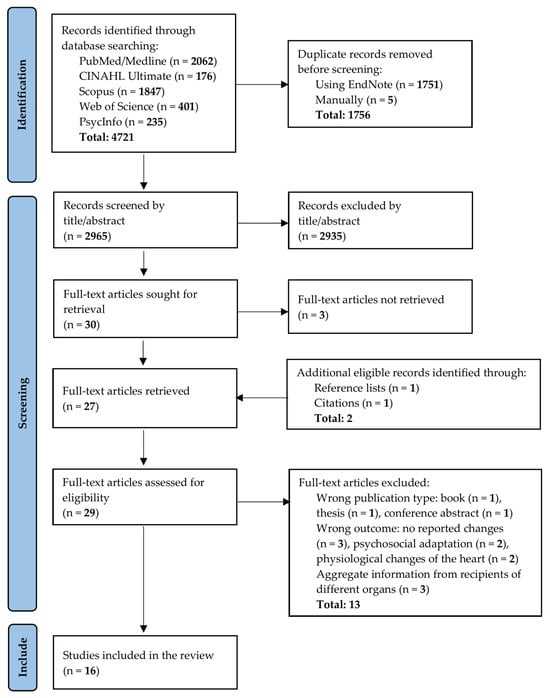
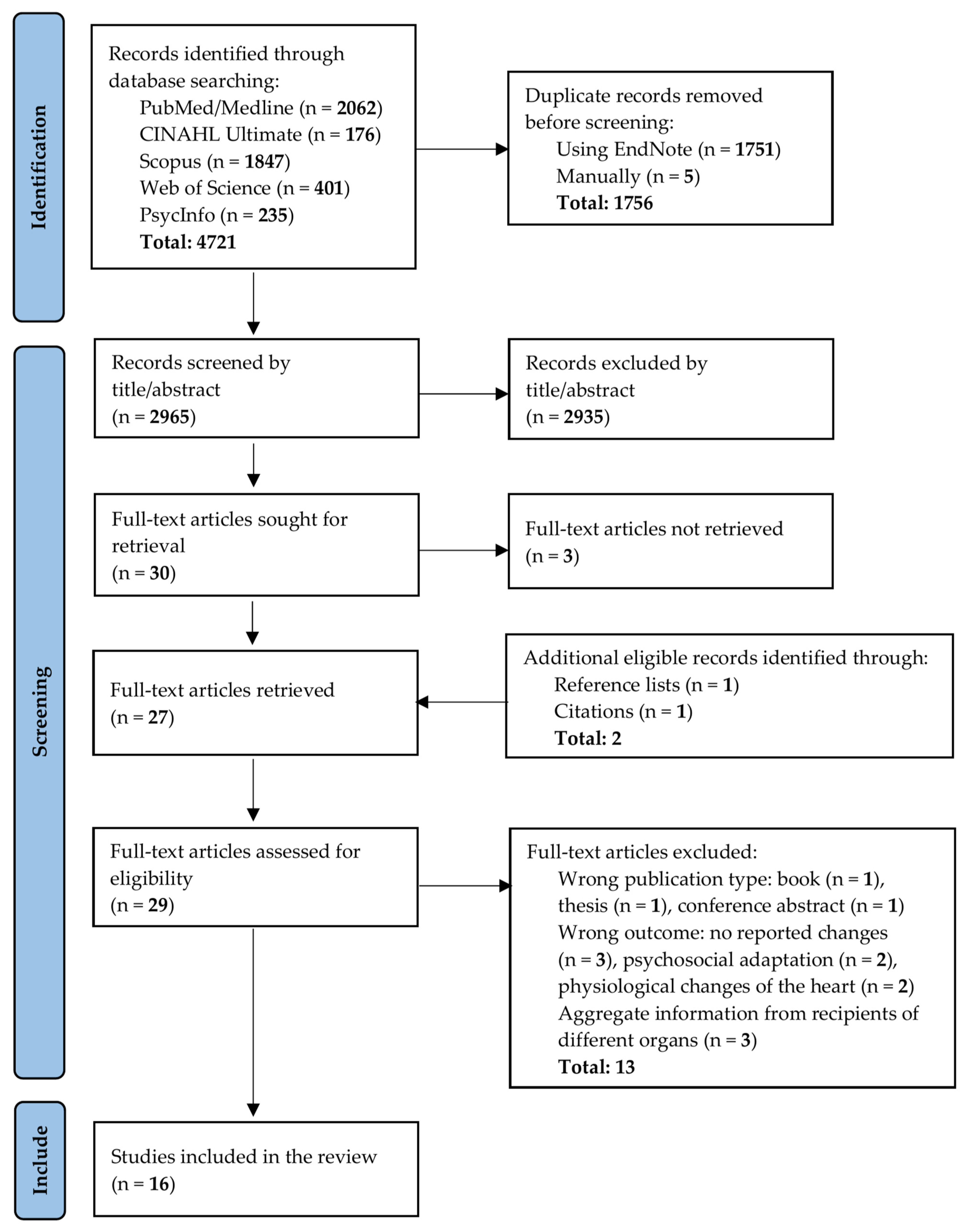
The database searches identified 4721 records. After the removal of 1756 duplicates, 2965 records underwent title and abstract screening. Of these, 2935 were excluded because they did not meet the eligibility criteria, and 30 reports were sought for full-text retrieval. Three reports could not be retrieved despite support from the institutional library service. Citation searching of the 27 retrieved reports identified two additional potentially eligible reports. Consequently, 29 full-text records were assessed for eligibility, of which 13 were excluded for specific reasons. Ultimately, 16 sources of evidence met the eligibility criteria and were included in the review. The study-selection process is presented in the PRISMA flow diagram [31] (see Figure 1).
Figure 1.
PRISMA flow diagram illustrating the identification, screening, eligibility assessment, and inclusion of sources of evidence.
3.2. Characteristics of Sources of Evidence
The characteristics of the studies included in this review are presented in Table 1.
Table 1.
Characteristics of the included sources of evidence.
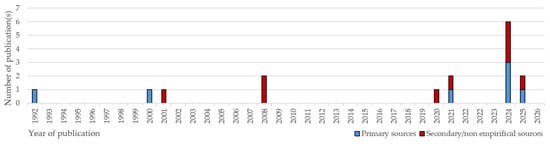
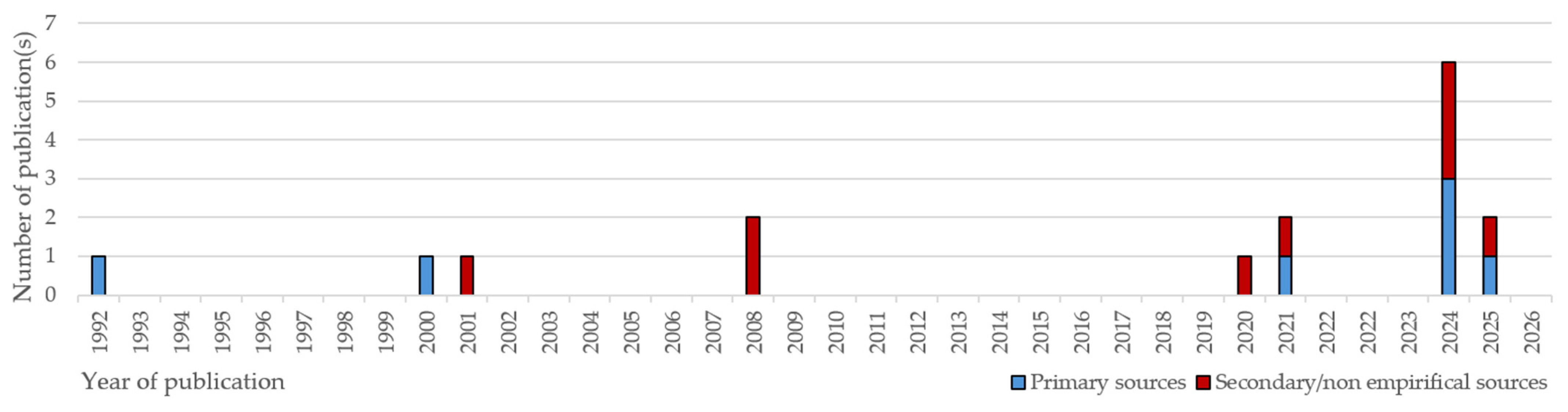
The 16 included sources were published between 1992 and 2025, with an uneven distribution over time. Eleven sources (68.7%) were published from 2020 onward [16,18,22,32,33,35,36,37,38,39,40]. The largest number of included sources was published in 2024 (n = 6; 37.5%) [18,32,35,36,37,38]. The distribution of the included sources by year of publication is presented in Figure 2.
Figure 2.
Temporal distribution of included sources by publication year and source type.
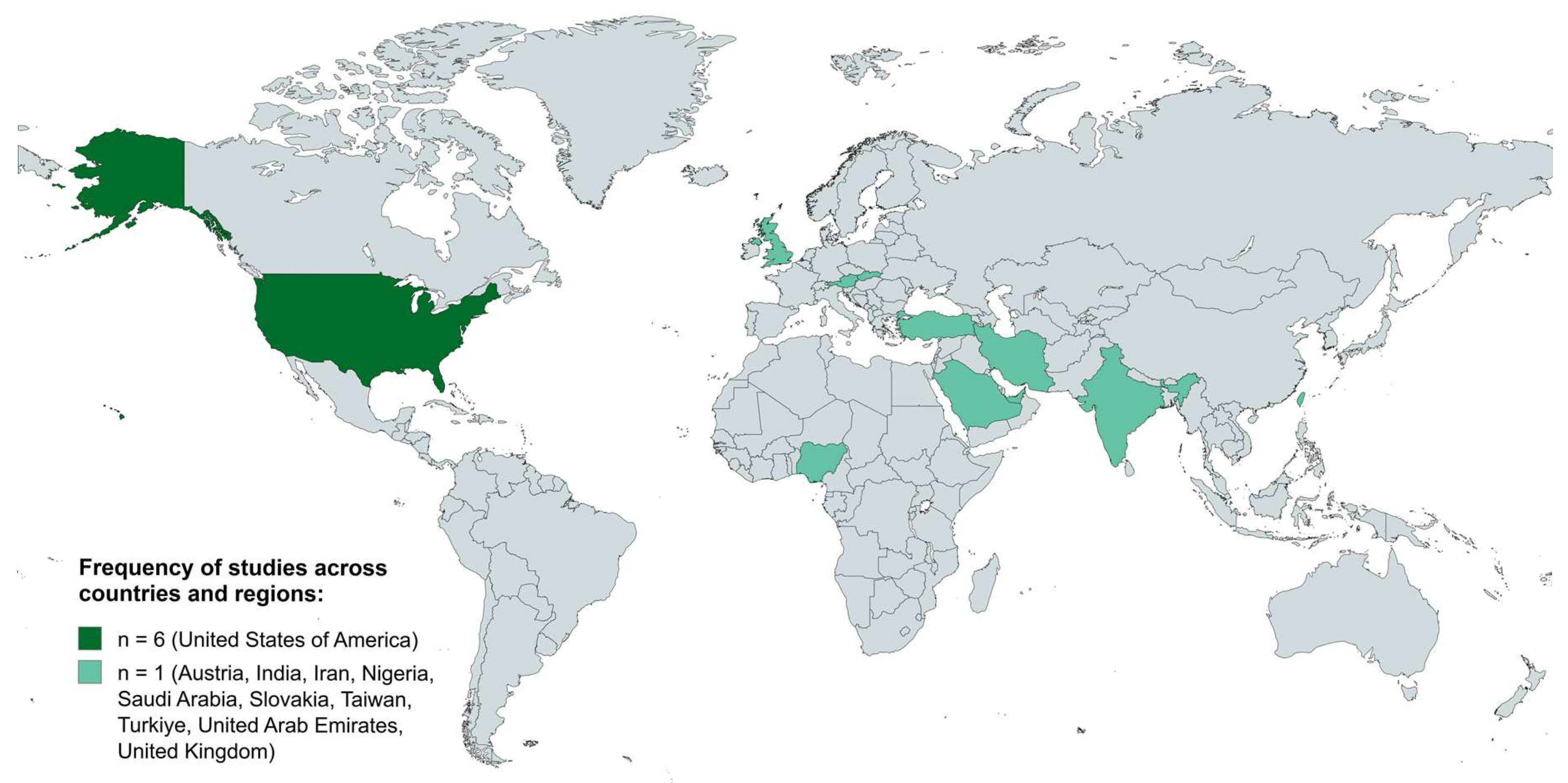
The included sources showed broad geographical distribution. North America accounted for the largest proportion (n = 6; 37.5%), with all sources originating from the United States of America [15,16,35,37,41,42]. Europe contributed three sources (18.8%) from Austria [34], Slovakia [39], and the United Kingdom [43], while three sources (18.8%) originated from the Middle East, namely Iran [40], Saudi Arabia [18], and the United Arab Emirates [32]. One source each (6.3%) originated from East Asia (Taiwan) [38], West Asia (Türkiye) [33], South Asia (India) [36], and Sub-Saharan Africa (Nigeria) [22]. No eligible sources originated from Latin America or Oceania. Within this distribution, Austria [34], India [36], Iran [40], Taiwan [38], Türkiye [33], and two sources from the United States of America [35,41] represent study settings of empirical studies. In contrast, Saudi Arabia [18], the United Arab Emirates [32], Slovakia [39], the United Kingdom [43], Nigeria [22], and four sources from the United States of America [15,16,37,42] represent the first authors’ institutional affiliations of secondary or non-empirical sources.
The geographical distribution of the included sources is presented in Figure 3.
Figure 3.
Geographical distribution and frequency of included sources across countries and regions.
The included sources were methodologically heterogeneous. Seven (43.8%) were empirical studies [33,34,35,36,38,40,41], two (12.5%) were secondary sources [18,22], and seven (43.8%) were opinions or conceptual contributions [15,16,32,37,39,42,43]. Among the empirical studies, three used qualitative designs [34,36,40], two were cross-sectional studies [33,35], one was a case series [41], and one used a mixed-methods design [38]. The secondary literature comprised one narrative review [18] and one scoping review [22]. The remaining sources included four expert opinions [15,37,42,43] and three conceptual contributions [16,32,39].
Sample characteristics varied in terms of size, population, and the inclusion of informants. Five sources (31.2%) focused exclusively on HT recipients, with sample sizes ranging from 7 to 47 participants [34,36,38,40,41], whereas two (12.5%) also included recipients of other transplanted organs or implanted cardiac devices; their HT subsamples ranged from 23 to 45 participants [33,35]. Among the empirical studies, five (31.2%) included recipients as the sole participant group [33,34,35,36,40], while two (12.5%) also collected data from the recipients’ families and donor relatives [38,41]. Secondary, opinion, and conceptual sources did not recruit participants and relied on previously published literature.
3.3. Synthesis of Results
3.3.1. Post-Transplant Changes and Their Relationship with Donor Characteristics
To address the first research question, empirical studies identified a broad range of post-transplant changes across multiple dimensions, including dietary preferences [35,38,40,41], social and occupational functioning [33,36], physical functioning [33,35,36], interests and preferences [34,35,38,40,41], personality and emotions [33,34,35,36,38,40,41], sexuality and gendered behavior [33,35,40,41], identity and embodiment [34,35,36,38,40], memory-, dream-, and sensory-related experiences [35,38,41], and spirituality [34,35,36,40].
Regarding the second research question, the empirical evidence linking these changes to donor characteristics varied. Some changes in personality, temperament, interests, gendered behavior, identity, and spirituality were attributed to the donor by the recipients themselves, but were not independently verified [34,36,40]. In contrast, donor–recipient correspondences supported by donor information were reported for dietary preferences, interests, temperament and behavior, sexuality, and dream-, sensory-, or other unusual experiences [38,41]. These correspondences were examined by comparing recipient accounts with reports from recipient and donor relatives [41], or through matched recipient–donor-family groups and qualitative triangulation [38]. Notably, although some donor–recipient similarities were identified qualitatively, quantitative analysis showed no significant correlations between donor-family assessments and recipient personality ratings in a study [38]. The empirical evidence supporting donor–recipient correspondences was methodologically heterogeneous, with most reports arising from studies with limitations in sampling, retrospective assessment, and the control of alternative explanations.
The reported post-transplant changes and their relationship with the donor characteristics identified across the empirical studies are summarized in Table 2.
Table 2.
Reported post-transplant changes and their relationship with donor characteristics.
3.3.2. Proposed Explanatory Frameworks for Post-Transplant Changes and Donor-Recipient Correspondences
Concerning the third research question, the included literature, encompassing both empirical studies and secondary or non-empirical sources, reflected two broad interpretive levels. Within the empirical studies, post-transplant changes were predominantly interpreted in relation to psychological and existential adaptation, reconstruction of identity and bodily self, medication effects, perioperative and neurocognitive factors, changes in physical capacity, and sociocultural influences on the meaning attributed to the transplanted heart [33,34,35,36,38,40,41]. Primary studies also considered, to varying degrees, donor-related expectations, coincidence, and other interpretive processes when accounting for perceived donor–recipient similarities [34,35,38,41].
Secondary and non-empirical sources further developed these conventional and alternative interpretations, including suggestibility, exposure to donor information, source-memory processes, coincidence, confirmation bias, and retrospective attribution [15,16,22,37,42]. A second group of explanatory frameworks sought more specifically to account for donor–recipient correspondences through hypothetical mechanisms of information retention or transmission. Some of these hypotheses, particularly cellular memory and related intracardiac or energetic explanations, were also discussed or mentioned in primary empirical studies [35,38,40,41]. However, they were developed more extensively in secondary and non-empirical sources, which proposed cellular and molecular memory, extracellular-vesicle-mediated transfer, intracardiac neural processes, energetic or electromagnetic models, quantum-information mechanisms, and nonlocal or transpersonal interpretations [15,16,18,22,32,37,39,42,43]. Overall, the donor-transfer mechanisms identified in the literature remained theoretical or hypothesis-generating.
The detailed explanatory frameworks and the extent to which each was addressed across the empirical, secondary, and non-empirical sources are presented in Table 3.
Table 3.
Proposed explanatory frameworks for post-transplant changes and donor-recipient correspondences.
3.4. Methodological Appraisal of Included Sources
The critical appraisal showed considerable heterogeneity across the included literature. Among the empirical studies, recurrent limitations included small or selected samples, retrospective assessment, absence of pre-transplant baseline measures, limited use of validated instruments, susceptibility to recall bias, and insufficient control of alternative explanations [33,34,35,36,38,40,41]. Secondary and non-empirical sources showed different methodological limitations, including non-systematic or insufficiently transparent evidence selection, reliance on anecdotal or secondary material, and theoretical extrapolation beyond directly observed evidence [15,16,18,22,32,37,39,42,43].
Detailed appraisal results are presented in Table 4.
Table 4.
Methodological appraisal of included sources of evidence.
4. Discussion
This scoping review provides an integrated account of post-transplant changes reported by adult HT recipients, their attribution to donor characteristics, and the explanatory frameworks proposed to interpret these phenomena. These represent different levels of inference and should not be conflated. Primary empirical studies documented a broad range of changes involving preferences, emotional and personality-related experiences, social and physical functioning, sexuality, identity and embodiment, memory-, dream-, and sensory-related experiences, and spirituality [33,34,35,36,38,40,41]. Some of these changes were interpreted by the recipients as reflecting donor characteristics [34,36,40], whereas a smaller subset involved correspondences supported by independently obtained donor information [38,41]. In contrast, proposed mechanisms of donor–recipient correspondences have been developed predominantly in the secondary, conceptual, and opinion-based literature [15,16,18,22,32,37,39,42,43], although some empirical studies mentioned these hypotheses [35,38,40,41]. This distinction is central to interpreting literature in which phenomenological observations coexist with specific but hypothetical explanatory models.
The reported changes identified in empirical studies are consistent with the broader understanding of HT as a major psychosocial, embodied, and biographical transition. Recipients must adapt to medical uncertainty, fear of rejection, treatment burden, altered social roles, and the persistent vulnerability associated with living with a transplanted organ [5,10,13,44,45]. Emotional, behavioral, and preference-related changes may therefore emerge within a wider process of adaptation following severe illness, major surgery, and the transition from life-threatening disease to long-term survivorship [5,46,47,48]. Psychological distress, including depression, anxiety, and post-traumatic stress symptoms, is documented after HT [6,7,8,9], while fear of graft rejection, uncertainty, medication-related effects, functional changes [49,50,51,52], and the demands of chronic post-transplant care [5,53] may further influence the recipients’ emotional and behavioral adjustment. Within this context, reported changes may reflect adaptation to a profoundly altered life situation rather than phenomena requiring a donor-derived explanation [5,46,48].
Nevertheless, conventional categories of psychological distress alone do not adequately capture the identity- and embodiment-related experiences identified in the empirical literature. Recipients may experience the graft as simultaneously incorporated into the body and biographically associated with another person, thereby challenging established boundaries between the self and other [36,38,40]. Previous research has similarly conceptualized transplantation as a transformative process in which bodily integrity, self-continuity, and personal identity may need to be renegotiated [54,55,56]. Accordingly, changes in self-perception or feelings of unfamiliarity toward the graft should not necessarily be reduced either to psychopathology or to evidence of donor-characteristic transfer; they may represent forms of embodied adaptation and identity reconstruction.
The symbolic and cultural meanings associated with the heart may further influence this process. Across cultural and historical traditions, the heart has been associated with emotion, love, courage, morality, spirituality, and personal essence [57,58]. These meanings coexist with biomedical understandings of the heart and may influence how recipients interpret bodily and psychological post-transplant changes [59]. Recipients may conceptualize the graft as a biological replacement, a gift, or as a material connection with the donor [12,51,60]. Such interpretations are therefore likely to arise from an interaction between embodied experience, individual beliefs, and wider sociocultural frameworks rather than from a single explanatory process.
Existential changes identified in the empirical literature further support this interpretation. Survival following HT may be experienced as rebirth or a second opportunity for life, accompanied by gratitude, renewed appreciation of life, changes in priorities, or greater spiritual engagement [40,47,59,60]. At the same time, survival can coexist with indebtedness, guilt, and concerns about whether one is living in a manner worthy of the donated organ [61,62,63]. For instance, recipients may feel obliged to remain grateful, honor the donor, or preserve an idealized legacy [64], struggling to reconcile their survival with another person’s death [12,65]. The donor therefore occupies a complex position in recipients’ meaning-making, simultaneously associated with loss and survival. These processes may contribute to changes in values, relationships, spirituality, and self-concept without implying the transmission of donor characteristics.
A specific issue concerns the interpretation of perceived donor–recipient correspondences. Although some empirical studies documented recipient-attributed similarities in personality, temperament, interests, gendered behavior, identity, and spirituality [34,36,40], independently sourced donor information was available in only a limited portion of the evidence [38,41]. Such information strengthens the documentation of correspondence but does not establish its cause. This caution is reinforced by the methodological characteristics of the available evidence. Studies providing detailed donor–recipient correspondences were based on small or selected samples, retrospective accounts, and limited standardized assessment, with potential susceptibility to recall, matching, and confirmation biases [38,41]. Collateral accounts from recipients and donor relatives do not resolve these limitations. Independent informants may strengthen confidence that a reported characteristic was not generated solely by the recipient [38,41], yet agreement across informants remains vulnerable to retrospective interpretation and selective matching [15,22,37,41]. Moreover, donor relatives may seek continuity with the deceased donor, while recipients may reinterpret their own experiences after learning donor characteristics [15,22,37]. Previous research suggests that donor families can experience an enduring symbolic connection with recipients and may perceive donor characteristics in them [66]. Contact between recipients and donor families can therefore be meaningful while also shaping subsequent interpretations of the graft and donor–recipient relationship [66,67,68].
The current evidence therefore supports the existence of reported and perceived donor–recipient correspondences, but not the conclusion that such similarities reflect the transmission of donor-derived information.
The explanatory literature further illustrates why empirical observation and causal interpretation must remain distinct. Several frameworks account for post-transplant changes without requiring donor-derived transfer, including psychological and existential adaptation, graft incorporation, medication effects, perioperative factors, sociocultural influences, suggestibility, exposure to donor information, coincidence, and attributional processes [15,22,34,35,36,37,38,40,41,42]. These processes are not mutually exclusive and may interact. An experience may, for example, initially be perceived as unexpected, later acquire significance after exposure to donor information, and subsequently be incorporated into the recipient’s narrative of transplantation. Such a sequence does not invalidate the experience but demonstrates why the experience itself should be distinguished from its causal attribution.
Other frameworks propose that donor-related information could be retained or transmitted through cellular, molecular, neurocardiac, energetic, quantum, or nonlocal processes [15,16,18,22,32,35,37,39,41,42,43]. Some invoke biological phenomena, including epigenetic regulation, extracellular-vesicle signaling, RNA-mediated communication, and bidirectional heart–brain signaling [16,18,22,35,37,39]. However, the existence of these biological processes does not demonstrate that autobiographical memories, preferences, personality traits, or other donor-specific psychological information can be encoded in the heart and subsequently expressed by the recipient. Epigenetic memory, for example, concerns the persistence of regulatory cellular states and should not be equated with autobiographical or declarative memory [17]. Similarly, extracellular vesicles and RNA can mediate intercellular communication, but their proposed role in transmitting donor memory after HT remains hypothetical [16,18,22,39].
The structure and methodological appraisal of the literature reinforce this distinction. Although donor-transfer hypotheses were occasionally mentioned or discussed in primary empirical studies [35,38,40,41], their detailed development occurred in secondary and non-empirical sources [15,16,18,22,32,37,39,42,43]. Several of these contributions rely on anecdotal observations, theoretical extrapolation, or selective secondary evidence. Repetition of the same mechanism across conceptual or secondary publications should therefore not be interpreted as empirical corroboration. These frameworks are more appropriately regarded as hypotheses mapped within the literature than as established explanations for the reported phenomena.
A distinction can therefore be made between the phenomenological reality of post-transplant experiences and the ontological claims proposed to explain them. Recipients may genuinely experience unfamiliar preferences, emotions, dreams, bodily sensations, changes in identity, or a perceived connection with the donor. Such experiences may have substantial psychological, relational, and clinical significance regardless of whether their attributed cause is supported. Conversely, an ontological claim that donor memories, personality, or identity persist within the transplanted heart and are transmitted to the recipient requires a stronger level of evidence than is currently available. Maintaining this distinction avoids two opposing errors: interpreting unusual post-transplant experiences as proof of donor-memory transfer, and dismissing recipients’ accounts because the proposed explanation remains unsupported. A scientifically cautious approach can acknowledge the experience while remaining neutral regarding causal interpretations that have not been demonstrated.
4.1. Implications for Practice and Research
The findings support post-HT follow-up that addresses physical and psychological outcomes together with identity, embodiment, existential concerns, and donor-related meaning. Healthcare professionals should be aware of the challenges experienced by HT recipients [47,51] and should be prepared to explore unexpected emotional, behavioral, and sensory experiences, including guilt and donor-related concerns [63]. These experiences should be acknowledged without pathologizing recipients or endorsing unsupported explanations. To facilitate person-centered care, Table A2 provides suggested questions addressing emotional adjustment, identity and embodiment, donor-related meaning, unusual experiences, and their potential impact on functioning and treatment. These prompts are intended to support clinical conversation rather than constitute a validated screening instrument. Nurses are well-positioned to identify distress, support meaning-making, and coordinate referral to psychological, social, or spiritual care when appropriate. Advanced practice nursing roles may further strengthen continuity, assessment, and multidisciplinary management [69,70,71], consistent with international recommendations for longitudinal and multidisciplinary care after HT [72,73].
Future research should clearly distinguish the reported experience, its attribution to donor characteristics, and any proposed explanatory framework. Prospective, multicenter, and longitudinal designs should document relevant recipient characteristics and experiences before and after transplantation, preferably before the disclosure of donor information, and compare subsequent reports with independently obtained donor data using predefined criteria. Studies should also assess and report recipients’ exposure to donor information. Mixed-methods approaches may help clarify how these experiences develop and relate to psychological well-being, identity integration, adherence, relationships, and quality of life. Nursing theories may provide useful conceptual frameworks for interpreting recipients’ adaptation and lived experiences [3]. Greater cultural diversity is also needed to examine how social, spiritual, and symbolic meanings shape post-transplant interpretation and adaptation.
4.2. Limitations
Several limitations should be considered. First, the evidence base was methodologically heterogeneous. Only seven included sources were primary empirical studies; the remaining were secondary or non-empirical contributions. Although their inclusion was appropriate to the scoping objective of mapping both reported phenomena and proposed explanations, these source types provide different levels of evidence. Accordingly, secondary and non-empirical sources were used to contextualize explanatory frameworks rather than as independent confirmation of empirical findings. Second, most empirical studies relied on small samples, with five of the seven primary empirical studies including fewer than 30 HT recipients, alongside retrospective self-report and the absence of pre-transplant baseline assessments. These limitations are relevant to perceived donor–recipient correspondences, which may be susceptible to recall, selection, matching, confirmation, and attribution biases. Independently obtained donor information was available in only two studies, and the timing and extent of the recipients’ prior exposure to donor characteristics were not always clearly established. Therefore, the available evidence cannot determine whether reported similarities exceed chance or establish a causal mechanism of donor-derived information transfer. Third, methodological appraisal identifies important limitations across the included literature, including sampling and measurement limitations in empirical studies and limited methodological transparency, selective evidence use, or theoretical extrapolation in several secondary and non-empirical sources. Fourth, publication and reporting bias cannot be excluded, as unusual experiences may be preferentially reported. Potential overlap between primary cases and their subsequent discussion in other sources should also be considered. Given the heterogeneous designs and non-probability samples, the prevalence of these experiences cannot be estimated from the available evidence. Finally, the geographical distribution of the evidence was uneven, with no eligible sources identified from Latin America or Oceania and several regions represented by only one study. This may limit the transferability of the findings given the potential influence of cultural, spiritual, and symbolic meanings of the heart. Although the search covered five major databases, imposed no language or date restrictions, and was supplemented by backward and forward citation searching, three potentially eligible reports could not be retrieved. These limitations should be considered when interpreting the findings.
5. Conclusions
This scoping review identified a broad range of behavioral, emotional, identity-related, sensory, and existential changes reported after HT. Some recipients perceived these changes as corresponding to donor characteristics; however, the available evidence was limited by retrospective reporting, subjective attribution, and methodological heterogeneity. The available evidence does not establish the transfer of donor memories, personality, or identity. These experiences should therefore be understood primarily as clinically and psychologically meaningful aspects of post-transplant adaptation rather than as evidence of donor-derived information transfer. Their recognition may support more person-centered, psychologically informed, and multidisciplinary follow-up. Future prospective, longitudinal, and culturally diverse research using predefined assessments and independently obtained donor information is needed to clarify the occurrence, interpretation, and clinical significance of these experiences.
Supplementary Materials
The following supporting information can be downloaded at https://www.mdpi.com/article/10.3390/jcm15176584/s1, PRISMA-ScR checklist [26].
Author Contributions
Conceptualization, D.N., M.R.G., M.F. and G.A.; methodology, D.N., M.F., M.L.M., L.I., R.L. and G.A.; software, D.N., M.F. and G.A.; validation, M.L.M., M.R.G., L.I. and R.L.; formal analysis, D.N., M.L.M., M.F. and R.L.; investigation, D.N., I.A. and I.Z.; resources, G.A.; data curation, D.N., M.F. and G.A.; writing—original draft preparation, D.N., M.R.G., I.Z., I.A. and L.I.; writing—review and editing, D.N., M.L.M., M.F., R.L. and G.A.; visualization, D.N., M.F. and G.A.; supervision, D.N., M.F., R.L. and G.A.; project administration, D.N., M.L.M. and M.F. All authors have read and agreed to the published version of the manuscript.
Funding
This research received no external funding.
Institutional Review Board Statement
Not applicable.
Informed Consent Statement
Not applicable.
Data Availability Statement
No new primary data were generated. Data supporting the findings of this review were extracted from the published sources cited in the article. The completed data-charting form is available from the corresponding author upon reasonable request.
Acknowledgments
During the preparation of this manuscript/study, the author(s) used ChatGPT version GPT-4o (OpenAI, San Francisco, CA, USA) for language editing, grammar, and stylistic refinement of parts of the manuscript. The authors have reviewed and edited the output and take full responsibility for the content of this publication.
Conflicts of Interest
The authors declare no conflicts of interest.
Abbreviations
The following abbreviations are used in this manuscript:
| HT | Heart Transplantation |
| JBI | Joanna Briggs Institute |
| LVAD | Left Ventricular Assist Device |
| MMAT | Mixed Methods Appraisal Tool |
Appendix A
Table A1.
Full search strategies for each database.
Table A2.
Proposed clinical inquiry prompts for post-heart-transplant follow-up.
References
- Alraies, M.C.; Eckman, P. Adult heart transplant: Indications and outcomes. J. Thorac. Dis. 2014, 6, 1120–1128. [Google Scholar] [CrossRef] [Scilit]
- Singh, T.P.; Hsich, E.; Cherikh, W.S.; Perch, M.; Hayes, D., Jr.; Lewis, A.; Dellgren, G.; Cogswell, R. The International Thoracic Organ Transplant Registry of the International Society for Heart and Lung Transplantation: 2025 Annual Report of Heart and Lung Transplantation. J. Heart Lung Transplant. 2025, 44, 1857–1873. [Google Scholar] [CrossRef] [Scilit]
- Almgren, M.; Lundqvist, P.; Lennerling, A.; Forsberg, A. Self-efficacy, recovery and psychological wellbeing one to five years after heart transplantation: A Swedish cross-sectional study. Eur. J. Cardiovasc. Nurs. 2021, 20, 34–39. [Google Scholar] [CrossRef] [Scilit]
- Leivaditis, V.; Mavroudes, G.; Mulita, F.; Baikoussis, N.G.; Papatriantafyllou, A.; Garantzioti, V.; Tasios, K.; Tchabashvili, L.; Litsas, D.; Katsakiori, P.; et al. Opening the Sacred Chamber: The Cultural and Ethical Odyssey of Cardiac Surgery. J. Cardiovasc. Dev. Dis. 2025, 12, 378. [Google Scholar] [CrossRef] [Scilit]
- Sadala, M.L.; Stolf, N.A. Heart transplantation experiences: A phenomenological approach. J. Clin. Nurs. 2008, 17, 217–225. [Google Scholar] [CrossRef] [Scilit]
- Loh, A.Z.H.; Tan, J.S.Y.; Tam, J.K.C.; Zhang, M.W.; Ho, C.S.H.; Ho, R.C. Postoperative Psychological Disorders Among Heart Transplant Recipients: A Meta-Analysis and Meta-Regression. Psychosom. Med. 2020, 82, 689–698. [Google Scholar] [CrossRef] [Scilit]
- Dew, M.A.; Kormos, R.L.; DiMartini, A.F.; Switzer, G.E.; Schulberg, H.C.; Roth, L.H.; Griffith, B.P. Prevalence and risk of depression and anxiety-related disorders during the first three years after heart transplantation. Psychosomatics 2001, 42, 300–313. [Google Scholar] [CrossRef] [Scilit]
- Tackmann, E.; Dettmer, S. Health-related quality of life in adult heart-transplant recipients-a systematic review. Herz 2020, 45, 475–482. [Google Scholar] [CrossRef] [Scilit]
- Favaro, A.; Gerosa, G.; Caforio, A.L.; Volpe, B.; Rupolo, G.; Zarneri, D.; Boscolo, S.; Pavan, C.; Tenconi, E.; d’Agostino, C.; et al. Posttraumatic stress disorder and depression in heart transplantation recipients: The relationship with outcome and adherence to medical treatment. Gen. Hosp. Psychiatry 2011, 33, 1–7. [Google Scholar] [CrossRef] [Scilit]
- Nour El Hadi, S.; Zanotti, R.; Danielis, M. Lived experiences of persons with heart transplantation: A systematic literature review and meta-synthesis. Heart Lung 2025, 69, 174–184. [Google Scholar] [CrossRef] [Scilit]
- Conway, A.; Schadewaldt, V.; Clark, R.; Ski, C.; Thompson, D.R.; Doering, L. The psychological experiences of adult heart transplant recipients: A systematic review and meta-summary of qualitative findings. Heart Lung 2013, 42, 449–455. [Google Scholar] [CrossRef] [Scilit]
- Palmar-Santos, A.M.; Pedraz-Marcos, A.; Zarco-Colón, J.; Ramasco-Gutiérrez, M.; García-Perea, E.; Pulido-Fuentes, M. The life and death construct in heart transplant patients. Eur. J. Cardiovasc. Nurs. 2019, 18, 48–56. [Google Scholar] [CrossRef] [Scilit]
- Stubber, C.; Kirkman, M. The experiences of adult heart, lung, and heart-lung transplantation recipients: A systematic review of qualitative research evidence. PLoS ONE 2020, 15, e0241570. [Google Scholar] [CrossRef] [Scilit]
- Engle, D. Psychosocial aspects of the organ transplant experience: What has been established and what we need for the future. J. Clin. Psychol. 2001, 57, 521–549. [Google Scholar] [CrossRef] [Scilit]
- Dossey, L. Transplants, cellular memory, and reincarnation. EXPLORE 2008, 4, 285–293. [Google Scholar] [CrossRef] [Scilit]
- Liester, M.B. Personality changes following heart transplantation: The role of cellular memory. Med. Hypotheses 2020, 135, 109468. [Google Scholar] [CrossRef] [Scilit]
- D’Urso, A.; Brickner, J.H. Mechanisms of epigenetic memory. Trends Genet. 2014, 30, 230–236. [Google Scholar] [CrossRef] [Scilit]
- Al-Juhani, A.; Imran, M.; Aljaili, Z.K.; Alzhrani, M.M.; Alsalman, R.A.; Ahmed, M.; Ali, D.K.; Fallatah, M.I.; Yousuf, H.M.; Dajani, L.M. Beyond the Pump: A Narrative Study Exploring Heart Memory. Cureus 2024, 16, e59385. [Google Scholar] [CrossRef] [Scilit]
- Sanner, M.A. Transplant recipients’ conceptions of three key phenomena in transplantation: The organ donation, the organ donor, and the organ transplant. Clin. Transplant. 2003, 17, 391–400. [Google Scholar] [CrossRef] [Scilit]
- Rosenberger, E.M.; Fox, K.R.; DiMartini, A.F.; Dew, M.A. Psychosocial factors and quality-of-life after heart transplantation and mechanical circulatory support. Curr. Opin. Organ Transplant. 2012, 17, 558–563. [Google Scholar] [CrossRef] [Scilit]
- Laskowski, N.M.; Brandt, G.; Tigges-Limmer, K.; Halbeisen, G.; Paslakis, G. Donor and Donation Images (DDI)—A Scoping Review of What We Know and What We Don’t. J. Clin. Med. 2023, 12, 952. [Google Scholar] [CrossRef] [Scilit]
- Ashinze, P.; Salawu, W.; Akande, E.; Banerjee, S.; Idris-Agbabiaka, A.; Chukwu, B.; Mafua, N.; Ngirigwa, F.; Okeoyo, T.; Olowookere, S.; et al. Neurocognitive outcomes and memory transfer in heart transplantation. Glob. Cardiol. Sci. Pract. 2025, 2025, e202543. [Google Scholar] [CrossRef] [Scilit]
- Arksey, H.; O’Malley, L. Scoping Studies: Towards a Methodological Framework. Int. J. Soc. Res. Methodol. Theory Pract. 2005, 8, 19–32. [Google Scholar] [CrossRef] [Scilit]
- Peters, M.D.J.; Marnie, C.; Tricco, A.C.; Pollock, D.; Munn, Z.; Alexander, L.; McInerney, P.; Godfrey, C.M.; Khalil, H. Updated methodological guidance for the conduct of scoping reviews. JBI Evid. Synth. 2020, 18, 2119–2126. [Google Scholar] [CrossRef] [Scilit] [PubMed]
- Pollock, D.; Davies, E.L.; Peters, M.D.J.; Tricco, A.C.; Alexander, L.; McInerney, P.; Godfrey, C.M.; Khalil, H.; Munn, Z. Undertaking a scoping review: A practical guide for nursing and midwifery students, clinicians, researchers, and academics. J. Adv. Nurs. 2021, 77, 2102–2113. [Google Scholar] [CrossRef] [Scilit] [PubMed]
- Tricco, A.C.; Lillie, E.; Zarin, W.; O’Brien, K.K.; Colquhoun, H.; Levac, D.; Moher, D.; Peters, M.D.J.; Horsley, T.; Weeks, L.; et al. PRISMA Extension for Scoping Reviews (PRISMA-ScR): Checklist and Explanation. Ann. Intern. Med. 2018, 169, 467–473. [Google Scholar] [CrossRef] [Scilit] [PubMed]
- Munn, Z.; Barker, T.H.; Moola, S.; Tufanaru, C.; Stern, C.; McArthur, A.; Stephenson, M.; Aromataris, E. Methodological quality of case series studies: An introduction to the JBI critical appraisal tool. JBI Evid. Synth. 2020, 18, 2127–2133. [Google Scholar] [CrossRef] [Scilit] [PubMed]
- Hong, Q.N.; Fàbregues, S.; Bartlett, G.; Boardman, F.; Cargo, M.; Dagenais, P.; Gagnon, M.-P.; Griffiths, F.; Nicolau, B.; O’Cathain, A.; et al. The Mixed Methods Appraisal Tool (MMAT) version 2018 for information professionals and researchers. Educ. Inf. 2018, 34, 285–291. [Google Scholar] [CrossRef] [Scilit]
- Popay, J.; Roberts, H.; Sowden, A.; Petticrew, M.; Arai, L.; Rodgers, M.; Britten, N.; Roen, K.; Duffy, S. Guidance on the Conduct of Narrative Synthesis in Systematic Reviews: A Product from the ESRC Methods Programme; Lancaster University: Lancaster, UK, 2006; Volume 1, pp. 1–92. [Google Scholar]
- Pope, C.; Mays, N.; Popay, J. Synthesizing Qualitative and Quantitative Health Research; Mcgraw-Hill Education: London, UK, 2007. [Google Scholar]
- Page, M.J.; McKenzie, J.E.; Bossuyt, P.M.; Boutron, I.; Hoffmann, T.C.; Mulrow, C.D.; Shamseer, L.; Tetzlaff, J.M.; Akl, E.A.; Brennan, S.E.; et al. The PRISMA 2020 statement: An updated guideline for reporting systematic reviews. BMJ 2021, 372, n71. [Google Scholar] [CrossRef] [Scilit] [PubMed]
- Al-Karaki, J.; Khan, M.A.Z.; Rathebe, P.; Valverde, R.; Sepehri, A.; Fioranelli, M. Retrieving the information stored in the donated organ may cause the patient’s personality to change after the transplant operation. Ital. J. Med. 2024, 18, 1790. [Google Scholar] [CrossRef] [Scilit]
- Aydın, G.; Ünlü, H. Comparison of Psychosocial and Economic Problems and Quality of Life in Patients Following Heart Transplantation or Left Ventricular Assist Device Implantation. J. Educ. Res. Nurs. 2025, 22, 129–135. [Google Scholar] [CrossRef] [Scilit]
- Bunzel, B.; Schmidl-Mohl, B.; Grundböck, A.; Wollenek, G. Does changing the heart mean changing personality? A retrospective inquiry on 47 heart transplant patients. Qual. Life Res. 1992, 1, 251–256. [Google Scholar] [CrossRef] [Scilit]
- Carter, B.; Khoshnaw, L.; Simmons, M.; Hines, L.; Wolfe, B.; Liester, M. Personality Changes Associated with Organ Transplants. Transplantology 2024, 5, 12–26. [Google Scholar] [CrossRef] [Scilit]
- Dixit, P.; Gupta, S.; Seth, S.; Satapathy, S.; Surbala Devi, Y. A Hermeneutic Phenomenological Study on Experiences of Patients Post Heart Transplantation. Florence Nightingale J. Nurs. 2024, 32, 51–57. [Google Scholar] [CrossRef] [Scilit]
- Fagan, A. What the Heart Remembers: Is it possible for organ transplant recipients to take on traits of their donor? Psychol. Today 2024, 57, 38–44. [Google Scholar]
- Hou, C.C.; Hu, Y.N.; Kuo, L.P.; Chang, C.H.; Tsai, T.F.; Huang, Y.C.; Tsai, M.T.; Hsu, Y.Y.; Roan, J.N. Biopsychosocial Effects of Donor Traits on Heart Transplant Recipients. Ann. Transplant. 2024, 29, e945828. [Google Scholar] [CrossRef] [Scilit]
- Lakota, J.; Jagla, F.; Pecháňová, O. Heart memory or can transplanted heart manipulate recipient’s brain control over mind body interactions? Homeost. Health Dis. Int. J. Devoted Integr. Brain Funct. Homeost. Syst. 2021, 63, 49–51. [Google Scholar]
- Pashaeypoor, S.; Cheraghi, M.A.; Bahramnezhad, F.; Asgari, P. Back on the Road to Life: Iranian Patients’ Experience of Heart Transplantation. J. Qual. Res. Health Sci. 2021, 10, 328–337. [Google Scholar] [CrossRef] [Scilit]
- Pearsall, P.; Schwartz, G.E.; Russek, L.G. Changes in heart transplant recipients that parallel the personalities of their donors. Integr. Med. 2000, 2, 65–72. [Google Scholar] [CrossRef] [Scilit]
- Pearsall, P.K. Are heart transplant recipients receiving cellular memories from their donated organ? A heuristic study. Hawaii. Med. J. 2001, 60, 282–300. [Google Scholar]
- Wright, S. Heart and soul. Nurs. Stand. 2008, 22, 24–25. [Google Scholar] [CrossRef] [Scilit]
- Peyrovi, H.; Raiesdana, N.; Mehrdad, N. Living with a heart transplant: A phenomenological study. Prog. Transplant. 2014, 24, 234–241. [Google Scholar] [CrossRef] [Scilit]
- Mack, S.; Baker, M.J. What I Wish I Knew: The Reality of Heart Transplant Recipients. Clin. Transplant. 2026, 40, e70485. [Google Scholar] [CrossRef] [Scilit]
- Lindberg, C.; Almgren, M.; Lennerling, A.; Forsberg, A. The Meaning of Surviving Three Years after a Heart Transplant-A Transition from Uncertainty to Acceptance through Adaptation. Int. J. Environ. Res. Public Health 2020, 17, 5434. [Google Scholar] [CrossRef] [Scilit]
- Fatma, C.; Cigdem, C.; Emine, C.; Omer, B. Life experiences of adult heart transplant recipients: A new life, challenges, and coping. Qual. Life Res. 2021, 30, 1619–1627. [Google Scholar] [CrossRef] [Scilit]
- Paris, W.; White-Williams, C. Social adaptation after cardiothoracic transplantation: A review of the literature. J. Cardiovasc. Nurs. 2005, 20, S67–S73. [Google Scholar] [CrossRef] [Scilit]
- Javier Delmo, E.M.; Javier, M.; Wagner, F.; Hetzer, R. Resumé of the challenges and burden of living with transplanted hearts for >31 years. Cardiovasc. Diagn. Ther. 2021, 11, 164–170. [Google Scholar] [CrossRef] [Scilit]
- Forsberg, A.; Kisch, A.M.; Paulsson, A.; Ragntoft, C.; Dalvindt, M.; Lennerling, A. Fear of graft rejection after heart transplantation—A nationwide cross-sectional cohort study. Eur. J. Cardiovasc. Nurs. 2021, 20, 71–79. [Google Scholar] [CrossRef] [Scilit]
- Ross, H.; Abbey, S.; De Luca, E.; Mauthner, O.; McKeever, P.; Shildrick, M.; Poole, J. What they say versus what we see: “hidden” distress and impaired quality of life in heart transplant recipients. J. Heart Lung Transplant. 2010, 29, 1142–1149. [Google Scholar] [CrossRef] [Scilit]
- Martin, S.C.; Stone, A.M.; Scott, A.M.; Brashers, D.E. Medical, personal, and social forms of uncertainty across the transplantation trajectory. Qual. Health Res. 2010, 20, 182–196. [Google Scholar] [CrossRef] [Scilit]
- Kaba, E.; Thompson, D.R.; Burnard, P. Coping after heart transplantation: A descriptive study of heart transplant recipients’ methods of coping. J. Adv. Nurs. 2000, 32, 930–936. [Google Scholar] [CrossRef] [Scilit]
- Sharp, L.A. Organ transplantation as a transformative experience: Anthropological insights into the restructuring of the self. Med. Anthropol. Q. 1995, 9, 357–389. [Google Scholar] [CrossRef] [Scilit]
- Keefer, V. The Transformative Journey of Transplantation. Narrat. Inq. Bioeth. 2022, 12, 129–131. [Google Scholar] [CrossRef] [Scilit]
- Shildrick, M. Staying Alive:Affect, Identity and Anxiety in Organ Transplantation. Body Soc. 2015, 21, 20–41. [Google Scholar] [CrossRef] [Scilit]
- Conti, A.A. The heart: A symbol from ancient times to current biomedics. Clin. Ter. 2012, 163, e337–e338. [Google Scholar]
- Fragasso, G.; Carlino, M. The origin of the popular iconic heart symbol: Fiction or facts? J. Vis. Commun. Med. 2023, 46, 192–196. [Google Scholar] [CrossRef] [Scilit]
- Inspector, Y.; Kutz, I.; David, D. Another person’s heart: Magical and rational thinking in the psychological adaptation to heart transplantation. Isr. J. Psychiatry Relat. Sci. 2004, 41, 161–173. [Google Scholar]
- O’Brien, G.M.; Donaghue, N.; Walker, I.; Wood, C.A. Deservingness and gratitude in the context of heart transplantation. Qual. Health Res. 2014, 24, 1635–1647. [Google Scholar] [CrossRef] [Scilit]
- Kaba, E.; Thompson, D.R.; Burnard, P.; Edwards, D.; Theodosopoulou, E. Somebody else’s heart inside me: A descriptive study of psychological problems after a heart transplantation. Issues Ment. Health Nurs. 2005, 26, 611–625. [Google Scholar] [CrossRef] [Scilit]
- Anthony, S.J.; Nicholas, D.B.; Regehr, C.; West, L.J. The Heart as a Transplanted Organ: Unspoken Struggles of Personal Identity Among Adolescent Recipients. Can. J. Cardiol. 2019, 35, 96–99. [Google Scholar] [CrossRef] [Scilit]
- Shemesh, Y.; Peles-Bortz, A.; Peled, Y.; HarZahav, Y.; Lavee, J.; Freimark, D.; Melnikov, S. Feelings of indebtedness and guilt toward donor and immunosuppressive medication adherence among heart transplant (HTx) patients, as assessed in a cross-sectional study with the Basel Assessment of Adherence to Immunosuppressive Medications Scale (BAASIS). Clin. Transplant. 2017, 31, e13053. [Google Scholar] [CrossRef] [Scilit]
- Poole, J.M.; Shildrick, M.; De Luca, E.; Abbey, S.E.; Mauthner, O.E.; McKeever, P.D.; Ross, H.J. The obligation to say ‘Thank you’: Heart transplant recipients’ experience of writing to the donor family. Am. J. Transplant. 2011, 11, 619–622. [Google Scholar] [CrossRef] [Scilit]
- Poole, J.; Ward, J.; DeLuca, E.; Shildrick, M.; Abbey, S.; Mauthner, O.; Ross, H. Grief and loss for patients before and after heart transplant. Heart Lung 2016, 45, 193–198. [Google Scholar] [CrossRef] [Scilit]
- Dicks, S.G.; Northam, H.; van Haren, F.M.; Boer, D.P. An exploration of the relationship between families of deceased organ donors and transplant recipients: A systematic review and qualitative synthesis. Health Psychol. Open 2018, 5, 2055102918782172. [Google Scholar] [CrossRef] [Scilit]
- Wind, T.; Jansen, N.; Flodén, A.; Haase-Kromwijk, B.; Shaw, D.; Gardiner, D. An Inventory of Deceased Donor Family Care and Contact Between Donor Families and Recipients in 15 European Countries. Transpl. Int. 2021, 35, 10188. [Google Scholar] [CrossRef] [Scilit]
- Azuri, P.; Tabak, N. The transplant team’s role with regard to establishing contact between an organ recipient and the family of a cadaver organ donor. J. Clin. Nurs. 2012, 21, 888–896. [Google Scholar] [CrossRef] [Scilit]
- Lee, J.H.; Kang, S.M.; Kim, Y.A.; Chu, S.H. Clinical outcomes of a nurse-led post-discharge education program for heart-transplant recipients: A retrospective cohort study. Appl. Nurs. Res. 2021, 59, 151427. [Google Scholar] [CrossRef] [Scilit]
- Morse, C.J. Advance practice nursing in heart transplantation. Prog. Cardiovasc. Nurs. 2001, 16, 21–38. [Google Scholar] [CrossRef] [Scilit]
- Villarreal-Granda, P.; Recio-Platero, A.; Martín-Bayo, Y.; Durantez-Fernández, C.; Cárdaba-García, R.M.; Pérez-Pérez, L.; Madrigal, M.; Muñoz-Del Caz, A.; Bahillo Ruiz, E.; Jiménez-Navascués, L.; et al. Systematic Review of Case Manager Nurse in Heart Transplant and Heart Failure Consultation. Transplant. Proc. 2024, 56, 2006–2011. [Google Scholar] [CrossRef] [Scilit]
- Peled, Y.; Ducharme, A.; Kittleson, M.; Bansal, N.; Stehlik, J.; Amdani, S.; Saeed, D.; Cheng, R.; Clarke, B.; Dobbels, F.; et al. International Society for Heart and Lung Transplantation Guidelines for the Evaluation and Care of Cardiac Transplant Candidates-2024. J. Heart Lung Transplant. 2024, 43, 1529–1628.e54. [Google Scholar] [CrossRef] [Scilit] [PubMed]
- Velleca, A.; Shullo, M.A.; Dhital, K.; Azeka, E.; Colvin, M.; DePasquale, E.; Farrero, M.; García-Guereta, L.; Jamero, G.; Khush, K.; et al. The International Society for Heart and Lung Transplantation (ISHLT) guidelines for the care of heart transplant recipients. J. Heart Lung Transplant. 2023, 42, e1–e141. [Google Scholar] [CrossRef] [Scilit] [PubMed]

Disclaimer/Publisher’s Note: The statements, opinions and data contained in all publications are solely those of the individual author(s) and contributor(s) and not of MDPI and/or the editor(s). MDPI and/or the editor(s) disclaim responsibility for any injury to people or property resulting from any ideas, methods, instructions or products referred to in the content. |
© 2026 by the authors. Licensee MDPI, Basel, Switzerland. This article is an open access article distributed under the terms and conditions of the Creative Commons Attribution (CC BY) license.