


Highlights
Please indicate how your work links to systems science via your contributions to systems practice, theory, and/or methodology.
- Theory and methodology: ADAPT turns the integrating purposes of complex system governance, namely communication, coordination, control, and integration, into an artifact-level recovery procedure whose dependency-anchored measures (trace completeness, branchlessness, critical-path depth, and change blast radius) are concrete and computable.
- Practice: It gives sponsors of stalled systems-of-systems an explicit, auditable recovery procedure that works alongside existing control boards and program offices rather than replacing them.
What are the main findings and/or the implications of the main findings?
- Across four field engagements, offered as feasibility evidence rather than a test, the two stalled programs reached approved baselines in compressed timeframes; on 72,342 independent public issues, higher dependency load is associated with slower resolution (median 11 to 219 days across load bins), which is a premise check that is consistent with ADAPT’s mechanism.
- ADAPT’s measures are well defined on independent public data, and the method is specified for pre-registered confirmatory testing, so ADAPT is offered as a falsifiable recovery procedure rather than merely a framework.
Abstract
Systems-of-systems (SoSs) integrate constituents that retain operational and managerial independence, and that independence leaves their engineering artifacts prone to drift: changes fail to propagate, misalignment surfaces late, and outputs accumulate that trace to no validated need. A recurring consequence is a stalled SoS: years of effort across independent teams yielding no usable, connected baseline. The SoS-engineering and complex-system-governance literature describes what governance should achieve but under-specify how to recover one that has lost coherence. This paper introduces ADAPT (Anchor, Dependency, Allocation, Production, Traceability), whose components operationalize the integrating purposes a stalled SoS has lost: communication, coordination, control, and integration. It enhances rather than replaces control boards and program offices. ADAPT is illustrated through four de-identified cases (feasibility evidence, not a test) under a case-study protocol; in the lead case, six prior teams under the same program’s funding and sponsorship had produced no usable baseline, whereas the ADAPT-led attempt reached an approved one in four months against an eighteen-month plan of record. The evidence is retrospective, single-organization, and uncontrolled, supporting this paper’s propositions analytically rather than statistically. ADAPT’s measures are exercised on independent public data as construct validation and premise checks, and a confirmatory study with falsification conditions is specified for pre-registration.
1. Introduction
Large software-intensive programs, many of them systems-of-systems (SoSs), often fail not by progressing slowly but by stalling: after years of effort across independent teams, they have produced no usable, connected baseline. A system-of-systems arises when constituent systems, each useful in its own right and each under its own operational and managerial authority, are integrated to deliver a capability that none provides alone [1]. That independence is also the source of a distinctive engineering pathology. When authority over constituents is distributed, no single party owns the artifacts that must connect across them; baselines drift as development evolves; and emergent misalignment often surfaces only at integration, where it is most expensive to correct. The cost is large: the U.S. Government Accountability Office reports that major defense acquisition programs, many of them systems-of-systems, have accumulated more than USD 628 billion (about 54 percent) in cost growth since program start and now deliver initial capability roughly 30 percent later than planned [2].
These are not isolated overruns. In the federal information-technology portfolio, sixteen of twenty-five major IT business programs experienced cost or schedule changes with delays of three to thirty-three months [3]. In a congressionally mandated study, the Carnegie Mellon Software Engineering Institute found that technical debt in defense software-intensive systems is widely acknowledged but rarely quantified, tracked, or prioritized, and that it drives downstream schedule breaches and rework [4]; the broader technical-debt literature documents the same gap across industry [5,6]. Such figures describe environments in which large, multi-constituent efforts routinely fail to converge.
This paper concerns a specific failure of SoS governance: the stalled SoS. The stalled SoS has consumed substantial effort, often years and multiple independent teams, and produced no usable, connected baseline. The symptom is disconnected work. A change in one constituent’s concept of operations (CONOPS) does not propagate to the system requirements document (SRD), which is inconsistent with the interface control documents (ICDs); stakeholders use the same terms with divergent meanings until the divergence collides at integration; and requirements float without tracing to a validated need, which is a condition this paper terms branchless (an artifact, requirement, or document that cannot be traced upstream to a validated capability need). Under operational and managerial independence, these become the default outcome once no governance mechanism actively maintains coherence across the constituents.
The SoS literature recognizes governance as central. Systems-of-systems engineering (SoSE) frames the discipline of integrating constituents toward capability [7,8], distinguishes SoS types by the degree of central authority (directed, acknowledged, collaborative, and virtual [9]) and codifies core SoSE activities, including translating capability objectives, understanding the constituent systems and their relationships, and developing and evolving an SoS architecture through an iterative “wave” of analysis, architecture, and implementation [10]. Complex system governance (CSG), building on the Viable System Model and management cybernetics [11,12,13,14], goes further: it treats governance as the design, execution, and evolution of the metasystem functions (policy and identity, environmental scanning, learning and transformation, and the operational and coordination functions) that together produce the communication, coordination, control, and integration a complex system needs to remain viable. These traditions are not silent on change and repair: the evolutionary wave model iterates architecture as constituents and needs shift [10], and CSG explicitly treats the reconfiguration of a struggling complex system’s metasystem [14]. What remains under-specified, on my reading, is an explicit, artifact-level procedure for recovering an SoS that has already lost coherence: how to re-establish an anchor, reconstruct the dependency map, and re-sequence the work when the existing baseline is branchless. Recovery in that specific sense tends to be treated as the application of good practice rather than as a repeatable method, and it is that gap this paper addresses.
This paper introduces ADAPT (Anchor, Dependency, Allocation, Production, Traceability) and positions it as exactly that: a governance-oriented methodology for recovering stalled systems-of-systems. ADAPT does not replace SoS governance structures; it is tool-agnostic and designed to operate alongside the configuration control boards (CCBs), integrated product teams (IPTs), and program management offices (PMOs) already present. Its central claim, offered as feasibility rather than a confirmed effect, is that a disordered SoS accelerates not by working faster but by re-instituting the governance functions that independence erodes. ADAPT does this in sequence: first re-establish shared meaning and a reference point (anchor); then rebuild the map of constituent relationships and the order of work (dependency); and only then orchestrate, produce, and trace against that order.
Taken individually, ADAPT’s components are established practice. What is new is combining them into an explicit procedure for the recovery condition; the methodology should therefore be read as an integration of existing governance concepts—not an original construct. On that footing, this paper makes four contributions. First, it articulates ADAPT as an explicit, falsifiable methodology and maps its five components onto recognized SoS and CSG functions (Section 4), so the methodology is legible as governance rather than project management. Second, it positions ADAPT against the SoSE, CSG, agile, MBSE, and requirements-traceability literature and states what the integration adds for SoS recovery (Section 2.6), which is summarized in a comparison table. Third, it specifies a rigorous case-study protocol (five propositions, triangulation, chain of evidence, member checking, and analytic generalization; Section 3) and illustrates ADAPT against it across four de-identified engagements (Section 5), which are offered as feasibility evidence rather than a test. Fourth, it converts the usual “future work” gesture into a confirmatory evaluation design ready for pre-registration, including the conditions that would falsify the central claim (Section 7).
The remainder of the paper proceeds as follows. Section 2 reviews SoS governance and adjacent literature and locates the recovery gap. Section 3 describes the intervention-based design and case-study protocol. Section 4 presents ADAPT, its mapping to governance functions, and a worked example. Section 5 reports the cases, a cross-case synthesis, and a proposition-to-evidence mapping. Section 6 discusses mechanisms, boundary conditions, and validity. Section 7 specifies the confirmatory design. Section 8 concludes.
2. Related Work and Background
2.1. Systems-of-Systems and Their Governance
Maier’s characterization of an SoS by operational and managerial independence, geographic distribution, emergent behavior, and evolutionary development remains the field’s reference point and explains why SoS artifacts are structurally prone to divergence [1]. Boardman and Sauser elaborate the distinguishing properties of an SoS relative to a monolithic system as autonomy, belonging, connectivity, diversity, and emergence [15]. Dahmann and Baldwin classify an SoS by the degree of central authority into directed, acknowledged, collaborative, and virtual types [9], a distinction that, as Section 6.3 argues, bounds where a methodology like ADAPT can be applied. Systems-of-systems engineering as a discipline and its management challenges [8] are well surveyed, and U.S. Department of Defense guidance codifies the core SoSE activities and the evolutionary “wave model” of analysis, architecture, and implementation [10]. Across this body of work, two themes recur: that an SoS is held together by relationships among constituents rather than by a single design authority, and that maintaining those relationships under independence is the central engineering difficulty. ADAPT takes that difficulty as its starting point and asks what to do when the relationships have already broken.
2.2. Complex System Governance
Complex system governance treats governance as the design, execution, and evolution of metasystem functions that produce the communication, coordination, control, and integration a complex system needs to remain viable under environmental and internal turbulence, drawing on the Viable System Model and management cybernetics [12,13,14]. CSG is valuable here because it names the functions that a stalled SoS has lost: when constituents cannot agree on terms (communication), cannot see one another’s dependencies (coordination), cannot route decisions to accountable owners (control), and cannot maintain a single authoritative baseline (integration), the metasystem has failed. ADAPT can be read as a concrete, artifact-level instantiation of these functions for the specific case of SoS recovery, which is a mapping that Section 4 makes explicit and the discussion returns to.
Communication, coordination, control, and integration are the integrating purposes the metasystem provides—not its full set of functions: in Keating and Katina’s formulation, the metasystem comprises a broader range of interrelated functions (policy and identity, environmental scanning, and learning and transformation among them, alongside the operational and coordination functions), which are grounded in the Viable System Model [12]. ADAPT instruments the here-and-now operational machinery that delivers those integrating purposes in a stalled program: shared meaning (communication), a shared map of dependencies (coordination), accountable decision routing (control), and a single traceable source of truth (integration). It does not, by itself, supply the identity-, scanning-, and learning-oriented functions, which are treated here as the governance context ADAPT plugs into rather than replaces. Read this way, ADAPT is not a competing governance theory but an artifact-level intervention that re-institutes a specific, diagnosable region of the metasystem; correspondingly, the governance-deficiency signature introduced in Section 4.8 is intended to connect to, not supplant, the established CSG diagnostic and governance-pathologies tradition [16].
2.3. Lifecycle Process Models, Agile, and MBSE
System lifecycle standards and the INCOSE handbook codify the activities by which needs become verified elements [17,18] but presuppose the coherent inputs a stalled SoS lacks. Agile and scaled-agile methods contribute iterative cadence and transparency [19,20] but assume a prioritizable backlog and an empowered owner, assumptions that fail precisely under SoS managerial independence, where the backlog is itself branchless; empirical studies of large-scale agile transformations report persistent challenges and outright failures rooted in exactly these governance preconditions, distributed authority, unclear ownership, and integration across autonomous teams [21,22,23]. Model-based systems engineering improves consistency by deriving views from an authoritative model and enables review at the level of diagrams rather than statements [24,25,26], although the empirical evidence for its benefits remains largely perceptual rather than measured [27], and metrics for evaluating digital-engineering transformation are only now being developed [28]. ADAPT is compatible with, and at scale benefits from, MBSE, but its contribution is upstream, deciding what the model should contain and in what order to populate it once anchoring and dependency discipline are in place.
2.4. Requirements Engineering and Traceability
The difficulty of establishing and maintaining traceability, linking requirements to their sources and to downstream artifacts, is long standing [29,30]. In an SoS, the problem is magnified because trace links must cross organizational as well as artifact boundaries, and no single owner is accountable for the links between constituents. ADAPT operationalizes traceability as a structure built in parallel with the dependency web, so the same graph that orders the work scopes the impact of change across constituents, and it enforces a prerequisite discipline: every element must identify a valid parent as a direct countermeasure to branchless artifacts.
2.5. Program Turnaround and the Recovery Gap
Organizational change and turnaround practice identify executive sponsorship, the authority to change how work is performed, and the transparent surfacing of problems as preconditions for recovery [31]; the troubled-project turnaround literature attributes recovery chiefly to new actors and changed resource commitment [32]; and soft-systems and systems-practice traditions emphasize shared meaning and stakeholder participation [33]. What these accounts share is that they work at the managerial and decision level. They establish that sponsorship, new leadership, and de-escalation matter—not how to rebuild the branchless requirements, interfaces, and traceability a stalled SoS has lost. What is missing, on my reading of the SoS-governance, CSG, and turnaround literature, is a disciplined, repeatable, artifact-level procedure for the specific act of recovering a stalled SoS. ADAPT addresses that gap.
2.6. Synthesis: What ADAPT Adds
Table 1 positions ADAPT against the adjacent approaches along dimensions that matter for a stalled SoS. The “explicit recovery procedure” column denotes whether an approach supplies a step-by-step procedure for recovering an already-incoherent SoS; a “No” or “Partial” reflects the absence of such a procedure—not a claim that the approach ignores change or adaptation, as the wave model and CSG both address architectural evolution and metasystem reconfiguration [10]. The pattern is consistent: existing approaches presuppose the coherence that a stalled SoS lacks and provide no explicit recovery procedure, whereas ADAPT takes incoherence as its entry condition and supplies one. That contribution is one of integration and operationalization rather than invention: each element of ADAPT operationalizes an established idea (Section 6.2), and the claim to novelty rests on their disciplined combination into a single recovery procedure—not on the originality of any component. ADAPT’s distinctive elements are a diagnostic orientation step (rather than an assumed decomposition direction), dependency-aligned milestones across independent constituents, paired Definition-of-Done and minimum-deliverable criteria, disciplined black-boxing of cross-constituent unknowns, and a synchronous, approver-present review structure that overcomes the coordination penalty of managerial independence.
Table 1.
ADAPT positioned against adjacent approaches for the stalled-SoS condition.
Two adjacent traditions warrant a sharper contrast, because ADAPT is closest to them and therefore most at risk of being read as a relabeling. Complex system governance specifies the metasystem functions a viable complex system must sustain policy and identity, environmental scanning, learning and transformation, and the operational and coordination functions, and it supplies diagnostic instruments such as the M-Path for locating which function is deficient [14]. What it does not supply, because it operates at the level of metasystem design and viability rather than of engineering artifacts, is the artifact-level procedure for reconstituting the communication, coordination, and control functions once the operational baseline itself has gone branchless: CSG establishes that those functions are deficient without prescribing that one extract a controlled lexicon, rebuild a cross-constituent dependency web section by section, and re-sequence production against it. ADAPT is the operational complement, instrumenting exactly those integrating functions at the artifact level (Section 4). The Department of Defense wave model, in turn, iterates analysis, architecture, and implementation as constituents and needs evolve [10], but it presupposes an architecture that exists and is progressing and offers no entry point for the condition ADAPT targets, in which no usable, connected baseline exists to evolve. The wave model evolves coherence; ADAPT establishes it from incoherence, and it makes explicit two steps the recovery condition specifically demands but that neither tradition foregrounds: a diagnostic orientation step that derives the decomposition direction from what actually exists rather than assuming one, and disciplined black-boxing that lets production proceed on stable elements while genuinely externally owned unknowns remain typed placeholders under an owner and a due date. Both draw on established practice; ADAPT’s contribution is to require them explicitly for the recovery condition, which is consistent with its claim of integration rather than invention.
3. Materials and Methods
3.1. Research Design
This paper adopts an intervention-based, multi-case research design in the action-research tradition. In that tradition, the researcher takes part in real organizational change, and that participation both applies and evaluates the methodology under study [34]. This design suits SoS recovery for three reasons: the phenomenon is inseparable from its organizational context and cannot be reproduced in the laboratory; the unit of analysis (a program or SoS) is rare and high stakes; and the question is explanatory: does re-instituting governance functions change the trajectory, and through what mechanisms? This paper follows established guidance for designing and reporting case-study research in systems and software engineering [35,36] and treats the four engagements as a multiple-case design with a replication (not sampling) logic [36].
3.2. Propositions
The methodology implies a theory of change, which is stated here as five expected mechanisms. They are framed as testable propositions for the confirmatory study (Section 7). The cases in Section 5 illustrate them but do not test them. Each is tied to a mechanism and, in Section 5.6, to the cases that bear on it.
- P1 (Shared meaning). Establishing a controlled lexicon and a validated anchor reduces the late-integration misalignment that arises from divergent terminology and branchless artifacts.
- P2 (Diagnosed orientation). Diagnosing the decomposition orientation, rather than assuming a top–down decomposition, enables progress in SoSs where prior approaches stalled.
- P3 (Dependency sequencing). Sequencing by an explicit, cross-constituent dependency web, rather than by calendar dates, reduces rework and shortens time-to-baseline.
- P4 (Synchronous production). Synchronous, approver-present reviews collapse review cycles relative to asynchronous review across independent owners.
- P5 (Black-boxing). Black-boxing externally owned unknowns sustains progress under the incomplete information characteristic of managerial independence.
3.3. Case Selection
Cases were selected purposively from engagements in which the methodology was applied in full, the prior state was documented, and outcomes could be observed once an approved baseline was established. Four cases are reported (Section 5): a system-of-systems requirements recovery (the lead, in-depth case), an intelligence-community concept-of-operations development, a multi-year schedule recovery, and an operations-automation effort. They vary deliberately in domain, artifact type, and scale (from programs valued in the hundreds of thousands to the billions of dollars). Replication logic operates in two ways here. Similar outcomes across dissimilar settings provide literal replication, and predicting contrasting results where conditions differ provides theoretical replication. Both strengthen the inference that the methodology, rather than a setting-specific factor, accounts for the pattern [36].
3.4. Data Sources and Measures
Within each case, the analysis draws on program documentation (existing and produced artifacts, dependency maps, review and decision records) and on the engagement’s planning and status records. Leading indicators tracked during the engagement include sections completed versus planned, dependencies resolved versus total, review-cycle time, black boxes remaining, and stakeholder attendance at reviews. Lagging indicators observed at or after baseline include schedule performance against the program’s prior trajectory or initial projections, the number and connectedness of approved artifacts, rework rate, and baseline stability. No equivalent control SoS was run in parallel; the within-case comparison is of the pre/post and against-prior-trajectory type—not a randomized between-groups comparison. For example, time-to-baseline under ADAPT is compared against the duration and result of prior attempts on the same SoS.
In governance terms, these indicators measure the recovery itself. The leading indicators track whether the communication, coordination, and control functions are being restored (dependencies resolved, review-cycle time, stakeholder attendance); the lagging indicators record whether integration has held (baseline stability, rework rate). The same measures define escalation triggers: a critical-path item blocked beyond one week, a required approver repeatedly unavailable, scope changing without a corresponding schedule or resource adjustment, the team split on a decision affecting baseline integrity, or a sustained negative trend. Each trigger routes a governance decision back to the sponsor before it silently becomes schedule loss. This is an algedonic alert in cybernetic terms: a pain signal carried past the normal review cadence to the level with authority to act [12]. Two terms are defined operationally for these measures. An approved baseline is the set of in-scope artifacts that have met their Definition of Done (Section 4.3) and received formal sponsor sign-off. “Acceleration” is how much the calendar time to that milestone is reduced relative to the program’s documented prior trajectory (for the lead case, the contracted eighteen-month plan of record).
The case figures reported below are drawn from each engagement’s own contemporaneous planning and status records. To reduce reliance on the author’s account, three forms of corroboration are added. First, the lead case is corroborated by a within-program comparison against six prior attempts (Section 5.1). Second, a protocol for an independent re-coding of the case record by a neutral auditor is provided for execution (Supplementary Materials with inter-rater agreement to be reported on completion; see Section 6.4). Third, for every case the program sponsor has provided, a written attestation that the methodology was applied and the recorded outcome followed (recovery for the two stalled programs, completion or transfer for the other two); this attestation is held on file and available to the editor on a confidential basis. These attestations independently confirm application and outcome across all four cases; the specific timeline figures (for the lead case, the four-month recovery against the documented eighteen-month plan of record) remain author-reported.
3.5. Case-Study Protocol and Validation Procedures
To support a defensible chain of inference under these constraints, this paper applies four procedures drawn from case-study methodology [35,36]. Data triangulation: Each reported outcome rests on more than one source (produced artifacts, the engagement’s status records, and participant observation) so that no claim depends on a single account. Chain of evidence: Each result is traceable from the cited outcome back through the status record to the underlying artifact, mirroring the traceability discipline the methodology itself enforces. Member checking: Engagement outcomes were reviewed with sponsors and core-team members at closeout, reducing single-observer bias in the recorded figures. Analytic generalization: Generalization is to the propositions of Section 3.2 and the theory of change—not to a population; the cases corroborate or fail to corroborate the propositions, and Section 5.6 reports that mapping explicitly. No claim of statistical generalization is made.
3.6. De-Identification, Confidentiality, and Ethics
The engagements were conducted for government and commercial sponsors, several of which were in the defense and intelligence community. All cases are reported in de-identified form: sponsor identities, program names, classified content, and any detail that could identify a specific system have been removed, and outcomes are reported at a granularity consistent with public release. As a consequence, complete underlying datasets are not publicly available; the data-availability statement reflects this. The interactions during the engagements (interviews, working sessions, and closeout member checking) were operational activities of the professional consulting work—not research interventions conducted on human participants. The research reported here is a retrospective analysis of the program artifacts, planning and status records, and outcomes those engagements produced, which were de-identified before analysis. It does not constitute human-subjects research.
3.7. Researcher Role and Conflict of Interest
The author developed the methodology and participated in the engagements through The Swift Group, which is the methodology’s commercial originator. This dual role is intrinsic to action research and is also a conflict of interest, which is disclosed here and in the back matter. Four mitigations apply: outcomes are reported conservatively and against each program’s own prior performance; the validation procedures of Section 3.5 are applied; threats to validity and limitations are foregrounded (Section 6.4 and Section 6.5); and the contribution is framed as feasibility evidence and a falsifiable methodology rather than a confirmed, generalizable effect.
4. ADAPT as a Governance Methodology for SoS Recovery
4.1. Overview and Mapping to Governance Functions
ADAPT comprises five interdependent components (Anchor, Dependency, Allocation, Production, and Traceability) executed across distinct planning and execution phases. They follow a logic of prerequisite: Anchor must establish solid ground before Dependency can map the structure; Dependency must expose the order of work before Allocation can scope resources; Production cannot begin on a section until its upstream dependencies are satisfied; and Traceability runs in parallel with Dependency throughout. Read as governance, the five components supply the integrating purposes that operational and managerial independence erodes in a stalled SoS (Table 2): shared meaning, a shared map of constituent relationships, orchestration of distributed effort, authoritative cross-stakeholder decision making, and the integration that maintains a single authoritative baseline. The methodology’s overall structure is summarized in Figure 1.
Table 2.
ADAPT components mapped to SoS pathologies and complex-system-governance integrating purposes. The four are the metasystem’s integrating purposes, corresponding to the operational and coordination tier (Beer’s System 1–3 and the information channel); policy and identity (System 5) and environmental scanning (System 4) lie with the surrounding governance context.
Figure 1.
The ADAPT methodology at a glance. Anchor establishes the starting point; Dependency, Allocation, and Production sequence the work; and Traceability is built in parallel with Dependency throughout, scoping change impact into Production. Planning precedes execution at every step.
A conceptual distinction underlies the method. A need is what a stakeholder requires at the capability level; a requirement is a specific element that satisfies a need. In ADAPT, needs anchor the SoS and requirements derive from and trace to needs; a requirement without a traceable need is branchless and is treated as a defect.
Each component also has an explicit provenance in an established literature, and its inclusion is justified in those terms rather than by appeal to novelty. Anchor operationalizes the restoration of shared meaning and an agreed reference point, the communication purpose CSG assigns the metasystem [33], through the controlled-vocabulary and elicitation practice of requirements engineering [29,30]; its orientation diagnosis is motivated by the cybernetic principle that a regulator must embody a model of the system it regulates [37]. Dependency operationalizes the SoSE activity of understanding constituent systems and their relationships [10,18] as an explicit cross-constituent graph with definitions of done. Allocation adapts capacity- and cadence-based planning from large-scale agile practice [20] to a dependency-derived rather than calendar-derived order. Production adapts synchronous, decision-maker-present review to collapse the asynchronous cycles that defeat convergence across independent owners (Section 2.3), and Traceability applies the requirements-traceability and single-source-of-truth discipline [17,29,30] that scopes change impact; the leading indicators and algedonic escalation it feeds are drawn directly from management cybernetics [12]. The claimed contribution is accordingly not any single element but rather their ordering and joint enforcement under the recovery condition (Section 1 and Section 2.6).
4.2. Anchor: Re-Establish Shared Meaning and a Reference Point
Before building anything, ADAPT finds solid ground; in an SoS, this means constructing the shared frame that independent constituents never agreed upon. Excavation reviews all existing material (approved documents, broken drafts, fragment notes, correspondence, tickets, model files) and interviews those who have worked the program, producing a simple inventory (name, type, state, last update, owner) and an assessment of each artifact’s quality and connectivity. The highest-integrity artifact becomes the candidate anchor; if none qualifies, the anchor becomes the validated capability needs themselves. Excavation is time-boxed (typically one to two weeks); the aim is enough to anchor rather than perfect information.
The first concrete anchor is a controlled lexicon: using a tool-backed approval process, every term must be defined and approved before it may appear in any artifact, beginning with the contested terms surfaced during excavation. A definition is adequate when two readers interpret it identically. In governance terms, the lexicon restores the communication function across constituents that use the same words differently. Orientation then diagnoses, rather than assumes, the decomposition direction: top–down where validated high-level documents exist; bottom–up where implementation exists but requirements do not; and middle–out where fragments exist at several levels but nothing connects, black-boxing both the high-level needs and the low-level specifications to expose the gap and then filling it with traceable requirements. Middle–out is the most common orientation for SoSs that have churned for years. When information is genuinely unavailable, it is black-boxed: a placeholder asserting that an element exists and will be defined when a named dependency resolves with an owner and a target date.
4.3. Dependency: Map Relationships Across Constituents
Dependency mapping is the SoSE function of understanding the constituent systems and their relationships [10], which are rendered as a concrete artifact. ADAPT organizes dependencies into a three-tier hierarchy, Capability Need → Document → Section, in which the section is the unit of work and the level at which cross-constituent dependencies are expressed (for example, “SRD §3.2 depends on CONOPS §2.1,” where the two may be owned by different constituents). From these relations ADAPT builds a dependency web: a directed graph in which zero-dependency sections may start immediately and dependent sections wait. It is constructed by listing the documents that should exist (including those that do not yet, which are gaps), defining each document’s table of contents (structure before content), and mapping document- and section-level dependencies, including external dependencies owned by other organizations; still, real blockers even when outside the recovering team’s authority, which is a defining condition of SoS work.
For each artifact, ADAPT defines paired criteria. The Definition of Done specifies the exact sections and the content, format, and review required for completeness, which is equivalent to a functional baseline. The minimum deliverable specifies the least content a section must contain to be submitted for review—enough to enable meaningful feedback and no more, preventing both gold-plating and the submission of un-reviewable work. Prerequisite enforcement completes the discipline: every requirement must identify a valid parent, and where one is missing, intermediate requirements are created until the tree is whole. Sequencing then follows the graph: identify the critical path, start zero-dependency work, track blockers actively, and re-sequence as reality changes.
4.4. Allocation: Orchestrate Distributed Effort
With dependencies mapped, the order of work is known, and Allocation orchestrates the distributed effort that SoS independence otherwise leaves uncoordinated. ADAPT uses a two-tier team: a small, dedicated core team of generalist systems engineers who own the methodology (facilitating reviews, maintaining the dependency map, driving sections to completion), which is augmented by part-time subject-matter experts (SMEs) who supply and validate domain content from the constituents. The separation is intentional: the core team runs the process and the SMEs provide the content, and the two should not be the same people. Two disciplines govern Allocation. Planning precedes execution at every task: scope, Definition of Done, minimum deliverables, dependency verification, staffing, internal phasing, risk, and expected maturity are settled before work starts; the planning gate is hard because skipping it reliably produces rework. Milestones align to dependency order rather than calendar dates: a deliverable is due “three weeks after the architecture baseline,” not “on 15 March,” because a calendar date is meaningless if its prerequisites, often owned by another constituent, resolve later. Externally owned dates are marked contingent rather than absorbed as internal commitments.
4.5. Production: Authoritative Cross-Stakeholder Decision Making
Production converts plans into approved artifacts and is where managerial independence most often defeats convergence: asynchronous reviews across independent owners cycle without resolving. ADAPT reviews are synchronous and collaborative, decision-makers, including the responsible government or sponsor leads, are present; questions are answered and disagreements resolved in session; and each review ends with an unambiguous outcome and immediate follow-up. A session distributes a pre-read in advance, limits author presentation to a minority of the session, devotes the majority to real-time resolution, documents the decision, and turns changes around in hours or days. Artifact creation proceeds through a phased review sequence: Blue (initial content), Pink (individual audit), Red (full-team review), Gold (final review with approvers for formal acceptance), and Green (technical-writer and sponsor final review), which are compressed or expanded with complexity. Having approvers physically present is treated as a first-class concern, because reviews fail when work is examined by people who cannot approve it. This synchronous, co-present design is deliberate: co-located, real-time work builds shared understanding and converges on decisions faster than distributed, asynchronous exchange [38]. Its value here is decision latency and authority, reaching an approved outcome in a single pass rather than defect detection as such: controlled studies find that the review meeting adds little to the number of defects that individual preparation already surfaces [39]. ADAPT’s gain is therefore convergence—not more findings: the people who can bind the constituents are in the room when the disagreement arises. At scale, MBSE provides leverage: requirements live in the model and are approved via exported views, so a single artifact review can approve many requirements at once. Production extends past signature to transition (training, operational guidance, sustainment handoff to a named owner, lessons learned, and formal closeout) because an SoS capability is delivered only when the organization can operate it independently.
4.6. Traceability: Communication, Coordination, and Integration
Traceability runs in parallel with Dependency: as the dependency web is built, the trace structure is built with it, and the same graph that orders the work scopes the impact of any change across constituents. Completeness, not mere presence, is what matters: across industrial projects with more complete requirements, traceability is associated with lower defect rates [40], and in a controlled experiment, developers working with traceability were faster and produced more correct changes [41]. That is the empirical warrant for ADAPT’s drive toward zero branchless artifacts. For each element type, ADAPT designates exactly one authoritative location and derives rather than duplicates (generating sections from the model or register instead of copying, since copies guarantee drift) labeling-derived content with its source and version. Change is governed by impact analysis before the change, notification of affected owners, versioning of what each downstream element was built against, and re-approval when changes are significant; where possible, this process is automated with human-approval gates. Approvals follow an explicit responsible/accountable/consulted/informed (RACI) assignment per artifact type with the single Accountable role held by the sponsor or designated governance authority rather than the facilitating recovery team, and each decision is logged against that owner in the existing control-board record. The methodology’s transparency stance (progress, blockers, dependencies, and decisions visible to all stakeholders through open tooling) surfaces problems while they are cheap to fix. ADAPT integrates with, rather than replaces, existing governance: a CCB, IPT, or PMO continues to own contracts, budget, and external reporting, while ADAPT instruments the technical baseline, what artifacts exist, how they connect, what “done” means, and how work is sequenced. The line is between governance authority and governance execution: the accountable decision rights stay with the sponsor and control board, to whom ADAPT routes every baseline decision, while ADAPT operates the machinery that makes those decisions legible and timely; it does not assume the decision rights. A CCB ticket can represent a capability need just as readily as a technical work item, so ADAPT enhances rather than supplants the governance already in place.
4.7. Failure Modes and Governance Mechanisms
ADAPT is designed so that each recurring failure mode of a stalled SoS is met by a specific mechanism (Table 3). The mapping is the methodology’s theory of change: restoring these functions should move an SoS from motion-without-convergence to convergence.
Table 3.
SoS failure modes under independence, the corresponding ADAPT governance mechanisms, and the recovery intervention applied when the mode recurs.
4.8. Governance Diagnostics and Deficiency Screening
Recovery begins with diagnosis—not blame. Before intervening, ADAPT reads a stalled SoS for which governance functions have failed, mapping observable symptoms to root-cause governance deficiencies and to a first-pass deficiency screen (Table 4). The diagnosis is deliberately rapid, conducted in the opening days of an engagement, and it is organized as a small set of probing questions—one probe for each integrating purpose the metasystem must supply: communication, coordination, control, and integration (the exact probes are listed in Table 4). A constituent that cannot answer is, by that fact, missing the corresponding function; the pattern of unanswered questions is the governance-deficiency signature that tells Anchor, Dependency, and Traceability where to do the most work. The diagnosis is deliberately scoped to these operational, here-and-now purposes; failures of the higher metasystem functions (identity and policy, environmental scanning, or learning and transformation) fall to the surrounding governance context (the sponsor, control board, and program office) rather than to ADAPT. These four probes form an operational-tier screen—not a whole-metasystem diagnosis: positive findings are candidates for a structured assessment with Katina’s metasystem-pathologies (M-Path) method [16], which examines the full metasystem-function set and which the screen is meant to feed rather than replace. Because the probes are answered by the constituents’ own staff, the diagnosis also surfaces the human and organizational dimension of failure (who owns what, who decides, and who was never consulted) rather than treating recovery as a purely technical exercise.
Table 4.
Diagnostic mapping from observable symptom to root-cause governance deficiency and the probe used to confirm it.
4.9. Worked Example (Illustrative)
To make the mechanics concrete, consider a deliberately simplified, illustrative slice of a two-constituent SoS; the example is synthetic and is included only to show how the artifacts behave—not as case data. Constituent A owns a CONOPS; constituent B owns an SRD and an ICD. Excavation finds an approved CONOPS §2.1 (“the system shall provide track data to external consumers”), a draft SRD §3.2 (“the system shall format track messages”), and an ICD §3.1 that names no source for its message fields. Orientation is diagnosed as middle–out: a high-level need exists and low-level fragments exist, but nothing connects them.
Dependency mapping records that SRD §3.2 depends on CONOPS §2.1 (the message content derives from the operational need) and that ICD §3.1 depends on SRD §3.2 (the interface formalizes the message the SRD defines). Prerequisite enforcement reveals a missing parent: ICD §3.1’s data fields trace to no requirement, so an intermediate requirement is created in SRD §3.2 until the tree is whole, eliminating the branchless interface. The cooling and cybersecurity provisions of the interface await a constituent-B hardware decision, so they are black-boxed with an owner and a target date rather than blocking the message-format work. The Definition of Done for the ICD section is “every external interface listed with source system, destination system, data elements, frequency, and protocol”; the minimum deliverable is “the interface list with primary data elements for all interfaces, plus full specifications for the highest-priority interface,” which is enough to enable a meaningful first review. Because SRD §3.2 is now a satisfied prerequisite, it is sequenced before ICD §3.1; the black-boxed provisions sit off the critical path. When, later, CONOPS §2.1 changes, the trace structure shows immediately that SRD §3.2 and ICD §3.1 are impacted and must be re-reviewed, the change impact is scoped by the same graph that ordered the original work. The dependency web for this slice is shown in Figure 2.
Figure 2.
Worked-example dependency web (illustrative, Section 4.9). Each section traces upstream to a validated capability need; the unresolved cooling and cybersecurity provisions are black-boxed with an owner and due date and sit off the critical path. A later change to CONOPS §2.1 propagates downstream through the same graph that ordered the original work.
4.10. The Recovery Loop, Read Cybernetically
For readers without a background in cybernetics, Figure 3 assembles the components of Section 4.2, Section 4.3, Section 4.4, Section 4.5, Section 4.6, Section 4.7 and Section 4.8 into the single closed feedback loop they jointly implement. Reading around the loop: the anchor and controlled lexicon attenuate the disturbance variety that constituent independence continuously generates (divergent terms, untracked cross-dependencies, drifting drafts); the dependency web, built in parallel with the trace structure, gives the governing metasystem the model of constituent relationships a regulator requires [37]; allocation converts that order into commitments; synchronous, approver-present production amplifies the control channel so that decisions can be emitted in one pass; and the approved baseline is monitored through the leading indicators of Section 3.4, which act as the loop’s comparator. Deviations within tolerance re-sequence work inside Allocation; breaches of the escalation triggers travel past the normal review cadence as an algedonic alert [12] to the sponsor and control board, whose decisions re-enter the loop by re-anchoring, re-sequencing, or clearing blockers. Recovery, on this reading, is the deliberate re-closure of this loop where independence has severed it; the full cybernetic interpretation is developed in Section 6.1. The loop’s structural guarantees that the disciplined baseline is connected, free of branchless artifacts, schedulable, has bounded change impact, and is held by construction; these are stated and proved in Appendix A.
Figure 3.
The ADAPT recovery closed loop, read cybernetically [11,12]. The anchor and controlled lexicon attenuate disturbance variety; the dependency web and parallel traceability supply the regulator’s model of the SoS [37]; allocation converts dependency order into commitments; synchronous, approver-present production is designed to amplify the control channel; and the leading indicators (Section 3.4) act as comparator against the dependency-ordered plan. Breaches of the escalation triggers route as algedonic alerts to the sponsor and control board, whose decisions close the loop by re-anchoring, re-sequencing, or clearing blockers; deviations within tolerance re-sequence inside Allocation without escalation.
5. Results
This section reports four de-identified cases; then, it synthesizes and maps the evidence to the propositions of Section 3.2. Figures are those recorded in the engagements’ planning and status records, which are reported at public-release granularity and reviewed with sponsors at closeout (Section 3.5); comparisons are against each program’s prior trajectory or initial projections rather than against a parallel control. The completeness of reporting differs across the four cases in a way the reader should know in advance: the lead case supports the dimension-by-dimension comparability reporting of Section 5.1 (Table 5), while for Cases B–D, the engagement records preserve outcome-level figures and mechanism profiles at public-release granularity but not, in general, process-level counts (dependency-web sizes, review-cycle counts and times, rework instances). Where a measure defined in Section 3.4 was not recorded for a case, or cannot be released within the de-identification bound of Section 3.6, the case report says so explicitly rather than estimating; this is consistent with the feasibility tier at which the cases are offered (Section 6.5).
Table 5.
Comparability of the seven attempts on the lead-case SoS per the program’s records (de-identified; “not separately recorded” indicates the records support the fact only in aggregate).
5.1. Case A: System-of-Systems Requirements Recovery (Lead Case)
The program was a system-of-systems effort integrating multiple constituent systems under separate owners, and it had failed to produce acceptable requirements documentation despite sustained effort: six successive teams had attempted the work without yielding a usable baseline. The failure exhibited the canonical SoS-governance pathology: no framework or requirements mapping at the SoS scale, an assumed rather than diagnosed decomposition approach, no anchor point (every output branchless), and artifacts produced in isolation by constituent teams that did not reference one another. ADAPT was applied in full: excavation and a controlled lexicon re-established shared meaning and an anchor; orientation was diagnosed as middle–out; a dependency web reconstructed the cross-constituent relationships and sequenced the work; a core team was paired with constituent SMEs; and artifacts were produced through the synchronous, approver-present review cycle.
Against the program’s documented eighteen-month plan of record carried from the preceding attempt, the program reached its approved baseline in approximately four months, finishing five days ahead of the compressed schedule that ADAPT’s own dependency sequencing produced at the outset of the engagement (a re-sequencing of the inherited scope rather than an externally imposed deadline). A small, dedicated core team, augmented by part-time constituent SMEs, delivered eighteen interconnected artifacts comprising more than five hundred pages and on the order of thousands of requirements. The salient result is categorical and works as a within-program comparison. Six prior teams had produced no usable baseline over the preceding effort; the attempt that re-instituted the governance functions established an approved, connected one. Those teams were comparably funded and executively sponsored, per the program’s records, though team composition was not comparable and per-attempt staffing was not separately recorded (Table 5). Because funding and sponsorship were roughly held constant, the reversal is unlikely to be attributable to renewed sponsorship or funding alone, though other contextual differences cannot be excluded (Section 6.4). It is consistent with the paper’s central claim: that the binding constraint in a stalled SoS is the loss of governance coherence rather than the absence of effort.
Because this within-program comparison carries much of the paper’s evidential weight, Table 5 states the comparability of the seven attempts dimension by dimension, at the granularity the program’s records support; where the records establish a fact only in aggregate (for example, total elapsed effort across the six prior attempts) rather than per attempt, the table says so instead of estimating. Three questions a reader should ask of the comparison are answered directly. Did scope change at the ADAPT boundary? No: the artifact set and acceptance criteria were those of the inherited plan of record, and the ADAPT plan compressed and re-sequenced that same scope rather than reducing it. Did the team change? Yes: the engagement introduced a new, dedicated core team with part-time subject-matter-expert augmentees, replacing the prior contract team; this is precisely the team-change confound Section 6.4 concedes and the comparative design of Section 7 is specified to control. Did the tooling change? No: no new tooling was introduced, and the engagement ran on the toolchain already present in the program environment.
The table substantiates the comparability claim at the level the program’s records permit and no further: staffing, funding, and sponsorship comparability are documented in aggregate, not per attempt, and two dimensions (the composition of the team and the in-room exercise of decision authority) genuinely differed at the ADAPT boundary. The first of these is the confound Section 6.4 names; the second is not a confound in the usual sense, because convening approvers into synchronous review is a component of the procedure being illustrated, but separating its contribution from the rest of the procedure is likewise a task for the comparative design of Section 7.
5.2. Case B: Intelligence-Community Concept of Operations
Prior state and inputs. The engagement’s charge was a concept of operations for an emerging-technology capability whose monitoring framework had to operate across segregated networks owned by different authorities, which is a canonical SoS condition in which no single owner controls the artifacts that must connect. The program had allocated approximately six months to the effort.
What was applied. The procedure of Section 4 was applied with the anchor stage leading: shared definitions and a reference point were established across the owning authorities, and the CONOPS was then produced through the synchronous, approver-present review cycle (propositions P1, P3, and P4; Section 5.6). Beyond the CONOPS itself, the engagement defined minimum systems-engineering requirements and an implementation pathway for the developers who would build against it, so the deliverable set bounded downstream work rather than describing operations alone. Orientation diagnosis and black-boxing were not among the mechanisms this engagement stressed (Section 5.6).
Outcome and record. Completion is reported pre/post against the program’s own allocation: the CONOPS reached the operational completion standard of Section 3.4 (in-scope artifacts at their definition of done with formal sponsor sign-off) in approximately two months against the approximately six allocated. The engagement record preserves that outcome and the mechanism profile at public-release granularity; it does not preserve dependency-web size, review-cycle counts or times, or rework instances for this case; that absence is reported rather than estimated (Section 3.4). What the case adds to the cross-case argument is artifact-type variation: the same governance procedure applied to a CONOPS rather than a requirements set supports the claim that the procedure is independent of the specific artifacts, while its artifacts vary with the constituents.
5.3. Case C: Multi-Year Schedule Recovery
Prior state and inputs. The program had been assessed as roughly five years behind schedule against its initial projections, which was the planning basis recorded by the program itself; the engagement record does not preserve, at public-release granularity, an inventory of the artifact state at day one beyond that assessment.
What was applied. The engagement applied primarily dependency mapping to the root blockers, anchor establishment, and disciplined black-boxing of cross-constituent unknowns, which are elements whose resolution was owned elsewhere and awaited upstream decisions with delivery phased against the re-sequenced roadmap (propositions P1, P2, P3, and P5; Section 5.6). Black-boxing is the mechanism this case stresses hardest: rather than halting on decisions the program did not own, genuinely uncertain elements were carried as explicit placeholders under the owner-and-target-date discipline of Section 4.2 so that production could proceed on the stable elements of the web. Synchronous production was not among the mechanisms this engagement stressed (Section 5.6).
Outcome and record. Subsequent delivery ran on the order of two to three times faster than the program’s initial projections, which was the same planning basis on which the five-years-behind assessment had been made; the engagement record preserves the ratio at public-release granularity—not the underlying dates. Counts of black boxes carried and resolved, dependency-web size, and review-cycle times are likewise not preserved for this case, and no estimate is substituted for the missing record. The case stresses ADAPT’s mechanisms for proceeding under the incomplete information characteristic of independent ownership.
5.4. Case D: Operations Automation
Prior state and inputs. In an operations setting, the program’s operator functions were executed manually against documented procedures; the documented operator actions constituted the input corpus, and converting those manual processes to system automation was the object of the engagement.
What was applied. The documented operator actions served as the anchor; downstream workflows not yet ready for definition were black-boxed under the same owner-and-target-date discipline; and documented manual steps were then converted into implemented automation (propositions P1, P3, and P5; Section 5.6). The mechanisms the engagement record marks as stressed are anchoring, black-boxing, and transition (Table 6), the last reflecting the method’s position that an engagement completes only when the organization operates the result independently (Section 4.5). Orientation diagnosis and synchronous production were not among the stressed mechanisms (Section 5.6).
Table 6.
Cross-case summary (de-identified; figures from engagement records at public-release granularity).
Outcome and record. At closeout, the system performed functions autonomously that had previously required human intervention. The engagement record preserves that categorical outcome at public-release granularity; counts of processes automated, operator-hours displaced, and error-rate changes were not preserved, and the gap is stated as a gap. The case illustrates application beyond document-centric SoS engineering; the “artifacts” were processes and their automations—again with the governance procedure held constant and the artifacts varied.
5.5. Cross-Case Synthesis
Table 6 summarizes the cases. In the two recovery cases (A, a stalled SoS, and C, a program years behind schedule), efforts that had been unable to converge under prior approaches reached approved outputs within compressed timeframes after ADAPT was applied; Cases B and D were not stalled programs but apply the same procedure to a different artifact type (a CONOPS) and a different domain (operations automation), and they are offered as transfer illustrations rather than recovery evidence. Across all four, the pattern, an association the design cannot elevate to causation (Section 6.4), held across markedly different domains, artifact types, and scales. Two observations recur. First, the decisive change is often categorical (from no baseline to an approved one) rather than a percentage schedule gain. Second, the mechanisms the cases most stress (orientation diagnosis, dependency sequencing across constituents, and black-boxing of externally owned unknowns) are precisely those the engagement records show as absent from the prior, failed attempts.
5.6. Mapping Evidence to Propositions
Under analytic generalization (Section 3.5), Table 7 records which cases are consistent with each proposition. The mapping is interpretive rather than statistical: a check indicates that the case’s recorded events and outcomes are consistent with the proposition, and the absence of a check indicates that the case did not stress the mechanism—not that it disconfirmed it. No case ran a within-program control, so the table reports the author’s interpretive correspondence—not effect estimation. One reading caution follows from how ADAPT is applied. Anchor (P1) and dependency sequencing (P3) are executed in every full engagement by construction, so their consistency with all four cases reflects the method’s definition rather than independent corroboration; the discriminating signal is therefore in the selectively instantiated mechanisms, which appear where the theory of change predicts and are absent where it does not, orientation diagnosis (P2) in the cases that required re-deriving a decomposition but not the others, synchronous production (P4) instantiated where approver-present review applied (A, B) but not where it did not (C, D), and black-boxing (P5) where externally owned unknowns dominated (C, D) but not elsewhere. That selective pattern, rather than the universality of P1 and P3, is the basis on which feasibility rather than proof is claimed.
Table 7.
Proposition-to-case correspondence (analytic generalization; ✓ = case events consistent, in the author’s interpretation, with the proposition). P1 and P3 are applied in every full engagement by construction (Section 5.6), so their consistency across all cases is definitional; the discriminating signal is in the selectively instantiated P2, P4, and P5.
5.7. External Construct Validation and Premise Checks on Independent Public Data
Because the four cases are single-organization and author-reported, ADAPT’s measurement machinery was additionally exercised on a real, public, independent system-of-systems dataset the author did not produce: the Dronology safety-case artifacts (two versions, V0 and V1) released with the SAFA study [42]. Dronology is a system-of-systems coordinating cooperating unmanned aerial vehicles, and the dataset links hazards, requirements, design definitions, code, tests, and environmental assumptions through explicit trace links, which is the structure ADAPT’s dependency and traceability components operate on. ADAPT’s constructs were mapped onto the dataset (root hazard = capability need; branchless rate = prerequisite enforcement; longest chain = critical-path depth; delegated links = cross-constituent dependency; the version delta = change propagation) and computed directly (Table 8); the analysis script and data are provided as Supplementary Materials.
Table 8.
ADAPT constructs measured on the independent Dronology/SAFA dataset [42].
This is construct validation rather than outcome validation. ADAPT’s dependency-web, prerequisite-enforcement, critical-path, cross-constituent-dependency, and change-impact measures are computable and behave as specified on independent real-world SoS artifacts, including localizing each change’s downstream blast radius from the trace graph (Section 4.6; Appendix A). The zero-branchless invariant ADAPT drives toward is itself measurable. It does not test the recovery outcome, which remains the subject of the confirmatory study (Section 7). Two caveats bound the exercise: the Dronology trees are a curated safety case, so their full trace-completeness is the target state ADAPT seeks in stalled programs rather than a stalled state; and the public export omits some artifact descriptions, so only structural measures are reported.
To probe ADAPT’s premise and mechanisms beyond a single dataset, the same machinery was run on three further independent public datasets (full method and figures in Supplementary Materials). On a corpus of twenty microservice systems (199 services, 373 dependencies), ADAPT’s dependency-web measures computed as specified, flagging 8% orphan (branchless) services and the change blast-radii of up to twelve downstream services. On the CoEST Albergate requirements-to-code benchmark, the prerequisite-enforcement measure reproduced 94.5% of code artifacts traced to a requirement with three branchless artifacts flagged; two further CoEST datasets (eANCI and iTrust) were run but excluded because their published trace matrices did not parse into usable links (Table S3 collects these structural measures alongside the Dronology dataset). That premise does not rest on this paper’s data alone. In single-system software engineering, it is well established that greater dependency and coupling load is associated with more defects and rework: tightly coupled core components account for a majority of defect-related activity even after controlling for size and complexity [43], and both logical and work dependencies raise a component’s failure odds severalfold [44]; an SoS only amplifies these effects, adding the contractual and managerial boundaries a single codebase does not have. Dependency load was not instrumented in the four engagements themselves; the premise is instead tested directly on a large independent sample. An initial three-project snapshot (953 issues carrying any link) was underpowered for blocking-specific dependencies and returned a null for the all-link measure. A larger corpus was therefore assembled: 72,342 issues from fourteen large, dependency-heavy Apache projects after discarding 339 of 72,681 pulled records with out-of-range timestamps or unparseable durations (data from issues.apache.org, cf. the Public Jira Dataset [45]). An independent 117-project Apache study reaches the same qualitative conclusion that dependency structure predicts defect-proneness [46]. For readers unfamiliar with survival analysis, a Kaplan–Meier curve plots, for each day since an issue was opened, the share of issues still unresolved. A curve that sits higher and declines more slowly therefore means slower resolution, and the method makes no assumption about the shape of the underlying distribution. Issues still open at the snapshot date are handled by right-censoring: each contributes information up to the day it was last observed rather than being dropped, so still-unresolved work is counted rather than discarded. Descriptively, the aggregate pattern is consistent (non-parametric): in a Kaplan–Meier analysis of time to resolution, issues resolve progressively more slowly as the dependency load rises (Figure 4). The same ordering appears in the median resolution time of resolved issues (11, 32, 70, and 219 days for 0, 1, 2–3, and 4 or more dependency links). The association is real but not uniform. Estimating the per-link association separately within each project (Figure 5) finds it significant and in the expected direction in eight of the fourteen, including the largest (Cassandra, Flink, Spark, HBase, Kafka, and Hadoop). It is absent in five and reversed in one (MapReduce) with high between-project heterogeneity (). A pooled random-effects hazard ratio is 0.91 (95% CI 0.87–0.95), but under heterogeneity this severe, it is a rough summary rather than a definitive aggregate; full per-project values are in Table S1. The heterogeneity is consequential: although the pooled mean is significant, its 95% prediction interval, the range expected for a new and previously unseen project, is 0.76–1.10 and includes unity, so the per-link slowdown need not appear at all in a given system. The Cox model’s proportional-hazards assumption is violated for dependency load here (), so the association is read through assumption-light estimators rather than a hazard ratio. The restricted mean time unresolved over one year rises monotonically with load—about 102 days longer at four or more links than at none. A Weibull accelerated-failure-time model, which makes no proportional-hazards assumption, places each additional link at a time ratio of 1.09 (95% CI 1.07–1.11) adjusted for project, issue type, and priority (1.21 unadjusted). These assumption-light estimators are collected in Table S2. The association is therefore real but modest and, as the prediction interval shows, not uniform across systems; the non-parametric curves of Figure 4 carry the reading. Read together, the evidence is correlational and heterogeneous: greater dependency load is associated with slower resolution in most large systems, though not universally, and much of the raw gap reflects confounding with issue importance. Two points bound the measure. First, the load above counts all issue-link types. Restricting it to blocking and blocked-by relations, the prerequisite dependencies ADAPT actually sequences, preserves and in fact sharpens the association: the median resolution time rises 17, 48, 105, and 547 days across the same load bins (0, 1, 2–3, 4+ blocking links). The pooled per-blocking-link hazard ratio is 0.934 (95% CI 0.890–0.980; ), which is significant in the random-effects pool though reaching individual significance in fewer projects because blocking links are far rarer (present on roughly four thousand of the 72,342 issues). Second, the count is measured cross-sectionally at the snapshot, so it indexes an issue-level association—not the temporal precedence of a dependency over the delay it accompanies. What it establishes on large, independent data is that the dependency disorder ADAPT is built to surface and sequence is empirically associated with delay in most large systems. Whether removing it accelerates a stalled program remains the charge of the confirmatory study (Section 7). A boundary on relevance must also be stated plainly. None of these public datasets is a stalled SoS undergoing recovery, and open-source dependencies differ in kind from the cross-constituent dependencies of an SoS. An Apache issue link connects work items inside a single organization and toolchain where any contributor can see, and often resolve, the blocking item. An SoS dependency, by contrast, crosses managerial and contractual authority, so the blocked party frequently cannot see, schedule, or compel the blocking work. The corpus therefore exercises the load–delay premise under weaker independence than an SoS presents; whether the association strengthens under managerial independence, as the mechanism predicts, is itself a question for future work. The evidential role of every analysis in this subsection is accordingly construct validation and premise plausibility—no more (Section 6.5). Full method, scripts, and the frozen dataset are in the Supplementary Materials. At the program scale, the stalled-program premise is independently visible in public acquisition oversight: the 2025 portfolio of U.S. major defense programs grew by USD 49.3 billion in a single year amid low development maturity [47].
Figure 4.
Time to resolution by dependency load across 72,342 Apache issues (Kaplan–Meier estimator; shaded bands are 95% confidence intervals). Reading guide: each curve’s height at a given day is the share of issues still unresolved at that day, so higher, flatter curves mean slower resolution. Issues resolve progressively more slowly as the number of dependency links rises, which is an association subject to the confounding discussed in the text. Being non-parametric, this view makes no proportional-hazards assumption and carries the inference for this corpus.
Figure 5.
Per-link association of dependency load on resolution time, estimated separately in each of fourteen Apache projects (unadjusted Cox hazard ratios; a ratio below one denotes slower resolution; squares are point estimates, whiskers are 95% confidence intervals, and the diamond is the random-effects pooled estimate). The association is significant and in the slower direction in eight projects, null in five, and reversed in one with high between-project heterogeneity () present in most large systems but not universal.
6. Discussion
6.1. Mechanisms and Pattern Matching
The cases are consistent with a simple account of mechanism, and the match between predicted and observed patterns is the core of the analytic-generalization argument. A stalled SoS is characterized not by insufficient effort but by missing governance functions: no shared meaning, no shared map of constituent relationships, no shared definition of done, and decisions that do not route to accountable owners. ADAPT supplies each function before, not during, execution, so that work begins only against satisfied prerequisites and proceeds in dependency order. Three elements appear to do disproportionate work. The diagnosis of orientation is designed to prevent the common error of assuming a top–down decomposition where nothing connects, redirecting effort to the middle–out mapping that branchless SoSs actually require (P2). Dependency-aligned sequencing converts an undifferentiated mass of late work, distributed across independent owners, into an ordered sequence with a critical path so that, on this account, acceleration is a by-product of order (P3). And black-boxing is designed to decouple progress from the slowest externally owned unknowns (P5).
These mechanisms have a precise cybernetic reading. A stalled SoS is, in Ashby’s terms, a requisite-variety imbalance: under managerial independence, the disturbance variety generated across constituents (divergent terms, untracked cross-dependencies, asynchronous review states) outruns the variety the governing metasystem can absorb, and only variety absorbs variety [11]. ADAPT’s mechanisms are designed to restore the balance on the operational channels. The controlled lexicon and the paired Definition-of-Done/minimum-deliverable are variety attenuators: they collapse the admissible meanings of a term and of “done”. Black-boxing attenuates by transduction, reducing an externally owned unknown to a typed interface plus an owner and a date. The dependency web and parallel traceability amplify the regulator. They give the governing metasystem a model of constituent relationships sufficient to match the disturbance. A good regulator, in Conant and Ashby’s sense, is a model of the system it regulates [37]. The synchronous, approver-present review transiently amplifies the control channel. It raises the channel’s capacity, so a decision of matching variety is emitted in one pass rather than attenuated to a comment across many asynchronous rounds. The scope of this reading is limited in three respects. ADAPT restores operational coherence: requisite variety on the here-and-now regulatory channels. It does not restore viability in the full cybernetic sense, which additionally requires the environmental-scanning and identity functions that ADAPT leaves to the surrounding context. It operates within a single recursion level of the SoS, taking the constituents’ own internal governance as given while the control board and program office hold the level above. And it addresses representational coherence, the consistency of the engineering baseline, as the precondition for managing the SoS’s behavioral emergence at integration—not as the same thing. CSG accordingly supplies the diagnostic vocabulary and the scoping discipline here. It gives a principled account of which eroded function to rebuild first rather than the procedure itself. ADAPT’s own components operationalize established systems-engineering practice (Section 6.2).
In CSG terms, ADAPT re-establishes communication (lexicon), coordination (dependency web, dependency-aligned milestones), control (synchronous approval, RACI), and integration (single source of truth); the observed convergence is what the restoration of those functions predicts. This chain—failure mode to mechanism to restored governance function to convergence—is summarized in Figure 6.
Figure 6.
ADAPT’s theory of change. Each recurring failure mode of a stalled SoS is met by a specific mechanism; the mechanisms restore the eroded complex-system-governance functions; and the restored functions are posited to produce convergence to an approved, connected baseline.
6.2. Relationship to Existing SoS Practice
ADAPT is complementary to, not competitive with, SoSE and CSG. It assumes the SoS governance structures and adds the recovery procedure they under-specify. It borrows agile’s iterative, transparency-oriented cadence but subordinates it to a pre-established dependency structure suited to managerial independence. And it treats MBSE as the preferred realization at scale once anchoring and dependency discipline have determined what the model should contain. Relative to the SoSE wave model [10], ADAPT supplies the upstream act of re-establishing the conditions that model presumes. Its most distinctive elements relative to this literature are those enumerated in Section 2.6. At the component level, several of these mechanisms operationalize established ideas rather than introduce wholly new ones: the controlled lexicon and orientation step extend Checkland’s attention to shared meaning and boundary framing [33]; black-boxing and dependency sequencing operationalize SoSE dependency management [10]; and the Definition-of-Done/minimum-deliverable pairing adapts scaled-agile practice [20]. ADAPT’s contribution is their disciplined integration into a single recovery procedure.
6.3. Boundary Conditions Across the SoS Spectrum
The applicability of ADAPT varies systematically with SoS type [9]. In a directed SoS, where a central authority owns the SoS objectives, ADAPT’s preconditions (an executive sponsor, an empowered lead, dependency-aligned milestones binding on constituents) are most readily met, and the methodology is most directly applicable. In an acknowledged SoS, where constituents retain independent ownership but recognize shared objectives, ADAPT remains applicable provided sponsorship is sufficient to convene approvers and enforce the dependency sequence. Its synchronous-review and RACI mechanisms are, in fact, designed for exactly this partial authority. The four cases reported here sit in the acknowledged band, so ADAPT’s strongest observed results are for acknowledged SoSs; directed-SoS applicability, where the preconditions are easier still, is an inference rather than an observed result. In collaborative and especially virtual SoSs, where central authority is weak or absent, ADAPT’s hard planning gates and approver-present reviews lose their lever. Here, the methodology predicts its own difficulty: without authority to change how work is done, recovery stalls as surely as the SoS it is meant to fix. This typology-aware boundary condition is itself a testable claim. The dependence on sponsor authority deserves a direct statement, because it is where the methodology’s strongest mechanisms invert. With an insufficient sponsor, a synchronous review becomes a meeting that cannot conclude, because no one present can bind the constituents. A hard planning gate becomes a queue, because no one can clear what blocks it. The predicted failure mode is therefore deadlock rather than degraded benefit. ADAPT accordingly treats sponsor authority as an entry criterion rather than an adjustable parameter. Its escalation triggers (Section 3.4) are designed to make an authority deficit visible within weeks. At that point, the engagement should be renegotiated at the level that does hold authority, or ended, rather than allowed to reproduce the stall it was brought in to repair. A second, function-scoped boundary follows from the same scoping. Because ADAPT instruments only the operational integrating purposes, it predicts its own failure on stalls rooted in the higher metasystem functions: a contested or absent SoS identity and purpose, or a failure of environmental scanning or learning. A full M-Path diagnosis [16] would surface those, and ADAPT cannot repair them. An SoS that stalled for those reasons should not respond to ADAPT. Figure 7 summarizes ADAPT’s applicability across the SoS-type spectrum.
Figure 7.
ADAPT’s applicability across the SoS-type spectrum [9]. Shading (dark to light) indicates declining applicability: the methodology’s preconditions (an executive sponsor, an empowered lead, and dependency-aligned milestones binding on constituents) are most readily met in directed and acknowledged SoSs and weaken as central authority diminishes toward collaborative and virtual SoSs.
More generally, ADAPT is indicated when an SoS has worked for months or years without a usable baseline, is trapped in rework loops, must scale, or is recovering from failure with leadership willing to change; it is overkill for small, contained efforts and for already healthy programs. The methodology’s applicability is, in practice, gated by a set of organizational entry criteria distilled from engagement experience: an executive sponsor who is committed and able to clear blockers; a lead with explicit authority to direct how work is structured; a dedicated core team rather than borrowed part-time staff; confirmed access to the SMEs and approvers who must participate; a minimum engagement horizon (typically three to six months); and an explicit acknowledgement that the current state is inadequate. These are precisely the conditions a directed or acknowledged SoS can furnish and that collaborative and virtual SoSs frequently cannot. The entry criteria are therefore a restatement of the boundary conditions in organizational terms: their absence predicts that recovery will stall for governance reasons rather than technical ones.
6.4. Threats to Validity
Validity is assessed using the standard case-study categories [35,36] (Table 9). Construct validity: Outcome constructs such as “acceleration” are operationalized against each program’s prior trajectory rather than an external benchmark, which is appropriate for recovery but limiting cross-case comparability; triangulation and the chain of evidence (Section 3.5) mitigate construct slippage. Internal validity: With no parallel control, observed improvements cannot be attributed to ADAPT to the exclusion of confounds such as team change or the selection of recoverable programs. For the lead case, however, the six prior attempts constitute a within-program comparison under comparable funding and sponsorship (Section 5.1): because renewed executive sponsorship and dedicated funding were present in those failed attempts as well, the reversal is unlikely, on the program’s records, to be explained by sponsorship or funding alone. Table 5 states that comparability dimension by dimension, including where the records support only aggregate rather than per-attempt granularity, and shows explicitly the two dimensions that did change at the ADAPT boundary: team composition and the in-room exercise of decision authority that the procedure itself prescribes. Cross-case replication, the proposition mapping, and pattern matching further mitigate, but do not eliminate, the residual threat. A related confound deserves naming, and it is not resolved here. ADAPT’s entry criteria themselves impose governance conditions (an empowered sponsor, convened approvers, and dedicated core staffing) that the recovery literature identifies as among the strongest drivers of turnaround in their own right; leadership effectiveness in particular is reported as the factor that most influences IT-project recovery [48]. I therefore cannot claim that the five-component procedure, rather than the empowered team and authority it requires, produced the outcomes. Table 5 records that dedicated staffing and in-room decision authority were themselves among the conditions that changed. Two points bound the confound without dissolving it. Comparable funding and executive sponsorship were present in the six failed attempts, so those particular conditions had not sufficed alone. And the methodology’s position is that imposing the conditions in a specific order, anchored, dependency-sequenced, and traced, is itself the procedure. ADAPT is thus best read as a complement to empowered staffing—not a substitute for it. Cleanly separating the procedure from the conditions requires the comparative design of Section 7, whose conditions-only arm is specified for exactly that purpose. External validity: All cases derive from a single organization operating largely in directed and acknowledged defense and intelligence SoS, so generalization beyond that scope is a hypothesis rather than a result. Reliability: The author’s dual role as developer and evaluator introduces investigator bias, mitigated by member checking, conservative reporting, a pre-specified protocol for independent re-coding of the case records by a neutral auditor with no role in the engagements (protocol and coding sheet in the Supplementary Materials, with inter-rater agreement to be reported on completion), and, for all four cases, a written sponsor attestation that the methodology was applied and the recorded outcome followed (independently confirming application and outcome but not the specific magnitudes); the confirmatory design of Section 7 is intended to remove the residual threat by placing the methodology in other hands.
Table 9.
Threats to validity and mitigations.
6.5. Limitations
The evidence is retrospective, single-organization, practitioner-reported, and de-identified, and complete quantitative datasets cannot be released. The number of cases is small and selected from engagements in which the methodology was applied in full, risking survivorship bias. The proposition mapping of Section 5.6 is interpretive corroboration—not statistical testing. No causal effect size for ADAPT is estimated or claimed; the descriptive case magnitudes and the public-data association statistics of Section 5.7 are reported as such—not as estimates of a methodology effect. The contribution is feasibility evidence and a falsifiable governance methodology. It is useful to separate three tiers of evidence this paper offers and to claim each only at its own strength: that ADAPT’s governance measures are well defined and computable (construct evidence, established on independent public data in Section 5.7); that applying ADAPT is associated with recovery in real engagements (feasibility evidence, the cases of Section 5, author-reported as to magnitude but, for every case, independently attested by the program sponsor that the methodology was applied and that the recorded outcome followed, and for the lead case further corroborated by a within-program comparison with an independent neutral-auditor re-coding specified for execution); and that ADAPT causes faster recovery (a causal claim that only the confirmatory study of Section 7 can establish). These limitations are shared with much intervention research on rare, high-stakes systems, but they bound the strength of the conclusions accordingly and motivate the confirmatory design that follows.
7. A Pre-Registration-Ready Confirmatory Evaluation Design
To move from feasibility to evidence, this section specifies a confirmatory study that can be pre-registered before data collection, placing the methodology in the hands of practitioners other than its originator and testing the propositions of Section 3.2 against comparison programs.
Objective and hypotheses. The study tests three hypotheses derived from the propositions: H1: directed and acknowledged SoSs recovered with ADAPT reach an approved baseline in less calendar time than matched non-ADAPT recoveries (P3, P4); H2: ADAPT programs exhibit a lower rework rate, defined as the proportion of approved sections reopened after baseline (P1, P3); H3: the leading indicators (dependencies resolved versus total; stakeholder attendance at reviews) predict time-to-baseline within ADAPT programs (P3, P4).
Design and sampling. The design is prospective and multiple-case, spanning at least three independent organizations, each contributing one or more directed or acknowledged SoS recoveries. Matched or historical comparison programs are drawn from the same organizations to control for sector and scale. Practitioners are trained in ADAPT but are independent of the originator, addressing the reliability threat. Because this paper’s distinctive claim is that the procedure, and not merely the conditions it requires, drives recovery, the design makes a conditions-only comparison central rather than optional: participating organizations contribute recoveries granted the same entry conditions (an empowered sponsor, approver access, dedicated core staffing) but without the ADAPT procedure. This arm isolates the governance conditions from the procedure itself (the confound named in Section 6.4); where an organization genuinely cannot furnish it, that gap is recorded as a limitation on what this paper can separate.
Measures. Time-to-approved-baseline (calendar days from engagement start to sponsor baseline approval); rework rate (reopened approved sections ÷ approved sections); review-cycle time (median days from artifact submission to disposition); trace completeness (share of requirements with a valid parent and at least one downstream link). Each measure has an explicit operational definition fixed before data collection.
Analysis. Survival or mixed-effects modeling for time-to-baseline with organization as a random effect; pre-registered comparisons for rework rate; within-program regression for the leading-indicator hypothesis. Analyses, exclusion rules, and stopping criteria are registered in advance.
Falsification. The methodology’s central claim is not supported if ADAPT programs show no reduction in time-to-baseline or rework relative to matched comparisons—or if the leading indicators do not predict convergence. Its distinctive claim, that the procedure adds value beyond the entry conditions, fails specifically if ADAPT programs do not outperform the conditions-only arm. Stating these conditions in advance is what makes ADAPT, as presented here, a falsifiable governance methodology rather than a post hoc rationalization of favorable cases.
8. Conclusions
The lesson of these cases is simple to state. A stalled system-of-systems is not short of effort; in the lead case, six teams had already tried. It is short of the governance that keeps independent work coherent. Existing SoS-engineering and complex-system-governance frameworks describe those functions but under-specify how to restore them once lost. This paper introduced ADAPT, which is a governance-oriented methodology that treats recovery as re-instituting exactly those functions—shared meaning, a shared map of constituent relationships, orchestrated effort, authoritative cross-stakeholder decisions, and a single traceable source of truth—alongside existing governance bodies rather than replacing them. Its claim to novelty is the disciplined integration—not the invention of its components.
Illustrated across four de-identified engagements under an explicit case-study protocol, the two stalled efforts reached approved baselines within compressed timeframes, and the decisive change was frequently categorical rather than incremental. The same procedure transferred to a different artifact type and a different domain in the two non-recovery cases. Each proposition was consistent with at least two cases under analytic generalization: an illustration rather than a statistical test. On independent public data (Section 5.7), ADAPT’s dependency, prerequisite-enforcement, critical-path, cross-constituent-dependency, and change-impact measures behaved as specified, giving construct validation and premise plausibility independent of the author’s cases.
The claim is feasibility rather than proof. The evidence is retrospective, single-organization, and practitioner-reported, and it is shaped by the author’s disclosed conflict of interest; recovery followed ADAPT’s application but is not thereby shown to have been produced by it, and applicability varies across the SoS spectrum. What is claimed is testability: Section 7 states the conditions under which the method’s central claim would be falsified. On those terms, ADAPT offers the SoS-governance community a practical procedure for recovering stalled systems-of-systems and a set of claims specific enough to be proved wrong.
Supplementary Materials
The following supporting information can be downloaded at https://www.mdpi.com/article/10.3390/systems14080959/s1. The supplementary materials comprise the Supplementary Materials document (systems-14-00959_Supplementary.pdf) and the supplementary file package (the Supplementary folder). The document contains Sections S1–S6, as follows. S1: per-project dependency-load estimates, with Table S1: per-project unadjusted Cox hazard ratio for the per-link effect of dependency load on resolution (HR < 1 = slower), with the random-effects pooled estimate and heterogeneity in Table S2; produced by external_validation/cox_large.py and forest_data_unadj.csv. S2: assumption-light and pooled estimators, with Table S2: assumption-light and pooled estimators for the dependency-load effect, cleaned corpus (n = 72,342 issues; KM, Kaplan–Meier; RMST, restricted mean survival time; AFT, accelerated failure time; PH, proportional hazards); produced by external_validation/jira_survival_analysis.py from jira_issues_large.jsonl. S3: structural measures across the public datasets, with Table S3: structural dependency measures on the public datasets (“branchless” is the fraction of artifacts that trace to no validated parent; “max blast radius” is the largest downstream reachable set per change; for Dronology/SAFA it is the maximum impact localized across measured V0→V1 changes, cf. Table 8 in the main text); produced by external_validation/micro_analysis.py, the CoEST Albergate files, and real_data_pilot/pilot_analysis.py. S4: methods note for the estimators and measures (Section S4 of the Supplementary Materials document; no separate package file). S5: reproduction guide, giving the exact commands that regenerate every supplementary value from the package (make_synthetic.py, reproduce.py, and the external_validation scripts). S6: background note surveying the large-scale agile transformation-failure and technical-debt-quantification literature (Section S6 of the Supplementary Materials document; self-contained, with all its sources also cited in the main-text reference list). The file package additionally contains the synthetic, illustrative lead-case dataset (lead_case_sections.csv, lead_case_indicators.csv) with its generator; the cross-case and proposition tables and the worked-example dependency web (cross_case.csv, proposition_case_matrix.csv, dependency_web_example.csv); the independent re-coding protocol with its coding sheet (independent_recoding_protocol.pdf, recoding_sheet_template.csv); the Dronology/SAFA pilot inputs (real_data_pilot/); and the frozen public-data extracts and analysis scripts (external_validation/, including MicroDepGraphDataset/).
Funding
This research received no external funding; it was conducted under the internal research and development (IRAD) function of The Swift Group, LLC.
Institutional Review Board Statement
Ethical review and approval were waived for this paper. The research was conducted under the independent research and development (IRAD) function of The Swift Group, LLC, which is a private organization that maintains no institutional review board and, for internally funded work, is not subject to the U.S. Federal Policy for the Protection of Human Subjects (45 CFR part 46). The company’s authorizing official determined that this paper, a retrospective analysis of de-identified program artifacts, planning and status records, and engagement outcomes, in which the interactions during the engagements (interviews, working sessions, and closeout member checking) were operational activities of professional consulting work rather than research interventions on human participants (Section 3.6), does not constitute human-subjects research under 45 CFR §46.102(e)(1) and would in any case qualify as exempt secondary research under 45 CFR §46.104(d)(4). A letter recording this determination has been provided to the editorial office.
Informed Consent Statement
Informed consent for research participation was not required, as this paper did not involve human-subjects research under 45 CFR §46.102(e)(1): the interviews and working sessions referenced in the manuscript were operational activities of professional consulting engagements, and the research is a retrospective analysis of program records de-identified before analysis (Section 3.6). Written attestation and permission for the publication of de-identified engagement outcomes was obtained from the program sponsor of each case; the signed attestations are held on file with The Swift Group, LLC, and a blank copy of the company’s attestation and permission form has been provided to the editorial office.
Data Availability Statement
The engagements underlying this paper were conducted for government and commercial sponsors, several of which are in the defense and intelligence community. Owing to client confidentiality and security-classification constraints, the complete underlying datasets are not publicly available. De-identified outcome information is reported in the text at a level of granularity consistent with public release. A synthetic, clearly labeled companion dataset that reproduces the reported patterns (with fictional values), the analysis script that regenerates the reported tables and indicators, and an independent re-coding protocol are provided as Supplementary Materials so that the analysis is inspectable and the case coding independently checkable; the real program data remain classified or client-confidential and cannot be released. Separately, the public Dronology/SAFA dataset used for the external construct validation (Section 5.7) is openly available from its original authors, and the script that computes ADAPT’s measures on it is included in the Supplementary Materials so that the analysis is fully reproducible. The further public datasets exercised in Section 5.7, a 20-system microservice-dependency corpus, the CoEST Albergate traceability benchmark, and a corpus of 72,342 Apache Jira issues (resolved and open) from issues.apache.org, are likewise public; the frozen data extracts and the analysis scripts that generate the Section 5.7 figures and statistics are provided in the Supplementary Materials and, additionally, as an open repository at https://github.com/calboreanu/adapt-external-validation (accessed on 6 May 2026), so those analyses are independently reproducible.
Acknowledgments
Generative-AI tools were used to assist with editing and formatting. The methodology, the case design and data, and all analytical claims are the author’s own; the author reviewed all output and takes full responsibility for the content of this publication.
Conflicts of Interest
The author developed the ADAPT methodology and applied it through The Swift Group, LLC, the methodology’s commercial originator, and is employed by that organization; this constitutes a conflict of interest, which is disclosed here and treated at length in Section 3.7. Because the author designed the methodology, conducted the engagements, and analyzed and wrote up the results, that dual role is intrinsic to this paper rather than external to it; beyond the author’s own role so disclosed, the employer exercised no additional editorial control over the study’s design, the analysis or interpretation of data, the writing of the manuscript, or the decision to publish. This work was conducted under The Swift Group’s internal research and development (IRAD) function.
Abbreviations
The following abbreviations are used in this manuscript:
| ADAPT | Anchor, Dependency, Allocation, Production, Traceability |
| CCB | Configuration Control Board |
| CONOPS | Concept of Operations |
| CSG | Complex System Governance |
| ICD | Interface Control Document |
| IPT | Integrated Product Team |
| MBSE | Model-Based Systems Engineering |
| PMO | Program Management Office |
| RACI | Responsible, Accountable, Consulted, Informed |
| SME | Subject-Matter Expert |
| SoS | System of Systems |
| SoSE | System of Systems Engineering |
| SRD | System Requirements Document |
Appendix A. Formal Properties of the Procedure
ADAPT’s stages impose graph structure on the baseline, and several guarantees follow by construction independently of any empirical outcome. They are stated as Propositions A1–A4 (distinct from the empirical propositions P1–P5 of Section 3) and proved from the discipline the methodology enforces. Two framing remarks bound their force. First, the mathematics is deliberately elementary, standard properties of directed acyclic graphs, which is why it is collected here rather than in the body. Second, the propositions are statements of internal consistency: each holds whenever the discipline of Assumption A1 is maintained, essentially by construction, so they establish what the procedure guarantees mechanically—not that real teams can maintain that discipline under field conditions, which is an empirical question and the subject of Section 5, Section 6 and Section 7.
Definition A1
(Artifact, trace, and precedence graphs). Let V be the finite set of engineering artifacts and the capability-need roots. The trace graph T has an edge when p is a validated parent of v (Anchor and Traceability). The precedence graph has an arc when u is a prerequisite of v (Dependency). For , the blast radius is the set of vertices reachable from v in D.
Assumption A1
(The discipline ADAPT enforces). (i, anchoring) every has a parent in T; (ii, stratification) there is a rank with for each trace edge , and for ; (iii, coherent precedence) the prerequisite relation is a strict partial order, so D has no directed cycles (the Definition of Done surfaces and breaks any cycle before execution).
Proposition A1
(Connectivity; no branchless artifacts). Under (i) and (ii), T is acyclic and every artifact has a directed path to a root; equivalently, the set of branchless artifacts is empty.
Proof.
By (ii) every trace edge strictly decreases rank, so T has no directed cycle. Take ; by (i) it has a parent , and if a parent , and so on. The ranks strictly decrease in , so the chain is finite and ends at a vertex with no parent, which by (i) lies in R. Hence, v reaches a root; as v was arbitrary and roots reach themselves, no artifact is branchless. □
Proposition A2
(Schedulability). Under (iii), D is acyclic and admits a topological order, which ADAPT’s Dependency stage computes in time.
Proof.
A strict partial order has no cycles, so D is a directed acyclic graph, and every finite such graph admits a topological ordering computable in linear time. The Dependency stage returns such an order by construction. □
Proposition A3
(Dependency order attains the makespan lower bound). Assign each artifact a positive duration and admit unlimited parallel capacity. Over all precedence-respecting schedules, the minimum makespan equals the critical-path length taken over directed paths π in D, and the dependency-aligned schedule attains it. Producing an artifact before its prerequisites are complete is not a precedence-respecting schedule: its output is computed against inputs that may still change and may require recomputation when those prerequisites are finalized.
Proof.
Along any directed path, each artifact finishes only after its predecessor, so any valid schedule has a makespan that is at least the sum of durations on that path, hence at least . Scheduling each artifact at the earliest time all its predecessors have finished gives, by induction over D, a finish time for v equal to the longest-path length ending at v; the maximum over sinks equals . Finally, an artifact produced against an unfinished prerequisite depends on a non-final input, so if that input later changes, the artifact is invalidated and must be redone. □
Proposition A4
(Bounded, computable change impact). For every v, the blast radius is computable in by graph search. Black-boxing an externally owned artifact e, fixing its interface by contract, removes the arcs that would propagate change out of e’s descendant set, yielding a pruned graph with reachable sets for all v.
Proof.
A change to v can invalidate only artifacts that depend on v directly or transitively—that is, exactly the vertices reachable from v in D, which are found by breadth- or depth-first search in linear time. Black-boxing e fixes the value it exposes, so changes confined to its sealed subtree do not cross the interface; the corresponding arcs are absent from , and deleting arcs cannot enlarge any reachable set, so . □
Taken together, Propositions A1–A4 show that under the discipline of Assumption A1, ADAPT yields a connected, schedulable baseline free of branchless artifacts, whose completion time is bounded below by the critical path (with equality under idealized unlimited parallelism and longer under finite capacity) and whose change impact is a bounded, computable set. They formalize the mechanisms named in P1, P3, and P5 and the structural measures reported in Section 5.7. They establish what the procedure guarantees by construction rather than the empirical recovery outcome (that an ADAPT engagement reaches an approved baseline faster than the alternatives), which remains the subject of the planned confirmatory evaluation (Section 7).
References
- Maier, M.W. Architecting Principles for Systems-of-Systems. Syst. Eng. 1998, 1, 267–284. [Google Scholar] [CrossRef] [Scilit]
- U.S. Government Accountability Office. Defense Acquisitions Annual Assessment: Drive to Deliver Capabilities Faster Increases Importance of Program Knowledge and Consistent Data for Oversight; GAO-20-439; GAO: Washington, DC, USA, 2020. [Google Scholar]
- U.S. Government Accountability Office. IT Systems Annual Assessment: DOD Needs to Improve Performance Reporting and Development Planning; GAO-23-106117; GAO: Washington, DC, USA, 2023. [Google Scholar]
- Ozkaya, I.; Shull, F.; Cohen, J.B.; O’Hearn, B. Report to the Congressional Defense Committees on Section 835 of the FY2022 NDAA: Independent Study on Technical Debt in Software-Intensive Systems; CMU/SEI-2023-TR-003; Software Engineering Institute, Carnegie Mellon University: Pittsburgh, PA, USA, 2023. [Google Scholar]
- Li, Z.; Avgeriou, P.; Liang, P. A Systematic Mapping Study on Technical Debt and Its Management. J. Syst. Softw. 2015, 101, 193–220. [Google Scholar] [CrossRef] [Scilit]
- Besker, T.; Martini, A.; Bosch, J. Software Developer Productivity Loss Due to Technical Debt: A Replication and Extension Study Examining Developers’ Development Work. J. Syst. Softw. 2019, 156, 41–61. [Google Scholar] [CrossRef] [Scilit]
- Keating, C.; Rogers, R.; Unal, R.; Dryer, D.; Sousa-Poza, A.; Safford, R.; Peterson, W.; Rabadi, G. System of Systems Engineering. Eng. Manag. J. 2003, 15, 36–45. [Google Scholar] [CrossRef] [Scilit]
- Gorod, A.; Sauser, B.; Boardman, J. System-of-Systems Engineering Management: A Review of Modern History and a Path Forward. IEEE Syst. J. 2008, 2, 484–499. [Google Scholar] [CrossRef] [Scilit]
- Dahmann, J.S.; Baldwin, K.J. Understanding the Current State of US Defense Systems of Systems and the Implications for Systems Engineering. In Proceedings of the 2nd Annual IEEE Systems Conference, Montreal, QC, Canada, 7–10 April 2008; pp. 1–7. [Google Scholar]
- U.S. Department of Defense. Systems Engineering Guide for Systems of Systems, version 1.0; Office of the Deputy Under Secretary of Defense for Acquisition and Technology: Washington, DC, USA, 2008. [Google Scholar]
- Ashby, W.R. An Introduction to Cybernetics; Chapman & Hall: London, UK, 1956. [Google Scholar]
- Beer, S. The Heart of Enterprise; Wiley: Chichester, UK, 1979. [Google Scholar]
- Keating, C.B.; Katina, P.F.; Bradley, J.M. Complex System Governance: Concept, Challenges, and Emerging Research. Int. J. Syst. Syst. Eng. 2014, 5, 263–288. [Google Scholar] [CrossRef] [Scilit]
- Keating, C.B.; Katina, P.F. Complex System Governance: Concept, Utility, and Challenges. Syst. Res. Behav. Sci. 2019, 36, 687–705. [Google Scholar] [CrossRef] [Scilit]
- Boardman, J.; Sauser, B. System of Systems: The Meaning of “of”. In Proceedings of the IEEE/SMC International Conference on System of Systems Engineering, Los Angeles, CA, USA, 24–26 April 2006; pp. 118–123. [Google Scholar]
- Katina, P.F. Metasystem Pathologies (M-Path) Method: Phases and Procedures. J. Manag. Dev. 2016, 35, 1287–1301. [Google Scholar] [CrossRef] [Scilit]
- ISO/IEC/IEEE 15288:2023; Systems and Software Engineering: System Life Cycle Processes. International Organization for Standardization: Geneva, Switzerland, 2023.
- INCOSE. Systems Engineering Handbook: A Guide for System Life Cycle Processes and Activities, 5th ed.; Wiley: Hoboken, NJ, USA, 2023. [Google Scholar]
- Beck, K.; Beedle, M.; van Bennekum, A.; Cockburn, A.; Cunningham, W.; Fowler, M.; Grenning, J.; Highsmith, J.; Hunt, A.; Jeffries, R.; et al. Manifesto for Agile Software Development. 2001. Available online: https://agilemanifesto.org (accessed on 14 June 2026).
- Leffingwell, D. Agile Software Requirements: Lean Requirements Practices for Teams, Programs, and the Enterprise; Addison-Wesley: Boston, MA, USA, 2011. [Google Scholar]
- Dikert, K.; Paasivaara, M.; Lassenius, C. Challenges and Success Factors for Large-Scale Agile Transformations: A Systematic Literature Review. J. Syst. Softw. 2016, 119, 87–108. [Google Scholar] [CrossRef] [Scilit]
- Conboy, K.; Carroll, N. Implementing Large-Scale Agile Frameworks: Challenges and Recommendations. IEEE Softw. 2019, 36, 44–50. [Google Scholar] [CrossRef] [Scilit]
- Edison, H.; Wang, X.; Conboy, K. Comparing Methods for Large-Scale Agile Software Development: A Systematic Literature Review. IEEE Trans. Softw. Eng. 2022, 48, 2709–2731. [Google Scholar] [CrossRef] [Scilit]
- Friedenthal, S.; Moore, A.; Steiner, R. A Practical Guide to SysML: The Systems Modeling Language, 3rd ed.; Morgan Kaufmann: Waltham, MA, USA, 2014. [Google Scholar]
- Estefan, J.A. Survey of Model-Based Systems Engineering (MBSE) Methodologies; INCOSE-TD-2007-003-02; INCOSE: San Diego, CA, USA, 2008. [Google Scholar]
- Object Management Group. OMG Systems Modeling Language (OMG SysML), Version 1.6; OMG: Needham, MA, USA, 2019. [Google Scholar]
- Henderson, K.; Salado, A. Value and Benefits of Model-Based Systems Engineering (MBSE): Evidence from the Literature. Syst. Eng. 2021, 24, 51–66. [Google Scholar]
- Henderson, K.; McDermott, T.; Van Aken, E.; Salado, A. Towards Developing Metrics to Evaluate Digital Engineering. Syst. Eng. 2023, 26, 3–31. [Google Scholar] [CrossRef] [Scilit]
- Gotel, O.; Finkelstein, A. An Analysis of the Requirements Traceability Problem. In Proceedings of the IEEE International Conference on Requirements Engineering, Colorado Springs, CO, USA, 18–22 April 1994; pp. 94–101. [Google Scholar]
- Cleland-Huang, J.; Gotel, O.; Zisman, A. (Eds.) Software and Systems Traceability; Springer: London, UK, 2012. [Google Scholar]
- Kotter, J.P. Leading Change; Harvard Business School Press: Boston, MA, USA, 1996. [Google Scholar]
- Keil, M.; Robey, D. Turning Around Troubled Software Projects: An Exploratory Study of the Deescalation of Commitment to Failing Courses of Action. J. Manag. Inf. Syst. 1999, 15, 63–87. [Google Scholar] [CrossRef] [Scilit]
- Checkland, P. Systems Thinking, Systems Practice; Wiley: Chichester, UK, 1999. [Google Scholar]
- Susman, G.I.; Evered, R.D. An Assessment of the Scientific Merits of Action Research. Adm. Sci. Q. 1978, 23, 582–603. [Google Scholar] [CrossRef] [Scilit]
- Runeson, P.; Höst, M. Guidelines for Conducting and Reporting Case Study Research in Software Engineering. Empir. Softw. Eng. 2009, 14, 131–164. [Google Scholar] [CrossRef] [Scilit]
- Yin, R.K. Case Study Research and Applications: Design and Methods, 6th ed.; Sage: Thousand Oaks, CA, USA, 2018. [Google Scholar]
- Conant, R.C.; Ashby, W.R. Every Good Regulator of a System Must Be a Model of That System. Int. J. Syst. Sci. 1970, 1, 89–97. [Google Scholar] [CrossRef] [Scilit]
- Olson, G.M.; Olson, J.S. Distance Matters. Hum.–Comput. Interact. 2000, 15, 139–178. [Google Scholar] [CrossRef] [Scilit] [PubMed]
- Votta, L.G. Does Every Inspection Need a Meeting? In Proceedings of the 1st ACM SIGSOFT Symposium on the Foundations of Software Engineering (FSE), Los Angeles, CA, USA, 8–10 December 1993; pp. 107–114. [Google Scholar]
- Rempel, P.; Mäder, P. Preventing Defects: The Impact of Requirements Traceability Completeness on Software Quality. IEEE Trans. Softw. Eng. 2017, 43, 777–797. [Google Scholar] [CrossRef] [Scilit]
- Mäder, P.; Egyed, A. Do Developers Benefit from Requirements Traceability When Evolving and Maintaining a Software System? Empir. Softw. Eng. 2015, 20, 413–441. [Google Scholar] [CrossRef] [Scilit]
- Agrawal, A.; Khoshmanesh, S.; Vierhauser, M.; Rahimi, M.; Cleland-Huang, J.; Lutz, R. Leveraging Artifact Trees to Evolve and Reuse Safety Cases. In Proceedings of the 41st IEEE/ACM International Conference on Software Engineering (ICSE), Montreal, QC, Canada, 25–31 May 2019; IEEE: Piscataway, NJ, USA, 2019; pp. 1222–1233. [Google Scholar]
- MacCormack, A.; Sturtevant, D.J. Technical Debt and System Architecture: The Impact of Coupling on Defect-Related Activity. J. Syst. Softw. 2016, 120, 170–182. [Google Scholar] [CrossRef] [Scilit]
- Cataldo, M.; Mockus, A.; Roberts, J.A.; Herbsleb, J.D. Software Dependencies, Work Dependencies, and Their Impact on Failures. IEEE Trans. Softw. Eng. 2009, 35, 864–878. [Google Scholar] [CrossRef] [Scilit]
- Montgomery, L.; Lüders, C.; Maalej, W. An Alternative Issue Tracking Dataset of Public Jira Repositories. In Proceedings of the 19th International Conference on Mining Software Repositories (MSR), Pittsburgh, PA, USA, 23–24 May 2022; pp. 73–77. [Google Scholar]
- Cui, D.; Liu, T.; Cai, Y.; Zheng, Q.; Feng, Q.; Jin, W.; Guo, J.; Qu, Y. Investigating the Impact of Multiple Dependency Structures on Software Defects. In Proceedings of the 41st IEEE/ACM International Conference on Software Engineering (ICSE), Montreal, QC, Canada, 25–31 May 2019; pp. 584–595. [Google Scholar]
- U.S. Government Accountability Office. Weapon Systems Annual Assessment: DOD Leaders Should Ensure That Newer Programs Are Structured for Speed and Innovation; GAO-25-107569; U.S. GAO: Washington, DC, USA, 2025. [Google Scholar]
- Lei, H.; Fang, X.; Rajkumar, T.M.; Holsapple, C.W. Recovering Troubled IT Projects: The Roles of Transformational Leadership and Project Complexity. Inf. Syst. Front. 2022, 24, 233–245. [Google Scholar] [CrossRef] [Scilit]
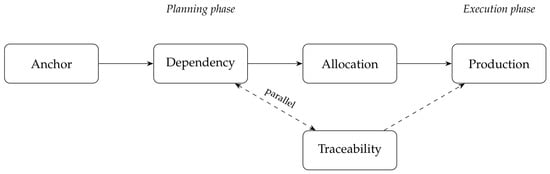
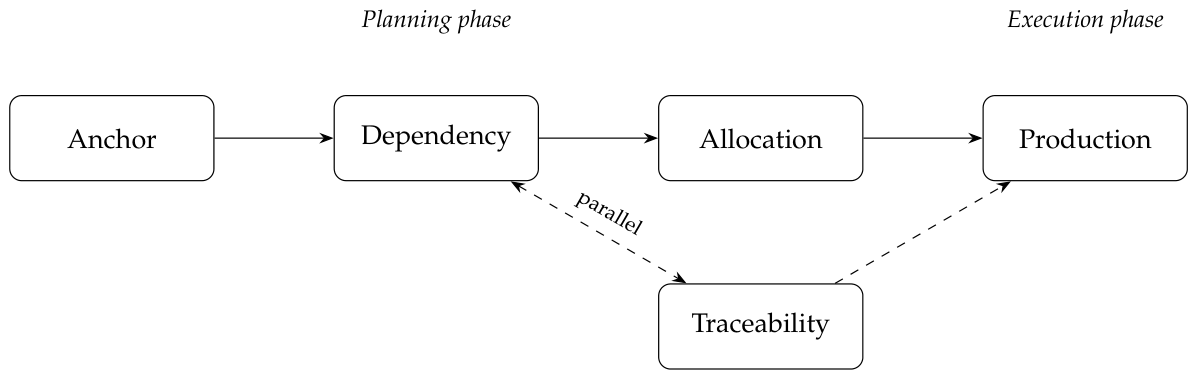
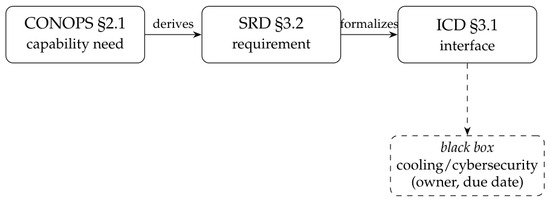
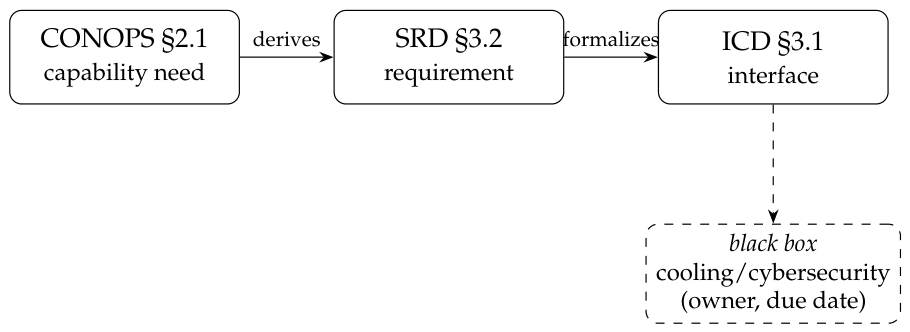
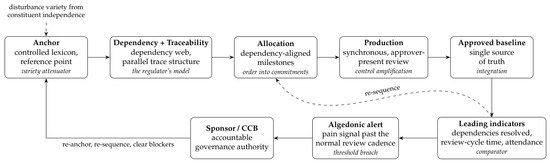
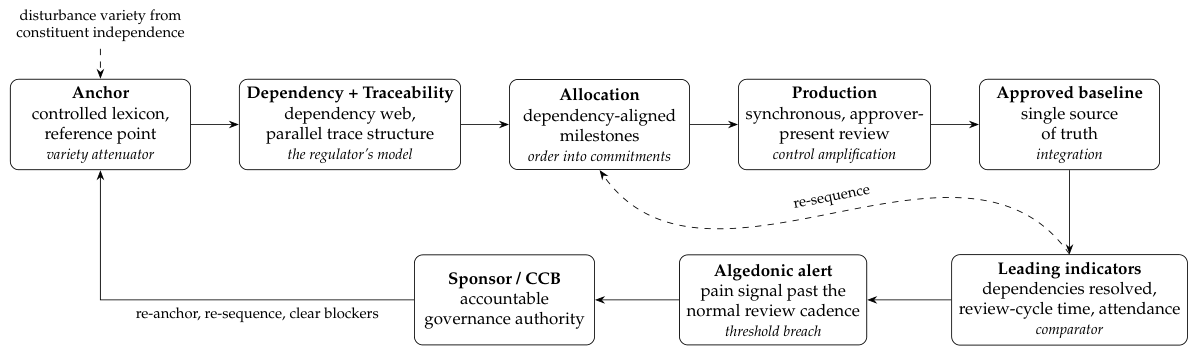
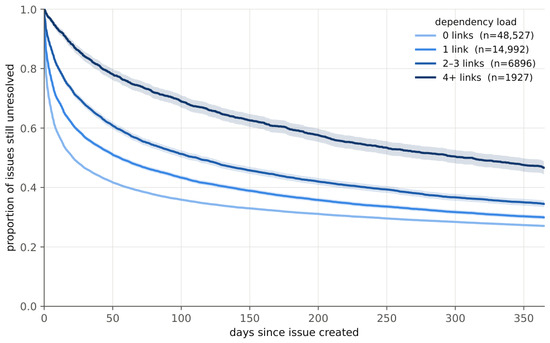
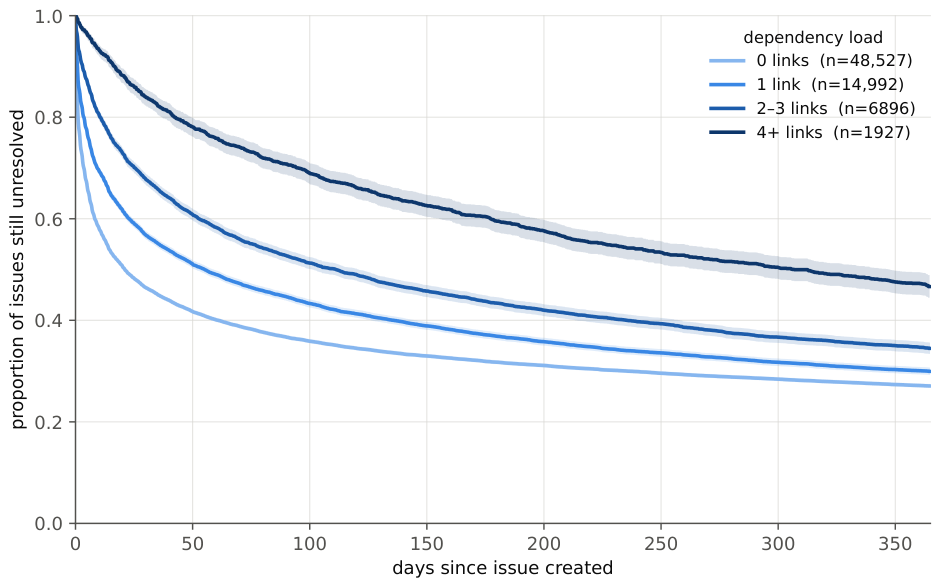
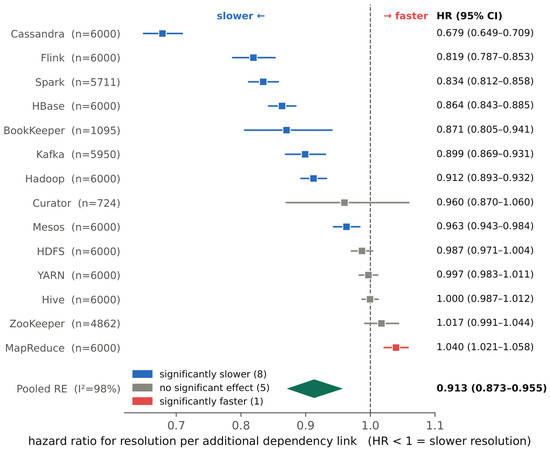
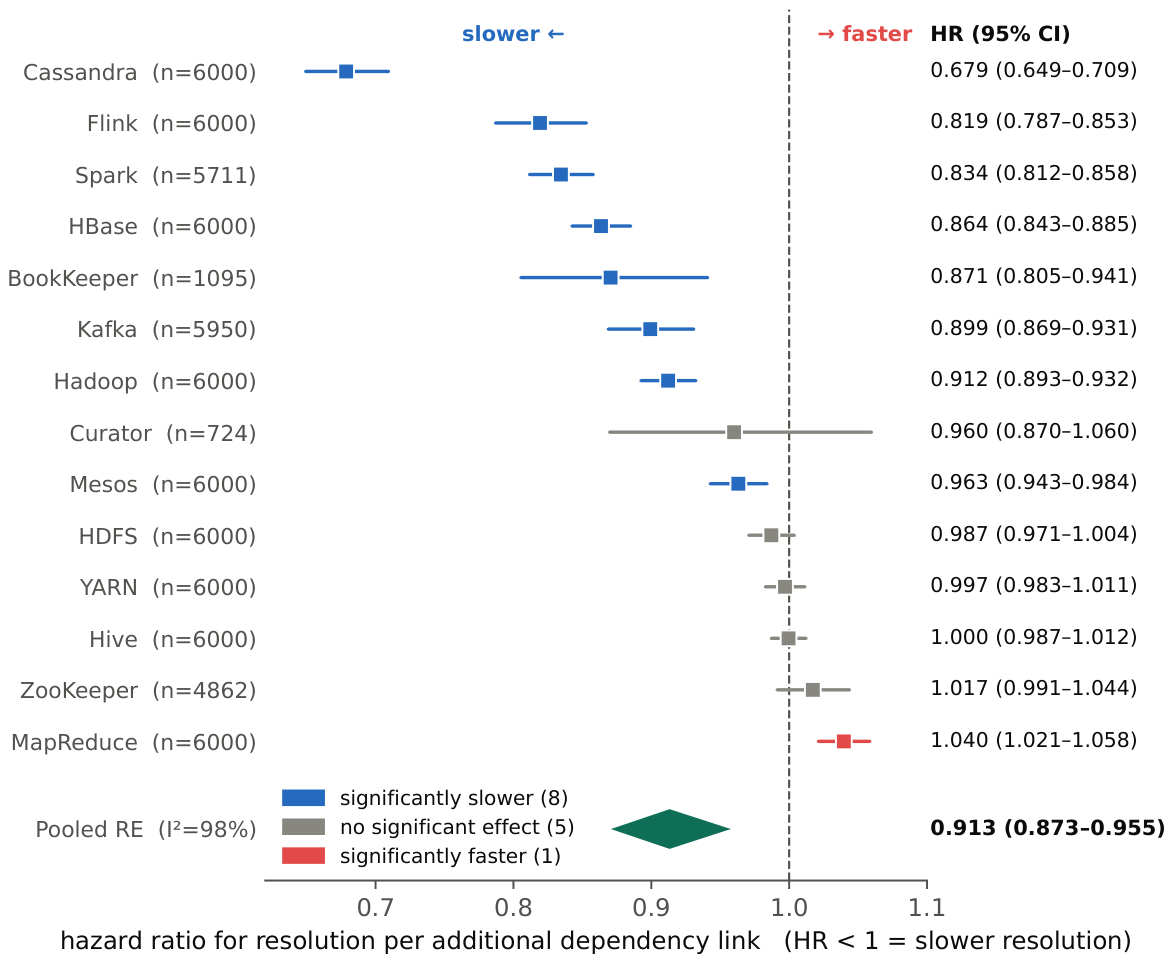


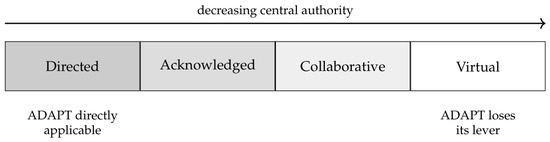
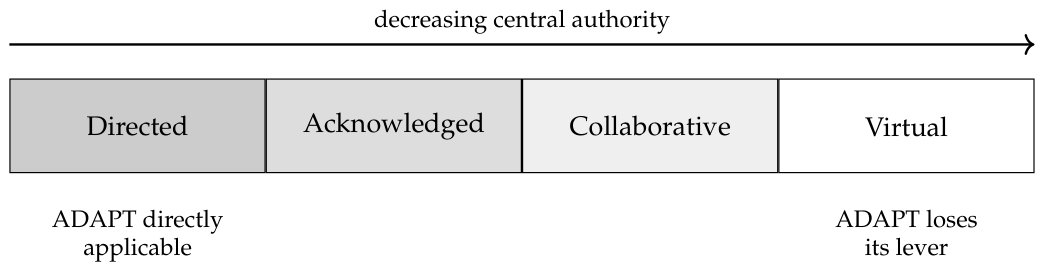

Disclaimer/Publisher’s Note: The statements, opinions and data contained in all publications are solely those of the individual author(s) and contributor(s) and not of MDPI and/or the editor(s). MDPI and/or the editor(s) disclaim responsibility for any injury to people or property resulting from any ideas, methods, instructions or products referred to in the content. |
© 2026 by the author. Licensee MDPI, Basel, Switzerland. This article is an open access article distributed under the terms and conditions of the Creative Commons Attribution (CC BY) license.