
Skip to Content

Maritime

Maritime is an international, peer-reviewed, open access journal which addresses the immense and interconnected challenges of maritime transport sectors, with the vision of shaping future maritime transport and systems. This journal is published quarterly online by MDPI.
  • Open Access— free for readers, with article processing charges (APC) paid by authors or their institutions.
  • Rapid Publication: first decisions in 18 days; acceptance to publication in 7 days (median values for MDPI journals in the first half of 2026).
  • Recognition of Reviewers: Reviewers whose reports are timely and of high quality receive an APC discount voucher for a future publication in an MDPI journal. Become a reviewer.
  • Companion Journals: Maritime is a companion journal of JMSE.

Get Alerted

Add your email address to receive forthcoming issues of this journal.

All Articles (5)

  • Article
  • Open Access

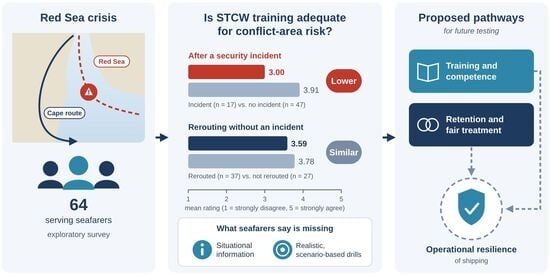
Global shipping carries over 80% of world trade, yet existing supply-chain-resilience theory models resilience at the level of the firm, node and network, without treating the workforce operating those nodes as a variable. This exploratory study addresses that gap using the 2023–2026 Red Sea/Houthi crisis as its empirical setting. A pilot-scale, cross-sectional online survey of 64 serving seafarers combined closed-ended items with qualitative content analysis of two open-text questions. Seafarers who had witnessed or been directly involved in a security incident rated STCW crisis-management training as less adequate for conflict-area risk than those without such exposure (Mann–Whitney U = 227.0, p = 0.007, r = 0.34), the only comparison that remained significant after Holm adjustment within its family of tests; Red Sea transit or Cape of Good Hope rerouting without an incident was not associated with lower ratings. Open-text responses identified situational information and realistic scenario-based drills, rather than generic compliance training, as the specific gap, and a minority questioned seafarers’ right to decline a high-risk voyage. Because fatigue and psychological distress could be captured only through single, non-validated items, findings on these outcomes are indicative only. Building on these results, the study proposes, as exploratory propositions for future testing rather than established relationships, two human-factor pathways through which geopolitical risk may affect operational resilience: a training-competence pathway and a retention/psychological-contract pathway. The study contributes hypothesis-generating evidence, gathered directly from an affected workforce, and derives practical and policy recommendations for STCW training content and seafarer consent protections.

Maritime

6 November 2026

Article thumbnail image
  • Article
  • Open Access

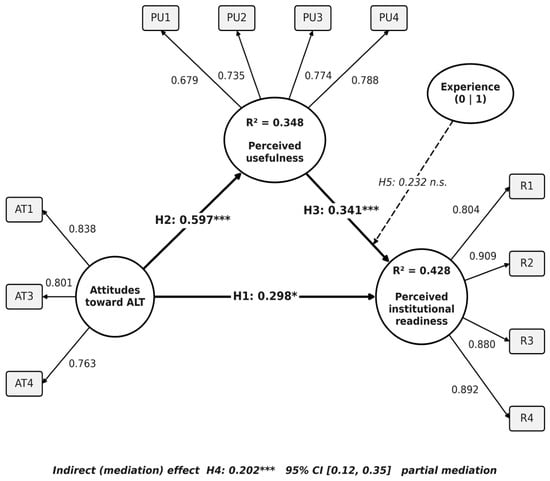
Maritime Education and Training (MET) is undergoing rapid digital transformation, yet adoption of adaptive learning technologies (ALT) remains uneven, constrained by the Standards of Training, Certification and Watchkeeping (STCW) regime and by human and organizational barriers. A persistent question in the technology-acceptance literature is how individual acceptance becomes organizational readiness in safety-critical, regulated settings. This study models the translation from educator attitudes to perceived institutional readiness through the mediating role of perceived usefulness. Partial least squares structural equation modeling was applied to survey data from 104 maritime educators. The model explained 42.8% of the variance in perceived institutional readiness and 34.8% in perceived usefulness. Educator attitudes significantly predicted perceived institutional readiness (β = 0.298), and the relationship was partially mediated by perceived usefulness (indirect β = 0.202, 95% CI 0.12 to 0.35): educators must first be convinced of an ALT’s practical value before judging their institution ready to adopt it. A hypothesized moderation by professional experience was not supported and is reported as exploratory. Because predictor and outcome were self-reported by the same respondents, the outcome is interpreted as perceived readiness rather than a verified organizational state. The study contributes a validated model of the individual-to-organizational translation mechanism in MET and guidance for MET leaders integrating ALT under STCW.

Maritime

15 September 2026

PLS-SEM structural model of educator attitudes, perceived usefulness, and perceived institutional readiness for ALT adoption. Standardized path coefficients are shown with significance levels; the dashed arrow denotes the exploratory experience moderation, which is not supported under conventional two-tailed testing. Outer arrows run from each construct to its indicators and show standardized loadings; inner arrows are the standardized path coefficients, with R2 reported inside the endogenous constructs. Experience is coded 1 = under five years of MET experience and 0 = five or more. Significance: *** p < 0.001; * p < 0.05; n.s. = not significant (two-tailed).
  • Article
  • Open Access

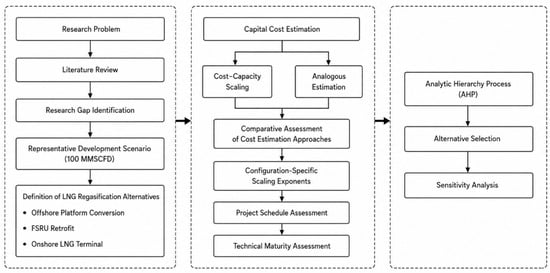
This study presents a comparative techno-economic assessment of three LNG regasification alternatives, namely offshore platform conversion, floating storage and regasification unit (FSRU) retrofit, and onshore LNG terminals, under a 100 million standard cubic feet per day (MMSCFD) development scenario representative of prospective LNG infrastructure requirements in Indonesia. Capital cost is estimated using both cost–capacity scaling based on a 20 MMSCFD reference case and analogous estimation, while project schedule and technical maturity are evaluated. The resulting capital cost, project schedule, and technical maturity are subsequently used as input criteria in the Analytic Hierarchy Process (AHP) to rank the LNG regasification alternatives. The assessment shows that offshore platform conversion remains the preferred alternative, followed by FSRU retrofit and onshore LNG terminals. Although the alternative ranking remains unchanged under both cost estimation approaches, the choice of cost estimation method influences the preference magnitude among the alternatives through its effect on the cost criterion. Comparison of the two approaches shows that the conventional cost–capacity scaling method, using a uniform scaling exponent of 0.6, produces inconsistent cost estimates relative to analogous estimation, overestimating the costs of offshore platform conversion and FSRU retrofit while underestimating those of onshore LNG terminals. Back-calculation yields effective scaling exponents of 0.43, 0.37, and 0.77 for offshore platform conversion, FSRU retrofit, and onshore LNG terminals, respectively. The study extends previous comparative techno-economic assessments to a 100 MMSCFD development scenario and systematically evaluates the applicability of the conventional cost–capacity scaling approach through comparison with analogous estimation, leading to the derivation of configuration-specific scaling exponents by back-calculation. These findings provide a more representative basis for conceptual-stage cost estimation and support more reliable decision-making during early-stage LNG infrastructure planning.

Maritime

31 August 2026

Research Framework.
  • Article
  • Open Access

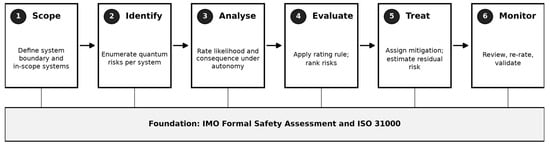
A maritime autonomous surface ship (MASS) operates with reduced or absent crew and depends on cryptography to authenticate the commands, software updates, and position data that keep it under control, and on satellite positioning to navigate. Quantum computing changes this risk picture in two opposite directions that this study keeps separate. As a threat, a cryptographically relevant quantum computer would break the public-key cryptography that authenticates remote-control commands, code-signing signatures, and position exchanges, and adversaries can harvest long-lived encrypted data now for later decryption. As a contributor to mitigation, quantum sensing offers positioning that does not rely on satellite signals, addressing the distinct problem of positioning denial. No prior work has named the specific quantum-related risks to such a vessel, rated them under a degree of autonomy, and paired each with a mitigation and a residual-risk estimate; this study provides that assessment. Following the International Maritime Organization Formal Safety Assessment style and the ISO 31000 process, it identifies eight risks, rates likelihood and consequence on defined qualitative scales that represent structured expert judgement (with consequence conditioned on autonomy), applies bow-tie analysis to the highest-rated risks, and adds a sensitivity analysis, uncertainty ranges, and an illustrative cyber-physical propagation model. Positioning denial and command-link forgery rate highest; the ranking is robust to the threshold choices tested, with the autonomy conditioning the most influential assumption. Migration to post-quantum cryptography combined with a non-satellite positioning fallback reduces residual risk most. The register is offered to operators, classification societies, and flag administrations as a basis for planning and for expert elicitation, with its ratings stated as judgement open to revision.

Maritime

27 August 2026

The risk-assessment process as six numbered stages on a Formal Safety Assessment and ISO 31000 foundation. Arrows indicate the sequence of the stages.

Highly Accessed Articles

News & Conferences

Latest Issues

Open for Submission

Journal Sections

XFacebookLinkedIn
Maritime - ISSN 3043-1085