


Abstract
Purification systems in water treatment, gas upgrading, bioprocessing, pharmaceuticals, and resource recovery operate under disturbances that expose the limits of static design and end-point analytics. The central question is no longer whether a model can reproduce historical data, but whether the process can infer its internal state early enough to protect purity, recovery, productivity, and robustness. This critical review examines how purification is moving from monitoring toward self-optimizing operation through process analytical technology, operando sensing, chemometrics, soft sensors, digital shadows, digital twins, hybrid models, and control-oriented optimization. Distinct from recent platform-specific or method-specific reviews, it compares membranes, adsorption and cyclic gas separations, chromatography, and integrated purification trains through the operational chain that links measurement, state estimation, model updating, decision support, and closed-loop action. The review also provides a cross-platform maturity framework and minimum reporting expectations for operational claims. The strongest published operational evidence remains concentrated in continuous downstream bioprocessing, while membrane and adsorption systems contribute major advances in fouling inference, adaptive surrogates, and state estimation. The review concludes by defining the evidentiary conditions required for trustworthy self-optimizing purification.
1. Introduction
Purification determines product quality, regulatory compliance, and process economics across water treatment, gas upgrading, bioprocessing, pharmaceuticals, and resource recovery. In each of these settings, the variables that matter most during operation are often hidden inside filters, membranes, adsorbent beds, chromatographic columns, and integrated trains. Fouling begins before flux loss becomes obvious. Usable binding capacity declines before outlet breakthrough is detected. Hydrodynamic maldistribution and resin aging alter column behavior before the final product signals a problem. Purification is therefore an engineering problem of hidden states, indirect evidence, and time-critical action.
Digitalization has given this long-standing problem a new vocabulary. Process analytical technology (PAT), data-driven monitoring, and soft sensing shape one part of the discussion [1,2,3]. Digital shadows and digital twins shape another [4,5]. Physics-informed modeling adds a further layer [6]. Yet the terminology is often used loosely. A regressor trained on historical campaigns is not a twin simply because it runs online. A dashboard is not a self-optimizing system because it displays more signals. Conceptual precision matters because the operational value of a digital layer depends on what it can infer, how it stays calibrated, how uncertainty is treated, and whether its output can support a qualified operating decision.
Recent reviews clarify important parts of this landscape, but they remain separated by platform or tool class. Reviews in bioprocessing [7], membrane science [8], and the water sector [9] define major segments of the digitalization problem. Downstream-purification reviews then add focused analyses of process analytical technology, chemometrics, and quality monitoring within biomanufacturing [10,11,12,13]. Additional membrane-focused reviews synthesize machine learning, hybrid models, digital shadows, and digital twins across major membrane technologies [14,15]. The unresolved gap is operational comparability across purification platforms. This review addresses that gap by evaluating membranes, adsorption and cyclic gas separations, chromatography, and hybrid trains through a common operational lens that distinguishes monitoring, digital shadows, digital twins, and self-optimizing systems according to observability, state estimation, model updating, uncertainty handling, and decision authority. That framework allows claims of digital maturity to be judged against the same criteria across domains.
The operationally mature literature is concentrated where measurements, mechanistic understanding, and explicit decision objectives have been developed together. The evidence base now spans PAT and automation in downstream processing (DSP) [10,11,12,13], membrane prediction and live monitoring [14,15,16,17,18], adaptive and physics-constrained adsorption modeling [19,20], and continuous chromatography, autonomous extraction, and newer hybrid-train studies [21,22,23,24,25,26]. The purpose of this review is therefore not to catalogue digital methods in purification, but to test whether the chain from measurement to decision has become reliable enough to support state-aware, self-optimizing operation.
The specific task of this review is to evaluate whether published digital layers in purification have progressed beyond observability toward intervention. For that reason, each platform class is assessed using the same operational criteria: what is measured, what hidden state is inferred, how the model is updated, how uncertainty is handled, what decision authority is granted, and what evidence supports operation under drift or scale transfer.
Table 1 makes that distinction explicit by positioning the present review against adjacent recent surveys that are already central to this manuscript.
Table 1.
Position of the present review relative to adjacent recent reviews.
Seen against these adjacent reviews, the present article is not another platform-specific survey or a review of one algorithmic family. Its differentiator is a purification-specific operational chain from observability to intervention that spans membranes, adsorption and cyclic gas separations, gas purification, chromatography, and hybrid trains, asking what can be measured, inferred, updated, and acted upon across domains.
2. Literature Base, Search Strategy, and Review Logic
The literature base in this critical review was developed through a transparent scoping workflow using Scopus, Web of Science, PubMed, and Google Scholar, followed by manual checking of publisher records, DOI landing pages where available, and reference lists from recent reviews and primary studies. The core operational-literature search was last updated in March 2026. Regulatory and standards sources added during revision were checked on 25 May 2026. The main Boolean search family combined purification terms (purification OR separation OR membrane OR adsorption OR “pressure swing adsorption” OR “vacuum pressure swing adsorption” OR chromatography OR “downstream processing” OR “gas purification” OR “water treatment”) with digitalization and control terms (“digital twin” OR “digital shadow” OR “soft sensor” OR chemometrics OR “process analytical technology” OR “hybrid model” OR “physics-informed” OR “model predictive control” OR “reinforcement learning” OR autonomous operation). Priority was given to peer-reviewed journal articles from January 2022 to March 2026, while earlier sources were retained when they established methodological, regulatory, or conceptual foundations that remain necessary for the argument [1,2,3,4,5,6].
Screening followed a four-stage scoping workflow: (a) identification through database searching and citation chaining, (b) eligibility screening by title, abstract, and full text for operational relevance, (c) classification against the observability-to-intervention criteria, and (d) manual verification of retained sources. Inclusion emphasized studies that connected purification operation to at least one operational element: live or near-live measurement, hidden-state inference, model updating, uncertainty treatment, decision support, supervisory control, autonomous operation, or an explicit deployment limitation. Exclusion applied to conference abstracts without full peer-reviewed records, preprints, patents, generic artificial-intelligence studies without a validated purification context, and studies limited to material discovery, offline property prediction, or retrospective screening without operational linkage. Non-peer-reviewed web material was excluded from the core operational evidence base; official regulatory and standards documents were retained only where they define governance, compliance, or integration requirements. The final cited working set in the revised manuscript comprises 59 sources. The exact database-hit counts are not presented as PRISMA-style screening counts because the review was not designed or claimed as an exhaustive systematic review and no auditable database export was preserved. This avoids unverifiable numerical reconstruction while still making the search pathway, screening logic, and selection criteria auditable.
The representative operational-evidence synthesis was constructed as a judgment-based synthesis rather than as an exhaustive extraction table. Studies were selected to cover the main platform classes discussed in the review and to illustrate different levels of operational maturity. Priority was given to works that explicitly reported or enabled assessment of test scale, time basis or campaign duration, live or near-live measurement, hidden-state inference, model updating, uncertainty treatment, advisory/supervisory/autonomous decision use, fallback behavior, or unresolved deployment limitation. Where the source literature does not consistently report scale, duration, uncertainty, or control authority, the table states this explicitly rather than inferring missing values.
The functional ladder used for this classification is shown in Table 2. The cross-platform maturity map presented later was constructed by applying this ladder to the representative operational-evidence synthesis described below. The maturity assignments are qualitative evidence-weighted judgments, not meta-analytic scores. They reflect the density and consistency of published evidence for live or near-live measurement, hidden-state estimation, model updating, uncertainty treatment, scale or duration of validation, and decision authority.
Table 2.
Functional ladder from monitoring to self-optimizing purification systems.
Application sectors such as food manufacturing are therefore treated only where they share the same purification-unit logic and operational digitalization challenges. They are not developed as separate sector-specific domains in this review. The organizing unit of analysis is the purification platform and its operational maturity rather than the end-use sector.
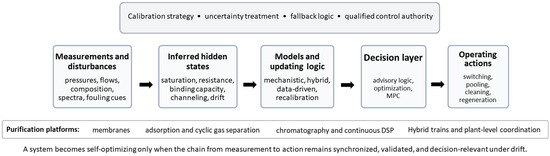
GenAI-assisted literature mapping was used only as an auxiliary orientation and editorial-structuring tool. No reference was retained solely because it appeared in GenAI output. Candidate references were verified manually against publisher records, DOI pages, indexing records where available, and the reference lists of relevant primary studies and reviews. References that could not be verified, did not match the manuscript context, or did not support the claim for which they were considered were excluded. All cited sources, interpretations, and final wording were critically reviewed by the author. This organizing logic is summarized in Figure 1.
Figure 1.
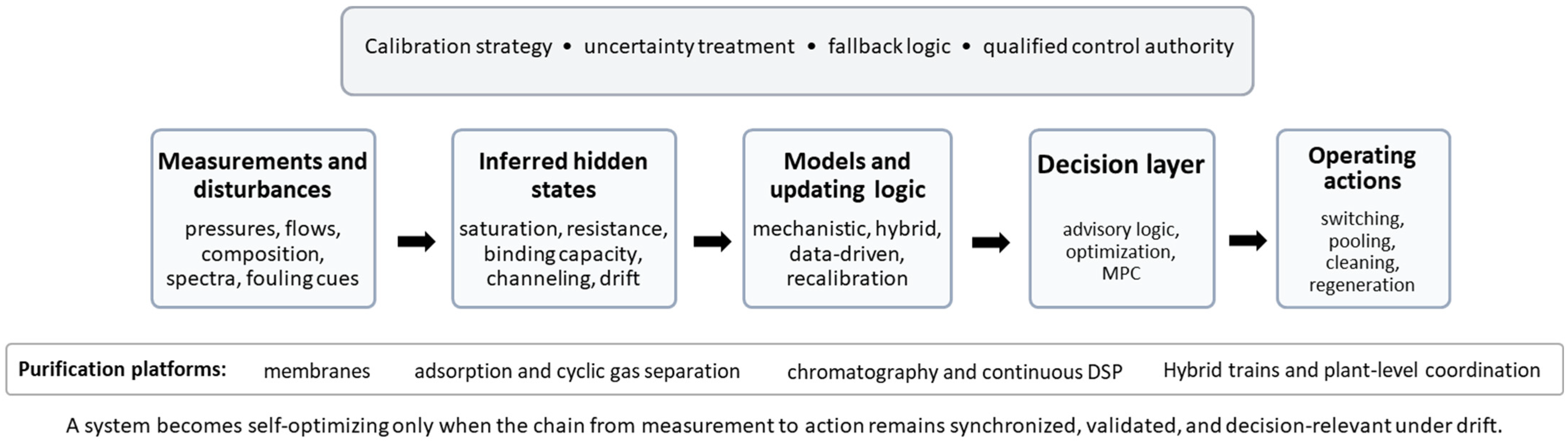
Operational chain from observability to self-optimizing purification. The diagram summarizes the required progression from measurements and disturbances to hidden-state inference, model/update logic, decision layers, and operating actions. The chain is interpreted across membranes, adsorption and cyclic gas separation, chromatography/continuous downstream processing, and hybrid trains; a system is considered self-optimizing only when the chain remains synchronized, validated, and decision-relevant under drift.
3. What Makes a Purification System Self-Optimizing
A self-optimizing purification system is an operating architecture, not a visualization layer. It has to measure or infer variables that matter, estimate the hidden states that govern performance, update or recalibrate its model as the process drifts, and convert those estimates into actions that remain inside quality, safety, and equipment constraints. If one of these links is missing, the system falls back to monitoring, offline optimization, or a digital shadow.
The distinction between digital shadow and digital twin remains central. In the broader manufacturing and process-engineering literature, a digital shadow is usually a model-linked representation updated from process data, whereas a digital twin implies a bidirectional relationship with operational meaning [4,5]. Reviews in bioprocessing, membrane science, and the water sector point to the same practical criterion. The digital representation must stay synchronized with the physical process, remain predictive as feeds, materials, and equipment condition drift, and be qualified to inform or execute a decision rather than explain performance after the event [7,8,9].
Self-optimizing operation also does not require the removal of human supervision. A purification system may still operate under expert oversight and qualify as self-optimizing if it can adapt loading limits, pooling rules, switching times, cleaning intervals, recycle policies, or regeneration schedules on the basis of an updated process state. What matters is the presence of a validated decision layer with authority to act through feedback. Table 2 translates these distinctions into an operational ladder that can be applied consistently across purification platforms.
This ladder shows why a large share of the recent literature still fits advanced monitoring or digital-shadow categories rather than self-optimizing operation.
4. The Observability Layer: Process Analytical Technology, Operando Sensing, and Chemometrics
Process analytical technology established the core operational principle well before digital-twin terminology became widespread. Product quality has to be protected during operation through timely measurements and model-assisted interpretation, not verified only after the fact [1]. Downstream bioprocessing translated that principle most systematically into purification because quality attributes, viral safety, and campaign economics demand earlier intervention [10,11,12,13]. The lesson extends beyond biopharma. In any purification train, observability begins with measurement design. A sensor only matters when it improves what the process can know early enough to change an operating decision.
The variables that most strongly influence purification performance are rarely measured directly. Feed composition and outlet quality are easier to observe than local saturation in an adsorbent bed, cake consolidation inside a membrane module, early compaction, channeling in a column, or solvent holdup in an extraction stage. Operando and inline sensing are valuable because they shorten the distance between measurable signals and the hidden states that determine purity loss, energy demand, cycle timing, and equipment protection.
Chemometrics and soft-sensor design therefore occupy a central position in self-optimizing purification. Reviews in downstream bioprocessing show that multivariate calibration, spectral preprocessing, sensor fusion, and inferential quality prediction are moving from offline analysis toward real-time decision support [2,3,10,11,12,27]. The same logic is now visible in water and membrane systems, where digital-twin initiatives increasingly combine process data, state estimation, and supervisory objectives rather than treating analytics as a detached reporting layer [9,28].
A recurring weakness across the literature is mismatch between time scales. Data recorded every few minutes cannot stabilize a phenomenon that unfolds in seconds. High-frequency data are equally unhelpful when the inferred states are fragile under noise, missing values, latency, or drift. In practice, the bottleneck is often not the absence of algorithms. It is the mismatch between sampling rate, disturbance dynamics, model latency, recalibration frequency, and control horizon. That problem is already visible in membrane fouling prediction, water treatment digitalization, and autonomous reverse-osmosis studies, where the value of a digital layer depends less on nominal predictive accuracy than on how prediction latency aligns with the operating move it is meant to support [28,29,30,31].
5. Modeling Architectures for Purification
5.1. Mechanistic and Reduced-Order Models
Purification has never lacked mechanistic models. Transport equations, adsorption isotherms and kinetics, resistance-in-series formulations, column balances, thermodynamic relations, and computational fluid dynamics remain indispensable because they preserve physical meaning and usually extrapolate more responsibly than purely empirical fits [5,32,33,34]. Their weaknesses are equally well known, namely computational burden, parameter uncertainty, and the fact that many critical states and boundary conditions cannot be measured directly in real time.
Reduced-order modeling is a design task for control-relevant digitalization. A useful twin does not need to reproduce every degree of freedom of a high-fidelity simulation if a lower-dimensional representation can preserve the states that govern decision quality. In purification, the most useful reduced models maintain mass-balance closure, physically admissible flux decline, bounded responses to actuation, and realistic breakthrough or elution behavior. Model reduction succeeds only when it preserves the structure that makes the operating decision trustworthy.
5.2. Hybrid and Physics-Informed Models
Hybrid modeling is attractive because it avoids a false choice between rigid first-principles descriptions and opaque regressors. Physics-informed learning, grey-box formulations, and model-structure augmentation can preserve conservation laws and known kinetics while allowing data to correct the part of the process that is difficult to parameterize or poorly understood [6,8,32,33,35]. Membrane fouling illustrates this point because hybrid formulations can improve prediction while retaining mechanistic interpretation of the dominant resistance contributions [16].
The same logic extends to adsorption and chromatography. Equilibrium relations and transport theory are known in principle, yet real feeds, resin aging, valve timing, and non-ideal hydrodynamics can push purely mechanistic models outside their validated range. Operational relevance depends on whether the hybrid model improves decisions under disturbance, scale transfer, or partial sensor failure. Recent work on adsorption surrogates, chromatography hybrid models, and broader bioprocess architectures shows that hybridization becomes useful only when it remains tied to experimentally measurable variables and to operating actions that an operator or controller can actually take [19,33,36,37].
5.3. Updating, Drift, and Uncertainty
A model that recovers accuracy only after repeated manual refitting is not yet a self-updating twin. Recent process-engineering, bioprocess, and membrane reviews repeatedly identify calibration, qualification, uncertainty treatment, and maintenance logic as the real divide between promising demonstrations and deployable systems [5,7,8]. Purification papers still underreport how sensor error propagates into control decisions, how the model behaves outside the training domain, and how much manual intervention is needed to keep the digital layer trustworthy over long campaigns [22,25,31].
6. Domain-Specific Progress
6.1. Membrane Processes
Membrane systems currently provide two distinct bodies of digital literature. One body is broad and methodological. Recent reviews document rapid growth of machine learning across membrane science [14,15]. The membrane-specific critical review by Ghasemzadeh et al. widens that picture to hybrid models, digital shadows, and digital twins across major membrane technologies [8]. Water-sector and water-systems reviews reinforce the same shift toward operational digitalization [9,35]. Dynamic membrane-desalination and organic-framework membrane reviews further show how control relevance and materials prediction still coexist uneasily within the broader membrane literature [38,39]. The second body of literature is narrower but more operationally relevant. It focuses on fouling inference, state estimation, and live synchronization with running equipment [16,17,18,28,29,30,31]. The difference matters because self-optimizing purification depends much more on the second body of work than on retrospective prediction alone.
One of the most important recent membrane advances is physically disciplined prediction of performance loss. Garakani and Chew showed that classical fouling relations can be embedded within a learning framework that improves prediction while retaining mechanism-level interpretation [16]. Full-scale membrane bioreactor studies now show that plant signals can support useful early warning of irreversible fouling, but early warning is not yet the same as a qualified twin with control authority [29]. The same caution applies to unsteady membrane desalination. As recent desalination reviews emphasize, dynamic operation, feed variability, and disturbance propagation matter because the control problem is inherently time dependent rather than static [38].
Operationally oriented membrane examples are now appearing, although they remain less common than review-level synthesis or design screening. Taylor et al. reported a live digital shadow soft sensor for single-pass tangential flow filtration that tracked membrane degradation during continuous manufacturing [17]. Møller et al. demonstrated a continuously updated data-driven twin for water ultrafiltration [18]. Ma et al. described a machine-learning-enabled digital-twin framework for water treatment facilities, while Chowdhury et al. and Abdullah et al. moved closer to qualified decision-making through autonomous online optimization and model predictive control of closed-circuit reverse osmosis [28,30,31]. Reviews on machine learning for organic framework membranes, however, still remind us that a large share of membrane artificial intelligence remains upstream of production, at the stage of material selection and performance screening rather than validated control [39].
6.2. Adsorption and Cyclic Gas Separations
Adsorption systems and cyclic gas separations are especially suitable test cases for twin-enabled operation because breakthrough, regeneration, and cycle scheduling all depend on internal bed states that are only partly observable. One of the clearest recent steps is the adaptive digital twin for pressure swing adsorption reported by Costa et al., which combines feedback tracking, online learning, and uncertainty assessment [20]. Recent work on physics-informed surrogate modeling and transfer-learning-enabled pressure swing adsorption modeling shows that spatiotemporal adsorption behavior can be learned under physical constraints, an important step when labeled data are scarce and computational cost limits real-time use [19,36].
The critical hidden states in adsorption and cyclic gas separation are the spatial loading profile, mass-transfer-zone position, thermal-front evolution, impurity accumulation, sorbent aging, valve timing, and local maldistribution. These states are difficult to observe directly because industrial beds are enclosed, pressure-cycled, often thermally heterogeneous, and commonly instrumented only at inlets, outlets, pressure nodes, and a limited number of temperature positions. Model updating is therefore more fragile than in systems where quality attributes can be measured frequently at the outlet or at multiple intermediate locations.
The implementation bottleneck is not only algorithmic. Deployment is limited by sensor accessibility in high-pressure or hazardous service, cycle latency, synchronization of multi-bed switching, validation cost, proprietary historian data, and the risk that an apparently accurate model may fail after feed swings, adsorbent aging, valve wear, or changes in regeneration duty. Poor estimation or outdated updating can lead to premature switching, impurity breakthrough, excessive purge or vacuum duty, over-conservative cycle times, and avoidable product loss. Because reported gains are not directly comparable across feeds and cycles, future studies should report consequences using common metrics such as purity, recovery, energy per unit product, productivity, adsorbent utilization, and off-specification events.
This matters directly for gas purification, carbon capture, acid-gas removal, hydrogen purification, and biogas upgrading, where disturbances are common and cycle inefficiency translates rapidly into energy use and purity loss. Current evidence is strongest for model development, surrogate construction, and demonstration-scale digitalization rather than for broadly transferable closed-loop deployment. Carbon-capture modeling reviews, demo-scale digital twins for H2S removal from biogas, and digital-twin implementations in biomass-to-gas plants all point to the same opportunity: gas purification is rich in mechanistic knowledge and industrial relevance, yet published examples of validated live state estimation and supervisory control remain comparatively sparse. The asymmetry reflects the published literature rather than selective treatment in this review, which is why the discussion here remains deliberately more cautious for gas purification and cyclic separation [40,41,42].
Adsorption and gas-purification research combine strong mechanistic foundations with rapidly developing adaptive models. What is still scarce is a widely used operational framework that connects sensing, state inference, updating, and control with the same discipline already visible in downstream bioprocessing [12,13,20,36].
6.3. Chromatography and Continuous Downstream Purification
Continuous chromatography and related downstream bioprocess workflows provide the densest published evidence of digitalization with direct decision relevance. These systems combine rich online analytics, explicit quality attributes, and economically meaningful control decisions. Reviews on process analytical technology in downstream bioprocessing document a sustained shift from offline analytics toward model-assisted monitoring, quality prediction, and control [10,11,12,13]. Recent work on continuous downstream processing and digital solution platforms shows how analytics, automation, and supervisory environments are beginning to converge into operational workflows rather than isolated tools [7,25,43].
Tiwari et al. showed that a digital twin linked to online high-performance liquid chromatography data can support pooling decisions in continuous monoclonal antibody capture [21]. Sondell et al. then demonstrated automated twin generation and calibration for continuous antibody capture, with optimization of yield and resin utilization under close agreement between experiment and simulation [22]. Eslami et al. provided one of the clearest chromatography examples of model predictive control directed at dynamic binding capacity and productivity [44]. Beyond these studies, model-assisted development for continuous antibody chromatography and hybrid chromatographic models are making the mechanistic-to-hybrid transition technically mature enough for more adaptive control architectures [34,37]. Michalopoulou and Papathanasiou extended this direction with reinforcement-learning-based dual adaptive control of continuous chromatographic separations, illustrating how learning-based supervision can be embedded within structured process constraints [45].
Related convergence is now visible beyond chromatography alone. Autonomous liquid–liquid extraction supported by a digital twin and process analytical technology has been demonstrated in biologics manufacturing [23]. Digital twins for continuous virus-like particle production and autonomous downstream operation show that the unit-operation boundary is beginning to widen [24,46]. Yet even in this comparatively advanced domain, most studies remain laboratory scale or pilot-like rather than fully industrial deployments [25,43].
6.4. Hybrid Trains and Beyond Single-Unit Operations
The next challenge is plant-level coordination. Most industrial purification problems are not single-unit problems. They are flowsheet problems shaped by buffers, recycle loops, utility constraints, and disturbance propagation across trains. Emerging studies on high-gradient magnetic separation, continuous clarification, and hybrid adsorption–ultrafiltration systems show that twin logic can be extended beyond the canonical membrane and chromatography cases [26,47,48]. Even so, a digital layer that optimizes one unit in isolation can still damage overall flowsheet performance if it ignores upstream variability, downstream bottlenecks, or shared objectives such as purity, recovery, throughput, energy demand, and solvent consumption [9,28]. Table 3 compares representative recent studies through a shared maturity lens so that methodological novelty is not mistaken for operational readiness.
Table 3.
Representative operational evidence and reporting descriptors used to judge purification-digitalization maturity. The table is a judgment-based synthesis rather than an exhaustive catalogue. “Not consistently reported” means that the corresponding descriptor was absent or non-comparable across one or more sources in the evidence group.
Across the studies in Table 3, integration is increasing, but validated end-to-end architectures that unite qualified state estimation, model updating, and decision authority remain uncommon.
Additional plant-oriented studies broaden this picture. Yang et al. used pressure swing adsorption simulation, modeling, and machine learning to support gas allocation in a hybrid hydrogen network [49]. Abdoos et al. combined validated pressure swing adsorption modeling, industrial scale-up, and surrogate-based optimization for ammonia-derived hydrogen purification [50]. Control-oriented studies by Martínez García et al. and Brizuela-Mendoza et al. showed that simplified pressure swing adsorption models can be coupled to state-feedback or geometric controllers that preserve hydrogen purity under disturbance scenarios [51,52]. In parallel, Solari et al. demonstrated a real-data-driven digital twin for monitoring and control of an industrial cyclone bag filter [53]. Together, these studies extend the evidence base beyond downstream bioprocessing, but they also confirm that most plant-oriented gas and filtration examples remain site-specific and only partly integrated with live state estimation, uncertainty-aware updating, and multi-unit supervisory control. At the cyclic-unit level, Gutierrez-Ortega et al. demonstrated automated breakthrough control in a seven-step vacuum pressure swing adsorption (VPSA) CO2-capture cycle, showing that feed and rinse stop points together with vacuum pressure can replace purely time-scheduled operation and directly shape purity, recovery, and energy demand [54].
Gas purification and plant-level filtration introduce an additional observability problem: the variables that matter for capture efficiency, contaminant slip, pressure drop, solvent or sorbent condition, and equipment fouling are distributed across units and often recorded at different sampling rates. Industrial implementation is constrained by sparse inline composition sensing, analyzer lag, cybersecurity restrictions on plant historians, proprietary process data, and the need to qualify model updates before allowing control authority. Plant-level examples should therefore be read as decision support or supervisory digitalization unless they demonstrate synchronized state estimation, uncertainty-aware updating, and a validated fallback strategy.
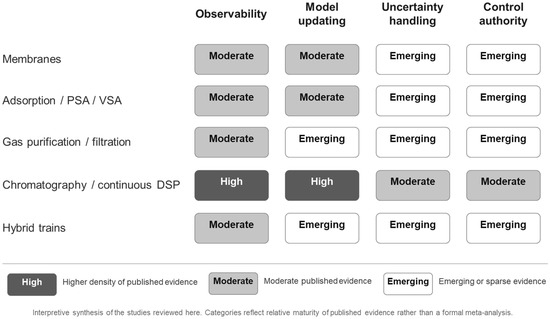
Figure 2 converts the same literature into a cross-platform maturity map. The assignments were made by applying the functional ladder in Table 2 to the evidence groups in Table 3, with greater weight given to live or near-live measurements, explicit hidden-state inference, model updating, uncertainty treatment, scale or duration of validation, and decision authority. The result is a qualitative evidence-weighted synthesis, not a statistical meta-analysis.
Figure 2.
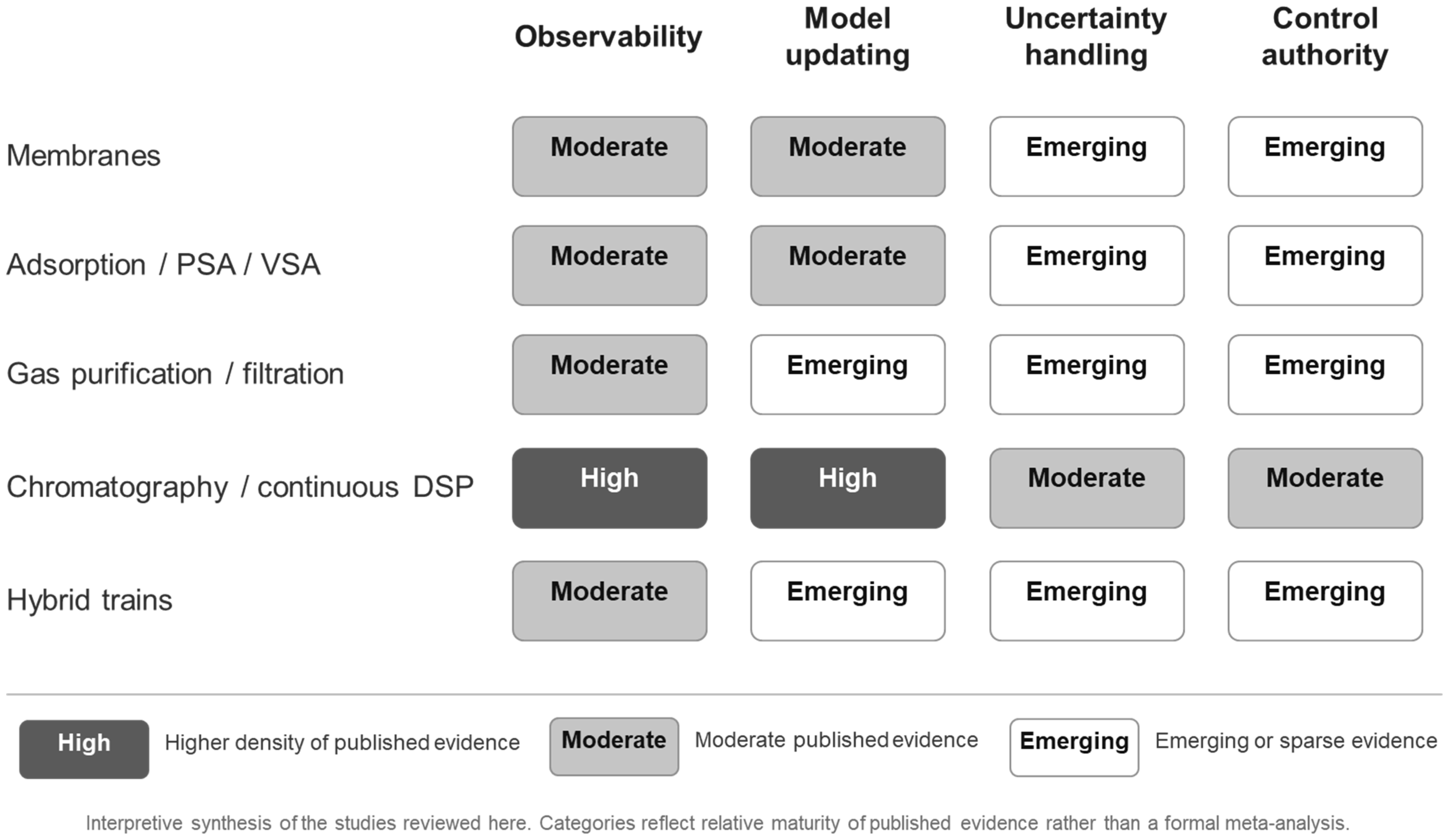
Cross-platform map of operational maturity across purification domains. Darker labels indicate stronger published evidence for the named capability. “High” denotes multiple studies with live or near-live measurements, explicit state estimation or model updating, and demonstrated advisory, supervisory, or autonomous decision use. “Moderate” denotes credible sensing/modeling evidence with limitations in updating, control authority, campaign duration, scale validation, or uncertainty reporting. “Emerging” denotes mainly offline modeling, retrospective prediction, or sparse operational validation. The map should be read as a structured comparison of current evidence density and consistency rather than as a meta-analysis.
This asymmetry reflects the published literature, not selective treatment in the review. Continuous downstream purification provides the densest published combination of observability, model updating, and decision authority. Membranes and adsorption or pressure swing adsorption show stronger progress in modeling than in validated closed-loop deployment. Gas-purification and filtration cases are emerging around disturbance handling and plant-specific supervisory logic, while hybrid trains remain comparatively sparse and still more often optimization-led than autonomously controlled. For this reason, the manuscript uses “monitoring,” “digital shadow,” “digital twin,” “supervisory control,” and “autonomous operation” only when the corresponding level of synchronization, updating, decision authority, and validation is supported by the cited evidence [17,18,20,21,22,23,24,25,39,40,41,42,43,44,45,46,47,48,49,50,51,52,53,54].
7. From Decision Support to Closed Loop Control
Models that explain a completed run are not equivalent to models that determine an operating move in real time. Decision support in purification already spans alarms, advisory dashboards, scenario evaluation, constrained optimization, supervisory control, and a limited number of autonomous or semi-autonomous implementations. These functions differ materially in control authority, validation burden, and consequences of error [5,7,8].
Model predictive control (MPC) is particularly attractive because purification processes are governed by coupled constraints, including purity targets, pressure limits, breakthrough risk, solvent or buffer consumption, and cleaning or regeneration cost. When the underlying model is trustworthy, MPC offers a disciplined way to balance productivity against these constraints. Chromatography already provides persuasive examples, including online optimization of dynamic binding capacity and productivity, digital-twin-enabled pooling, and emerging adaptive control strategies [21,44,45]. Similar logic is now visible in reverse-osmosis systems, where autonomous online optimization and machine-learning-assisted MPC have been demonstrated under dynamic operation [30,31]. For adsorption and cyclic gas separations, the control logic is promising, but the published evidence remains more concentrated in adaptive modeling and optimization than in broadly validated supervisory control [20,36,40,41,42].
The near-term target is dependable, human-supervised decision support with explicit uncertainty and safe failure behavior [5,7]. In purification, trust will be earned by transparent state estimation, documented rationale for recommendations, and well-defined fallback behavior when sensors drift, models lose validity, or feeds move outside the qualified domain [8,22].
8. Governance, Compliance, and Economic Adoption
Self-optimizing purification cannot be evaluated solely by prediction accuracy. In regulated or quality-critical environments, a model-supported decision has to be traceable, validated, attributable, and reversible when the process leaves its qualified operating envelope. In pharmaceutical and bioprocessing settings, this connects to the U.S. Food and Drug Administration (FDA) PAT framework, good manufacturing practice (GMP), European Medicines Agency (EMA) real-time release testing (RTRT), electronic-record integrity, audit trails, and model lifecycle management [1,55,56].
Deployment also depends on the interface between models and plant systems. A digital twin that cannot exchange trustworthy data with supervisory control and data acquisition (SCADA), manufacturing execution system (MES), historian, or control layers remains a decision-support prototype rather than an operational asset. Standards and architectures such as Open Platform Communications Unified Architecture (OPC UA), ISA-95 for enterprise-control integration, and ISA-88 for batch-process control are therefore relevant because they help define the information-technology/operational-technology (IT/OT) environment in which model-supported purification decisions must be integrated, audited, and constrained [57,58,59].
Economic justification should be reported with the same discipline as model accuracy. Relevant metrics include reduction in off-specification product, product loss, buffer or solvent consumption, energy demand, membrane cleaning frequency, sorbent replacement, resin utilization, batch-release time, downtime, and operator intervention. Total cost of ownership (TCO) should include instrumentation, validation, cybersecurity, data infrastructure, software maintenance, model monitoring, and retraining. Without return-on-investment (ROI) and TCO reporting, self-optimizing purification remains difficult to compare with conventional process-control upgrades.
9. Why Most Published Systems Are Not Yet True Digital Twins
Most published systems remain better described as digital shadows than as true digital twins. The main reasons are one-way connectivity, narrow validation, and weak treatment of uncertainty and model maintenance. A model may be updated from process data without ever demonstrating qualified bidirectional intervention. A system calibrated to one feed, one membrane lot, one resin batch, or one campaign length reveals little about deployment under realistic variability. When recalibration is frequent but undocumented, apparently strong performance may conceal substantial manual burden [4,5,7,8].
Continuous validation should be treated as an operating requirement rather than a post hoc accuracy check. For control-oriented purification, the minimum validation protocol should include (a) blocked or rolling-origin validation across feeds, campaigns, resin or membrane lots, and scales, (b) residual and distribution-shift monitoring for drift, (c) explicit sensor-latency and missing-data tests, (d) disturbance and cleaning-history logs, (e) model-invalidation thresholds, and (f) a fallback policy that defines when the system returns from autonomous or supervisory action to advisory or manual operation. These metrics make model maintenance visible and prevent a digital shadow from being overstated as a qualified twin.
Purification also has a scale problem that digital-twin rhetoric can underestimate. Internal states do not transfer trivially from bench modules to pilot skids and production units. Sensor placement, residence-time distribution, cleaning behavior, dead volume, and disturbance structure all change with scale. Economic objectives also need to be integrated much earlier than they usually are. A twin that cannot reason jointly over purity, recovery, throughput, energy demand, solvent consumption, or regeneration duty will have limited operational value in industrial purification [5,26,41,42,43].
The literature therefore contains numerous validated components but comparatively few complete systems. The next phase of the field will be defined as much by validation, governance, and control architecture as by model form.
10. Research Priorities and Reporting Standards
Sensor strategy needs to be treated as part of model design rather than as hardware appended at the end of a project. The decisive issue is which measurements make the dominant hidden states identifiable early enough to influence operation.
Transferability deserves much stricter scrutiny. Hybrid models should not be judged only by fit on the original dataset. Their real value lies in whether they continue to support decisions across feed changes, campaign extension, scale transfer, controlled perturbation, and sensor degradation. Benchmark datasets will only be useful for control-oriented purification research if they preserve process context, including sensor lag, actuation timing, cleaning history, and disturbance structure [8,9,14,35].
Reporting also needs to be more explicit. Papers should state what is measured directly, what is inferred, how models are updated, how uncertainty is quantified, what control authority is actually granted, and how the system behaves when sensors fail or inputs leave the training domain. The most robust future architectures are likely to be hierarchical, with state estimation at the equipment level, optimization at the train level, and human oversight over safety, economics, and quality tradeoffs. Across purification platforms, the common problem is decision-making under uncertainty rather than the digitalization of a single unit operation in isolation. Table 4 converts these priorities into minimum reporting expectations that make claims of digital-twin maturity easier to test and compare across purification domains.
Table 4.
Deployment barriers and minimum reporting expectations for rigorous purification digitalization studies. Expectations are framed to distinguish monitoring, digital shadows, digital twins, and self-optimizing systems by validation status, decision authority, fallback behavior, and operational governance.
These expectations are practical rather than exhaustive. Their purpose is to make operational claims easier to scrutinize, reproduce, and compare.
11. Conclusions
This review addressed a specific task: to determine whether digital layers in purification have moved from observability to intervention, and under what evidentiary conditions they can be called digital shadows, digital twins, or self-optimizing systems. The answer is uneven. Continuous downstream bioprocessing currently provides the clearest operational evidence, whereas membranes, adsorption, and gas purification contribute much of the present methodological innovation in fouling inference, adaptive surrogates, and state estimation [16,17,20,21,22,28,30,36,40,41,42,46]. The limiting factor across domains is not the absence of algorithms but the incomplete integration of measurement design, hidden-state estimation, updating, uncertainty, control authority, governance, and economic justification under realistic drift and scale change.
Five recommendations follow from the evidence reviewed. First, researchers should prioritize sensors and sampling strategies that make the critical hidden states of each purification platform identifiable. Second, model-updating, recalibration, and invalidation rules should be reported explicitly rather than treated as implementation details. Third, validation should include drift, delay, sensor failure, feed disturbance, cleaning or regeneration history, and scale transfer, in addition to nominal operating data. Fourth, studies should distinguish advisory, supervisory, and autonomous authority, including the fallback logic used when model confidence is insufficient. Fifth, economic, regulatory, cybersecurity, and data-governance constraints should be reported alongside predictive accuracy, as they determine whether a digital twin can become an operational purification asset.
Trustworthy self-optimizing purification will therefore be achieved not by relabeling dashboards or synchronized models as twins, but by demonstrating that process state, model confidence, and operating authority remain linked under disturbances that matter industrially. The central test is whether the system can infer the hidden state early enough, update itself responsibly, and support or execute an operating action that protects purity, recovery, productivity, safety, and robustness.
Funding
This research received no external funding.
Data Availability Statement
No new datasets were generated for this review. All sources discussed are cited in the reference list.
Acknowledgments
During the preparation of this manuscript, the author used ChatGPT (OpenAI; GPT-5.5) for literature mapping, thematic comparison, language refinement, and editorial structuring. GenAI output was not used as an independent source of references or scientific claims. The author manually checked candidate sources against publisher records, DOI pages, indexing records (where available), and source reference lists, critically reviewed and edited all generated text, and takes full responsibility for the content of this publication.
Conflicts of Interest
The author declare no conflicts of interest.
Abbreviations
The following abbreviations are used in this manuscript:
DSP, downstream processing. EMA, European Medicines Agency. FDA, U.S. Food and Drug Administration. GMP, good manufacturing practice. ISA-88, batch process control standard. ISA-95, enterprise-control integration standard. IT/OT, information technology/operational technology. MES, manufacturing execution system. MPC, model predictive control. OPC UA, Open Platform Communications Unified Architecture. PAT, process analytical technology. ROI, return on investment. RTRT, real-time release testing. SCADA, supervisory control and data acquisition. TCO, total cost of ownership. VPSA, vacuum pressure swing adsorption.
References
- U.S. Food and Drug Administration. Guidance for Industry: PAT—A Framework for Innovative Pharmaceutical Development, Manufacturing, and Quality Assurance; FDA: Silver Spring, MD, USA, 2004. Available online: https://www.fda.gov/media/71012/download (accessed on 28 March 2026).
- Qin, S.J. Survey on data-driven industrial process monitoring and diagnosis. Annu. Rev. Control 2012, 36, 220–234. [Google Scholar] [CrossRef] [Scilit]
- Kadlec, P.; Gabrys, B.; Strandt, S. Data-driven soft sensors in the process industry. Comput. Chem. Eng. 2009, 33, 795–814. [Google Scholar] [CrossRef] [Scilit]
- Kritzinger, W.; Karner, M.; Traar, G.; Henjes, J.; Sihn, W. Digital twin in manufacturing: A categorical literature review and classification. IFAC-PapersOnLine 2018, 51, 1016–1022. [Google Scholar] [CrossRef] [Scilit]
- Peterson, L.; Gosea, I.V.; Benner, P.; Sundmacher, K. Digital twins in process engineering: An overview on computational and numerical methods. Comput. Chem. Eng. 2025, 193, 108917. [Google Scholar] [CrossRef] [Scilit]
- Raissi, M.; Perdikaris, P.; Karniadakis, G.E. Physics-informed neural networks: A deep learning framework for solving forward and inverse problems involving nonlinear partial differential equations. J. Comput. Phys. 2019, 378, 686–707. [Google Scholar] [CrossRef] [Scilit]
- Shariatifar, M.; Salimian Rizi, M.; Sotudeh-Gharebagh, R.; Zarghami, R.; Mostoufi, N. On digital twins in bioprocessing: Opportunities and limitations. Process Biochem. 2025, 156, 274–299. [Google Scholar] [CrossRef] [Scilit]
- Ghasemzadeh, K.; Jafari, M.; Torabi, T.; Amiri, A.; Iulianelli, A. Hybrid models, digital twins, and digital shadows for sustainable membrane technologies: A critical review. Adv. Membr. 2026, 8, 100219. [Google Scholar] [CrossRef] [Scilit]
- Ghorbani Bam, P.; Rezaei, N.; Roubanis, A.; Austin, D.; Austin, E.; Tarroja, B.; Takacs, I.; Villez, K.; Rosso, D. Digital twin applications in the water sector: A review. Water 2025, 17, 2957. [Google Scholar] [CrossRef] [Scilit]
- Sathiyapriyan, P.; Mukherjee, S.; Vogel, T.; Essen, L.-O.; Boerema, D.; Vey, M.; Kalina, U. Current PAT landscape in the downstream processing of biopharmaceuticals. Anal. Sci. Adv. 2025, 6, e70013. [Google Scholar] [CrossRef] [Scilit] [PubMed]
- Dürauer, A.; Jungbauer, A.; Scharl, T. Sensors and chemometrics in downstream processing. Biotechnol. Bioeng. 2024, 121, 2347–2364. [Google Scholar] [CrossRef] [Scilit] [PubMed]
- Carvalho, M.; Cruz, A.; Haringa, C.; Ottens, M.; Klijn, M. A review on quantitative process analytical technology for continuous downstream processing of monoclonal antibodies. Biotechnol. Bioeng. 2026, 123, 564–581. [Google Scholar] [CrossRef] [Scilit] [PubMed]
- Schmidt, A.; Helgers, H.; Lohmann, L.J.; Vetter, F.; Juckers, A.; Mouellef, M.; Zobel-Roos, S.; Strube, J. Process analytical technology as key-enabler for digital twins in continuous biomanufacturing. J. Chem. Technol. Biotechnol. 2022, 97, 2336–2346. [Google Scholar] [CrossRef] [Scilit]
- Ignacz, G.; Bader, L.; Beke, A.K.; Ghunaim, Y.; Shastry, T.; Vovusha, H.; Carbone, M.R.; Ghanem, B.; Szekely, G. Machine learning for the advancement of membrane science and technology: A critical review. J. Membr. Sci. 2025, 713, 123256. [Google Scholar] [CrossRef] [Scilit]
- Zhang, Y.; He, J.; Li, D.; Wang, J.; Song, Q.; Wang, X.; Zhu, J.; Feng, X.; Duan, K.; Gao, X.; et al. Evaluation of machine learning applied in membrane-based water desalination: A review. Desalination 2025, 613, 119041. [Google Scholar] [CrossRef] [Scilit]
- Garakani, S.S.; Chew, J.W. Development of physics-informed machine-learning models to enhance understanding and prediction of membrane fouling. J. Membr. Sci. 2025, 728, 124133. [Google Scholar] [CrossRef] [Scilit]
- Taylor, R.; Mandur, J.; Amira, U.; Al-Inati, N.; Marin-Celis, J.; Hatch, S.; Fernandez Cerezo, L.; Pinto, N.; Metsi-Guckel, E.; Matos, T.; et al. Use of live digital twin (shadow) soft sensor to monitor membrane degradation in continuous manufacturing single-pass tangential flow filtration. Biotechnol. Prog. 2025, 41, e70058. [Google Scholar] [CrossRef] [Scilit] [PubMed]
- Møller, J.K.; Goranović, G.; Brath, P.; Madsen, H. A data-driven digital twin for water ultrafiltration. Commun. Eng. 2022, 1, 23. [Google Scholar] [CrossRef] [Scilit]
- Galanti, M.; Janssen, M.; Roghair, I.; Dieulot, J.-Y.; Shoeibi Omrani, P.; Boon, J.; van Sint Annaland, M. Towards surrogate modeling for adsorption processes using physics-informed neural networks. Processes 2025, 13, 2824. [Google Scholar] [CrossRef] [Scilit]
- Costa, E.A.; Rebello, C.M.; Schnitman, L.; Loureiro, J.M.; Ribeiro, A.M.; Nogueira, I.B.R. Adaptive digital twin for pressure swing adsorption systems: Integrating a novel feedback tracking system, online learning and uncertainty assessment for enhanced performance. Eng. Appl. Artif. Intell. 2024, 127, 107364. [Google Scholar] [CrossRef] [Scilit]
- Tiwari, A.; Masampally, V.S.; Agarwal, A.; Rathore, A.S. Digital twin of a continuous chromatography process for mAb purification: Design and model-based control. Biotechnol. Bioeng. 2023, 120, 748–766. [Google Scholar] [CrossRef] [Scilit] [PubMed]
- Sondell, M.; Andersson, N.; Nilsson, B. Automatic generation of a digital twin for continuous antibody capture. J. Chromatogr. A 2026, 1766, 466611. [Google Scholar] [CrossRef] [Scilit] [PubMed]
- Uhl, A.; Schmidt, A.; Hlawitschka, M.W.; Strube, J. Autonomous liquid–liquid extraction operation in biologics manufacturing with aid of a digital twin including process analytical technology. Processes 2023, 11, 553. [Google Scholar] [CrossRef] [Scilit]
- Hengelbrock, A.; Probst, F.; Baukmann, S.; Uhl, A.; Tschorn, N.; Stitz, J.; Schmidt, A.; Strube, J. Digital twin for continuous production of virus-like particles toward autonomous operation. ACS Omega 2024, 9, 34990–35013. [Google Scholar] [CrossRef] [Scilit] [PubMed]
- Andersson, N.; Gomis Fons, J.; Isaksson, M.; Tallvod, S.; Espinoza, D.; Sjökvist, L.; Andersson, G.Z.; Nilsson, B. Methodology for fast development of digital solutions in integrated continuous downstream processing. Biotechnol. Bioeng. 2024, 121, 2378–2387. [Google Scholar] [CrossRef] [Scilit] [PubMed]
- Gümüş, D.; Alver, A.; Akbal, F. Development of a digital twin framework for hybrid adsorption-ultrafiltration systems in drinking water treatment. Process Saf. Environ. Prot. 2026, 205, 108182. [Google Scholar] [CrossRef] [Scilit]
- Helleckes, L.M.; Putz, S.; Gupta, K.; Franzreb, M.; Garcia Martin, H. Perspectives for artificial intelligence in bioprocess automation. Curr. Opin. Biotechnol. 2026, 97, 103392. [Google Scholar] [CrossRef] [Scilit] [PubMed]
- Ma, Z.; Zhu, Y.; Chen, C.; Li, T.; Li, Y.; Li, X.; Wang, Y.; Waite, T.D.; Guan, J. Towards the digitalization of water treatment facilities: A case study on machine learning-enabled digital twins. J. Water Process Eng. 2025, 77, 108316. [Google Scholar] [CrossRef] [Scilit]
- Zhu, Y.; Wang, Y.; Zhu, E.; Ma, Z.; Wang, H.; Chen, C.; Waite, T.D.; Guan, J. Predicting membrane fouling of submerged membrane bioreactor wastewater treatment plants using machine learning. Environ. Sci. Technol. 2025, 59, 10010–10021. [Google Scholar] [CrossRef] [Scilit] [PubMed]
- Chowdhury, D.; Kuras, A.; Cath, T.; Hering, A.S.; Melin, A.; Cath, T.Y.; Villez, K. Autonomous online optimization of a closed-circuit reverse osmosis system. Water Res. X 2024, 26, 100279. [Google Scholar] [CrossRef] [Scilit] [PubMed]
- Abdullah, F.; Villez, K.; Allu, S. Machine learning modeling and model predictive control of a closed-circuit reverse osmosis system. Chem. Eng. Res. Des. 2025, 222, 29–47. [Google Scholar] [CrossRef] [Scilit]
- Gaddem, M.R.; Kim, J.; Matsunami, K.; Hayashi, Y.; Badr, S.; Sugiyama, H. Roles of mechanistic, data-driven, and hybrid modeling approaches for pharmaceutical process design and operation. Curr. Opin. Chem. Eng. 2024, 44, 101019. [Google Scholar] [CrossRef] [Scilit]
- Herrera-Ruiz, J.F.; Fontalvo, J.; Prado-Rubio, O.A. Hybrid modeling for bioprocesses: Architectures, applications, and perspectives. Eng. Rep. 2025, 7, e70502. [Google Scholar] [CrossRef] [Scilit]
- Sun, Y.-N.; Chen, W.-W.; Yao, S.-J.; Lin, D.-Q. Model-assisted process development, characterization and design of continuous chromatography for antibody separation. J. Chromatogr. A 2023, 1707, 464302. [Google Scholar] [CrossRef] [Scilit] [PubMed]
- Di Bella, A.; Raissi, M.; Santoro, D.; Roccaro, P. Physics-informed neural networks in water and wastewater systems: A critical review. Water Res. 2026, 293, 125449. [Google Scholar] [CrossRef] [Scilit] [PubMed]
- Wu, Z.; Chen, Y.; Zhang, B.; Ren, J.; Chen, Q.; Wang, H.; He, C. Pressure swing adsorption process modeling using physics-informed machine learning with transfer learning and labeled data. Green Chem. Eng. 2025, 6, 233–248. [Google Scholar] [CrossRef] [Scilit]
- Michalopoulou, F.; Papathanasiou, M.M. An approach to hybrid modelling in chromatographic separation processes. Digit. Chem. Eng. 2025, 14, 100215. [Google Scholar] [CrossRef] [Scilit]
- Liang, Y.Y.; Li, M. Unsteady-state dynamics and AI in membrane desalination: Challenges and emerging opportunities. Desalination 2026, 618, 119507. [Google Scholar] [CrossRef] [Scilit]
- Wu, T.; Zhang, J.; Yan, Q.; Wang, J.; Yang, H. Machine learning in the design and performance prediction of organic framework membranes: Methodologies, applications, and industrial prospects. Membranes 2025, 15, 178. [Google Scholar] [CrossRef] [Scilit] [PubMed]
- Chen, Y.-S.; Chiu, H.-H.; Jao, H.-S.; Kiew, Y.-Q.; Yu, B.-Y. Progress in modeling of carbon capture technologies. Camb. Prism. Carbon Technol. 2025, 1, e5. [Google Scholar] [CrossRef] [Scilit]
- Pallavicini, J.; Fedeli, M.; Scolieri, G.D.; Tagliaferri, F.; Parolin, J.; Sironi, S.; Manenti, F. Digital twin-based optimization and demo-scale validation of absorption columns using sodium hydroxide/water mixtures for the purification of biogas streams subject to impurity fluctuations. Renew. Energy 2023, 219, 119466. [Google Scholar] [CrossRef] [Scilit]
- Jankovic, S.; Stanger, L.; Bartik, A.; Hammerschmid, M.; Benedikt, F.; Mittermayr, M.; Binder, M.; Kozek, M.; Müller, S. Design and implementation of a digital twin for a biomass-to-gas plant. Appl. Energy 2025, 402, 126861. [Google Scholar] [CrossRef] [Scilit]
- Jungbauer, A.; Satzer, P.; Dürauer, A.; Azevedo, A.; Aires-Barros, R.; Nilsson, B.; Farid, S.; Goldrick, S.; Ottens, M.; Sponchioni, M.; et al. Continuous downstream processing. Sep. Purif. Technol. 2024, 338, 126439. [Google Scholar] [CrossRef] [Scilit]
- Eslami, T.; Steinberger, M.; Csizmazia, C.; Jungbauer, A.; Lingg, N. Online optimization of dynamic binding capacity and productivity by model predictive control. J. Chromatogr. A 2022, 1680, 463420. [Google Scholar] [CrossRef] [Scilit] [PubMed]
- Michalopoulou, F.; Papathanasiou, M.M. Integrated dual adaptive control of continuous chromatographic separation processes via reinforcement learning. J. Chromatogr. A 2026, 1768, 466638. [Google Scholar] [CrossRef] [Scilit] [PubMed]
- Isaksson, M.; Espinoza, D.; Lorek, J.K.; Sondell, M.; Nilsson, B.; Andersson, N. Autonomous operation and quality monitoring of a continuous antibody downstream process. J. Chromatogr. A 2025, 1757, 466157. [Google Scholar] [CrossRef] [Scilit] [PubMed]
- Tesanovic, M.; Bardel, T.; Karl, R.; Berensmeier, S. Towards a digital twin: Digitization and model-based optimization of the innovative high-gradient magnetic separator. Curr. Res. Biotechnol. 2025, 10, 100324. [Google Scholar] [CrossRef] [Scilit]
- Banerjee, S.; Jesubalan, N.G.; Kulkarni, A.; Agarwal, A.; Rathore, A.S. Developing cyber-physical system and digital twin for smart manufacturing: Methodology and case study of continuous clarification. J. Ind. Inf. Integr. 2024, 38, 100577. [Google Scholar] [CrossRef] [Scilit]
- Yang, Y.; Zhang, Q.; Feng, X. An innovative gas management methodology based on PSA for efficient gas allocation and utilization in hybrid hydrogen network: Integrating process simulation, modeling, and machine learning. Int. J. Hydrogen Energy 2024, 57, 224–239. [Google Scholar] [CrossRef] [Scilit]
- Abdoos, B.; Di Benedetto, A.; Russo, D. Integrated design, scale-up, and surrogate-based optimization of PSA systems for hydrogen purification from ammonia decomposition. Chem. Eng. J. 2025, 526, 170994. [Google Scholar] [CrossRef] [Scilit]
- Martínez García, M.; Rumbo Morales, J.Y.; Torres, G.O.; Rodríguez Paredes, S.A.; Vázquez Reyes, S.; Sorcia Vázquez, F.d.J.; Pérez Vidal, A.F.; Valdez Martínez, J.S.; Pérez Zúñiga, R.; Renteria Vargas, E.M. Simulation and State Feedback Control of a Pressure Swing Adsorption Process to Produce Hydrogen. Mathematics 2022, 10, 1762. [Google Scholar] [CrossRef] [Scilit]
- Brizuela-Mendoza, J.A.; Rumbo-Morales, J.Y.; Ortiz-Torres, G.; Sorcia-Vázquez, F.D.J.; Gómez Radilla, J.; Calixto-Rodriguez, M.; Sarmiento-Bustos, E.; Rentería Vargas, E.M.; Rodríguez-Cerda, J.C.; Valdez Martínez, J.S.; et al. Separation and recovery of biohydrogen using a Pressure Swing Adsorption plant characterized by adsorption of CO2, CO, and CH4: Novel geometric control with integral action to mitigate disturbances in a complex process. Appl. Energy Combust. Sci. 2025, 24, 100371. [Google Scholar] [CrossRef] [Scilit]
- Solari, F.; Lysova, N.; Montanari, R. Monitoring and control of air filtration systems: Digital twin based on 1D computational fluid dynamics simulation and experimental data. Comput. Ind. Eng. 2024, 197, 110607. [Google Scholar] [CrossRef] [Scilit]
- Gutierrez-Ortega, A.; Melis, A.; Nomen, R.; Sempere, J.; Fernandez-Garcia, J.; Pou, J.O.; Gonzalez-Olmos, R. Parameter screening of a VPSA cycle with automated breakthrough control for carbon capture. Fuel 2023, 339, 127298. [Google Scholar] [CrossRef] [Scilit]
- Electronic Code of Federal Regulations. Title 21, Part 11—Electronic Records; Electronic Signatures. Available online: https://www.ecfr.gov/current/title-21/chapter-I/subchapter-A/part-11 (accessed on 25 May 2026).
- European Medicines Agency. Guideline on Real Time Release Testing (Formerly Guideline on Parametric Release), EMA/CHMP/QWP/811210/2009-Rev.1; EMA: Amsterdam, The Netherlands, 2012; Available online: https://www.ema.europa.eu/en/real-time-release-testing-scientific-guideline (accessed on 25 May 2026).
- OPC Foundation. OPC Unified Architecture—Part 1: Overview and Concepts. Available online: https://reference.opcfoundation.org/specs/OPC-10000-1/4 (accessed on 25 May 2026).
- International Society of Automation. ISA-95 Series of Standards: Enterprise-Control System Integration. Available online: https://www.isa.org/standards-and-publications/isa-standards/isa-95-standard (accessed on 25 May 2026).
- International Society of Automation. ISA-88 Series of Standards: Batch Process Control. Available online: https://www.isa.org/standards-and-publications/isa-standards/isa-88-standards (accessed on 25 May 2026).

Disclaimer/Publisher’s Note: The statements, opinions and data contained in all publications are solely those of the individual author(s) and contributor(s) and not of MDPI and/or the editor(s). MDPI and/or the editor(s) disclaim responsibility for any injury to people or property resulting from any ideas, methods, instructions or products referred to in the content. |
© 2026 by the author. Licensee MDPI, Basel, Switzerland. This article is an open access article distributed under the terms and conditions of the Creative Commons Attribution (CC BY) license.