


Abstract
The United Nations’ Sustainable Development Goals (UN’s SDG) are a set of actionable frameworks, which can be achieved through collaboration among nations, emphasizing the significant role of leadership. Recent geopolitical trends have spotlighted leaders with pronounced sociopathic narcissistic characteristics, opposing any collaborative approach to achieving the UN’s SDGs. This study used a mix method (a scoping review and action research), to critically investigate the impact of leadership, narcissistic leadership in particular, on achieving the UN’s SDGs. The results showed that publications discussing the impacts of narcissism on achieving interconnected SDGs are scarce. The systemic negative factors enabling narcissistic leaders to rise above and keep power, and potential strategies to inhibit such leadership styles were critically discussed. The loss of the Sustainable Development Goals remains the best indicator of the global negative impact of narcissistic leadership and its influence on global health systems. It is not country-specific and is the only legitimate global measure available. Preventing the rise of such leadership, particularly in low- and middle-income countries may avert wars, conflicts, and their deadly outcomes from national and global perspectives. Novel global policies are urgently needed to safeguard global peace, health, and security.
1. Introduction
The United Nations’ Sustainable Development Goals (SDGs) present an actionable framework to address the plethora of emergencies that today’s world is grappling with [1]. These goals, however, cannot be achieved without a system thinking and collaborative approach due to the existing complex web of global issues [2,3,4,5,6]. A critical evaluation of the SDGs’ agenda, particularly its pledge to “leave no one behind”, shows that although the SDGs aim to tackle global poverty and environmental challenges, they give precedence to neoliberal policies and commercial interests over social justice and sustainability, promoting individualism over collectivism, and justifying problematic political agendas, calling for ongoing political efforts to achieve truly sustainable development [7].
The distinction between individualism and collectivism is crucial for achieving SDGs, especially, when an increasing number of team-based work during the last decades, shows a shift in working practice from individualism to collectivism [8], underscoring a need for integration among diverse partners/nations with specific abilities and specialties, collaboration, and significant leadership [9]. Collaboration has been studied from diverse levels [10]. However, the focus has often been on inter-organizational collaboration [11,12], while studies of interpersonal collaboration, which are more critical to team integration and governance, have been scarce. Colbry et al. define collaboration as “ongoing interpersonal interactions without significant power imbalances, all directed toward achieving common goals” [13]. Their framework emphasizes the interplay between individual initiative and team dynamics, with effective collaboration, not a fusion, boosted by strong leadership and hindered by self-centered leaders lacking responsibility or empathy, maintaining team diversity to be crucial for problem-solving [14,15].
Studies have shown that one important factor, which may facilitate team integration, collaboration, comparison, and evaluation of development progress, is defined indicators, such as collaborative factors, which allow integration and comparison between two parties, planning, and evaluating the progress [15]. In another study, the significance of sustainability indicators for standardizing and comparing development progress was studied. These indicators, revealing an organization’s environmental, social, and economic aspects, were reported to be essential for national sustainability policy strategies. However, their effectiveness varied widely between countries, leaning towards national and individual approaches and thus contradicting their intended role as collaborative tools [16]. In the face of these challenges, the dynamics of national and global leadership and its role in crises and conflicts, especially in establishing necessary grounds for peace, justice, strong institutions (Goal 16), and partnerships (Goal 17) become increasingly clear [17,18,19].
Leadership styles vary from command and control to follower empowerment, depending on the situation and group maturity [20]). Good leaders are defined by their abilities, skills, engagement, ethics, and collaborative decision-making [17,18,21]. Bad leaders can be ineffective or destructive [22], with destructive leadership involving volitional harm-doing through abuse or passivity, intentionally or unintentionally, due to incompetence or reckless behavior [22,23,24,25,26]. Recent research has linked abusive leadership with narcissism [27]. Narcissistic leaders are more prone to oscillate between good and bad leadership, probably affecting their actions and existence over time. They enjoy rivalry and seek admiration, which contradicts collaborative decision-making. This competitive nature appears to be the maladaptive dimension of narcissism [22,26,27,28,29].
Narcissistic leaders exhibit strengths and weaknesses, driven by arrogance and self-absorption [27,30,31,32]. Their actions are influenced by their inflexibility and disregard for rules and rights [33]. Poor leadership perpetuates itself, as narcissists maintain power to soothe internal conflicts [34]. Their narcissism leads to poor decisions, exacerbated by the authority they hold, creating a cycle of ineffective leadership [34]. Over time, this pattern causes them to falter [33,34,35,36,37]. While often innovative and charismatic, narcissistic leaders can drive followers into crises due to their vision’s inflexibility [37,38,39,40]. Their lack of empathy and obsession with power pose significant risks [19,37,41,42], leading to potentially monumental national and global consequences.
Narcissism, a complex personality trait and disorder, has been extensively studied in psychology, leading to various theories explaining its origins, characteristics, and dynamics. Sigmund Freud introduced narcissism, describing primary narcissism in infants and secondary narcissism in adults. Melanie Klein and D. W. Winnicott’s Object Relations Theory emphasizes early caregiver relationships, where disruptions can lead to narcissism (Psychodynamic Theory). Heinz Kohut proposed that a lack of empathetic caregiver responses causes narcissism. Children need admiration and validation to develop a healthy self; without it, they may seek external validation, fostering narcissistic traits (Self-Psychology Theory). John Bowlby’s Attachment Theory links early attachment experiences to future relationships and self-image. Insecure attachments can lead to narcissism as a defense against perceived rejection. Cognitive-behavioral theory focuses on thought patterns and behaviors. Narcissists often have distorted self-views and need constant validation, reinforcing their narcissistic traits over time. Sociocultural perspectives highlight the role of societal values and norms. Cultures emphasizing individualism and materialism, along with social media, promote narcissistic behaviors (Social and Cultural Theories). Genetic research indicates a hereditary component to narcissism, while neurobiological studies suggest brain abnormalities in areas related to empathy and self-regulation (Biological and Genetic Theories). Certain narcissistic traits, like confidence and dominance, may have evolved as advantageous, but when exaggerated, they become maladaptive (Evolutionary Theory) [43,44].
The recent geopolitical trends and research highlight leaders with sociopathic narcissistic traits. Despite the acknowledged impact of narcissistic leadership on organizational and societal levels, there is a dearth of literature specifically examining its effects on the UN SDGs. This study aims to fill this gap by critically analyzing whether and how narcissistic leadership hinders the fulfillment of the SDGs and proposing measures to mitigate these negative effects. Since all SDGs, especially SDGs 16 and 17, require collaborative leadership, the systemic factors enabling narcissistic leaders to rise above and keep power should be mitigated by potential strategies and measures to circumvent wars, conflicts, and their deadly global and public health outcomes.
2. Materials and Methods
Study design: This scoping review aimed to assess the size and scope of the available research literature and the existing gaps about the impact of narcissism on leadership and narcissistic leaders on achieving SDGs. Starting with a systematic search, we aimed to ensure the transparency and replicability of outcomes [45,46]. However, since the scoping review process can be interactive, and to avoid missing critical studies, “Action Research” was conducted in the next stage to investigate and resolve critical issues simultaneously [47]. The results were later synthesized narratively. Relevant studies were selected using eligible databases, and the predefined inclusion and exclusion criteria. Extracted data were organized, and the outcomes were summarized and reported as a table (see the result section) and in text. As part of action research, the reference lists of included papers were reviewed and additional studies from other sources were included in the final list of reviewed studies according to Munn et al. [48].
PRISMA statement: This research was conducted according to the PRISMA (Preferred Reporting Items for Systematic Reviews and Meta-Analyses) guidelines to ensure rigorous and transparent reporting. This research was registered in the Open Science Framework (DOI:10.6084/m9.figshare.26380726).
Research question: Does narcissistic leadership influence the achievement of the UN’s Sustainable Development Goals?
Search keywords: Search keywords were used in isolation or combination, according to the recently published classification, covering four categories: (1) environmental factors; (2) infrastructural and economic factors; (3) social and health-related factors; (4) consequential factors (Table 1).
Table 1.
SDGs classification according to Khorram-Manesh [1].
Search strings: The following keywords were used based on the research question and SDGs categorization. The search process and results of each search string are presented in Supplementary Materials File.
“Narcissistic Leadership” AND “Environmental Impacts”
“Narcissistic Leadership” AND “Infrastructure” AND “Economics” AND “Impacts”
“Narcissistic Leadership” AND “Sociocultural” AND “Healthcare” AND “Impacts”
“Narcissistic Leadership” AND “Peace” AND “Justice” AND “Strong Institutions” AND Partnership
Databases and search engines: PubMed, Scopus, and Web of Science (WOS) databases.
Eligibility criteria: The included papers must discuss narcissistic leadership and its impacts on different SDG categories.
Inclusion criteria: All published scientific papers, including reviews in English with no time restriction. At least two elements of each keyword should be discussed in the paper for each combination.
Exclusion criteria: Reports, conference papers, book chapters, dissertations, and publications in other languages were excluded. Conference papers were excluded because they often lacked the peer-review rigor and detailed methodology required for this study. A few dissertations were found but not included, since according to our psychiatrist expert in the group, they were not aligned with the aim of the study.
Review process and data charting:
Initial review: Two authors assessed the results obtained by screening all abstracts of included papers and choosing eligible studies for further review. The selected paper underwent a detailed review, allowing for a thorough exploration of each paper’s key insights given the heterogeneous nature of the selected articles.
Secondary review: In this phase, two authors reviewed all selected papers. A collaborative effort was made to develop a data extraction form for all included studies, covering author names, geographic locations, study methods and populations, main results, and themes, as presented in Table 2.
Selection of sources of evidence: The authors assessed each article’s title, content, and abstract. In cases where consensus was not reached, a third reviewer was consulted to make the final decision. The final search results were exported to an Excel file, where two reviewers examined the collected papers. Duplicate entries were eliminated, and the remaining papers were carefully evaluated for their relevance to the study’s objectives. The authors did not assess the evidence of each article, due to the heterogenicity of the included studies.
Data and content analysis: The results were compiled, synthesized, and grouped under the search keywords, i.e., the four subcategories of SDGs (Supplementary Materials File).
Ethical approval: No ethical approval was necessary for this review.
Reporting checklist: Presented as Appendix A.
3. Results
A sum of 428 articles was obtained for the first review. After excluding 84 duplicates, and 168 irrelevant papers, 176 papers went to screening. A total of 62 papers were irrelevant or from unreliable sources, leaving 114 papers for the second review, of which 35 papers were included in the final list. Another 12 studies were also added through action research to this final list (Figure 1). The outcomes (n = 47) were grouped according to the four categories of SDGs, summarized, and presented in Table 2.
Figure 1.
PRISMA 2020 flow diagram for new systematic reviews which included searches of databases, registers, and other sources [48].
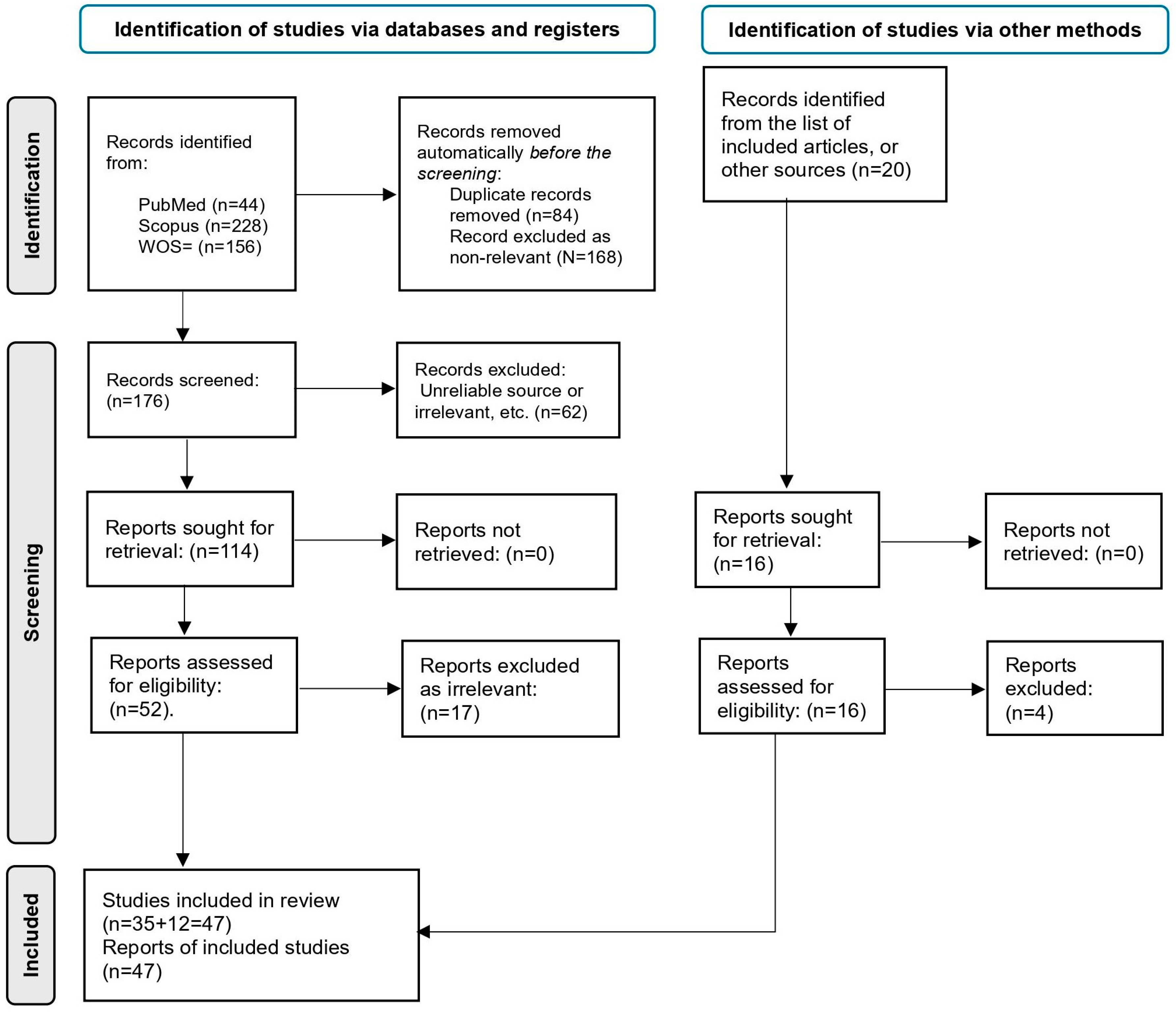
Table 2.
The summary of all included literature in the review and keywords for content analysis.
3.1. Narcissism and Its Impacts on Leadership
Narcissism is a natural part of human development, with some individuals displaying unique traits early in life. Healthy narcissism, emerging in childhood, fosters curiosity, critical thinking, and empathy through experiences like anxiety and guilt. However, a lack of supportive environments can lead to pathological narcissism, characterized by a disregard for rules and a desire for power, often resulting in attempts to control others, culminating in violence and posing a security threat [19,37,49].
The Dark Triad (DT)—narcissism, psychopathy, and Machiavellianism—is globally prevalent across cultures and genders [23,73,74,75]. Psychopathy, a neuropsychiatric disorder, differs from sociopathy, which involves narcissistic traits and antisocial behaviors [19,37,76]. Psychopaths lack empathy, leading to criminal behavior, while sociopaths act impulsively and struggle with emotional attachments [77]. Notable world leaders like Hitler, Saddam Hussein, and Stalin exhibited these traits [33,34,37]. New leaders appear continuously within the present and future timeframes [78,79].
Narcissistic leaders, driven by grandiosity and self-centeredness, contradict collaborative leadership frameworks [13,50,51]. Studies often link narcissism with transformational leadership [51]. However, narcissists’ leadership qualities are limited by their emotional development, typically arrested between ages 10 and 15. This emotional arrest persists throughout life, affecting all relationships and leadership activities. Narcissistic traits are lifelong and can only be mitigated, not eliminated, usually under significant pressure. Despite various efforts, these traits remain fixed from adolescence, where the individual’s confidence and responses to threats become internalized. Traditional therapy often fails because narcissists embrace their differences, reinforcing their personality traits rather than changing them [37,80].
Although Maccoby’s study focused on the business community, it applies universally, highlighting the pros and cons of narcissistic leadership. While narcissistic leaders may bring gains and benefits, they often overlook the negative impact on small businesses and individuals [33,52,53]. A recent study examined how narcissistic Chief Executive Officers (CEOs) behave regarding irresponsible environmental, social, and governance (ESG) strategies, influenced by their managerial power and the operational uncertainty of their firms. The research revealed that narcissistic CEOs avoid adopting irresponsible ESG practices to protect their reputations and garner positive recognition from stakeholders and society. Furthermore, CEO narcissism’s impact on ESG practices was moderated, or limited by CEO power, the uncertainty of the business environment, and the presence of corporate social responsibility committees and or independent board of directors [53,54].
3.1.1. Narcissistic Leadership and Environmental Factors
Narcissists, often associated with materialism, show weaker environmental ethics, and lack empathy for others’ costs, favoring their benefits [54,55,81]. Their short-term focus and risk-taking behavior lead to costly and unsuccessful environmental projects, diminishing followers’ interests over time [56,57,58,59]. Achieving the UN’s SDGs environmental goals (Goals 6–7, 13–15) requires long-term planning, which conflicts with a narcissist’s preference for quick-fix projects [60] and Colbry et al.’s collaborative framework [13].
Leaders like presidents Donald Trump, Vladimir Putin, and Benjamin Netanyahu are perceived as narcissistic and have shown disregard for environmental concerns, as seen in Trump’s denial of climate change, Putin’s actions in Ukraine, and Netanyahu’s performance in Gaza, resulting in irreparable damage, as they prioritize chaos over environmental protection to bolster their egos [53,59,60,78,82]. Elsewhere, a lack of investment in infrastructure and public health in a rich country such as IR Iran, or the destruction of the existing minimal health security system in Palestine, highlights the need for peace, justice, and global collaboration for sound environmental planning, prevention, protection, and policymaking [83,84,85].
3.1.2. Narcissistic Leadership and Infrastructural and Economic Factors
SDGs 8, 9, 11, and 12 are infrastructural needs that stimulate economic growth and require substantial and long-term financial support, education, and commitments [20,21,22]. While narcissistic leaders may initiate projects to showcase innovation and gain popularity, their short-term planning and self-centered management style can hinder long-term success [29,39,61,62,63,85,86,87]. Their reluctance to consider diverse opinions and prioritize sustainability jeopardizes project outcomes [20,21,22,63,64,79,88] and contradicts collaboration [13,25]. For instance, the US administration’s handling of the COVID-19 pandemic disregarded public health experts’ advice [19,79,81]. Projects led by narcissistic leaders may not align with public needs or sustainability goals [85,87]. The Russian invasion of Ukraine exemplifies the devastating impact of conflicts initiated by narcissistic impulses, causing widespread damage to infrastructure and essential services [89]. Autocratic regimes led by narcissistic leaders perpetuate chaos to maintain power, resulting in economic instability and social unrest, exacerbating economic hardships, hindering foreign investment, and compromising public health systems, leading to societal challenges and healthcare vulnerabilities, all of which contradict collaborative action [41,54,80].
3.1.3. Narcissistic Leadership and Social and Health-Related Factors
Under narcissistic leadership, achieving social and healthcare-related SDGs, such as Goals 1–5 and 10 becomes challenging due to environmental degradation, economic instability, and social unrest. The rise of individualism under narcissistic regimes diminishes collectivism, hindering progress toward goals like poverty reduction, hunger eradication, gender equality, and the spirit of collectivism and collaboration [55,59,60,81,82,83,84]. Narcissists also exploit social media to propagate their ideas and engage in bullying and revenge, further worsening social divisions [65,66,88,89,90,91]. Narcissistic leadership poses a direct threat to healthcare security, with continual violence straining healthcare systems and triggering refugee crises. The management of global health crises like COVID-19 is also compromised by narcissistic decision-making, affecting mental health and healthcare on local, regional, and global scales [19,65,92]. For instance, the use of vaccines made in the West was banned by the supreme leader of IR Iran [93]. Narcissistic leadership undermines social well-being and poses a significant risk to healthcare security and collaboration at all levels [67,68,69,94].
3.1.4. Narcissistic Leadership and Consequential Factors (Peace, Justice, Strong Institutions, and Global Partnership)
Fomenting a chaotic situation lets the narcissistic leadership grow and keep its power. Under narcissistic leadership, hybrid warfare (HW) tactics are employed through non-military means such as cyberattacks and lawfare, coupled with limited conventional force usage [19,70,89,91,95,96,97,98,99]. These strategies create chaos while evading legal consequences, undermining SDGs related to peace, justice, and strong institutions (Goal 16) and global partnerships (Goal 17) [1,19,97,99].
The Russian invasion of Ukraine exemplifies how such actions result in global chaos, environmental damage, and humanitarian crises, with significant implications for healthcare security and human rights [89,98], including the illegal use of a peacekeeping unit by Russia to annihilate the UN peacekeeping process, keeping international organizations out of the scene, and destroying global health and peace accomplishments that gave the global population some trust and hope [41,97,98,99,100].
A narcissistic leader strengthens his power while denying the resulting social misery, using more force [101,102]. As the world condemns the brutality of the Russian–Ukrainian war and its social consequences [89,99], elsewhere, other conflicts result in human rights violations and violent suppression, mirroring tactics seen in HW [100,101,102,103,104,105,106]. The use of force against civilians by using “non-lethal weapons”, worsens human suffering, injuries, and deaths due to the increasing physical and mental consequences of their use, requiring years of rehabilitation and creating inequality in healthcare access [89,107].
Physical and psychological violence, including sexual assault, is used to intimidate and weaken the opposition, particularly targeting women and children [103,105,106,108]. The toll of such violence is devastating, with thousands of civilian casualties reported in conflicts like the Ukrainian war and civilian uprising, e.g., in IR Iran [109,110]. These events disrupt public health security and sociocultural infrastructure, leading to poverty, food and water insecurity, and restricted access to healthcare [41]. Social media manipulation exacerbates misinformation, while internet disruptions impede communication and access to vital information [66,111,112]. Finally, attacking hospitals and healthcare professionals, forbidden by international laws, has resulted in insufficient access to medical facilities, migration of specialists, civilians suffering, and inequality in healthcare [89,91,108].
4. Discussion
This study aimed to assess the influence of narcissistic leaders on achieving the UN’s Sustainable Development Goals (SDGs). The findings indicate that political decisions made by global leaders can potentially lead to conflicts with serious social, environmental, infrastructural, healthcare, and health security repercussions, thereby impeding SDG attainment. Making such decisions necessitates careful, collaborative, expert-guided approaches, and democratic procedures. Effective leadership should align individual goals with collective aspirations [13,111]. The absence of collaborative leadership due to narcissism significantly hampers team performance and member effectiveness. Leaders who prioritize themselves undermine team spirit and cooperation, fostering distrust and reducing the collective commitment needed to achieve overarching goals.
From a global perspective, the unwillingness to collaborate, the self-centeredness in collective teamwork, and the lack of “responsibility” for actions, as part of narcissistic traits, worsen the outcomes of global health and well-being and calls for urgent global actions and policy change to promote leadership committed to public welfare and the achievement of SDGs [1,112]. The failure to obtain proper preventive and responsive measures to manage the diverse consequences of global emergencies is often caused or fueled by the choices made by political leaders, resulting in injustice, and inequity in need of societal and medical interventions [101]. These consequences are far more significant and magnified by narcissistic leadership [27].
Narcissistic global leaders often lack the conscientiousness to prevent or may even contribute to disasters, as seen in the ongoing conflict in Ukraine, which has targeted infrastructure and healthcare facilities [33,34,64,71]. Attacks on medical facilities violate international laws, posing threats to global security and health. Autocratic regimes exacerbate these issues by prioritizing weaponry over public health, leading to increased disease outbreaks in our interconnected world. The targeted bombings in Syria and Ukraine highlight these critical concerns [1,41,101,113,114]. Even decisions made within democratic frameworks can have global repercussions if leaders exhibit harmful traits [59].
It is essential to acknowledge the diversity and complexity of global leadership, where some leaders prioritize public welfare and international harmony. However, the risks associated with narcissistic leadership necessitate attention and mitigation. Political decisions and policies influencing global health and security should be deliberated at forums like the UN Security Council, where responsible decision-making is critical amidst uncertain future challenges [41,101,115,116]. The disregard for international laws, particularly International Humanitarian Law (IHL), due to political maneuvering by repressive states, is irresponsible and alarming. The Rohingya crisis in Myanmar exemplifies the severe humanitarian consequences of such violations [117].
Armed conflicts trigger mass migration and significantly shape the futures of affected countries, straining host countries’ various sectors, especially healthcare, with ethnic and socioeconomic tensions. Competition for financial support, resources, and services further exacerbates these challenges [71,116]. Recent events in Ukraine, IR Iran, and Palestine disrupt global order, erode trust and confidence, and result in widespread human suffering, injustice, and the weakening of democratic institutions and partnerships, hindering progress toward the UN’s SDGs.
While focusing on the characteristics of narcissistic leaders is crucial in understanding their role in causing distress, it is equally important to examine systemic factors within socio-political structures that facilitate their rise to power and perpetuation. Understanding who bears responsibility for the ascent and decline of narcissistic leaders is essential for a comprehensive approach to addressing this issue. Analyzing socio-political conditions that foster such leadership may reveal underlying patterns that, if addressed, could prevent harmful leadership in the future [117,118]. Narcissistic leaders do not emerge in isolation but are often products of broader socio-political dynamics, sustained by specific structures within these systems. Recognizing this interplay between individual traits and systemic conditions is critical for devising effective strategies to tackle the global implications of narcissistic leadership [19].
Narcissism is viewed through multiple perspectives, each providing distinct insights into its origins and expression. Psychodynamic theories stress the importance of early childhood experiences and relationships, while cognitive-behavioral theories concentrate on thought patterns and behaviors. Sociocultural theories examine the impact of societal norms, and biological theories investigate genetic and neurological factors. Considering narcissism from these varied viewpoints offers a more complete understanding of this complex trait and disorder. Although this paper does not follow any specific theory, it suggests that the cause of narcissism is multifactorial, and narcissism is best understood through a mix of theories, considering early experiences, cognitive distortions, societal influences, and biological factors. This multi-faceted approach provides a comprehensive understanding of narcissism’s development and manifestation.
The novelty of this study lies in its specific focus on the intersection between narcissistic leadership and global sustainability goals, an area previously underexplored. The findings of this study have significant practical implications for global governance and policymaking. To mitigate the detrimental effects of narcissistic leadership on achieving the SDGs, it is crucial to implement strategies that promote collaborative and empathetic leadership. Organizations and international bodies should develop training programs, emphasizing emotional intelligence, ethical decision-making, and long-term strategic thinking. Furthermore, establishing robust systems of accountability and transparency can help curb the rise of narcissistic leaders. Considering the interconnected goals of SDG, future multitasking challenges require cross-disciplinary, transdisciplinary, and multidisciplinary collaborative solutions [72,119,120]. Policymakers should consider creating frameworks that foster inclusive leadership and encourage participation from diverse stakeholders to ensure the achievement of sustainability and global health security goals (Table 3).
Table 3.
Recommendations for achieving SDGs.
Limitations
The main limitation of this study is the study’s method. Although we expanded our search across multiple search engines and databases, completed with action research, some relevant studies might have been overlooked unintentionally due to our focus on English-language publications. Furthermore, our emphasis on leadership’s role in global health may have overshadowed other significant factors like systemic inequalities and socio-political dynamics. The complexity of the relationship between leadership styles and their impacts, influenced by various contextual factors, poses another challenge. Despite these limitations, this review contributes valuable insights to the discussion on future leadership and global health. Future research can further build upon these findings to address these complexities effectively.
5. Conclusions
Although some SDGs have been targeted for investigation, discussion, and research, this original approach of this study to cover all SDGs, as far as we know, is a novel and original approach and has never been conducted before. This paper’s insights involve an acknowledgment of the dearth of literature on this subject and present the systematic factors that promote narcissistic leaders, urging future research to investigate the broader socio-political factors contributing to the rise of narcissistic leaders and their ability to maintain power. Examining these extensive processes can provide deeper insights into the connection between individual personality traits and the environmental conditions of an organization, thereby helping to address the global impacts of narcissistic leadership.
Today’s conflicts and emergencies are managed by a blend of military and non-military tactics, leveraging asymmetrical methods amplified by modern technology and social media. These actions, coupled with narcissistic leadership, escalate violence against civilians, and undermine global security. Leadership decisions directly impact outcomes in different regions, endangering innocent lives and violating international humanitarian law. The destructive influence of narcissistic leadership poses a significant threat to global health and the UN’s Sustainable Development Goals and contradicts collaborative efforts for globalization and global harmony. Human rights violations are intertwined with narcissistic leadership traits, highlighting the urgency to cultivate leaders committed to public welfare and SDG achievement. As global citizens, we must address these challenges by implementing preventive and corrective measures. Addressing the challenges posed by narcissistic and abusive leadership and promoting global health and sustainable development, several actions are imperative at collective and individual levels, as suggested in Table 3.
Questing solutions to combat narcissistic leadership is not a philosophical debate but an urgent call to action. By promoting conscientious and empathetic leadership, we can effectively address global health crises and advance sustainable development goals.
Supplementary Materials
The following supporting information can be downloaded at https://www.mdpi.com/article/10.3390/challe15030037/s1.
Author Contributions
Conceptualization, A.K.-M.; methodology, A.K.-M. and K.G.; validation, F.M.B.J.; formal analysis, and investigation, A.K.-M.; data curation, A.K.-M., K.G. and F.M.B.J.; writing—original draft preparation, A.K.-M.; writing—review and editing, A.K.-M., K.G. and F.M.B.J. All authors have read and agreed to the published version of the manuscript.
Funding
This research received no external funding.
Institutional Review Board Statement
Not applicable.
Informed Consent Statement
Not applicable.
Data Availability Statement
All data included in the study or available as Supplementary Materials.
Conflicts of Interest
The authors declare no conflicts of interest.
Appendix A
Appendix A.1. PRISMA Checklist
Preferred Reporting Items for Systematic reviews and Meta-Analyses Extension for Scoping Reviews (PRISMA-ScR) Checklist.
| SECTION | ITEM | PRISMA-ScR CHECKLIST ITEM | REPORTED ON PAGE |
| TITLE | |||
| Title | 1 | Identify the report as a scoping review. | Page 1 |
| ABSTRACT | |||
| Structured summary | 2 | Provide a structured summary that includes (as applicable) background, objectives, eligibility criteria, sources of evidence, charting methods, results, and conclusions that relate to the review questions and objectives. | Unstructured according to the journal, Page 1 |
| INTRODUCTION | |||
| Rationale | 3 | Describe the rationale for the review in the context of what is already known. Explain why the review questions/objectives lend themselves to a scoping review approach. | Page 3, last paragraph in the introduction |
| Objectives | 4 | Provide an explicit statement of the questions and objectives being addressed with reference to their key elements (e.g., population or participants, concepts, and context) or other relevant key elements used to conceptualize the review questions and/or objectives. | Page 3, last paragraph in the introduction |
| METHODS | |||
| Protocol and registration | 5 | Indicate whether a review protocol exists; state if and where it can be accessed (e.g., a Web address); and if available, provide registration information, including the registration number. | No protocol registered |
| Eligibility criteria | 6 | Specify characteristics of the sources of evidence used as eligibility criteria (e.g., years considered, language, and publication status), and provide a rationale. | Page 4 |
| Information sources * | 7 | Describe all information sources in the search (e.g., databases with dates of coverage and contact with authors to identify additional sources), as well as the date the most recent search was executed. | Page 4 |
| Search | 8 | Present the full electronic search strategy for at least 1 database, including any limits used, such that it could be repeated. | Page 4 |
| Selection of sources of evidence † | 9 | State the process for selecting sources of evidence (i.e., screening and eligibility) included in the scoping review. | Page 4 |
| Data charting process ‡ | 10 | Describe the methods of charting data from the included sources of evidence (e.g., calibrated forms or forms that have been tested by the team before their use, and whether data charting was performed independently or in duplicate) and any processes for obtaining and confirming data from investigators. | Page 4 |
| Data items | 11 | List and define all variables for which data were sought and any assumptions and simplifications made. | ---- |
| Critical appraisal of individual sources of evidences | 12 | If performed, provide a rationale for conducting a critical appraisal of included sources of evidence; describe the methods used and how this information was used in any data synthesis (if appropriate). | Not performed, heterogenous material |
| Synthesis of results | 13 | Describe the methods of handling and summarizing the data that were charted. | Page 5 |
| SECTION | ITEM | PRISMA-ScR CHECKLIST ITEM | REPORTED ON PAGE |
| RESULTS | |||
| Selection of sources of evidence | 14 | Give the numbers of sources of evidence screened, assessed for eligibility, and included in the review, with reasons for exclusions at each stage, ideally using a flow diagram. | Page 5 |
| Characteristics of sources of evidence | 15 | For each source of evidence, present characteristics for which data were charted and provide the citations. | Table 2 |
| Critical appraisal within sources of evidence | 16 | If performed, present data on critical appraisal of included sources of evidence (see item 12). | See item 12 |
| Results of individual sources of evidence | 17 | For each included source of evidence, present the relevant data that were charted that relate to the review questions and objectives. | Table 2 |
| Synthesis of results | 18 | Summarize and/or present the charting results as they relate to the review questions and objectives. | Page 5–8 |
| DISCUSSION | |||
| Summary of evidence | 19 | Summarize the main results (including an overview of concepts, themes, and types of evidence available), link to the review questions and objectives, and consider the relevance to key groups. | Pages 22–23 |
| Limitations | 20 | Discuss the limitations of the scoping review process. | Page 23 |
| Conclusions | 21 | Provide a general interpretation of the results with respect to the review questions and objectives, as well as potential implications and/or next steps. | Page 23–24 |
| FUNDING | |||
| Funding | 22 | Describe sources of funding for the included sources of evidence, as well as sources of funding for the scoping review. Describe the role of the funders of the scoping review. | Not Applicable, page 24 |
| JBI = Joanna Briggs Institute; PRISMA-ScR = Preferred Reporting Items for Systematic reviews and Meta-Analyses Extension for Scoping Reviews. * Where sources of evidence (see second footnote) are compiled from, such as bibliographic databases, social media platforms, and Web sites. † A more inclusive/heterogeneous term used to account for the different types of evidence or data sources (e.g., quantitative and/or qualitative research, expert opinion, and policy documents) that may be eligible in a scoping review as opposed to only studies. This is not to be confused with information sources (see first footnote). ‡ The frameworks by Arksey and O’Malley (6) and Levac and colleagues (7) and the JBI guidance (4, 5) refer to the process of data extraction in a scoping review as data charting. The process of systematically examining research evidence to assess its validity, results, and relevance before using it to inform a decision. This term is used for items 12 and 19 instead of “risk of bias” (which is more applicable to systematic reviews of interventions) to include and acknowledge the various sources of evidence that may be used in a scoping review (e.g., quantitative and/or qualitative research, expert opinion, and policy document) [121]. | |||
References
- Khorram-Manesh, A. Global transition, global risks, and the UN’s sustainable development goals–A call for peace, justice, and political stability. Glob. Transit. 2023, 5, 90–97. [Google Scholar] [CrossRef] [Scilit]
- McGill, N.; Verdon, S.; Curtin, M.; Crockett, J.; Parnell, T.; Hodgins, G. The impact of climate-related disasters on children’s communication and wellbeing: Addressing Sustainable Development Goals. Int. J. Speech-Lang. Pathol. 2023, 25, 20–26. [Google Scholar] [CrossRef] [Scilit] [PubMed]
- Filho, W.L.; Minhas, A.; Schmook, B.; Mardero, S.; Sharifi, A.; Paz, S.; Kovaleva, M.; Albertini, M.C.; Skouloudis, A. Sustainable development goal 13 and switching priorities: Addressing climate change in the context of pandemic recovery efforts. Environ. Sci. Eur. 2023, 35, 6. [Google Scholar] [CrossRef] [Scilit] [PubMed]
- Bin-Nashwan, S.A.; Hassan, M.K.; Muneeza, A. Russia–Ukraine conflict: 2030 Agenda for SDGs hangs in the balance. Int. J. Ethic Syst. 2022, 40, 3–16. [Google Scholar] [CrossRef] [Scilit]
- Nugent, R.; Bertram, M.Y.; Jan, S.; Niessen, L.W.; Sassi, F.; Jamison, D.T.; Pier, E.G.; Beaglehole, R. Investing in non-communicable disease prevention and management to advance the Sustainable Development Goals. Lancet 2018, 391, 2029–2035. [Google Scholar] [CrossRef] [Scilit] [PubMed]
- Ma, T.; E Peden, A.; Peden, M.; A Hyder, A.; Jagnoor, J.; Duan, L.; Brown, J.; Passmore, J.; Clapham, K.; Tian, M.; et al. Out of the silos: Embedding injury prevention into the Sustainable Development Goals. Inj. Prev. 2020, 27, 166–171. [Google Scholar] [CrossRef] [Scilit] [PubMed]
- Weber, H. Politics of ‘Leaving No One Behind’: Contesting the 2030 Sustainable Development Goals Agenda. Globalizations 2017, 14, 399–414. [Google Scholar] [CrossRef] [Scilit]
- Hollenbeck, J.R.; Beersma, B.; Schouten, M.E. Beyond Team Types and Taxonomies: A Dimensional Scaling Conceptualization for Team Description. Acad. Manag. Rev. 2012, 37, 82–106. [Google Scholar] [CrossRef] [Scilit]
- Badaracco, J.L. Leading Quietly: An Unorthodox Guide to Doing the Right Thing; Harvard Business School Press: Boston, MA, USA, 2002. [Google Scholar]
- Sedikides, C. In search of narcissus. Trends Cogn. Sci. 2021, 25, 67–80. [Google Scholar] [CrossRef] [Scilit] [PubMed]
- Thomson, A.M.; Perry, J.L. Collaboration Processes: Inside the Black Box. Public Adm. Rev. 2006, 66, 20–32. [Google Scholar] [CrossRef] [Scilit]
- Patel, H.; Pettitt, M.; Wilson, J.R. Factors of collaborative working: A framework for a collaboration model. Appl. Ergon. 2012, 43, 1–26. [Google Scholar] [CrossRef] [Scilit] [PubMed]
- Colbry, S.; Hurwitz, M.; Adair, R. Collaboration Theory. J. Leadersh. Educ. 2014, 13, 63–75. [Google Scholar] [CrossRef] [Scilit]
- Wennman, I.; Wittholt, M.; Carlström, E.; Carlsson, T.; Khorram-Manesh, A. Urgent care centre in Sweden-the integration of teams and perceived effects. Int. J. Health Plan. Manag. 2019, 34, 1205–1216. [Google Scholar] [CrossRef] [Scilit] [PubMed]
- Phattharapornjaroen, P.; Carlström, E.; Sivarak, O.; Tansuwannarat, P.; Chalermdamrichai, P.; Sittichanbuncha, Y.; Kongtoranin, L.; Phattranonuthai, R.; Marlow, P.; Winyuchonjaroen, W.; et al. Community-based response to the COVID-19 pandemic: Case study of a home isolation centre using flexible surge capacity. Public Health 2022, 211, 29–36. [Google Scholar] [CrossRef] [Scilit] [PubMed]
- Lepenies, R.; Büttner, L.; Bärlund, I.; Jax, K.; Lyytimäki, J.; Pedersen, A.B.; Nielsen, H.; Mosoni, C.; Mille, R.; Payen, G.; et al. The politics of national SDG indicator systems: A comparison of four European countries. AMBIO 2023, 52, 743–756. [Google Scholar] [CrossRef] [Scilit] [PubMed]
- Fransen, K.; Vanbeselaere, N.; De Cuyper, B.; Vande Broek, G.; Boen, F. When is a leader considered a good leader? Perceived impact on teammates’ confidence and social acceptance as key ingredients. Athl. Insight: Online J. Sport Psychol. 2017, 12, 21–51. [Google Scholar]
- Newstead, T.; Dawkins, S.; Macklin, R.; Martin, A. We don’t need more leaders–We need more good leaders. Advancing a virtues-based approach to leader (ship) development. Leadersh. Q. 2021, 32, 101312. [Google Scholar] [CrossRef] [Scilit]
- Khorram-Manesh, A.; Burkle, F.M. Narcissistic Sociopathy in Global Autocratic Leaders: Arrested Development, Obsessive Demand for Power, and the Emergence of Unlawful Hybrid Wars. Disaster Med. Public Health Prep. 2023, 17, e263. [Google Scholar] [CrossRef] [Scilit] [PubMed]
- Hunt, J.; Fitzgerald, M. Styles of leadership. Leadersh. Glob. Reg. Perspect. 2018, 3, 62–98. [Google Scholar]
- Karp, T. What Do We Really Mean by Good Leadership? J. Values-Based Leadersh. 2020, 13, 3. [Google Scholar] [CrossRef] [Scilit]
- Krasikova, D.V.; Green, S.G.; LeBreton, J.M. Destructive Leadership. J. Manag. 2013, 39, 1308–1338. [Google Scholar] [CrossRef] [Scilit]
- Jin, D. Devils at job environment: A study on employee ego depletion from abusive supervision and workaholic coworker. Int. J. Hosp. Manag. 2023, 114, 103586. [Google Scholar] [CrossRef] [Scilit]
- De Bruin, R.; Finkelstein, L.M. Reactions from the dark side: How does the Dark Tetrad affect responses to daily abusive supervision today and tomorrow? J. Psychol. 2023, 157, 160–191. [Google Scholar] [CrossRef] [Scilit] [PubMed]
- Brender-Ilan, Y.; Sheaffer, Z. How do self-efficacy, narcissism, and autonomy mediate the link between destructive leadership and counterproductive work behaviour? Asia Pac. Manag. Rev. 2019, 24, 212–222. [Google Scholar] [CrossRef] [Scilit]
- Kelloway, E.K.; Sivanathan, N.; Francis, L.; Barling, J. Poor leadership. In Handbook of Work Stress: 89-112; Barling, J., Kelloway, E.K., Frone, M.R., Eds.; Sage: Thousand Oaks, CA, USA, 2005. [Google Scholar]
- Gauglitz, I.K.; Schyns, B.; Fehn, T.; Schütz, A. The Dark Side of Leader Narcissism: The Relationship Between Leaders’ Narcissistic Rivalry and Abusive Supervision. J. Bus. Ethic 2022, 185, 169–184. [Google Scholar] [CrossRef] [Scilit]
- VON Känel, R.; Herr, R.M.; van Vianen, A.E.M.; Schmidt, B. Association of adaptive and maladaptive narcissism with personal burnout: Findings from a cross-sectional study. Ind. Health 2017, 55, 233–242. [Google Scholar] [CrossRef] [Scilit] [PubMed]
- Lynch, J.; Benson, A.J. Putting Oneself Ahead of the Group: The Liability of Narcissistic Leadership. Pers. Soc. Psychol. Bull. 2023, 50, 1211–1226. [Google Scholar] [CrossRef] [Scilit] [PubMed]
- Tiwari, M.; Jha, R. Narcissism, toxic work culture and abusive supervision: A double-edged sword escalating organizational deviance. Int. J. Organ. Anal. 2022, 30, 99–114. [Google Scholar] [CrossRef] [Scilit]
- Chen, H.; Zhang, L.; Wang, L.; Bao, J.; Zhang, Z. Multifaceted leaders: The double-edged sword effect of narcissistic leadership on employees’ work behavior. Front. Psychol. 2024, 14, 1266998. [Google Scholar] [CrossRef] [Scilit]
- Cleary, M.; Walter, G.; Sayers, J.; Lopez, V.; Hungerford, C. Arrogance in the Workplace: Implications for Mental Health Nurses. Issues Ment. Health Nurs. 2015, 36, 266–271. [Google Scholar] [CrossRef] [Scilit] [PubMed]
- Maccoby, M. Narcissistic leaders: The incredible pros, the inevitable cons. Harv. Bus. Rev. 2000, 69–77. [Google Scholar]
- Glad, B. Why Tyrants Go Too Far: Malignant Narcissism and Absolute Power. Politi-Psychol. 2002, 23, 1–2. [Google Scholar] [CrossRef] [Scilit]
- Hickman, S.E.; Watson, P.J.; Morris, R.J. Optimism, pessimism, and the complexity of narcissism. Personal. Individ. Differ. 1996, 20, 521–525. [Google Scholar] [CrossRef] [Scilit]
- Ong, C.W.; Roberts, R.; Arthur, C.A.; Woodman, T.; Akehurst, S. The Leader Ship Is Sinking: A Temporal Investigation of Narcissistic Leadership. J. Pers. 2016, 84, 237–247. [Google Scholar] [CrossRef] [Scilit] [PubMed]
- Burkle, F.M.; Hanfling, D. When being smart is not enough: Narcissism in US polity. Harv. Int. Rev. 2016, 1–5. [Google Scholar]
- Nevicka, B.; Van Vianen, A.E.M.; De Hoogh, A.H.B.; Voorn, B.C.M. Narcissistic leaders: An asset or a liability? Leader visibility, follower responses, and group-level absenteeism. J. Appl. Psychol. 2018, 103, 703–723. [Google Scholar] [CrossRef] [Scilit] [PubMed]
- Wang, L.; Li, X.; Guo, Q.; Liang, H. The Influence Mechanism of Narcissistic Leader on Subordinates’ Followership under the Chinese Cultural Background. Ekoloji Derg. 2019, 107. [Google Scholar]
- Wang, L. The Impact of Narcissistic Leader on Subordinates and Team Followership: Based on “Guanxi” Perspective. Front. Psychol. 2021, 12, 684380. [Google Scholar] [CrossRef] [Scilit] [PubMed]
- Burkle, F.M. Declining Public Health Protections within Autocratic Regimes: Impact on Global Public Health Security, Infectious Disease Outbreaks, Epidemics, and Pandemics. Prehospital Disaster Med. 2020, 35, 237–246. [Google Scholar] [CrossRef] [Scilit] [PubMed]
- Hepper, E.G.; Hart, C.M.; Sedikides, C. Moving Narcissus: Can narcissists be empathic? Personal. Soc. Psychol. Bull. 2014, 40, 1079–1091. [Google Scholar] [CrossRef] [Scilit] [PubMed]
- Ronningstam, E. Psychoanalytic theories on narcissism and narcissistic personality. In The Handbook of Narcissism and Narcissistic Personality Disorder: Theoretical Approaches, Empirical Findings, and Treatments; Campbell, W.K., Miller, J.D., Eds.; John Wiley & Sons, Inc.: Hoboken, NJ, USA, 2011; pp. 41–55. [Google Scholar]
- Wright, K.; Furnham, A. What Is Narcissistic Personality Disorder? Lay Theories of Narcissism. Psychology 2014, 05, 1120–1130. [Google Scholar] [CrossRef]
- Grant, M.J.; Booth, A. A typology of reviews: An analysis of 14 review types and associated methodologies. Health Inf. Libr. J. 2009, 26, 91–108. [Google Scholar] [CrossRef] [Scilit] [PubMed]
- Page, M.J.; McKenzie, J.E.; Bossuyt, P.M.; Boutron, I.; Hoffmann, T.C.; Mulrow, C.D.; Shamseer, L.; Tetzlaff, J.M.; Akl, E.A.; Brennan, S.E.; et al. The PRISMA 2020 statement: An updated guideline for reporting systematic reviews. BMJ 2021, 372, 71. [Google Scholar] [CrossRef] [Scilit] [PubMed]
- Oosthuizen, M.J. Action Research. Research Methods for Students, Academics and Professionals: Information Management and Systems, 2nd ed.; Centre for Information Studies, Charles Sturt University: Wagga Wagga, Australia, 2002; pp. 159–175. [Google Scholar]
- Munn, Z.; Peters, M.D.; Stern, C.; Tufanaru, C.; McArthur, A.; Aromataris, E. Systematic review or scoping review? Guidance for authors when choosing between a systematic or scoping review approach. BMC Med. Res. Methodol. 2018, 18, 143. [Google Scholar] [CrossRef] [PubMed]
- Burton, J.P.; Hoobler, J.M. Aggressive reactions to abusive supervision: The role of interactional justice and narcissism. Scand. J. Psychol. 2011, 52, 389–398. [Google Scholar] [CrossRef] [Scilit]
- Judge, T.A.; LePine, J.A.; Rich, B.L. Loving yourself abundantly: Relationship of the narcissistic personality to self- and other perceptions of workplace deviance, leadership, and task and contextual performance. J. Appl. Psychol. 2006, 91, 762–776. [Google Scholar] [CrossRef] [Scilit] [PubMed]
- O’Reilly, C.A., III; Doerr, B. Conceit and deceit: Lying, cheating, and stealing among grandiose narcissists. Personal. Individ. Differ. 2020, 154, 109627. [Google Scholar] [CrossRef] [Scilit]
- Burkle, F.M. Character Disorders among Autocratic World Leaders and the Impact on Health Security, Human Rights, and Humanitarian Care. Prehospital Disaster Med. 2019, 34, 2–7. [Google Scholar] [CrossRef] [Scilit] [PubMed]
- Burkle, F.M. Antisocial personality disorder and pathological narcissism in prolonged conflicts and wars of the 21st century. Disaster Med. Public Health Prep. 2016, 10, 118–128. [Google Scholar] [CrossRef] [Scilit] [PubMed]
- Khorram-Manesh, A.; Burkle, F.M. Sociopathic narcissistic leadership: How about their victims? World Med. Health Policy 2024, 16, 19–36. [Google Scholar] [CrossRef] [Scilit]
- Ogunfowora, B.; Nguyen, V.Q.; Steel, P.; Hwang, C.C. A meta-analytic investigation of the antecedents, theoretical correlates, and consequences of moral disengagement at work. J. Appl. Psychol. 2022, 107, 746–775. [Google Scholar] [CrossRef] [Scilit] [PubMed]
- Milligan, M.; Mankelwicz, J.M.; See, H.P. Narcissism as a global barrier to education for sustainable development. Perspect. Educ. 2022, 40, 29–46. [Google Scholar] [CrossRef] [Scilit]
- Bergman, J.Z.; Westerman, J.W.; Bergman, S.M.; Westerman, J.; Daly, J.P. Narcissism, Materialism, and Environmental Ethics in Business Students. J. Manag. Educ. 2014, 38, 489–510. [Google Scholar] [CrossRef] [Scilit]
- Song, L.J.; Ni, D.; Zhu, J.; Zheng, X.; Zhu, L. Servant Leadership and Employee Gratitude: The Moderating Role of Employee Narcissism. J. Bus. Psychol. 2024, 39, 1005–1021. [Google Scholar] [CrossRef] [Scilit]
- Kumar, V.D. Multiple Faces of Narcissistic Leadership in Medical Education. J. Adv. Med. Educ. Prof. 2019, 7, 103–105. [Google Scholar] [CrossRef] [Scilit]
- Liao, S.; Zhou, X.; Guo, Z.; Li, Z. How Does Leader Narcissism Influence Employee Voice: The Attribution of Leader Impression Management and Leader-Member Exchange. Int. J. Environ. Res. Public Health 2019, 16, 1819. [Google Scholar] [CrossRef] [Scilit] [PubMed]
- Ji, Y.; Liu, H.; Liu, S.; Xu, M.; Lin, Z. Are narcissists more creative? Only if we believe it: How narcissism can relate to creativity. Front. Psychol. 2023, 13, 1091770. [Google Scholar] [CrossRef] [Scilit] [PubMed]
- Norouzinik, Y.; Rahimnia, F.; Maharati, Y.; Eslami, G. Narcissistic leadership and employees’ innovative behaviour: Mediating roles of job embeddedness and job engagement. Innovation 2022, 24, 355–380. [Google Scholar] [CrossRef] [Scilit]
- Yang, J.; Chang, M.; Li, J.; Zhou, L.; Tian, F.; Zhang, J. Exploring the moderated mediation relationship between leader narcissism and employees’ innovative behavior. Chin. Manag. Stud. 2021, 15, 137–154. [Google Scholar] [CrossRef] [Scilit]
- Zhou, L.; Li, J.; Liu, Y.; Tian, F.; Zhang, X.; Qin, W. Exploring the relationship between leader narcissism and team creativity: Evidence from R&D teams in Chinese high-technology enterprises. Leadersh. Organ. Dev. J. 2019, 40, 916–931. [Google Scholar]
- Kong, F.; Wang, M.; Zhang, X.; Li, X.; Sun, X. Vulnerable Narcissism in Social Networking Sites: The Role of Upward and Downward Social Comparisons. Front. Psychol. 2021, 12, 711909. [Google Scholar] [CrossRef] [Scilit] [PubMed]
- Zell, A.L.; Moeller, L. Narcissism and “likes”: Entitlement/Exploitativeness predicts both desire for and dissatisfaction with responses on Facebook. Pers. Individ. Differ. 2017, 110, 70–73. [Google Scholar] [CrossRef] [Scilit]
- Huang, X.; Chen, H.; Wang, L.; Zeng, S. How does leader narcissism influence firm internationalization? IEEE Trans. Eng. Manag. 2019, 67, 683–696. [Google Scholar] [CrossRef] [Scilit]
- Höflinger, V.; Büttgen, M. No Benefits for Paradox Personalities? Narcissism and Humility in New Work Careers. Mrev Manag. Rev. 2022, 33, 429–451. [Google Scholar] [CrossRef] [Scilit]
- Leonelli, S.; Primavera, E. Narcissism and perceived stress among Italian hospital nurses during COVID-19: The moderator role of age. Int. J. Healthc. Technol. Manag. 2022, 19, 260–279. [Google Scholar]
- Erkutlu, H.; Chafra, J. Leader Narcissism and Defensive Silence in Higher Education: A Moderated Mediation Model of Interactional Justice and Value Congruence. Res. Educ. Adm. Leadersh. 2020, 5, 586–620. [Google Scholar] [CrossRef] [Scilit]
- Ebron, K.T.; Luzynski, C.; Komanski, C.S.N. Leave No One Behind: How systemic racism impacts Sustainable Development Goals. Int. J. Public Leadersh. 2023, 19, 31–44. [Google Scholar] [CrossRef] [Scilit]
- Caligor, E.; Levy, K.N.; Yeomans, F.E. Narcissistic Personality Disorder: Diagnostic and Clinical Challenges. Am. J. Psychiatry 2015, 172, 415–422. [Google Scholar] [CrossRef] [Scilit] [PubMed]
- Zeigler-Hill, V.; Marcus, D.K. (Eds.) Introduction: A bright future for dark personality features? In The Dark Side of Personality: Science and Practice in Social, Personality, and Clinical Psychology; American Psychological Association: Washington, DC, USA, 2016; pp. 3–22. [Google Scholar] [CrossRef] [Scilit]
- Rogoza, R.; Żemojtel-Piotrowska, M.; Jonason, P.K.; Piotrowski, J.; Campbell, K.W.; Gebauer, J.E.; Maltby, J.; Sedikides, C.; Adamovic, M.; Adams, B.G.; et al. Structure of Dark Triad Dirty Dozen Across Eight World Regions. Assessment 2021, 28, 1125–1135. [Google Scholar] [CrossRef] [Scilit] [PubMed]
- Hutter, K.; Füller, J.; Hautz, J.; Bilgram, V.; Matzler, K. Machiavellianism or morality: Which behavior pays off in online innovation contests? J. Manag. Inf. Syst. 2015, 32, 197–228. [Google Scholar] [CrossRef] [Scilit]
- Pemment, J. Psychopathy versus sociopathy: Why the distinction has become crucial. Aggress. Violent Behav. 2013, 18, 458–461. [Google Scholar] [CrossRef] [Scilit]
- Lynam, D.R.; Gudonis, L. The development of psychopathy. Annu. Rev. Clin. Psychol. 2005, 1, 381–407. [Google Scholar] [CrossRef] [Scilit] [PubMed]
- Kimhi, S. Benjamin Netanyahu: A psychological profile using behavior analysis. In Profiling Political Leaders; Feldman, O., Valenty, L.O., Eds.; Praeger: Westport, CT, USA, 2001; pp. 149–164. [Google Scholar]
- Mercer, J.A. The Dangerous Case of Donald Trump: A Case Study in Contested Ethics and the Public Uses of Professional Expertise. Pastor. Psychol. 2018, 67, 323–336. [Google Scholar] [CrossRef] [Scilit]
- Jackson, C.J.; Roberts, J. Transformational and narcissist leaders: Their different behaviors in different contexts. Pers. Individ. Differ. 2022, 191, 111579. [Google Scholar] [CrossRef] [Scilit]
- Martínez-Ferrero, J.; Ramón-Llorens, M.C.; García-Meca, E. CEO narcissism and ESG misconduct. Res. Int. Bus. Financ. 2024, 69, 102284. [Google Scholar] [CrossRef] [Scilit]
- De Pryck, K.; Gemenne, F. The Denier-in-Chief: Climate Change, Science, and the Election of Donald J. Trump. Law Crit. 2017, 28, 119–126. [Google Scholar] [CrossRef] [Scilit]
- Rawtani, D.; Gupta, G.; Khatri, N.; Rao, P.K.; Hussain, C.M. Environmental damages due to war in Ukraine: A perspective. Sci. Total. Environ. 2022, 850, 157932. [Google Scholar] [CrossRef] [Scilit] [PubMed]
- Koren, O.; E Bagozzi, B.; Benson, T.S. Food and water insecurity as causes of social unrest: Evidence from geolocated Twitter data. J. Peace Res. 2021, 58, 67–82. [Google Scholar] [CrossRef] [Scilit]
- Ebadi, A.G.; Toughani, M.; Najafi, A.; Babaee, M. A brief overview on current environmental issues in Iran. Cent. Asian J. Environ. Sci. Technol. Innov. 2020, 1, 1–11. [Google Scholar]
- Shorrab, A.; Nassef, M.; Subhi, A.; Giwa, B.; Buheji, M. Health in the Crossfire-Analyzing and Mitigating the Multifaceted Health Risks of the 2023 War on Gaza. Public Health Res. 2024, 14, 1–11. [Google Scholar]
- Field, B. Infrastructure investment and economic performance. J. Mega Infrastruct. Sustain. Dev. 2019, 1, 94–97. [Google Scholar]
- Yang, L.; Lin, Z.; Quan, R.; Cunningham, J.; Huang, W. Internal R&D or external asset growth? A closer look at CEO narcissism and entrepreneurial orientation. Int. J. Entrep. Behav. Res. 2024, 30, 110–127. [Google Scholar] [CrossRef] [Scilit]
- Baker, M.S.; Baker, J.; Burkle, F.M. Russia’s Hybrid Warfare in Ukraine Threatens Both Healthcare & Health Protections Provided by International Law. Ann. Glob. Health 2023, 89, 1–6. [Google Scholar] [CrossRef] [Scilit]
- Dutot, V. A social identity perspective of social media’s impact on satisfaction with life. Psychol. Mark. 2020, 37, 759–777. [Google Scholar] [CrossRef] [Scilit]
- Khorram-Manesh, A.; Goniewicz, K.; Burkle, F.M. Social and Healthcare Impacts of the Russian-Led Hybrid War in Ukraine—A Conflict with Unique Global Consequences. Disaster Med. Public Health Prep. 2023, 17, e432. [Google Scholar] [CrossRef] [Scilit] [PubMed]
- Harman, S.; Davies, S.E. President Donald Trump as global health’s displacement activity. Rev. Int. Stud. 2019, 45, 491–501. [Google Scholar] [CrossRef] [Scilit]
- Human Rights Watch. Iran: Khamenei’s Reckless Ban on COVID-19 Vaccines. 2021. Available online: https://www.hrw.org/news/2021/01/12/iran-khameneis-reckless-ban-covid-19-vaccine (accessed on 17 June 2024).
- Witte, A.E. Co-operation–the missing value of business education. J. Manag. Dev. 2014, 33, 357–373. [Google Scholar] [CrossRef] [Scilit]
- Milkis, S.M. Review Essay: Donald Trump, Charismatic Leadership and the “Deep State”. Political Sci. Q. 2024, qqae018. [Google Scholar] [CrossRef] [Scilit]
- Kayani, M.B.; Zafar, A.; Aksar, M.; Hassan, S. Impacts of despotic leadership and dark personality triad on follower’s sense of meaningful work: Moderating influence of organizational justice. Int. Trans. J. Eng. Manag. Appl. Sci. Technol. 2019, 11, 322–342. [Google Scholar]
- Khorram-Manesh, A.; Burkle, F.M.; Goniewicz, K.; Robinson, Y. Estimating the Number of Civilian Casualties in Modern Armed Conflicts–A Systematic Review. Front. Public Health 2021, 9, 765261. [Google Scholar] [CrossRef] [Scilit] [PubMed]
- Goniewicz, K.; Khorram-Manesh, A.; Goniewicz, M. Refugees and Their Unforeseen Future. Prehospital Disaster Med. 2023, 38, S11. [Google Scholar] [CrossRef] [Scilit]
- Burkle, F.M.; Goniewicz, K.; Khorram-Manesh, A. Bastardizing Peacekeeping and the Birth of Hybrid Warfare. Prehospital Disaster Med. 2022, 37, 147–149. [Google Scholar] [CrossRef] [Scilit] [PubMed]
- Golkar, S. Deep Society and New Authoritarian Social Control in Iran after the Green Movement. In New Authoritarian Practices in the Middle East and North Africa; Topak, O., Mekouar, M., Cavatorta, F., Eds.; Edinburgh University Press: Edinburgh, UK, 2022; pp. 92–111. [Google Scholar]
- Robinson, K. Iran’s Regional Armed Network. Council on Foreign Relations. 2021. Available online: https://www.cfr.org/article/irans-regional-armed-network (accessed on 17 June 2024).
- Lu, C. Iran Scrambles to Crush Uprising. Foreign Policy. 2022. Available online: https://foreignpolicy.com/2022/11/01/iran-protest-crackdown-university-revolutionary-guard/ (accessed on 17 June 2024).
- Khorram-Manesh, A.; Burkle, F.M. Civilian Population Victimization: A Systematic Review Comparing Humanitarian and Health Outcomes in Conventional and Hybrid Warfare. Disaster Med. Public Health Prep. 2023, 17, e192. [Google Scholar] [CrossRef] [Scilit] [PubMed]
- Krishna, G.; Howard, S. How Iran’s protests are a response to the “backslide” in women’s health rights. BMJ 2022, 379, o2839. [Google Scholar] [CrossRef] [Scilit]
- Khorram-Manesh, A. The Impacts of Armed Conflicts and Civilian Uprisings on Children’s Health. Children 2022, 9, 1913. [Google Scholar] [CrossRef] [Scilit] [PubMed]
- Guha-Sapir, D.; Schlüter, B.; Rodriguez-Llanes, J.M.; Lillywhite, L.; Hicks, M.H.-R. Patterns of civilian and child deaths due to war-related violence in Syria: A comparative analysis from the Violation Documentation Center dataset, 2011–2016. Lancet Glob. Health 2017, 6, e103–e110. [Google Scholar] [CrossRef] [Scilit] [PubMed]
- Casey-Malden, S. Non-Kinetic-Energy Weapons Termed “Non-Lethal.” A Primary Assessment Under International Humanitarian Law and International Human Rights Law. The Geneva Academy of International Humanitarian Law and Human Rights. 2010. Available online: https://www.geneva-academy.ch/joomlatools-files/docman-files/Non-Kinetic-Energy%20Weapons.pdf (accessed on 17 June 2024).
- Haar, R.J.; Read, R.; Fast, L.; Blanchet, K.; Rinaldi, S.; Taithe, B.; Wille, C.; Rubenstein, L.S. Violence against healthcare in conflict: A systematic review of the literature and agenda for future research. Confl. Health 2021, 15, 37. [Google Scholar] [CrossRef] [Scilit] [PubMed]
- UN-OHCHR. United Nations Human Rights Office of the High Commissioner. Ukraine: Civilian Casuzalty Update 14 August 2023. 2023. Available online: https://www.ohchr.org/en/news/2023/08/ukraine-civilian-casualty-update-14-august-2023 (accessed on 17 June 2024).
- Voice of America (VOA) News. At Least 537 Killed in Iran Protest Crackdown, Rights Group Says. 2023. Available online: https://www.voanews.com/a/at-least-537-killed-in-iran-protest-crackdown-rights-group-says/7036125.html (accessed on 17 June 2024).
- Tobias, E. Using Twitter and other social media platforms to provide situational awareness during an incident. J. Bus. Contin. Emerg. Plan. 2011, 5, 208–223. [Google Scholar] [CrossRef] [Scilit]
- Hinz, T.; Walzenbach, S.; Laufer, J.; Weeber, F. Media coverage, fake news, and the diffusion of xenophobic violence: A fine-grained county-level analysis of the geographic and temporal patterns of arson attacks during the German refugee crisis 2015–2017. PLoS ONE 2023, 18, e0288645. [Google Scholar] [CrossRef] [Scilit] [PubMed]
- Powell, J.; Chacha, M. Investing in stability: Economic interdependence, coups d’état, and the capitalist peace. J. Peace Res. 2016, 53, 525–538. [Google Scholar] [CrossRef] [Scilit]
- Goniewicz, K.; Burkle, F.M.; Hertelendy, A.J.; Khorram-Manesh, A. The impact of war on emergency departments visits by Ukrainian refugees in Poland. Am. J. Emerg. Med. 2023, 67, 189–190. [Google Scholar] [CrossRef] [Scilit] [PubMed]
- Mahase, E. “Same tactics, same injuries”: The targeting of healthcare in Syria and Ukraine. BMJ 2022, 378, o1745. [Google Scholar] [CrossRef] [Scilit] [PubMed]
- Michel, P. Targeting health care in conflict: The need to end impunity. Lancet 2023, 401, 1825. [Google Scholar]
- Alim, M.A. The International Humanitarian Law Principles and Its Applicability to Rohingya Situations. Indian J. Law Justice 2018, 9, 1–17. [Google Scholar]
- Goniewicz, K.; Burkle, F.M.; Dzhus, M.; Khorram-Manesh, A. Ukraine’s Healthcare Crisis: Sustainable Strategies for Navigating Conflict and Rebuilding for a Resilient Future. Sustainability 2023, 15, 11602. [Google Scholar] [CrossRef] [Scilit]
- Ofei, A.M.A.; Paarima, Y.; Barnes, T.; Poku, C.A. Toxic leadership behaviour of nurse managers on perceived job satisfaction and productivity of nursing workforce in sub-Saharan Ghana: A multi-centre cross-sectional study. J. Nurs. Manag. 2022, 30, 2733–2742. [Google Scholar] [CrossRef] [Scilit] [PubMed]
- Khorram-Manesh, A.; Burkle, F.M., Jr.; Goniewicz, K. Pandemics: Past, present, and future: Multitasking challenges in need of cross-disciplinary, transdisciplinary, and multidisciplinary collaborative solutions. Osong Public Health Res. Perspect. 2024. [Google Scholar] [CrossRef] [Scilit] [PubMed]
- Tricco, A.C.; Lillie, E.; Zarin, W.; O’Brien, K.K.; Colquhoun, H.; Levac, D.; Moher, D.; Peters, M.D.; Horsley, T.; Weeks, L.; et al. PRISMA Extension for Scoping Reviews (PRISMAScR): Checklist and Explanation. Ann. Intern. Med. 2018, 169, 467–473. [Google Scholar] [CrossRef] [Scilit] [PubMed]

Disclaimer/Publisher’s Note: The statements, opinions and data contained in all publications are solely those of the individual author(s) and contributor(s) and not of MDPI and/or the editor(s). MDPI and/or the editor(s) disclaim responsibility for any injury to people or property resulting from any ideas, methods, instructions or products referred to in the content. |
© 2024 by the authors. Licensee MDPI, Basel, Switzerland. This article is an open access article distributed under the terms and conditions of the Creative Commons Attribution (CC BY) license (https://creativecommons.org/licenses/by/4.0/).