


Abstract
Early-stage gastronomic research faces a tension between two aims: developing products suitable for professional practice and designing experiments in which process variables can be isolated and independently replicated. This study develops and examines Professional Sensory Screening (PSS) as an action case–informed approach for systematically comparing realistic prototypes, identifying recurring sensory and practice-based patterns, and translating them into hypotheses for controlled testing, thereby bridging professional and scientific relevance in gastronomy. Twelve sourdough breads were developed by two artisan bakers using two Swedish bread wheat landraces and one spelt wheat under four flour-processing conditions: cyclone-milled wholegrain, stone-milled wholegrain, stone-milled sifted, and roller-milled sifted. Eighteen assessors experienced in baking, milling, cereals, or gastronomy evaluated the breads using Rate-All-That-Apply (RATA), liking rankings within each cereal block, and structured discussion. Sifted breads were associated with elasticity and airiness, stone-milled wholegrain breads with stronger cereal and roasted attributes, and cyclone-milled wholegrain breads with intermediate structural–flavor profiles. Cyclone-milled wholegrain breads were consistently among the more highly ranked for liking. Given the integrated, non-replicated design, findings are hypothesis-generating. PSS made a structural–flavor relationship explicit and generated the testable hypothesis that cyclone-assisted wholegrain milling may reduce perceived structural penalties while retaining cereal and wholegrain sensory character.
1. Introduction
In gastronomic research and development, relevant questions often emerge through professional practice before a clearly defined experimental hypothesis exists. Bakers, chefs, millers, growers, and other food professionals work with materials whose properties vary, adjust processes in response to what they observe, compare prototypes, taste outcomes, and gradually identify relationships that appear worth investigating. Such work can generate important questions, yet it occupies an uneasy position between professional product development and conventional experimental research.
This tension is particularly relevant to gastronomy because professional knowledge is situated in making as well as in formal analysis. Culinary expertise includes material familiarity, sensory discrimination, process knowledge, and tacit forms of judgment that are difficult to separate from the contexts in which they are exercised. Recent work in gastronomic research has similarly emphasized the context-sensitive character of professional culinary knowledge and the role of practitioners in creativity, collaboration, and innovation [1]. The methodological challenge is therefore not simply how to replace professional judgment with controlled measurement, but how observations emerging from professional practice can be systematically incorporated into research.
Action case research has been proposed within Culinary Arts and Meal Science as one approach to this early phase of knowledge production [2]. Rather than beginning exclusively from a predefined hypothesis, action case research embeds inquiry in real-world practice and uses intervention, observation, and reflection to generate context-specific research questions. Its intended role is exploratory: practice can expose unexpected relationships and thereby precede rather than replace controlled hypothesis testing. This corresponds with broader approaches to food design in which realistic prototypes and professional interpretation contribute to exploratory research [3].
Recent discussion within the international gastronomy research field has emphasized both the development of gastronomy as an inclusive and interdisciplinary research field [4] and a related epistemic problem: how analytically distinguishable processes become related and mutually consequential within gastronomic situations [5]. This raises a methodological question for early-stage gastronomic research: how can potentially important relations encountered in professional practice be retained and systematically examined before they are separated into variables for controlled investigation?
For such observations to support research, they require sufficient structure for systematic comparison without being prematurely detached from the professional contexts in which they arise. Rapid sensory profiling methods such as Rate-All-That-Apply (RATA) can differentiate products without the extensive training required for conventional descriptive sensory analysis [6,7,8,9]. Experienced assessors and product professionals may be particularly relevant when the objective is exploratory differentiation within a specialized product space rather than estimation of consumer preference [10]. Professional assessment also creates the possibility of considering perceived sensory differences alongside knowledge of raw materials and processing.
Building on these premises, the present study develops and examines Professional Sensory Screening (PSS) as a structured approach for comparing professionally developed prototypes and identifying recurring sensory and practice-based patterns that warrant further investigation.
The inferential purpose of such screening needs to be explicit. Repeated sensory assessments of a single technological realization provide information about perceived differentiation among prototypes, but they do not constitute independent replication of, for example, milling or breadmaking treatments. Early-stage gastronomic research may nevertheless address a different question from a confirmatory processing experiment: whether sufficiently coherent sensory and practice-based patterns can be identified to specify what should subsequently be tested under replicated conditions. Recent discussion in sensory science has similarly emphasized the value of considering the magnitude, direction, and practical relevance of sensory effects alongside conventional significance testing [11].
The present study examines this research logic through an applied case involving wholegrain sourdough bread. Wholegrain bread provides a useful case because desirable nutritional and flavor characteristics can conflict with technological and textural properties. Heritage cereals and landraces are especially relevant in this context because their value depends not only on agronomic diversity, but also on how their material and sensory characteristics are translated into food through processing and craft practice [12,13,14]. In Sweden, such cereals are also associated with small-scale cultivation and artisan breadmaking, where wholegrain inclusion can be an important part of making use of the grain and expressing its distinctive character [13,14]. At the same time, retaining bran and germ creates technological challenges: although these fractions contribute dietary fiber, phenolic compounds, lipids, and minerals, they can reduce loaf volume and crumb openness and contribute bitterness or coarse mouthfeel [15,16,17,18].
Against this background, professional experience with cyclone-assisted wholegrain milling in Swedish artisan cereal and baking networks provided the immediate impetus for the case. Unlike conventional single-pass stone milling, the centrifugal system used here accelerates kernels against a stationary stone within an airflow before the flour is separated through a cyclone. Prior use by the collaborating bakers and millers suggested that cyclone-milled wholegrain flour appeared substantially finer than conventionally stone-milled wholegrain flour and showed distinct water-absorption and dough-handling behavior. Given the established importance of particle characteristics for wholegrain flour functionality [16,17,18], these observations provided a practical reason to investigate the resulting breads systematically. They were treated as professional observations rather than established physical mechanisms: particle-size distribution, starch damage, and flour composition were not measured in the present study.
The study therefore used contrasting bread prototypes to examine this methodological approach in a concrete wholegrain bread case. It addresses three questions:
- What recurring sensory contrasts can the assessor group identify among realistic artisan bread prototypes?
- How do liking rankings and interest in further baking or development vary among the prototypes within this assessor group, and how are their characteristics interpreted through practice-oriented reflection and professional discussion?
- What testable processing hypothesis can be generated by integrating sensory profiling, liking ranking, and practice-based interpretation?
The broader purpose is to examine PSS as a discovery stage within gastronomic research, positioned between practice-based gastronomic development and subsequent controlled validation.
2. Materials and Methods
2.1. Methodological Orientation
The study was conducted as a practice-embedded case combining iterative prototype development with professional sensory screening and was interpreted through the principles of action case research [2]. The methodological purpose was exploratory differentiation and hypothesis generation.
In this article, Professional Sensory Screening (PSS) refers to a screening workflow in which professionally developed prototypes undergo structured sensory assessment and the resulting patterns are interpreted using domain-specific professional knowledge. In this usage, “professional” refers to the role of professional practice and expertise in the workflow, not to the employment status or formal sensory training of every assessor.
The workflow combined contrasting prototypes, structured rapid sensory profiling, within-cereal liking ranking, a separate development-interest response, and collective interpretation through group discussion. These outputs were integrated to identify recurring relationships among prototype characteristics, sensory responses, and professional interpretation, and to formulate questions for subsequent validation.
2.2. Cereal Materials and Prototype Design
A 3 × 4 product design combined three cereal materials with four flour-processing conditions, producing twelve bread prototypes. The cereals were two Swedish bread wheat landraces (Triticum aestivum L.; Öland and Munktorp) and one spelt wheat (Triticum aestivum ssp. spelta). All grains were organically cultivated and fine-cleaned before milling. One grain batch of each cereal material was used across the four flour-processing conditions to reduce within-cereal variation.
The four flour-processing conditions were cyclone-milled wholegrain, stone-milled wholegrain, stone-milled sifted, and roller-milled sifted. The two wholegrain flours retained all anatomical grain fractions, whereas the sifted flours had lower extraction rates.
Cyclone-milled wholegrain flour was produced using a centrifugal stone mill (Stoll Klaus Maschinenhandel, Kaufbeuren, Germany), in which kernels were fragmented against a stationary stone within an airflow and flour was continuously separated through a cyclone. Stone-milled wholegrain flour was produced through single-pass milling of the whole kernel using an A400 MSM combination stone mill (Osttiroler Getreidemühlen Heidemarie Green GmbH, Dölsach, Austria). Stone-milled sifted flour was produced through repeated milling and sieving at 220 µm, with an estimated extraction rate of 65–70%. Roller-milled sifted flour was produced using a MIAG roller mill (MIAG Mühlenbau und Industrie AG, Braunschweig, Germany) through sequential grinding and sieving, with an estimated extraction rate of approximately 70%.
Particle-size distribution, starch damage, and compositional differences among the flours were not measured. The prototypes are therefore defined by their applied production conditions rather than analytically characterized particle-size fractions. Observed or professionally perceived differences in particle characteristics are treated as candidate explanations rather than measured properties of the study flours. One milling batch was produced for each cereal × flour-processing combination.
2.3. Bread Production
Before the sensory study, a separate prototype-development phase was conducted by two artisan bakers experienced in sourdough breadmaking, heritage cereals, and cyclone-milled flour. Each cereal × flour-processing combination was iteratively test-baked using alternative process adaptations to establish a bread considered suitable for routine high-quality artisan production and commercial sale. The purpose was therefore not to impose an identical breadmaking process on flours with different functional properties, as this would prioritize process standardization over the professional optimization of each material. The comparison was therefore intentionally between professionally optimized prototypes rather than between flours subjected to an otherwise identical breadmaking process.
The final study breads were subsequently produced by one of the bakers in her artisan bakery using the selected formulations and process adaptations. Hydration was adapted to flour class: sifted flours received 78% water, stone-milled wholegrain flours 90%, and cyclone-milled wholegrain flours 93%, expressed in baker’s percentages. Mature sourdough starter and salt were held constant across all twelve prototypes at 15% and 2.5%, respectively. On the study day, the baker selected a water temperature within 25–30 °C to suit the prevailing early-summer bakery conditions, and the same temperature was then used for all study doughs.
Flour-specific hydration reflected differences in water requirement and dough behavior expected among the flour classes [19,20,21]. Stone-milled wholegrain doughs were baked in loaf tins because prototype development showed that, at the hydration required to achieve the targeted finished-bread quality, these doughs were not sufficiently self-supporting before baking. The cyclone-milled wholegrain and sifted doughs did not require loaf-tin support. Loaf format therefore constituted an additional flour-specific process adaptation within the prototypes. Scoring was likewise adapted to dough behavior during prototype development. The cyclone-milled wholegrain loaves were scored differently from the roller-milled and stone-milled sifted loaves because their dough had different structural characteristics and required a different scoring pattern, while the stone-milled wholegrain loaves baked in tins were not scored.
Ingredients were mixed manually and rested for 1 h before bulk fermentation. Bulk fermentation was managed through repeated professional craft assessment of dough expansion, gas development, resilience/elasticity, and overall dough structure and handling, interpreted in relation to hydration, cereal material, ambient temperature, and sourdough activity, rather than by a fixed duration or predefined instrumental or volumetric endpoint. In this study, bulk fermentation was about 4 h for stone-milled wholegrain breads, just under 5 h for cyclone-milled wholegrain breads, just over 5 h for stone-milled sifted breads, and about 6 h for roller-milled sifted breads.
Two folds were performed at 30 min intervals. Each dough batch was divided into four portions of about 900 g, yielding four loaves per cereal × flour-processing combination and 48 loaves in total across the twelve prototypes. The loaves were shaped and cold-proofed for 16 h at 2–4 °C. Breads were baked in a steam-injected, two-deck stone-hearth bakery oven (ABBU; Aktiebolaget Borås Ugntjänst, Borås, Sweden) at 260 °C for 25 min to a target core temperature of 97 °C. Each deck accommodated eight loaves, allowing 16 loaves to be baked simultaneously. After baking, the loaves were cooled to room temperature and evaluated on the day of baking. The four loaves produced from each dough batch were used as serving units for the sensory evaluation across both sessions; individual loaves were not assigned to a specific session, and portions were taken from the available loaves as needed.
The process reflects contemporary artisan sourdough breadmaking with ancient and historical cereal materials, including adaptation to flour characteristics, extended fermentation, and craft judgment [14,22]. Retaining these material-specific adaptations was therefore a deliberate discovery-stage choice; the design compared professionally developed, integrated prototypes rather than estimating the independent effects of individual process variables.
2.4. Professional Sensory Screening Procedure
Eighteen assessors with professional, research, educational, or practice-related engagement with bread, milling, cereals, or gastronomy participated. The group comprised six artisan bakers, five mill owners/millers, one mill worker, two sourdough/home-baking enthusiasts, one agronomy student, one horticultural trainee with an interest in craft bread, one researcher in gastronomy, and one researcher in agronomy. Years of professional experience were not recorded. Participants were recruited through an open invitation distributed by the Food and Health Centre at Örebro University. The invitation was directed to both private individuals and professionals, including bakers, millers, and others with an interest in bread. Participation was voluntary and based on self-registration; formal sensory-panel training was not a recruitment criterion.
Approximately half of the participants had previous practical familiarity with cyclone-milled flour through professional baking or milling. None of the non-professional participants had previous experience with the milling technology. Two separate sensory sessions of approximately 2 h were conducted consecutively on the same day, from 09:00 to 11:00 and from 11:30 to 13:30. Ten participants attended the first session and eight different participants attended the second; there was no participant overlap. All participants evaluated all twelve prototypes. The breads served across the two sessions originated from the same dough batches for each cereal × flour-processing combination, although portions did not necessarily come from the same individual loaf.
The twelve breads were organized into three cereal-specific blocks. The order of the three blocks was randomized separately for the two sensory sessions. Within each block, the four flour-processing conditions were presented simultaneously in randomized order using three-digit codes. Participants were not informed which flour-processing condition corresponded to each bread during the individual evaluation stage.
RATA was used to evaluate 17 attributes. The attribute set was developed from published sensory research on bread, sourdough, and wholegrain cereal products, together with preliminary professional tasting [23,24,25]. Attribute names are reported here in English translation. Odor attributes were yeast odor, sourdough odor, and roasted notes (odor). Crumb attributes were acidity, sweetness, saltiness, fullness (body), cereal character, fruitiness, elasticity, and airiness. Crust attributes were color intensity, crispness, roasted notes (taste), and bitterness. Flavor complexity and balance were included as overall judgments. These two descriptors were treated as integrative evaluative judgments rather than elementary sensory attributes and were interpreted accordingly. Unchecked attributes were coded as 0; checked attributes were rated from 1 to 5.
Bread was served at room temperature. Participants selected their own portion sizes, could obtain additional bread, and were allowed to retaste samples. Water was available for palate cleansing. No fixed evaluation time or interval between blocks was imposed. Participants were encouraged to rely primarily on their first sensory impressions rather than repeatedly deliberating over individual ratings.
After completing RATA within each cereal block, participants received the following instruction (translated from Swedish): “Rank the breads you tasted in this block, from 1 (most liked) to 4 (least liked). Use each number (1, 2, 3, 4) exactly once; no tied rankings.” The ranking is therefore interpreted as a within-block measure of liking in the present assessor group, not as consumer-preference evidence representative of a wider population. The protocol separately asked which bread generated the greatest interest for further baking or development. This practice-oriented question was distinct from the liking ranking and was not included in the R-index analysis. All individual RATA, ranking, and practice-oriented responses were completed before the identities of the flour-processing conditions were disclosed.
2.5. Professional Interpretation
A semi-structured group discussion followed each cereal block in both sensory sessions, yielding six block-level discussions. The collaborating baker moderated the discussions. After all individual responses within each cereal block had been completed, she was given the three-digit code key identifying each bread and its corresponding flour-processing condition. She then guided the group through the four breads in the block, using the revealed identities as the basis for the subsequent discussion.
The researcher attended all discussions as an observer and took contemporaneous notes but did not participate in the discussion. Detailed field notes were entered directly into a computer while participants spoke, producing a separate set of notes for each of the six block-level discussions (two sessions × three cereal blocks). Discussions were not audio-recorded.
Following the sessions, the six sets of field notes were read comparatively using qualitative description and interpretive summary [26,27]. Semantically similar observations concerning sensory characteristics, processing behavior, and possible explanations were grouped manually. An interpretation was treated as recurring when related observations occurred in both sensory sessions and were repeated within or across cereal blocks. Isolated observations were retained as contextual material but were not treated as recurring interpretations; contradictory observations were considered when assessing whether an interpretation could reasonably be characterized as recurring. The field notes and resulting descriptive interpretations were subsequently reviewed with the moderator to check their consistency with her understanding of the discussions and to clarify technical details concerning flour and breadmaking that required domain-specific expertise. This review was used for clarification rather than as independent confirmation of the interpretations. The resulting descriptive groupings were then considered alongside the RATA and ranking patterns and used to formulate the process-oriented questions. The qualitative component was used descriptively to contextualize the sensory patterns and generate process-oriented research questions.
2.6. Quantitative Analysis
RATA responses were analyzed on the 0–5 scale. For each attribute, differences among the twelve products were examined in EyeOpenR using a linear mixed-effects model with product specified as a fixed effect and assessor as a random effect; Type II sums of squares were used. Tukey-adjusted pairwise comparisons were interpreted at α = 0.05. Because each cereal × flour-processing combination was represented by one milling batch and one dough/baking batch, the inferential tests describe differentiation among the evaluated prototypes across assessors rather than independently replicated technological treatment effects.
To support cereal-specific visualization, the same mixed-model analysis was conducted separately within each cereal material. Attributes showing a product effect at p ≤ 0.05 were retained for the corresponding radar plot. This threshold was used as a pragmatic screening criterion to focus the visualization on attributes contributing to product differentiation.
Pearson correlations among attributes selected for their relevance to the emerging structural–flavor pattern were calculated from product-level mean RATA scores and interpreted descriptively. Principal component analysis (PCA) was conducted in EyeOpenR on product-level mean RATA profiles using correlation-type PCA; attributes were therefore mean-centered and standardized to unit variance before analysis.
For descriptive visualization of the emerging structural–flavor pattern, a structural composite was calculated as the mean of elasticity and airiness, and a flavor composite as the mean of fullness (body), cereal character, and flavor complexity. These composites were plotted to illustrate structural–flavor positioning. The correlations, PCA, and descriptive composite scores were complementary exploratory representations of the same product-level sensory dataset.
Ranking data were analyzed separately within each cereal material using R-index analysis for ranked data in EyeOpenR [28]. Complete ranking data were available from 16 participants for Munktorp wheat, 17 for spelt wheat, and 15 for Öland wheat. Responses to the separate question concerning interest in further baking or development were analyzed descriptively. Valid responses were available from 14 participants for Munktorp wheat, 15 for spelt wheat, and 13 for Öland wheat, and percentages were calculated using the number of respondents within each cereal block as the denominator. The reasons for missing responses were not recorded; incomplete or missing responses were excluded only from the corresponding cereal-specific analysis.
Statistical analyses were conducted using EyeOpenR (EyeQuestion Software, version 5.8.2; Logic8 BV, Elst, The Netherlands). Descriptive tabulation and calculation of response frequencies and percentages were performed in Microsoft Excel for Mac (version 16.101.3, build 25100321; Microsoft Corporation, Redmond, WA, USA).
2.7. From Screening Pattern to Research Hypothesis
Hypothesis generation was treated as a distinct interpretive step. Candidate patterns were considered particularly relevant when they (i) recurred across more than one cereal material, (ii) were visible across several related sensory attributes, and/or (iii) were reflected in more than one form of evidence, such as RATA positioning, liking ranking, and professional discussion.
Observed sensory patterns were kept conceptually separate from proposed processing mechanisms. Mechanistic explanations arising from professional interpretation or previous literature were therefore formulated as hypotheses requiring subsequent experimental testing rather than as explanations established by the present case.
2.8. Generative AI as a Reflective Research Support Tool
Generative AI was used as a reflective support tool during the later stages of analysis integration and manuscript development. ChatGPT GPT-5.6 Sol (OpenAI, San Francisco, CA, USA) was introduced only after the primary sensory data had been collected, the quantitative analyses had been conducted, and the initial professional interpretation of the discussion material had been completed. It was not used to generate or modify primary data or to perform the statistical analyses. It was used iteratively to examine developing interpretations, identify possible inconsistencies or alternative interpretations, and challenge causal claims that exceeded the study design.
Relevant peer-reviewed literature identified by the author through database searches was used to inform specific methodological and technical queries to ChatGPT. AI-generated suggestions were treated as provisional and checked against the original field notes, sensory data, statistical outputs, and the source literature itself. The author remained responsible for selecting and assessing the relevant literature and independently verified retained references and factual claims. No identifying participant information was provided to the AI system. Evidential judgment and scientific responsibility remained with the author, consistent with recommendations emphasizing transparency, critical verification, privacy, and human accountability in research use of generative AI [29].
3. Results
3.1. Recurring Sensory Contrasts Among the Bread Prototypes
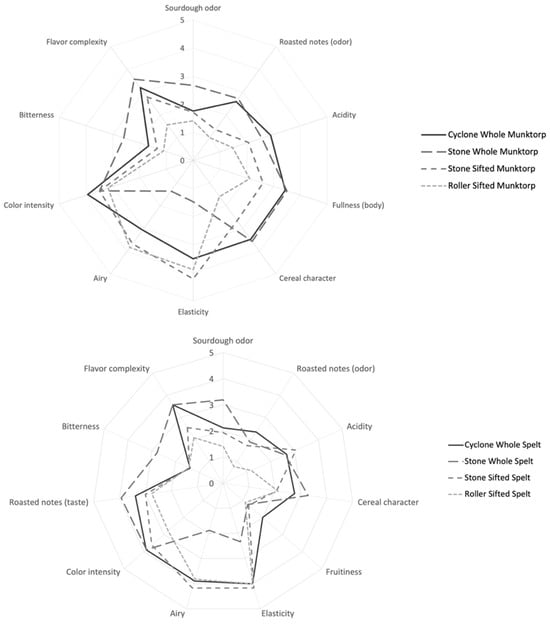
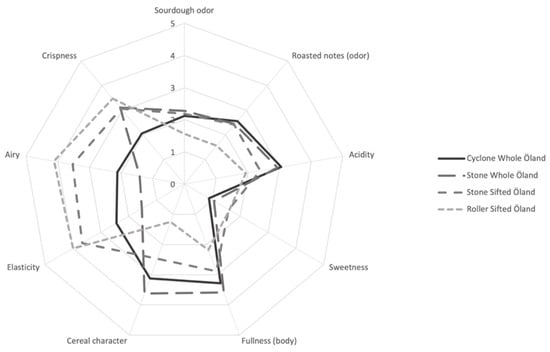
The twelve bread prototypes showed recurring sensory differentiation across the three cereal materials. Sifted breads were generally associated with greater perceived structural lightness, stone-milled wholegrain breads with greater flavor intensity, and cyclone-milled wholegrain breads with combinations of characteristics intermediate between these positions (Table 1; Figure 1). Results in this section refer to the integrated bread prototypes described in Section 2.3 rather than to isolated flour-processing effects.
Table 1.
Mean RATA intensity scores for the twelve bread prototypes.
Figure 1.
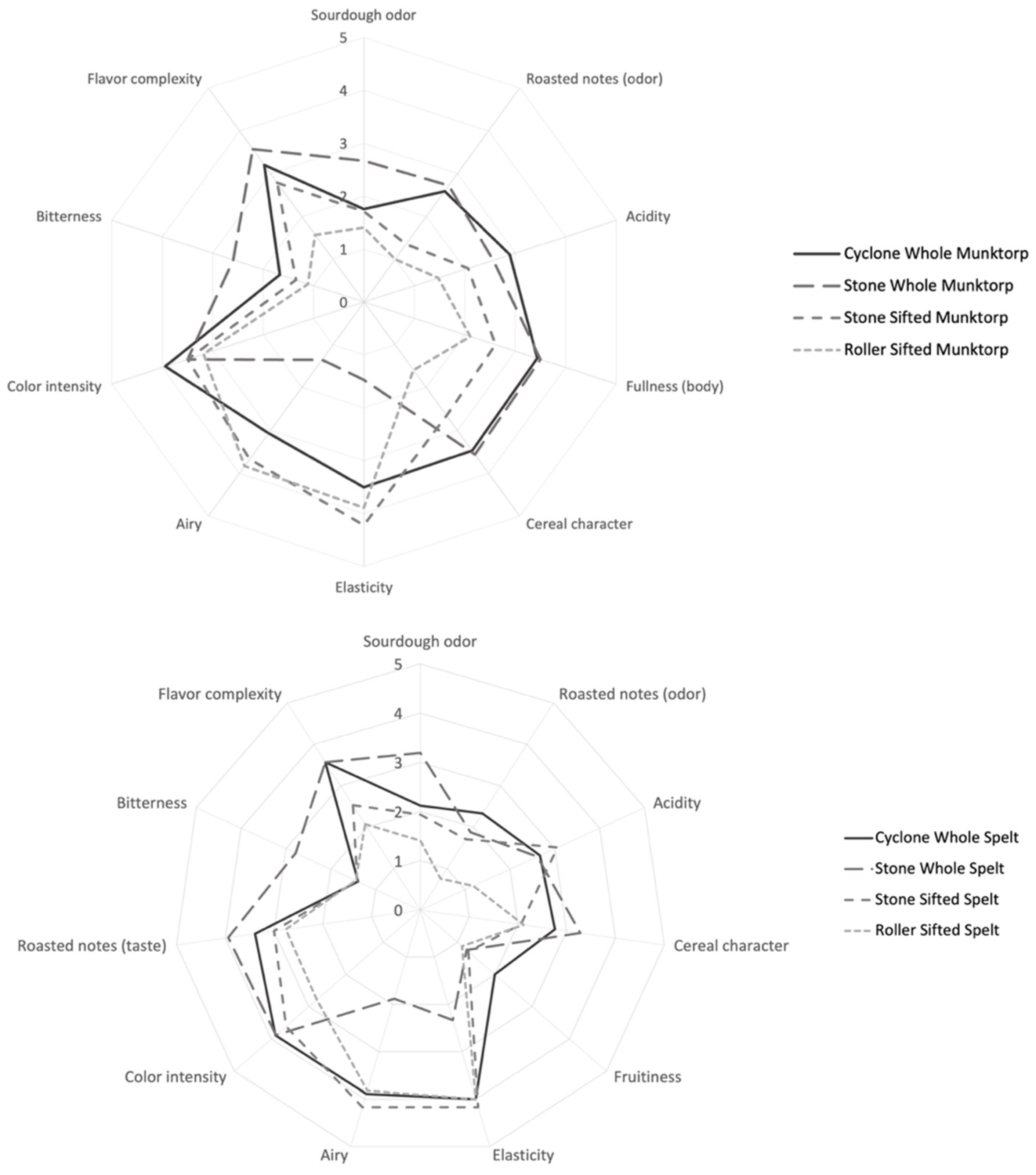
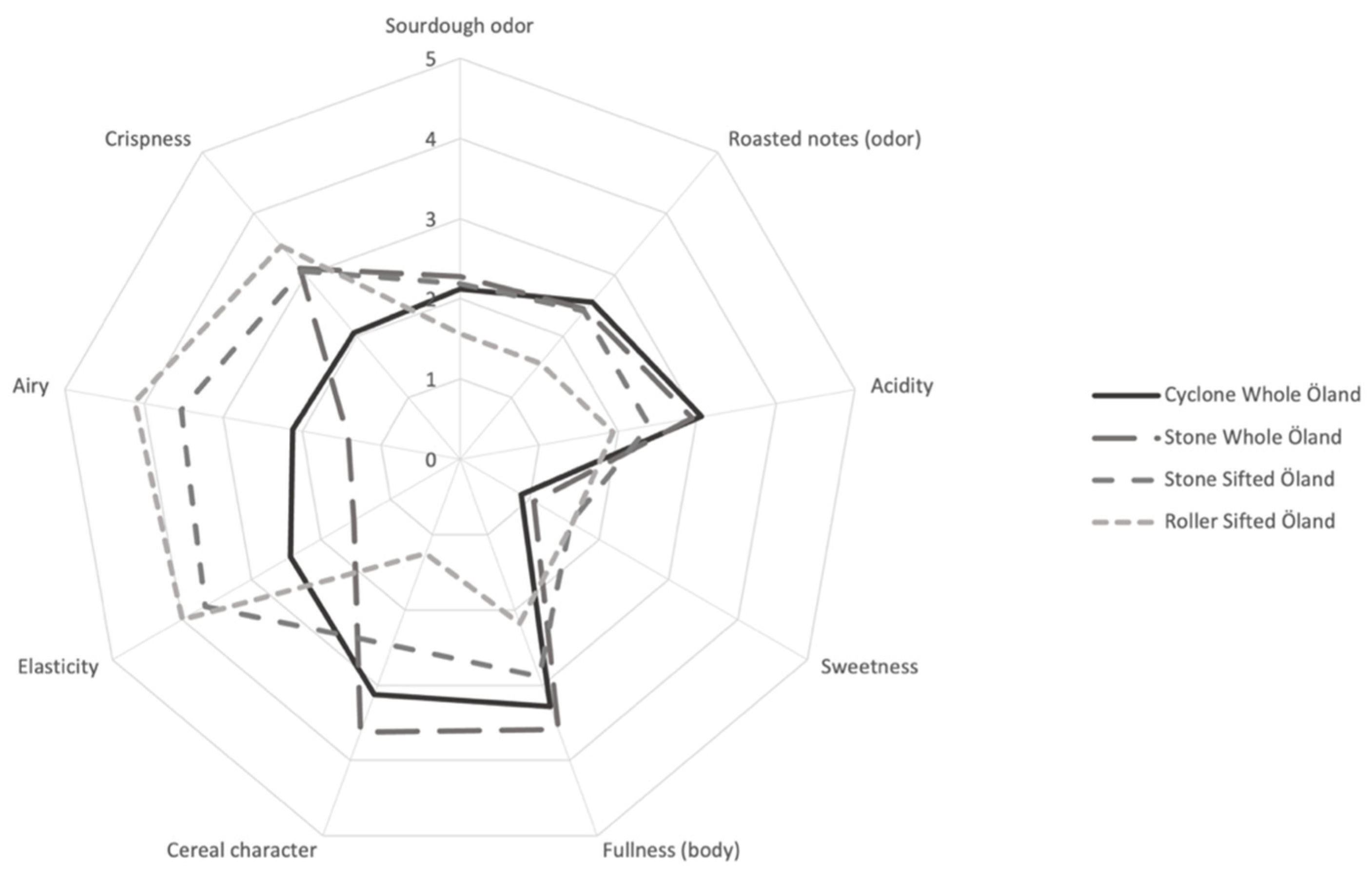
Radar plots of mean RATA intensity scores by cereal material. Panels show breads produced from Munktorp wheat, spelt wheat, and Öland wheat. Only attributes showing a significant product effect within the cereal material are displayed (linear mixed-effects model with product as a fixed effect and assessor as a random effect, p ≤ 0.05). Line types distinguish flour-processing conditions. Scores are shown on the original 0–5 intensity scale.
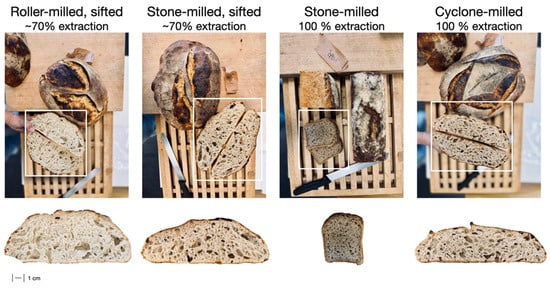
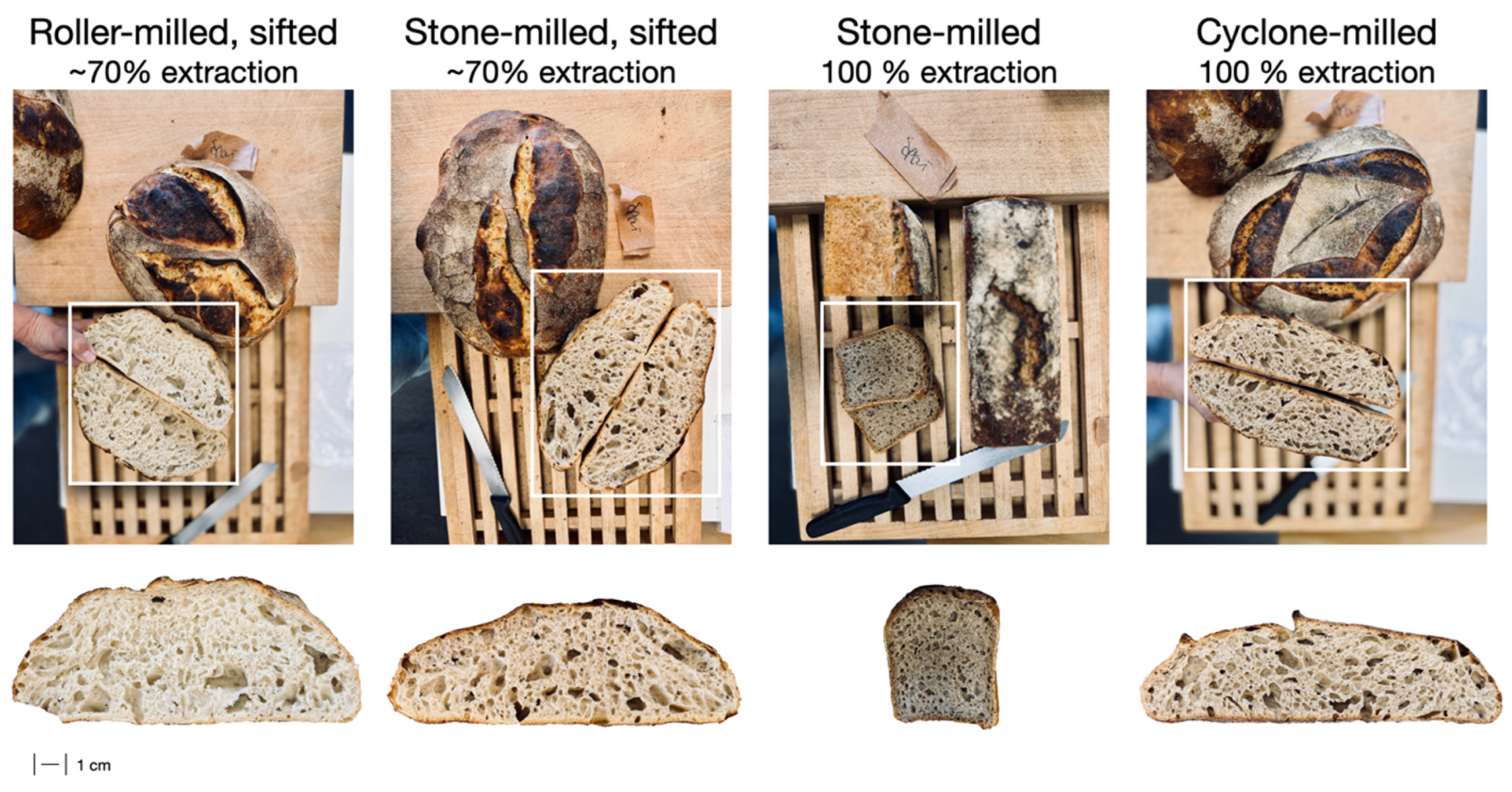
Elasticity and airiness produced the clearest structural contrasts. Roller-milled and stone-milled sifted breads had elasticity scores of 3.67–4.22 and airiness scores of 3.53–4.17. Stone-milled wholegrain breads ranged from 1.47 to 2.33 for elasticity and from 1.35 to 1.88 for airiness. Cyclone-milled wholegrain breads occupied an intermediate-to-high structural position, ranging from 2.44 to 4.00 in elasticity and from 2.12 to 3.89 in airiness. For several comparisons, no statistically significant difference was detected between cyclone-milled wholegrain and corresponding sifted prototypes for these attributes. Representative crumb sections of the four spelt breads illustrate the corresponding differences in crumb appearance (Figure 2).
Figure 2.
Crumb sections of the four spelt sourdough bread prototypes produced from roller-milled sifted (~70% extraction), stone-milled sifted (~70% extraction), stone-milled wholegrain (100% extraction), and cyclone-milled wholegrain (100% extraction) flours. The image illustrates visible differences in crumb porosity and cell distribution. Scoring was adapted to the dough characteristics of the respective flour classes; the stone-milled wholegrain loaf was baked in a tin and was not scored.
Flavor-related attributes showed a contrasting pattern. Stone-milled wholegrain breads showed high fullness (body) (3.44–3.59), cereal character (3.28–3.62), and roasted notes (taste) (3.50–3.94), with bitterness reaching 2.78 and sourdough odor 3.19. Sifted breads generally showed lower cereal character and flavor complexity. Cyclone-milled wholegrain breads retained moderate-to-high fullness (body) and cereal character while showing lower bitterness and sourdough odor than some stone-milled wholegrain prototypes.
For spelt, for example, the cyclone-milled wholegrain bread had bitterness and sourdough odor scores of 1.39 and 2.12, respectively, compared with 2.78 and 3.19 for the stone-milled wholegrain bread.
The recurring screening pattern was therefore concentrated primarily in elasticity and airiness and in attributes related to cereal and flavor intensity. Whole-kernel retention did not consistently coincide with the lowest perceived structural lightness. Other attributes showed less consistent differentiation: yeast odor, saltiness, fruitiness, and balance varied comparatively little across the product set, while differences in acidity, roasted notes (odor), color intensity, and crispness were more product-specific (Table 1).
3.2. Exploratory Multivariate Analyses Provided Complementary Views of Product Positioning
Product-level correlations described two partially opposing sensory dimensions (Table 2). Elasticity and airiness were positively associated (r = 0.77). Fullness (body) was associated with cereal character (r = 0.48) and flavor complexity (r = 0.47), whereas structural attributes showed weaker negative relationships with fullness (body) and cereal character (approximately r = −0.35 to −0.23). Because these correlations were based on twelve product means, they are interpreted descriptively.
Table 2.
Pearson correlation matrix for selected sensory attributes. Values are Pearson correlation coefficients for key sensory attributes used to interpret structural–flavor balance. Positive values indicate attributes that tended to increase together, whereas negative values indicate attributes that tended to vary in opposite directions.
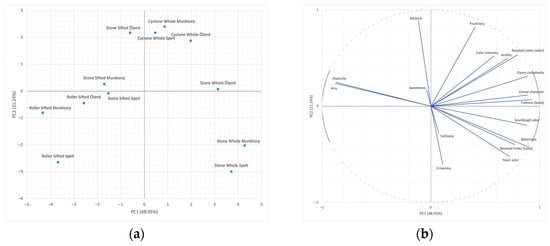
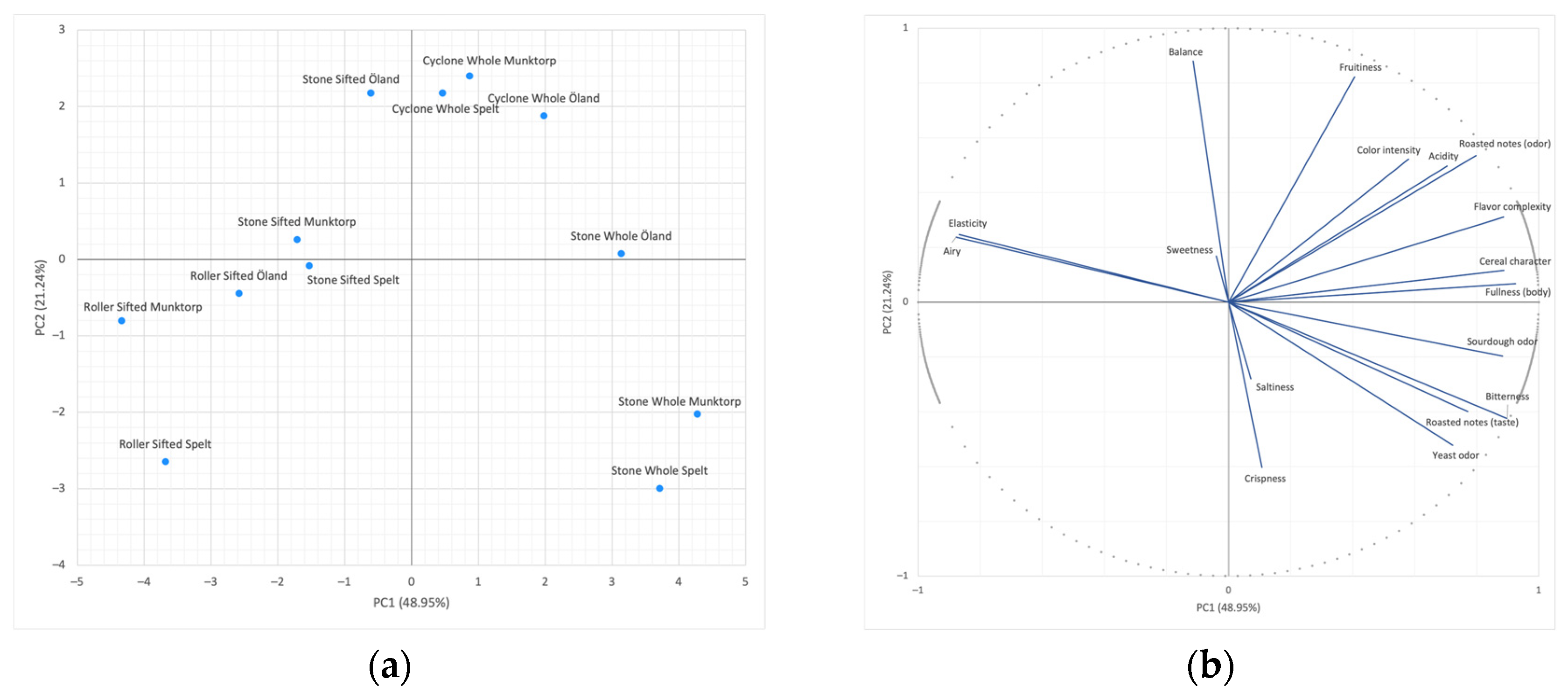
The first two principal components explained 70.2% of the variation in the product-level sensory profiles (Figure 3), with PC1 accounting for 48.95% and PC2 for 21.24%. PC1 primarily differentiated breads associated with elasticity and airiness from breads associated with fullness (body), cereal character, flavor complexity, sourdough odor, roasted notes (taste), and bitterness. PC2 further differentiated profiles associated with fruitiness, balance, and roasted notes (odor).
Figure 3.
Principal component analysis of product-level mean RATA scores. (a) PCA product map showing the twelve breads produced from three cereal materials and four flour-processing conditions. (b) PCA variable map showing sensory attributes contributing to product positioning. PC1 and PC2 explained 48.95% and 21.24% of the variation, respectively.
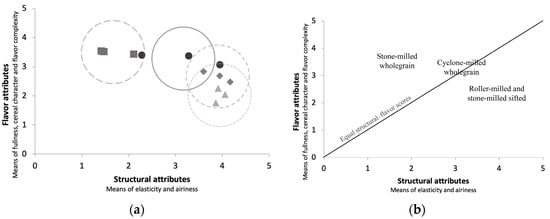
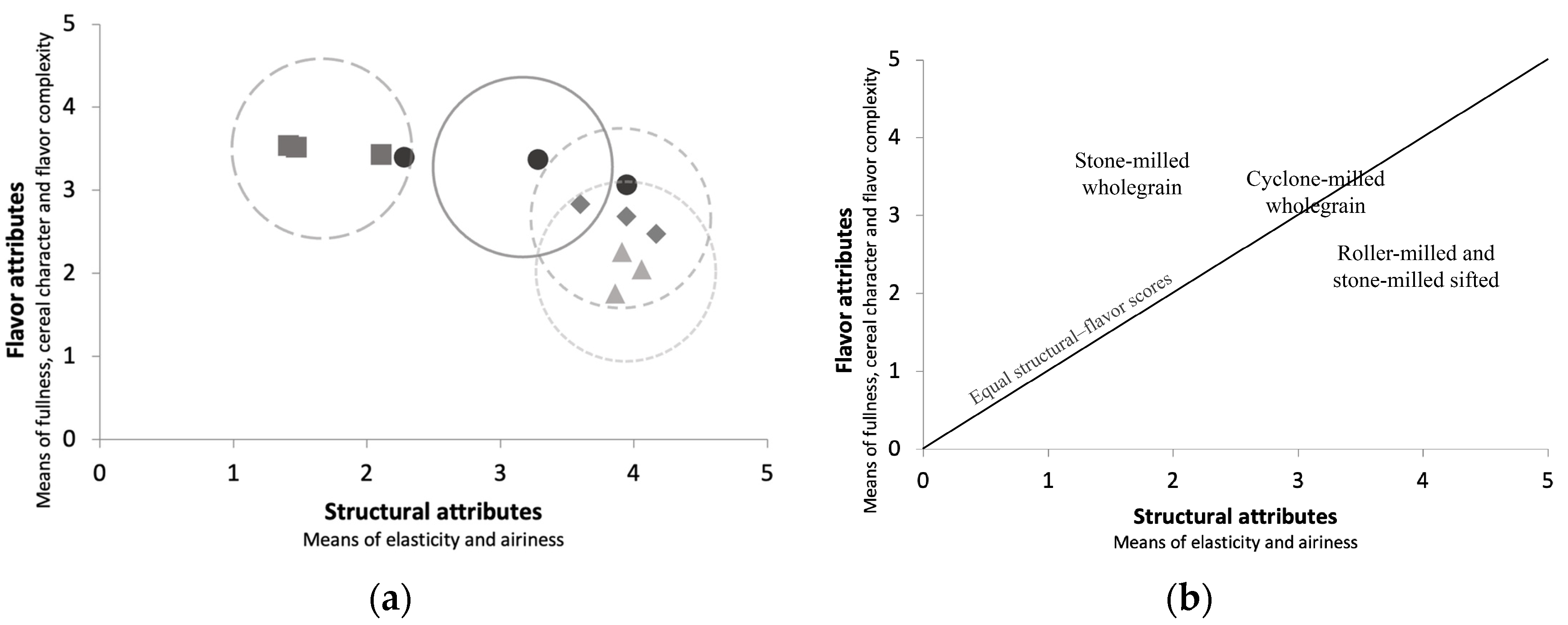
Taken together, the correlations and PCA provided complementary descriptions of the same relationship between structural and flavor-related attributes in the product-level sensory data. Figure 4 visualizes this positioning using the two descriptive composite dimensions.
Figure 4.
Sensory positioning and structural–flavor balance. (a) Structural composite score (mean of elasticity and airiness) plotted against flavor composite score (mean of fullness (body), cereal character, and flavor complexity) for the twelve bread prototypes. Individual markers represent prototypes, and marker shapes indicate flour-processing condition: black circles = cyclone wholegrain; dark gray squares = stone-milled wholegrain; gray rectangles = stone-milled sifted; light gray triangles = roller-milled sifted. Large outlined circles indicate the mean sensory position of each flour-processing condition across cereal materials. Line styles of these circles correspond to flour-processing condition (solid = cyclone wholegrain; long dashed = stone wholegrain; dashed = stone sifted; short dashed = roller sifted). (b) Conceptual representation of the structural–flavor balance. The diagonal line indicates equal composite structural and flavor scores; positions above and below the line indicate relatively greater flavor and structural emphasis, respectively.
3.3. Within-Cereal Liking Rankings Identified More Highly Ranked Prototypes
Within-cereal liking rankings provided a separate indication of how the participants ordered the four prototypes in each cereal block (Table 3). Cyclone-milled wholegrain was ranked first or second by 69% of participants for Munktorp, 71% for spelt, and 67% for Öland. Stone-milled sifted breads were also frequently ranked first or second (63%, 59%, and 67%, respectively).
Table 3.
Within-cereal liking ranking of bread prototypes. Participants ranked breads from 1 (most liked) to 4 (least liked), with lower mean ranks indicating greater liking. Percentages show the proportion of assessors assigning each bread to ranks 1–2 or 3–4 and are rounded to the nearest whole number; totals may therefore not equal 100%. Within each cereal material, products sharing a letter are not significantly different according to R-index analysis at p ≤ 0.05. Complete within-block rankings were available for n = 16 (Munktorp), n = 17 (spelt), and n = 15 (Öland). These results describe liking within the present assessor group.
R-index comparisons further showed that cyclone-milled wholegrain was significantly more highly ranked than roller-milled sifted bread for Munktorp (p = 0.025) and spelt (p = 0.032), and more highly ranked than stone-milled wholegrain bread for Öland (p = 0.029). No statistically significant difference was detected between cyclone-milled wholegrain and stone-milled sifted bread in any of the three cereal materials. Other prototypes therefore shared the more highly ranked groupings in several comparisons.
The liking rankings therefore did not uniquely favor cyclone-milled wholegrain, nor did they simply favor either the structurally lightest or the most flavor-intense prototypes. Rather, cyclone-milled wholegrain and stone-milled sifted breads were repeatedly among the more highly ranked products within this assessor group.
The separate question concerning interest in further baking or development showed a somewhat different pattern from the liking rankings. Cyclone-milled wholegrain was the most frequently selected prototype in all three cereal blocks, selected by 43% of respondents for Munktorp, 40% for spelt, and 38% for Öland. Although stone-milled sifted breads were frequently among the more highly ranked products for liking, they were selected as generating the greatest interest for further baking or development by 21%, 13%, and 23% of respondents, respectively. Stone-milled wholegrain was selected by 29%, 33%, and 15%, respectively. The descriptive pattern therefore indicates that liking and interest in further development were not interchangeable responses within the assessor group.
3.4. Professional Discussion Added Process-Oriented Interpretation
The deliberately unblinded professional discussions provided a practice-oriented interpretive layer after the coded individual assessments had been completed. Several interpretations recurred across both sensory sessions and across cereal blocks and helped translate product-level sensory patterns into questions for subsequent investigation (Table 4).
Table 4.
Integration of professional observations, sensory patterns, and research questions generated from the action case.
Across discussions, the most recurrent interpretation was that cyclone-milled wholegrain combined recognizable wholegrain character with structural qualities more commonly associated with sifted flour. Participants also linked milling to flour-specific water absorption, dough handling, and fermentation, while stone-milled wholegrain was valued for cereal character but associated with dense, grainy, or sandy texture. Increased sifting was discussed as reducing cereal identity, and cereal material, growing year, grain batch, falling number, and protein quality were identified as potential sources of variation. Together, these interpretations translated quantitative product differentiation into process-oriented questions concerning flour structure, hydration–fermentation relationships, extraction, and robustness across raw materials. The discussion also raised broader questions concerning consumer expectations, flour yield, milling throughput, and economic feasibility, providing additional directions for future investigation.
3.5. From Screening Pattern to the Primary Processing Hypothesis
Integration of the sensory profiles, liking rankings, and practice-based interpretation generated several process-oriented questions for subsequent investigation (Table 4). Among these, the most consistent cross-cereal pattern concerned the relationship between perceived bread structure and the expression of cereal and wholegrain character.
The observed product space suggested a continuum between structure-dominant breads, characterized by greater elasticity and airiness, and flavor-dominant breads, characterized by greater fullness (body), cereal character, and flavor complexity. Stone-milled wholegrain and sifted breads tended toward opposite regions of this continuum, whereas cyclone-milled wholegrain breads were located closer to an intermediate position.
The term structural–flavor balance is used here as a provisional organizing construct that makes this recurring relationship explicit in a form that can be specified and tested.
Combined with professional observations that cyclone-milled wholegrain could retain recognizable wholegrain character while displaying structural properties more commonly associated with sifted flour, the screening generated the following primary processing hypothesis: Cyclone-assisted wholegrain milling may alter the physical organization of wholegrain flour in a way that allows cereal and wholegrain sensory character to be retained while reducing some of the perceived structural penalties associated with conventional stone-milled wholegrain flour.
4. Discussion
There is a tension in gastronomic and food-design research between developing products suitable for professional practice and structuring studies so that individual variables can be isolated, replicated, and tested independently. Professional product development often requires material- and process-specific adaptation, whereas confirmatory experiments are designed to estimate the effects of more clearly defined variables. Early-stage inquiry may therefore require a different research logic from subsequent confirmatory testing [3].
The present study addresses this tension through Professional Sensory Screening (PSS). PSS structures the comparison of professionally developed prototypes so that recurring sensory and practice-based patterns can be translated into research questions and hypotheses for controlled testing. This approach is consistent with action case research and with food-design approaches that recognize the value of practice-based and prototype-driven exploration in early stages of inquiry [2,3].
This methodological problem also connects to an ongoing discussion within international gastronomy research about scientific decomposition. Berg and Fischler [5] argue that specialized analysis can produce increasingly precise knowledge of constituent processes while making their relations within gastronomic situations less visible. Their argument is not against disciplinary analysis, but for retaining attention to the relations through which otherwise distinguishable processes become gastronomically consequential.
In the present bread case, this meant allowing flour-specific breadmaking adaptations in hydration, fermentation, scoring, and loaf format so that the prototypes could be developed for professional artisan production rather than imposing an identical process on functionally different flours. The aim at this stage was therefore not to estimate the independent effect of each process variable, but to examine the professionally developed prototypes as integrated systems and identify recurring relationships within them. The credibility of this discovery stage rests on transparent prototype development, systematic sensory assessment, comparison across multiple forms of evidence, and professional interpretation grounded in the observed patterns. It also depends on a clear distinction between observations and candidate mechanisms and on consideration of potential sources of interpretive influence.
4.1. Professional Sensory Screening (PSS) as an In-House Research Tool
A practical advantage of PSS is its feasibility within professional networks and applied development contexts. Culinary professionals have previously been used for structured sensory evaluation of emerging artisanal ingredients [30], while rapid profiling with experienced or expert assessors has been proposed as a pragmatic approach to product differentiation [9,10]. The present case does not establish an optimal assessor-group size, but illustrates the type of product differentiation and practice-oriented interpretation that can emerge from an assessor group of a size feasible within collaborative or in-house development contexts.
The proposed role of such screening is therefore not quality control in the conventional sense and not consumer research. It is an in-house discovery tool. A producer facing several technically plausible alternatives could use a structured procedure to move beyond informal statements such as “this seems lighter” or “this tastes more of the grain” toward an explicit product map, prioritized prototypes, and defined questions for further investigation.
The same logic may also be useful in culinary product-development settings, including education, where students and practitioners can develop realistic prototypes, document the material-specific adaptations required, and use structured sensory screening to identify and prioritize potentially important variables.
The sequence suggested by this case can be summarized as: practice-based problem → iterative prototype development and process adaptation → realistic contrasting prototypes → structured sensory comparison → liking and practice-oriented interpretation → recurring pattern → research question → testable hypothesis → discipline-specific validation → return to practice and further development.
The same practice-embedded setting that makes this approach relevant also creates potential sources of expectancy and interpretive influence. Approximately half of the participants had prior professional familiarity with cyclone-milled flour, and the collaborating baker had produced the breads and subsequently moderated the discussions. The researcher’s established professional relationship with the collaborating mill also represents a potential source of interpretive influence in the synthesis of the field notes and formulation of hypotheses. Although individual RATA assessments, liking rankings, and the question concerning interest in further baking or development were completed under coded presentation before the flour-processing conditions were disclosed, the moderator’s extensive familiarity with the materials and production conditions may have influenced the subsequent discussion and its interpretation once the flour-processing conditions were revealed. Accordingly, the discussion stage is treated as a source of practice-based interpretation rather than independent confirmation of the sensory results.
4.2. Liking, Development Interest, and Professional Interpretation
The liking rankings and the separate development-interest question captured different aspects of product response. Cyclone-milled wholegrain and stone-milled sifted breads were both frequently among the more highly ranked products for liking. When participants instead identified the bread generating the greatest interest for further baking or development, cyclone-milled wholegrain was the most frequently selected condition in all three cereal blocks. Stone-milled wholegrain also attracted substantial development interest for spelt and Munktorp despite being less highly ranked for liking. Because participants were not sampled to represent a consumer population, the liking results should not be interpreted as estimates of consumer preference.
Professional interpretation entered primarily through the post-evaluation group discussions. Participants moved from perceived differences in crumb structure and flavor to questions concerning water absorption, fermentation behavior, grain-batch variation, and the physical characteristics of the flour. Gastronomic expertise has previously been described as context-sensitive and closely linked to creativity, collaboration, and tacit forms of knowledge [1]. In exploratory product development, such knowledge can help interpret why particular sensory differences may matter in practice.
Practitioner and professional participation can therefore contribute beyond providing sensory data: domain-specific interpretations may redirect attention, challenge initial assumptions, and connect sensory observations to material and process knowledge. This is consistent with transdisciplinary approaches in gastronomy that recognize professional and stakeholder knowledge as relevant to research on complex food-related questions [2,31].
4.3. Statistical Inference for Hypothesis Generation
The present study used mixed-model comparisons together with product-level correlations and exploratory multivariate analyses to structure the observed sensory space. Conventional significance testing served a screening function by identifying attributes that differentiated the prototypes and by focusing subsequent visualization and interpretation. Because the technological conditions were not independently replicated, these tests do not estimate generalized effects of milling method; their inferential scope is limited to differentiation among the prototypes across assessors.
In a hypothesis-generating design, statistical significance represents one source of information among several. The direction and magnitude of sensory differences, recurrence across cereal materials, product positioning, liking rankings, and practice-based interpretation were considered together when identifying patterns warranting further investigation. Correlations, PCA, and composite scores provided complementary descriptions of the same product-level sensory dataset rather than independent confirmation of the emerging pattern.
4.4. Implications of the Bread Case and Priorities for Validation
For the specific bread case, cyclone-assisted wholegrain milling emerged as the principal processing candidate for further investigation. Across three cereal materials, the cyclone-milled wholegrain prototypes showed greater perceived structural lightness than the stone-milled wholegrain prototypes while retaining cereal character, and they were repeatedly among the more highly ranked products for liking within the study group. They were also the most frequently selected prototypes for further baking or development in all three cereal blocks. Taken together, this structural–flavor pattern (Figure 4) provides a concrete example of what PSS can identify before controlled testing. The screening further directed attention toward flour particle characteristics, their interaction with the breadmaking process, and raw-material variability, consistent with the multiple pathways through which milling can influence flour, dough, and bread properties [32].
One plausible mechanism involves particle-size distribution and the physical behavior of bran and germ fractions. Coarse bran particles can interfere with gluten development, compete for water, and reduce gas-cell stability [17,33,34]. Greater particle refinement may reduce structural discontinuities while retaining all anatomical kernel fractions [16,17]. Particle-size distribution was not measured in the present case, however, and particle refinement should therefore be understood as a candidate mechanism rather than an explanation demonstrated by the study.
The professional discussions additionally directed attention toward the interaction between flour characteristics and the breadmaking process. Participants repeatedly linked milling method to water absorption, dough handling, and fermentation behavior. Because the breadmaking adaptations were coupled to flour-processing conditions during prototype development, the present case points to these interactions as priorities for mechanistic investigation rather than separating their individual effects.
Raw-material variation represents a further boundary condition. Professionals emphasized that cereal material, growing year, grain batch, falling number, and protein quality may alter flour and dough behavior. The recurrence of the structural–flavor pattern across three cereal materials is therefore relevant as a screening signal, while its robustness across cereal species, cultivars, seasons, and independent grain batches remains to be established.
A confirmatory follow-up could compare cyclone- and stone-milled wholegrain flour using multiple independent grain, milling, and baking batches; characterize particle-size distribution and starch damage; quantify water absorption and dough rheology; and measure fermentation behavior, loaf volume, and crumb structure. The primary structural–flavor hypothesis could then be evaluated using trained descriptive sensory analysis and, subsequently, consumer testing.
5. Conclusions
This study used a wholegrain sourdough bread case to examine PSS as a hypothesis-generating approach in gastronomic research. Across twelve professionally developed prototypes, sifted breads were generally associated with greater perceived structural lightness, stone-milled wholegrain breads with greater flavor intensity, and cyclone-milled wholegrain breads with an intermediate position. Cyclone-milled wholegrain breads were also consistently among the more highly ranked prototypes for liking within the assessor group. These patterns led to structural–flavor balance as a provisional organizing construct and identified cyclone-assisted wholegrain milling as a candidate for controlled validation.
The primary contribution is methodological. PSS combined structured sensory comparison with professional interpretation to make recurring relationships among material conditions, craft adaptations, and sensory outcomes sufficiently clear to generate testable questions without implying independent causal effects. PSS may therefore provide a useful discovery stage between practice-based development and confirmatory testing. Future work should examine its application across products, assessor groups, and professional settings.
Funding
This study was supported through the project “Samverkansplattform Mat och hälsa” (case ID: 20361373), coordinated by the Food and Health Centre at Örebro University and funded by the European Union through the European Regional Development Fund and Region Örebro County, with funding administered by the Swedish Agency for Economic and Regional Growth (Tillväxtverket).
Institutional Review Board Statement
According to the Swedish Act (2003:460) concerning the ethical review of research involving humans, this kind of sensory study does not require ethical approval in Sweden. The study was therefore not submitted for formal ethical review.
Informed Consent Statement
Informed consent was obtained from all participants involved in the study. Participants were informed of the research purpose, the voluntary nature of participation, and the reporting of results at group level.
Data Availability Statement
Anonymized RATA, ranking, and development-interest data underlying the quantitative analyses are available from the author upon reasonable request. Qualitative field notes are not publicly available because participants were recruited from a small professional community and full release could compromise anonymity.
Acknowledgments
The author thanks the participating bakers, millers, cereal professionals, and other assessors for their contribution to the sensory evaluation and discussions. The author thanks Josefin Åhlfeldt for contributing to the preliminary prototype-development phase and Märta Westling for prototype development, production of the final study breads, and facilitation of the professional discussions. Generative AI Statement: During the preparation, interpretive development, and revision of this manuscript, the author used ChatGPT (OpenAI, GPT-5.6 Sol; accessed August–October 2026) as described in Section 2.8. The author reviewed and verified all retained outputs and takes full responsibility for the analysis, interpretation, and published content.
Conflicts of Interest
The author declares a potential conflict of interest. The study was conducted in relation to a potential milling investment and applied development collaboration involving Sörgårdens Lisselbruk, a small-scale mill specializing in heritage cereals. The author and his spouse, Märta Westling, have an established professional relationship with Sörgårdens Lisselbruk through their co-owned artisan bakery.
References
- Cordeiro, C.M.; Berbyuk Lindström, N. Unveiling the Essence of Gastronomy: A Data-Driven Exploration of Culinary Expertise in the Nordic Region. Gastronomy 2024, 2, 215–232. [Google Scholar] [CrossRef] [Scilit]
- Westling, M. Introducing Action Case Research within Transdisciplinary Approaches: Natural Cider Making in Central Sweden. In Revealing Meals; Wellton, L., Eriksson, L., Öström, Å., Walter, U., Leer, J., Eds.; Örebro University: Örebro, Sweden, 2024; pp. 148–171. Available online: https://urn.kb.se/resolve?urn=urn%3Anbn%3Ase%3Aoru%3Adiva-117731 (accessed on 27 August 2026).
- Schifferstein, H.N.J. Supporting food design with consumer research: From inspiration and validation to participation and integration. Curr. Opin. Food Sci. 2023, 51, 101020. [Google Scholar] [CrossRef] [Scilit]
- Pieroni, A. Gastronomy: Fostering a New and Inclusive Scientific Field. Gastronomy 2023, 1, 1–2. [Google Scholar] [CrossRef] [Scilit]
- Berg, P.O.; Fischler, C. Reframing Gastronomy: Gastronomics as an Area of Science? Int. J. Gastron. Food Sci. 2026, 46, 101668. [Google Scholar] [CrossRef] [Scilit]
- Ares, G.; Bruzzone, F.; Vidal, L.; Silva Cadena, R.; Giménez, A.; Pineau, B.; Hunter, D.C.; Paisley, A.G.; Jaeger, S.R. Evaluation of a rating-based variant of check-all-that-apply questions: Rate-all-that-apply (RATA). Food Qual. Prefer. 2014, 36, 87–95. [Google Scholar] [CrossRef] [Scilit]
- Giacalone, D.; Hedelund, P.I. Rate-all-that-apply (RATA) with semi-trained assessors: An investigation of the method reproducibility. Food Qual. Prefer. 2016, 51, 65–71. [Google Scholar] [CrossRef] [Scilit]
- Vidal, L.; Ares, G.; Hedderley, D.I.; Meyners, M.; Jaeger, S.R. Comparison of rate-all-that-apply (RATA) and check-all-that-apply (CATA) questions across seven consumer studies. Food Qual. Prefer. 2018, 67, 49–58. [Google Scholar] [CrossRef] [Scilit]
- van Stokkom, V.; Benguedda, S.; Pelgrim, E.; Nijmeijer, M. Exploring sensory profiling with rate-all-that-apply in comparison to check-all-that-apply with and without just-about-right in product development. Appl. Food Res. 2025, 5, 101494. [Google Scholar] [CrossRef] [Scilit]
- Amar, K.; Adhikari, K. Rapid sensory profiling techniques using experienced, expert, and trained panelists: A review. Food Humanit. 2026, 7, 101243. [Google Scholar] [CrossRef] [Scilit]
- Collier, E.S.; Harris, K.L.; Niimi, J.; Lahne, J.; Bendtsen, M. There are other worlds than these: Why sensory and consumer science should embrace Bayesian inference. Food Qual. Prefer. 2027, 147, 106081. [Google Scholar] [CrossRef] [Scilit]
- Migliorini, P.; Spagnolo, S.; Torri, L.; Arnoulet, M.; Lazzerini, G.; Ceccarelli, S. Agronomic and quality characteristics of old, modern and mixture wheat varieties and landraces for organic bread chain. Eur. J. Agron. 2016, 79, 131–141. [Google Scholar] [CrossRef] [Scilit]
- Ortman, T.; Sandström, E.; Bengtsson, J.; Watson, C.A.; Bergkvist, G. Farmers’ motivations for landrace cereal cultivation in Sweden. Biol. Agric. Hortic. 2023, 39, 247–268. [Google Scholar] [CrossRef] [Scilit]
- Jönsson, M.; Gerhardt, K.; Wendin, K. Historical grains in modern gastronomy: A case study of artisan breads. Int. J. Gastron. Food Sci. 2025, 40, 101165. [Google Scholar] [CrossRef] [Scilit]
- Anson, N.M.; Hemery, Y.M.; Bast, A.; Haenen, G.R.M.M. Optimizing the bioactive potential of wheat bran by processing. Food Funct. 2012, 3, 362–375. [Google Scholar] [CrossRef] [Scilit] [PubMed]
- Hemery, Y.; Chaurand, M.; Holopainen, U.; Lampi, A.M.; Lehtinen, P.; Piironen, V.; Sadoudi, A.; Rouau, X. Potential of dry fractionation of wheat bran for the development of food ingredients, part I: Influence of ultra-fine grinding. J. Cereal Sci. 2011, 53, 1–8. [Google Scholar] [CrossRef] [Scilit]
- Gómez, M.; Gutkoski, L.C.; Bravo-Núñez, Á. Understanding whole-wheat flour and its effect in breads: A review. Compr. Rev. Food Sci. Food Saf. 2020, 19, 3241–3265. [Google Scholar] [CrossRef] [Scilit] [PubMed]
- Dziki, D.; Krajewska, A.; Findura, P. Particle size as an indicator of wheat flour quality: A review. Processes 2024, 12, 2480. [Google Scholar] [CrossRef] [Scilit]
- Arif, S.; Ahmed, M.; Chaudhry, Q.; Hasnain, A. Effects of water extractable and unextractable pentosans on dough and bread properties of hard wheat cultivars. LWT 2018, 97, 736–742. [Google Scholar] [CrossRef] [Scilit]
- Cappelli, A.; Cini, E.; Guerrini, L.; Masella, P.; Angeloni, G.; Parenti, A. Predictive models of the rheological properties and optimal water content in doughs. J. Cereal Sci. 2018, 83, 229–235. [Google Scholar] [CrossRef] [Scilit]
- Rezette, L.; Kansou, K.; Della Valle, G.; Le Gall, S.; Saulnier, L. The role of wheat flour minor components in predicting water absorption. Food Chem. 2025, 463, 141232. [Google Scholar] [CrossRef] [Scilit] [PubMed]
- Guerrini, L.; Parenti, O.; Angeloni, G.; Zanoni, B. The bread making process of ancient wheat: A semi-structured interview to bakers. J. Cereal Sci. 2019, 87, 9–17. [Google Scholar] [CrossRef] [Scilit]
- Lotong, V.; Chambers, E., IV; Chambers, D.H. Determination of the sensory attributes of wheat sourdough bread. J. Sens. Stud. 2000, 15, 309–326. [Google Scholar] [CrossRef] [Scilit]
- Callejo, M.J. Present situation on the descriptive sensory analysis of bread. J. Sens. Stud. 2011, 26, 255–268. [Google Scholar] [CrossRef] [Scilit]
- Heiniö, R.L.; Noort, M.W.J.; Katina, K.; Alam, S.A.; Sozer, N.; de Kock, H.L.; Hersleth, M.; Poutanen, K. Sensory characteristics of wholegrain and bran-rich cereal foods: A review. Trends Food Sci. Technol. 2016, 47, 25–38. [Google Scholar] [CrossRef] [Scilit]
- Sandelowski, M. Whatever happened to qualitative description? Res. Nurs. Health 2000, 23, 334–340. [Google Scholar] [CrossRef] [Scilit] [PubMed]
- Neergaard, M.A.; Olesen, F.; Andersen, R.S.; Sondergaard, J. Qualitative description—The poor cousin of health research? BMC Med. Res. Methodol. 2009, 9, 52. [Google Scholar] [CrossRef] [Scilit] [PubMed]
- Bi, J. Statistical analyses for R-index. J. Sens. Stud. 2006, 21, 584–600. [Google Scholar] [CrossRef] [Scilit]
- European Commission. Living Guidelines on the Responsible Use of Generative AI in Research, 3rd ed.; Directorate-General for Research and Innovation: Brussels, Belgium, 2026; Available online: https://research-and-innovation.ec.europa.eu/document/download/2b6cf7e5-36ac-41cb-aab5-0d32050143dc_en?filename=ec_rtd_ai-guidelines.pdf (accessed on 27 August 2026).
- Price, L.M.L.; Colonna, A.; Jones, E.T. Chefs Evaluate Syrup from the Wild Bigleaf Maple (Acer macrophyllum): A New Artisanal Food from Pacific Northwest Forests. Gastronomy 2024, 2, 155–168. [Google Scholar] [CrossRef] [Scilit]
- Parasecoli, F.; Rodriguez-Garcia, G. Politics beyond the Plate: Embracing Transdisciplinarity in Addressing the Gastronomic Heritage of Spain. Gastronomy 2023, 1, 18–31. [Google Scholar] [CrossRef] [Scilit]
- Cappelli, A.; Oliva, N.; Cini, E. Stone milling versus roller milling: A systematic review of the effects on wheat flour quality, dough rheology, and bread characteristics. Trends Food Sci. Technol. 2020, 97, 147–155. [Google Scholar] [CrossRef] [Scilit]
- Doblado-Maldonado, A.F.; Pike, O.A.; Sweley, J.C.; Rose, D.J. Key issues and challenges in whole wheat flour milling and storage. J. Cereal Sci. 2012, 56, 119–126. [Google Scholar] [CrossRef] [Scilit]
- Pietiäinen, S.; Moldin, A.; Ström, A.; Malmberg, C.; Langton, M. Effect of physicochemical properties, pre-processing, and extraction on the functionality of wheat bran arabinoxylans in breadmaking—A review. Food Chem. 2022, 383, 132584. [Google Scholar] [CrossRef] [Scilit] [PubMed]

Disclaimer/Publisher’s Note: The statements, opinions and data contained in all publications are solely those of the individual author(s) and contributor(s) and not of MDPI and/or the editor(s). MDPI and/or the editor(s) disclaim responsibility for any injury to people or property resulting from any ideas, methods, instructions or products referred to in the content. |
© 2026 by the author. Licensee MDPI, Basel, Switzerland. This article is an open access article distributed under the terms and conditions of the Creative Commons Attribution (CC BY) license.