Review

Physical and Rheological Properties of Bitumen Modified with Biochar

by
Nuha S. Mashaan
*,
Suneth Sirinatha
and
Chathurika Dassanayake
*
School of Engineering, Edith Cowan University, 270 Joondalup Drv, Joondalup, WA 6027, Australia
*
Authors to whom correspondence should be addressed.
J. Exp. Theor. Anal. 2026, 4(3), 23; https://doi.org/10.3390/jeta4030023
Submission received: 18 May 2026 / Revised: 5 June 2026 / Accepted: 15 June 2026 / Published: 23 June 2026

Abstract

The integration of biochar into asphalt binders represents a significant advancement toward global sustainability in pavement engineering. Produced through biomass pyrolysis, biochar enables the valorization of agricultural and industrial waste while reducing dependence on petroleum-derived binder constituents. This review critically synthesizes current research regarding the impact of biochar on the physical, rheological, and aging performance of bitumen. The evidence consistently shows that biochar improves binder stiffness, raises softening points, and strengthens rutting resistance at elevated temperatures, largely due to its porous microstructure and high carbon content. Biochar-modified binders also exhibit enhanced aging resistance through the adsorption of volatile light fractions. These improvements are primarily ascribed to the carbonaceous composition and high porosity of the biochar particles. However, systemic challenges, including phase stability at high concentrations, long-term oxidative aging, and a lack of standardized characterization protocols, hinder widespread implementation. By identifying consistent findings, contradictions, and critical research gaps across the literature, this review provides a consolidated foundation to guide the transition of biochar-modified bitumen from laboratory investigation to large-scale pavement infrastructure applications.

1. Introduction

Bitumen binders are widely used across the construction and infrastructure sectors and are valued for their versatility. They serve as a basic component in many applications, ranging from paving roads and sealing roofs to providing waterproofing and industrial adhesives. The durability and sustainability of construction materials are primarily threatened by four main factors, identified as aging, rutting, thermal sensitivity, and environmental hazards [1]. Among these, aging is particularly problematic due to its impact on bitumen binders. When these binders are exposed to oxidation, heat and UV radiation, their chemical structure degrades. This process increases their viscosity and stiffness, making the material significantly more prone to cracking over time. The construction industry is increasingly concerned with the environmental footprint of bitumen binders, specifically regarding their high energy consumption and overall sustainability. Beyond their use, the initial extraction and refining processes contribute significantly to carbon emissions and ecological damage. Consequently, there is a growing demand for the development of eco-friendly, sustainable alternatives [1,2].
Bitumen modification involves the incorporation of additives such as polymer, rubber, nanomaterial, and waste-derived material to enhance its physical and rheological properties [3,4,5,6]. The incorporation of various polymers into bitumen significantly enhances pavement durability by improving resistance to rutting and thermal cracking. Research has extensively explored plastomers like PE (polyethylene) [7], PP (polypropylene) [8], and EVA (ethylene vinyl acetate) [9], alongside thermoplastic elastomers such as SBS (styrene-butadiene-styrene) [10] and SIS (styrene-isoprene-styrene) [11], highlighting that while these modifiers improve elasticity and fatigue resistance, they also introduce complexities regarding storage stability, aging mechanisms, and phase separation. Recent developments include the use of compatibilizers to make polymer–bitumen networks more stable and the use of sustainable additives like lignin, which has been shown to make materials more resistant to moisture and more durable. The performance of polymer-modified bitumen ultimately depends on the type and amount of polymer used. To get the best long-term pavement performance, the rheological and chemical compatibility must be carefully handled [12]. Although traditional additives like polymers and recycled rubber improve resistance to wear and tear, they often come with higher costs and significant environmental drawbacks [1]. As a result, researchers are increasingly focusing on modifiers sourced from renewable and waste materials. These alternatives are focused on enhancing pavement performance while improving sustainability goals required by the industry [13,14].
Because of increasing concerns about the environment, such as greenhouse gas emissions, the depletion of natural resources, and problems with managing waste, the pavement industry is using more sustainable methods. Traditional road construction relies heavily on petroleum-based products and processes that use a lot of energy. These things are contributing significantly to environmental degradation. The goal of sustainable materials in pavement engineering is to lower their impact on the environment while maintaining or improving performance. The use of waste-derived and bio-based materials not only minimizes landfill disposal but also promotes circular economy principles [15,16]. The incorporation of waste-derived and bio-based materials into bitumen binders can significantly reduce dependence on virgin petroleum resources, thereby lowering the overall carbon footprint associated with pavement construction and maintenance. Recent research highlights that sustainable modifiers, including industrial by-products and biomass-derived materials, can improve binder performance while offering environmental and economic benefits [17,18]. Life-cycle assessments have demonstrated that modified binders using renewable materials can significantly reduce emissions and energy consumption [8,15]. Furthermore, the integration of sustainable materials aligns with global initiatives for greener infrastructure and resilient transportation systems.
Biochar is a carbon-rich material that is produced by thermochemically converting biomass using a process called pyrolysis in the absence of oxygen in a temperature range of 300–700 °C [1,13,19]. This process turns agricultural residues, forestry waste, and other organic materials into biochar, along with byproducts like bio-oil and syngas [19]. According to past studies, corn residue, wheat, barley, olive, sunflower, oil palm, sugarcane, cassava, coconut, and coffee were used to produce biochar under agricultural and forestry waste [20,21]. The properties of biochar depend on factors like feedstock type, pyrolysis temperature, and processing conditions, which influence its chemical composition and physical structure [14]. In general, biochar’s high carbon content, porous structure, and thermal stability make it suitable for a variety of engineering applications.
Recent research has shown that biochar could improve bitumen’s physical characteristics. It has been demonstrated that adding biochar raises the viscosity and softening point, suggesting better resistance to rutting and high-temperature deformation. Increased stiffness and better resistance to wear and indentation are also reflected in a decrease in penetration values. The need for the ideal content to balance stiffness and flexibility is highlighted by the fact that an excessive amount of biochar may decrease ductility [19]. Biochar-modified bitumen has better viscoelastic behavior from the rheological side, especially at high temperatures. Increased complex modulus values and decreased temperature susceptibility have been shown, in studies, to improve resistance to permanent deformation under high traffic loads [13]. For example, it has been demonstrated that biochar made from agricultural residues and oat hulls greatly improves rheological performance, particularly after aging conditions, demonstrating its effectiveness in improving long-term pavement performance [22,23]. Furthermore, biochar particles can improve mechanical stability and load distribution by acting as reinforcing agents within the bitumen structure [2]. The ability of biochar to improve bitumen’s resistance to aging is one of its main advantages. According to studies, biochar reduces oxidative and photo-oxidative degradation by preventing the formation of hydroxyl and carbonyl functional groups under UV radiation [13]. A longer lifespan and improved pavement durability are the results of this chemical stability. In addition to its mechanical advantages, its porous structure enables it to absorb volatile organic compounds (VOCs), thereby reducing harmful emissions during the production and application of bitumen [14]. Biochar presents a promising alternative for sustainable pavement infrastructure, as it simultaneously addresses environmental mitigation and contributes to the structural reinforcement of bituminous binders.
Regardless of these encouraging results, there are still several obstacles in the way of using biochar to modify bitumen. Inconsistent performance may result from the variability in biochar properties caused by variations in feedstock and production conditions [1]. Finding the ideal content of biochar is also crucial because too much of it can affect ductility and workability. Additionally, its widespread use in real-world applications is restricted by the absence of comprehensive studies on long-term performance and standardized guidelines.
In this regard, more investigation is needed to thoroughly assess the rheological and physical characteristics of bitumen modified with biochar. Gaining more insight into these characteristics will help maximize the use of biochar and advance its use in sustainable pavement engineering. Thus, the purpose of this study is to examine how bitumen’s physical behavior and rheological qualities are affected by biochar.

2. Methodology

The primary objective of this review is to offer a comprehensive review of the physical and rheological properties of bitumen modified with biochar. The review was conducted through a structured literature search and screening approach to identify, assess, and synthesize relevant studies on biochar as an additive and modifier in bitumen.
A literature search was conducted using several databases available on Edith Cowan University (ECU) library, such as Scopus, Web of Science, ScienceDirect, SpringerLink, and Google Scholar. The search was performed by combining keywords like “Biochar”, “Bitumen”, “Sustainability”, “Pavement construction”, “Carbon”, “Rheology”, and “Pyrolysis”. To maintain a high standard of quality, relevance, and consistency, specific selection criteria were defined before screening the literature. Studies were included if they were peer-reviewed journal articles, conference papers, or technical reports published in English between 2014 and 2026. Additionally, they had to feature original experimental data or quantitative findings regarding the production, properties, and application of biochar as a bitumen modifier, with a clear emphasis on its physical or rheological properties. Conversely, the review excluded non-peer-reviewed sources such as thesis, grey literature, and opinion pieces as well as any research published before 2014. Works unrelated to bitumen or pavement engineering, those investigating asphalt mixture performance without a binder-level analysis, and papers lacking primary experimental data, duplicates, or retractions were also disqualified.
To ensure a rigorous and transparent selection of literature, the screening process was executed in three sequential stages. The first stage involved conducting a keyword-based search across all five databases and systematically removing any duplicate entries from the initial pool of articles. In the second stage, the remaining records underwent a preliminary title and abstract screening against the predefined eligibility criteria, which filtered out studies that were clearly unrelated to biochar–bitumen modification, lacked peer review, or fell outside the specified timeline. Finally, the third stage involved a comprehensive full-text assessment of the remaining articles. Each paper was meticulously evaluated for its relevance to the physical and rheological properties of biochar-modified bitumen.
Data were systematically extracted from all studies that passed the full-text screening stage, capturing the biochar feedstock type, pyrolysis conditions (such as temperature, duration, and processing atmosphere), biochar dosage, bitumen grade, and the resulting physical and rheological test outcomes. These extracted details were then organized into summary tables categorized by research focus, feedstock origin, and production parameters to facilitate a structured and consistent cross-study comparison. The findings were subsequently synthesized into a narrative discussion highlighting consistent trends, contradictions, and research gaps. Furthermore, where quantitative data allowed, comparative observations were made across studies to pinpoint exactly how different feedstocks and production conditions influence bitumen performance, ensuring the overall accuracy and integrity of the review’s data.
This review paper is organized into eleven sections. Section 1 provides a brief introduction to the reviewed topic, while Section 2 outlines the review methodology adopted for this study. Section 3 describes the production and key properties of biochar, followed by Section 4, which examines the influence of biochar feedstock type and pyrolysis conditions on material characteristics. Section 5 discusses the mechanisms of biochar modification in asphalt binder. Section 6 and Section 7 evaluate the physical properties and aging performance of biochar-modified bitumen, respectively. Section 8 presents the rheological properties of biochar-modified bitumen. Section 9 is dedicated to comparing the performance of polymer-modified and biochar-modified bitumen. Consistent findings, contradictions, and research gaps are discussed under Section 10. Finally, Section 11 presents the conclusions and recommendations for future research.

3. Biochar Materials and Characteristics

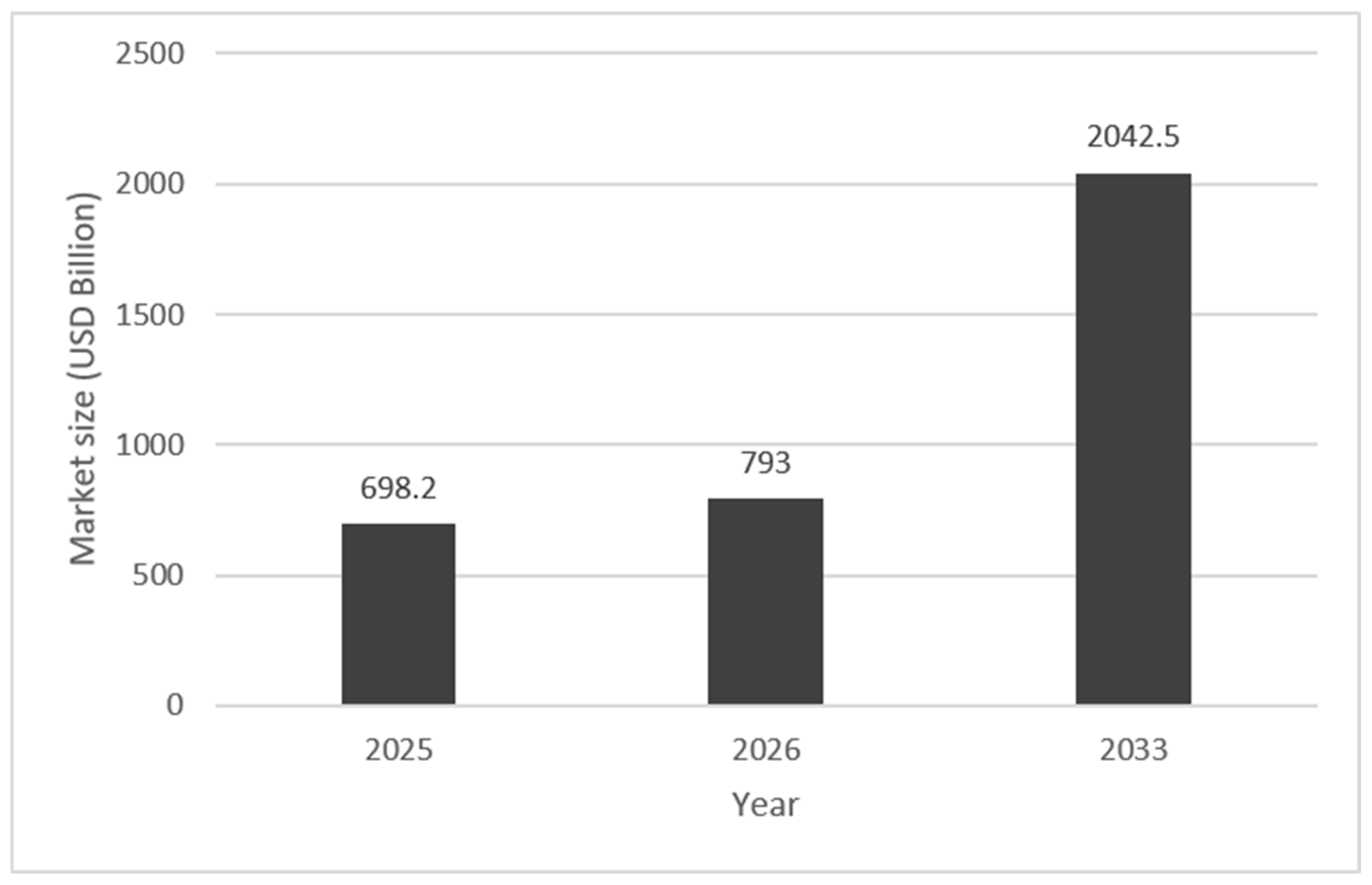
The characteristics of biochar are mainly determined by two factors, namely the raw material (feedstock) selected, and the production method employed. Feedstock sources are incredibly varied, ranging from municipal solid waste and animal manure to forestry debris and agricultural leftovers [24]. Historically, the most prevalent sources are residues from farming and timber industries. Common examples include waste from staples like corn, wheat, and rice, as well as specialized byproducts from crops such as sugarcane, coffee, coconut, and oil palm [1]. Biochar is defined primarily by its physical structure, including its light weight, porous nature, high surface area, and its chemical composition, which are heavily influenced by the feedstock used and the temperature of pyrolysis [25]. Biochar has wide-ranging applications across environmental, agricultural, industrial, and energy sectors due to its unique physicochemical properties. It is extensively used in agriculture as a soil amendment to enhance fertility, water retention, microbial activity, and carbon sequestration while reducing greenhouse gas emissions [26]. In environmental management, biochar serves as an effective adsorbent for removing organic and inorganic pollutants from soil, water, and air, making it valuable in wastewater treatment and remediation of heavy metals. Industrially, it is applied in construction as a sustainable additive in materials like concrete, and in energy systems as both a catalyst and product in biofuel and bioenergy generation [27]. Biochar is also emerging in advanced fields such as electronics and electrochemical energy storage due to its porous structure and conductivity [28]. As per the global biochar market report [29], it shows that the biochar industry will grow a lot from 2021 to 2023. In 2023, global production surged to approximately 352,304 metric tons from 96,320 metric tons, reflecting a remarkable 91% annual growth rate since 2021. The market size of biochar for 2025 is 698.2 USD million, and the estimated market value at the end of 2026 is 793 USD million. Projected market value for 2033 is about 2042.5 USD million [30]. In terms of market distribution, the agricultural sector remains the primary consumer, accounting for 70% of global usage. In contrast, the construction industry currently utilizes just 5% of the supply for modifying cement and bitumen. These production trends and future forecasts are visualized in Figure 1 [1].
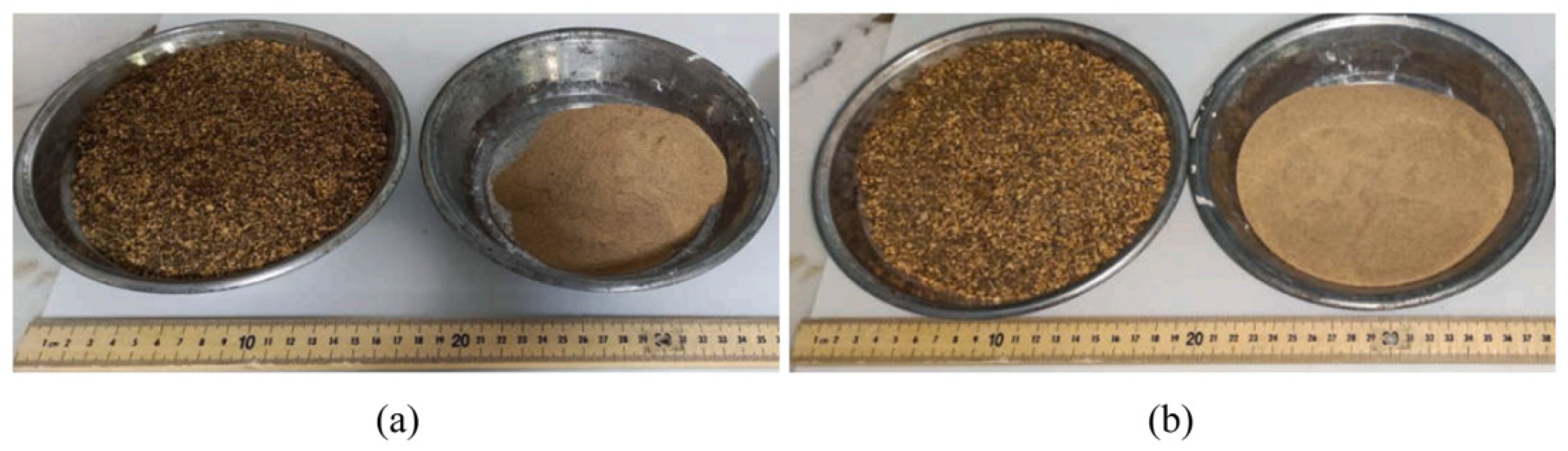
As per the report [29], agricultural wastes like crop residues of corn stover, rice, and wheat straw serve as the primary raw material of biochar. Typically, these materials are either discarded post-harvest or disposed of via open burning practices that trigger significant environmental concerns, such as air pollution, greenhouse gas release, and the leaching of contaminants into groundwater [31]. Consequently, transforming these residues into biochar addresses these ecological hazards while creating a versatile, valuable product. Rice production is a cornerstone of global agriculture, with nearly 90% of nations contributing to an annual yield of approximately 500 million tons. However, this massive scale of cultivation brings significant environmental hurdles, particularly regarding waste management. Each year, harvesting generates between 800 and 1000 million tons of rice straw, alongside a substantial volume of husks that are notoriously difficult to decompose because of their high silica content [1,21]. Based on the research [14], rice straw-derived biochar serves as an effective bitumen modifier due to its porous, fibrous microstructure and textured surface, which foster robust physicochemical bonding within the bitumen binder. The study emphasizes that pyrolysis temperature is a decisive factor in producing biochar. Higher temperatures enhances biomass decomposition by improving the quality of biochar, though they simultaneously lower the overall yield in favor of liquid and gaseous byproducts. Additionally, the study highlights that agricultural residues such as rice straw represent an abundant and sustainable feedstock for biochar production, offering significant potential for recycling biomass waste into value-added material for engineering applications. In a study by Yegane et al. [23], bitumen was modified using biochar sourced from cherry and sour cherry waste, produced via slow pyrolysis at approximately 500 °C in an inert nitrogen environment. The researchers found that the resulting biochar possessed a rough, microporous surface and fine particle size, characteristics that facilitate superior dispersion and stronger interfacial bonding with bitumen. These experimental results showed that this modification significantly enhanced the binder’s viscosity and stiffness, increasing it by up to 2.5 times while also reducing temperature sensitivity and improving rutting resistance, as indicated by a higher complex modulus G* and lower non-recoverable creep compliance Jnr. While the biochar enhanced fatigue performance, the study also noted a minor decrease in elastic recovery following aging, suggesting a necessary balance between increased stiffness and maintained elasticity. Investigation by Kumar et al. [32] evaluated the efficacy of biochar sourced from Mesua ferrea seed cover waste as a sustainable alternative for bitumen modification. This specific biomass is a byproduct of oil extraction and undergoes pyrolysis to generate bio-oil and gases, leaving behind a carbon-dense solid biochar. By integrating this biochar into bitumen binders at different concentrations, researchers assessed its impact on the material’s physical and chemical profile. The result revealed that the biochar significantly improved the binder’s durability, specifically increasing its resistance to aging, deformation and rutting. These findings underscore the potential of repurposing agricultural waste into high performance, eco-friendly additives for the paving industry. Beyond the above-mentioned agricultural wastes, various other agricultural byproducts have been utilized for biochar production, including coconut shell [33], cotton and sunflower stalks [12], sugarcane bagasse, tomato waste, and groundnut shells [1,21]. Additionally, researchers have successfully converted feedstock such as switchgrass [34], late harvest grass [35], and fibers from factory tea waste [36] into biochar. Research on forestry waste-derived biochar, like wood chip saw dust, pine shavings, and bark residues, for bitumen modification, has gained increasing attention due to its abundance and high carbon content. Studies such as the work on waste wood-based biochar-modified bitumen demonstrate that incorporating wood-derived biochar significantly enhances the viscoelastic properties, rutting resistance, and fatigue performance of bitumen binders, mainly due to its porous structure and ability to stiffen the binder matrix [37]. Mousavi et al. [38] evaluated the effectiveness of a metal-rich biochar derived from the acacia plant as a sustainable modifier for bitumen surfaces. Their research demonstrated that acacia biochar is significantly more efficient at capturing hazardous volatile organic compounds (VOCs) than lower metal alternatives like silver grass, reducing bitumen emission to 16.9%. This enhanced performance is primarily attributed to the higher inherent concentrations of calcium (8.1 wt%), aluminum (6.9 wt%), and iron (4.4 wt%) within the acacia biomass. Specifically, molecular modeling revealed that these metals, particularly iron, serve as active sites that strengthen the adsorption of air pollutants and, in some cases, initiate their catalytic degradation. By mitigating the release of VOCs, this modifier not only improves air quality but also slows the aging process of the bitumen, thereby extending the service life of the road infrastructure. More broadly, studies on biochar-modified bitumen indicate that the fibrous and porous microstructure of biochar forms a reinforcing skeleton within the binder, increasing the proportion of viscous components and improving high-temperature performance by up to about 35% [17]. These findings collectively suggest that forestry waste biochar functions as an effective micro filler and reinforcing agent enhancing binder aggregate interaction and resistance to deformation, while also promoting sustainable waste valorization. However, compared to agricultural biochar, research on forestry-derived biochar remains relatively limited, particularly in terms of long-term aging and low-temperature cracking performance, indicating a need for further investigation. Figure 2 shows a photograph of (a) cherry and (b) sour cherry waste materials prepared for decomposition with pyrolysis in the research by Yegane et al. (2025) [23].
In the agricultural sector, livestock manure is known to be an important fertilizer because it has a lot of organic matter and important minerals like nitrogen, phosphorus, and potassium. For the industry, managing this waste is a challenge because improper disposal leads to transmission of high-risk pathogens and air pollution. Research has shown that animal husbandry is a major cause of greenhouse gas emissions around the world. It is responsible for about 37% of methane (CH4) emissions and 65% of nitrous oxide (N2O) emissions. To deal with these environmental issues, modern technology has focused on converting manure into high-performance products. Biochar production has emerged as a practical solution. Recent studies have shown that biochar made from chicken manure and cow dung has great properties that make them good for adsorbing things and improving soil. These properties include a very well-developed pore structure and perfect surface area [39,40]. Biochar made from organic waste from households, like paper and animal waste, can improve soil fertility by changing its chemical makeup. Moreover, rapid urbanization has resulted in an excessive amount of untreated sewage sludge. Converting this waste into biochar offers an environmentally friendly way to get rid of it that can be used in many ways. In addition to being a good way to improve soil, sludge-based biochar also serves as a valuable additive in construction. Specifically, it has been shown to improve thermal stability and resistance to aging, and to be better at rutting, while also making bitumen stick better and making the pavement last longer [41,42]. Various feedstocks, pyrolysis techniques, and temperature ranges utilized by researchers to generate biochar are detailed in Table 1.
Biochar production technologies are mainly focused on the thermochemical conversion processes. Pyrolysis is the most common method used in the research industry today. When biomass is heated in an environment with limited oxygen, usually between 300 °C and 700 °C, it breaks down into solid biochar, bio-oil, and syngas. Pyrolysis can be categorized into slow, fast, and intermediate processes depending on operating conditions. Normally, slow pyrolysis, which has low heating rates and longer residence time is considered the best for getting most biochar out of the process. Slow pyrolysis started in the early 20th century for making coal and other chemicals on a large scale. Now, it is a well-known way to make high-quality biochar. The process involves heating organic matter at a rate of 5 °C to 100 °C per minute within a temperature range of 400 °C to 650 °C, and sustaining these conditions for a duration varying from minutes to several days [47,48,49]. This longer residence time makes it easier for organic compounds to thermally crack and rearrange their structures into a solid residue. At the same time, a lower temperature and slow heating suppress the formation of liquid and gaseous byproducts [50]. Fast pyrolysis, on the other hand, works at higher heating rates and shorter residence times. It makes more bio-oil and less biochar as a result. The process involves the thermal treatment of organic matter within a limited oxygen environment at temperatures ranging from 600 °C to 650 °C, utilizing an extremely rapid heating rate of 1000 °C per second [47]. Another emerging technology is gasification, which turns biomass into syngas by partially oxidizing it at high temperatures (usually above 700 °C). This leaves behind a small amount of biochar with different physical and chemical properties. Gasification-derived biochar is not as common, but it usually has a larger surface area and better porosity, which may improve interaction with bitumen [6].
The physical, chemical, and structural properties of biochar are what mostly determine how effective and useful it is. In the research by Dassanayake & Mashaan, 2025 [1], an illustration was given for the surface characterization of different types of biochar using scanning electron microscopy (SEM). As per this SEM analysis, it depicts that biochar usually has a high carbon content and a complex, fibrous, and porous surface. These particular features are not the same, as they differ greatly depending on the original feedstock and the specific thermal condition used in production. The surface area and pore structure of biochar, which includes micro-, meso-, and micropores, are what make it physically useful. These factors directly govern its ability to retain nutrients, water, and pollutants. These properties are usually measured using the Brunauer–Emmett–Teller (BET) method and nitrogen sorption. These properties fluctuate based on the long-term stability of the material and production methods. For example, research shows that rice straw subjected to fast pyrolysis may have a surface area as low as 4.5 m2/g, as it does not have many macropores [14], while chemically activated cow dung can have a surface area as high as 4081.1 m2/g [39]. So the final structural and environmental performance depends on how well the feedstock, pyrolysis temperature, and activation method work together [1]. Biochar is made up of four main components, identified as fixed carbon, volatile matter, ash, and moisture. It also has small amounts of nitrogen and sulfur. The fixed carbon that stays after devolatilization gives it its strength and thermal stability, which makes it perfect for use in high-temperature situations like reinforcing bitumen. However, the material’s performance is also influenced by its volatile matter and ash content; while the former affects reactivity, a high ash content can diminish carbon sequestration and introduce toxic heavy metals. In addition, to stabilize biochar, it needs to be dried in a controlled way to control the moisture content, and its pH levels, which usually range from 4.6 to 9.3 [51], need to be carefully considered. Ultimately, a thorough assessment of these chemical and physical properties is essential prior to the effective incorporation of biochar into bituminous binder systems [1].
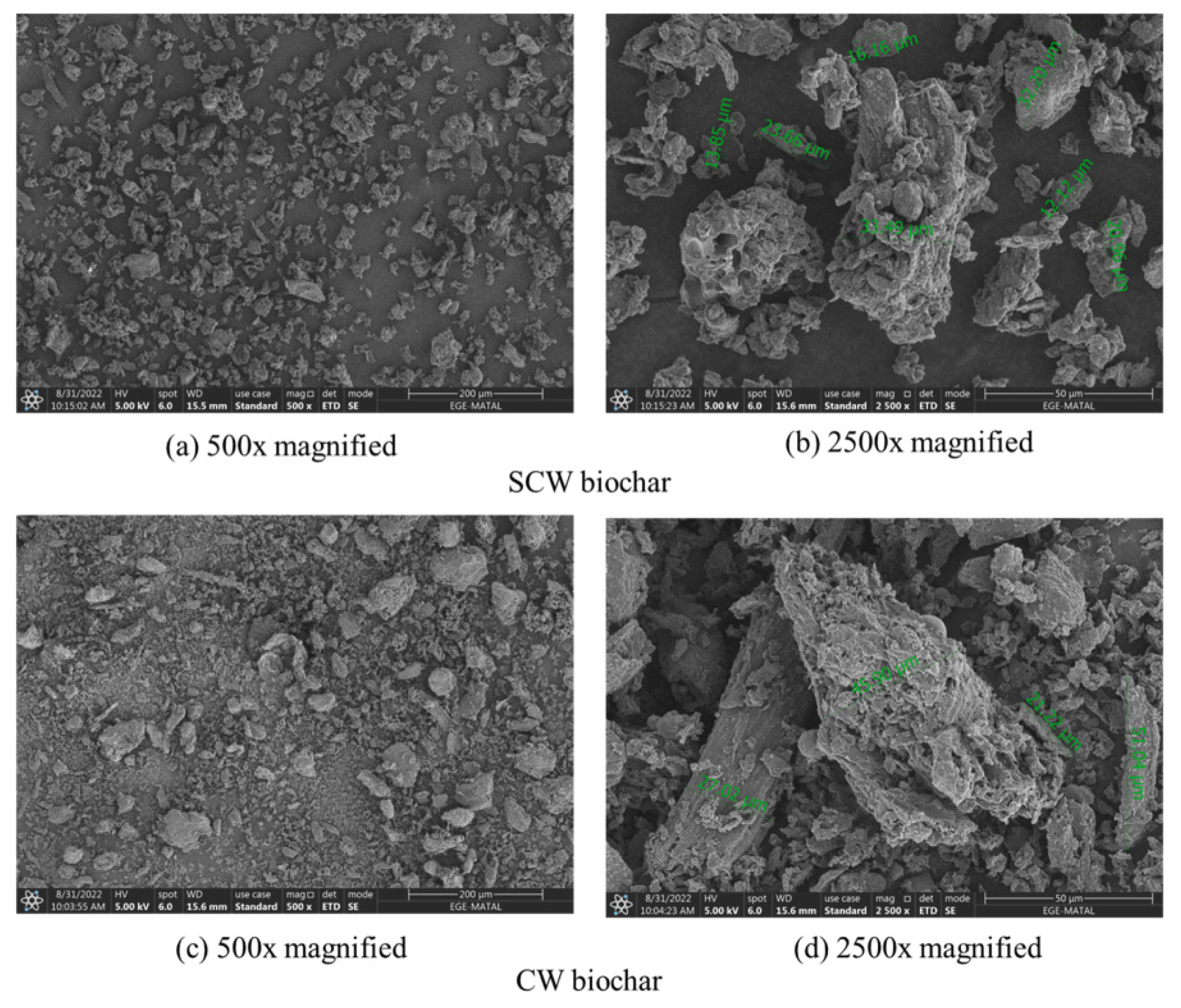
Figure 3 displays the SEM micrographs of both the CW and SCW biochars in the research by Yegane et al. (2025) [23].
The application of biochar as a sustainable additive in bitumen modification is a big step forward in green pavement engineering, as it solves problems in waste management and infrastructural durability. Biochar derived from different types of agricultural and forestry waste, such as cherry and sour cherry waste, cotton and sunflower stalks, groundnut shells, hardwood, and rice straw, has a rough, porous, and fibrous surface that helps the bitumen matrix to facilitate robust mechanical interlocking and physiochemical interactions. This microstructural compatibility results in a significant enhancement of binder stiffness and rotational viscosity, particularly improving performance at elevated temperatures. For example, adding cherry waste biochar can make the viscosity a few times higher, and adding rice straw biochar can make the rutting parameter much higher. This suggests that the material is better at resisting permanent deformation under heavy traffic loads [14,23]. Modifying biochar makes bituminous binder more thermally stable by raising the softening point and the penetration index (PI). High concentrations of cotton stalk biochar have been reported to elevate the performance grade (PG) of bitumen from PG 64-Y to PG 76-Y, indicating a significant transition towards sol–gel behavior that exhibits reduced sensitivity to temperature variations [12]. These additives usually make the material more resistant to shear and enhance the non-recoverable creep compliance. They may also result in a reduction in low-temperature ductility and cracking resistance due to the increased hardness of the binder [19,44]. These findings collectively highlight biochar’s potential as a cost-effective, renewable substitute for synthetic modifiers, facilitating the shift towards more resilient and low-carbon road construction methodologies.

4. Influence of Biochar Feedstock Type and Pyrolysis Conditions on Bitumen Performance

The performance of biochar with bitumen strongly depends on the feedstock origin, the pyrolysis method, and the treatment temperature, which collectively affect the biochar’s physical, chemical, and microstructural attributes. The following subsections further describe cross-study comparisons of key relationships among feedstock, conditions, and performance, based on previous studies.

4.1. Influence of Feedstock Type on Biochar Properties and Bitumen Modification

The origin of the biomass influences both the microstructural and chemical character of biochar. Tag et al. [52] conducted a study using four biomass types, including agricultural waste (vine pruning/lignocellulosic), animal waste (poultry litter), agro-industrial waste (orange pomace), and algal biomass (seaweeds), pyrolyzed under five different temperatures between 250 and 600 °C. Their results showed that lignocellulosic and vine pruning waste consistently achieved the highest BET surface area (up to 8.1 m2/g) of the tested feedstocks, while orange pomace produced the lowest (approximately 1.2 m2/g) despite equivalent pyrolysis conditions. Biochar with a high BET specific surface area generally exhibits stronger interaction with bitumen due to the increased availability of active adsorption sites and porous structure.
Yegane et al. [23] incorporated cherry waste (CW) and sour cherry waste (SCW) biochars into bitumen at 13–17 wt%, achieving viscosity increases by 2.40 and 2.59 times, respectively, and enhanced the complex modulus by 1.94 and 1.83 times. The high performance of SCW was attributable to its finer particle distribution, which provided greater surface area per unit mass for bitumen interactions. Ahmedzade et al. [12] found that cotton stalk biochar achieved higher performance as a bitumen modifier than sunflower stalks because of its unique porous, fibrous structure and 60.1% higher fixed carbon, confirming that feedstock composition, particularly lignin and cellulose content, affects the resulting biochar’s ability to interact with the binder matrix.
In addition to the biochar feedstock type, the quality of biochar and several of its physical and chemical properties significantly influence the performance of bitumen binder modification. These include BET surface area, porosity, particle size, particle morphology, ash content, carbon content, surface functional groups, moisture content, and density.

4.2. Effect of Pyrolysis Temperature and Method on Biochar Properties and Binder Performance

Pyrolysis temperature and method are the most influential processing variables controlling biochar surface chemistry and structural order. Zhou et al. [53] investigated the physicochemical characteristics of biochar produced from waste wood and pig manure through fast pyrolysis at temperatures of 450 °C, 500 °C, and 550 °C, and evaluated the performance of adding 2% biochar as a bitumen modifier. Elemental and XRF analyses showed that increasing the pyrolysis temperature from 450 °C to 550 °C resulted in a slight reduction in the carbon content of waste wood-based biochar (WBB), from 23.25% to 21.25%. When 2% WBB was incorporated into bitumen, the softening point increased from 49 °C for the control binder to 52 °C and 53 °C for WBB produced at 450 °C and 550 °C, respectively. At the same time, penetration values decreased from 66 to approximately 57–58, and viscosity at 60 °C increased significantly from 185 Pa·s to 320–322 Pa·s. These results confirm that biochar produced at all investigated temperatures increased binder stiffness. In addition, dynamic shear rheometer (DSR) temperature sweep testing revealed that the complex modulus (G*) of WBB-modified bitumen increased with higher pyrolysis temperature, indicating enhanced high-temperature stiffness and rutting resistance.
The slow and fast pyrolysis comparison by Sanchez and Varamini [54] clearly demonstrates the influence of pyrolysis conditions on biochar properties and bitumen performance at similar temperatures (450–480 °C). Biochar produced through slow pyrolysis with a long residence time of 12 h showed a much higher fixed-carbon content (85.2%) and lower ash content (1.47%) than fast-pyrolysis biochar, which contained 55.1% carbon and 31.7% ash. In terms of bitumen performance, the slow-pyrolysis biochar produced greater binder stiffening, as reflected by higher viscosity and lower penetration. Furthermore, slow-pyrolysis biochar-modified bitumen also showed greater susceptibility to short-term oxidative hardening, as indicated by a higher RTFO carbonyl index. Overall, the findings indicate that slow-pyrolysis biochar provides greater stiffness and improved aging resistance, whereas fast-pyrolysis biochar offers lower stiffness and greater aging susceptibility.
The role of pyrolysis temperature is further illustrated by the hemp stalk study of Aslan et al. [55], who produced biochar at 300 °C, 450 °C, and 600 °C and tested all variants as 15 wt% modifiers. The study demonstrated that both pyrolysis temperature and cooling method significantly influence the properties of biochar and the resulting performance of biochar-modified bitumen binders. Biochar produced from industrial hemp stalks increased binder stiffness, as shown by a higher softening point, lower penetration, increased viscosity, and improved rutting resistance. The cooling method had a particularly strong effect on binder performance, with rapidly cooled biochar producing higher rutting resistance than slowly cooled biochar, likely due to its greater surface area and stronger interaction with the bitumen binder observed in SEM analysis. Although pyrolysis temperature did not create a major difference in rutting performance, lower-temperature pyrolysis at 300 °C was considered more suitable because it achieved comparable performance while improving efficiency.
Table 2 presents the comparison of the influence of biochar feedstock type and pyrolysis conditions on bitumen performance.
The comparison across feedstock types and pyrolysis conditions shows that both variables directly influence bitumen binder performance. Within the same feedstock category, moderate pyrolysis temperatures consistently outperformed higher temperatures, as lower temperatures preserved more surface functional groups that interact with the binder. Regardless of feedstock type, increasing biochar dosage improved high-temperature rutting resistance but reduced low-temperature performance. Physical properties such as particle size also played an important role, as demonstrated by the superior performance of sour cherry biochar over cherry biochar under identical conditions. Overall, the results indicate that neither feedstock type nor pyrolysis temperature alone determines binder performance, both must be considered together to achieve the desired modification outcome.

5. Mechanism of Biochar Modification in Asphalt Binder

The evidence in the literature suggests that biochar interacts with bitumen mainly through physical processes rather than chemical reactions. Fourier-transform infrared spectroscopy (FTIR) studies provide important evidence regarding the interaction between biochar and bitumen. Ma et al. [17] reported that no new chemical functional groups were formed after incorporating biochar into bitumen binders, indicating that no significant new chemical bonds form between the biochar and the binder. The performance gains are therefore better explained by the porous, rigid, carbon-rich nature of biochar and its physical interaction with the bitumen fractions, as outlined below.
The physical interaction mechanism is strongly related to the porous and rough microstructure of biochar. Scanning electron microscopy (SEM) images presented by Ma et al. [17] showed that biochar particles possess irregular, porous, and fibrous morphologies with high specific surface areas. When dispersed within the bitumen binder, the porous structure enables biochar particles to absorb lighter maltene fractions from the bitumen. This absorption reduces binder fluidity and increases viscosity, leading to higher stiffness and improved rutting resistance. At the same time, the rigid particles form a reinforcing skeletal network within the binder matrix, restricting deformation under loading conditions. Ma et al. [17] described this behavior as the formation of a skeleton and stiffening zone between biochar and bitumen. Consequently, biochar modification generally results in lower penetration values, higher softening points, increased viscosity, and higher complex modulus values. The porous surface texture, roughness, and surface functionality of biochar improve adhesion and cohesion within the modified binder system [1].
The improvement in aging resistance is another significant mechanism associated with biochar modification. Rajib et al. [56] investigated the aging performance of biochar-modified binders under oxidation aging (RTFO/PAV), ultraviolet (UV) aging, mixture aging, and xenon arc weathering. Their results showed that biochar-modified binders exhibited lower rheological and chemical aging indices compared with neat bitumen. The authors attributed this behavior to the pore structure and surface functional groups of biochar, which can adsorb reactive species and scavenge free radicals generated during oxidative aging. Under UV aging conditions, biochar has been reported to act as both a UV-light-blocking material and a free-radical scavenger, thereby slowing oxidative degradation and delaying changes in binder rheology.
Similar findings were reported by Celauro et al. [13], who observed lower accumulation of carbonyl and hydroxyl groups in biochar-modified binders exposed to UVB irradiation compared with neat bitumen. Their aging index, calculated before and after aging, decreased from 43.5% in the unmodified binder to 36.5% in the binder containing 10% biochar. The authors explained this anti-aging behavior by highlighting the carbonaceous nature of biochar. Similar to carbon black and carbon nanotubes, biochar particles can absorb UV radiation due to their dark color and carbon-rich structure, thereby reducing the formation of oxygen-containing degradation products in the binder. In addition, the elemental similarity between biochar and bitumen, both mainly composed of carbon, hydrogen, oxygen, and nitrogen, improves compatibility and dispersion within the binder matrix [1,13].
Storage stability is another important aspect influenced by biochar modification. Good storage stability requires the modifier to remain uniformly dispersed during hot storage without phase separation. Zhang et al. [57] reported that the porous characteristics and surface properties of biochar contributed to improved compatibility and storage stability in biochar-modified binders. In their segregation study, the softening point differences between the upper and lower layers after 48 h were reported values, all of which were below the commonly accepted limit of ±1 °C. The results of the study demonstrated excellent storage stability at 6% biochar content. The very small differences between the upper and lower sections indicated that no significant phase separation occurred during storage, suggesting good compatibility between the biochar particles and the bitumen binder. Celauro et al. [13] similarly reported that only low biochar dosages achieved acceptable storage stability. These findings suggest that moderate amounts of biochar can remain well dispersed because the porous particles absorb maltenes and become anchored within the binder matrix, whereas excessive dosages exceed the anchoring capacity of the binder and promote gravitational settling.
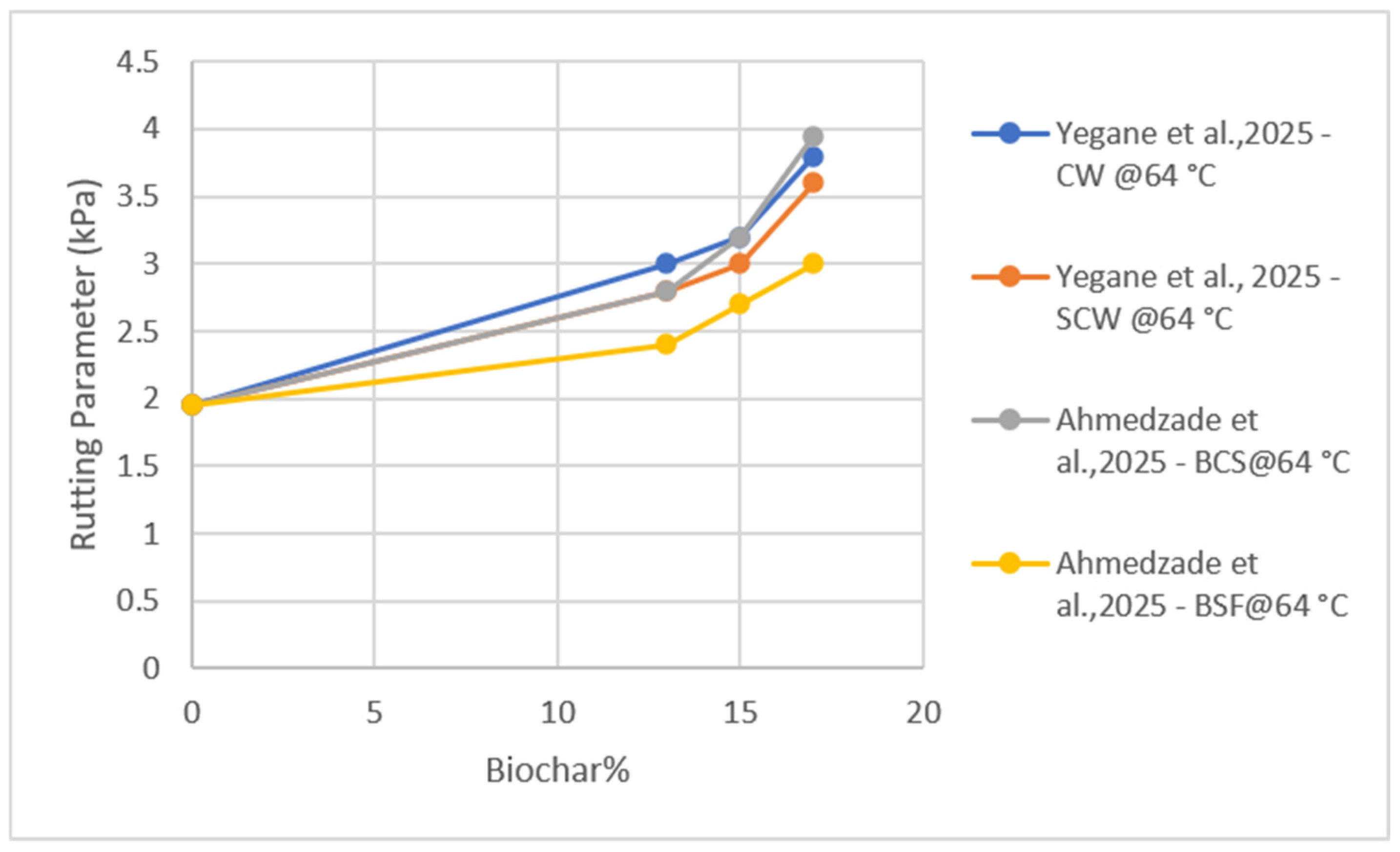
The enhancement of rutting resistance in biochar-modified binders is mainly associated with the increase in high-temperature stiffness and viscosity. Because biochar increases the complex modulus (G*) and reduces temperature susceptibility, the rutting parameter (G*/sinδ) increases significantly. Ma et al. [17] reported that the critical temperature corresponding to G*/sinδ = 1.0 kPa increased from 65.2 °C for neat bitumen to 70.1 °C for the binder containing 15% biochar.
Overall, the literature indicates that biochar improves bitumen performance mainly through physical reinforcement and adsorption mechanisms rather than chemical reactions. The porous microstructure and high surface area of biochar allow absorption of lighter binder fractions and formation of a rigid reinforcing network within the bitumen matrix. At the same time, the carbon-rich structure of biochar contributes to UV shielding and free-radical scavenging, improving aging resistance. These combined mechanisms explain the observed increases in stiffness, viscosity, complex modulus, rutting resistance, and aging resistance in biochar-modified bitumen binders.

6. Physical Properties of Biochar-Modified Bitumen

The physical properties of bitumen, including penetration, softening point, viscosity, and ductility, are fundamental indicators of binder consistency, temperature susceptibility, and workability. A consistent stiffening trend was reported across all reviewed studies following biochar incorporation, though the magnitude of changes varied with feedstock type, pyrolysis conditions, and dosage.

6.1. Penetration

Penetration values are a measure of needle indentation depth into bitumen under a standard load. Penetration values decreased monotonically with increasing biochar content across all reviewed studies, indicating progressive stiffening of the binder matrix.
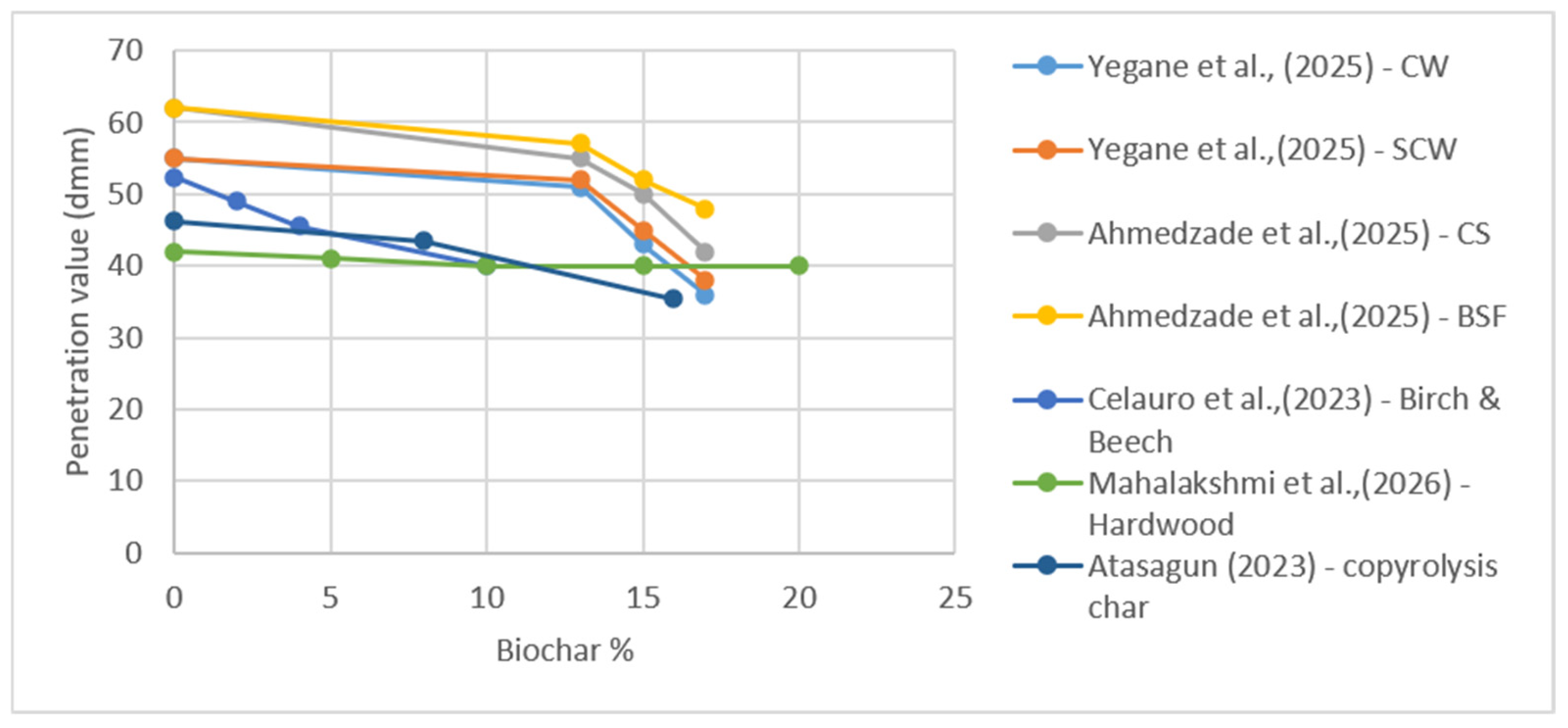
Yegane et al., 2025 [23], reported that the addition of 17% cherry waste (CW) biochar to a 50/70 penetration grade bitumen resulted in approximately 35% reduction in needle penetration relative to neat bitumen. Sour cherry waste (SCW) biochar at the same dosage produced a comparable reduction, though the trend was marginally less pronounced than CW-based biochar. Similarly, Ahmedzade et al., 2025 [12], observed a progressive decline in penetration with increasing cotton stalk biochar (BCS) and sunflower stalk biochar (BSF) content (13–17% by weight), with B-17BCS reducing penetration from 62 dmm (base bitumen) to 42 dmm, indicating an approximate reduction by 32%, and B-17BSF producing a smaller but consistent decrease.
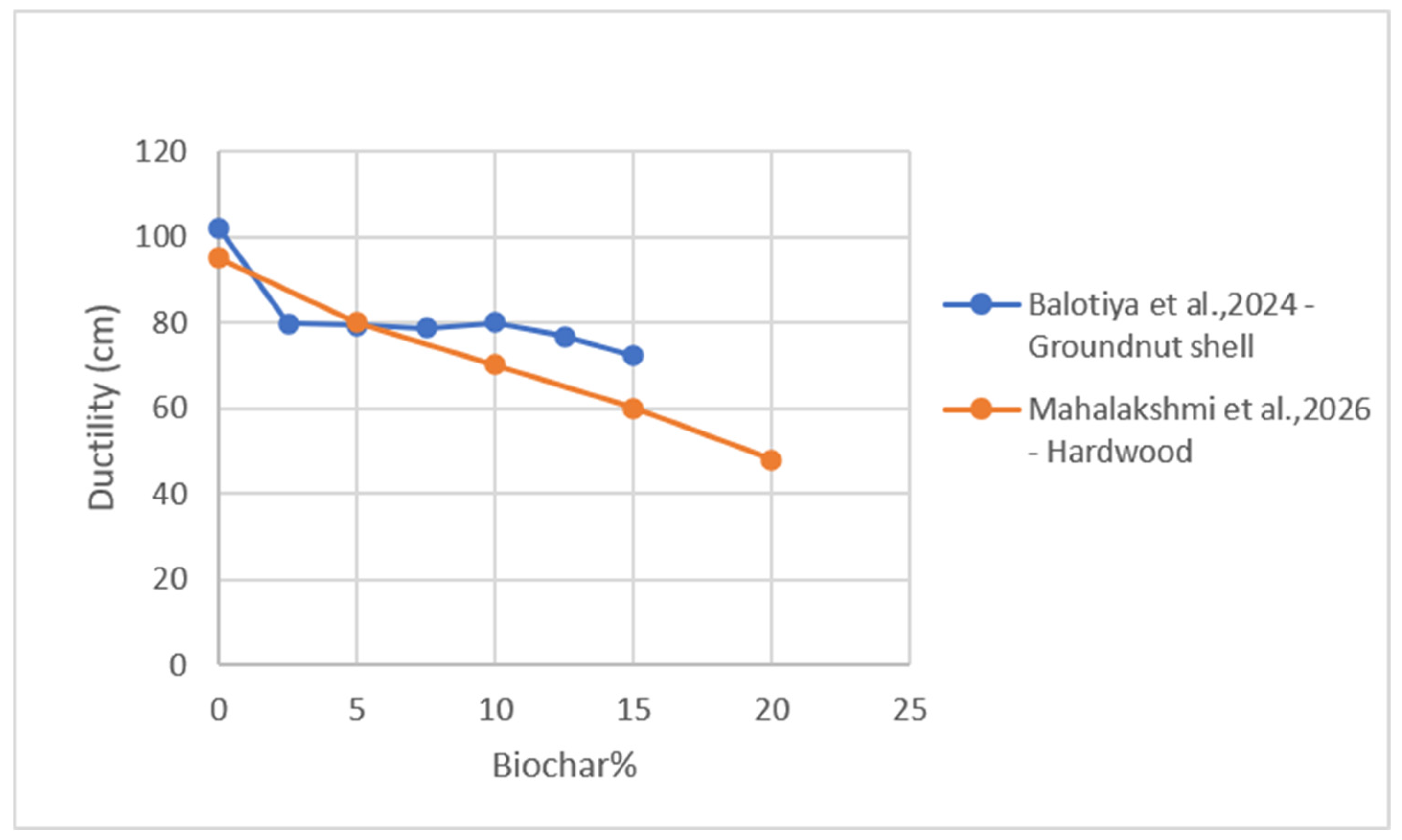
Balotiya et al., 2024 [19], used groundnut shell biochar at increments from 2.5% to 15% in VG30 bitumen and documented a clear downward penetration trend. The decline was particularly pronounced in the 7.5–12.5% range before leveling off, suggesting diminishing stiffening returns near saturation. Mahalakshmi et al., 2026 [44], observed a similar pattern with hardwood biochar (HBC) in 40/50 grade bitumen at a dosage from 5% to 20%, with penetration declining from 42 dmm at 0% to 40 dmm at 20%. HBC showed a more modest reduction, which the authors attributed to the initial partial softening effect at 5% HBC before the dominant stiffening mechanism took over above 10%.
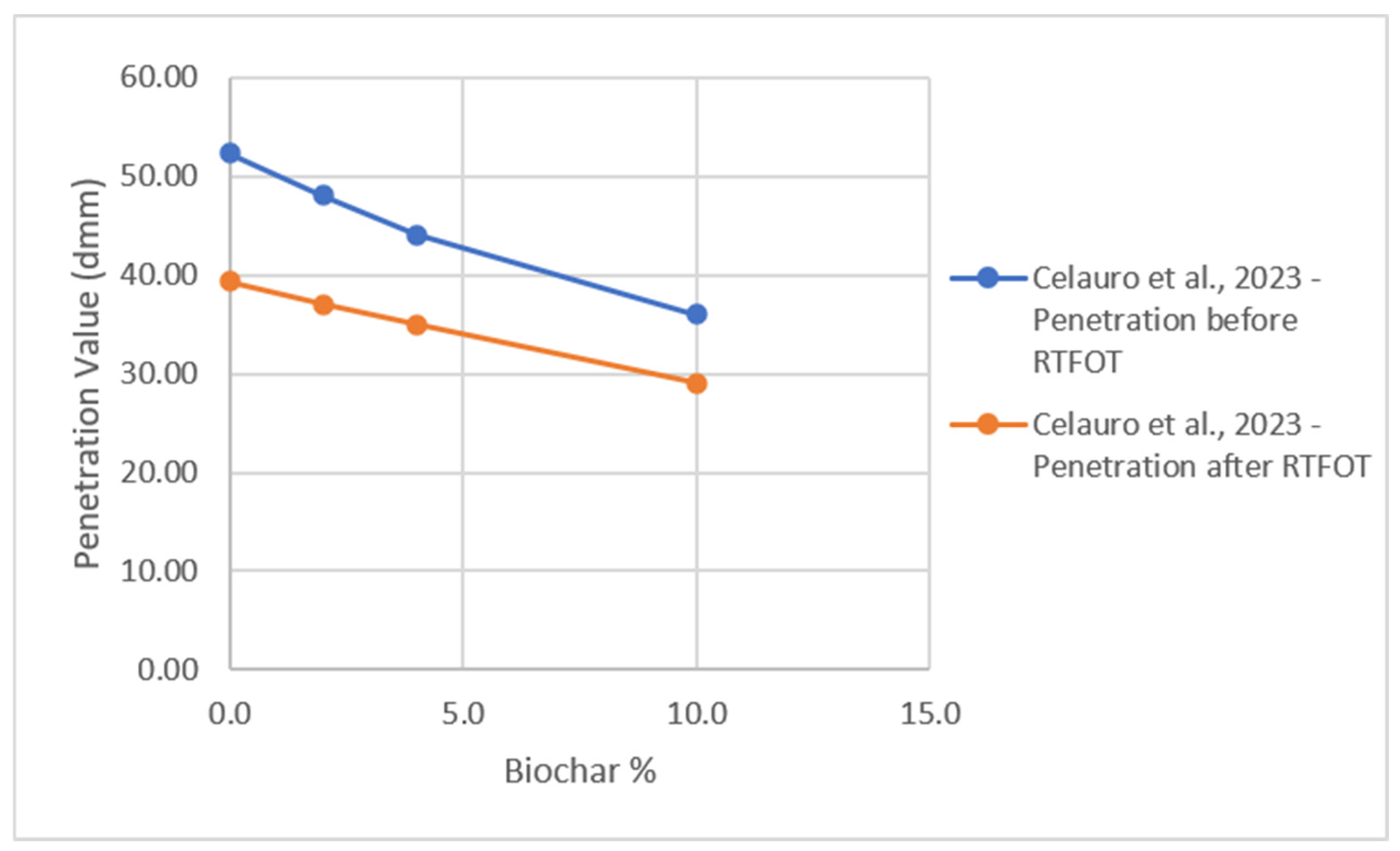
Celauro et al., 2023 [13], utilizing commercial biochar produced from birch and beech wood pyrolysis at lower dosages (2%, 4%, and 10%), also confirmed this systemic decrease in penetration as biochar percentage increased. Importantly, their study noted that the magnitude of penetration reduction at low dosage was relatively modest, suggesting a threshold effect beyond which biochar begins to significantly alter bitumen stiffness. Atasağun, 2023 [58], discovered that the penetration decreased from 46.2 to 43.43 dmm with an 8% addition of co-pyrolysis char derived from paper cups, polypropylene, and PET (polyethylene terephthalate) waste, and further diminished to 35.37 dmm at 16%, thereby confirming the dose-dependent characteristic of this modification.
The stiffening mechanism is broadly attributed to the porous structure of biochar particles, which adsorb the lighter aromatic fractions of bitumen into their micropores, thereby increasing the proportion of heavier asphaltene and resin components in the remaining binder phase. This shifts the bitumen’s colloidal structure towards a more gel-type behavior as evidenced by rising penetration index (PI) values from as low as 3.23 for neat bitumen to 2.45 for cherry waste-modified blends [23], indicating reduced temperature susceptibility alongside increased stiffness. Figure 4 depicts the variation in penetration value depending on the incorporated percentage of biochar.

6.2. Softening Point

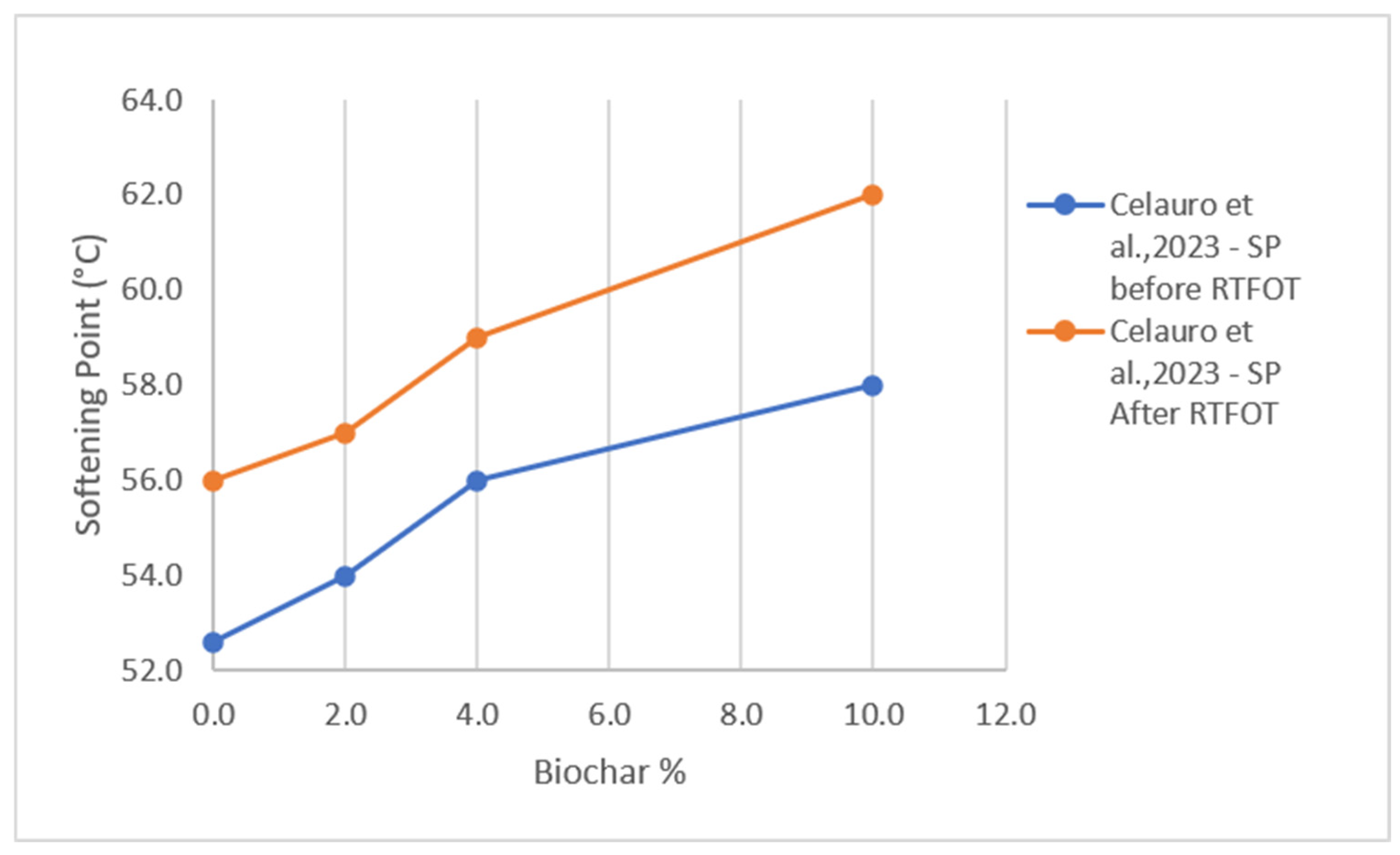
The softening point is the temperature at which bitumen transitions from a semi-solid to a viscous state under the ring and ball apparatus, which has increased consistently with biochar content across most of the reviewed studies, confirming enhanced heat resistance.
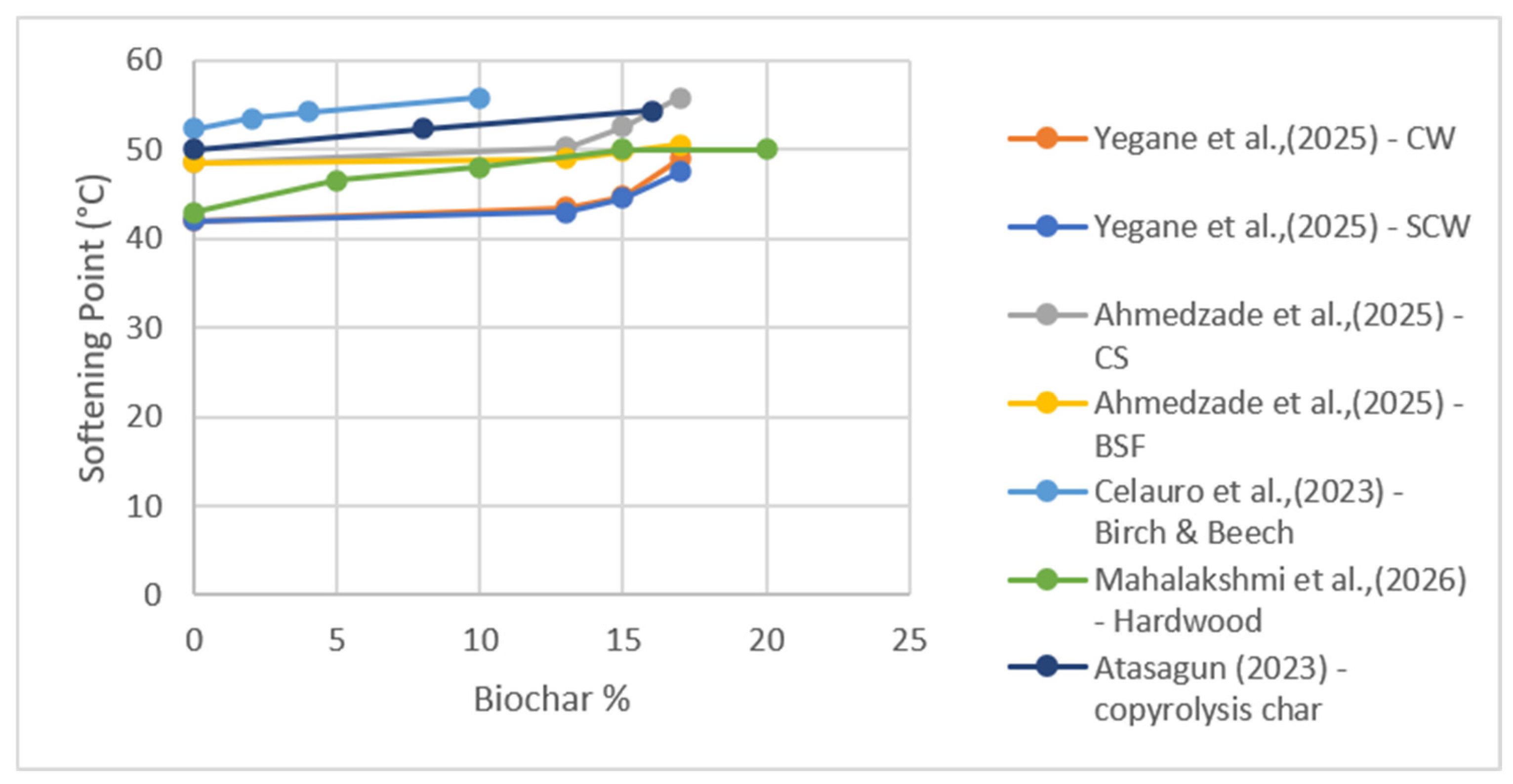
Yegane et al., 2025 [23], reported that B-17CW achieved a softening point increase of approximately +7 °C relative to neat bitumen, while B-17SCW exhibited a slightly smaller elevation. Ahmedzade et al., 2025 [12], recorded the most substantial improvement among the reviewed studies, with BCS-modified bitumen at 17%, raising the softening point from 48.5 °C to 55.8 °C (+7.3 °C), outperforming BSF-modified blends, which achieved smaller but consistent increases. The superior performance of BCS was attributed to its higher fixed carbon content (60.1% versus 28.1% for BSF) and its irregular, fibrous, and porous morphology observed via SEM analysis, which facilitated stronger adhesion to the bitumen matrix and more extensive light component adsorption.
Balotiya et al., 2024 [19], similarly observed a softening point increase from 48°C (Base VG30) to 63.2°C at 15% groundnut shell biochar, which is one of the largest increases reported in the reviewed literature. Mahalakshmi et al., 2026 [44], recorded an increase from 43 °C (base 40/50) to 51 °C at 20% HBC, with the response leveling off between 15% and 20%, suggesting a practical upper threshold of effective thermal improvement.
Celauro et al., 2023 [13], observed that all three biochar dosages (2%, 4%, and 10%) increased softening point, with a more significant impact observed at the 10% dosage. Their research stressed that these increases did not compromise the binder’s workability or processability at standard mixing temperatures, which is a significant practical aspect. Atasağun, 2023 [58], documented an increase in the softening point from 50 °C (neat bitumen) to 52.25 °C with an 8% char addition and to 54.25 °C with a 16% addition, validating proportional enhancement. Figure 5 depicts the variation in the softening point depending on the incorporated percentage of biochar.

6.3. Viscosity

Using a Brookfield rotational viscometer, viscosity measurements are usually taken at 135 °C and 165 °C. These measurements show how consistent the binder is and help find the best temperatures for mixing and compacting asphalt.
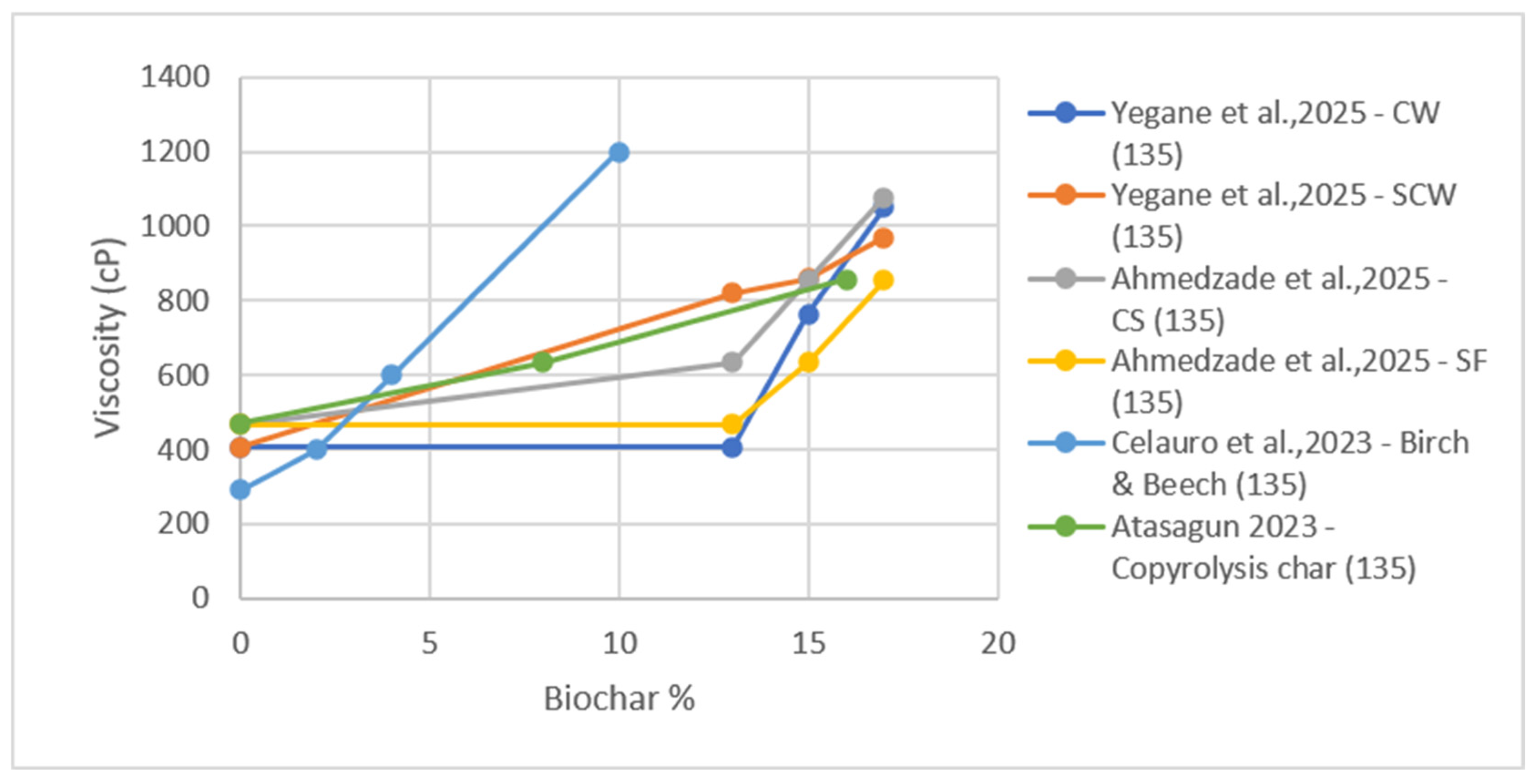
Yegane et al. (2025) [23] found that viscosity increased by as much as 2.59 times (for CW) and 2.40 times (for SCW) at the highest dosage (17%) compared to neat bitumen at 135 °C. This showed that the materials are much more resistant to flow at higher temperatures. This meant that the material had a much better chance of not rutting when used on high-temperature pavement, but it also meant that the mixing and compaction temperatures had to be about 20 °C higher than those needed for unmodified bitumen. This was a practical problem for using it in the field.
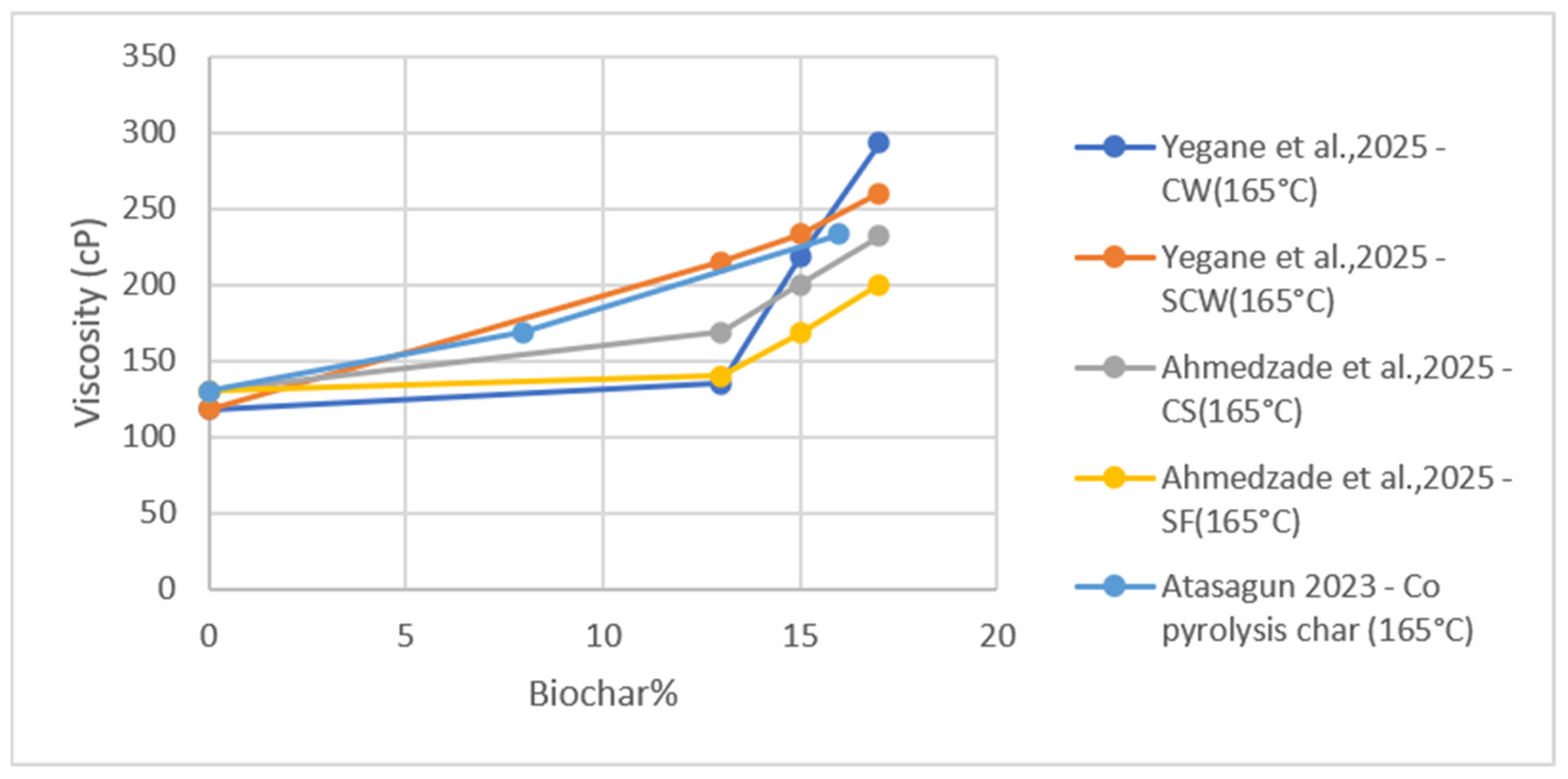
Ahmedzade et al. (2025) [12] corroborated this trend for BCS-modified bitumen, as viscosity curves at both 135 °C and 165 °C exhibited distinct upward shifts with escalating biochar content. All of the modified blends stayed below the SuperPave maximum viscosity threshold of 5000 cP at 135 °C, which kept them easy to work with in the field. BSF-modified blends showed smaller but steady increases in viscosity, which was in line with their smoother surface morphology and higher ash content compared to BCS.
Balotiya et al. (2024) [19] noted a consistent increase in viscosity with the addition of groundnut shell biochar, rising from 3087 Poise at 0% to 5129 Poise at 15% (at 60 °C), indicating the binder’s gradual stiffening.
Celauro et al. (2023) [13] also found that all biochar-modified binders stayed below 3 Pa·s at 135 °C, which is the technical specification limit for road use, even with the highest 10% biochar dosage. Atasağun (2023) [58] reported that adding 8% and 16% char to the mix at 135 °C made the viscosity go up by about 35.3% and 82.5%, respectively, but all binders stayed within the 3000 cP specification.
Atasağun, 2023 [58], showed a 35.3% increase in viscosity at 8% addition and 82.5% increase at 16% addition at 135 degrees C for PCPW (paper cup, polypropylene, and PET waste) co-pyrolysis char. All samples were below 3000 cP. At all tested temperatures (120, 135, 150, and 165 degrees C), the viscosity increased, and the rate of increase was more pronounced at lower temperatures, confirming the decrease in stiffening effect with the increase in processing temperature. The 82.5% increase at 16% PCPW met the SuperPave workability criteria, which showed that it can work in practice. Figure 6 and Figure 7 depict the variation in viscosity depending on the incorporated percentage of biochar.

6.4. Ductility and Elastic Recovery

Ductility and elastic recovery are complementary properties that describe the tensile deformation and rebound behavior of bituminous binders at ambient temperatures and can be used as important indicators of low-temperature flexibility, resistance to thermal cracking, and fatigue performance. The ductility test is carried out as per ASTM D113 [59] or IS 1208 [60] and involves stretching a standardized dog-bone briquette specimen at a constant speed of 5 cm/min at 25 degrees C until fracture. The total elongation at failure is reported in centimeters. Higher ductility values mean that molecular chain extensibility is higher, a reflection of lower binder stiffness and better flexibility at ambient and low temperatures. A ductility of less than 40 cm at 25 degrees C is generally considered too brittle for paving purposes, although the minimum acceptable value may depend on the standard and the application [19].
Balotiya et al. (2024) [19] documented a gradual decrease in ductility from 102 cm (base VG30) to 72.33 cm at 15% groundnut shell biochar, causing a reduction of about 29% while still keeping values within acceptable limits for paving-grade bitumen. Ahmedzade et al. (2025) [12] likewise noted a systematic reduction in ductility with the incorporation of BCS and BSF, attributing this phenomenon to the stiffening effect of biochar, which limits molecular mobility and elasticity. The authors noted that values of up to 15% HBC were still within acceptable paving-grade limits.
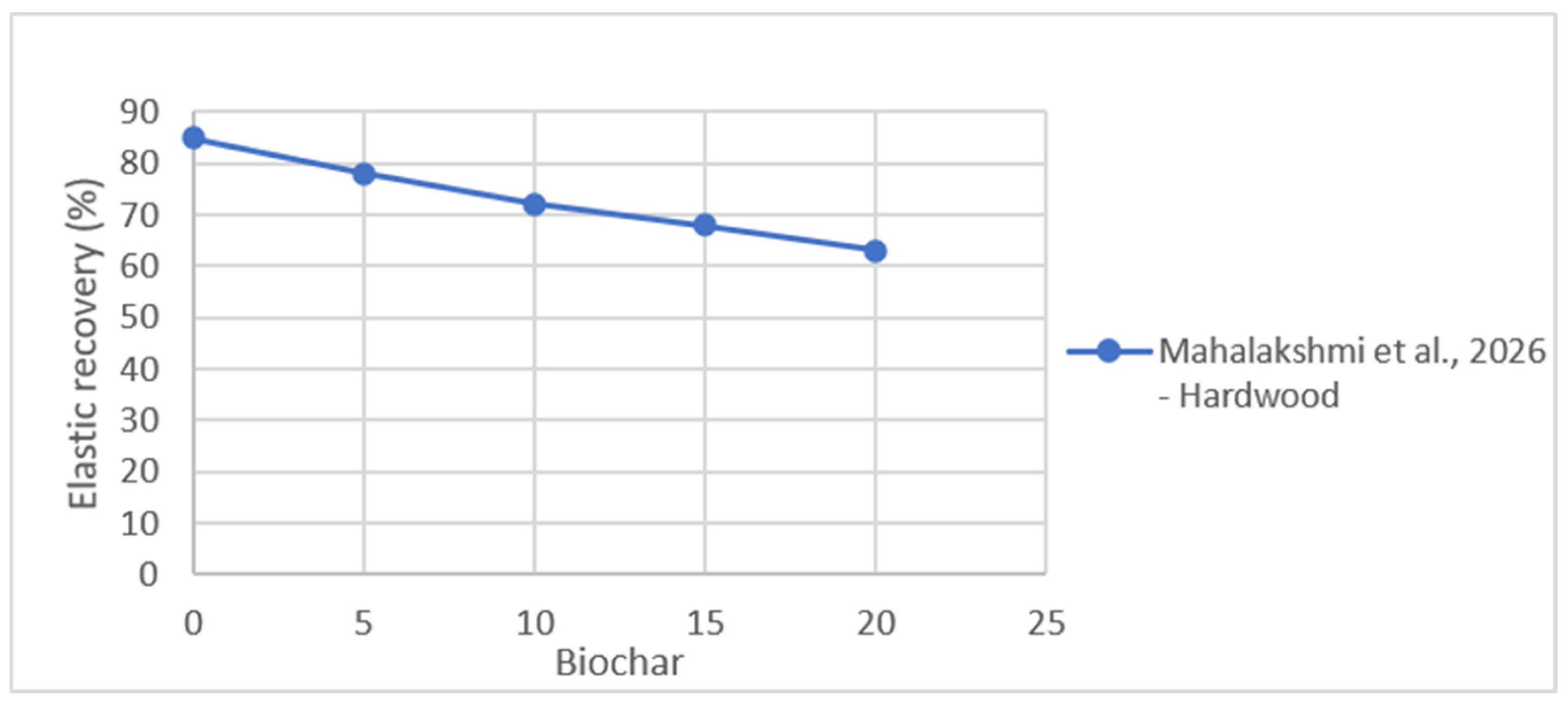
Mahalakshmi et al. (2026) [44] presented an interesting supplementary finding, which is a reduction in ductility, and the elastic recovery (ER) of the binder’s capacity to regain its original dimensions post-deformation exceeded 60% even at 20% HBC, indicating that the modification did not significantly compromise the elastic response. The researchers determined that 15% HBC constituted the ideal dosage, achieving an equilibrium among stiffness, thermal resistance, and sufficient flexibility.
Yegane et al. (2025) [23] reported that adding biochar to both CW and SCW blends slightly lowered the creep-recovery percentage (R%) values. At 64 °C and 3.2 kPa, the values dropped by about 1.15 and 1.06 times, respectively. This small drop in elastic recovery, along with the much bigger drop in non-recoverable creep compliance (Jnr), shows that the benefits of rutting resistance far outweigh the small losses in elasticity in practice. Figure 8 and Figure 9 depict the variation in ductility and elastic recovery depending on the incorporated percentage of biochar.

7. Aging Performance of Biochar-Modified Bitumen

Aging is one of the most important ways that bituminous binders break down over time. As bitumen ages, it becomes stiffer and more brittle, which makes the pavement less effective. This process happens because the physical properties of bitumen change chemically. It happens in two stages, identified as short-term aging, which happens during mixing, hauling, paving, and compacting, and long-term aging, which happens to the bitumen over the entire life of the pavement [1]. These changes are mostly caused by oxidation, which is the gradual addition of functional groups that contain oxygen to the bitumen molecular structure. This makes the pavement harder and more brittle, and eventually causes problems like cracking and raveling. Bitumen and pavement crack too soon because of premature aging. Nanoindentation measurements show that the modulus of bitumen at the surface increases by 100 times after only 20 h of UV exposure [56].
Because this process cannot be stopped, recent research has focused on sustainable modifiers that can slow down oxidative degradation. Biochar, a solid made from the pyrolysis of organic biomass that is rich in carbon, has become a promising candidate. There are a lot of studies that show how biochar can be helpful in road engineering, but only a few that look at how bitumen–biochar mixtures age through oxidation. This is an important area that needs more research because oxidation is a natural process that hurts the long-term performance of bitumen binders [13].

7.1. Short-Term Aging (RTFOT)

The rolling thin-film oven test (RTFOT) is a standardized laboratory procedure used to simulate the short-term aging of bitumen binders during the mixing and compaction stages of pavement construction. It shows how the binder changes when it gets too hot during the making and building of bitumen binders. The RTFOT test uses eight specially designed bottles to hold 35 ± 0.5 g of bitumen binder. The test takes place at 163 °C for 85 min, and the bottles are sprayed with compressed air at a rate of 4000 ± 200 mL/min. Some studies also use the older thin-film oven test (TFOT) according to ASTM D1754 [61]. This test places bitumen samples in open pans in similar thermal conditions. After RTFOT aging, physical properties like mass loss, softening point, penetration, and viscosity were measured. Rheological indices should be calculated to see how much the binder has aged compared to the virgin binder.
Short-term aging is characterized by oxidative hardening and the volatilization of lighter fractions during construction. All of the studies that were reviewed stated that adding biochar generally made materials more resistant to short-term aging. This was shown by higher retained penetration values, smaller changes in softening point, and less mass loss.
Yegane et al., 2025 [23], discovered that CW-based biochar moderately enhanced retained penetration following RTFO conditioning, with all samples exhibiting mass loss below 0.5%, well within acceptable thresholds. Ahmedzade et al., 2025 [12], similarly noted slight enhancements in retained penetration (increasing from 82% for base bitumen to a maximum of 89.3% for B-17BCS) and a decrease in softening point variation following RTFO conditioning. The only sample that lost more mass (0.48%) than the others was B-17BSF. This is probably because sunflower stalk biochar has more volatile matter (22.5%) than cotton stalk biochar (17.9%).
Zhou et al., 2025 [14], assessed aging performance utilizing the complex modulus index (CMI) and phase angle index (PAI) obtained from dynamic shear rheometer (DSR) tests on RTFO-aged specimens. All BMB (biochar-modified bitumen) variants had lower CMI values than base bitumen, which means that they did not get stiffer as they aged. This shows that they are better at resisting oxidation in the short term. The porous structure of biochar was identified as the principal mechanism, facilitating the physical adsorption of light bitumen fractions and preventing their oxidative degradation. BS-type biochar (separator-collected, with the largest pore volume) showed the most noticeable anti-aging effects, followed by BR (reactor-collected) and BG (ground).
Celauro et al., 2023 [13], examined short-term aging through the RTFOT procedure (EN 12607-1 [62]) and utilized an aging index (AI), which is derived from variations in crossover frequency between unaged and aged states to measure aging susceptibility. Their findings showed that all biochar-modified binders had lower AI values than neat bitumen, which means they were less likely to age. The AI was specifically decreased from 43.5% (unmodified bitumen) to 36.5% at the 10% biochar dosage, causing the authors to conclude that biochar offers a significant protective effect during short-term thermal aging. This protective effect was due to the fact that biochar and bitumen are chemically similar because they are both mostly made of carbon. This makes them easy to mix and spread. The surface oxygen-containing groups (carboxyl and hydroxyl) on the biochar surface may also help with free radical scavenging. Variation in penetration and softening point after RTFOT is shown by Figure 10 and Figure 11.

7.2. Long-Term Aging (PAV)

The pressure-aging vessel (PAV) is used to simulate the oxidative aging that happens over time when pavement is in use. The PAV test’s leftovers are used to figure out how the binder will behave after 5 to 10 years in the field. The binder is first aged for a short time in the RTFO and then put in a PAV where it is kept at 100 °C and 2070 kPa for 20 h [63]. This sequential conditioning, of RTFO and then PAV, is now the standard approach in most biochar aging studies [55].
Yegane et al., 2025 [23], carried out PAV testing according to ASTM D6521 [64] at 100 °C and 2.1 kPa for 20 h on RTFOT pre-aged samples of all cherry waste (CW)- and sour cherry waste (SCW)-modified blends at 13%, 15%, and 17% biochar content by binder weight, and the unmodified base bitumen.
Complex modulus at intermediate temperatures DSR tests were performed at 22, 25 and 28 °C using an 8 mm parallel plate geometry with a 2 mm gap after PAV aging, the geometry prescribed for characterizing the stiffer, more elastic PAV-aged binders. These temperatures are in the intermediate pavement service temperature range, where fatigue cracking is the dominant distress mode. B-17CW demonstrated G* increases of 25.9%, 25.3%, and 25.2% at 22, 25, and 28 °C compared to PAV-aged base bitumen, respectively, which are directly stated in the paper text of Yegane et al. [23], and are among the most accurately measured data points within the surveyed literature. The similarity of the percentage increase at the three temperatures indicates a consistent stiffening effect independent of the intermediate testing temperature, which means that CW biochar also shows its reinforcing contribution to the binder matrix after long-term oxidative aging.
Even more striking is the behavior of B-17SCW, which showed G* increases of 48.3%, 47.1% and 47.3% at 22, 25 and 28 °C, respectively—again stated explicitly in the text of Yegane et al. [23]. Although the G* improvements for B-17SCW are lower than for B-17CW in both unaged (84% vs. 94%) and RTFOT conditions, the numbers are almost twice as high as for B-17CW. This remarkable reversal in relative performance is attributed to the finer particle size of SCW biochar (20–40 micrometres) compared to CW biochar (30–60 micrometres). As the PAV ages, the binder matrix becomes gradually stiffer, and the viscosity at the aging temperature (100 °C) increases significantly, thereby restricting the mobility of dispersed particles. In the increasing viscous medium, the finer SCW particles maintain their more uniform dispersion, while the coarser CW particles tend to aggregate more, decreasing their effective surface area on the binder–particle interaction and thus their reinforcing contribution in the PAV-aged state. This finding suggests that particle size distribution (which was not comprehensively reported in any of the studies reviewed) is an important variable determining long-term aging performance, and that biochars optimal for unaged performance may not be optimal for long-term aged performance.
Phase Angle at Intermediate Temperatures: The phase angle delta at 22 °C after PAV aging was found to increase by 2.9% for B-17SCW compared to PAV-aged base bitumen. This value is explicitly mentioned in the text of Yegane et al. [23]. This increment shows that B-17SCW can partially compensate for the embrittlement tendency inherent to long-term oxidative aging. In neat bitumen, PAV aging decreases delta, making the material more elastic and solid-like due to the growing concentration of polar functional groups, which increases the stiffness and immobilizes the binder molecules. The greater delta for the PAV-aged, modified binder as compared to the PAV-aged neat binder indicates that SCW biochar retards the loss of viscous flow capacity with aging and results in a more balanced viscoelastic response. This has direct practical implications: binders with too low of a delta at intermediate temperatures are more susceptible to brittle fracture under traffic loading, and maintaining a higher delta (more viscous character) is associated with better fatigue resistance. The B-17CW blend showed smaller delta changes after PAV aging, which is consistent with its coarser particle size, resulting in less efficient binder–matrix interaction in the aged condition.

8. Rheological Properties of Biochar-Modified Bitumen

Advanced rheological characterization is essential for predicting the in-service performance of bituminous binders. Bitumen is a viscoelastic material that acts like a viscous liquid at high temperatures and an elastic solid at low temperatures. Its response to traffic loading and changes in temperature must be measured through a series of dynamic and steady-state tests. The rheological assessment of biochar-modified bitumens in the four studies was performed using the dynamic shear rheometer (DSR), rotational viscometer (RV), and the linear amplitude sweep (LAS) method, with the addition of multiple -stress creep and recovery (MSCR) testing in the study by Yegane et al. (2025) [23]. The uniform implementation of these methodologies across various biochar types and bitumen grades facilitates significant cross-study comparisons of viscoelastic behavior, rutting resistance, fatigue performance, and performance grade classification.

8.1. Dynamic Shear Rheometer (DSR)

Among the tools used to evaluate bitumen performance, the dynamic shear rheometer (DSR) occupies a central role within the SuperPave binder specification framework. Its operating principle is relatively straightforward. A small bitumen sample is placed between two parallel plates, one of which oscillates while the other remains stationary, subjecting the material to a sinusoidal shear force at a set temperature and frequency. What makes the DSR particularly valuable is the richness of the data it produces. The complex modulus G* reflects the binder’s overall stiffness, while its two components, the storage modulus G′ and the loss modulus G″, separate the elastic and viscous contributions, respectively. The phase angle δ then ties these together, expressing how much of the binder’s response is recoverable versus permanently lost as heat. A binder that is stiff and elastic (high G*, low δ) will generally hold up well against rutting under repeated traffic loads, whereas one that remains flexible at intermediate temperatures tends to perform better in fatigue.
The high-temperature viscoelastic behavior of char-modified bitumen was assessed using dynamic shear rheometer (DSR) testing. The DSR performance was evaluated by Atasağun (2023) [58] by the AASHTO T315 [65] test method based on the rutting parameter G*/sinδ at temperatures from 52 °C to 82 °C. The results indicated that the co-pyrolysis char from paper cups, polypropylene, and PET waste gradually increased the value of G*/sinδ with the increase in additive content, which improved the high-temperature performance grade from PG64 to PG70 at the dosages of 8% and 16%. The improvement was attributed to the stiffening of bitumen by the absorption of lighter components of bitumen by char particles.
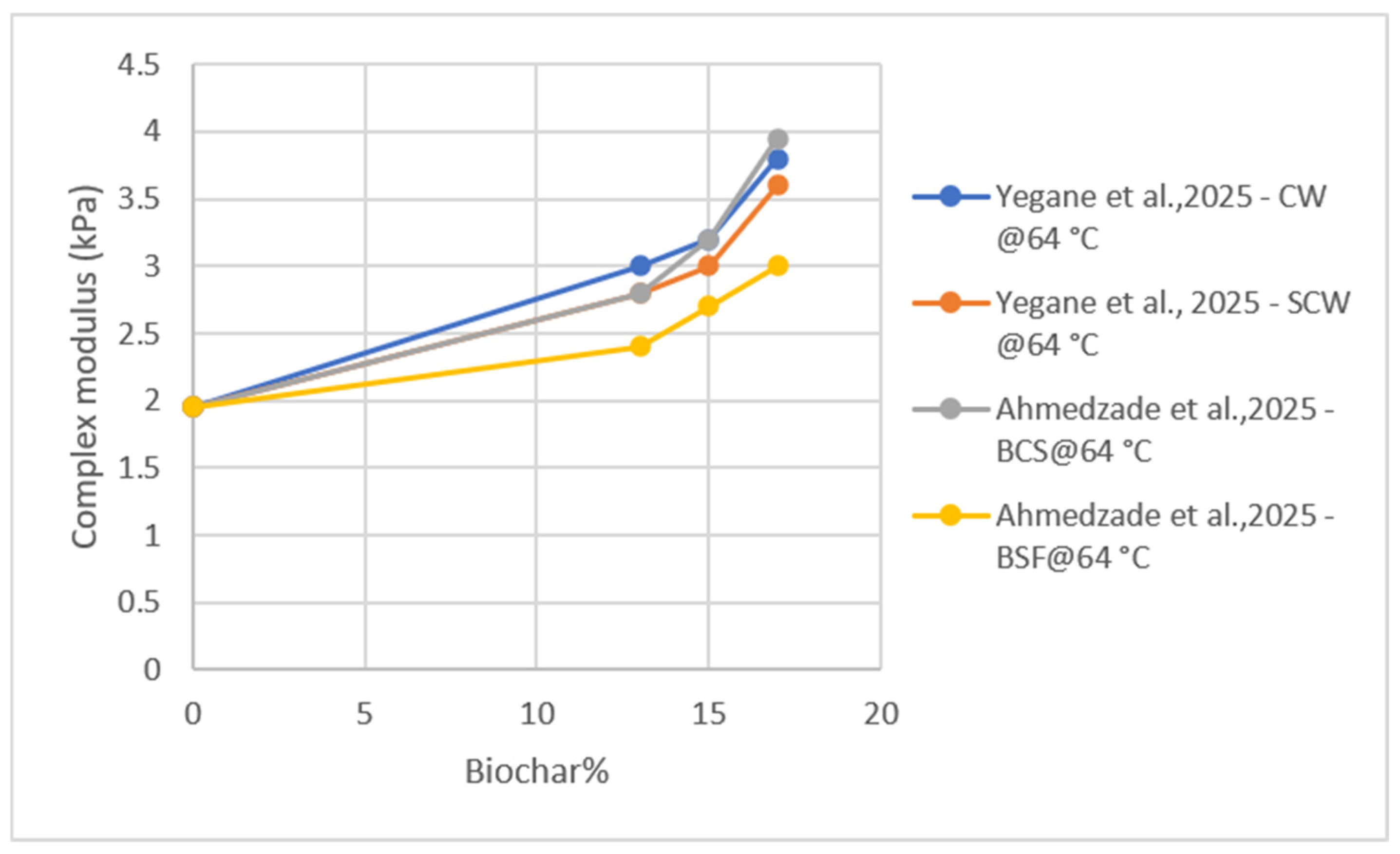
Celauro et al. [13] used frequency sweep tests to produce master curves based on Williams–Landel–Ferry (WLF) [66] shift factors, which showed that the impact of biochar modification on the rheological properties was negligible for unaged conditions, while it significantly increased the moduli of the aged state, with the aging index dropping from 43.5% to 36.5% at 10% biochar content. Yegane et al. [23] extended DSR analysis by incorporating oscillation, temperature sweep, and MSCR testing, and showed that cherry waste biochar increased G* by about 94% at 64 °C. The addition of char and biochar consistently improved rutting resistance, complex modulus, and high-temperature performance grades in all three studies, and DSR was confirmed as an indispensable tool in characterizing modified binder behavior.
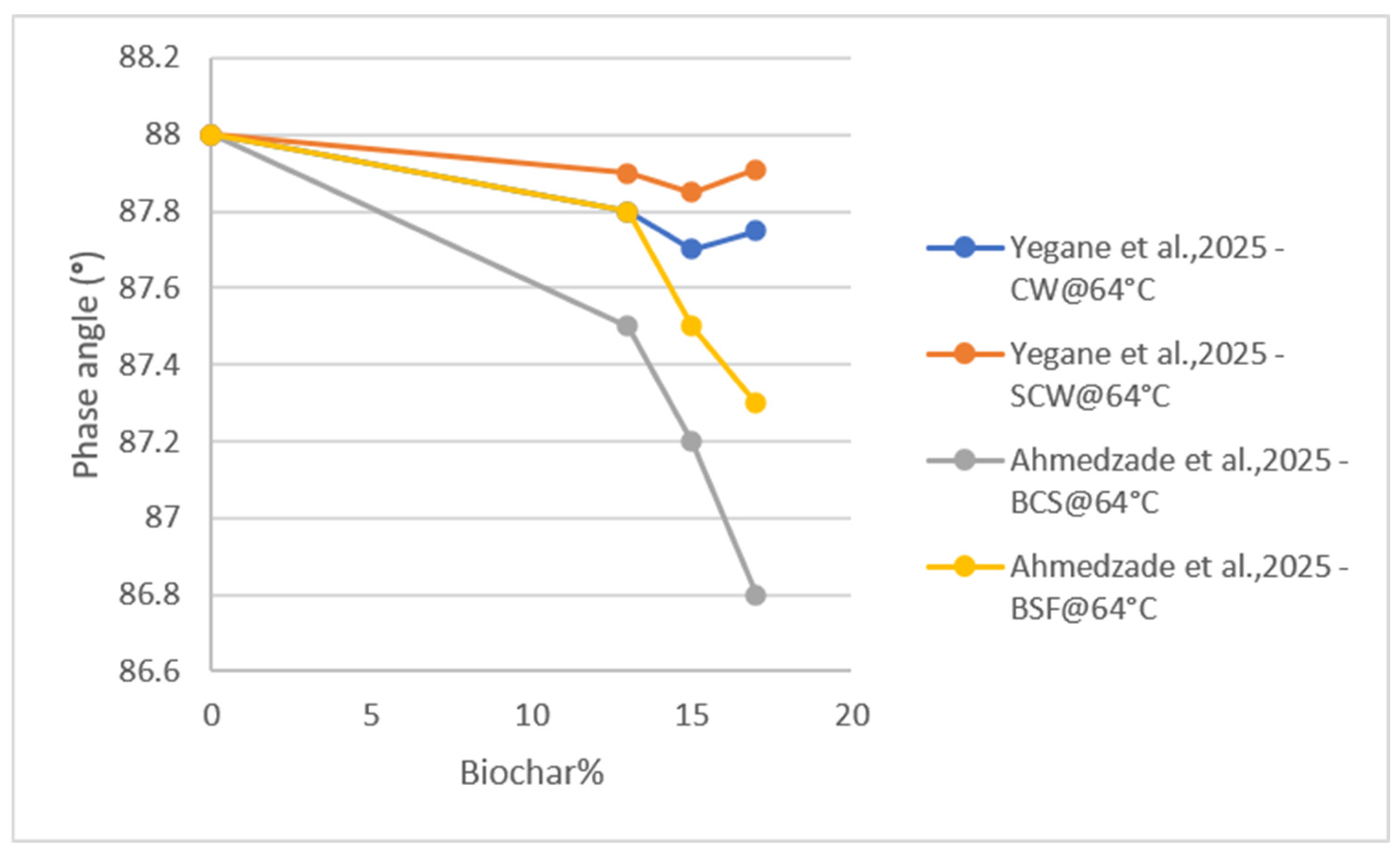
The variation in complex modulus (G*) and phase angle (δ) with incorporation of biochar is shown in Figure 12 and Figure 13.

8.2. Rutting Resistance: G*/Sin (δ), MSCR, and Performance Grading

Of all of the performance characteristics examined across the reviewed literature, resistance to permanent deformation under traffic loading stands out as the property most reliably and substantially enhanced by biochar addition. Under SuperPave criteria, a binder must achieve a minimum G*/sin (δ) of 1.0 kPa in its original state and 2.2 kPa following short-term aging, at the highest pavement temperature expected in service. The temperature at which a binder can no longer meet this threshold determines its high-temperature performance grade, and biochar-modified binders consistently pushed this boundary upward by one to two grade intervals (6 °C to 12 °C) depending on the biochar source and dosage applied.
The data from Atasağun, 2023 [58], illustrate this shift in concrete terms. Unmodified bitumen met the 1.0 kPa threshold up to 64 °C, with an actual failure temperature of 69.6 °C. Binders modified with 8% and 16% PCPW co-pyrolysis char both held to a 70 °C grade, with failure temperatures of 72.5 °C and 73.3 °C, lifting the classification from PG 64 to PG 70. The G*/sin (δ) values at 64 °C rose from 2.01 kPa for neat bitumen to 2.96 kPa and 3.07 kPa for the 8% and 16% blends. At 70 °C, where neat bitumen fell below the required threshold at 0.92 kPa, the modified binders returned values of 1.35 kPa and 1.46 kPa, the latter representing roughly a 59% gain. The marginal difference between the two dosages, however, points to diminishing returns beyond 8% addition in terms of grade classification.
Yegane et al., 2025 [23], extended their rutting assessment beyond standard DSR parameters by incorporating the multiple-stress creep and recovery (MSCR) protocol (ASTM D7405-15) [67], a test better suited to capturing how binders behave under the kind of repeated, variable loading that real pavements experience. The procedure applies cycles of one-second loading followed by nine seconds of rest, repeated ten times each at stress levels of 0.1 kPa and 3.2 kPa, representing standard and heavy traffic, respectively. The primary output is the non-recoverable creep compliance Jnr, which is the ratio of unrecovered strain to applied stress, while lower figures signal stronger rutting resistance. Elastic recovery capacity is captured separately through the percent recovery R%. All testing was carried out on RTFO-aged samples at 52 °C, 58 °C, and 64 °C using a 25 mm plate geometry.
Neat bitumen returned Jnr values of 0.339, 0.949, and 2.447 kPa−1 at 0.1 kPa across the three temperatures, and 0.350, 1.008, and 2.605 kPa−1 at 3.2 kPa. Biochar incorporation brought these figures down across the board, with the effect growing more pronounced at higher temperatures and greater addition levels. At 64 °C under 3.2 kPa stress, the B-17CW blend achieved a 2.19-fold reduction in Jnr relative to neat bitumen, and B-17SCW a 1.99-fold reduction. At 15% addition, Jnr fell by factors of 0.492 and 0.502 for cherry and sour cherry biochar blends, respectively, at the same temperature. The rate at which Jnr climbed with temperature, 2.69 times between 52 °C and 58 °C and 2.88 times between 58 °C and 64 °C for the B-17 blends, further suggested that cherry waste biochar offered somewhat stronger temperature stability. Notably, all Jnr diff values stayed beneath the 75% ceiling stipulated by MSCR specifications, confirming that none of the modified binders exhibited problematic stress-sensitivity.
When traffic loading categories were assigned following AASHTO M320 [68] criteria based on Jnr at 3.2 kPa, the practical implications became clear. At 52 °C, all binders, including unmodified bitumen, fell within the Extreme (E) grade. At 58 °C, every biochar blend reached the Very High (V) category while neat bitumen remained at High (H). The most telling results emerged at 64 °C, where neat bitumen dropped to Standard (S) grade, blends containing 13% or 15% CW biochar and all SCW formulations reached High (H), and the B-17CW blend achieved Very High (V) classification. A binder graded Very High at 64 °C is suitable for routes carrying more than 30 million equivalent single-axle loads, including slow-moving and standing traffic, a performance level well beyond the reach of the base binder.
The R% data introduced a degree of nuance to this otherwise consistent picture. Elastic recovery declined modestly as biochar content rose, suggesting that while biochar stiffens the binder matrix and curtails permanent deformation, it does not replicate the elastic network formed by polymer modifiers. Peak recovery among the modified samples occurred at 15% addition for both biochar types. Compared to neat bitumen at 0.1 kPa, recovery in B-15CW was reduced by factors of 1.123, 1.040, and 1.462 at 52 °C, 58 °C, and 64 °C, respectively, with B-15SCW showing reductions of 1.028, 1.027, and 1.625 across the same temperatures. This trade-off between improved deformation resistance and some loss of elastic rebound aligns with what would be expected from a solid particulate modifier, which reinforces through physical means rather than altering the binder’s fundamental viscoelastic architecture. Figure 14 depicts the variation in ductility and elastic recovery depending on the incorporated percentage of biochar.

8.3. Fatigue Performance—LAS Analysis

The linear amplitude sweep (LAS) test checks how well bitumen binders can handle fatigue by putting them under strain levels that increase. This gives parameters A and B, which indicate how many cycles it takes for the material to fail (Nf) at different strain levels.
Yegane et al., 2025 [23], discovered that biochar modification improved fatigue properties, as indicated by elevated A parameters and diminished B parameters, resulting in increased Nf across all strain levels. B-17CW had an Nf that was 1.35 times higher than neat bitumen at 1% shear strain, and B-17SCW had an Nf that was 1.26 times higher. SCW-based biochar did better than CW at higher strain levels (5% and 10%), which means it might be better for thinner pavement layers where more damage usually happens. Damage characteristic curves showed that adding biochar greatly increases the fatigue resistance of bitumen. The B-17SCW and B-13CW samples showed the best structural integrity as damage built up over time.
Ahmedzade et al., 2025 [12], observed an approximate 25% enhancement in fatigue life for B-17BCS (cotton stalk biochar) at 5% strain relative to base bitumen, and this is a significant finding, considering that simultaneous improvement in fatigue and stiffness is seldom attained with conventional bitumen modifiers. BSF-modified blends (sunflower stalk biochar), on the other hand, did not show any significant improvement in fatigue at lower doses. Only B-17BSF showed a slight increase in fatigue life. The researchers said that the BCS was better because of its microstructural properties. In particular, its rough, fibrous, and porous shape was better at spreading stress and delaying the start of fatigue cracks.

8.4. Viscoelastic Behavior

The viscoelastic properties of biochar-modified bitumens were evaluated across a broad range of temperatures and frequencies using temperature sweep tests, master curves, and Cole–Cole diagrams. Yegane et al., 2025 [23], found that adding biochar greatly increases shear resistance (G*), especially at higher temperatures and slower traffic speeds, whereas bitumen is more likely to flow viscously. When loaded quickly or in cold weather, all binders become stiffer and more elastic. However, samples modified with biochar showed a clear “crossover temperature” that ranged from 30 °C to 40 °C depending on the frequency. The modified binders are more flexible than neat bitumen below this point, but they become thicker above it. This behavior shows that the structure is changing from a fluid “sol-type” phase to a more stable “sol–gel-type” phase. The increase in the penetration index also supports this change. Celauro et al., 2023 [13], did more research using master curves and found that while low to moderate amounts of biochar (up to 10%) do not change the viscoelastic response of unaged bitumen very much, they do help a lot after aging. After RTFO aging, binders that had been modified with biochar, especially the 10% blend, showed an increase in modulus at high temperatures. This means that biochar’s ability to soak up moving aromatic phases gets better as the bitumen oxidizes. The “crossover modulus,” which is the point at which the storage and loss moduli are equal, also went up with higher biochar concentrations. This shows that the modifier makes the material’s structure more stable, even though aging makes the matrix more diverse. Using Cole–Cole and Black diagrams made it possible to describe the binder without having to worry about the exact test temperatures or frequencies. In these plots, biochar-modified bitumens always filled areas that showed higher energy dissipation and a steady change toward gel-like behavior. Biochar makes rutting more resistant at high temperatures by changing the bitumen from a “sol” state that is very fluid and sensitive to temperature to a “sol–gel” state that is more elastic and stable. This increased stiffness, on the other hand, is a functional trade-off because it may make thermal cracking more likely at low temperatures. This shows how important it is to find the right amount of biochar for each climate.

8.5. High-Temperature Grade Improvement

The usefulness of performance grade (PG) upgrading comes from the fact that it can turn lab rheological data into standard specifications that pavement engineers can easily use. This classification is based on finding the highest temperature at which the unaged binder has a G*/sin (δ) value of at least 1.0 kPa, rounded down to the nearest 6 °C increment. Recent studies consistently confirm this improvement; for example, Atasağun, 2023 [58], noted a shift from PG 64 to PG 70 with the incorporation of PCPW char at both 8% and 16% concentrations. Even though the failure temperatures went up from 69.6 °C for neat bitumen to over 73 °C with the additive, the fact that both dosages had the same PG rating suggests a “saturation effect,” where PG 70 acts as a functional ceiling in these conditions. Yegane et al., 2025 [23], and Celauro et al., 2023 [13], had similar results. Yegane et al., 2025 [23], found “Very High” traffic classifications at 64 °C, and Celauro et al., 2023 [13], showed that biochar modification raised failure temperatures to a one-grade specification improvement at high dosages. The main reason for this improvement is physical. Biochar strengthens the bitumen matrix by adding rigid, porous particles that soak up lighter aromatic fractions. This makes the matrix more resistant to viscous flow and raises the temperature at which the binder loses its elastic recovery. Polymer modifiers like SBS work by making an elastic network through swelling and getting stuck together. Biochar, on the other hand, works more like a high-performance mineral filler. This filler-reinforcement system works better with high carbon content, which makes sure that the chemicals work together and gives it extra benefits like UV protection and anti-aging properties. But biochar does not have the low-temperature flexibility that polymers do because it relies on stiffening instead of elastic networking. Because of this, biochar usually has a neutral or slightly negative effect on the low-temperature PG, since the added stiffness may make it harder for it to work in cold weather.
Table 3 demonstrates a comparison of rheological properties found in the literature.

9. Comparative Performance of Polymer-Modified and Biochar-Modified Bitumen

Biochar’s performance as a bitumen modifier must be contextualized against conventional polymer modifiers, which remain the industry standard for performance-graded binder modification. Polymers such as SBS, SIS, PE, PP, and EVA have been extensively studied and are widely used in pavement engineering practice [7,8,9,10,11]. The following subsections systematically compare their physical, rheological, aging, and sustainability performance against biochar-modified binders.

9.1. Physical Property Comparison

SBS, the most widely used thermoplastic elastomer modifier, improves bitumen performance by swelling in the aromatic maltene fraction and forming a continuous polymer network that simultaneously increases stiffness and elastic recovery [10]. At typical dosages of 4–6%, SBS raises the softening point by 15–25 °C while maintaining or improving ductility and elastic recovery, properties that biochar cannot replicate at equivalent dosages [10,11]. Biochar operates exclusively as a particulate stiffener through physical adsorption of lighter aromatic fractions into its micropore network [13,23]. While groundnut shell biochar at 15% raised the softening point from 48 °C to 63.2 °C and cotton stalk biochar at 17% elevated it from 48.5 °C to 55.8 °C [12], these improvements are achieved at considerably higher dosages than polymers and are accompanied by reductions in ductility and elastic recovery [10,11]. Viscosity comparisons show similar trends, with cherry waste biochar at 17% raising viscosity by up to 2.59 times at 135 °C [23] and co-pyrolysis char at 16% producing an 82.5% increase [58], comparable to SBS but without the accompanying elastic network formation [12,23].

9.2. Rheological Performance Comparison

The rheological performance gap between polymer and biochar modifiers is most evident in high-temperature rutting resistance and low-temperature flexibility. SBS consistently achieves PG improvements of two to three grade intervals at dosages of 4–6% while simultaneously maintaining or improving low-temperature PG through elastic network formation [10,11]. Biochar achieves one to two grade interval improvements at higher dosages, with cotton stalk biochar at 17% elevating PG from 64-Y to 76-Y [12] and co-pyrolysis char at 8–16% upgrading PG from 64 to 70 [58]. Critically, biochar has a neutral or slightly negative effect on low-temperature PG [13,23], narrowing the usable performance temperature range rather than expanding it as SBS does. Under MSCR testing, SBS-modified binders typically achieve Jnr values below 0.5 kPa−1 at 64 °C corresponding to Very High or Extreme traffic classifications [68], while cherry waste biochar at 17% achieved a 2.19-fold Jnr reduction reaching Very High classification, though with consistently lower elastic recovery R% values than SBS systems [23]. Fatigue performance follows a similar pattern, with SBS delivering substantially greater Nf improvements than biochar at comparable or lower dosages [10,11], and biochar modification potentially reducing the usable fatigue temperature range by approximately 5 °C [23].

9.3. Aging and Durability Comparison

One area where biochar demonstrates meaningful advantage over conventional polymer modifiers is oxidative and photo-oxidative aging resistance. SBS is susceptible to polymer network degradation under prolonged thermal and oxidative aging due to oxidative chain scission of the polybutadiene block, progressively destroying the elastic network over time [10]. Biochar, by contrast, demonstrates a protective anti-aging effect through physical adsorption of volatile aromatic fractions and free radical scavenging by surface oxygen-containing functional groups [13]. Celauro et al. [11,13] reported that the aging index decreased from 43.5% for neat bitumen to 36.5% at 10% biochar dosage following RTFOT conditioning. Zhou et al. [14] similarly found that all biochar-modified variants exhibited lower complex modulus index values than base bitumen after RTFO aging. Additionally, metal-rich acacia biochar reduced bitumen VOC emissions to 16.9% [38], an environmental benefit with no equivalent in conventional polymer modification systems.

10. Discussion

10.1. Consistent Findings Across Studies

There are a lot of substantial propensities that are the same in most of the studies we reviewed. The stiffening effect of biochar, regardless of feedstock origin, may be the most universal finding. When added to bituminous binders, all forms of biochar examined, which include agricultural residue chars, fruit-processing waste chars, commercial hardwood chars, and mixed household-waste co-pyrolysis chars, consistently produce increases in softening point, decreases in penetration, and increases in viscosity when incorporated into bituminous binders. This behavior is explained by the fact that biochar particles have a porous microstructure that absorbs the lighter, lower-viscosity maltene fractions from the bitumen matrix. This raises the effective asphaltene-to-maltene ratio. The stiffer composite that results is better able to withstand deformation when traffic is heavy and the pavement is hot, which is an important performance requirement in hot countries like India and Turkey, where many of these studies are based.
A second consistent trend is that all of the effects depend on the dose. In most of the studies, stiffness-related parameters become more effective with the amount of biochar increase, while flexibility-related parameters, such as ductility, elastic recovery, and penetration, decrease. This monotonic relationship shows that the dose–response is clear and predictable, which is both a good thing and a design problem. It means that practitioners can choose the right dose to get the stiffness improvement they want. However, it also means that adding more biochar indefinitely is not a good idea. After a certain point, adding more biochar will not improve performance and may even make storage stability problems worse. The threshold varies between the studies that were examined. For agro-plastic co-pyrolysis chars, it is about 9–12%, while for mixed-waste chars, it is as low as 8%. This is because the dense biochar particles tend to settle down when they are hot, which makes them stiffer.
A third area of agreement concerns aging and ultraviolet resistance. Celauro et al., 2023 [13], and Yegane et al., 2025 [23], both reported that biochar makes bitumen less likely to break down when it is exposed to oxygen. The mechanism is similar to what has been found for other carbon-based additives like carbon black and multi-walled carbon nanotubes. The dark, carbon-rich biochar particles soak up UV light, which lowers the amount of photo-oxidative energy that can be used to make carbonyl and hydroxyl groups in the bitumen matrix. The aging index measured by Celauro et al., 2025 [13], went down from 43.5% for neat bitumen to 36.5% for 10% biochar. The retained penetration values also became better after RTFOT in the cherry waste study. This shows that adding biochar has a significant protective effect that could extend the life of pavement, especially in urban areas where the heat island effect makes thermal degradation worse.

10.2. Contradictions

Biochar modification has been consistently reported to enhance the physical properties of bitumen, although the degree of enhancement varies significantly with feedstock type and production parameters [69]. Agro-plastic co-pyrolysis chars are better at stiffening than biomass-only biochars because they add polymer residues that make reinforcing networks in the binder instead of just acting as simple particulate fillers. But there is still a big performance–stability trade-off where high amounts of biochar, which make high-temperature rutting resistance better, often cause storage stability problems because the particles settle. This means that biochar-modified bitumen cannot be used in real life because it cannot stay the same when stored in hot conditions.
Also, it seems that the advantage of better performance at high temperatures comes at the cost of less flexibility at low temperatures. Biochar is a stiffener, not an elastic modifier, so it can make binders more brittle and less resistant to fatigue. This means that it may not be good for places with very hot and cold seasons. The literature indicates an ongoing mechanistic debate concerning the nature of the biochar–bitumen interaction, questioning whether it is exclusively physical or partially chemical. Inert wood biochars depend on physical pore absorption, whereas agro-plastic composites may establish chemical bonds with the bitumen matrix. To make things better in the future, it is important to figure out this difference, because it tells engineers whether they should work on physical improvements, like making the particles smaller, or chemical surface functionalization to make the binder work better.

10.3. Research Gaps

When observed together, these studies reveal significant gaps that currently prevent biochar-modified bitumen from achieving widespread commercial implementation. The most critically under-addressed gap is the near-complete absence of low-temperature characterization, as most reviewed studies focused exclusively on high-temperature rutting resistance without employing the bending beam rheometer (BBR) or direct tension test (DTT) to assess cracking resistance at low service temperatures. This is a particularly consequential omission given that biochar’s stiffening mechanism inherently reduces low-temperature flexibility and may limit the usable fatigue temperature range by nearly 5 °C, as acknowledged by Yegane et al., (2025) [23]. Fatigue resistance similarly requires more rigorous investigation, as LAS-derived fatigue predictions have not been validated against direct methods such as the time sweep test or simplified viscoelastic continuum damage (S-VECD) modelling, and no study has examined fatigue behavior at the mixture level where stress distribution and crack propagation differ substantially from binder-only testing. A further fundamental limitation is the exclusive reliance on laboratory simulation across all reviewed studies; no study has advanced to instrumented field trial sections with long-term performance monitoring, which is indispensable for validating whether laboratory rutting resistance improvements translate into equivalent reductions under real traffic, temperature cycling, moisture, and UV exposure over pavement design lives of 20 to 40 years. Equally significant is the absence of a comprehensive life-cycle assessment (LCA) and techno-economic analysis (TEA) despite sustainability being the central motivation for biochar research; a rigorous evaluation must account for upstream pyrolysis energy consumption, increased construction temperatures, extended service-life benefits, and the recyclability of biochar-modified reclaimed asphalt pavement (RAP), while also addressing whether the cost premium of biochar over conventional modifiers is justified across a full design life, particularly given that the construction sector currently accounts for only 5% of global biochar consumption [29] and carbon pricing frameworks increasingly embedded in infrastructure procurement across Australia, Europe, and North America may significantly alter the economic case. Additional gaps include the absence of a controlled parametric study linking pyrolysis conditions to bitumen-modification-relevant biochar properties, the unexplored potential of surface modification techniques such as silane functionalization and ball milling to extend practical dosage ranges beyond the 8–12% phase-separation threshold, and the lack of mixture-level testing including wheel tracking and moisture susceptibility assessments needed to bridge binder-level rheological improvements to full-scale pavement performance standardization.

11. Conclusions and Future Research

11.1. Summary of Key Findings

This review brings together the results of recent studies on biochar-modified bitumen. These studies looked at a wide range of feedstock, such as agricultural wastes like cotton and sunflower stalks, hardwood, and even plastic-paper waste that had been co-pyrolyzed. These studies employed 40/50 and 50/70 penetration grade bitumen to evaluate the impact of various biochar types and dosages on material performance. Biochar consistently acts as a stiffening agent in all of the feedstocks that were studied. Adding biochar makes the binder less likely to penetrate, while also raising its softening point and viscosity, which makes it more sensitive to temperature changes. In general, these improvements are in line with the amount of biochar, specifically the amount of fixed carbon and the complexity of the char’s structure. The porous and rough surface texture of fibrous residues, like cotton stalk biochar, makes it easier for the bitumen matrix to form a stronger physical bond. From a rheological point of view, biochar makes things much more stable at high temperatures. Testing shows that G*/sin (δ) values go up a lot and non-recoverable creep compliance (Jnr) goes down a lot. Some blends even show performance improvements by a factor of more than two. Researchers say to be careful when interpreting the results of linear amplitude sweep (LAS) testing because the methods used can vary. Most cases show a small increase in fatigue life during this type of testing. Lastly, biochar is a great way to protect against oxidative aging and UV damage. It slows down the buildup of carbonyl and hydroxyl groups. But there are still worries about how long it will last. Some evidence suggests that cumulative stiffening after pressure-aging vessel (PAV) conditioning may make the binder more brittle than regular bitumen. Also, retaining storage stability is still a practical problem because phase separation usually happens when the concentration of biochar goes above 8–10% by weight.

11.2. Recommendations for Future Research

To facilitate the incorporation of biochar into bitumen technology, subsequent research must transition from regulated laboratory environments to practical applications. Field trials with long-term monitoring are the most important thing to do because they give us the data we need to confirm that experimental results hold in real-world traffic and environmental conditions. A key part of this transition is making sure that biochar modification does not make it more likely to crack in cold climates. This suggests doing bending beam rheometer (BBR) tests.
Researchers should concentrate on enhancing the storage stability of these modified binders from both technical and chemical perspectives. This can be accomplished through methodical research into particle surface alteration, size enhancement, and the incorporation of compatibilizer additives to avert phase separation. Molecular dynamics simulations and advanced spectroscopy should also be used to find out why these materials act the way they do by mapping the basic interactions between biochar surfaces and bitumen components.
Finally, thorough mixture testing, such as wheel tracking and indirect tensile strength tests, must support the change from binder-level properties to full-scale pavement performance. To find out the real environmental and economic benefits of biochar, these physical tests should be done along with life-cycle assessments (LCA). By taking into account different types of feedstock and regional contexts, these studies will give a complete picture of how sustainable and useful biochar-modified bitumen is in the global infrastructure market.

Author Contributions

Conceptualization, S.S., C.D. and N.S.M.; methodology, S.S., C.D. and N.S.M.; validation, S.S., C.D. and N.S.M.; resources, S.S., C.D. and N.S.M.; data curation, S.S.; writing—original draft preparation, S.S.; writing—review and editing, S.S., C.D. and N.S.M.; visualization, S.S., C.D. and N.S.M.; supervision, N.S.M.; funding acquisition, N.S.M. All authors have read and agreed to the published version of the manuscript.

Funding

This research received no external funding.

Institutional Review Board Statement

Not applicable.

Informed Consent Statement

Not applicable.

Data Availability Statement

No new data were created or analyzed in this study.

Acknowledgments

Guidance and support received from the School of Engineering at Edith Cowan University are highly acknowledged.

Conflicts of Interest

The authors declare no conflicts of interest.

References

  1. Dassanayake, C.; Mashaan, N.S. Biochar as Additive and Modifier in Bitumen and Asphalt Mixtures. Eng 2025, 6, 341. [Google Scholar] [CrossRef]
  2. Zhou, X.; Zhang, Z.; Wang, H.; Chen, M.; Wu, S.; Xu, S.; Zhou, X.; Ran, M.; Li, L.; Lu, G.; et al. Review on the properties and mechanisms of asphalt modified with bio-oil and biochar. J. Road Eng. 2024, 4, 421–432. [Google Scholar] [CrossRef]
  3. Ali, S.I.A.; Gallouz, K.S.; Uwanuakwa, I.D.; Alas, M.; Mohd Hasan, M.R. Evaluations on the Properties of Polymer and Nanomaterials Modified Bitumen Under Different Aging Conditions. Nanomaterials 2025, 15, 1071. [Google Scholar] [CrossRef] [PubMed]
  4. Al-Mansob, R.A.; Ismail, A.; Alduri, A.N.; Azhari, C.H.; Karim, M.R.; Yusoff, N.I.M. Physical and rheological properties of epoxidized natural rubber modified bitumens. Constr. Build. Mater. 2014, 63, 242–248. [Google Scholar] [CrossRef]
  5. Mashaan, N.; Chegenizadeh, A.; Nikraz, H. A Comparison on Physical and Rheological Properties of Three Different Waste Plastic-Modified Bitumen. Recycling 2022, 7, 18. [Google Scholar] [CrossRef]
  6. Sharma, R.; Wooten, J.; Baliga, V.; Lin, X.; Chan, W.; Hajaligol, M. Characterization of chars from pyrolysis of lignin. Fuel 2004, 83, 1469. [Google Scholar] [CrossRef]
  7. Mostofi Sarkari, N.; Ayar, P.; Hatefi Oskouei, M.; Karimian Khosrowshahi, F.; Mohseni, M. Silane crosslinkable polyethylene waste as bitumen modifier: A new fortunate destiny by in time recycling of thermoplastic waste before conversion to thermoset end-of-life unrecyclable polymer. Constr. Build. Mater. 2021, 287, 122999. [Google Scholar] [CrossRef]
  8. Xu, X.; Chu, Y.; Chen, R.; Wu, Q.; Chen, X.; Zou, F.; Peng, C. Thermo-mechanochemical recycling of waste polypropylene into degradation products as modifiers for cleaner production and properties enhancement of bitumen. J. Clean. Prod. 2022, 379, 134792. [Google Scholar] [CrossRef]
  9. He, W.; Zhao, Z.; Yuan, J.; Xiao, F. Recent development of ethylene–vinyl acetate modified asphalt. Constr. Build. Mater. 2023, 363, 129800. [Google Scholar] [CrossRef]
  10. Li, Z.; Zeng, J.; Li, Y.; Zhao, Z.; Cong, P.; Wu, Y. Effect of bitumen composition on micro-structure and rheological properties of styrene–butadiene–styrene modified asphalt before and after aging. Mater. Struct. 2022, 55, 165. [Google Scholar] [CrossRef]
  11. Vural Kok, B.; Furtana Yalcin, B.; Yilmaz, M.; Yalcin, E. Performance evaluation of bitumen modified with styrene–isoprene-styrene and crumb rubber compound. Constr. Build. Mater. 2022, 344, 128304. [Google Scholar] [CrossRef]
  12. Ahmedzade, P.; Yegane, M.; Yanık, J.; Günay, T. An investigation on effects of cotton and sunflower stalk biochar on bitumen modification. Case Stud. Constr. Mater. 2025, 23, e05400. [Google Scholar] [CrossRef]
  13. Celauro, C.; Teresi, R.; Dintcheva, N.T. Evaluation of Anti-Aging Effect in Biochar-Modified Bitumen. Sustainability 2023, 15, 10583. [Google Scholar]
  14. Zhou, J.; Dong, Z.; Yu, Y.; Sun, Z.; Zhou, T.; Chen, Z. Utilization of biochar derived from rice straw in petroleum bitumen: Agricultural waste recycling and pavement sustainability. J. Clean. Prod. 2025, 490, 144808. [Google Scholar] [CrossRef]
  15. Nizamuddin, S.; Jamal, M.; Gravina, R.; Giustozzi, F. Recycled plastic as bitumen modifier: The role of recycled linear low-density polyethylene in the modification of physical, chemical and rheological properties of bitumen. J. Clean. Prod. 2020, 266, 121988. [Google Scholar] [CrossRef]
  16. Pérez, I.P.; Rodríguez Pasandín, A.M.; Pais, J.C.; Alves Pereira, P.A. Use of lignin biopolymer from industrial waste as bitumen extender for asphalt mixtures. J. Clean. Prod. 2019, 220, 87–98. [Google Scholar] [CrossRef]
  17. Ma, F.; Dai, J.; Fu, Z.; Li, C.; Wen, Y.; Jia, M.; Wang, Y.; Shi, K. Biochar for asphalt modification: A case of high-temperature properties improvement. Sci. Total Environ. 2022, 804, 150194. [Google Scholar] [CrossRef] [PubMed]
  18. Tiza, T.M.; Mogbo, O.; Singh, S.K.; Shaik, N.; Shettar, M.P. Bituminous pavement sustainability improvement strategies. Energy Nexus 2022, 6, 100065. [Google Scholar] [CrossRef]
  19. Balotiya, G.; Gaur, A.; Somani, P.; Sain, A.; Bairwa, S. Evaluating Physical Properties of Biochar-Modified Bitumen: An MCDM Approach Using TOPSIS and VIKOR. Key Eng. Mater. 2024, 1000, 59–66. [Google Scholar] [CrossRef]
  20. Bindar, Y.; Hernowo, P.; Wahyu, S.; Saquib, S.; Setiadi, T. Sustainable Technologies for Biochar Production. In Current Developments in Biotechnology and Bioengineering; Elsevier: Amsterdam, The Netherlands, 2023; pp. 1–40. [Google Scholar]
  21. Li, H.; Wang, L.; Zhang, Y.; Yang, J.; Tsang, D.; Mechtcherine, V. Biochar for sustainable construction industry. In Current Developments in Biotechnology and Bioengineering; Elsevier: Amsterdam, The Netherlands, 2023. [Google Scholar]
  22. Martinez-Toledo, C.; Valdes-Vidal, G.; Calabi-Floody, A.; Gonzalez, M.E.; Reyes-Ortiz, O. Evaluation of Rheological Properties of Asphalt Binder Modified with Biochar from Oat Hulls. Materials 2024, 17, 4312. [Google Scholar] [CrossRef] [PubMed]
  23. Yegane, M.; Katanalp, B.Y.; Ahmedzade, P. Effects of using biochar materials obtained from cherry and sour cherry wastes on bitumen modification. Constr. Build. Mater. 2025, 470, 140609. [Google Scholar] [CrossRef]
  24. Hassan, M.; Liu, Y.; Naidu, R.; Parikh, S.J.; Du, J.; Qi, F.; Willett, I.R. Influences of feedstock sources and pyrolysis temperature on the properties of biochar and functionality as adsorbents: A meta-analysis. Sci. Total Environ. 2020, 744, 140714. [Google Scholar] [CrossRef] [PubMed]
  25. Li, S.; Harris, S.; Anandhi, A.; Chen, G. Predicting biochar properties and functions based on feedstock and pyrolysis temperature: A review and data syntheses. J. Clean. Prod. 2019, 215, 890–902. [Google Scholar] [CrossRef]
  26. Shyam, S.; Ahmed, S.; Joshi, S.J.; Sarma, H. Biochar as a Soil amendment: Implications for soil health, carbon sequestration, and climate resilience. Discov. Soil 2025, 2, 18. [Google Scholar] [CrossRef]
  27. Barbhuiya, S.; Das, B.; Kanavaris, F. Biochar-Concrete: A Comprehensive Review of Properties, Production and Sustainability. Case Stud. Constr. Mater. 2024, 20, e02859. [Google Scholar] [CrossRef]
  28. Singh, R.; Goyal, A.; Sinha, S. Global insights into biochar: Production, sustainable applications, and market dynamics. Biomass Bioenergy 2025, 194, 107663. [Google Scholar] [CrossRef]
  29. Global Biochar Market Report 2023. Available online: https://biochar-international.org/wp-content/uploads/2024/06/Global-Biochar-Market-Report-2023-%E2%80%93-Public.pdf#:~:text=Biochar%20Industry%20Growth:%20Gigatonne%20Pathway.%20Biochar%20producers,that%20were%20also%20reported%20in%20this%20survey (accessed on 13 May 2026).
  30. Biochar Market (2026–2033). Available online: https://www.grandviewresearch.com/industry-analysis/biochar-market (accessed on 13 May 2023).
  31. Zhou, L. A Review of Biomass-Derived Biochar and Its Potential in Asphalt Pavement Engineering. Mater. Sci.-Pol. 2024, 42, 81–99. [Google Scholar] [CrossRef]
  32. Kumar, A.; Choudhary, R.; Narzari, R.; Kataki, R.; Shukla, S.K. Evaluation of bio-asphalt binders modified with biochar: A pyrolysis by-product of Mesua ferrea seed cover waste. Cogent Eng. 2018, 5, 1548534. [Google Scholar] [CrossRef]
  33. Ajien, A.; Idris, J.; Md Sofwan, N.; Husen, R.; Seli, H. Coconut shell and husk biochar: A review of production and activation technology, economic, financial aspect and application. Waste Manag. Res. 2023, 41, 37–51. [Google Scholar] [CrossRef] [PubMed]
  34. Zhao, S.; Huang, B.; Ye, X.P.; Shu, X.; Jia, X. Utilizing bio-char as a bio-modifier for asphalt cement: A sustainable application of bio-fuel by-product. Fuel 2014, 133, 52–62. [Google Scholar] [CrossRef]
  35. Heinrich, T.; Park, H.; Orozco, R.; Ding, Z.; Álvarez-López, V.; Mosquera-Losada, M.R.; Steinbeis, L.; Hoffmann, T. Biochar production from late-harvest grass—Challenges and potential for farm-scale implementation. Sustain. Prod. Consum. 2023, 37, 256–267. [Google Scholar] [CrossRef]
  36. Aslan, M.; Kutuk-Sert, T.; İskender, E.; Aksoy, A.; İskender, C. Investigation of Biochar Additive as a Performance Enhancer in Asphalt Coatings. In Proceedings of the 4th International Conference on Advanced Engineering Technologies (ICADET’22), Bayburt, Türkiye, 28–30 September 2022. [Google Scholar]
  37. Zhang, R.; Wang, H.; Ji, J.; Wang, H. Viscoelastic Properties, Rutting Resistance, and Fatigue Resistance of Waste Wood-Based Biochar-Modified Asphalt. Coatings 2022, 12, 89. [Google Scholar]
  38. Mousavi, M.; Park, K.-B.; Kim, J.-S.; Fini, E.H. Metal-rich biochar as an asphalt modifier to improve sustainability and reduce VOC emissions. Sustain. Mater. Technol. 2024, 40, e00903. [Google Scholar] [CrossRef]
  39. Chen, X.; Yu, G.; Chen, Y.; Tang, S.; Su, Y. Cow Dung-Based Biochar Materials Prepared via Mixed Base and Its Application in the Removal of Organic Pollutants. Int. J. Mol. Sci. 2022, 23, 10094. [Google Scholar] [CrossRef] [PubMed]
  40. Chen, H.; Awasthi, S.K.; Liu, T.; Duan, Y.; Ren, X.; Zhang, Z.; Pandey, A.; Awasthi, M.K. Effects of microbial culture and chicken manure biochar on compost maturity and greenhouse gas emissions during chicken manure composting. J. Hazard. Mater. 2020, 389, 121908. [Google Scholar] [CrossRef] [PubMed]
  41. Li, Q.; Xu, L.; Chen, X.; Li, W.; Li, Y.; Wang, H.; Liu, K. Study on the Adhesion Performance of Biochar-Modified Asphalt Based on Surface Free Energy and Atomic Force Microscopy. Coatings 2024, 14, 1390. [Google Scholar] [CrossRef]
  42. Nega, T.; Yeshanew, E.S.; Nallamothu, R.B.; Aswossie, E. Enhancing soil fertility through Biochar using slaughter-house waste as a feedstock. Sci. Rep. 2025, 15, 11109. [Google Scholar] [CrossRef] [PubMed]
  43. Kumar, N.S.; Shaikh, H.M.; Asif, M.; Al-Ghurabi, E.H. Engineered biochar from wood apple shell waste for high-efficient removal of toxic phenolic compounds in wastewater. Sci. Rep. 2021, 11, 2586. [Google Scholar] [CrossRef] [PubMed]
  44. Mahalakshmi, S.; Jayaseelan, R.; Pandulu, G. Investigation of hardwood biochar-modified bitumen: Physical and microstructural evaluation with optimization and soft computing techniques. Emergent Mater. 2026, 9, 38. [Google Scholar] [CrossRef]
  45. Gan, X.; Zhang, W. Application of biochar from crop straw in asphalt modification. PLoS ONE 2021, 16, e0247390. [Google Scholar] [CrossRef] [PubMed]
  46. Wang, Z.; Miao, R.; Ning, P.; He, L.; Guan, Q. From wastes to functions: A paper mill sludge-based calcium-containing porous biochar adsorbent for phosphorus removal. J. Colloid Interface Sci. 2021, 593, 434–446. [Google Scholar] [CrossRef] [PubMed]
  47. Labanya, R.; Sahu, P.; Mandal, S.; Singh, S.V.; Meena, R.S. Chapter 1—Crop waste conversion into biochar: An overview. In Biochar Production for Green Economy; Singh, S.V., Mandal, S., Meena, R.S., Chaturvedi, S., Govindaraju, K., Eds.; Academic Press: Cambridge, MA, USA, 2024; pp. 1–23. [Google Scholar]
  48. Chen, W.-H.; Farooq, W.; Shahbaz, M.; Naqvi, S.R.; Ali, I.; Al-Ansari, T.; Saidina Amin, N.A. Current status of biohydrogen production from lignocellulosic biomass, technical challenges and commercial potential through pyrolysis process. Energy 2021, 226, 120433. [Google Scholar] [CrossRef]
  49. Goyal, H.B.; Seal, D.; Saxena, R.C. Bio-fuels from thermochemical conversion of renewable resources: A review. Renew. Sustain. Energy Rev. 2008, 12, 504–517. [Google Scholar] [CrossRef]
  50. Bertero, M.; Sedran, U. Chapter 13—Coprocessing of Bio-oil in Fluid Catalytic Cracking. In Recent Advances in Thermo-Chemical Conversion of Biomass; Pandey, A., Bhaskar, T., Stöcker, M., Sukumaran, R.K., Eds.; Elsevier: Boston, MA, USA, 2015; pp. 355–381. [Google Scholar]
  51. Maniraj, J.; Ramesh, M.; Kumar, S.; Arockiasamy, F.S. Introduction of Biochar: Sources, Composition, and Recent Updates. In Materials Horizons: From Nature to Nanomaterials; Springer: Singapore, 2023; pp. 1–17. [Google Scholar]
  52. Tag, A.T.; Duman, G.; Ucar, S.; Yanik, J. Effects of feedstock type and pyrolysis temperature on potential applications of biochar. J. Anal. Appl. Pyrolysis 2016, 120, 200–206. [Google Scholar] [CrossRef]
  53. Zhou, X.; Moghaddam, T.B.; Chen, M.; Wu, S.; Zhang, Y.; Zhang, X.; Adhikari, S.; Zhang, X. Effects of pyrolysis parameters on physicochemical properties of biochar and bio-oil and application in asphalt. Sci. Total Environ. 2021, 780, 146448. [Google Scholar] [CrossRef] [PubMed]
  54. Sanchez, X.; Varamini, S. Effect of Biochar Type in the Performance of Biochar-Modified Binder. Rev. Ing. Construcción 2024, 39, 1–9. [Google Scholar] [CrossRef]
  55. Aslan, İ.; Tasdemir, F.; Tasdemir, Y. Utilization of biochar derived from industrial hemp stalks with various cooling methods for asphalt binder modification. PLoS ONE 2025, 20, e0325943. [Google Scholar] [CrossRef] [PubMed]
  56. Rajib, A.; Saadeh, S.; Katawal, P.; Mobasher, B.; Fini, E.H. Enhancing Biomass Value Chain by Utilizing Biochar as A Free Radical Scavenger to Delay Ultraviolet Aging of Bituminous Composites Used in Outdoor Construction. Resour. Conserv. Recycl. 2021, 168, 105302. [Google Scholar] [CrossRef]
  57. Zhang, X.; Zhou, Y.; Xue, Y. Biochars from Cotton Seed, Camelia Seed Shell, and Coffee Ground in Modification of Asphalt: Fundamental Properties, Rheological Performance, and Inhibition of VOC Emissions. Materials 2025, 18, 1504. [Google Scholar] [CrossRef] [PubMed]
  58. Atasağun, N. High-Temperature Rheological Properties and Storage Stability of Bitumen Modified with the Char Produced from Co-Pyrolysis of Different Wastes. Sustainability 2023, 15, 8119. [Google Scholar]
  59. ASTM D113-17; Standard Test Method for Ductility of Asphalt Materials. ASTM International: West Conshohocken, PA, USA, 2017.
  60. IS 1208–1:2023; Methods for Testing Tar and Bituminous Materials-Part 1: Determination of Ductility. Bureau of Indian Standards: New Delhi, India, 2023.
  61. ASTM D1754/D1754M-20; Standard Test Method for Effects of Heat and Air on Asphaltic Materials (Thin-Film Oven Test). ASTM International: West Conshohocken, PA, USA, 2020.
  62. EN 12607-1; Bitumen and Bituminous Binders—Determination of the Resistance to Hardening Under Influence of Heat and Air—Part 1: RTFOT Method. European Committee for Standardization: Brussels, Belgium, 2014.
  63. Dong, W.; Ma, F.; Li, C.; Fu, Z.; Huang, Y.; Liu, J. Evaluation of Anti-Aging Performance of Biochar Modified Asphalt Binder. Coatings 2020, 10, 1037. [Google Scholar] [CrossRef]
  64. ASTM D6521; Standard Practice for Accelerated Aging of Asphalt Binder Using a Pressurized Aging Vessel (PAV). ASTM International: West Conshohocken, PA, USA, 2013.
  65. AASHTO T-315; Standard Test Method for Determining the Rheological Properties of Asphalt Binder Using a Dynamic Shear Rheometer. The American Association of State Highway and Transportation Officials (AASHTO): Washington, DC, USA, 2012.
  66. Williams, M.L.; Landel, R.F.; Ferry, J.D. The Temperature Dependence of Relaxation Mechanisms in Amorphous Polymers and Other Glass-forming Liquids. J. Am. Chem. Soc. 1955, 77, 3701–3707. [Google Scholar] [CrossRef]
  67. ASTM D 7405-20; Standard Test Method for Multiple Stress Creep and Recovery (MSCR) of Asphalt Binder Using a Dynamic Shear Rheometer. ASTM International: West Conshohocken, PA, USA, 2020.
  68. AASHTO M 320-23; Standard Specification for Performance-Graded Asphalt Binder. The American Association of State Highway and Transportation Officials (AASHTO): Washington, DC, USA, 2023.
  69. Mashaan, N.; Singh, T.; Asodariya, A.; Iqbal, A. Biochar Waste as a Sustainable Modifier for Bitumen Binder Reinforcement: A Review. Preprints 2025. [Google Scholar] [CrossRef]
Figure 1. Market size value of biochar [30].
Jeta 04 00023 g001
Figure 2. (a) Cherry waste, (b) sour cherry waste materials prepared for decomposition with pyrolysis in the research by Yegane et al. (2025) [23].
Jeta 04 00023 g002
Figure 3. SEM displays of CW and SCW biochar material obtained by slow pyrolysis [23].
Jeta 04 00023 g003
Figure 4. Variation in penetration value with incorporated percentage of biochar found in the literature [12,13,23,44,58].
Jeta 04 00023 g004
Figure 5. Variation in the softening point with incorporated percentage of biochar [12,13,23,44,58].
Jeta 04 00023 g005
Figure 6. Variation in viscosity @135 °C with incorporated percentage of biochar [12,13,23,58].
Jeta 04 00023 g006
Figure 7. Variation in viscosity @165 °C with incorporated percentage of biochar [12,23,58].
Jeta 04 00023 g007
Figure 8. Variation in ductility with incorporated percentage of biochar [19,44].
Jeta 04 00023 g008
Figure 9. Variation in elastic recovery with incorporated percentage of biochar [44].
Jeta 04 00023 g009
Figure 10. Variation in penetration value before and after RTFOT with incorporated % of biochar [13].
Jeta 04 00023 g010
Figure 11. Variation in softening point value before and after RTFOT with incorporated % of biochar [13].
Jeta 04 00023 g011
Figure 12. Variation in complex modulus (G*) with incorporated percentage of biochar @64° [12,23].
Jeta 04 00023 g012
Figure 13. Variation in phase angle (δ) with incorporated percentage of biochar @64 °C [12,23].
Jeta 04 00023 g013
Figure 14. Variation in rutting parameter with incorporated percentage of biochar @64 °C [12,23].
Jeta 04 00023 g014
Table 1. Biochar production methods and feedstock types found in the literature.
Waste CategoryFeedstock TypePyrolysis Method and TemperatureReferences
Agricultural and forestry wasteCotton and sunflower stalkSlow pyrolysis, at a rate of 10 °C/min to 500 °C under nitrogen flow of 50 mL/min[12]
Rice strawFast pyrolysis at 400–600 °C[14]
Cherry & sour cherry wasteSlow pyrolysis, at a rate of 10 °C/min to 500 °C[23]
Wood apple shell10 °C/min to 700 °C[43]
HardwoodSlow pyrolysis, at a rate of 10 °C/min to 500 °C[44]
Groundnut shellSlow pyrolysis at 450 °C[19]
Mesua ferrea seed cover450 °C at a rate of 40 °C/min[32]
Coconut shellSlow pyrolysis at 300–800 °C[33]
Oat hull300 °C and 500 °C[22]
Crop straw450 °C[45]
Animal manure and urban solid wasteChicken manure (CM)Slow dry pyrolysis at 550–600 °C[40]
Cow dung (CD)500 °C under nitrogen[39]
Municipal sewage sludgePyrolysis in tube furnace[41]
Paper mill sludgePre-carbonization at 450–800 °C under inert atmosphere and chemical activation[46]
Table 2. Comparison of the influence of biochar feedstock type and pyrolysis conditions on bitumen performance.
FeedstockPyrolysis Method/TemperatureComparative Key Binder PerformanceReferences
White birch wood chipsSlow pyrolysis, 450 °CSlow pyrolysis produced a high-carbon (85.2%), low-ash (1.47%) biochar that significantly stiffened the binder. Penetration reduced up to 50%, and viscosity increased substantially at 10% dosage compared to 5%. The higher dosage also showed a greater anti-aging effect, reducing the aging index by 12%, while the lower dosage showed a smaller reduction.[54]
Poplar barkFast pyrolysis, 480 °CFast pyrolysis produced a lower-carbon (55.1%), high-ash (31.7%) biochar, resulting in less binder stiffening compared to the slow pyrolysis birch biochar from the same study. At 5% dosage, fatigue resistance was better than at 10%, while rutting resistance was higher at 10%, showing that the dosage level determines which performance aspect is prioritized for this feedstock and production method.[54]
Waste woodFast pyrolysis, 450–550 °CHigher pyrolysis temperature produced more effective binder modification. Biochar at 550 °C gave a higher softening point, lower penetration, and higher G* than biochar at 450 °C at the same 2% dosage. This confirms that within fast pyrolysis of wood, increasing temperature from 450 °C to 550 °C progressively improves high-temperature binder performance.[53]
Vine pruning (lignocellulosic)Slow pyrolysis, 250–600 °CLower pyrolysis temperatures preserved more surface functional groups and higher surface acidity, making the biochar more reactive toward bitumen. As the pyrolysis temperature increased from 250 °C to 600 °C, the BET surface area reached a maximum of 8.1 m2/g.[52]
Cotton stalkSlow pyrolysis, 500 °C; 17 wt%At the same pyrolysis temperature and dosage, cotton stalk biochar outperformed sunflower stalk biochar, achieving a two-grade PG upgrade (64-Y to 76-Y), a 25% improvement in fatigue life, and greater changes in penetration and softening point. This difference was attributed to the cotton stalk’s higher fixed carbon content (60.1%) and more developed porous fibrous structure compared to the sunflower stalk.[12]
Sunflower stalkSlow pyrolysis, 500 °C; 13–17 wt%Under identical pyrolysis conditions, sunflower stalk biochar produced a lower degree of binder modification than cotton stalk biochar. However, increasing dosage from 13 to 17 wt% progressively improved high-temperature stiffness, with 15 wt% identified as the optimal dosage, suggesting that a higher dosage is needed to compensate for its lower modification efficiency compared to cotton stalk.[12]
Industrial hemp stalkSlow pyrolysis, 300–600 °C; 15 wt%Among the three pyrolysis temperatures tested, 450 °C produced the highest rutting resistance (G*/sinδ = 3.46 kPa), marginally outperforming 300 °C (3.39 kPa), while 600 °C gave the lowest value (3.30 kPa). All temperatures increased the high-temperature PG equally, but 600 °C showed a slight decline in rutting performance, indicating that excessively high pyrolysis temperatures begin to reduce the effectiveness of modification for this feedstock.[55]
Cherry & sour cherry wasteSlow pyrolysis; 13–17 wt%At the same pyrolysis conditions and dosage, sour cherry waste biochar consistently outperformed cherry waste biochar across all performance indicators, viscosity increased 2.59 times versus 2.40 times, and rutting resistance and penetration index showed greater improvement. This performance difference was attributed entirely to the finer particle size of sour cherry biochar, demonstrating that particle size is a critical variable even when feedstock origin and pyrolysis conditions are similar.[23]
Table 3. Comparison of rheological properties found in the literature.
ReferencesBiochar FeedstockRheology Factor EvaluatedTest and ConditionsMajor Outcomes
[23]Cherry waste (CW) & sour cherry waste (SCW)Flow resistance (rotational viscosity)Brookfield RV (135 °C and 165 °C at shear rate 20 rpm)Viscosity at 135° increased up to 2.59 times in CW and 2.4 times in SCW
Transition to sol–gel structure partially explains the reduced fluidity
Viscoelastic stiffness & rutting resistanceDSR
RTFOT aged at 52–76 °C
PAV aged at 22–28 °C
At 64 °C (unaged): G* increased 94% for B-17CW; δ changed only −0.28%—stiffness improved with minimal elasticity loss.
After RTFOT: biochar effects persisted; differences narrowed except B-17SCW.
After PAV: B-17SCW showed 48% higher G* and 2.9% higher δ at 22 °C—improved stiffness but some elasticity loss.
Crossover modulus consistently increased with biochar content.
Rutting resistanceMSCR
Short-term aged RTFOT samples
Stress level: 0.1k Pa and 3.2 kPa
Temperatures; 52, 58, 64 °C
At 64 °C/3.2 kPa: Jnr reduced 2.19× (B-17CW) and 1.99× (B-17SCW) vs. neat bitumen.
Traffic grade: Standard (S) to High (H) at 13–15%; 17% CW = Very High (V).
R% slightly decreased with biochar—marginal loss of elastic recovery.
Jnrdiff remained <75% for all modified binders (within specification).
Fatigue resistanceLAS—linear amplitude sweepNf values increased for all biochar-modified blends vs. neat bitumen at all strain levels.
B-17CW: Nf 1.19× greater than neat at 2.5% strain; SCW better at higher strains (5%, 10%).
Parameter B (strain sensitivity) slightly reduced, improved resistance to strain variations.
Note: SuperPave fatigue factor analysis suggests biochar may reduce usable fatigue temperature range by nearly 5 °C.
[13]Birch and beech woodViscoelastic propertiesDSR
Anton Paar physical MCR 10
Temperature: −10 to 180 °C
In unaged condition: G* barely changed with biochar content.
After RTFOT aging: biochar-modified binders showed notably higher G* at low loading frequencies.
Crossover modulus rose from 2.32 × 10 7 Pa (0%) to 4.57 × 10⁷ Pa (10%). Biochar shifts bitumen toward gel-like behavior.
Cole–Cole curves for all modified blends lay above neat bitumen.
Photo-oxidative agingUV irradiation agingBoth I(C=O) and I(OH) increased with UV exposure time for all samples.
Rate of accumulation consistently lower in biochar-containing binders vs. neat bitumen.
Biochar’s carbonaceous particles absorb UV radiation, mechanism analogous to carbon black.
Protection not strictly proportional to dosage; 4% showed faster accumulation than 2% at some exposure times due to system heterogeneity.
[58]Household waste biocharHigh-temperature rutting resistance & performance gradeDynamic shear rheometer (DSR)G*/sinδ increased at all temperatures and char dosages.
At 70 °C: 16% PCPW char binder showed nearly 59% higher G*/sin δ than neat bitumen.
High-temperature PG upgraded from PG 64 (neat) to PG 70 for both 8% and 16% modified binders.
Failure temperature rose from 69.6 °C (0%) to 72.5 °C (8%) and 73.3 °C (16%).
Flow resistance and workabilityRotational viscometer (RV)Viscosity at 135 °C increased approximately 35.3% (8%) and 82.5% (16%) relative to neat bitumen.
All modified binders remained below 3000 cP workability limit, production feasibility maintained.
Viscosity increased at all tested temperatures as char content rose.
Storage stabilityTube segregation
Al tubes stored at 180 °C for 72 h; cut into 3 equal sections
Softening point and penetration on top and bottom sections
8% is the maximum viable dosage for PCPW char. Higher loadings require compatibilization strategies.
[44]Hardwood biocharTemperature susceptibilityDerived from penetration
and softening point results;
Pfeiffer & Van Doormaal
equation
PI increased progressively from 0 to 15 wt% HBC.
15 wt% HBC represents most thermally stable combination.
Ductility and elastic recoveryDuctility: IS 1208-2023 (25 °C, 5 cm/min)Ductility decreased with HBC content but remained within acceptable paving-grade limits up to 15%.
Elastic recovery remained >60% even at 20% HBC, elastic performance not severely compromised.
Microstructural & chemical characterizationSEM (ZEISS, 500×, 20 µm)
EDX elemental mapping
FTIR (Perkin Elmer Frontier,
500–4000 cm−1);
XRD (CuKα, 2θ = 5–80°)
SEM: Transition from smooth (0% HBC) to rough, microporous, mineral-rich surface (20% HBC); 16.6% blend (RSM optimum) showed densest uniform microstructure with minimal agglomeration.
At 20% HBC: surface irregularities and agglomeration, indicator of over-saturation.
FTIR: Peaks at 1588 cm−1 (aromatic C=C) and 1321 cm−1 (C–O/O–H) confirm oxygenated HBC functional groups integrating into the binder matrix.
XRD: Crystalline peaks at 2θ ≈ 20° (silica) and 42° (graphitic C) intensified with HBC dosage; peak at 26° confirmed ordered graphitic carbon contributing to thermal stability.
[12]Cotton stalk (BCS) & sunflower stalk (BSF)Rotational viscosityRotational viscometer (RV)
135 °C & 165 °C
Viscosity increased progressively with dosage for both BCS & BSF.
BCS blends showed higher viscosity than BSF at equivalent dosage
High-temperature performance (G*,δ, G*/sinδ, PG grade)Dynamic shear rheometer (DSR)
Original and RTFOR aged
B-17BCS: PG upgraded from 64-Y to 76-Y (two grade improvement).
Most BCS and BSF blends achieved PG 70-y.
G* increased with dosage.
δ decreased, more elastic response under traffic loading
Fatigue parameter
(G*sinδ)
DSR fatigue parameter
22, 25, 28, 31 °C
PAV aged
G*sinδ is slightly higher for modified blends (increased stiffness).
All samples met SuperPave fatigue criterion (<5000 kPa) above 31 °C.
Stiffness-driven increase does not reflect true fatigue damage.
Fatigue life
(LAS: Nf, A, B parameters)
Linear amplitude sweep (LAS)B-17BCS: Nf increased to 25% at 5% strain vs. base bitumen.
BSF blends showed negligible or no fatigue improvement.
BCS porous/fibrous morphology and high fixed C content are key drivers.
Fatigue life not strictly linked to stiffness.
Deformation behavior vs. loading rate (frequency sweep)Frequency sweep (DSR)
30, 40, 50, 60 °C
0.63–12.15 rad/s
25 mm plate, 1 mm gap
Higher temperatures show more linear response with loading rate.
BCS modification most effective at elevated temperature (50–60 °C).
At 30 °C, linearity less pronounced—semi-solid phase-limit contribution.
Disclaimer/Publisher’s Note: The statements, opinions and data contained in all publications are solely those of the individual author(s) and contributor(s) and not of MDPI and/or the editor(s). MDPI and/or the editor(s) disclaim responsibility for any injury to people or property resulting from any ideas, methods, instructions or products referred to in the content.