


Abstract
Rooster fertility depends on semen quality, but conventional laboratory tests still lack sufficient capability to predict semen fertility. At 46 and 48 weeks of age, 385 roosters from 4 distinct genetic lines were selected to assess semen quality and reproductive potential after artificial insemination. The evaluated breeds comprised Rhode Island Red (RIR; n = 138) roosters, White Leghorn (WL; n = 90) roosters, Colombian Rock (CR; n = 101) roosters, and Barred Rock (BR; n = 56) roosters. RIR roosters showed higher ejaculate semen volume (VOL), sperm motility (MOT), sperm viability (VIA), and sperm plasma membrane integrity (HOST) values than WL, CR, and BR lines (p < 0.01). However, RIR roosters had lower semen pH and total spermatozoa abnormalities (TSA) than the other three lines (p < 0.01). Pearson’s correlation analysis showed that HOST scores were significantly correlated with total fertility (TF), semen quality, and sperm kinematics across all chicken genetic groups. Using factor analysis, the study identified three distinct trait combinations that account for more than 65% of variance across chicken genetic lines. These variables successfully grouped the whole population into three independent clusters. The findings highlight that intact sperm plasma membrane integrity is significantly correlated with roosters’ fertilization potential.
1. Introduction
The existing use of conventional semen traits, such as ejaculate volume, sperm concentration, sperm motility, sperm viability, and spermatozoa abnormality, based on the World Health Organization (WHO) guidelines, is a bit artificial due to substantial go beyond between semen traits of fertile and infertile [1,2,3] because the conventional semen analysis mainly focused on the estimation of the general characters of semen (VOL, semen pH, MOT, SCON, VIA, and TSA). Regular semen analysis can reveal basic semen quality to a certain degree, but it is simply affected by laboratory circumstances and artificial factors. Therefore, traditional semen analysis mainly gives attention to the morphological observations and fertilizing potential of the male [4]. So, to meet the clinical requirements for diagnosis of male fertility, sperm selection for assisted reproductive technology, and screening of high-quality sperm in the sperm bank, attention has revolved around the sperm function test [5,6].
In many species, including human beings and farm animals, infertility is a great concern in reproductive processes [7]. Numerous studies have attempted to predict the values of specific sperm traits and tests of sperm’s role, but it is unclear which functional tests or semen traits have the highest predictive value, and no single laboratory test is able to assess spermatozoa’s total fertility potential [8]. It is obviously true that sperm plasma membrane integrity is an indispensable condition for motility and fertilization [9]. Variations in sperm plasma membrane integrity across different genetic lines can significantly impact long-term breeding programs by affecting fertilization rates, embryo quality, and ultimately, the success of genetic improvement efforts. Sperm with compromised membrane integrity may have reduced motility, be less able to penetrate the egg, or result in abnormal embryonic development. This can lead to higher costs associated with needing more insemination cycles or producing fewer viable offspring. So, it is not surprising that semen samples with abnormal motility showed a sperm plasma membrane integrity (HOST) result indicative of a defective plasma membrane [9]. HOST has a great contribution to metabolism, sperm capacitation, acrosome reaction, and the binding of the spermatozoa to the egg surface [10,11,12]. While the genetic background and specific genomic regions associated with semen traits in Rhode Island Red (RIR) chickens have been partially characterized in our previous work [13], a broader association evaluation of semen quality across diverse genetic lines remains necessary to understand differences in reproductive efficiency.
Therefore, from the point of view of animal genetics, to determine the functional sperm motility, principal component and clustering multivariate analyses serve as a means to reveal subpopulations of spermatozoa, as harmonizing tools used to characterize raw semen and processed cell suspension. Even with the advancements of such powerful mechanisms, scholars are not well competent on such techniques and their advantages. However, future selection programs could improve rooster fertility by using multivariate analysis to evaluate multiple sperm quality traits simultaneously [14]. Assessing sperm movement has been a common part of selecting males of high fertility and culling those males with low fertility in the chicken and Turkey industries [1,15]. By comparison, for the experimental animals used for this study, there has been a little effort to investigate sperm plasma membrane integrity as a predictor for assessing male fertility. While plasma membrane integrity is a crucial factor for fertility in chickens and other animals, it is not a universally reliable predictor on its own. While sperm with damaged plasma membranes generally have lower fertilization rates, other factors, like sperm motility, morphology, and acrosome integrity, also play significant roles. Furthermore, the specific relationship between membrane integrity and fertility can vary between species. That is why the important relation between plasma membrane integrity and roosters’ fertility has not been investigated. Therefore, the objective of this study was to examine various semen quality parameters in relation to the fertility potential of the four different chicken genetic group lines following artificial insemination.
2. Materials and Methods
2.1. Statement of Ethics
The study was approved by the local ethical review board of the Animal Care and Use Committee (No. IAS2020-05, 15 January 2020) of the Institute of Animal Science of the Chinese Academy of Agricultural Sciences (IAS-CAAS), Beijing, China.
2.2. Experimental Cocks and Experimental Design
A total of 385 roosters of 4 different pure chicken genetic lines, Rhode Island Red (RIR; n = 138), White Leghorn (WL; n = 90), Colombian Rock (CR; n = 101), and Barred Rock (BR; n = 56) roosters, of 46 and 48 weeks of age from the experimental farm of IAS-CAAS were randomly selected for this study. Each cock was placed in an individual cage measuring 45 cm × 33 cm × 50 cm (length × width × height) under a 16 h light (L):8 h dark (D) photoperiod. The diet’s nutrient content was developed in accordance with China Agricultural Industry Standards (NY/T 33-2004) [16].
2.3. Semen Quality Traits and Sperm Kinematic Parameters Evaluation
To analyze semen quality traits and sperm kinematic variables, semen samples were collected twice from each rooster at a two-week interval at the age of 46 and 48 weeks around 8:00 am and 3:00 pm from the four different chicken genetic lines by the same skilled technician. To account for repeated measurements and minimize individual collection variance, the data from both ejaculates were averaged for each rooster prior to statistical analysis. Consequently, the individual rooster served as the experimental unit (n = 385 roosters per 4 genetic lines) by the dorsal abdominal massage method described by Burrows and Quinn [17]. Briefly, semen collection and evaluation methods for RIR individuals have been previously reported [13]. In this study, these records were combined and jointly analyzed alongside WL, CR, and BR roosters to contrast variability across lines. Immediately after the collection, the ejaculate volume was measured in a graduated collection tube. Semen pH was measured with a pH meter (Seven Compact S210, Mettler-Toledo Instruments Co., Ltd., Schwarzenbach, Switzerland) within 5 min after the semen collection. After thoroughly mixing the diluted semen samples (1:100 in 0.9% NaCl), 10 µL of diluted semen was placed in the prewarmed slide coverslip for analysis of sperm concentration and sperm motility with a computer-aided semen analysis system (CASA, ML-608JZII; Nanning Songjingtianlun Bio-technology Co., Ltd., Nanning, China). For each rooster’s semen sample analysis, a minimum of five randomly selected microscopic fields of view were captured and analyzed using the ML-608JZII CASA system. This system consists of an optical phase-contrast microscope, a camera, a minitherm heating stage, an image digitizer, and computer saving and analyzing. Concurrently, sperm viability was assessed manually using a dye exclusion assay. Briefly, a separate aliquot of the diluted semen was mixed 1:1 with an Eosin–Nigrosin staining solution, smeared on a slide, and 200 spermatozoa per sample were evaluated under the phase-contrast microscope at 400× magnification, where membrane-intact (live) sperm excluded the dye and dead sperm were stained pink. In addition, sperm kinematic variables, including curve linear velocity (VCL), average path velocity (VAP), straight-line velocity (VSL) expressed in µm/s, lateral displacement of the head (ALH) in µm, crossover frequency (BCF) in Hz, straightness (STR = VSL / VAP × 100), wobble (WOB = VAP / VCL × 100), and linearity (LIN = VSL / VCL·× 100), were also obtained from the CASA system. Total sperm count (TSC) was calculated for each chicken genetic line using the relationship as follows:
TSC = Ejaculate semen volume × sperm concentration.
2.4. Sperm Morphology
From each rooster ejaculate semen, 10 µL was taken and placed on a prewarmed slide, smeared, and allowed to air dry. Samples were stained with the in vivo crystal violet [18], according to the manufacturer’s instructions. After staining, the slides were examined under light microscopy (Olympus, Tokyo, Japan) at 400× magnification. The abnormal sperm percentage was calculated as the percentage of abnormal spermatozoa of around 500 spermatozoa analyzed per sample. Morphological abnormalities were classified based on standard criteria [19], into head defects (enlarged or reduced), flagellum defects (detached, twisted, shortened, or broken), and midpiece defects (cytoplasmic droplets). For breed-level comparison, individual abnormalities were aggregated, and the data are presented as the total percentage of abnormal spermatozoa.
2.5. The Sperm Plasma Membrane Integrity (HOST)
Following semen collection from the experimental cocks, sperm plasma membrane integrity was also analyzed using the HOST. The HOST was carried out using the procedure outlined by [20]. Briefly, the HOST was performed by mixing 5 µL of sperm suspension with 500 µL of hypoosmotic swelling test solution and then incubated for 30 min at a temperature of 37 °C. After incubation, a drop of 10 µL of the mixture was placed on a slide and a minimum of 100 spermatozoa per sample were randomly evaluated under a phase-contrast microscope at 400× magnification. Spermatozoa exhibiting characteristic tail swelling or coiling patterns were classified as having functional, intact membranes (swelling membrane, %), while those with straight, uncoiled tails were classified as having damaged membranes (non-swelling membrane, %). The results were expressed as percentages of the total counted spermatozoa per slide. The sperm plasma membrane integrity (HOST) was calculated by the following equation:
2.6. Fertility and Hatchability
A total of 180 roosters from 4 pure lines (RIR, n = 60; WL, n = 60; CR, n = 30; BR, n = 30) were randomly selected to be used as semen donors at 48 weeks of age to inseminate hens of the same genetic line for evaluation of total fertility (%), total hatchability (%), fertile hatchability, dead germ (%), and dead chick inside the shell. Individual fertility was measured by artificial insemination (AI) using 1080 birds from RIR (n = 540) and WL (n = 540) and 540 birds from CR (n = 270) and BR (n = 270) hens separately. These hens were sexually rested for 4 weeks before the AI. The ejaculate was diluted with the appropriate volume of 37 °C-preheated Blesville Poultry Semen Extender [21] to ensure that each hen was inseminated with 3 × 10⁷ spermatozoa contained in a 50 μL volume of semen. This was done to reduce the possibility that spermatozoa count would affect fertility. Depending on the sperm production, male-to-female ratio varied from breed to breed; that is, the ratio of male to female was 1:7 or 1:10 in the total 1080 hens that were used. AI was first performed on 2 consecutive days, and twice again with 4 days in between. Hatching eggs after AI were collected 2–8 days post-insemination and marked by the cocks’ ID appropriately. The eggs were stored at a temperature of 18 °C and a relative humidity of 75% for a maximum period of 8 days before being setting in the incubator. In total, 37 to 85 eggs per cock were incubated in the same condition. The eggs were candled on day 11 post-incubation. Those eggs without clear viable embryos were opened to determine whether they contained an early-dead embryo or were an unfertilized oocyte. Fertility, hatchability, dead germs, and a dead chick inside the shells were calculated as follows:
2.7. Statistical Analysis
The data obtained from the computer-assisted semen analysis (CASA) of all semen quality parameters, sperm kinematic variables, and total fertility (%), total hatchability (%), hatchability from fertilized (%), and dead chick inside the shell (%) were assessed for homoscedasticity using Levene’s tests. A normality probability plot was used to assess the normal distribution. ANOVA was further applied to evaluate the statistical difference among the four different chicken genetic lines in semen quality and sperm kinematic parameters. The model used for the variance components’ estimation for semen quality traits was:
where Yij = represents the ij-th observation at the genotype level (semen quality parameters), µ = overall mean, Gi = genotype effect (RIR, WL, CR, and BR), and eij = residual effects. Pairwise comparisons between the semen quality traits and sperm kinematic variables were performed using the Tukey–Kramer test. In addition, the Pearson product moment correlation was used to evaluate the correlation matrices of several semen quality and sperm kinematic parameters.
Yij = µ + Gi + eij,
2.8. Multivariate Procedures
Principal factor analysis (PFA) was used in multivariate analyses to find sperm clusters and extract a small number of linear combinations from this subset of sperm kinematic parameters. To prevent scaling effects, all kinematic variables were normalized. Using the highest absolute correlation coefficient between each variable and any other, prior commonalities were inferred for this research. The number of principal components (PCs) to be extracted was determined by selecting only those with an eigenvalue > 1 (Kaiser criterion). The measure of dataset adequacy for factor extraction was also determined by the KMO (Kaiser–Meyer–Olkin) statistic. The varimax method with Kaiser normalization was used as a rotation method. Next, we applied a two-stage clustering approach: hierarchical clustering using Ward’s method to determine the optimal number of clusters, followed by non-hierarchical K-means clustering to fine-tune the final cluster assignments. All data were analyzed using the PROC glm in SAS software (version 9.2; SAS Inst. Inc., Cary, NC, USA).
3. Results
3.1. Descriptive Statistics of Semen Quality and Sperm Kinematic Parameters
The attribute of semen quality and sperm kinematic parameters of the four different chicken genetic lines are presented in (Table 1). The descriptive statistics for semen quality parameters in RIR roosters VOL, TSC, and MOT were consistent with our previously established benchmarks [13], whereas the WL, CR, and BR lines exhibited distinct lineage-specific variations. Significant variation (p < 0.05) in VOL, semen pH, SCON, MOT, TSC, VIA, and HOST were observed among the four genetic lines. In contrast, the lowest values for semen pH (p < 0.01) were observed in RIR roosters compared to WL, CR, and BR, respectively.
Table 1.
Evaluation of semen quality parameters among the four chicken genetic breeds of roosters at 46–48 weeks of age (mean ± standard error).
3.2. Spermatozoa Morphology
Significant variations in spermatozoa morphology were observed among the evaluated chicken genetic lines (Table 2). Barred Rock and Colombian Rock roosters exhibited the highest total abnormality rates, which were largely driven by elevated percentages of flagellum defects. In contrast, Rhode Island Red and White Leghorn roosters demonstrated superior morphological integrity, recording the lowest total abnormalities and flagellum-related defects.
Table 2.
Rooster fertility impacts across sperm defect scenarios.
The average values for CASA sperm motility predictors of the four different genetic lines are summarized in Table 3. Significant difference was observed for the sperm functional parameters (VSL, VCL, VAP, ALH, LIN, and STR) among the chicken genetic lines (p < 0.01). RIR showed significantly higher sperm VCL, VAP, ALH, and WOB than any other genetic line groups (p < 0.01). In contrast, the highest values for sperm velocity, reflected by LIN and STR parameters, were observed in WL, CR, and BR roosters (p < 0.05), compared to RIR roosters. No significant differences were observed for the BCF parameter among the genetic lines of roosters (p > 0.05).
Table 3.
Comparison of sperm kinematic parameters of different chicken genetic breeds of roosters at 46–48 weeks of age (mean ± standard error).
3.3. Sperm Plasma Membrane Integrity (HOST)
The integrity of the sperm plasma membrane is presented in Table 4 below. The one-way ANOVA revealed a significant effect of genetic line on the percentage of intact sperm plasma membrane integrity (p < 0.05). Specifically, RIR exhibited significantly higher membrane integrity compared to BR and CR, but WL was intermediate and did not differ significantly from RIR and CR, but it was significantly higher than BR roosters.
Table 4.
Hypoosmotic swelling test (%) results across four chicken genetic lines (mean ± standard error).
3.4. Fertility, Hatchability, and Embryonic Mortality Percentage
As indicated in Table 5, non-significant variation (p > 0.05) in the percent of fertility rate among the genetic groups of roosters was observed; however, the total hatchability percentage from the settable eggs and hatchability from the fertilized eggs significantly (p < 0.05) varied among the genetic groups of roosters. In addition, the embryo mortality and dead chick inside the shell were significantly (p < 0.05) different among the genetic groups of roosters. For chicken genotypes RIR and BR, early and late embryonic mortality were higher (p < 0.05) than those of CR and WL roosters.
Table 5.
Fertility, hatchability, and embryonic and chick mortality of different cock genotypes at 48 weeks of age.
3.5. Correlation Analysis of Semen Quality and Sperm Kinematic Parameters with the Total Fertility Rate of the Four Different Chicken Genetic Lines
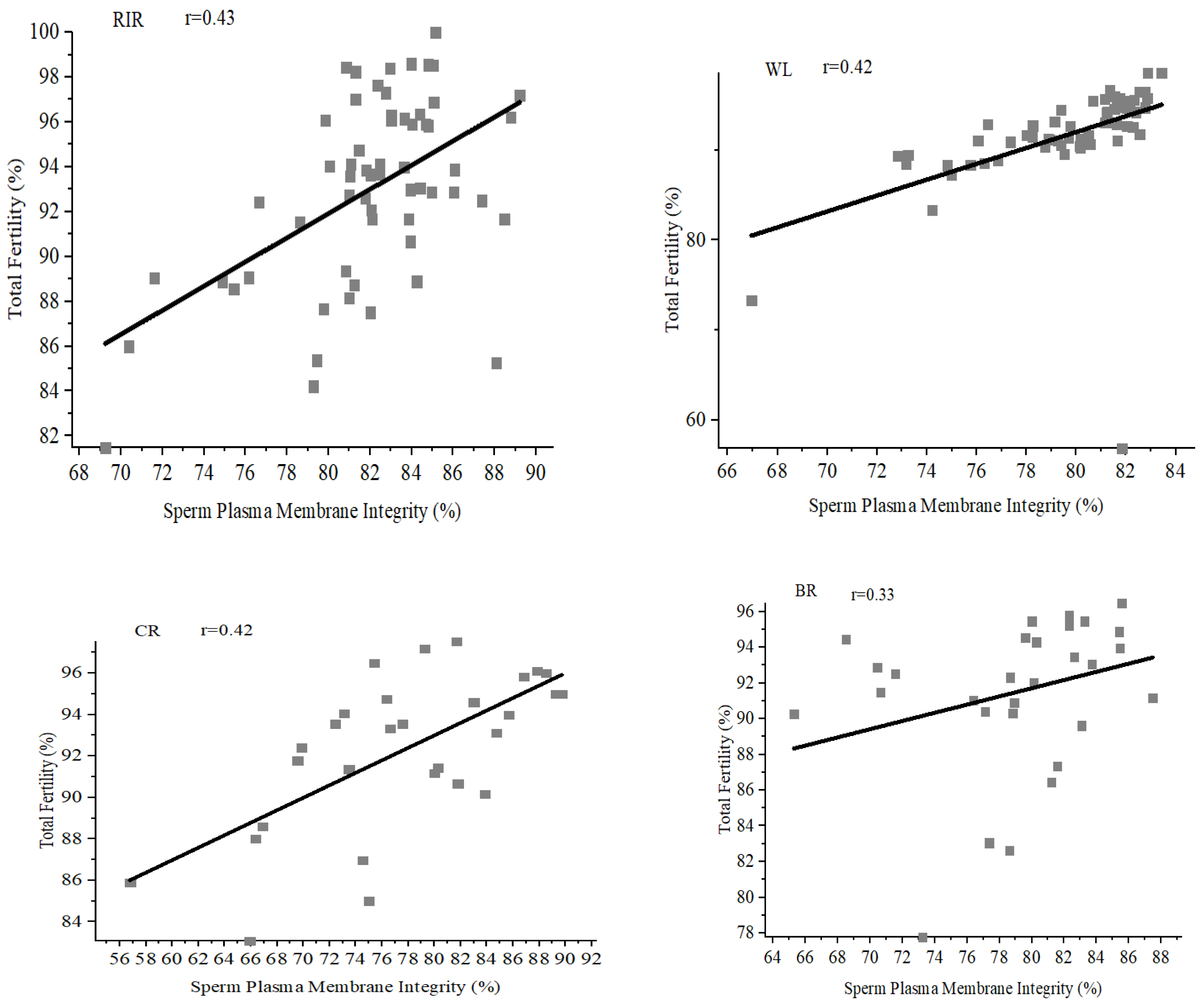
From the Pearson product moment correlation matrix, analyses of the various semen quality and sperm kinematic parameters of the four different chicken genetic lines are presented in (Table 6 and Table 7, and Figure 1).
Table 6.
Pearson’s correlation coefficient among semen quality traits, sperm kinematic parameters, and fertility rate of Colombian Rock roosters (n = 30; above the diagonal) and Barred Rock roosters (n = 30; below the diagonal).
Table 7.
Pearson’s correlation coefficient among semen quality traits, sperm kinematic parameters, and total fertility rate of Rhode Island Red roosters (n = 60; above the diagonal) and White Leghorn roosters (n = 60; below the diagonal).
Figure 1.
Scatter plot of the correlation sperm plasma membrane integrity and total fertility rate of Rhode Island Red, White Leghorn, Colombian Rock, and Barred Rock roosters.
Pearson’s correlation coefficients revealed that sperm plasma membrane integrity exhibited consistent positive and significant correlations with the majority of evaluated semen quality traits and computer-aided sperm analysis (CASA) kinematic parameters across all four genetic lines. For Barred Rock and Columbian Rock roosters, most parameters, including ejaculate semen volume, sperm concentration, sperm motility, sperm viability, and primary velocity/progression metrics, showed significantly higher positive associations (p < 0.01), whereas static/concentration traits, such as spermatozoa abnormality, total sperm count, and curvilinear velocity, demonstrated the lowest relationships. Similarly, in Rhode Island Red and White Leghorn roosters, the vast majority of semen quality and kinematic variables demonstrated a strong positive correlation with sperm plasma membrane integrity, with only spermatozoa abnormality, total sperm count, and straightness showing weak correlations. Overall, functional and kinematic vigor tracked closely with membrane integrity regardless of the genetic line.
3.6. Factor Analysis (FA) of Sperm Functional Predictor Variables
Factor analysis of sperm traits across four chicken lines (RIR, WL, CR, and BR) are presented in Table 8. Bartlett’s test of sphericity and the Kaiser–Meyer–Olkin (KMO) measure yielded identical sampling adequacy (KMO = 0.65) alongside statistically significant chi-squared results (p < 0.01). Specifically, the test values were chi square = 3329.54 for RIR, chi square = 3081.92 for WL, chi square = 2388.06 for CR, and chi square = 1892.59 for BR. The first three components accounted for cumulative variances of 72.08% (WL), 69.05% (BR), 68.05% (RIR), and 65.07% (CR), details of which are fully outlined in Table 8. These three-factor analyses (quantity factor score, velocity factor score, and linearity factor score) were used to describe each sperm functional parameter and categorize them into the following cluster analysis. Wobble and average path velocity loaded negatively for the BR genetic group, but linearity and straightness showed large positive loads. This suggests that sperm linearity drives quantity performance while wobble reduces it. In the CR genetic group, amplitude lateral head displacement, curvilinear velocity, and average path velocity largely dominate, indicating that this group’s quantity score is significantly supported by high curvilinear velocity and amplitude lateral head displacement. Linearity, straightness, curvilinear velocity, average path velocity, and amplitude lateral head displacement all load extremely high for the RIR genetic group, demonstrating a well-balanced, strong synergy among movement linearity and amplitude parameters. For the WL genetic group, linearity, straightness, and average path velocity are robust, while straight-line velocity loads negatively, indicating an inverse relationship where straight-line speed diminishes this particular quantity metric.
Table 8.
Rotated factor loadings and total variance explained for the four chicken genetic lines.
Figure 2.
Sperm subpopulation proportions across chicken breeds.
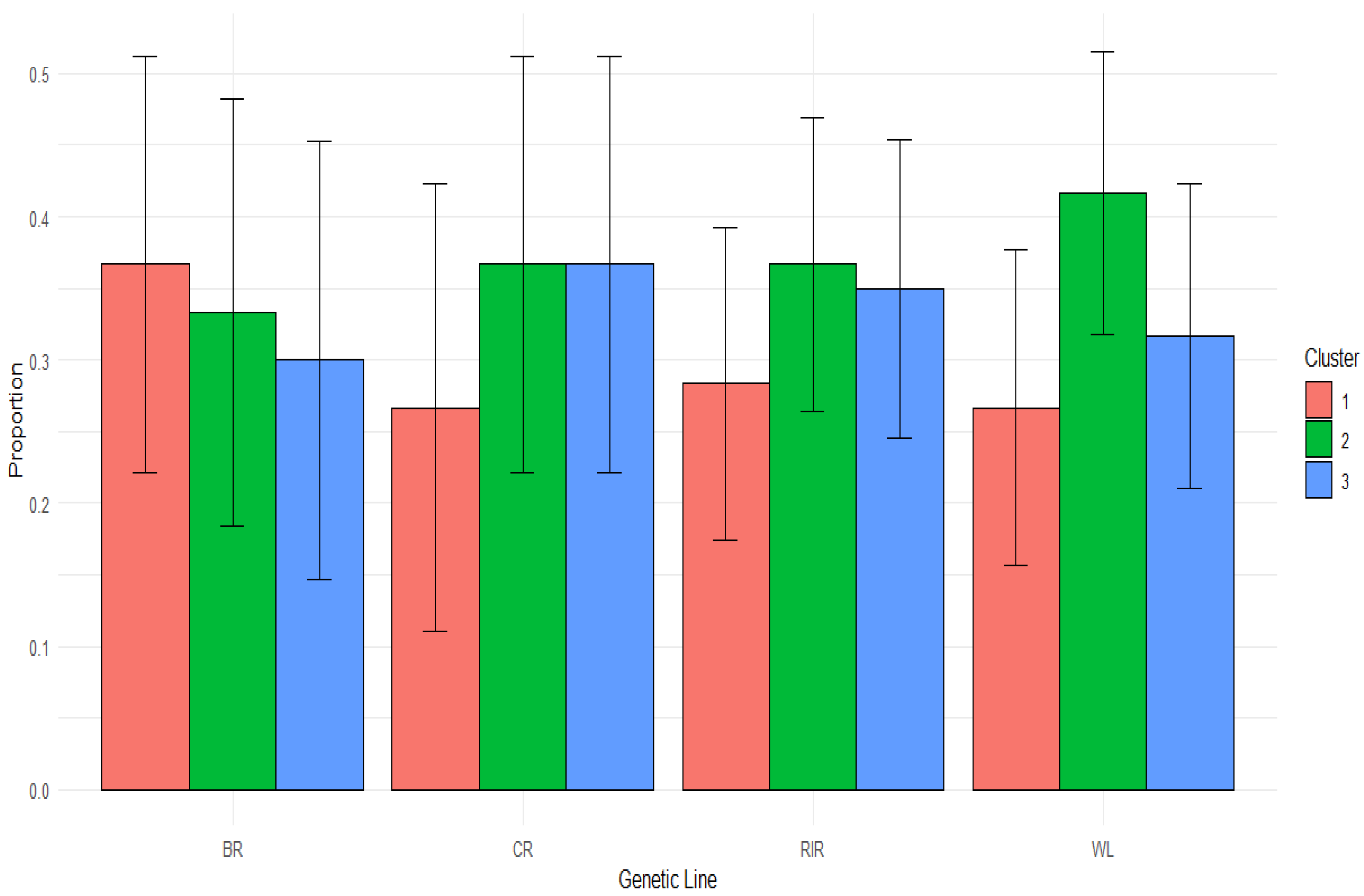
Table 9.
The distribution of sperm kinematic clusters across the four different genetic lines of roosters, respective of fertilizing capacity at 46 weeks of age.
4. Discussion
Although certain baseline phenotypic values for the RIR line corroborate our previous findings [13], the expanded multi-line approach provides a deeper physiological context, revealing that line-dependent variations in sperm kinematic features are key determinants of overall reproductive success. Characterized semen quality traits are useful in predicting a rooster’s potential for fertility in the poultry industry [22]. In the present study, we assessed various semen quality parameters in relation to fertility potential of the four different chicken genetic groups of roosters following artificial insemination. Significant differences were found among the four different chicken genetic group of roosters in VOL, semen pH, MOT, VIA, HOST, TSC, SA, and the sperm functional predictors like VSL, VCL, VAP, ALH, WOB, LIN, and STR. Differences in various semen parameters between different chicken genetic lines have also been described in Punjab Red [23] and RIR and WL [14]. The values obtained across all chicken genetic groups of roosters in VOL, HOST, semen pH, VIA, and MOT were higher than the values reported by [23,24] in RIR, PR, Aseel, and Kadaknath roosters, but lower than the earlier report for Sasso lines [25]. The reason for variation in those semen traits among the breed lines may be elucidated by the fact that normal physiological processes regulate spermatogenesis, whereas there was no significant (p > 0.05) difference in BCF among the four different chicken genetic groups of roosters.
The sperm functional parameters of the four different chicken genetic groups of roosters have been analyzed by multivariate and clustering methods. Several interesting findings related to sperm kinematics and fertility potential based on VSL, VCL, VAP, ALH, LIN, and STR, as well as other morphometric-derived parameters, were reported by Satake et al. [26] and García-Herreros and Leal [27]. Computer-assisted semen analysis (CASA) provides precise and useful information on various sperm motion characteristics that are helpful to predict the fertility status of semen samples [14]. Furthermore, sperm kinematic parameters have been associated with the prediction of roosters’ fertility potential [14]. As a result, Pearson’s correlation coefficients revealed that the HOST was significantly correlated with sperm motility and sperm kinematic parameters like VSL, VCL, VAP, ALH, LIN, and STR. These results agreed with the finding of [28], who reported that spermatozoa with higher velocities are more effective for fertilization in Bos taurus.
Sperm plasma membrane integrity is a crucial indicator of sperm quality and a primary determinant of male fertility, as the membrane is essential for sperm metabolism, motility, capacitation, and successful fertilization [29,30]. Surprisingly, even with these biochemical differences in sperm plasma membrane integrity, our present study indicated that the overall fertility potential of the four genetic lines showed no significant differences. This can be scientifically discussed through several evolutionary and biological lenses. Different chicken lines might utilize varying biological strategies to achieve equivalent fertilization. For instance, breeds with slightly lower membrane integrity may produce compensatory higher sperm concentrations or utilize more vigorous kinematic attributes (such as faster progressive motility) during natural mating or artificial insemination [31,32]. In poultry, a natural insemination or standard artificial insemination dose typically contains highly concentrated spermatozoa (ranging into the billions). This abundance often over-saturates the oviduct’s sperm storage tubules, compensating for the percentage of structurally fragile or damaged sperm [33,34]. The intrinsic fertility rate is ultimately a multifactorial trait. While membrane integrity is a vital biomarker for individual sperm viability, it does not act as a sole bottleneck [35]. The robust fertilization rates across all four lines (BR, CR, WL, and RIR) highlight that each genetic line is well-adapted for reproductive success. These values (ranging from 91.52% to 93.01%) are within the high fertility range reported in Thai native roosters [36]. However, the observed genetic variations align with previous studies that note breed-specific differences in semen quality traits [37]. The observed numeric differences could be attributed to genetic factors, as previous research has shown a strong genetic influence and heritability for sperm quality traits [38]. The specific genetic makeup of Rhode Island Red might confer greater resistance to membrane damage during semen collection or initial storage, possibly due to differences in membrane lipid composition or antioxidant capacity. In addition, the HOST % of the four different genetic lines of roosters was positively and strongly (p < 0.01) associated with the total fertility rate (TF), semen quality like VOL, SCON, MOT, TSC, and VIA, and sperm kinematic variables (VCL, VSL, VAP, ALH, STR, and LIN). Similarly, it was reported that the HOST has been positively correlated with Indonesian Garut ram and avian species of semen traits [39,40]. Moreover, previous studies recommended that the sperm plasma membrane can be used to evaluate the fertility capacity of males as a predictor variable [41]. In addition, Tapia et al. [42] also stated that knowing the sperm plasma membrane integrity, and its structural rearrangements in signaling actions that lead to fertilization of the oocyte, is of crucial importance.
Therefore, examination of the state of the sperm plasma membrane integrity can indicate one aspect of the fertilization potential of the semen sample [43]. Across all chicken genetic lines, sperm plasma membrane integrity correlated significantly (p < 0.01) with sperm kinematic parameters and standard semen variables (VOL, MOT, VIA, TSC, and SA). This is consistent with earlier findings in Large White boars and cases of male infertility [39,43]. In the present study, semen quality among the four different genetic groups of roosters associated with fertility potential was assessed by assessing semen quality traits, mainly sperm plasma membrane integrity and the rest of the semen quality traits, including sperm kinematic parameters. Unlike female fertility, male fertility potential cannot be measured directly; instead, it is evaluated indirectly through the reproductive success of females inseminated via artificial insemination. For this reason, artificial insemination is vital for producing elite future sires [44,45]. A conclusion supported by Wolc et al. [46] had also reported that there is a genetic correlation between sperm motility and roosters’ fertility traits. As indicated in the present study, the fertilities of settable eggs fertilized by the different genetic groups of roosters did not show significant variation across all genetic lines of roosters. On the contrary, the total hatchability of the settable eggs and the hatchability of the fertilized eggs significantly differed among the chicken genetic lines. The reason for decreasing total hatchability and hatchability from the fertilized eggs in the RIR chicken genetic group could be due to the poor quality of the eggshells. However, in the present study, the total fertility potential of the four different genetic lines was higher as compared with the previous studies by Sun and Xue et al. [22] in Beijing-You and Hrnčár et al. [47] in Brahma and Cochin, but lower as compared with the [48] report in RIR and WL breeds.
Even though there was a significant variation in sperm plasma membrane integrity among the four different genetic groups of roosters, the fertility potential of these genetic lines did not show any significant variation among them, and the reason behind this might be that the sperm plasma membrane integrity acts as the primary protective barrier that dictates sperm survival, metabolic function, and fertilizing capacity [49]. It is recognized that essential and non-essential factors, such as changes in pH, conductivity, temperature, and osmotic stress, among others, may affect sperm fertility characteristics [50]. Thus, the findings obtained in the present study indicated that the most critical variable of sperm motility impairment, at least in roosters’ semen, is related to sperm plasma membrane integrity because, as evidenced by this result, we observed that the largest impact of sperm plasma membrane integrity reflected on the fertility potential of the roosters. The economical and practical implications of the present research on roosters’ association of sperm plasma membrane integrity in semen of roosters related to fertility potential are evident to improve the whole sperm analysis in roosters’ semen quality trait [51].
Therefore, from a practical point of view, the study of well-defined functional sperm clusters would be important for selecting roosters with high merit for artificial insemination service [52]. In the present study, it is obvious that the distribution of these clusters clearly influenced the percentage of spermatozoa dispensed to each cluster. Just the sperm functional predictor was classified as slow/nonlinear, fast/linear or fast/nonlinear, and very fast/linear or very vast/nonlinear. Differences in sperm movement characteristics among the four different chicken genetic groups of roosters were primarily found in cluster 1, cluster 2, and cluster 3. Thereby, across all chicken genetic lines of roosters, the sperm functional predictors varied from cluster to cluster in relation to their fertilization capacity. Those clusters reflected the movement of the sperm functional predictor variables from slow/nonlinear or/and linear to very fast/nonlinear or/and linear slow/nonlinear sperm movement. In RIR roosters cluster 3 did show slow sperm movement with low fertilization potential compared to cluster 1 and cluster 2. This cluster contained 30% on average, with the lowest ALH values. On the contrary, cluster 1 explained the largest fertilization potential compared to cluster 2 and cluster 3. This covered around 33%, on average, of the largest nonlinear and linear sperm functional predictors. Whereas, for WL roosters, cluster 1 reflected very fast/nonlinear sperm movement with high fertilization capacity compared to cluster 2 and cluster 3. This cluster covered 33% with the largest VCL, VAP, ALH, and WOB values. On the contrary, cluster 3 reflected the lowest fertilization capacity as compared to cluster 1 and cluster 2. This comprised 32% of the lowest linearity. Similarly, the sperm functional parameters categorized into clusters in CR roosters did show variation across each cluster group. Therefore, cluster 1 had the highest fertilization capacity among the clusters 2 and 3, while in BR roosters, the sperm functional parameters characterized in cluster 1 had more effective fertilization capacity compared to cluster 2 and cluster 3. Several authors have stated that sperm functional parameters are related to fertility in males [14,52,53,54]. However, in spite of the fact that the distribution percentage and fertilizing capacity detected in each clustering group differ among the genetic chicken lines, this further confirmed the effectiveness of multivariate analysis in the accurate selection of roosters of high fertility by the inclusive method of different measures of sperm quality.
5. Conclusion
In conclusion, the complete evaluation of conventional semen traits, such as sperm plasma membrane integrity, as well as the numerous semen and sperm functional parameters, offered excellent evidence for a comprehensive assessment of RIR, WL, CR, and BR roosters’ fertility potential. Our findings underscore the need for multivariate assessment in genetic screening, allowing breeders to optimize for both quantity and quality, ultimately enhancing reproductive performance in different chicken genetic lines. However, more research is needed to understand how genotypes and phenotypes interact, as well as how biological pathways contribute to male reproductive potential.
Author Contributions
H.H.T., writing original draft, methodology, investigation, formal analysis, conceptualization; Y.L., writing original draft, methodology, investigation, formal analysis, conceptualization, funding acquisition; A.N., software, formal analysis, validation; Y.Z. (Yi Zhao), software, formal analysis, validation; Z.M., software, formal analysis, validation; X.Z., software, formal analysis, validation; X.H., software, formal analysis, validation; H.Y., software, formal analysis, validation; Y.Z. (Yunhe Zong), software, formal analysis, validation; C.C., software, formal analysis, validation; J.Y., software, formal analysis, validation; H.M., software, formal analysis, validation; Y.S., software, formal analysis, validation; J.C., conceptualization, review and editing, funding acquisition. All authors contributed to the interpretation of the results and writing of the article. All authors have read and agreed to the published version of the manuscript.
Funding
This research was funded by STI2030—Major Projects (No. 2023ZD040520102), China Agriculture Research Systems (No. CARS-39), the National Germplasm Bank of Domestic Animals (2025), the Agricultural Science and Technology Innovation Program (No. ASTIP-2021-IAS-16), Project on Egg Quality Determination and Genetic Regularity Analysis of Rare and High-Yielding Brown-Shell Egg Chicken Breeds (No. 22250179), the Guizhou Ecological Broiler Advantageous and Characteristic Industry Cluster Project (Qiancainong (2024) No. 80), and the China Scholarship Council.
Institutional Review Board Statement
The study was approved by the local ethical review board of the Animal Care and Use Committee (No. IAS2020-05, 15 January 2020 of the Institute of Animal Science of the Chinese Academy of Agricultural Sciences (IAS-CAAS), Beijing, China.
Informed Consent Statement
Not applicable.
Data Availability Statement
The original contributions presented in this study are included in the article. Further inquiries can be directed to the corresponding author.
Acknowledgments
The authors would like to thank Hongwei Wang (IAS, CAAS) for his assistance on semen collection and artificial insemination.
Conflicts of Interest
The authors have declared no conflicts of interest.
Abbreviations
| AI | artificial insemination |
| ALH | amplitude of lateral head |
| ANOVA | one-way analysis of variance |
| BCF | beat cross-frequency |
| CASA | computer-aided sperm analysis |
| FA | factor analysis |
| KMO | Kaiser–Meyer–Olkin |
| LIN | linearity |
| MOT | sperm motility |
| PCA | principal component analysis |
| SCON | sperm concentration |
| STR | straightness |
| TSC | total sperm count |
| VAP | average path velocity |
| VCL | curvilinear velocity |
| VSL | straight-line velocity |
| VOL | semen volume ejaculation |
| WOB | wobble |
References
- Khatun, A.; Rahman, M.S.; Pang, M.G. Clinical assessment of the male fertility. Obstet. Gynecol. Sci. 2018, 61, 179–191. [Google Scholar] [CrossRef] [Scilit]
- Majzoub, A.; Cho, C.L.; Agarwal, A.; Esteves, S. Conventional Semen Analysis and Specialized Sperm Function Tests in Patients with Varicocele; Springer: Berlin/Heidelberg, Germany, 2019; pp. 137–157. [Google Scholar]
- Dave, P.; Farber, N.; Vij, S. Conventional semen analysis and advanced sperm function tests in diagnosis and management of varicocele. Andrologia 2021, 53, e13629. [Google Scholar] [CrossRef] [Scilit]
- Patel, A.S.; Leong, J.Y.; Ramasamy, R. Prediction of male infertility by the World Health Organization laboratory manual for assessment of semen analysis: A systematic review. Arab. J. Urol. 2018, 16, 96–102. [Google Scholar] [CrossRef] [Scilit]
- Barazani, Y.; Agarwal, A.; Sabanegh, E.S. Functional Sperm Testing and the Role of Proteomics in the Evaluation of Male Infertility. Urology 2014, 84, 255–261. [Google Scholar] [CrossRef] [Scilit]
- Wright, C.; Milne, S.; Leeson, H. Sperm DNA damage caused by oxidative stress: Modifiable clinical, lifestyle and nutritional factors in male infertility. Reprod. Biomed. Online 2014, 28, 684–703. [Google Scholar] [CrossRef] [Scilit]
- Kumaresan, A.; Das Gupta, M.; Datta, T.K.; Morrell, J.M. Sperm DNA Integrity and Male Fertility in Farm Animals: A Review. Front. Vet. Sci. 2020, 7, 321. [Google Scholar] [CrossRef] [Scilit]
- Franken, D.R.; Oehninger, S. Semen analysis and sperm function testing. Asian J. Androl. 2012, 14, 6–13. [Google Scholar] [CrossRef] [Scilit]
- Carreras, A.; Ramirez, J.P.; Mendoza, C. Sperm plasma membrane integrity measurement: A combined method. Andrologia 1992, 24, 335–340. [Google Scholar] [CrossRef] [Scilit]
- Kızılay, F.; Altay, B. Sperm function tests in clinical practice. Turk. J. Urol. 2017, 43, 393–400. [Google Scholar] [CrossRef] [Scilit]
- Rouen, A.; Jeyendran, R. Sperm Vitality: Hypo-Osmotic Swelling Test; Cambridge University Press: Cambridge, UK, 2021; pp. 52–57. [Google Scholar]
- Hecht, B.R.; Jeyendran, R.S. The hypo-osmotic swelling test: Is it a sperm vitality or a viability assay? F&S Sci. 2022, 3, 18–20. [Google Scholar] [CrossRef] [Scilit]
- Tesfay, H.H.; Zhang, X.; Li, Y.; Zong, Y.; Ma, Z.; Han, X.; Zhao, Y.; Pan, Z.; Mani, A.I.; Yang, F.; et al. Weighted single-step GWAS identified candidate genes associated with semen traits in Rhode Island Red chickens. Poult. Sci. 2026, 105, 107202. [Google Scholar] [CrossRef] [Scilit]
- Tesfay, H.H.; Sun, Y.; Li, Y.; Shi, L.; Fan, J.; Wang, P.; Zong, Y.; Ni, A.; Ma, H.; Mani, A.I.; et al. Comparative studies of semen quality traits and sperm kinematic parameters in relation to fertility rate between 2 genetic groups of breed lines. Poult. Sci. 2020, 99, 6139–6146. [Google Scholar] [CrossRef] [Scilit]
- Tanga, B.M.; Qamar, A.Y.; Raza, S.; Bang, S.; Fang, X.; Yoon, K.; Cho, J. Semen evaluation: Methodological advancements in sperm quality-specific fertility assessment—A review. Anim. Biosci. 2021, 34, 1253–1270. [Google Scholar] [CrossRef] [Scilit]
- NY/T 33-2004; Feeding Standard of Chicken. China Agriculture Press: Beijing, China, 2004.
- Burrows, W.H.; Quinn, J.P. The Collection of Spermatozoa from the Domestic Fowl and Turkey. Poult. Sci. 1937, 16, 19–24. [Google Scholar] [CrossRef] [Scilit]
- Santiago-Moreno, J.; López-Sebastián, A.; Castaño, C.; Coloma, M.A.; Gómez-Brunet, A.; Toledano-Díaz, A.; Prieto, M.T.; Campo, J.L. Sperm variables as predictors of fertility in Black Castellana roosters; use in the selection of sperm donors for genome resource banking purposes. Span. J. Agric. Res. 2009, 7, 555–562. [Google Scholar] [CrossRef] [Scilit]
- Chung, E.; Atmoko, W.; Saleh, R.; Shah, R.; Agarwal, A. Sixth edition of the World Health Organization laboratory manual of semen analysis: Updates and essential take away for busy clinicians. Arab. J. Urol. 2024, 22, 71–74. [Google Scholar] [CrossRef] [Scilit]
- Bezerra, L.G.P.; Silva, A.M.; Moreira, S.S.J.; de Souza, C.M.P.; Silva, A.R. Establishment of methods to analyze the structural and functional integrity of the quail (Coturnix coturnix japonica) sperm plasma membrane. Br. Poult. Sci. 2023, 64, 429–434. [Google Scholar] [CrossRef] [Scilit]
- Sexton, T.J.; Fewlass, T.A. A new poultry semen extender 2. Effect of the diluent components on the fertilizing capacity of chicken semen stored at 5 °C. Poult. Sci. 1978, 57, 277–284. [Google Scholar] [CrossRef] [Scilit]
- Sun, Y.; Xue, F.; Li, Y.; Fu, L.; Bai, H.; Ma, H.; Xu, S.; Chen, J. Differences in semen quality, testicular histomorphology, fertility, reproductive hormone levels, and expression of candidate genes according to sperm motility in Beijing-You chickens. Poult. Sci. 2019, 98, 4182–4189. [Google Scholar] [CrossRef] [Scilit]
- Mavi, G.; Dubey, P.; Cheema, R.; Dash, S.K.; Bansal, B. Comparative analysis of semen quality parameters and their relationship with fertility in different genetic groups of layer chicken. Indian J. Anim. Res. 2018, 53, 1269–1274. [Google Scholar] [CrossRef] [Scilit]
- Mavi, G.; Dubey, P.; Cheema, R. Comparison of Sperm Attributes in two Indigenous Layer Breeds and their Relationship with Fertility. Theriogenolog. Insight Int. J. Reprod. All Anim. 2017, 7, 123. [Google Scholar] [CrossRef] [Scilit]
- Tarif, A.; Bhuiyan, M.; Ferdousy, R.; Juyena, N.; Mollah, M.B.R. Evaluation of semen quality among four chicken lines. IOSR J. Agric. Vet. Sci. 2013, 6, 7–13. [Google Scholar] [CrossRef] [Scilit]
- Satake, N.; Elliott, R.M.; Watson, P.F.; Holt, W.V. Sperm selection and competition in pigs may be mediated by the differential motility activation and suppression of sperm subpopulations within the oviduct. J. Exp. Biol. 2006, 209, 1560–1572. [Google Scholar] [CrossRef] [Scilit]
- García-Herreros, M.; Leal, C.L. Comparative study of sperm washing and selection methods after cryopreservation and its influence on sperm subpopulational structure in a bovine model. Syst. Biol. Reprod. Med. 2014, 60, 338–347. [Google Scholar] [CrossRef] [Scilit]
- Palacin, I.; Santolaria, P.; Alquezar-Baeta, C.; Soler, C.; Silvestre, M.A.; Yániz, J. Relationship of sperm plasma membrane and acrosomal integrities with sperm morphometry in Bos taurus. Asian J. Androl. 2020, 22, 578–582. [Google Scholar] [CrossRef] [Scilit]
- Ramu, S.; Jeyendran, R.S. The hypo-osmotic swelling test for evaluation of sperm membrane integrity. Methods Mol. Biol. 2013, 927, 21–25. [Google Scholar] [CrossRef] [Scilit]
- Da Costa, R.; Redmann, K.; Schlatt, S. Simultaneous detection of sperm membrane integrity and DNA fragmentation by flow cytometry: A novel and rapid tool for sperm analysis. Andrology 2021, 9, 1254–1263. [Google Scholar] [CrossRef] [Scilit]
- Nonnis, S.; Maffioli, E.; Grana, J.; Madeddu, M.; Zaniboni, L.; Marelli, S.P.; Perricone, V.; Iaffaldano, N.; Tedeschi, G.; Cerolini, S. Relation between proteome characterization and semen quality in Italian chicken breeds. PLoS ONE 2025, 20, e0333802. [Google Scholar] [CrossRef] [Scilit]
- Li, Y.; Sun, Y.; Ni, A.; Tesfay, H.H.; Isa, A.M.; Zong, Y.; Ma, H.; Yuan, J.; Chen, J. Factor Analysis of Semen Quality in Chicken and Its Impact on Fertility. Animals 2025, 15, 1906. [Google Scholar] [CrossRef] [Scilit]
- Yoshimura, Y.; Nii, T.; Isobe, N. Unique Physiological Mechanisms of Sperm Storage and Prolonged Sperm Survival in Hen Oviducts: A Review. J. Poult. Sci. 2025, 62, 2025031. [Google Scholar] [CrossRef] [Scilit]
- Brady, K.; Krasnec, K.; Long, J.A. Transcriptome analysis of inseminated sperm storage tubules throughout the duration of fertility in the domestic turkey, Meleagris gallopavo. Poult. Sci. 2022, 101, 101704. [Google Scholar] [CrossRef] [Scilit]
- Góngora, A.; Johnston, S.; Contreras, P.; López-Fernández, C.; Gosálvez, J. The Nexus Between Sperm Membrane Integrity, Sperm Motility, and DNA Fragmentation. Membranes 2025, 15, 109. [Google Scholar] [CrossRef] [Scilit]
- Juiputta, J.; Loengbudnark, W.; Koedkanmark, T.; Chankitisakul, V.; Boonkum, W. Determining the priority semen characteristics and appropriate age for genetic improvement in Thai native roosters. PLoS ONE 2025, 20, e0319537. [Google Scholar] [CrossRef] [Scilit]
- Kumar, P.; Srivastava, N.; Pande, M.; Prasad, J.K.; Sirohi, A.S. Evaluating Sperm Cell Viability and Membrane Integrity. In Protocols in Semen Biology (Comparing Assays); Srivastava, N., Pande, M., Eds.; Springer Singapore: Singapore, 2017; pp. 57–71. [Google Scholar]
- Xue, S.H.; Xu, B.B.; Yan, X.C.; Zhang, J.X.; Su, R. Sperm Membrane Stability: In-Depth Analysis from Structural Basis to Functional Regulation. Vet. Sci. 2025, 12, 658. [Google Scholar] [CrossRef] [Scilit]
- Moskovtsev, S.I.; Willis, J.; Azad, A.; Mullen, J.B. Sperm DNA integrity: Correlation with sperm plasma membrane integrity in semen evaluated for male infertility. Arch. Androl. 2005, 51, 33–40. [Google Scholar] [CrossRef] [Scilit]
- Fischer, D.; Schneider, H.; Failing, K.; Meinecke-Tillmann, S.; Wehrend, A.; Lierz, M. Viability assessment of spermatozoa in large falcons (Falco spp.) using various staining protocols. Reprod. Domest. Anim. 2020, 55, 1383–1392. [Google Scholar] [CrossRef] [Scilit]
- Rodriguez-Martinez, H.; Martinez, E.A.; Calvete, J.J.; Peña Vega, F.J.; Roca, J. Seminal Plasma: Relevant for Fertility? Int. J. Mol. Sci. 2021, 22, 4368. [Google Scholar] [CrossRef] [Scilit]
- Tapia, J.A.; Macias-Garcia, B.; Miro-Moran, A.; Ortega-Ferrusola, C.; Salido, G.M.; Peña, F.J.; Aparicio, I.M. The membrane of the mammalian spermatozoa: Much more than an inert envelope. Reprod. Domest. Anim. 2012, 47, 65–75. [Google Scholar] [CrossRef] [Scilit]
- Matabane, M.B.; Thomas, R.; Netshirovha, T.; Tsatsimpe, M.; Ng’ambi, J.; Nephawe, K.A.; Nedambale, T. Relationship between sperm plasma membrane integrity and morphology and fertility following artificial insemination. S. Afr. J. Anim. Sci. 2017, 47, 102. [Google Scholar] [CrossRef] [Scilit]
- Tabatabaei, S.; Batavani, R.A.; Talebi, A.R. Comparison of Semen Quality in Indigenous and Ross Broiler Breeder Roosters. J. Anim. Vet. Adv. 2009, 8, 90–93. [Google Scholar] [CrossRef] [Scilit]
- Froman, D.P.; Rhoads, D.D. Breeding and Genetics Symposium: A systems biology definition for chicken semen quality. J. Anim. Sci. 2013, 91, 523–529. [Google Scholar] [CrossRef] [Scilit]
- Wolc, A.; Arango, J.; Settar, P.; Fulton, J.E.; O’Sullivan, N.P.; Dekkers, J.C.M. Genetics of male reproductive performance in White Leghorns. Poult. Sci. 2019, 98, 2729–2733. [Google Scholar] [CrossRef] [Scilit]
- Hrnčár, C.; Gašparovič, M.; Gálik, B.; Bujko, J. Egg Traits, Fertility and Hatchability of Brahma, Cochin and Orpington Chicken Breeds. Sci. Pap. Anim. Sci. Biotechnol. 2015, 48, 137–141. [Google Scholar]
- Zelleke, G.; Moudgal, R.P.; Asmare, A. Fertility and hatchability in RIR and WL breeds as functionally modified by crossing them in alternate sex combinations (Gallus domesticus). Br. Poult. Sci. 2005, 46, 119–123. [Google Scholar] [CrossRef] [Scilit]
- Janosikova, M.; Petricakova, K.; Ptacek, M.; Savvulidi, F.G.; Rychtarova, J.; Fulka, J., Jr. New approaches for long-term conservation of rooster spermatozoa. Poult. Sci. 2023, 102, 102386. [Google Scholar] [CrossRef] [Scilit]
- Chao, H.H.; Zhang, Y.; Dong, P.Y.; Gurunathan, S.; Zhang, X.F. Comprehensive review on the positive and negative effects of various important regulators on male spermatogenesis and fertility. Front. Nutr. 2022, 9, 1063510. [Google Scholar] [CrossRef] [Scilit]
- Blesbois, E.; Grasseau, I.; Seigneurin, F. Membrane fluidity and the ability of domestic bird spermatozoa to survive cryopreservation. Reproduction 2005, 129, 371–378. [Google Scholar] [CrossRef] [Scilit]
- Barquero, V.; Roldan, E.R.S.; Soler, C.; Vargas-Leitón, B.; Sevilla, F.; Camacho, M.; Valverde, A. Relationship between Fertility Traits and Kinematics in Clusters of Boar Ejaculates. Biology 2021, 10, 595. [Google Scholar] [CrossRef] [Scilit]
- Barbas, J.P.; Leahy, T.; Horta, A.E.; García-Herreros, M. Sperm kinematics and subpopulational responses during the cryopreservation process in caprine ejaculates. Cryobiology 2018, 82, 137–147. [Google Scholar] [CrossRef] [Scilit]
- Víquez, L.; Barquero, V.; Soler, C.; Roldan, E.R.S.; Valverde, A. Kinematic Sub-Populations in Bull Spermatozoa: A Comparison of Classical and Bayesian Approaches. Biology 2020, 9, 138. [Google Scholar] [CrossRef] [Scilit]

Disclaimer/Publisher’s Note: The statements, opinions and data contained in all publications are solely those of the individual author(s) and contributor(s) and not of MDPI and/or the editor(s). MDPI and/or the editor(s) disclaim responsibility for any injury to people or property resulting from any ideas, methods, instructions or products referred to in the content. |
© 2026 by the authors. Licensee MDPI, Basel, Switzerland. This article is an open access article distributed under the terms and conditions of the Creative Commons Attribution (CC BY) license.