


Abstract
Chronic cyclic heat stress impairs thermoregulation, growth, tissue integrity, microbial metabolism, and stress-related molecular responses in broiler chickens. N-acetyl-L-cysteine, a cysteine donor involved in glutathione synthesis, has been proposed as a nutritional strategy to support stress adaptation. Therefore, this study evaluated NAC in 324 Ross 308 broilers allocated to thermoneutral conditions (TN, 7 pens), HS (HS, 10 pens), or HS plus 2000 mg/kg NAC (HS + NAC, 10 pens). From day 20 to 35, HS birds were exposed to 34 °C for 7 h/day and 26 °C otherwise, while TN birds were kept at 22 °C. Heat stress increased rectal temperature and respiratory rate (p < 0.001), reduced average daily gain, and increased drinking and gasping behavior (p < 0.05). Heat stress also increased hepatic cord disorganization, cerebral vacuolisation–necrocytosis, hepatic and cerebral HSP70 expression, and caecal propionate, while reducing cerebral apelin expression (p < 0.05). Jejunal villus morphology and microbiota α-diversity were unchanged, although caecal profiles indicated treatment-related shifts and potentially higher Bilophila spp. in heat-stressed birds. NAC did not improve growth, thermoregulation, oxidative status, caecal fermentation, microbial structure, or HSP70 expression. It increased jejunal villus fusion and hepatocellular vacuolation scores and reduced cerebral ghrelin expression (p < 0.05). In conclusion, heat stress impaired growth and induced tissue, microbial, fermentative, and cerebral gene-expression changes, whereas 2000 mg/kg NAC did not provide measurable protection under the chronic cyclic HS in the present study.
1. Introduction
Heat stress (HS) remains a major environmental, welfare, and productivity challenge in modern broiler production. Because chickens are covered with feathers and lack sweat glands, they rely heavily on respiratory heat dissipation and behavioural adaptation when ambient temperature exceeds their thermoregulatory capacity. Under sustained or recurrent heat load, broilers typically show increased panting and water intake, reduced feed intake, altered acid–base balance, impaired growth, and changes in intestinal function [1,2]. Beyond these immediate thermoregulatory responses, HS can affect tissue integrity, liver metabolism, microbial fermentation, and stress-related molecular responses in the central nervous system, indicating that thermal challenge involves broader physiological disruption than reduced performance alone.
The intestine, microbiota, and central nervous system are biologically interconnected through neural, endocrine, immune, and microbial routes, often discussed within the gut–brain axis concept. In poultry, HS has been associated with intestinal barrier impairment, altered microbial composition, behavioural changes, and modified expression of appetite- and stress-related genes [3,4]. However, direct evidence of functional gut-to-brain signalling during chronic HS in broilers remains limited, particularly because intestinal, microbial, and cerebral endpoints are often evaluated separately. Thus, assessing these endpoints in parallel may help the prior description of systemic HS phenotype and provide preliminary data for further studies, especially designed to investigate gut–brain communications.
N-acetyl-L-cysteine (NAC) is a cysteine donor that can support glutathione synthesis and redox-sensitive cellular responses. Its biological relevance under HS is linked mainly to the role of oxidative stress in intestinal dysfunction, hepatic stress, and cellular heat-shock responses. Previous studies have reported beneficial effects of NAC on growth performance or intestinal function in heat-stressed broilers [5,6], although responses have not been consistent across HS models, supplementation routes, and tissue glutathione-related endpoints. This variability suggests that the efficacy of NAC may depend on heat-load severity, bird age, dietary context, and the biological endpoints considered.
Although many physiological and performance responses to HS are well established, including work from our group, the broader systemic effects of dietary NAC under chronic cyclic HS remain less clear. Therefore, the present study included complementary endpoints to capture different metabolic responses during HS: performance and activity to quantify whole-animal functional impact; rectal temperature and respiratory rate to verify thermoregulatory strain; jejunal, hepatic, and cerebral histopathology to detect tissue-level damage; caecal short-chain fatty acids and microbiota structure to assess microbial ecology; oxidative-status markers and selected liver, jejunal, and cerebral genes to examine oxidative stress- and appetite-related responses. We hypothesised that chronic cyclic HS would induce a multi-system stress response, and that dietary NAC would attenuate these responses.
2. Materials and Methods
2.1. Birds, Housing, Diets, and Experimental Design
One-day-old male Ross 308 broiler chicks were housed in an environmentally controlled facility in floor pens measuring 1.0 × 0.9 m and bedded with wood shavings to a depth of approximately 5 cm. Each pen contained 12 birds and was equipped with one feeder and two drinking nipples. All experimental procedures were approved by the Ethics Committee of the Faculty of Veterinary Medicine, Ghent University, Belgium, under approval number 2022-044. The photoperiod was set at 23 h light and 1 h darkness from d 0 to 7 and 18 h light and 6 h darkness thereafter. Room temperature was maintained at 32 °C during the first 3 d post-hatch and was gradually reduced to 22 °C by d 20. Relative humidity during the experimental period ranged from 46% to 56%. Birds were vaccinated against Newcastle disease and infectious bronchitis on d 1, and Newcastle disease vaccination was repeated by spray application on d 18.
Birds received a starter diet from d 0 to 11, a grower diet from d 11 to 21, and a finisher diet from d 21 to 35. Diets were formulated according to Ross 308 nutrient recommendations, and their ingredient and nutrient compositions are shown in Table 1. Dietary metabolisable energy values were calculated from the ingredient nutrient matrix used for feed formulation, based on standard AMEn values for poultry ingredients. Representative feed samples from each feeding phase were analysed on an as-fed basis for dry matter (AOAC 934.01), crude protein (AOAC 990.03), ether extract (AOAC 920.39), and ash (AOAC 942.05). Organic matter was calculated as dry matter minus ash. Diets were provided as crumbles during the starter phase and as pellets during the grower and finisher phases.
Table 1.
Ingredient and nutrient composition of the experimental diets.
On d 20, birds with similar body weight were randomly allocated to 27 pens and assigned to one of three treatments: thermoneutral control (TN; n = 7 pens), heat stress (HS; n = 10 pens), or heat stress with dietary N-acetyl-L-cysteine supplementation (HS + NAC; n = 10 pens). Birds in the TN group were maintained at 22 °C and fed the basal diet ad libitum. Birds in the HS and HS + NAC groups were exposed to chronic cyclic HS from d 20 to 35, consisting of 34 °C for 7 h/day and 26 °C for the remaining period. The HS group received the basal diet, whereas the HS + NAC group received the basal diet supplemented with 2000 mg/kg NAC. This thermal regimen followed the climate-controlled room setup used in previous broiler HS studies from our group. The target number of replicate pens was determined according to a statistical power analysis with average daily gain as the response variable, and resulted in a minimum of 7 pens. However, due to practical conditions in the climate-controlled housing facility and smaller expected treatment effects between HS and HS + NAC, the final number of replicate pens was increased to 10 pens for the latter two treatment groups. Nevertheless, the pen was maintained as the experimental unit for all treatment-level analyses.
The NAC used in this study was obtained from Zambon, Jette, Belgium (CAS 616-91-1; 99% purity; 74.3% L-cysteine). The inclusion level of 2000 mg/kg was selected based on previous broiler studies from our group, including dose–response evaluation, showing that NAC supplementation under HS elicited measurable biological and performance-related responses and was well tolerated [6,7,8]. NAC was incorporated into the HS + NAC diet during feed manufacturing to achieve the intended a final inclusion level of 2000 mg/kg feed.
2.2. Data Collection and Sampling
Body weight, feeder weight, and mortality were recorded per pen on d 0, d 20, and d 35. Average daily gain, average daily feed intake, and feed conversion ratio were calculated on a per-pen basis. Feed conversion ratio was calculated as feed intake divided by body weight gain and corrected for mortality when applicable.
Respiratory rate and rectal temperature were measured on d 22, 29, and 34 in three birds randomly selected from each pen, as described by Majdeddin et al. [9]. For each pen, the mean value of the three birds was used for statistical analysis. Respiratory rate was expressed as breaths per minute, and rectal temperature was measured using a digital thermometer inserted into the cloaca.
On d 35, two birds per pen with body weight close to the pen average were selected for sampling approximately 4 h after the onset of the HS period. Birds were euthanised by administration of a lethal dose of pentobarbital sodium at 60 mg/kg body weight, followed by exsanguination. From one bird per pen, the right liver lobe, mid-jejunum, and right cerebrum were collected for oxidative status measurements, jejunal histomorphology, and histopathological evaluation. From the second bird per pen, liver, mid-jejunal mucosa, and right cerebrum were collected for gene-expression analysis. Caecal contents were collected at the same sampling time for short-chain fatty acid and microbiota analyses. Samples for molecular and oxidative analyses were frozen and stored at −80 °C until analysis. Tissue samples for histology were fixed in 4% neutral-buffered formaldehyde.
The cerebral sample consisted of right cerebral tissue and was not dissected into discrete hypothalamic or other nuclei. Therefore, gene-expression results from this tissue were interpreted as selected cerebral molecular responses rather than region-specific hypothalamic regulation.
2.3. Jejunal Histomorphology and Tissue Histopathology
After fixation in 4% neutral-buffered formaldehyde, mid-jejunum samples were dehydrated, embedded in paraffin, sectioned at 5 µm, and stained with haematoxylin and eosin. Villus height and adjacent crypt depth were measured in at least ten well-oriented villi per sample, and the villus height-to-crypt depth ratio was calculated [10]. Liver and right cerebrum samples were processed using the same histological procedure.
Histopathological evaluation was based on previously published poultry pathology frameworks for the liver, mid-jejunum, and brain tissue [11,12,13]. Slides were evaluated by observers blinded to treatment allocation. Lesions were scored using a binary system, where 0 indicated the absence and 1 indicated the presence of a predefined histological feature. Scores were summarised at tissue level and as a total histopathological score per bird.
Each bird was evaluated for 12 predefined features: four in the right cerebrum, four in the mid-jejunum, and four in the liver. Cerebral features included abnormal neuronal or glial morphology, vacuolisation and necrocytosis, nuclear dissolution or fragmentation, and inflammatory cell infiltration. Mid-jejunal features included epithelial cell accumulation in the lumen, shortened villi with villus fusion, proliferative enterocytes, and inflammatory changes in villi. Hepatic features included loss of normal hepatic cord arrangement, dilated or congested central veins and sinusoids, foamy hepatocellular vacuolation, and nuclear degenerative changes. All observations were performed using a light microscope (Olympus BX61, Olympus, Aartselaar, Belgium) and analysed using image capture software (AnalySIS Pro 3.2, Olympus, Aartselaar, Belgium).
2.4. Behavioural Activity Scoring
Broiler activity was assessed according to Calefi et al. [3]. Observations were conducted on d 34 during the HS episode, between 4 and 6 h after the onset of heat exposure. Video recordings were obtained at pen level using a digital camera positioned 210 cm above the floor (Arducam 16 MP Autofocus USB Camera, model B029001, Arducam Technology Co., Ltd., Hong Kong, China). Each recording lasted 6 min, including 1 min of habituation followed by 5 min of behavioural assessment.
The following behaviours were recorded: standing, defined as resting on both feet with an upright trunk for more than 5 s; feeding, defined as active consumption of feed at the feeder; walking, defined as movement with an elevated and parallel trunk for more than 5 s; feather pecking, defined as pecking at another bird’s feathers; drinking, defined as positioning at the drinking nipple and consuming water; and gasping, defined as open-beak breathing with increased respiratory movement. Individual birds could be recorded more than once for a given behaviour, and results were expressed as events per bird per hour.
Because video recordings were not conducted simultaneously for all pens, some pens were recorded during the middle and others toward the end of the HS period. Recording time may therefore have influenced activity levels. Behavioural outcomes were consequently interpreted as exploratory indicators rather than definitive behavioural endpoints.
2.5. Short-Chain Fatty Acid Analysis
Short-chain fatty acids were determined in caecal contents by gas chromatography according to the method described by Castro-Montoya et al. [14], with minor modifications. Briefly, 1 g of caecal content was diluted with 5 mL of 10% formic acid and shaken for 5 min. Samples were centrifuged at 31,000× g for 15 min at 4 °C, and the supernatant was filtered through a 12–15 µm filter. The filtrate was transferred into gas chromatography vials and stored at 4 °C until injection. Short-chain fatty acids were analysed using a Varian CP-3800 gas chromatograph (Varian, Inc., Walnut Creek, CA, USA).
2.6. Caecal Microbiota Analysis
Caecal samples were submitted to Eurofins Genomics Germany, Ebersberg, Germany, for high-throughput sequencing of the bacterial 16S rRNA gene. Microbial communities were characterised by amplification of the V3–V4 region using primers 341F (5′-TACGGGAGGCAGCAG-3′) and 805R (5′-CCAGGGTATCTAATCC-3′). Sequencing was performed on an Illumina platform (Illumina, Inc., San Diego, CA, USA).
Sequence processing was conducted in QIIME2 (v2025) using the DADA2 plugin for quality filtering, denoising, chimera removal, and amplicon sequence variant inference. Operational taxonomic unit clustering at 97% similarity was not applied. Low-abundance amplicon sequence variants with fewer than 10 total reads across all samples were removed before downstream analysis to reduce noise and unstable fold-change estimates. Alpha-diversity was assessed using Chao1, Shannon, Simpson, and observed ASV indices. Beta-diversity was assessed using PERMANOVA (v2025) based on Bray–Curtis dissimilarity and weighted UniFrac distance matrices and visualised by principal coordinate analysis. Differential abundance findings were interpreted after correction for multiple comparisons, taxa not significant after correction were considered descriptive patterns rather than specific biomarkers from treatments.
2.7. Oxidative Status
Buffered aqueous extracts of liver, mid-jejunal mucosa, and right cerebrum were prepared from approximately 300 to 1000 mg of tissue, depending on tissue availability. Samples were homogenised in 1% Triton X-100 phosphate buffer (Sigma-Aldrich, St. Louis, MO, USA), 50 mM pH 7.0 at a ratio of 1 part tissue to 9 parts buffer. Homogenates were prepared for 40 s at 13,000 rpm and centrifuged at 10,000× g for 15 min at 4 °C. The supernatant was collected and used for oxidative status assays.
Malondialdehyde concentration was determined according to Grotto et al. [15], with minor modifications, by spectrophotometric measurement at 532 nm. Superoxide dismutase activity was measured by monitoring the increase in absorbance at 420 nm for 5 min, based on the autoxidation of pyrogallol [16]. One unit of superoxide dismutase activity was defined as the amount of enzyme required to inhibit pyrogallol autoxidation by 50%. Glutathione peroxidase activity was evaluated by measuring the decrease in NADPH absorbance at 340 nm. The reaction mixture contained 1 mM reduced glutathione, 0.15 mM NADPH, 0.15 mM H2O2, 40 mM potassium phosphate buffer (pH 7.0), 0.5 mM EDTA, 1 mM NaN3, 1.5 units of glutathione reductase, and 30 µL of tissue extract in a final volume of 250 µL. Absorbance was recorded for 3 min at 22 °C. One unit of glutathione peroxidase activity was defined as the amount of enzyme required to oxidise 1 µmol of NADPH to NADP+ per min at 25 °C [17].
2.8. Gene-Expression Analysis
Total RNA was extracted from liver, mid-jejunal mucosa, and right cerebrum samples using the PureLink™ RNA Mini Kit (Invitrogen, Thermo Fisher Scientific, Carlsbad, CA, USA) combined with TRIzol reagent (Invitrogen, Thermo Fisher Scientific, Carlsbad, CA, USA), according to the manufacturers’ instructions. Genomic DNA was removed during RNA isolation using the gDNA removal step included in the extraction protocol. RNA concentration and purity were assessed using a NanoDrop ND-2000 spectrophotometer (NanoDrop Technologies, Thermo Scientific, Wilmington, DE, USA). Samples with A260/A280 ratios between 1.95 and 2.25 were used for cDNA synthesis.
Complementary DNA was synthesised using the QuantiTect Reverse Transcription Kit (QIAGEN, Hilden, Germany), according to the manufacturer’s instructions. Briefly, 1 µg of total RNA was mixed with 2 µL of gDNA Wipeout Buffer, and the volume was adjusted to 14 µL with RNase-free water before reverse transcription.
Reverse-transcription quantitative PCR was performed using Maxima SYBR Green/ROX qPCR Master Mix (2×) (Thermo Fisher Scientific, Carlsbad, CA, USA). Reactions were prepared in a final volume of 10 µL containing 5 µL of 2× SYBR Green master mix, 1 µL of forward and reverse primer mix, 1 µL of cDNA template, and nuclease-free water. Thermal cycling consisted of initial denaturation at 95 °C for 10 min, followed by 40 cycles of denaturation at 95 °C for 15 s and annealing/extension at 60 °C for 1 min. Melt-curve analysis was performed to verify amplification specificity.
Amplification was performed on a StepOne Plus Real-Time PCR System (Applied Biosystems, Foster City, CA, USA), and data were collected using the corresponding instrument software. Gene expression was normalised using ACTB and GAPDH as internal reference genes. Relative expression was calculated using the 2^−ΔΔCt method, with the TN group used as the calibrator. Gene-specific primers are shown in Table 2. Primers were designed using Primer Premier 5.0 based on Gallus gallus reference sequences. Where possible, primers were designed using a cross-exon strategy to reduce amplification of genomic DNA, and amplification specificity was confirmed by melt-curve analysis.
Table 2.
Primers used for reverse-transcription quantitative PCR.
2.9. Statistical Analysis
The pen was considered the experimental unit for all treatment-level analyses. For physiological measurements, values from the three sampled birds within each pen were averaged before analysis. For tissue, oxidative, gene-expression, short-chain fatty acid, and microbiota endpoints, one sampled bird per pen was used unless otherwise specified.
Treatment effects were analysed using the model: yij = μ + Ti + εij, where yij is the response variable of pen j in treatment i, μ is the overall mean, Ti is the fixed effect of treatment, and εij is the residual error. The three treatments were TN, HS, and HS + NAC. Data normality was assessed using the Shapiro–Wilk test. For normally distributed data, treatment effects were analysed by one-way ANOVA, followed by Tukey’s post hoc test. For data that did not meet normality assumptions, the Kruskal–Wallis test was used, followed by Dunn’s post hoc test for pairwise comparisons. Behavioural activity data were analysed as non-parametric data and interpreted as exploratory endpoints because recording time differed among pens.
Binary histopathological scores were analysed as semi-quantitative lesion-presence outcomes. Total histopathological scores were calculated per bird and analysed at pen level after checking distributional assumptions. Because lesion scoring was binary and inter-observer agreement was not formally quantified, histopathological outcomes were interpreted cautiously as indicators of tissue alteration rather than quantitative measures of lesion severity.
For microbiota analysis, alpha-diversity indices were compared among treatments using ANOVA or Kruskal–Wallis tests according to data distribution. Beta-diversity was tested using permutational multivariate analysis of variance based on Bray–Curtis and weighted UniFrac distance matrices. Amplicon sequence variant inference and microbiome preprocessing were conducted using QIIME2 with the DADA2 plugin.
Statistical analyses of performance, physiological, histological, oxidative, short-chain fatty acid, and gene-expression data were performed using SPSS version 27.0 (IBM Corp., Armonk, NY, USA). Microbiota-related statistical analyses were performed using QIIME2 and associated packages. Differences were considered significant at p < 0.05, and tendencies were discussed at 0.05 ≤ p < 0.10 when biologically relevant.
3. Results
3.1. Rectal Temperature, Respiratory Rate, and Performance
As shown in Table 3, chronic cyclic HS significantly increased rectal temperature and respiratory rate on days 22, 29, and 34 compared with thermoneutral conditions (p < 0.001), confirming successful induction of HS. Growth performance was negatively affected by HS, as indicated by reduced final body weight and average daily gain (p < 0.05; Table 4). Dietary NAC supplementation did not improve performance under HS. Average daily feed intake was lower in the HS + NAC group compared with the TN group (p < 0.05), with the HS group showing intermediate values. Feed conversion ratio and mortality were not affected by either HS or NAC supplementation.
Table 3.
Effect of heat stress and N-acetyl-L-cysteine feed supplementation on rectal temperature and respiratory rate of male broilers.
Table 4.
Effect of heat stress and N-acetyl-L-cysteine feed supplementation on body weight, average daily gain, average daily feed intake, feed conversion ratio, and mortality of male broilers from day 20 to 35.
3.2. Activity Pattern
Heat stress significantly increased drinking frequency (p < 0.05) and gasping behaviour (p < 0.001) in broilers (Table 5). Walking activity tended to be higher in heat-stressed birds compared with thermoneutral controls (p = 0.060). Dietary NAC supplementation did not significantly modify any activity parameters relative to the HS group.
Table 5.
Effect of heat stress and N-acetyl-L-cysteine feed supplementation on the activity pattern of male broilers on day 34.
3.3. Histomorphology Indices of the Mid-Jejunum and Histopathology of the Liver, Mid-Jejunum, and Cerebrum
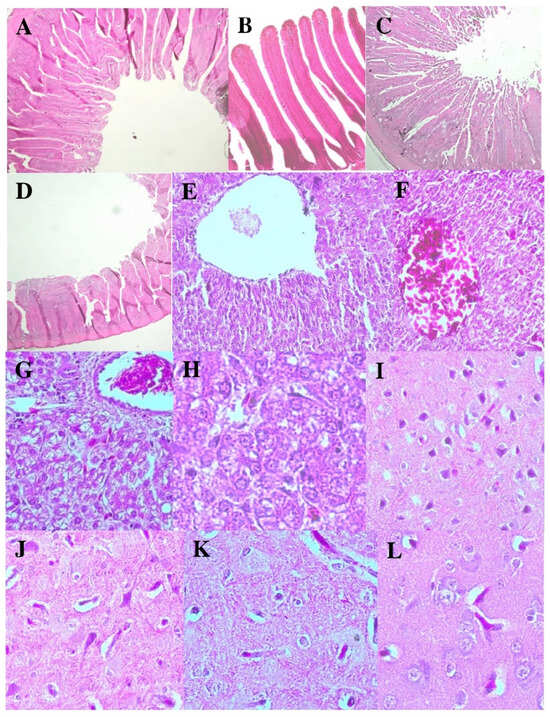
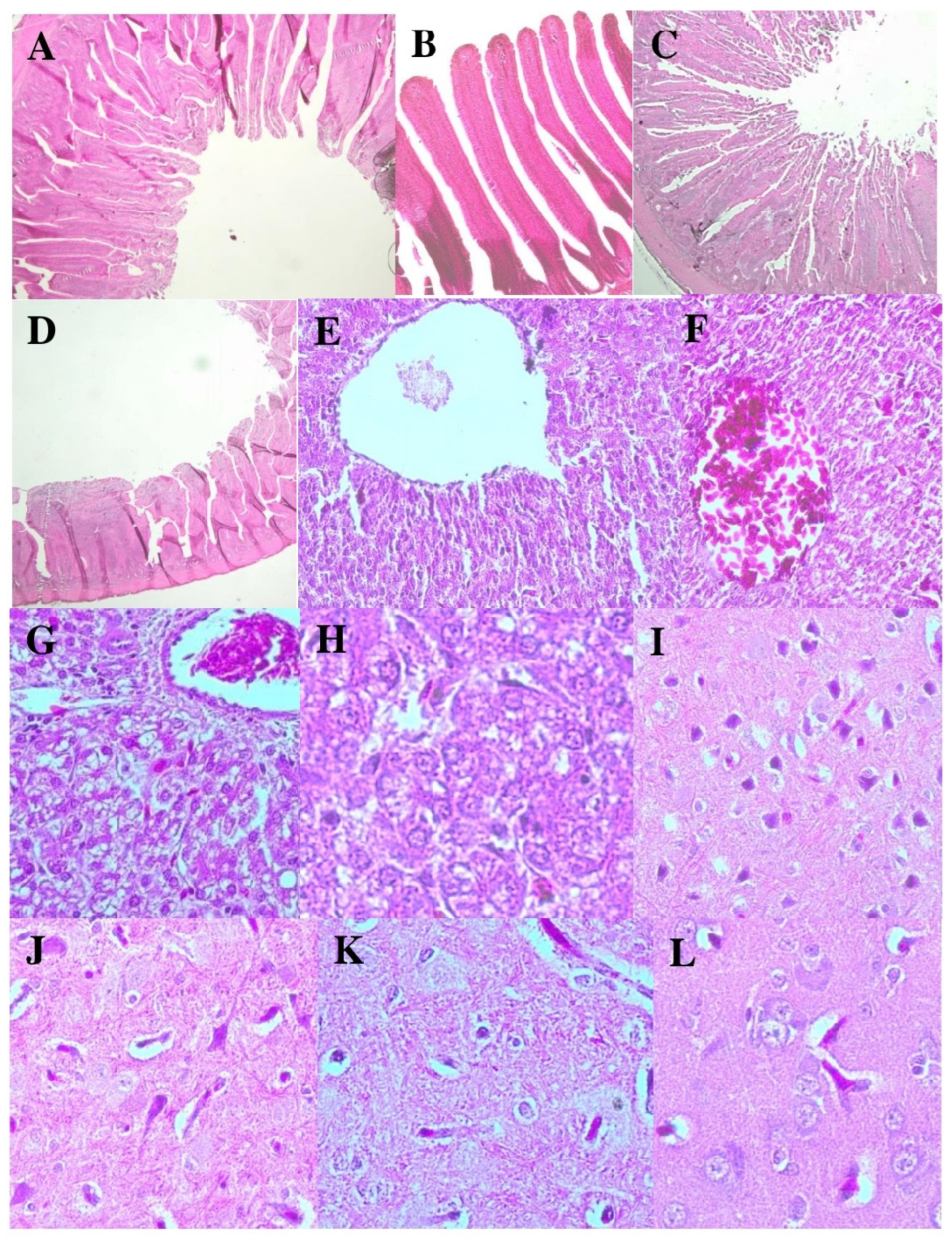
Histomorphometric analysis showed that neither HS nor NAC supplementation significantly affected jejunal villus height, crypt depth, or the villus-to-crypt ratio (Table 6). A numerical increase in villus height was observed in the HS + NAC group compared with the other treatments, although this did not reach statistical significance (p = 0.077). In contrast, histopathological assessment revealed treatment-related tissue alterations, with representative features shown in Figure 1. HS significantly increased the frequency of disrupted hepatic cord organisation and nuclear pyknosis in the liver (p < 0.05), as well as vacuolisation–necrocytosis in the cerebrum (p < 0.001). Birds receiving NAC showed a higher incidence of foamy hepatocellular vacuolation in the liver and villus fusion in the mid-jejunum compared with thermoneutral controls (p < 0.05). Accordingly, total histopathology scores were higher in both HS and HS + NAC groups than in the TN group (p < 0.05).
Table 6.
Effect of heat stress and N-acetyl-L-cysteine feed supplementation on histopathology scores in the liver, mid-jejunum, and cerebrum and on mid-jejunal histomorphology of male broilers on day 35.
Figure 1.
Representative histopathological features used for scoring in the mid-jejunum, liver, and cerebrum. (A,B): normal mid-jejunal villi and lumen; (C): epithelial cells in the mid-jejunal lumen; (D): shortened mid-jejunal villi with villus fusion; (E): normal hepatic cord arrangement; (F): congested central vein; (G): foamy hepatocellular vacuolation; (H): nuclear degenerative changes in hepatocytes; (I): normal neuronal morphology; (J): abnormal neuronal morphology; (K): neuronal vacuolisation and necrocytosis; (L): degenerated neuronal nucleus.
3.4. Short-Chain Fatty Acids and Microbiome in Caeca
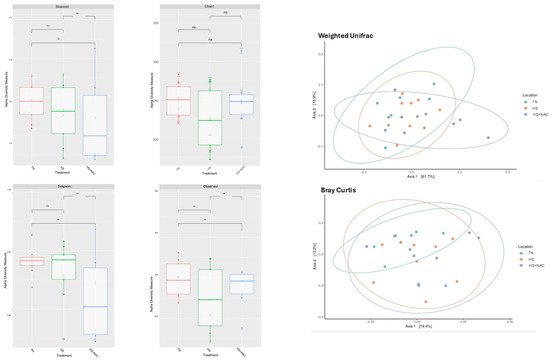
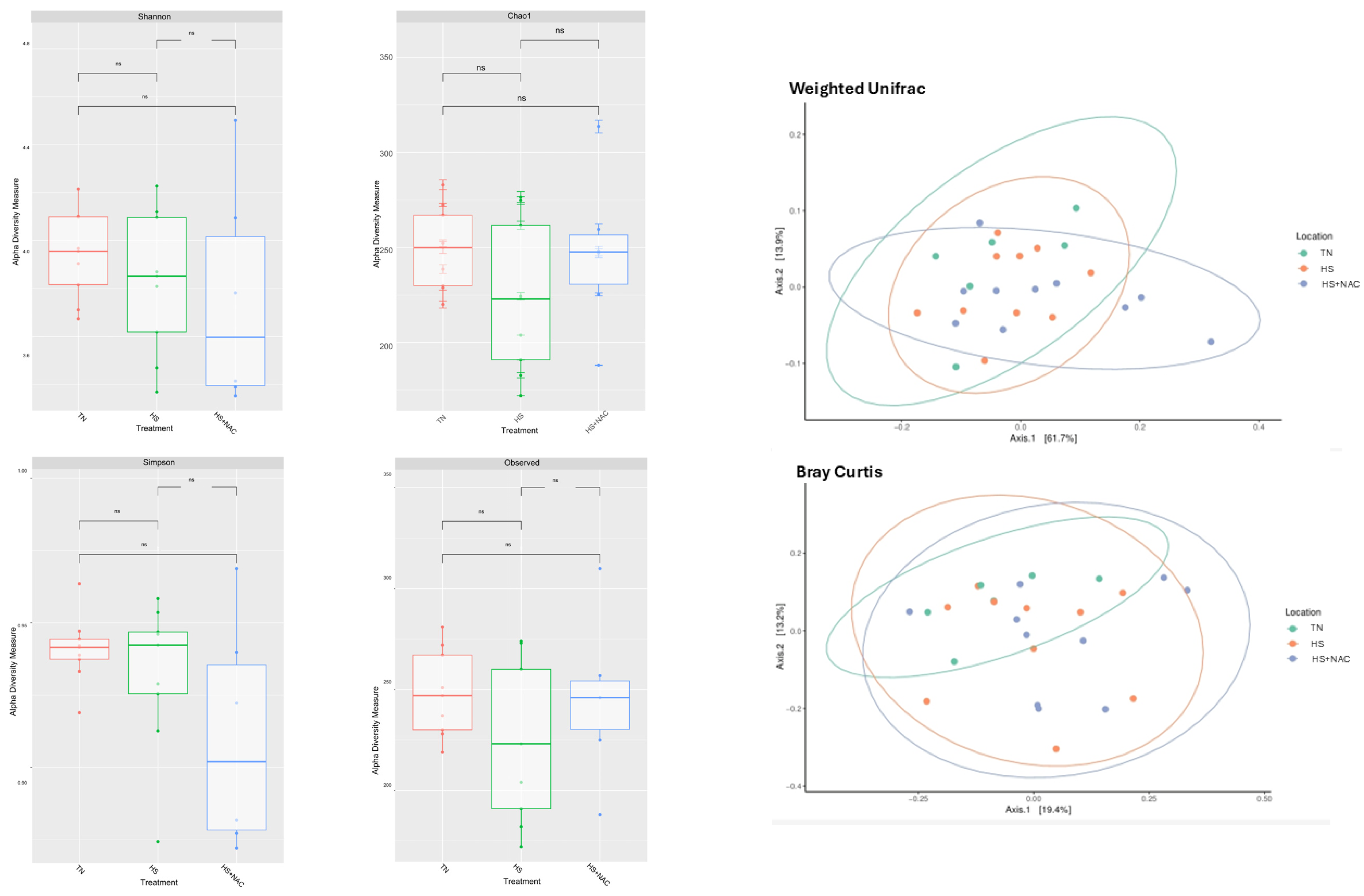
The HS group showed higher caecal propionate concentrations than the TN group (p < 0.05; Table 7), indicating altered microbial fermentation under heat stress. To examine whether these functional changes were associated with shifts in microbial community structure, caecal microbiota were analysed using 16S rRNA amplicon sequencing, yielding 1066 high-quality ASVs predominantly assigned to Firmicutes and Bacteroidota. Genus-level α-diversity indices, including Chao1, Shannon, and Simpson, did not differ among TN, HS, and HS + NAC groups (Figure 2), indicating preserved microbial richness and evenness. In contrast, β-diversity analyses indicated differences in caecal microbial community structure according to PERMANOVA (Figure 2). At the genus level, relative abundance profiles suggested a higher abundance of Bilophila spp. in HS birds. However, this is considered to be a descriptive microbial pattern rather than a specific biomarker from treatment because it was not confirmed after multiple testing correction.
Table 7.
Effect of heat stress and N-acetyl-L-cysteine feed supplementation on caecal short-chain fatty acid concentrations of male broilers on day 35.
Figure 2.
Caecal microbiota α-diversity and β-diversity across treatments. Alpha-diversity was evaluated using Shannon, Chao1, Simpson, and observed ASV indices. Beta-diversity was visualised using weighted UniFrac and Bray–Curtis principal coordinate analysis. Alpha-diversity did not differ among groups, whereas beta-diversity plots indicated differences in caecal community structure. ns, not significant.
3.5. Oxidative Status and Gene Expression in the Liver, Mid-Jejunal Mucosa, and Cerebrum
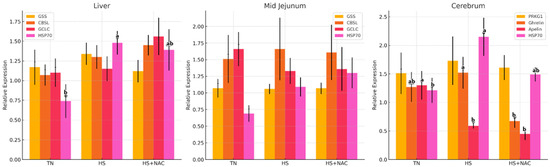
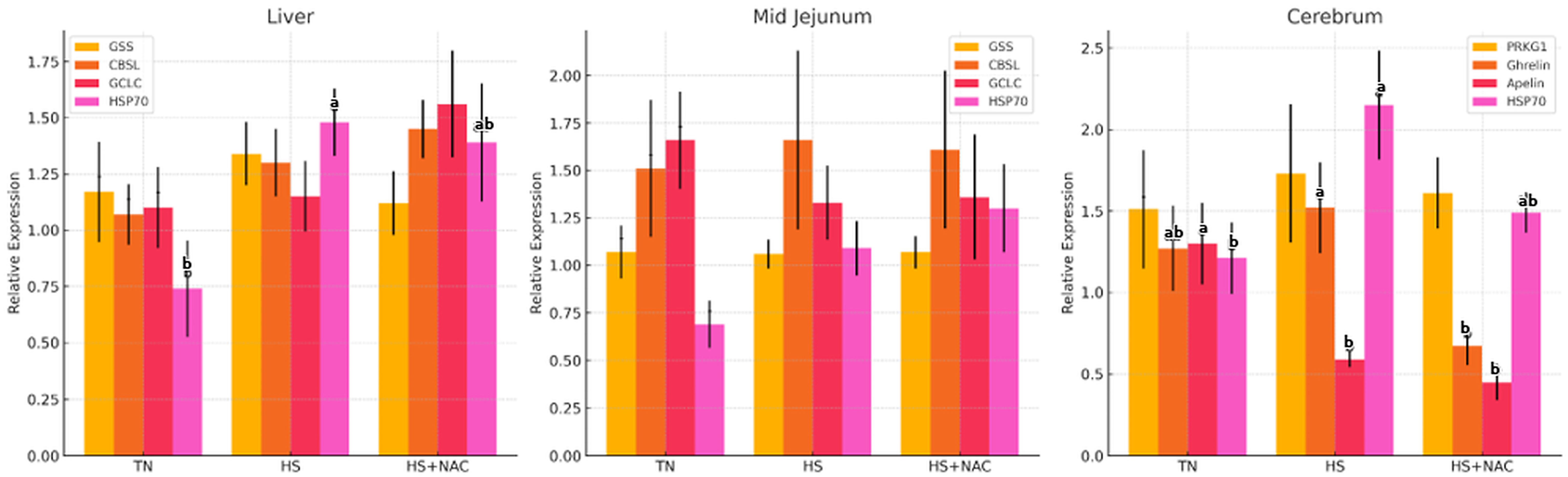
No significant differences in oxidative status were observed among treatments in the liver, mid-jejunal mucosa, or cerebrum, as indicated by comparable MDA concentrations and GPx and SOD activities (p > 0.05; Table 8). HS significantly increased HSP70 mRNA expression in the liver and cerebrum (p < 0.05) and tended to increase HSP70 expression in the mid-jejunal mucosa (p = 0.089; Figure 3). NAC supplementation did not modify HSP70 expression compared with either TN or HS birds. The expression of glutathione-related genes, including GSS, CBSL, and GCLC, in the liver and mid-jejunal mucosa was not affected by treatment. In the cerebrum, HS significantly downregulated apelin mRNA expression (p < 0.05), whereas NAC supplementation selectively downregulated ghrelin mRNA without affecting apelin expression. Since the sample tissue was not dissected from the hypothalamus as a central appetite regulator, these findings are not direct evidence of hypothalamic appetite regulatory mechanisms. On the other hand, PRKG1 mRNA levels were not influenced by HS or NAC.
Table 8.
Effect of heat stress and N-acetyl-L-cysteine feed supplementation on oxidative status in selected tissues of male broilers on day 35.
Figure 3.
Relative mRNA expression of glutathione-related genes (GSS, GCLC, and CBSL) and HSP70 in the liver and mid-jejunal mucosa, and PRKG1, ghrelin, apelin, and HSP70 in the cerebrum of male broilers on day 35. Expression was normalised to ACTB and GAPDH and calculated using the 2^−ΔΔCt method, with the thermoneutral group set as the calibrator. Bars represent means ± SEM. Different letters indicate p < 0.05. Abbreviations: GSS, glutathione synthetase; GCLC, glutamate-cysteine ligase catalytic subunit; CBSL, cystathionine beta-synthase-like; HSP70, heat shock protein 70; PRKG1, protein kinase cGMP-dependent 1; ACTB, beta-actin; GAPDH, glyceraldehyde-3-phosphate dehydrogenase.
4. Discussion
4.1. Thermoregulatory, Activity Patterns, and Growth Responses to Chronic Cyclic Heat Stress
The marked increases in rectal temperature, respiratory rate, drinking behaviour, and gasping confirmed that the cyclic HS model imposed a substantial thermal challenge. These responses are consistent with well-established thermoregulatory adaptations in broilers, which rely mainly on respiratory evaporative heat loss because of feather coverage and the absence of sweat glands [18]. Gasping reflects intensified panting and facilitates carbon dioxide elimination, but prolonged panting may predispose birds to respiratory alkalosis and related electrolyte disturbances [19,20].
Activity patterns were also affected by HS, with higher drinking and gasping frequencies and a tendency toward increased walking activity. Increased locomotor activity under HS may reflect agitation, competition for access to water, or altered comfort-seeking behaviour during thermal challenge. However, behavioural data should be interpreted cautiously because recordings were not performed simultaneously across all pens. Observation timing within the HS episode may have influenced activity levels, which probably contributes to differences between the present results and those reported by Calefi et al. [3]. Therefore, these behavioural outcomes are considered supportive indicators of the thermal response rather than definitive welfare or activity endpoints.
Chronic cyclic HS reduced average daily gain and final body weight, confirming the expected negative effect of thermal stress on growth. Average daily feed intake was also lower, particularly in the HS + NAC group, whereas feed conversion ratio was not significantly affected. This indicates that growth depression was mainly associated with reduced feed intake rather than a clear deterioration in feed efficiency. The lower ADFI was observed in both the HS and HS + NAC birds, and thus should be interpreted as HS-related feeding suppression. This effect is therefore likely not attributed to a specific appetite regulatory mechanism according to the cerebral ghrelin expression, but could potentially be linked to the reduction in cerebral apelin expression, as compared to the TN group. Also, the response differs from studies reporting an increased feed conversion ratio under HS [7], probably because heat-load severity, exposure duration, bird age, diet composition, and recovery temperature differ among models. In the present study, the recovery temperature remained relatively high at 26 °C, which likely maintained a considerable cumulative heat load, although the cyclic pattern may still have allowed partial metabolic recovery compared with continuous severe HS.
4.2. Tissue Integrity and Oxidative Status Under Chronic Cyclic Heat Stress
The histological findings indicate that chronic cyclic HS affected tissue integrity, although conventional jejunal histomorphometric indices were largely preserved. Villus height, crypt depth, and villus-to-crypt ratio did not differ significantly among treatments, whereas histopathological scoring revealed treatment-related alterations in the liver, mid-jejunum, and right cerebrum. This distinction is important because villus morphometry may not capture focal or qualitative epithelial alterations, particularly when lesions are mild, patchy, or not primarily expressed as villus shortening. Similar discrepancies between histomorphometry and tissue-level damage have been reported in HS broilers [21].
The liver showed increased disruption of hepatic cord organisation under HS, while NAC-supplemented birds showed higher scores for foamy hepatocellular vacuolation than thermoneutral controls. The liver is highly responsive to HS because of its central role in nutrient metabolism, detoxification, lipid handling, and redox regulation. Hepatic structural changes under HS are consistent with reports linking thermal stress to hepatic metabolic strain, endoplasmic reticulum stress, steatosis-like changes, and apoptosis-related pathways [22,23]. However, the present study did not include liver function markers, lipid quantification, or apoptosis assays. Therefore, these histological findings should be interpreted as morphological tissue alterations rather than direct evidence of impaired hepatic function.
In the right cerebrum, HS increased vacuolisation and necrocytosis and upregulated HSP70 expression. These findings suggest cerebral cellular stress during chronic cyclic HS. Heat shock proteins act as molecular chaperones and are induced when cells face protein damage or proteotoxic stress [24]. The concurrent presence of higher HSP70 expression and histological alterations suggests that cerebral tissue responded to the repeated thermal challenge, even though MDA concentration and antioxidant enzyme activities in the cerebrum were not significantly altered. This discrepancy indicates that bulk oxidative status marker measured at a single sampling point may not fully reflect tissue stress.
Across the liver, mid-jejunal mucosa, and right cerebrum, MDA, GPx, and SOD were not significantly modified by treatment. This contrasts with many poultry HS studies, including our previous works [6,8], reporting increased lipid peroxidation or altered antioxidant enzyme activity [23], but such responses are strongly influenced by HS intensity, exposure duration, recovery temperature, tissue type, sampling time, and adaptation to cyclic exposure. Because samples were collected at d35, a transient oxidative response may have been missed. In the present model, HSP70 and histopathological endpoints appeared more responsive than the measured oxidative status markers.
4.3. Tissue Gene-Expression Responses
Under chronic cyclic HS conditions, HSP70 expression increased in the liver and right cerebrum, and tended to increase HSP70 expression in mid-jejunal mucosa. This pattern supports the presence of tissue-level cellular stress in response to HS. In contrast, the measured glutathione-related genes, including GSS, GCLC, and CBSL, were not significantly affected in liver or mid-jejunal mucosa. This may explain why NAC did not translate into measurable improvement in tissue oxidative status or performance under the present conditions. It also suggests that cysteine supply through NAC was not the primary limiting factor for the measured antioxidant responses in this HS model.
Apelin mRNA expression was reduced in the right cerebrum during HS, while NAC supplementation decreased right-cerebral ghrelin mRNA expression as compared to the TN group. Apelin and ghrelin are involved in energy balance and appetite-related signalling, but interpretation in the present study requires caution. The sampled tissue was the right cerebrum and was not dissected into hypothalamic or other discrete appetite-regulatory nuclei. Therefore, these data should not be conceived as a direct evidence of hypothalamic regulation of feed intake. Moreover, ghrelin and apelin signalling in chickens is generally considered anorexigenic [25], meaning that the direction of association between lower expression and decreased feed intake in the HS groups is not the expected association.
4.4. Caecal Fermentation and Microbiota Responses
Chronic cyclic HS increased caecal propionate concentration, indicating a shift in hindgut fermentation. Reduced feed intake under HS may have contributed to altered substrate flow to the caeca, thereby modifying microbial fermentation. In addition, HS may affect intestinal motility, digesta retention time, epithelial function, and host–microbe interactions, all of which can influence short-chain fatty acid profiles [26,27]. The increase in propionate should therefore be interpreted as part of the intestinal and microbial response to HS rather than as evidence of a specific signalling pathway.
Microbiota analysis indicated treatment-related differences in β-diversity without corresponding changes in α-diversity. This suggests that HS altered caecal community structure without markedly changing overall richness or evenness. Relative abundance profiles suggested a higher abundance of Bilophila spp. in HS birds. Because differential abundance was not confirmed after multiple-testing correction, this finding should be interpreted as a descriptive microbial pattern rather than a treatment-specific biomarker. Bilophila is associated with bile acid metabolism and can use taurine-conjugated bile acids, producing hydrogen sulfide as a metabolic end product. Hydrogen sulfide can impair epithelial integrity and promote inflammatory responses under certain conditions [28,29]. However, the present study did not measure bile acids, hydrogen sulfide, inflammatory cytokines, or epithelial barrier function in the caeca. Thus, Bilophila was interpreted as an HS-associated microbial signal, not as a demonstrated cause of intestinal, hepatic, or cerebral alterations.
NAC supplementation did not measurably modify caecal short-chain fatty acid profiles or microbial community structure. This may be biologically plausible because NAC is a soluble thiol compound that is expected to be absorbed and deacetylated mainly in the proximal gastrointestinal tract, limiting its direct availability in the caeca [30]. Under the present model, the dominant drivers of the caecal microbial phenotype were more likely the HS challenge itself, the associated reduction in feed intake, and broader changes in intestinal function. Although NAC-associated microbiota changes have been reported in pigs [31], such effects cannot be generalised across species, diets, doses, routes of administration, baseline microbiota, and challenge models.
4.5. Limited Efficacy of Dietary N-Acetyl-L-Cysteine Under Chronic Cyclic Heat Stress
Based on previous reports that NAC can support glutathione-dependent antioxidant defence and improve stress adaptation in broilers under certain conditions [5,6,32], we expected NAC to attenuate HS-related impairments. This was not observed. Dietary NAC at 2000 mg/kg did not improve growth performance, thermoregulatory responses, oxidative status, caecal fermentation, microbial community structure, or HS-induced HSP70 expression. These results indicate limited protective efficacy of NAC under the present chronic cyclic HS model.
A likely explanation is that the cumulative heat load in this experiment was high. Although the peak HS temperature was comparable with previous work from our group, the recovery temperature remained at 26 °C rather than returning to thermoneutral conditions. This probably reduced the opportunity for physiological recovery between heat episodes. Consistent with this, heat-stressed birds showed sustained hyperthermia and high respiratory rates across the measurement days. Such persistent thermal strain may have exceeded the capacity of NAC to produce measurable performance or tissue-level benefits.
Differences in bird age, exposure window, diet form, basal dietary sulfur amino acid supply, and supplementation route may also contribute to discrepancies among NAC studies. In previous work, NAC responses differed depending on whether supplementation was provided in feed or drinking water and on the HS model applied [6,8]. The present study used a pelleted commercial-type diet and a single NAC inclusion level. Although the diet was formulated to meet sulfur amino acid requirements, the interaction between NAC, basal methionine and cysteine supply, feed intake depression, and tissue demand for sulfur-containing compounds may differ across experimental settings.
The lower feed intake observed in NAC-supplemented birds should be interpreted cautiously. It cannot be attributed directly to right-cerebral ghrelin expression, because the sampled tissue was not hypothalamus and because avian ghrelin physiology differs from that of mammals. Palatability may also have contributed, as cysteine-related compounds can impart bitter or sulfur-like sensory characteristics [33,34]. However, this cannot be separated from the dominant heat-driven reduction in feeding motivation. Therefore, the present data support a limited NAC effect under this HS model but do not establish the mechanism underlying the lower feed intake in the HS + NAC group.
The higher histological scores for jejunal villus fusion and hepatocellular vacuolation in NAC-supplemented birds also require cautious interpretation. These findings suggest altered tissue morphology but do not by themselves demonstrate impaired organ function, toxicity, or reduced welfare. NAC has complex redox and thiol-related biological activity, and its effects may depend on dose, duration, tissue redox state, sulfur amino acid metabolism, and challenge severity [35]. Under the present chronic cyclic HS conditions, NAC at 2000 mg/kg feed did not improve performance, thermoregulatory responses, oxidative status, or microbial outcomes. These findings indicate that the response to NAC may be limited under conditions of sustained thermal load. Here, differences in the HS protocol, and particularly the temperature and duration of the HS phase and recovery during cooler night episodes (i.e., 26 °C in the current experiment) likely can explain differences in responses between experiments.
4.6. Limitations
Several limitations should be considered when interpreting the present findings. First, the study measured intestinal, microbial, hepatic, and right-cerebral endpoints in parallel but did not include direct markers of gut–brain communication, such as circulating short-chain fatty acids, bile acids, inflammatory cytokines, corticosterone, vagal activity, or brain metabolite concentrations. Therefore, the data cannot establish functional gut–brain communication. Second, cerebral gene expression was measured in right cerebral tissue rather than in discrete hypothalamic nuclei, limiting interpretation of appetite-regulatory pathways. Third, caecal short-chain fatty acids and microbiota were measured only at d 35, limiting the ability to infer temporal relationships between HS exposure, microbial shifts, tissue alterations, and cerebral gene-expression responses. Fourth, the number of pens was unbalanced among treatments because of logistical constraints in the climate-controlled facility. Fifth, histopathological lesions were scored using a binary system, and inter-observer agreement was not formally quantified; therefore, these scores should be interpreted as semi-quantitative indicators of tissue alteration. Finally, behavioural observations were exploratory because recordings were not conducted simultaneously across all pens.
5. Conclusions
Chronic cyclic HS induced a multi-system stress phenotype in broilers, characterised by impaired growth, altered activity pattern, hepatic and right-cerebral histological alterations, increased caecal propionate concentration, shifts in caecal microbial community structure, and changes in selected right-cerebral gene-expression markers. Dietary supplementation with 2000 mg/kg N-acetyl-L-cysteine did not provide measurable protection against the main HS responses under the present conditions. NAC selectively reduced cerebral ghrelin mRNA expression, whereas apelin expression was affected by HS itself. Because feed intake differences were associated with HS rather than NAC treatment, apelin may be more closely related to feed intake regulation during HS. However, this interpretation remains tentative and should be confirmed in hypothalamic tissue.
Author Contributions
Conceptualization, H.P., H.Z. and J.M.; methodology, H.P., H.Z., M.M., J.D. and J.M.; formal analysis, H.P., H.Z. and J.D.; investigation, H.P., H.Z., M.M., J.D. and J.M.; data curation, H.P., H.Z. and J.D.; writing—original draft preparation, H.P., H.Z. and J.D.; writing—review and editing, M.M., J.M. and J.D.; supervision, J.M. and J.D.; project administration, H.P. and J.D.; funding acquisition, H.P. and J.M. All authors have read and agreed to the published version of the manuscript.
Funding
This research was supported by Ghent University, Belgium, through the BOF Special Research Fund, and by Airlangga University, Indonesia, grant number 1491/UN3.5/KP/2020.
Institutional Review Board Statement
The animal study protocol was approved by the Ethics Committee of the Faculty of Veterinary Medicine, Ghent University, Belgium, under approval number 2022-044, approved on 12 September 2022.
Informed Consent Statement
Not applicable.
Data Availability Statement
The original contributions presented in this study are included in the article. Further inquiries can be directed to the corresponding author.
Acknowledgments
The authors thank Els Vossen, Anneke Ovyn, and Sabine Coolsaet for their excellent technical support.
Conflicts of Interest
The authors declare no conflicts of interest.
References
- Akbarian, A. Alleviating Some Physiological Responses to High Ambient Temperatures in Finishing Broilers by Dietary Plant Extracts Rich in Phenolic Compounds. Ph.D. Thesis, Ghent University, Ghent, Belgium, 2014. [Google Scholar]
- Nanto-Hara, F.; Kikusato, M.; Ohwada, S.; Toyomizu, M. Heat Stress Directly Affects Intestinal Integrity in Broiler Chickens. J. Poult. Sci. 2020, 57, 284–290. [Google Scholar] [CrossRef] [Scilit] [PubMed]
- Calefi, A.S.; Da Silva Fonseca, J.G.; Cohn, D.W.H.; Honda, B.T.B.; Costola-De-Souza, C.; Tsugiyama, L.E.; Quinteiro-Filho, W.M.; Piantino Ferreira, A.J.; Palermo-Neto, J. The Gut-Brain Axis Interactions during Heat Stress and Avian Necrotic Enteritis. Poult. Sci. 2016, 95, 1005–1114. [Google Scholar] [CrossRef] [Scilit] [PubMed]
- Scanes, C.G. Biology of Stress in Poultry with Emphasis on Glucocorticoids and the Heterophil to Lymphocyte Ratio. Poult. Sci. 2016, 95, 2208–2215. [Google Scholar] [CrossRef] [Scilit] [PubMed]
- Yi, D.; Hou, Y.; Tan, L.; Liao, M.; Xie, J.; Wang, L.; Ding, B.; Yang, Y.; Gong, J. N-Acetylcysteine Improves the Growth Performance and Intestinal Function in the Heat-Stressed Broilers. Anim. Feed Sci. Technol. 2016, 220, 83–92. [Google Scholar] [CrossRef] [Scilit]
- Pertiwi, H.; Majdeddin, M.; Degroote, J.; Zhang, H.; Michiels, J. N-Acetyl-L-Cysteine Improves the Performance of Chronic Cyclic Heat-Stressed Finisher Broilers but Has No Effect on Tissue Glutathione Levels. Br. Poult. Sci. 2023, 64, 751–762. [Google Scholar] [CrossRef] [Scilit] [PubMed]
- Zhang, H.; Majdeddin, M.; Degroote, J.; Van Liefferinge, E.; Van Noten, N.; Van Kerschaver, C.; Vandaele, M.; Cesar De Paula Dorigam, J.; Michiels, J. Effect of Supplemental Methyl Sulfonyl Methane on Performance, Carcass and Meat Quality and Oxidative Status in Chronic Cyclic Heat-Stressed Finishing Broilers. Poult. Sci. 2023, 102, 102321. [Google Scholar] [CrossRef] [Scilit] [PubMed]
- Pertiwi, H.; Zhang, H.; Majdeddin, M.; Degroote, J.; Michiels, J. Effect of N-Acetyl-L-Cysteine Administration in Drinking Water of Broilers Exposed to Heat Stress on Performances, Intestinal Integrity, and Oxidative Status. Ital. J. Anim. Sci. 2024, 23, 824–832. [Google Scholar] [CrossRef] [Scilit]
- Majdeddin, M.; Braun, U.; Lemme, A.; Golian, A.; Kermanshahi, H.; De Smet, S.; Michiels, J. Guanidinoacetic Acid Supplementation Improves Feed Conversion in Broilers Subjected to Heat Stress Associated with Muscle Creatine Loading and Arginine Sparing. Poult. Sci. 2020, 99, 4442–4453. [Google Scholar] [CrossRef] [Scilit] [PubMed]
- Van Nevel, C.J.; Decuypere, J.A.; Dierick, N.; Molly, K. The Influence of Lentinus edodes (Shiitake Mushroom) Preparations on Bacteriological and Morphological Aspects of the Small Intestine in Piglets 1. Arch. Anim. Nutr. 2003, 57, 399–412. [Google Scholar] [CrossRef] [Scilit]
- Landmann, M.; Scheibner, D.; Graaf, A.; Gischke, M.; Koethe, S.; Fatola, O.I.; Raddatz, B.; Mettenleiter, T.C.; Beer, M.; Grund, C.; et al. A Semiquantitative Scoring System for Histopathological and Immunohistochemical Assessment of Lesions and Tissue Tropism in Avian Influenza. Viruses 2021, 13, 868. [Google Scholar] [CrossRef] [Scilit] [PubMed]
- Elsayed, A.; Elkomy, A.; Elkammar, R.; Youssef, G.; Abdelhiee, E.Y.; Abdo, W.; Fadl, S.E.; Soliman, A.; Aboubakr, M. Synergistic Protective Effects of Lycopene and N-Acetylcysteine against Cisplatin-Induced Hepatorenal Toxicity in Rats. Sci. Rep. 2021, 11, 13979. [Google Scholar] [CrossRef] [Scilit] [PubMed]
- Al-Garadi, M.A.; Al-Baadani, H.H.; Alqhtani, A.H. Growth Performance, Histological Changes and Functional Tests of Broiler Chickens Fed Diets Supplemented with Tribulus Terrestris Powder. Animals 2022, 12, 1930. [Google Scholar] [CrossRef] [Scilit] [PubMed]
- Castro-Montoya, J.; De Campeneere, S.; Van Ranst, G.; Fievez, V. Interactions between Methane Mitigation Additives and Basal Substrates on in Vitro Methane and VFA Production. Anim. Feed Sci. Technol. 2012, 176, 47–60. [Google Scholar] [CrossRef] [Scilit]
- Grotto, D.; Santa Maria, L.D.; Boeira, S.; Valentini, J.; Charão, M.F.; Moro, A.M.; Nascimento, P.C.; Pomblum, V.J.; Garcia, S.C. Rapid Quantification of Malondialdehyde in Plasma by High Performance Liquid Chromatography–Visible Detection. J. Pharm. Biomed. Anal. 2007, 43, 619–624. [Google Scholar] [CrossRef] [Scilit] [PubMed]
- Marklund, S.; Marklund, G. Involvement of the Superoxide Anion Radical in the Autoxidation of Pyrogallol and a Convenient Assay for Superoxide Dismutase. Eur. J. Biochem. 1974, 47, 469–474. [Google Scholar] [CrossRef] [Scilit] [PubMed]
- Hernández, P.; Zomeño, L.; Ariño, B.; Blasco, A. Antioxidant, Lipolytic and Proteolytic Enzyme Activities in Pork Meat from Different Genotypes. Meat Sci. 2004, 66, 525–529. [Google Scholar] [CrossRef] [Scilit] [PubMed]
- Kim, H.R.; Seong, P.; Seol, K.-H.; Park, J.-E.; Kim, H.; Park, W.; Cho, J.H.; Lee, S.D. Effects of Heat Stress on Growth Performance, Physiological Responses, and Carcass Traits in Broilers. J. Therm. Biol. 2025, 127, 103994. [Google Scholar] [CrossRef] [Scilit] [PubMed]
- Beckford, R.C.; Ellestad, L.E.; Proszkowiec-Weglarz, M.; Farley, L.; Brady, K.; Angel, R.; Liu, H.C.; Porter, T.E. Effects of Heat Stress on Performance, Blood Chemistry, and Hypothalamic and Pituitary mRNA Expression in Broiler Chickens. Poult. Sci. 2020, 99, 6317–6325. [Google Scholar] [CrossRef] [Scilit] [PubMed]
- Livingston, M.L.; Pokoo-Aikins, A.; Frost, T.; Laprade, L.; Hoang, V.; Nogal, B.; Phillips, C.; Cowieson, A.J. Effect of Heat Stress, Dietary Electrolytes, and Vitamins E and C on Growth Performance and Blood Biochemistry of the Broiler Chicken. Front. Anim. Sci. 2022, 3, 807267. [Google Scholar] [CrossRef] [Scilit]
- Santos, R.R.; Awati, A.; Roubos-van den Hil, P.J.; Tersteeg-Zijderveld, M.H.G.; Koolmees, P.A.; Fink-Gremmels, J. Quantitative Histo-Morphometric Analysis of Heat-Stress-Related Damage in the Small Intestines of Broiler Chickens. Avian Pathol. 2015, 44, 19–22. [Google Scholar] [PubMed]
- Ma, B.; Xing, T.; Li, J.; Zhang, L.; Jiang, Y.; Gao, F. Chronic Heat Stress Causes Liver Damage via Endoplasmic Reticulum Stress-Induced Apoptosis in Broilers. Poult. Sci. 2022, 101, 102063. [Google Scholar] [CrossRef] [Scilit] [PubMed]
- Tang, L.P.; Liu, Y.L.; Zhang, J.X.; Ding, K.N.; Lu, M.H.; He, Y.M. Heat Stress in Broilers of Liver Injury Effects of Heat Stress on Oxidative Stress and Autophagy in Liver of Broilers. Poult. Sci. 2022, 101, 102085. [Google Scholar] [CrossRef] [Scilit] [PubMed]
- Leandro, N.S.M.; Gonzales, E.; Ferro, J.A.; Ferro, M.I.T.; Givisiez, P.E.N.; Macari, M. Expression of Heat Shock Protein in Broiler Embryo Tissues after Acute Cold or Heat Stress. Mol. Reprod. Dev. 2004, 67, 172–177. [Google Scholar] [PubMed]
- Mahdavi, K.; Zendehdel, M.; Zarei, H. Decoding the Role of Ghrelin and Its Interactions with Central Signaling Pathways in Avian Appetite Regulation. Vet. Res. Commun. 2025, 49, 73. [Google Scholar] [CrossRef] [Scilit] [PubMed]
- Shi, D.; Bai, L.; Qu, Q.; Zhou, S.; Yang, M.; Guo, S.; Li, Q.; Liu, C. Impact of Gut Microbiota Structure in Heat-Stressed Broilers. Poult. Sci. 2019, 98, 2405–2413. [Google Scholar] [CrossRef] [Scilit] [PubMed]
- Xing, S.; Wang, X.; Diao, H.; Zhang, M.; Zhou, Y.; Feng, J. Changes in the Cecal Microbiota of Laying Hens during Heat Stress Is Mainly Associated with Reduced Feed Intake. Poult. Sci. 2019, 98, 5257–5364. [Google Scholar] [CrossRef] [Scilit] [PubMed]
- Zheng, S.; Jin, X.; Chen, M.; Shi, Q.; Zhang, H.; Xu, S. Hydrogen Sulfide Exposure Induces Jejunum Injury via CYP450s/ROS Pathway in Broilers. Chemosphere 2019, 214, 25–34. [Google Scholar] [CrossRef] [Scilit] [PubMed]
- Devkota, S.; Wang, Y.; Musch, M.W.; Leone, V.; Fehlner-Peach, H.; Nadimpalli, A.; Antonopoulos, D.A.; Jabri, B.; Chang, E.B. Dietary-Fat-Induced Taurocholic Acid Promotes Pathobiont Expansion and Colitis in Il10−/− Mice. Nature 2012, 487, 104–108. [Google Scholar] [CrossRef] [Scilit] [PubMed]
- Petkova, T.; Milanova, A. Absorption of N-acetylcysteine in Healthy and Mycoplasma gallisepticum-Infected Chickens. Vet. Sci. 2021, 8, 244. [Google Scholar] [CrossRef] [Scilit] [PubMed]
- Xu, C.C.; Yang, S.F.; Zhu, L.H.; Cai, X.; Sheng, Y.S.; Zhu, S.W.; Xu, J.X. Regulation of N-Acetyl Cysteine on Gut Redox Status and Major Microbiota in Weaned Piglets. J. Anim. Sci. 2014, 92, 1504–1511. [Google Scholar] [CrossRef] [Scilit] [PubMed]
- He, S.; Ding, J.; Xiong, Y.; Liu, D.; Dai, S.; Hu, H. Effects of Dietary N-Acetylcysteine on Rectal Temperature, Respiratory Rate, Growth Performance and Blood Redox Parameters in 22- to 42-Day Old Broilers Exposed to Chronic Heat Stress. Eur. Poult. Sci. 2019, 83, 1–11. [Google Scholar] [CrossRef] [Scilit]
- Lee, S.; Han, K.H.; Nakamura, Y.; Kawakami, S.; Shimada, K.I.; Hayakawa, T.; Onoue, H.; Fukushima, M. Dietary L-Cysteine Improves the Antioxidative Potential and Lipid Metabolism in Rats Fed a Normal Diet. Biosci. Biotechnol. Biochem. 2013, 77, 1430–1434. [Google Scholar] [CrossRef] [Scilit] [PubMed]
- Marcinkowska, M.A.; Jeleń, H.H. Role of Sulfur Compounds in Vegetable and Mushroom Aroma. Molecules 2022, 27, 6116. [Google Scholar] [CrossRef] [Scilit] [PubMed]
- El-Barbary, A.M.; El-Sahn, A.A.; Manaa, E.A.; Khalifah, A.; Aboelnour, A.; Abdulkader, A.; Taha, A.E.; Alagawany, M.; Abdel-Latif, M.A. Effect of N-acetyl cysteine on productive performance, biochemical indicators, mRNA expression of growth, antioxidant and heat shock protein related genes and hepatic morphology in broilers under heat stress. Poult. Sci. 2026, 105, 106801. [Google Scholar] [CrossRef] [Scilit] [PubMed]

Disclaimer/Publisher’s Note: The statements, opinions and data contained in all publications are solely those of the individual author(s) and contributor(s) and not of MDPI and/or the editor(s). MDPI and/or the editor(s) disclaim responsibility for any injury to people or property resulting from any ideas, methods, instructions or products referred to in the content. |
© 2026 by the authors. Licensee MDPI, Basel, Switzerland. This article is an open access article distributed under the terms and conditions of the Creative Commons Attribution (CC BY) license.