


Abstract
Oral health is particularly important in adolescents undergoing orthodontic treatment. However, studies have shown that, in this period, behaviors that are favorable toward oral health appear to decrease. Measures such as self-prevention and self-promotion do not seem to be as effective as they should be. This study has assessed dental hygiene habits and knowledge regarding oral health using a questionnaire that was given to the participants. The sample consisted of 200 subjects aged between 10 and 24 years old. The results suggest that there is a lack of knowledge surrounding oral-self-care and prove the need to invest in oral health education.
1. Introduction
Oral health is crucial, particularly in adolescent patients because of the physical and mental transformations that happen in this phase. Therefore, the habits acquired in this phase tend to have future repercussions on the self-esteem and health behavior of the individual. However, studies have shown that, in this period, behaviors that are favorable toward oral health appear to decrease since oral health is considered to be less important from their perspective. Measures such as self-prevention and self-promotion do not seem to be as effective as they should be [1,2,3,4]. This line of study aims to identify the mental representation of a part of the body, namely, the inner oral cavity. In the present study, we seek the perception of adolescents on this topic with the mere objective of contributing to the creation of innovative oral health strategies and health instruments.
2. Materials and Methods
This study assessed the dental hygiene habits and knowledge regarding oral health using a questionnaire that was given to the participants. The sample consisted of 200 subjects aged between 10 and 24 years old in consultations at the Egas Moniz University Clinic [5]. They were first asked to draw the interior of their oral cavity before and after undergoing orthodontic treatment. Then, they were invited to answer a questionnaire concerning oral health behaviors and knowledge. Finally, the patients were given information to help them maintain and improve their self-care. The data were then analyzed using various tools; among them was a content analysis grid, created especially for this study, that was made of analytical categories and subcategories [6]. The data obtained were also analyzed using the statistical software IBM SPSS 28.
3. Results
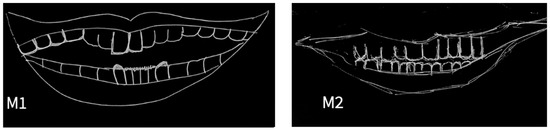
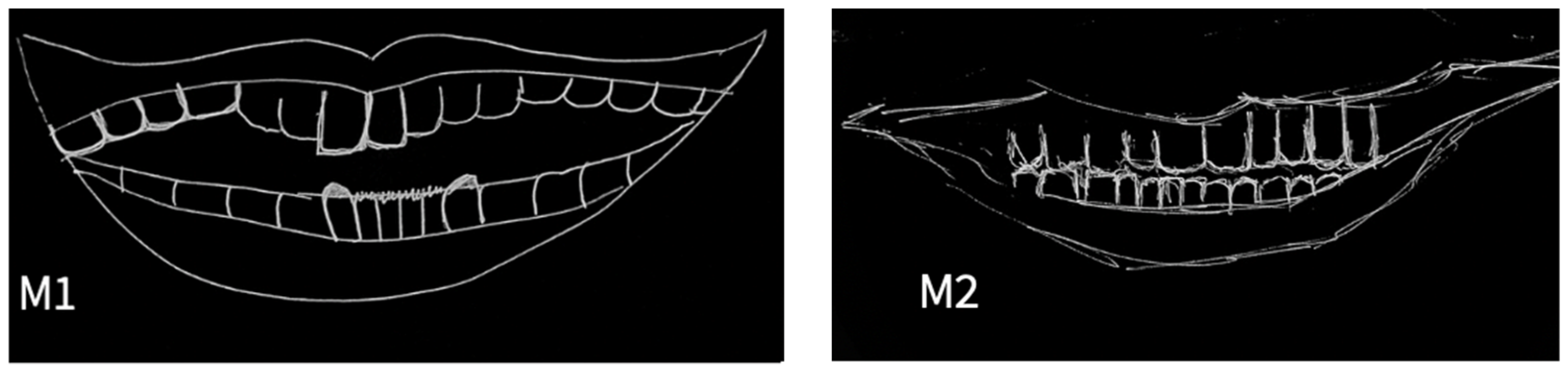
While adolescents are at risk of developing dental health problems due to their oral health habits but also their knowledge and motivation, the results showed that there is a significant lack of knowledge in adolescents, especially in terms of frequency of brushing, duration, and technique of brushing. Only 67 patients (33.5%) revealed that they brush the inside surface of the tooth, and most of the sample (62%) admitted brushing their teeth for approximately 2 min. Although 78.5% of the adolescents, through the orthodontic consultations, reported that they had access to information regarding their health, the results showed that they did not use it properly. Regarding the results obtained from the drawings, they indicate that there is a low area of knowledge surrounding the interior of the oral cavity. Although the subjects were asked to draw the interior of the oral cavity, 55.5% of drawings represented a broad smile in M1 (before) and 60.5% represented that in M2 (after the orthodontic treatment), supported by an extra-oral view.
4. Discussion
Firstly, the results showed that most of the subjects demonstrated a lack of oral health knowledge. When asked how do you brush your teeth?, most of the patients admitted brushing the occlusal and facial face, whereas 67 subjects (33.5%) stated that they brushed the lingual face. Then, when asked are you using any additional tools to clean your teeth?, 85 patients (42.5%) responded that they were not. Nevertheless, not only this, but in most cases they revealed to have already received some information about oral hygiene, and they also disclosed that they perceived this information well (Table 1 and Table 2).
Table 1.
Descriptive analysis regarding the information about oral hygiene received by the patients.
Table 2.
Descriptive analysis regarding the perception of the received information.
Furthermore, it is surprising that most of the adolescents in the study self-evaluated their oral health as being good (64%) or reasonable (25.5%) when asked.
In relation to the inner oral cavity knowledge, the patients were asked if they knew the number of teeth in their mouth. The results showed that only 26.5% were assumed to know it, and 58.5% responded incorrectly (Table 3).
Table 3.
Descriptive analysis regarding the self-perception of the number of teeth.
Secondly, concerning the results of the content analysis of the drawings obtained, the data indicate that the self-perception of the inner oral cavity was perceived as a smile by the subjects. In fact, the adolescents’ drawings represented a broad smile from an extra-oral view, which was in contradiction with what they were assigned to do—draw the interior of your oral cavity (Table 4, Figure 1).
Table 4.
Descriptive analysis regarding the view category.
Figure 1.
Drawings from a patient representing a broad smile from an extra-oral view.
5. Conclusions
To conclude, adolescents need to receive better education on oral hygiene care in order to enable self-prevention and self-promotion and hence facilitate this. Information should be given regularly as it showed efficacy in the short term and adolescents should be continually reminded of it. To this end, the shortage of knowledge proves the need to invest in oral health education.
Author Contributions
Conceptualization, M.d.R.D. and A.K.; methodology, M.d.R.D., A.K. and J.G.E.; software, A.K.; formal analysis, A.K.; investigation, A.K. and V.P.A.; data curation, A.K. writing, A.K. supervision, M.d.R.D., J.G.E., V.P.A. and A.S.D. All authors have read and agreed to the published version of the manuscript.
Funding
This research received no external funding.
Institutional Review Board Statement
The study was conducted in accordance with the Declaration of Helsinki and approved by the Ethics Committee of Egas Moniz, School of Health and Science (protocol code PT-173/22; date: 26 January 2023), for studies involving humans.
Informed Consent Statement
Informed consent was obtained from all subjects involved in the study.
Data Availability Statement
Data are available upon reasonable request from the author.
Conflicts of Interest
The authors declare no conflict of interest.
References
- Awartani, F.; Atassi, F. Oral Hygiene Status among Orthodontic Patients. J. Contemp. Dent. Pract. 2010, 11, 25–32. [Google Scholar] [CrossRef] [Scilit]
- Inquimbert, C.; Clement, C.; Couatarmanach, A.; Tramini, P.; Bourgeois, D.; Carrouel, F. Oral Hygiene Practices and Knowledge among Adolescents Aged between 15 and 17 Years Old during Fixed Orthodontic Treatment: Multicentre Study Conducted in France. Int. J. Environ. Res. Public Health 2022, 19, 2316. [Google Scholar] [CrossRef] [Scilit] [PubMed]
- Jorge, S.M. Impacto do Reforço da Motivação num Programa de Promoção de Saúde Oral. Master’s Thesis, Universidade do Porto, Porto, Portugal, 2013. [Google Scholar]
- Martignon, S.; Ekstrand, K.R.; Lemos, M.I.; Lozano, M.P.; Higuera, C. Plaque, Caries Level and Oral Hygiene Habits in Young Patients Receiving Orthodontic Treatment. Community Dent. Health 2010, 27, 133–138. [Google Scholar] [CrossRef] [Scilit] [PubMed]
- Sawyer, S.M.; Azzopardi, P.S.; Wickremarathne, D.; Patton, G.C. The Age of Adolescence. Lancet Child Adolesc. Health 2018, 2, 223–238. [Google Scholar] [CrossRef] [Scilit] [PubMed]
- Karramkan, A.; Do Rosário Dias, M.; Grillo Evangelista, J.; Dias Dos Santos, H.; Pedroso Alves, V.; Sintra Delgado, A. X-ray Vision: Representação Mental da Cavidade Oral dos Adolescentes em Tratamento Ortodôntico. In Proceedings of the III JEM Jornadas Cientificas Egas Moniz, Caparica, Portugal, 30 January–3 February 2023. [Google Scholar]

Disclaimer/Publisher’s Note: The statements, opinions and data contained in all publications are solely those of the individual author(s) and contributor(s) and not of MDPI and/or the editor(s). MDPI and/or the editor(s) disclaim responsibility for any injury to people or property resulting from any ideas, methods, instructions or products referred to in the content. |
© 2023 by the authors. Licensee MDPI, Basel, Switzerland. This article is an open access article distributed under the terms and conditions of the Creative Commons Attribution (CC BY) license (https://creativecommons.org/licenses/by/4.0/).