


Abstract
Wheat improvement is based on exploiting genetic diversity, including variation in grain composition and quality. We have exploited genetic resources, including the Watkins landrace collection, to identify genetic sources for high contents of essential minerals and dietary fiber in wholegrain and white flour. Analyses of bi-parental populations and association mapping panels have identified genetic loci for these improved nutritional traits allowing the development of molecular markers for use in conventional wheat breeding programs and the identification of candidate genes. This will allow their incorporation into elite germplasm and their stacking to deliver healthier staple foods.
1. Introduction
Wheat is the most widely consumed staple crop and delivers about 20% of all calories consumed globally [1]. Bread and other staple foods made from wheat not only provide calories in the form of starch, but are also important sources of nutrients including protein, a range of minerals and vitamins and dietary fiber (DF) [2]. Deficiencies in these nutrients, particularly minerals and DF, are recognized worldwide with symptoms often being severe and debilitating. Because wheat is so widely consumed, genetic biofortification to enhance nutritional quality could have significant impacts on improving global nutrition and health.
Genetic biofortification relies on identifying natural variation which can be exploited to develop new cultivars by conventional breeding, aided by modern breeding tools such as marker assisted and genomic selection. Modern cultivars are known to have limited genetic diversity [3] due to their development from narrow ranges of (largely related) genotypes.
Hence, wider sources of variation have been sought. These include collections of landraces (genotypes grown before modern scientific breeding), such as the A.E. Watkins collection of 827 landraces dating from the 1920s and 1930s held at the John Innes Centre [4]. In fact, whole-genome resequencing of the Watkins landraces and 208 modern cultivars showed that modern bread wheats are derived from only two of the seven ancestral groups of wheat, with the other five groups representing untapped sources of genetic variation for crop improvement.
Other sources of variation have been sought in global collections of wheat cultivars, such as the 150 cultivars which ranged from China to North America and from Russia to Southern Italy, selected for the Healthgrain project [5], older cultivars developed before modern breeding (sometimes called heritage or heirloom varieties) and ‘ancient’ wheats (einkorn, emmer and spelt).
Wheat is consumed in a range of processed foods, notably bread and other baked goods, pasta and noodles, as well as being an ingredient in a vast number of other processed foods. Although some of these are made from whole milled grain, most are made from refined white flour. This is carried out by milling the grain to separate the starchy endosperm tissue (white flour) from the outer layers and embryo. Because the outer layers and embryo are enriched with the most beneficial components (protein, DF, minerals, vitamins and phytochemicals) white flour is depleted in these components compared to whole grain. For example, the content of DF in white flour is about a third of that in whole grain [6].
However, because white flour products are more widely consumed, they still make a significant contribution to dietary intakes of nutrients. For example, white bread provides 11% of DF in the UK diet while wholemeal bread provides only 5% [7]. Consequently, white bread is an excellent vehicle to deliver health benefits.
Our aims are therefore to increase the contents of DF and minerals in the starchy endosperm of wheat and hence in white flour. If this can be combined to produce high-yielding, disease-resistant, and climate-ready wheat, it should facilitate substantial improvements to human health.
2. Genetic Biofortification: Looking Beyond Elite Varieties—Minerals
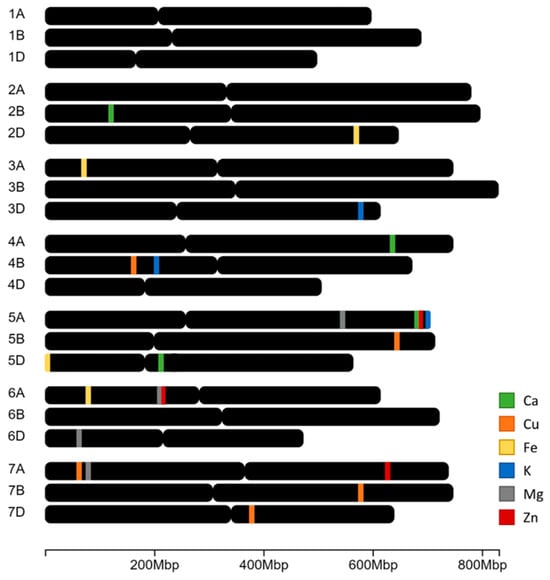
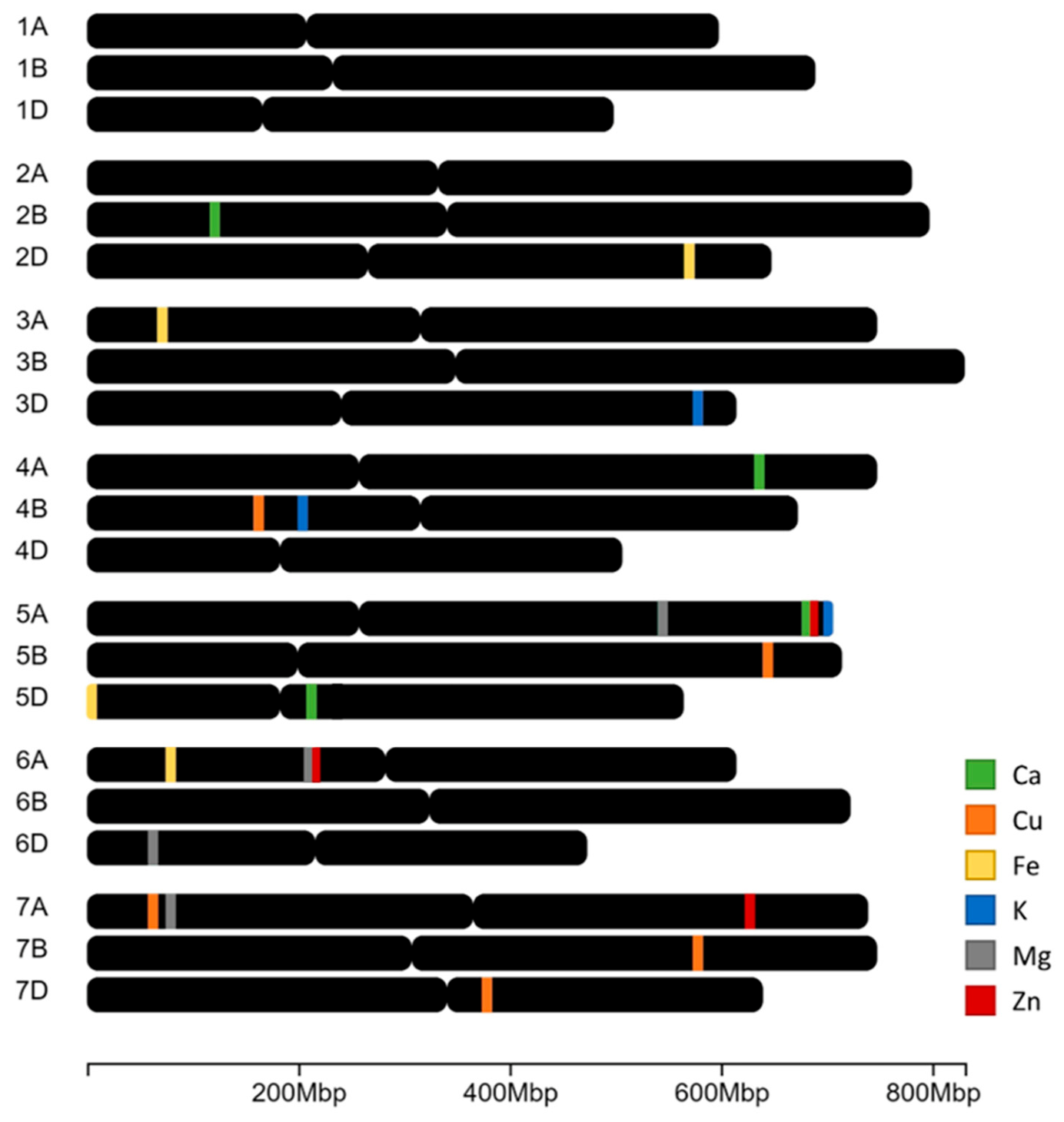
We have exploited the Watkins collection of landraces to identify variation in the contents of essential minerals. This study focused on five essential minerals, which are often deficient in human diets (Ca, Mg, Fe, Zn and K), and on Cu, which may be deficient in livestock diets, with wheat being an important dietary source in all cases. The mineral contents of Watkins landraces and modern elite lines were initially determined in wholemeal flour fractions. In many cases the landraces contained higher mineral contents than the elite varieties, even when the grain mineral content was adjusted for thousand grain weight (i.e., to take into account possible ‘yield dilution effects’). We then analyzed grain from bi-parental populations of recombinant inbred lines (RILs) made from crosses between selected landraces and the UK cultivar Paragon grown in replicated multisite field trials. This allowed us to generate a robust quantitative trait loci (QTL) atlas for grain mineral content [8] (Figure 1). Analysis of the gene contents in the regions surrounding the QTLs also identified candidate genes for several of the QTLs [8].
Figure 1.
Distribution of identified QTLs for essential mineral content in bread wheat grain. This figure illustrates the approximate locations of the QTLs across the 21 chromosomes of wheat, based on the IWGSC RefSeq v1.0. Each color annotation corresponds to a different mineral: Ca (Calcium), Cu (Copper), Fe (Iron), K (Potassium), Mg (Magnesium), and Zn (Zinc), as indicated by the legend. The scale beneath the chromosomes represents distances in Mb. (Reproduced with kind permission from [8]).
These studies were carried out on wholemeal flours which have higher contents of essential minerals (notably iron and zinc) than white flour. This is because minerals are concentrated in the aleurone layer and embryo of the grain which are removed by milling. However, the minerals in these tissues, and hence in wholemeal flour, have low bioavailability as they are largely present as insoluble salts of phytic acid (phytates). However, although the contents of total minerals are lower in white flour than in wholegrain (for example, [9] reported Fe contents of 11.9 mg/kg and 6.7 mg/kg in white flours of two wheat cultivars grown in the UK and 46.7 mg/kg and 30.3 mg/kg in the corresponding wholemeal flours), the contents of bioavailable minerals may be higher as they are not present as phytates [10]. Hence, we are currently characterizing the genetic sources of high mineral content in wholegrain to determine their contents in white flour.
3. Genetic Biofortification: Looking Beyond Elite Varieties—Arabinoxylan
Total DF accounts for about 4% of the dry weight of white flour and comprises mainly cell wall polysaccharides with smaller proportions of fructans, arabinogalactan peptide and resistant starch (Table 1). The major cell wall polysaccharide in white flour is arabinoxylan (AX), with smaller amounts of β-glucan and mannans. Other polysaccharides (xyloglucan, cellulose, callose and pectins) have been detected in purified cell wall preparations or using immunochemistry on sections of grain but are present at very low levels and have not been quantified in white flour [7]. AX accounts for about three quarters of the cell wall polysaccharides and half of total DF in white flour and has therefore been the focus of studies aimed to increase total DF in white flour.
Table 1.
Summary of the contents of dietary fiber components in white wheat flour. Taken with permission from [7] which gives full references to the data sources.
We have screened a wide range of samples for variation in the content of AX. Analysis of a global collection of 150 wheat genotypes in the Healthgrain screen [11] identified the Chinese bread wheat Yumai 34 as having the highest contents of both total (TOT)-AX and water-extractable (WE)-AX. Field trials were then carried out with a smaller number of genotypes (26) in five environments (sites and/or years). This showed that flour AX has high heritability with ratios of genetic variance to total variance of 0.597 for WE-AX and 0.716 for TOT-AX [12].
Bi-parental populations of RILs and doubled haploid (DH) lines from crosses between Yumai 34 and modern European cultivars were grown in replicated field plots in order to identify QTL for AX in white flour [13,14]. These analyses identified robust QTLs for WE-AX on chromosome 6B and TOT-AX on chromosome 1B, facilitating the identification of the candidate gene for the high WE-AX allele on chromosome 6B as encoding a defective form of a peroxidase enzyme, which reduces the level of cross-linking of AX by diferulate bridges, resulting in greater solubility [15].
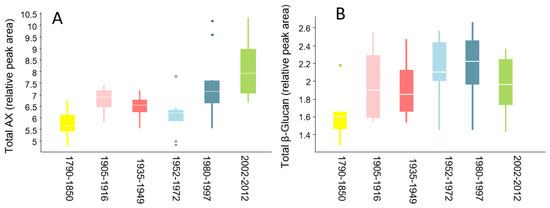
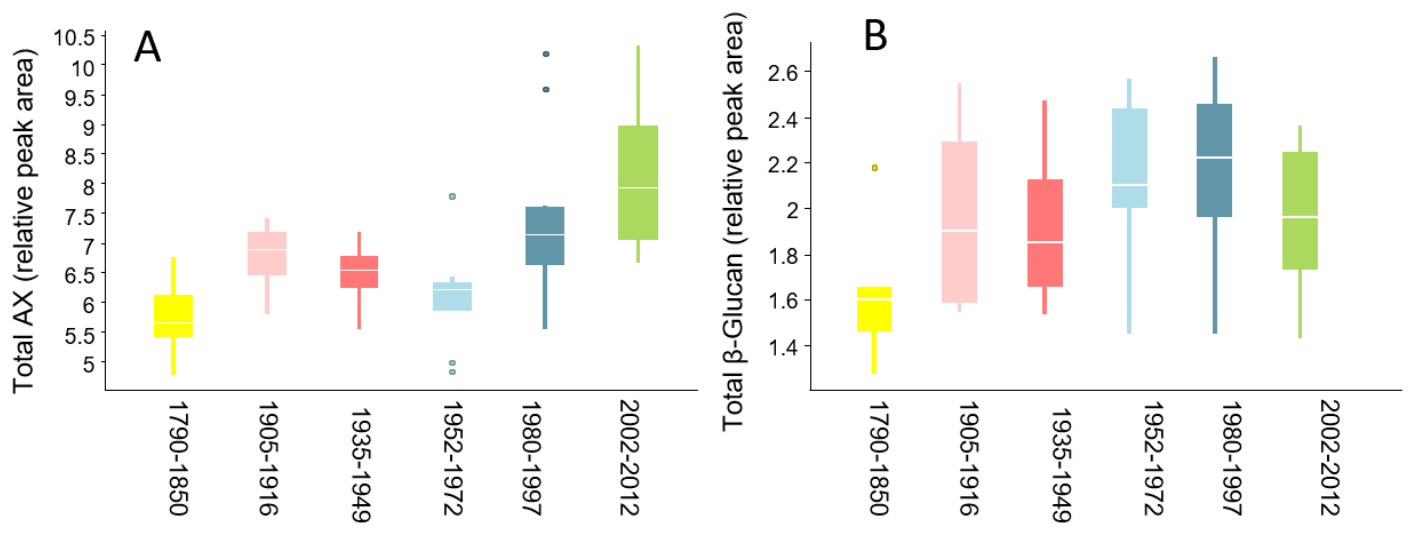
In addition to having lower diversity, it has also been suggested that modern wheats have lower contents of beneficial components than older types of wheat [16]. To determine whether conventional breeding has led to lower contents of DF in white flour, a collection of 39 ‘heritage’ wheat varieties were grown in replicated field trials for 3 years [17]. The varieties were selected because they were adapted to the UK and had been commercially successful. The contents of AX and β-glucan in white flour fractions from these samples are replotted in Figure 2, with the cultivars being divided into six groups: released between 1790 and 1850 (5 cultivars), 1905–1916 (4 cultivars), 1935–1949 (5 cultivars), 1952–1972 (8 cultivars), 1980–1997 (11 cultivars) and 2002–2012 (6 cultivars).
Figure 2.
Box and whisker plots of the contents of major DF components in white flour of the 39 cultivars grown in three field trials. Cultivars are divided into six groups based on their release dates: 1790 and 1850 (5 cultivars), 1905–1916 (4 cultivars), 1935–1949 (5 cultivars), 1952–1972 (8 cultivars), 1980–1997 (11 cultivars) and 2002–2012 (6 cultivars). Error bars represent the least significant difference (LSD) between genotype means. (A) arabinoxylan (AX); (B) β-glucan. (Replotted from data reported in [17].).
These groups represent the development of breeding technologies, from empirical selection from landraces and crosses through the early application of scientific understanding to modern scientific breeding, with the major scientific advance being the introduction of the green revolution dwarfing genes in the 1970s (with Rht-B1a being present in all of the cultivars released since 1980). The analyses show that the more recent cultivars had higher contents of AX, although the range of variation (reflecting effects of genetics (G), environment (E) and G × E interactions) was wider than in the earlier groups of cultivars. The contents of β-glucan were more variable but were clearly lower in the oldest group of cultivars (1790–1850). These results therefore show that scientific breeding has not resulted in decreased DF in white flour and are consistent with previous analysis of data from the Healthgrain project [18].
These results are important as AX content has not been selected by plant breeders, who focus on yield components, disease resistance and processing quality. Hence, we can conclude that AX content does not have any negative effects on yield, other aspects of crop performance, or quality for processing.
4. Conclusions
Wheat diversity panels, including the Watkins landrace collection, have been exploited to identify genetic sources of high contents of grain minerals and DF. Mapping populations from bi-parental crosses and association panels have been used to identify QTLs and candidate genes for these traits, and molecular markers have been developed for screening in wheat breeding programs. This will facilitate the development of new types of wheat with increased nutritional quality and health benefits, contributing to the delivery of healthier staple foods and improved health outcomes for consumers.
Author Contributions
Conceptualization, A.L. and P.R.S.; writing—original draft, A.L. and P.R.S.; writing—review and editing, M.J.H.; funding acquisition, P.R.S., S.G., M.J.H., and A.L.; methodology, investigation, formal analysis, data curation, review & editing O.K., A.P., J.B., R.M., M.L.-W., L.W., A.-K.A. and P.S. All authors have read and agreed to the published version of the manuscript.
Funding
Rothamsted Research and the John Innes Centre receive strategic funding from the Biotechnology and Biological Science Research Council (BBSRC) of the UK and the work form part of the Delivering Sustainable Wheat Institute Programme [BB/X011003/1].
Institutional Review Board Statement
Not applicable.
Informed Consent Statement
Not applicable.
Data Availability Statement
Data will be made available on request.
Acknowledgments
The Strategic Collaboration for Sustainable Wheat Production: Addressing Global Challenges in the OECD was sponsored by the OECD under its Co-operative Research Programme: Sustainable Agricultural and Food Systems, whose financial support made it possible for the invited speakers to participate in this event. The opinions expressed and arguments employed are those of the authors. This work, as well as any data and map included herein, should not be reported as representing the views of the OECD Member countries or the OECD Secretariat.
Conflicts of Interest
Author Petros Sigalas was employed by the company TIMAC AGRO UK. The remaining authors declare that the research was conducted in the absence of any commercial or financial relationships that could be construed as a potential conflict of interest.
References
- Erenstein, O.; Jaleta, M.; Mottaleb, K.A.; Sonder, K.; Donovan, J.; Braun, H.J. Global trends in wheat production, consumption and trade. In Wheat Improvement; Reynolds, M.P., Braun, H.J., Eds.; Springer: Cham, Switzerland, 2022; pp. 47–66. [Google Scholar] [CrossRef] [Scilit]
- Brouns, F.; Hemery, Y.; Price, R.; Anson, N.M. Wheat aleurone: Separation, composition, health aspects and potential food use. Crit. Rev. Food Sci. Nutr. 2012, 52, 553–568. [Google Scholar] [CrossRef] [Scilit] [PubMed]
- Pont, C.; Leroy, T.; Seidel, M.A.; Tondelli, A.; Duchemin, W.; Armisen, D.; Lang, D.; Bustos-Korts, D.; Goué, N.; Balfourier, F.; et al. Tracing the ancestry of modern bread wheats. Nat. Genet. 2019, 51, 905–911. [Google Scholar] [CrossRef] [Scilit] [PubMed]
- Cheng, S.; Feng, C.; Wingen, L.U.; Cheng, H.; Riche, A.B.; Jiang, M.; Leverington-Waite, M.; Huang, Z.; Collier, S.; Orford, S.; et al. Harnessing landrace diversity empowers wheat breeding. Nature 2024, 632, 823–831. [Google Scholar] [CrossRef] [Scilit] [PubMed]
- Ward, J.L.; Poutanen, K.; Gebruers, K.; Piironen, V.; Lampi, A.-M.; Nyström, L.; Andersson, A.A.M.; Åman, P.; Boros, D.; Rakszegi, M.; et al. The HEALTHGRAIN Cereal Diversity Screen: Concept, Results, and Prospects. J. Agric. Food Chem. 2008, 56, 9699–9709. [Google Scholar] [CrossRef] [Scilit] [PubMed]
- Steer, T.; Thane, C.; Stephen, A.; Jebb, S. Bread in the diet: Consumption and contribution to nutrient intakes of British adults. Proc. Nutr. Soc. 2008, 67, E363. [Google Scholar] [CrossRef] [Scilit]
- Shewry, P.R.; Prins, A.; Kosik, O.; Lovegrove, A. Challenges to Increasing Dietary Fiber in White Flour and Bread. J. Agric. Food Chem. 2024, 72, 13513–13522. [Google Scholar] [CrossRef] [Scilit] [PubMed]
- Sigalas, P.P.; Shewry, P.R.; Riche, A.; Wingen, L.; Feng, C.; Siluveru, A.; Chayut, N.; Burridge, A.; Uauy, C.; Castle, M.; et al. Improving wheat grain composition for human health by constructing a QTL atlas for essential minerals. Commun. Biol. 2024, 7, 1001. [Google Scholar] [CrossRef] [Scilit] [PubMed]
- Eagling, T.; Neal, A.L.; McGrath, S.P.; Fairweather-Tait, S.; Shewry, P.R.; Zhao, F.-J. Distribution and Speciation of Iron and Zinc in Grain of Two Wheat Genotypes. J. Agric. Food Chem. 2014, 62, 708–716. [Google Scholar] [CrossRef] [Scilit] [PubMed]
- Eagling, T.; Wawer, A.A.; Shewry, P.R.; Zhao, F.-J.; Fairweather-Tait, S.J. Iron Bioavailability in Two Commercial Cultivars of Wheat: Comparison between Wholegrain and White Flour and the Effects of Nicotianamine and 2′-Deoxymugineic Acid on Iron Uptake into Caco-2 Cells. J. Agric. Food Chem. 2014, 62, 10320–10325. [Google Scholar] [CrossRef] [Scilit] [PubMed]
- Gebruers, K.; Dornez, E.; Boros, D.; Fraś, A.; Dynkowska, W.; Bedő, Z.; Rakszegi, M.; Delcour, J.A.; Courtin, C.M. Variation in the Content of Dietary Fiber and Components Thereof in Wheats in the HEALTHGRAIN Diversity Screen. J. Agric. Food Chem. 2008, 56, 9740–9749. [Google Scholar] [CrossRef] [Scilit] [PubMed]
- Gebruers, K.; Dornez, E.; Bedõ, Z.; Rakszegi, M.; Frás, A.; Boros, D.; Courtin, C.M.; Delcour, J.A. Environment and Genotype Effects on the Content of Dietary Fiber and Its Components in Wheat in the HEALTHGRAIN Diversity Screen. J. Agric. Food Chem. 2010, 58, 9353–9361. [Google Scholar] [CrossRef] [Scilit] [PubMed]
- Charmet, G.; Masood-Quraishi, U.; Ravel, C.; Romeuf, I.; Balfourier, F.; Perretant, M.R.; Joseph, J.L.; Rakszegi, M.; Guillon, F.; Sado, P.E.; et al. Genetics of dietary fibre in bread wheat. Euphytica 2009, 170, 155–168. [Google Scholar] [CrossRef] [Scilit]
- Lovegrove, A.; Wingen, L.U.; Plummer, A.; Wood, A.; Passmore, D.; Kosik, O.; Freeman, J.; Mitchell, R.A.C.; Hassall, K.; Ulker, M.; et al. Identification of a major QTL and associated molecular marker for high arabinoxylan fibre in white wheat flour. PLoS ONE 2020, 15, e0227826. [Google Scholar] [CrossRef] [Scilit] [PubMed]
- Mitchell, R.A.C.; Kosik, O.; Alabdullah, A.K.; Prins, A.; Oszvald, M.; Pellny, T.K.; Freeman, J.; Halsey, K.; Sparks, C.A.; Huttly, A.; et al. A High Soluble-Fibre Allele in Wheat Encodes a Defective Cell Wall Peroxidase Responsible for Dimerization of Ferulate Moieties on Arabinoxylan. Plant Biotechnol. J. 2026, 24, 2751–2761. [Google Scholar] [CrossRef] [Scilit] [PubMed]
- Morris, C.E.; Sands, D.C. The breeder’s dilemma—Yield or nutrition? Nat. Biotechnol. 2006, 24, 1078–1080. [Google Scholar] [CrossRef] [Scilit] [PubMed]
- Lovegrove, A.; Pellny, T.K.; Hassall, K.L.; Plummer, A.; Wood, A.; Bellisai, A.; Przewieslik-Allen, A.; Burridge, A.J.; Ward, J.L.; Shewry, P.R. Historical changes in the contents and compositions of fibre components and polar metabolites in white wheat flour. Sci. Rep. 2020, 10, 5920. [Google Scholar] [CrossRef] [Scilit] [PubMed]
- Shewry, P.R.; Gebruers, K.; Andersson, A.A.M.; Åman, P.; Piironen, V.; Lampi, A.-M.; Boros, D.; Rakszegi, M.; Bedő, Z.; Ward, J.L. Relationship between the Contents of Bioactive Components in Grain and the Release Dates of Wheat Lines in the HEALTHGRAIN Diversity Screen. J. Agric. Food Chem. 2011, 59, 928–933. [Google Scholar] [CrossRef] [Scilit] [PubMed]

Disclaimer/Publisher’s Note: The statements, opinions and data contained in all publications are solely those of the individual author(s) and contributor(s) and not of MDPI and/or the editor(s). MDPI and/or the editor(s) disclaim responsibility for any injury to people or property resulting from any ideas, methods, instructions or products referred to in the content. |
© 2026 by the authors. Licensee MDPI, Basel, Switzerland. This article is an open access article distributed under the terms and conditions of the Creative Commons Attribution (CC BY) license.