


Abstract
The present study explored the dynamic effects of foliar biostimulants on cucumber (Cucumis sativus var. Centauro) accumulated yield curves using a novel statistical approach: Functional Data Analysis (FDA). Four treatments were tested: T1 (control, water), T2 (seaweed extract with N, K, B, Zn), T3 (high Mg, B, Zn), and T4 (T2 + T3). Yield was measured over four harvest cuts. FDA modelled cumulative yield as continuous functions. Functional principal component analysis identified one major mode of variation, revealing an accelerated yield response between the second and third cuts, especially for T4. A functional generalized regression detected significant treatment effects (p = 0.029), which were not detected by a traditional repeated-measures ANOVA (p = 0.074). The results showed that FDA captures subtle, time-dependent growth dynamics missed by conventional methods. The combination treatment (T4) maximized yield via early-phase acceleration, highlighting a synergistic biostimulant effect. FDA provided a superior analytical framework for understanding continuous crop responses to biostimulants.
1. Introduction
Cucumber (Cucumis sativus) is a globally significant crop, with Mexico ranking as the fourth-largest producer and a major exporter [1]. In recent years, the search for sustainable agricultural practices has intensified, focusing on improving both yield and quality while minimizing environmental impact. Biostimulants have emerged as promising tools, enhancing nutrient use efficiency, stress tolerance, and overall crop productivity [2]. Among these, algal extracts and micronutrient formulations are widely applied [3,4,5,6,7].
Traditional statistical methods, such as analysis of variance (ANOVA), often treat yield measurements as discrete points, neglecting the continuous nature of crop dynamics [8]. Functional Data Analysis (FDA) offers a robust alternative by modelling yield trajectories as smooth curves, thereby capturing dynamic treatment effects over time [9,10]. Recent studies have applied FDA to various crops to study yield-related dynamics. For example, FDA has been successfully applied to model year-round crop yields by representing environmental parameters (e.g., temperature and solar radiation) as continuous functions. Varying-coefficient functional regression models allow visualization of seasonal shifts and dynamic interactions between environmental conditions and crop yield [11]. A great advantage of FDA is the ability to reduce the dimensionality of large monitoring datasets, making them easier to interpret and manage without significant loss of accuracy [11,12,13,14].
This study aimed to apply FDA to evaluate the dynamic responses of cucumber to foliar biostimulants under greenhouse hydroponic conditions. Specifically, we compared the sensitivity of FDA with traditional repeated-measures ANOVA in detecting treatment effects on yield accumulation over four harvest cuts.
2. Materials and Methods
2.1. Experimental Design
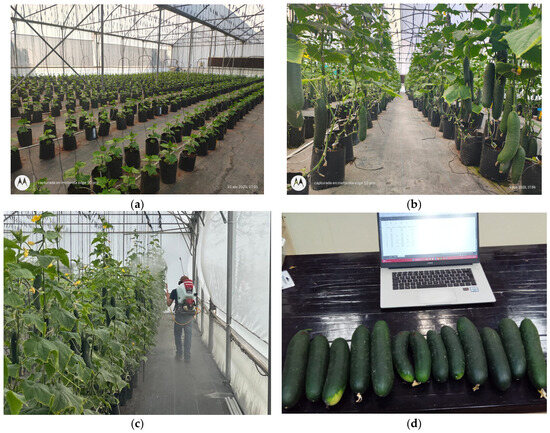
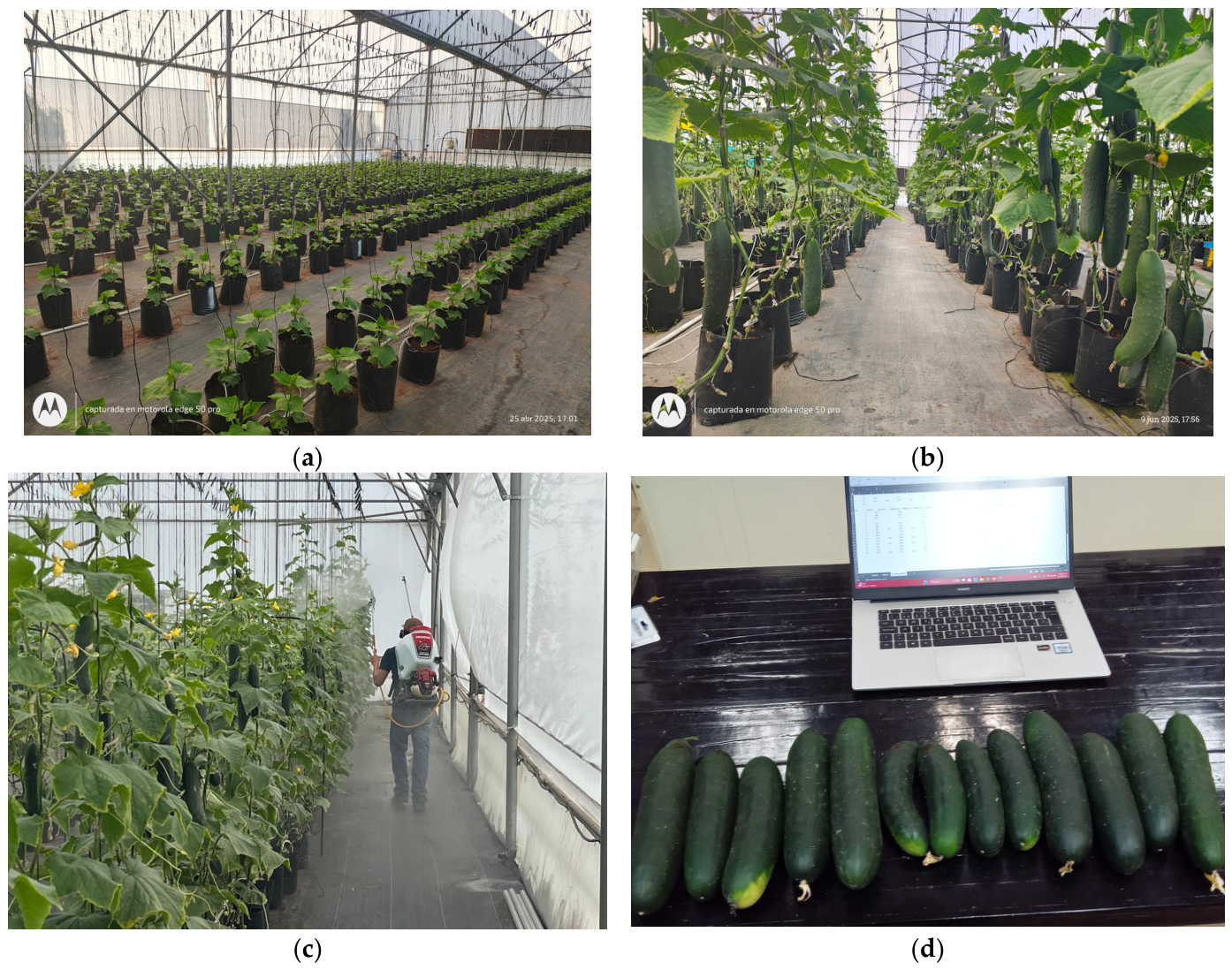
The experiment was conducted at a hydroponic greenhouse located in the Faculty of Higher Studies Cuautitlán, using Cucumber (Cucumis sativus) of the Centauro variety. Four treatments were assigned to two greenhouse beds (blocks) with 60 plants each (Figure 1a,b).
Figure 1.
Experiment to assess the effect of different biostimulant treatments on Cucumber. (a) Greenhouse and plant setup; (b) fruit growth; (c) biostimulant applications; (d) fruit data collection.
The treatments were as follows:
- T1: Control (water only).
- T2: Algal (Ascophyllum nodosum) extract (YaraAmplix OptitracTM, Yara Mexico™, Guadalajara, México) containing 2 g·L−1 of free aminoacids and 1 g·L−1 of mannitol, as well as N (65 g·L−1), K (K2O 27 g·L−1), B (13 g·L−1), and Zn (13 g·L−1)
- T3: Commercial foliar formulation (YaraVita Magzibor ™, Yara Mexico™) with Mg (69 g·L−1), B (70 g·L−1), and Zn (142 g·L−1).
- T4: 1:1 mixture of algal extract and commercial foliar formulation (T2 + T3).
The dosages were 2 L/ha for all treatments, which were diluted in 200 L of water and applied by aspersion (1% v/v final spray solution; Figure 1c). Additionally, all plants received a base nutrient solution (14 N, 1.5 P, 7 K, 8 Ca, 2.5 Mg, 3 S) throughout the production cycle. A total of ten applications of foliar applications were made every 15 days after transplanting, except for the commercial foliar formulation in T3 and T4, which was discontinued in both treatments at flowering, as per manufacturer recommendations (Yara México ™) to avoid potential fruit set inhibition, whereas the algal extract in T2 and T4 was applied throughout all ten events. Fruits were harvested across four weekly cuts, and fresh weight was recorded. Fifteen plants per treatment and block were randomly selected and marked for accumulated yield calculations during the experiment (Figure 1d).
2.2. Statistical Analysis
Raw fruit yield data were converted into continuous functions using B-spline expansions in JMP Student Edition 19.0.1 (SAS Institute, Cary, NC, USA). Functional principal component analysis (FPCA) was applied to decompose yield trajectories into principal components for each treatment. A functional generalized regression model was fitted to each principal component score to explore treatment effects, with significance set at α = 0.05. For comparison, a repeated-measures ANOVA (α = 0.05) for a general factorial design (4 treatments, 4 cuts, 2 blocks, 15 sampled plants) and a Tukey post hoc test were also performed on the accumulated yield.
3. Results and Discussion
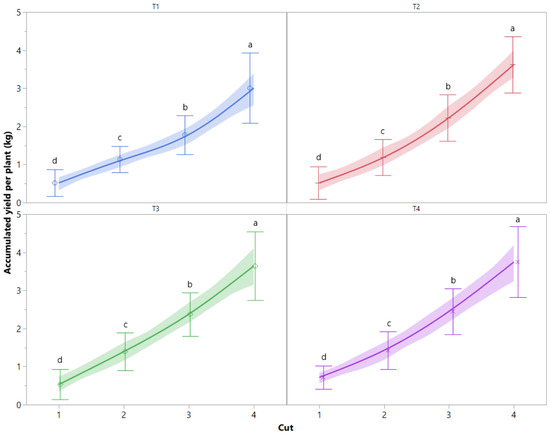
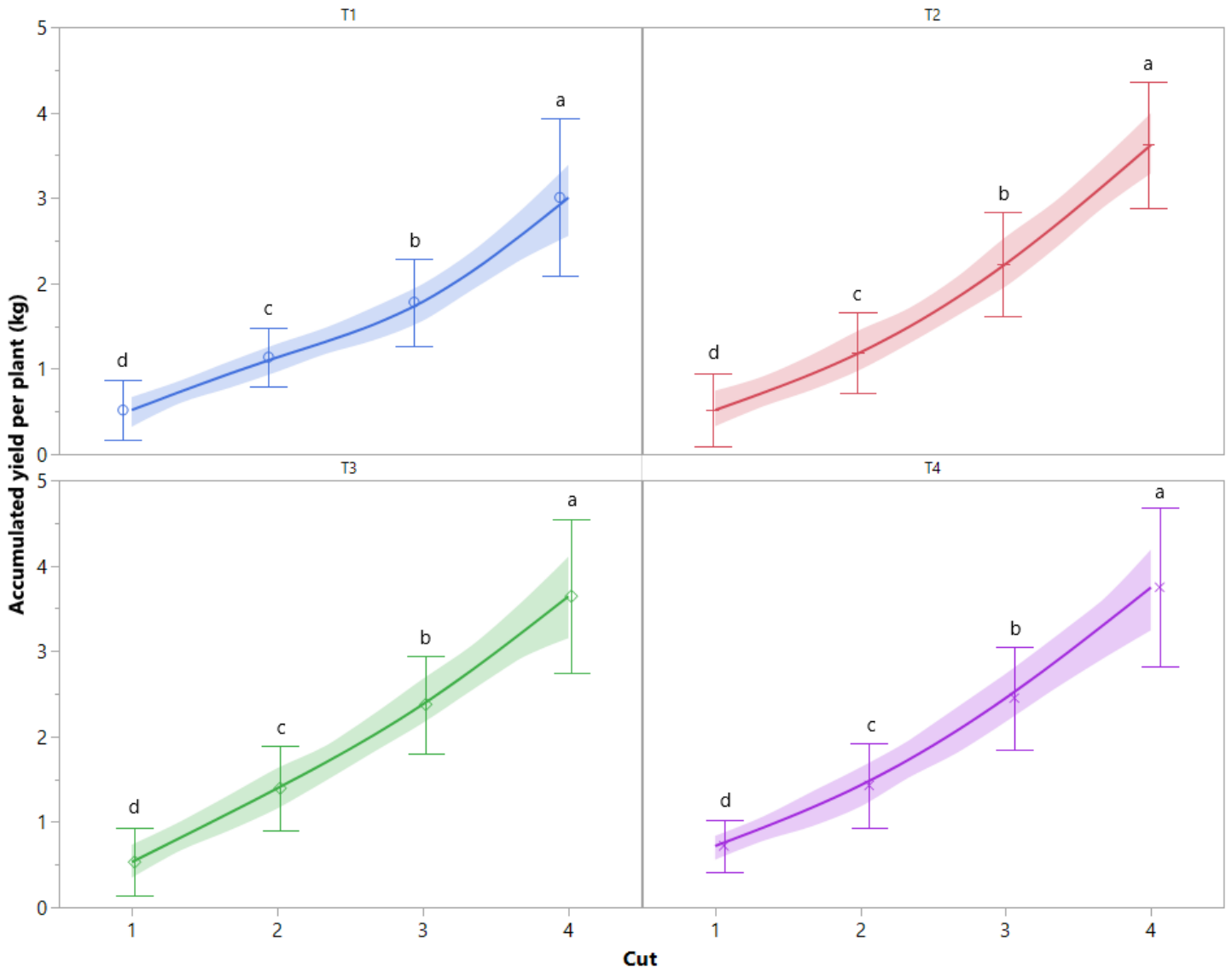
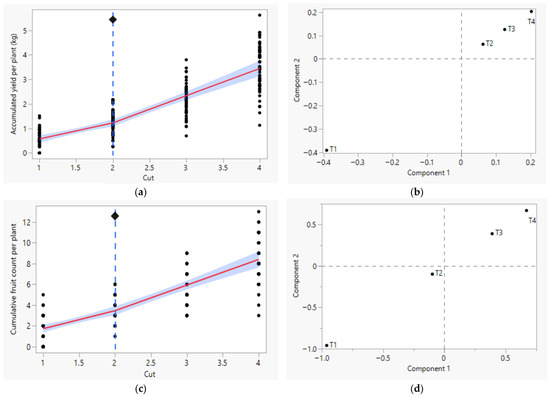
Raw cumulative yield data of the sampled plants were successfully converted into smooth, continuous functions for each treatment using B-spline expansions (Figure 2). The best fit was achieved with linear splines incorporating a single knot after the second harvest/cut, as seen in the mean yield curve (Figure 3a), resulting in piecewise-linear trajectories that accurately reflected the constant nature of yield accumulation over the four cuts studied. FPCA revealed that one principal component explained 99.7% of the variability in yield curves. This primary mode of variation was characterized by a greater positive deviation or acceleration in fruit yield between the second and third harvest cuts (Figure 3a). T4 exhibited the strongest positive score associated with this acceleration phase (0.203; Figure 3b).
Figure 2.
Continuous curves and discrete mean cumulative fruit yield data of Cucumber plants treated with different biostimulant treatments (T1 to T4). The continuous curves represent the functions obtained after spline smoothing the raw data; the shading represents the confidence of fit, while the markers indicate the discrete mean cumulative fruit yield. Bars represent the standard deviation from the discrete mean yield per plant (n = 30 plants per treatment and cut). Means that do not share letters indicate differences between cuts (Tukey test, p < 0.05). No significant differences were found among the treatments (p > 0.05).
Figure 3.
Fruit productivity dynamics of cucumber plants under different foliar biostimulant treatments. (a) Mean yield function; (b) PCA scoreplot for yield; (c) mean fruit number function; (d) FPCA scoreplot for fruit number. For the mean yield functions in (a,c), the continuous lines represent the functions obtained after spline smoothing the raw data with a B-spline model, the shading represents the confidence of fit, and the symbols ♦ and dashed line mark the changes in slope or knots in the functions.
Accordingly, the functional generalized regression model identified significant effects (p = 0.029) of the treatments on the shape of the function described by the FPC scores. In general, accumulated yield increased in the biostimulant group (p < 0.01). This was also confirmed by inspecting the scoreplot, which shows a separation between the three bostimulant treatments and T1, whose function exhibited a negative deviation from the mean curve (score = −0.39) and a smaller slope between cuts 2 and 3 (Figure 3b). The curves for T2 and T3 appeared intermediate and visually similar to each other (Figure 2), with positive score values of 0.062 and 0.125, respectively (Figure 3b). The clustering of T2, T3, and T4 suggests that all biostimulant treatments altered yield dynamics relative to T1, albeit to different degrees.
A complementary functional analysis of fruit number per plant revealed similar trajectories and fits: linear splines with one knot at cut 2, with the 1st FPCA explaining 83.9% of the variance (Figure 3c,d). T4 produced the highest cumulative fruit count, followed by T3, T2 and finally T1 (mean counts of 8.587, 5.720, 3.554 and 1.680, respectively), further supporting the results observed for yield.
The functional trajectory for T4 showed the most pronounced early- to mid-season acceleration, culminating in a higher final cumulative yield than either the algal extract or the Mg–B–Zn formulation alone. It has been reported that Zn, B and Mg formulations can significantly boost cucumber yield and fruit quality. Foliar fertilizers rich in Zn and B have consistently shown to increase cucumber fruit number and total yield due to their ability to improve flower set, and their effect is enhanced when applied at moderate doses and combined with proper base fertilization [15,16]. Regarding foliar Mg, a study evaluating moderate to high doses found that while the former increased yield, the latter (50 mM Mg) could, in fact, decrease it by close to 50%. High foliar Mg can depress yield, likely because an excess of this nutrient can disrupt the balance and uptake of cations like K and Ca, thus impairing root growth and nutrient absorption, which in turn can alter the plant’s stress metabolism, limiting growth, flowering, and fruit set [15,17]. In T4, the Mg-rich formulation was discontinued one month before harvesting, during flowering, likely preventing those adverse effects while promoting fruit setting and probably increasing fruit number.
Regarding the application of Ascophyllum nodosum extracts, it is generally accepted that microalgal extracts exert their influence by improving plant health, nutrient uptake, and the quality traits of vegetables [18,19]. However, the literature also reports that microalgal biostimulants can have positive effects on yield, especially when combined with other factors such as microbes or optimal mineral nutrition [20,21,22]. Although the specific biostimulants used in this study have not been studied in the literature, this interpretation is consistent with recent studies emphasizing the potential of combined biostimulants to enhance early growth and fruit development [2,21,22,23,24].
When the discrete accumulated yield per plant data was analyzed using a traditional repeated-measures ANOVA, no significant main effect of treatment (p = 0.074) or treatment–cut interaction (p = 0.423) was found. The only significant factor detected was the harvest cut number itself (p ≤ 0.001), which identified cut 4 as the highest in yield, with cuts 1 and 2 being the lowest. Likewise, the analysis of cumulative fruit count per plant found a highly significant effect only for cut number (p = 0.002).
Previous studies have used FDA to evaluate time-dependent effects of environmental variability on the yields of horticultural crops, highlighting how FDA modelling is useful for visualizing yield changes across a range of conditions, optimizing resource use and predicting plant responses before they affect productivity [11]. The present study also supported the utility of FDA over traditional ANOVA in capturing subtle, time-dependent treatment effects of the application of biostimulants on something as simple as accumulated yield. In our case, FDA was able to model continuous yield trajectories, allowing the identification of inflection points that were missed by discrete statistical methods.
Despite the insights provided by FDA, several limitations should be acknowledged. First, the study focused exclusively on accumulated yield as the response variable, and even though fruit number data were collected and showed similar trends, other physiologically relevant traits, such as fruit quality parameters, nutrient tissue concentrations, and photosynthetic indicators, were not measured. Incorporating such covariates in future functional regression models could help elucidate the mechanistic pathways underlying the observed yield accelerations. Finally, the present results are specific to the commercial biostimulant products, application rates, and greenhouse hydroponic conditions used, so validation under different production systems and with other cucumber varieties would be necessary to confirm the observations regarding the synergistic effects of a combined treatment.
In future work, we hope to address these limitations, explore other quality traits, and integrate physiological covariates to elucidate the mechanisms underlying the acceleration trajectories observed following biostimulant application. Also, we hope to expand the models and identify optimal application timing or dose–response relationships across a gradient, moving beyond simple treatment presence/absence questions. Regardless of the limitations stated, the present study successfully demonstrated that FDA was able to detect time-dependent treatment effects that conventional ANOVA missed, even under a modest experimental design. We hope our findings serve to promote the broader adoption of FDA in agronomic research to study and understand crop dynamic responses.
4. Conclusions
FDA effectively captured the dynamic yield responses of hydroponic cucumber to foliar biostimulants, revealing significant treatment effects and growth accelerations not detected by traditional ANOVA. T4 (algal extract combined with Mg–B–Zn) emerged as the most effective treatment, promoting early-phase yield acceleration. This study highlights the value of functional data approaches in understanding temporal crop responses and improving biostimulant use in sustainable agriculture.
Author Contributions
Conceptualization, J.A.F.-M. and E.D.-H.; methodology, M.E.D.-H., E.D.-H. and J.A.F.-M.; formal analysis, J.A.F.-M. and E.D.-H.; investigation, R.J.-R., N.V.-F., N.P.L.C., J.A.F.-M. and F.O.-S.; resources, J.A.F.-M., F.O.-S., M.E.D.-H. and E.D.-H.; writing—original draft preparation, J.A.F.-M. and E.D.-H.; visualization, E.D.-H.; writing—review and editing, M.E.D.-H. and E.D.-H. All authors have read and agreed to the published version of the manuscript.
Funding
This work was supported by UNAM—PAPIIT IA207626, SECIHTI, grant No. 534775, and the FES Cuautitlán UNAM, project: CI2454.
Institutional Review Board Statement
Not applicable.
Informed Consent Statement
Not applicable.
Data Availability Statement
All data are contained in the article.
Acknowledgments
The authors wish to thank the FES Cuautitlán UNAM for the material and infrastructural support for the experiments.
Conflicts of Interest
The authors declare no conflict of interest.
References
- FAOSTAT. Food Agriculture Organization of the United Nations FAOSTAT. Available online: http://www.fao.org/faostat/es/#data/QC (accessed on 28 December 2023).
- Khoulati, A.; Ouahhoud, S.; Taibi, M.; Ezrari, S.; Mamri, S.; Merah, O.; Hakkou, A.; Addi, M.; Maleb, A.; Saalaoui, E. Harnessing Biostimulants for Sustainable Agriculture: Innovations, Challenges, and Future Prospects. Discov. Agric. 2025, 3, 56. [Google Scholar] [CrossRef] [Scilit]
- Minaoui, F.; Hakkoum, Z.; Chabili, A.; Douma, M.; Mouhri, K.; Loudiki, M. Biostimulant Effect of Green Soil Microalgae Chlorella Vulgaris Suspensions on Germination and Growth of Wheat (Triticum aestivum var. Achtar) and Soil Fertility. Algal Res. 2024, 82, 103655. [Google Scholar] [CrossRef] [Scilit]
- Li, J.; Lens, P.N.L.; Ferrer, I.; Du Laing, G. Evaluation of Selenium-Enriched Microalgae Produced on Domestic Wastewater as Biostimulant and Biofertilizer for Growth of Selenium-Enriched Crops. J. Appl. Phycol. 2021, 33, 3027–3039. [Google Scholar] [CrossRef] [Scilit]
- Chabili, A.; Hakkoum, Z.; Minaoui, F.; Douma, M.; Meddich, A.; Loudiki, M. Germination Screen of Eco-Extracts from Soil Cyanobacteria and Microalgae for Their Biostimulant Effects on Wheat Seeds Emergence and Vigor. Algal Res. 2025, 89, 104087. [Google Scholar] [CrossRef] [Scilit]
- Yadav, A.; Singh, S.; Yadav, V. Screening Herbal Extracts as Biostimulant to Increase Germination, Plant Growth and Secondary Metabolite Production in Wheatgrass. Sci. Rep. 2024, 14, 607. [Google Scholar] [CrossRef] [Scilit] [PubMed]
- Chabili, A.; Minaoui, F.; Hakkoum, Z.; Douma, M.; Meddich, A.; Loudiki, M. Effects of Extraction Methods on the Plant Biostimulant Activity of the Soil Microalga Chlorella vulgaris. J. Appl. Phycol. 2024, 36, 3301–3314. [Google Scholar] [CrossRef] [Scilit]
- Ramsay, J.O.; Silverman, B.W. Functional Data Analysis, 2nd ed.; Springer: New York, NY, USA, 2005. [Google Scholar]
- Crainiceanu, C.M.; Goldsmith, J.; Leroux, A.; Cui, E. Functional Data Analysis with R; Chapman and Hall/CRC: Boca Raton, FL, USA, 2024. [Google Scholar]
- Horváth, L.; Kokoszka, P. Inference for Functional Data with Applications; Springer: New York, NY, USA, 2012; Volume 200. [Google Scholar]
- Matsui, H.; Mochida, K. Functional Data Analysis-Based Yield Modeling in Year-Round Crop Cultivation. Hortic. Res. 2024, 11, uhae144. [Google Scholar] [CrossRef] [Scilit] [PubMed]
- Mancini, A.; Solfanelli, F.; Coviello, L.; Martini, F.M.; Mandolesi, S.; Zanoli, R. Time Series from Sentinel-2 for Organic Durum Wheat Yield Prediction Using Functional Data Analysis and Deep Learning. Agronomy 2024, 14, 109. [Google Scholar] [CrossRef] [Scilit]
- Tiwari, V.; Hymavathi, M.; Reddy, M.B.; Jahnavi, Y. Data Visualization and Analytics for Crop Yield Estimation. Int. J. Adv. Netw. Appl. 2025, 16, 6621–6626. [Google Scholar] [CrossRef] [Scilit]
- Montesinos-López, A.; Montesinos-López, O.A.; de los Campos, G.; Crossa, J.; Burgueño, J.; Luna-Vazquez, F.J. Bayesian Functional Regression as an Alternative Statistical Analysis of High-Throughput Phenotyping Data of Modern Agriculture. Plant Methods 2018, 14, 46. [Google Scholar] [CrossRef] [Scilit] [PubMed]
- Siddique, S. Enhancement of Growth and Productivity of Cucumber (Cucumis sativus) through Foliar Application of Calcium and Magnesium. Pure Appl. Biol. 2017, 6, 402–411. [Google Scholar] [CrossRef] [Scilit]
- Hussain, Z.; Khan, K.; Ali, S.; Shah, W.A.; Ahmad, M.; Amin, R.; Khan, R. Synergistic Effects of Boron and Zinc on the Morpho-Physiological and Nutritional Traits of Cucumber (Cucumis sativus L.) as Influenced by Different Application Methods. Kashf J. Multidiscip. Res. 2024, 1, 44–54. [Google Scholar] [CrossRef] [Scilit]
- Qu, S.; Li, H.; Zhang, X.; Gao, J.; Ma, R.; Ma, L.; Ma, J. Effects of Magnesium Imbalance on Root Growth and Nutrient Absorption in Different Genotypes of Vegetable Crops. Plants 2023, 12, 3518. [Google Scholar] [CrossRef] [Scilit] [PubMed]
- Kumari, S.; Sehrawat, K.D.; Phogat, D.; Sehrawat, A.R.; Chaudhary, R.; Sushkova, S.N.; Voloshina, M.S.; Rajput, V.D.; Shmaraeva, A.N.; Marc, R.A.; et al. Ascophyllum nodosum (L.) Le Jolis, a Pivotal Biostimulant toward Sustainable Agriculture: A Comprehensive Review. Agriculture 2023, 13, 1179. [Google Scholar] [CrossRef] [Scilit]
- Parmar, P.; Kumar, R.; Neha, Y.; Srivatsan, V. Microalgae as next Generation Plant Growth Additives: Functions, Applications, Challenges and Circular Bioeconomy Based Solutions. Front. Plant Sci. 2023, 14, 1073546. [Google Scholar] [CrossRef] [Scilit] [PubMed]
- Mendez, A.; Martinez, S.; Leal, A.; Hernandez, A.; García, J.; Sánchez, M. Synergism of Microorganisms and Seaweed Extract on Vegetative Growth, Yield and Quality of Cucumber Fruit. Not. Bot. Horti Agrobot. Cluj Napoca 2023, 51, 12888. [Google Scholar] [CrossRef] [Scilit]
- Zamljen, T.; Šircelj, H.; Veberič, R.; Hudina, M.; Slatnar, A. Impact of Two Brown Seaweed (Ascophyllum nodosum L.) Biostimulants on the Quantity and Quality of Yield in Cucumber (Cucumis sativus L.). Foods 2024, 13, 401. [Google Scholar] [CrossRef] [Scilit] [PubMed]
- Trejo Valencia, R.; Sánchez Acosta, L.; Fortis Hernández, M.; Preciado Rangel, P.; Gallegos Robles, M.Á.; Antonio Cruz, R.d.C.; Vázquez Vázquez, C. Effect of Seaweed Aqueous Extracts and Compost on Vegetative Growth, Yield, and Nutraceutical Quality of Cucumber (Cucumis sativus L.) Fruit. Agronomy 2018, 8, 264. [Google Scholar] [CrossRef] [Scilit]
- Skapste, I.; Vircava, I.; Skutele, K.; Žaimis, U.; Grinberga-Zalite, G.; Zvirbule, A. Algae Digestate Biostimulants as an Innovative Solution for Food System Sustainability and Productivity Improvement. Front. Sustain. Food Syst. 2025, 9, 1656867. [Google Scholar] [CrossRef] [Scilit]
- Zuluaga, M.Y.A.; de Oliveira Caretta, T.; Agostini, A.; Monterisi, S.; Fattorini, R.; Cesco, S.; Pii, Y. Unlocking Cucumber Growth: Exploring the Impact of Nutrient Availability Levels and Bacterial Inoculation on Plant Growth and Mineral Composition. Hortic. Environ. Biotechnol. 2025, 67, 141–156. [Google Scholar] [CrossRef] [Scilit]
Disclaimer/Publisher’s Note: The statements, opinions and data contained in all publications are solely those of the individual author(s) and contributor(s) and not of MDPI and/or the editor(s). MDPI and/or the editor(s) disclaim responsibility for any injury to people or property resulting from any ideas, methods, instructions or products referred to in the content. |
© 2026 by the authors. Licensee MDPI, Basel, Switzerland. This article is an open access article distributed under the terms and conditions of the Creative Commons Attribution (CC BY) license.