


Abstract
Background: Predicting the need for surgical intervention in infants with antenatally diagnosed hydronephrosis (ANH) remains challenging. This study aimed to identify antenatal and postnatal factors associated with surgical intervention in infants with ANH. Method: This prospective observational study included infants aged less than 6 months with antenatally diagnosed hydronephrosis. Antenatal Society for Fetal Urology (SFU) and anterior–posterior pelvic diameter (APD) grades were obtained from maternal antenatal ultrasound reports, and the infants were followed for 6 months after birth. Demographic characteristics and antenatal and postnatal radiological findings were compared between infants who underwent surgical intervention and those managed conservatively. SFU and APD grades were also compared according to postnatal outcomes. In addition, the association of postnatal APD with surgical intervention was evaluated, and an exploratory cutoff value was determined. Result: Among 53 infants with antenatally diagnosed hydronephrosis, 18 had bilateral hydronephrosis, yielding a total of 71 renal units for renal-unit level analyses, 16 (22.5%) required surgery. Infants undergoing surgery had reduced renal parenchymal thickness, higher SFU grades (III/IV), greater postnatal APD (29.5 vs. 7.8 mm; p ≤ 0.001), and less preserved corticomedullary differentiation (31.2% vs. 92.7%; p < 0.001). Higher APD grade (OR 6.3, 95% CI 1.9–26.5; p = 0.001), SFU grade (OR 6.64, 95% CI 2.1–21.0; p = 0.001), and postnatal APD (OR 1.16, 95% CI 1.06–1.29; p = 0.004) were independently associated with surgical intervention. A postnatal APD cutoff of 13 mm showed good diagnostic accuracy (AUC = 0.87 (95% CI 0.77–0.96), p = 0.001). Conclusion: Antenatal SFU grade and APD grade and postnatal APD were strongly associated with subsequent surgical intervention and represented key factors influencing surgical decision-making during follow-up.
1. Introduction
Antenatal hydronephrosis (ANH) is the enlargement of the pelvis of the kidneys in the developing fetus, with or without dilatation of the calyces [1]. Congenital anomalies account for approximately 8–15% of prenatal deaths and 13–16% of neonatal mortality [2]. Hydronephrosis is one of the most frequently detected fetal abnormalities, being identified in 1–5% of fetal renal ultrasonographic examinations performed [1]. ANH has a reported prevalence ranging from 0.6% to 5.4%, depending on the gestational age at assessment and the diagnostic criteria used. The condition is bilateral in approximately 17–54% of cases and may occasionally be associated with other congenital anomalies [3,4]. Transient hydronephrosis accounts for approximately 41–88% of cases of ANH, while the remaining cases represent persistent hydronephrosis. Given its diverse etiologies, hydronephrosis may be classified as either obstructive or non-obstructive. Obstructive causes are responsible for approximately 10–30% of cases and include conditions that impair urinary drainage, leading to dilatation of the urinary collecting system [5].
Among the various causes of hydronephrosis, transient dilatation of the collecting system, ureteropelvic junction obstruction (UPJO), ureterovesical junction (UVJ) obstruction, and vesicoureteral reflux (VUR) are the most common. Although many cases are transient, a substantial proportion of infants diagnosed with hydronephrosis during pregnancy experience spontaneous resolution after birth. Among persistent cases, UPJO is the most frequent underlying cause, accounting for approximately 44% of postnatal chronic hydronephrosis. Identifying the underlying etiological factor is essential for determining the appropriate management strategy and guiding treatment decisions [6]. The clinical course of hydronephrosis caused by UPJ obstruction is variable. Severe obstruction can lead to urine accumulation, increased renal pelvic pressure, impaired drainage, and ultimately irreversible renal damage if left untreated. In contrast, mild UPJ obstruction may remain stable or improve over time as the growing kidney compensates, often resulting in spontaneous resolution or improvement of hydronephrosis.
Hydronephrosis is most commonly detected during routine antenatal ultrasonographic evaluation of the mother and fetus and accounts for approximately 5–6% of all urological abnormalities identified in newborns. Because many cases of antenatal hydronephrosis are benign and resolve spontaneously, conservative postnatal follow-up is often preferred. However, selecting patients who require surgical intervention remains controversial [7]. The reported rate of surgical intervention varied considerably across published studies, ranging from 12% to 52% [8].
The prenatal detection of ANH has significantly improved the early identification and management of congenital renal and urinary tract abnormalities. Despite advances in understanding the genetic basis, natural history, and clinical outcomes of antenatal hydronephrosis, considerable uncertainty remains regarding optimal surgical selection. Owing to the heterogeneous nature of congenital anomalies of the kidney and urinary tract, there is limited consensus on standardized postnatal management strategies. A key challenge in the management of these infants is accurately identifying those who require surgical intervention while avoiding unnecessary procedures in patients who can be safely managed with conservative surveillance [9,10], highlighting the need for studies that can better guide risk stratification and treatment decisions. The objectives of this study were to evaluate the association of antenatal and postnatal factors with surgical intervention and postnatal outcomes and to identify the factors independently associated with surgical intervention.
2. Materials and Methods
2.1. Study Design
This prospective observational study was conducted in the Department of Pediatric Surgery, Kasturba Medical College and Hospital, Manipal, between February 2023 and May 2024. Infants younger than 6 months with antenatally diagnosed hydronephrosis identified on third-trimester ultrasonography (32–36 weeks’ gestation) were prospectively enrolled and followed for 6 months after birth. Infants with incomplete antenatal records, inadequate imaging, or loss to follow-up were excluded. The study was approved by the Institutional Ethics Committee (IEC No. 413/2022), and written informed consent was obtained from the parents or legal guardians before enrollment.
2.2. Data Collection
Antenatal Society for Fetal Urology (SFU) and Anteroposterior Pelvic Diameter (APD) grades were collected from the maternal antenatal ultrasound scan reports. APD grading and SFU classification were assigned according to standard published criteria [6]. All infants with antenatally diagnosed hydronephrosis underwent their first postnatal renal ultrasonography (USG) between 48 and 72 h after birth. The APD of the renal pelvis was measured, and infants with an APD > 20 mm underwent an ethylene cysteine (EC) diuretic renal scan at 4–6 weeks of age using ^99mTc-L,L-ethylenedicysteine (^99mTc-L,L-EC) and furosemide IV (1 mg/kg) at zero minutes. Infants with an APD ≤ 20 mm underwent a repeat renal ultrasonography at 1 month of age to assess the trend in APD. At the 1-month follow-up, infants demonstrating a stable or decreasing APD were followed with a third renal ultrasonography at 3 months of age. Those with an increasing APD underwent an EC renal scan to evaluate renal drainage and differential renal function. At 3 months, the APD trend was reassessed. Infants with a decreasing APD continued serial ultrasonographic follow-up, with the next evaluation at 6 months of age, followed by 6-monthly surveillance or earlier assessment if clinically indicated. Infants with an increasing APD at the 3-month evaluation underwent an EC renal scan for further assessment. Postnatal outcomes were assessed among the cohort. Infants with bilateral kidneys contributed two renal units. Among twin pregnancies, both twins were included when they independently fulfilled the study eligibility criteria.
Postnatal APD values used for group comparison, regression, and ROC analysis were measured at 48–72 h after birth. Later APD values (1 month, 3 months, pre-surgery) were used for clinical decision-making but not for baseline predictive analyses. Infants were prospectively enrolled at birth, as mothers were already being followed antenatally. Enrollment therefore occurred on the day of delivery for all infants born, and each infant was followed until 6 months of age or until surgery, whichever occurred first.
Infants were considered for surgical intervention if they demonstrated one or more of the following: (i) Obstructive drainage on diuretic renography (T½ > 20 min); (ii) progressive increase in anteroposterior pelvic diameter (APD) on serial ultrasonography; (iii) loss of corticomedullary differentiation; (iv) progressive thinning of the renal parenchyma; (v) recurrent febrile urinary tract infection or symptomatic obstruction; (vi) high SFU(III-IV). Surgical decisions were made by a multidisciplinary team comprising pediatric surgeons and nephrologists.
2.3. Definitions
Physiological hydronephrosis was defined as hydronephrosis that remained stable or resolved during follow-up without evidence of obstruction or progressive radiological deterioration, whereas pathological hydronephrosis was defined as hydronephrosis demonstrating progressive worsening on follow-up imaging, abnormal drainage (T½ > 20 min), or reduced differential renal function (<40%); parenchymal thinning was categorized as cortical thickness < 3 mm, and severe thinning as <2 mm or loss of corticomedullary differentiation.
2.4. Statistical Analysis
The Shapiro–Wilk test was used to assess the normal distribution of variables. The means ± SDs represent normally distributed variables, whereas the medians with interquartile ranges are used for non-normally distributed variables. For categorical variables, Pearson’s chi-square test was used when all expected cell counts were ≥5, whereas Fisher’s exact test was used when expected counts were <5. Continuous variables were compared using the Mann–Whitney U test when non-normally distributed. Univariate and multivariate logistic regression analyses were performed to identify factors independently associated with surgery intervention. Variables demonstrating statistical significance on univariate analysis were entered into an exploratory multivariate logistic regression model. Variables that formed part of the outcome definition and variables with substantial missing data were not included in multivariable modeling. Receiver operating characteristic (ROC) curves were generated, and the area under the curve (AUC) was calculated to assess the diagnostic utility of postnatal APD in identifying the need for surgery. A p-value of <0.05 was considered significant. The data were analyzed via SPSS version 20.0.
3. Result
A total of 60 infants met the eligibility criteria, of whom 3 were lost to follow-up, and 4 were excluded because of incomplete data. A total of 53 infants were included for analysis, and among these, 18 infants had bilateral hydronephrosis and therefore contributed two renal units each. Consequently, the final analysis included 71 renal units. Of the 71 cases, 83.1% were male, and 16.9% were female. Bilateral cases were reported in 18 cases, and both twins were included. Infants who did not undergo surgery during the 6-month observation period were categorized into the non-surgical group, which therefore included all cases not undergoing surgery within the observed follow-up interval. In our study cohort, surgery was performed in 16 (22.5%) cases. Among the 16 infants who underwent surgery, dismembered pyeloplasty was the most commonly performed procedure, accounting for 13 patients (81.3%), followed by ureterostomy in 2 patients (12.5%), while partial nephrectomy was required in 1 patient (6.2%). The median age at surgery was 2 months (IQR 0–3).
3.1. Patient Characteristics
The baseline antenatal maternal and fetal characteristics between the groups are compared in Table 1. The mean maternal age of the overall cohort was 29.0 years, and there was no statistical significance found between the groups (p = 0.909). Most pregnancies were singleton gestations (94.4%), with all infants in the surgery group being from singleton pregnancies (100%), while four DCDA pregnancies were reported in the non-surgery group; however, this difference was not statistically significant (p = 0.57). Primiparous mothers constituted the majority of the study population (73.2%), with a similar pattern observed in both groups (p = 0.23).
Table 1.
Antenatal maternal and fetal characteristics *.
3.2. Antenatal Fetal Renal Ultrasound Characteristics
In the comparison of antenatal fetal renal ultrasound characteristics (Table 2), preserved corticomedullary differentiation was significantly more common in the non-surgery group compared to those who underwent surgery (92.7% vs. 31.2%, p < 0.001). Reduced parenchymal thickness was significantly associated with surgical intervention, with thin renal parenchyma (62.5% vs. 27.4%) and severe parenchymal thinning (18.8% vs. 5.4%) being more frequently observed in the surgery group (p = 0.001). Severe APD grade was more prevalent among infants requiring surgery (62.5% vs. 18.1%), whereas mild APD grade was more commonly observed in the non-surgery group (45.4% vs. 6.3%) (p = 0.001). SFU grade III (25.0% vs. 12.7%) and grade IV (50.0% vs. 18.2%) were more frequently observed in the surgery group, whereas SFU grade 1 predominated in the non-surgery group (49.1% vs. 6.3%) (p = 0.008). Ureter dilation and the affected side of the kidney were not statistically significant between the groups (p > 0.05).
Table 2.
Antenatal fetal renal ultrasound characteristics.
3.3. Postnatal Factors
On postnatal factors analyzed (Table 3), all infants in the surgery group demonstrated pathological hydronephrosis compared with 65.5% in the non-surgery group (p = 0.004). Of the 71 infants, 30 underwent diuretic renography based on predefined clinical indications (postnatal APD > 20 mm or progressive worsening on serial monthly ultrasonography). A PUJO-type obstructive curve was significantly higher in the surgery group than in the non-surgery group (86.7% vs. 26.7%, p = 0.003). Conversely, a non-obstructive curve pattern was more frequently observed in the non-surgery group. In addition, the postnatal APD was significantly higher in infants who underwent surgery than in the non-surgery group (29.5 mm [IQR 17.2–36.7] mm vs. 7.8 [IQR 4.9–12.0], p ≤ 0.001).
Table 3.
Postnatal period factors.
3.4. Predictors of Surgical Intervention
In multivariable logistic regression analysis, higher APD grade (OR 6.3, 95% CI 1.9–26.5; p = 0.001), higher SFU grade (OR 6.64, 95% CI 2.1–21.0; p = 0.001), and increasing postnatal APD (OR 1.16, 95% CI 1.06–1.29; p = 0.004) were independently associated with surgical intervention (Table 4).
Table 4.
Predictors of surgical intervention in univariable and multivariable regression analysis.
We additionally performed a comparison of APD and SFU grading between pathological and physiological ANH. Moderate APD grading was significantly higher in the pathological type (46.2%) compared to the physiological type (5.3%), p ≤ 0.001. A severe APD grade was absent in the physiological type, whereas 38.4% had severe APD grading in the pathological type (Table 5).
Table 5.
APD and SFU grading among postnatal outcomes.
3.5. Diagnostic Efficacy of Postnatal APD
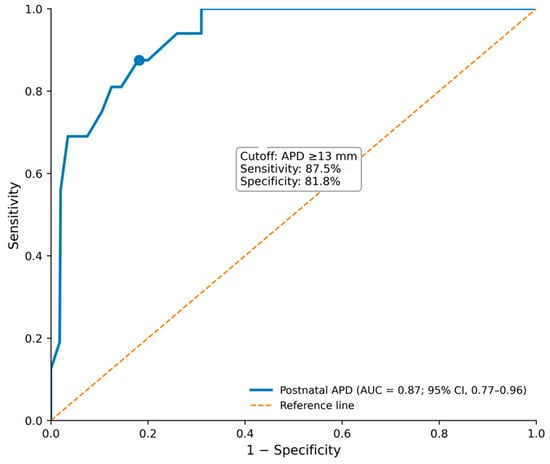
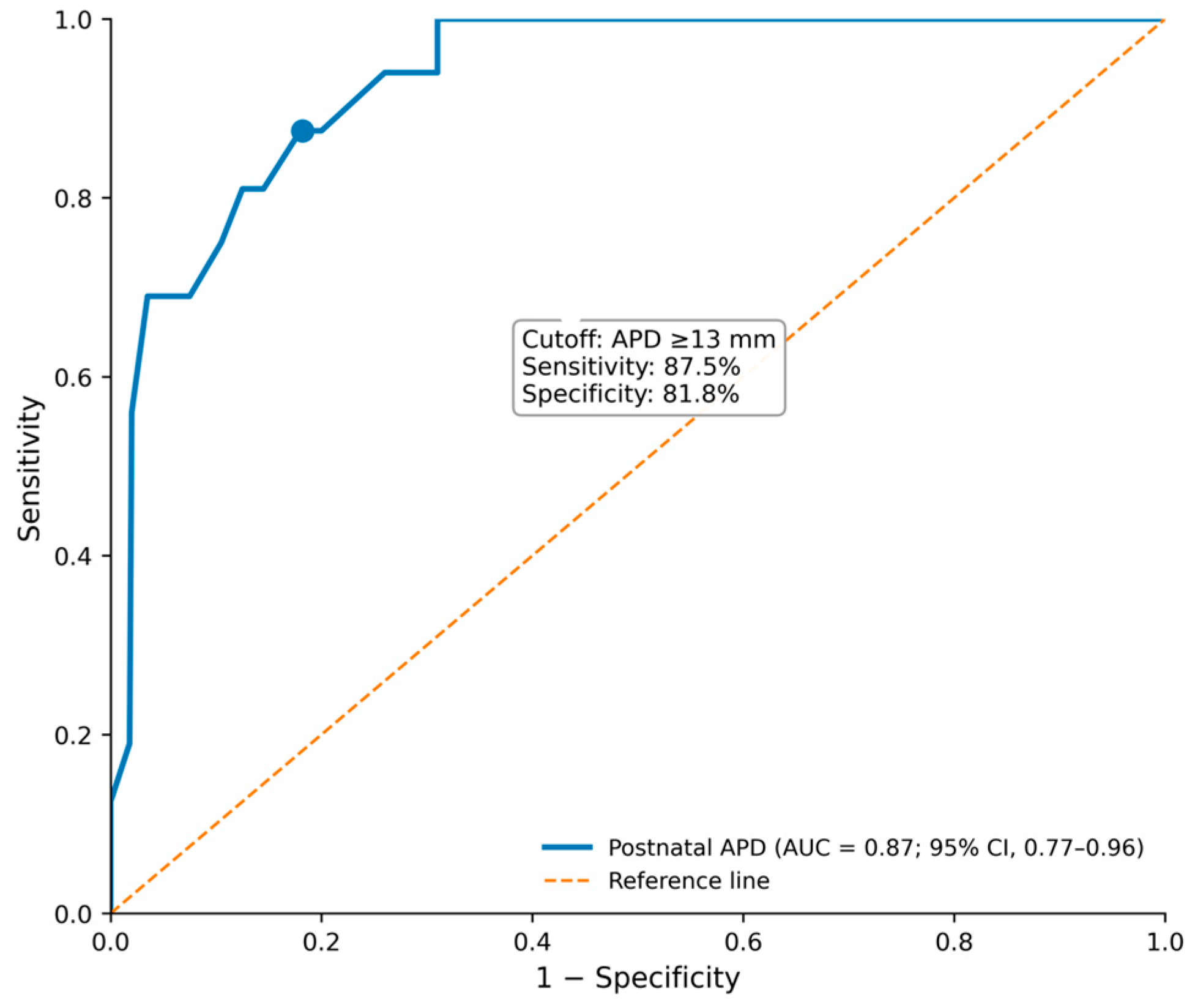
Receiver Operating Characteristic (ROC) curve analysis was performed (shown in Figure 1) to determine the diagnostic value of postnatal APD in identifying surgical intervention. The APD cut-off value was 13 mm with an AUC of 0.87 (95% CI 0.77–0.96, p = 0.001). A positive test was defined as APD ≥ 13 mm (Table 6). Sensitivity was 87.5% (14/16, 95% CI 61–98%), and specificity was 81.8% (45/55, 95% CI 69–90%). Positive predictive value was 58.3% (95% CI 39–76%), and negative predictive value was 95.7% (95% CI 85–99%). The cutoff was selected using Youden’s index. Because the threshold was derived and assessed in the same cohort, it is presented as an exploratory, internally derived cutoff.
Figure 1.
ROC curve showing the diagnostic performance of postnatal APD.
Table 6.
Cutoff value of APD.
4. Discussion
ANH is one of the most common congenital abnormalities detected during prenatal ultrasonography and serves as a surrogate marker for underlying congenital renal and urinary tract anomalies. Despite advances in prenatal diagnosis, considerable uncertainty remains regarding optimal surgical selection [7]. We assessed third-trimester antenatal factors and further postnatal factors to identify the predictors of surgical intervention. Abnormal findings identified during this examination are almost invariably followed by postnatal renal ultrasonography to assess the persistence and severity of hydronephrosis [11].
In the present study, 22.5% of patients required surgical intervention, which is comparable to the findings of the prospective study by S. Arora et al. [11], where 23.9% of patients underwent surgery, and the retrospective study by Longpré et al., which reported a surgical intervention rate of 24% [12]. Further, Sen et al. conducted a combined prospective and retrospective study involving 219 ANH cases, in which pyeloplasty was performed in 34.7% of cases [13]. In a prospective cohort, Li et al. followed 353 patients with UPJO–like hydronephrosis selected from a prenatal hydronephrosis database of 928 patients. Surgical intervention was required in 81 patients, yielding a pyeloplasty rate of 23% [14]. In contrast to these findings, the highest rate of surgical intervention (47%) was reported in a prospective study by Mahmoud et al., as most of the patients in their cohort included a higher grade of ANH [15].
Loss of corticomedullary differentiation and thinning or severe thinning of the renal parenchyma were significantly associated with surgical intervention in our study. However, these variables were not significant predictors in multivariate regression analysis. In contrast, Jena et al. reported that cortical thickness and curve pattern were significant predictors of the need for surgery in ANH [16].
SFU grade 3 (25.0% vs. 12.7%) and grade 4 (50.0% vs. 18.2%) were also more frequently observed in the surgery group. Additionally, severe SFU grade remained independently associated with predictor of the surgical intervention. This was consistent with Mahmoud et al., wherein SFU grades 3 and 4 were significantly higher in the surgery group with 42.03% and 49.28%, respectively [15]. Similarly, S. Arora et al. reported that SFU grade 4 was significantly more frequent in the surgical intervention group [11].
Severe APD grading was significantly more prevalent among infants who required surgical intervention than among those managed conservatively (62.5% vs. 18.1%). Furthermore, APD grade remained independently associated with the predictor of the surgical intervention in our cohort. This was consistent with S Arora, who reported that APD was the sole independent predictor of surgical intervention in their prospective study [11]. The present study also observed that an APD cutoff of 13 mm predicted the need for surgical intervention with good discriminatory ability (AUC = 0.87). This aligns with Coplen et al., who conducted a retrospective study involving 257 neonates with ANH and reported that an APD cutoff of 15 mm identified renal pathology in approximately 80% of fetuses, with a sensitivity of 73% and a specificity of 82% [17]. Similarly, Ismail et al. highlighted the importance of APD as a screening parameter. In their prospective study of 213 infants, a third-trimester APD cutoff of 10 mm identified only 23% of renal anomalies, whereas lowering the cutoff to 7 mm increased the detection rate to 68%, indicating that lower APD thresholds improve sensitivity for detecting clinically significant renal abnormalities. These findings underscore the value of APD in prenatal risk stratification [18]. Mahmoud et al. reported the best cut-off of APD was 23 mm with 95% specificity and 70% sensitivity. They also reported that obstructed drainage curve and recurrent UTI were also independent risk factors for surgical intervention in their cohort [15]. The APD threshold was derived as an exploratory predictor for surgery in antenatally detected hydronephrosis, primarily reflecting UPJO-like dilatation, where most surgical cases were UPJO-type in this cohort.
We found that higher APD and SFU grades were associated with pathological postnatal outcomes in our cohort, suggesting that antenatal hydronephrosis severity is an important marker of clinically significant renal pathology. This was consistent with the study by Zhang et al., who reported a higher SFU grade III/IV hydronephrosis among infants with pathological compared with physiological outcomes (75.0% vs. 25.0%), as well as a greater frequency of severe APD dilatation (66.6% vs. 33.3%) [19].
In the present study, several imaging variables included in the model reflected overlapping aspects of hydronephrosis severity. Antenatal APD grade and postnatal APD both quantify pelvic dilatation, whereas SFU grade incorporates changes in parenchymal morphology, including thinning and corticomedullary differentiation. Therefore, some degree of collinearity is likely, and the multivariable findings should be interpreted as exploratory.
Among the available ultrasound-based classification systems, the SFU grading system and the APD measurement are the most widely used standardized methods for assessing the severity of ANH. The SFU grading system provides a qualitative assessment based on the degree of pelvicalyceal dilatation and renal cortical thinning. However, its reliance on subjective interpretation of these features may result in considerable inter-observer variability, limiting its reproducibility [20]. The APD grading system provides a quantitative assessment of pelviectasis based on the maximum anterior–posterior diameter of the renal pelvis measured on prenatal ultrasound. However, establishing a definitive APD threshold is challenging because renal pelvic diameter varies with several factors, including gestational age, fetal bladder filling, and maternal hydration status [11]. APD provides a quantitative threshold, SFU adds morphological detail, and the urinary tract dilation (UTD) classification system integrates both with ureteral and bladder findings, offering a comprehensive risk-stratification framework that may become the universal language for reporting hydronephrosis [21].
The study has several limitations. First, this was the single-center design and small number of events. The APD cutoff derived here primarily reflects UPJO–like dilatation and may not be generalizable to other anatomical variants of antenatal hydronephrosis. Second, surgical decisions were partly based on APD and SFU grading, which were also analyzed as predictors. Consequently, the identified associations should be interpreted as predictors of surgical intervention within our management protocol. Third, the multivariable model is exploratory, and the estimates should be interpreted cautiously given the small sample size and limited number of surgical events. Fourth, diuretic renography was performed only in infants meeting predefined clinical indications, rather than uniformly across the cohort, which limited evaluation of renography-based outcomes. Fifth, antenatal SFU and APD grades were obtained from routine ultrasound reports rather than centralized image review, and inter-observer variability could not be assessed. Sixth, the initial APD measurement was obtained at 48–72 h of life, when physiological variations in neonatal urine output and hydration may influence the measurement. Seventh, infants who remained under conservative surveillance at that time were classified as non-surgical, although some may have subsequently required intervention during longer-term follow-up. In addition, the regression and ROC analyses treated bilateral kidneys as independent.
5. Conclusions
In our cohort, approximately one-fifth of patients with ANH ultimately required surgical intervention. Loss of corticomedullary differentiation, renal parenchymal thinning, and an obstructive renogram curve were significantly associated with the need for surgery. Higher SFU grades (III/IV), severe APD grading, and postnatal APD were more common among patients who underwent surgical intervention, and both grading systems were independently associated with the surgical intervention. Postnatal APD demonstrated good discriminatory performance in distinguishing renal units that underwent surgical intervention from those managed conservatively within this cohort. Furthermore, pathological postnatal outcomes were associated with higher SFU and APD grades, underscoring the value of these ultrasound-based grading systems in the third trimester for risk stratification and assisting risk stratification and clinical surveillance of infants with antenatally diagnosed hydronephrosis.
Author Contributions
K.S., S.P.P. and P.S.S. involved in conceptualization, data collection, methodology and conducted the statistical analysis. S.P., S.M.S., S.P.N., M.V.B. and D.R. involved in methodology and wrote the initial draft of the manuscript, with input from all other authors during the drafting process. Manuscript draft was critically revised by P.S.S. and K.S. for important intellectual content. The final manuscript was read and approved by all authors. All authors have read and agreed to the published version of the manuscript.
Funding
This research received no external funding.
Institutional Review Board Statement
The study was approved by the Institutional Ethics Committee of Kasturba Medical College and Kasturba Hospital (IEC No. 413/2022, 2 January 2023).
Informed Consent Statement
Written informed consent was obtained from the parents or legal guardians before enrollment.
Data Availability Statement
The data presented in this study are available on request from the corresponding author due to patient privacy and ethical restrictions.
Conflicts of Interest
The authors declare no conflicts of interest.
References
- Evertsson, A.; Bäckstrand, J.; Öhman, M.O.; Sjöström, S.; Carlsson, Y. Outcomes of antenatal hydronephrosis and other renal abnormalities in a population-based cohort. Acta Obstet. Gynecol. Scand. 2026, 105, 703–713. [Google Scholar] [CrossRef] [Scilit] [PubMed]
- Yang, X.; Bai, R.; Zhang, J.; Yang, Y.; Zhang, J.; Wang, B.; Li, Z.; Yu, X. Analysis of the causes of neonatal death and genetic variations in congenital anomalies: A multi-center study. Front. Pediatr. 2024, 12, 1419495. [Google Scholar] [CrossRef] [Scilit] [PubMed]
- Wong, J.; Rickard, M.; Dos Santos, J.; Lorenzo, A.J. Antenatal hydronephrosis: An updated review on postnatal care and management. Curr. Opin. Pediatr. 2025, 37, 473–481. [Google Scholar] [CrossRef] [Scilit] [PubMed]
- Silecchia, V.; Meneghesso, D.; Fati, F.; Morlacco, A.; Vidal, E. Prenatal diagnosis of urinary tract dilation: Comparative prognostic value of APDRP and UTD grading systems. J. Pediatr. Urol. 2026, 22, 105748. [Google Scholar] [CrossRef] [Scilit] [PubMed]
- Gradwell, L.E.; Neel, A.K.; Somani, B.K. Predictive tools and scoring systems for surgical intervention in antenatal hydronephrosis and pelviureteric junction obstruction: An ATLAS based on comprehensive review of literature. Urol. Ann. 2025, 17, 133. [Google Scholar] [CrossRef] [Scilit] [PubMed]
- Nguyen, H.T.; Herndon, C.A.; Cooper, C.; Gatti, J.; Kirsch, A.; Kokorowski, P.; Lee, R.; Perez-Brayfield, M.; Metcalfe, P.; Yerkes, E.; et al. The Society for Fetal Urology consensus statement on the evaluation and management of antenatal hydronephrosis. J. Pediatr. Urol. 2010, 6, 212–231. [Google Scholar] [CrossRef] [Scilit] [PubMed]
- Ozsoy, A.F.; Oguz, E.S.; Altay, A.K.; Fitoz, O.S.; Burgu, B.; Soygur, Y.T. Pyramidal Thickness: A New Player In Predicting The Need For Pyeloplasty–A Nonrandomized Prospective Study. Urology 2026, in press. [Google Scholar] [CrossRef] [Scilit] [PubMed]
- Duong, H.P.; Piepsz, A.; Collier, F.; Khelif, K.; Christophe, C.; Cassart, M.; Janssen, F.; Hall, M.; Ismaili, K. Predicting the clinical outcome of antenatally detected unilateral pelviureteric junction stenosis. Urology 2013, 82, 691–696. [Google Scholar] [CrossRef] [Scilit] [PubMed]
- Gormuş, S.; Cömert, H.S.; Şalcı, G.; Kızılırmak, R.; Osmanağaoğlu, M.A.; Eyüboğlu, İ.; İmamoğlu, M.; Sarıhan, H. Clinical significance and management of antenatally detected hydronephrosis due to ureteropelvic junction obstruction: A retrospective single-center study. BMC Pediatr. 2026, 26, 886. [Google Scholar] [CrossRef] [Scilit] [PubMed]
- Jung, J.; Lee, J.H.; Kim, K.S.; Park, Y.S. Utility of Society for Fetal Urology and anteroposterior pelvic diameter grading systems for estimating time to resolution of isolated hydronephrosis: A single center study. J. Urol. 2020, 204, 1048–1053. [Google Scholar] [CrossRef] [Scilit] [PubMed]
- Arora, S.; Yadav, P.; Kumar, M.; Singh, S.K.; Sureka, S.K.; Mittal, V.; Ansari, M.S. Predictors for the need of surgery in antenatally detected hydronephrosis due to UPJ obstruction–a prospective multivariate analysis. J. Pediatr. Urol. 2015, 11, 248-e1. [Google Scholar] [CrossRef] [Scilit] [PubMed]
- Longpre, M.; Nguan, A.; MacNeily, A.E.; Afshar, K. Prediction of the outcome of antenatally diagnosed hydronephrosis: A multivariable analysis. J. Pediatr. Urol. 2012, 8, 135–139. [Google Scholar] [CrossRef] [Scilit] [PubMed]
- Sen, S.S.; Menon, P.; Malik, M.A.; Sodhi, K.S. Outcome of patients with antenatally diagnosed hydronephrosis with respect to postnatal diagnosis and need for surgical intervention. J. Indian Assoc. Pediatr. Surg. 2022, 27, 333–339. [Google Scholar] [CrossRef] [Scilit] [PubMed]
- Li, B.; McGrath, M.; Farrokhyar, F.; Braga, L.H. Ultrasound-based scoring system for indication of pyeloplasty in patients with UPJO-like hydronephrosis. Front. Pediatr. 2020, 8, 353. [Google Scholar] [CrossRef] [Scilit] [PubMed]
- Mahmoud, T.A.; Morsy, E.E.; Morsy, H.A.; Abouzeid, A.M.; Elmoghazy, H.M. Predictors of surgical intervention for antenatally detected ureteropelvic junction obstruction (UPJO): A prospective multivariate analysis. Urol. J. 2024, 91, 220–225. [Google Scholar] [CrossRef] [Scilit] [PubMed]
- Jena, R.; Arya, A.; Madhavan, K.; Lal, H.; Yadav, P.; Ansari, M.S. The obstructive index in antenatal unilateral pelviureteric junction obstruction: A novel predictor of the failure of conservative management. Pediatr. Int. 2022, 64, e14977. [Google Scholar] [CrossRef] [Scilit] [PubMed]
- Coplen, D.E.; Austin, P.F.; Yan, Y.; Blanco, V.M.; Dicke, J.M. The magnitude of fetal renal pelvic dilatation can identify obstructive postnatal hydronephrosis, and direct postnatal evaluation and management. J. Urol. 2006, 176, 724–727. [Google Scholar] [CrossRef] [Scilit] [PubMed]
- Ismaili, K.; Hall, M.; Donner, C.; Thomas, D.; Vermeylen, D.; Avni, F.E. Results of systematic screening for minor degrees of fetal renal pelvis dilatation in an unselected population. Am. J. Obstet. Gynecol. 2003, 188, 242–246. [Google Scholar] [CrossRef] [Scilit] [PubMed]
- Zhang, D.; Sun, X.; Chen, X.; Yu, B.; Li, T.; Cheng, Y.; Ye, M.; Lin, L.; Ma, L.; Zhao, Y.; et al. Ultrasound evaluation for prediction of outcomes and surgical decision in fetal hydronephrosis. Exp. Ther. Med. 2019, 18, 1399–1406. [Google Scholar] [CrossRef] [Scilit] [PubMed]
- Chalmers, D.J.; Meyers, M.L.; Brodie, K.E.; Palmer, C.; Campbell, J.B. Inter-rater reliability of the APD, SFU and UTD grading systems in fetal sonography and MRI. J. Pediatr. Urol. 2016, 12, 305-e1. [Google Scholar] [CrossRef] [Scilit] [PubMed]
- Vallasciani, S.; Bujons Tur, A.; Gatti, J.; Machado, M.; Cooper, C.S.; Farrugia, M.K.; Zhou, H.; El Anbari, M.; Lopez, P.J. Hydronephrosis classifications: Has UTD overtaken APD and SFU? a worldwide survey. Front. Pediatr. 2021, 9, 646517. [Google Scholar] [CrossRef] [Scilit] [PubMed]

Disclaimer/Publisher’s Note: The statements, opinions and data contained in all publications are solely those of the individual author(s) and contributor(s) and not of MDPI and/or the editor(s). MDPI and/or the editor(s) disclaim responsibility for any injury to people or property resulting from any ideas, methods, instructions or products referred to in the content. |
© 2026 by the authors. Licensee MDPI, Basel, Switzerland. This article is an open access article distributed under the terms and conditions of the Creative Commons Attribution (CC BY) license.