


Abstract
Background: Pruritus is a frequently encountered problem in patients undergoing hemodialysis and may negatively affect sleep quality. Therefore, this study aims to examine the relationship between pruritus and sleep quality in patients undergoing hemodialysis. Methods: Descriptive, cross-sectional study. Between June and December 2025, 150 patients receiving treatment at dialysis centers in Istanbul who met the inclusion and exclusion criteria were included. The data were collected through face-to-face interviews using an information form to determine the patients’ sociodemographic and disease-related characteristics, the 5-D Itch Scale, and the Pittsburgh Sleep Quality Index (PSQI). Results: A positive association was found between the total pruritus score and several dimensions of sleep quality, including subjective sleep quality, sleep latency, sleep duration, sleep disturbances, and daytime dysfunction (p < 0.05). Higher scores for the impact of pruritus on daily life (disability), duration, course, and severity of pruritus were associated with poorer sleep quality. In the multiple regression analysis, gender, income level, duration of diagnosis, smoking status, and pruritus severity were significantly associated with PSQI scores. The model explained 38.3% of the variance in PSQI scores. Conclusions: Pruritus severity was significantly associated with poorer sleep quality and greater impairment in daily life. Sociodemographic characteristics were also associated with sleep quality. Therefore, a comprehensive, multidimensional assessment of patients may be important in managing pruritus and sleep disturbances.
1. Introduction
Chronic kidney disease (CKD) is an important global health problem characterized by a persistent and progressive decline in kidney function, with multisystemic consequences [1]. The global burden of CKD has increased substantially, and particularly among patients with end-stage kidney disease, the burden of disease-related symptoms and complications can substantially impair quality of life [2]. Among these symptoms, pruritus is a common and frequently overlooked condition. Pruritus may adversely affect patients’ physical, psychological, and social well-being [3]. Because the occurrence and severity of pruritus are not linearly related to the overall severity of uremia, the term chronic kidney disease-associated pruritus (CKD-aP) is now commonly used [4]. CKD-aP is particularly common among patients undergoing hemodialysis and represents an important source of symptom burden in this population [5].
Pruritus associated with kidney disease, historically referred to as uremic pruritus, is characterized by persistent itching that may vary in intensity and distribution across different body regions. Although its pathophysiology is complex and not yet completely understood, immune dysregulation, systemic inflammation, xerosis, neuropathic alterations, endogenous opioid imbalance, and the accumulation of uremic toxins have been implicated in its development [6]. Pruritus in patients undergoing hemodialysis affects a substantial proportion of patients undergoing hemodialysis and has been associated with impaired daily functioning, psychological well-being, and overall quality of life [7]. Recent evidence has further emphasized that the burden of pruritus in patients undergoing hemodialysis extends beyond itch intensity itself, with greater pruritus severity being associated with poorer patient-reported outcomes and increased healthcare utilization [8,9].
Sleep is a fundamental physiological process that plays an important role in maintaining physical health, cognitive functioning, and emotional well-being [10]. However, sleep disturbances are highly prevalent among patients undergoing hemodialysis, reflecting the combined effects of metabolic abnormalities, dialysis-related factors, psychological distress, comorbidities, and symptom burden [11,12]. Pruritus is one of the symptoms that may contribute to sleep impairment, particularly because itching can become more troublesome at night and may lead to difficulty initiating sleep, nocturnal awakening, and reduced sleep duration [13].
Importantly, the association between pruritus and sleep disturbance in patients undergoing hemodialysis has been previously investigated, and therefore this relationship should not be considered a novel finding. More recent evidence has further emphasized the importance of sleep quality as a patient-centred outcome of pruritus in dialysis populations. A 2025 systematic review including 29 studies and 174,174 patients identified sleep quality as one of the most frequently examined patient-centred outcomes associated with chronic kidney disease-associated pruritus. [14] In addition, a recent cross-sectional study among patients undergoing hemodialysis found that higher levels of pruritus were associated with poorer sleep quality, supporting the close relationship between pruritus and sleep disturbance in this population. [15] However, differences in study populations, assessment instruments, and definitions of pruritus severity may limit the comparability and generalizability of these findings across different settings.
The contribution of the present study is primarily to provide population-specific evidence from Türkiye and to examine whether the previously reported association between pruritus severity and sleep quality is also observed in a Turkish hemodialysis population. In addition to assessing the overall relationship between pruritus severity and sleep quality, we examined the associations between the individual dimensions of pruritus and specific components of the Pittsburgh Sleep Quality Index (PSQI). We also evaluated whether pruritus severity remained associated with overall sleep quality after accounting for selected sociodemographic and disease-related characteristics. Thus, this study should be viewed as a population-specific extension and partial replication of previous research rather than as an attempt to establish a previously unknown association. By examining both the multidimensional burden of pruritus and specific dimensions of sleep quality, the study provides additional clinically relevant information on the relationship between these two symptom domains in patients undergoing hemodialysis in Türkiye.
Against this background, the present study was designed to address the limited evidence regarding the relationship between pruritus severity in patients undergoing hemodialysis and sleep quality specifically in patients undergoing hemodialysis in Türkiye. The contribution of this study is therefore not to establish a previously unknown association between pruritus and sleep disturbance, but rather to examine whether the previously reported relationship between pruritus severity and sleep quality is also observed in a Turkish hemodialysis population. In this regard, the study provides population-specific evidence that may help determine the consistency and generalizability of findings reported in previous studies. In addition, by evaluating pruritus severity and sleep quality using standardized assessment tools, the study allows the relationship between symptom severity and sleep outcomes to be examined in a systematic and clinically interpretable manner. Specifically, we investigated whether increasing pruritus severity in patients undergoing hemodialysis was associated with progressively poorer sleep quality. The findings may contribute to the existing literature by providing further evidence from a Turkish hemodialysis setting and may highlight the importance of considering sleep quality when assessing the overall symptom burden of patients with pruritus in patients undergoing hemodialysis.
Therefore, this study aimed to examine the association between pruritus severity and sleep quality in patients undergoing hemodialysis in Türkiye.
2. Materials and Methods
2.1. Study Design and Participants
The sample size was determined a priori using G*Power 3.1.9.7 (Heinrich Heine University Düsseldorf, Düsseldorf, Germany) based on a previous study reporting that pruritus explained 22% of the variance in sleep quality among hemodialysis patients (R2 = 0.22) [16]. The corresponding Cohen’s effect size was calculated as f2 = 0.282. For the multiple linear regression analysis, an α-level of 0.05, statistical power of 80%, and nine predictors were assumed. The required minimum sample size was calculated as 65 participants. To account for a potential 15% loss of data, the minimum planned sample size was increased to 77 patients. A total of 150 patients were included in the study.
Between June and December 2025, 150 patients receiving treatment at dialysis centers in Istanbul who met the inclusion and exclusion criteria were approached for participation. Patients diagnosed with chronic kidney disease (CKD) stage G5D, receiving maintenance hemodialysis, aged ≥18 years, and without any diagnosed psychological or mental health disorder were eligible for inclusion. In this study, pruritus was defined as self-reported itching experienced by patients undergoing hemodialysis, regardless of its presumed underlying cause. No specific diagnostic criteria were used to establish pruritus in patients undergoing hemodialysis. Individuals who did not speak Turkish, had difficulty communicating, were receiving peritoneal dialysis, used any pharmacological or non-pharmacological treatment to relieve pruritus or facilitate sleep, or had acute kidney disease were excluded. Patients with a known clinical condition that was considered a potential alternative explanation for chronic pruritus were also excluded when identified from their medical history or available clinical records. However, no standardized dermatological examination or specific diagnostic work-up was performed to systematically exclude all possible causes of pruritus, including dermatological, allergic, hepatic, or other systemic conditions. Therefore, the term “pruritus in patients undergoing hemodialysis” is used in this study rather than assuming that the reported pruritus was exclusively pruritus in patients undergoing hemodialysis. Xerosis was not considered an exclusion criterion because of its high prevalence and potential contribution to pruritus among patients undergoing hemodialysis.
Seventeen patients declined to participate for various reasons, including unwillingness to answer the study questions, unwillingness to provide written informed consent, or fatigue that prevented participation.
2.2. Data Collection and Measurements
Convenience sampling was used to recruit participants based on the accessibility of dialysis centers and the availability of eligible participants. A data collection form to determine the sociodemographic and disease-related characteristics of the patients, the 5-D Itch Scale, and the Pittsburgh Sleep Quality Index (PSQI) were administered face-to-face. Disease duration was defined as the time elapsed since the patient was first diagnosed with chronic kidney disease (CKD) and did not refer to the duration of hemodialysis (dialysis vintage). Dialysis vintage was not systematically assessed or available in the present data.
5-D Itch Scale: The validity and reliability of the scale for the Turkish population were established by Ersoy and Akyar, who reported a Cronbach’s alpha coefficient of 0.608 for patients receiving hemodialysis. The internal consistency of the study instruments was assessed using Cronbach’s alpha coefficient. In the present sample, the 5-D Itch Scale demonstrated Cronbach’s alpha of 0.739. The scale consists of five dimensions: duration, degree, direction, disability, and distribution, and eight variables, assessing the duration, severity, course of itching, its impact on daily activities, and its distribution on the body [17].
It is subjective and multidimensional, yet it can be easily administered in a summarized form. The instrument enables the collection of data regarding the severity, duration, and progression of pruritus, its effects on sleep, and its impact on daily life activities such as social activities, household tasks, and school/educational work, as well as the body regions where itching occurs. The scores that can be obtained from the scale range between 5 and 25. As the score increases, the severity of pruritus is understood to increase. According to the reliability analysis conducted, Cronbach’s alpha value of the 5-D Itch Scale was reported as 0.608, and the agreement between the test and retest was indicated as an Inter-Class Correlation Coefficient (ICC) of 0.936 [17].
The Pittsburgh Sleep Quality Index (PSQI): The validity and reliability of the scale in the Turkish population were established by Ağargün et al., who reported a Cronbach’s alpha coefficient of 0.80. In the present study, the PSQI demonstrated a Cronbach’s alpha coefficient of 0.678. PSQI is a measure that provides information about sleep quality and the type and severity of sleep disturbances during the past month. Each item on the scale is scored between 0 (no difficulty) and 3 (severe difficulty). The sum of the scores of the seven subdimensions yields the total PSQI score, which ranges from 0 to 21. PSQI ≤ 5 indicates good sleep quality; PSQI ˃ 5 indicates poor sleep quality. The scale consists of seven component scores, including subjective sleep quality, sleep latency, sleep duration, habitual sleep efficiency, sleep disturbances, use of sleep medication, and daytime dysfunction [18]. Because participants using pharmacological or non-pharmacological agents to facilitate sleep were excluded from the study, the PSQI component assessing sleep medication use was not included in the component-level statistical analyses. All participants had a score of 0 on the PSQI sleep medication component, consistent with the exclusion criterion regarding the use of medication to facilitate sleep. This component was included in the calculation of the total PSQI score according to the standard PSQI scoring procedure.
2.3. Statistical Analysis
The statistical analysis of the obtained data was performed using IBM SPSS Statistics (Statistical Package for the Social Sciences) version 26.0. Descriptive statistics were expressed as mean ± standard deviation and median (minimum–maximum) for continuous variables, and number (n) and percentage (%) for categorical variables. The normality of data distribution was evaluated using the Kolmogorov–Smirnov test. For comparisons between two groups, the Independent t-test was used. For comparisons among three or more groups, the One-way ANOVA test was applied. The relationship between the 5-D Itch Scale and the PSQI was evaluated using Pearson correlation analysis. When a significant difference between groups was detected, the Tukey post hoc test was conducted to determine which groups caused the difference. The level of statistical significance was accepted as p < 0.05.
Sensitivity analysis: Because the disability domain of the 5-D Itch Scale includes the effect of pruritus on sleep, whereas the PSQI directly assesses sleep quality, a sensitivity analysis was performed to assess the potential impact of overlapping sleep-related content on the observed association. For this analysis, the 5-D disability score was recalculated after excluding the sleep-related item, using the remaining disability items (social/leisure activities, housework/errands, and work/school). The correlation between the modified 5-D disability score and PSQI total score was then reassessed using Spearman’s rank correlation coefficient. The results were compared with those obtained using the original 5-D disability score.
3. Results
3.1. Characteristics of Participants
The mean age of the patients was 58.77 ± 15.77 years. It was found that 51.3% were male, 57.3% were married, 87.3% were not working, 38.7% were secondary school, and 59.3% reported that their income was equal to their expenses. Additionally, 84.7% did not smoke.
Among the 150 patients included in the study, the mean 5-D Itch Scale score was 13.53 ± 3.70, and the mean total PSQI score was 13.49 ± 3.66. According to the predefined cutoff score of >5, 145 (96.7%) patients were classified as having poor sleep quality (Table 1).
Table 1.
Sociodemographic and clinical characteristics of participants.
3.2. The Relationship Between the 5-D Itch Scale and the Components of the PSQI
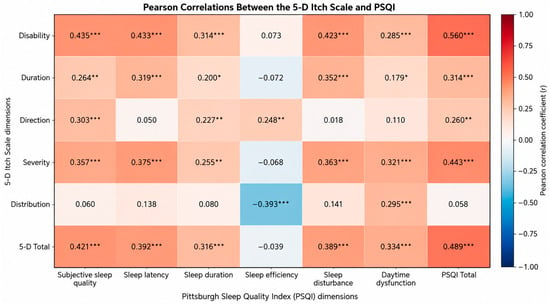
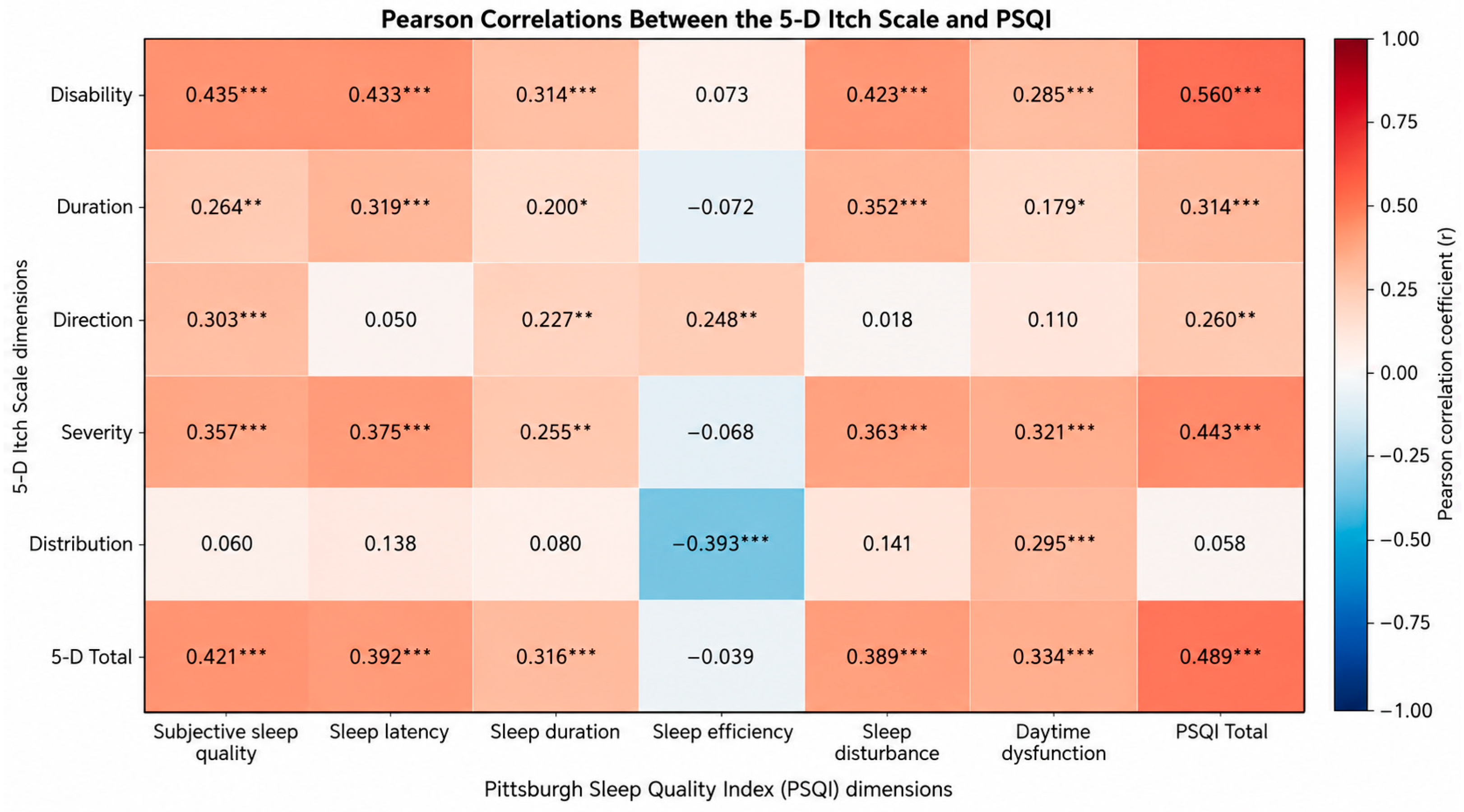
The relationship between the 5-D Itch Scale and the components of the PSQI in patients undergoing hemodialysis was evaluated using Pearson correlation analysis. The analysis revealed statistically significant positive correlations between the total pruritus score and subjective sleep quality (r = 0.421, p < 0.001), sleep latency (r = 0.392, p < 0.001), sleep duration (r = 0.316, p < 0.001), sleep disturbances (r = 0.389, p < 0.001), and daytime dysfunction (r = 0.334, p < 0.001).
However, no significant relationship was found between sleep efficiency and the total pruritus score (r = −0.039, p = 0.634). Additionally, a moderate positive and statistically significant correlation was identified between the total 5-D Itch Scale score and the total PSQI score (r = 0.489, p < 0.001). When the relationship between the components of the 5-D Itch Scale and the total PSQI score was examined, significant positive correlations were found between pruritus-related disability (r = 0.560, p < 0.001), duration of pruritus (r = 0.314, p < 0.001), course of pruritus (r = 0.260, p = 0.001), and severity of pruritus (r = 0.443, p < 0.001). In contrast, no significant correlation was observed between the body regions affected by pruritus and the total PSQI score (r = 0.058, p = 0.481) (Figure 1).
Figure 1.
Heatmap of Pearson correlations between the 5-D Itch Scale and PSQI components. * p < 0.05, ** p < 0.01, *** p < 0.001.
In the sensitivity analysis excluding the sleep-related item from the 5-D disability domain, the correlation between the modified disability score and PSQI total score remained statistically significant and was slightly stronger than that observed with the original disability score (Spearman’s ρ = 0.596 vs. 0.566, both p < 0.001).
3.3. The Comparison of the 5-D Itch Scale and PSQI Total Scores According to Sociodemographic Characteristics
The comparison of the 5-D Itch Scale and PSQI total scores according to sociodemographic characteristics is presented in Table 2. No significant differences were observed in the total 5-D Itch Scale scores according to gender (p = 0.106), marital status (p = 0.606), working status (p = 0.336), or smoking status (p = 0.615). However, the PSQI total score was significantly higher in female patients (14.73 ± 3.07) compared with male patients (12.31 ± 3.79) (t = −4.288, p < 0.001). Marital status, working status, and smoking were not significantly associated with PSQI total scores (p > 0.05) (Table 2).
Table 2.
The comparison of the 5-D Itch Scale and PSQI total scores according to sociodemographic characteristics.
Economic status was found to be significantly associated with both 5-D Itch Scale and PSQI total scores. Participants whose income was lower than their expenses had higher 5-D Itch Scale scores (13.65 ± 3.30) than those whose income was equal to their expenses (11.94 ± 2.53) or higher than their expenses (11.40 ± 3.68) (F = 6.217; p = 0.003). Similarly, participants whose income was lower than their expenses had higher PSQI total scores (14.84 ± 3.34) than those in the other economic status groups (F = 9.060; p < 0.001). The Tukey HSD test indicated that the groups differed in the order of a < b < c. Educational status was significantly associated with pruritus severity (F = 4.158, p = 0.007). The mean 5-D Itch Scale score was highest among patients with primary school education (13.62 ± 2.95) and lowest among those with secondary school education (11.53 ± 3.09). Tukey-HSD post hoc analysis demonstrated a significant difference between the primary and secondary school groups (p = 0.007), whereas no significant differences were observed among the other educational groups (Table 2).
3.4. Regression According to Sociodemographic Variables and 5-D Itch Scale
The regression model was statistically significant (F (9140) = 11.258, p < 0.001) and explained 38.3% of the variance in PSQI scores (adjusted R2 = 0.383). Gender, economic status, smoking status, and 5-D Itch Scale scores were significant predictors of PSQI scores, with the strongest standardized association observed for the 5-D Itch Scale (β = 0.390, p < 0.001). Disease duration showed a borderline statistically significant association with PSQI scores (β = 0.141, p ˂0.05), whereas age, marital status, education, and working status were not significant predictors (p > 0.05). VIF values (1.169–2.155) indicated no problematic multicollinearity (Table 3).
Table 3.
Regression according to sociodemographic variables and 5-D Itch Scale.
4. Discussion
The findings of this study demonstrated that pruritus severity was significantly associated with sleep quality among patients undergoing hemodialysis. As pruritus severity increased, sleep disturbances also increased, and pruritus severity showed a significant association with sleep quality in the multiple regression analysis. In addition, gender, economic status, disease duration, and smoking status were significantly associated with PSQI scores. These findings suggest that pruritus is an important clinical factor to consider when assessing sleep problems among patients undergoing hemodialysis. However, given the cross-sectional design of the study, these associations should not be interpreted as evidence of a causal relationship.
Chronic pruritus is not merely a physical symptom; it may also be associated with daily functioning, psychological well-being, and quality of life. Particularly when pruritus intensifies at night, it may interfere with sleep initiation, contribute to recurrent nocturnal awakenings, and be associated with reduced total sleep duration [19]. Previous studies have reported that sleep fragmentation and impaired subjective sleep quality are common among patients with chronic pruritus and may coexist with daytime fatigue and reduced quality of life [14,19]. The significant associations observed in the present study between pruritus severity and various dimensions of sleep quality are consistent with these findings. Therefore, assessment of pruritus in patients undergoing hemodialysis may also provide useful information when evaluating sleep-related problems.
Regarding the associations of sociodemographic variables with sleep quality, female participants had significantly higher PSQI scores than male participants, indicating poorer sleep quality among women. This finding is consistent with previous studies reporting a higher prevalence of sleep disturbances among women [20,21]. This difference in sleep quality may be related to several factors, including hormonal fluctuations, psychosocial stress, living conditions, and differences in symptom perception. However, in the present study, neither marital status nor employment status was significantly associated with pruritus severity or sleep quality. This finding is consistent with recent evidence indicating that associations between sociodemographic characteristics and sleep quality are not uniform across hemodialysis populations. For instance, Jamelo et al. reported no significant associations between sleep quality and sex, marital status, employment status, or BMI among hemodialysis patients, whereas recent evidence suggests that symptom-related factors such as pruritus and fatigue may be associated with sleep quality [22].
One notable finding of the present study was a significant association between economic status and both pruritus severity and sleep quality. Participants with income lower than their expenses had higher 5-D Itch Scale and PSQI total scores than those with income equal to or higher than their expenses. These findings suggest that economic circumstances may be relevant to the experience of pruritus and sleep disturbances among patients undergoing hemodialysis. Socioeconomic circumstances may coexist with psychological, social, and treatment-related factors that are also associated with symptom perception, disease management, and sleep quality. Previous studies have reported associations between pruritus severity and poor sleep quality among patients undergoing hemodialysis, which is consistent with the findings of the present study [15,23].
The observed association between economic status and pruritus severity may reflect broader socioeconomic circumstances rather than financial resources alone. Patients with fewer economic resources may potentially experience greater challenges in managing the demands of chronic kidney disease; however, the specific mechanisms underlying this association, including possible differences in access to healthcare services or treatment-related resources, were not directly assessed in the present study. Therefore, these explanations should be interpreted cautiously and considered possible hypotheses rather than established mechanisms. Our findings suggest that socioeconomic circumstances may be relevant when assessing patients undergoing hemodialysis who experience pruritus and sleep disturbances, alongside clinical and symptom-related factors. Previous studies have primarily focused on clinical factors associated with pruritus and sleep disturbances. The present findings suggest that socioeconomic circumstances may also warrant consideration in this context. Accordingly, assessment of both clinical symptoms and the economic and social circumstances of patients undergoing hemodialysis may provide additional contextual information for identifying individuals with greater symptoms and sleep-related burden and for considering appropriate supportive care [24].
In the present study, educational status was significantly associated with pruritus severity, with patients with primary school education having the highest 5-D Itch Scale scores, whereas those with secondary school education had the lowest scores. This finding is noteworthy in the context of chronic kidney disease-associated pruritus, which is a common and clinically burdensome symptom among patients undergoing hemodialysis. Evidence regarding the relationship between educational attainment and pruritus severity in hemodialysis patients remains limited. A recent mixed-methods study of 294 adults receiving hemodialysis used the 5-D Itch Scale and found no significant association between educational level and moderate-to-severe pruritus. However, previous pruritus-related education was significantly associated with moderate-to-severe pruritus in multivariable analysis. The authors suggested that this association may reflect greater exposure to education among patients experiencing more severe symptoms rather than a detrimental effect of education itself [25]. Our finding therefore differs from this recent evidence, as educational attainment was significantly associated with pruritus severity in our cohort. Differences in patient characteristics, educational categories, underlying comorbidities, cultural and socioeconomic factors, and the distribution of pruritus severity may partly explain this discrepancy.
The mechanism underlying pruritus is complex and multifactorial, involving inflammatory, immune, neurological, metabolic, and psychosocial pathways. Consequently, educational attainment is unlikely to have a direct biological effect on pruritus. The observed differences may partly reflect unmeasured factors such as health literacy, self-management practices, or access to healthcare. This interpretation is consistent with recent evidence emphasizing that pruritus is frequently under-recognized and under-reported, and that systematic assessment and patient-centered management are important components of hemodialysis care. [26] Recent literature has highlighted that limited patient awareness of pruritus, and its treatment options may contribute to under-reporting, while inadequate use of patient-reported outcome measures may result in missed recognition of symptom burden and treatment opportunities. [27] Therefore, the association between educational status and pruritus severity observed in our study may suggest that socioeconomic and health-literacy factors are related to differences in how pruritus is perceived, reported, and managed. Nevertheless, given the cross-sectional design of our study, this association should not be interpreted as causal; prospective studies are needed to clarify the independent contribution of educational and health literacy factors to pruritus severity in patients receiving hemodialysis.
The identification of pruritus severity as the variable showing the strongest association with sleep quality in the multiple regression analysis represents one of the key findings of this study. In addition, gender, income level, disease duration, and smoking status were significantly associated with PSQI scores. These findings suggest that sleep quality among patients undergoing hemodialysis is associated with multiple clinical, sociodemographic, and disease-related characteristics rather than with a single factor. Similarly, previous studies have reported that symptom severity, disease duration, and psychosocial factors may be associated with sleep quality among individuals experiencing chronic symptoms [3,28]. Therefore, a comprehensive and multidisciplinary approach may be appropriate when assessing sleep problems in patients undergoing hemodialysis.
Another noteworthy finding was the absence of a significant association between sleep efficiency and overall pruritus severity. Although pruritus has been associated with sleep disturbances and sleep loss, the relationship between pruritus severity and different dimensions of sleep may not always be consistent. Recent studies have demonstrated associations between itch intensity and sleep disturbance or sleep loss and have reported that reductions in pruritus severity were accompanied by improvements in overall sleep quality [29]. However, these findings do not establish that changes in pruritus directly lead to changes in sleep quality. Sleep efficiency may also be related to several other factors, including sleep habits, psychological status, other disease-related symptoms, and individual differences in coping with chronic pruritus. A recent study of individuals with chronic pruritus likewise emphasized that sleep quality represents an important but multidimensional aspect of the experience of pruritus [30].
Accordingly, the absence of a significant association between total pruritus scores and sleep efficiency in the present study may indicate that the association between pruritus and sleep differs across specific dimensions of sleep quality. Although participants with greater pruritus severity reported poorer subjective sleep quality, this pattern was not observed for sleep efficiency. One possible explanation is that subjective perceptions of sleep disturbance and nocturnal discomfort may not necessarily correspond to the proportion of time spent asleep relative to time spent in bed. However, the cross-sectional nature of the present study prevents determination of the direction of these associations. This finding further supports the multidimensional nature of the relationship between pruritus and sleep and highlights the importance of assessing different components of sleep quality separately.
Overall, the findings of this study indicate that pruritus severity is significantly associated with sleep quality among patients undergoing hemodialysis and that sleep quality is also associated with gender, economic status, disease duration, and smoking status. From a clinical perspective, these findings highlight the potential value of considering pruritus severity and sleep quality during the clinical assessment of patients receiving hemodialysis. In particular, patients reporting severe or persistent pruritus may warrant further assessment of sleep disturbances and related daytime consequences. Nurses and other healthcare professionals may consider these factors when identifying patients who require more comprehensive symptom assessment and individualized supportive care. Assessment of relevant socioeconomic circumstances may also provide additional contextual information when evaluating patients experiencing substantial symptom burden.
However, the present study does not establish the effectiveness of any specific intervention for improving pruritus or sleep quality. Although appropriate management of pruritus may be clinically relevant to reducing symptom burden, our cross-sectional findings cannot determine whether reducing pruritus would subsequently be associated with improved sleep quality. Similarly, the association between economic status and pruritus severity does not demonstrate that addressing financial circumstances would reduce pruritus or sleep disturbances. Therefore, specific interventions such as structured sleep-management programs, targeted psychosocial support, or socioeconomic interventions should be considered potential areas for further investigation rather than recommendations directly supported by the present findings. Longitudinal and intervention studies are needed to clarify the temporal and potentially causal relationships between pruritus severity, sleep quality, and other clinical and socioeconomic factors, and to determine whether targeted management of these factors is associated with improved sleep outcomes in patients undergoing hemodialysis.
4.1. Key Findings
Pruritus was significantly associated with impaired sleep quality in patients undergoing hemodialysis, with greater pruritus severity and overall symptom burden associated with longer sleep latency, shorter sleep duration, more frequent sleep disturbances, and increased daytime dysfunction. The moderate positive correlation between the total 5-D Itch Scale and PSQI scores further indicates that worsening pruritus burden parallels deterioration in overall sleep quality. Notably, pruritus severity, together with gender, income level, duration of diagnosis, and smoking status, independently contributed to variations in sleep quality, with the regression model explaining 38.3% of the variance in PSQI scores. These findings underscore the need to recognize pruritus and sleep disturbance as interconnected clinical concerns and support routine multidimensional assessment and integrated symptom management to improve the overall well-being and quality of life of patients undergoing hemodialysis.
4.2. Limitations
This study has several limitations that should be considered when interpreting the findings. First, the cross-sectional design does not allow causal relationships to be established between pruritus severity and sleep quality. Pruritus severity and sleep quality were assessed using self-reported instruments (the 5-D Itch Scale and PSQI); therefore, the findings may have been influenced by subjective perceptions and reporting bias. Second, the study was conducted with a relatively limited sample from a specific patient population and setting, which may limit the generalizability of the findings. In particular, the study was conducted among hemodialysis patients receiving treatment in Istanbul, and social, cultural, healthcare-system, and treatment-related characteristics specific to this setting may have influenced the observed associations. Therefore, the findings should be generalized cautiously to hemodialysis populations in other regions or countries, particularly where socioeconomic conditions, healthcare access, dialysis practices, and cultural characteristics differ. Third, although several sociodemographic and clinical variables were included in the regression model, other potentially relevant factors, such as depression, anxiety, and biochemical parameters, were not assessed and may have influenced sleep quality. In addition, the sociodemographic variables examined in this study may reflect broader social and environmental circumstances that were not directly assessed. Although economic status, gender, disease duration, and smoking status were associated with sleep quality, these findings should be interpreted as associations rather than causal effects. The present study cannot determine whether these factors have a direct effect on pruritus severity or sleep quality, or whether the observed associations may be partly attributable to unmeasured social, clinical, or environmental factors. Finally, temporal changes in pruritus severity or sleep quality were not evaluated. Longitudinal and multicenter studies involving larger and more diverse samples and more comprehensive clinical, psychosocial, and social variables are needed to confirm these findings and clarify the underlying pathways and direction of the observed associations.
Another limitation of this study is the possibility of residual confounding by clinical and treatment-related factors that were not systematically assessed or available for comprehensive adjustment in the present dataset. In hemodialysis patients, dialysis-related characteristics such as dialysis vintage, frequency and duration, dialysis adequacy, vascular access, treatment-related complications, and dialysis setting, as well as clinical factors including residual kidney function, diabetes and other comorbidities, hemoglobin, albumin, calcium/phosphate/parathyroid hormone levels, inflammation, xerosis, medications, depression, and anxiety, may influence both pruritus in patients undergoing hemodialysis and sleep quality. Therefore, the potential effects of these factors could not be fully evaluated or controlled for, and residual confounding cannot be excluded. Accordingly, the associations observed in the present study should be interpreted cautiously and should not be considered evidence of causality. Future prospective studies should incorporate comprehensive dialysis-related and clinical parameters and account for their potential confounding effects when investigating the relationship between pruritus and sleep quality in patients undergoing hemodialysis.
5. Conclusions
The findings of this study demonstrate that pruritus severity is significantly associated with sleep quality in patients undergoing hemodialysis. Higher pruritus severity was associated with poorer subjective sleep quality, longer sleep latency, shorter sleep duration, greater sleep disturbances, and greater daytime dysfunction. In addition, the total 5-D Itch Scale score showed a moderate positive correlation with the total PSQI score, indicating that greater pruritus severity was associated with poorer overall sleep quality.
Among the dimensions of pruritus, its impact on daily life (disability) showed the strongest association with sleep quality, whereas the body regions affected by pruritus were not significantly associated with PSQI scores. Sociodemographic characteristics were also associated with sleep quality. Female patients had poorer sleep quality than male patients, while lower economic status was associated with both greater pruritus severity and poorer sleep quality.
The multiple linear regression analysis showed that pruritus severity had the strongest statistical association with sleep quality among the variables included in the model, followed by gender, income, duration of diagnosis, and smoking status. Overall, these findings suggest that pruritus is an important factor associated with sleep quality in patients undergoing hemodialysis. Given the cross-sectional design of the study, these findings should not be interpreted as evidence of a causal or temporal relationship between pruritus and sleep quality. Therefore, routine assessment of both pruritus severity and sleep quality may be valuable in the clinical care of patients undergoing hemodialysis. Longitudinal and interventional studies are needed to determine whether changes in pruritus severity are followed by changes in sleep quality and to evaluate whether targeted management of pruritus can improve sleep outcomes.
Author Contributions
Conceptualization, D.B. and Z.A.; methodology: D.B. and Z.A.; formal analysis and investigation: D.B.; writing—original draft preparation: D.B. and Z.A.; writing—review and editing: D.B. and Z.A.; supervision: D.B. and Z.A. All authors have read and agreed to the published version of the manuscript.
Funding
This research received no external funding.
Institutional Review Board Statement
Before the study, ethical permission (27 May 2025/66517) was received from the Istanbul Atlas University Clinical Research Ethics Committee to conduct the research. The Declaration of Helsinki was adhered to throughout the study. After the purpose of the study was explained, written consent was obtained from the participants who agreed to participate.
Informed Consent Statement
Participation was voluntary, and written and verbal consent was obtained from each individual.
Data Availability Statement
The datasets generated and/or analyzed during the current study are not publicly available because they contain potentially identifiable participant information and were collected under ethical approval that limits public data sharing. The data are available from the corresponding author upon reasonable request, subject to approval by the relevant ethics committee and in accordance with institutional and data protection regulations.
Acknowledgments
We thank all participants.
Conflicts of Interest
The authors declare no conflicts of interest.
References
- Stevens, P.E.; Ahmed, S.B.; Carrero, J.J.; Foster, B.; Francis, A.; Hall, R.K.; Herrington, W.G.; Hill, G.; Inker, L.A.; Kazancıoğlu, R.; et al. KDIGO 2024 clinical practice guideline for the evaluation and management of chronic kidney disease. Kidney Int. 2024, 105, 117–314. [Google Scholar] [CrossRef] [Scilit] [PubMed]
- Mark, P.B.; Stafford, L.K.; Grams, M.E.; GBD 2023 Chronic Kidney Disease Collaborators. Global, regional, and national burden of chronic kidney disease in adults, 1990–2023, and its attributable risk factors: A systematic analysis for the Global Burden of Disease Study 2023. Lancet 2025, 406, 2461–2482. [Google Scholar] [CrossRef] [Scilit] [PubMed]
- Sinikumpu, S.P.; Jokelainen, J.; Tasanen, K.; Timonen, M.; Huilaja, L. Association between pruritus and psychosocial well-being: A population-based study among 6809 subjects. Acta Derm.-Venereol. 2023, 103, 2922. [Google Scholar] [CrossRef] [Scilit] [PubMed]
- Kim, D.; Pollock, C. Epidemiology and burden of chronic kidney disease-associated pruritus. Clin. Kidney J. 2021, 14, i1–i7. [Google Scholar] [CrossRef] [Scilit] [PubMed]
- Titapiccolo, J.I.; Lonati, C.; Goethel-Paal, B.; Bello, A.R.; Bellocchio, F.; Pizzo, A.; Theodose, M.; Salvador, M.E.B.; Schofield, M.; Cioffi, M.; et al. Chronic kidney disease-associated pruritus (CKD-aP) is associated with worse quality of life and increased healthcare utilization among dialysis patients. Qual. Life Res. 2023, 32, 2939–2950. [Google Scholar] [CrossRef] [Scilit] [PubMed]
- Ko, M.J.; Peng, Y.S.; Wu, H.Y. Uremic pruritus: Pathophysiology, clinical presentation, and treatments. Kidney Res. Clin. Pract. 2023, 42, 39–52. [Google Scholar] [CrossRef] [Scilit] [PubMed] [PubMed Central]
- Sukul, N.; Karaboyas, A.; Csomor, P.A.; Schaufler, T.; Wen, W.; Menzaghi, F.; Rayner, H.C.; Hasegawa, T.; Al Salmi, I.; Al-Ghamdi, S.M.G.; et al. Self-reported pruritus and clinical, dialysis-related, and patient-reported outcomes in hemodialysis patients. Kidney Med. 2021, 3, 42–53. [Google Scholar] [CrossRef] [Scilit] [PubMed]
- Rehman, I.U.; Chohan, T.A.; Bukhsh, A.; Khan, T.M. Impact of pruritus on sleep quality of hemodialysis patients: A Systematic Review and Meta-Analysis. Medicina 2019, 55, 699. [Google Scholar] [CrossRef] [Scilit] [PubMed] [PubMed Central]
- Al Naamani, Z.; Gormley, K.; Noble, H.; Santin, O.; Maqbali, M.A. Fatigue, anxiety, depression, and sleep quality in patients undergoing hemodialysis. BMC Nephrol. 2021, 22, 157. [Google Scholar] [CrossRef] [Scilit] [PubMed]
- Tan, L.H.; Chen, P.S.; Chiang, H.Y.; King, E.; Yeh, H.C.; Hsiao, Y.L.; Chang, D.R.; Chen, S.H.; Wu, M.Y.; Kuo, C.C. Insomnia and poor sleep in CKD: A systematic review and meta-analysis. Kidney Med. 2022, 4, 100458. [Google Scholar] [CrossRef] [Scilit] [PubMed]
- Huang, C.H.; Cheng, C.S.; Yen, M. Factors associated with poor sleep quality in patients with pre-dialysis chronic kidney disease: A systematic review. J. Adv. Nurs. 2023, 79, 2043–2057. [Google Scholar] [CrossRef] [Scilit] [PubMed]
- Yoshida, N.; Tanaka, T.; Suzuki, Y.; Takahashi, S.; Hitaka, M.; Ishii, S.; Yamazaki, K.; Ohashi, Y. Sleep quality and its association with quality of life and mortality in hemodialysis patients. J. Clin. Med. 2025, 14, 8729. [Google Scholar] [CrossRef] [Scilit] [PubMed]
- Matsui, K.; Yoshiike, T.; Nagao, K.; Utsumi, T.; Tsuru, A.; Otsuki, R.; Ayabe, N.; Hazumi, M.; Suzuki, M.; Saitoh, K.; et al. Association of subjective quality and quantity of sleep with quality of life among a general population. Int. J. Environ. Res. Public Health 2021, 18, 12835. [Google Scholar] [CrossRef] [Scilit] [PubMed]
- Wang, T.; Goh, J.X.; Seth, S.; Do, L.L.; Tesfaye, W.; Sud, K.; Van, C.; Small, F.; Tarafdar, S.; Castelino, R.L. Chronic kidney disease-associated pruritus and patient-centred outcomes: A systematic review. J. Nephrol. 2025, 38, 371–391. [Google Scholar] [CrossRef] [Scilit] [PubMed] [PubMed Central]
- Almutary, H. Fatigue and pruritus impact sleep quality in hemodialysis patients. Nat. Sci. Sleep 2024, 16, 2289–2298. [Google Scholar] [CrossRef] [Scilit] [PubMed] [PubMed Central]
- Ege, T.; Ok, E.; Ünver, V. The effect of itching on sleep quality and comfort in patients with hemodialysis and renal transplantation: A multi-center cross-sectional study. J. Tissue Viability 2024, 33, 903–908. [Google Scholar] [CrossRef] [Scilit] [PubMed]
- Ersoy, N.A.; Akyar, İ. Validity and reliability of 5-D itch scale on chronic disease patients. Acıbadem Üniversitesi Sağlık Bilimleri Dergisi 2018, 9, 455–461. [Google Scholar]
- Agargun, M.Y. Pittsburgh uyku kalitesi indeksinin gecerligi ve guvenirligi. Turk. J. Psychiatry 1996, 7, 107–115. [Google Scholar]
- Wasim, A.U.; Miriyala, S.A.; Haward, R.; Hammoud, Z.; Agarwal, P.; Kaka, N.; Patel, N.; Sethi, N.; Sethi, Y.; Gupta, P. Sleep disturbance and chronic urticaria: A narrative review of its relationship, treatment and evolving literature. Health Sci. Rep. 2025, 8, e70777. [Google Scholar] [CrossRef] [Scilit] [PubMed]
- Thalib, H.I.; Ali, S.H.; Shaikh, A.H.; Ikram, N.M.; Khan, S.R.; Jamal, A.M.; Bajri, R.O.; Ikram, H.N. Prevalence of poor sleep quality among adults in Jeddah, Saudi Arabia. Med. Sci. 2024, 28, 1–8. [Google Scholar] [CrossRef] [Scilit]
- Perger, E.; Silvestri, R.; Bonanni, E.; Di Perri, M.C.; Fernandes, M.; Proini, F.; Zoccoli, G.; Lombardi, C. Gender medicine and sleep disorders: From basic science to clinical research. Front. Neurol. 2024, 15, 1392489. [Google Scholar] [CrossRef] [Scilit] [PubMed]
- Jamelo, J.P.; Valdepenas, A.N.; Fadriquela, D.L.; Gueco, I. #235 Quality of sleep and the quality of life in chronic kidney disease patients undergoing hemodialysis in a tertiary hospital in the Philippines. Nephrol. Dial. Transplant. 2024, 39, gfae069-1421-235. [Google Scholar] [CrossRef] [Scilit]
- Malhotra, K.; Desai, T.; Ficociello, L.H.; Arens, H.J.; Lasky, R.A.; Anger, M.S. Association of chronic kidney disease-associated pruritus with the sleep disturbance, depression, pain, anxiety, and low energy/fatigue symptom cluster: A Retrospective Cohort Study. Kidney Med. 2025, 8, 101162. [Google Scholar] [CrossRef] [Scilit] [PubMed] [PubMed Central]
- Manuel Buades, J.; Figueras-Nart, I.; Goicoechea, M.; Sánchez Villanueva, R.J.; Serra-Baldrich, E.; En Representación del Grupo Español de Prurito Asociado a ERC. Information and consensus document for the diagnostic and therapeutic management of pruritus associated with chronic kidney disease in patients on haemodialysis in Spain. Nefrologia 2024, 44, 465–474. [CrossRef] [Scilit] [PubMed]
- Turgay, G.; Özdemir Eler, Ç. Chronic kidney disease-associated pruritus in hemodialysis: A mixed-methods study of symptom burden and patient experience. J. Ren. Care 2026, 52, e70075. [Google Scholar] [CrossRef] [Scilit] [PubMed] [PubMed Central]
- Latus, J.; Lanot, A.; Ständer, S.; Sanchez-Alvarez, E.; Aucella, F.; Yosipovitch, G. CKD-associated pruritus in haemodialysis: A road map for diagnosis and treatment. Clin. Kidney J. 2025, 18, sfaf096. [Google Scholar] [CrossRef] [Scilit] [PubMed] [PubMed Central]
- Faucon, A.L.; Clase, C.M.; Rydell, H.; Uhde, M.; Barany, P.; Evans, M.; Carrero, J.J. Burden of CKD-Associated Pruritus and Adverse Clinical Outcomes in Patients Receiving Dialysis: The Stockholm Creatinine Measurements (SCREAM) Project. Am. J. Kidney Dis. 2025, 85, 45–54.e1. [Google Scholar] [CrossRef] [Scilit] [PubMed]
- Jeele, M.O.O.; Adam, A.M.; Addow, R.O.B. Unveiling the burden of pruritus: Its prevalence and impact on sleep quality in hemodialysis patients in Somalia. Int. J. Gen. Med. 2025, 18, 473–482. [Google Scholar] [CrossRef] [Scilit] [PubMed]
- Yosipovitch, G.; Gooderham, M.J.; Ständer, S.; Fonacier, L.; Szepietowski, J.C.; Deleuran, M.; Girolomoni, G.; Su, J.C.; Bushmakin, A.G.; Cappelleri, J.C.; et al. Interpreting the Relationship Among Itch, Sleep, and Work Productivity in Patients with Moderate-to-Severe Atopic Dermatitis: A Post Hoc Analysis of JADE MONO-2. Am. J. Clin. Dermatol. 2024, 25, 127–138. [Google Scholar] [CrossRef] [Scilit] [PubMed] [PubMed Central]
- Mann, C.; Staubach, P. Lebens und Schlafqualität bei Patienten mit chronischem Pruritus [Quality of life and sleep quality in patients with chronic pruritus]. Dermatologie 2024, 75, 612–616. [Google Scholar] [CrossRef] [Scilit] [PubMed]

Disclaimer/Publisher’s Note: The statements, opinions and data contained in all publications are solely those of the individual author(s) and contributor(s) and not of MDPI and/or the editor(s). MDPI and/or the editor(s) disclaim responsibility for any injury to people or property resulting from any ideas, methods, instructions or products referred to in the content. |
© 2026 by the authors. Licensee MDPI, Basel, Switzerland. This article is an open access article distributed under the terms and conditions of the Creative Commons Attribution (CC BY) license.