


Simple Summary
Melanoma diagnosed during pregnancy or in the postpartum period presents challenges because therapeutic decisions may affect maternal health and pregnancy outcomes. This review integrates evidence from 16 publications, including four additional observational studies identified through expanded database searching. Contemporary comparative cohorts provide tumor-stage, Breslow-thickness, treatment and survival information; population-level evidence does not consistently demonstrate a worse prognosis attributable to pregnancy itself. In contrast, pregnancy-specific evidence for immune checkpoint inhibitors and BRAF/MEK inhibitors remains limited and is insufficient to establish fetal safety. Clinical decisions should incorporate melanoma severity, gestational age, maternal preferences, alternatives, multidisciplinary counselling and explicit communication of uncertainty.
Abstract
Background: Pregnancy-associated melanoma requires integration of maternal cancer prognosis with treatment, obstetric and fetal considerations. Methods: PubMed/MEDLINE and OpenAlex searches were supplemented with Scopus and Web of Science Core Collection through 15 October 2026. The four export sets yielded 3460 records; conservative DOI/title deduplication retained 2642 unique records, after independent adjudication of 21 discordant-identifier groups. In accordance with the authors’ eligibility decisions, 16 publications (12 original and four newly identified observational studies) were retained for a narrative synthesis. Results: Davidson et al. reported comparable five-year overall survival in 83 pregnancy-associated melanoma patients and 309 matched controls (97% versus 97%). Kostaki et al. described 70 pregnancy-associated melanomas within a 1270-woman European cohort, with a mean Breslow thickness of 1.16 mm and five-year recurrence-free survival of 95%. Grippaudo et al. reported multidisciplinary surgical management in 20 pregnant patients. Borgers et al. described 72 women with advanced melanoma across two partly overlapping pregnancy-related groups, illustrating high maternal and perinatal risks and variation in treatment timing. Conclusions: Pregnancy itself is not consistently associated with adverse melanoma prognosis after accounting for disease characteristics, whereas treatment safety in gestation remains insufficiently established. Stage-specific, multidisciplinary and autonomy-respecting decisions are required; the evidence remains heterogeneous and registry populations must not be counted twice.
1. Introduction
Melanoma is among the malignancies most frequently encountered during pregnancy, reflecting its occurrence in women of reproductive age. Although pregnancy-associated melanoma (PAM) remains uncommon, its management poses distinctive clinical challenges because diagnostic and therapeutic decisions may simultaneously affect maternal prognosis, pregnancy course, and fetal or neonatal outcomes. These challenges become particularly complex in advanced disease, when postponing effective anticancer treatment may compromise maternal health, whereas treatment during pregnancy may expose the developing fetus to risks that are incompletely characterized.
Whether pregnancy itself adversely affects melanoma prognosis has long been debated. Pregnancy induces substantial endocrine and immunological adaptations, historically raising concerns that these changes could influence melanoma progression. However, available clinical evidence has been inconsistent. Large population-based studies have not demonstrated a uniform adverse prognostic effect associated with pregnancy, whereas selected analyses have reported increased mortality in postpartum melanoma [1,2]. A recent meta-analysis likewise found no consistent independent survival disadvantage after accounting for stage and study quality [3].
The introduction of immune checkpoint inhibitors and molecularly targeted therapies has added a new dimension to this clinical problem. These agents have substantially changed the prognosis of advanced melanoma, yet pregnant women are generally underrepresented or excluded from prospective therapeutic trials. Consequently, evidence regarding treatment during pregnancy remains largely derived from case reports, small case series, retrospective observations, and pharmacovigilance data. Current diagnosis, staging and management options are contextualized by the ESMO guideline for cutaneous melanoma [4].
This uncertainty has implications extending beyond conventional oncologic risk-benefit assessment. Pregnancy introduces fetal interests into clinical decision-making while the pregnant woman remains the autonomous decision-maker. Maternal and fetal interests cannot necessarily be conceptualized as opposing: avoiding fetal drug exposure by withholding or delaying maternal treatment may itself increase the likelihood of maternal deterioration, emergency delivery, prematurity, or fetal compromise.
Accordingly, the central ethical challenge is often not the choice between a demonstrably safe and a demonstrably harmful intervention, but decision-making between alternatives characterized by different and incompletely quantifiable risks. Informed consent therefore requires explicit communication not only of established benefits and harms but also of the limits of available evidence. Distinguishing known risks, biologically plausible risks, and genuinely uncertain or non-quantifiable risks becomes particularly important.
The primary aim of this systematic review was to synthesize the available evidence regarding maternal prognosis, oncologic management, and obstetric, fetal, and neonatal outcomes in melanoma occurring during or in temporal association with pregnancy. A secondary objective was to examine how clinical decisions are reported in situations of therapeutic uncertainty, with particular attention to maternal autonomy, fetal interests, multidisciplinary assessment, informed consent, shared decision-making, and the medico-legal relevance of decision-making processes.
2. Materials and Methods
2.1. Review Design and Reporting
This systematic review was designed to integrate clinical evidence concerning melanoma in relation to pregnancy with a structured analysis of therapeutic decision-making in situations of maternal-fetal uncertainty. The review was reported with reference to the PRISMA 2020 statement [5], and a PRISMA 2020 reporting checklist and location audit is provided as Supplementary S1. The review protocol was not prospectively registered. Given the expected heterogeneity of study designs, populations, definitions of pregnancy-associated melanoma, therapeutic exposures, and reported outcomes, a narrative evidence synthesis was planned.
2.2. Information Sources and Search Strategy
The original electronic searches were conducted in PubMed/MEDLINE and OpenAlex through 17 September 2026. PubMed/MEDLINE used (“Melanoma”[Mesh] OR melanoma) AND (“Pregnancy”[Mesh] OR pregnan* OR gestation*), restricted to Humans and English but not by publication type or full-text availability (115 records); OpenAlex contributed 21 records. In response to peer review, Scopus was searched on 14 October 2026 using TITLE-ABS-KEY (melanoma* AND (pregnan* OR gestation* OR postpartum OR “post-partum” OR antepartum OR antenatal OR peripartum OR prenatal)); 2598 unfiltered records and 2296 English-language records were identified. Web of Science Core Collection was searched on 15 October 2026 using TS = (melanoma* AND (pregnan* OR gestation* OR postpartum OR “post-partum” OR antepartum OR antenatal OR peripartum OR prenatal)); 1092 unfiltered and 1028 English-language records were identified. No year, document-type or open-access restriction was applied to these supplementary exports. All four search exports were retained and cross-referenced using normalized DOI and title. A Cochrane Library query on 14 October 2026 returned 111 CENTRAL records and one editorial, but full record export was unavailable; these records were not incorporated into the formal screening denominator. All reported counts relate to records, not distinct studies or patients. Database-specific search strategies and the deduplication audit are provided in Supplementary S2.
2.3. Eligibility Criteria
Eligibility for the primary clinical synthesis required original evidence on melanoma diagnosed during pregnancy or postpartum, or melanoma-treatment exposure during gestation, with maternal oncologic or pregnancy/offspring outcomes. Original observational cohorts, case series and case reports contributed primary evidence; for hybrid case reports with embedded reviews, only original patients were extracted. Four previously included systematic, narrative or counselling publications were retained separately as contextual references; they contributed no independent patients, effect estimates or event denominators to the primary synthesis. Thus, the 16 publications discussed comprise 12 primary reports and four secondary/contextual publications, not 16 independent primary studies. Following the first-round reviewers’ recommendation to broaden the search, Scopus identified four additional eligible primary reports (Davidson [6], Grippaudo [7], Borgers [8] and Kostaki [9]); Web of Science yielded no further included reports. Pregnancy-time diagnosis, postpartum melanoma, recurrence during gestation, and treatment exposure at or after conception were distinguished where reported.
2.4. Evidence Classification and Management of Overlapping Data
The 12 primary reports comprised six observational cohort or case-series publications (Cairncross [1], Johansson [2], Davidson [6], Grippaudo [7], Borgers [8] and Kostaki [9]) and six case-based/hybrid reports contributing eight original patient-level cases (Bou Zerdan [10], Gulino [11], Melus [12], Mendizábal [13], Vurture [14] and Xu [15]). Four additional publications—Andrikopoulou [16], Lannoo [17], Stylianakis [3], and Todd and Driscoll [18]—were used solely for background, triangulation and interpretation, not as independent clinical datasets. Patients summarized within earlier reviews were never counted again. The preliminary Borgers 2024 conference abstract was not considered an independent report of the 2025 full registry publication [8]. The six primary observational studies were presented separately, without pooling participants or assuming absence of registry overlap.
2.5. Data Extraction
Data extraction used a prespecified domain structure covering study design, definition and timing of pregnancy association, histological subtype, AJCC stage, Breslow thickness, ulceration, molecular status when available, gestational timing of diagnosis and therapy, maternal prognosis, obstetric outcomes, neonatal outcomes, and reported elements of informed decision-making. Data from the four additional studies were checked against their corresponding published records; unavailable information was coded as not reported. Review populations were classified separately from primary patient samples, and study denominators were not summed across potentially overlapping cohorts. Two reviewers independently screened titles/abstracts, examined eligible full texts, extracted study data and determined inclusion. The authors report no disagreements in these procedures.
2.6. Outcomes
Primary outcomes were maternal oncologic outcomes (overall survival, melanoma-specific survival, progression, recurrence, and response) and pregnancy/offspring outcomes (pregnancy loss, gestational age at delivery, prematurity, fetal growth restriction, congenital abnormalities, neonatal morbidity/mortality, and longer-term pediatric outcomes when available). Secondary outcomes included treatment feasibility, adverse events, treatment deferral, delivery planning, and reported elements of multidisciplinary and shared decision-making.
2.7. Ethical and Medico-Legal Analytical Framework
A structured interpretative framework focused on maternal autonomy, maternal benefit, fetal interests, and proportionality. Therapeutic uncertainty was categorized as documented risk, plausible but incompletely established risk, or unknown/non-quantifiable risk. The analysis did not retrospectively determine whether individual decisions were legally or ethically correct; instead, it examined reported elements relevant to a high-quality decision-making process and distinguished outcome-based retrospective judgment from ex-ante reasonableness.
2.8. Critical Appraisal of the Included Evidence
Two reviewers independently performed design-specific methodological appraisal using the Joanna Briggs Institute cohort (11 items), case-series (10 items), and case-report (8 items) checklists for primary studies [19]. For hybrid original case reports with an embedded literature review, only patients originally described in those reports were appraised as original evidence. Systematic evidence syntheses were assessed descriptively with applicable AMSTAR 2 domains [20]; non-systematic narrative and counselling sources were retained for context without a formal outcome risk-of-bias rating. A source-based narrative appraisal summary is provided in Supplementary S2; original reviewer-level item judgments are not reproduced. No numerical checklist totals were calculated. The two reviewers independently completed the appraisal without disagreements, as confirmed by the authors. Supplementary S2 provides study-level methodological summaries rather than the original item-level assessor worksheets.
2.9. Data Synthesis
Because of substantial clinical and methodological heterogeneity, no overall quantitative pooling was performed. Results were synthesized according to maternal prognosis and survival; advanced melanoma during pregnancy; systemic anticancer treatment; obstetric, fetal, and neonatal outcomes; pregnancy after melanoma diagnosis/treatment; and clinical decision-making with ethical and medico-legal considerations.
3. Results
3.1. Study Selection
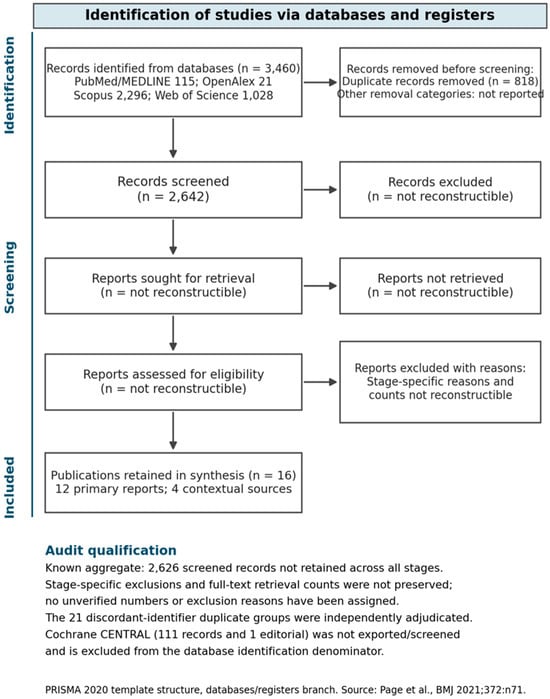
The updated searches yielded 3460 exported records: PubMed/MEDLINE (n = 115), OpenAlex (n = 21), Scopus (English-language records; n = 2296) and Web of Science Core Collection (English-language records; n = 1028). A conservative DOI/normalized-title deduplication algorithm identified 818 duplicate records, provisionally leaving 2642 distinct records. Twenty-one title-matched groups with discordant DOI identifiers were independently adjudicated by two reviewers and confirmed to represent the same publications. Assuming one further redundant record per group, these contributed 21 additional duplicates beyond the initial 797 algorithmic duplicates. Following the authors’ eligibility decisions, 16 publications were retained (12 from the original review and four additional primary studies: Davidson [6], Grippaudo [7], Borgers [8] and Kostaki [9]). The aggregate number of unique records not retained was 2626, under the two-reviewer deduplication decisions. The available aggregated screening archive does not reliably distinguish the numbers excluded after title/abstract screening from those excluded following full-text assessment; these stage-specific values are consequently not assigned retrospectively. Cochrane CENTRAL yielded 111 trial records and one editorial, but the records could not be exported or screened and are not counted among the 3460 records in Figure 1.
Figure 1.
Study selection according to the PRISMA 2020 flow-diagram structure for database searches. Of 3460 identified records, 818 duplicates were removed and 2642 records were screened. The retained synthesis comprises 12 primary reports and four secondary/contextual publications. Historical title/abstract and full-text stage counts are unavailable and were not imputed. Cochrane CENTRAL results were not exported or included in the denominator. Based on Page et al. [5].
3.2. Characteristics of the Included Evidence
The characteristics and role of all 16 included publications are summarized in Table 1. The clinical characteristics and outcomes of individual patients are presented in Table 2.
Table 1.
Characteristics and role of the 16 publications retained in the revised evidence set.
Table 2.
Individual melanoma cases: clinical characteristics, treatment timing and maternal–fetal outcomes.
Of the 16 publications discussed, 12 provide original primary clinical evidence: six observational studies and six case-based/hybrid reports describing eight original cases. The remaining four are secondary/contextual publications and do not enter patient-level denominators or outcome synthesis as independent studies. The four primary studies added following the first review round were identified through Scopus and provide further data on Breslow thickness, stage, surgery, pregnancy outcomes and survival; their distinct populations and outcomes were not pooled.
Four Additional Primary Studies Identified Through Scopus Following First-Round Peer Review
Davidson et al. [6] retrospectively compared 83 women with pregnancy-associated melanoma with 309 matched controls, reporting stage distribution (80% stage I, 2.4% stage II, 13% stage III, 4.8% stage IV), mean Breslow thickness 0.79 mm, and comparable five-year overall survival (97% versus 97%) and recurrence-free survival (96% versus 96%). Grippaudo et al. [7] reported a bicentric series of 20 pregnant women, 13 managed by wide local excision alone and seven by excision with sentinel lymph node biopsy; no surgery-related maternal or fetal complications were reported. Borgers et al. [8] analyzed 72 women with advanced melanoma across 23 institutions: 63 were diagnosed with advanced melanoma during pregnancy, whereas 10 conceived during systemic therapy; one woman belonged to both groups (63 + 10 − 1 = 72). The publication described treatment and pregnancy outcomes separately for advanced disease during pregnancy versus conception during systemic therapy. Kostaki et al. [9] evaluated 1270 women in a five-country European cohort, including 70 pregnancy-associated melanomas, with mean Breslow thickness 1.16 mm, 80% superficial spreading histology and five-year recurrence-free survival of 95%. These four reports are described individually without summing denominators.
3.3. Maternal Prognosis and Survival
Johansson et al. [2] reported no overall excess mortality for pregnancy-associated cutaneous malignant melanoma compared with non-pregnancy-associated melanoma (adjusted HR 0.99; 95% CI 0.75–1.31). Their main timing-specific analyses did not show increased mortality for cutaneous malignant melanoma diagnosed during pregnancy or within the first two postpartum years, although finer interval analyses identified a signal at 18–24 months postpartum. Cairncross et al. [1], in contrast, identified an increased adjusted mortality hazard for melanoma diagnosed within one year postpartum (aHR 1.84; 95% CI 1.02–3.30). Stylianakis et al. [3] found no statistically significant difference in overall survival for melanoma diagnosed during pregnancy (HR 1.13; 95% CI 0.19–6.70) or postpartum (HR 1.14; 95% CI 0.39–3.38); the stage-matched pooled estimate across endpoints was HR 0.85 (95% CI 0.73–1.00). Overall, the available evidence does not demonstrate a consistent independent adverse prognostic effect of pregnancy itself, but postpartum estimates remain heterogeneous and require cautious interpretation. The expanded comparative evidence is concordant with this cautious interpretation: Davidson et al. [6] found similar five-year overall and recurrence-free survival between pregnancy-associated melanoma patients and stage-matched controls; Kostaki et al. [9] found no significant difference in recurrence-free survival between pregnancy-associated and non-pregnancy-associated melanoma in their multicentre European cohort. The two studies used different clinical settings and pregnancy association definitions, and their survival proportions should not be pooled.
3.4. Advanced Melanoma During Pregnancy
Advanced disease was associated with the most clinically complex maternal and perinatal courses. Mendizábal et al. [13] reported two original cases, including metastatic melanoma diagnosed at 26 weeks with fatal maternal and neonatal outcomes. Gulino et al. [11] described a 36-year-old woman at 27 + 2 weeks with an approximately 11 cm primary lesion and hepatic metastases, followed by clinical deterioration and urgent cesarean delivery. These observations emphasize that fetal and neonatal risk may arise from severe maternal disease itself, not only from anticancer therapy. The updated registry evidence by Borgers et al. [8] demonstrated the different baseline risk profile of advanced melanoma: 63 women were diagnosed with advanced melanoma during pregnancy, while 10 conceived during systemic therapy; one woman was included in both groups, yielding 72 distinct women. Five-year overall survival estimates were 53% (95% CI 39–71%) and 71% (95% CI 51–100%), respectively. These are separate descriptive, non-comparative strata, not evidence that either pregnancy state improves survival.
3.5. Immune Checkpoint Inhibitor Exposure
Andrikopoulou et al. [16] identified seven pregnancies and nine neonates following immunotherapy exposure. Mean gestational age at delivery was 30.4 weeks, eight of nine neonates were premature, and mean neonatal birth weight was 1267 g. Pregnancy adverse events were reported in five of seven cases. These proportions should not be interpreted as treatment-attributable risk estimates because of severe underlying disease, small sample size, heterogeneous exposures, and publication bias. Bou Zerdan et al. [10] reported two additional original melanoma cases: one patient received a final pembrolizumab dose five days after conception and subsequently delivered a healthy term infant without complications; the second conceived while receiving adjuvant nivolumab and miscarried at 13 weeks. Neither patient experienced an immune-related adverse event during pregnancy, and both had no evidence of disease at follow-up. Xu et al. [15] described nivolumab exposure through 7 + 6 weeks of gestation, subsequent discontinuation, delivery at 33 weeks, fetal growth restriction, and congenital hypothyroidism reported as a possible fetal immune-related adverse event.
3.6. BRAF/MEK-Targeted Therapy
BRAF-directed inhibitors target oncogenic mutant BRAF (most commonly BRAF V600 variants), whereas MEK inhibitors act downstream on MEK1/2 within the MAPK pathway; these mechanisms should not be conflated. Melus et al. [12] reported a woman with previously resected cutaneous melanoma (Breslow 1.1 mm, initially stage IIA) who presented at 24 + 2 weeks of gestation with brain metastases carrying a BRAF V600E mutation. After neurosurgical management, dabrafenib (mutant BRAF inhibitor) plus trametinib (MEK1/2 inhibitor) was initiated at 30 + 1 weeks following multidisciplinary counselling and informed consent. Emergency cesarean delivery at 33 + 6 weeks followed a seizure. The neonate weighed 2030 g and experienced complications of prematurity requiring neonatal intensive care, while subsequent corrected-age neurodevelopmental assessments were within the reported normal range. This exceptional case does not establish fetal safety of combined targeted treatment.
3.7. Obstetric, Fetal, and Neonatal Outcomes
Reported obstetric and neonatal outcomes varied markedly with disease stage, intervention timing, and the purpose of delivery. Among the individual case reports, Bou Zerdan et al. [10] described both a healthy term birth after periconceptional pembrolizumab exposure and a miscarriage at 13 weeks after nivolumab exposure, without establishing drug causality. Melus et al. [12] reported cesarean delivery at 33 + 6 weeks and neonatal respiratory and neurologic complications after a maternal seizure in the setting of metastatic disease and targeted therapy. Vurture et al. [14] described a healthy term infant following planned induction and vaginal birth after cesarean, with melanoma surgery subsequently performed in the postpartum period. Xu et al. [15] described fetal growth restriction and neonatal congenital hypothyroidism after early gestational nivolumab exposure. Study-specific timing and outcomes are shown in Table 2; the available case-based reports should not be converted into treatment-attributable adverse-event rates. Borgers et al. [8] reported nine pregnancy terminations and two miscarriages in the group diagnosed with advanced melanoma during gestation, with median gestational age at live birth of 34 weeks; the group conceiving during systemic treatment had four terminations, one miscarriage and a median gestational age of 33 weeks among live births. These reports arise from very different severity and exposure contexts and should not be interpreted as treatment-attributable risks. Grippaudo et al. [7] did not observe maternal or fetal complications related to the described surgical procedures.
3.8. Pregnancy-Specific Diagnostic and Management Considerations
Lannoo et al. [17] addressed incidental suspicion of maternal malignancy through abnormal non-invasive prenatal testing, emphasizing diagnostic uncertainty, communication with prospective parents, and multidisciplinary management. Although not a melanoma-specific outcome cohort, the paper illustrates how pregnancy-related testing may unexpectedly generate maternal oncologic information with simultaneous maternal and fetal implications.
3.9. Decision-Making and Ethical Domains
The published patient-level cases differed in what they reported about treatment alternatives and counselling. The report by Melus et al. [12] describes a multidisciplinary choice among immediate delivery, antepartum systemic treatment, and surveillance after progressive intracranial disease. Vurture et al. [14] describe a preference-sensitive decision about induction and trial of labor after cesarean at term. Such narratives provide examples of decision processes but do not establish that comparable processes were absent from studies where they were not described. Table 2 prioritizes observed clinical and perinatal data over a binary reporting score.
3.10. Critical Appraisal of the Evidence
The design-specific methodological appraisal summarized in Table 3 and Supplementary S2 identified residual confounding and selection bias as the dominant threats in observational evidence. Johansson et al. [2] could not adjust for tumor stage or treatment, whereas Cairncross [1] and Davidson [6] included stage in their analytic approach; the specialist-center cohorts nonetheless remain vulnerable to referral and unmeasured prognostic factors. Borgers [8] provides management data from a multicenter advanced-disease registry, but treatment selection is confounded by maternal disease severity and clinical urgency. The focused Grippaudo case series [7] is descriptive, and outcome comparisons cannot establish surgical or fetal safety. Individual cases give valuable diagnostic and treatment timelines but cannot quantify risk, establish causation, or ensure generalizability. Secondary systematic syntheses [3,16] were not used as independent patient denominators; narrative sources [17,18] were retained for context only. Study-level methodological summaries are provided in Supplementary S2; original item-level assessor worksheets are not reproduced. Selected clinical characteristics of the four additional observational studies are summarized in Table 4.
Table 3.
Critical appraisal of the 16 publications.
Table 4.
Maternal, oncologic, and pregnancy outcomes in four observational studies.
4. Discussion
4.1. Principal Findings and Prognostic Evidence
This updated synthesis supports three distinct conclusions. First, pregnancy-associated melanoma does not show a consistent independent survival disadvantage across the available comparative evidence, although postpartum-specific findings remain uncertain. Second, the most severe maternal and perinatal events arise predominantly in reports of advanced disease, in which tumor burden, obstetric complications, and anticancer exposure are difficult to disentangle. Third, published experience with immune checkpoint inhibitors and BRAF/MEK inhibitors in gestation is too sparse and selected to establish fetal safety or treatment-attributable event rates. The four newly included primary reports add complementary, rather than interchangeable, information: Davidson [6] and Kostaki [9] address predominantly prognostic and clinicopathologic questions; Grippaudo [7] describes surgical management in a selected pregnancy cohort; and Borgers [8] addresses advanced disease and treatment timing. Their populations must not be combined into a single risk denominator.
The interpretation of prognosis depends critically on adjustment for melanoma stage, diagnosis timing, treatment era, and selection into specialist care. Johansson et al. [2] found no overall excess melanoma mortality associated with pregnancy but could not adjust for stage or treatment; Cairncross et al. [1] observed increased adjusted mortality among patients diagnosed within one year postpartum. The systematic review by Stylianakis et al. [3] did not establish a statistically significant antepartum or postpartum survival disadvantage, while the precision of several estimates was limited. Davidson et al. [6] reported comparable five-year survival in a stage-matched institutional comparison, and Kostaki et al. [9] found no significant recurrence-free survival difference in a European multicentre cohort. These estimates address differently defined exposures, comparator populations, and outcomes; concordance is supportive but does not prove biological equivalence or exclude risk in particular postpartum subgroups.
For counselling, pregnancy should not automatically be characterized as an independent marker of aggressive melanoma. Prognosis should be communicated primarily in terms of disease stage, tumor pathology, and clinical trajectory, while acknowledging the limitations of postpartum analyses and unmeasured confounding. The observation of similar outcomes in selected cohorts must not be generalized to advanced melanoma or used to minimize maternal symptoms and treatment urgency.
4.2. Systemic Treatment and Clinical Implications
The principal therapeutic uncertainty is not simply whether a drug may harm the fetus, but how that potential harm compares with the maternal and fetal consequences of delaying effective oncologic treatment. In advanced melanoma, disease progression itself can precipitate maternal deterioration, emergency delivery, prematurity, and neonatal morbidity. By contrast, exposure reports cannot isolate drug effects from tumor severity, gestational timing, or obstetric intervention. Consequently, the observed outcomes after immune checkpoint inhibitor exposure [10,15,16] or BRAF/MEK treatment [12] should be described as clinical observations, neither proof of safety nor proof of causality.
Management implications differ by clinical context. In localized melanoma, prompt staging-appropriate assessment and local treatment should be considered without assuming that pregnancy inherently worsens prognosis; the selected surgical series [7] offers feasibility observations rather than comparative safety estimates. In advanced disease, an individualized comparison should consider immediate treatment, treatment modification, deferral with planned reassessment, and delivery followed by systemic therapy where obstetrically feasible. The 72 women with advanced melanoma in the Borgers registry [8] represent a substantially different risk population from predominantly early-stage prognostic cohorts; its overlapping treatment/pregnancy strata are descriptive and cannot be used to infer treatment efficacy or safety by direct comparison.
Gestational age, fetal condition, disease kinetics, metastatic sites, molecular profile, expected response, and the time available before delivery may materially change this comparison. Available reports include both favorable births and miscarriage, prematurity, growth restriction, and neonatal complications [10,12,15,16]; their small, selectively published samples and limited long-term offspring follow-up preclude reliable incidence estimates. Counseling should distinguish documented clinical observations from biologically plausible effects and unknown risks, and should explicitly address what is known about the consequences of non-treatment or deferral.
4.3. Multidisciplinary Clinical Decision-Making Under Uncertainty
In rare treatment scenarios, the absence of robust pregnancy-specific safety estimates is itself decision-relevant information. Three categories should be clearly distinguished: risks observed in relevant evidence, potential harms supported chiefly by biological plausibility or indirect information, and outcomes for which the available evidence is insufficient to quantify likelihood.
Shared decision-making is especially important where more than one medically reasonable course remains. Maternal prognosis and therapeutic urgency, gestational age and fetal condition, anticipated treatment benefit, exposure uncertainty, possible earlier delivery, and the pregnant patient’s values should be considered together. Published case narratives [12,14] illustrate different ways such deliberation may be reported; lack of detailed reporting in other cases does not show that counselling or multidisciplinary discussion did not occur.
For a prospective appraisal of a difficult decision, clinicians may ask whether disease severity and urgency were established; fetal and obstetric status assessed; realistic alternatives and consequences of delay considered; treatment-related evidence and uncertainty communicated; multidisciplinary advice sought where relevant; and the patient’s informed preferences and agreed follow-up documented. These are practical documentation domains, not a validated prediction rule or universal legal standard.
Depending on the clinical problem, the team may include oncology, dermatologic surgery, maternal–fetal medicine, neonatology, anesthesia/critical care, neurosurgery, radiology, pathology, pharmacology, and psychosocial support. Input from multiple specialties informs but does not replace the patient’s decision-making authority. Ethics consultation may assist where substantial disagreement or uncertainty remains.
An additional case report concerning primary mediastinal lymphoma in pregnancy described by Neri et al. [21] illustrates time-sensitive coordination among obstetric, critical-care, surgical, and oncologic teams in a different malignancy. It is included solely as an illustrative example of interdisciplinary sequencing and does not supply melanoma-specific outcome or treatment-safety evidence. Its contextual role should be kept separate from the 16 publications included in the melanoma evidence synthesis.
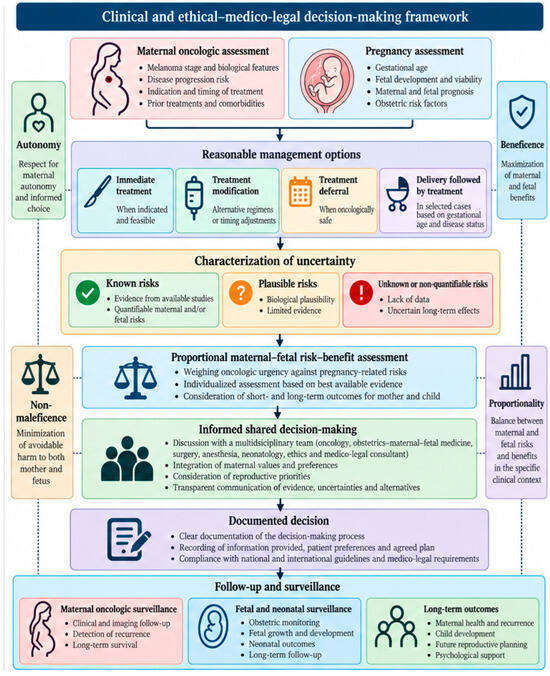
Figure 2 translates these considerations into an author-proposed discussion framework: characterize maternal disease; evaluate gestational and fetal status; compare available management strategies; communicate observed, plausible, and unknown risks; document an informed and multidisciplinary decision; and plan maternal and offspring follow-up. It is a conceptual aid, not a prospectively validated algorithm or a substitute for case-specific guidelines.
Figure 2.
Proposed clinical and ethical decision-making framework for melanoma during pregnancy. This is an interpretative framework, not a validated treatment algorithm or a graphical abstract. AI-assisted graphical preparation is disclosed in the AI Assistance Disclosure; the authors assume responsibility for the scientific content.
4.4. Maternal Autonomy, Informed Consent and Medico-Legal Considerations
The ethical problem should not be reduced to a presumptive conflict between the woman and fetus. The pregnant patient retains decision-making authority; fetal interests are relevant to counselling and to assessment of the effects of maternal disease and treatment choices. Discussion must avoid treating fetal risk as the only risk while disregarding the fetal consequences of severe untreated maternal illness.
Meaningful informed consent should address expected maternal benefit, foreseeable treatment harms, consequences of treatment delay or omission, available alternatives, obstetric implications of delivery timing, potential fetal effects, and limits to long-term offspring data. Documentation of an informed discussion is more informative than a signed consent form in isolation, particularly where no reliable numerical risk estimate exists.
From a medico-legal perspective, hindsight bias must be avoided. An adverse outcome following exposure does not, without stronger evidence, establish treatment causation or imply that the original choice was unreasonable; likewise, a favorable outcome cannot validate safety. Evaluation of clinical reasonableness should focus on the information, plausible alternatives, available expertise, and patient preferences at the time of the decision. This ethical-analytical position does not purport to establish a jurisdiction-independent legal test.
A proportionate decision record should capture tumor stage and trajectory, treatment urgency, gestational and fetal assessment, alternatives considered, the anticipated effects of deferral, known and uncertain fetal risks, specialist recommendations, patient priorities, the agreed plan, and follow-up arrangements. Transparent records primarily support clinical continuity and accountable patient-centered care, rather than defensive documentation alone.
4.5. Limitations of the Evidence and Future Research
The expanded four-database search and addition of four contemporary primary reports broadened the evidence base, but several limitations constrain confidence. Included publications mix primary cohorts, isolated original cases, and secondary/contextual sources; these categories cannot be interpreted as 16 independent patient cohorts. Studies differ in melanoma stage, definitions and windows of pregnancy association, comparator selection, treatment era, and outcome measurement. Observational prognosis remains vulnerable to residual confounding; advanced-disease treatment choices are confounded by indication; fetal drug-exposure observations are highly selected and provide limited long-term follow-up. No pooled estimate was calculated because a common estimand and sufficiently comparable populations were lacking. The 21 title/DOI-conflict groups were independently adjudicated as duplicates by two reviewers; however, the retained screening logs do not permit reconstruction of the stage-specific title/abstract and full-text exclusion counts. The study-level summaries in Supplementary S2 do not reproduce the original item-level assessor worksheets.
Future multicentre registries should prospectively capture melanoma stage and biology; gestational timing of diagnosis, interventions and systemic exposures; reasons for treatment initiation, modification or deferral; maternal response and survival; obstetric indications and placental findings; and standardized neonatal and long-term childhood outcomes. Recording counselling alternatives, the patient’s priorities, multidisciplinary participation, and uncertainty would also permit more rigorous study of the decision-making process. The proposed minimum reporting dataset is presented in Table 5.
Table 5.
Proposed minimum dataset for future reporting.
Additional contextual literature reinforces the need for individualized management: a practical review addresses surgical treatment of melanoma during pregnancy [22], a European survey documents variation in melanoma management decisions [23], and an ESMO consensus on breast cancer in pregnancy illustrates broader multidisciplinary decision principles without providing melanoma-specific outcome evidence [24]. These publications are cited as clinical context and are not included among the 16 melanoma publications in the evidence synthesis.
5. Conclusions
This review discusses 16 publications, comprising 12 primary clinical reports and four secondary/contextual sources. Four of the primary reports were identified through Scopus after the database search was expanded in response to first-round peer review. Comparative evidence does not show a consistent independent survival disadvantage attributable solely to pregnancy, but residual uncertainty persists for postpartum timing and inadequately measured prognostic factors. Advanced melanoma may carry serious maternal and perinatal consequences, while existing gestational exposure reports cannot quantify treatment-attributable fetal risks.
Care should therefore be anchored in tumor severity, therapeutic urgency, gestational and fetal assessment, feasible alternatives, and the consequences of treatment deferral. Uncertainty about immune checkpoint inhibitors and BRAF/MEK inhibitors must be communicated explicitly, without conflating absence of evidence of harm with demonstrated safety. Maternal autonomy, multidisciplinary input, and a documented shared decision process remain essential.
The proposed clinical-ethical framework is intended to support prospective deliberation, not to prescribe a universal treatment pathway or legal standard. Better prospective and linked registry data, particularly long-term offspring outcomes, are needed. Figure 1 presents the PRISMA 2020-structured selection flow with transparently unavailable stage-specific counts; Figure 2 is the conceptual framework; and Table 5 suggests standardized future reporting domains.
Supplementary Materials
The following supporting information can be downloaded at: https://www.mdpi.com/article/10.3390/onco6040052/s1, Supplementary S1, PRISMA 2020 checklist and reporting audit; Supplementary S2, Search strategies and deduplication audit; Supplementary S3, Design-specific critical appraisal evidence summary.
Author Contributions
Conceptualization, H.M., I.M. and I.A.; methodology, H.M., I.M. and E.G.; investigation, H.M., I.M., M.A.S., S.G., G.M. and G.N.; data curation, H.M., I.M., M.A.S. and G.M.; formal analysis, E.G. and G.M.; validation, S.G., E.G., G.N. and I.A.; visualization, G.N.; supervision, I.A.; writing—original draft, H.M. and I.M.; writing—review and editing, H.M., I.M., M.A.S., S.G., E.G., G.M., G.N. and I.A. All authors have read and agreed to the published version of the manuscript.
Funding
This research received no external funding.
Institutional Review Board Statement
Not applicable. This review analyses published literature and does not recruit participants or access identifiable patient data.
Informed Consent Statement
Not applicable.
Data Availability Statement
All bibliographic records used for identification were derived from the four named database exports. Study-level clinical data were drawn from the cited publications. The database exports, normalized-identifier deduplication log and eligibility working records can be supplied by the corresponding author upon reasonable request; Cochrane CENTRAL results were not available for record-level screening.
Acknowledgments
AI-assisted tools were used to support manuscript language editing, graphical formatting, and tabular organization. All scientific content, study selection, data extraction, methodological assessments, and final interpretations were independently reviewed and validated by the authors. The authors take full responsibility for the manuscript.
Conflicts of Interest
The authors declare no conflicts of interest.
Abbreviations
BRAF, B-Raf proto-oncogene; CMM, cutaneous malignant melanoma; FAERS, FDA Adverse Event Reporting System; HR, hazard ratio; ICI, immune checkpoint inhibitor; JBI, Joanna Briggs Institute; MDT, multidisciplinary team; MEK, mitogen-activated protein ki-nase kinase; MSS, melanoma-specific survival; NIPT, non-invasive prenatal testing; OS, overall survival; PAC, pregnancy-associated cancer; PAM, pregnancy-associated mela-noma; PRISMA, Preferred Reporting Items for Systematic Reviews and Meta-Analyses; ROBINS-E, Risk Of Bias In Non-randomized Studies of Exposures.
References
- Cairncross, Z.F.; Shack, L.; Nelson, G.; Friedenreich, C.M.; Ray, J.; Fell, D.B.; Lisonkova, S.; Bhatti, P.; Sikdar, K.; McMorris, C.; et al. Long-term Mortality in Individuals Diagnosed With Cancer During Pregnancy or Postpartum. JAMA Oncol. 2023, 9, 791–799. [Google Scholar] [CrossRef] [Scilit] [PubMed]
- Johansson, A.L.V.; Fredriksson, I.; Mellemkjaer, L.; Stensheim, H.; Lähteenmäki, P.; Winther, J.F.; Ullenhag, G.J.; Lundberg, F.E. Cancer survival in women diagnosed with pregnancy-associated cancer: An overview using nationwide registry data in Sweden 1970–2018. Eur. J. Cancer 2021, 155, 106–115. [Google Scholar] [CrossRef] [Scilit] [PubMed]
- Stylianakis, D.; Solinas, C.; Petrelli, F.; Nazzaro, G.; Passoni, E.; Martella, S.; Stylianakis, I.; Donisi, C.; Scartozzi, M.; Lambertini, M.; et al. The prognostic impact of pregnancy-associated melanoma on overall and melanoma-specific survival: A systematic review and meta-analysis. Crit. Rev. Oncol. Hematol. 2026, 224, 105376. [Google Scholar] [CrossRef] [Scilit] [PubMed]
- Amaral, T.; Ottaviano, M.; Arance, A.; Blank, C.; Chiarion-Sileni, V.; Donia, M.; Dummer, R.; Garbe, C.; Gershenwald, J.; Gogas, H.; et al. Cutaneous melanoma: ESMO Clinical Practice Guideline for diagnosis, treatment and follow-up. Ann. Oncol. 2025, 36, 10–30. [Google Scholar] [CrossRef] [Scilit] [PubMed]
- Page, M.J.; McKenzie, J.E.; Bossuyt, P.M.; Boutron, I.; Hoffmann, T.C.; Mulrow, C.D.; Shamseer, L.; Tetzlaff, J.M.; Akl, E.A.; Brennan, S.E.; et al. The PRISMA 2020 statement: An updated guideline for reporting systematic reviews. BMJ 2021, 372, n71. [Google Scholar] [CrossRef] [Scilit] [PubMed]
- Davidson, T.M.; Hieken, T.J.; Glasgow, A.E.; Habermann, E.B.; Yan, Y. Pregnancy-associated melanoma: Characteristics and outcomes from 2002 to 2020. Melanoma Res. 2024, 34, 175–181. [Google Scholar] [CrossRef] [Scilit] [PubMed]
- Grippaudo, F.R.; Ruggeri, G.; De Simone, P.; Di Prete, M.; Tellan, G.; Govoni, E.R.; Migliano, E. Melanoma in pregnancy: Multidisciplinary treatment management and outcome. Dermatol. Rep. 2025, 17, 10095. [Google Scholar] [CrossRef] [Scilit] [PubMed]
- Borgers, J.S.W.; Johnson, D.B.; Livingstone, E.; Schadendorf, D.; Buchbinder, E.I.; Haydu, L.E.; Gohil, L.; Robinson, W.A.; Mehmi, I.; Hamid, O.; et al. Advanced stage melanoma during pregnancy: Recommendations from a retrospective, multicentre, registry-based study. EClinicalMedicine 2025, 89, 103501. [Google Scholar] [CrossRef] [Scilit] [PubMed]
- Kostaki, M.; Plaka, M.; Chardalia, V.; Kypreou, K.; Nikolaou, C.; Louros, L.; Tsallas, S.; Gamatsi, I.; Del Regno, L.; Di Nardo, L.; et al. Pregnancy-associated melanoma epidemiology: A multicentre European study. J. Eur. Acad. Dermatol. Venereol. 2026, 40, 835–840. [Google Scholar] [CrossRef] [Scilit] [PubMed]
- Zerdan, M.B.; Kfoury, B.; Aoun, E.; Hmaidan, S.D.; Wilke, R.N.; How, J.A.; Woodard, T.L.; Soliman, P.T.; McKenzie, L.J. Pregnancy Outcomes After in Utero Exposure to Immune Checkpoint Inhibitors. Curr. Oncol. 2026, 33, 318. [Google Scholar] [CrossRef] [Scilit] [PubMed]
- Gulino, F.A.; Ettore, C.; Pappalardo, E.; Blanco, M.C.; Ettore, G.; Capriglione, S. A primary lesion of advanced melanoma in pregnancy: Case report and review of literature of the advanced cases in the last ten years. J. Matern. Fetal Neonatal Med. 2022, 35, 2195–2202. [Google Scholar] [CrossRef] [Scilit] [PubMed]
- Melus, J.; Jezberova, M.; Mikulajova, S.; Gerincova, K.; Karlik, M.; Straka, I.; Krivosik, M.; Valkovic, P.; Timarova, G. Combined BRAF/MEK inhibition for BRAF-mutant melanoma brain metastases in pregnancy: A case report. Oncol. Lett. 2026, 31, 1–8. [Google Scholar] [CrossRef] [Scilit] [PubMed]
- Mendizábal, E.; De León-Luis, J.; Gómez-Hidalgo, N.R.; Joigneau, L.; Pintado, P.; Rincón, P.; Ortega, V.; Lizarraga, S. Maternal and perinatal outcomes in pregnancy-associated melanoma. Report of two cases and a systematic literature review. Eur. J. Obstet. Gynecol. Reprod. Biol. 2017, 214, 131–139. [Google Scholar] [CrossRef] [Scilit] [PubMed]
- Vurture, G.; Klein, B.; Shapiro, R.; Baum, J. Balancing Maternal Melanoma and Vaginal Birth After Cesarean (VBAC) Delivery: A case report highlighting shared decision-making. Cureus 2024, 16, e66279. [Google Scholar] [CrossRef] [Scilit] [PubMed]
- Xu, W.; Moor, R.J.; Walpole, E.T.; Atkinson, V.G. Pregnancy with successful foetal and maternal outcome in a melanoma patient treated with nivolumab in the first trimester: Case report and review of the literature. Melanoma Res. 2019, 29, 333–337. [Google Scholar] [CrossRef] [Scilit] [PubMed]
- Andrikopoulou, A.; Korakiti, A.; Apostolidou, K.; Dimopoulos, M.; Zagouri, F. Immune checkpoint inhibitor administration during pregnancy: A case series. ESMO Open 2021, 6, 100262. [Google Scholar] [CrossRef] [Scilit] [PubMed]
- Lannoo, L.; Lenaerts, L.; Bogaert, K.V.D.; Che, H.; Brison, N.; Devriendt, K.; Amant, F.; Vermeesch, J.R.; Van Calsteren, K. Non-invasive prenatal testing suggesting a maternal malignancy: What do we tell the prospective parents in Belgium? Prenat. Diagn. 2021, 41, 1264–1272. [Google Scholar] [CrossRef] [Scilit] [PubMed]
- Todd, S.P.; Driscoll, M.S. Prognosis for women diagnosed with melanoma during, before, or after pregnancy: Weighing the evidence. Int. J. Womens Dermatol. 2017, 3, 26–29. [Google Scholar] [CrossRef] [Scilit] [PubMed]
- Joanna Briggs Institute. Critical Appraisal Tools; JBI: Adelaide, Australia. Available online: https://jbi.global/critical-appraisal-tools (accessed on 15 October 2026).
- Shea, B.J.; Reeves, B.C.; Wells, G.; Thuku, M.; Hamel, C.; Moran, J.; Moher, D.; Tugwell, P.; Welch, V.; Kristjansson, E.; et al. AMSTAR 2: A critical appraisal tool for systematic reviews that include randomised or non-randomised studies of healthcare interventions, or both. BMJ 2017, 358, j4008. [Google Scholar] [CrossRef] [Scilit] [PubMed]
- Neri, G.; Ielapi, J.; Bosco, V.; Mastrangelo, H.; Mellace, F.; Salerno, N.; Mazza, G.A.; Serraino, G.F.; Caracciolo, D.; Venturella, R.; et al. Severe Hemodynamic Instability in a Young Pregnant Woman with Massive Pericardial Effusion and Pulmonary Embolism Secondary to Primary Mediastinal Non-Hodgkin’s Lymphoma. J. Clin. Med. 2025, 14, 2670. [Google Scholar] [CrossRef] [Scilit] [PubMed]
- Crisan, D.; Treiber, N.; Kull, T.; Widschwendter, P.; Adolph, O.; Schneider, L.A. Surgical treatment of melanoma in pregnancy: A practical guideline. J. Dtsch. Dermatol. Ges. 2016, 14, 585–593. [Google Scholar] [CrossRef] [Scilit] [PubMed]
- Ribero, S.; Longo, C.; Dika, E.; Fortes, C.; Pasquali, S.; Nagore, E.; Glass, D.; Robert, C.; Eggermont, A.; Testori, A.; et al. Pregnancy and melanoma: A European-wide survey to assess current management and a critical literature overview. J. Eur. Acad. Dermatol. Venereol. 2017, 31, 65–69. [Google Scholar] [CrossRef] [Scilit] [PubMed]
- Loibl, S.; Azim, H.A., Jr.; Bachelot, T.; Berveiller, P.; Bosch, A.; Cardonick, E.; Denkert, C.; Halaska, M.; Hoeltzenbein, M.; Johansson, A.; et al. ESMO Expert Consensus Statements on the management of breast cancer during pregnancy (PrBC). Ann. Oncol. 2023, 34, 849–866. [Google Scholar] [CrossRef] [Scilit] [PubMed]

Disclaimer/Publisher’s Note: The statements, opinions and data contained in all publications are solely those of the individual author(s) and contributor(s) and not of MDPI and/or the editor(s). MDPI and/or the editor(s) disclaim responsibility for any injury to people or property resulting from any ideas, methods, instructions or products referred to in the content. |
© 2026 by the authors. Licensee MDPI, Basel, Switzerland. This article is an open access article distributed under the terms and conditions of the Creative Commons Attribution (CC BY) license.