


Highlights
What are the main findings?
- Integrating GPS or BDS observations with GLONASS improves particle filter-based IFB rate estimation, particularly when few GLONASS satellites are tracked, and enables single-frequency estimation;
- The enhanced method improves GLONASS ambiguity resolution reliability and single-epoch RTK accuracy; across the datasets tested in this study, GPS/GLONASS single-frequency RTK shows performance comparable to GPS dual-frequency RTK.
What are the implications of the main findings?
- Stable IFB rates can support direct GLONASS RTK positioning for calibrated receiver pairs without repeated online estimation;
- Multi-GNSS integration makes single- and dual-frequency GLONASS observations practical for robust RTK, including BDS-assisted configurations.
Abstract
Due to inter-frequency phase bias (IFB), GLONASS is ignored when discussing real-time kinematic (RTK) positioning. Although this problem has been effectively solved, defects still exist when the number of tracked satellites is small or when single-frequency observations are processed. This contribution proposes an enhanced method that can effectively overcome these existing shortcomings by combining GLONASS and GPS observations. By using an enhanced algorithm, the performance of estimated IFB rate is more stable and reliable when there are few tracked satellites, and estimating the IFB rate with a single frequency is available. In this contribution, the GLONASS dual-frequency RTK ambiguity fixed rate and positioning accuracy are significantly improved by adding GPS observations, and the GPS/GLONASS single-frequency RTK using the enhanced algorithm has a similar performance to GPS dual-frequency RTK, according to long-term statistics. And, another code-division multiple access (CDMA) system, BDS, is introduced, which shows that the IFB rate estimated by BDS+GLONASS observations is as good as that by GPS+GLONASS. The experiment with the muti-GNSS single-epoch RTK shows that the precision and reliability are enhanced by adding another system or frequency observation. Thus, single-/dual-frequency GLONASS observations are available and reliable for single-epoch RTK and can improve the precision and reliability of GPS RTK by using the enhanced algorithm.
1. Introduction
With GLONASS being fully operational with 24 satellites in orbit again, BDS continually providing service in the Asia–Pacific Region, and Galileo speeding up networking, the number of satellites has increased significantly. The accuracy and reliability of RTK have improved synchronously with the increasing number of tracked satellites. Thus, multi-GNSS real-time kinematic (RTK) will become a development trend in the future.
There are many studies examining the performance of RTK, particularly single-/dual-frequency single-epoch positioning multi-GNSS RTK. Single-frequency GPS/BDS RTK can significantly improve the ambiguity fixed rate and time to first fix compared to GPS or BDS RTK [1]. Teunissen et al. [2] and He et al. [3] proved that dual-frequency GPS/BDS RTK is optimal in terms of fixed-rate reliability of ambiguity resolution and positioning accuracy, and that the performance of single-frequency GPS/BDS RTK and dual-frequency single-system RTK is better than that of single-frequency single-system RTK, especially for higher cut-off angles. With the inter-system biases (ISBs) being estimated, a four-system RTK model performs better than single, dual, or triple systems at integer ambiguity resolution and positioning performance, particularly for higher cut-off angles [4]. Odolinski and Teunissen [5] analyzed single-frequency, dual-system, and dual-frequency, single-system RTK performance, and concluded that a single-frequency, dual-system RTK with low-cost receivers could give comparable performance to that of dual-frequency, single-system RTK with survey-grade receivers, using GPS and BDS signals in Australia and New Zealand. More recently, Odolinski and Teunissen [6] evaluated the best integer equivariant (BIE) estimation using real data collected by low-cost, single- and dual-frequency multi-GNSS receivers for short- to long-baseline RTK positioning and demonstrated that the BIE solution always performs equal to or better than the float and the integer least-squares solutions. However, only the CDMA-based systems (GPS, BDS, Galileo, and QZSS) were involved, and GLONASS was excluded from their RTK model. Luo et al. [7] assessed the benefits of Galileo to high-precision GNSS positioning in the RTK, precise point positioning (PPP) and post-processing scenarios, and showed that the integration of Galileo significantly improves the RTK fix availability and reduces the position errors caused by incorrect ambiguity fixes in challenging environments. Nevertheless, GLONASS was only treated as a stand-alone solution for comparison, and its contribution to the combined multi-GNSS RTK was not exploited. Odolinski and Teunissen [8] further compared the multivariate normal and t-distributed BIE estimators for multi-GNSS RTK positioning and confirmed the superiority of the BIE estimator for low-cost receivers, but the GLONASS observations were still not included owing to the difficulty of its integer ambiguity resolution.
Unfortunately, GLONASS rarely appears in the field of multi-GNSS RTK, especially on single-frequency RTK. Due to the application of frequency division multiple access (FDMA) technology, GLONASS phase and pseudorange double-differenced (DD) observations contain inter-frequency bias (IFB), which hinders GLONASS integer ambiguity resolution. This problem is divided into two kinds of situations (to solve it). First, receivers generated by the same manufacturer and have similar IFB theoretically, so differences between receivers could solve this problem. Second, receivers generated by the same manufacturer but have different bias [9] or a more general situation, receivers generated by different manufacturers and have different IFB. In this situation, Wanninger [9] presented a method to estimate GLONASS differential carrier-phase IFB by the combination of GPS and GLONASS but a priori values of the inter-frequency biases should be introduced, which restricts the application of this method. Al-Shaery et al. [10] estimates the GLONASS phase and pseudorange IFB from zero-baselines; however it needs a zero-baselines processing before real-time kinematic positioning. Tian et al. [11] employed a particle filter to estimate GLONASS IFB rate, which could provide a real-time IFB rate for GLONASS integer ambiguity resolution. However, the performance of this method is not reliable when the tracked satellites are few, and it is unavailable when dealing with single-frequency observations. In recent years, the GLONASS IFB is still being intensively investigated. Zhang et al. [12] proposed a GLONASS pseudorange IFB solution with ionospheric delay modeling based on the undifferenced and uncombined precise point positioning (PPP), by which the pseudorange IFB can be estimated accurately together with the ionospheric delay. However, this method is developed for the PPP scenario, and the carrier-phase IFB, which is the dominant obstacle of GLONASS integer ambiguity resolution in RTK, is not considered. Peng et al. [13] estimated the GLONASS inter-frequency code bias with the UofC model and analyzed its impact on single-frequency PPP, and the positioning accuracy is improved after the code bias is calibrated. Nevertheless, only the code IFB is corrected in their work, and the GLONASS ambiguities are still kept as float values. Tian et al. [14] implemented the Markov chain Monte Carlo (MCMC) method to refine the sample distribution in the differential code phase bias estimation, which enables the ambiguity fixing of GLONASS-only FDMA single-epoch positioning even though the phase IFB is unknown in advance. Nevertheless, since only the GLONASS observations are involved, its fixed rate is still lower than that of the multi-GNSS solutions, and the performance is restricted when the tracked GLONASS satellites are few or only single-frequency observations are available.
Therefore, in order to solve this problem, this study estimated the GLONASS IFB rate by using a particle filter to deal with the GPS and BDS observations simultaneously. With this method, the GLONASS IFB could be estimated accurately and reliably, no matter if using single-frequency observations or a smaller number of satellites. And, to detect the incorrect IFB rate, an IFB rate real-time outlier detection method is proposed. Hence the multi-GNSS RTK with GLONASS integer ambiguity resolution, especially on single-frequency single-epoch RTK, can be realized by this method.
This paper is organized as follows: the mathematical modeling and observation data collection is introduced first, followed by the shortcomings of the particle filter-based estimation of inter-frequency, the improved approach, and IFB rate real-time outlier detection method. Finally, we present the experiment results and conclusions.
2. Materials and Methods
2.1. Basic Observation Models
The GPS or GLONASS undifferenced observation equations for carrier phase and pseudorange are expressed in unit of length as [15]:
where the superscript refers to system type (GPS/GLONASS), the symbol and refers to the pseudorange and carrier phase observation from satellite i to receiver r. and refer to the geometric distance in meter and tropospheric mapping function between satellite i to receiver r. c is the speed of light in vacuum, and are satellite clock bias and receiver clock bias. The symbol refers to the signal wavelength of satellite i. is the inter-carrier phase ambiguity, and represent the pseudorange IFB and the carrier phase IFB. Compared to the carrier phase, the pseudorange has little effect on the ambiguity resolution and estimate the coordinates of receiver [16]. Thus, the pseudorange IFB is ignored in this study. The symbol and refer to observation noise of pseudorange and carrier phase, respectively.
In order to fix the integer ambiguity and estimate the coordinates of receiver, there are several challenges that must be overcome. Frist of all, for short baselines, the ionosphere delay, troposphere delay, satellite clock bias, and satellite orbit bias should be reduced or eliminated by forming single-difference (SD) observations between two receivers, and receiver clock bias should be eliminated by differencing SD-observations between two satellites. Secondly, GLONASS DD-ambiguity loses the integer nature when observation equations are expressed in units of length, because of the various signal wavelengths, so it should be transformed into a DD-ambiguity which has the integer nature and a SD-ambiguity as seen below [17,18].
where is SD-ambiguity of reference satellite j, is DD-ambiguity which is fixed by the ambiguity determination method, LAMBDA [19]. With the integer DD ambiguity, the accurate receiver coordinates can be estimated subsequently.
Finally, because GPS satellites use the technology of code division multiple access (CDMA), the IFB of GPS satellites could be eliminated by forming single-difference (SD) observations between two satellites. However, while receivers generated by different manufacturers or receivers generated by the same manufacturer but have different bias, the DD-observations of GLONASS may still contain the IFB. According to Wanninger [9], Al-Shaery et al. [10], and Tian et al. [11,16], the IFB can be modeled as linear functions of frequency. Therefore, the phase DD-IFB can be derived as:
where and refers to the frequency of satellite i and j, respectively, is the IFB rate and it refers to differenced phase IFB between receiver r and m. Thus, the DD-observation equation can be described below:
2.2. Data Collection
Six sets of data are presented in this contribution. In order to demonstrate the applicability of this method, two receivers for a set of data are generated by different manufacturers for all baselines involved in this study. The details of the data are summarized in Table 1.
Table 1.
The details of the data.
Baseline NYBR-NYBP and HERT-HERS were collected in America and Europe. And the data D is a kinematic baseline in Wuhan, China. The data F STR1-STR2 includes GPS+BDS+GLONASS observation.
2.3. Limitations of Particle-Filter-Based IFB Estimation
The performance of the approach proposed by Tian et al. [16] is perfect, both the inter-frequency bias estimated by particle filter and the kinematic solution and single-epoch ambiguity resolution using the inter-frequency bias. However, the situation with few tracked satellites or single-frequency data is not considered. So, two experiments were manipulated to test the performance of this method with the data A NYBR-NYBP on the above situations.
2.3.1. Case 1: Few Tracked Satellites
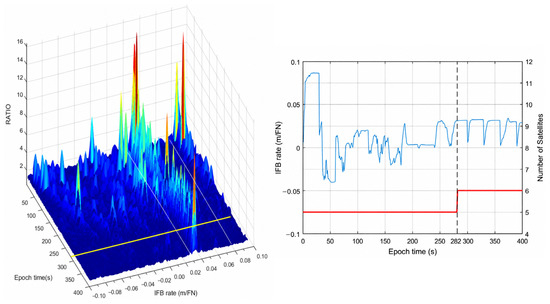
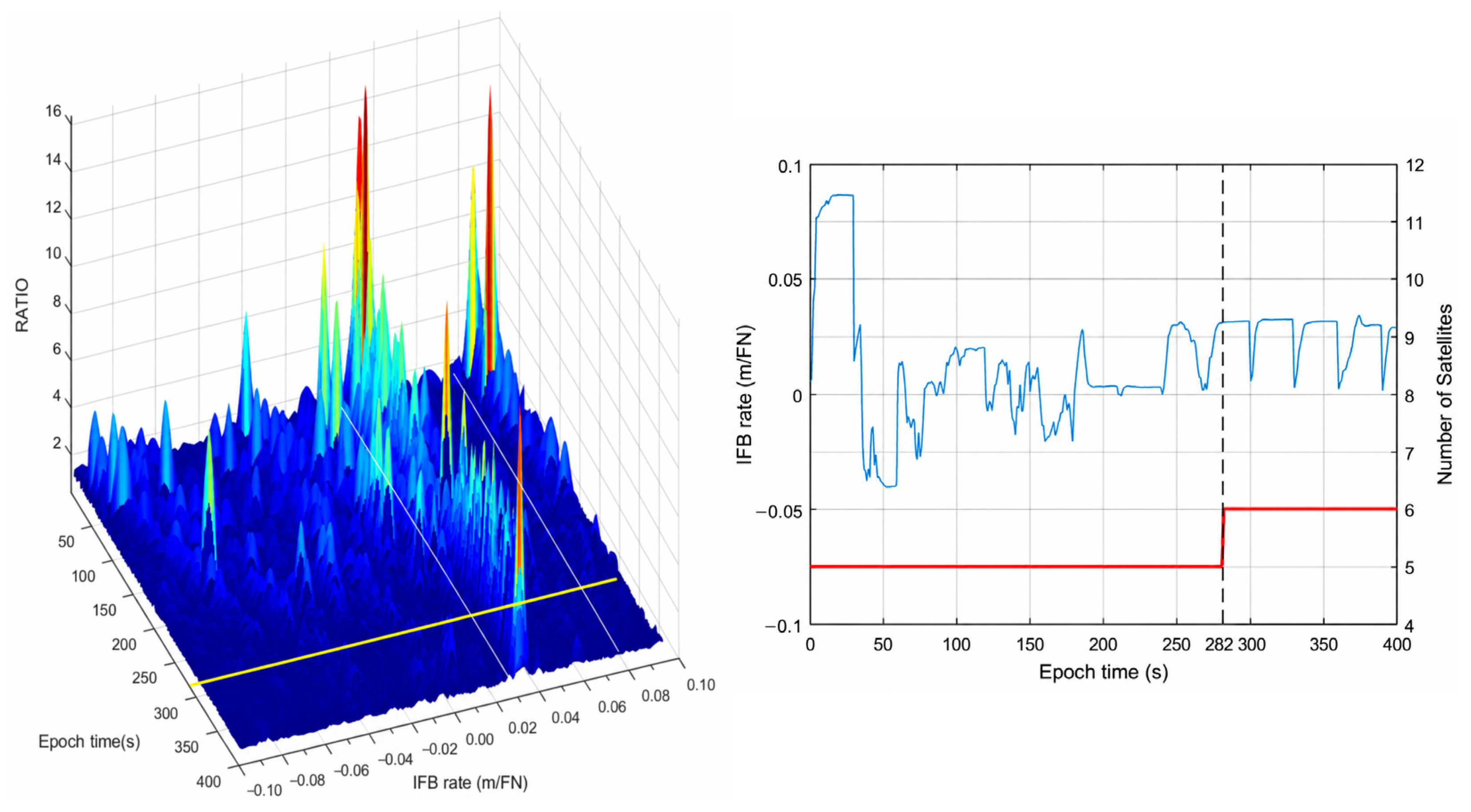
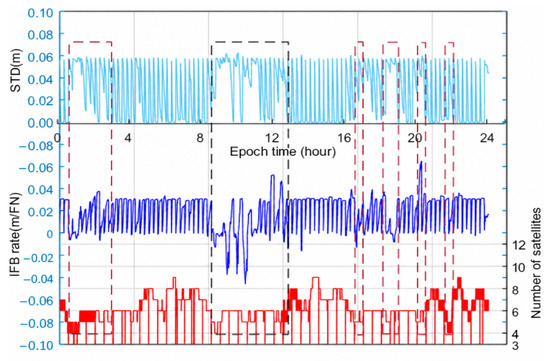
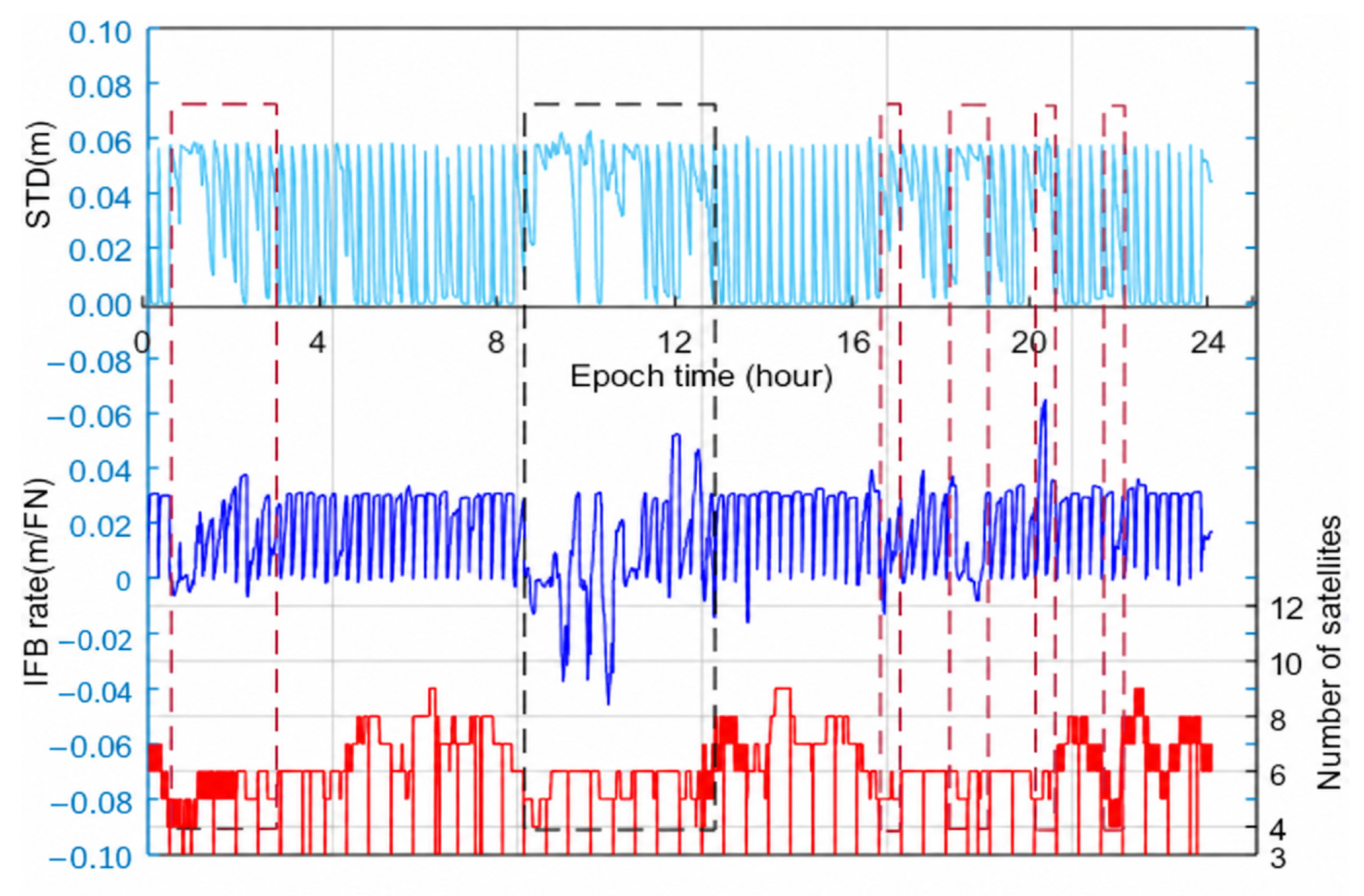
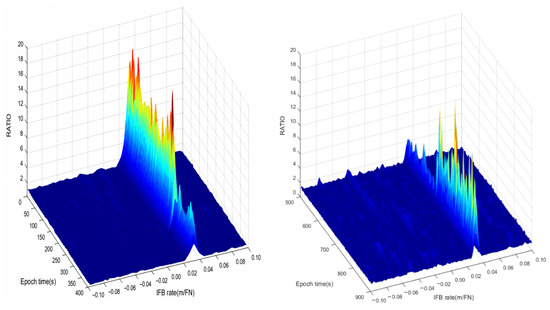
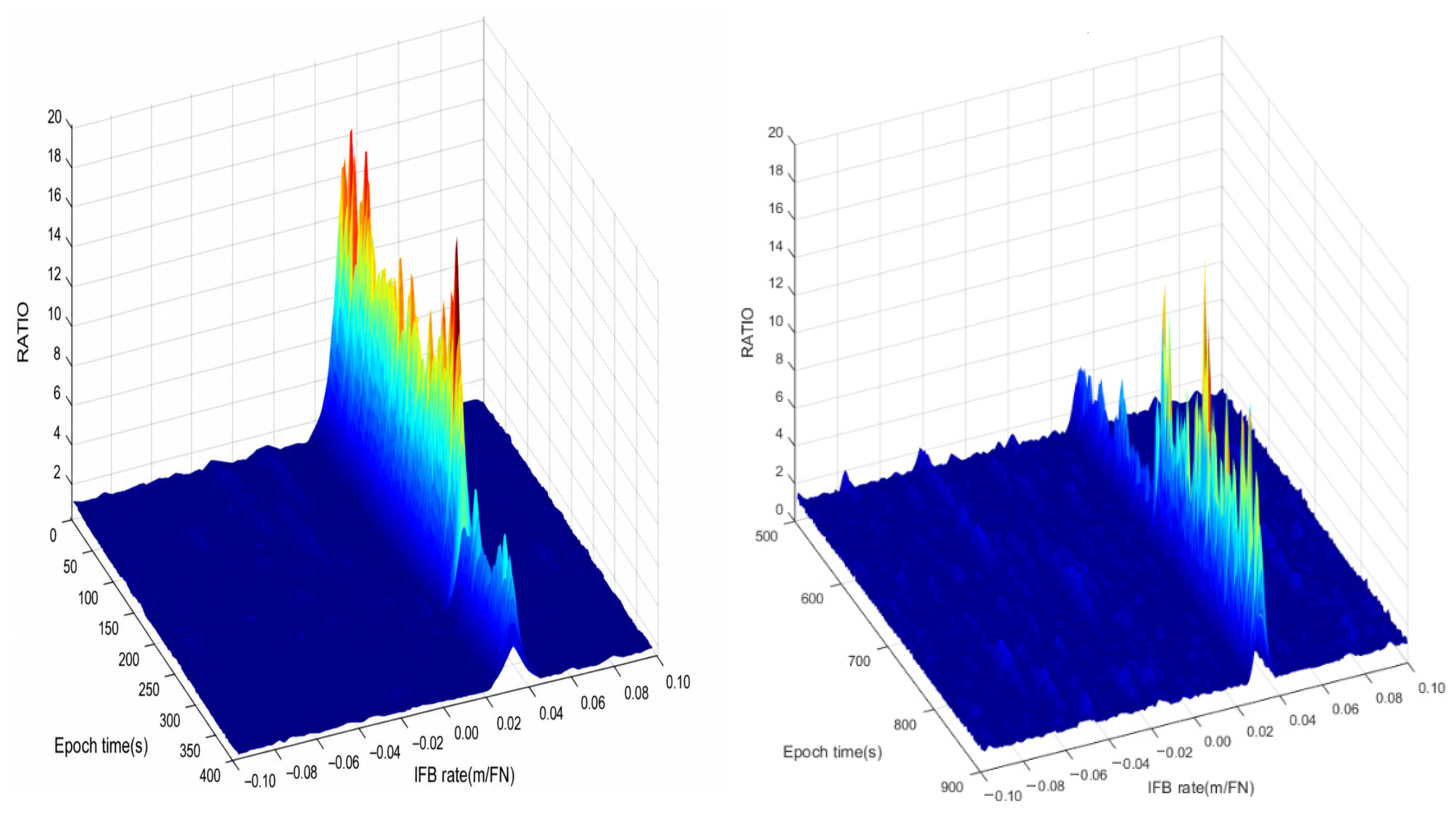
Few tracked satellites will be discussed first. The satellite number from 0 to 282 s is 5, and 282 s to 400 s is 6. According to the approach proposed by Tian et al. [11,16], the RATIO value [19] of ambiguity resolution is the key to the estimation of inter-frequency bias. The RATIO result of single-epoch ambiguity resolution for all IFB rate samples and all epochs is presented in Figure 1 (left). Between 0 s and 282 s, there are two peak series lines when IFB rate is 0.03 m and 0.08 m, and many ridges scattered on the figure. But, during 282 s to 400 s, there is only one peak series line and no other ridges. It is significantly different for the RATIO behavior when the satellite number is 5 and 6. For the estimation of IFB rates, when data are processed over 30 epochs, a new IFB rate is estimated again. The number of epochs that IFB rate convergence need is referenced by the data in Tian et al. [11,16]. Figure 1 (right) shows the result of IFB rate estimation is not reliable when the satellite number is few, which is similar with the conclusion presented in Figure 1 (left). There is significant correlation between the GLONASS tracked satellites number and the performance of the particle filter-based estimation in Figure 2.
Figure 1.
Three-dimensional RATIO distribution along with epochs and IFB rate sample for dual-frequency GLONASS IFB estimation (left) and the convergence procedures of the estimated IFB rate with a step size of 30 epochs for dual-frequency GLONASS IFB estimation (right). In the left panel, the surface color changes from blue to red with increasing RATIO values. In the right panel, the blue solid line represents the estimated IFB rate, the red solid step line represents the number of tracked GLONASS satellites, and the gray dashed vertical line at 282 s marks the change in the number of tracked satellites from five to six.
Figure 2.
Relationship among the number of tracked GLONASS satellites, the estimated IFB rate, and the standard deviation (STD) of the estimated IFB rate. The blue solid line represents the estimated IFB rate, the light blue solid line represents the standard deviation of the estimated IFB rate, and the red stepped line, plotted against the right vertical axis, represents the number of tracked GLONASS satellites. The red stepped line is included to illustrate the relationship between the number of tracked GLONASS satellites and the IFB-rate estimation performance.
2.3.2. Case 2: Single-Frequency GLONASS IFB-Rate Estimation
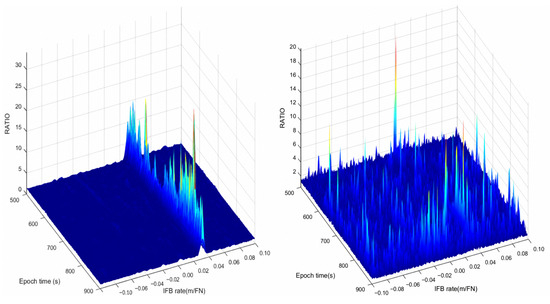
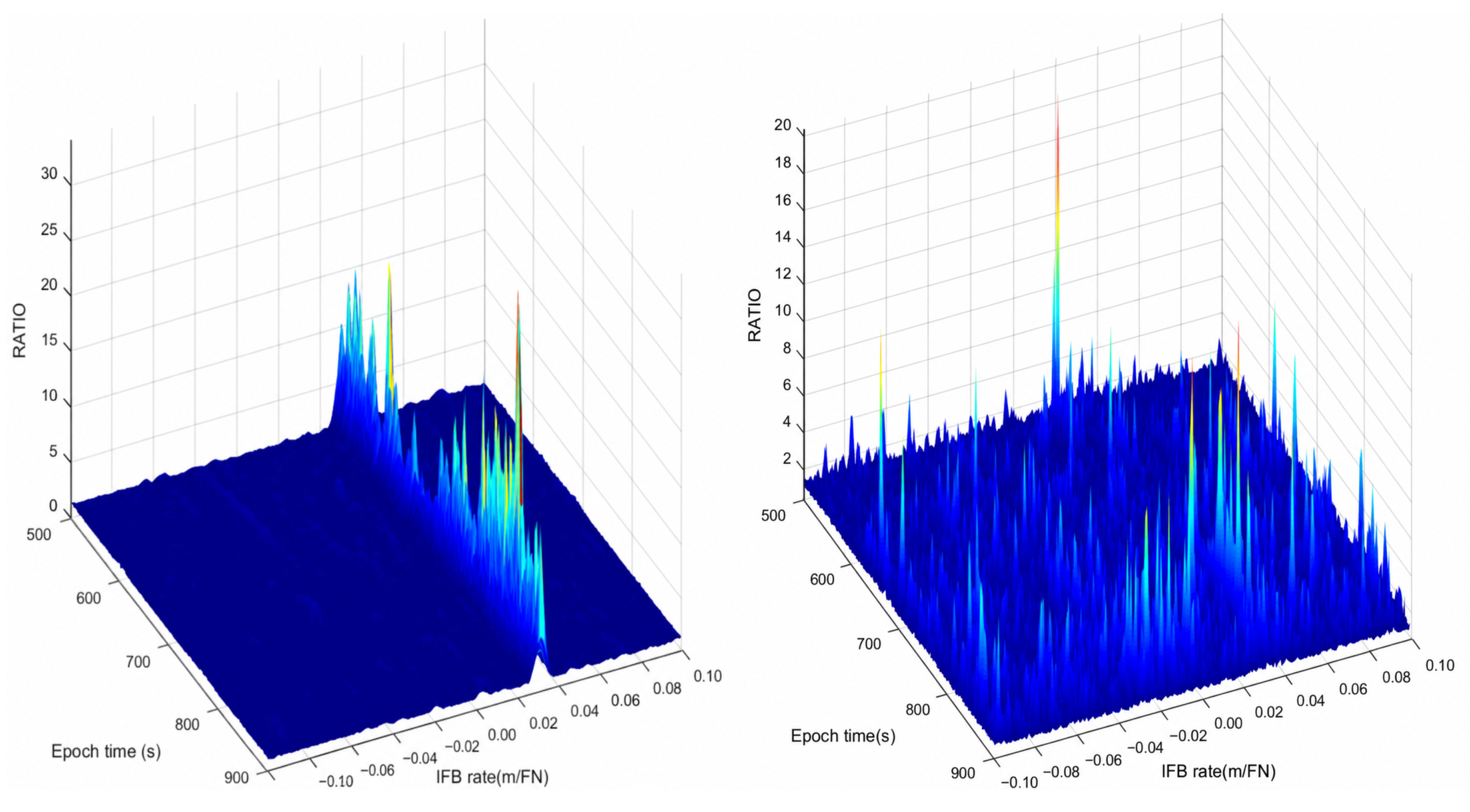
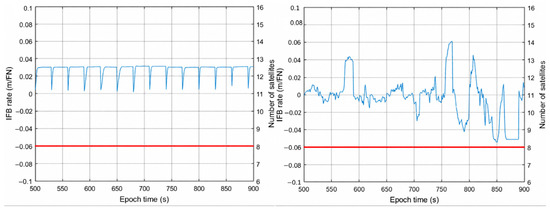
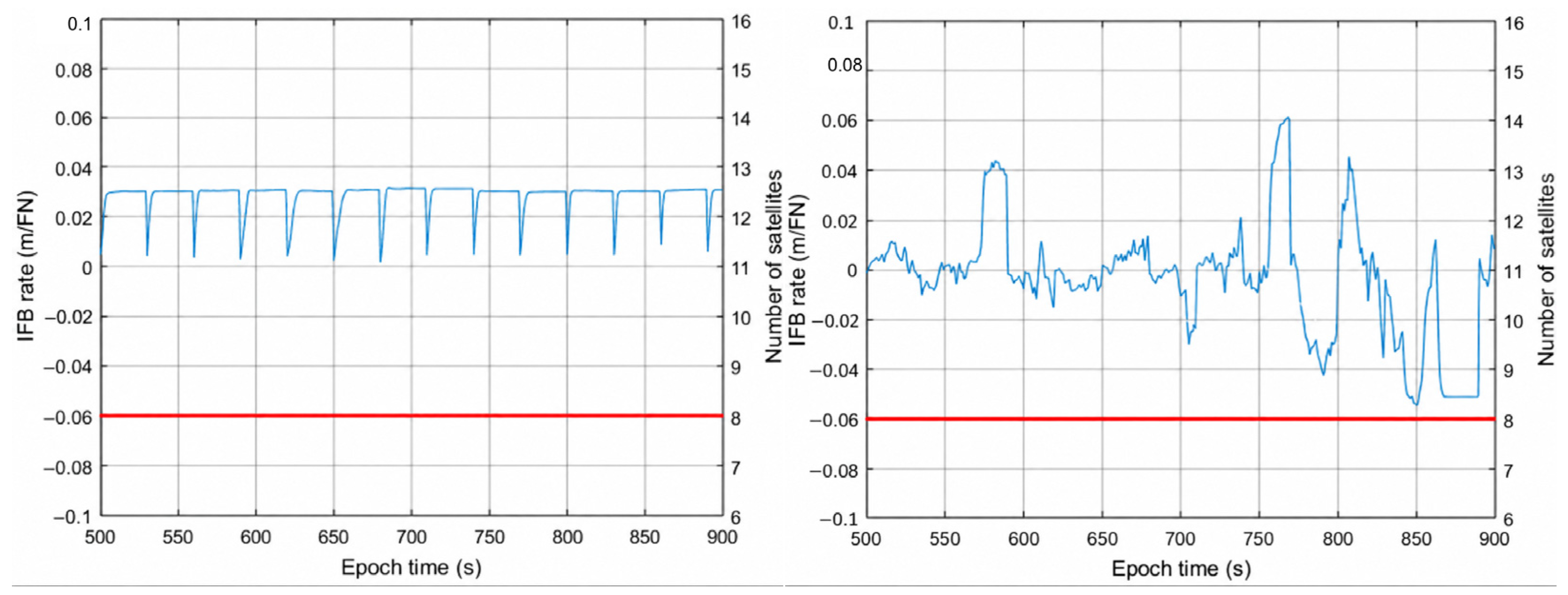
A piece of Data A NYBR-NYBP in Table 1 with good quality and 8 tracked satellites is processed by the method proposed by Tian et al. [11,16], and the performance of RATIO value of single-epoch and the estimation of IFB rate is satisfactory in Figure 3 (left) and Figure 4 (left). While only L1 observation is processed, Figure 3 (right) and Figure 4 (right) show that the approach proposed by Tian et al. [11] is unavailable.
Figure 3.
Three-dimensional RATIO distribution along with epochs and IFB rate sample for dual-frequency GLONASS IFB estimation (left) and single-frequency GLONASS IFB estimation (right). In both panels, the surface color changes from blue to red with increasing RATIO values.
Figure 4.
The convergence procedures of estimated IFB rate with a step size of 30 epochs for dual-frequency GLONASS IFB estimation (left) and single-frequency GLONASS IFB estimation (right). In both panels, the blue solid line represents the estimated IFB rate, whereas the red solid line represents the number of tracked GLONASS satellites.
In fact, because of the shelter of trees, buildings, and the limited number of GLONASS satellites, the satellite number which could be observed by a receiver is low for much of the time and place. To reduce costs, an increasing number of single-frequency receivers will be used in the future. So, the shortcomings of the approach proposed by Tian et al. [11] need to be overcome.
2.4. Improved Approach and Real-Time IFB-Rate Outlier Detection
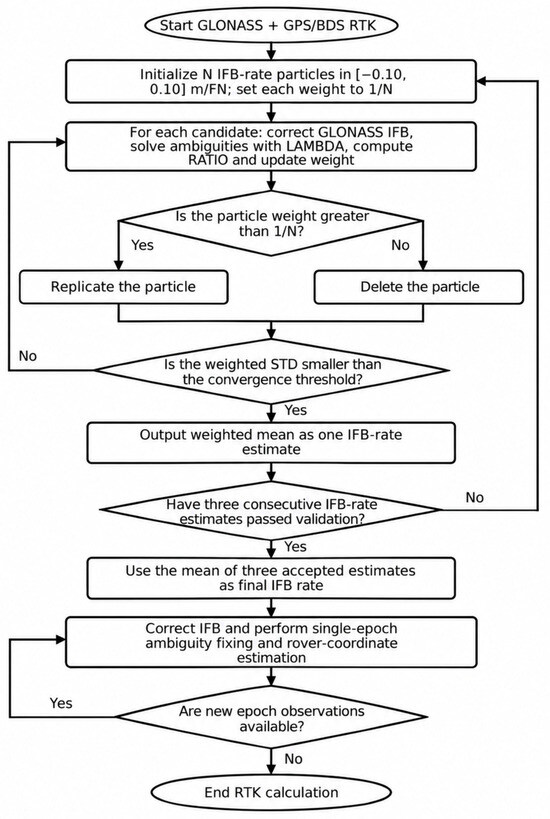
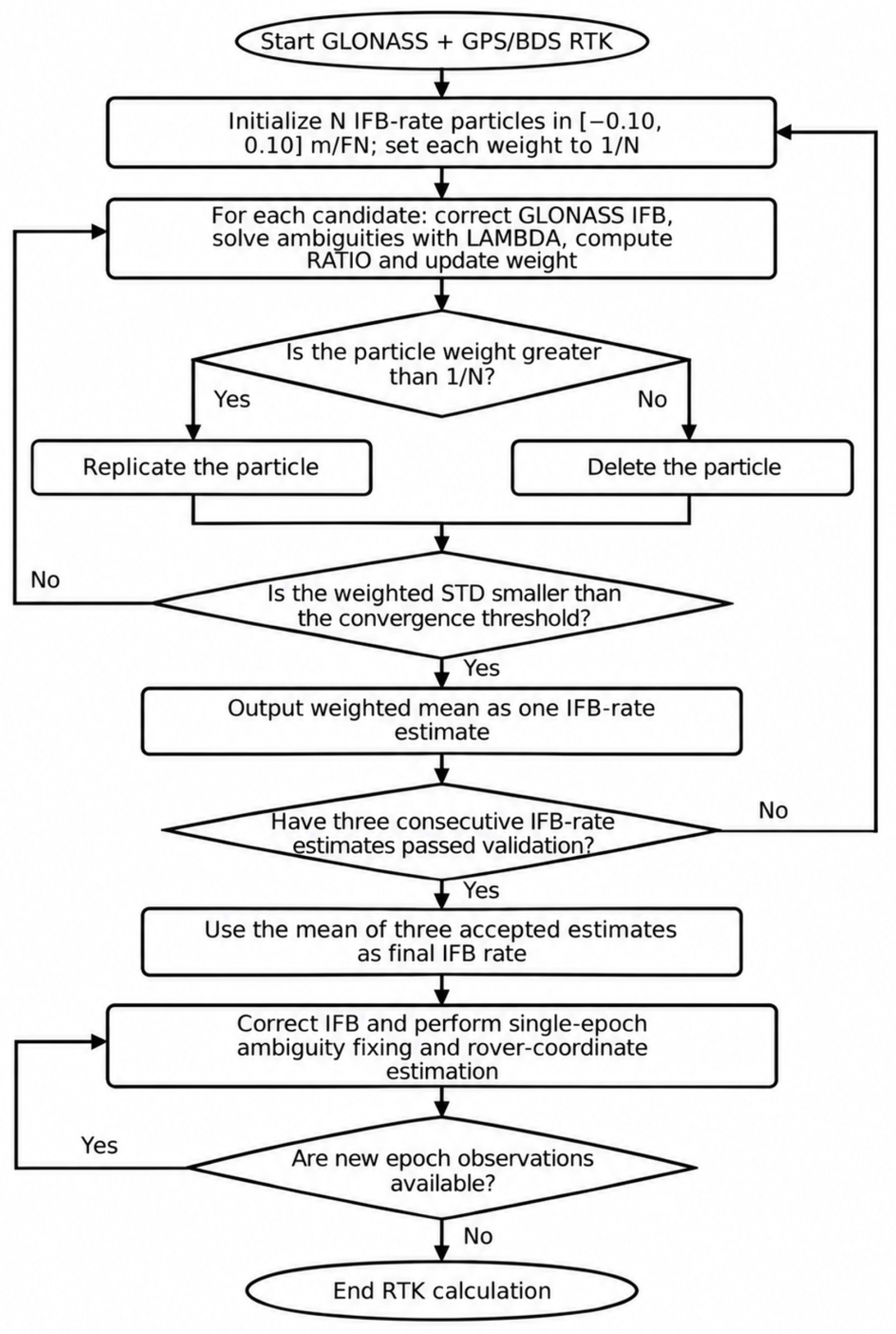
The data-processing workflow of the improved approach is shown in Figure 5. The procedure first estimates an accepted GLONASS IFB rate from consecutive epochs and then introduces this value into the combined-system single-epoch RTK model. Therefore, the term single-epoch RTK in this study refers to ambiguity resolution and coordinate determination using one epoch of observations after the IFB-rate calibration has been completed, whereas the IFB-rate estimation itself is a sequential particle-filter process.
Figure 5.
Processing workflow of the enhanced IFB-rate estimation and single-epoch RTK positioning strategy.
Based on the observation model above and the particle-filter strategy, the procedure can be carried out as follows:
- At the beginning of GLONASS+GPS or GLONASS+BDS RTK processing, the raw code and carrier-phase observations and broadcast ephemerides are read, the elevation cut-off angle and the single- or dual-frequency mode are applied, and the corresponding single- and double-differenced observations are formed;
- A set of N candidate IFB-rate particles is generated within the interval [−0.10, 0.10] m/FN, and each particle is initially assigned the same weight of 1/N;
- For each epoch and for each candidate IFB rate, the GLONASS carrier-phase IFB term is corrected in the double-differenced observation model. The receiver coordinates and ambiguities are then estimated jointly, the integer ambiguities are searched using the LAMBDA method, and the ambiguity RATIO is used as the likelihood information to update the particle weight;
- The particles are resampled after the weight update. If the weight of a particle is greater than 1/N, this particle is replicated; otherwise, the particle is discarded. The resampled particle set is then carried into the next update;
- The weighting and resampling process is repeated until the weighted standard deviation of the candidate IFB-rate particles is smaller than the convergence threshold. The weighted mean of all retained particles is output as one IFB-rate estimate;
- To avoid using an abnormal IFB-rate estimate, three consecutive IFB-rate estimates are checked by the real-time outlier-detection rule. When all three estimates pass the validation test, their average is adopted as the final IFB rate for positioning; otherwise, the IFB-rate estimation is restarted.
- The accepted IFB rate is introduced into the combined-system single-epoch RTK model to correct the GLONASS carrier-phase IFB, perform LAMBDA ambiguity resolution, and determine the rover coordinates. If new epoch observations are available, the subsequent epoch is processed with the accepted IFB rate; otherwise, the RTK calculation is terminated.
It should be noted that the accepted IFB rate is receiver-pair-dependent and is treated as a calibration quantity for the subsequent RTK epochs. In normal real-time positioning, once the IFB rate passes the consecutive-estimate validation, it can be used to correct the following single-epoch observations. In the experiments below, the IFB rate is estimated repeatedly in order to display the convergence process and evaluate the reliability of the proposed strategy.
The use of GPS or BDS observations is critical in this workflow because these additional code-division multiple access observations provide independent equations that are not affected by the GLONASS carrier-phase IFB. They strengthen the coordinate solution and alleviate the strong correlation and rank-deficiency problems among the IFB rate, coordinate, and ambiguity parameters. Consequently, the particle likelihood surface becomes more concentrated when only one GLONASS frequency is available or when only a few GLONASS satellites are tracked, which explains why the improved approach converges more reliably than the GLONASS-only particle-filter solution discussed in Section 2.3.
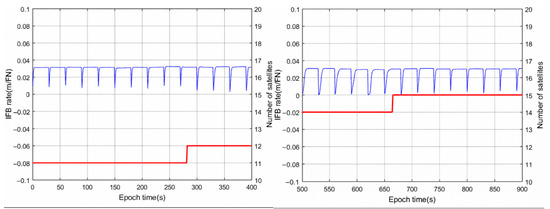
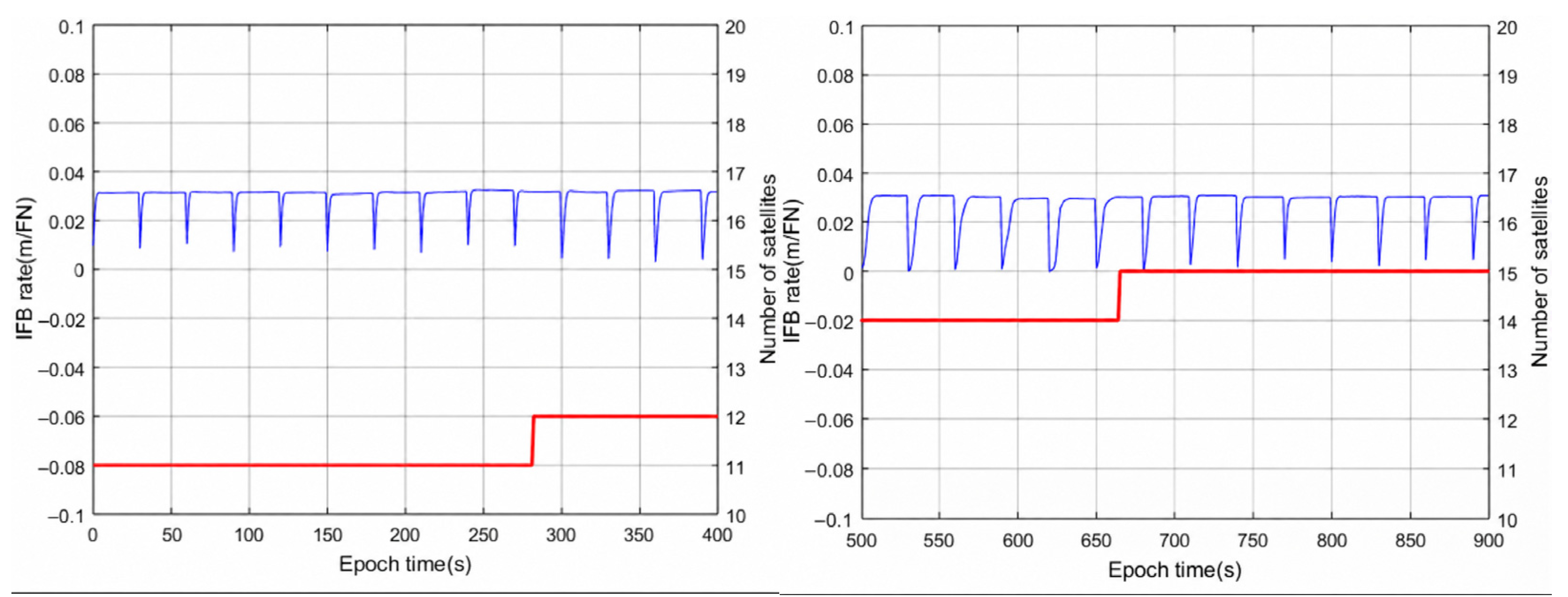
The number of tracked GLONASS satellites is therefore crucial for IFB-rate estimation. In general, receivers that track GLONASS also track GPS signals, so the data used in Cases 1 and 2 are processed again with the improved GPS+GLONASS approach. In Figure 6 (left), the RATIO distribution is concentrated near 0.03 m/FN, and Figure 7 (left) shows rapid and repeatable convergence even when few GLONASS satellites are tracked. For single-frequency data, Figure 6 (right) and Figure 7 (right) show that the additional GPS observations make IFB-rate estimation feasible and markedly more stable than GLONASS-only single-frequency processing, although short-term fluctuations may remain during convergence.
Figure 6.
Three-dimensional RATIO distribution along with epochs and IFB rate sample for dual-frequency GPS+GLONASS IFB estimation (left) and single-frequency GPS+GLONASS IFB estimation (right). In both panels, the surface color changes from blue to red with increasing RATIO values.
Figure 7.
The convergence procedures of the estimated IFB rate with a step size of 30 epochs for dual-frequency GPS+GLONASS IFB estimation (left) and single-frequency GPS+GLONASS IFB estimation (right). In both panels, the blue solid line represents the estimated IFB rate, whereas the red solid step line represents the number of tracked GLONASS satellites. The (left) and (right) panels use the Case 1 dataset (Data B; 30 s sampling interval) and the Case 2 dataset (Data A; 1 s sampling interval), respectively.
Figure 7 uses two independent datasets rather than a common time series. Accordingly, the left and right panels retain different epoch ranges and should not be interpreted as synchronized observations. After GPS observations are incorporated, the additional observation redundancy substantially strengthens the estimation model, enabling both the dual-frequency and single-frequency solutions to converge rapidly and thereby producing similar convergence profiles. Although the IFB rate of a given receiver pair is expected to remain stable over long time scales, the estimator was deliberately reinitialized every 30 epochs in this experiment to evaluate its repeatable fast-convergence capability. The periodic drops in both panels therefore indicate the beginning of successive re-estimation cycles rather than genuine temporal variations in the IFB rate. Because both datasets were collected with the same receiver pair on different observation days, their converged IFB-rate values are also consistent.
In addition, there are some incorrectly estimated IFB rates, directly influencing the accuracy of RTK positioning. So, it is necessary to propose a real-time outlier detection method to detect the incorrect IFB rate. In this study, when the absolute value between the IFB rate and the average of consecutive three estimated IFB rate, is more than 3 times convergence threshold, the IFB rate is considered to be an outlier. The average of three tested IFB rates would be used in RTK positioning, and this method will be validated in the following sections.
3. Results
To further validate the improved approach, three experiments were designed. These are the details of data processed. The IFB rate convergence threshold is 1 mm/FN for all baselines and broadcast ephemerides have been used to compute the orbits and clocks of GPS and GLONASS satellites. The failure rate and successful fixing rate of ambiguity was defined by Teunissen et al. [20] and Li et al. [21]. In order to express convenience, a concise shorthand used by Odolinski and Teunissen [5] is adopted like single-frequency (SF), single-system (SS), and dual-frequency dual-system (DF-DS).
3.1. IFB Rate Estimation and GPS/GLONASS RTK Positioning with Ambiguity Resolution
Three sets of data collected from American, Europe, and Asia are processed by the approach proposed by Tian et al. [11,16] and the enhanced approach presented in this contribution. The two methods are compared to the performance of IFB rate estimation, ambiguity resolution, and positioning. To make full use of the data, a new IFB rate begins to converge immediately after an IFB rate is converged. After all epochs of data are processed, the estimated IFB rates are ordered by size, and the interquartile range is computed (this is the value of the residual at 75% of the sorted array minus the value of the residual at 25% of the sorted array). Any estimated IFB rate less than 3 times this interquartile range below or above the median is considered to be an outlier [22]. The success rate of the IFB rate is calculated by the number of correct IFB rates divided by the number of all estimated IFB rates.
Table 2 shows the performance of IFB rate estimated by the original approach (the approach proposed by Tian et al. [11,16]) and the improved approach. For the HERT-HERS baseline, The DF-SS represented the approach and the SF-DS, DF-DS which are represented the improved approach perform similar on success rate, the standard deviation of IFB rate (STD) and epochs for convergence. However, NYBR-NYBP and WUHN-ROER’s observation quality are not as good as HERT-HERS, especially for the WUHN-ROER, 4566 epochs of data were collected, there are 1560 epochs that GLONASS satellites are less than 4 and 1621 epochs that the number of tracked satellites is 5. Table 2 shows that the performance of improved approach is better than the original approach especially on success rate of IFB rate estimation and convergence time for NYBR-NYBP and WUHN-ROER. From the statistics, it is obvious that the performance of IFB rate estimated by GPS+GLONASS single-frequency data is better than GLONASS dual-frequency. This means that IFB rate can be estimated by GPS+GLONASS single-frequency observation and the effect of SF-DS is better than DF-SS. The better performance of SF-DS is mainly attributed to the larger number of available observations and the additional constraints provided by GPS measurements, which are unaffected by GLONASS IFB.
Table 2.
IFB-rate estimation statistics for GLONASS-only and GPS+GLONASS solutions on the three test baselines.
After the IFB rate is estimated, we analyzed the ambiguity resolution and single-epoch RTK positioning. Due to few visible satellites, GLONASS dual-frequency ambiguity fixed rate and failure rate performed poorly in NYBR-NYBP and WUHN-ROER. The ambiguity resolution statistics for NYBR-NYBP, HERT-HERS, and WUHN-ROER are summarized in Table 3, Table 4 and Table 5, respectively. For all three baselines, the GPS+GLONASS single-frequency solution performs better than the GLONASS dual-frequency solution and shows performance comparable to the GPS dual-frequency solution in terms of the ambiguity fixed rate and failure rate.
Table 3.
Ambiguity resolution statistics for NYBR-NYBP.
Table 4.
Ambiguity resolution statistics for HERT-HERS.
Table 5.
Ambiguity resolution statistics for WUHN-ROER.
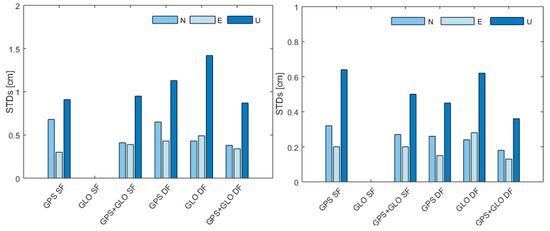
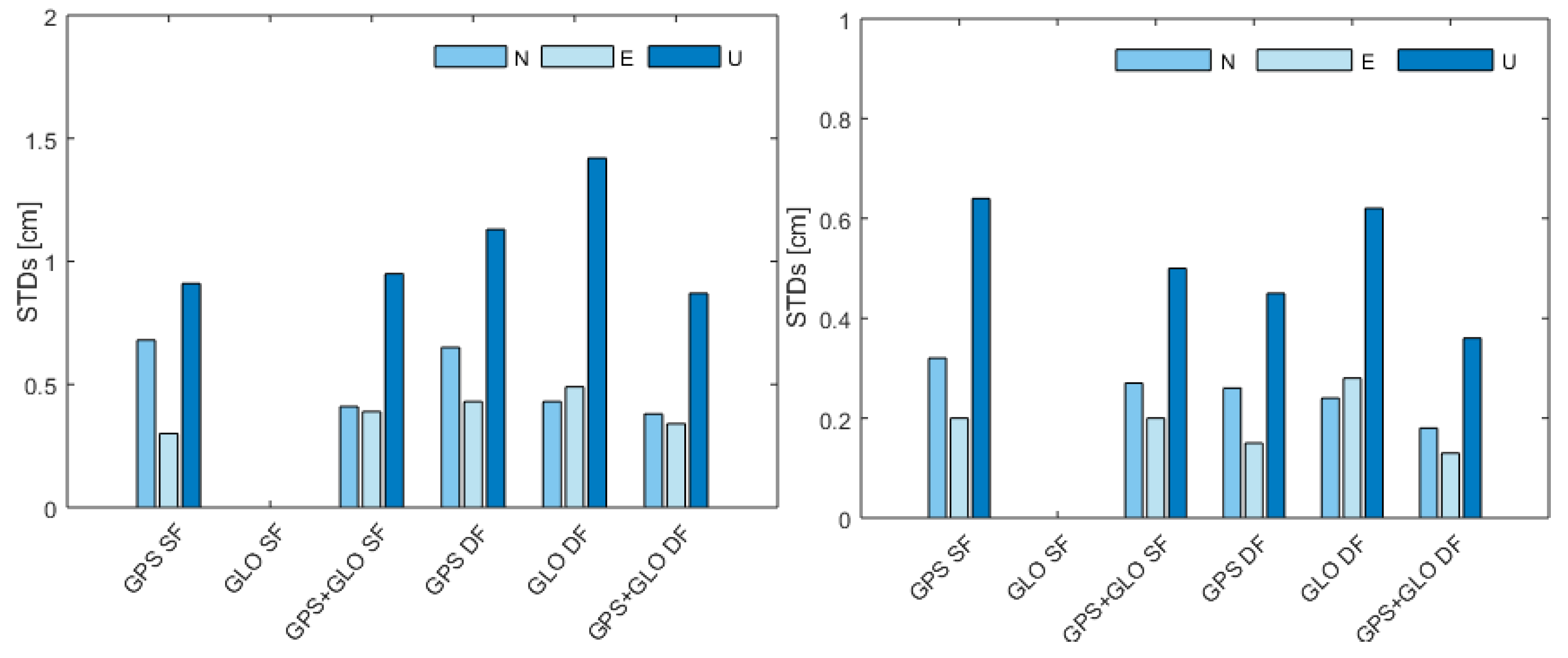
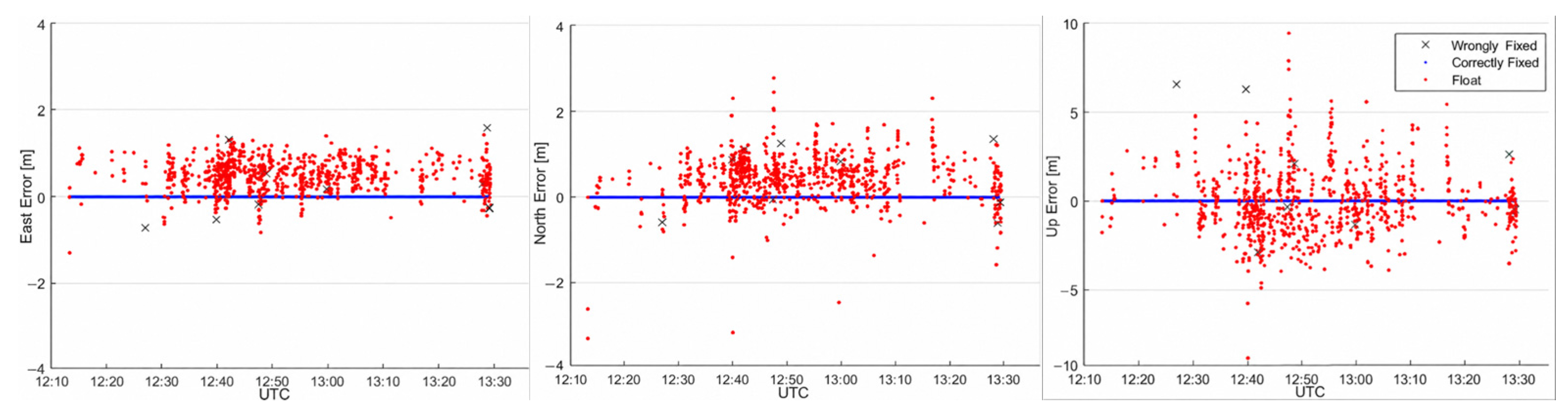
For RTK positioning precision, all modes are satisfactory, and the positioning precision of GPS+GLONASS single-frequency solution is similar to GPS dual-frequency solution in Figure 8. Because WUHN-ROER is a kinematic observation data, the STD of north, east, and up (NEU) direction cannot be calculated. To validate the accuracy of GPS+GLONASS single-frequency solution, the GPS+GLONASS dual-frequency solution is used as a truth value and the difference is presented in Figure 9. The NEU RMS of fixed solutions are 0.23 cm, 0.15 cm, and 0.58 cm, and the RMS of float solutions are 60.24 cm, 59.76 cm, and 166.02 cm for WUHN-ROER, which means that the GPS+GLONASS single-frequency observation is available for RTK positioning. The much larger errors of the float solutions arise because the integer ambiguities cannot be resolved at these epochs. Consequently, the high-precision carrier-phase observations cannot fully contribute to the coordinate solution, and the positioning accuracy is dominated mainly by the pseudorange observations. Therefore, the float-solution accuracy is close to that of pseudorange-based differential positioning.
Figure 8.
Position errors of fixed solution for NYBR-NYBP (left) and HERT-HERS (right).
Figure 9.
Position errors of GPS+GLONASS single-frequency solution for WUHN-ROER.
3.2. Long-Term Experiments for IFB Rate Estimation and RTK Positioning
In this section, an empirical analysis is based on the performance of IFB rate estimation and RTK positioning over a long-term experiment. Data from 1 January to 31 December 2015 of HERT and HERS in Europe were collected. Due to the lack of HERS2720.15o, the result of DOY 272 could not be counted.
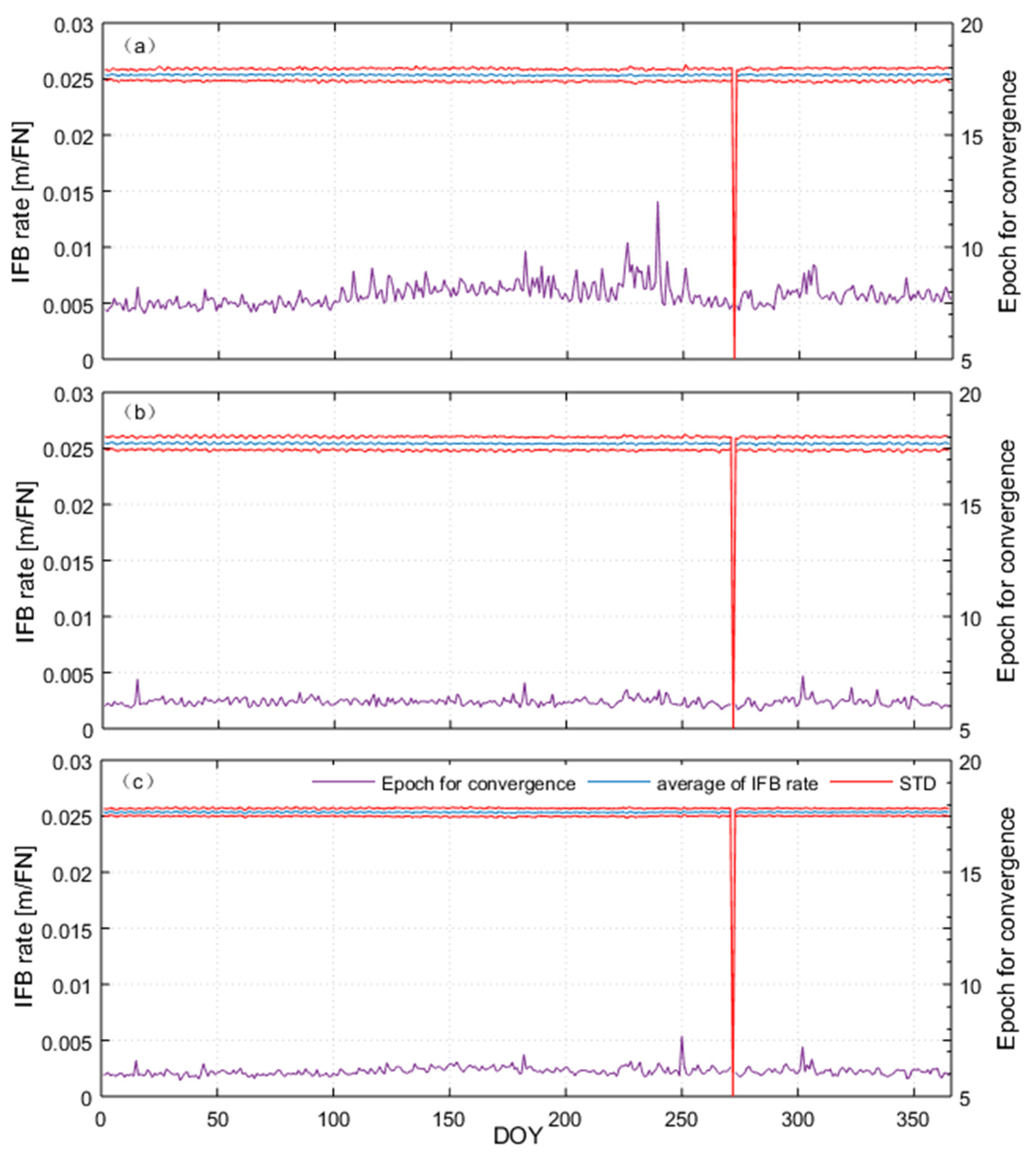
For convenience, we set all the estimated IFB rates of one day as a unit, the average and STD of the unit would be counted. The average is stabilized at 0.0254 m and the STD is stable, which means that the IFB rate is irrelevant to time in Figure 10. And, if there is a priori IFB rate for a pair of GNSS receiver, we could use the priori value to do GLONASS RTK positioning without GLONASS IFB rate estimation. Figure 10 and Table 6 show that the STD of (a), (b), and (c) is stable, but STD of GPS+GLONASS dual-single solution is closer to the average of estimated IFB rate and the epoch for convergence of GPS+GLONASS dual-frequency solution is least, which proved the IFB rate estimated by improved approach is more stable and faster than the original method. Furthermore, the performance of IFB rate estimated by GPS+GLONASS single-frequency solution is reliable, and even time for convergence shown in Figure 10 and Table 6 is less than GLONASS dual-frequency solution.
Figure 10.
The epoch for convergence, the average of estimated IFB rate and its STD of GLONASS dual-frequency solution (a), GPS+GLONASS single-frequency solution (b) and GPS+GLONASS dual–single solution (c) during 2015 DOY1-365.
Table 6.
The statistics of the estimated IFB rate during 2015 DOY1-365.
Table 7 shows the success rate and failure rate of the IFB rate real-time outlier detection method proposed in this study. The success rates are near to 100% which means all outliers are eliminated, and the low failure rate indicates that very few correct IFB-rate estimates are incorrectly rejected. Thus, the result of this experiment proves that the outlier detection method is effective in detecting the incorrect IFB rate and could provide a reliable real-time IFB rate to RTK positioning.
Table 7.
The statistics of IFB rate real-time outlier detection method.
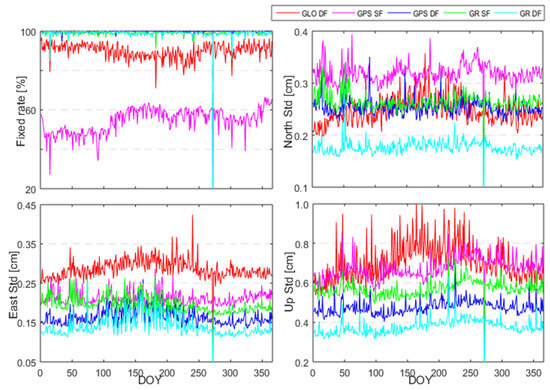
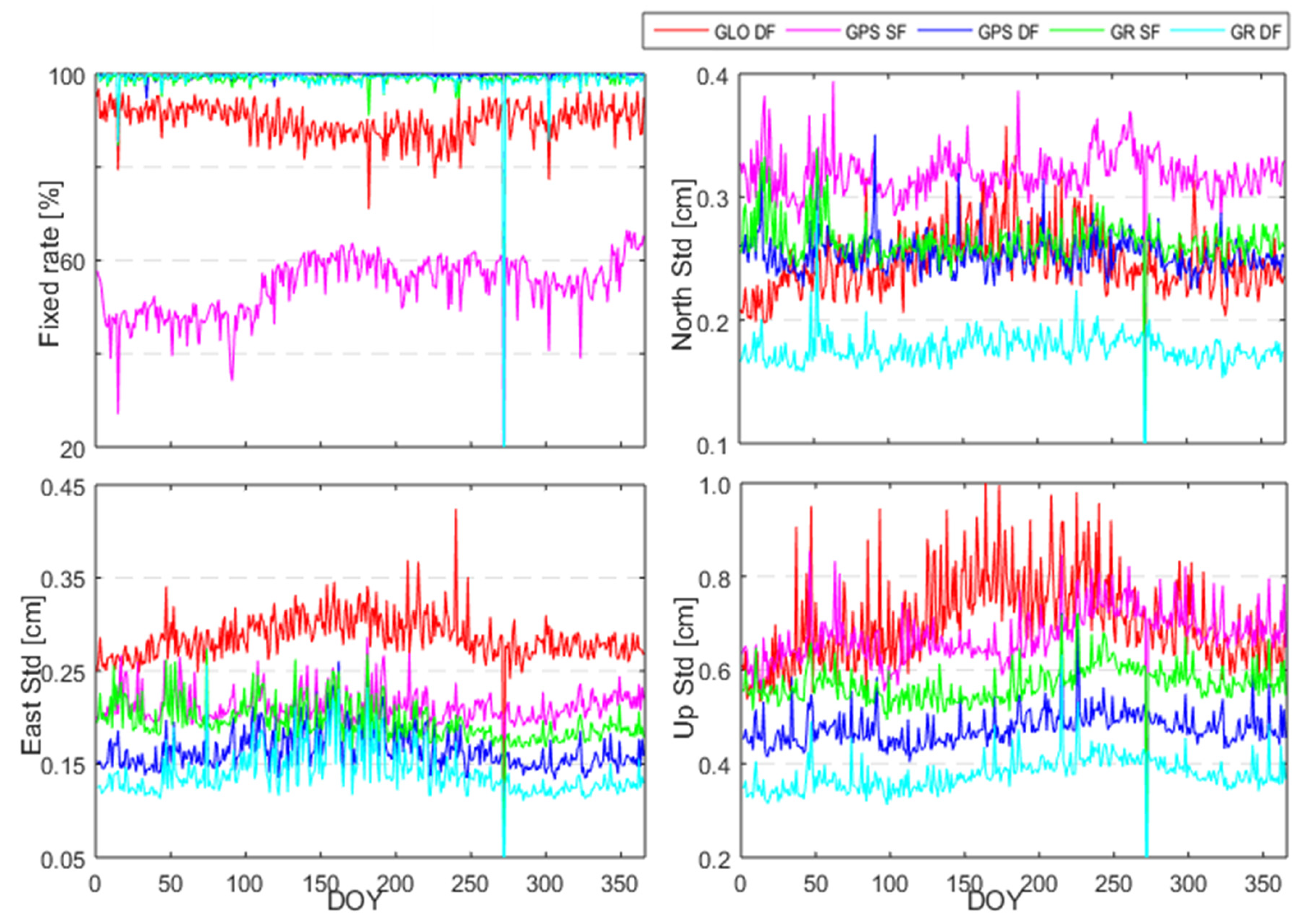
To verify the performance of integer ambiguity resolution and RTK positioning, the ambiguity fixed rate and NEU STD of a day’s all epoch result are presented in Figure 11, and the result of one year data is presented in Table 8. For GLONASS dual-frequency ambiguity, the ambiguity fixed rate is improved from 89.87% to 99.00% by utilizing the improved method. For positioning error, GPS/GLONASS dual-frequency RTK precision compared to GLONASS dual-frequency RTK are improved by 28.00%, 51.72%, and 45.71% on the north, east, and up components, respectively. For dual-frequency observation, Table 8 shows that the positioning precision of improved method is better than original method, and the single-frequency GLONASS not only could be utilized but also has a similar precision to GPS dual-frequency solution.
Figure 11.
Ambiguity resolution and position error during 2025 DOY1-365. Note: DOY = day of year; GLO DF = GLONASS dual-frequency; GPS SF = GPS single-frequency; GPS DF = GPS dual-frequency; GR SF = GPS/GLONASS single-frequency; GR DF = GPS/GLONASS dual-frequency.
Table 8.
The statistics of ambiguity resolution and position error during 2025 DOY1-365.
3.3. Adding BDS Observations
As shown above, the improved approach that uses GPS and GLONASS observation to estimate IFB rate, fix integer ambiguity, and positioning is more stable and precise than the original method and is also available to single-frequency observation. Then, the performance of the improved approach which substitutes BDS observation for GPS would be analyzed. Data of STR1 and STR2 in Australia which could observe GPS, BDS, and GLONASS satellites is processed.
Firstly, for IFB rate, BDS+GLONASS has a similar performance to GPS+GLONASS estimation on success rate and time to convergence in Table 9. For time to convergence, dual-frequency is faster than single-frequency, and three system dual-system is better than single system.
Table 9.
IFB rate estimation statistics for different GPS/BDS/GLONASS combinations on the STR1-STR2 baseline.
The ambiguity resolution and positioning statistics for different single- and dual-frequency GNSS combinations are summarized in Table 10.
Table 10.
The statistics of ambiguity resolution and position error.
For integer ambiguity resolution, BDS+GLONASS is nearly equal with GPS+GLONASS, no matter when single-frequency or dual-frequency observation is processed. But GPS is better than BDS on positioning precision especially in the vertical direction both single-system positioning and dual-system. In a word, for utilizing single/dual-frequency GLONASS observation to RTK positioning, BDS can play a similar role to GPS.
4. Discussion
The results demonstrate that supplementing GLONASS observations with GPS or BDS addresses a principal weakness of particle-filter-based IFB-rate estimation when the number of tracked GLONASS satellites is small or only single-frequency observations are available. Compared with the GLONASS-only approach of Tian et al. [11,16], the multi-GNSS formulation provides additional observations to constrain the IFB rate, leading to more stable estimation, faster convergence in the tested cases, and more reliable ambiguity resolution.
The long-term experiment further indicates that the estimated IFB rate is stable for a given receiver pair. This stability suggests that a previously calibrated IFB rate may be used for direct RTK processing, reducing the need for repeated online estimation. The comparable performance of GPS/GLONASS single-frequency RTK and GPS dual-frequency RTK also broadens the practical use of GLONASS observations for receivers with limited frequency capability. The BDS experiments show that this benefit is not limited to GPS-assisted configurations.
These findings should nevertheless be interpreted within the tested receiver pairs, baselines, satellite geometries, and data periods. Further work should evaluate the transferability of calibrated IFB rates across more receiver types and environments, particularly under obstructed or rapidly changing conditions, and should assess real-time computational performance in operational systems.
5. Conclusions
Although most multi-GNSS receivers can track GLONASS satellites, GLONASS observation is hardly used at RTK. The approach proposed by Tian et al. [16] makes real-time GLONASS integer ambiguity resolution possible. Thus, the method that enhanced the performance of GLONASS RTK by combining GPS/BDS observation is proposed in this study to overcome these shortcomings. The experimental results show the enhanced algorithm not only has a better performance than the original method when tracked satellites are few but also uses the single-frequency GLONASS observation to achieve a precise RTK positioning solution, whose precision is similar to the performance of GPS dual-frequency solution.
According to the statistics of one year’s estimation result, the estimated IFB rate is stable and irrelevant to time. This means if there is an a priori IFB rate for a pair of receivers, we could perform RTK positioning directly without GLONASS IFB rate estimation. The performance of GPS/GLONASS single/dual-frequency RTK is also evaluated for first time. Firstly, GPS/GLONASS dual-frequency solution could improve the ambiguity fixed rate and position accuracy compared to GPS dual-frequency. Secondly, the long-term statistics show that the performance of GPS/GLONASS single-frequency RTK is close to GPS dual-frequency RTK.
The performance of the enhanced approach by combining BDS signal is assessed. The result shows that the improved method for estimating IFB rate using BDS+GLONASS observation is available, and its performance is similar to GPS+GLONASS. It is also shown that the more system or frequency observation is used, the better the performance of estimated IFB rate, ambiguity resolution, and RTK positioning.
Author Contributions
Conceptualization, M.H. and C.X.; methodology, M.H. and J.K.; software, M.H. and J.K.; validation, H.Z., Y.Z. and Y.Y. (Yifei Yang); formal analysis, M.H. and J.K.; investigation, M.H. and J.K.; resources, C.X. and Y.Y. (Yibin Yao); data curation, H.Z. and Y.Z.; writing—original draft preparation, M.H.; writing—review and editing, J.K., C.X. and Y.Y. (Yibin Yao); visualization, M.H. and J.K.; supervision, C.X. and Y.Y. (Yibin Yao); project administration, C.X.; funding acquisition, C.X. and Y.Y. (Yibin Yao). All authors have read and agreed to the published version of the manuscript.
Funding
This research was funded by National Natural Science Foundation of China [42404050], Natural Resources Information Center of Guangxi Zhuang Autonomous Region [KJ2025B01], the National Key Research and Development Program of China [2023YFB3907101], the Key Research and Development Program of Shandong Province [2025GNKJHZ0401], the Key Research and Development Program of Qinghai Province [2026-GX-153], the Key Research and Development Program of Shaanxi Province [2024SF2-GJHX-54]. The APC was funded by Wuhan University.
Data Availability Statement
The GNSS datasets collected from the USA CORS network, the EUREF Permanent Network, and MGEX were used in this study.
Acknowledgments
The GNSS datasets collected from the USA CORS network, the EUREF Permanent Network, and MGEX were used in this study and are acknowledged. No individuals are named in this section.
Conflicts of Interest
The authors declare no conflicts of interest.
References
- Zhao, S.; Cui, X.; Guan, F.; Lu, M. A Kalman filter-based short baseline RTK algorithm for single-frequency combination of GPS and BDS. Sensors 2014, 14, 15415–15433. [Google Scholar] [CrossRef] [Scilit]
- Teunissen, P.J.G.; Odolinski, R.; Odijk, D. Instantaneous BeiDou+GPS RTK positioning with high cut-off elevation angles. J. Geod. 2014, 88, 335–350. [Google Scholar] [CrossRef] [Scilit]
- He, H.; Li, J.; Yang, Y.; Xu, J.; Guo, H.; Wang, A. Performance assessment of single- and dual-frequency BeiDou/GPS single-epoch kinematic positioning. GPS Solut. 2014, 18, 393–403. [Google Scholar] [CrossRef] [Scilit]
- Odolinski, R.; Teunissen, P.J.G.; Odijk, D. Combined BDS, Galileo, QZSS and GPS single-frequency RTK. GPS Solut. 2015, 19, 151–163. [Google Scholar] [CrossRef] [Scilit]
- Odolinski, R.; Teunissen, P.J.G. Single-frequency, dual-GNSS versus dual-frequency, single-GNSS: A low-cost and high-grade receivers GPS-BDS RTK analysis. J. Geod. 2016, 90, 1255–1278. [Google Scholar] [CrossRef] [Scilit]
- Odolinski, R.; Teunissen, P.J.G. Best integer equivariant estimation: Performance analysis using real data collected by low-cost, single- and dual-frequency, multi-GNSS receivers for short- to long-baseline RTK positioning. J. Geod. 2020, 94, 91. [Google Scholar] [CrossRef] [Scilit]
- Luo, X.; Schaufler, S.; Branzanti, M.; Chen, J. Assessing the benefits of Galileo to high-precision GNSS positioning—RTK, PPP and post-processing. Adv. Space Res. 2021, 68, 4916–4931. [Google Scholar] [CrossRef] [Scilit]
- Odolinski, R.; Teunissen, P.J.G. Best integer equivariant position estimation for multi-GNSS RTK: A multivariate normal and t-distributed performance comparison. J. Geod. 2022, 96, 3. [Google Scholar] [CrossRef] [Scilit]
- Wanninger, L. Carrier-phase inter-frequency biases of GLONASS receivers. J. Geod. 2012, 86, 139–148. [Google Scholar] [CrossRef] [Scilit]
- Al-Shaery, A.; Zhang, S.; Rizos, C. An enhanced calibration method of GLONASS inter-channel bias for GNSS RTK. GPS Solut. 2013, 17, 165–173. [Google Scholar] [CrossRef] [Scilit]
- Tian, Y.; Ge, M.; Neitzel, F. Particle filter-based estimation of inter-frequency phase bias for real-time GLONASS integer ambiguity resolution. J. Geod. 2015, 89, 1145–1158. [Google Scholar] [CrossRef] [Scilit]
- Zhang, Z.; Lou, Y.; Zheng, F.; Gu, S. On GLONASS pseudo-range inter-frequency bias solution with ionospheric delay modeling and the undifferenced uncombined PPP. J. Geod. 2021, 95, 32. [Google Scholar] [CrossRef] [Scilit]
- Peng, W.; Chu, R.; Gao, Y.; Xu, C.; Yao, Y.; Shi, J. Estimation and impact of GLONASS inter-frequency code bias in single-frequency precise point positioning. Adv. Space Res. 2023, 71, 5302–5310. [Google Scholar] [CrossRef] [Scilit]
- Tian, Y.; Liu, Z.; Li, K. Markov chain Monte Carlo-based DCPB estimation for ambiguity fixing of GLONASS-only FDMA single-epoch positioning. GPS Solut. 2023, 27, 46. [Google Scholar] [CrossRef] [Scilit]
- Shi, C.; Yi, W.; Song, W.; Lou, Y.; Yao, Y.; Zhang, R. GLONASS pseudorange inter-channel biases and their effects on combined GPS/GLONASS precise point positioning. GPS Solut. 2013, 17, 439–451. [Google Scholar] [CrossRef] [Scilit]
- Tian, Y.; Ge, M.; Neitzel, F.; Yuan, L.; Huang, D.; Zhou, L.; Yan, H. Improvements on the particle-filter-based GLONASS phase inter-frequency bias estimation approach. GPS Solut. 2018, 22, 71. [Google Scholar] [CrossRef] [Scilit]
- Leick, A. GLONASS satellite surveying. J. Surv. Eng. 1998, 124, 91–99. [Google Scholar] [CrossRef] [Scilit]
- Takasu, T.; Yasuda, A. Development of the low-cost RTK-GPS receiver with an open source program package RTKLIB. In Proceedings of the International Symposium on GPS/GNSS, Seogwipo-si, Republic of Korea, 4–6 November 2009. [Google Scholar]
- Teunissen, P.J.G. The least-squares ambiguity decorrelation adjustment: A method for fast GPS integer estimation. J. Geod. 1995, 70, 65–82. [Google Scholar] [CrossRef] [Scilit]
- Teunissen, P.J.G.; Verhagen, S. On GNSS ambiguity acceptance tests. In Proceedings of the IGNSS Symposium, Sydney, Australia, 4–6 December 2007; pp. 1–13. [Google Scholar]
- Li, B.; Shen, Y.; Feng, Y.; Gao, W.; Yang, L. GNSS ambiguity resolution with controllable failure rate for long baseline network RTK. J. Geod. 2014, 88, 99–112. [Google Scholar] [CrossRef] [Scilit]
- John, L.; Yehuda, B. High-rate real-time GPS network at Parkfield: Utility for detecting fault slip and seismic displacements. Geophys. Res. Lett. 2004, 31, 289–302. [Google Scholar] [CrossRef] [Scilit]

Disclaimer/Publisher’s Note: The statements, opinions and data contained in all publications are solely those of the individual author(s) and contributor(s) and not of MDPI and/or the editor(s). MDPI and/or the editor(s) disclaim responsibility for any injury to people or property resulting from any ideas, methods, instructions or products referred to in the content. |
© 2026 by the authors. Licensee MDPI, Basel, Switzerland. This article is an open access article distributed under the terms and conditions of the Creative Commons Attribution (CC BY) license.