


Abstract
Human–animal interactions have been associated with numerous benefits for human wellbeing, yet their potential contributions to conservation have received comparatively little theoretical attention. The biophilia hypothesis proposes that humans possess an innate tendency to affiliate with living organisms and provides a compelling theoretical foundation for examining how meaningful interactions with animals may influence both personal and environmental outcomes. The purpose of this paper is to propose a deductively derived conceptual framework describing how meaningful interactions with domesticated waterfowl may contribute simultaneously to human wellbeing and wetland conservation. Interpreted through the biophilia hypothesis, the proposed framework describes two complementary pathways. The therapeutic pathway suggests that meaningful human–waterfowl interactions foster emotional connection with living organisms, contributing to human wellbeing. The conservation pathway proposes that emotional connection may stimulate curiosity and learning about waterfowl and the wetland ecosystems they naturally represent, fostering appreciation for wetlands, conservation awareness, and stewardship. Central to the framework is the proposition that domesticated waterfowl retain a recognizable ecological identity despite domestication, providing a conceptual bridge between meaningful human–animal interactions and the ecosystems these animals naturally represent. The proposed framework integrates concepts from biophilia, human–animal interaction research, conservation education, and conservation psychology while generating empirically testable hypotheses for future research. More broadly, it suggests that meaningful interactions with domesticated waterfowl may represent one pathway through which human wellbeing and wetland conservation can be advanced simultaneously. Although broadly applicable across multiple settings, the proposed framework has particular applicability to zoological institutions, where meaningful observation of ambassador waterfowl, interpretation, and conservation education may provide opportunities to simultaneously promote visitor wellbeing and strengthen conservation awareness and stewardship.
1. Introduction
Meaningful interactions between humans and animals have long been part of the human experience, fostering emotional connections, learning, and wellbeing. Over the past several decades, research on human–animal interactions has increasingly documented the therapeutic benefits of these relationships across diverse populations and settings [1,2]. Although these benefits are now well recognized, considerably less attention has been devoted to understanding how meaningful interactions with animals may also contribute to conservation-related outcomes.
Meaningful interactions with animals may extend beyond individual therapeutic benefits by encouraging curiosity, learning, and appreciation for the natural world. Conservation education has increasingly emphasized the importance of fostering meaningful experiences with wildlife and nature; however, the theoretical mechanisms through which these experiences may influence conservation awareness and stewardship remain incompletely understood [3,4,5,6]. Although Wilson’s biophilia hypothesis provides a theoretical connection between human affiliation with the living world, human wellbeing, and conservation, the specific pathways through which meaningful interactions with domesticated animals might simultaneously influence individual wellbeing and conservation-related outcomes remain less clearly articulated. In particular, limited theoretical attention has been given to whether emotional affiliation with a domesticated animal may extend beyond the individual animal to stimulate curiosity, learning, and concern for the ecosystem that animal represents.
Zoological institutions provide an ideal context in which such relationships may be explored because they integrate meaningful animal observation, conservation education, public engagement, and biodiversity stewardship within a single educational environment.
Wilson’s biophilia hypothesis provides a compelling theoretical foundation for examining these relationships. Biophilia proposes that humans possess an innate tendency to affiliate with living organisms, reflecting an evolutionary relationship with the natural world [7]. Wilson further argued that this affiliation provides the basis for the development of a conservation ethic, suggesting that emotional relationships with living organisms may ultimately influence attitudes toward biodiversity and environmental stewardship [8].
Domesticated waterfowl provide a particularly useful model through which to examine these concepts. Despite domestication, ducks and geese retain recognizable morphological and behavioral associations with aquatic environments and with the wetland ecology of their wild relatives, making them suitable for exploring how meaningful interactions with domesticated animals may contribute not only to human wellbeing but also to appreciation for associated ecosystems [9].
We hypothesize that meaningful human–waterfowl interactions foster emotional affiliation with living organisms, contributing to human wellbeing while simultaneously stimulating curiosity and ecological learning that may strengthen wetland conservation awareness and stewardship. The novelty of the proposed framework lies not in suggesting that biophilic affiliation can benefit both humans and conservation, relationships already inherent in Wilson’s formulation, but in proposing a specific, empirically testable pathway through which meaningful interactions with domesticated animals that retain a recognizable ecological identity may connect individual wellbeing with concern for the ecosystems those animals represent.
The purpose of this paper is to propose a deductively derived conceptual framework that extends the biophilia hypothesis by describing how meaningful human–waterfowl interactions may contribute simultaneously to human wellbeing and wetland conservation. Integrating concepts from biophilia, human–animal interaction research, conservation education, and conservation psychology, the proposed framework generates empirically testable hypotheses while offering a theoretical foundation for future interdisciplinary research.
2. The Biophilia Hypothesis as the Theoretical Foundation
Wilson’s biophilia hypothesis proposes that humans possess an innate tendency to affiliate with life and life-like processes, reflecting humanity’s evolutionary history within the living world. These predispositions are expressed through emotional, cognitive, aesthetic, and behavioral responses and interact with individual experience, culture, and learning [7].
Wilson extended biophilia beyond individual experience by proposing that emotional affiliation with living organisms can contribute to the development of a conservation ethic [8]. He also recognized domestication as an expression of humanity’s longstanding affiliation with other species, suggesting that domesticated animals may remain meaningful objects of biophilic affiliation [7].
Building on this foundation, the present paper uses domesticated waterfowl as a model for examining whether affiliation with a familiar domesticated animal can contribute to wellbeing while also extending to concern for the ecosystems represented by that animal.
3. Meaningful Human–Waterfowl Interactions
In zoological settings, meaningful interactions need not involve physical contact. Observation of ambassador waterfowl, interpretive exhibits, educational programming, and guided discussions may foster emotional affiliation while encouraging curiosity about wetland ecology, migration, biodiversity, and conservation.
Within the present framework, meaningful human–waterfowl interaction refers to an encounter characterized by sustained attention to waterfowl and active cognitive, emotional, or behavioral engagement with the animal or with information associated with it. Such engagement may occur through direct interaction, observation, questioning, discussion, participation in educational activities, or voluntary attention to interpretive materials. Meaningfulness is therefore not defined by physical contact or by a predetermined duration of exposure.
For empirical testing, meaningful interaction may be operationalized using measurable indicators such as duration of observation, frequency and type of behavioral engagement, participation in interpretive or educational activities, attention to educational materials, and participant-reported salience or emotional engagement. The relative importance of these indicators, and whether particular thresholds of exposure are necessary to initiate the proposed pathways, should be determined empirically rather than prescribed by the framework.
While the biophilia hypothesis is applicable to relationships with a wide variety of living organisms, different species may evoke distinct ecological associations. The present framework focuses on domesticated waterfowl as a particularly useful model, but it does not assume that ecological identity is unique to waterfowl or absent in other domesticated species. Domesticated ducks and geese differ from their wild relatives as a consequence of artificial selection, including changes in morphology, behavior, physiology, reproduction, body size, and flight capability [9,10]. Nevertheless, domesticated waterfowl retain conspicuous characteristics associated with aquatic life and with the ecology of their wild relatives, making them useful for examining whether affiliation with a familiar domesticated animal can extend to concern for the ecosystems that animal represents.
To describe these enduring associations, this paper introduces the concept of ecological identity. As used here, ecological identity refers to the recognizable association between an animal and the ecosystems represented by its evolutionary history, retained morphology and behavior, and contemporary ecological symbolism. Ecological identity does not imply ecological equivalence between domesticated animals and their wild relatives. Rather, it proposes that retained biological characteristics can provide perceptual cues linking domesticated animals with particular environments. In waterfowl, aquatic locomotor morphology, specialized bill structure and tactile foraging, and persistent water-related behaviors such as dabbling, bathing, swimming, and preening provide biologically grounded examples of such cues [11,12,13]. These traits vary among species and breeds and have been modified by domestication, but their persistence may help maintain a recognizable association between domesticated ducks and geese and aquatic or wetland environments.
The framework, therefore, does not claim that domesticated waterfowl retain a stronger ecological identity than dogs, chickens, or other domesticated species. Instead, waterfowl provide a tractable model because recognizable aquatic morphology and behavior coexist with strong ecological associations between their wild relatives and wetland ecosystems. Whether comparable ecological associations occur with other domesticated species, and whether the strength or consequences of those associations differ among species or breeds, are empirical questions for future research.
The concept of ambassador animals provides additional support for this perspective. Encounters with carefully selected animals have been shown to enhance public engagement, facilitate conservation education, and encourage interest in wildlife and biodiversity [3,4,5]. Although ambassador animal programs have traditionally emphasized nondomesticated species in zoological settings, the present framework suggests that domesticated waterfowl possessing strong ecological identity may fulfill a similar educational role by representing wetland ecosystems. Empirical findings also suggest that the effects of ambassador encounters are context-dependent rather than uniformly positive. In a zoo study of Humboldt penguin experiences, visitors demonstrated gains in conservation-related knowledge and pro-environmental behavioral intentions, although the animal encounter itself did not outperform other visit conditions [14]. More recent experimental evidence found that in-person animal viewing was associated with greater affect, empathic concern, and conservation intent than video viewing, while physical touch conferred no additional benefit over in-person observation without touch [15]. These findings support the framework’s emphasis on meaningful engagement rather than physical contact alone.
4. The Therapeutic Pathway
The therapeutic benefits of human–animal interactions have been documented across diverse populations, clinical settings, and animal species. Interactions with animals have been associated with improvements in emotional wellbeing, reductions in stress and anxiety, increased social engagement, and enhanced quality of life [1,2]. Although much of this literature has focused on companion animals, growing evidence suggests that meaningful interactions with a wider variety of species may also promote psychological and emotional wellbeing.
Emerging evidence suggests that birds may offer distinctive opportunities for promoting wellbeing through observation, interaction, and care. Encounters with birds have been associated with positive emotional experiences, stress reduction, and enhanced connection with the natural environment [16,17]. These findings suggest that therapeutic benefits may arise not only from traditional companion animals but also from species that encourage engagement with broader ecological contexts. Additional population-level evidence has linked greater bird diversity with better mental health outcomes, further supporting the relevance of birds within research on nature-related wellbeing [18].
These observations are consistent with findings from a recent qualitative study of animal-assisted therapy using domesticated waterfowl among adults with traumatic brain injury. Participants described experiences characterized by joy, emotional connection, meaningful activity, and engagement with nature, while quantitative findings from the related intervention study demonstrated a significant reduction in anxiety following participation; changes in depression and self-efficacy were not statistically significant [19,20]. Although these findings require further investigation, they illustrate the therapeutic potential of meaningful human–waterfowl interactions.
Within the present framework, emotional connection refers broadly to the affective affiliation that develops through meaningful interactions with living organisms. Rather than representing a specific psychological construct, it serves as the conceptual mechanism linking biophilic affiliation with subsequent therapeutic and conservation-related pathways.
The therapeutic pathway represents one expression of biophilic affiliation. The framework further proposes that the emotional connection underlying this pathway may also initiate curiosity and ecological learning, providing the transition to the conservation pathway described below.
5. The Conservation Pathway
The curiosity and learning components of the proposed conservation pathway are particularly applicable to zoological institutions, where animal observation is intentionally paired with interpretation and conservation education. Consequently, zoos and aquariums represent practical environments in which the proposed framework may be examined empirically without modifying the underlying conceptual model.
Wilson proposed that affiliation with life can contribute to the development of a conservation ethic [8]. Building on this premise, the conservation pathway predicts a sequence in which emotional connection with waterfowl stimulates curiosity, ecological learning, appreciation of wetlands, conservation awareness, and ultimately stewardship.
Emotional connection is therefore proposed as the catalyst rather than the endpoint of the conservation pathway. Affiliation with waterfowl may stimulate curiosity about the animals and the wetland ecosystems with which they are associated, encouraging attention to species, habitats, migration, ecological relationships, and biodiversity [7,9].
Environmental education research supports the importance of experiential learning in developing ecological understanding. Direct experiences with wildlife and nature have been associated with greater ecological knowledge, environmental awareness, and appreciation for biodiversity [6,21,22]. In the proposed pathway, curiosity links emotional affiliation with learning, while learning provides a mechanism through which engagement may develop into conservation awareness. Zoo-based evidence also demonstrates the importance of interpretation: in a pre-post study of children visiting a zoo, conservation biology learning occurred after both educator-guided and unguided visits, but negative changes in understanding were more common during unguided visits [23].
For domesticated waterfowl, ecological learning may extend from the animals to wetland ecology, migration, habitat conservation, biodiversity, and aquatic ecosystem functions because of the ecological associations described above [9,21,22]. Thus, interaction with waterfowl may serve as an entry point for ecological discovery rather than as an isolated animal encounter.
Greater ecological understanding may foster appreciation for wetlands and conservation awareness, although appreciation alone does not necessarily produce conservation behavior [24,25]. Human–nature connectedness has been associated with deliberate and spontaneous pro-environmental behavior, supporting the proposed progression from affiliation toward environmentally relevant action [26]. Zoo research showing positive affect during observation of active animals further supports affective engagement as a component of visitor experience [27].
The proposed endpoint is stewardship: actions intended to protect, restore, or responsibly manage natural ecosystems [28]. Environmental education, experiences with nature, and ecological understanding may encourage behaviors such as habitat restoration, citizen science, conservation advocacy, and support for biodiversity initiatives [28,29]. Within the framework, such actions represent a potential behavioral expression of the conservation ethic generated through the preceding pathway.
This sequence is conceptual rather than established as causal. Its individual relationships require empirical testing; the framework integrates biophilia, conservation education, conservation psychology, and human–animal interaction research to generate those testable predictions.
6. Proposed Conceptual Framework
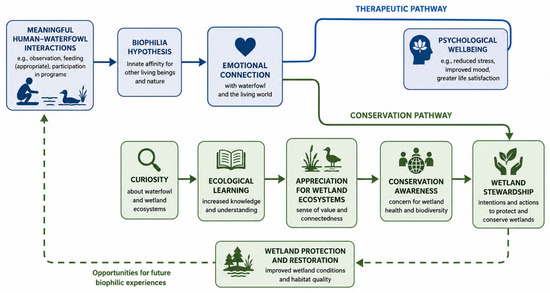
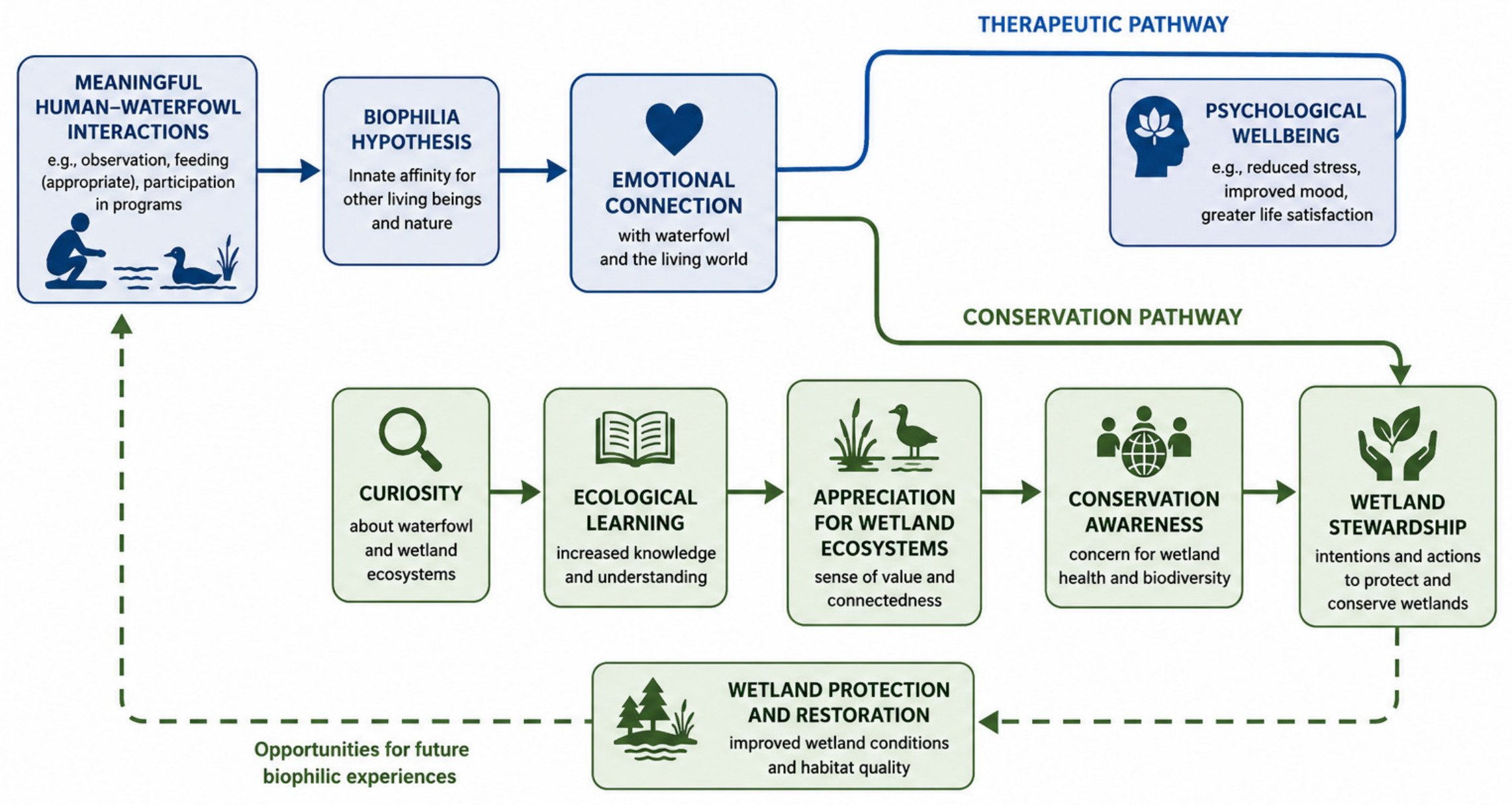
The preceding sections describe two complementary pathways through which meaningful human–waterfowl interactions may contribute to human wellbeing and wetland conservation. Figure 1 integrates these relationships into a deductively derived conceptual framework interpreted through the biophilia hypothesis [7,8]. Rather than depicting established causal relationships, the framework synthesizes existing theoretical and empirical literature to propose a biologically grounded explanation for how meaningful interactions with domesticated waterfowl may influence both therapeutic and conservation-related outcomes.
Figure 1.
Proposed conceptual framework linking meaningful human–waterfowl interactions with psychological wellbeing and wetland stewardship through therapeutic and conservation pathways. The dashed pathway represents a hypothesized ecological feedback relationship in which stewardship supports wetland protection and restoration, creating future opportunities for meaningful biophilic experiences.
Although the framework is intended to be applicable across multiple settings, zoological institutions provide one particularly important context in which it may be implemented and empirically evaluated. Within these settings, meaningful observation of ambassador waterfowl, combined with interpretation and conservation education, may initiate the therapeutic and conservation pathways illustrated in Figure 1 without altering the underlying conceptual model.
The primary contribution of the framework is the integration of previously disconnected areas of scholarship. Human–animal interaction research has predominantly emphasized therapeutic outcomes, whereas conservation education and conservation psychology have focused on fostering environmental awareness and stewardship [1,2,6,21,24,29]. By interpreting both perspectives through Wilson’s biophilia hypothesis, the present framework proposes that these outcomes need not be considered independently but may represent complementary expressions of the same underlying biophilic affiliation.
A second contribution is the introduction of ecological identity as a conceptual explanation for why certain domesticated species may retain meaningful associations with the ecosystems from which they originated. Within the present framework, ecological identity explains how interactions with domesticated waterfowl may extend beyond the individual animal to appreciation for wetland ecosystems, consistent with literature on ambassador animals and conservation education [3,4,5]. Although developed here in the context of waterfowl, the concept is intended to facilitate future discussion rather than establish a fixed taxonomy of domesticated species. The revised model also proposes a potential ecological feedback relationship: wetland stewardship may support protection and restoration of wetland environments, thereby sustaining opportunities for future meaningful biophilic experiences. This feedback relationship is presented as a testable extension of the framework rather than an established causal process.
Testable Hypotheses
The proposed framework generates the following empirically testable predictions:
H1.
Meaningful human–waterfowl interactions will be associated with greater emotional connection with waterfowl and the living world.
H2.
Greater emotional connection arising from meaningful human–waterfowl interactions will be associated with improved psychological wellbeing.
H3.
Greater emotional connection with waterfowl will be associated with increased curiosity about waterfowl and wetland ecosystems.
H4.
Greater curiosity about waterfowl and wetland ecosystems will be associated with increased ecological learning and knowledge.
H5.
Greater ecological knowledge and understanding will be associated with increased appreciation of wetlands and stronger conservation awareness.
H6.
Greater conservation awareness will be associated with stronger intentions to engage in wetland stewardship and conservation behaviors.
These hypotheses correspond to the common entry mechanism, therapeutic pathway, and conservation pathway depicted in Figure 1. Their directional wording reflects predictions derived from the proposed framework rather than established causal relationships.
7. Implications
The proposed framework has implications for human–animal interaction research, conservation education, and health professions by providing a common theoretical perspective through which therapeutic and conservation-related outcomes may be considered together rather than independently. Although these disciplines have traditionally emphasized different objectives, the biophilia hypothesis suggests that both may represent complementary expressions of humanity’s affiliation with the living world [7,8].
For human–animal interaction research, the framework expands discussion beyond therapeutic outcomes by proposing that meaningful interactions with animals may also influence how individuals perceive and value the ecosystems those animals naturally represent. This perspective encourages future studies to consider conservation-related outcomes alongside traditional measures of wellbeing, particularly for species that retain strong ecological associations despite domestication.
For conservation education, the framework highlights the potential value of meaningful human–animal interactions as experiences that encourage curiosity, learning, and ecological appreciation. Rather than viewing education solely as the transfer of ecological knowledge, the framework proposes that emotional engagement with living organisms may serve as an important precursor to learning and, ultimately, the development of a conservation ethic [6,21,22]. Domesticated waterfowl may therefore represent valuable educational ambassadors for wetland ecosystems in appropriate settings, including nature centers, rehabilitation programs, farms, botanical gardens, and zoological institutions [3,4,14].
Zoological institutions provide one important setting in which these educational principles may be implemented and empirically evaluated. By combining meaningful observation of ambassador waterfowl with interpretation, keeper presentations, and conservation education, zoos and aquariums offer opportunities to examine whether the therapeutic and conservation pathways proposed in the present framework operate simultaneously within visitor populations. Existing waterfowl exhibits and ambassador animal programs may therefore provide valuable contexts for evaluating both therapeutic and conservation-related outcomes within a single conceptual framework.
Animal welfare may represent an important moderating variable within the proposed framework, particularly in zoological settings. Visitor perceptions of animal welfare have been associated with attitudes toward zoological institutions, visitor experience, and conservation-related behavioral intentions [30]. Positive perceptions of waterfowl welfare may support emotional affiliation and engagement, whereas perceptions of compromised welfare may alter the emotional character of the encounter and potentially weaken or redirect the proposed therapeutic and conservation pathways. Future empirical testing should therefore consider both objective indicators of waterfowl welfare and participants’ perceptions of animal welfare when evaluating outcomes associated with meaningful human–waterfowl interactions.
Application of the framework must also account for potential ecological consequences of human–waterfowl interactions. Conservation-oriented programs should discourage inappropriate feeding and other practices that may alter animal behavior or contribute to nutrient enrichment of aquatic environments [31]. Domesticated waterfowl should be managed to prevent unintended escape or release into natural habitats, because introgression from domesticated mallard lineages can affect the genetic integrity and adaptive characteristics of wild mallard populations [32]. Meaningful interaction within the proposed framework should therefore be understood as ecologically responsible engagement rather than simply increased contact between humans and waterfowl.
The framework also has potential implications for nursing and other health professions. Nature-based and animal-assisted interventions are increasingly recognized as approaches that support psychological wellbeing and person-centered care [1,2,16,17]. By proposing a conceptual connection between therapeutic human–animal interactions and conservation, the present framework suggests that interventions involving domesticated waterfowl may provide opportunities to promote both individual wellbeing and environmental awareness. Although the framework is illustrated using domesticated waterfowl, its broader contribution lies in encouraging interdisciplinary dialog among healthcare professionals, conservation scientists, educators, and human–animal interaction researchers.
For nursing and other health professions, the framework supports consideration of waterfowl-based engagement as a nature-based form of human–animal interaction that may be relevant to rehabilitation and mental healthcare. Previous therapeutic work with domesticated ducks in adults with acquired traumatic brain injury demonstrated a significant reduction in anxiety, while qualitative findings described experiences of joy, coping, attachment, learning, and meaningful work, providing preliminary empirical support for examining waterfowl interactions in rehabilitative settings [19,20]. Waterfowl-based interventions may also differ conceptually from more conventional animal-assisted approaches because ducks and geese can simultaneously function as interaction partners and as recognizable links to aquatic and wetland environments. This ecological dimension creates an opportunity to investigate whether therapeutic engagement can be integrated with nature connection and environmental learning rather than treating human wellbeing and environmental meaning as separate outcomes. Such applications should remain population- and setting-specific and should incorporate appropriate infection prevention, animal welfare, and environmental safeguards.
8. Future Research
The proposed framework is intended to generate empirically testable hypotheses rather than provide definitive explanations. Future research should test both the individual relationships and the proposed sequence of the therapeutic and conservation pathways, with particular attention to whether changes observed after meaningful human–waterfowl interactions are sustained over time.
Longitudinal studies should assess conservation attitudes, wetland knowledge, stewardship intentions, and relevant conservation behaviors before exposure to meaningful human–waterfowl interactions and at multiple follow-up points. This approach would directly address whether conservation-related attitudes and behaviors develop or strengthen following the interaction rather than simply reflecting pre-existing interest in animals or nature. Where feasible, comparison groups receiving educational content without live waterfowl exposure or animal observation without structured interpretation could help distinguish the contribution of the interaction itself from that of conservation education.
Future studies should also determine which dimensions of interaction are most consequential. Duration of observation, attentional engagement, direct versus observational exposure, participation in interpretive activities, use of educational materials, and emotional salience can be measured separately. Experimental comparisons of these components may clarify whether particular forms or intensities of engagement are more strongly associated with emotional connection, psychological wellbeing, curiosity, ecological learning, or conservation-related outcomes.
The proposed conservation pathway also lends itself to mediation testing. Studies may examine whether emotional connection predicts curiosity, whether curiosity predicts ecological learning and knowledge, and whether these changes subsequently predict wetland appreciation, conservation awareness, and stewardship. Measuring both intentions and observable behaviors is important because increased conservation awareness or stated intention does not necessarily demonstrate subsequent stewardship behavior. Such work could identify which links in the proposed pathway are supported empirically and where the model requires refinement.
Zoological institutions represent a particularly valuable setting for these investigations. Ambassador waterfowl exhibits, keeper presentations, interpretive programming, and conservation education initiatives provide naturally occurring opportunities to compare different forms of meaningful observation and learning. Studies conducted across multiple institutions could examine whether effects vary according to exhibit design, species or breed, interpretive approach, visitor characteristics, prior experience with waterfowl, and baseline connection with nature.
Animal welfare should be examined concurrently as a potential moderator of the proposed pathways. Studies in zoological settings should assess both species-appropriate indicators of waterfowl welfare and visitor perceptions of welfare to determine whether the quality and perceived ethical character of an encounter strengthens, weakens, or redirects emotional affiliation, wellbeing, ecological learning, and conservation-related outcomes.
The therapeutic pathway also requires direct empirical testing. Future investigations may assess short- and longer-term changes in affect, anxiety, stress, mood, and other indicators of psychological wellbeing following meaningful waterfowl interactions, while comparing direct interaction with observation-only and educational conditions. Research in rehabilitation, healthcare, educational, community, botanical garden, nature center, and zoological settings may help determine whether the proposed relationships generalize across populations and environments.
Finally, comparative research should examine whether ecological identity functions similarly with other domesticated species and whether the strength of the proposed animal–ecosystem connection differs among species or breeds. Interdisciplinary research involving human–animal interaction, conservation biology, environmental education, psychology, nursing, and related disciplines will be important for determining the boundaries of the framework and refining its proposed mechanisms.
9. Conclusions
The biophilia hypothesis provides a compelling theoretical foundation for understanding how meaningful relationships with living organisms may contribute to both human wellbeing and conservation. Building upon Wilson’s conception of biophilia as a foundation for the development of a conservation ethic, this paper proposes a deductively derived conceptual framework describing how meaningful human–waterfowl interactions may simultaneously support therapeutic and conservation-related outcomes [7,8].
The framework suggests that emotional connections developed through meaningful interactions with domesticated waterfowl may contribute not only to human wellbeing but also to appreciation for wetland ecosystems, conservation awareness, and stewardship. As a conceptual model, it is intended to generate empirically testable hypotheses rather than establish causal relationships.
More broadly, the framework returns to Wilson’s central insight that human affiliation with life may carry implications beyond individual experience. Meaningful interactions with domesticated waterfowl are not proposed here as a substitute for conservation education, ecological restoration, or biodiversity policy. Rather, they are proposed as one possible pathway through which emotional affiliation with living organisms may become curiosity, learning, appreciation, and stewardship. In this sense, the framework extends the biophilia hypothesis by suggesting that relationships with familiar living organisms may help renew concern for the ecosystems they naturally represent.
Funding
This research received no external funding.
Institutional Review Board Statement
Not applicable.
Informed Consent Statement
Not applicable.
Data Availability Statement
No new data were created or analyzed in this study.
Conflicts of Interest
The author declares no conflict of interest.
References
- Beetz, A.; Uvnäs-Moberg, K.; Julius, H.; Kotrschal, K. Psychosocial and psychophysiological effects of human-animal interactions: The possible role of oxytocin. Front. Psychol. 2012, 3, 234. [Google Scholar] [CrossRef] [Scilit] [PubMed]
- Pandey, R.P.; Himanshu; Gunjan; Mukherjee, R.; Chang, C.M. The role of animal-assisted therapy in enhancing patients’ well-being: Systematic study of the qualitative and quantitative evidence. JMIRx Med. 2024, 5, e51787. [Google Scholar] [CrossRef] [Scilit] [PubMed]
- Rank, S.J.; Roberts, S.J.; Manion, K. The impact of ambassador animal facilitated programs on visitor curiosity and connections: A mixed-methods study. Anim. Behav. Cogn. 2021, 8, 558–575. [Google Scholar] [CrossRef] [Scilit]
- Spooner, S.L.; Farnworth, M.J.; Ward, S.J.; Whitehouse-Tedd, K.M. Conservation education: Are zoo animals effective ambassadors and is there any cost to their welfare? J. Zool. Bot. Gard. 2021, 2, 41–65. [Google Scholar] [CrossRef] [Scilit]
- Association of Zoos and Aquariums Conservation Education Committee. Position Statement Regarding Animals Acting as Ambassadors. Available online: https://assets.speakcdn.com/assets/2332/cec_ambassador_animal_position_statement_final_072023.pdf (accessed on 13 August 2026).
- Thomas, S. Social Change for Conservation: The World Zoo and Aquarium Conservation Education Strategy; World Association of Zoos and Aquariums: Barcelona, Spain, 2020; Available online: https://www.waza.org/wp-content/uploads/2024/02/10.06_WZACES_spreads_20mbFINAL-compressed.pdf (accessed on 13 August 2026).
- Wilson, E.O. Biophilia; Harvard University Press: Cambridge, MA, USA, 1984. [Google Scholar]
- Wilson, E.O. Biophilia and the conservation ethic. In The Biophilia Hypothesis; Kellert, S.R., Wilson, E.O., Eds.; Island Press: Washington, DC, USA, 1993; pp. 31–41. [Google Scholar]
- Kear, J. (Ed.) Ducks, Geese and Swans; Oxford University Press: Oxford, UK, 2005. [Google Scholar]
- Zhang, Z.; Jia, Y.; Almeida, P.; E Mank, J.; van Tuinen, M.; Wang, Q.; Jiang, Z.; Chen, Y.; Zhan, K.; Hou, S.; et al. Whole-genome resequencing reveals signatures of selection and timing of duck domestication. GigaScience 2018, 7, giy027. [Google Scholar] [CrossRef] [Scilit] [PubMed]
- Duggan, B.M.; Hocking, P.M.; Schwarz, T.; Clements, D.N. Differences in hindlimb morphology of ducks and chickens: Effects of domestication and selection. Genet. Sel. Evol. 2015, 47, 88. [Google Scholar] [CrossRef] [Scilit] [PubMed]
- West, A.K.; Xu, E.M.; Nelson, M.D.; Hart, T.R.; Stricker, E.M.; Cones, A.G.; Martin, G.M.; Strickland, K.; Lambert, D.L.; Burman, L.; et al. Quantitative evaluation of tactile foraging behavior in Pekin and Muscovy ducks. Front. Physiol. 2022, 13, 921657. [Google Scholar] [CrossRef] [Scilit] [PubMed]
- EFSA Panel on Animal Health and Animal Welfare (AHAW); Nielsen, S.S.; Alvarez, J.; Bicout, D.J.; Calistri, P.; Canali, E.; Drewe, J.A.; Garin-Bastuji, B.; Rojas, J.L.G.; Schmidt, C.G.; et al. Welfare of ducks, geese and quail on farm. EFSA J. 2023, 21, e07992. [Google Scholar] [CrossRef] [Scilit] [PubMed]
- Clifford-Clarke, M.M.; Whitehouse-Tedd, K.; Ellis, C.F. Conservation education impacts of animal ambassadors in zoos. J. Zool. Bot. Gard. 2022, 3, 1–18. [Google Scholar] [CrossRef] [Scilit]
- Barrett, L.P.; Snyder, R.J. Impact of animal encounter modality and species on zoo visitor knowledge, concern, and conservation intent. Zoo Biol. 2025, 44, 652–661. [Google Scholar] [CrossRef] [Scilit] [PubMed]
- Hammoud, R.; Tognin, S.; Burgess, L.; Bergou, N.; Smythe, M.; Gibbons, J.; Davidson, N.; Afifi, A.; Bakolis, I.; Mechelli, A. Smartphone-based ecological momentary assessment reveals mental health benefits of birdlife. Sci. Rep. 2022, 12, 17589. [Google Scholar] [CrossRef] [Scilit] [PubMed]
- Stobbe, E.; Sundermann, J.; Ascone, L.; Kühn, S. Birdsongs alleviate anxiety and paranoia in healthy participants. Sci. Rep. 2022, 12, 16414. [Google Scholar] [CrossRef] [Scilit] [PubMed]
- Methorst, J. Positive relationship between bird diversity and human mental health: An analysis of repeated cross-sectional data. Lancet Planet. Health 2024, 8, e285–e296. [Google Scholar] [CrossRef] [Scilit] [PubMed]
- Sargsyan, A.; Beebe, L.H.; Horn, F.; Thomas, S. Exploring the perceptions of individuals with traumatic brain injury participating in animal-assisted therapy with domesticated ducks. J. Integr. Complement. Med. 2025, 31, 997–1004. [Google Scholar] [CrossRef] [Scilit] [PubMed]
- Sargsyan, A.; Beebe, L.; Ng, Z.; Roberson, P.; Thomas, S. “Quacking for Noggin”: Farm animal-assisted therapy for traumatic brain injury survivors. People Anim. Int. J. Res. Pract. 2024, 7, 15. Available online: https://docs.lib.purdue.edu/paij/vol7/iss1/15/ (accessed on 13 August 2026).
- Marcinkowski, T. Education about, in, and for wetlands: Practices, premises, possibilities, and challenges. Front. Water 2025, 7, 1604496. [Google Scholar] [CrossRef] [Scilit]
- Cardenas Morales, B.K.; Oré Gálvez, S.F.; Castro Aponte, W.V.; Aguilar Ozejo, A.; Ñaupari Molina, R.; Huayhua Lévano, F.G.; Mendoza Colos, M. Integrating education and conservation: A case study of the Huaper wetland. Front. Psychol. 2025, 16, 1517653. [Google Scholar] [CrossRef] [Scilit] [PubMed]
- Jensen, E. Evaluating children’s conservation biology learning at the zoo. Conserv. Biol. 2014, 28, 1004–1011. [Google Scholar] [CrossRef] [Scilit] [PubMed]
- Castillo-Huitrón, N.M.; Naranjo, E.J.; Santos-Fita, D.; Estrada-Lugo, E. The importance of human emotions for wildlife conservation. Front. Psychol. 2020, 11, 1277. [Google Scholar] [CrossRef] [Scilit] [PubMed]
- Smith, P.; Mann, J.; Marsh, A.A. Empathy for wildlife: The importance of the individual. Ambio 2024, 53, 1269–1280. [Google Scholar] [CrossRef] [Scilit] [PubMed]
- Geng, L.; Xu, J.; Ye, L.; Zhou, W.; Zhou, K. Connections with nature and environmental behaviors. PLoS ONE 2015, 10, e0127247. [Google Scholar] [CrossRef] [Scilit] [PubMed]
- Luebke, J.F.; Watters, J.V.; Packer, J.; Miller, L.J.; Powell, D.M. Zoo visitors’ affective responses to observing animal behaviors. Visit. Stud. 2016, 19, 60–76. [Google Scholar] [CrossRef] [Scilit]
- McLeod, L.J.; Kitson, J.C.; Dorner, Z.; Tassell-Matamua, N.A.; Stahlmann-Brown, P.; Milfont, T.L.; Hine, D.W. Environmental stewardship: A systematic scoping review. PLoS ONE 2024, 19, e0284255. [Google Scholar] [CrossRef] [Scilit] [PubMed]
- Merenlender, A.M.; Crall, A.W.; Drill, S.; Prysby, M.; Ballard, H. Evaluating environmental education, citizen science, and stewardship through naturalist programs. Conserv. Biol. 2016, 30, 1255–1265. [Google Scholar] [CrossRef] [Scilit] [PubMed]
- Phillips, N.; Maréchal, L.; Ventura, B.; Cooper, J. How do perceptions of zoo animal welfare influence public attitudes, experiences, and behavioral intentions? A mixed-methods systematic review. Anim. Behav. Cogn. 2024, 11, 404–431. [Google Scholar] [CrossRef] [Scilit]
- Manny, B.A.; Johnson, W.C.; Wetzel, R.G. Nutrient additions by waterfowl to lakes and reservoirs: Predicting their effects on productivity and water quality. Hydrobiologia 1994, 279–280, 121–132. [Google Scholar] [CrossRef] [Scilit]
- Lavretsky, P.; Mohl, J.E.; Söderquist, P.; Kraus, R.H.S.; Schummer, M.L.; Brown, J.I. The meaning of wild: Genetic and adaptive consequences from large-scale releases of domestic mallards. Commun. Biol. 2023, 6, 819. [Google Scholar] [CrossRef] [Scilit] [PubMed]
Disclaimer/Publisher’s Note: The statements, opinions and data contained in all publications are solely those of the individual author(s) and contributor(s) and not of MDPI and/or the editor(s). MDPI and/or the editor(s) disclaim responsibility for any injury to people or property resulting from any ideas, methods, instructions or products referred to in the content. |
© 2026 by the author. Licensee MDPI, Basel, Switzerland. This article is an open access article distributed under the terms and conditions of the Creative Commons Attribution (CC BY) license.