


Abstract
Background: Type 2 diabetes mellitus (T2DM) is common in patients with gastrointestinal malignancies, yet its relationship with functional status at cancer diagnosis remains poorly defined. Because both diabetes and cancer are characterized by systemic inflammatory activation, inflammation may be associated with the relationship between diabetes and functional impairment. Methods: We performed a retrospective observational study of 344 patients with colon or pancreatic cancer diagnosed between January 2019 and December 2025, including 172 patients with T2DM and 172 without diabetes, frequency-matched by tumor site. Clinical characteristics, The Eastern Cooperative Oncology Group—ECOG performance status (ECOG-PS) and laboratory parameters were assessed at diagnosis before oncological treatment. Associations between T2DM and ECOG-PS were examined using multinomial and ordinal logistic regression adjusted for age, cancer stage, tumor site, and sex. Multivariable linear regression was used to assess associations with log-transformed C-reactive protein (CRP) and lactate dehydrogenase (LDH). An exploratory analysis evaluated the indirect statistical association through a composite inflammatory score derived from standardized CRP, LDH, and neutrophil count values using 5000 bootstrap samples. Results: T2DM was independently associated with a higher ECOG-PS category in the ordinal model (OR = 1.78; 95% CI 1.14–2.76; p = 0.010). In the multinomial model, T2DM was associated with ECOG 2 versus ECOG 0 (OR = 2.84; 95% CI 1.22–6.63; p = 0.016), whereas the association with ECOG 1 versus ECOG 0 was not statistically significant. After multivariable adjustment, T2DM was associated with 56.4% higher CRP and 34.7% higher LDH levels. A significant indirect statistical association through the composite inflammatory score was observed (β = 0.147; 95% bootstrap CI 0.083–0.216; p < 0.001), whereas the direct association after inclusion of the inflammatory score was not significant (β = 0.020; 95% CI −0.119 to 0.158; p = 0.780). Conclusions: In this selected sample assessed cross-sectionally at cancer diagnosis, T2DM was associated with poorer ECOG performance status and higher systemic inflammatory markers. The observed indirect statistical association through the composite inflammatory score should be interpreted as exploratory because the concurrent assessment of inflammatory markers and ECOG-PS precludes temporal or causal inference. Prospective longitudinal studies are required to clarify these relationships.
1. Introduction
Type 2 diabetes mellitus (T2DM) is a common comorbidity among patients with gastrointestinal malignancies and may shape the clinical trajectory of both colon and pancreatic cancer [1,2]. In colon cancer, pre-existing T2DM has been linked to poorer overall survival, whereas its association with cancer-specific mortality is less consistent and appears to vary according to diabetes duration, comorbidity burden, and treatment exposure [3,4]. Pancreatic cancer presents an even more complex relationship, as diabetes may represent a long-standing metabolic condition or emerge shortly before cancer diagnosis as a consequence of pancreatic dysfunction. This heterogeneity is reflected in studies reporting variable prognostic effects of diabetes according to tumor stage and the duration of diabetes before pancreatic cancer diagnosis [5].
Chronic systemic inflammation represents a plausible interface through which T2DM may contribute to greater clinical vulnerability in patients with cancer [6]. Diabetes is accompanied by persistent metabolic and immune dysregulation, while malignant disease independently activates inflammatory pathways through reciprocal interactions between the tumor and the host [7]. In pancreatic cancer, the coexistence of T2DM has been associated with increased circulating leukocyte counts and a distinct inflammatory tumor microenvironment [8]. Evidence from broader populations with concomitant diabetes and cancer further indicates that systemic immune-inflammatory indices retain prognostic significance after adjustment for relevant clinical characteristics [9]. In colon cancer, elevated C-reactive protein (CRP) has likewise been associated with unfavorable outcomes across disease stages, reinforcing the prognostic relevance of systemic inflammation in gastrointestinal malignancy [10].
Functional capacity constitutes another major dimension of clinical vulnerability in oncology. The Eastern Cooperative Oncology Group performance status (ECOG-PS) provides a standardized assessment of functional impairment and remains central to therapeutic decision-making, treatment eligibility, and prognostic evaluation [11,12,13]. Increasing ECOG-PS has been associated with a greater risk of hospitalization, chemotherapy-related toxicity, and mortality among patients with cancer [14]. Emerging evidence also indicates that functional decline and systemic inflammation are closely intertwined. In advanced malignancy, worsening ECOG-PS has been accompanied by higher CRP and interleukin-6 concentrations, while the combined evaluation of inflammatory status and performance status provides substantial prognostic information [15,16]. These observations raise the possibility that systemic inflammation may represent an important correlate of functional deterioration rather than merely reflecting tumor burden.
Despite extensive evidence linking T2DM, systemic inflammation and functional status individually to adverse cancer outcomes, their relationship at the time of diagnosis has received comparatively limited investigation [17,18]. Specifically, whether T2DM is associated with impaired ECOG performance status independently of major demographic and oncological characteristics remains unclear in patients with colon or pancreatic cancer. The relationship between systemic inflammatory activity and diabetes-associated differences in functional status also remains uncertain. Characterizing this interplay could identify a clinically relevant phenotype in which metabolic dysfunction, heightened inflammatory activity, and reduced functional reserve coexist at cancer presentation.
In this study, we investigated the association between T2DM and ECOG performance status in patients with newly diagnosed colon or pancreatic cancer before the initiation of oncological treatment. We additionally examined whether T2DM was associated with systemic inflammatory markers and explored the indirect association through a composite inflammatory score incorporating CRP, lactate dehydrogenase and neutrophil count. We hypothesized that patients with T2DM would exhibit a greater systemic inflammatory burden and poorer functional status.
2. Materials and Methods
2.1. Study Design and Population
This retrospective cohort study was conducted at Sibiu County Clinical Emergency Hospital, Romania and included adult patients with a diagnosis of primary colon or pancreatic cancer between January 2019 and December 2025. The study was based on a defined clinical assessment pathway rather than on a hospital-wide registry of all patients with colon or pancreatic cancer across inpatient, outpatient and supportive-care settings. This distinction is relevant to the interpretation of the functional-status distribution and the representativeness of the analytic cohort.
Patients were considered eligible when the medical record contained a confirmed diagnosis of colon or pancreatic cancer together with documented cancer stage, ECOG-PS, T2DM status and all laboratory measurements required for the planned analyses. Clinical and laboratory variables were collected at the time of cancer diagnosis and before the initiation of chemotherapy or radiotherapy. Patients were excluded if they had type 1 diabetes mellitus or another specific form of diabetes, a concurrent active malignancy or missing information for any of the principal study variables.
The study population was classified according to the presence or absence of T2DM at cancer diagnosis. The analytic sample was restricted to patients with complete information for all principal study variables. All patients with documented T2DM who fulfilled these criteria were included, while patients without diabetes were selected from the same eligible population at a 1:1 ratio using frequency matching by tumor site. The final analytic cohort comprised 344 patients, including 172 with T2DM and 172 without diabetes. The available analytical dataset contained only patients meeting the complete-case eligibility criteria; therefore, the number and baseline characteristics of patients excluded because of incomplete records could not be reliably reconstructed from this dataset. Consequently, a formal comparison between included and excluded patients was not possible.
In accordance with the institutional requirements applicable to retrospective analyses of routinely collected clinical data, formal ethics committee approval and individual informed consent were not required. All patient-level information was anonymized before analysis.
2.2. Data Collection and Definitions
Demographic, clinical, oncological and laboratory variables were retrospectively retrieved from the medical records. Demographic and clinical data included age, sex, tumor site, cancer stage, ECOG-PS, anemia status, Charlson Comorbidity Index, chemotherapy and external-beam radiotherapy.
Laboratory variables comprised hemoglobin, hematocrit, mean corpuscular volume, leukocyte count, neutrophil count, platelet count, CRP, glycated hemoglobin (HbA1c), lactate dehydrogenase (LDH), alkaline phosphatase, serum albumin, carcinoembryonic antigen, ferritin and estimated glomerular filtration rate (eGFR).
T2DM was defined according to a documented diagnosis in the medical record at the time of cancer diagnosis. Information on diabetes duration and timing of diabetes onset relative to cancer diagnosis was not available for the planned analyses. Consequently, long-standing diabetes could not be distinguished from recent-onset diabetes. Tumor site was categorized as colon or pancreas, while cancer stage was classified from stage I to stage IV. ECOG performance status was extracted from documented ECOG-PS scores recorded in the clinical records at cancer diagnosis, without retrospective reconstruction from narrative descriptions. No ECOG-specific exclusion criterion was specified in the study eligibility criteria. The final complete-case analytic cohort included patients with ECOG-PS 0–2. This observed distribution should be interpreted in the context of the clinical pathway from which the cohort was assembled and should not be taken to indicate the absence of patients with ECOG-PS 3–4 from the broader hospital population. Because information on patients outside the captured pathway and those who failed eligibility screening was not retained in the analytical dataset, the respective contributions of referral patterns and eligibility-related exclusions could not be quantified.
2.3. Statistical Analysis
Continuous variables were summarized as medians with interquartile ranges and compared between patients with and without T2DM using the Mann–Whitney U test. Categorical variables were presented as absolute frequencies and percentages and compared using the chi-square test.
The association between T2DM and ECOG-PS was initially examined using multinomial logistic regression, with ECOG 0 defined as the reference category. Separate odds ratios were estimated for ECOG 1 versus ECOG 0 and ECOG 2 versus ECOG 0. Because ECOG-PS represents an ordered categorical outcome, an ordinal proportional-odds logistic regression model was additionally fitted using the same covariates. Both regression approaches were adjusted for age, cancer stage, tumor site and sex. Because CRP and LDH showed skewed distributions, both variables were logarithmically transformed before regression analysis. Their associations with T2DM were evaluated using multivariable linear regression models adjusted for age, cancer stage, tumor site and sex. Regression coefficients for T2DM were subsequently back-transformed and expressed as percentage differences in CRP and LDH levels between patients with and without diabetes.
An exploratory mediation-type analysis was conducted to estimate the indirect statistical association between T2DM and ECOG performance status through systemic inflammation. The mediator was defined as a composite inflammatory score calculated as the mean of the standardized z-scores of CRP, LDH and neutrophil count. For this exploratory analysis, ECOG performance status was modeled as an ordered numerical outcome ranging from 0 to 2. Because inflammatory markers and ECOG performance status were assessed concurrently, the resulting coefficients were interpreted as statistical associations rather than causal effects, and no proportion mediated was considered interpretable. The indirect association was estimated using the product-of-coefficients approach and 95% confidence intervals were derived from 5000 bootstrap samples. The mediation analysis was adjusted for age and cancer stage.
Between-group comparisons of baseline characteristics were considered descriptive and exploratory. No adjustment for multiple comparisons was applied to these comparisons; therefore, the corresponding p values should be interpreted cautiously and were not used for variable selection or confirmatory inference.
All statistical tests were two-sided, and a p value < 0.05 was considered statistically significant. Statistical analyses were performed using IBM SPSS Statistics for Windows, version 24.0 (IBM Corp., Armonk, NY, USA).
3. Results
3.1. General Characteristics of the Study Population
The study included 344 patients with colon or pancreatic cancer, equally distributed between the T2DM group (n = 172) and the non-diabetic group (n = 172). The two groups were frequency-matched according to tumor site.
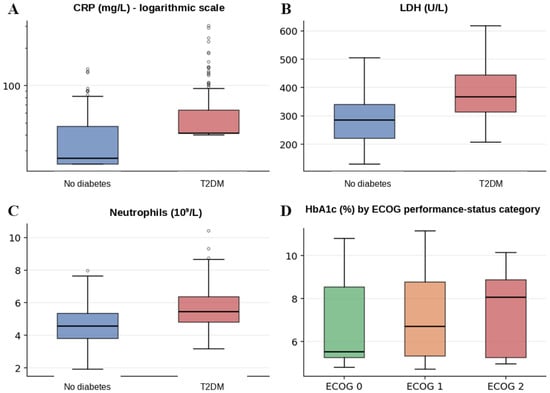
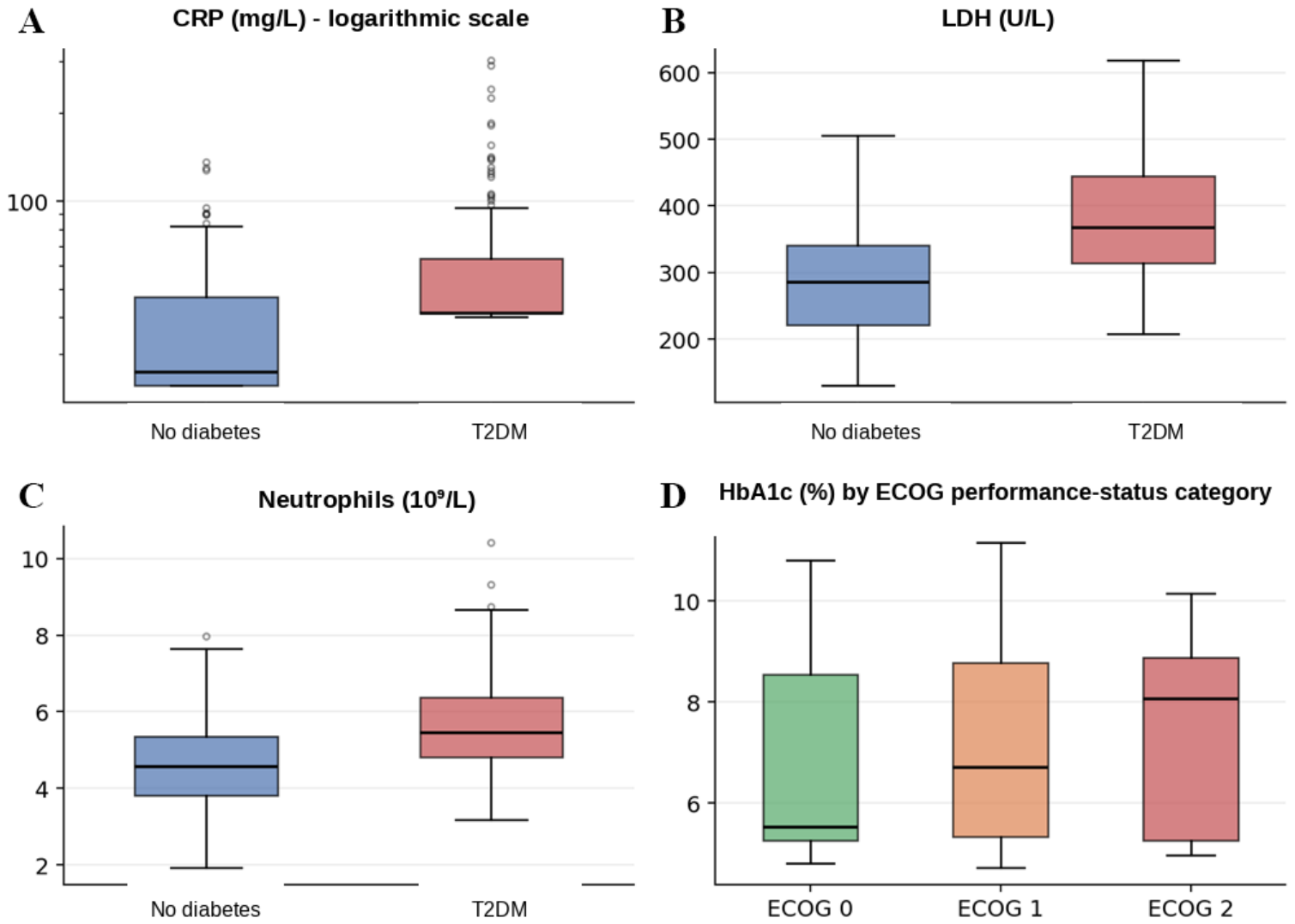
No significant between-group differences were observed for age (p = 0.519), mean corpuscular volume (p = 0.726), alkaline phosphatase (p = 0.597), carcinoembryonic antigen (p = 0.164) or ferritin (p = 0.597). In contrast, patients with T2DM had lower hemoglobin, hematocrit, albumin and eGFR values and higher leukocyte, neutrophil, platelet, CRP, LDH and Charlson Comorbidity Index values than patients without diabetes (all p < 0.001) (Table 1; Figure 1). As expected given the diabetes classification, HbA1c was substantially higher in the T2DM group than in the non-diabetic group (8.7% [7.9–9.3] vs. 5.3% [5.2–5.4]; p < 0.001); this comparison is presented as a descriptive metabolic check rather than as an independent study finding.
Table 1.
Demographic, hematologic, and biochemical characteristics of patients with colon or pancreatic cancer according to type 2 diabetes status.
Figure 1.
Distribution of inflammatory and metabolic markers in patients with colon or pancreatic cancer. (A) C-reactive protein, displayed on a logarithmic scale, according to type 2 diabetes status; (B) lactate dehydrogenase according to type 2 diabetes status; (C) neutrophil count according to type 2 diabetes status; and (D) HbA1c according to ECOG performance-status category. ECOG, Eastern Cooperative Oncology Group; HbA1c, glycated hemoglobin; LDH, lactate dehydrogenase; T2DM, type 2 diabetes mellitus).
The groups showed no statistically significant differences in sex (p = 0.666), tumor site (p = 0.829), cancer stage (p = 0.742), ECOG performance status (p = 0.055), chemotherapy (p = 0.642) and external-beam radiotherapy (p = 0.063). Anemia was substantially more prevalent among patients with T2DM than among those without diabetes (91.9% vs. 58.1%, respectively; p < 0.001) (Table 2).
Table 2.
Demographic and clinical categorical characteristics of patients with colon or pancreatic cancer according to type 2 diabetes status.
3.2. Multinomial Logistic Regression: Separate Comparisons of Each ECOG Category
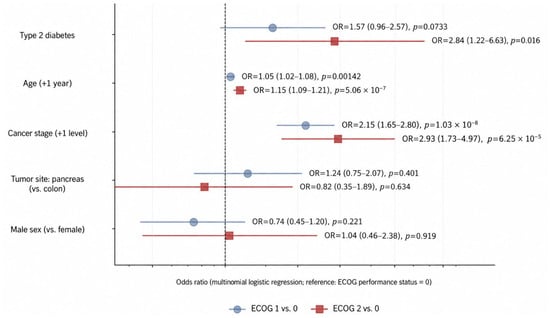
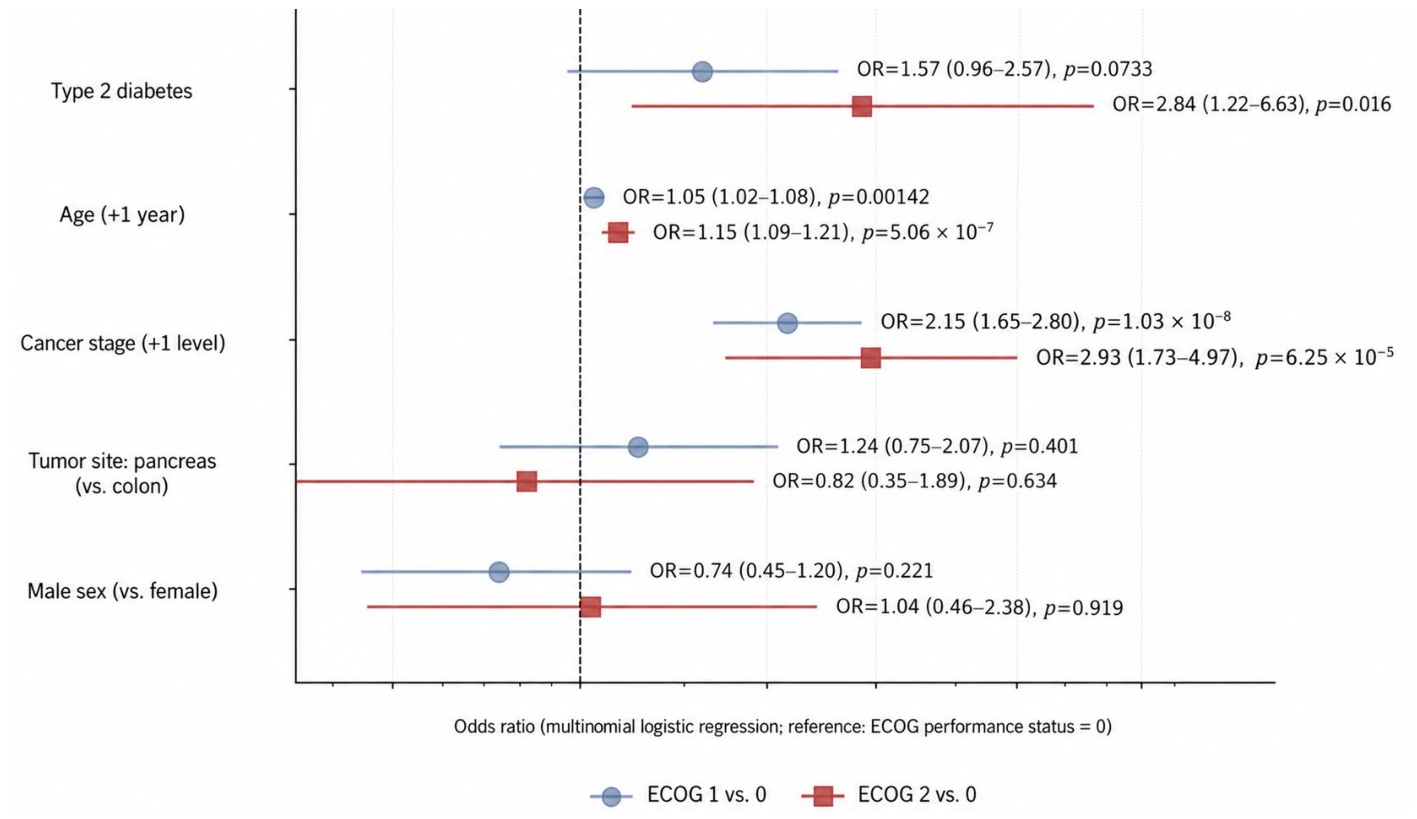
In the multinomial logistic regression model, T2DM was not significantly associated with ECOG 1 compared with ECOG 0 (OR = 1.57, 95% CI 0.96–2.57; p = 0.073). Increasing age (OR = 1.05, 95% CI 1.02–1.08; p = 0.001) and more advanced cancer stage (OR = 2.15, 95% CI 1.65–2.80; p < 0.001) were independently associated with ECOG 1 versus ECOG 0. Neither pancreatic tumor site nor sex was significantly associated with this comparison (Table 3; Figure 2).
Table 3.
Multinomial logistic regression: association of type 2 diabetes mellitus and other predictors with ECOG performance status 1 compared with ECOG performance status 0.
Figure 2.
Forest plot of the multinomial logistic regression models for ECOG performance status. (Each ECOG category was compared separately with ECOG performance status 0. Blue circles represent ECOG performance status 1 versus 0 and red squares represent ECOG performance status 2 versus 0. Points represent odds ratios, and horizontal lines represent 95% confidence intervals. ECOG, Eastern Cooperative Oncology Group; OR, odds ratio).
For ECOG 2 versus ECOG 0, T2DM was independently associated with poorer performance status (OR = 2.84, 95% CI 1.22–6.63; p = 0.016). Increasing age and more advanced cancer stage were also significantly associated with ECOG 2. Pancreatic tumor site and sex were not significantly associated with ECOG 2 versus ECOG 0 (Table 4; Figure 2).
Table 4.
Multinomial logistic regression: association of type 2 diabetes mellitus and other predictors with ECOG performance status 2 compared with ECOG performance status 0.
3.3. Ordinal Logistic Regression
Given the ordered structure of ECOG performance status (0 < 1 < 2), an ordinal proportional-odds logistic regression model was additionally fitted using the same covariates included in the multinomial analyses. An approximate likelihood-ratio comparison was reconstructed from the reported AIC values and parameter counts, yielding χ2 ≈ 7.60, df = 5, and p ≈ 0.180. This comparison did not suggest a substantial improvement in fit with the more highly parameterized multinomial model. However, because the ordinal and multinomial models are not strictly nested, this approximate comparison cannot be considered a formal verification of the proportional-odds assumption. Accordingly, the multinomial results were retained as the primary analysis, while the ordinal model was interpreted as a complementary analysis.
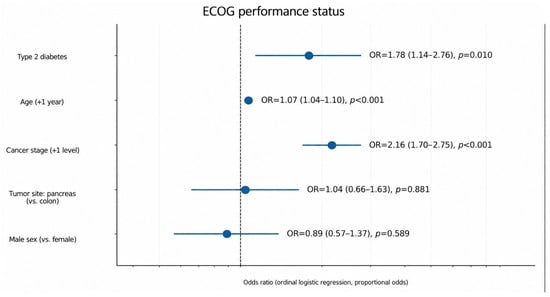
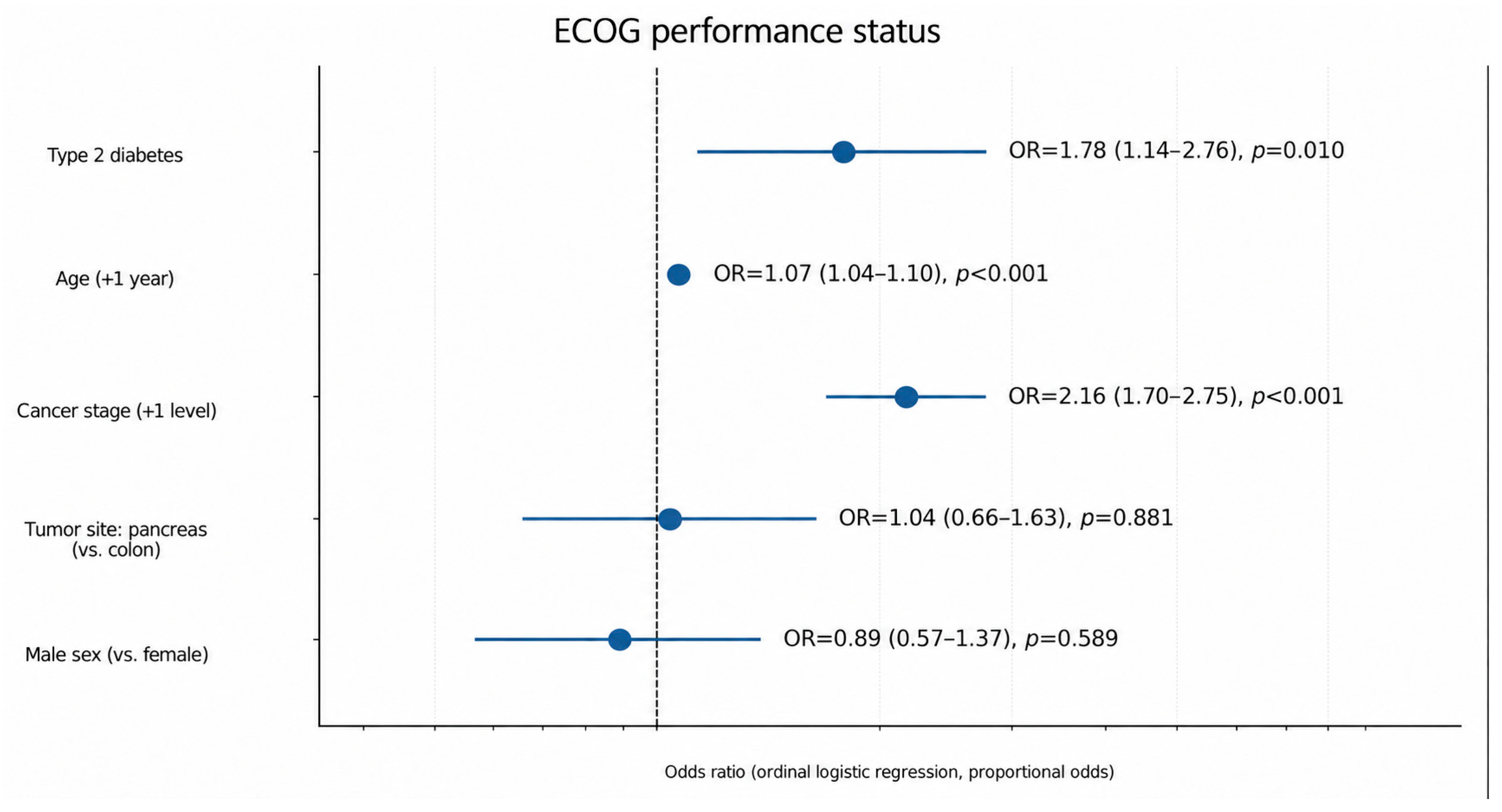
In the ordinal model, T2DM was independently associated with greater odds of belonging to a poorer ECOG performance-status category (OR = 1.78, 95% CI 1.14–2.76; p = 0.010). Increasing age (OR = 1.07, 95% CI 1.04–1.10; p < 0.001) and more advanced cancer stage (OR = 2.16, 95% CI 1.70–2.75; p < 0.001) were also independently associated with poorer performance status. No significant associations were observed for pancreatic tumor site or sex (Table 5; Figure 3).
Table 5.
Ordinal logistic regression: association of type 2 diabetes mellitus and other predictors with ECOG performance status, adjusted for age, cancer stage, tumor site, and sex.
Figure 3.
Forest plot of the ordinal proportional-odds logistic regression model for ECOG performance status. (Points represent odds ratios and horizontal lines indicate 95% confidence intervals. ECOG, Eastern Cooperative Oncology Group; OR, odds ratio).
The ordinal model provided a significantly better fit than the null model (likelihood-ratio χ2 = 86.53, df = 5; p < 0.001), with a McFadden pseudo-R2 of 0.133. It also yielded slightly lower Akaike and Bayesian information criteria than the multinomial model (AIC, 579.1 vs. 581.5; BIC, 605.9 vs. 627.6) while requiring fewer parameters (7 vs. 12).
Overall, the ordinal analysis was concordant with the multinomial findings. Although the estimated association with T2DM was numerically stronger for ECOG 2 versus ECOG 0 (OR = 2.84) than for ECOG 1 versus ECOG 0 (OR = 1.57), both approaches supported an association between T2DM and poorer functional status. Given the absence of a formally verified proportional-odds assumption, the multinomial model provides the primary inferential results, whereas the ordinal model offers a complementary summary of the association across ordered ECOG categories.
3.4. Inflammatory Markers: Linear Regression Analyses
To quantify differences in systemic inflammatory markers according to diabetes status, CRP and LDH were log-transformed and evaluated using multivariable linear regression models adjusted for age, cancer stage, tumor site and sex.
T2DM was strongly associated with higher log-transformed CRP concentrations (β = 0.447, 95% CI 0.353–0.541; p < 0.001). Age, cancer stage, pancreatic tumor site and male sex were not significantly associated with log-transformed CRP (Table 6).
Table 6.
Linear regression analysis of the association between type 2 diabetes mellitus and other predictors and log-transformed CRP.
T2DM was also independently associated with higher log-transformed LDH concentrations (β = 0.298, 95% CI 0.240–0.356; p < 0.001). More advanced cancer stage was positively associated with LDH (β = 0.085, 95% CI 0.055–0.114; p < 0.001), whereas pancreatic tumor site was associated with lower LDH levels (β = −0.063, 95% CI −0.124 to −0.002; p = 0.043). Age and male sex were not significantly associated with log-transformed LDH (Table 7).
Table 7.
Linear regression analysis of the association between type 2 diabetes mellitus and other predictors and log-transformed LDH.
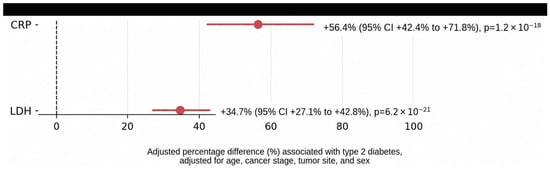
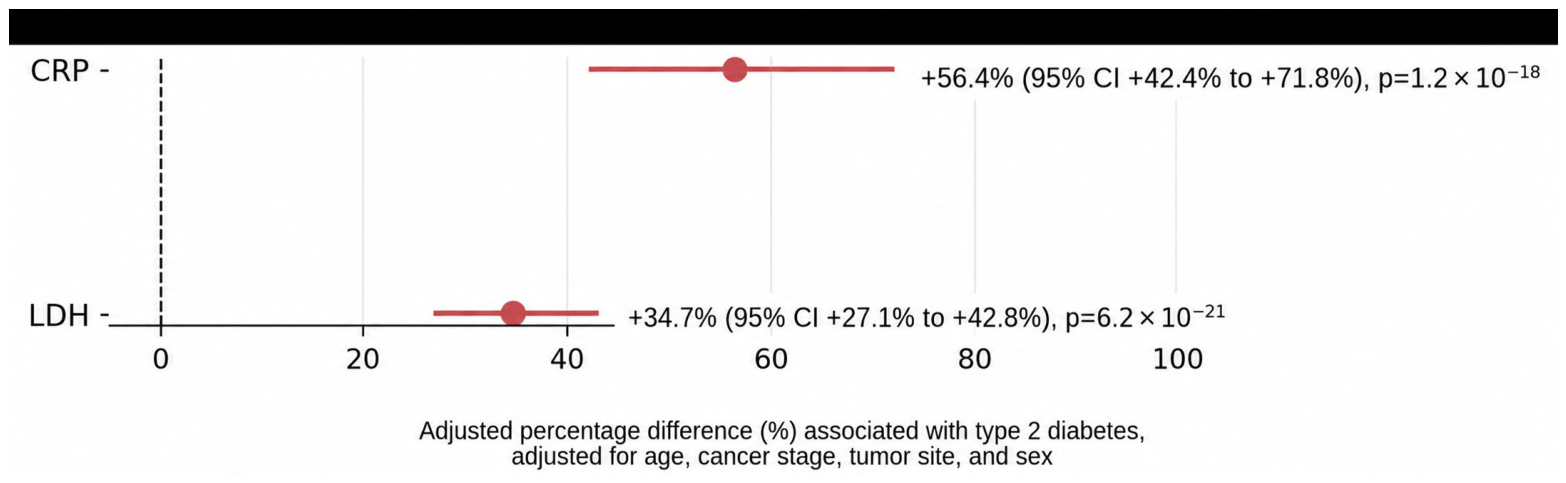
Following back-transformation of the regression coefficients, T2DM was associated with 56.4% higher CRP levels (95% CI 42.4–71.8%; p < 0.001) and 34.7% higher LDH levels (95% CI 27.1–42.8%; p < 0.001) after multivariable adjustment (Figure 4).
Figure 4.
Adjusted percentage differences in inflammatory markers associated with T2DM. (Percentage differences in CRP and LDH were derived from multivariable linear regression models fitted on the logarithmic scale and adjusted for age, cancer stage, tumor site, and sex. Points represent percentage differences and horizontal lines indicate 95% confidence intervals. CI, confidence interval; CRP, C-reactive protein; LDH, lactate dehydrogenase).
3.5. Mediation Analysis of the Association Between Type 2 Diabetes and Performance Status
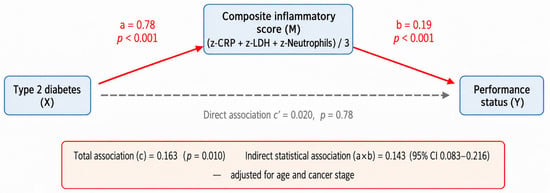
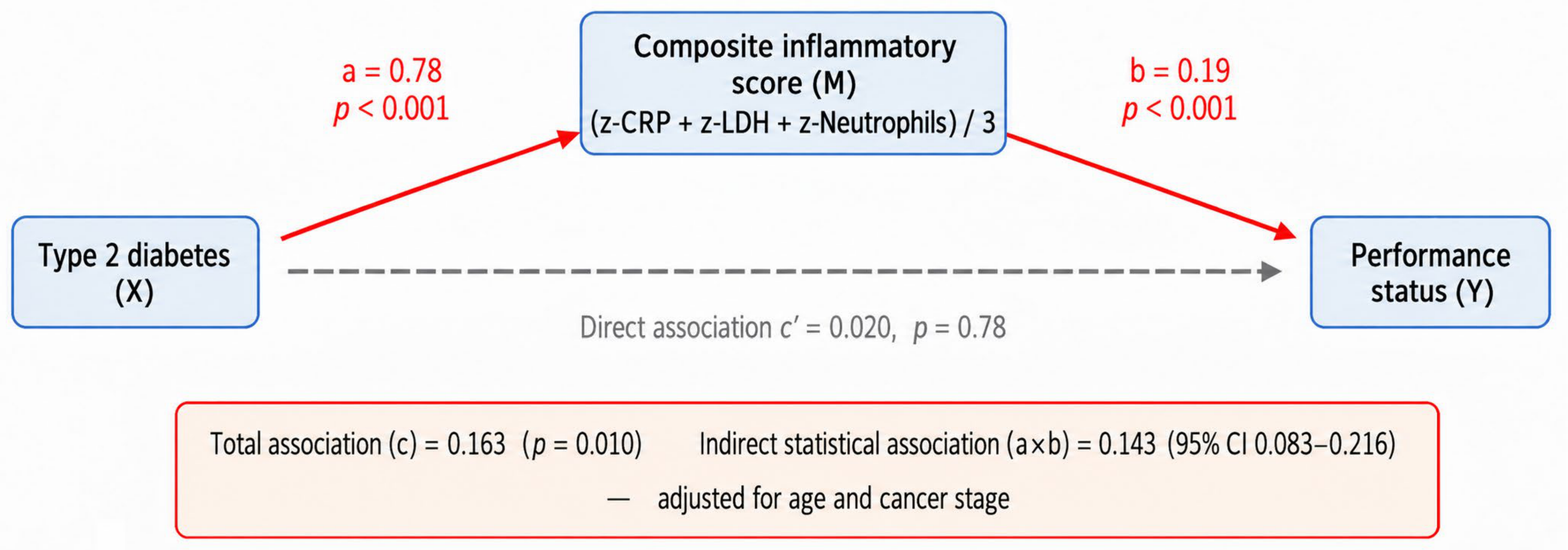
T2DM was significantly associated with the composite inflammatory score (path a: β = 0.780, 95% CI 0.634–0.927; p < 0.001). In turn, the composite inflammatory score was significantly associated with performance status after adjustment for T2DM and covariates (path b: β = 0.189, 95% CI 0.114–0.265; p < 0.001) (Table 8).
Table 8.
Exploratory analysis of the association between type 2 diabetes mellitus and performance status through the composite inflammatory score.
The total association between T2DM and performance status was statistically significant (path c: β = 0.163, 95% CI 0.040–0.286; p = 0.010). After inclusion of the composite inflammatory score, the direct association was markedly attenuated and was no longer statistically significant (path c′: β = 0.020, 95% CI −0.119 to 0.158; p = 0.780).
The estimated indirect statistical association through systemic inflammation was significant (path a × b: β = 0.147, 95% bootstrap CI 0.083–0.216; p < 0.001) (Table 8; Figure 5).
Figure 5.
Exploratory analysis of the indirect statistical association between T2DM and ECOG performance status through systemic inflammation. The composite inflammatory score was calculated as the mean of standardized CRP, LDH and neutrophil count values. The reported pathways represent statistical associations rather than established causal relationships.
4. Discussion
In this retrospective study of patients with colon or pancreatic cancer, T2DM was independently associated with poorer ECOG performance status at diagnosis and with a substantially greater systemic inflammatory burden. The association with functional impairment persisted after adjustment for age, cancer stage, tumor site and sex, while T2DM was also independently associated with higher CRP and LDH levels. The exploratory analysis identified a significant indirect statistical association through the composite inflammatory score, accompanied by attenuation of the direct association after inclusion of the score in the model. These findings support collectively the presence of a clinically vulnerable phenotype in which T2DM, systemic inflammatory activation and impaired functional status coexist at the time of cancer diagnosis.
The findings are consistent with previous evidence linking diabetes to an adverse inflammatory and nutritional phenotype in gastrointestinal malignancy. In a cohort of 345 patients with colon or pancreatic cancer, pre-existing T2DM was associated with a higher prevalence of cachexia, greater weight loss, increased CRP and interleukin-6 concentrations, lower serum albumin and poorer survival [19]. The pattern observed in the present research, including higher CRP together with lower albumin and hemoglobin levels among patients with T2DM, closely parallels this previously described phenotype. Whereas that study primarily examined cachexia and mortality, our findings extend the available evidence by identifying an independent association between T2DM and functional impairment measured by ECOG performance status [19].
The close relationship between systemic inflammation and functional status is also supported by prior oncological studies. Among patients with advanced malignancy, worsening ECOG performance status has been associated with increasing CRP and interleukin-6 concentrations and with evidence of broader systemic inflammatory activation. Furthermore, analyses from two international cohorts comprising 1518 patients with advanced cancer demonstrated that both ECOG performance status and the modified Glasgow Prognostic Score independently contributed to prognostic stratification, including among patients with gastrointestinal malignancies [15,16]. These observations reinforce the concept that systemic inflammation and functional decline represent interconnected dimensions of cancer-associated clinical deterioration.
Evidence from tumor-specific studies further supports the biological relevance of the inflammatory phenotype identified in our population. In pancreatic cancer, coexisting T2DM has been associated with higher systemic leukocyte counts, while increased macrophage and neutrophil infiltration within the tumor microenvironment has been linked to substantially poorer survival among patients with diabetes. In colon cancer, elevated CRP has similarly been associated with poorer disease-specific outcomes across tumor stages [8,10]. Although these studies did not directly evaluate the relationship between T2DM and ECOG performance status, they provide complementary evidence that inflammatory activation is clinically relevant in both malignancies included in the present analysis.
The exploratory mediation findings provide an additional perspective on the relationship between diabetes and functional impairment. The significant indirect association through the composite inflammatory score and attenuation of the direct association should be interpreted as exploratory statistical findings, without assigning a causal or quantitative explanatory role to inflammation. Several mechanisms could plausibly contribute to this pattern, as chronic inflammatory activation may promote fatigue, anorexia, anemia, skeletal muscle catabolism and progressive loss of physical capacity. These findings describe a statistical mediation pattern rather than establishing a causal pathway. Inflammatory markers and ECOG performance status were measured at the same diagnostic time point, so the temporal relationship between systemic inflammation and functional decline cannot be determined. The association may also reflect reciprocal or bidirectional processes, particularly in the presence of cachexia, nutritional deterioration, advanced tumor burden and other unmeasured determinants of functional status.
Clinical and laboratory variables were collected before oncological treatment, reducing the potential influence of chemotherapy- or radiotherapy-related changes in inflammatory markers and functional status. The association between T2DM and ECOG performance status was evaluated using both multinomial and ordinal regression models, which produced broadly consistent findings. However, the proportional-odds assumption could not be formally verified from the available model summaries, and the ordinal results should therefore be interpreted as complementary to the multinomial analyses.
The retrospective, single-center design and complete-case selection may limit the generalizability of the findings and do not eliminate residual confounding. The number and characteristics of patients excluded because of incomplete records could not be assessed, and selection bias cannot be excluded. The restriction of the analytic cohort to ECOG-PS 0–2 warrants particular consideration. Ascertainment through a defined oncology assessment pathway may have preferentially captured patients with relatively preserved functional status, while patients with more severe impairment may have been managed through other care settings. This represents a potential source of referral-related selection bias; however, its contribution could not be established from the available dataset. Accordingly, the observed associations apply to the ECOG-PS 0–2 population represented in this cohort and should not be extrapolated to patients with ECOG-PS 3–4. Further studies encompassing the full spectrum of performance status are needed to determine whether these associations persist among patients with severe functional impairment. Data on diabetes duration, antidiabetic therapy, body mass index, longitudinal weight loss, sarcopenia and cachexia were not available, although these factors may affect both systemic inflammation and functional capacity. Micronutrient status, including serum 25-hydroxyvitamin D concentrations, was also unavailable. In addition to its role in mineral metabolism, vitamin D has immunomodulatory and anti-inflammatory functions, as discussed in a systematic review of vitamin D and pediatric health [20]. Although the clinical outcomes examined in that review differ from those investigated here, these biological functions provide a rationale for considering vitamin D status in future assessments of the inflammatory phenotype. The present analysis could not determine whether differences in vitamin D status contributed to the observed inflammatory-marker profiles or influenced the association between T2DM and ECOG performance status. CRP, LDH and neutrophil count are also nonspecific markers, and the composite inflammatory score has not yet been externally validated. Colon and pancreatic cancer differ substantially in their biological relationship with diabetes, inflammation and cancer-associated wasting. In pancreatic cancer, recent-onset diabetes may arise as a consequence of the malignancy and may have been classified as T2DM in the present study. The absence of diabetes-duration data prevents differentiation between long-standing T2DM and pancreatic cancer-associated or pancreatogenic diabetes, limiting the interpretation of the pooled estimates. Larger studies with adequate power for tumor-specific analyses are therefore needed.
Study Limitations
The final analytic cohort included only patients with recorded ECOG performance status scores of 0–2; no patients with ECOG-PS 3–4 were represented. This restricted distribution limits the generalizability of the findings, particularly to patients with severe functional impairment. As the cohort was assembled from patients undergoing diagnostic and pretreatment assessment within the participating oncology service, referral and ascertainment processes may have influenced the population captured. However, the available data do not establish why patients with ECOG-PS 3–4 were absent. The observed associations between T2DM, systemic inflammation, and functional status should therefore be interpreted within the ECOG-PS 0–2 population represented in this study and should not be extrapolated to patients with ECOG-PS 3–4.
5. Conclusions
In this selected sample of patients with colon or pancreatic cancer, T2DM was associated with poorer ECOG performance status and higher systemic inflammatory markers at diagnosis. An exploratory indirect statistical association was observed through the composite inflammatory score, but the concurrent assessment of inflammatory markers and ECOG-PS does not permit causal or temporal interpretation. Prospective longitudinal studies incorporating repeated inflammatory measurements and detailed metabolic, nutritional and body-composition assessments are needed to clarify these associations. These findings apply to the selected clinical population with ECOG performance status scores of 0–2 represented in this cohort. Whether the observed associations extend to patients with ECOG-PS 3–4 remains undetermined.
Author Contributions
Conceptualization: P.A., C.I. and A.P.; Methodology: C.P. and A.B.; Formal analysis: S.B.T. and A.P.; Investigation: S.B.T.; Resources: P.A., L.-M.P., O.S. and C.P.; Software and data analysis: S.B.T.; Validation: C.P., L.-M.P. and P.A.; Supervision: A.B., O.S. and P.A.; Writing—original draft: C.I. and A.B.; Writing—review and editing: L.-M.P., C.P., S.B.T. and P.A. All authors have read and agreed to the published version of the manuscript.
Funding
This research received no external funding.
Institutional Review Board Statement
The study was conducted in accordance with the Declaration of Helsinki and local institutional requirements governing research involving human participants. Ethical review and approval were not required for this retrospective observational study under the Romanian regulatory framework applicable at the time the study was conducted. Ministerial Order No. 1502/2016, which governed the Ethics Councils of public hospitals did not establish a general requirement for ethics committee approval of retrospective observational studies. The dataset analyzed in this study did not contain information allowing the identification of individual patients.
Informed Consent Statement
We would like to clarify that no additional informed consent for participation was required for this study. The manuscript does not involve experimental interventions. Furthermore, no identifiable personal data, images or sensitive information are reported. All data were analyzed anonymously and presented in a fully de-identified manner, in accordance with applicable ethical standards and institutional requirements. Therefore, no separate informed consent statement beyond standard ethical compliance was deemed necessary.
Data Availability Statement
The raw data supporting the conclusions of this article will be made available by the authors on request.
Conflicts of Interest
The authors have no conflicts of interest to declare.
References
- Toriola, A.T.; Stolzenberg-Solomon, R.; Dalidowitz, L.; Linehan, D.; Colditz, G. Diabetes and pancreatic cancer survival: A prospective cohort-based study. Br. J. Cancer 2014, 111, 181–185. [Google Scholar] [CrossRef] [Scilit]
- De Jong, R.G.P.J.; Peeters, P.J.H.L.; Burden, A.M.; De Bruin, M.L.; Haak, H.R.; Masclee, A.A.M.; de Vries, F.; Janssen-Heijnen, M.L. Gastrointestinal cancer incidence in type 2 diabetes mellitus; results from a large population-based cohort study in the UK. Cancer Epidemiol. 2018, 54, 104–111. [Google Scholar] [CrossRef] [Scilit]
- Dehal, A.N.; Newton, C.C.; Jacobs, E.J.; Patel, A.V.; Gapstur, S.M.; Campbell, P.T. Impact of Diabetes Mellitus and Insulin Use on Survival After Colorectal Cancer Diagnosis: The Cancer Prevention Study-II Nutrition Cohort. J. Clin. Oncol. 2012, 30, 53–59. [Google Scholar] [CrossRef] [Scilit]
- Amshoff, Y.; Maskarinec, G.; Shvetsov, Y.B.; Raquinio, P.H.; Grandinetti, A.; Setiawan, V.W.; Haiman, C.A.; Le Marchand, L. Type 2 diabetes and colorectal cancer survival: The multiethnic cohort. Int. J. Cancer 2018, 143, 263–268. [Google Scholar] [CrossRef] [Scilit]
- Jeon, C.Y.; Li, D.; Cleary, S.; Stolzenberg-Solomon, R.; Bosetti, C.; La Vecchia, C.; Porta, M.; Toriola, A.T.; Hung, R.J.; Kurtz, R.C.; et al. The Association of Recently Diagnosed Diabetes and Long-term Diabetes With Survival in Pancreatic Cancer Patients: A Pooled Analysis. Pancreas 2018, 47, 314–320. [Google Scholar] [CrossRef] [Scilit]
- Gallagher, E.J.; LeRoith, D. Epidemiology and molecular mechanisms tying obesity, diabetes, and the metabolic syndrome with cancer. Diabetes Care 2013, 36, S233–S239. [Google Scholar] [CrossRef] [Scilit]
- Donath, M.Y.; Shoelson, S.E. Type 2 diabetes as an inflammatory disease. Nat. Rev. Immunol. 2011, 11, 98–107. [Google Scholar] [CrossRef] [Scilit]
- Karnevi, E.; Sasor, A.; Hilmersson, K.S.; Ansari, D.; Erjefält, J.S.; Rosendahl, A.H.; Andersson, R. Intratumoural leukocyte infiltration is a prognostic indicator among pancreatic cancer patients with type 2 diabetes. Pancreatology 2018, 18, 85–93. [Google Scholar] [CrossRef] [Scilit]
- Li, W.; Dong, P.; Wang, W. Association of systemic inflammation markers in cancer mortality with diabetes: Evidence from National Health and Nutrition Examination Survey. Acta Diabetol. 2024, 61, 1403–1412. [Google Scholar] [CrossRef] [Scilit]
- Kersten, C.; Louhimo, J.; Ålgars, A.; Lahdesmaki, A.; Cvancerova, M.; Stenstedt, K.; Haglund, C.; Gunnarsson, U. Increased C-reactive protein implies a poorer stage-specific prognosis in colon cancer. Acta Oncol. 2013, 52, 1691–1698. [Google Scholar] [CrossRef] [Scilit]
- Sohal, D.P.S.; Mangu, P.B.; Khorana, A.A.; Shah, M.A.; Philip, P.A.; O’Reilly, E.M.; Uronis, H.E.; Ramanathan, R.K.; Crane, C.H.; Engebretson, A.; et al. Metastatic Pancreatic Cancer: American Society of Clinical Oncology Clinical Practice Guideline. J. Clin. Oncol. 2016, 34, 2784–2796. [Google Scholar] [CrossRef] [Scilit]
- Oken, M.M.; Creech, R.H.; Tormey, D.C.; Horton, J.; Davis, T.E.; McFadden, E.T.; Carbone, P.P. Toxicity and response criteria of the Eastern Cooperative Oncology Group. Am. J. Clin. Oncol. 1982, 5, 649–655. [Google Scholar] [CrossRef] [Scilit] [PubMed]
- Abdel-Rahman, O. ECOG performance score 0 versus 1: Impact on efficacy and safety of first-line 5-FU-based chemotherapy among patients with metastatic colorectal cancer included in five randomized trials. Int. J. Colorectal Dis. 2019, 34, 2143–2150. [Google Scholar] [CrossRef] [Scilit]
- Neeman, E.; Gresham, G.; Ovasapians, N.; Hendifar, A.; Tuli, R.; Figlin, R.; Shinde, A. Comparing Physician and Nurse Eastern Cooperative Oncology Group Performance Status (ECOG-PS) Ratings as Predictors of Clinical Outcomes in Patients with Cancer. Oncologist 2019, 24, e1460–e1466. [Google Scholar] [CrossRef] [Scilit]
- Dolan, R.D.; Laird, B.J.A.; Klepstad, P.; Kaasa, S.; Horgan, P.G.; Paulsen, Ø.; McMillan, D.C. An exploratory study examining the relationship between performance status and systemic inflammation frameworks and cytokine profiles in patients with advanced cancer. Medicine 2019, 98, e17019. [Google Scholar] [CrossRef] [Scilit]
- Rocha, B.M.M.; Dolan, R.D.; Paiva, C.E.; McGovern, J.; Paiva, B.S.R.; Preto, D.D.; McMillan, D.C.; Maia, Y.C.; Laird, B.J. Inflammation and Performance Status: The Cornerstones of Prognosis in Advanced Cancer. J. Pain Symptom Manag. 2023, 65, 348–357. [Google Scholar] [CrossRef] [Scilit]
- Mills, K.T.; Bellows, C.F.; Hoffman, A.E.; Kelly, T.N.; Gagliardi, G. Diabetes Mellitus and Colorectal Cancer Prognosis: A Meta-analysis. Dis. Colon Rectum 2013, 56, 1304–1319. [Google Scholar] [CrossRef] [Scilit]
- Wang, J.; Shen, H.; Zhan, M.; Wang, W.; Yang, D. Impact of diabetes mellitus on the survival of pancreatic cancer: A meta-analysis. OncoTargets Ther. 2016, 9, 1679–1688. [Google Scholar] [CrossRef] [Scilit]
- Chovsepian, A.; Prokopchuk, O.; Petrova, G.; Gjini, T.; Kuzi, H.; Heisz, S.; Janssen, K.-P.; Martignoni, M.E.; Friess, H.; Hauner, H.; et al. Diabetes increases mortality in patients with pancreatic and colorectal cancer by promoting cachexia and its associated inflammatory status. Mol. Metab. 2023, 73, 101729. [Google Scholar] [CrossRef] [Scilit]
- Bumbu, B.A.; Luca, M.M.; Buzatu, R. Examining the Role of Vitamin D in Caries Susceptibility in Children’s Deciduous Teeth: A Systematic Review. Nutrients 2023, 15, 4826. [Google Scholar] [CrossRef] [Scilit]

Disclaimer/Publisher’s Note: The statements, opinions and data contained in all publications are solely those of the individual author(s) and contributor(s) and not of MDPI and/or the editor(s). MDPI and/or the editor(s) disclaim responsibility for any injury to people or property resulting from any ideas, methods, instructions or products referred to in the content. |
© 2026 by the authors. Licensee MDPI, Basel, Switzerland. This article is an open access article distributed under the terms and conditions of the Creative Commons Attribution (CC BY) license.