


Abstract
In this work, the single-walled carbon nanotubes (SWCNTs) were filled with cobaltocene. The growth properties of individual chirality nanotubes were studied with Raman spectroscopy. It was shown that the larger nanotubes grow slower. The growth of inner nanotubes becomes faster with increasing annealing temperature. These results are of high importance as they stimulate research on carbon nanotubes, and bring ideas from laboratories into factories.
1. Introduction
Filling of single-walled carbon nanotubes (SWCNTs) is important for applications [1,2,3,4]. Metallocenes are promising filler material as they modify the chemical and physical properties of SWCNTs. Metallocenes inside SWCNTs represent a unique system for the growth of inner carbon nanotubes. The electronic properties of filled SWCNTs are also modified [5,6]. In this work, I filled the SWCNTs with cobaltocene, and I investigated the growth of inner carbon nanotubes. Raman spectroscopy allowed me to trace the process of growth with high precision. The growth of inner SWCNTs with chiralities of (13,1), (12, 3), and (11, 1) was detected. The chirality-specific growth curves of SWCNTs were obtained at different temperatures to compare kinetics.
2. Experiments
I performed the filling of SWCNTs with cobaltocene in gas phase. The filling was performed in glass ampoule at low temperature (~59 °C). The filled SWCNTs were annealed at different temperatures to investigate kinetics. This system is very interesting for investigation of these properties as it gives a clean environment for highly precise study of growth of SWCNTs.
3. Results
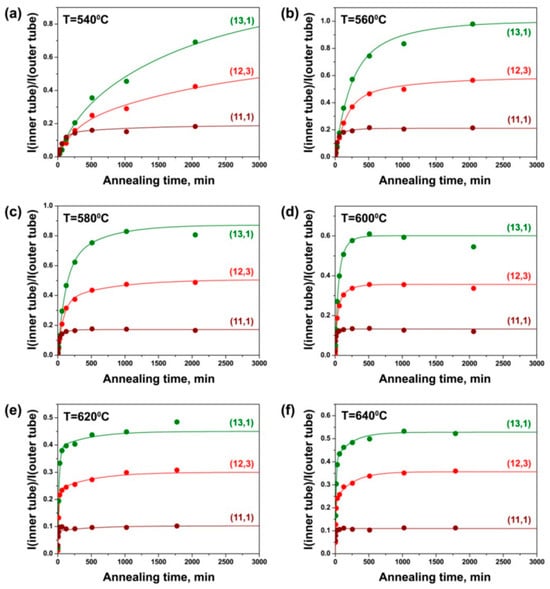
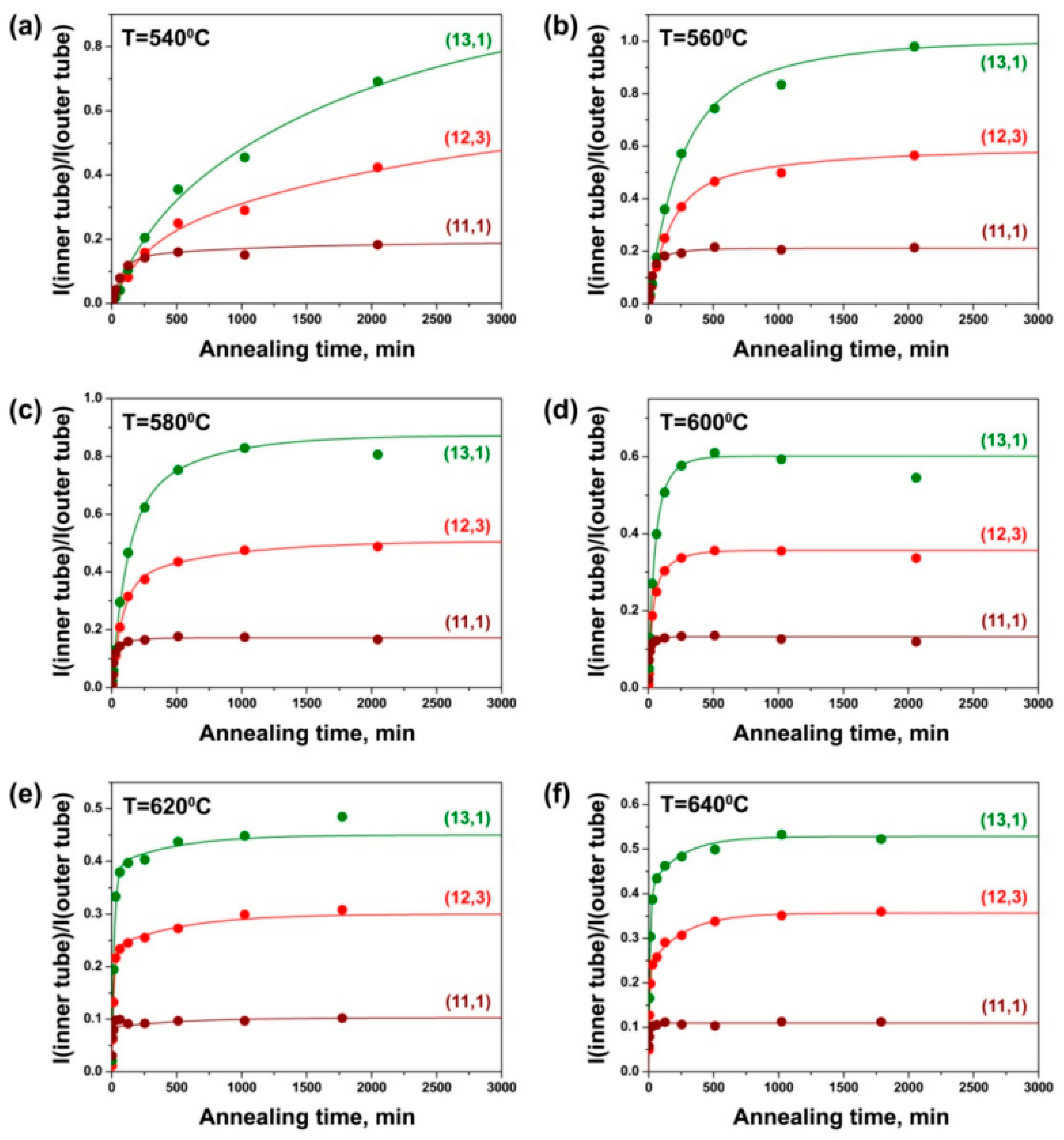
Figure 1 shows the growth curves of inner nanotubes inside cobaltocene-filled SWCNTs at temperatures of 540 °C (a), 560 °C (b), 580 °C (c), 600 °C (d), 620 °C (e) and 640 °C (f). With these lots of data, it is visible that the larger nanotubes grow slower. The growth of inner nanotubes becomes faster with increasing annealing temperature. This is because the kinetics of growth of inner SWCNTs depends on their chirality. Here, I present the chirality-specific kinetics, which is important knowledge for applications. For example, this will allow decreasing the growth temperature of SWCNTs to make the preparation processes easier, simpler, and low cost. It should be noted that the growth kinetics of SWCNTs in this system should be investigated with different conditions, i.e., precursor types, which lead to new results, and important information on synthesis protocols is implemented in industry. The kinetics experiment is time-consuming, but the established fundamental dependencies and trends lead to quick modernization of preparation processes. I expect that this data will be involved in factory process developments soon.
Figure 1.
The growth curves of inner nanotubes inside cobaltocene-filled SWCNTs at temperatures of 540 °C (a), 560 °C (b), 580 °C (c), 600 °C (d), 620 °C (e) and 640 °C (f) [2]. Copyright 2021 by the author. Licensee MDPI, Basel, Switzerland. This article is an open access article distributed under the terms and conditions of the Creative Commons Attribution (CC BY) license.
4. Conclusions
In this work, the growth properties of individual chirality nanotubes were studied. It was shown that the larger nanotubes grow slower. The growth of inner nanotubes becomes faster with increasing annealing temperature. The high importance of this data is caused by the necessity of a driving force for researchers to study. With these materials obtained, research on carbon nanotubes is going faster.
Funding
These studies were partly performed during the implementation of the project Building-up Centre for advanced materials application of the Slovak Academy of Sciences, ITMS project code 313021T081 supported by Research & Innovation Operational Programme funded by the ERDF.
Institutional Review Board Statement
Not applicable.
Informed Consent Statement
Not applicable.
Data Availability Statement
The data are available on request of Marianna V. Kharlamova.
Conflicts of Interest
The funders had no role in the design of the study; in the collection, analyses, or interpretation of data; in the writing of the manuscript; or in the decision to publish the results.
References
- Kharlamova, M.V.; Kramberger, C. Applications of Filled Single-Walled Carbon Nanotubes: Progress, Challenges, and Perspectives. Nanomaterials 2021, 11, 2863. [Google Scholar] [CrossRef] [Scilit] [PubMed]
- Kharlamova, M.V.; Kramberger, C. Metal Cluster Size-Dependent Activation Energies of Growth of Single-Chirality Single-Walled Carbon Nanotubes inside Metallocene-Filled Single-Walled Carbon Nanotubes. Nanomaterials 2021, 11, 2649. [Google Scholar] [CrossRef] [Scilit] [PubMed]
- Kharlamova, M.V.; Kramberger, C. Spectroscopy of filled single-walled carbon nanotubes. Nanomaterials 2022, 12, 42. [Google Scholar] [CrossRef] [Scilit] [PubMed]
- Kharlamova, M.V. Advances in tailoring the electronic properties of single-walled carbon nanotubes. Prog. Mater. Sci. 2016, 77, 125–211. [Google Scholar] [CrossRef] [Scilit]
- Kharlamova, M.V. Electronic properties of pristine and modified single-walled carbon nanotubes. Phys. Uspekhi 2013, 56, 1047–1073. [Google Scholar] [CrossRef] [Scilit]
- Kharlamova, M.V.; Kramberger, C. Metallocene-filled single-walled carbon nanotube hybrids. Nanomaterials 2023, 13, 77. [Google Scholar] [CrossRef] [Scilit] [PubMed]
Disclaimer/Publisher’s Note: The statements, opinions and data contained in all publications are solely those of the individual author(s) and contributor(s) and not of MDPI and/or the editor(s). MDPI and/or the editor(s) disclaim responsibility for any injury to people or property resulting from any ideas, methods, instructions or products referred to in the content. |
© 2023 by the author. Licensee MDPI, Basel, Switzerland. This article is an open access article distributed under the terms and conditions of the Creative Commons Attribution (CC BY) license (https://creativecommons.org/licenses/by/4.0/).