


Abstract
The growing demand for sustainable and cost-effective alternatives to synthetic nematicides has driven interest in naturally derived compounds with selective activity against plant-parasitic nematodes. In this study, we evaluated the bionematicidal potential of undecanoic acid, a naturally occurring medium-chain (C11) fatty acid, against two economically important root-knot nematodes: Meloidogyne ethiopica and M. graminicola. Direct contact bioassays demonstrated 100% mortality of both species within 24 h of exposure to a 1 mg/mL concentration, confirming strong and rapid nematicidal activity. In contrast, exposure of a non-target, the free-living soil nematode Cephalobus sp., resulted in only ca. 20% mortality, suggesting a favorable degree of selectivity toward phytoparasites. Additionally, environmental fate modeling indicated a predicted distribution of this compound of ca. 69% in soil, 28% in water, and 3% in air environmental compartments, consistent with its use as a soil-applied agent, while highlighting the need for environmental risk assessment under field conditions. As a naturally sourced compound, undecanoic acid offers advantages over synthetic nematicides, not only due to its biodegradability and potential reduced environmental impact, but also its lower cost compared to commercial pesticide active ingredients. The selective toxicity of undecanoic acid makes it a favorable candidate for integrated pest management programs, particularly in low-input or organic systems. These results underscore the potential of this naturally occurring fatty acid as an effective and sustainable tool for nematode control. Further studies on formulation optimization, persistence, and field efficacy will be needed to fully realize its application in agricultural systems.
1. Introduction
The escalating demands of a growing global population exert unprecedented pressure on agricultural systems to increase food production efficiently and sustainably. However, this is constantly threatened by countless biotic and abiotic factors, among which plant-parasitic nematodes (PPNs) represent one of the most significant biological constraints on crop yields worldwide. These microscopic roundworms inhabit the rhizosphere, where they directly feed on plant roots, causing extensive damage that compromises nutrient and water uptake, stunts plant growth, and predisposes host crops to secondary infections by pathogenic fungi and bacteria. The collective damage inflicted by these pests results in estimated global crop losses amounting to billions of dollars annually, underscoring their profound economic impact on both large-scale commercial farming and subsistence agriculture [1].
Among PPNs, root-knot nematodes (RKNs, Meloidogyne spp.) are considered the most economically damaging genus, with a host range spanning over 3000 plant species, including major food and cash crops like soybean, corn, potato, tomato, and various fruit trees. The characteristic symptoms of RKN infestation include the formation of galls or knots on the root system, which severely disrupt the plant’s vascular tissues and lead to visible symptoms of wilting, chlorosis, and overall decline. The RKN life cycle involves a mobile second-stage juvenile (J2) that seeks out a suitable host root, where it penetrates the root tip and migrates into the vascular cylinder. Once inside, the J2s establish a permanent feeding site, a complex process that involves the induction of giant cells and the manipulation of host cell metabolism. This sedentary phase allows the nematode to grow and develop into an adult, which can then produce eggs, leading to a rapid buildup of population densities in the soil and exacerbating damage in subsequent crop cycles [2]. For example, M. ethiopica is a particularly aggressive and polyphagous species with a wide geographical distribution, posing a significant threat to perennial crops such as coffee, grapevine, and fruit trees, especially in tropical and subtropical regions [3]. While M. graminicola, by contrast, is known as the rice root-knot nematode and is a major constraint on global rice production. This species is highly adapted to both upland and lowland rice ecosystems, causing stunting, chlorosis, and reduced tillering, which directly translates to substantial yield reductions for a crop that is a staple food for half of the world’s population [4].
For decades, the primary strategy for managing RKNs has been the application of synthetic chemical nematicides. These fumigant and non-fumigant agrochemicals have historically offered high efficacy in controlling PPNs and protecting crop yields. However, the widespread and indiscriminate use of these compounds has led to a range of critical drawbacks that have spurred a global reevaluation of their role in modern agriculture [5,6]. Many of the most effective synthetic nematicides are highly toxic to non-target organisms, including beneficial soil microbes, nematodes, insects, and aquatic life, leading to a severe disruption of ecosystem balance. Furthermore, their high mobility and persistence in soil have raised serious concerns about groundwater contamination and the accumulation of toxic residues in agricultural products, posing a significant risk to human health [7]. The most pressing issue, however, is the development of resistance in nematode populations, which diminishes the long-term effectiveness of these chemical controls and necessitates the search for novel, more sustainable management strategies. Thus, there has been a significant shift toward developing and implementing environmentally favorable alternatives for PPN control. The search for a new generation of nematicides has focused heavily on biopesticides derived from natural sources, including plant extracts, microbial agents, and organic compounds. These naturally occurring substances often exhibit high specificity, have a more favorable environmental fate, and are generally considered less harmful to human health and to non-target organisms [8]. The use of botanical nematicides represents a promising avenue for integrated pest management systems, offering a viable and sustainable alternative that aligns with the principles of ecological agriculture. A wide array of plant-derived compounds, including alkaloids, terpenoids, phenolics, and fatty acids, have been identified as having potential nematicidal properties, but the mechanism of action and practical application of many of these remain to be fully explored [9].
Among the various classes of organic compounds with reported biological activity, saturated fatty acids and their derivatives have attracted considerable attention. Fatty acids are fundamental components of lipids and play a crucial role in cellular metabolism, but at elevated concentrations, some of these compounds can exhibit potent antimicrobial and pesticidal effects [7]. Medium carbon chain saturated fatty acids are naturally occurring compounds found in various plant oils and microbial metabolites. Their relatively simple structure and presence in natural sources make them attractive candidates for development as bionematicides. Although their antimicrobial properties have been studied, the specific efficacy against the most economically significant PPNs, such as RKNs, has been scarcely evaluated, leaving a critical knowledge gap in the field of sustainable nematode management [10,11].
The current preliminary study evaluates the nematicidal activity of undecanoic acid, a medium carbon chain unsaturated fatty acid, against M. ethiopica and M. graminicola under controlled in vitro conditions, in comparison to a free-living nematode of the Cephalobus genus, as an ecological indicator. This research seeks to provide data on the potential of undecanoic acid as a natural, low-risk alternative to conventional chemical nematicides. The findings of this study aim to contribute to the growing body of knowledge on natural nematicides and may pave the way for the development of new, more sustainable strategies for RKN management and highlight the broader significance of using natural fatty acids as a viable tool in the future of sustainable agriculture.
2. Material and Methods
2.1. Chemicals
Undecanoic acid (≥99%) was acquired as a pure standard from Sigma-Aldrich (St. Louis, MO, USA). Stock solutions were prepared in HPLC-grade methanol (Fischer Chemicals, Hampton, NH, USA) at 20 mg/mL. All solutions were stored at −20 °C.
2.2. Growth of Root-Knot Nematodes
These RKNs are regularly maintained as reference isolates at the Plant Nematology Lab of the National Institute for Agrarian and Veterinary Research (INIAV, I.P.), in Oeiras, Portugal, using the protocols described in [3] for Meloidogyne ethiopica, using tomato as host, and [4] for M. graminicola, using rice as host. After completion of each RKN life cycle, hosts were harvested and the root systems washed. The eggs were extracted from the egg masses by mixing with NaOCl at 0.52% (v/v) and hatched in moist chambers at 25 ± 1 °C [4]. For each of the resulting 5 mL suspensions, 5 aliquots of 100 µL were observed under an Olympus SZX12 (Tokyo, Japan) stereomicroscope to count the J2s that hatched from the eggs. The free-living Cephalobus sp. nematodes were isolated from the vicinity of grown rice roots and identified through morphological assessments and molecular techniques. For molecular identification, genomic DNA was extracted from three separate specimens following the protocol of the DNeasy Blood and Tissue Kit (Ref 69504, Qiagen, Germantown, MD, USA) as described by the manufacturer. The 18S ribosomal rDNA region was amplified by PCR using the primers 988F/1912R [12] in a total reaction volume of 25 µL with Supreme NZYTaq II 2x Green Master Mix (Ref. MB3600, NZYTech Lisbon, Portugal) in a Biometra Twin 48G thermocycler (Analytik Jena, Germany). The amplicons were sequenced, and the resulting sequences were analyzed by comparison with the GenBank database using BLAST version 2.16.0. For in vitro growth, ca. 100 nematodes were surface sterilized with 10% hydrogen peroxide (H2O2), according to [3], and transferred to semi-solid Schenk and Hildebrandt [13] medium with 8 g/L agar, 30 g/L sucrose, and pH = 5.6. The nematode population increased by feeding on the naturally accompanying bacteria that grew monoxenically in the culture medium. After 4 weeks, mixed-life-stage nematodes were recovered through the modified Baermann tray method [14] and immediately used in direct contact bioassays.
2.3. Direct Contact Bioassays
For the determination of compound bioactivity against the soil-dwelling nematodes, each well of a flat-bottom 96-well microtiter plate (Carl Roth GmbH & Co. KG, Karlsruhe, Germany) was filled with a 95 µL suspension containing approximately 60 RKN J2s (for M. ethiopica or M. graminicola) or 60 mixed-life-stage free-living nematodes (Cephalobus sp.). Afterwards, 5 µL of undecanoic acid stock solution was added to obtain a final concentration of 1 mg/mL. Blank (5 µL of ultrapure water) and control (5 µL of methanol) wells were also performed to determine natural mortality and solvent-related effects. The microtiter plates were then sealed and shaken on an orbital shaker (IKA labortechnik, Staufen, Germany) at 800 r.p.m. for 1 min. Finally, the plates were incubated for 24 h in an orbital shaker set to 60 r.p.m. at 25 ± 1 °C in complete darkness. The bioassays were performed in triplicate for each sample, with a total of 9 bioassays conducted.
2.4. Data Treatment and Statistical Analysis
Nematode mortality percentages were determined using the following formula: mortality% = (dead nematodes/total no. of nematodes) × 100. It was then corrected with the mortality percentages determined for the methanol control: corrected mortality% = [(mortality% in treatment − mortality% in control)/(100 − mortality% in control)] × 100. Compound nematicidal strength was classified using previously established criteria, where mortality was deemed complete at 100%, very strong at ≥90% strong at 60–89%, moderate at 37–59%, weak at 11–36%, and low or inactive at <10% [15].
For the prediction of the environmental fates (PED, %) of undecanoic acid in comparison to the synthetic nematicides oxamyl and fluopyram [3], the EPISuite freeware [16], freely available from the US Environmental Protection Agency (EPA) [17], was used with its unified database.
3. Results and Discussion
Natural mortality was assessed for the RKNs after 24 h in water. While for M. ethiopica a 2.1 ± 0.1% mortality was recorded, for M. graminicola natural mortality was 0.0 ± 0.0%. Control RKN mortality was assessed by exposing the J2 to 5% methanol. For M. ethiopica, control mortality was 2.3 ± 0.1%, while for M. graminicola, control mortality was 0.0 ± 0.0%, which suggests that RKNs were mostly unaffected by methanol as a carrier agent for undecanoic acid.
Undecanoic acid tested at 1 mg/mL induced complete mortality in RKN J2s tested; however, free-living nematodes (Cephalobus sp.) were only weakly influenced (Table 1).
Table 1.
Nematicidal activity of undecanoic acid against the plant parasitic nematodes Meloidogyne ethiopica and M. graminicola and the free-living nematode Cephalobus sp. at 1 mg/mL.
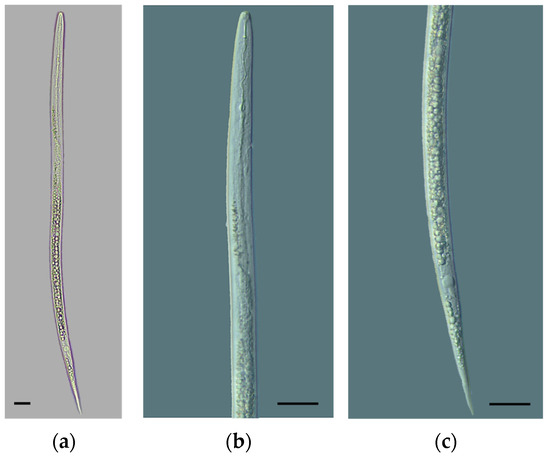
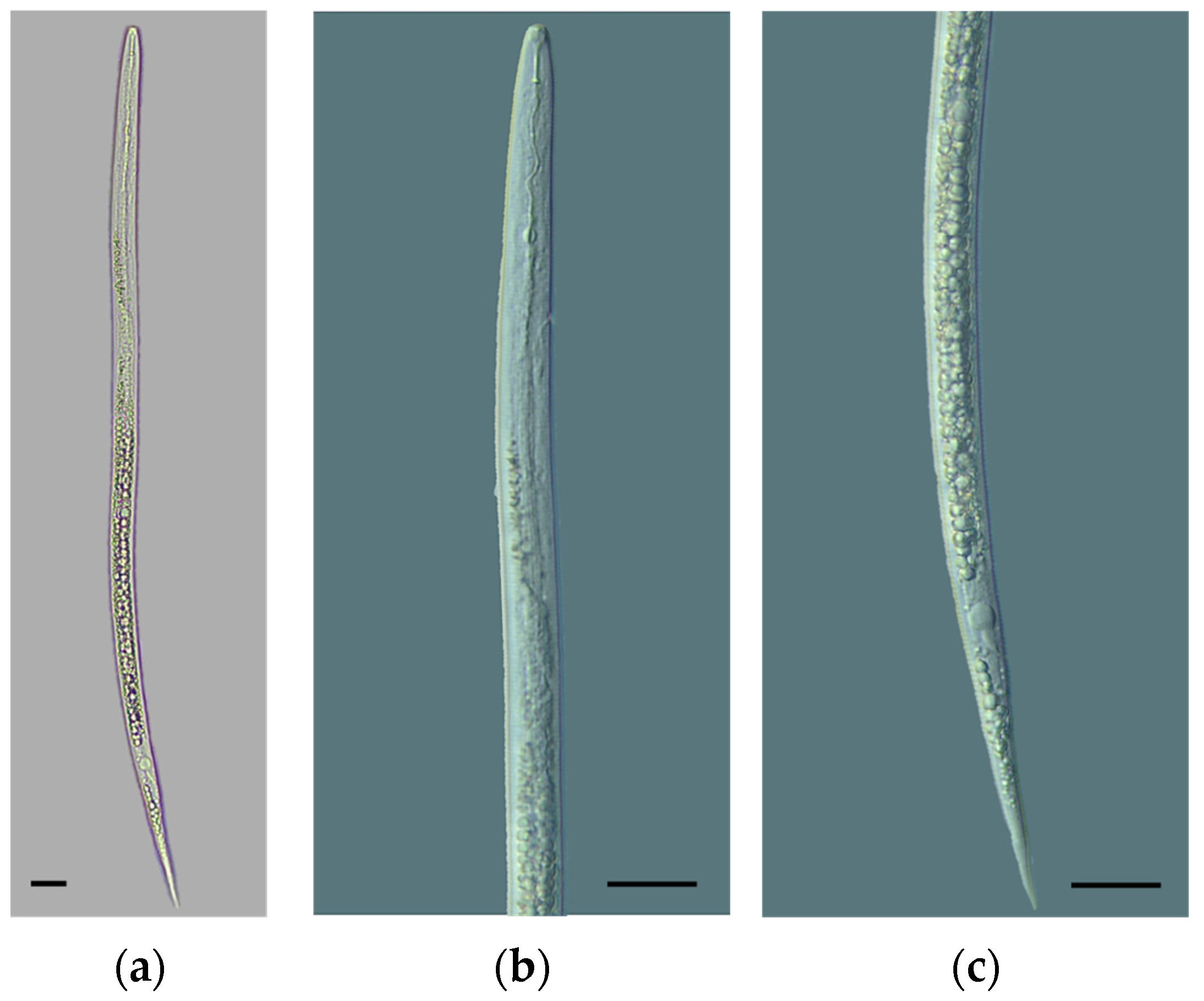
RKNs showed the common morphological features of each species. For example, for M. graminicola, control J2 were slender, vermiform, and transparent, with an average body length of 400–500 µm (Figure 1a). The body tapered gradually at both ends, with the anterior region bearing a distinct, well-developed stylet that is slender and sharply pointed, adapted for host penetration (Figure 1b). The esophageal region was clearly differentiated, with the median bulb, esophageal glands, and lumen. The intestine extended along the body length and was filled with granular contents, reflecting normal metabolic activity under control conditions. The posterior region narrowed progressively to form a finely pointed tail, which is a key diagnostic feature for this species (Figure 1c).
Figure 1.
Differential interference contrast microscopy (DIC) images of Meloidogyne graminicola second-stage juveniles under control conditions after 24 h. The whole body shows slender vermiform morphology with intact internal organization (a), an anterior region with distinct stylet and esophageal structures (b), and a posterior region with a gradually tapering, sharply pointed tail and granular intestinal content (c). Bar = 30 µm.
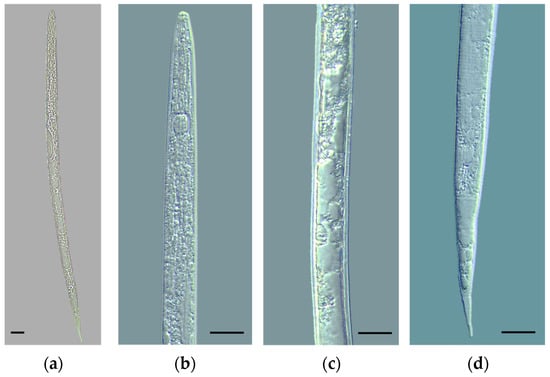
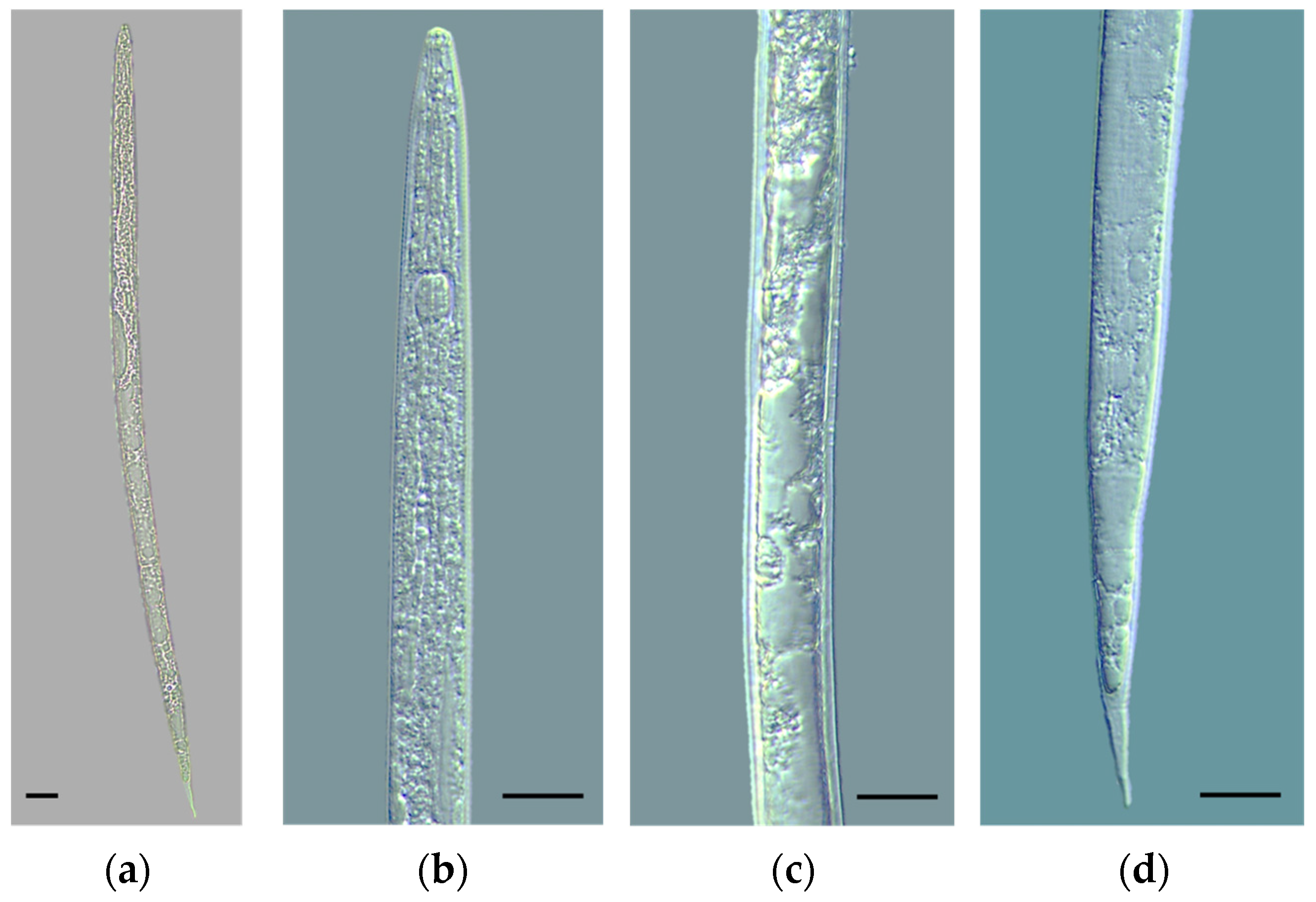
However, in contact with undecanoic acid, M. graminicola J2s exhibited severe internal structural disruption compared to controls. The entire body appeared degraded, with loss of transparency and distorted internal organization (Figure 2a). In the anterior region, the median bulb and esophageal structures were barely noticeable, indicating degeneration of feeding apparatus integrity (Figure 2b). The mid-body showed marked vacuolization and swelling, suggesting cytoplasmic degradation and organelle breakdown (Figure 2c). The posterior region also presented extensive vacuolization and loss of tissue organization, with the tail region appearing shrunken and irregular (Figure 2d).
Figure 2.
Differential interference contrast microscopy (DIC) images of Meloidogyne graminicola second-stage juveniles after 24 h in contact with 1 mg/mL of undecanoic acid. The whole body showing internal disruption and loss of transparency (a), the anterior region with the median bulb and esophageal structures barely distinguishable (b), the mid-body exhibiting extensive vacuolization and disintegration of internal organs (c), and the posterior region with disrupted tissues and a shrunken tail (d). Bar = 20 µm.
The potential environmental distribution of undecanoic acid was compared to that of the conventional pesticides oxamyl and fluopyram to understand the possible ecological impacts of using undecanoic acid as a biopesticide. In the analyzed compounds, the soil environmental compartment was favored, with a predicted 80% fluopyram, 69% undecanoic acid, and 65% oxamyl being retained in this compartment (Table 2). For fluopyram, the remaining compound was predicted to be mainly retained in the sediments (17%) and water (3%) environmental compartments. For oxamyl and undecanoic acid, the remaining compounds were predicted to be mainly retained in the water environmental compartment, 35% and 28%, respectively.
Table 2.
Predicted environmental distribution (PED) percentages (%) in the air, water, soil, and sediments environmental compartments computed with the EPISuite freeware [16], for undecanoic acid and the conventional nematicides oxamyl and fluopyram.
These preliminary results point towards undecanoic acid as a strong nematicide effective against both M. ethiopica and M. graminicola, achieving complete mortality of J2 within 24 h at 1 mg/mL. This effect seems more directed at root-knot nematodes, as only minor mortality was observed in the free-living nematode Cephalobus sp., suggesting a degree of selectivity that could be advantageous in agricultural applications. Morphological observations revealed that activity may be due to marked internal disruption and vacuolization in RKNs treated with undecanoic acid, whereas control juveniles retained intact internal structures. When compared to conventional nematicides, environmental modeling suggested that undecanoic acid may behave similarly to oxamyl and fluopyram, although differences in partitioning suggest that undecanoic acid may behave distinctly in certain environments. Such results highlight both the potential benefits of undecanoic acid as a biopesticide and the need for further research into its environmental persistence, ecological risks, and field-level efficacy.
Author Contributions
Conceptualization, J.M.S.F.; methodology, J.M.S.F., L.R. and A.R.V.; software, J.M.S.F.; formal analysis, J.T., M.C., L.R., A.R.V. and J.M.S.F.; investigation, J.T., M.C., L.R., A.R.V. and J.M.S.F.; resources, L.R., A.R.V. and J.M.S.F.; data curation, J.M.S.F.; writing—original draft preparation, L.R., A.R.V. and J.M.S.F.; writing—review and editing, J.T., M.C., L.R., A.R.V. and J.M.S.F. All authors have read and agreed to the published version of the manuscript.
Funding
Partly funded by Fundação para a Ciência e a Tecnologia (FCT/MCTES) through project NemACT (DOI 10.54499/2022.00359.CEECIND/CP1737/CT0002) and structural funding GreenIT (DOIs 10.54499/UIDB/04551/2020 and 10.54499/UIDP/04551/2020).
Institutional Review Board Statement
Not applicable.
Informed Consent Statement
Not applicable.
Data Availability Statement
The raw data is available from the corresponding author (Jorge M. S. Faria) upon reasonable request.
Acknowledgments
The authors wish to thank Nidia Laureano at INIAV and Cristina Moiteiro at CQE/FCUL, Lisbon, Portugal.
Conflicts of Interest
The authors declare no conflicts of interest.
Abbreviations
The following abbreviations are used in this manuscript:
| PPN | Plant-parasitic nematodes |
| RKN | Root-knot nematodes |
| J2 | Second stage juveniles |
References
- Poveda, J.; Abril-Urias, P.; Escobar, C. Biological Control of Plant-Parasitic Nematodes by Filamentous Fungi Inducers of Resistance: Trichoderma, Mycorrhizal and Endophytic Fungi. Front. Microbiol. 2020, 11, 992. [Google Scholar] [CrossRef] [Scilit] [PubMed]
- Jones, J.T.; Haegeman, A.; Danchin, E.G.J.; Gaur, H.S.; Helder, J.; Jones, M.G.K.; Kikuchi, T.; Manzanilla-López, R.; Palomares-Rius, J.E.; Wesemael, W.M.L.; et al. Top 10 Plant-Parasitic Nematodes in Molecular Plant Pathology. Mol. Plant Pathol. 2013, 14, 946–961. [Google Scholar] [CrossRef] [Scilit] [PubMed]
- Faria, J.M.S.; Rusinque, L.; Cavaco, T.; Nunes, J.C.; Inácio, M.L. Essential Oil Volatiles as Sustainable Antagonists for the Root-Knot Nematode Meloidogyne ethiopica. Sustainability 2023, 15, 11421. [Google Scholar] [CrossRef] [Scilit]
- Faria, J.M.S.; Rusinque, L.; Inácio, M.L. Nematicidal Activity of Volatiles against the Rice Root-Knot Nematode and Environmental Safety in Comparison to Traditional Nematicides. Plants 2024, 13, 2046. [Google Scholar] [CrossRef] [Scilit] [PubMed]
- Oka, Y.; Koltai, H.; Bar-Eyal, M.; Mor, M.; Sharon, E.; Chet, I.; Spiegel, Y. New Strategies for the Control of Plant-Parasitic Nematodes. Pest Manag. Sci. 2000, 56, 983–988. [Google Scholar] [CrossRef] [Scilit]
- Oka, Y. From Old-Generation to next-Generation Nematicides. Agronomy 2020, 10, 1387. [Google Scholar] [CrossRef] [Scilit]
- Cavaco, T.; Faria, J.M.S. Phytochemical Volatiles as Potential Bionematicides with Safer Ecotoxicological Properties. Toxics 2024, 12, 406. [Google Scholar] [CrossRef] [Scilit] [PubMed]
- Sarri, K.; Mourouzidou, S.; Ntalli, N.; Monokrousos, N. Recent Advances and Developments in the Nematicidal Activity of Essential Oils and Their Components against Root-Knot Nematodes. Agronomy 2024, 14, 213. [Google Scholar] [CrossRef] [Scilit]
- Chitwood, D.J. Research on Plant-Parasitic Nematode Biology Conducted by the United States Department of Agriculture-Agricultural Research Service. Pest Manag. Sci. 2003, 59, 748–753. [Google Scholar] [CrossRef] [Scilit] [PubMed]
- Zhang, W.P.; Ruan, W.B.; Deng, Y.Y.; Gao, Y.B. Potential Antagonistic Effects of Nine Natural Fatty Acids against Meloidogyne Incognita. J. Agric. Food Chem. 2012, 60, 11631–11637. [Google Scholar] [CrossRef] [Scilit] [PubMed]
- Seo, S.-M.; Kim, J.; Kim, E.; Park, H.-M.; Kim, Y.-J.; Park, I.-K. Structure−Activity Relationship of Aliphatic Compounds for Nematicidal Activity against Pine Wood Nematode (Bursaphelenchus xylophilus). J. Agric. Food Chem. 2010, 58, 1823–1827. [Google Scholar] [CrossRef] [Scilit] [PubMed]
- Holterman, M.; van der Wurff, A.; van den Elsen, S.; van Megen, H.; Bongers, T.; Holovachov, O.; Bakker, J.; Helder, J. Phylum-Wide Analysis of SSU RDNA Reveals Deep Phylogenetic Relationships among Nematodes and Accelerated Evolution toward Crown Clades. Mol. Biol. Evol. 2006, 23, 1792–1800. [Google Scholar] [CrossRef] [Scilit] [PubMed]
- Schenk, R.U.; Hildebrandt, A.C. Medium and Techniques for Induction and Growth of Monocotyledonous and Dicotyledonous Plant Cell Cultures. Can. J. Bot. 1972, 50, 199–204. [Google Scholar] [CrossRef] [Scilit]
- Faria, J.M.S.; Barbosa, P.; Figueiredo, A.C.; Mota, M.; Vicente, C.S.L. In Vivo and In Vitro Infection of Potato Roots with Plant Parasitic Nematodes for the Assessment of Induced Structural Changes. J. Vis. Exp. (JoVE) 2025, e67756. [Google Scholar] [CrossRef] [Scilit]
- Dias, M.C.; Conceição, I.L.; Abrantes, I.; Cunha, M.J. Solanum Sisymbriifolium—A New Approach for the Management of Plant-Parasitic Nematodes. Eur. J. Plant Pathol. 2012, 133, 171–179. [Google Scholar] [CrossRef] [Scilit]
- US EPA. Estimation Programs Interface SuiteTM for Microsoft® Windows, v4.11; US EPA: Washington, DC, USA, 2023.
- Olker, J.H.; Elonen, C.M.; Pilli, A.; Anderson, A.; Kinziger, B.; Erickson, S.; Skopinski, M.; Pomplun, A.; LaLone, C.A.; Russom, C.L.; et al. The ECOTOXicology Knowledgebase: A Curated Database of Ecologically Relevant Toxicity Tests to Support Environmental Research and Risk Assessment. Environ. Toxicol. Chem. 2022, 41, 1520–1539. [Google Scholar] [CrossRef] [Scilit] [PubMed]

Disclaimer/Publisher’s Note: The statements, opinions and data contained in all publications are solely those of the individual author(s) and contributor(s) and not of MDPI and/or the editor(s). MDPI and/or the editor(s) disclaim responsibility for any injury to people or property resulting from any ideas, methods, instructions or products referred to in the content. |
© 2025 by the authors. Licensee MDPI, Basel, Switzerland. This article is an open access article distributed under the terms and conditions of the Creative Commons Attribution (CC BY) license (https://creativecommons.org/licenses/by/4.0/).