
Proceeding Paper

Optimization of Alternative Techniques for the Extraction of Natural Pigments from Beetroot Waste †
by
María Victoria Schultheis
1,2,*,
Candela Acuña
1,
Vanina A. Guntero
1,2 and
Cristián A. Ferretti
2
1
Group of Natural Products and Materials (ProNaM), Facultad Regional San Francisco, Universidad Tecnológica Nacional (UTN), San Francisco 2400, Argentina
2
Group of Organic Synthesis and Materials (GSOM), Laboratorio Fester-Quimica Orgánica(FIQ), Instituto de Química Aplicada del Litoral (IQAL) (UNL-CONICET), Universidad Nacional del Litoral, Santa Fe 3000, Argentina
*
Author to whom correspondence should be addressed.
Presented at the 29th International Electronic Conference on Synthetic Organic Chemistry (ECSOC-29); Available online: https://sciforum.net/event/ecsoc-29.
Chem. Proc. 2025, 18(1), 138; https://doi.org/10.3390/ecsoc-29-26689
Published: 11 November 2025

Abstract

The increasing demand for natural compounds with functional properties in the food, pharmaceutical, and cosmetic industries highlights the importance of sustainable sourcing. Beetroot, rich in betalains, with significant antioxidant potential, is a prime candidate for valorization, especially considering the considerable waste generated during its processing. Recovering these discarded materials not only reduces waste but also provides a valuable source of bioactive substances that can add significant value to various industries. This study focuses on optimizing ultrasound-assisted aqueous extraction (UAE), a versatile and environmentally friendly technology, for recovering these pigments. UAE offers several advantages, including reduced solvent usage, operational simplicity, and the ability to preserve the biological activity of extracted compounds, making it suitable for industrial implementation. Our experimental approach utilized a full factorial design to evaluate the influence of key variables: solvent type (water, ethanol, and mixture of equals parts ethanol and water), extraction time (20, 30, and 40 minutes), and temperature (30, 40 and 50 °C). Following extraction, a sequential process of filtration, evaporation, and oven drying was performed to separate and purify the bioactive compounds. Results consistently showed extraction yields ranging between 7% and 14% across all samples. These findings underscore the potential of UAE as an efficient method for extracting valuable natural pigments from beetroot waste, contributing to a more sustainable agri-food chain and creating new avenues for high-value product development.

1. Introduction

Globally, the issue of food waste represents a major challenge in both environmental and economic terms. Due to overproduction and deficiencies in storage, it is estimated that approximately one-third of the food produced for human consumption is not utilized, which corresponds to 1.2 billion kilograms throughout the supply chain [1]. This phenomenon results in the loss of nutrient-rich products such as fruits and vegetables, whose annual production exceeds 1.5 billion tons [2]. These billions of tons of discarded food waste generated each year have detrimental consequences for the environment, including the emission of greenhouse gases [3].
In order to reduce environmental impact and add value to agro-industrial by-products, the recovery of bioactive compounds present in fruits and vegetables has been proposed, since, as previously mentioned, the disposal of these foods accounts for a large proportion of waste. Bioactive compounds, such as pigments and phenolic compounds, exhibit antioxidant, antibacterial, and anti-inflammatory properties [4]. For this reason, natural pigments play an important role in the production of food, cosmetic, and pharmaceutical materials, offering a natural and non-toxic alternative that is safer than synthetic colorants [5].
Beetroot is an agro-food crop of significant relevance cultivated in various countries, with a global production of 270 million tons per year, which reflects its importance within the agro-industrial chain [6], from which a considerable percentage of waste is inevitably generated. Beetroot is considered one of the most important vegetables in terms of health benefits [7], and it has gained increasing interest as a functional food due to the presence of betalains, which are responsible for its characteristic red coloration and are also attributed with a relevant antioxidant potential [8]. Betalains are hydrophilic pigments composed of two main groups: betacyanins, which exhibit red-violet hues, and betaxanthins, which present yellow-orange tones; both share betalamic acid as their core unit [9]. The extraction of bioactive compounds from underutilized plant resources represents a promising strategy to enhance the sustainability of the agro-food chain [10]. Within this framework, the extraction of these biologically active compounds is being investigated through the application of ultrasound technology.
Ultrasound-assisted extraction in aqueous medium has been established as an emerging technique of remarkable efficiency for the recovery of bioactive compounds from plant matrices. Its innovative nature, together with the ability to intensify processes through acoustic cavitation, positions it as a sustainable alternative to conventional methods, particularly in the context of the integral utilization of natural resources. However, it is a complex process in which numerous variables are involved [11]. Ultrasound waves cause the mechanical disruption of the cell wall, releasing bioactive components, while the localized heating of the solvent enhances extract diffusion, thereby improving mass transfer across the solid–liquid interface [10]. In this study, an evaluation of the operating conditions was carried out to obtain extracts from beetroot by-products using ultrasound-assisted extraction, with the aim of optimizing such conditions.
In this study, an evaluation of the operating conditions was carried out to obtain extracts from beetroot by-products using ultrasound-assisted extraction, with the aim of optimizing these conditions.

2. Materials and Methods

2.1. Materials

The residues studied consisted of beetroot discarded by markets in the city of San Francisco, Córdoba, Argentina, for failing to meet the optimal conditions for commercialization. Throughout this study, the starting beetroot material will be referred to as biomass. Additionally, water (W), ethanol (E), and a water–ethanol mixture (W–E) were used as solvents for the extraction.

2.2. Biomass Characterization

The beetroots were characterized both physically and chemically by analyzing their morphology, weight, diameter, moisture content, and protein content. For the physical characterization, six units were randomly selected, and each measurement was performed in triplicate to calculate the mean and standard deviation.
Moisture content was determined by drying the samples in an oven at 100–105 °C until constant weight was achieved, recording the sample weight before and after drying.
For protein content analysis, the Kjeldahl method was employed. In this procedure, the sample is subjected to digestion with sulfuric acid, followed by neutralization with an alkaline solution and distillation. The captured ammonia is titrated with a standard acid, and the nitrogen content in the sample is calculated from the volume used in the titration. Finally, the crude protein percentage is determined according to Equation (1).
P % = % N × 6.25

2.3. Experimental Design

To determine the optimal conditions that maximize the yield of beetroot extract obtainable by the ultrasound method, a full factorial design (33) was conducted to study the influence of temperature, time, and ethanol–water mixture in different proportions, as well as the interactions between these factors, on the obtained yield, while keeping the biomass-to-solvent ratio constant (1:10). The levels were selected considering that the bioactive compounds of interest can degrade at high temperatures and extended extraction times, and taking into account the use of polar and non-toxic solvents.
Accordingly, the following levels were established: pure water (0% E), water–ethanol mixture (50% E), and pure ethanol (100% E); temperatures of 30, 40, and 50 °C; and extraction times of 20, 30, and 40 minutes. These factors are critical for determining process efficiency and stability, as they are the variables that most significantly influence the response.
The full factorial design was performed to ensure all possible combinations were evaluated.

2.4. Ultrasound-Assisted Extraccion Method

This procedure was carried out in an ultrasonic bath, as shown in Figure 1, under the different operating conditions established according to the experimental design described above. Briefly, a certain amount of crushed beetroot was placed in a beaker with a measured volume of solvent and subjected to the ultrasound equipment. The resulting extract was then filtered, and the solvent was removed using a rotary evaporator.
The composition and functional properties of the obtained extracts are strongly influenced by the extraction parameters applied during the process. Extraction conditions—namely temperature, extraction time, and solvent polarity—play a crucial role in defining the chemical profile of the obtained extracts. Elevated temperatures and prolonged extraction times generally enhance yield but may also lead to the degradation of thermolabile compounds such as phenolic acids and betalains. Similarly, solvent polarity determines the selectivity of the process: polar solvents, such as water or ethanol–water mixtures, facilitate the recovery of hydrophilic constituents, whereas less polar solvents favor the extraction of lipophilic molecules. In this study, these parameters were carefully optimized to preserve both the chemical stability and the antioxidant potential of the extracts (Cacace & Mazza, 2003; Kujala et al., 2000; López et al., 2021) [12,13,14]. These findings highlight the importance of selecting appropriate extraction conditions to maximize the recovery of bioactive compounds while maintaining their structural integrity and functional activity.

2.5. Yield Calculation

The yield (R) was expressed as a percentage and calculated based on the mass of the dry extract (m) and the mass of the initial beetroot (mi).
R   % = m g m i   g × 100   %

3. Results

3.1. Biomass Characterization

Beetroot is a root vegetable, and depending on its variety, its shape may be rounded, elongated-globular, conical, or cylindrical. Both diameter and weight can vary, with Dt representing the transverse diameter and Dl the longitudinal diameter. The results are presented in Table 1.
Regarding moisture content and crude protein, the results were 88.22% and 1.92%, respectively.

3.2. Analysis of the Experimental Design

The experimental design included 27 possible combinations, and the yield obtained for each is shown in Table 2.
Using RStudio (2025.09.2+418), it was possible to carry out an analysis of the three factors under study, that is, the effect of temperature, extraction time, and ethanolic solvent concentration on the extraction yield of bioactive compounds from beetroot was evaluated. Regarding the response variable, extraction yields ranged from 7.03 to 14.13%, with an average of 10.58%. However, some treatments showed higher yields, making it necessary to examine them in greater depth through an analysis of variance (ANOVA), as this suggested favorable experimental conditions.
The results of the analysis of variance show that the solvent is a factor that significantly influences yield, due to the fact that the compounds present different solubility in water and hydroalcoholic mixtures. Nevertheless, significant interactions among the three factors can be observed, which allows us to conclude that the optimal yield depends on the simultaneous combination of the three parameters.
Given this situation, it was necessary to apply a response surface methodology (RSM) followed by a desirability analysis to more precisely identify the optimal operating region with the aim of maximizing extraction yield without compromising the bioactive compounds.
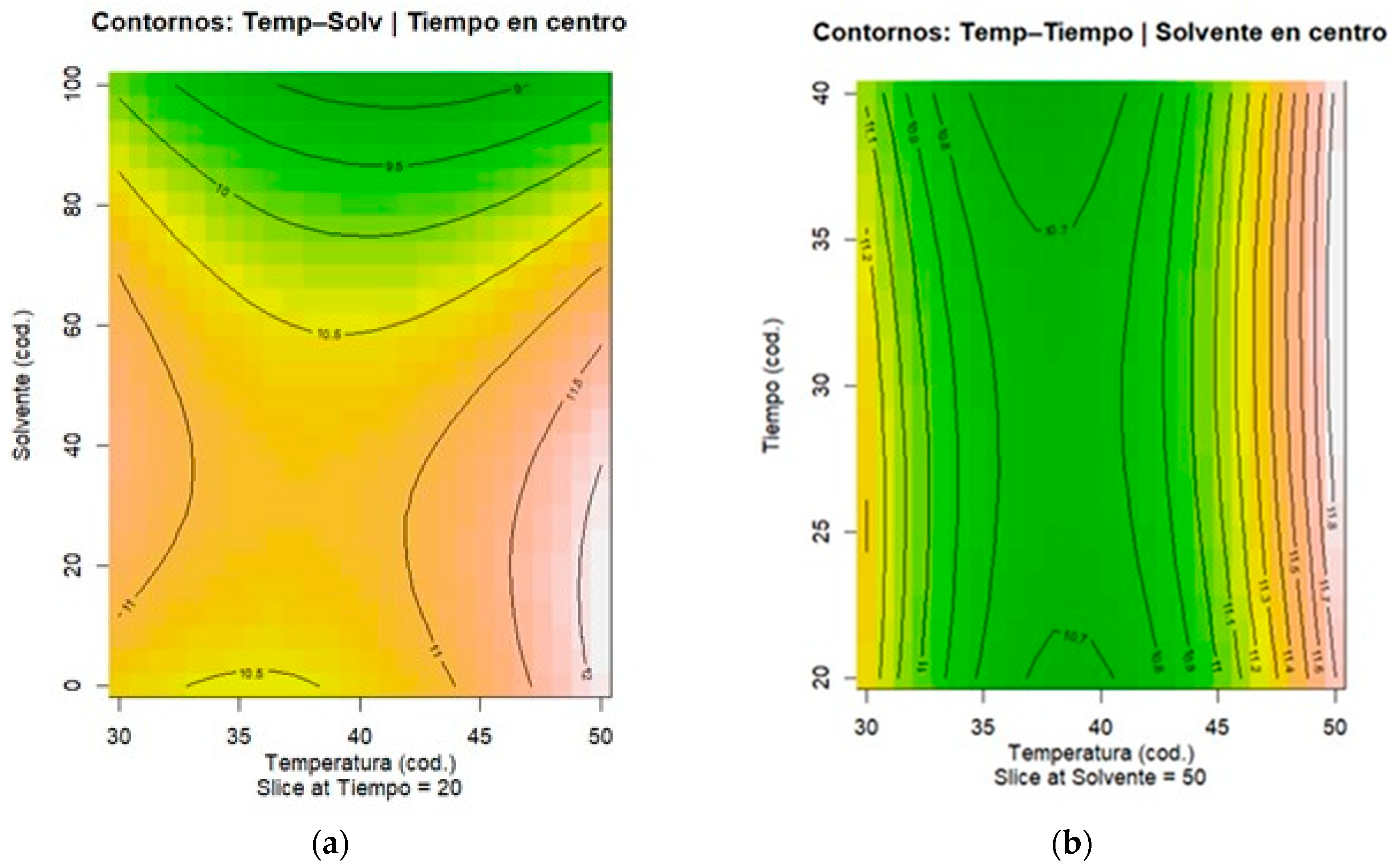
The fitted response surface model shown in Figure 2 explained approximately 46% of the variability in yield (R2 = 0.456), indicating a moderate fit. On the other hand, none of the individual terms were statistically significant, although a relevant trend was observed for the solvent variable (p ≈ 0.21), which confirms the importance of the hydroalcoholic composition in the extraction process.
In Figure 2a, the interaction between temperature and solvent can be observed, while keeping the extraction time constant at 20 min. The extraction yield shows an intermediate maximum region around 35–40 °C and at ethanol concentrations of 40–60%, conditions that enhance the release of bioactive compounds. In contrast, at low temperatures and with pure solvent (0% and 100%), the yield decreases significantly, which allows us to conclude that extreme conditions result in lower efficiency of the process.
In Figure 2b, the interaction between temperature (30–50 °C) and time (20–40 min) is analyzed, while keeping the solvent constant at an ethanol concentration of 50%. It can be observed that the extraction yield reaches a maximum in the central region, that is, at approximately 40 °C and 30 min. This behavior suggests that the extraction process is sensitive to the balance between time and temperature; in other words, short extraction times are insufficient to adequately recover all compounds, whereas high temperatures promote their degradation.
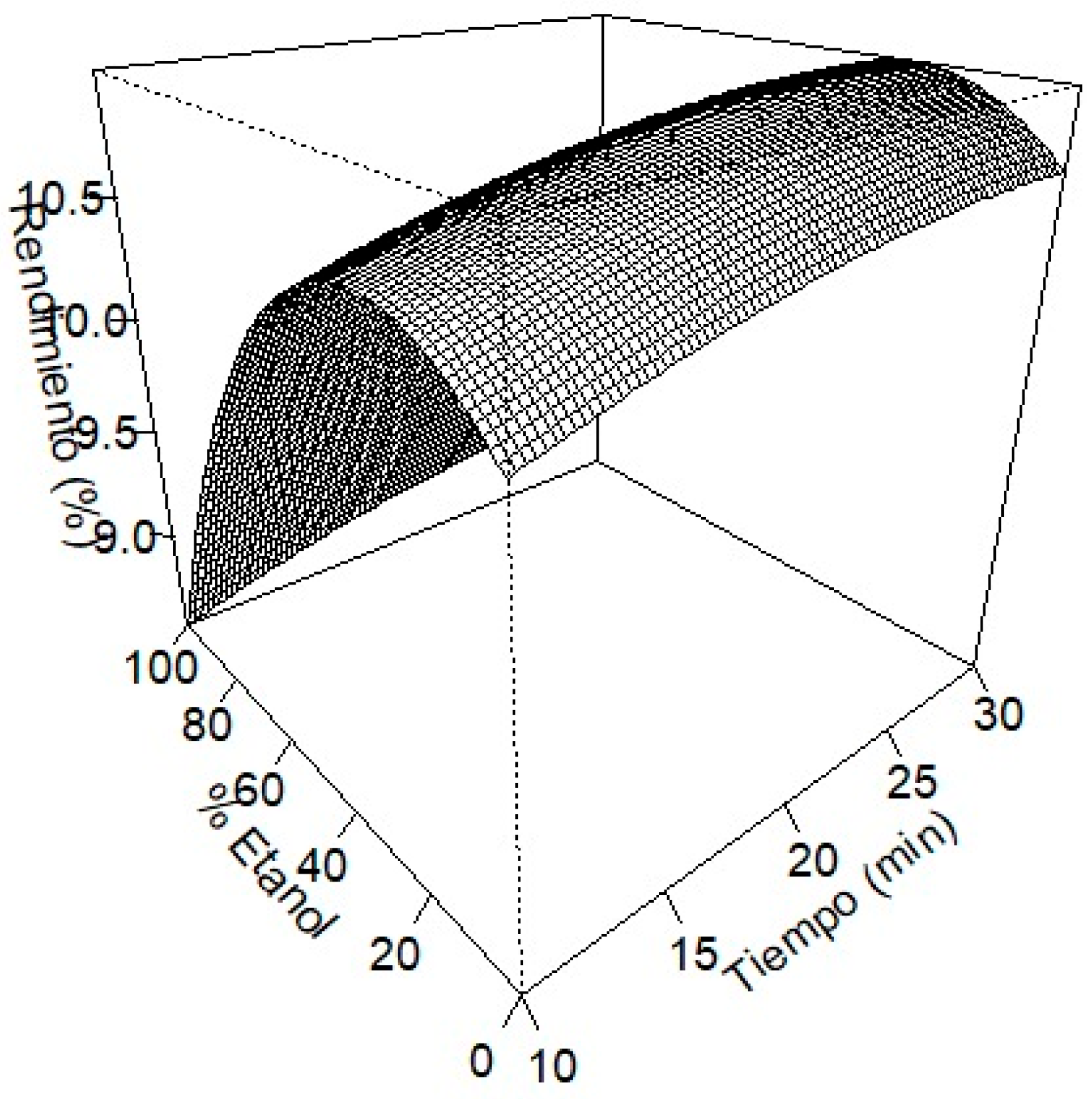
Finally, the response surface obtained in Figure 3 confirms that the condition of 100% ethanol as solvent leads to a marked decrease in yield compared to those obtained with water (0%) and mixtures (50%), demonstrating that the latter are more efficient than pure ethanol for the extraction of pigments and bioactive compounds. This three-dimensional representation corroborates the previous ANOVA and multiple comparison results, highlighting that process optimization is achieved under intermediate solvent conditions, while temperature and time exert less decisive effects within the studied range.

4. Conclusions

The results obtained indicate that the extraction process of betalains and bioactive compounds from beetroot using ultrasound technology is feasible and exhibits an optimal region with the highest yields under the following conditions: 40 °C, 30 min, and a solvent consisting of an equal mixture of ethanol and water.
This study represents a significant advancement in the optimization of the extraction process of bioactive compounds from beetroot. However, new research lines should be pursued in the future; in particular, it would be advisable to incorporate and control additional variables in the model, such as the pH of the extraction medium, as this factor influences the stability and preservation of betalains.

Author Contributions

Methodology, M.V.S. and C.A.; writing—preparation and editing, M.V.S., C.A. and V.A.G.; writing review C.A.F. All authors have read and agreed to the published version of the manuscript.

Funding

This research was funded by Universidad Tecnológica Nacional grant number SFPAEC395.

Institutional Review Board Statement

Not applicable.

Informed Consent Statement

Not applicable.

Data Availability Statement

Data are available in this manuscript.

Conflicts of Interest

The authors declare no conflict of interest.

References

  1. Santos, N.C.; Almeida, R.L.J.; Monteiro, S.S.; de Lima, T.L.B.; Figueira, J.G.S.; Martins, A.N.A.; Paiva, Y.F.; Pinheiro, L.S.S.; Morais, S.K.Q.; Carvalho, R.O.; et al. Ultrasound combined with chemical hydrolysis as a pretreatment for microencapsulation of beetroot waste by spray and freeze drying. Chem. Eng. Process. 2025, 208, 110082. [Google Scholar] [CrossRef]
  2. Deotale, S.; Reddy, N.B.P.; Vivek, K.; Rajam, R.; Gururaj, P.N.; Thivya, P. Recent advances in sustainable extraction of plant pigments from fruit and vegetable peel waste for smart packaging applications in food freshness monitoring. Food Humanit. 2025, 5, 100651. [Google Scholar] [CrossRef]
  3. Martins, I.R.; Martins, L.H.S.; Chisté, R.C.; Picone, C.S.F.; Joele, M.R.S.P. Betalains from vegetable peels: Extraction methods, stability, and applications as natural food colorants. Food Res. Int. 2024, 195, 114956. [Google Scholar] [CrossRef]
  4. More, P.R.; Jambrak, A.R.; Arya, S.S. Green, environment-friendly and sustainable techniques for extraction of food bioactive compounds and waste valorization. Trends Food Sci. Technol. 2022, 128, 296–315. [Google Scholar] [CrossRef]
  5. Bahar, Q.S.; Shahi, N.C.; Richa, R.; Showkat, S.; Gupta, A.K.; Naik, B.; Rustagi, S.; Kumar, V. Insights into extraction methods of pigments from Celosia cristata L. flower: A review. J. Agric. Food Res. 2025, 19, 101599. [Google Scholar] [CrossRef]
  6. Zhou, Y.; Tian, Y.; Yang, B. Root vegetable side streams as sources of functional ingredients for food, nutraceutical and pharmaceutical applications: The current status and future prospects. Trends Food Sci. Technol. 2023, 137, 1–16. [Google Scholar] [CrossRef]
  7. Borjan, D.; Šeregelj, V.; Andrejč, D.C.; Pezo, L.; Šaponjac, V.T.; Knez, Ž.; Vuli´c, J.; Marevci, M.K. Green Techniques for Preparation of Red Beetroot Extracts with Enhanced Biological Potential. Antioxidants 2022, 11, 805. [Google Scholar] [CrossRef] [PubMed]
  8. Ramon, C.; Gil-Garzón, M.A.; Ramon, C. Efecto de los parámetros de operación de la extracción asistida por ultrasonido en la obtención de polifenoles de uva: Una revisión. Tecnológicas 2021, 24, 263–277. [Google Scholar] [CrossRef]
  9. Khan, M.I.; Polturak, G. Biotechnological production and emerging applications of betalains: A review. Biotechnol. Adv. 2025, 81, 108576. [Google Scholar] [CrossRef]
  10. Rojas, T.; Gómez, S.; Fuentes Campos, M.E.; Contreras-López, E.; Muñoz Jáuregui, A.M. Ultrasound-assisted extraction of phenolic compounds of the peel of sanky (Corryocactus brevistylus). Revista de la Sociedad Química del Perú 2019, 85, 258–267. [Google Scholar] [CrossRef]
  11. Correa de Carvalho, M.; Jagus, R.J.; Agüero, M.V. Optimización de la extracción acuosa de polifenoles y betalaínas, en hojas de remolacha, con asistencia de ultrasonido pulsado. Investig. Joven 2023, 10, 2314–3991. [Google Scholar]
  12. Cacace, J.E.; Mazza, G. Mass transfer process during extraction of phenolic compounds from milled berries. J. Food Eng. 2003, 59, 379–389. [Google Scholar] [CrossRef]
  13. Kujala, T.S.; Loponen, J.M.; Klika, K.D.; Pihlaja, K. Phenolics and betacyanins in red beetroot (Beta vulgaris) root: Distribution and effect of cold storage on the content of total phenolics and three individual compounds. J. Agric. Food Chem. 2000, 48, 5338–5342. [Google Scholar] [CrossRef] [PubMed]
  14. López, N.; Cejas, E.; Marfil, P.; Agüero, M.V. Ultrasound-assisted extraction of betalains and phenolic compounds from beetroot waste using green solvents. Food Chem. 2021, 362, 130233. [Google Scholar]
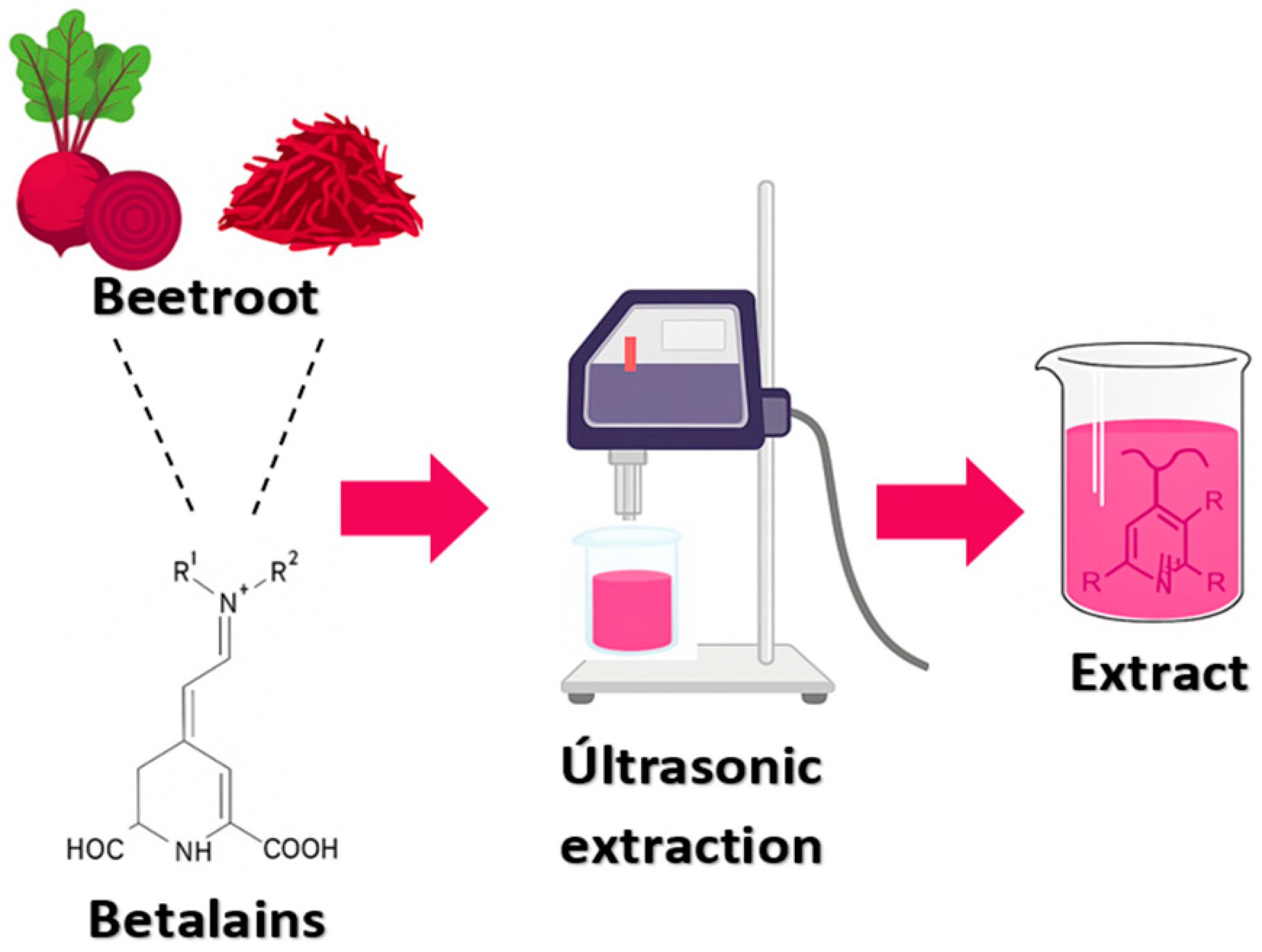
Figure 1. Process extraction ultrasonic.
Chemproc 18 00138 g001
Figure 2. RSM contour plots: (a) interaction between temperature and solvent (time fixed at the center point) on extraction yield; (b) interaction between temperature and time (solvent fixed at the center point) on extraction yield.
Chemproc 18 00138 g002
Figure 3. Three-dimensional surface of the effect of time-solvent on yield at 40 °C.
Chemproc 18 00138 g003
Table 1. Physical characterization.
SamplesWeight (g)Dt (mm)Dl (mm)
R1170.5 ± 0.0170.36 ± 0.0174 ± 0.01
R295.7 ± 0.0159.18 ± 0.0159.3 ± 0.01
R392.8 ± 0.0153.48 ± 0.0158.76 ± 0.01
R4145.5 ± 0.0164.32 ± 0.0160.46 ± 0.01
R5169.3 ± 0.0165.72 ± 0.0174.62 ± 0.01
R677.8 ± 0.0146.38 ± 0.0160 ± 0.01
Table 2. Experimental design and obtained yields.
AssayT (°C)Time (min)Svte.R (%)
U13020010.10
U2302010010.52
U33020509.85
U43030010.61
U530301009.97
U630305012.82
U73040011.54
U830401009.06
U930405010.51
U104020011.15
U11402010010.00
U1240205010.02
U13403009.38
U1440301007.03
U1540305014.12
U16404009.67
U1740401008.56
U1840405010.43
U195020012.85
U2050201008.90
U2150205011.64
U225030012.40
U2350301008.74
U2450305010.68
U255040012.50
U26504010011.45
U2750405011.00
Disclaimer/Publisher’s Note: The statements, opinions and data contained in all publications are solely those of the individual author(s) and contributor(s) and not of MDPI and/or the editor(s). MDPI and/or the editor(s) disclaim responsibility for any injury to people or property resulting from any ideas, methods, instructions or products referred to in the content.