


Abstract
Background/Objectives: Obesity and diabetes mellitus coexist, but the association of obesity with invasive management and in-hospital outcomes in acute myocardial infarction (AMI) complicated by cardiogenic shock is uncertain. We evaluated these associations among adults with diabetes mellitus. Methods: We performed a retrospective discharge-level analysis of the National Inpatient Sample for 2016–2021. Obesity was identified from ICD-10-CM codes. Survey-design logistic regression accounted for weights, strata, hospital clusters, and prespecified covariates. Results: The cohort comprised 19,399 discharges, representing 96,995 hospitalizations; 24.1% had obesity. Angiography and coronary artery bypass grafting (CABG) were more frequent with obesity, whereas percutaneous coronary intervention (PCI) was less frequent. After adjustment, obesity was associated with higher odds of angiography (adjusted odds ratio [aOR] 1.12, 95% confidence interval [CI] 1.03–1.21) and CABG (aOR 1.49, 95% CI 1.35–1.63), lower odds of PCI (aOR 0.90, 95% CI 0.84–0.97), and similar odds of circulatory support (aOR 1.00, 95% CI 0.93–1.07). Adjusted odds were lower for major adverse cardiovascular and cerebrovascular events (aOR 0.88, 95% CI 0.82–0.95), in-hospital mortality (aOR 0.90, 95% CI 0.83–0.98), acute ischemic stroke (aOR 0.78, 95% CI 0.64–0.95), and major bleeding (aOR 0.86, 95% CI 0.76–0.98). Procedure adjustment attenuated mortality and major bleeding. Conclusions: Obesity was associated with a different invasive-management pattern and lower adjusted odds of several short-term outcomes, consistent with an apparent in-hospital obesity paradox in this high-risk population.
1. Introduction
Diabetes mellitus and obesity are increasing worldwide. In 2024, an estimated 589 million adults aged 20–79 years were living with diabetes, and this number is projected to reach approximately 853 million by 2050 [1]. In parallel, global forecasts indicate that more than half of adults may have overweight or obesity by 2050 [2]. Diabetes is a major risk factor for cardiovascular disease, including acute myocardial infarction [3,4]. It has been associated with a higher incidence of cardiogenic shock after acute myocardial infarction, although its independent association with mortality after shock onset has varied across studies [5,6,7,8]. These adverse cardiovascular patterns may partly reflect a greater burden of diffuse coronary disease, endothelial and microvascular dysfunction, and accompanying macrovascular complications [9,10,11].
Obesity is one of the most prevalent comorbidities in type 2 diabetes. Approximately 90% of adults with type 2 diabetes have overweight or obesity [12]. Conversely, a US cohort found obesity to be associated with an approximately 2.7-fold higher risk of incident diabetes [13]. Obesity is also a well-recognized independent risk factor for ischemic heart disease [14,15], potentially through chronic inflammation, oxidative stress, endothelial dysfunction, and adverse metabolic effects [16,17]. Nevertheless, some studies reported lower unadjusted event rates among patients with higher body mass index after acute myocardial infarction or percutaneous coronary intervention, although the association did not consistently persist after multivariable adjustment [18,19]. This apparent “obesity paradox” has also been described in meta-analyses of acute coronary syndrome and coronary artery disease [20,21].
The objective of this study was to evaluate the association of obesity with coronary angiography, revascularization, circulatory support, in-hospital mortality, MACCE, acute ischemic stroke, and major bleeding among adults with diabetes mellitus hospitalized for acute myocardial infarction complicated by cardiogenic shock.
2. Materials and Methods
2.1. Data Source
We performed a retrospective discharge-level analysis using the National Inpatient Sample (NIS), Healthcare Cost and Utilization Project, Agency for Healthcare Research and Quality, for 2016–2021 [22]. The NIS is a restricted-access limited data set comprising an approximately 20% stratified all-payer sample of hospital discharges from US community hospitals and is designed to generate national estimates rather than function as a census of every hospitalization. To account for the sampling design, the Healthcare Cost and Utilization Project assigns each observed discharge record a discharge weight (DISCWT), indicating how many similar hospitalizations in the national population that record represents. Applying DISCWT expands the observed sample to an estimate of the total number of US hospitalizations. We therefore report both the number of discharge records directly observed in the NIS (n) and the corresponding weighted national estimate (weighted N). For example, the 19,399 observed records in our analytic cohort represent an estimated 96,995 hospitalizations nationally. Because the unit of analysis is a hospital discharge, repeated hospitalizations of the same individual cannot be identified.
We included hospital discharge records for adults aged ≥18 years whose admission was nonelective and who had diabetes mellitus, a principal diagnosis of acute myocardial infarction, and cardiogenic shock. We excluded type 2 myocardial infarction, records without a valid hospital identifier required for design-based analysis, and records with incomplete information required for cohort definition. Descriptive analyses used the final cohort; multivariable models used complete observations for all prespecified covariates.
2.2. Definitions
Diagnoses and in-hospital complications were identified using International Classification of Diseases, Tenth Revision, Clinical Modification (ICD-10-CM) codes, whereas inpatient procedures were identified using the International Classification of Diseases, Tenth Revision, Procedure Coding System (ICD-10-PCS). Diabetes mellitus was identified using ICD-10-CM codes E08.*, E09.*, E10.*, E11.*, and E13.*. Acute myocardial infarction was identified by a principal diagnosis code from I21.*, with type 2 myocardial infarction (I21.A1) excluded, and cardiogenic shock was identified by R57.0. Obesity was defined by ICD-10-CM codes E66.0*, E66.1*, E66.2*, E66.8*, or E66.9* in any diagnosis field; E66.3, denoting overweight, was excluded. Hospitalizations without a qualifying obesity diagnosis formed the reference group. Acute ischemic stroke was identified using I63.* diagnosis codes. MACCE was defined as a composite of in-hospital mortality or acute ischemic stroke. The complete operational code list is provided in Supplementary Table S1. For readability, the terms obesity, obesity group, and reference group are used throughout the remainder of the manuscript.
2.3. Statistical Analysis
Continuous variables are presented as weighted means with standard deviations and categorical variables as weighted frequencies and percentages. Between-group comparisons used weighted Student’s t tests or Pearson chi-square tests, as appropriate. All reported national counts were obtained with the NIS discharge weight; these weighted counts estimate national hospitalizations and do not represent additional observed records.
Multivariable analyses incorporated the NIS discharge weight, sampling stratum, and hospital cluster. The eligible cohort was specified as a subpopulation (domain) of the master analytic file so that design-based standard errors reflected the full sampling structure.
Covariates were prespecified on clinical grounds and from the prior literature; automated variable selection was not used. Every primary model included age (continuous), sex, race, calendar year, hospital region, hospital bed size, hospital location/teaching status, ST-segment elevation myocardial infarction, cardiac arrest, ventricular tachycardia, ventricular fibrillation, atrial fibrillation, heart failure, hypertension, hyperlipidemia, chronic kidney disease, smoking history/tobacco use, anemia, thrombocytopenia, coagulopathy, malignancy, dementia, peripheral vascular disease, and valvular heart disease.
Separate design-based logistic regression models estimated adjusted odds ratios (aORs) with 95% confidence intervals (CIs) for coronary angiography, PCI, CABG, circulatory support, MACCE, in-hospital mortality, acute ischemic stroke, and major bleeding. Because in-hospital procedures occur after admission and may reflect both the evolving clinical condition and treatment selection, they were not included in the primary clinical-outcome models. A sensitivity analysis additionally included coronary angiography, PCI, CABG, circulatory support, and mechanical ventilation. Models used complete records for all covariates (n = 18,638 observed discharges; weighted N = 93,190). Model fit was summarized with Nagelkerke pseudo-R2.
Analyses were performed using IBM SPSS Statistics version 24 (IBM Corp., Armonk, NY, USA). All tests were two-sided, and p < 0.05 was considered statistically significant. Figures were prepared using Python 3 and Pillow version 12.2.0.
3. Results
3.1. Cohort Characteristics and Crude Outcomes
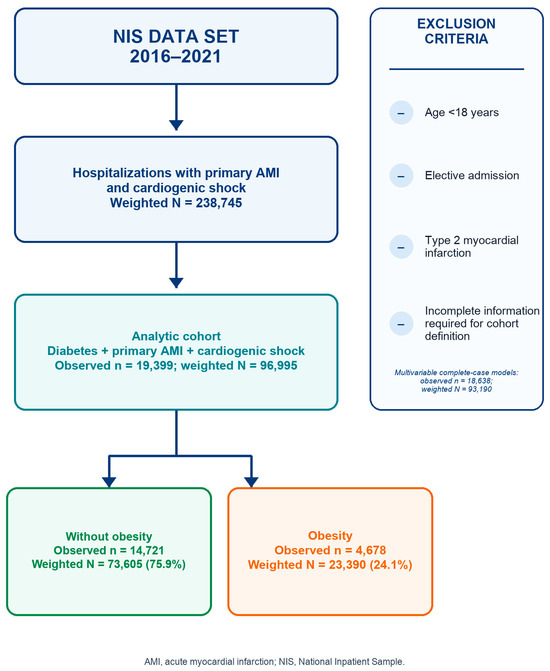
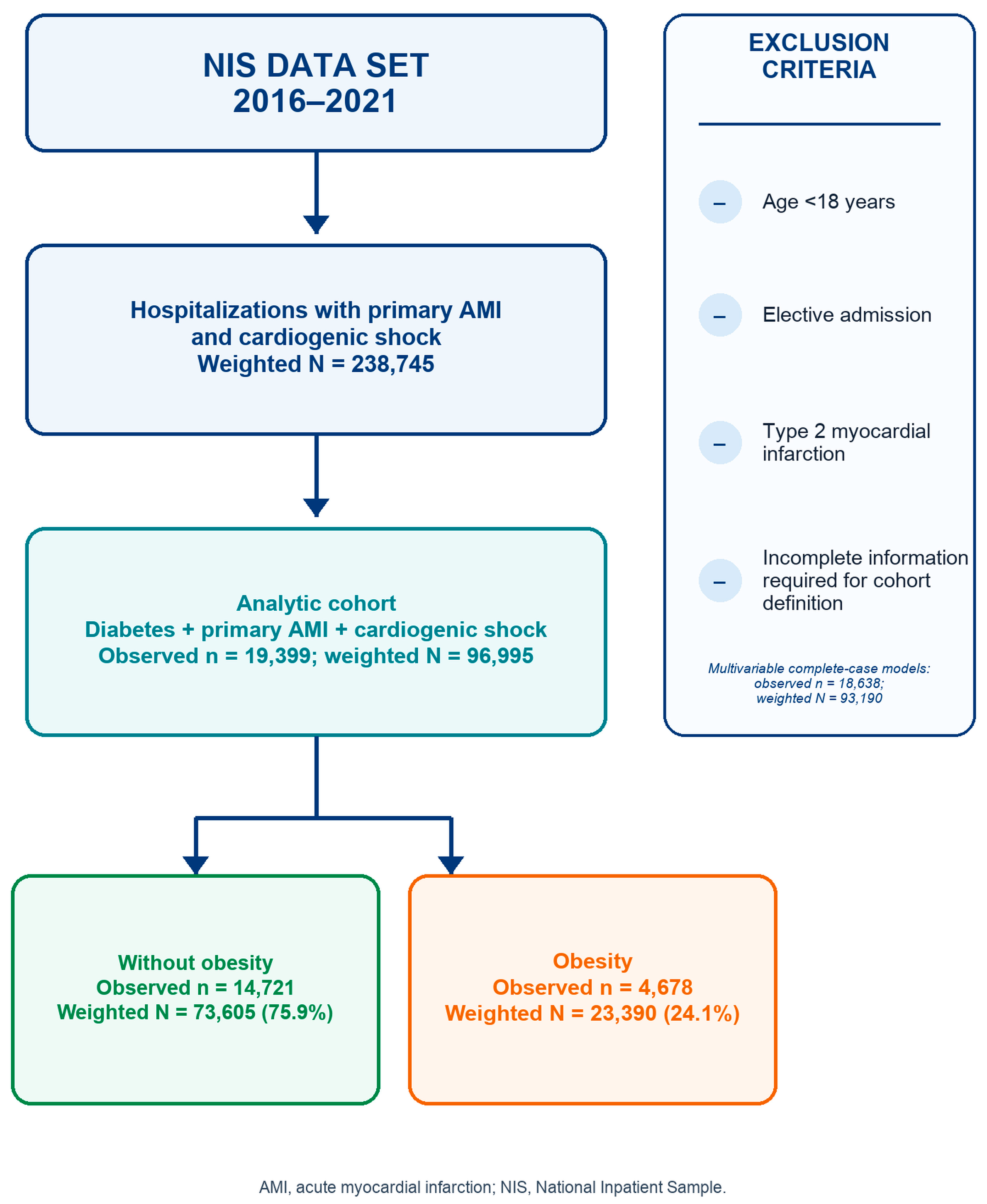
The source cohort represented 238,745 weighted hospitalizations with acute myocardial infarction complicated by cardiogenic shock. The final cohort included 19,399 observed discharges with diabetes mellitus, corresponding to 96,995 weighted national hospitalizations. Obesity was present in 4678 observed discharges, representing 23,390 weighted hospitalizations (24.1%); 14,721 observed discharges, representing 73,605 weighted hospitalizations (75.9%), were in the reference group (Figure 1).
Figure 1.
Study flow diagram. Lowercase n denotes observed discharges and weighted N denotes estimated national hospitalizations.
Baseline characteristics are shown in Table 1. Adults in the obesity group were younger than those in the reference group (65 ± 11 vs. 69 ± 11 years, p < 0.001) and were more often female (39.6% vs. 35.7%, p = 0.001).
Table 1.
Baseline demographic and clinical characteristics of adults with diabetes mellitus and acute myocardial infarction complicated by cardiogenic shock according to obesity status. The reference group comprised hospitalizations without obesity.
Heart failure, hypertension, hyperlipidemia, atrial fibrillation, smoking history/tobacco use, and anemia were more frequent in the obesity group. Valvular heart disease, dementia, peripheral vascular disease, thrombocytopenia, coagulopathy, and malignancy were more frequent in the reference group. Chronic kidney disease and chronic liver disease did not differ significantly between the groups.
Crude, weighted procedure rates are shown in Table 2. Coronary angiography (72.5% vs. 68.4%) and CABG (25.3% vs. 17.8%) were more frequent in the obesity group, whereas PCI was slightly less frequent (49.9% vs. 51.0%). Circulatory support (46.6% vs. 45.0%) and mechanical ventilation (46.2% vs. 45.4%) were modestly more frequent in the obesity group.
Table 2.
Crude survey-weighted in-hospital procedures, complications, and outcomes according to obesity status. The reference group comprised hospitalizations without obesity.
Crude MACCE (33.6% vs. 40.6%), in-hospital mortality (27.9% vs. 34.6%), acute ischemic stroke (3.1% vs. 3.9%), and major bleeding (7.1% vs. 8.6%) were less frequent in the obesity group (all p < 0.001). Other in-hospital complications are summarized in Table 2.
3.2. Adjusted Associations and Sensitivity Analysis
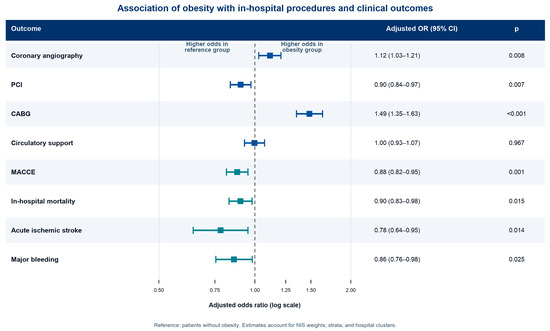
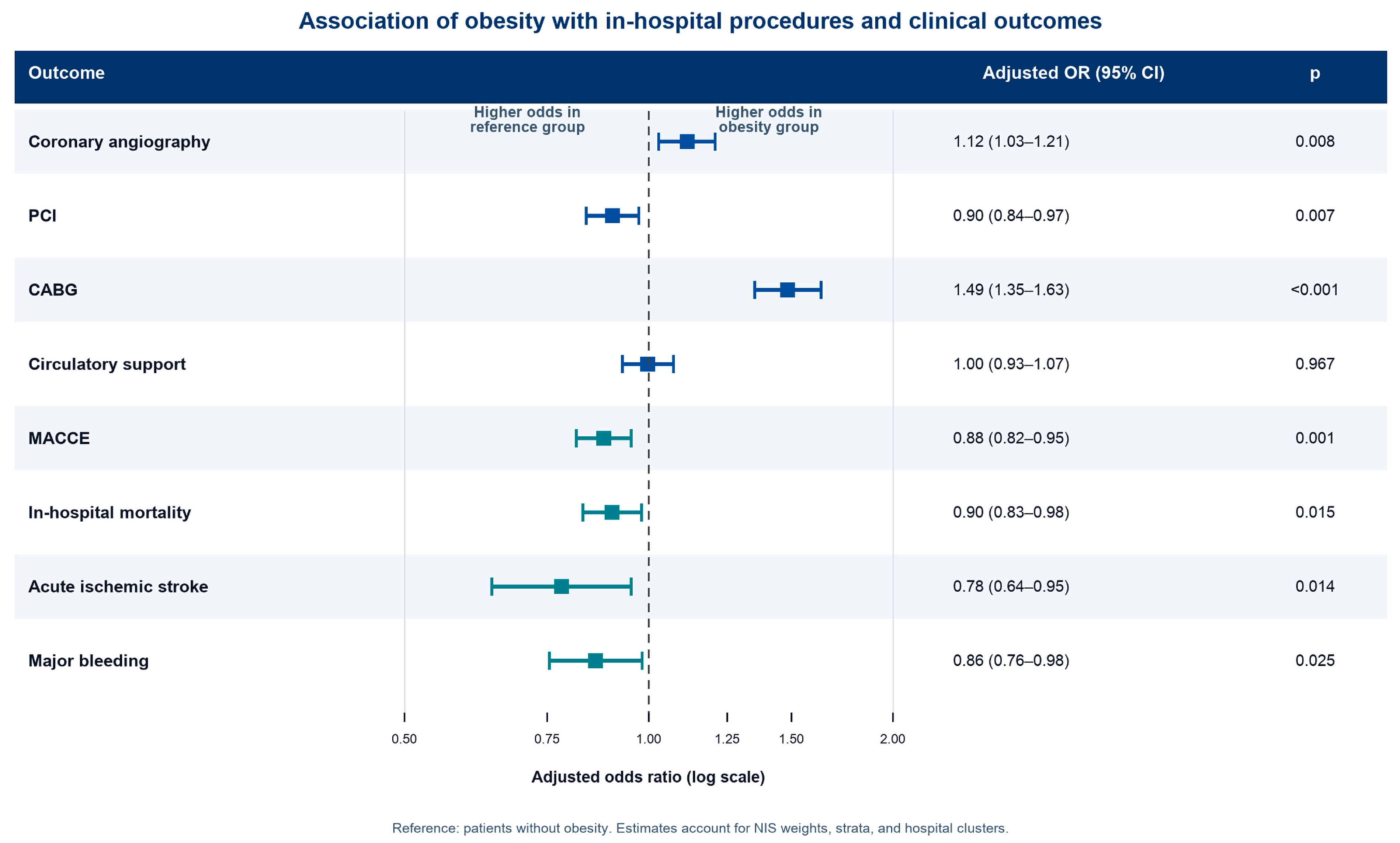
In primary design-adjusted models, obesity was associated with higher odds of coronary angiography (aOR 1.12, 95% CI 1.03–1.21; p = 0.008) and CABG (aOR 1.49, 95% CI 1.35–1.63; p < 0.001), lower odds of PCI (aOR 0.90, 95% CI 0.84–0.97; p = 0.007), and similar odds of circulatory support (aOR 1.00, 95% CI 0.93–1.07; p = 0.967) (Table 3 and Figure 2).
Table 3.
Primary design-adjusted association of obesity with in-hospital procedures and outcomes.
Figure 2.
Design-adjusted odds ratios and 95% confidence intervals for the association of obesity with in-hospital procedures and clinical outcomes. The reference group is hospitalizations without obesity. Figures were prepared using Python 3 and Pillow version 12.2.0.
Obesity was also associated with lower adjusted odds of MACCE (aOR 0.88, 95% CI 0.82–0.95; p = 0.001), in-hospital mortality (aOR 0.90, 95% CI 0.83–0.98; p = 0.015), acute ischemic stroke (aOR 0.78, 95% CI 0.64–0.95; p = 0.014), and major bleeding (aOR 0.86, 95% CI 0.76–0.98; p = 0.025). Nagelkerke pseudo-R2 values for the primary models ranged from 0.033 to 0.322 (Table 3).
When in-hospital procedures were added in sensitivity analyses, the associations with MACCE (aOR 0.90, 95% CI 0.83–0.98; p = 0.013) and acute ischemic stroke (aOR 0.77, 95% CI 0.63–0.93; p = 0.008) persisted. The associations with in-hospital mortality (aOR 0.94, 95% CI 0.86–1.02; p = 0.147) and major bleeding (aOR 0.89, 95% CI 0.78–1.01; p = 0.068) were attenuated and no longer statistically significant (Table 4).
Table 4.
Sensitivity analysis of clinical outcomes additionally adjusted for coronary angiography, PCI, CABG, circulatory support, and mechanical ventilation.
4. Discussion
In this nationally representative analysis of adults with diabetes mellitus and acute myocardial infarction complicated by cardiogenic shock, obesity was associated with important differences in both invasive management and in-hospital outcomes. After adjustment, the obesity group had higher odds of coronary angiography and CABG, lower odds of PCI, and similar odds of circulatory support. Obesity was also associated with lower adjusted odds of MACCE, in-hospital mortality, acute ischemic stroke, and major bleeding. In the procedure-adjusted sensitivity analysis, the associations with MACCE and acute ischemic stroke remained significant, whereas those with mortality and major bleeding were attenuated.
The greater use of coronary angiography and CABG, together with the lower use of PCI, may indicate a different pathway of invasive management in the obesity group. Several factors may have contributed to this pattern. Patients with obesity were younger, which may have increased the likelihood of invasive evaluation and surgical candidacy. In patients with diabetes, multivessel coronary disease may favor CABG over complex PCI when surgical revascularization is clinically feasible [11,23]. In acute myocardial infarction complicated by cardiogenic shock, the choice between PCI and CABG is also shaped by coronary anatomy and clinical circumstances [24]. Thus, more frequent angiography may have identified coronary anatomy less suitable for PCI and prompted referral for CABG. Differences in clinical presentation, referral pathways, and treatment selection may also have contributed. Although these associations persisted after adjustment for measured patient and hospital characteristics, the contribution of the proposed mechanisms is difficult to evaluate in the present study and should be explored in cohorts with detailed angiographic and temporal information.
The focus on diabetes mellitus is clinically important. Diabetes is associated with accelerated and often diffuse coronary atherosclerosis, endothelial and microvascular dysfunction, and a prothrombotic milieu, all of which may influence the presentation and course of acute myocardial infarction and cardiogenic shock [3,5,6,7,8,9,10,11]. Obesity frequently coexists with diabetes and may further modify insulin resistance, inflammation, cardiorespiratory reserve, and treatment feasibility [12,16,17,25,26]. The observed combination of different revascularization patterns and lower adjusted odds of several in-hospital events therefore provides clinically relevant information for a particularly high-risk metabolic population that remains incompletely characterized.
The lower adjusted odds of adverse clinical outcomes are consistent with the reported “obesity paradox” in coronary artery disease and acute coronary syndromes [20,21,27,28]. A meta-analysis of patients with cardiogenic shock also reported a modestly lower adjusted mortality estimate among patients with overweight or obesity [29]. A conference abstract using NIS data also reported favorable in-hospital outcomes among patients with diabetes, obesity, and ST-segment elevation myocardial infarction [30]. Our study extends these observations to adults in whom diabetes mellitus, acute myocardial infarction, and cardiogenic shock coexist and demonstrates that the observed pattern encompasses both clinical outcomes and the use of invasive cardiovascular procedures.
Several complementary mechanisms may contribute to this apparent paradox. Adults in the obesity group were younger and had lower frequencies of dementia, peripheral vascular disease, coagulopathy, and malignancy, suggesting differences in frailty, competing illness, and treatment eligibility. In people with diabetes, body size may also reflect heterogeneous disease trajectories: longstanding diabetes, sarcopenia, catabolic illness, or unintentional weight loss may place some adults without documented obesity at greater short-term risk, whereas greater metabolic or nutritional reserve may be relevant during critical illness. Body mass index itself cannot distinguish fat mass from lean mass, visceral adiposity, sarcopenia, or cardiorespiratory fitness [28,31]. A systematic review in older adults similarly emphasized the potential influence of age, frailty, and comorbidity on the apparent obesity paradox [32]. These factors, together with selective survival and differences in presentation or treatment eligibility, may help explain why the association between obesity and outcomes during an acute hospitalization can differ from the well-established long-term cardiovascular risks of obesity.
The procedure-adjusted sensitivity analysis complements the primary findings by assessing whether the observed associations were maintained after accounting for major in-hospital interventions. The associations with MACCE and acute ischemic stroke remained statistically significant, supporting their consistency across model specifications, whereas those with mortality and major bleeding were attenuated. Because coronary angiography, revascularization, circulatory support, and mechanical ventilation are undertaken during hospitalization, they may reflect elements of both clinical severity and treatment selection. The attenuation observed for mortality and bleeding therefore suggests that differences in in-hospital management may contribute, at least in part, to these associations. Accordingly, this sensitivity analysis shows how stable the findings were after accounting for in-hospital procedures, but it was not designed to determine whether these procedures explained the observed associations.
The findings for acute ischemic stroke and major bleeding are particularly relevant in diabetes, in which vascular injury, thrombosis, renal dysfunction, and the need for intensive antithrombotic treatment often coexist. The association with acute ischemic stroke remained significant after procedure adjustment, whereas the major-bleeding estimate was attenuated. Differences in age, comorbidity burden, antithrombotic management, vascular access, and competing in-hospital mortality may all contribute. More detailed clinical datasets will be needed to determine how these factors interact in patients with diabetes and cardiogenic shock.
The absence of an adjusted difference in circulatory support suggests that obesity was not associated with greater overall device use after measured patient and hospital characteristics were considered. Device use nevertheless depends on hemodynamics, institutional capability, candidacy, goals of care, and temporal practice patterns and therefore cannot be used as a direct measure of shock severity.
The principal strengths of this study are its large, nationally representative sample; consistent cohort definition; incorporation of the NIS sampling design; evaluation of multiple clinically relevant procedures and outcomes; and sensitivity analysis addressing in-hospital treatment. For diabetology, the results provide a contemporary national benchmark for a population in which metabolic disease, coronary disease, and shock converge. Future studies linking such population-level data with glycated hemoglobin, diabetes duration and subtype, glucose-lowering and obesity-directed therapies, body composition, shock stage, and coronary anatomy may clarify which diabetic and obesity phenotypes account for the observed differences.
Limitations
These findings should be interpreted in the context of several limitations. First, the retrospective administrative design may be affected by coding variation, residual confounding, selection, and repeated hospitalizations of the same individual. Second, obesity was identified from diagnosis codes rather than measured body mass index or body composition; obesity class, waist circumference, percentage body fat, sarcopenia, and weight change were unavailable. Third, the NIS does not include shock stage, detailed hemodynamics, laboratory values, ventricular function, coronary anatomy, medication exposure, vascular access, or granular procedure timing. Measures of diabetes control, including glycated hemoglobin, disease duration, and glucose-lowering therapy, were likewise unavailable. Fourth, the analysis is limited to the index hospitalization and cannot assess post-discharge outcomes. Fifth, several secondary outcomes were examined without formal multiplicity correction. Finally, in-hospital procedures may represent both treatment and markers of clinical severity, which is why they were evaluated in a separate sensitivity analysis. Despite these limitations, the study offers nationally representative evidence on a critically ill and understudied population with diabetes mellitus.
5. Conclusions
Among US hospitalizations of adults with diabetes mellitus and acute myocardial infarction complicated by cardiogenic shock, obesity was associated with higher adjusted odds of coronary angiography and CABG, lower odds of PCI, and similar odds of circulatory support. Obesity was also associated with modestly lower adjusted odds of MACCE, in-hospital mortality, acute ischemic stroke, and major bleeding, although the mortality and bleeding associations were attenuated after additional adjustment for procedures. This pattern is consistent with an apparent in-hospital obesity paradox in a complex population with diabetes mellitus and suggests that metabolic phenotype, comorbidity burden, and treatment pathways may all be relevant. Further studies incorporating body composition, diabetes severity and treatment, shock stage, coronary anatomy, and procedural timing are needed to clarify the mechanisms underlying these associations.
Supplementary Materials
The following supporting information can be downloaded at: https://www.mdpi.com/article/10.3390/diabetology7080152/s1, Table S1: Operational definitions for the cohort, exposure, adjustment variables, procedures, and study outcomes.
Author Contributions
Conceptualization, K.B., O.K., and I.M.; methodology, K.B., O.K., and I.M.; formal analysis, K.B.; investigation, K.B., A.F., M.B., R.A.-F., and A.R.; data curation, K.B.; writing—original draft preparation, K.B.; writing—review and editing, O.K., I.M., R.A.-F., and A.R.; supervision, O.K. All authors have read and agreed to the published version of the manuscript.
Funding
This research received no external funding.
Institutional Review Board Statement
Ethical review and approval were not required because this study analyzed de-identified discharge-level data from the HCUP National Inpatient Sample under the HCUP Data Use Agreement and involved no direct patient contact or access to direct identifiers.
Informed Consent Statement
Patient consent was not applicable because the study used de-identified administrative discharge data.
Data Availability Statement
The data used in this study are available from the Healthcare Cost and Utilization Project National Inpatient Sample after completion of the required training and acceptance of the HCUP Data Use Agreement. The authors are not permitted to redistribute the source data.
Acknowledgments
During the preparation and revision of this manuscript, the authors used ChatGPT 5.5 and Codex 0.147.0 (OpenAI) to assist with English-language editing, manuscript organization, preparation of statistical syntax, and figure generation. All statistical analyses were executed using the study dataset and independently reviewed by the authors. The authors verified all numerical results, references, interpretations, and AI-assisted outputs, revised the resulting material as necessary, and take full responsibility for the content of the manuscript.
Conflicts of Interest
The authors declare no conflicts of interest.
Abbreviations
The following abbreviations are used in this manuscript:
| AMI | Acute Myocardial Infarction |
| aOR | Adjusted Odds Ratio |
| BMI | Body Mass Index |
| CABG | Coronary Artery Bypass Grafting |
| CI | Confidence Interval |
| ECMO | Extracorporeal Membrane Oxygenation |
| HCUP | Healthcare Cost and Utilization Project |
| IABP | Intra-Aortic Balloon Pump |
| MACCE | Major Adverse Cardiovascular and Cerebrovascular Events |
| NIS | National Inpatient Sample |
| PCI | Percutaneous Coronary Intervention |
| SD | Standard Deviation |
| STEMI | ST-Segment Elevation Myocardial Infarction |
| USA | United States of America |
References
- Genitsaridi, I.; Salpea, P.; Salim, A.; Sajjadi, S.F.; Tomic, D.; James, S.; Thirunavukkarasu, S.; Issaka, A.; Chen, L.; Basit, A.; et al. 11th edition of the IDF Diabetes Atlas: Global, regional, and national diabetes prevalence estimates for 2024 and projections for 2050. Lancet Diabetes Endocrinol. 2026, 14, 149–156. [Google Scholar] [CrossRef] [Scilit] [PubMed]
- Ng, M.; Gakidou, E.; Lo, J.; Abate, Y.H.; Abbafati, C.; Abbas, N.; Abbasian, M.R.; Abd ElHafeez, S.; Abdel-Rahman, W.M.; Abd-Elsalam, S.; et al. Global, regional, and national prevalence of adult overweight and obesity, 1990–2021, with forecasts to 2050: A forecasting study for the Global Burden of Disease Study 2021. Lancet 2025, 405, 813–838. [Google Scholar] [CrossRef] [Scilit] [PubMed]
- Leon, B.M.; Maddox, T.M. Diabetes and cardiovascular disease: Epidemiology, biological mechanisms, treatment recommendations and future research. World J. Diabetes 2015, 6, 1246–1258. [Google Scholar] [CrossRef] [Scilit] [PubMed]
- Centers for Disease Control and Prevention. National Diabetes Statistics Report: Estimates of Diabetes and Its Burden in the United States, 2014; U.S. Department of Health and Human Services: Atlanta, GA, USA, 2014.
- Lindholm, M.G.; Boesgaard, S.; Torp-Pedersen, C.; Køber, L.; TRACE Registry Study Group. Diabetes mellitus and cardiogenic shock in acute myocardial infarction. Eur. J. Heart Fail. 2005, 7, 834–839. [Google Scholar] [CrossRef] [Scilit] [PubMed]
- Jain, V.; Qamar, A.; Matsushita, K.; Vaduganathan, M.; Ashley, K.E.; Khan, M.S.; Bhatt, D.L.; Arora, S.; Caughey, M.C. Impact of diabetes on outcomes in patients hospitalized with acute myocardial infarction: Insights from the Atherosclerosis Risk in Communities Study Community Surveillance. J. Am. Heart Assoc. 2023, 12, e028923. [Google Scholar] [CrossRef] [Scilit] [PubMed]
- Echouffo-Tcheugui, J.B.; Kolte, D.; Khera, S.; Aronow, H.D.; Abbott, J.D.; Bhatt, D.L.; Fonarow, G.C. Diabetes mellitus and cardiogenic shock complicating acute myocardial infarction. Am. J. Med. 2018, 131, 778–786.e1. [Google Scholar] [CrossRef] [Scilit] [PubMed]
- Luo, C.; Chen, F.; Liu, L.; Ge, Z.; Feng, C.; Chen, Y. Impact of diabetes on outcomes of cardiogenic shock: A systematic review and meta-analysis. Diabetes Vasc. Dis. Res. 2022, 19, 14791641221132242. [Google Scholar] [CrossRef] [Scilit] [PubMed]
- Gregg, E.W.; Sattar, N.; Ali, M.K. The changing face of diabetes complications. Lancet Diabetes Endocrinol. 2016, 4, 537–547. [Google Scholar] [CrossRef] [Scilit] [PubMed]
- Gatuz, M.V.; Abu-Fanne, R.; Abramov, D.; Mamas, M.A.; Roguin, A.; Kobo, O. Diabetes and its impact on cardiogenic shock outcomes in acute myocardial infarction with polyvascular disease: A comparative analysis. Biomedicines 2024, 12, 1900. [Google Scholar] [CrossRef] [Scilit] [PubMed]
- Marx, N.; Federici, M.; Schütt, K.; Müller-Wieland, D.; Ajjan, R.A.; Antunes, M.J.; Christodorescu, R.M.; Crawford, C.; Di Angelantonio, E.; Eliasson, B.; et al. 2023 ESC Guidelines for the management of cardiovascular disease in patients with diabetes. Eur. Heart J. 2023, 44, 4043–4140. [Google Scholar] [CrossRef] [Scilit] [PubMed]
- Bays, H.E.; Bindlish, S.; Clayton, T.L. Obesity, diabetes mellitus, and cardiometabolic risk: An Obesity Medicine Association Clinical Practice Statement. Obes. Pillars 2023, 5, 100056. [Google Scholar] [CrossRef] [Scilit] [PubMed]
- Cameron, N.A.; Petito, L.C.; McCabe, M.; Allen, N.B.; O’Brien, M.J.; Carnethon, M.R.; Khan, S.S. Quantifying the sex-race/ethnicity-specific burden of obesity on incident diabetes mellitus in the United States, 2001–2016: MESA and NHANES. J. Am. Heart Assoc. 2021, 10, e018799. [Google Scholar] [CrossRef] [Scilit] [PubMed]
- Ades, P.A.; Savage, P.D. Obesity in coronary heart disease: An unaddressed behavioral risk factor. Prev. Med. 2017, 104, 117–119. [Google Scholar] [CrossRef] [Scilit] [PubMed]
- Caleyachetty, R.; Thomas, G.N.; Toulis, K.A.; Mohammed, N.; Gokhale, K.M.; Balachandran, K.; Nirantharakumar, K. Metabolically healthy obese and incident cardiovascular disease events among 3.5 million men and women. J. Am. Coll. Cardiol. 2017, 70, 1429–1437. [Google Scholar] [CrossRef] [Scilit] [PubMed]
- Battineni, G.; Sagaro, G.G.; Chintalapudi, N.; Amenta, F.; Tomassoni, D.; Tayebati, S.K. Impact of obesity-induced inflammation on cardiovascular diseases. Int. J. Mol. Sci. 2021, 22, 4798. [Google Scholar] [CrossRef] [Scilit] [PubMed]
- Masi, S.; Rizzoni, D.; Taddei, S.; Widmer, R.J.; Montezano, A.C.; Lüscher, T.F.; Schiffrin, E.L.; Touyz, R.M.; Paneni, F.; Lerman, A.; et al. Assessment and pathophysiology of microvascular disease: Recent progress and clinical implications. Eur. Heart J. 2021, 42, 2590–2604. [Google Scholar] [CrossRef] [Scilit] [PubMed]
- Kosuge, M.; Kimura, K.; Kojima, S.; Sakamoto, T.; Ishihara, M.; Asada, Y.; Tei, C.; Miyazaki, S.; Sonoda, M.; Tsuchihashi, K.; et al. Impact of body mass index on in-hospital outcomes after percutaneous coronary intervention for ST-segment elevation acute myocardial infarction. Circ. J. 2008, 72, 521–525. [Google Scholar] [CrossRef] [Scilit] [PubMed][Green Version]
- Gruberg, L.; Weissman, N.J.; Waksman, R.; Fuchs, S.; Deible, R.; Pinnow, E.E.; Ahmed, L.M.; Kent, K.M.; Pichard, A.D.; Suddath, W.O.; et al. The impact of obesity on the short-term and long-term outcomes after percutaneous coronary intervention: The obesity paradox? J. Am. Coll. Cardiol. 2002, 39, 578–584. [Google Scholar] [CrossRef] [Scilit] [PubMed]
- Niedziela, J.; Hudzik, B.; Niedziela, N.; Gąsior, M.; Gierlotka, M.; Wasilewski, J.; Myrda, K.; Lekston, A.; Poloński, L.; Rozentryt, P. The obesity paradox in acute coronary syndrome: A meta-analysis. Eur. J. Epidemiol. 2014, 29, 801–812. [Google Scholar] [CrossRef] [Scilit] [PubMed]
- Romero-Corral, A.; Montori, V.M.; Somers, V.K.; Korinek, J.; Thomas, R.J.; Allison, T.G.; Mookadam, F.; Lopez-Jimenez, F. Association of body weight with total mortality and cardiovascular events in coronary artery disease: A systematic review of cohort studies. Lancet 2006, 368, 666–678. [Google Scholar] [CrossRef] [Scilit] [PubMed]
- Agency for Healthcare Research and Quality. Introduction to the HCUP National Inpatient Sample (NIS). 2021. Available online: https://hcup-us.ahrq.gov/db/nation/nis/NIS_Introduction_2021.jsp (accessed on 23 July 2026).
- Farkouh, M.E.; Domanski, M.; Sleeper, L.A.; Siami, F.S.; Dangas, G.; Mack, M.; Yang, M.; Cohen, D.J.; Rosenberg, Y.; Solomon, S.D.; et al. Strategies for multivessel revascularization in patients with diabetes. N. Engl. J. Med. 2012, 367, 2375–2384. [Google Scholar] [CrossRef] [Scilit] [PubMed]
- White, H.D.; Assmann, S.F.; Sanborn, T.A.; Jacobs, A.K.; Webb, J.G.; Sleeper, L.A.; Wong, C.K.; Stewart, J.T.; Aylward, P.E.G.; Wong, S.C.; et al. Comparison of percutaneous coronary intervention and coronary artery bypass grafting after acute myocardial infarction complicated by cardiogenic shock: Results from the SHOCK trial. Circulation 2005, 112, 1992–2001. [Google Scholar] [CrossRef] [Scilit] [PubMed]
- Powell-Wiley, T.M.; Poirier, P.; Burke, L.E.; Després, J.P.; Gordon-Larsen, P.; Lavie, C.J.; Lear, S.A.; Ndumele, C.E.; Neeland, I.J.; Sanders, P.; et al. Obesity and cardiovascular disease: A scientific statement from the American Heart Association. Circulation 2021, 143, e984–e1010. [Google Scholar] [CrossRef] [Scilit] [PubMed]
- Lopez-Jimenez, F.; Almahmeed, W.; Bays, H.; Cuevas, A.; Di Angelantonio, E.; le Roux, C.W.; Sattar, N.; Sun, M.C.; Wittert, G.; Pinto, F.J.; et al. Obesity and cardiovascular disease: Mechanistic insights and management strategies. Eur. J. Prev. Cardiol. 2022, 29, 2218–2237. [Google Scholar] [CrossRef] [Scilit] [PubMed]
- McAuley, P.A.; Artero, E.G.; Sui, X.; Lee, D.-C.; Church, T.S.; Lavie, C.J.; Myers, J.N.; España-Romero, V.; Blair, S.N. The obesity paradox, cardiorespiratory fitness, and coronary heart disease. Mayo Clin. Proc. 2012, 87, 443–451. [Google Scholar] [CrossRef] [Scilit] [PubMed]
- Carbone, S.; Canada, J.M.; Billingsley, H.E.; Siddiqui, M.S.; Elagizi, A.; Lavie, C.J. Obesity paradox in cardiovascular disease: Where do we stand? Vasc. Health Risk Manag. 2019, 15, 89–100. [Google Scholar] [CrossRef] [Scilit] [PubMed]
- Tao, W.X.; Qian, G.Y.; Li, H.D.; Su, F.; Wang, Z. Body mass index and outcomes of patients with cardiogenic shock: A systematic review and meta-analysis. World J. Clin. Cases 2022, 10, 10956–10966. [Google Scholar] [CrossRef] [Scilit] [PubMed]
- Bodair, R.; Dargham, S.R.; Al Suwaidi, J.M.; Jneid, H.; Abi Khalil, C. Obesity is associated with better intra-hospital outcome in diabetes patients hospitalized for STEMI: Findings from the National Inpatient Sample. Circulation 2021, 144, 11189. [Google Scholar] [CrossRef] [Scilit]
- Bozorgmanesh, M.; Arshi, B.; Sheikholeslami, F.; Azizi, F.; Hadaegh, F. No obesity paradox—BMI incapable of adequately capturing the relation of obesity with all-cause mortality: An inception diabetes cohort study. Int. J. Endocrinol. 2014, 2014, 282089. [Google Scholar] [CrossRef] [Scilit] [PubMed]
- Dramé, M.; Godaert, L. The obesity paradox and mortality in older adults: A systematic review. Nutrients 2023, 15, 1780. [Google Scholar] [CrossRef] [Scilit] [PubMed]

Disclaimer/Publisher’s Note: The statements, opinions and data contained in all publications are solely those of the individual author(s) and contributor(s) and not of MDPI and/or the editor(s). MDPI and/or the editor(s) disclaim responsibility for any injury to people or property resulting from any ideas, methods, instructions or products referred to in the content. |
© 2026 by the authors. Licensee MDPI, Basel, Switzerland. This article is an open access article distributed under the terms and conditions of the Creative Commons Attribution (CC BY) license.