


Abstract
Background/Objectives: Interferon-free direct-acting antiviral (DAA) therapy cures chronic hepatitis C virus (HCV) infection, but its short-term effects on health-related quality of life (HRQoL) are captured differently by generic and disease-specific instruments. We examined longitudinal changes in utility scores and HRQoL in a multicenter Japanese cohort. Methods: Adults with chronic HCV completed the EuroQol 5-Dimension 5-Level questionnaire (EQ-5D-5L), the 8-Item Short-Form Health Survey (SF-8), and the Chronic Liver Disease Questionnaire (CLDQ) at baseline and at 12, 24, and 36 weeks after treatment initiation; 48-week data were included when available. Complete-case panels were analyzed for each instrument (SF-8, n = 112; CLDQ, n = 131; EQ-5D-5L, n = 128). Domain trajectories were summarized and compared with baseline. Results: By week 36, SF-8 general health improved significantly from 50.42 to 52.47, whereas vitality (50.73 to 52.55) and mental health (51.02 to 53.05) showed nonsignificant numerical increases. CLDQ showed improvements in worry (5.21 to 5.82) and total score (5.21 to 5.47). EQ-5D-5L utility values remained high and largely stable (0.913 to 0.920), suggesting ceiling effects in patients with relatively good baseline health status. External real-world evidence also suggested better on-treatment HRQoL with ribavirin-free regimens. Conclusions: In Japanese patients with HCV, interferon-free DAA therapy was associated with early improvements in symptom-proximal and mental domains of HRQoL. Generic utility scores changed little over the short term, indicating that disease-specific patient-reported outcome (PRO) instruments and utility measures should be used together for patient-centered assessment and cost–utility modeling.
1. Introduction
Chronic hepatitis C virus (HCV) infection impairs health-related quality of life (HRQoL) across physical, psychological, and social domains before the onset of end-stage liver complications [1,2]. In Japan, our prior population-based study documented stepwise health-state utility values of 0.821 for chronic hepatitis, 0.737 for compensated cirrhosis, and 0.671 for decompensated cirrhosis [3]. These data provide clinically interpretable anchors for economic evaluations, but they do not describe how patient-reported outcomes (PRO) change within individuals during contemporary antiviral treatment.
The advent of interferon-free direct-acting antivirals (DAAs) has transformed the management of chronic hepatitis C by achieving high sustained virologic response rates with substantially improved tolerability compared with interferon-based regimens [2,4,5,6]. Clinical trials, observational studies, and meta-analyses have shown improvements in patient-reported outcomes during and after DAA therapy [5,6,7]. However, the magnitude and timing of improvement may differ according to the instrument used. Generic preference-based utility measures, such as the EuroQol 5-Dimension 5-Level questionnaire (EQ-5D-5L), may show limited short-term change in patients with high baseline health status, whereas generic health-status scales and liver-specific questionnaires may be more responsive to changes in fatigue, worry, and other symptom-proximal domains [6,8,9,10,11].
These considerations support the need for longitudinal data that assess multiple complementary instruments in the same cohort. Such data can clarify whether interferon-free DAA therapy is associated with changes in utility scores, generic health perceptions, and liver-specific quality-of-life domains, and can inform how short-term PRO should be incorporated into cost–utility analyses. The aim of this multicenter longitudinal study was to describe changes over time in utility scores and HRQoL among Japanese adults with chronic hepatitis C receiving interferon-free DAA therapy. We focused on the longitudinal trajectory of the overall cohort rather than on a formal regimen-level comparative hypothesis, because the instrument-specific complete-case samples were limited for subgroup comparisons. By integrating EQ-5D-5L utilities, the 8-Item Short-Form Health Survey (SF-8), and the Chronic Liver Disease Questionnaire (CLDQ), this study provides evidence for patient-centered assessment and cost–utility modeling in Japan.
2. Materials and Methods
2.1. Study Design and Setting
This was a multicenter longitudinal observational study conducted in Japan among adults with chronic hepatitis C who initiated interferon-free DAA therapy in routine clinical practice. PRO data were collected at baseline before treatment and at 12, 24, and 36 weeks after treatment initiation; 48-week data were collected where available. The maximum planned follow-up for this analysis was 48 weeks. Reporting followed the Strengthening the Reporting of Observational Studies in Epidemiology (STROBE) statement [12].
2.2. Participants and Clinical Variables
Adults aged 18 years or older with chronic hepatitis C who were able to complete questionnaires were eligible. Disease categories (chronic hepatitis, cirrhosis, hepatocellular carcinoma under control) were abstracted from clinical records. DAA regimens were prescribed according to routine clinical practice. Objective clinical and treatment-related variables, including disease category (chronic hepatitis, cirrhosis, or hepatocellular carcinoma under control) and treatment regimen, were obtained from clinical records and were not self-reported by patients.
2.3. Patient-Reported Outcome Instruments
HRQoL and utility scores were assessed using three PRO instruments. The EQ-5D-5L was used to derive utility scores using the Japanese value set [8] and to contextualize results with Japanese population norms [9]. The SF-8, Japanese version, was used to assess generic HRQoL and has established psychometric properties [13]. The CLDQ is a liver-specific instrument with six domains and has been widely used in hepatology [11]; its use in Japanese real-world hepatitis C cohorts has also been reported [10].
Questionnaires were completed directly by participants during routine clinic visits or remotely by mail according to the study protocol. When telephone follow-up was required, responses were recorded using the same standardized questionnaire items. The questionnaire domains, number of items, response scales, scoring direction, assessment schedule, and copyright and permission status are summarized in Supplementary File S1. Because the EQ-5D-5L, SF-8, and CLDQ are protected instruments, the full questionnaire forms were not reproduced verbatim in the manuscript or supplement unless permitted by the respective copyright holders.
2.4. Outcomes and Missing Data
The primary outcome was within-patient change from baseline in instrument scores. Complete-case panels were defined separately for each instrument because the number of participants with complete longitudinal data differed by questionnaire (SF-8, n = 112; CLDQ, n = 131; EQ-5D-5L, n = 128). Missing data were handled by complete-case analysis, and no imputation was performed. To evaluate potential attrition bias, we performed an exploratory baseline comparison using the archived parent survey dataset, in which CLDQ complete-case status was available for 398 baseline respondents. T he CLDQ panel was selected because it provided the largest complete-case sample among the HRQoL instruments. This parent survey denominator was not identical to the 344-patient descriptive clinical cohort used for the present interferon-free DAA analysis.
2.5. Statistical Analysis
Continuous variables are summarized as means and standard deviations, and categorical variables as counts and percentages. Longitudinal changes from baseline were evaluated using repeated-measures analysis of variance with Mauchly’s test of sphericity [14]; when the assumption of sphericity was violated, the Greenhouse–Geisser correction was applied [15]. Post hoc Tukey–Kramer pairwise comparisons were used to accommodate unequal cell sizes [16]. Two-sided p-values < 0.05 were considered statistically significant.
2.6. Ethical Considerations
The study used anonymous, questionnaire identifiers to link repeated responses across time; these identifiers were not linked to personal identifiers. The study was conducted in accordance with the Declaration of Helsinki. The study was coordinated by Daito Bunka University and Kagawa University with collaborating Japanese hepatology centers. Ethical approval was obtained from the Institutional Review Board of Daito Bunka University (protocol code K-14-010) and the Institutional Review Board of Kagawa University (protocol code Heisei 26-141). Written informed consent was obtained from all participants.
3. Results
3.1. Patient Characteristics and Baseline HRQoL
For the present interferon-free DAA analysis, the descriptive baseline cohort comprised 344 patients (Table 1). The cohort included 145 men (42.2%) and 199 women (57.8%); the clinical categories were chronic hepatitis in 291 patients (84.6%), cirrhosis in 29 patients (8.4%), and hepatocellular carcinoma under control in 24 patients (7.0%).
Table 1.
Baseline characteristics.
Baseline HRQoL scores for the instrument-specific complete-case panels are summarized in Table 2. Baseline EQ-5D-5L utility values were high (mean 0.913, standard deviation 0.140), indicating limited headroom for short-term improvement on this generic preference-based measure. Baseline SF-8 and CLDQ scores indicated generally preserved health status but measurable symptom-proximal and psychological burden in these panels.
Table 2.
Baseline HRQoL in the instrument-specific complete-case panels.
Because the number of complete longitudinal observations differed by instrument, complete-case panels comprised 112 participants for SF-8, 131 for CLDQ, and 128 for EQ-5D-5L. Separately, the archived parent baseline survey dataset used for the exploratory attrition analysis comprised 398 respondents and was not identical to the 344-patient descriptive clinical cohort in Table 1. Of these respondents, 131 were included in the CLDQ com-plete-case panel and 267 were classified as non-completers. No statistically significant differences were observed in sex, age group, occupation, SF-8 physical and mental component summary scores, EQ-5D-5L utility values, CLDQ domain scores, or CLDQ total score (Supplementary Table S1).
3.2. Longitudinal Changes in PROs (SF-8, CLDQ, EQ-5D-5L)
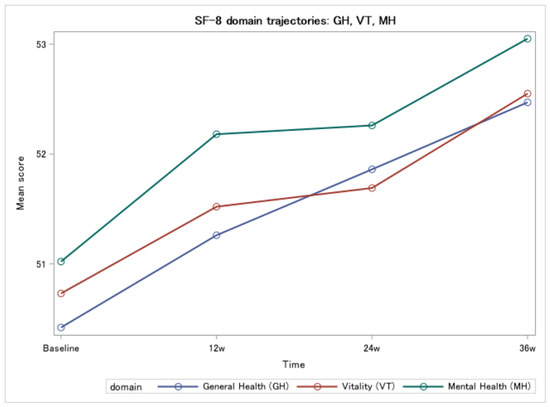
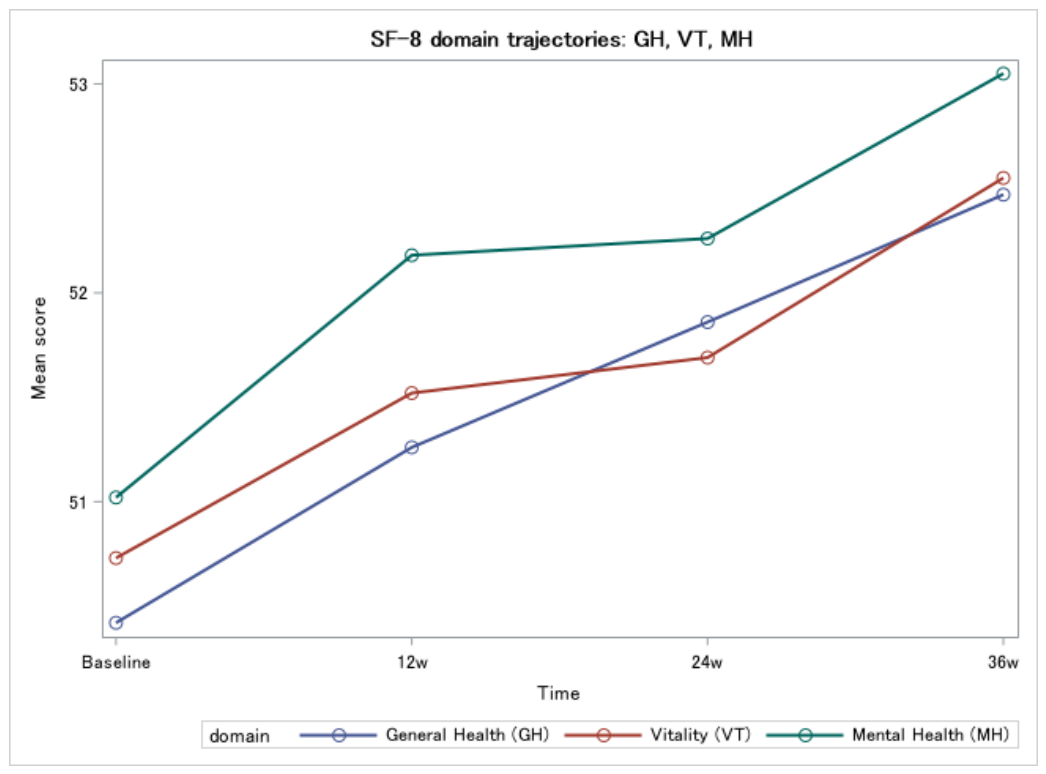
Longitudinal changes in utility scores and health-related quality-of-life domains are shown in Table 3 and Figure 1, Figure 2 and Figure 3. General Health increased significantly from 50.42 at baseline to 51.89 at week 24 and 52.47 at week 36.Vitality increased from 50.73 to 52.55 and Mental Health from 51.02 to 53.05 by week 36, but these changes were not statistically significant.
Table 3.
Longitudinal changes in HRQoL and utilities.
Figure 1.
SF-8 domain trajectories (general health, vitality, mental health).
Figure 2.
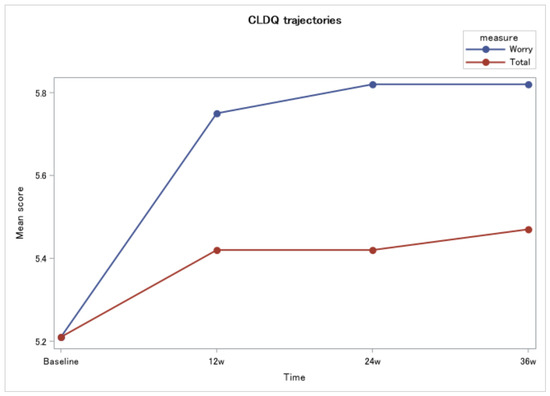
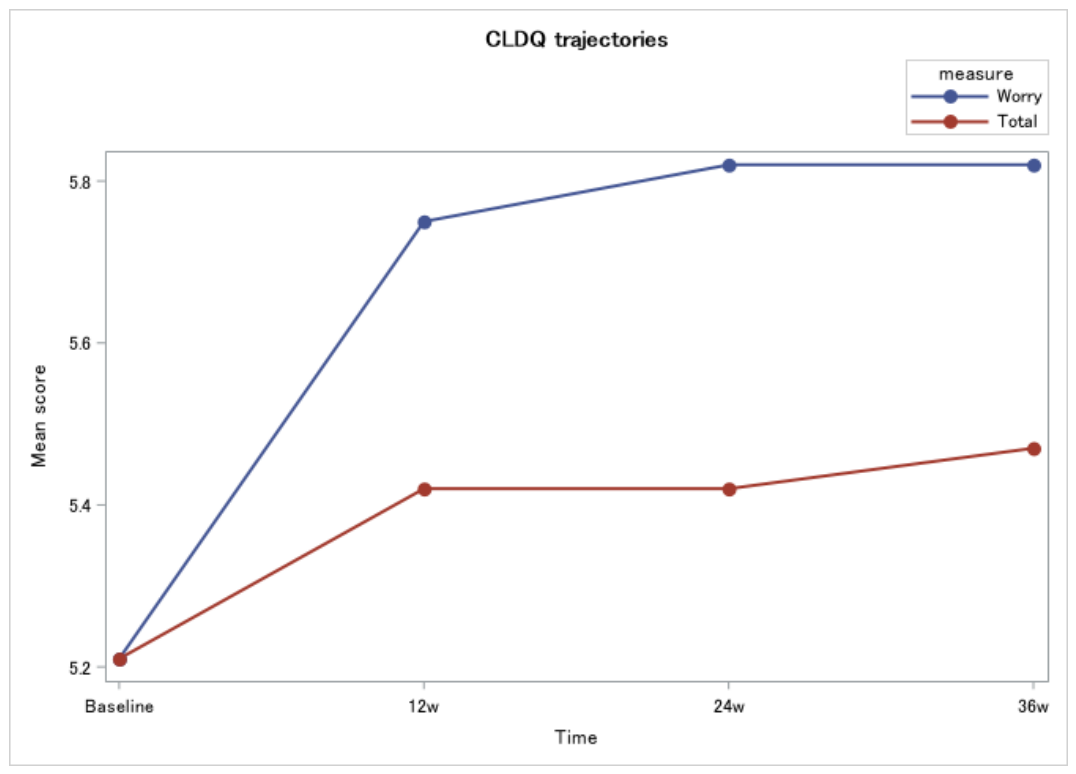
CLDQ trajectories (worry and total score).
Figure 3.
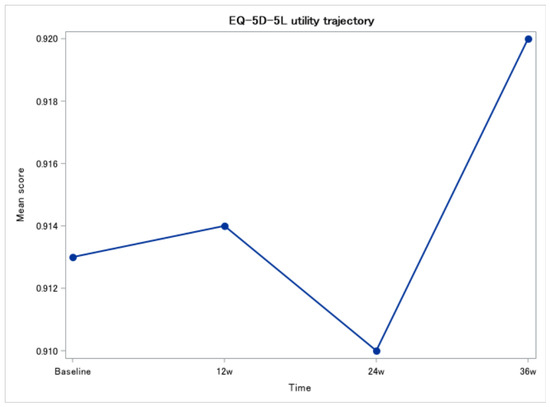
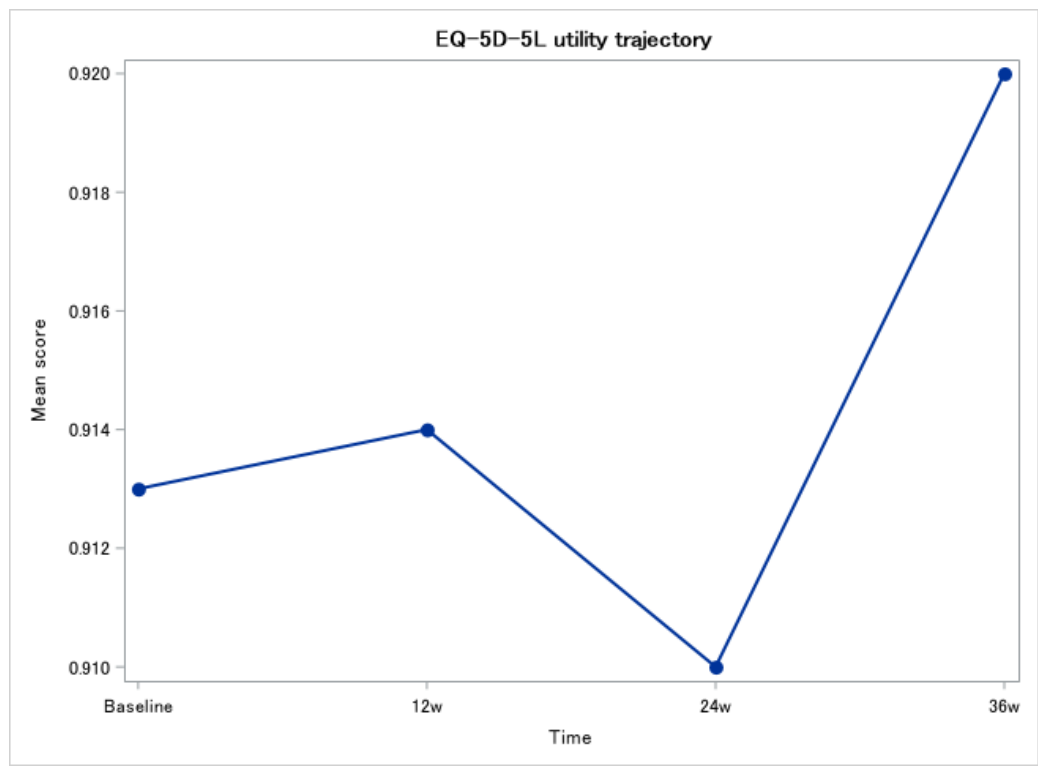
EQ-5D-5L utility trajectory.
CLDQ showed consistent improvement in several domains, most notably worry and the total score (Table 3 and Figure 2). Worry increased from 5.21 at baseline to 5.82 at week 36, and the total score increased from 5.21 to 5.47. These findings suggest early improvement in liver-specific and psychological aspects of health-related quality of life during and after interferon-free DAA therapy.
In contrast, EQ-5D-5L utility values remained high and stable during follow-up (0.913 at baseline and 0.920 at week 36; Table 3 and Figure 3). This pattern is compatible with ceiling effects in a cohort with relatively high baseline utility values and is consistent with previous Japanese EQ-5D-5L evidence and post-DAA follow-up studies [6,8,9].
Overall, the longitudinal trajectory showed early symptom-proximal gains captured by SF-8 and CLDQ, alongside limited short-term movement in EQ-5D-5L utility values. This pattern is consistent with differences in instrument responsiveness and supports the combined use of disease-specific PROs and utility measures in cost–utility analyses [5,6,7,10,11].
4. Discussion
In this multicenter, real-world Japanese cohort, we observed improvements in PROs during and after interferon-free DAA therapy. SF-8 General Health increased significantly, whereas Vitality, and Mental Health showed nonsignificant numerical increases. CLDQ showed consistent gains—most prominently in worry and he total score—whereas EQ-5D-5L utilities remained high and stable over the same interval. These patterns indicate that symptom-proximal and perception-related domains are especially responsive during the on-treatment phase, while generic utilities may show limited short-term change in patients with good baseline health status [5,6,8,9,11].
Our findings are concordant with meta-analytic and trial data showing PRO improvements during and after DAA therapy, with ribavirin-free regimens achieving greater physical-health gains [5,7]. In a meta-analysis of 1,619 patients, most SF-36 domains improved by 12–24 weeks post-treatment, with larger benefits in bodily pain for ribavirin-free regimens [5]. Japanese experiences—including longitudinal SF-8 trajectories through SVR24 to 1 year and long-term improvements in symptoms and muscle mass—provide additional support [4,6].
The limited short-term movement in EQ-5D-5L relative to SF-8/CLDQ aligns with differences in construct focus and responsiveness. Given Japanese value-set scaling and high normative utilities, modest health gains may not translate into detectable utility changes over months [8,9]. Consistent with this, a Japanese sofosbuvir-based cohort reported high baseline SF-8 with only minimal short-term changes, while overall status remained good after SVR [6]. Using disease-specific PROs alongside utilities is therefore crucial to capture patient-centered benefits [11].
Chronic hepatitis C virus infection may also impair HRQoL through extrahepatic manifestations and autoimmune phenomena. A systematic review and meta-analysis showed that extrahepatic manifestations are associated with impaired physical and mental HRQoL and substantial economic burden [17]. In addition, hepatitis C virus-infected patients with liver-kidney microsomal antibody type 1 positivity may be susceptible to autoimmune thyroid disorders, and geographic differences in this autoantibody profile may partly reflect host genetic background [18,19]. Although our study focused on interferon-free DAA therapy, unmeasured extrahepatic autoimmune comorbidities, thyroid disease, or autoantibody status may have contributed to heterogeneity in baseline HRQoL and subsequent PRO trajectories.
Although the present dataset focused on overall trajectories, real-world Japanese data using CLDQ showed better on-treatment HRQoL with LDV/SOF than with SMV/Peg-IFN/RBV—supporting regimen choices that minimize on-treatment burden [10]. Meta-analytic subgroup results likewise favor ribavirin-free regimens for physical-health domains [5].
Beyond the 24–36-week horizon of our panel, DAA-related PRO gains often persist and can coincide with improvements in disease-related symptoms and even skeletal muscle mass, suggesting a physiological substrate for sustained well-being after viral clearance [4]. Complementary cohorts in diverse settings also report significant HRQoL improvements months after treatment ends, supporting the generalizability of these benefits across populations [7]. The overall direction is consistent with meta-analytic findings of post-treatment gains [5].
For clinicians, early improvements—especially in worry—highlight the value of addressing uncertainty, stigma, sleep, and fatigue during therapy; targeted supportive care may amplify PRO gains [4,5,6,10,11]. For health technology assessment, integrating our longitudinal PROs with Japanese utility benchmarks facilitates credible QALY modeling as DAA costs fall and SVR remains high [3,7,8,9].
The improvement observed in the Chronic Liver Disease Questionnaire Worry domain may also partly reflect anxiety related to treatment initiation, renewed awareness of chronic hepatitis C infection, or a recent-diagnosis effect, rather than a treatment-specific effect alone. Because the timing of diagnosis and the psychological context at treatment initiation were not systematically assessed, this interpretation should be considered exploratory.
Another aspect is work productivity and social contributions. Improved HRQoL likely translates to better work performance and less absenteeism for employed patients, and greater engagement in daily activities for all. In economic terms, these reflect reductions in absenteeism/presenteeism and indirect costs from a societal perspective. Trial and modeling work using the Work Productivity and Activity Impairment (WPAI) instrument has shown that DAA therapy improves work productivity and that these gains can offset costs [20,21,22]. For working-age patients, the reduction in fatigue and improved well-being may increase hours worked and effectiveness, which can translate into lower indirect costs and improved cost-effectiveness when broader perspectives are considered [20,21,22]. These broader societal benefits, while beyond our study’s measurement, are part of the real-world impact of improved HRQoL and warrant scenario/sensitivity analyses that incorporate productivity (e.g., WPAI-based estimates) alongside utilities [20,21,22].
Preference-based utility is the currency that converts patient-centered benefits into QALYs. In Japan, our prior population-based benchmarks showed stepwise utilities of 0.821 (chronic hepatitis), 0.737 (compensated cirrhosis), and 0.671 (decompensated cirrhosis), which provide clinical anchors for plausible long-term gains post-SVR [3]. Anchoring utilities to the Japanese EQ-5D-5L value set and population norms [8,9], even modest post-SVR utility increments (e.g., +0.03 to +0.05) sustained over 10 years would yield ≈0.3–0.5 QALYs per patient, before accounting for avoided complications. Coupled with our observed improvements in symptom-proximal PROs (CLDQ and SF-8) [5,10], this supports a favorable cost–utility profile of interferon-free DAAs in Japan, particularly as access broadens and regimen selection minimizes on-treatment burden. Because short-term EQ-5D-5L may under-detect early benefits due to ceiling effects [6,8,9], modeling should (i) explore scenario and sensitivity analyses bounded by Japanese utility benchmarks [3,8,9]; (ii) consider mapping approaches that translate disease-specific changes (fatigue, pain, worry) into utilities; and (iii) use subgroup-specific trajectories (age, baseline utility) to avoid over- or under-estimation of incremental cost-effectiveness.
Evidence in people who inject drugs (PWID) and those on opioid agonist therapy (OAT) indicates that DAAs can deliver meaningful PRO gains when cure is achieved. In US OAT clinics, EQ-5D-3L increased from 0.66 to 0.77 with marked reductions in pain and anxiety by 12–24 weeks post-SVR [23]. In a randomized trial among OAT recipients, elbasvir/grazoprevir led to greater improvements in SF-36v2 general health, vitality, and mental health at 4 weeks post-treatment versus placebo [24]. Pooled analyses of sofosbuvir-based phase 3 data further show that IFN/RBV-free regimens produce on-treatment PRO improvements, often more pronounced in opioid substitution therapy recipients [25]. Some PWID cohorts show minimal short-term utility change despite improved employment, underscoring the need for multifaceted models of care beyond antiviral therapy [26].
Strengths include a multicenter design; repeated measures across complementary, validated instruments (EQ-5D-5L, SF-8, CLDQ); and pre-specified complete-case longitudinal panels. Limitations include potential selection bias inherent to complete-case analysis. The exploratory CLDQ-based comparison in the parent baseline survey dataset did not indicate major baseline differences between completers and non-completers; however, be-cause that survey denominator was not identical to the 344-patient descriptive clinical cohort, residual attrition bias in the present analysis cannot be excluded (Supplementary Table S1). Other limitations include limited regimen-stratified detail, which precluded full comparative effectiveness within this dataset, and a short-term utility horizon relative to the longer timeframe over which economic benefits accrue. Psychosocial factors, including depression, anxiety, stigma, sleep disturbance, fatigue, recent diagnosis, and treatment-initiation anxiety, were not formally measured and may have modulated the magnitude of HRQoL gains [5,6,8,9,10]. We also did not systematically assess extrahepatic autoimmune comorbidities, thyroid disease, or autoantibody status, including liver-kidney microsomal antibody type 1 positivity, which may have influenced baseline health-related quality of life and longitudinal patient-reported outcome trajectories [17,18,19].
Priorities include longer-term utilities post-SVR to better parameterize QALY gains, explicit assessment of psychosocial mediators (depression/anxiety, stigma, sleep/fatigue), and head-to-head comparisons of pangenotypic ribavirin-free regimens with PROs as co-primary outcomes [5,6]. Given the burden in PWID, pragmatic designs embedded in OAT/low-threshold settings would strengthen external validity [23,24,25].
5. Conclusions
Interferon-free DAA therapy for chronic hepatitis C was associated with early improvements in patient-centered outcomes captured by SF-8 and CLDQ, while EQ-5D-5L utilities showed minimal short-term change. This pattern is consistent with differences in instrument responsiveness and possible ceiling effects in patients with relatively high baseline health status. Integrating disease-specific PROs with utility measures and anchoring utility assumptions to Japanese benchmarks provides a practical pathway to robust cost–utility evaluation.
Supplementary Materials
The following supporting information can be downloaded at: https://www.mdpi.com/article/10.3390/livers6040078/s1, Table S1: Exploratory comparison of baseline characteristics and baseline HRQoL scores by CLDQ complete-case status in the archived baseline survey dataset; Supplementary File S1: Questionnaire overview, assessment schedule, baseline demographic and clinical items, treatment-related follow-up items, and overview of standardized patient-reported outcome instruments used in the survey.
Author Contributions
Conceptualization, H.S. and M.H.; methodology, A.I. and S.I.; formal analysis, M.H. and T.H.; investigation, H.Y. (Hiroshi Yatsuhashi), H.Y. (Hiroshi Yotsuyanagi) and N.M.; data curation, N.I. and T.O.; writing—original draft preparation, M.H. and T.H.; writing—review and editing, all authors; visualization, M.H. and T.H.; supervision, H.S., T.S., T.T., T.Y., M.A. and M.S.; project administration, H.S.; funding acquisition, H.S. All authors have read and agreed to the published version of the manuscript.
Funding
This research was funded by Health and Labour Sciences Research Grants for Research on Hepatitis, grant numbers 201619003A and 201619003B (Hirao group).
Institutional Review Board Statement
The study was conducted in accordance with the Declaration of Helsinki and approved by the Institutional Review Board of Daito Bunka University (protocol code K-14-010, 3 February 2015) and the Institutional Review Board of Kagawa University (protocol code Heisei 26-141, 3 February 2015) for studies involving humans. Participating clinical centers conducted the study under this approved ethics framework and institutional requirements.
Informed Consent Statement
Informed consent was obtained from all subjects involved in the study. Written informed consent has been obtained from the patients to publish this paper.
Data Availability Statement
Aggregated data supporting the findings are provided in the article and Supplementary Materials. Additional information is available from the corresponding author upon reasonable request and subject to institutional approvals.
Acknowledgments
We thank all participating patients and clinical staff at the collaborating centers for their valuable contributions. During the preparation of the Graphical Abstract, the authors used Adobe Firefly (Adobe Inc.) to generate initial illustrative elements. The authors subsequently reviewed and edited the output and take full responsibility for the scientific accuracy and final content of the image.
Conflicts of Interest
The authors declare no conflicts of interest.
Abbreviations
The following abbreviations are used in this manuscript:
| DAA | direct-acting antiviral |
| SVR | sustained virologic response |
| HRQoL | health-related quality of life |
| PRO | patient-reported outcome |
| EQ-5D-5L | EuroQol 5-dimension 5-level |
| SF-8 | 8-Item Short-Form Health Survey |
| CLDQ | Chronic Liver Disease Questionnaire |
| PCS | Physical Component Summary (SF-8) |
| MCS | Mental Component Summary (SF-8) |
| QALY | quality-adjusted life-year |
| ICER | incremental cost-effectiveness ratio |
| RBV | ribavirin |
| IFN | interferon |
| LDV/SOF | ledipasvir/sofosbuvir |
| SOF/RBV | sofosbuvir/ribavirin |
| SMV | simeprevir |
| Peg-IFN | pegylated interferon |
| WPAI | Work Productivity and Activity Impairment |
| STROBE | Strengthening the Reporting of Observational Studies in Epidemiology |
References
- Spiegel, B.M.; Younossi, Z.M.; Hays, R.D.; Revicki, D.; Robbins, S.; Kanwal, F. Impact of hepatitis C on health related quality of life: A systematic review and quantitative assessment. Hepatology 2005, 41, 790–800. [Google Scholar] [CrossRef] [Scilit] [PubMed]
- Dusheiko, G. The impact of antiviral therapy for hepatitis C on the quality of life: A perspective. Liver Int. 2017, 37, 7–12. [Google Scholar] [CrossRef] [Scilit] [PubMed]
- Sugimori, H.; Hirao, M.; Igarashi, A.; Yatsuhashi, H.; Ikeda, S.; Masaki, N.; Yotsuyanagi, H.; Yoda, T.; Odajima, T.; Takura, T.; et al. Health state utilities of patients with hepatitis B and C and hepatitis-related conditions in Japan. Sci. Rep. 2022, 12, 17139. [Google Scholar] [CrossRef] [Scilit] [PubMed]
- Ichikawa, T.; Miyaaki, H.; Miuma, S.; Motoyoshi, Y.; Yamashima, M.; Yamamichi, S.; Koike, M.; Nakano, Y.; Honda, T.; Yajima, H.; et al. Direct-acting Antivirals Improved the Quality of Life, Ameliorated Disease-related Symptoms, and Augmented Muscle Volume Three Years Later in Patients with Hepatitis C Virus. Intern. Med. 2020, 59, 2653–2660. [Google Scholar] [CrossRef] [Scilit] [PubMed]
- He, N.; Feng, G.; Hao, S.; Xu, M.; Liu, J.; Kong, F.; Ren, Z.; Dou, W.; Yao, C.; Liang, T.; et al. The impact of direct-acting antivirals on quality of life in patients with hepatitis C virus infection: A meta-analysis. Ann. Hepatol. 2022, 27, 100705. [Google Scholar] [CrossRef] [Scilit] [PubMed]
- Miyasaka, A.; Yoshida, Y.; Suzuki, A.; Takikawa, Y. Health-related quality of life in patients with chronic hepatitis C treated with sofosbuvir-based treatment at 1-year post-sustained virological response. Qual. Life Res. 2021, 30, 3501–3509. [Google Scholar] [CrossRef] [Scilit] [PubMed]
- Marcellin, F.; Mourad, A.; Lemoine, M.; Kouanfack, C.; Seydi, M.; Carrieri, P.; Attia, A.; Protopopescu, C.; Lacombe, K.; Boyer, S. Patient-reported outcomes with direct-acting antiviral treatment for hepatitis C in West and Central Africa (TAC ANRS 12311 trial). JHEP Rep. 2023, 5, 100665. [Google Scholar] [CrossRef] [Scilit] [PubMed]
- Shiroiwa, T.; Ikeda, S.; Noto, S.; Igarashi, A.; Fukuda, T.; Saito, S.; Shimozuma, K. Comparison of Value Set Based on DCE and/or TTO Data: Scoring for EQ-5D-5L Health States in Japan. Value Health 2016, 19, 648–654. [Google Scholar] [CrossRef] [Scilit] [PubMed]
- Shiroiwa, T.; Noto, S.; Fukuda, T. Japanese Population Norms of EQ-5D-5L and Health Utilities Index Mark 3: Disutility Catalog by Disease and Symptom in Community Settings. Value Health 2021, 24, 1193–1202. [Google Scholar] [CrossRef] [Scilit] [PubMed]
- Aimono, Y.; Kohyama, N.; Kamoshida, T.; Yamamoto, T.; Kogo, M. QOL Assessment in Chronic Hepatitis C Patients Receiving Ledipasvir/Sofosbuvir or Simeprevir/Peginterferon/Ribavirin in Clinical Practice. Yakugaku Zasshi 2019, 139, 1427–1434. [Google Scholar] [CrossRef] [Scilit] [PubMed]
- Younossi, Z.M.; Guyatt, G.; Kiwi, M.; Boparai, N.; King, D. Development of a disease specific questionnaire to measure health related quality of life in patients with chronic liver disease. Gut 1999, 45, 295–300. [Google Scholar] [CrossRef] [Scilit] [PubMed]
- Von Elm, E.; Altman, D.G.; Egger, M.; Pocock, S.J.; Gøtzsche, P.C.; Vandenbroucke, J.P. Strengthening the reporting of observational studies in epidemiology (STROBE) statement: Guidelines for reporting observational studies. BMJ 2007, 335, 806–808. [Google Scholar] [CrossRef] [Scilit] [PubMed]
- Tokuda, Y.; Okubo, T.; Ohde, S.; Jacobs, J.; Takahashi, O.; Omata, F.; Yanai, H.; Hinohara, S.; Fukui, T. Assessing Items on the SF-8 Japanese Version for Health-Related Quality of Life: A Psychometric Analysis Based on the Nominal Categories Model of Item Response Theory. Value Health 2009, 12, 568–573. [Google Scholar] [CrossRef] [Scilit] [PubMed]
- Mauchly, J.W. Significance Test for Sphericity of a Normal n-Variate Distribution. Ann. Math. Stat. 1940, 11, 204–209. [Google Scholar] [CrossRef] [Scilit]
- Greenhouse, S.W.; Geisser, S. On methods in the analysis of profile data. Psychometrika 1959, 24, 95–112. [Google Scholar] [CrossRef] [Scilit]
- Kramer, C.Y. Extension of Multiple Range Tests to Group Means with Unequal Numbers of Replications. Biometrics 1956, 12, 307–310. [Google Scholar] [CrossRef] [Scilit]
- Younossi, Z.; Park, H.; Henry, L.; Adeyemi, A.; Stepanova, M. Extrahepatic manifestations of hepatitis C: A meta-analysis of prevalence, quality of life, and economic burden. Gastroenterology 2016, 150, 1599–1608. [Google Scholar] [CrossRef] [Scilit] [PubMed]
- Muratori, L.; Bogdanos, D.P.; Muratori, P.; Lenzi, M.; Granito, A.; Ma, Y.; Mieli-Vergani, G.; Bianchi, F.B.; Vergani, D. Susceptibility to thyroid disorders in hepatitis C. Clin. Gastroenterol. Hepatol. 2005, 3, 595–603. [Google Scholar] [CrossRef] [Scilit] [PubMed]
- Muratori, P.; Czaja, A.J.; Muratori, L.; Granito, A.; Guidi, M.; Ferri, S.; Volta, U.; Mantovani, W.; Pappas, G.; Cassani, F.; et al. Evidence of a genetic basis for the different geographic occurrences of liver/kidney microsomal antibody type 1 in hepatitis C. Dig. Dis. Sci. 2007, 52, 179–184. [Google Scholar] [CrossRef] [Scilit] [PubMed]
- Younossi, Z.M.; Stepanova, M.; Afdhal, N.; Kowdley, K.V.; Zeuzem, S.; Henry, L.; Hunt, S.L.; Marcellin, P. Improvement of health-related quality of life and work productivity in chronic hepatitis C patients with early and advanced fibrosis treated with ledipasvir and sofosbuvir. J. Hepatol. 2015, 63, 337–345. [Google Scholar] [CrossRef] [Scilit] [PubMed]
- Younossi, Z.; Brown, A.; Buti, M.; Fagiuoli, S.; Mauss, S.; Rosenberg, W.; Serfaty, L.; Srivastava, A.; Smith, N.; Stepanova, M.; et al. Impact of eradicating hepatitis C virus on the work productivity of chronic hepatitis C (CH-C) patients: An economic model from five European countries. J. Viral Hepat. 2016, 23, 217–226. [Google Scholar] [CrossRef] [Scilit] [PubMed]
- Sulkowski, M.; Ionescu-Ittu, R.; Macaulay, D.; Sanchez-Gonzalez, Y. The Economic Value of Improved Productivity from Treatment of Chronic Hepatitis C Virus Infection: A Retrospective Analysis of Earnings, Work Loss, and Health Insurance Data. Adv. Ther. 2020, 37, 4709–4719. [Google Scholar] [CrossRef] [Scilit] [PubMed]
- Gormley, M.A.; Akiyama, M.J.; Rennert, L.; Howard, K.A.; Norton, B.L.; Pericot-Valverde, I.; Muench, S.; Heo, M.; Litwin, A.H. Changes in Health-related Quality of Life for Hepatitis C Virus-Infected People Who Inject Drugs While on Opioid Agonist Treatment Following Sustained Virologic Response. Clin. Infect. Dis. 2022, 74, 1586–1593. [Google Scholar] [CrossRef] [Scilit] [PubMed]
- Dalgard, O.; Litwin, A.H.; Shibolet, O.; Grebely, J.; Nahass, R.; Altice, F.L.; Conway, B.; Gane, E.J.; Luetkemeyer, A.F.; Peng, C.Y.; et al. Health-related quality of life in people receiving opioid agonist treatment and treatment for hepatitis C virus infection. J. Addict. Dis. 2023, 41, 213–224. [Google Scholar] [CrossRef] [Scilit] [PubMed]
- Stepanova, M.; Thompson, A.; Doyle, J.; Younossi, I.; de Avila, L.; Younossi, Z.M. Hepatitis C Virus–Infected Patients Receiving Opioid Substitution Therapy Experience Improvement in Patient-Reported Outcomes Following Treatment with Interferon-Free Regimens. J. Infect. Dis. 2017, 217, 1033–1043. [Google Scholar] [CrossRef] [Scilit] [PubMed]
- Cheng, Q.; Cunningham, E.B.; Shih, S.; Amin, J.; Bruneau, J.; Artenie, A.A.; Powis, J.; Litwin, A.H.; Cooper, C.; Dalgard, O.; et al. Patient-Reported Outcomes During and After Hepatitis C Virus Direct-Acting Antiviral Treatment Among People Who Inject Drugs. Value Health 2023, 26, 883–892. [Google Scholar] [CrossRef] [Scilit] [PubMed]

Disclaimer/Publisher’s Note: The statements, opinions and data contained in all publications are solely those of the individual author(s) and contributor(s) and not of MDPI and/or the editor(s). MDPI and/or the editor(s) disclaim responsibility for any injury to people or property resulting from any ideas, methods, instructions or products referred to in the content. |
© 2026 by the authors. Licensee MDPI, Basel, Switzerland. This article is an open access article distributed under the terms and conditions of the Creative Commons Attribution (CC BY) license.