
Skip to Content
You are currently on the new version of our website. Access the old version .

Sustainable Chemistry, Volume 2, Issue 1

2021 March - 12 articles

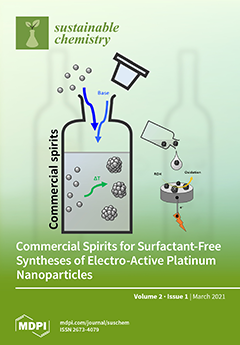
Cover Story: The Co4CatTM process is a simple, surfactant-free method to produce precious metal nanoparticles. Most syntheses of nanoparticles require organic solvents and/or additives as stabilizers. These complicate the synthesis and are typically derived from fossil fuels and/or toxic. Several time/energy-consuming and waste-generating steps are needed to clean nanoparticles before use. These extra steps limit the applicability of the nanoparticles. In contrast, the Co4CatTM synthesis performed in low-boiling-point solvents leads to readily active nanocatalysts in a simple and sustainable way which is relevant for industrial production. The robustness of the process is demonstrated using three commercial spirits as solvents and reducing agents. A careful control of solvent purity is not needed to synthesize 2 nm platinum nanoparticles for readily active electrocatalysts for energy conversion. View this paper
  • Issues are regarded as officially published after their release is announced to the table of contents alert mailing list .
  • You may sign up for email alerts to receive table of contents of newly released issues.
  • PDF is the official format for papers published in both, html and pdf forms. To view the papers in pdf format, click on the "PDF Full-text" link, and use the free Adobe Reader to open them.

Articles (12)

  • Article
  • Open Access
34 Citations
6,956 Views
16 Pages

Synthesis of Biodiesel from Tall Oil Fatty Acids by Homogeneous and Heterogeneous Catalysis

  • Gideon Lawer-Yolar,
  • Benjamin Dawson-Andoh and
  • Emmanuel Atta-Obeng

10 March 2021

This study compared the yield of biodiesel produced from tall oil fatty acids (TOFA) via (i) homogeneous catalyst (sulfuric acid) and (ii) a heterogeneous catalyst (Amberlyst® BD20, together with Ambersep BD 19 (Midcontinental Chemical Co., Olathe, K...

  • Review
  • Open Access
404 Citations
60,585 Views
39 Pages

A Review on Battery Market Trends, Second-Life Reuse, and Recycling

  • Yanyan Zhao,
  • Oliver Pohl,
  • Anand I. Bhatt,
  • Gavin E. Collis,
  • Peter J. Mahon,
  • Thomas Rüther and
  • Anthony F. Hollenkamp

9 March 2021

The rapid growth, demand, and production of batteries to meet various emerging applications, such as electric vehicles and energy storage systems, will result in waste and disposal problems in the next few years as these batteries reach end-of-life....

  • Article
  • Open Access
9 Citations
3,875 Views
18 Pages

4 March 2021

Proteins are bioactive compounds with high potential to be applied in the biopharmaceutical industry, food science and as biocatalysts. However, protein stability is very difficult to maintain outside of the native environment, which hinders their ap...

  • Article
  • Open Access
10 Citations
3,818 Views
12 Pages

Ecotoxicity and Hemolytic Activity of Fluorinated Ionic Liquids

  • Nicole S. M. Vieira,
  • Ana L. S. Oliveira,
  • João M. M. Araújo,
  • Maria Manuela Gaspar and
  • Ana B. Pereiro

2 March 2021

The task-specific design of ionic liquids (ILs) has emerged in several industrial and pharmaceutical applications. The family of ILs with fluorine tags equal to or longer than four carbon atoms, the fluorinated ionic liquids (FILs), combine the best...

  • Article
  • Open Access
2 Citations
4,245 Views
22 Pages

2 March 2021

Supercritical CO2 (ScCO2) emulsion has attracted lots of attention, which could benefit both climate control via CO2 storage and industry revenue through significantly increased oil recovery simultaneously. Historically, aqueous soluble surfactants h...

  • Review
  • Open Access
99 Citations
17,212 Views
23 Pages

A Review of Enzyme Induced Carbonate Precipitation (EICP): The Role of Enzyme Kinetics

  • Isaac Ahenkorah,
  • Md Mizanur Rahman,
  • Md Rajibul Karim,
  • Simon Beecham and
  • Christopher Saint

22 February 2021

Enzyme-induced carbonate precipitation (EICP) is a relatively new bio-cementation technique for ground improvement. In EICP, calcium carbonate (CaCO3) precipitation occurs via urea hydrolysis catalysed by the urease enzyme sourced from plants. EICP o...

  • Article
  • Open Access
6 Citations
4,217 Views
11 Pages

On the Dissolution of Metals in Ionic Liquids 1. Iron, Cobalt, Nickel, Copper, and Zinc

  • Jéssica D. S. Vicente,
  • Domingas C. Miguel,
  • Afonso M. P. Gonçalves,
  • Diogo M. Cabrita,
  • José M. Carretas,
  • Bruno J. C. Vieira,
  • João C. Waerenborgh,
  • Dulce Belo,
  • António P. Gonçalves and
  • João Paulo Leal

7 February 2021

Ionic liquids are critical reagents for science and technical processes nowadays. Metals are the most used reagents in the industry. It is crucial to have a deeper understanding of how ionic liquids and metals could interact. In this article the inte...

  • Review
  • Open Access
30 Citations
11,529 Views
18 Pages

Enzymatic Methods for the Manipulation and Valorization of Soapstock from Vegetable Oil Refining Processes

  • Beatrice Casali,
  • Elisabetta Brenna,
  • Fabio Parmeggiani,
  • Davide Tessaro and
  • Francesca Tentori

7 February 2021

The review will discuss the methods that have been optimized so far for the enzymatic hydrolysis of soapstock into enriched mixtures of free fatty acids, in order to offer a sustainable alternative to the procedure which is currently employed at the...

  • Article
  • Open Access
6 Citations
3,815 Views
14 Pages

Synthesis and Characterization of Transparent Biodegradable Chitosan: Exopolysaccharide Composite Films Plasticized by Bio-Derived 1,3-Propanediol

  • Narisetty Vivek,
  • Nishant Gopalan,
  • Satyajit Das,
  • Keerthi Sasikumar,
  • Raveendran Sindhu,
  • Kesavan Madhavan Nampoothiri,
  • Ashok Pandey and
  • Parameswaran Binod

2 February 2021

In this study, chitosan-based composite films blended with a dextran like exopolysaccharide derived from lactic acid bacteria were prepared using the solvent casting method. Later, these composite films were plasticized with 1,3-propanediol (1,3-PDO)...

  • Article
  • Open Access
12 Citations
5,090 Views
25 Pages

Dual UV-Thermal Curing of Biobased Resorcinol Epoxy Resin-Diatomite Composites with Improved Acoustic Performance and Attractive Flame Retardancy Behavior

  • Quoc-Bao Nguyen,
  • Henri Vahabi,
  • Agustín Rios de Anda,
  • Davy-Louis Versace,
  • Valérie Langlois,
  • Camille Perrot,
  • Vu-Hieu Nguyen,
  • Salah Naili and
  • Estelle Renard

14 January 2021

This study has developed novel fully bio-based resorcinol epoxy resin–diatomite composites by a green two-stage process based on the living character of the cationic polymerization. This process comprises the photoinitiation and subsequently the ther...

  • Article
  • Open Access
5 Citations
3,862 Views
16 Pages

12 January 2021

Pine as a softwood and poplar as a hardwood pretreated with hydrochloric acid (HCl), phosphoric acid (H3PO4), and hypophosphorous acid (H3PO2) are studied for the pyrolytic properties and products in thermogravimetry (TG) and fixed bed reactor. The p...

  • Communication
  • Open Access
10 Citations
3,537 Views
7 Pages

Commercial Spirits for Surfactant-Free Syntheses of Electro-Active Platinum Nanoparticles

  • Jonathan Quinson,
  • Søren Bredmose Simonsen,
  • Luise Theil Kuhn and
  • Matthias Arenz

The Co4CatTM process is a simple, surfactant-free method to produce colloidal dispersions of precious metal nanoparticles in alkaline mono-alcohols. The synthesis is performed in low-boiling-point solvents and is relevant for industrial production. T...

Get Alerted

Add your email address to receive forthcoming issues of this journal.

XFacebookLinkedIn
Sustain. Chem. - ISSN 2673-4079