


Abstract
The integration of low-Earth-orbit (LEO) satellites with unmanned aerial vehicles (UAVs) promises high-throughput and flexible wireless connectivity, yet it faces critical challenges in simultaneously guaranteeing data rates and long-term energy harvesting under mobility and imperfect channel state information (CSI). Additionally, the rate–energy trade-off imposed by simultaneous wireless information and power transfer (SWIPT) further complicates per-slot resource allocation. In this paper, we propose a Lyapunov-based scheduling framework that stabilizes UAV data and virtual energy queues while maximizing weighted throughput. The framework employs a custom inner solver combining successive convex approximation (SCA) and weighted minimum mean-square error (WMMSE) optimization to efficiently compute per-slot beamformers and power-splitting ratios. Our approach explicitly accounts for UAV mobility, Rician fading channels with Doppler, and circuit nonlinearities in energy harvesting, ensuring feasible and energy-aware SWIPT operation. A LEO satellite–UAV integrated communication system is considered, where multiple satellites provide wireless connectivity to energy-constrained UAVs operating in a dynamic three-dimensional environment. The satellites employ multi-antenna transmission, while the UAVs rely on energy harvesting mechanisms to sustain their operation. The communication links are characterized by dominant line-of-sight propagation conditions, and UAV trajectories are adaptively optimized to improve network performance and energy efficiency. Simulation results demonstrate that the proposed Lyapunov-based SCA-WMMSE framework significantly outperforms a fixed baseline approach, providing substantial improvements in signal quality, achievable data rates, and harvested energy. Moreover, the proposed method maintains stable energy management behavior and guarantees long-term energy sustainability for the UAVs.
1. Introduction
The integration of Low Earth Orbit (LEO) satellites with Unmanned Aerial Vehicles (UAVs) offers a powerful solution for achieving high-throughput, flexible, and wide-area wireless connectivity, combining the extensive coverage of satellites with the mobility of UAVs. Nonetheless, reliable communication in such systems remains challenging due to high mobility, time-varying channel conditions, and imperfect channel state information (CSI), which hinder accurate estimation and necessitate robust transmission strategies. Furthermore, energy efficiency and sustainability are vital concerns, as UAVs operate with limited battery capacity and their energy harvesting capabilities are constrained by unpredictable mobility and environmental factors that affect both harvested energy and achievable data rates [1,2]. To ensure reliable and sustainable operation, joint optimization of communication and energy management is essential, enabling adaptive responses to dynamic channel variations in next-generation aerial-satellite systems. In addressing the limitations of terrestrial networks, such as limited coverage and high deployment costs, the integration of satellite and UAV systems has become indispensable for future wireless architectures [3,4]. However, challenges such as spectrum scarcity—exacerbated by static allocation policies and the growing number of connected devices—demand more intelligent spectrum-sharing mechanisms [5,6], while maintaining energy-efficient operation through advanced energy harvesting (EH) techniques remains a critical design objective [7].
EH refers to the process of capturing and transforming otherwise wasted or low-value energy—such as heat, sound, and Radio Frequency (RF) signals—into usable electrical power that meets operational requirements. The surrounding environment often contains abundant and high-quality energy sources that can potentially outperform traditional energy storage solutions like batteries and charged supercapacitors. In recent years, numerous studies have investigated the integration of natural energy sources into the EH process within communication networks [8,9]. However, the efficiency of EH from natural sources has been limited by the irregularity and unpredictability of ambient conditions. Moreover, most existing EH techniques are highly scenario-dependent, restricting their applicability to specific environmental contexts [10].
Wireless Power Transfer (WPT) is an EH technology that enables network nodes to charge their batteries using electromagnetic radiation, either from ambient signals or dedicated sources like base stations [11]. Recent research has focused on short-range (near-field) rather than long-range (far-field) WPT, though near-field approaches face limitations such as limited range, high cost, and tuning difficulties [12]. The distance between base stations and devices is critical for both power and information transfer, motivating the development of far-field solutions and Simultaneous Wireless Information and Power Transfer (SWIPT) [11,13,14]. SWIPT allows for efficient, simultaneous transmission of power and information, addressing challenges similar to those in Power-Line Communication (PLC) while providing gains in energy efficiency, spectral efficiency, interference management, and transmission delay [10,11,15,16]. Properly designed SWIPT systems are therefore poised to support energy-efficient wireless communications and next-generation 5G and beyond networks. The reader can see a comprehensive survey on the subject in [17].
In this paper, we study the joint optimization of beamforming, power-splitting, and UAV mobility in integrated LEO satellite–UAV–terrestrial networks with SWIPT. We consider a system with multiple LEO satellites, each equipped with multi-antenna arrays performing coordinated beamforming, and multiple single-antenna UAVs acting as mobile receivers with energy harvesting capabilities. The channels are modeled as Rician fading with Doppler shifts to capture the high mobility of UAVs and the line-of-sight-dominant satellite links, while also accounting for imperfect channel state information. Each UAV employs a power-splitting receiver to simultaneously decode information and harvest energy, with both linear and nonlinear energy harvesting models considered. We explicitly account for practical constraints such as maximum transmit power, minimum data rate, energy causality, and battery limitations, as well as UAV mobility kinematics, which influence the link quality dynamically over time.
To efficiently manage the long-term trade-offs between throughput, latency, and energy availability, we introduce a Lyapunov-based scheduling [18] framework that stabilizes both data queues and virtual energy queues while maximizing a weighted sum of instantaneous rates and harvested energy. The resulting per-slot optimization problem is inherently non-convex due to logarithmic SINR rate expressions and quadratic energy harvesting terms. To solve this efficiently in an online manner, we propose an iterative decomposition combining successive convex approximation (SCA) and weighted minimum mean square error (WMMSE) transformations. The inner solver alternates between convex approximations of the energy harvesting and rate terms and closed-form WMMSE updates, producing a feasible solution for each slot that respects all power, energy, and quality-of-service constraints. By integrating the SCA-WMMSE inner solver with the Lyapunov controller, the proposed framework guarantees queue stability while enabling real-time joint optimization of UAV trajectories, satellite beamforming vectors, and power-splitting ratios. Simulation results demonstrate that the proposed approach significantly improves both throughput and energy efficiency compared to benchmark schemes, even under realistic UAV mobility, SWIPT, and imperfect CSI conditions.
The main contributions of this work are summarized as follows:
- We develop a comprehensive LEO satellite–UAV system model incorporating Rician fading channels with Doppler effects, UAV mobility, SWIPT-enabled receivers, imperfect CSI, and practical constraints including transmit power limits and energy causality.
- We propose a Lyapunov-based scheduling framework that jointly stabilizes data queues and virtual energy queues while optimizing the long-term trade-off between throughput and energy harvesting in a dynamic satellite-assisted UAV network.
- We formulate a per-slot non-convex optimization problem that jointly optimizes satellite beamforming, UAV power-splitting ratios, and mobility-aware resource allocation, capturing the coupling between SINR-dependent rates and nonlinear energy harvesting dynamics.
- We design an efficient inner-layer solver that integrates successive convex approximation (SCA) and weighted minimum mean-square error (WMMSE) transformations to handle the non-convexity with low computational complexity and feasibility at each iteration.
- We embed the SCA–WMMSE solver into the Lyapunov framework, enabling real-time online scheduling that respects UAV kinematics, power budgets, and long-term energy harvesting constraints.
- Extensive simulations demonstrate that the proposed approach significantly improves throughput, harvested energy, and queue stability compared to baseline schemes under realistic mobility and channel conditions.
2. Related Work
Recent studies have explored various architectures integrating satellites, UAVs, and emerging technologies to enhance energy efficiency, data collection, and communication reliability. In [19], an energy-efficient satellite–aerial–terrestrial network (SATN) is proposed, where a multi-antenna UAV serves as a relay under total and per-antenna power constraints. The authors employ Dinkelbach’s method and angular information-based beamforming schemes to maximize energy efficiency with low complexity, supported by analytical and simulation results. In [20], a LEO satellite-assisted UAV framework for Internet of Remote Things (IoRT) is introduced, aiming to minimize the UAVs’ total energy cost under data delay constraints using Dantzig–Wolfe decomposition and heuristic algorithms. Similarly, ref. [21] investigates resource allocation in a two-hop UAV–LEO data collection network, jointly optimizing UAV trajectories, bandwidth allocation, and satellite selection through successive convex approximation and block coordinate descent methods. Furthermore, ref. [22] considers a cognitive satellite–aerial network employing NOMA, formulating a trajectory and power optimization problem to minimize transmission delay, solved via a multi-agent deep deterministic policy gradient (MADDPG) algorithm for decentralized execution. Lastly, ref. [23] analyzes the performance of RIS-assisted satellite–UAV–terrestrial networks under hardware impairments and interference, deriving closed-form outage probability expressions and validating the advantages of RIS-assisted UAV relays in improving reliability in interference-limited environments. In terms of SWIPT, several works have been published in the literature, and they are given below.
In [24], a UAV-assisted SWIPT framework for emergency IoT communications is developed across dense, wide-area, and disaster scenarios, combining UAV-based wireless power transfer, multi-UAV trajectory and resource optimization, and predictive demand-aware path planning for improved energy efficiency and connectivity. In [25], energy efficiency in UAV-assisted IIoT networks with SWIPT-enabled D2D communications is maximized via joint optimization of UAV placement, beamforming, power allocation, and scheduling, using Dinkelbach transformation, MOEA/D, and successive convex optimization to handle the resulting nonconvex problem. In [26], UAV-mounted IRS with SWIPT is studied for joint user scheduling and trajectory optimization, where IRS reflection control and UAV mobility are jointly optimized via alternating optimization to minimize user energy consumption while satisfying rate and harvesting constraints. In [27], a UAV–IRS SWIPT system is proposed that jointly optimizes UAV trajectory, NOMA decoding order, power allocation, PS ratio, and IRS phases using alternating optimization with SCA, DC programming, and penalty methods to maximize sum-rate under nonlinear EH constraints. In [28], a UAV-mounted IRS SWIPT IoT system is developed with TDMA-based scheduling and trajectory design, formulated as a max–min rate problem and solved via SCA and block coordinate descent to ensure fairness and energy harvesting requirements. In [29], a multi-UAV, MBS, and IRS-assisted SWIPT-NOMA system is optimized for energy efficiency through staged decomposition, including subchannel assignment, Lagrangian-based beamforming, and SDR-based joint optimization of power splitting and IRS phases.
These works demonstrate that UAV- and IRS-assisted SWIPT systems significantly enhance coverage, energy efficiency, and joint information–energy transfer, but typically rely on static or decoupled optimization frameworks. In contrast, our proposed framework explicitly models time-varying LEO–UAV channels with Rician fading and Doppler effects, incorporates linear and nonlinear energy harvesting, and jointly tracks data and energy queues. A Lyapunov-based scheduler combined with an SCA–WMMSE inner solver enables real-time per-slot optimization of beamforming and power splitting, dynamically adapting to mobility, CSI variations, and energy deficits, thereby providing a more unified and online-capable solution than existing approaches.
Motivation for 6G Networks
The proposed framework aligns with the core objectives of sixth-generation (6G) wireless systems, emphasizing intelligent, sustainable, and integrated network architectures. In particular, the considered system integrates LEO satellites and UAVs, forming a Non-Terrestrial Network (NTN) topology that embodies the space–air–ground–sea continuum envisioned for 6G connectivity. The incorporation of SWIPT supports energy-efficient and self-sustainable communication for autonomous aerial nodes, addressing one of the principal 6G goals of green and perpetual networking. Furthermore, the Lyapunov-based scheduling approach enables real-time queue-aware control and stability under stochastic channel dynamics, representing an AI-driven optimization paradigm coherent with the 6G vision of native intelligence. Finally, the integration of SCA and WMMSE methods reflects the model-based learning direction of 6G physical layer design, ensuring efficient resource allocation, adaptive beamforming, and robustness to time-varying channel conditions. Collectively, the proposed methodology can be regarded as a step toward the realization of intelligent, energy-harvesting, and self-optimizing 6G Non-Terrestrial Networks.
3. System Model
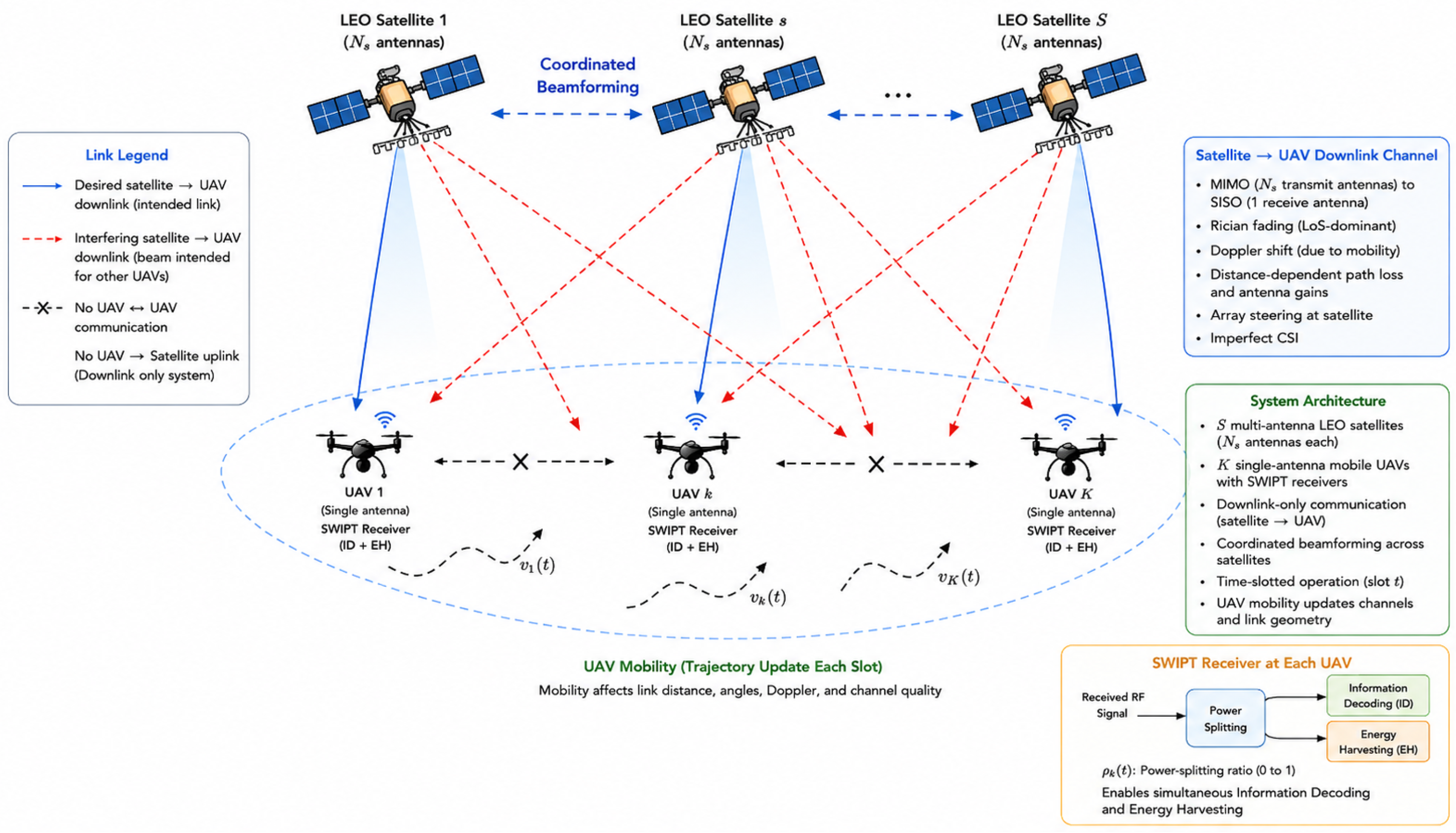
We consider a system comprising S LEO satellites and K mobile UAVs, each equipped with a single antenna. Satellites are equipped with antennas and perform coordinated beamforming. Time is slotted with index t. We assume a coordinated multi-point joint transmission architecture, where all satellites simultaneously transmit the same information symbol intended for UAV k. Each satellite applies an individual beamforming vector , enabling coherent signal combination at the UAV receivers.
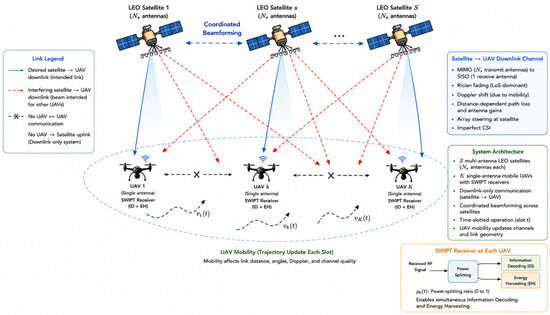
The considered network is a satellite-to-UAV downlink system. Each LEO satellite acts as a multi-antenna transmitter, while UAVs are single-antenna users. Thus, the only physical communication links are (satellite-to-UAV) links. There are no direct UAV-to-UAV or UAV-to-satellite communication links. However, since satellites simultaneously transmit to multiple UAVs using linear precoding, the received signals at each UAV are coupled through the shared wireless channel, giving rise to multi-user interference (MUI), also commonly referred to as inter-user interference (IUI). Figure 1 dictates the system model.
Figure 1.
Multi-satellite multi-UAV downlink system model. Each satellite serves multiple UAVs via coordinated beamforming, resulting in multi-user interference among UAV transmissions.
3.1. Channel Model with UAV Mobility
Let be the position of satellite at time t, and the position of UAV . Define the instantaneous link distance, line-of-sight (LoS) unit vector, and propagation delay as
where c is the speed of light.
Let and denote, respectively, the elevation and azimuth angles of the link as seen from satellite s. For a (uniform) -antenna array on satellite s, denote the array response (steering) vector by
The large-scale attenuation includes free-space path-loss, antenna gains, and (optionally) atmospheric absorption
where and are the satellite and UAV antenna gains, is the carrier wavelength, and is the specific atmospheric attenuation factor (frequency-dependent).
Due to (i) typically strong LoS in LEO→UAV links and (ii) high relative velocities, we model the small-scale fading as Rician with Doppler:
where is the (possibly elevation-dependent) Rician K-factor, is the Doppler shift
with the relative velocity between satellite s and UAV k, and is the satellite transmit correlation matrix (e.g., Kronecker or exponential correlation), and models the diffuse/scattered component.
Let and denote, respectively, the channel coherence time and coherence bandwidth. We adopt block fading over each slot of length , i.e., is constant within a slot and changes independently (or according to a Jakes-type temporal correlation model ) between slots.
The transmitter (satellite) and receiver (UAV) may only have imperfect estimates of the channel. Let
where . A norm-bounded uncertainty model can also be used:
Robust beamforming then enforces worst-case SINR constraints over .
Under the current transmission model, the received useful signal at UAV k is the coherent superposition of the signals transmitted by all satellites carrying the same symbol . Stack the beamformers for user k and denote by the unit-power information symbol. The received baseband signal at UAV k is
with . The instantaneous SINR at UAV k is
Each UAV receives its intended signal, as well as interference generated by beams allocated to other UAVs. This interference is referred to as MUI, or equivalently IUI, since it originates from transmissions intended for different users. The interference exists even when UAVs are associated with different satellites because coordinated multi-satellite transmission creates a coupled multi-user downlink. In Equation (11), the numerator represents the coherent desired signal power received at a UAV from all serving satellites, whereas the denominator represents the aggregate multi-user interference generated by beams intended for other UAVs together with the receiver noise.
UAV k follows (at least) first-order kinematics
subject to and . These trajectories change , , , , and hence the whole channel process in (6)–(11).
We adopt a slot-level model: for slot t, , , and are chosen/realized and kept constant. The optimization/scheduling (e.g., Lyapunov, DRL) is executed per slot using the available (possibly imperfect) CSI estimates .
Each time slot t represents a discrete scheduling interval of duration (e.g., 1 ms–10 ms depending on mobility and channel coherence conditions). Within each slot, the channel is assumed constant (block fading assumption), while UAV positions, beamforming vectors, and power-splitting ratios are updated at the slot boundaries. The slot duration is chosen such that , where is the channel coherence time, ensuring that CSI remains approximately invariant within each scheduling interval.
Note that multi-user interference has a dual role in the system: it degrades information decoding performance by reducing the SINR, while contributing positively to harvested energy in the SWIPT receiver because the energy harvesting circuit collects the total received RF power.
3.2. SWIPT Model
Each UAV k employs a power splitting (PS) receiver that divides the received RF signal into two branches: one for information decoding (ID) and one for EH. Let denote the PS ratio (fraction of received RF power routed to the EH rectifier). Hence, the remaining fraction is used for ID.
Let
be the complex baseband equivalent of the received signal before splitting, where are unit-power symbols and .
After PS, the ID branch observes
where is the additional RF/baseband processing noise introduced after splitting (e.g., from the low-noise amplifier (LNA) and ADC). The resulting instantaneous SINR is
The achievable rate (in bits/s) is
where is defined in (16). The RF power entering the EH rectifier is
A common linear EH model yields the harvested DC power
leading to per-slot harvested energy
The multi-user interference component is evaluated through the channel of the receiving UAV. Consequently, both the desired signal and the interfering beams are received through the same satellite-to-UAV propagation links, while the beamforming vectors correspond to transmissions intended for other UAVs. This is consistent with the adopted multi-user downlink model, where interference is generated by beams allocated to different users. This notation ensures that the harvested energy represents the total RF power incident at UAV k, which is consistent with the adopted SWIPT receiver architecture and the simulation implementation. However, real rectifiers exhibit saturation and nonlinear behavior. A widely used logistic (sigmoid) nonlinear model is
where is the saturation power, and are circuit-specific parameters. Our framework can accommodate either (20) or (21).
Often each UAV needs at least Joules per slot for sensing/propulsion/computation. This induces constraints such as
or in average/long-term form via a virtual queue (see Section 3.3). In turn, must be sufficiently large to meet these constraints, creating a rate–energy trade-off.
An alternative to PS is time-switching, where a fraction of the slot is devoted to EH and the rest to ID, yielding
but PS is adopted herein as it permits simultaneous ID and EH.
3.3. Queue, Battery, and Virtual Queue Dynamics
We consider data queues to guarantee QoS and energy (virtual) queues to enforce long-term EH constraints.
Let denote the data backlog (in bits) at UAV k at the beginning of slot t. Let be the data arrivals (bits) during slot t with . The service (departure) is bits if the rate is in bits/s. For simplicity, we keep in bits/slot below
Here, is expressed in bits per second, and therefore represents the number of bits transmitted during slot t.
Let (Joules) be the battery energy of UAV k at slot t. Let be the propulsion/flight power, the circuitry/computation power, and the harvested energy. Then,
with energy causality .
To avoid dealing with non-convex battery dynamics inside Lyapunov optimization, we introduce a virtual queue .
Stabilizing implies the constraint holds in the time average. Stability of the virtual queue implies that the long-term time-average energy harvesting constraint is satisfied.
At each slot we must satisfy
The formulation permits separate power beams and information beams; then, would be the sum of those contributions. The rate–energy coupling through is the main source of non-convexity and motivates the SCA/WMMSE tools described later. The queues and (or ) are the state variables used by the Lyapunov controller and/or DRL agent to learn stabilizing, high-throughput policies.
4. System Lyapunov-Based Scheduling
4.1. State, Queues, and Objective
We define the system state at slot t as
where is the data backlog of UAV k, is a virtual energy queue enforcing long-term energy harvesting (EH) constraints, is the (possibly imperfect) channel state information (CSI), and denotes UAV mobility.
The custom Lyapunov function is
where prioritizes energy deficit control relative to data queue stability.
The drift-plus-penalty is
with controlling the trade-off between queue stability and rate maximization.
4.2. Drift Upper Bound and Per-Slot Control Problem
Using the queue dynamics
we obtain the bound
where B is a constant collecting bounded second-order terms.
Dropping constants and expectations, we define the custom per-slot optimization problem:
Large values push higher data rates. Large values drive higher EH power in terms of energy deficit compensation. Penalties on power () and inter-satellite misalignment () ensure efficient cooperative beamforming. In terms of throughput–delay–energy trade-off, Lyapunov control ensures an optimality gap with average queue backlog.
The Lyapunov scheduler computes the weights and each slot and delegates the non-convex problem to an inner SCA/WMMSE solver (Section 5). Even approximate solutions maintain the stability guarantees.
5. SCA and WMMSE Optimization
The per-slot problem in (38) is non-convex due to two main sources: the log-SINR rate term in the objective and the quadratic structure of the energy harvesting (EH) expressions, which depend on both beamformers and power-splitting ratios . Directly solving this problem is intractable; therefore, we adopt an iterative decomposition that leverages both WMMSE transformations and SCA.
Specifically, the inner solver operates twofold, the WMMSE block and the SCA block. For the former, the queue-weighted rate term is reformulated using the WMMSE method [30]. This transformation converts the non-convex log-SINR maximization into a convex quadratic form in terms of auxiliary variables (receiver equalizers) and (MSE weights), yielding the equivalence
For the rate maximization term, we apply the standard WMMSE transformation, introducing auxiliary variables (receive filters) and (MSE weights), which yields closed-form updates for . For the energy harvesting term, , the non-convex coupling between beamformers and power-splitting ratios is handled via successive convex approximation (SCA), where the function is linearized around the current iterate . The algorithm alternates between WMMSE-based updates for beamforming optimization and SCA-based updates for power-splitting and EH feasibility, yielding a convex subproblem at each inner iteration.
The inner algorithm alternates between the WMMSE and SCA blocks until convergence, producing a feasible solution for the current Lyapunov slot. By iteratively updating the beamformers and power-splitting ratios in this manner, the solver ensures that each per-slot control action respects power budgets, EH constraints, and queue-aware rate objectives, while also being computationally tractable for online implementation. This decomposition allows the Lyapunov scheduler to leverage approximate solutions without violating stability guarantees. The approach generalizes naturally to systems with imperfect CSI, multi-antenna UAVs, or nonlinear EH models, as long as the approximations remain differentiable and convex in each SCA step. Convergence is typically observed within a few iterations per slot due to the closed-form WMMSE updates and first-order SCA linearizations.
The feasibility and stability guarantees of the proposed framework are subject to the standard assumptions of Lyapunov optimization and successive convex approximation. Specifically, it is assumed that: (i) the channel state information available at each scheduling slot is sufficiently accurate to compute a feasible beamforming solution; (ii) the per-slot optimization problem satisfies the transmit power, power-splitting, QoS, and energy harvesting constraints; (iii) the data arrival and harvested energy processes are bounded, ensuring bounded queue increments; and (iv) the inner WMMSE–SCA algorithm converges to a stationary point of the convexified subproblem at each scheduling slot. Under these assumptions, the Lyapunov drift-plus-penalty framework guarantees bounded virtual queues, thereby satisfying the long-term energy harvesting constraints while maintaining queue stability. Since the Lyapunov controller only requires an approximate solution of each per-slot optimization problem, exact global optimality of the inner WMMSE–SCA solver is not required. Consequently, approximate stationary solutions preserve the stability properties of the outer Lyapunov scheduler, although they may slightly reduce the achievable throughput compared with the global optimum.
5.1. Algorithm Description
The proposed Algorithm 1 integrates the Lyapunov scheduling framework with successive convex approximation (SCA) and weighted minimum mean square error (WMMSE) optimization to jointly optimize the satellite beamforming vectors and the UAV power-splitting ratios while accounting for the time-varying UAV mobility through the channel model. The UAV trajectories are not optimization variables; instead, the UAV positions evolve according to the prescribed kinematic model and influence the channel state at every scheduling slot.
At the beginning of each time slot t, the system observes the network state
where denotes the data queue of UAV k, is the virtual energy queue enforcing the long-term energy harvesting requirement, represents the imperfect CSI between satellite s and UAV k, and is the UAV position. Using the observed state, the Lyapunov controller constructs the per-slot optimization problem .
The resulting optimization problem is non-convex due to the coupled beamforming and power-splitting variables appearing in the SINR and energy harvesting expressions. To efficiently solve this problem online, the proposed algorithm employs an alternating SCA–WMMSE framework. The queue-weighted rate objective is first transformed into its equivalent WMMSE formulation through the introduction of the auxiliary receive filters and MSE weights , which admit closed-form updates. The remaining non-convex energy harvesting expressions are then convexified using first-order SCA around the current beamforming and power-splitting iterates. Solving the resulting convex surrogate yields updated beamforming vectors and power-splitting ratios. The WMMSE and SCA blocks are repeated until convergence, producing a feasible solution for the current scheduling slot while satisfying the transmit power, QoS, and energy harvesting constraints.
After obtaining the optimized beamforming vectors and power-splitting ratios, the data queues and virtual energy queues are updated according to
Finally, the UAV positions and velocities are propagated to the next scheduling slot using the discrete-time kinematic model,
which determines the channel realization for the subsequent slot. The optimization is then repeated using the updated network state.
| Algorithm 1 Lyapunov-Based Joint Beamforming and Power-Splitting Scheduling using SCA–WMMSE |
|
5.2. Impact of Slot Duration and Computational Complexity
The proposed Lyapunov–SCA–WMMSE framework performs one optimization during every scheduling slot. Consequently, the slot duration directly influences both the adaptation capability of the controller and the overall computational burden. For relatively large slot durations, optimization is performed less frequently, thereby reducing computational cost. However, since UAV positions and satellite–UAV channels evolve continuously due to mobility and Doppler effects, the beamforming vectors and power-splitting ratios may become less representative of the instantaneous channel conditions. This may result in degraded SINR, achievable rate, and harvested energy, particularly under high-mobility scenarios.
Conversely, smaller slot durations allow the scheduler to react more rapidly to channel variations, enabling more accurate beam steering, improved interference suppression, and better adaptation of the power-splitting ratios. The trade-off is that the optimization problem must be solved more frequently, thereby increasing the computational burden. Assuming successive convex approximation iterations and WMMSE iterations per slot, the dominant computational complexity is primarily associated with solving the convex beamforming optimization problem and can be approximated as
where S denotes the number of satellites, K the number of UAVs, and the number of satellite antennas.
Since the optimization is executed once every scheduling slot, the computational complexity per unit time scales approximately as
Therefore, decreasing the slot duration improves tracking of rapidly varying satellite–UAV channels but proportionally increases computational requirements. In practice, the slot duration should satisfy , where is the channel coherence time, providing an appropriate trade-off between optimization accuracy and computational complexity.
6. Results
The simulation considers a system of LEO satellites and UAVs operating over discrete time slots, each of duration s. Each satellite is equipped with antennas and operates under a maximum transmit power W, while the noise power at the UAV receivers is set to W. The UAVs are initially placed randomly in a three-dimensional space above the satellite coverage area, with initial velocities set to zero. The energy harvesting efficiency of each UAV is , and the minimum energy requirement per slot is J. Channels are modeled as Rician LoS-dominant with small random variations over time, and the satellite–UAV beamforming vectors are initialized using normalized maximum ratio transmission. Each LEO satellite is equipped with an antenna array and performs coordinated digital beamforming using linear precoding. Since one beamforming vector is designed for each satellite–UAV pair, every satellite simultaneously forms independent transmit beams, one for each UAV. During every scheduling slot, the beamforming vectors are optimized by the proposed WMMSE-SCA algorithm using the estimated channel state information (CSI). Consequently, the beam directions are continuously steered toward the instantaneous UAV locations while suppressing multi-user interference through coordinated precoding across the satellites. The effective beamwidth is not fixed in the proposed framework; instead, it is implicitly determined by the antenna array response and the optimized beamforming vectors, allowing the transmit beams to adapt to changes in UAV positions and channel conditions. A competitor baseline is also simulated, using fixed power-splitting ratios and simple fixed beamforming.
During the simulation, UAVs move towards their nearest satellite according to a scaled directional velocity, and the channels are updated based on their instantaneous positions. The system adopts an adaptive power-splitting strategy with varying sinusoidally for each UAV, while the beamforming vectors are optimized using a WMMSE-based inner solver with five iterations per time slot. Key performance metrics including SINR, achievable rate, harvested energy, and the virtual energy queue are tracked over time, while competitor metrics are computed for comparison. The simulation setup enables evaluation of the proposed Lyapunov-aware joint beamforming and power-splitting strategy in a dynamic UAV mobility scenario under realistic channel variations.
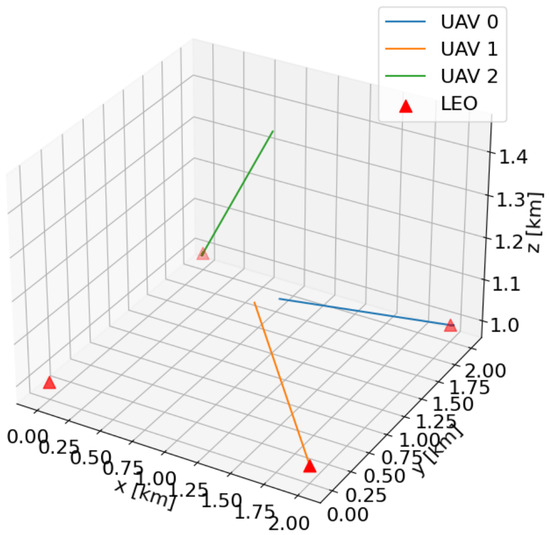
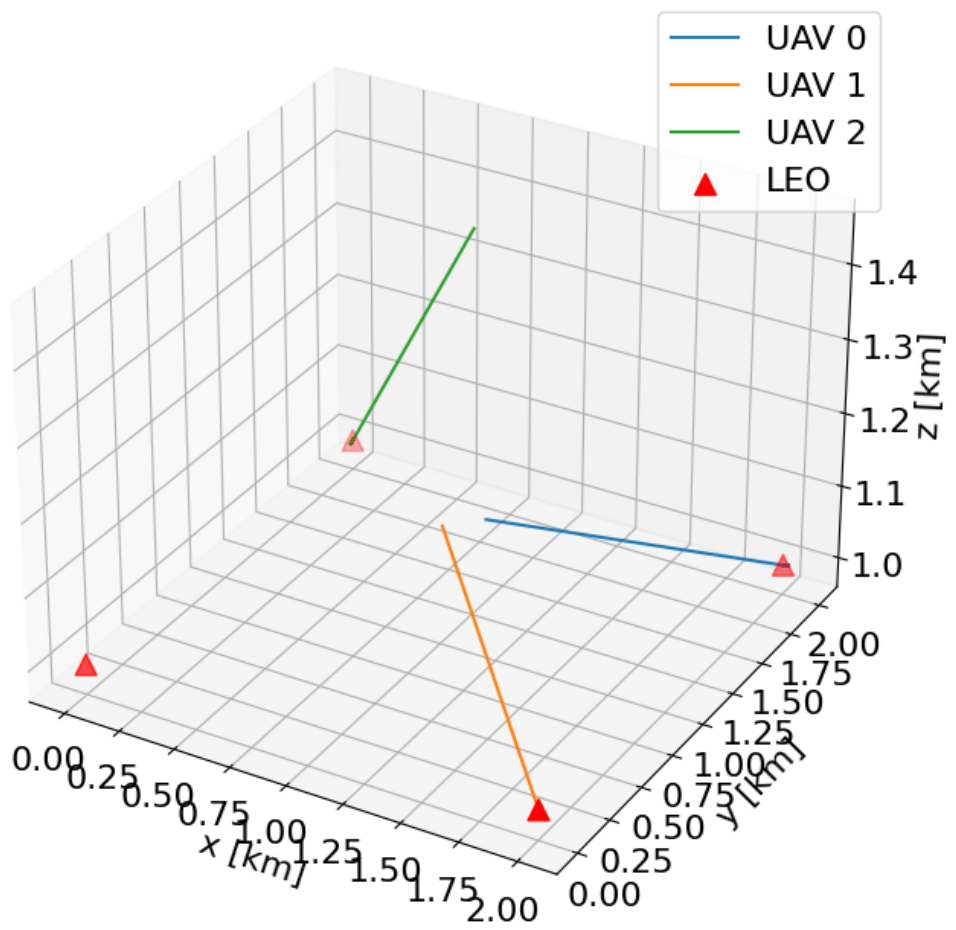
In Figure 2, the three-dimensional plot depicts the movement of the three UAVs in relation to the four LEO satellites (represented by red triangles). Each UAV follows a distinct trajectory toward its nearest LEO node, consistent with the nearest-association mobility rule. The UAVs gradually converge toward stable positions, indicating efficient trajectory adaptation and convergence without oscillatory behavior. This pattern confirms that the proposed velocity update mechanism maintains spatial stability while ensuring continuous connectivity with the closest LEO satellite.
Figure 2.
UAV trajectories.
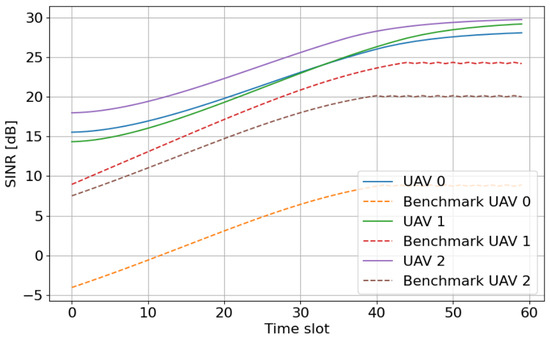
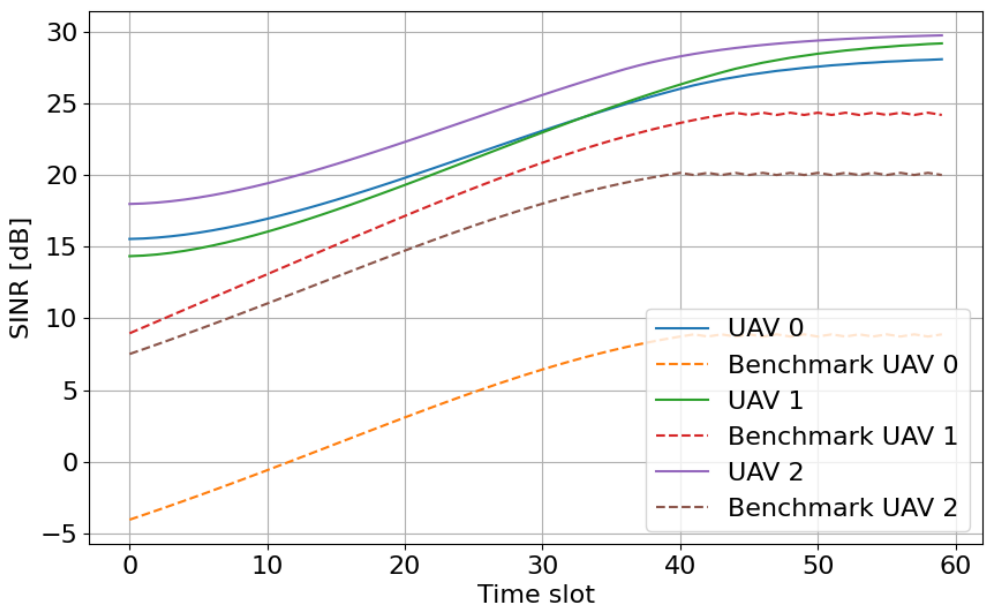
In Figure 3, the SINR evolution across time slots shows that the proposed SCA-WMMSE optimization consistently outperforms the baseline with fixed power-splitting ratios. The SINR values for all UAVs increase steadily from approximately 10–15 dB to nearly 30 dB, demonstrating the effectiveness of dynamic beamforming and interference management. The competitor’s performance remains notably lower, saturating earlier due to its static parameterization. The smooth yet slightly oscillatory growth indicates algorithmic convergence, with minor fluctuations stemming from alternating WMMSE-SCA updates.
Figure 3.
SINR per UAV.
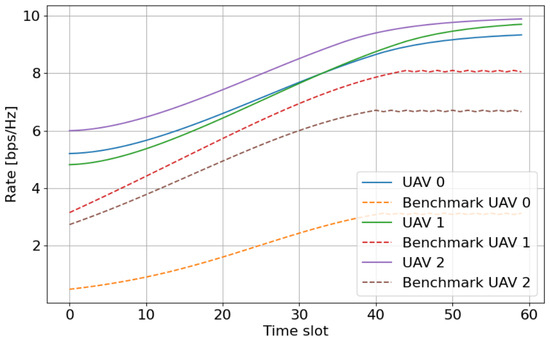
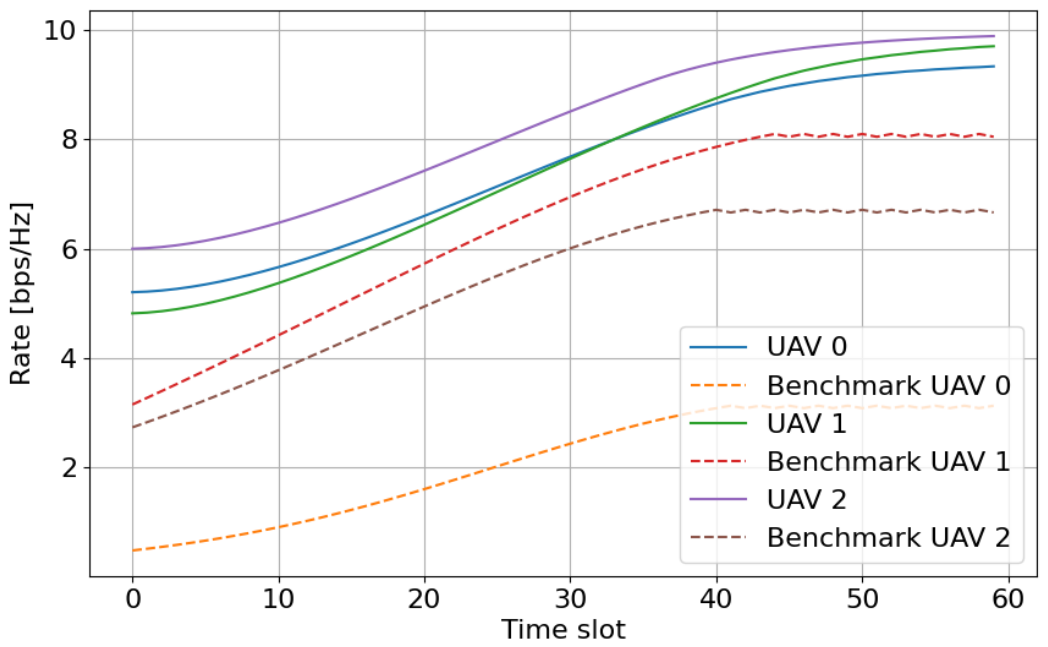
In Figure 4, the achievable rate curves mirror the SINR behavior, as . The proposed approach attains approximately 9–10 bps/Hz, compared to 6–7 bps/Hz for the competitor, achieving a 30–40% throughput improvement. The consistent spacing between UAV curves demonstrates fairness in power allocation and rate balancing. These results verify that the joint SCA-WMMSE framework effectively enhances spectral efficiency while adapting to mobility-induced variations.
Figure 4.
Achievable rate.
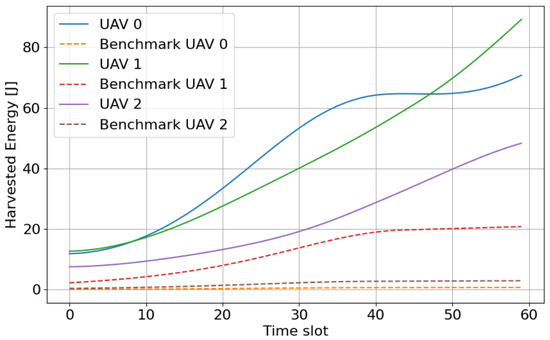
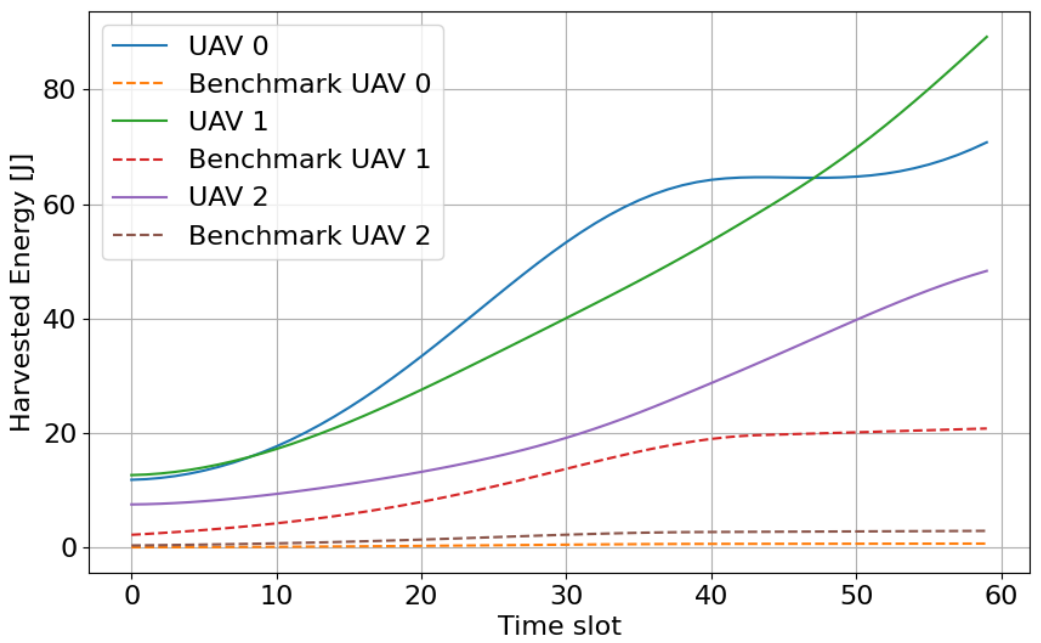
In Figure 5, the harvested energy performance shows a pronounced advantage of the proposed method, with values rising from around 10 J to over 80 J for certain UAVs. In contrast, the competitor remains below 25 J, emphasizing the benefit of dynamic power-splitting optimization. The smooth convex-shaped growth pattern reflects stable convergence of the linearized energy harvesting terms in the SCA procedure. This result quantifies the trade-off improvement between communication rate and harvested power.
Figure 5.
Harvested energy.
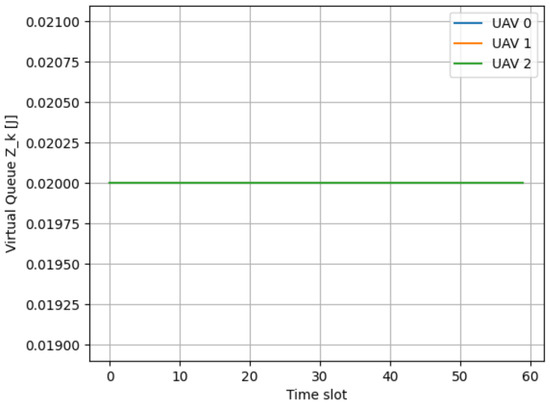
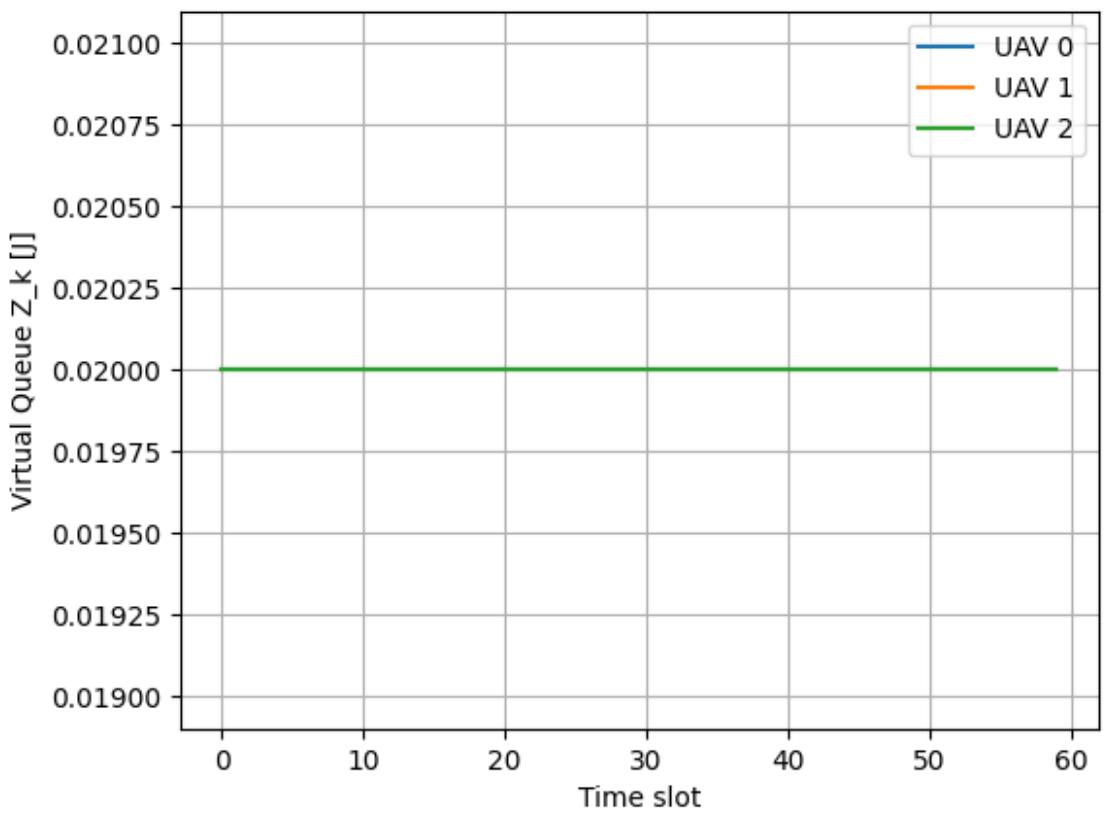
In Figure 6, the virtual queue remains nearly constant around 0.02 J for all UAVs, indicating that the energy harvesting constraints are consistently satisfied throughout the simulation. This stability confirms that the Lyapunov-based scheduling mechanism effectively maintains a balanced operating regime between energy consumption and harvesting, leading to convergence toward a feasible steady-state. The absence of significant oscillations or growth in further validates the long-term feasibility of the joint optimization framework. Importantly, this behavior does not suggest a weak constraint, but rather reflects that the system operates in a stable equilibrium where the energy harvesting requirement is continuously met with minimal drift.
Figure 6.
Virtual queue for EH.
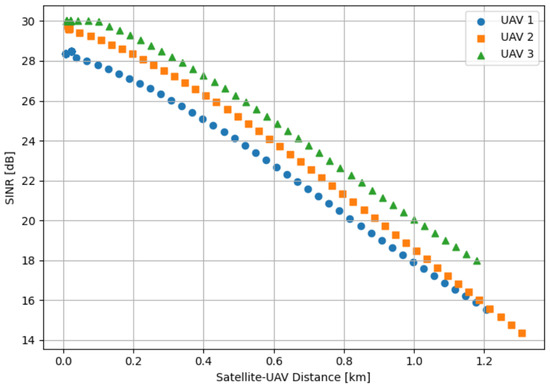
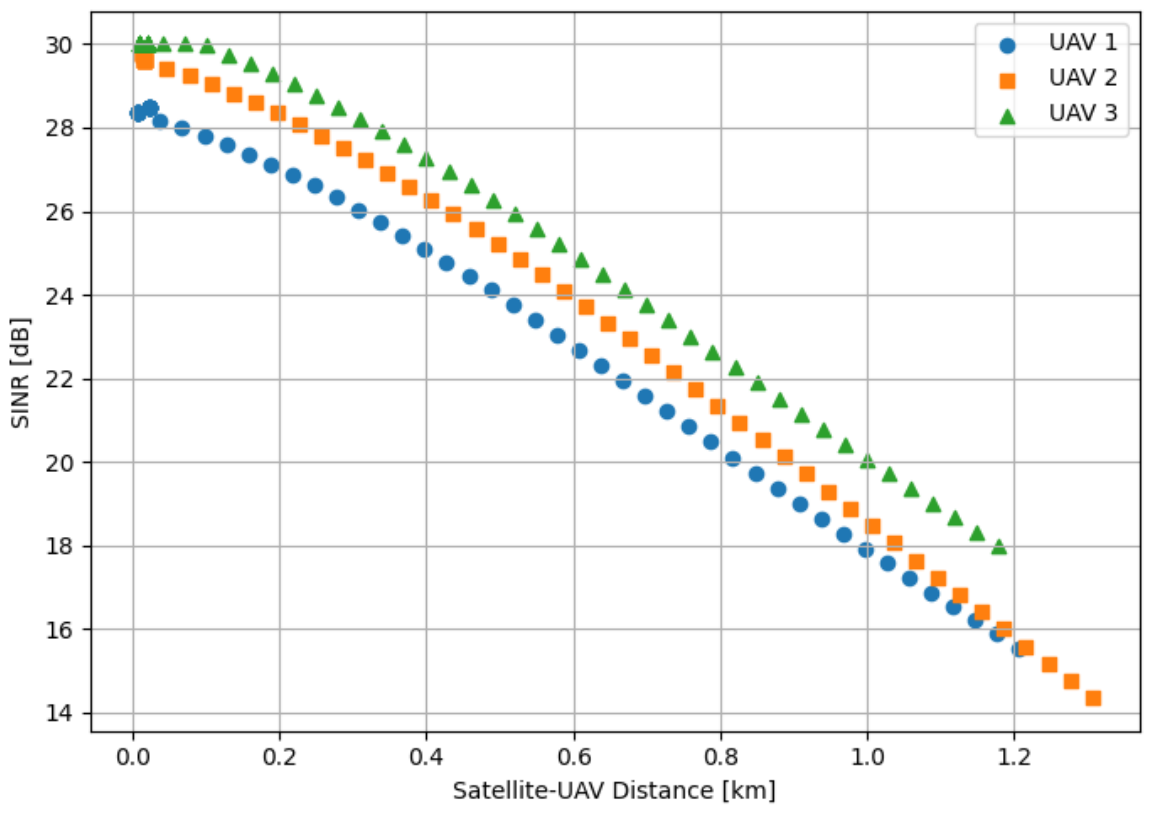
Figure 7 characterizes the quality of the satellite-to-UAV communication link by illustrating the relationship between the instantaneous SINR and the separation distance between each UAV and its serving LEO satellite. Unlike the time-domain SINR evolution presented previously, this figure directly reflects the propagation behavior of the proposed channel model, where the channel gain varies with the satellite–UAV distance, the dominant line-of-sight (LoS) component, and the adaptive beamforming performed by the multi-antenna satellites. The results show a clear decrease in SINR as the propagation distance increases, which is consistent with the large-scale attenuation incorporated in the channel model. At short distances, the received signal experiences lower propagation loss and the beamforming vectors provide high array gain toward the intended UAV. As the UAV moves farther from the serving satellite, the received signal power gradually decreases while the interference and receiver noise become relatively more significant, resulting in a monotonic reduction in SINR.
Figure 7.
Satellite for satellite–UAV distance.
For UAV 1, the SINR decreases from approximately dB when the UAV is closest to its serving satellite to approximately dB at a distance of about km, corresponding to an overall reduction of nearly 13 dB. UAV 2 exhibits a similar behavior, with the SINR decreasing from approximately dB to approximately dB over a maximum communication distance of about km, representing a degradation of approximately dB. UAV 3 consistently achieves the highest SINR throughout the trajectory, decreasing from approximately dB to approximately dB over a distance of approximately km, corresponding to a reduction of about 12 dB. The performance differences among the three UAVs arise from their different spatial locations relative to the satellites and the resulting channel realizations. Since the proposed system employs coordinated multi-satellite beamforming, the transmit beams are continuously updated according to the estimated CSI and the instantaneous UAV positions. Consequently, although the received SINR decreases with increasing propagation distance, the degradation remains gradual rather than abrupt, indicating that the beamforming algorithm successfully maintains directional gain toward the intended UAV while suppressing multi-user interference.
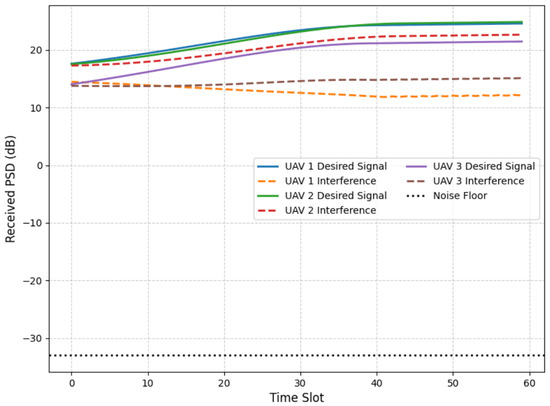
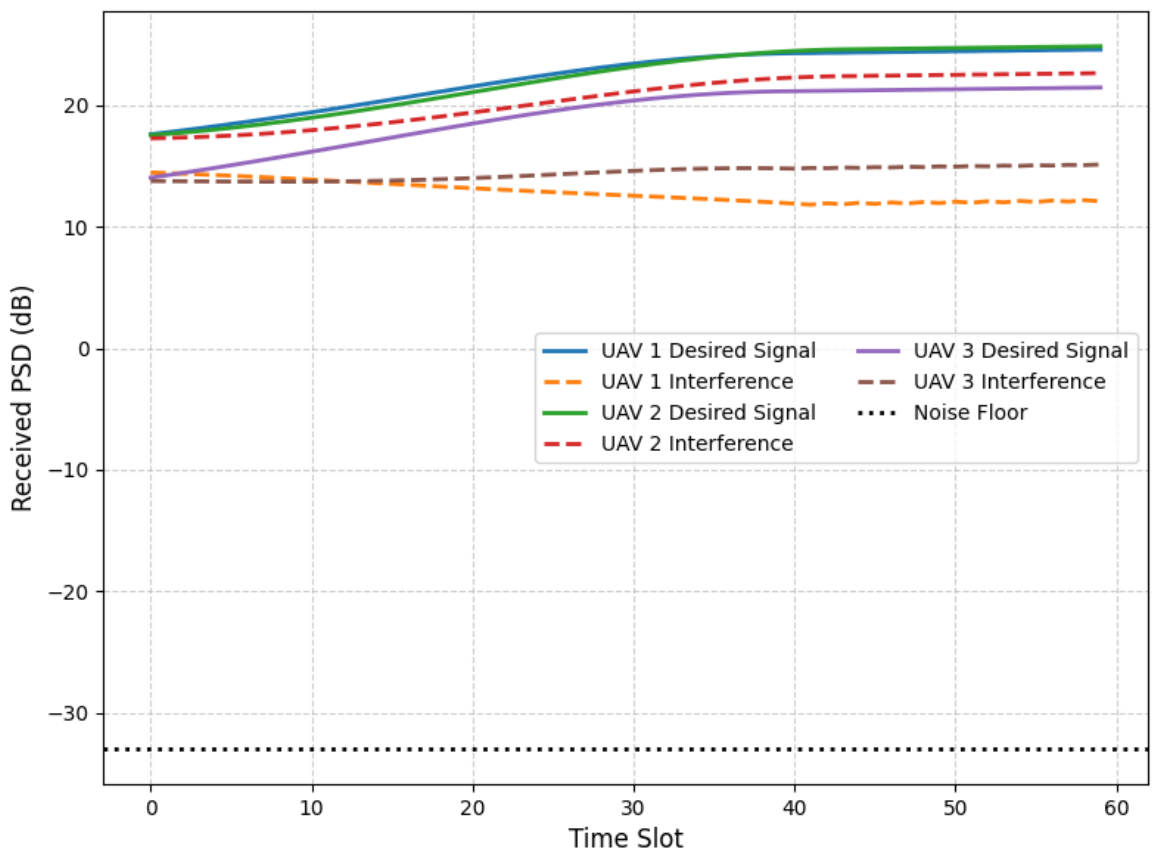
In Figure 8, the received power spectral density (PSD) of the desired signal and the aggregate interference are evaluated over the simulation period for each UAV. The results demonstrate that the proposed joint beamforming and adaptive power-splitting strategy continuously enhances the desired received signal while maintaining interference at a lower level. For UAV 1, the desired signal PSD increases from approximately 17.6 dB at the beginning of the simulation to about 24.8 dB at the final time slot, whereas the corresponding interference remains between 13.9 dB and 12.1 dB. This provides a separation of approximately 12.7 dB between the desired signal and interference at convergence. A similar trend is observed for UAV 2, where the desired signal PSD improves from approximately 17.5 dB to 24.7 dB, while the interference varies between 17.5 dB and 22.4 dB. Although UAV 2 experiences higher interference than UAV 1 due to its relative spatial position and simultaneous transmissions from neighboring beams, the desired signal remains consistently stronger throughout the simulation, indicating that the optimized beamforming successfully suppresses multi-user interference suppression while preserving link quality.
Figure 8.
PSD of desired signal and interference for satellite–UAV links.
For UAV 3, the desired signal PSD increases from approximately 14.1 dB to 21.3 dB, whereas the interference remains relatively stable between 14.0 dB and 14.8 dB. The resulting separation between the desired signal and interference increases from less than 1 dB at the initial time slot to approximately 6.5 dB after convergence. This behavior reflects the progressive refinement of the beamforming vectors as the UAV approaches its serving LEO satellite and the WMMSE optimization adapts to the updated channel state information. The noise floor remains constant at approximately dB throughout the simulation, which is significantly lower than both the desired signal and the interference PSD. Consequently, the system operates primarily in an interference-limited regime rather than a noise-limited regime. As the adaptive beamforming converges, the desired signal experiences a noticeable increase while the interference remains bounded, demonstrating that the proposed optimization effectively improves spatial separation between users.
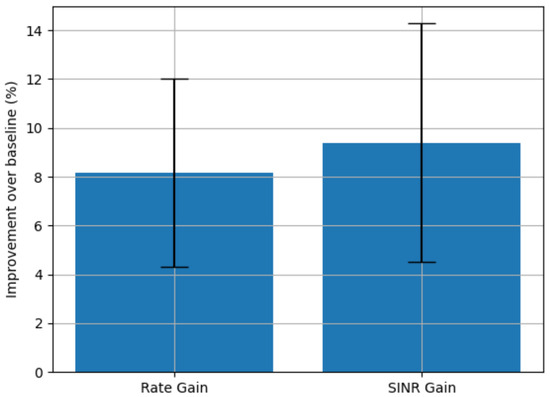
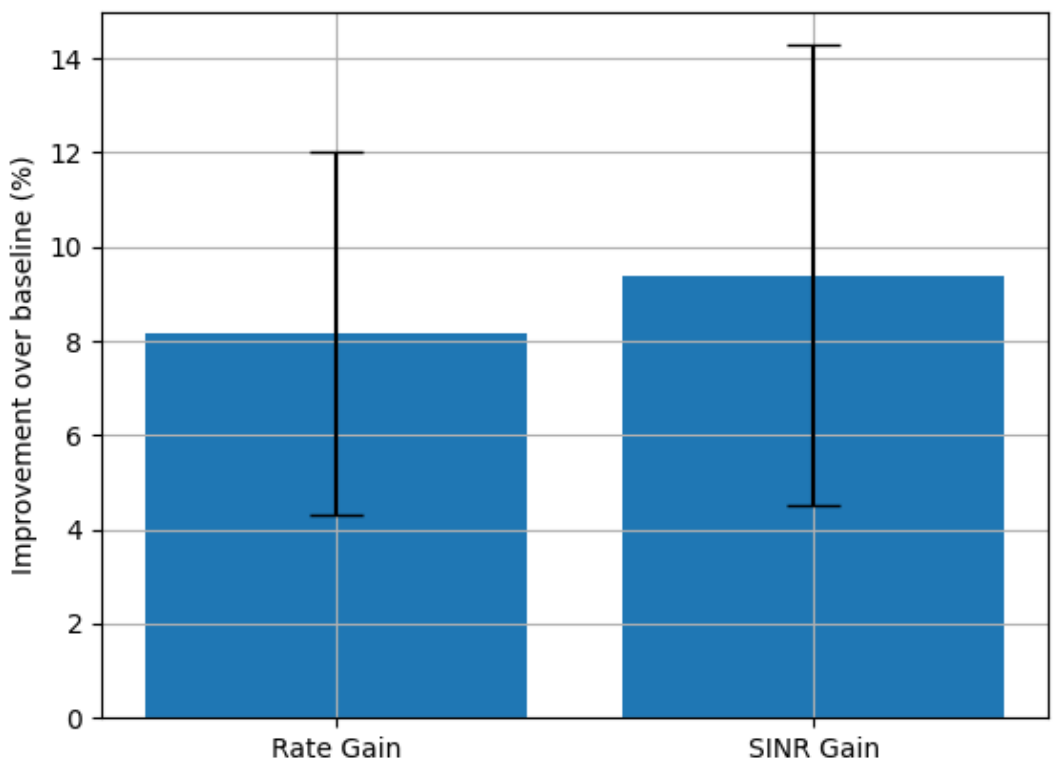
Furthermore, the system is analyzed over multiple independent Monte Carlo realizations to capture the stochastic nature of wireless channels and UAV positioning. At each realization, the proposed method is compared against a fixed baseline strategy in terms of achievable rate and SINR performance. The results demonstrate a consistent performance improvement, with an average rate gain of 8.16% and a SINR gain of 9.40%, both reported with 95% confidence intervals of [4.30%, 12.02%] and [4.51%, 14.28%], respectively, as seen in Figure 9. Furthermore, a paired statistical t-test confirms that the observed gains are statistically significant (), validating that the improvements are not due to random channel variations but are a direct consequence of the proposed joint optimization and adaptive resource allocation strategy.
Figure 9.
Rate and sinR gain improvements.
6.1. Impact of Imperfect CSI
The proposed Lyapunov-aware SCA-WMMSE framework assumes that each LEO satellite has access to partial channel state information (CSI) for beamforming and power-splitting optimization. In practical LEO satellite systems, however, CSI may be imperfect because of estimation errors, feedback delays, Doppler effects, and the continuous movement of both satellites and UAVs. When the CSI becomes inaccurate, the beamforming vectors are no longer perfectly aligned with the desired propagation channels. Consequently, the received signal power decreases while the residual multi-user interference increases due to imperfect spatial separation among UAVs. This degradation results in lower SINR, reduced achievable rate, and smaller harvested energy compared with the ideal CSI case. The impact becomes more pronounced when outdated CSI is used. Since the proposed algorithm performs beamforming optimization at every scheduling slot, a delayed CSI estimate corresponds to an earlier UAV position rather than the current one. As the satellite–UAV geometry changes continuously, the mismatch between the actual and estimated channels increases with the feedback delay, reducing the effectiveness of the WMMSE beamformer and slowing the convergence of the Lyapunov optimization.
Nevertheless, the proposed framework retains a degree of robustness because both the beamforming vectors and the power-splitting ratios are updated repeatedly at every scheduling slot. Therefore, CSI errors affect only the optimization performed during the current slot, while subsequent updates gradually compensate for channel mismatches as newer CSI estimates become available. Although the achievable SINR and harvested energy decrease under severe CSI uncertainty, the Lyapunov queue mechanism continues to maintain long-term energy stability by adapting the resource allocation over time. Future work will extend the proposed framework by incorporating robust beamforming techniques based on bounded CSI uncertainty sets or stochastic CSI error models, allowing the optimization to explicitly account for estimation errors and feedback delays that are characteristic of high-mobility LEO satellite communication systems.
6.2. Scalability Analysis with Respect to UAV Density
As the number of UAVs increases, a separate experiment has been implemented. As shown in Table 1, the system benefits from enhanced spatial reuse, since each UAV independently associates with the nearest LEO satellite, enabling multiple parallel transmission links. This leads to a significant increase in the aggregate sum rate, as additional UAVs contribute new communication paths that are efficiently managed through adaptive beamforming.
Table 1.
Scalability performance of the proposed UAV–LEO SWIPT system.
The average SINR exhibits a non-monotonic behavior as the UAV density increases. In particular, increasing the number of UAVs initially introduces higher interference due to denser spatial reuse and shared spectral resources. However, as the network scales further, the WMMSE-based beamforming and dynamic association mechanisms better exploit spatial diversity, partially mitigating interference and improving link quality. This results in a balance between interference growth and beamforming gain rather than a strictly decreasing SINR trend. In terms of energy harvesting, the system benefits from increased UAV density due to the SWIPT architecture, which aggregates more RF energy across a larger number of active links. Since harvested energy depends on channel gains and power splitting ratios, the overall energy increases with network size, reflecting improved RF energy availability and more frequent favorable propagation conditions.
6.3. Performance Evaluation and Representative Baseline Comparison
Table 2 presents a comprehensive comparison between the proposed method and three benchmark schemes, namely WMMSE, Lyapunov optimization, and SCA. The evaluation is conducted in terms of average SINR, achievable rate, and harvested energy across all UAVs over the simulation horizon. It can be observed that the proposed method achieves a favorable trade-off between communication performance and energy harvesting. While WMMSE attains a slightly higher average SINR and rate, it does so at the expense of significantly reduced harvested energy. In contrast, the proposed scheme maintains a balanced performance, achieving competitive SINR and rate values while substantially improving energy harvesting efficiency compared to all baseline approaches. The Lyapunov-based method exhibits the weakest overall performance, particularly in terms of harvested energy, indicating limited efficiency in joint communication and energy optimization. The SCA method performs better than Lyapunov in terms of SINR and rate but still falls short of the proposed approach in terms of energy harvesting capability.
Table 2.
Performance comparison of proposed and baseline methods.
7. Conclusions and Future Direction
This paper presented a comprehensive framework for joint beamforming, power-splitting, and UAV mobility optimization in integrated LEO satellite–UAV–terrestrial networks supporting SWIPT. By modeling realistic Rician fading channels with Doppler effects and imperfect CSI, the study captured the dynamic and uncertain nature of LEO-UAV communications. The proposed Lyapunov-based scheduling framework effectively balanced throughput, latency, and energy sustainability through queue stabilization. The per-slot non-convex optimization problem was efficiently addressed using a hybrid SCA and WMMSE algorithm, ensuring tractable online computation. Simulation results validated the method’s superiority in SINR, achievable rate, and harvested energy, confirming significant throughput improvement and robust energy-queue stability under mobility and interference constraints. The convergence behavior and fairness among UAVs further demonstrated the stability and adaptability of the proposed approach, establishing it as a practical and high-performance solution for next-generation LEO-assisted SWIPT networks.
Future research will focus on enhancing the proposed framework through learning-augmented control, integrating reinforcement and federated learning methods with the Lyapunov scheduler for adaptive decision-making in uncertain and dynamic environments. The system can be further extended to multi-layer satellite constellations (LEO–MEO–GEO) and heterogeneous UAV swarms to evaluate scalability and inter-tier coordination. Additionally, joint uplink–downlink optimization with full-duplex SWIPT will be explored to improve overall rate–energy efficiency. Incorporating realistic energy storage models, including battery aging and leakage effects, will enhance long-term reliability. Future work will also address security and robustness through secure beamforming and resilient power control against adversarial threats. Finally, experimental validation using hardware-in-the-loop simulations or UAV testbeds will be pursued to confirm the framework’s performance under real-world conditions.
Author Contributions
Conceptualization, E.D.S.; methodology, E.D.S.; software, E.D.S.; validation, C.T.A. and V.K. and C.S.; formal analysis, E.D.S.; investigation, E.D.S.; resources, C.S. and C.T.A.; data curation, E.D.S.; writing–original draft preparation, E.D.S.; writing–review and editing, C.T.A. and V.K. and C.S.; visualization, E.D.S.; supervision, C.T.A. and C.S.; project administration, C.S.; funding acquisition, C.S. All authors have read and agreed to the published version of the manuscript.
Funding
This research was carried out within the framework of the project “6G-BRICKS: Building Reusable Testbed Infrastructures for Validating Cloud-to-Device Breakthrough Technologies” (Grant Agreement No. 101096954), funded by the European Union’s Horizon Europe Research and Innovation Programme under the topic HORIZON-JU-SNS-2022-STREAM-C-01-01.
Data Availability Statement
The data is available upon request to Evangelos D. Spyrou due to project restrictions.
Conflicts of Interest
The authors declare no conflict of interest.
References
- Ayub, M.S.; Saadi, M.; Koo, I. Optimization of RIS-Assisted 6G NTN Architectures for High-Mobility UAV Communication Scenarios. Drones 2025, 9, 486. [Google Scholar]
- Enahoro, S.; Ekpo, S.; Al-Yasir, Y.; Uko, M.; Elias, F.; Unnikrishnan, R.; Alabi, S. Unified Framework for RIS-Enhanced Wireless Communication and Ambient RF Energy Harvesting: Performance and Sustainability Analysis. Technologies 2025, 13, 244. [Google Scholar] [CrossRef] [Scilit]
- Liu, S.; Gao, Z.; Wu, Y.; Ng, D.W.K.; Gao, X.; Wong, K.K.; Chatzinotas, S.; Ottersten, B. LEO satellite constellations for 5G and beyond: How will they reshape vertical domains? IEEE Commun. Mag. 2021, 59, 30–36. [Google Scholar] [CrossRef] [Scilit]
- Lin, M.; Huang, Q.; De Cola, T.; Wang, J.B.; Wang, J.; Guizani, M.; Wang, J.Y. Integrated 5G-satellite networks: A perspective on physical layer reliability and security. IEEE Wirel. Commun. 2020, 27, 152–159. [Google Scholar]
- Guo, K.; Dong, C.; An, K. NOMA-based cognitive satellite terrestrial relay network: Secrecy performance under channel estimation errors and hardware impairments. IEEE Internet Things J. 2022, 9, 17334–17347. [Google Scholar] [CrossRef] [Scilit]
- Liu, R.; Guo, K.; An, K.; Zhou, F.; Wu, Y.; Huang, Y.; Zheng, G. Resource allocation for NOMA-enabled cognitive satellite–UAV–terrestrial networks with imperfect CSI. IEEE Trans. Cogn. Commun. Netw. 2023, 9, 963–976. [Google Scholar]
- Chen, Y.; Kang, H.; Li, J.; Sun, G.; Wang, B.; Wang, J.; Liang, C.; Liang, S.; Niyato, D. Joint Resource Management for Energy-efficient UAV-Assisted SWIPT-MEC: A Deep Reinforcement Learning Approach. IEEE Internet Things J. 2025, 12, 31448–31465. [Google Scholar] [CrossRef] [Scilit]
- Hou, L.; Tan, S. A preliminary study of thermal energy harvesting for industrial wireless sensor networks. In Proceedings of the 2016 10th International Conference on Sensing Technology (ICST), Nanjing, China, 11–13 November 2016; IEEE: Piscataway, NJ, USA, 2016; pp. 1–5. [Google Scholar]
- Niyato, D.; Hossain, E.; Rashid, M.M.; Bhargava, V.K. Wireless sensor networks with energy harvesting technologies: A game-theoretic approach to optimal energy management. IEEE Wirel. Commun. 2007, 14, 90–96. [Google Scholar]
- Krikidis, I.; Timotheou, S.; Nikolaou, S.; Zheng, G.; Ng, D.W.K.; Schober, R. Simultaneous wireless information and power transfer in modern communication systems. IEEE Commun. Mag. 2014, 52, 104–110. [Google Scholar]
- Varshney, L.R. Transporting information and energy simultaneously. In Proceedings of the 2008 IEEE International Symposium on Information Theory, Toronto, ON, Canada, 6–11 July 2008; IEEE: Piscataway, NJ, USA, 2008; pp. 1612–1616. [Google Scholar]
- Yoon, I.J. Wireless power transfer in the radiating near-field region. In Proceedings of the 2015 USNC-URSI Radio Science Meeting (Joint with AP-S Symposium), Vancouver, BC, Canada, 19–24 July 2015; IEEE: Piscataway, NJ, USA, 2015; p. 344. [Google Scholar]
- Huang, K.; Zhou, X. Cutting the last wires for mobile communications by microwave power transfer. IEEE Commun. Mag. 2015, 53, 86–93. [Google Scholar] [CrossRef] [Scilit]
- Lu, X.; Wang, P.; Niyato, D.; Kim, D.I.; Han, Z. Wireless networks with RF energy harvesting: A contemporary survey. IEEE Commun. Surv. Tutor. 2014, 17, 757–789. [Google Scholar]
- Ding, Z.; Zhong, C.; Ng, D.W.K.; Peng, M.; Suraweera, H.A.; Schober, R.; Poor, H.V. Application of smart antenna technologies in simultaneous wireless information and power transfer. IEEE Commun. Mag. 2015, 53, 86–93. [Google Scholar] [CrossRef] [Scilit]
- Yu, H.; Shi, L.; Qian, Y.; Shu, F.; Li, J.; Zhao, Y.; Jayakody, D.N.K. A cooperative modulation recognition: New paradigm for power line networks in smart grid. Phys. Commun. 2017, 25, 268–276. [Google Scholar] [CrossRef] [Scilit]
- Perera, T.D.P.; Jayakody, D.N.K.; Sharma, S.K.; Chatzinotas, S.; Li, J. Simultaneous wireless information and power transfer (SWIPT): Recent advances and future challenges. IEEE Commun. Surv. Tutor. 2017, 20, 264–302. [Google Scholar] [CrossRef] [Scilit]
- Neely, M.J. Stochastic Network Optimization with Application to Communication and Queueing Systems; Morgan & Claypool: San Rafael, CA, USA, 2010. [Google Scholar]
- Huang, Q.; Lin, M.; Wang, J.B.; Tsiftsis, T.A.; Wang, J. Energy efficient beamforming schemes for satellite-aerial-terrestrial networks. IEEE Trans. Commun. 2020, 68, 3863–3875. [Google Scholar] [CrossRef] [Scilit]
- Jia, Z.; Sheng, M.; Li, J.; Niyato, D.; Han, Z. LEO-satellite-assisted UAV: Joint trajectory and data collection for Internet of Remote Things in 6G aerial access networks. IEEE Internet Things J. 2020, 8, 9814–9826. [Google Scholar] [CrossRef] [Scilit]
- Ma, T.; Zhou, H.; Qian, B.; Cheng, N.; Shen, X.; Chen, X.; Bai, B. UAV-LEO integrated backbone: A ubiquitous data collection approach for B5G internet of remote things networks. IEEE J. Sel. Areas Commun. 2021, 39, 3491–3505. [Google Scholar] [CrossRef] [Scilit]
- Guo, S.; Zhao, X. Multi-agent deep reinforcement learning based transmission latency minimization for delay-sensitive cognitive satellite-UAV networks. IEEE Trans. Commun. 2022, 71, 131–144. [Google Scholar] [CrossRef] [Scilit]
- Guo, K.; An, K. On the performance of RIS-assisted integrated satellite-UAV-terrestrial networks with hardware impairments and interference. IEEE Wirel. Commun. Lett. 2021, 11, 131–135. [Google Scholar] [CrossRef] [Scilit]
- Feng, W.; Tang, J.; Yu, Y.; Song, J.; Zhao, N.; Chen, G.; Wong, K.K.; Chambers, J. UAV-enabled SWIPT in IoT networks for emergency communications. IEEE Wirel. Commun. 2020, 27, 140–147. [Google Scholar] [CrossRef] [Scilit]
- Su, Z.; Feng, W.; Tang, J.; Chen, Z.; Fu, Y.; Zhao, N.; Wong, K.K. Energy-efficiency optimization for D2D communications underlaying UAV-assisted industrial IoT networks with SWIPT. IEEE Internet Things J. 2022, 10, 1990–2002. [Google Scholar] [CrossRef] [Scilit]
- Zargari, S.; Hakimi, A.; Tellambura, C.; Herath, S. User scheduling and trajectory optimization for energy-efficient IRS-UAV networks with SWIPT. IEEE Trans. Veh. Technol. 2022, 72, 1815–1830. [Google Scholar] [CrossRef] [Scilit]
- Li, Z.; Chen, W.; Cao, H.; Tang, H.; Wang, K.; Li, J. Joint communication and trajectory design for intelligent reflecting surface empowered UAV SWIPT networks. IEEE Trans. Veh. Technol. 2022, 71, 12840–12855. [Google Scholar] [CrossRef] [Scilit]
- Liu, Y.; Han, F.; Zhao, S. Flexible and reliable multiuser SWIPT IoT network enhanced by UAV-mounted intelligent reflecting surface. IEEE Trans. Reliab. 2022, 71, 1092–1103. [Google Scholar] [CrossRef] [Scilit]
- Zhang, X.; Zhang, H.; Du, W.; Long, K.; Karagiannidis, G.K. Joint resource allocation and reflecting design in IRS-UAV communication networks with SWIPT. IEEE Trans. Wirel. Commun. 2023, 23, 2533–2546. [Google Scholar] [CrossRef] [Scilit]
- Christensen, S.S.; Agarwal, R.; De Carvalho, E.; Cioffi, J.M. Weighted sum-rate maximization using weighted MMSE for MIMO-BC beamforming design. IEEE Trans. Wirel. Commun. 2008, 7, 4792–4799. [Google Scholar] [CrossRef] [Scilit]

Disclaimer/Publisher’s Note: The statements, opinions and data contained in all publications are solely those of the individual author(s) and contributor(s) and not of MDPI and/or the editor(s). MDPI and/or the editor(s) disclaim responsibility for any injury to people or property resulting from any ideas, methods, instructions or products referred to in the content. |
© 2026 by the authors. Licensee MDPI, Basel, Switzerland. This article is an open access article distributed under the terms and conditions of the Creative Commons Attribution (CC BY) license.