


Abstract
Accurate detection of cardboard boxes is essential to mobile manipulators to perform pick-and-place operations in warehouses. Conventional object detection methods like YOLOv11 struggle in low-texture and occluded environments. This paper presents YOLO-REFB, a novel object detection framework for real-time cardboard box detection in robotic manipulation using a dual-arm mobile robot (DAMR) operating in indoor warehouse environments. The proposed approach enhances the network by integrating the Rectangular Edge Fusion Block (REFB) into the YOLOv11 architecture; it focuses on learning the geometric and structural features of cardboard boxes. Enhanced edge information extraction and feature fusion improve training stability and localization accuracy. A custom dataset of 3501 annotated images, collected under varied conditions, was utilized. The images were randomly assigned to training and validation sets while keeping an 80:20 ratio. They were manually annotated and trained using Roboflow software, ensuring precise alignment of bounding boxes with cardboard box edges for accurate comparison with existing YOLO models. The model outperformed existing YOLO variants (YOLOv8n and YOLOv5n) in terms of precision (89.29%), recall (83.95%), and F1-score (86.54%). YOLO-REFB achieved improved localization metrics, including mean Average Precision (mAP)@0.5 (91.68%) and mAP@0.5:0.95 (68.61%). The inclusion of REFB was essential to performance gains, enabling effective detection of objects in challenging environments. Future developments may include 3D pose estimation and multi-object grasp planning for advanced robotic manipulation.
1. Introduction
The growth of e-commerce has dramatically changed the logistics industry, leading to increased reliance on automated systems to manage warehouses efficiently [1]. Central to these systems is the task of inventory detection, where accurately identifying and locating items are crucial. Among these items, cardboard boxes are a commonly used packaging type, often stacked and arranged in complex configurations [2]. Despite their geometric simplicity, reliable detection of cardboard boxes remains challenging in real-world scenarios due to variations in illumination, scale, occlusion, and background clutter. The ability to detect and track these boxes in such environments is key to enhancing the efficiency of automated warehouse systems. These systems increasingly rely on mobile manipulators for picking, sorting, and palletizing operations [3,4]. The mobile manipulators operate in unpredictable indoor environments facing challenges for object detection and grasping [5]. Reliable box detection is therefore vital to improving performance on automated tasks such as tracking and robotic manipulation [6,7,8]. Real-time object detection in complex images and video streams is essential to mobile robots, as it enhances safety, efficiency, and automation [9,10].
In this study, the focus is restricted to the problem of robust cardboard box detection, where images are captured using a DAMR and detection performance is enhanced through architectural improvements in deep learning models. Among traditional object detection models, the YOLO (You Only Look Once) family of algorithms has become the most influential for this purpose, balancing high accuracy with rapid inference speeds. Since its debut in 2016, YOLO has evolved through several architectural revisions, each overcoming limitations of earlier versions and integrating advancements in neural networks [11,12,13,14,15]. Recent research has focused on YOLO object detectors for real-time detection, with YOLO algorithms becoming increasingly popular due to their effective balance of performance and efficiency [16,17,18,19].
Earlier YOLO versions have some drawbacks in navigation for mobile robots in the detection of small and stacked objects [20,21]. These limitations were overcome by the introduction of the YOLOv8 model for better edge compatibility and seamless object detection [22,23,24,25,26,27]. Additionally, computational complexity, particularly in larger variants, may limit deployment on resource-constrained embedded systems without model pruning or quantization [28,29,30,31,32].
YOLOv11, released by Ultralytics in late 2024, enhances real-time object detection with improvements such as the C3k2 backbone and the C2PSA attention module, achieving higher mAP and faster inference rates [33,34]. It demonstrates superior performance in challenging scenarios like small-object detection and vehicle identification, surpassing previous versions in accuracy and robustness [35]. Despite advancements in object detection technologies, accurately detecting cardboard boxes in real-world warehouse settings remains a complex problem [36]. YOLO models made great strides in real-time performance. However, they often struggle with the challenges presented by warehouse environments, such as occlusions, variable lighting, and cluttered backgrounds [37]. Additionally, the detection of rectangular objects, such as cardboard boxes, requires models that are particularly sensitive to structural features, not just the appearance of the object itself [38,39]. Traditional YOLO models mainly use standard convolutional operations, which work well for general object detection but struggle with objects that have distinct shapes, like cardboard boxes. Despite their effectiveness, conventional YOLO models rely on isotropic convolution operations that treat spatial features uniformly in all directions. This limits their ability to explicitly capture directional geometric structures such as horizontal and vertical edges, which are essential to detecting rectangular objects like cardboard boxes. In real warehouse settings, boxes can be tilted, overlapping, or under different lighting, making them harder to detect. This often leads to missed detections or false positives, especially when multiple boxes are present in a crowded environment.
Recent studies on cardboard box detection emphasize the importance of robust perception for automated logistics and robotic manipulation. The Stacked Carton Dataset (SCD) provides a large-scale benchmark with dense, annotated carton images, enabling the improved training of deep learning models for detection and segmentation in cluttered environments [40]. Advanced methods enhance detection accuracy by addressing challenges such as occlusion and repetitive textures using modules like OPCL and boundary-guided supervision. In parallel, robotic systems such as ROGIBOT integrate vision-based detection with RGB-D sensing and 3D parameterization techniques, allowing for accurate estimation of box pose and dimensions for manipulation tasks. Although these approaches significantly improve performance, challenges remain in handling dense stacking, real-time processing, and seamless integration with grasp planning [41].
The research gaps identified in existing object detection frameworks excel at performing generic tasks but often fail with low-texture industrial objects like cardboard boxes. This paper addresses these challenges by focusing on improving the detection of cardboard boxes using an enhanced version of YOLOv11, which incorporates the Rectangular Edge Fusion Block (REFB). The REFB module is designed to enhance the model’s ability to detect geometric features, such as edges and corners, which are characteristic of rectangular objects like cardboard boxes. By incorporating directional convolution kernels that emphasize vertical and horizontal edges, the REFB module strengthens the model’s sensitivity to the structural features of boxes, making it more robust to variations in orientation and lighting.
A novel aspect of this work is the REFB’s ability to complement traditional feature extraction techniques. Instead of simply focusing on semantic features, such as object texture or color, REFB introduces a specialized mechanism for capturing the rectangular edge patterns commonly found in packaging environments. These features are crucial to distinguishing boxes from other objects in a warehouse, particularly when boxes are stacked or partially occluded.
The research framework comprises two stages: (1) The initial stage of the framework enhances geometry-aware object detection by incorporating the REFB into the YOLOv11 backbone, focusing on improved orthogonal edge representation through convolutional branches while maintaining real-time computational efficiency and making necessary architectural changes and theoretical formulations within a deep learning framework. (2) The final stage entails creating a custom dataset with different cardboard box configurations across various lighting and occlusion scenarios. The performance of the proposed approach is validated in warehouse environment-like indoor laboratory, where the model is tested against several baseline YOLO variants. The results show that integrating REFB into YOLO significantly improves precision and recall, particularly in environments with varying lighting conditions and occluded boxes. This performance enhancement highlights the importance of integrating geometric feature extraction into existing object detection frameworks, offering a more accurate and robust solution for warehouse automation tasks.
2. Methodology
The proposed methodology introduces a cardboard box detection approach by embedding the REFB into the YOLOv11 architecture deployed on a DAMR for pick-and-place operations in warehouse environments. The workflow begins with analyzing the baseline YOLOv11 architecture to determine where spatial information is learned and merged. Conventional convolutional blocks are replaced with REFB modules that capture and fuse horizontal, vertical, and spatial features into a compact representation. By integrating these modules at various stages, the network learns edge-aware features from low-level details to high-level semantic representations. The entire object detection process is implemented in the ROS 2 ecosystem for modularity, real-time communication, and hardware scalability. This methodology optimizes detection accuracy by enhancing the object geometry instead of just increasing model complexity. The design of the REFB module makes the YOLOv11 model suitable for real-time deployment on embedded platforms for dual-arm mobile manipulators, facilitating the reliable localization and grasp planning of cardboard boxes in warehouse settings.
2.1. Baseline YOLOv11 Model
To facilitate a clear understanding of the proposed modifications, it is important to briefly describe the baseline YOLOv11 architecture, which serves as the foundation for this study. YOLOv11 follows the standard single-stage object detection paradigm, where feature extraction, feature aggregation, and object prediction are performed within a unified network for real-time performance. The architecture is typically composed of three main components: a backbone for hierarchical feature extraction, a neck for multi-scale feature fusion, and a detection head for predicting bounding boxes, objectness scores, and class probabilities. The backbone employs convolutional layers with progressive downsampling to capture spatial and semantic features, while the neck integrates features from different resolutions using feature pyramid strategies to improve detection across small, medium, and large objects. The detection head operates on multiple scales to generate dense predictions in an anchor-free manner, enabling efficient and accurate localization. Despite its efficiency and strong performance, YOLOv11, like other YOLO variants, relies primarily on standard convolution operations that treat spatial information uniformly in all directions. This limits its ability to explicitly capture directional structural features, such as horizontal and vertical edges, which are critical to detecting geometrically regular objects like cardboard boxes. Consequently, while YOLOv11 provides a robust baseline for real-time detection, it offers an opportunity for enhancement through structure-aware feature learning, which motivates the proposed REFB in this work.
2.2. REFB Module
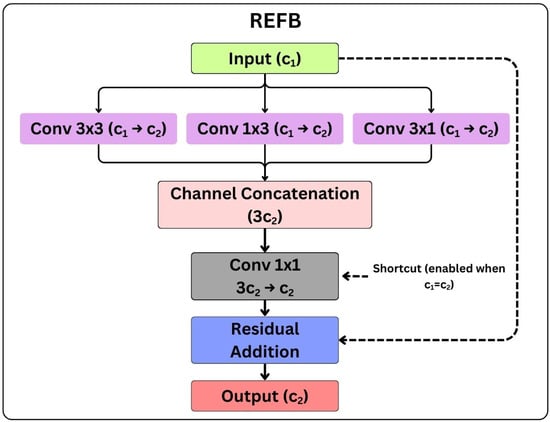
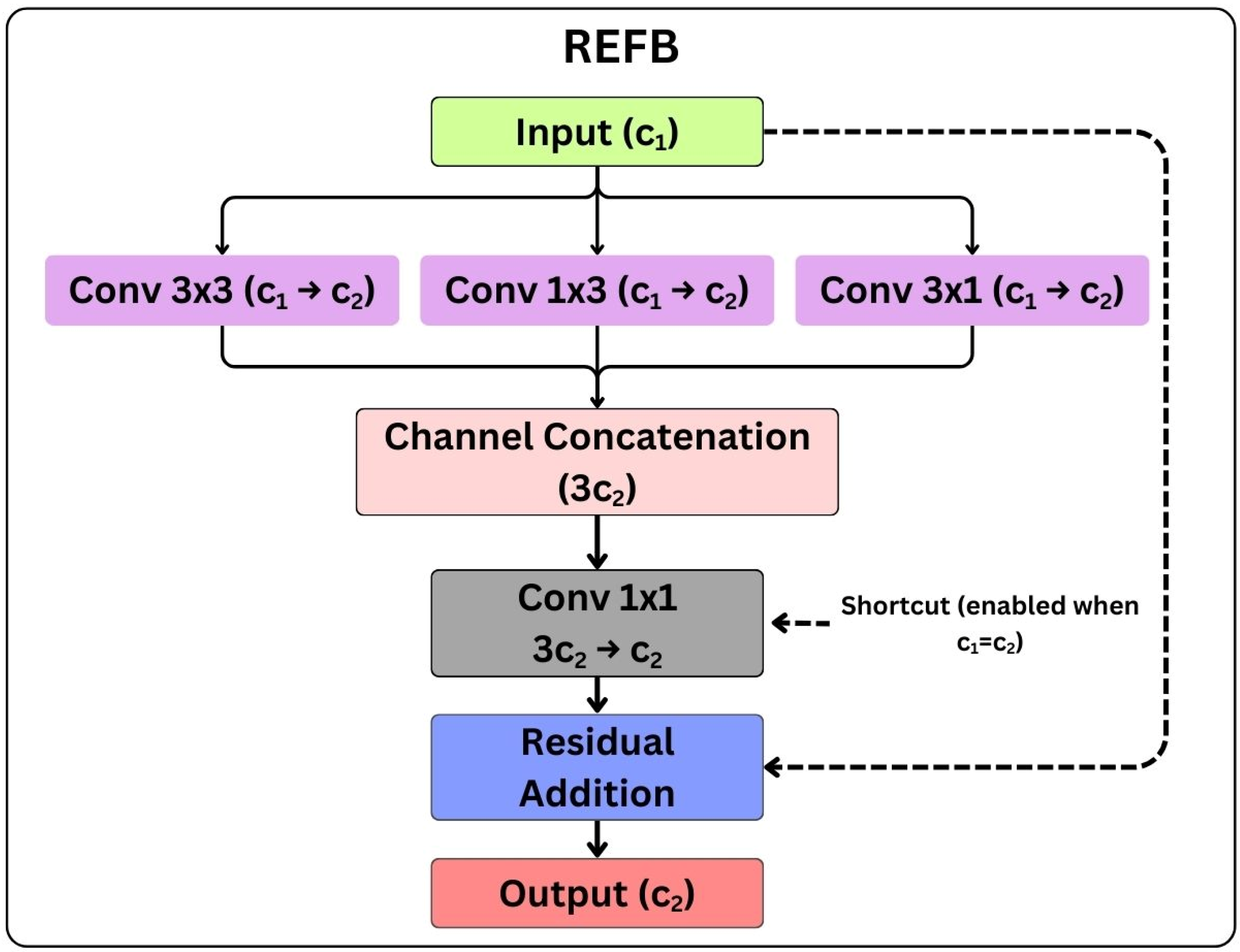
The Rectangular Edge Fusion Block (REFB) is a multi-branch convolutional module designed to enhance the network’s ability to learn the structural characteristics of rectangular objects by explicitly modeling directional edge information. In conventional convolutional blocks as shown in Figure 1, a single square kernel (typically 3 × 3) is used to capture spatial features in all directions simultaneously. Although effective for general-purpose feature extraction, this isotropic operation does not provide dedicated sensitivity to horizontal and vertical edge patterns, which are the most dominant and stable visual cues in objects such as cardboard boxes. The REFB addresses this limitation by decomposing spatial feature learning into parallel directional paths and then fusing them into a unified and discriminative representation. This introduces a task-specific inductive bias toward orthogonal geometry without significantly increasing the computational cost.
Figure 1.
Structure of REFB module.
The core of the proposed approach is the REFB, which integrates directional convolution into the feature extraction process to better capture the geometric characteristics of rectangular objects, such as cardboard boxes. The REFB uses 1 × 3 and 3 × 1 convolution kernels, which focus on detecting horizontal and vertical edges, respectively. These kernels are specifically designed to enhance the model’s ability to capture rectangular features, which are common in warehouse environments, particularly for objects like boxes.
It is important to note that these kernels do not rely on perfect alignment of the objects with the image plane. Instead, they are optimized to detect the structural features of boxes, such as edges and corners, which are characteristic of rectangular shapes. Even when cardboard boxes appear at different angles or orientations within the scene, the directional convolution approach is still effective in capturing these key geometric features.
Structurally, the REFB consists of three parallel convolutional branches that operate on the same input feature map, as shown in Figure 1. The first branch uses a 3 × 3 convolution to capture general spatial context and local neighborhood information, ensuring that the block retains the standard feature extraction capability of conventional convolutional layers. The second branch employs a 1 × 3 convolution, which has a horizontally elongated receptive field and is therefore highly sensitive to horizontal edges and long, continuous boundaries. The third branch uses a 3 × 1 convolution to emphasize vertical edges and vertical structural continuity. By separating these directional responses, the block allows the network to learn anisotropic spatial features that correspond directly to the geometric properties of rectangular objects. The outputs from these three branches are concatenated along the channel dimension, creating a feature map that simultaneously contains general, horizontal, and vertical edge information.
Following concatenation, a 1 × 1 convolution is applied as a fusion layer to reduce the channel dimensionality and to learn an optimal combination of the directional features. This point-wise convolution acts as a channel-wise interaction mechanism, enabling the network to adaptively weight the importance of each directional response depending on the object’s orientation, scale, and visibility. To stabilize training and improve gradient flow, a residual shortcut connection is introduced whenever the input and output channel dimensions are the same. This residual learning strategy [42] allows the block to preserve the original feature information while refining it with enhanced edge-aware representations, thereby preventing performance degradation in deeper networks.
From a functional perspective, the REFB progressively strengthens edge continuity, corner localization, and boundary alignment across different stages of the network. When used in the backbone, it transforms low-level gradient features into high-level geometry-aware representations as the receptive field increases. When used in the neck, it ensures that the fused multi-scale feature maps retain consistent directional information, which is essential to accurate localization of small, overlapping, or partially occluded rectangular objects. Despite its multi-branch design, the use of asymmetric convolutions (1 × 3 and 3 × 1) keeps the parameter count and floating-point operations only slightly higher than those of a standard convolutional block, making the module suitable for real-time deployment on embedded GPU platforms.
Mathematical Formulation of the REFB Framework
Let the input feature tensor to the REFB be defined as
where H, W, and C represent the height, the width and the number of channels, respectively. The objective of the REFB is to enhance directional sensitivity toward orthogonal edge structures inherent in rectangular objects. To achieve this, three parallel convolutional branches are employed. The first branch applies a conventional 3 × 3 convolution to capture general spatial context and local neighborhood interactions:
where represents the learnable convolution kernel, ∗ denotes the convolution operation, and σ(⋅) is the nonlinear activation function. This branch preserves isotropic feature extraction capability.
The second branch applies a 1 × 3 convolution to emphasize horizontal edge continuity:
The 1 × 3 kernel performs anisotropic filtering along the horizontal direction, thereby strengthening feature responses corresponding to vertically oriented boundaries.
Similarly, the third branch applies a 3 × 1 convolution to emphasize vertical edge continuity:
The 3 × 1 kernel enhances responses along the vertical axis, reinforcing horizontal structural boundaries typically observed in rectangular objects.
The outputs of the three branches are concatenated along the channel dimension to aggregate complementary directional features:
This concatenation increases the channel dimensionality to 3C, thereby combining isotropic and anisotropic representations within a unified feature tensor. To control model complexity and enable cross-channel interaction, a 1 × 1 convolution is subsequently applied:
The 1 × 1 convolution performs linear channel projection and the adaptive weighting of directional features, effectively learning the optimal contribution of each branch.
Finally, a residual connection is introduced to stabilize gradient propagation and preserve original information:
This residual mapping ensures that the block learns a refinement over the input features rather than replacing them entirely, thereby improving convergence stability and maintaining representational integrity.
Collectively, the REFB enhances orientation-specific feature representation while retaining computational efficiency, making it particularly suitable for rectangular-object detection in warehouse environments.
2.3. Proposed YOLO-REFB Architecture
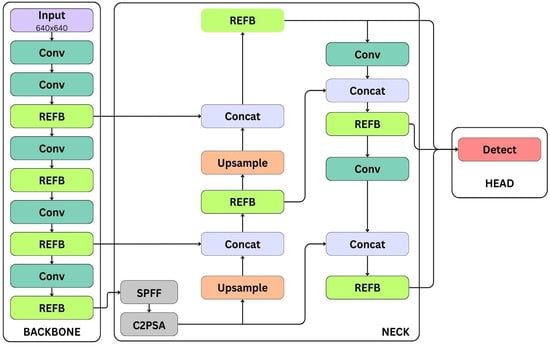
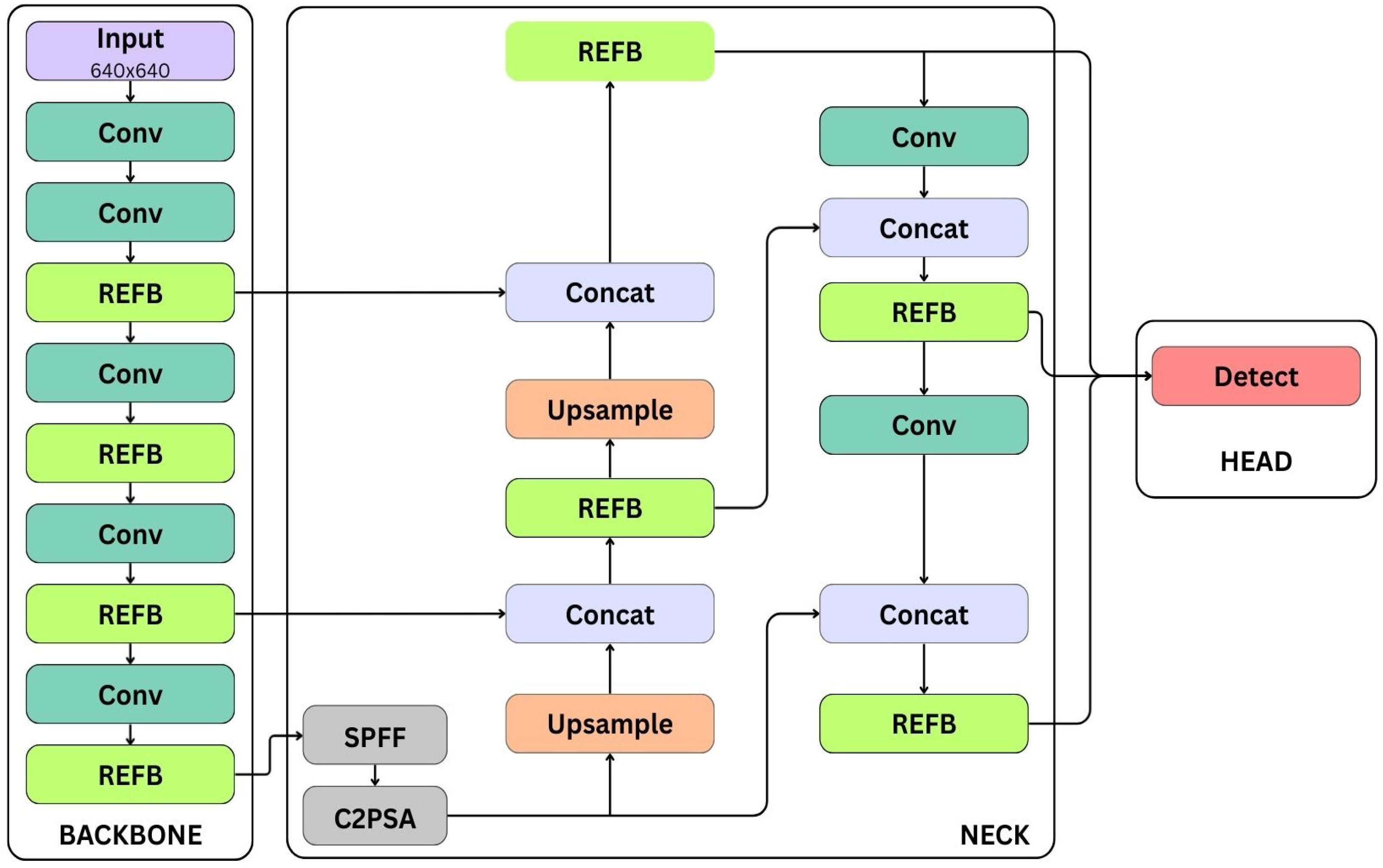
The YOLOv11 architecture is a single-stage, real-time object detection framework optimized for a balance of detection accuracy, computational efficiency, and suitability for deployment on embedded and edge devices. In the YOLO-REFB architecture, as shown in Figure 2, the detection network is formed by a sequence of specialized blocks that work together to extract, enhance, fuse, and finally predict object features in a structured and efficient manner.
Figure 2.
Modified YOLOv11 architecture with REFB.
The initial convolutional (Conv) layers operate as the primary feature extractors, capturing low-level spatial information such as edges, corners, and intensity variations while simultaneously reducing the spatial resolution and increasing the channel depth. These early features are then passed to the REFBs, which constitute the core modification of the architecture. Each REFB processes the incoming feature map through three parallel convolutional branches, 3 × 3, 1 × 3, and 3 × 1, to separately learn general spatial patterns, horizontal edges, and vertical edges. The outputs are concatenated and fused through a 1 × 1 convolution, and a residual shortcut is applied when the dimensions match, ensuring stable training and effective feature reuse. By placing REFBs throughout the backbone, the network progressively transforms basic edge responses into high-level geometry-aware representations.
At the deeper stage of the backbone, the Spatial Pyramid Pooling Fast (SPPF) block enlarges the receptive field and aggregates multi-scale contextual information, allowing the detector to understand the global layout of the scene without increasing computational complexity. This is followed by the C2PSA attention module, which refines the feature maps by modeling channel and spatial interdependencies, thereby emphasizing informative regions and suppressing background noise. In the neck region, upsampling layers increase the spatial resolution of deeper features so that they can be merged with shallow, detail-rich feature maps through concatenation operations, enabling effective multi-scale feature fusion. Immediately after each fusion stage, REFBs are again employed to ensure that the combined features retain strong directional edge information across all detection scales.
Finally, the Detect head performs anchor-free dense prediction at multiple pyramid levels to output bounding-box coordinates, objectness scores, and class probabilities. By keeping the detection head unchanged and introducing REFBs only in the feature extraction and fusion stages, the architecture improves the geometric understanding of rectangular objects while maintaining the real-time speed and efficiency of the original YOLOv11 network. The proposed YOLO-REFB architecture enhances sensitivity to identify rectangular objects in real-time warehouse environments. It incorporates REFBs to better capture horizontal and vertical edges of boxes during feature extraction, enabling direction-aware representation. This results in more stable, consistent bounding boxes under various challenging conditions, such as occlusions and differing illumination.
2.4. Environment-Oriented Dataset Acquisition
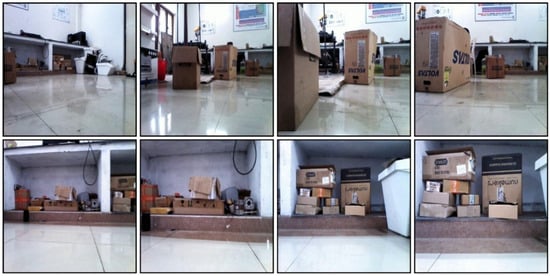
The proposed dataset engineering framework improves traditional object detection by aligning perception requirements with robotic manipulation goals [43]. Data were collected using an RGB-D camera on a DAMR in real warehouse settings to reflect operational variability, as shown in Figure 3. The dataset acquisition environmental configurations were designed to mimic real warehouse handling conditions for autonomous mobile robots. The DAMR operates as a dynamic vision platform, where image acquisition is performed during robot motion rather than from a static camera setup. This introduces variations in viewpoint, scale, and environmental conditions, enabling evaluation of the detection model in realistic robotic perception scenarios. Data collection involved various scenarios, such as single cardboard box placements, multi-box pallet stacking, and densely packed storage, including both labeled and unlabeled boxes to reflect surface variability. Lighting conditions were varied to represent industrial environments, incorporating aspects like LED lighting, directional glare, and low-light scenarios. Motion effects were included by varying the robot’s speed, resulting in natural motion blur and dynamic backgrounds. These configurations ensured the dataset addressed scale variation, occlusion complexity, and lighting diversity, enhancing the YOLO-REFB detection framework’s performance in real-world settings.
Figure 3.
Cardboard boxes captured by DAMR with RGB-D camera.
2.4.1. Dataset Creation
The proposed dataset used in this study was developed specifically for the task of cardboard box object detection under realistic indoor laboratory conditions. The objective of constructing this dataset was to create a reliable benchmark for evaluating object detection architectures, including the proposed YOLO-REFB model. The dataset contains a total of 3501 images, divided into training and validation subsets to enable supervised learning and fair performance evaluation, improving the performance of the proposed model in autonomous warehouse operations.
The dataset consists of 2801 training images (80.0% of the total dataset) and 700 validation images (20.0% of the total dataset). The training–validation split ratio was therefore maintained at 80:20, which is a widely accepted standard in object detection research [44]. This split ensures sufficient data for learning model parameters while reserving an independent subset for unbiased performance evaluation. The split was fixed prior to training and remained identical across all experiments and model comparisons to guarantee fairness in evaluation. In addition to the images collected and manually annotated for this study, approximately 600 publicly available cardboard box images were incorporated from the Roboflow public dataset repository [45] to enhance data diversity and improve model generalization. These additional images were reviewed to ensure consistency in object labeling and annotation format before integration. The images were randomly distributed across the existing training and validation subsets while maintaining the overall 80:20 training–validation ratio. This integration increased scene variability, including differences in lighting conditions, object scale, and background complexity, thereby strengthening the robustness of the trained detection models.
2.4.2. Data Augmentation
Data augmentation was utilized to simulate perceptual distortions and environmental variability in warehouse operations. The images were captured in diverse real-world indoor environments to simulate practical deployment conditions. The dataset includes variations in distance from camera (near field and mid-range), lighting conditions (natural daylight and low-light indoor settings), and object orientation (upright, rotated, and partially tilted). The objective was to incorporate realistic scene variability rather than ideal laboratory conditions. This ensures that the trained detection model does not overfit to a specific environment or background pattern. The cardboard boxes appear in different configurations, single-box scenes, multiple-box scenes, overlapping boxes, and partial occlusions, and such variations increase the complexity of the detection task and enhance the robustness of the trained model. The dataset was intentionally constructed to include varying lighting conditions to replicate the illumination changes commonly encountered in real warehouse and indoor robotic environments, as shown in Table 1.
Table 1.
Image distribution in dataset created under various lighting conditions.
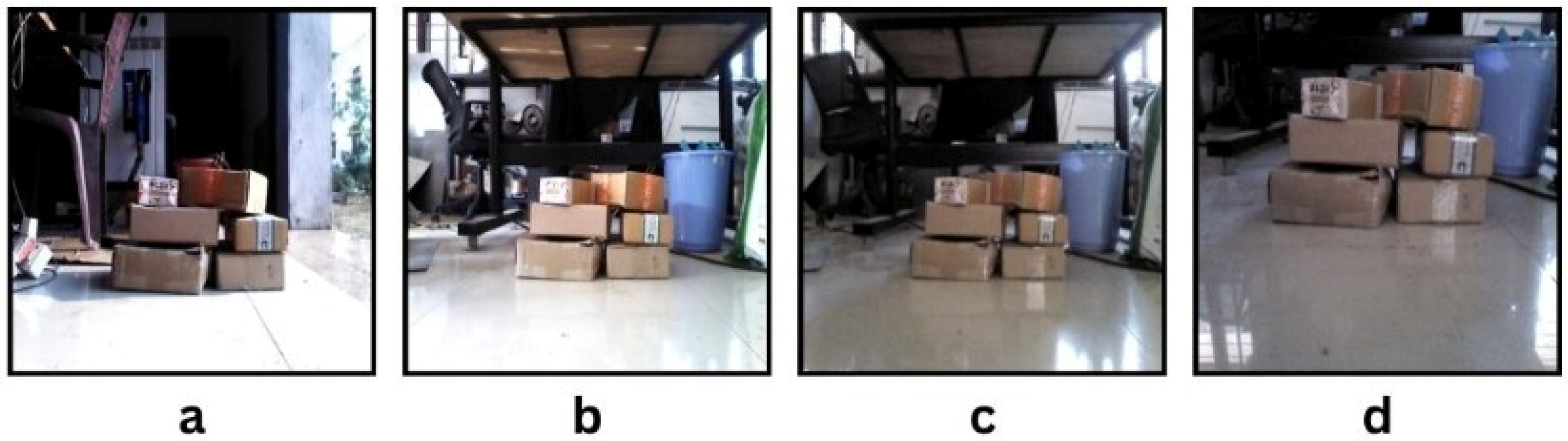
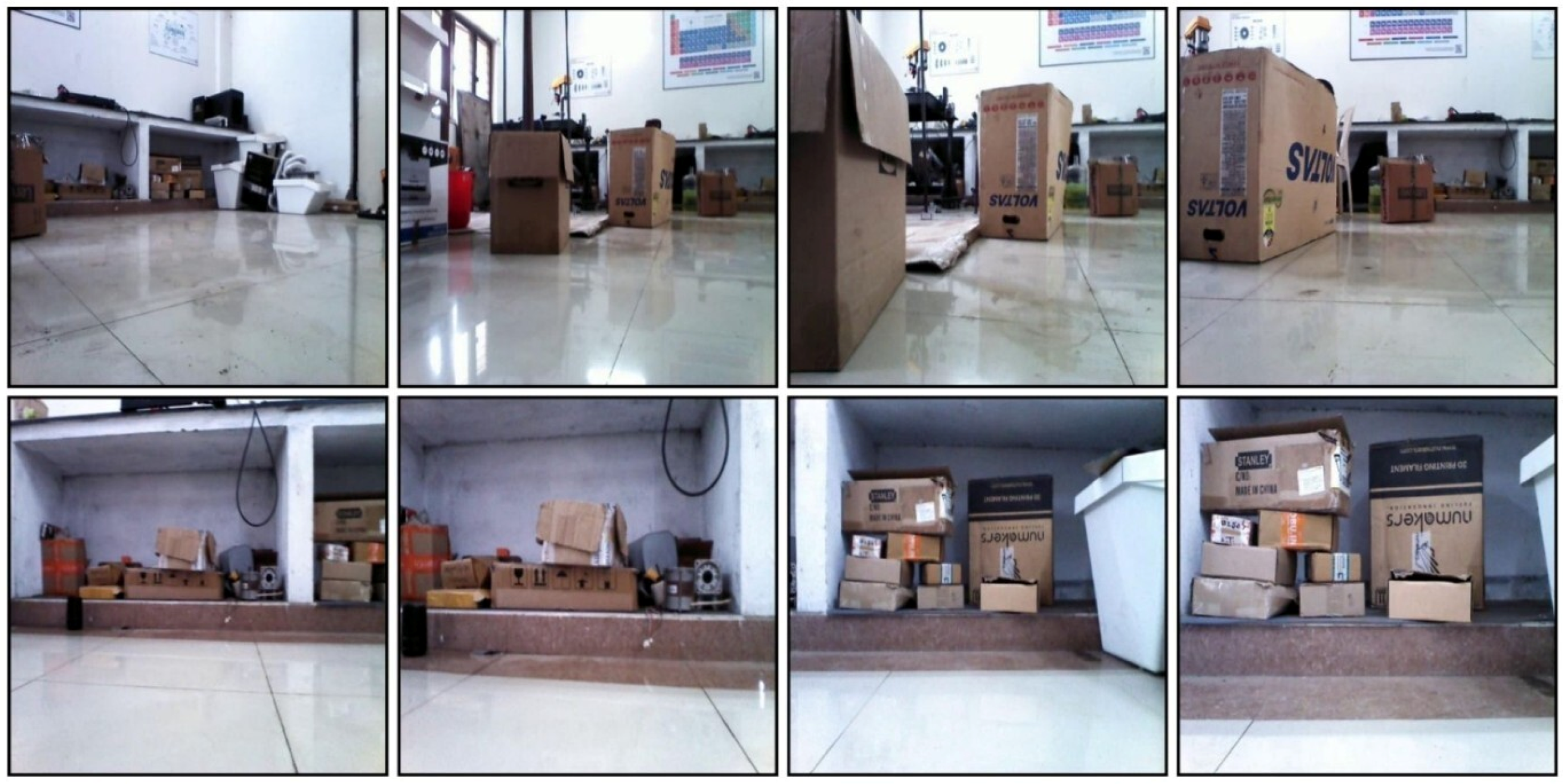
Images were captured under different levels of brightness, including well-lit scenes, low-light regions, shadowed areas, and conditions with non-uniform light distribution caused by overhead fixtures and natural light ingress, as shown in Figure 4a–d. Such variations introduce significant changes in color intensity, contrast, and edge visibility, which directly affect the quality of feature extraction in convolutional neural networks. In conventional detectors, poor illumination often leads to loss of texture details and weak boundary responses, resulting in missed detections or inaccurate localization. By incorporating these lighting variations during training, the model learns illumination-invariant representations and becomes more robust to real-time deployment scenarios. The proposed REFB modules demonstrate improved stability under these challenging conditions, as the directional convolutions emphasize structural box boundaries even when intensity gradients are reduced. This results in more consistent detection confidence and tighter bounding-box predictions across both brightly lit and dimly illuminated scenes.
Figure 4.
(a–d) A set of cardboard boxes captured under varying lighting conditions.
The collected dataset incorporates significant scale variations, where cardboard boxes appear at different distances from the RGB-D camera, resulting in large-, medium-, and small-object representations within the same scene. This variation challenges the detector’s multi-scale feature learning capability, particularly for small and distant boxes that contain limited pixel information. By training on such data, the network learns scale-invariant representations and improves its ability to detect objects across different feature pyramid levels. In addition, the dataset includes partial occlusions, where boxes are partially hidden by other objects, robot arms, or environmental structures. This condition simulates real manipulation scenarios in which objects are rarely fully visible and require the detector to rely on discriminative structural cues rather than complete object appearance. The proposed edge-enhanced feature learning enables the model to infer object presence even from visible corners and edges, leading to higher recall under occlusion.
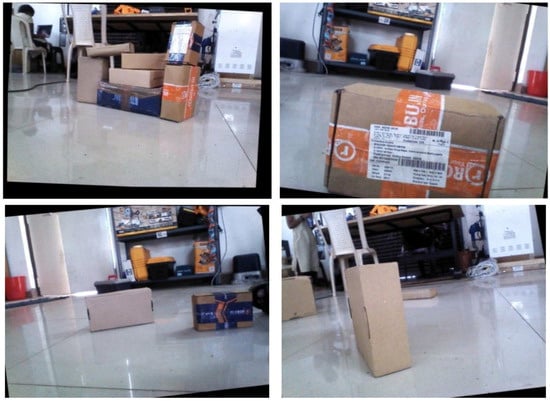
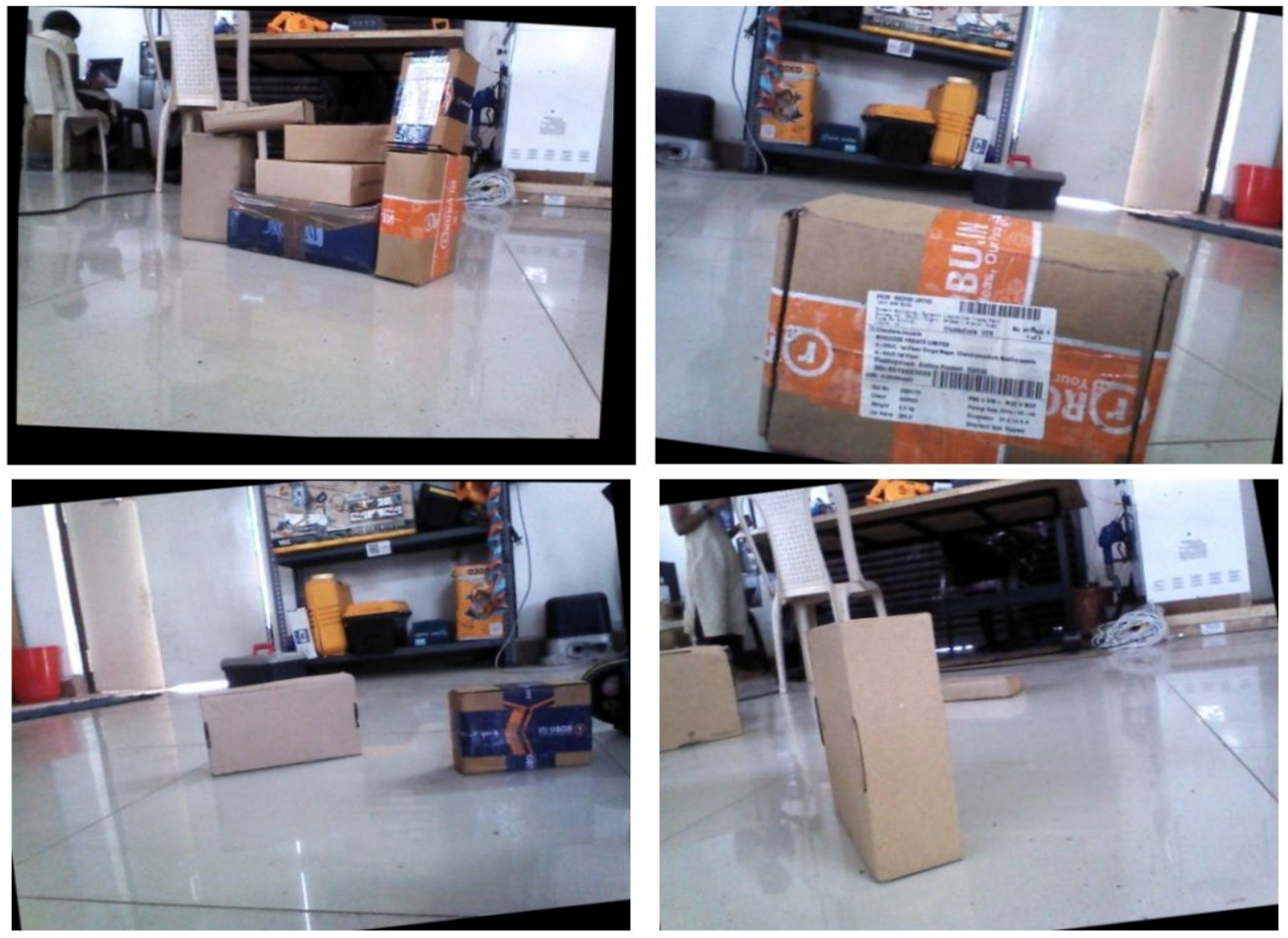
The images shown in Figure 5 also exhibit perspective distortions, caused by camera tilt, varying viewpoints, and depth differences as the mobile robot navigates the environment. These distortions alter the apparent geometry of the boxes, transforming rectangular faces into trapezoidal or skewed shapes. Furthermore, the dataset contains cluttered indoor backgrounds with shelves, walls, equipment, and other warehouse objects that share similar textures and colors with cardboard boxes. This increases the risk of false detections and demands strong foreground–background separation. Training on cluttered scenes forces the model to learn more discriminative and structurally meaningful features, and the integration of REFB helps emphasize box-specific edge continuity, thereby improving precision and detection stability in complex real-world environments.
Figure 5.
Cardboard boxes captured by varying viewpoints and camera tilt.
2.4.3. Data Annotation
All images were manually annotated using the Roboflow annotation platform, a widely used tool for object detection dataset creation and management. Each image was labeled with bounding boxes corresponding to the target object class cardboard box. The annotation process involved drawing tight bounding boxes is around visible box boundaries, ensuring consistency in annotation style across the dataset, as shown in Figure 6. All annotations were exported in YOLO format, which includes normalized bounding-box coordinates (x_center, y_center, width, height) relative to image dimensions. The dataset contains a single object category, namely, box. The single-class nature simplifies classification complexity while emphasizing localization accuracy and detection robustness. All evaluated models were trained using the same dataset, training–validation split, and image resolution and optimization configuration. This ensured that performance differences arose from architectural modifications rather than data-related inconsistencies. The number of bounding-box instances is higher than the number of images because several scenes contain multiple objects.
Figure 6.
Annotation of cardboard box images in Roboflow.
2.5. Evaluation Metrics
This study employs various model evaluation metrics: precision (P), recall (R), mAP, and F1-score are utilized to assess the performance of the developed model, with mAP50 (IoU threshold of 0.5) used for accuracy evaluation [46]. Precision indicates the proportion of true positives (Tp) among predicted positives, while recall measures true positives against all actual positives. Average Precision (AP) is defined as the area under the precision–recall curve at an IoU threshold of 0.5. mAP is assessed at mAP@0.5 and mAP@0.5–0.95, with the latter averaging mAP across IoU thresholds from 0.5 to 0.95 in increments of 0.05 for detailed evaluation.
Precision (8) measures the proportion of correctly predicted cardboard box detections to the total number of detections produced by the model, thereby indicating its ability to minimize false positives (Fp). During training for 100 epochs, precision also reflects how well the model learns discriminative features and stabilizes as the number of false detections decreases.
Recall (9) represents the proportion of actual cardboard boxes that are successfully detected by the model and provides insight into its ability to minimize missed detections. This metric becomes especially important in scenarios involving partial occlusion, varying lighting conditions, and small-scale objects, where visual cues are limited.
mAP (11) at an Intersection over Union (IoU) threshold of 0.5 evaluates overall detection accuracy by considering both classification and localization performance. It measures how well the predicted bounding boxes overlap with the ground-truth annotations when at least 50% overlap is achieved. This metric provides a balanced indication of whether the detector can correctly identify the presence of a cardboard box and approximately localize it within the image. In robotic perception, a high mAP@0.5 ensures reliable object recognition, which is sufficient for many grasp-planning pipelines that tolerate moderate localization error.
The mAP@0.5:0.95 metric is a more stringent evaluation that averages detection performance across multiple IoU thresholds ranging from 0.5 to 0.95. This metric emphasizes precise bounding-box regression and evaluates how accurately the predicted box aligns with the true object boundaries. For robotic grasping applications, this is particularly significant because tight and accurate localization directly influences grasp pose estimation and manipulation success. Improvements in this metric indicate that the model not only detects the object but also learns its geometric structure more effectively.
F1-score (12) is the harmonic mean of precision and recall and provides a single comprehensive measure of the model’s detection performance by balancing false positives and false negatives. In real-time robotic systems, where both accurate detection and complete object coverage are equally important, the F1-score offers a reliable indicator of overall system effectiveness. A higher F1-score implies that the detector maintains a strong trade-off between detecting all relevant cardboard boxes and avoiding incorrect predictions, making it a suitable metric for evaluating practical deployment readiness.
3. Experimental Testing and Analysis
This section outlines the experimental settings, including datasets and metrics, followed by comparative experiments on the datasets created to demonstrate the model’s effectiveness. It concludes with an analysis of key components’ contributions to overall performance.
3.1. Experimental Setup
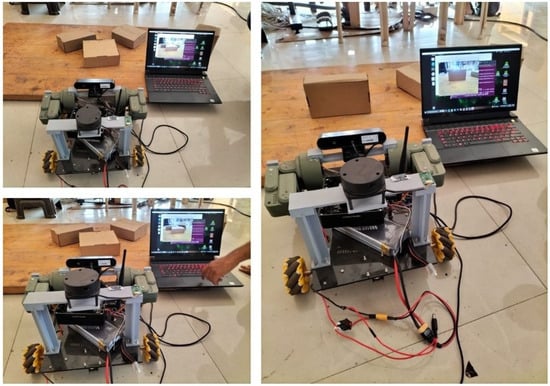
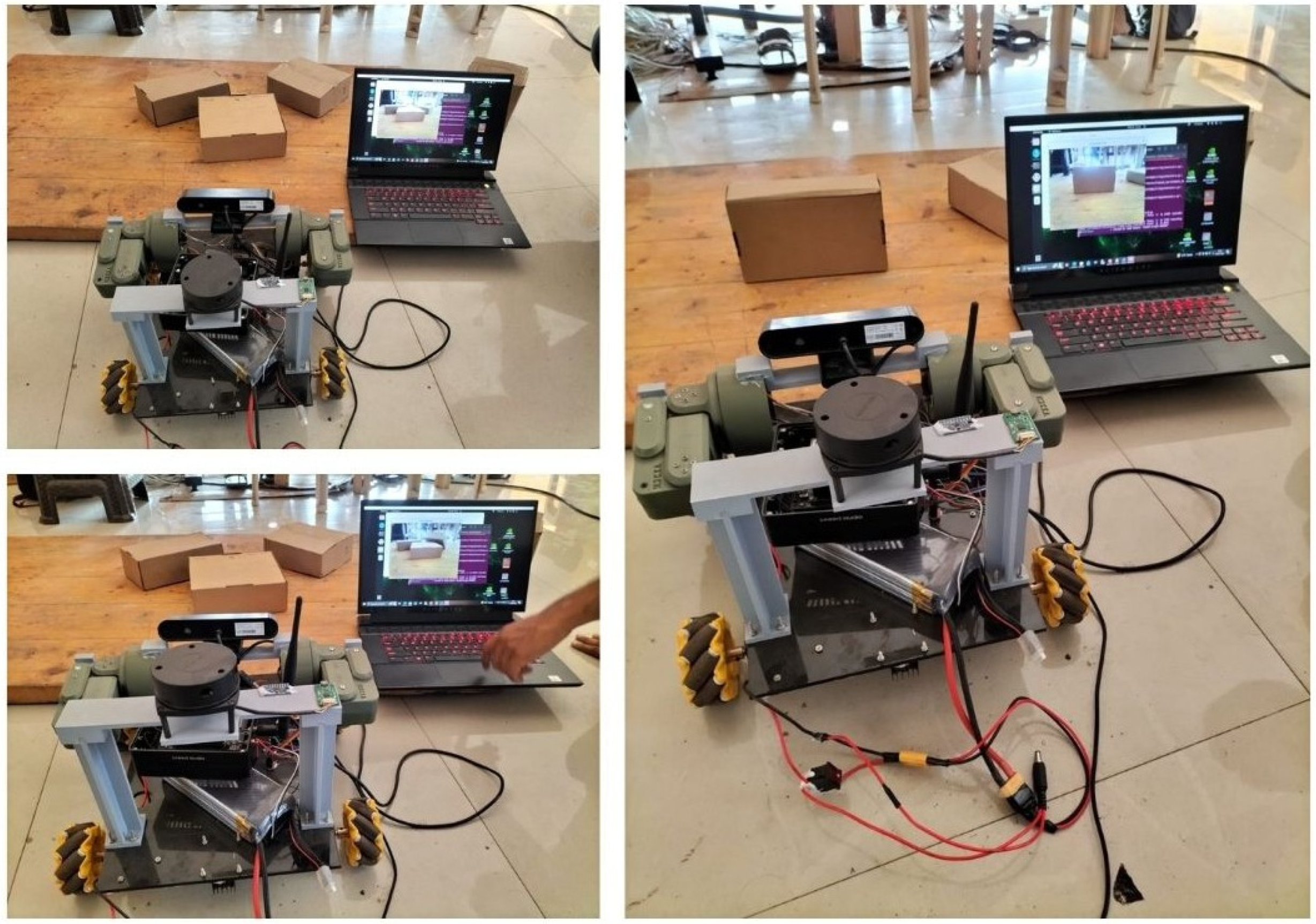
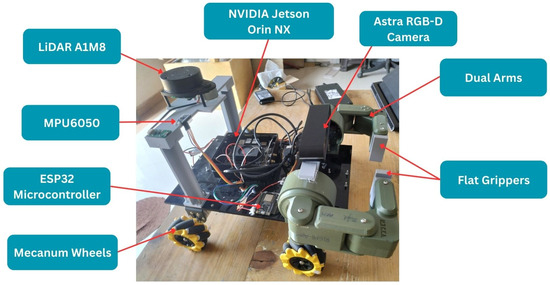
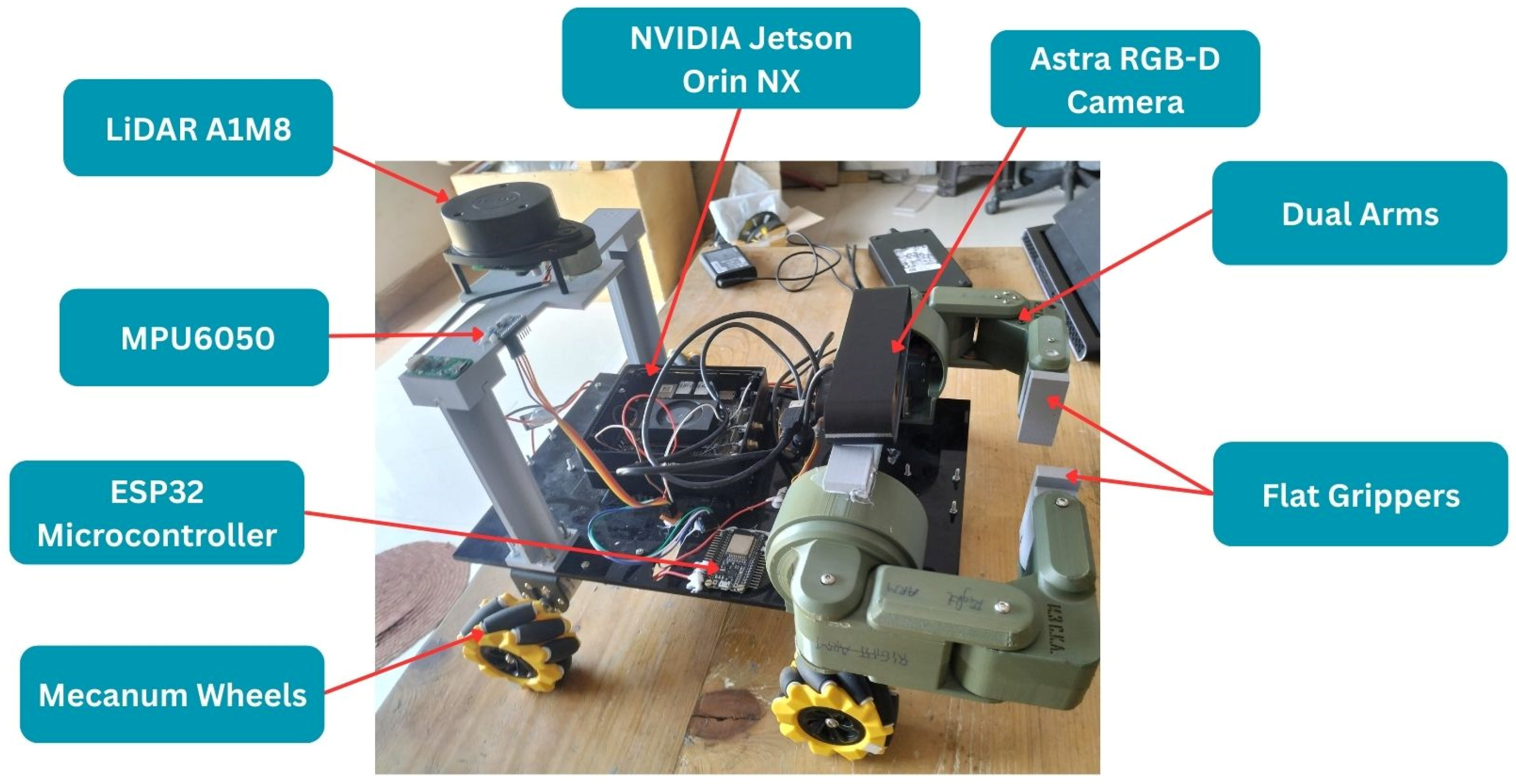
The proposed object detection models were trained on an Alienware m15 R4 laptop running a Linux-based operating system. The system was equipped with an Intel® Core™ i7-10870H CPU operating at 2.20 GHz, 16 GB of RAM, and an NVIDIA GeForce RTX 3070 Laptop GPU with 8 GB of dedicated memory. The trained model was deployed on a DAMR integrated with the robot’s control architecture. The DAMR consisted of a four-wheeled mecanum mobile base, two 3-DOF articulated arms with parallel grippers, a 2D LiDAR sensor for obstacle detection and localization, and an RGB-D camera mounted centrally for object perception, as shown in Figure 7. LiDAR provides planar environmental mapping and collision avoidance, while the RGB-D camera supplies synchronized color and depth information for 3D box localization.
Figure 7.
Fabricated model of DAMR with RGB-D camera.
The training framework was implemented using Ultralytics YOLO (version 8.4.14) [47] built upon the PyTorch deep learning framework (torch-2.10.0) with CUDA 12.8 acceleration, and Python 3.10.12. Stochastic Gradient Descent (SGD) was employed as the optimizer with an initial learning rate of 0.01 and a momentum of 0.937. A cosine learning rate scheduling strategy was adopted during training. The model training parameters are displayed in Table 2.
Table 2.
Model training parameters.
3.2. Experimental Testing with DAMR
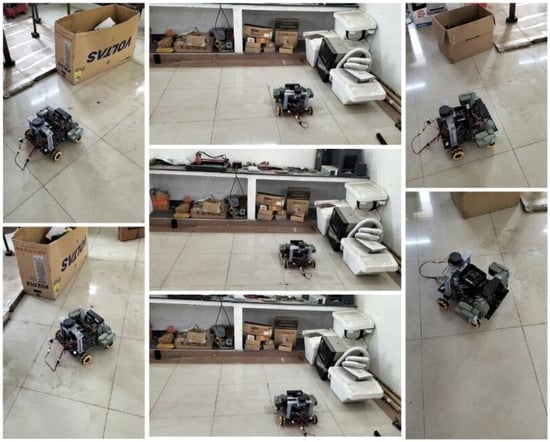
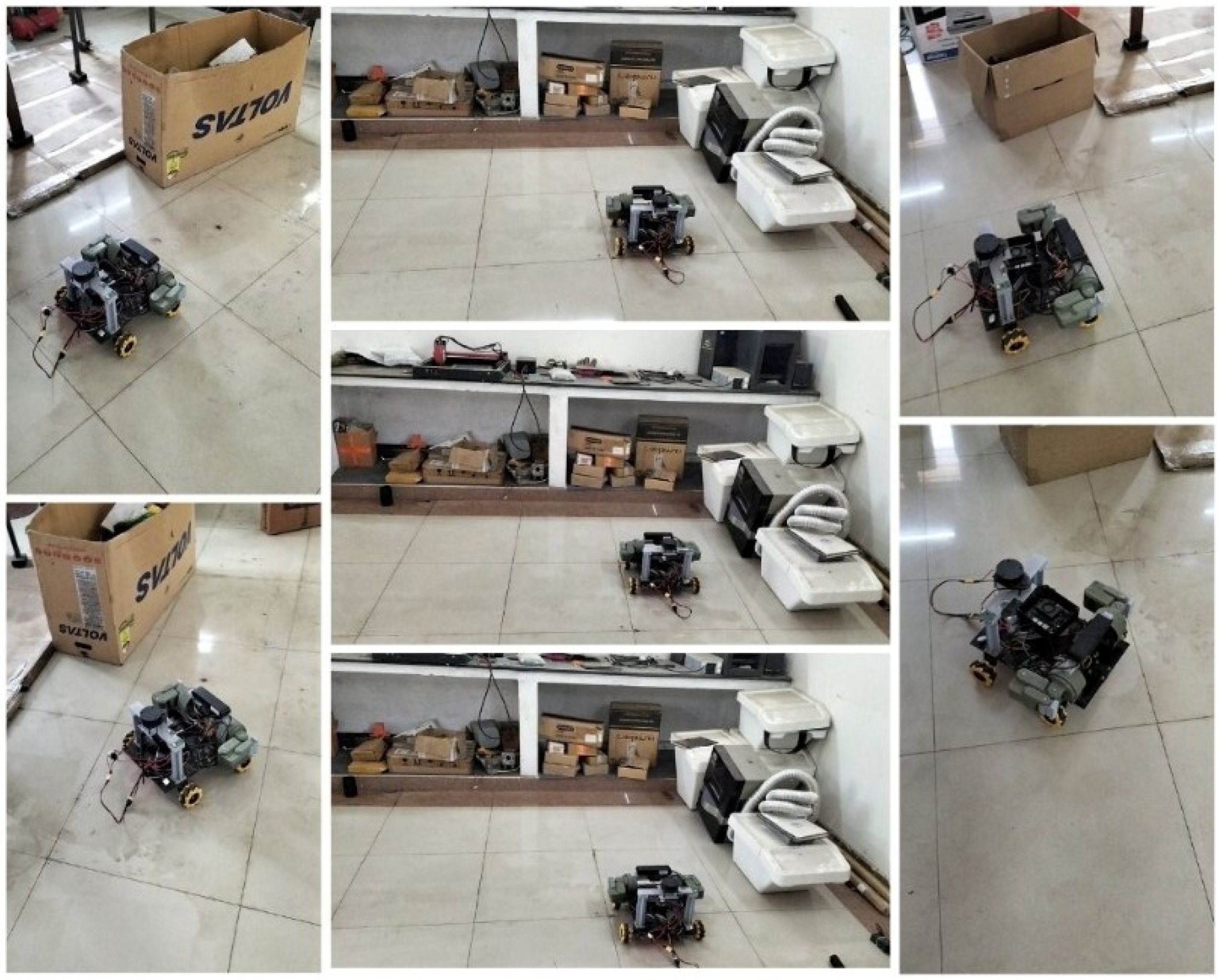
Experimental testing was conducted in a structured indoor warehouse environment using the proposed YOLO-REFB model deployed on a DAMR. For performance evaluation, the trained models were deployed on unseen validation images captured by the camera, as shown in Figure 8. The test phase focused on assessing the ability of the detector to correctly localize and classify cardboard boxes under real-world conditions. For experimental testing and validation, a custom dataset was prepared with 3501 images collected in different places in the laboratory by using a DAMR RGB-D camera. The dataset included variations in lighting, angles, stacking, occlusion, and clutter. Images were organized and annotated using Roboflow software, which ensured tight bounding-box alignment with cardboard box boundaries. It also facilitated the generation of balanced training, validation, and test splits while applying standardized preprocessing for model training. This comprehensive preparation led to high annotation consistency and supported the experimental evaluation of the YOLO-REFB detection framework in realistic warehouse operating conditions. To improve model generalization and robustness, a comprehensive augmentation pipeline was applied during dataset preparation using Roboflow. The augmentation strategy was carefully designed to simulate environmental variability, robot motion effects, and object arrangement diversity commonly encountered during autonomous pick-and-place operations.
Figure 8.
Testing of DAMR for cardboard box detection in indoor environment.
Geometric augmentations were performed to improve viewpoint invariance, and random rotations, horizontal flipping, scaling, and translation were applied to simulate different camera perspectives and object placements, as can be observed in Figure 9. Perspective transformations and slight affine warping were introduced to emulate oblique viewing angles when the mobile robot approached boxes from different trajectories. These transformations ensured that the detection model learned scale and orientation robustness. Random cropping was applied while preserving bounding-box integrity, improving partial object detection performance in occlusion scenarios. Background variations were also included to ensure that the detector did not overfit to a specific floor texture or shelving pattern. The combined augmentation framework increased intra-class variability, reduced overfitting risk, and enhanced detection robustness under varying illumination, motion, scale, and occlusion conditions. This structured augmentation methodology played a critical role in improving the reliability and deployment readiness of the proposed YOLO-REFB-based cardboard-box detection system in dynamic warehouse environments.
Figure 9.
Cardboard boxes placed on floor and shelves for testing YOLO-REFB model.
3.3. Ablation Experiments
Ablation experiments were conducted to systematically evaluate the contribution of the proposed YOLO-REFB framework by comparing it with the baseline YOLOv11 model and intermediate configurations [48]. In these experiments, the baseline model without REFB was first trained under identical conditions, and then the REFB was progressively introduced into the backbone and neck.
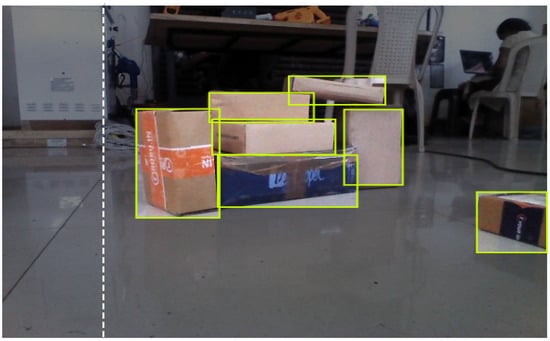
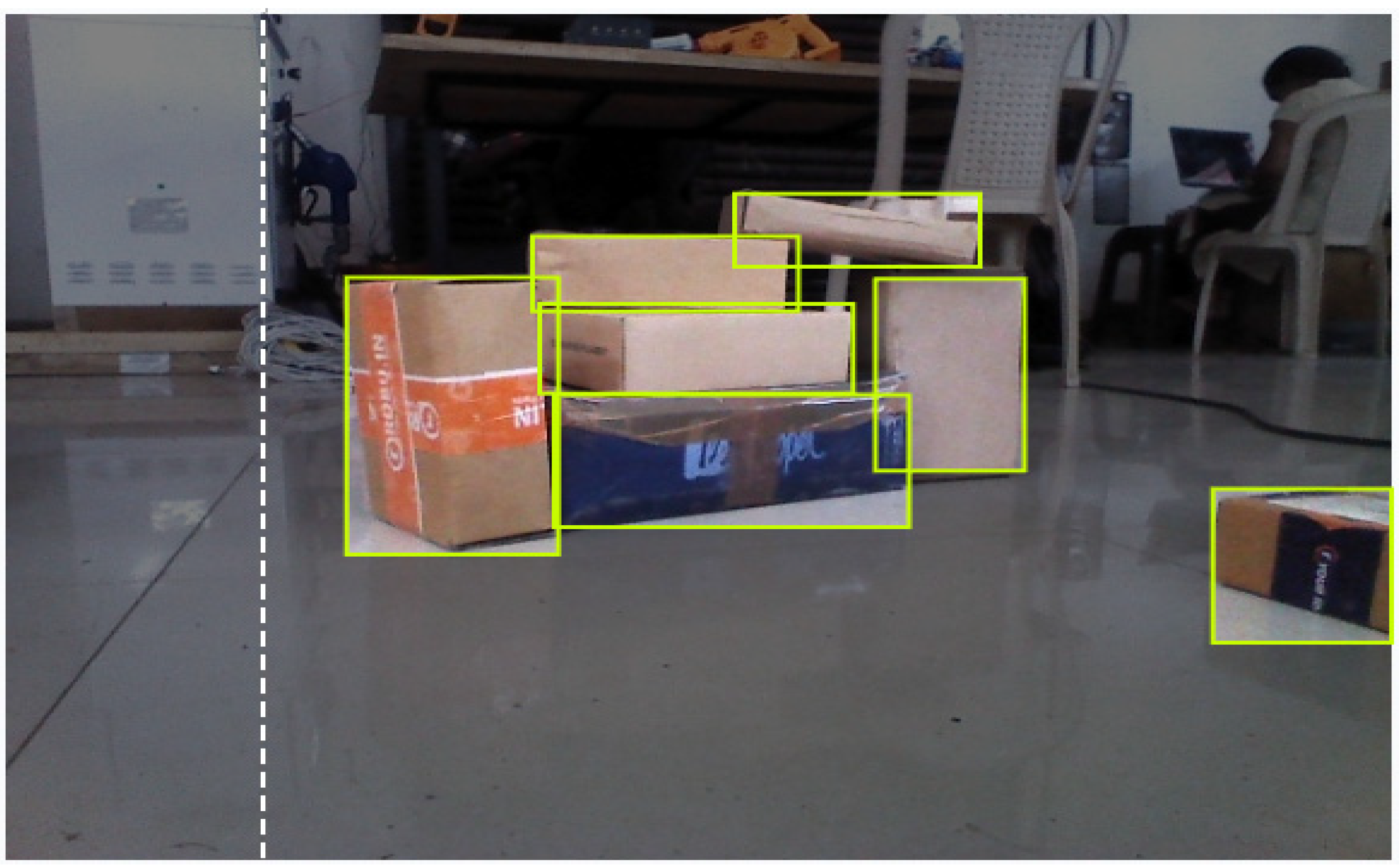
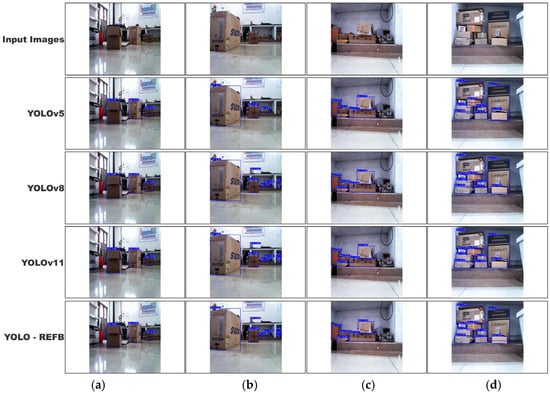
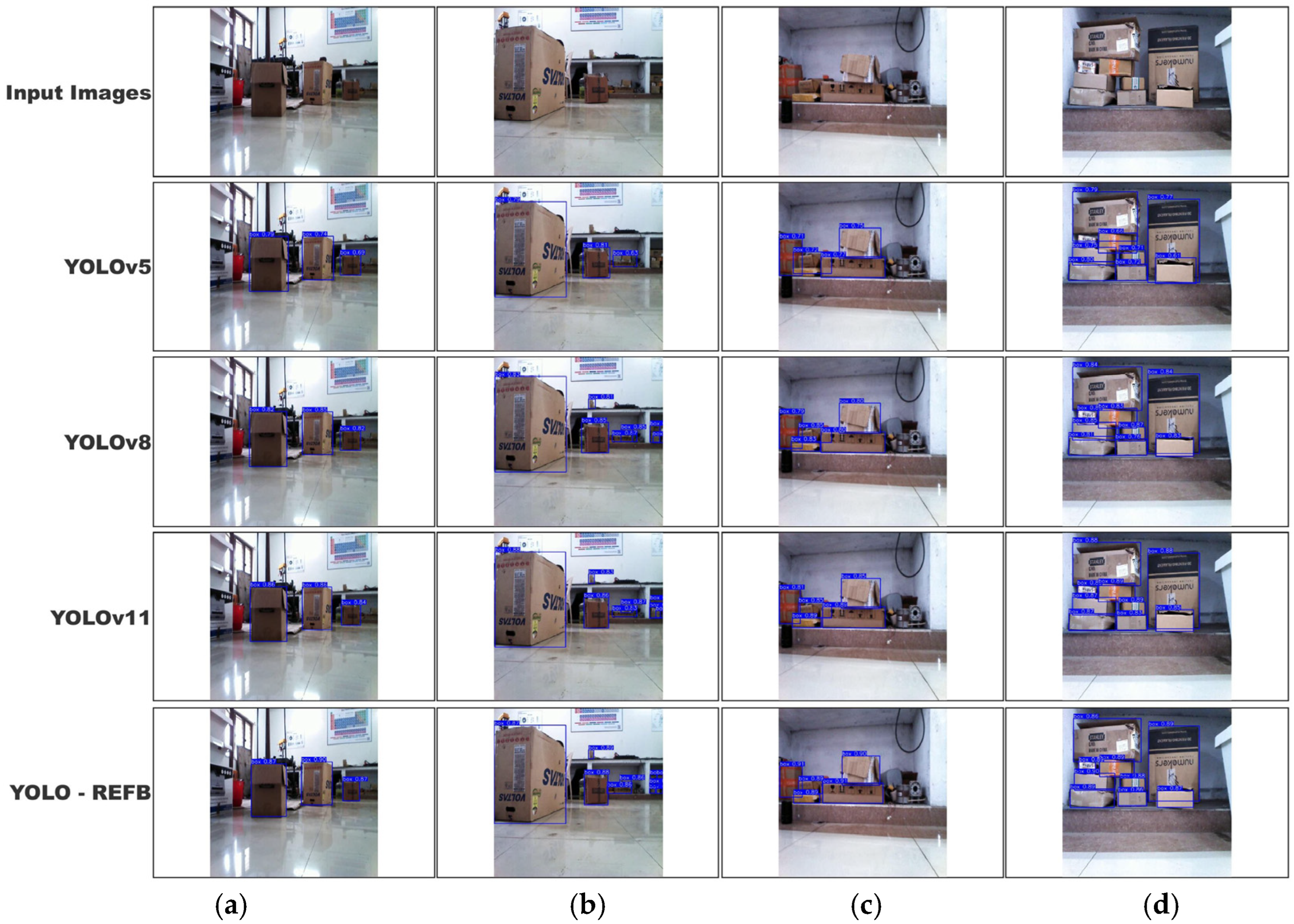
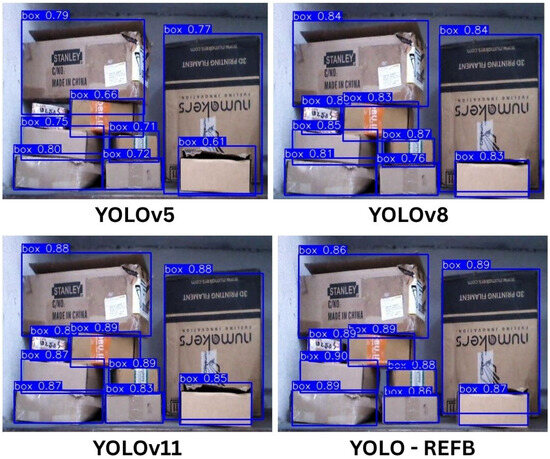
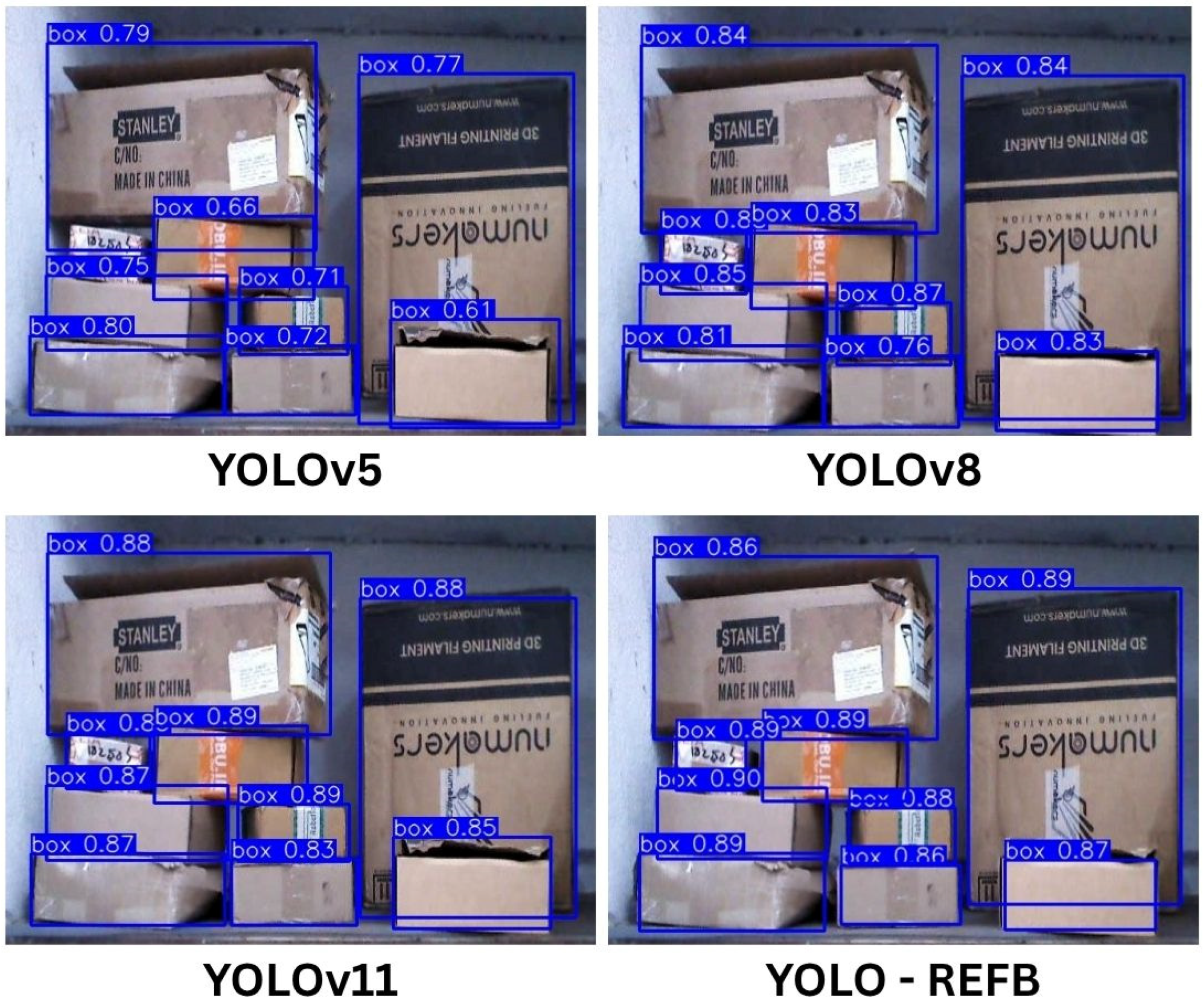
The qualitative comparison of the sample detection outputs clearly illustrates the impact of each modification, as shown in Figure 10a–d and Figure 11. The baseline YOLOv11 model produces acceptable detections for large and fully visible cardboard boxes; however, it shows weaker localization, lower confidence scores, and occasional missed detections in cases of small objects, partial occlusions, and complex backgrounds. When the REFB is incorporated, the detected bounding boxes become more compact and better aligned with the actual object boundaries, and the model successfully identifies boxes that were previously missed. Additionally, the confidence of true-positive detections increases, while false positives are reduced, indicating improved feature discrimination. The output prediction images on the validation dataset show that the baseline YOLO models can detect prominent and fully visible boxes; however, they exhibit missed detections and less accurate bounding boxes in cases involving small-scale objects, partial occlusions, non-uniform illumination, and cluttered backgrounds. In contrast, the proposed YOLO-REFB model produces consistently tighter and more geometrically aligned bounding boxes, with higher confidence scores and improved detection of partially visible boxes. This qualitative improvement confirms that the integration of REFB enhances structural feature learning and enables the network to better capture the rectangular boundaries of cardboard boxes.
Figure 10.
(a–d). Detection of cardboard boxes in ablation study of YOLO models.
Figure 11.
Enlarged view of cardboard boxes of Figure 10d.
The comparison of the detection outputs across all YOLO variants reveals a clear improvement in confidence score estimation, as displayed in Table 3, for the proposed YOLO-REFB model. The mean and standard deviation of detected confidence scores were computed across multiple cardboard boxes per scenario (a to d) to evaluate both the central tendency and variability of the model predictions, thereby providing a quantitative measure of consistency and robustness under varying warehouse environment conditions. In the baseline models, although most of the prominently visible cardboard boxes are detected, the associated confidence scores tend to fluctuate, particularly in challenging scenarios such as low illumination, partial occlusion, scale variation, and background clutter. These models often assign lower confidence values to small or partially visible boxes and occasionally produce moderate-confidence false positives in structurally similar regions. In contrast, the proposed YOLO-REFB model consistently generates higher and more stable confidence scores for true-positive detections while suppressing incorrect predictions.
Table 3.
Statistical comparison of YOLO models with confidence score detected (means ± standard deviations).
The bounding boxes produced by the proposed model are not only tighter and better aligned with object edges but are also accompanied by strong confidence values, indicating improved certainty in object classification. This behavior is quantitatively supported by the confidence score comparison table, where the proposed model achieves the highest average detection confidence across the validation dataset when compared with other YOLO versions. The increase in confidence values reflects the enhanced discriminative feature learning enabled by the REFB, which strengthens the representation of box-specific edge and shape information. From a robotic manipulation perspective, higher confidence detections are crucial because they allow for more reliable object selection for grasp planning and reduce the probability of execution failures. Therefore, both the visual output analysis and the tabulated confidence score comparison confirm that the proposed architecture provides more reliable and stable predictions for real-time cardboard box detection. All models were trained and evaluated under identical experimental conditions to ensure fair comparison. Although the reported mAP values are obtained from single training runs, the observed performance improvement is consistent with the trends observed across other evaluation metrics. A detailed statistical evaluation across multiple runs will be considered in future work.
3.4. Results and Discussion
The training curves generated for precision, recall, mAP@0.5, and mAP@0.5:0.95 over 100 epochs shows smooth convergence behavior, where the proposed model achieves faster stabilization and higher saturation values compared with the other YOLO variants. The precision curve indicates a significant reduction in false positives as training progresses, while the recall curve demonstrates the improved ability of the model to detect difficult and occluded objects. Similarly, the mAP plots show a consistent and steeper performance gain, highlighting superior localization accuracy across multiple IoU thresholds. The F1-score trend further confirms the balanced optimization between precision and recall, which is essential to reliable robotic perception. Quantitatively, the comparison table across all YOLO models reveals that the proposed YOLOv11-REFB model achieves the highest performance in terms of precision, recall, mAP@0.5, and mAP@0.5:0.95 while maintaining the real-time characteristics required for deployment on a DAMR. These results validate that the feature extraction and fusion strategy significantly improves detection robustness and localization accuracy, making the proposed architecture highly suitable for autonomous warehouse manipulation tasks.
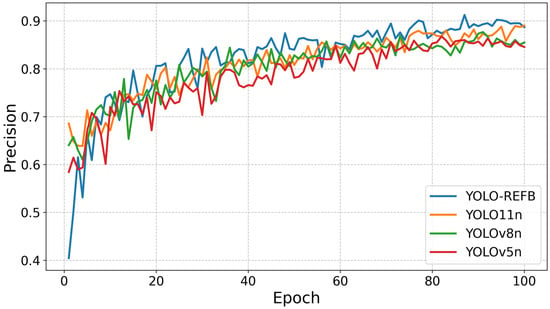
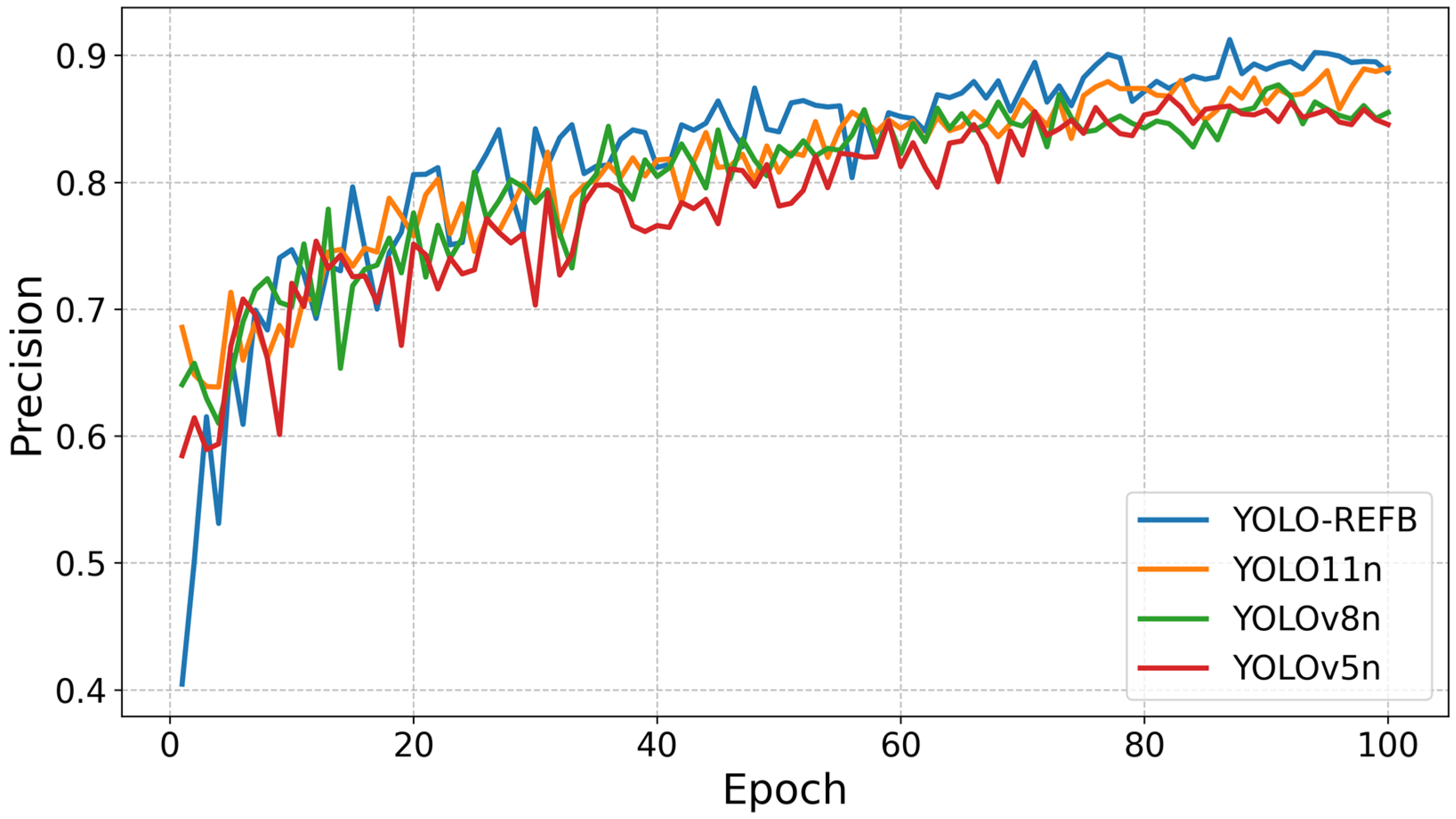
Figure 12 presents the precision comparison of YOLO-REFB, YOLOv11n, YOLOv8n, and YOLOv5n over 100 training epochs. Precision reflects the model’s ability to correctly identify positive detections while minimizing false positives. In the initial stage of training, the proposed YOLO-REFB model starts with a lower precision value compared with the baseline models. This initial drop is expected because the integration of the REFB module alters the network structure, limiting the complete utilization of pre-trained weights in the early epochs. As a result, the model requires several iterations to adjust and stabilize. However, after the early training phase, the precision of YOLO-REFB increases rapidly and begins to surpass the baseline models. From the mid-training stage onward, the proposed model consistently maintains higher precision values, indicating improved confidence in object detection and reduced false-positive predictions. Toward the final epochs, all models converge, but YOLO-REFB achieves the highest overall precision among the compared methods. This steady improvement suggests that the REFB module enhances feature extraction capability, enabling the network to make more accurate and reliable predictions.
Figure 12.
Comparison of precision in cardboard detection using YOLO models.
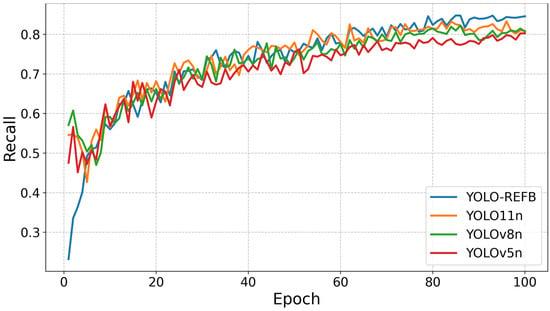
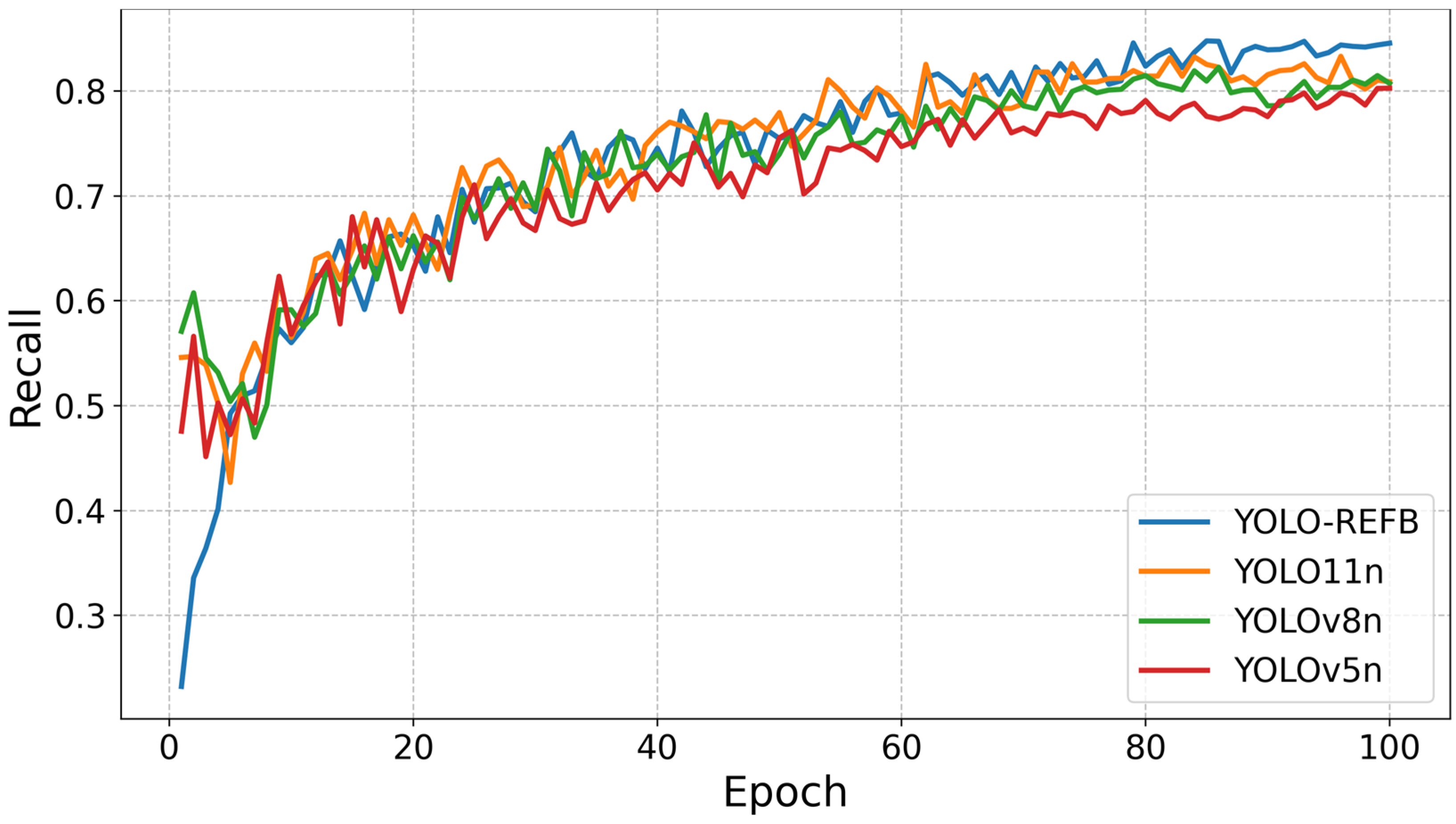
Figure 13 shows the recall comparison of YOLO-REFB with other models across 100 training epochs. Recall measures the model’s ability to correctly detect all relevant objects, indicating how effectively it minimizes missed detections. In the initial training phase, the proposed YOLO-REFB model starts with a lower recall value compared with the baseline models. This behavior is expected because the introduction of the REFB module modifies the backbone structure, and the pre-trained weights are not fully aligned with the newly added layers. Consequently, the model requires several epochs to adjust and learn meaningful feature representations. As training progresses, the recall of YOLO-REFB increases rapidly and begins to surpass the baseline models. From the mid-training stage onward, the proposed model consistently achieves higher recall values, demonstrating its improved ability to detect a greater number of true objects in the dataset. In the final epochs, all models approach convergence; however, YOLO-REFB maintains the highest recall among the methods compared. This improvement suggests that the REFB module enhances feature extraction and spatial awareness, allowing the network to capture more relevant objects while reducing missed detections.
Figure 13.
Recall comparison of cardboard detection using YOLO models.
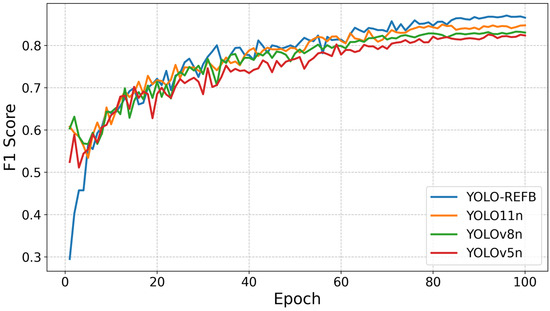
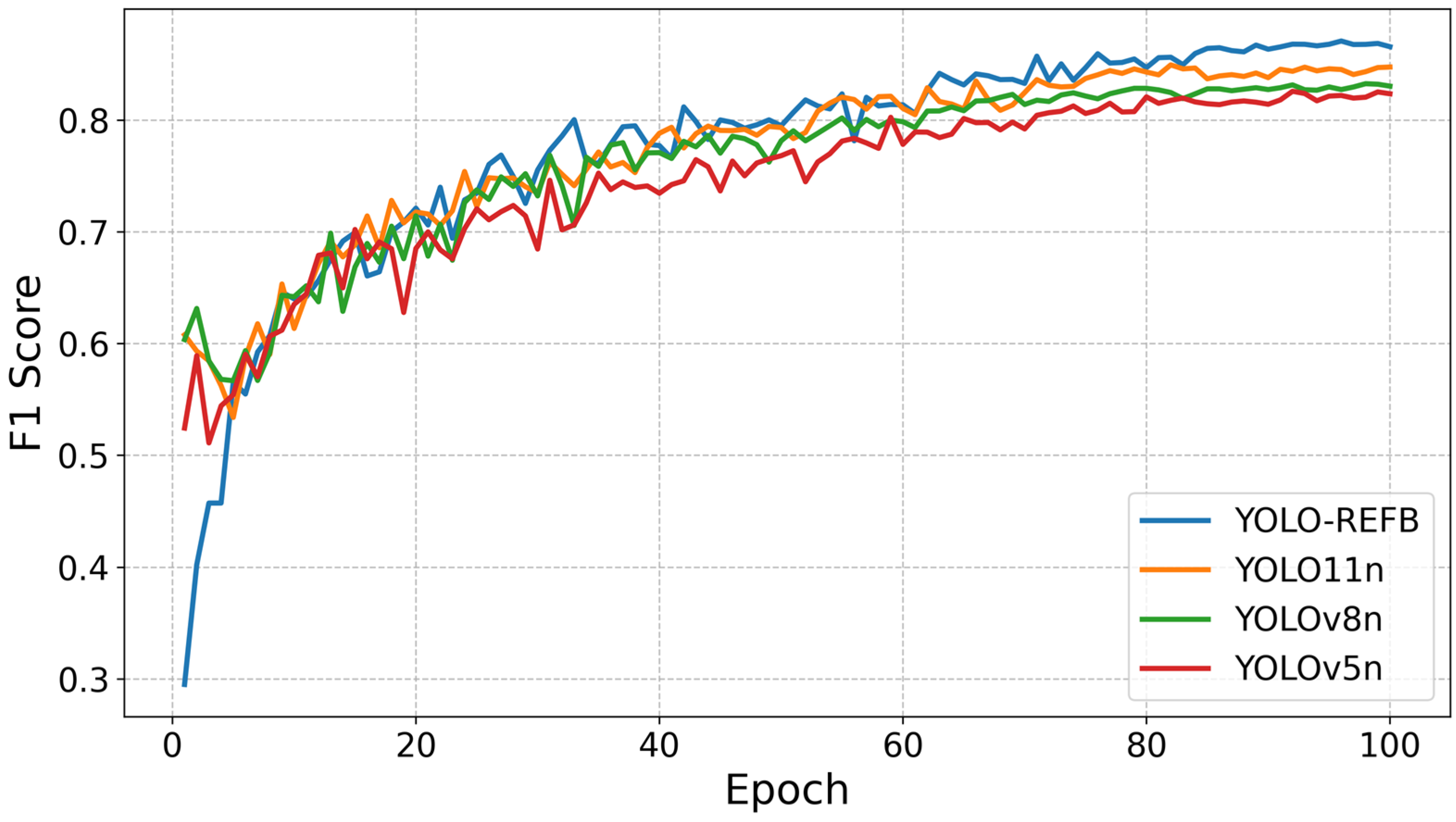
Figure 14 illustrates the F1-score comparison of YOLO-REFB, YOLOv11n, YOLOv8n, and YOLOv5n over 100 training epochs. The F1-score represents the harmonic mean of precision and recall, providing a balanced evaluation of a model’s detection performance by considering both false positives and missed detections. In the initial training stage, the proposed YOLO-REFB model starts with a lower F1-score compared with the baseline models.
Figure 14.
F1-score comparison of cardboard detection using YOLO models.
The introduction of the REFB module modifies the original architecture, limiting the immediate benefit of pre-trained weights and requiring additional epochs for stabilization. As training progresses, the F1-score of YOLO-REFB increases rapidly and begins to exceed that of the baseline models. During the mid-training phase, the proposed model maintains consistently higher F1 values, indicating improved balance between precision and recall. In the final epochs, all models approach convergence; however, YOLO-REFB achieves the highest overall F1-score among the compared methods. This consistent improvement demonstrates that the REFB module enhances detection confidence and object coverage, resulting in more balanced and robust object detection performance.
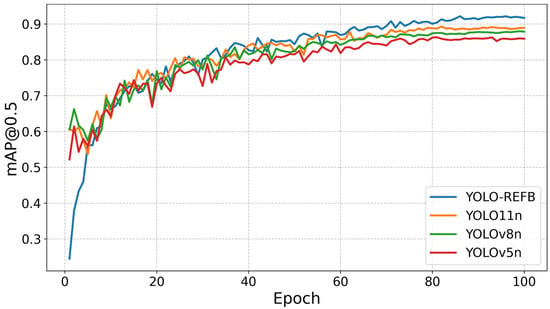
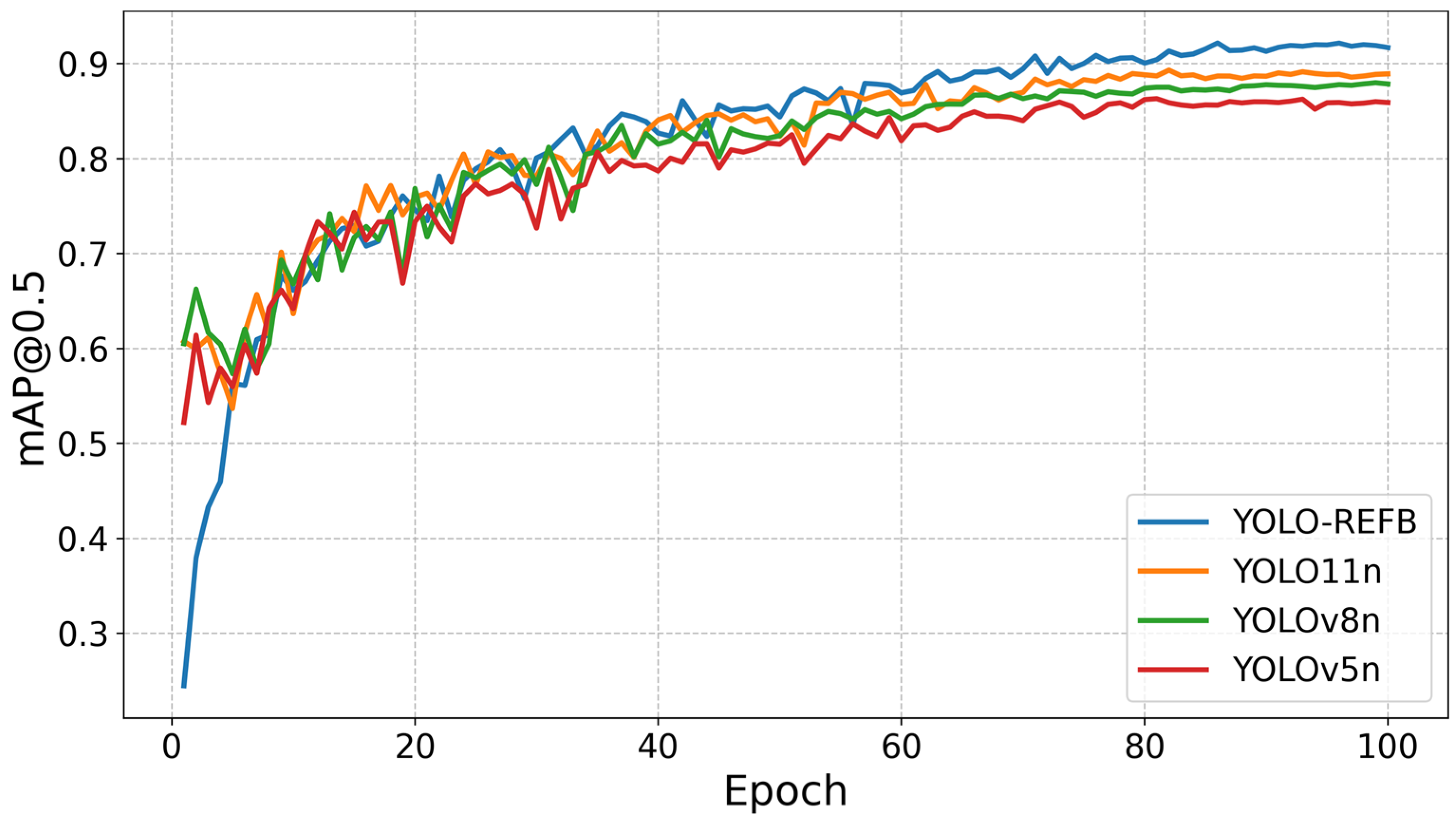
At the beginning of training (the first few epochs), the proposed YOLO-REFB model starts with a relatively lower mAP value compared with the baseline models. This behavior is expected because the REFB module modifies the original backbone structure; therefore the pre-trained weights from the standard YOLO model cannot fully transfer to the newly introduced layers. As a result, the network initially requires additional learning to adapt and stabilize the newly added feature extraction blocks. However, after the early training phase, the proposed model shows a rapid improvement in performance. This indicates that the REFB module effectively learns discriminative features once the network begins to adjust its weight. From approximately epoch 10 onward, YOLO-REFB consistently outperforms the baseline models. During the middle training phase (epochs 20–60), all models demonstrate gradual performance improvements, but the proposed model maintains a noticeable advantage. This suggests that the enhanced receptive field and multi-directional feature extraction introduced by the REFB block improve localization accuracy and feature representation. In the final stage of training (epochs 80–100), the models converge, and YOLO-REFB achieves the highest mAP@0.5 among all compared methods, as shown in Figure 15.
Figure 15.
mAP@0.5 comparison of cardboard detection using YOLO models.
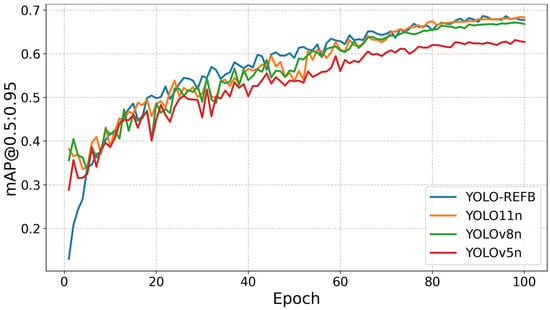
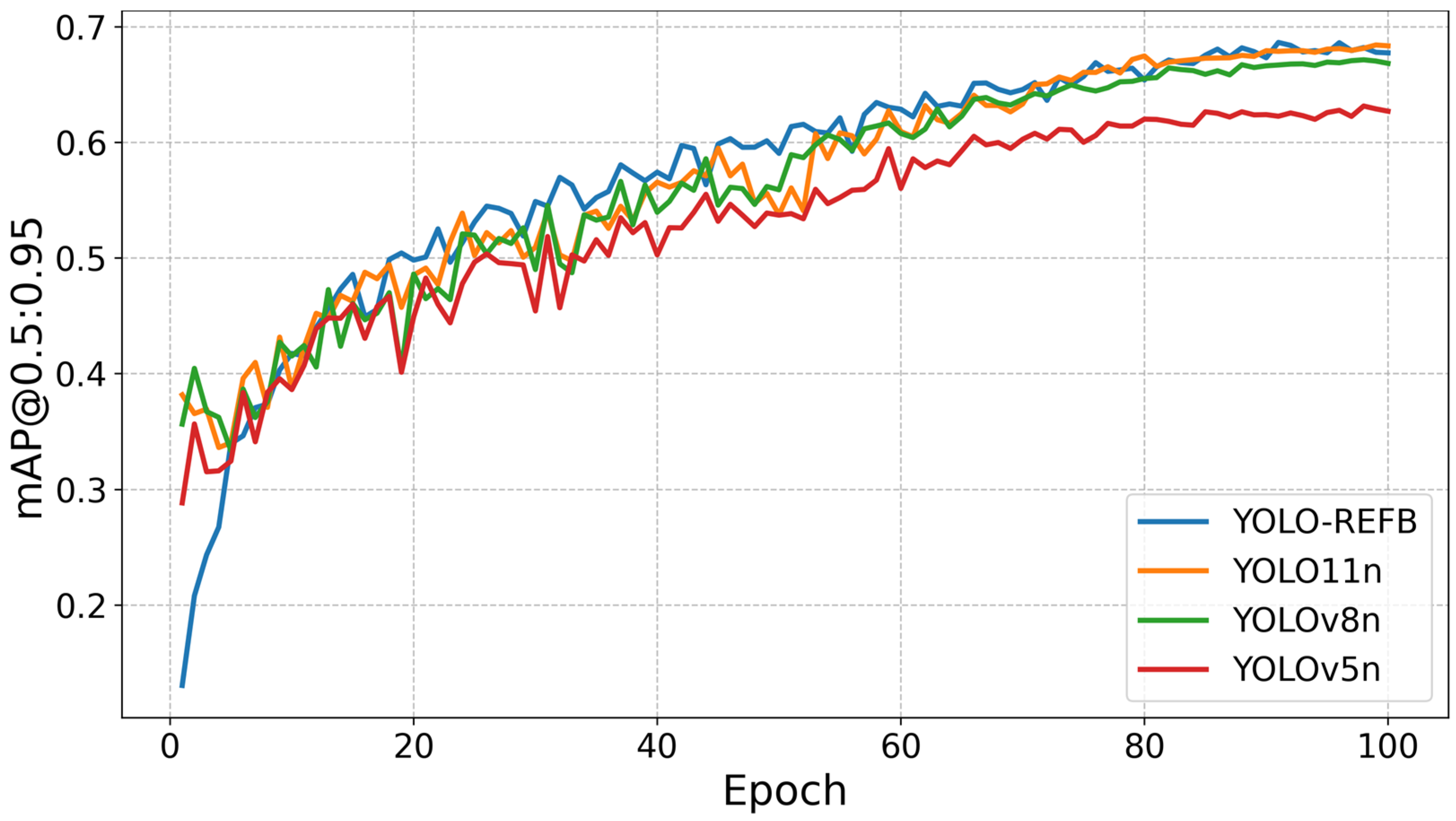
Figure 16 illustrates the comparison of mAP@0.5:0.95 over 100 training epochs for the proposed YOLO-REFB model and the baseline models. Since mAP@0.5:0.95 evaluates detection performance across multiple IoU thresholds from 0.5 to 0.95, it provides a stricter and more comprehensive measure of both detection accuracy and bounding-box localization quality. In the initial stage of training, the proposed YOLO-REFB model shows a relatively lower starting value compared with the baseline models. This behavior is expected because the integration of the REFB module modifies the original network structure, limiting the full utilization of pre-trained weights in the newly introduced layers. Consequently, the model requires additional epochs to adapt and stabilize. As training progresses, the proposed model demonstrates rapid improvement and consistently outperforms the baseline methods. During the middle and later training stages, YOLO-REFB maintains higher mAP@0.5:0.95 values, indicating improved localization precision under stricter IoU conditions. By the final epochs, the proposed model achieves the highest performance among all compared models, confirming that the REFB module enhances feature representation and bounding-box alignment, resulting in more accurate and robust object detection.
Figure 16.
mAP@0.5:0.95 comparison of cardboard detection using YOLO models.
The quantitative results displayed in Table 4 show an increase in precision, recall, mAP@0.5, mAP@0.5:0.95, F1-score, training time and inference time compared with the baseline YOLOv11 model, indicating enhanced localization accuracy and reduced false detections. The observed increase in training time compared with YOLOv11n is attributed to the additional feature extraction operations introduced by the REFB module. The improvement over the YOLOv11n baseline confirms that architectural enhancement contributes positively to detection performance without affecting training stability. Overall, the proposed model starts slightly lower due to partial incompatibility with pre-trained weights, and it surpasses all baseline models as training progresses, demonstrating better convergence behavior and improved final detection accuracy.
Table 4.
Comparison of YOLO-REFB with other YOLO models.
4. Conclusions
The work presented in this study introduced a novel object detection framework, YOLO-REFB, for reliable cardboard box detection in real-time robotic manipulation scenarios. By integrating the REFB into the backbone and neck of the baseline YOLOv11 architecture, the proposed model was specifically tailored to learn the geometric and structural characteristics of cardboard boxes. The directional convolutions enable enhanced extraction of horizontal and vertical edge information, while feature fusion and residual learning ensure stable training and preservation of spatial localization cues.
A custom dataset was generated with 3501 images collected in different places in the laboratory using an RGB-D camera mounted on a DAMR to replicate realistic warehouse operating conditions. The dataset included variations in illumination, scale, occlusion, viewpoint, and background complexity, ensuring that the trained model generalized well to practical deployment scenarios. The images were randomly distributed across the existing training and validation subsets while maintaining the overall 80:20 training–validation ratio. All images were carefully annotated and trained using Roboflow software, which ensured tight bounding-box alignment with cardboard box boundaries to enable a fair comparison with existing YOLO models. The evaluation, performed over 100 training epochs using standard object detection metrics (precision, recall, mAP@0.5, mAP@0.5:0.95 and F1-score), demonstrated smooth convergence behavior and improved detection stability for the proposed method.
Quantitative results confirmed the superiority of YOLO-REFB over the baseline YOLOv11 model and other YOLO variants (YOLOv8n and YOLOv5n). Table 4 shows an increase in precision, recall, mAP@0.5, mAP@0.5:0.95 and F1-score, indicating enhanced localization accuracy and reduced false detections. The proposed model achieved higher precision (89.29%), recall (83.95%) and F1-score (86.54%), indicating reduced false detections and improved object coverage, while the significant improvement in mAP@0.5 (91.68%), mAP@0.5:0.95 (68.61%) and high confidence score detected (0.95), validate its enhanced localization accuracy. The output detected images showed tighter bounding boxes, higher confidence scores, and robust detection of partially visible and small-scale boxes. The ablation study demonstrates that the inclusion of the REFB is the primary factor contributing to the observed performance improvement. The REFB enhances the model’s ability to learn structurally meaningful features, particularly edge and shape information, which are not effectively captured by conventional convolutional layers. As a result, the proposed model achieves more accurate and reliable detection of cardboard boxes under challenging indoor conditions. This improvement in detection performance directly contributes to more effective perception in the DAMR system, thereby supporting improved task execution in real-world environments. Therefore, the YOLO-REFB model represents a real-time, structurally aware detection framework suitable for intelligent warehouse automation.
D4espite these advancements, certain limitations remain. The proposed model is primarily optimized for rectangular-object detection and may not generalize equally well to irregularly shaped objects. In addition, the current work focuses mainly on perception, and full integration with dual-arm grasp planning and coordinated manipulation is not explored.
In ongoing and future work, efforts will be directed toward further expanding and refining the dataset to include more diverse real-world scenarios, as well as evaluating the proposed framework on publicly available benchmark datasets to assess generalization capability across different environments. Additionally, the framework can be extended to 3D pose estimation, multi-object grasp planning, and integration with whole-body motion control for fully autonomous bimanual manipulation. Overall, the YOLO-REFB model provides a real-time, geometry-aware detection framework that is well-suited for intelligent warehouse automation and robotic perception tasks.
Author Contributions
Introduction/Methodology/Experimentation and Validation/Writing/Editing done by N.K.K.; Review and Editing done by P.R.V. All authors have read and agreed to the published version of the manuscript.
Funding
This research received no external funding.
Data Availability Statement
The data presented in this study are available upon request from the corresponding author.
Acknowledgments
During the preparation of this manuscript/study, the authors used Chat GPT Plus, Quill bot premium versionand Grammarly (V1.2.254.1880) for the purposes of paraphrasing and correcting grammar in sentences only. The authors have reviewed and edited the output and take full responsibility for the content of this publication.
Conflicts of Interest
The authors declare no conflicts of interest.
Abbreviations
The following abbreviations are used in this manuscript:
| YOLO | You Only Look Once |
| REFB | Rectangular Edge Fusion Block |
| DAMR | Dual-Arm Mobile Robot |
| mAP | Mean Average Precision |
| ROS 2 | Robot Operating System-2 |
| CNN | Convolutional Neural Network |
| RGB-D | Red, Green, Blue–Depth |
References
- Ferreira, B.; Reis, J. A systematic literature review on the application of automation in logistics. Logistics 2023, 7, 80. [Google Scholar] [CrossRef] [Scilit]
- Santosa, E.; Gunawan, A.A.S. Ensemble stacking for cardboard box defect detection using ResNet-50 and Inception V3. In Proceedings of the 2025 7th International Conference on Cybernetics and Intelligent System (ICORIS); IEEE: New York, NY, USA, 2025; pp. 245–249. [Google Scholar] [CrossRef] [Scilit]
- Ghodsian, N.; Benfriha, K.; Olabi, A.; Gopinath, V. Mobile Manipulators in Industry 4.0: A review of developments for industrial applications. Sensors 2023, 23, 8026. [Google Scholar] [CrossRef] [Scilit]
- Soori, M.; Arezoo, B. Autonomous mobile robots in logistics and supply chain management of Industry 4.0: A review. Acta Mech. Autom. 2025, 19, 749–760. Available online: https://reference-global.com/article/10.2478/ama-2025-0084 (accessed on 20 April 2026).
- Abdul-Khalil, S.; Abdul-Rahman, S.; Mutalib, S.; Izyanie, S. A review on object detection for autonomous mobile robot. IAES Int. J. Artif. Intell. IJ-AI 2023, 12, 1033–1043. [Google Scholar] [CrossRef] [Scilit]
- Tjahyaningtijas, H.P.A.; Widayaka, P.D.; Alfatikarani, R.; Alamsyah, S.A.; Puspitaningayu, P.; Ningrum, L.E.C.; Paragas, J.R. Object Detection for Wheeled Mobile Robot Based Using Deep Learning: Systematic Review. J. Robot. Control 2025, 6, 1425–1433. Available online: https://journal.umy.ac.id/index.php/jrc/article/view/24979 (accessed on 20 April 2026).
- Aulia, U.; Hasanuddin, I.; Nasaruddin, N.; Dirhamsyah, M. A new CNN-based object detection system for autonomous mobile robots based on real-world vehicle datasets. Heliyon 2024, 10, e35247. [Google Scholar] [CrossRef] [Scilit]
- Ren, S.; He, K.; Girshick, R.; Sun, J. Faster R-CNN: Towards Real-Time Object Detection with Region Proposal Networks. IEEE Trans. Pattern Anal. Mach. Intell. 2017, 39, 1137–1149. [Google Scholar] [CrossRef] [Scilit] [PubMed]
- Li, T.; Huang, B.; Li, C.; Huang, M. Application of convolution neural network object detection algorithm in logistics warehouse. J. Eng. 2019, 2019, 9053–9058. [Google Scholar] [CrossRef] [Scilit]
- Top, A.; Gökbulut, M. Real-time deep learning-based position control of a mobile robot. Eng. Appl. Artif. Intell. 2024, 138, 109373. [Google Scholar] [CrossRef] [Scilit]
- Jiang, P.; Ergu, D.; Liu, F.; Cai, Y.; Ma, B.; Jiang, P. A Review of Yolo Algorithm Developments. Procedia Comput. Sci. 2022, 199, 1066–1073. [Google Scholar] [CrossRef] [Scilit]
- Diwan, T.; Anirudh, G.; Tembhurne, J.V. Object detection using YOLO: Challenges, architectural successors, datasets and applications. Multimed. Tools Appl. 2023, 82, 9243–9275. [Google Scholar] [CrossRef] [Scilit]
- Redmon, J.; Divvala, S.; Girshick, R.; Farhadi, A. You Only Look Once: Unified, Real-Time Object Detection. In Proceedings of the 2016 IEEE Conference on Computer Vision and Pattern Recognition, Las Vegas, NV, USA, 27–30 June 2016; pp. 779–788. [Google Scholar] [CrossRef] [Scilit]
- Singh, K.J.; Kapoor, D.S.; Thakur, K.; Sharma, A.; Gao, X. Computer-Vision Based Object Detection and Recognition for Service Robot in Indoor Environment. Comput. Mater. Contin. 2022, 72, 197–213. [Google Scholar] [CrossRef] [Scilit]
- Cao, Z.; Liao, T.; Song, W.; Chen, Z.; Li, C. Detecting the shuttlecock for a badminton robot: A YOLO-based approach. Expert Syst. Appl. 2021, 164, 113833. [Google Scholar] [CrossRef] [Scilit]
- Sun, R.; Wu, C.; Zhao, X.; Zhao, B.; Jiang, Y. Object recognition and grasping for collaborative robots based on vision. Sensors 2023, 23, 5932. [Google Scholar] [CrossRef] [Scilit]
- Reis, D.H.D.; Welfer, D.; De Souza Leite Cuadros, M.A.; Gamarra, D.F.T. Mobile Robot Navigation Using an Object Recognition Software with RGBD Images and the YOLO Algorithm Mobile Robot Navigation Using an Object Recognition. Appl. Artif. Intell. 2019, 33, 1290–1305. [Google Scholar] [CrossRef] [Scilit]
- Liu, G.; Hu, Y.; Chen, Z.; Guo, J.; Ni, P. Lightweight object detection algorithm for robots with improved YOLOv5. Eng. Appl. Artif. Intell. 2023, 123, 106217. [Google Scholar] [CrossRef] [Scilit]
- Zeng, T.; Li, S.; Song, Q.; Zhong, F.; Wei, X. Lightweight tomato real-time detection method based on improved YOLO and mobile deployment. Comput. Electron. Agric. 2023, 205, 107625. [Google Scholar] [CrossRef] [Scilit]
- Wang, F.; Song, C. YOLO-ARM: An enhanced YOLOv7 framework with adaptive attention receptive module for high-precision robotic vision object detection. Alex. Eng. J. 2025, 129, 1326–1339. [Google Scholar] [CrossRef] [Scilit]
- Li, J.; Li, C.; Zeng, S.; Luo, X.; Chen, C.L.P.; Yang, C. A lightweight pineapple detection network based on YOLOv7-tiny for agricultural robot system. Comput. Electron. Agric. 2025, 231, 109944. [Google Scholar] [CrossRef] [Scilit]
- Zhao, P.; Yang, S.; Chen, J.; Li, J.; Ning, J.; Chang, Y. Design and testing of an autonomous laser weeding robot for strawberry fields based on DIN-LW-YOLO. Comput. Electron. Agric. 2025, 229, 109808. [Google Scholar] [CrossRef] [Scilit]
- Mahaadevan, V.C.; Narayanamoorthi, R.; Pushparaj Logeshwer, S.; Jain, H.; Panda, S.; Moldrik, P.; Novak, T.; Gono, R. Integrated design and YOLO-based control framework for autonomous EV charging robot platforms. Results Eng. 2025, 26, 105438. [Google Scholar] [CrossRef] [Scilit]
- Chi, M.; Chang, S.; Guo, Z.; Huang, S.; Li, Z.; Li, J.; Xia, Z.; Zheng, Z.; Ren, Q. Research on Target Recognition and Grasping of Dual-arm Cooperative Mobile Robot Based on Vision. In Proceedings of the 2024 International Symposium on Intelligent Robotics and Systems, Changsha, China, 14–16 June 2024; pp. 232–236. [Google Scholar] [CrossRef] [Scilit]
- Wu, Y.; Chen, J.; Yu, X.; Li, J. YOLO-FOA: A lightweight rotational target detection algorithm based on improved YOLO for optical fiber robot. Biomim. Intell. Robot. 2026, 6, 100273. [Google Scholar] [CrossRef] [Scilit]
- Yang, L.; Noguchi, T.; Hoshino, Y. Development of a pumpkin fruits pick-and-place robot using an RGB-D camera and a YOLO based object detection AI model. Comput. Electron. Agric. 2024, 227, 109625. [Google Scholar] [CrossRef] [Scilit]
- Wu, T.; Dong, Y. YOLO-SE: Improved YOLOv8 for remote sensing object detection and recognition. Appl. Sci. 2023, 13, 12977. [Google Scholar] [CrossRef] [Scilit]
- Lin, B. Research on Object Localization and Grasping of Collaborative Robotic Arm Based on Deep Learning. In Proceedings of the 2024 5th International Conference on Mechatronics Technology and Intelligent Manufacturing, Nanjing, China, 26–28 April 2024; pp. 616–620. [Google Scholar] [CrossRef] [Scilit]
- Ragab, H.; Ali, S. Real-Time Object Detection and Grasping with an Autonomous Mobile Robot: A Case Study. In Proceedings of the 2024 9th International Conference on Robotics and Automation Engineering, Singapore, 15–17 November 2024; pp. 40–44. [Google Scholar] [CrossRef] [Scilit]
- Vo, H.-T.; Mui, K.C.; Thien, N.N.; Tien, P.P. Automating tomato ripeness classification and counting with YOLOv9. Int. J. Adv. Comput. Sci. Appl. 2024, 15, 1120–1128. [Google Scholar] [CrossRef] [Scilit]
- Pottier, N.; Lau, M.C. A modular object detection system for humanoid robots using YOLO. arXiv 2025, arXiv:2510.13625. [Google Scholar]
- Wang, A.; Chen, H.; Liu, L.; Chen, K.; Lin, Z.; Han, J.; Ding, G. YOLOv10: Real-time end-to-end object detection. arXiv 2024, arXiv:2405.14458. [Google Scholar] [CrossRef] [Scilit]
- Ali, M.L.; Zhang, Z. The YOLO framework: A comprehensive review of evolution, applications, and benchmarks in object detection. Computers 2024, 13, 336. [Google Scholar] [CrossRef] [Scilit]
- Singh, C.; Randhawa, G.S.; Farooque, A.A.; Gill, Y.S.; Fraser, A.; Kumar, L.K.M.; Barrett, R.; Al-Mughrabi, K. AgriScout: AI-powered robot for precise detection of PVY-infected potato plants. Comput. Electron. Agric. 2025, 238, 110781. [Google Scholar] [CrossRef] [Scilit]
- Wu, S.; Chen, H.; Zhang, Y.; Liao, K.; Li, L. Robot visual servo based on lightweight YOLO11-SMMA for Camellia oleifera fruits harvesting. Comput. Electron. Agric. 2026, 243, 111409. [Google Scholar] [CrossRef] [Scilit]
- You, L.; Liu, T.; Shi, R.; Gao, Y.; Wang, J.; Xu, F.; Yang, J. Defect detection in corrugated cardboard based on improved YOLOv5s. In Proceedings of the 2024 9th International Conference on Computer and Communication Systems (ICCCS); IEEE: New York, NY, USA, 2024; pp. 563–567. [Google Scholar] [CrossRef] [Scilit]
- Yang, M.; Li, D.; Luo, P.; Wan, X.; Zhang, Z.; Zhou, L.; Jia, Y. YOLOv5-S-G-B: A lightweight intelligent detection model for cardboard surface defects. Signal Image Video Process. 2024, 18, 6997–7011. [Google Scholar] [CrossRef] [Scilit]
- Yoon, J.; Han, J.; Nguyen, T.P. Logistics box recognition in robotic industrial de-palletising procedure with systematic RGB-D image processing supported by multiple deep learning methods. Eng. Appl. Artif. Intell. 2023, 123, 106311. [Google Scholar] [CrossRef] [Scilit]
- Kwon, J.; Kwon, S. Cardboard packaging minimization: Autonomous box selection by RGB-depth vision system and complementary deep learning classification. Instrum. Sci. Technol. 2025, 53, 267–286. [Google Scholar] [CrossRef] [Scilit]
- Yang, J.; Wu, S.; Gou, L.; Yu, H.; Lin, C.; Wang, J.; Wang, P.; Li, M.; Li, X. SCD: A stacked carton dataset for detection and segmentation. Sensors 2022, 22, 3617. [Google Scholar] [CrossRef] [Scilit] [PubMed]
- Auh, E.; Oh, I.; Lee, J.; Pico, N.; Park, Y.; Jang, J.H.; Lee, H.; Coutinho, A.; Park, J.; Jung, B.; et al. Development of a dual-arm autonomous container unloading robot system for various logistics packages. In IEEE Robotics & Automation Magazine; IEEE: New York, NY, USA, 2026. [Google Scholar] [CrossRef] [Scilit]
- He, K.; Zhang, X.; Ren, S.; Sun, J. Deep residual learning for image recognition. In Proceedings of the 2016 IEEE Conference on Computer Vision and Pattern Recognition, Las Vegas, NV, USA, 27–30 June 2016; pp. 770–778. [Google Scholar] [CrossRef] [Scilit]
- Yesudasu, S.; Brethé, J.F. Advanced Techniques for Corners, Edges, and Stacked Gaps Detection and Pose Estimation of Cardboard Packages in Automated Dual-Arm Depalletising Systems. In Proceedings of the 21st International Conference on Informatics in Control, Automation and Robotics; SciTePress: Setúbal, Portugal, 2024; Volume 2, pp. 264–273. [Google Scholar] [CrossRef] [Scilit]
- Wang, G.; Li, S.; Zhu, X.; Wang, Y.; Huang, J.; Zhong, Y.; Wu, Z. REW-YOLO: A lightweight box detection method for logistics. Modelling 2025, 6, 76. [Google Scholar] [CrossRef] [Scilit]
- Roboflow. Available online: https://universe.roboflow.com/carboard-box/carboard-box (accessed on 25 January 2026).
- Zhang, Z.; Liu, L.; Zhao, X.; Zhang, L.; Wu, J.; Zhang, Y. DSSO-YOLO: A fast detection model for densely stacked small object. Displays 2024, 82, 102659. [Google Scholar] [CrossRef] [Scilit]
- Ultralytics YOLO. Available online: https://docs.ultralytics.com/models/yolo11/ (accessed on 15 January 2026).
- Jin, S.; Zhou, L.; Zhou, H. CO-YOLO: A lightweight and efficient model for Camellia oleifera fruit object detection and posture determination. Comput. Electron. Agric. 2025, 235, 110394. [Google Scholar] [CrossRef] [Scilit]

Disclaimer/Publisher’s Note: The statements, opinions and data contained in all publications are solely those of the individual author(s) and contributor(s) and not of MDPI and/or the editor(s). MDPI and/or the editor(s) disclaim responsibility for any injury to people or property resulting from any ideas, methods, instructions or products referred to in the content. |
© 2026 by the authors. Licensee MDPI, Basel, Switzerland. This article is an open access article distributed under the terms and conditions of the Creative Commons Attribution (CC BY) license.