


Abstract
This study investigated the distribution of 40K, 137Cs and 90Sr during the processing of cow milk into cottage cheese from central Bosnia and Herzegovina and Livno cheese from the southwestern production area, with particular emphasis on physicochemical composition and regional differences. Raw milk (n = 15 per group), corresponding cheeses (n = 15 per group), and composite whey samples (one per cheese type) were analyzed for protein, fat, dry matter, water content, 40K, and 137Cs, as well as titratable acidity in milk samples. In a random second-stage subset, because of the cost and complexity of the radiochemical method, 90Sr was determined. Mean activity concentrations in milk used for cottage and Livno cheese production were 42.31 and 40.77 Bq/L for 40K, 0.030 and 0.057 Bq/L for 137Cs, and 0.015 and 0.030 Bq/L for 90Sr, respectively. Corresponding cheese means were 26.45 and 28.23 Bq/kg for 40K, 0.038 and 0.087 Bq/kg for 137Cs, and 0.073 and 0.369 Bq/kg for 90Sr. Processing retention factors showed limited transfer of 40K and 137Cs into cheese, whereas 90Sr was retained mostly in the curd. Significant regional differences were observed for 137Cs in both milk and cheese, whereas 40K did not differ significantly between regions. Differences between regions for 90Sr were also indicated, but these results should be interpreted cautiously because it was analyzed only in a limited second-stage subset. These findings show that radionuclide behavior in artisanal dairy systems is jointly shaped by radionuclide chemistry, cheese technology, and local environment, highlighting the need for site-specific food-chain assessment.
1. Introduction
Numerous nuclear accidents have occurred in both the past and present centuries, and ongoing global instability continues to pose a risk of similar events. In the aftermath of such incidents, authorities and experts are responsible for protecting public health and ensuring the safety of the food supply. The relevance of radionuclide monitoring in dairy systems has been reinforced by recent radiological events and renewed concerns about nuclear safety. Post-Fukushima surveillance demonstrated that long-term monitoring of foodstuffs, including milk and infant-food categories, is essential for evaluating the persistence and spatial heterogeneity of radiocaesium contamination in the food chain. Large-scale Japanese monitoring data collected after the Fukushima Daiichi accident showed that food-chain contamination may remain detectable and requires risk-based interpretation over extended periods, even when most products remain below regulatory limits [1]. At the European level, routine environmental radioactivity monitoring continues to include milk and mixed diet as key food-chain matrices, reflecting their relevance for assessing population exposure and verifying long-term radiological safety [2]. This issue has gained additional importance since 2022, as the war in Ukraine and repeated nuclear safety concerns regarding nuclear facilities have underscored the need for robust baseline data and processing-specific models for foods of high dietary and economic importance.
Processing contaminated milk into dairy products is considered an important radiation protection measure. Under conditions of environmental radioactive contamination, processing can reduce radionuclide concentrations in milk and dairy products. In cases where contamination levels remain too high for cheese production, further processing into butter or cream may reduce radionuclide concentrations to acceptable levels, thereby minimizing economic losses in the dairy industry while maintaining food safety [3]. Among radionuclides, radiocaesium (137Cs) is considered one of the most significant environmental contaminants due to its relatively long half-life of 30.2 years [4,5]. Unlike radioiodine, which has a half-life of approximately 8 days and typically ceases to pose a significant risk after several weeks [6], radiocaesium can persist in the environment for decades and consequently contaminate milk and dairy products over extended periods. After ingestion, radiocaesium is relatively uniformly distributed throughout the body, with children being more sensitive than adults, and high doses may affect the bone marrow, reproductive system, liver, and kidneys [7]. The primary dietary sources of caesium intake include milk, mushrooms, berries, and game meat [8].
Radiostrontium (90Sr) is also of particular concern due to its long half-life (28.8 years), widespread presence in the environment, and chemical similarity to calcium. It enters the biosphere through nuclear weapons testing, reactor waste, and nuclear or industrial accidents, subsequently transferring into the food chain via plants, animal feed, and milk [9]. Owing to its metabolic similarity to calcium, radiostrontium is readily incorporated into bones, teeth, and milk, contributing to its presence in dairy products [10]. Although its biological half-life in milk is relatively short (1–2 days), allowing for rapid reduction following the application of radioprotection measures [11,12], 90Sr remains a significant health concern. As a genotoxic carcinogen, it is associated with bone necrosis and cancer, with children being particularly susceptible due to higher absorption and retention in the developing skeleton [13,14].
In contrast, the only naturally occurring radionuclide of potassium is 40K, whose radiological significance is generally low compared with its essential biological role [15]. Due to the chemical similarity between potassium and caesium, their behavior in natural and technological processes is often comparable, and potassium distribution is therefore frequently used as a model for studying caesium distribution.
The production of raw milk in Bosnia and Herzegovina (B&H) represents one of the most significant branches of the agricultural sector. The importance of the dairy industry is reflected in its annual production of more than 600 million liters of milk, thereby making a substantial contribution to rural development. In addition, the dairy sector plays a crucial role in ensuring national food security. It is considered one of the most demanding agricultural sectors with respect to compliance with the regulatory and quality standards required during the accession process to the European Union (EU) [16].
Recent studies indicate that fresh cow milk cheese, also known as cottage cheese, is likely the oldest and most widely produced and consumed type of cheese in households across this region of Europe [17]. The technological process for its production involves milk pasteurization at 65 °C for 20 min, followed by the addition of rennet and CaCl2, without the incorporation of NaCl or starter cultures, while coagulation is carried out over 8 h.
In addition to fresh cheese varieties, several indigenous cheeses are traditionally produced and consumed in B&H, including Livno and Vlašić cheese. Livno cheese is among the most recognized indigenous cheeses in the country and, according to a consumer survey conducted in 2014, was consumed on a weekly basis by 64% of respondents [18]. Its production dates back to 1886 and originates from the southwestern region of B&H, particularly the broader area of the Livno field [19]. Over more than 130 years of production, the characteristics of Livno cheese have undergone notable modifications, primarily due to the gradual transition from sheep milk to cow milk or mixtures of the two. Another important technological advancement was the introduction of milk pasteurization and the application of starter cultures in cheesemaking. More recently, the implementation of modern cheesemaking equipment has enabled additional improvements, particularly in the processes of salting and ripening. Nevertheless, the fundamental production parameters and the distinctive sensory characteristics of this hard full-fat cheese have remained preserved and widely recognizable [19].
Previous studies have shown that radiocaesium is generally more readily transferred to the aqueous phase, whereas radiostrontium, because of its calcium-like behavior, may be retained more efficiently in the curd, especially in calcium-rich hard cheeses [20,21,22,23,24]. However, recent data on processing factors for traditional hard cheeses from Mediterranean and Balkan-type dairy systems remain limited, with one published study [3] independent from the present research, and most available reference values are derived from older experimental studies or from non-regional cheese technologies. Livno cheese was therefore included as a hard-cheese comparator because it represents a traditional ripened cheese from a karst pasture-based production area, allowing the study to examine how environmental setting, milk composition, and cheese technology interact in the transfer of 40K, 137Cs, and 90Sr from milk to cheese.
The study was based on the hypothesis that physicochemical parameters significantly influence the distribution of radionuclides during the processing of cow milk into two distinct cheese types. Accordingly, the objectives were to characterize the physicochemical properties of cow milk and cheese samples, quantify the activity concentrations of 40K, 137Cs, and 90Sr, assess the relationships between these parameters and radionuclide levels, evaluate radionuclide partitioning during cheese manufacture, and estimate the radiological safety limits for milk intended for cheese production.
2. Materials and Methods
This study was conducted on raw cow milk (n = 15) and corresponding cottage cheese samples (n = 15) in the central region of B&H, as well as on raw cow milk (n = 15) and corresponding Livno cheese samples (n = 15) in the southwestern region of B&H. Livno cheese samples were collected after 60 days of ripening. Composite whey samples, as a by-product of the cheese-making process, were collected, one from each type of cheese. The samples were transported to the laboratory at a temperature of +4 °C and were immediately processed for physicochemical analysis, after which radiometric analyses followed.
For physicochemical analyses, the collected sample volumes were approximately 0.2 L of milk, 0.2 L of whey, and 0.2 kg of cheese. For radiometric analyses, sample volumes were approximately 1.0 L of milk, 2.0 L of whey, and 0.5–1.0 kg of cheese.
According to the producers, approximately 5.2 L and 13.0 L of milk were required for the production of 1.0 kg of cottage and Livno cheese, respectively.
2.1. Physicochemical Analyzes
The following parameters were determined in milk and cheese samples: protein, fat, and dry matter (water content), with the titratable acidity additionally determined in milk samples. In the whey samples, the dry matter (water content) and protein content were determined. The determination and calculation procedures were performed in the Laboratory for Residue and Food Quality Testing of the Veterinary Institute of the Faculty of Veterinary Medicine, Sarajevo, Bosnia and Herzegovina.
Total nitrogen was determined using a reference Kjeldahl method and then converted to crude protein using a factor of 6.25.
Fat content in milk/cheese samples was determined using the standard Gerber (acid-butyrometry) method, and the results were expressed as % fat.
Dry matter, i.e., the water content, was determined by drying samples of milk/whey at 102 ± 2 °C and cheese at 105 ± 2 °C until constant weight. The dry matter (%) was calculated as (weight after drying/initial weight) × 100.
The acidity of milk was determined by the Soxhlet–Henkel method, titrating the sample with standardized 0.25 N NaOH and using 2% phenolphthalein as the indicator, giving an end-point of a faint pink color. Results are presented in Soxhlet–Henkel degrees (°SH). Due to technical and instrumental limitations at the time of analysis, certain complementary physicochemical parameters, including pH, NaCl content, ash/mineral content, and water activity, could not be determined. Although the absence of these parameters may limit a more comprehensive interpretation of the compositional characteristics of the cheeses, the obtained dataset still provides valuable insight into the physicochemical composition and radionuclide distribution in the analyzed dairy products.
2.2. Radiometric Analyzes
Sample preparation for radiometric analysis was carried out in the Laboratory for Radioactivity Control of the Veterinary Institute at the University of Sarajevo–Faculty of Veterinary Medicine.
Upon arrival at the laboratory, milk/whey samples were measured using measuring cups and then boiled in appropriate containers on a hot plate for 2 to 3 h until they reached the consistency of pudding. Then, the contents of the container were quantitatively transferred to the appropriate trays, which were placed in the drying oven for dehydration. Drying was conducted with a gradual increase in temperature from 50 °C to 105 °C over 48–72 h, with additional homogenization of the samples on the tray at least once a day using a laboratory spatula. After that, the samples were ground in a laboratory blender to a powder and returned to the trays, where they were briefly dried at a higher temperature (130 °C) for 2 h. Finally, the dried samples were quantitatively transferred into PVC bags and weighed on a technical scale. Their weight was recorded for the subsequent calculation of the activity concentration of radionuclides. A part of the thus prepared sample was then transferred into appropriate PVC containers for the purpose of gamma spectrometric analysis. Some samples required additional mass reduction and were incinerated to ash at 400 °C in muffle annealing furnaces.
Cheese samples were prepared in a similar manner, except for the initial measurement and boiling on the stove. Instead, the cheese samples were weighed and chopped with a knife, and then dried and ground according to the procedure described above.
2.2.1. Gamma Spectrometry
Ground dried or mineralized samples, prepared as described above, were packed in appropriate plastic containers with a capacity of 50, 100, and 200 mL and stored for 24 days before measurement to achieve equilibrium between radionuclides. The sample measurement time varied from 80,000 to 250,000 s, depending on the amount of dry matter, the specific gamma activity of the sample and the type of sample. Laboratory measurements were performed with a high-purity germanium detector (HPGe—Baltic Scientific Instruments, Riga, Latvia) with a relative efficiency of 50%.
The gamma-spectrometric system was calibrated for both energy and absolute efficiency using a standard multi-nuclide reference mixture (certified reference material, CRM), containing gamma energies from 59.54 keV (241Am) to 1836.07 keV (88Y). Experimentally determined efficiencies at the CRM energy points were used to construct an energy-dependent efficiency calibration curve using the procedures implemented in Genie™ 2000 software (Canberra Industries, Meriden, CT, USA, 2006), enabling the interpolation of detector efficiency at arbitrary energies.
The transfer of absolute efficiency from the CRM geometry and matrix (water-equivalent) to the geometry and matrix of the samples, including corrections for matrix composition and attenuation, was performed using EFFTRAN software (Version 1) [25]. This procedure was validated using various IAEA reference materials of different compositions obtained through participation in the ALMERA Proficiency Testing (PT) program, required for laboratories accredited according to ISO/IEC 17025:2017 [26].
Genie™ 2000 software (Mirion Technologies, Meriden, CT, USA) was used for all spectrum processing and activity calculations, including the application of correction factors and interference analysis.
After measurement and subtraction of the background signal, the activity of 137Cs was determined from its gamma line at 661.6 keV, and that of 40K from its gamma line at 1460.8 keV. Both radionuclides were quantified as specific activities per unit mass of fresh sample (FW—fresh weight) using the standard equation:
where As is the activity concentration in the sample, N is the net number of counts in the peak of a given energy, ε is the corrected absolute efficiency of a gamma spectrometric system at a given energy, pγ is the gamma yield of a radionuclide at a given energy corrected for true coincidence summing, t is the measurement time (s), and m is the sample weight (g).
The measurement uncertainty of the activity was calculated using the standard formula:
where u(N), u(ε), u(pγ), and u(m) are uncertainties in the net number of impulses, efficiency, percentage of gamma, and weight, respectively, while time measurement uncertainty is negligible.
2.2.2. Radiochemical Separation and Determination of 90Sr
Due to the high cost of determining the 90Sr content, the methodological approach was modified, using a two-stage sampling design [27], in which the number of samples was reduced in the second part of the study. This study design is very efficient when it comes to expensive methods, and the selection of samples in the second stage of selection for determining radiostrontium was performed using a random method. Its activity concentration was determined in five milk samples (two from the central region and three from the southwestern region of B&H) and five cheese samples (three from the central region and two from the southwestern region of B&H), as well as in both composite samples of whey. Where corresponding milk and cheese samples originated from the same production batch, these were treated as paired samples; non-corresponding samples were used only for descriptive and exploratory comparison. Because of the small subset size, the 90Sr results were interpreted as preliminary and exploratory.
Radiochemical determination of 90Sr was carried out in the laboratories of the Division of Radiation Protection of the Institute for Medical Research and Occupational Health in Zagreb, Croatia.
After the above-described sample preparation, the samples were incinerated to ash at 600 °C in the muffle annealing furnaces for 90Sr activity concentration analysis. The method is carried out according to the in-house procedure based on HASL-300 [28].
Approximately 15–20 g of the milk, cheese, or whey ash was weighed and dissolved in 80 mL of 1:1 HNO3. The mixture was heated to boiling, cooled, and filtered through black-strip filter paper.
Tributyl phosphate (TBP) was prepared by shaking 100 mL of TBP with 100 mL of 65% HNO3 in a separatory funnel for 10 min; the acid phase was then discarded. The activated TBP was divided into two portions: 80 mL in the first separatory funnel and 40 mL in the second.
The filtrate was transferred to the first separatory funnel, 1 mL of yttrium carrier was added, and the start time of the separation was recorded. The sample was extracted by continuous shaking for 10 min. The aqueous phase (lower) was then transferred to the second funnel containing 40 mL of TBP and extracted for an additional 10 min. The two organic phases were combined in a clean separatory funnel and purified by the addition of 80 mL saturated NH4NO3 solution, followed by 10 min of shaking. After discarding the aqueous phase, the organic phase was re-extracted twice with 80 mL of distilled water heated to 60–70 °C (each extraction for 10 min). The aqueous phases obtained from the last two extractions were combined, and the hydroxides were precipitated by adjusting the pH to 8–9 using NH4OH. The precipitate was centrifuged, and the supernatant was discarded. The pellet was dissolved in a few drops of 1:1 HNO3, after which 20 mL of H2C2O4 solution was added with stirring. The mixture was heated in a water bath for 15–20 min to precipitate the oxalates. After cooling, the sample was centrifuged for 10 min and the supernatant was removed.
The resulting precipitate was washed with 20 mL of methanol, centrifuged, and the supernatant discarded. The final pellet was transferred with a small volume of methanol to a plastic plate in a centrifuge tube, centrifuged once more, carefully removed, and air-dried.
After drying the sample on the planchet, it was placed in a beta counter, and the start time of measurement was recorded. Each sample was counted on the low-level gas-flow beta multicounter for 1400 min. Upon completion of the counting, the planchet containing the Y2(C2O4)3 precipitate was ignited and calcined in a pre-weighed platinum crucible until converted to white Y2O3. The crucible was then cooled in a desiccator, reweighed, and the chemical yield of yttrium was calculated using the following equation:
where is the reference weight of Y2O3 (g) and is the weight of Y2O3 after annealing in a crucible (g).
Activity of 90Y was calculated using the following equation:
where is the decay constant of 90Y (min−1), f is a counter efficiency factor in the beta radiation energy range of 90Y, T1 is the time between yttrium separation and measurement (min), T2 is measurement time (min), n is total sample counts, and n0 is the beta counter background radiation (min−1).
Activity of 90Sr was calculated using the following equation:
where A (90Y) is the activity of 90Y (Bq), V is the sample volume (L), ma is the ash weight for the analysis (g), mp is the total ash weight (g), and IY is the yield factor of 90Y.
Note: calibration of the beta counter was performed using a standard of known activity following the same procedure as for the sample, after which the counter efficiency factor was determined.
2.3. Data Analysis
To determine the distribution of radionuclides during milk processing into cheese, the food processing retention factor (Fr) was obtained by calculating the processing factor (Pf) and processing efficiency (Pe). Pe is the ratio of the fresh weight of the processed food to the weight of the original raw material [29]:
Pf is the ratio of the radionuclide activity concentration in a given food item, when ready for consumption, to the activity concentration before processing and preparation [29]:
Before calculating Pf, activity concentration in milk was converted from Bq/L to Bq/kg, considering the milk density of 1.03 kg per liter.
Fr is the fraction of radionuclide activity that is retained in the food after processing. There is a simple relationship among these three factors. All three factors are dimensionless, and Fr is the product of Pf and Pe [29]:
In January 2016, Council Regulation (Euratom) 2016/52 was adopted [30], laying down the maximum permitted levels of radioactive contamination of food and feed following a nuclear accident or any other case of radiological emergency. This Regulation defines the maximum permitted levels in dairy products as 125 Bq/kg for 90Sr and 1000 Bq/kg for 137Cs. To assess maximum levels of radioactive contamination in dairy products, the aforementioned formulas and the obtained Fr values were used to determine the maximum permissible levels of radioactive contamination in milk in the event of a nuclear accident. The derived equation from the above-listed source [29] is as follows:
2.4. Experimental Design and Statistics
The research employed a cross-sectional, observational, analytical study design, and the data obtained were processed using MS Excel (XLSTAT, version 25.1.1410) and R (R Studio, version 2023.03.0+386). Normality was evaluated using the Shapiro–Wilk test within each comparison group. Because several variables showed deviations from normality and group variances were not always homogeneous, differences between the two milk groups and between the two cheese groups were evaluated using Welch’s two-sample t-test as the primary parametric comparison, with Mann–Whitney U tests used as non-parametric sensitivity analyses where normality was questionable. Effect sizes were reported as Hedges’ g for parametric comparisons and, for non-parametric comparisons, were calculated from the Z value. For 90Sr, a pooled-variance two-sample t-test was performed together with Cohen’s d effect size. However, because 90Sr was analyzed only in a small second-stage subset, these between-group comparisons were considered exploratory. To avoid overreliance on parametric inference in this limited dataset, the t-test results were additionally checked using an exact permutation test, and the permutation-test result was reported separately from the t-test result in the Results section. Pearson correlations involving 90Sr were also interpreted descriptively because they were based on only five milk and five cheese samples. Pearson correlations were calculated to describe linear associations between physicochemical parameters and radionuclide activity concentrations.
It should be noted that the study design reflected two real production systems rather than a fully crossed experimental design. Milk used for cottage cheese production and milk used for Livno cheese production originated from different geographical areas, herds, and sampling periods, and were subsequently processed using different cheese-making technologies. Therefore, the effects of region, herd-level factors, season, milk composition, and cheese technology were not fully separable within the present dataset. The comparisons between cottage cheese and Livno cheese should consequently be interpreted as comparisons between two regionally and technologically distinct milk–cheese chains, rather than as estimates of the isolated effect of cheese technology alone.
3. Results
3.1. Physicochemical Parameters
The results of the physicochemical parameters of raw cow milk samples from the central region (used for the production of cottage cheese) and from the southwestern part of B&H (used for the production of Livno cheese) are presented in Table 1. The Shapiro–Wilk test indicated a normal data distribution for all parameters in the two groups of samples, except for fat and dry matter content in milk samples from the southwestern part of B&H, primarily due to an outlier marked as L8, as well as for fat content in milk samples from the central Bosnia region. Solids-not-fat (SNF) were on average 8.82% in the set of milk samples from central Bosnia and 8.40% in the set of milk samples from the Livno field.
Table 1.
Physicochemical parameters of raw cow milk samples.
Results of physicochemical parameters in cottage and Livno cheese samples are presented in Table 2. The Shapiro–Wilk test showed no deviation from normality for all physicochemical parameters tested, except for fat content in Livno cheese samples. Moisture on a fat-free basis (MFFB) was on average 81.15% and 55.69% for cottage and Livno cheese, respectively. Fat in dry matter (FDM) in cottage and Livno cheese was on average 62.15% and 58.55%, respectively.
Table 2.
Physicochemical parameters of cottage and Livno cheese samples.
Results of physicochemical analyses of composite whey samples are presented in Table 3.
Table 3.
Physicochemical parameters of composite whey samples.
Using statistical analysis, significant differences between milk groups were identified for dry matter content (p = 0.03, r = 0.59) and protein content (p < 0.0001, g = 2.32), whereas fat content (p = 0.31, r = 0.13) and titratable acidity °SH (p = 0.65, g = 0.16) did not differ significantly. In cheese samples, dry matter (p < 0.0001, g = 10.26), fat (p < 0.0001, r = 0.85), and protein (p < 0.0001, r = 0.85) contents all showed highly significant differences between groups.
3.2. Activity Concentrations of K, Cs, and Sr
Results of the determination of 40K and 137Cs in milk samples are presented in Table 4. The Shapiro–Wilk test determined that the results for both radionuclides are normally distributed in milk samples used for the production of cottage cheese. In contrast, the results of milk samples used for the production of Livno cheese showed a statistically significant deviation from normality.
Table 4.
Activity concentrations of 40K and 137Cs [Bq/L] in milk samples with measurement uncertainties (σ) [Bq/L].
The results of the determination of 40K and 137Cs in cheese samples are presented in Table 5. The Shapiro–Wilk test indicated that the results of 40K and 137Cs were normally distributed in both sets of cheese samples.
Table 5.
Activity concentrations of 40K and 137Cs [Bq/kg] in cheese samples with measurement uncertainties (σ) [Bq/kg].
Due to the complexity and high cost of the method for the determination of radiostrontium activity, its activity concentration was determined in five milk and five cheese samples (Table 6), as well as in both samples of whey (Table 7). Results are reported as value ± expanded uncertainty (U), with a coverage factor k = 2, corresponding to a confidence level of approximately 95%.
Table 6.
Activity concentrations of 90Sr in milk and cheese samples.
Table 7.
Activity concentrations of 40K, 137Cs, and 90Sr [Bq/L] in composite whey samples with measurement uncertainties (σ) [Bq/L].
Activity concentrations of all three radionuclides in whey samples are presented in Table 7.
For radionuclide activity concentrations, no statistically significant differences were observed for 40K in either milk (p = 0.20, r = 0.23) or cheese samples (p = 0.13, g = 0.57). In contrast, 137Cs activity concentrations differed significantly between the compared milk groups (p < 0.0001, r = 0.85) as well as between the cheese groups (p = 0.0002, g = 1.70). For 90Sr, large apparent differences were observed between the production systems compared in both milk and cheese. The pooled-variance t-test suggested differences for milk (p = 0.016, d = 4.89) and cheese (p = 0.0002, d = 19.39). However, because the analysis was based on only five milk and five cheese samples, these results were evaluated using an exact permutation test, which did not support a statistically robust difference in either milk or cheese (p = 0.10 for both). Accordingly, 90Sr comparisons were interpreted as exploratory.
3.3. Distribution and Correlation
To determine the radionuclide distribution coefficients in the production of cottage and Livno cheese, expressed as Fr, the processing efficiency coefficient (Pe) for the given cheese type was first determined. Approximately 5.2 L and 13.0 L of milk were required for the production of 1.0 kg of cottage and Livno cheese, respectively. Therefore, for cottage cheese Pe was 0.192, and for Livno cheese Pe was 0.077.
Then, the processing factors (Pf) for 40K and 137Cs were determined and presented in Table 8.
Table 8.
Processing factors (Pf) for 40K and 137Cs in cottage and Livno cheese samples.
Table 9.
Food processing retention factors (Fr) for 40K i 137Cs in cottage and Livno cheese samples.
To determine the Pf value for 90Sr, the mean activity concentration of the samples was used. The obtained Pf values were 5.139 for cottage cheese and 12.787 for Livno cheese. Consequently, the Fr values were 0.977 and 0.985 for cottage cheese and Livno cheese, respectively. When the Fr value is multiplied by 100, the percentage of radionuclide transfer is obtained. Therefore, to the cottage cheese, 12.3% of 40K, 25.6% of 137Cs, and 97.7% of 90Sr was transferred. Likewise, to the Livno cheese, 5.5% of 40K, 12.9% of 137Cs, and 98.5% of 90Sr was transferred.
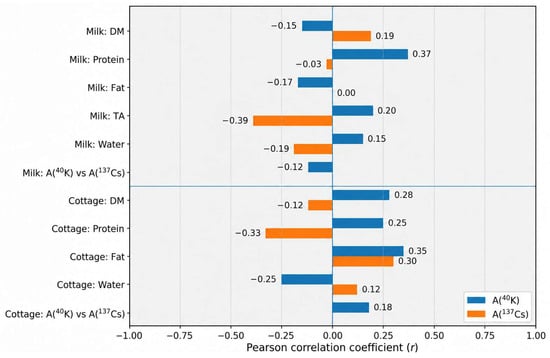
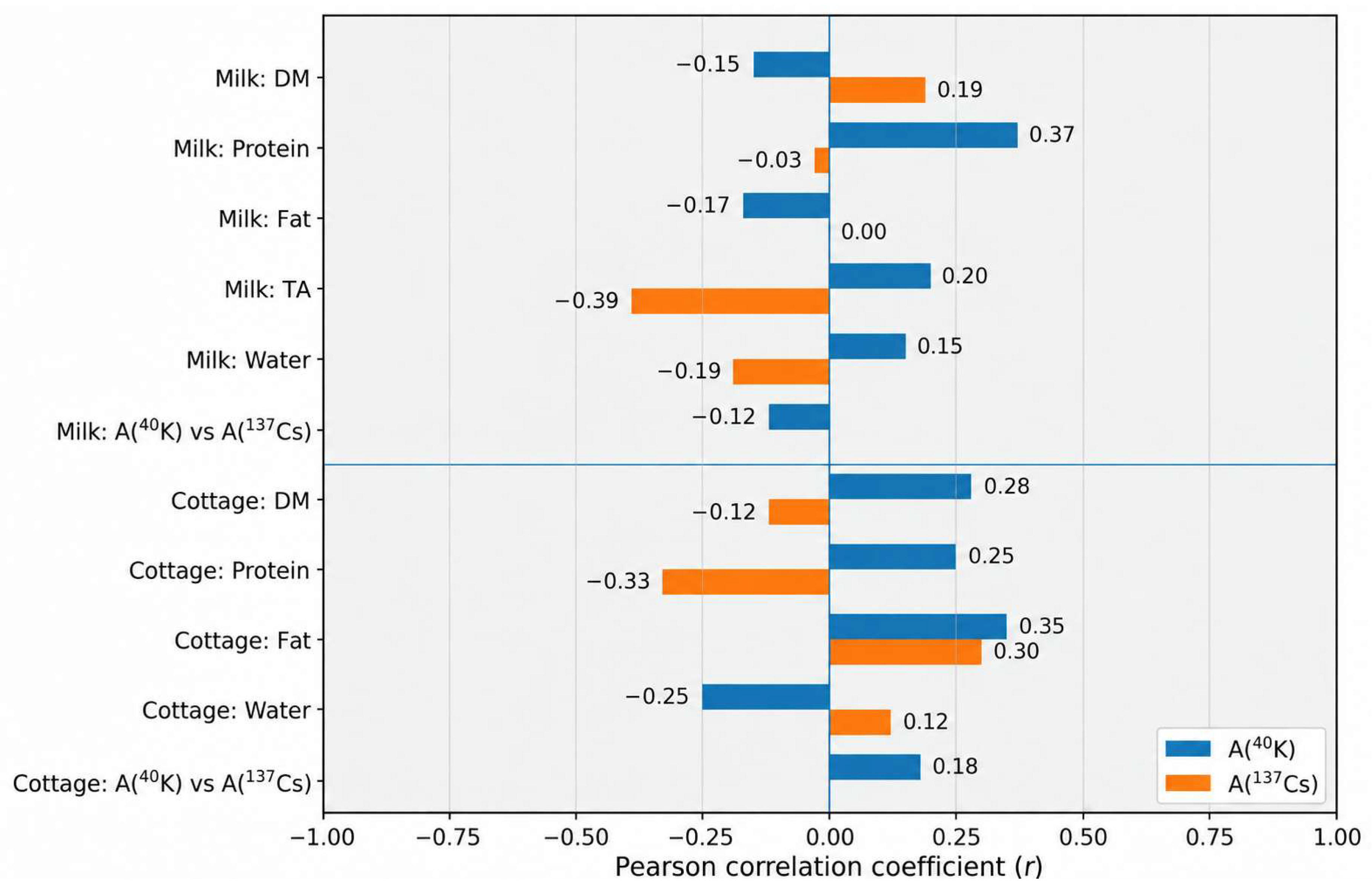
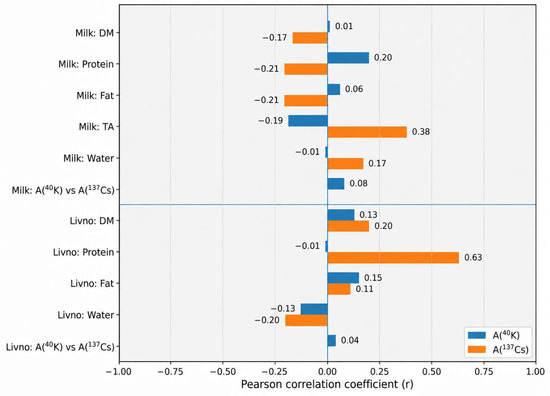
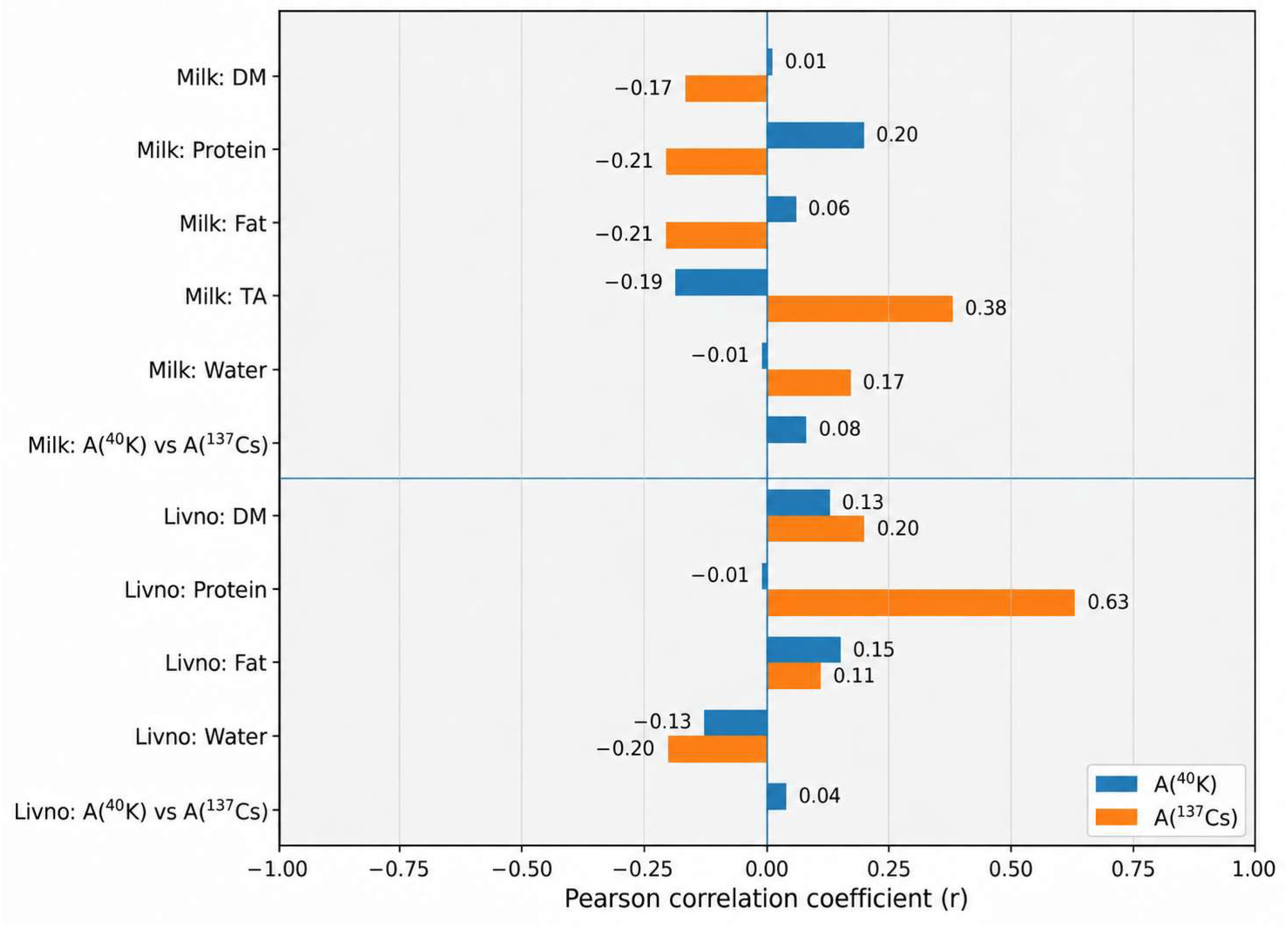
To assess the influence of the analyzed parameters on the composition and radionuclide content of milk and both types of cheeses, Pearson correlation analysis was performed, and correlation coefficients (r) were calculated. The resulting correlation coefficients for milk and cottage cheese are presented in Figure 1, and for milk and Livno cheese in Figure 2.
Figure 1.
Pearson’s correlation coefficients between physicochemical parameters and radionuclides in cow milk and cottage cheese (DM = Dry matter content; TA = Titratable acidity; A = Activity concentration).
Figure 2.
Pearson’s correlation coefficients between physicochemical parameters and radionuclides in cow milk and Livno cheese (DM = Dry matter content; TA = Titratable acidity; A = Activity concentration).
Pearson’s correlation coefficient between the activity concentrations of 40K and 137Cs in the analyzed milk samples used for the production of cottage cheese was −0.12, and in milk samples used for the production of Livno cheese it was 0.08. Furthermore, the said correlation coefficient was 0.18 for the cottage cheese samples and 0.04 for the Livno cheese samples.
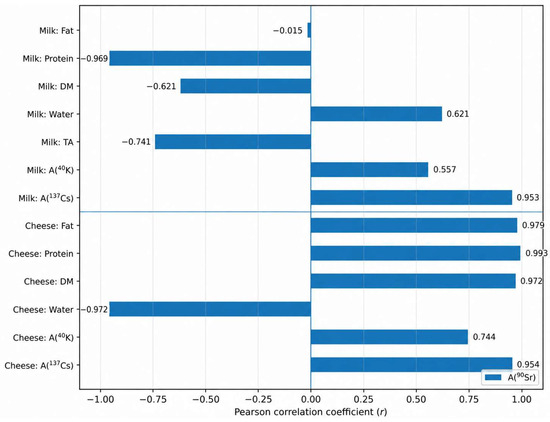
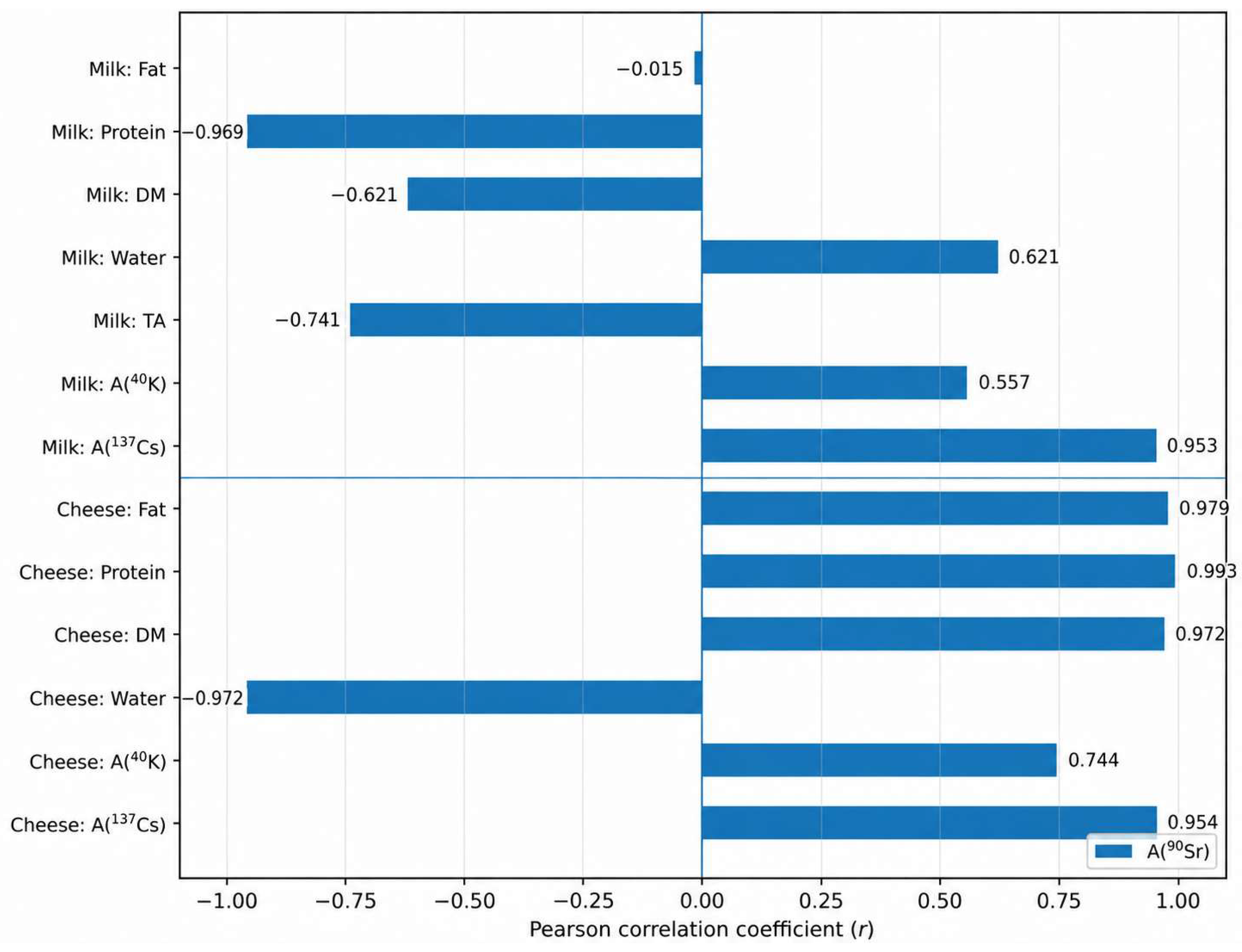
Owing to the limited number of samples analyzed for 90Sr, correlation analyses for this radionuclide were conducted on the combined dataset of milk (n = 5) and cheese (n = 5) samples, without subdivision by cheese production type. Consequently, the obtained correlation coefficients are presented in Figure 3 and represent overall associations between 90Sr activity concentrations and the investigated physicochemical parameters and radionuclides within each sample matrix. Because of the very small 90Sr subset, the t-test results were interpreted only as exploratory and were evaluated alongside the exact permutation test. The exact permutation test did not provide sufficient support for a robust statistically significant difference between production systems (p = 0.10 for both milk and cheese), and the observed 90Sr differences should therefore be interpreted cautiously.
Figure 3.
Pearson’s correlation coefficients between the activity concentration of 90Sr and physicochemical parameters and radionuclides in milk (n = 5) and cheese samples (n = 5). Due to the limited second-stage subset, these correlations should be interpreted as exploratory associations only. (DM = Dry matter content; TA = Titratable acidity; A = Activity concentration).
3.4. Estimated Radiological Safety Limits for Milk Intended for Cheese Production
The maximum activity concentrations of radionuclides in whole milk were calculated to ensure that the resulting products (cottage and Livno cheese) would be radiologically safe for human consumption (Table 10).
Table 10.
Maximum activity concentrations of radionuclides in milk for obtaining radiologically safe cheeses for consumption.
4. Discussion
The present study was designed to evaluate radionuclide behavior under conditions that reflect actual dairy production chains in Bosnia and Herzegovina, rather than under highly standardized experimental conditions. This approach provides practical insight into the combined effects of regional milk characteristics, local production practices, and cheese-making technology on radionuclide distribution. However, a key methodological limitation of this design is that geographical origin and cheese-making technology could not be fully disentangled. The cottage cheese and Livno cheese samples were produced from milk obtained from different regions and different herds, and sampling was not performed within a fully crossed design in which milk from each region was processed using both technologies under identical conditions. As a result, differences observed between the two cheese types may reflect the combined influence of environmental setting, feeding system, herd management, season, initial milk composition, and cheese-making technology. This is particularly relevant for radionuclide transfer, because radionuclide behavior may be influenced both by environmental transfer into milk and by technological partitioning between curd and whey. Therefore, the present findings should be interpreted as an applied comparison of two real milk–cheese production chains rather than as a controlled experimental separation of regional and processing effects. Future studies should address this limitation by applying a fully crossed design, in which milk from each region is processed into both cottage and hard cheese under standardized technological conditions.
The physicochemical characterization of raw milk indicated clear differences in compositional quality between the two sampling regions. Overall, milk samples from Central Bosnia showed a more uniform and satisfactory quality profile, with all samples meeting the minimum regulatory criteria for milk fat, protein, and solids-not-fat content defined by the national Rulebook on raw milk quality [31]. The only deviation in this group was observed in one result for titratable acidity. In contrast, milk samples from the Livno region showed a less consistent physicochemical profile, with several samples falling below the prescribed minimum values for fat content, protein content, and SNF. These findings suggest that the Livno milk set had comparatively lower technological and compositional quality at the time of sampling. Such differences may reflect regional variation in feeding systems, pasture composition, stage of lactation, herd management, breed structure, seasonal conditions, or dilution effects associated with higher water content and lower dry matter [32]. From a dairy-processing perspective, these differences are relevant because milk composition directly influences coagulation properties, curd formation, cheese yield, moisture retention, and the distribution of mineral-associated and water-soluble components during cheesemaking [21]. Therefore, the lower compositional quality observed in the Livno milk samples should be considered an important contextual factor when interpreting the subsequent differences in cheese composition and radionuclide partitioning. In this context, physicochemical milk quality is not only a regulatory and technological parameter, but also a potential determinant of radionuclide behavior during processing, particularly for radionuclides whose distribution is influenced by the protein-mineral structure of the curd, water removal, and matrix composition. Furthermore, based on the measured compositional parameters and the classification criteria defined in the national Rulebook on milk products and starter cultures [33], the analyzed cottage cheese samples were classified as fresh extra-fat cheese, whereas the analyzed Livno cheese samples corresponded to the hard full-fat cheese category.
The present results show three clearly differentiated radionuclide behaviors during milk processing. First, 40K remained highest in milk and whey and showed only limited retention in cheese, with mean Fr values of 0.123 for cottage cheese and 0.055 for Livno cheese. Second, 137Cs followed the same general partitioning trend as 40K, but showed somewhat higher retention in cheese, with mean Fr values of 0.256 and 0.129 for cottage and Livno cheese, respectively. Third, 90Sr behaved differently from both monovalent radionuclides and showed markedly stronger, almost complete retention in the cheese fractions. At the same time, the regional comparison of milk showed significant differences for 137Cs and 90Sr, but not for 40K. Taken together, these findings indicate that radionuclide distribution was governed simultaneously by radionuclide chemistry, processing technology, and regional exposure history. These findings are broadly consistent with the IAEA transfer-parameter handbook [34], which recognizes that food processing may substantially modify radionuclide concentrations in final food products, and with earlier milk-to-cheese studies [10,24,35,36] reporting that radiocaesium is only partially retained in curd, whereas radiostrontium tends to show higher retention due to its association with calcium-rich cheese fractions.
The preferential migration of 40K and much of 137Cs to whey is mechanistically plausible because both radionuclides are chemically analogous to monovalent alkali metals and are therefore expected to remain predominantly in the aqueous phase of milk rather than becoming strongly immobilized in the curd. In bovine milk, caseins occur predominantly as casein micelles in which calcium-sensitive caseins are associated with colloidal calcium phosphate (CCP). Calcium ions bind to phosphorylated serine residues of caseins, forming calcium caseinate-calcium phosphate complexes that stabilize the micellar structure [22,37]. Thus, 90Sr is a calcium analogue, and this chemistry makes stronger curd retention biologically and technologically plausible, in contrast to the previous two radionuclides. In the present study, this difference was amplified by cheese type: cottage cheese had a mean water content of 61.96%, whereas Livno cheese had a mean water content of 34.25% after ripening, so the low-moisture hard cheese concentrated retained constituents much more strongly on a fresh-weight basis. This interpretation is consistent with the broad radionuclide-behavior framework and with the well-established calcium-mimicking behavior of 90Sr [38]. In whey, 40K activity remained very close to milk activity in both production systems, and 137Cs also remained substantial, which indicates that most of the total inventory of these two radionuclides stayed in the liquid phase after coagulation and drainage. These patterns are consistent with the earlier cheese-processing literature [6,24,35,39].
Although 137Cs broadly tracked the aqueous behavior of 40K, its apparent retention in cheese was higher and much more variable. These findings should not be interpreted as contradicting their general chemical similarity, but rather as evidence that radionuclide behavior in cheese is also shaped by matrix composition and processing-related partitioning effects [24,39]. Furthermore, part of the difference is also likely methodological, because the absolute 137Cs activities were very low and the relative counting uncertainties were larger than for 40K. Nevertheless, both radionuclides partitioned mainly to whey, while 137Cs showed greater residual retention in cheese than 40K.
The 90Sr results indicate very high, near-complete retention within the cheese matrix. This finding is consistent with the chemical similarity of strontium to calcium, favoring its association with the casein–mineral fraction and retention in the cheese matrix [20]. However, the reported retention values of 97.7% for cottage cheese and 98.5% for Livno cheese should be regarded as approximate estimates of strong 90Sr retention in the cheese fraction, rather than precise batch-level retention coefficients. Nevertheless, the high estimated retention is mechanistically plausible because 90Sr behaves as a calcium analogue and may be preferentially associated with the casein–mineral curd fraction, as already mentioned above.
In milk, most correlations between radionuclides and physicochemical variables were weak, which suggests that modest differences in fat, protein, dry matter, or acidity were not the primary determinants of radionuclide activity in raw milk. This supports the hypothesis that the regional differences in 137Cs and 90Sr are upstream environmental signals rather than simple reflections of bulk milk composition. In cheese, positive associations with dry matter and negative associations with water are expected on a fresh-weight basis, because moisture removal concentrates whatever is retained in the curd. For 90Sr, such matrix-dependent retention is particularly plausible because of its calcium-like behavior and its expected association with the casein-mineral fraction of the curd [38]. However, the relationships observed for 40K and 137Cs should be interpreted more cautiously. Most correlations between these radionuclides and physicochemical parameters were weak to moderate, and in some cases, their directions differed between cottage and Livno cheese. This suggests that radionuclide behavior was influenced not only by individual compositional variables, but also by the broader cheese matrix, processing conditions, moisture removal, and regional characteristics of the milk. Therefore, the observed correlations should be presented as exploratory and matrix-dependent associations rather than as universal mechanistic relationships.
The regional contrast between central Bosnia and the Livno production area is one of the most interesting parts of this study. Livno-region milk showed higher mean 137Cs and 90Sr than the central-Bosnia milk, whereas 40K did not differ significantly between regions. Natural 40K is an essential element under strong physiological regulation [40], so modest environmental variation is less likely to translate into major between-region differences in milk. By contrast, 137Cs and 90Sr are anthropogenic contaminants whose transfer into milk depends much more directly on legacy fallout, soil chemistry, plant uptake, water movement, pasture contamination, and the animals’ feeding regime [29,41]. Studies from the wider regional context have shown that fallout-derived radionuclides may remain detectable in food-chain compartments for years to decades after major contamination events. For example, long-term monitoring in Croatia [42] demonstrated measurable 90Sr in milk over several decades and measurable radiocaesium in potatoes [43] and freshwater fish [44] during the post-Chernobyl period. In addition, the spatial distribution of 137Cs is not uniform because altitude, precipitation, slope position, runoff, erosion, and other topographic factors can influence both initial deposition and subsequent redistribution of radiocaesium in soils and vegetation [45,46]. This supports the interpretation that differences between central Bosnia and the Livno field may reflect not only dairy technology, but also region-specific environmental transfer from soil and pasture into the milk–cheese chain. The Livno field area is a large karst field with complex hydrology, wetlands, and seasonally flooded agricultural land [47], so it is reasonable to infer that local soil–water conditions and pasture pathways may have contributed to the higher anthropogenic radionuclide activities observed there.
From a public health and food safety perspective, the central conclusion is reassuring. The highest cheese activities observed in the study, 0.153 Bq/kg for 137Cs and 0.389 Bq/kg for 90Sr, were far below the maximum permitted levels laid down for dairy produce in Council Regulation (Euratom) 2016/52 [30], namely 1000 Bq/kg for the cesium group and 125 Bq/kg for the strontium group. However, it is important to note that these regulatory values apply to nuclear or radiological emergency exposure situations and are intended for the management of food and feed following such events. Therefore, the comparison made in the present study should be interpreted as showing that the measured radionuclide activities were several orders of magnitude below emergency regulatory levels, rather than as a complete radiological risk assessment. A full assessment of radiological risk would require additional exposure modeling, including consumption data, dose conversion coefficients, age-specific scenarios, and cumulative dietary intake from multiple food sources. This study has practical emergency-planning value because back-calculated thresholds show that different cheese technologies imply different intervention points for raw milk. The acceptable raw milk activity for safe production of Livno cheese was lower than for cottage cheese, particularly for 90Sr, meaning that hard-ripened cheeses would require earlier and stricter screening if contamination occurred. The highest 137Cs activity measured in the present cheese samples, 0.153 Bq/kg, was therefore several orders of magnitude below both the emergency limit for the caesium group and the post-Chernobyl radiocaesium control levels. This confirms that, under current conditions, the analyzed cheeses do not raise radiological food-safety concerns with respect to radiocaesium. In the regulatory context of Bosnia and Herzegovina, radiocaesium control values for food have also followed the post-Chernobyl framework, with maximum permitted levels expressed for the summed activity of 134Cs and 137Cs [48]. These include 370 Bq/kg for milk and milk products and foods for special nutritional needs intended for infants, and 600 Bq/kg for other foods. Against these values, the 137Cs activities measured in the present study were negligible.
5. Conclusions
This study demonstrates that radionuclide transfer from cow milk into cheese is radionuclide-specific and strongly influenced by processing. Natural 40K and much of 137Cs predominantly remained in the whey fraction, whereas 90Sr showed markedly stronger retention in the curd. However, the 90Sr findings should be interpreted as preliminary and exploratory, because this radionuclide was analyzed only in a limited second-stage subset. Similarly, the observed differences between cottage cheese and Livno cheese should be interpreted as the combined outcome of distinct real-world production chains rather than as independently demonstrated effects of cheese technology or geographical origin. The lower-moisture, ripened Livno cheese intensified concentration effects relative to fresh cottage cheese, particularly for 90Sr, but this interpretation requires confirmation under controlled conditions. In addition, the higher 137Cs and exploratory 90Sr activities observed in the Livno-region milk indicate that environmental exposure pathways, rather than bulk milk composition alone, contributed substantially to regional differences in contamination.
Under current background conditions, all analyzed products were radiologically safe and far below the maximum permitted European Union levels for dairy products. Nevertheless, the derived raw milk thresholds show that cheese technology matters for emergency management: hard-ripened cheeses would require stricter control of contaminated milk than fresh cheeses, especially with respect to 90Sr. Future studies should therefore aim for a fully crossed design in which both cheese types are produced from both milk origins, with paired whey collection and batch-specific yield measurements, in order to disentangle the effects of geography, milk composition, and technology more precisely.
Author Contributions
Conceptualization, E.M. and N.G.; methodology, E.M. and N.G.; software, N.M.; validation, N.M., I.G., M.K., T.B. and D.H.; formal analysis, E.M., N.M., N.K. and N.G.; investigation, E.M., N.M., N.K., I.G., M.K., T.B. and D.H.; resources, B.P. and N.G.; data curation, N.M., N.K., B.P., I.G., M.K., T.B. and D.H.; writing—original draft preparation, E.M.; writing—review and editing, E.M., N.M., N.K., B.P., I.G., M.K., T.B., D.H. and N.G.; visualization, E.M.; supervision, N.G.; project administration, E.M. and N.G.; funding acquisition, N.G. All authors have read and agreed to the published version of the manuscript.
Funding
This research was partially funded by the Ministry of Science, Higher Education and Youth of Canton Sarajevo, Bosnia and Herzegovina, through the project “Distribution of artificial radioactivity during the processing of milk into indigenous Bosnian and Herzegovinian cheeses” (Contract number: 27-02-35-35137-9/22). Part of the research conducted at the Institute for Medical Research and Occupational Health was performed using facilities and equipment funded by the European Regional Development Fund project KK.01.1.02.0007 “Research and Education Centre of Environmental Health and Radiation Protection—Reconstruction and Expansion of the Institute for Medical Research and Occupational Health”. The APC was funded by the Federal Ministry of Education and Science (Contract number: 05-35-3059-2/25).
Institutional Review Board Statement
Not applicable.
Informed Consent Statement
Not applicable.
Data Availability Statement
The original contributions presented in this study are included in the article. Further inquiries can be directed to the corresponding author.
Acknowledgments
The authors gratefully acknowledge the laboratory technician Admira Bogunić for her technical assistance and support during analyses.
Conflicts of Interest
The authors declare no conflicts of interest. The funders had no role in the design of the study; in the collection, analysis, or interpretation of data; in the writing of the manuscript; or in the decision to publish the results.
Abbreviations
The following abbreviations are used in this manuscript:
| B&H | Bosnia and Herzegovina |
| CRM | Certified reference material |
| DM | Dry matter |
| Fr | Food retention factor |
| FW | Fresh weight |
| HPGe | High-Purity Germanium |
| IAEA | International Atomic Energy Agency |
| MFFB | Moisture on a fat-free basis |
| °SH | Soxhlet–Henkel degree of acidity |
| Pe | Processing efficiency |
| Pf | Processing factor |
| PT | Proficiency test |
| SNF | Solids-not-fat |
| TA | Titratable acidity |
| U | Expanded uncertainty |
References
- Nakamura, K.; Chiba, S.; Kiuchi, T.; Nabeshi, H.; Tsutsumi, T.; Akiyama, H.; Hachisuka, A. Comprehensive Analysis of a Decade of Cumulative Radiocesium Testing Data for Foodstuffs throughout Japan after the 2011 Fukushima Daiichi Nuclear Power Plant Accident. PLoS ONE 2022, 17, e0274070. [Google Scholar] [CrossRef] [Scilit]
- Environmental Radioactivity in the European Community 2023-Publications Office of the EU. Available online: https://op.europa.eu/hr/publication-detail/-/publication/fff21606-d24f-11f0-8da2-01aa75ed71a1/language-hu?WT.mc_id=Selectedpublications&WT.ria_c=41957&WT.ria_f=6394&WT.ria_ev=search&WT.URL=https%3A%2F%2Fop.europa.eu%2Fhu%2Fweb%2Fgeneral-publications%2Fenvironment (accessed on 7 September 2026).
- Muftić, E.; Gradaščević, N.; Članjak-Kudra, E.; Mujić, N. Distribution of Radiocaesium (137Cs) and Radiopotassium (40K) during the Cheese Production. Int. J. Dairy Technol. 2023, 76, 1030–1036. [Google Scholar] [CrossRef] [Scilit]
- Baker, P.S.; Fuccillo, D.A., Jr.; Gerrard, M.W.; Lafferty, R.H., Jr. Radioisotopes in Industry; U.S. Atomic Energy Commission (USAEC): Washington, DC, USA, 1965. [Google Scholar]
- Atwood, D. Radionuclides in the Environment; Wiley: Chichester, UK, 2010. [Google Scholar]
- McEnri, C.; Mitchell, P.I.; Cunningham, J.D.; Mitchell, P.L. Radiocaesium Transfer from Whole Milk to a Range of Milk Products; Nuclear Energy Board: Dublin, Ireland, 1990. [Google Scholar]
- Lestaevel, P.; Racine, R.; Bensoussan, H.; Rouas, C.; Gueguen, Y.; Dublineau, I.; Bertho, J.M.; Gourmelon, P.; Jourdain, J.R.; Souidi, M. Césium 137: Propriétés et Effets Biologiques Après Contamination Interne. Med. Nucl. 2010, 34, 108–118. [Google Scholar] [CrossRef] [Scilit]
- Bandazhevsky, Y.I. Medical and Biological Effects of Radio-Cesium Incorporated into the Human Organism; Institute of Radiation Safety “BELRAD”: Minsk, Belarus, 2003. [Google Scholar]
- Stara, J.F.; Nelson, N.S.; Rosa, R.J.; Bustad, L.K. Comparative Metabolism of Radionuclides in Mammals: A Review. Health Phys. 1971, 20, 113–137. [Google Scholar] [CrossRef] [Scilit]
- Gradaščević, N.; Muftić, E.; Omerbegović, A. Transfer of Radionuclides into Dairy Products. Veterinaria 2023, 72, 3–14. [Google Scholar] [CrossRef] [Scilit]
- Fesenko, S.; Isamov, N.; Barnett, C.; Beresford, N.A.; Howard, B.J.; Sanzharova, N.; Fesenko, E. Review of Russian Language Studies on Radionuclide Behaviour in Agricultural Animals: Biological Half-Lives. J. Environ. Radioact. 2015, 142, 136–151. [Google Scholar] [CrossRef] [Scilit]
- Naletoski, I.; Luckins, A.G.; Viljoen, G. Nuclear and Radiological Emergencies in Animal Production Systems, Preparedness, Response and Recovery; Springer: Vienna, Austria, 2021. [Google Scholar]
- CDC Strontium|Toxicological Profile ATSDR. Available online: https://wwwn.cdc.gov/TSP/ToxProfiles/ToxProfiles.aspx?id=656&tid=120 (accessed on 9 July 2024).
- National Council on Radiation Protection and Measurements (NCRP). Some Aspects of Strontium Radiobiology; NCRP: Bethesda, MD, USA, 1991. [Google Scholar]
- Vinogradov, A.P. Biological Role of Potassium-40. Nature 1957, 180, 507–508. [Google Scholar] [CrossRef] [Scilit]
- MVTEO BiH. Analiza Stanja Na Tržištu Mlijeka i Mliječnih Proizvoda u Bosni i Hercegovini Za Period 2019.-2022. Godina (Analysis of the Milk and Dairy Products Market in Bosnia and Herzegovina for the Period 2019–2022); Ministarstvo vanjske trgovine i ekonomskih odnosa BiH: Sarajevo, Bosnia and Herzegovina, 2023. (In Bosnian) [Google Scholar]
- Rebić, V.; Aljičević, M.; Landeka, V.; Mešinović, D.; Karić, A. Pathogen Presence in Cottage Cheese Sold for Public Consumption at Sarajevo Canton Markets. Vet. Stanica 2023, 54, 425–434. [Google Scholar] [CrossRef] [Scilit]
- Matić, A.; Kalit, S.; Salajpal, K.; Ivanković, S.; Sarić, Z. Preferencije Potrošaca i Sastav Livanjskog Sira u Odnosu Na Njegova Senzorska Svojstva. Mljekarstvo 2014, 64, 170–177. [Google Scholar] [CrossRef] [Scilit]
- Kirin, S.; Marijan, Ž.; Mihaljević, D. Livanjski Sir. Mljekarstvo 2003, 53, 281–291. [Google Scholar]
- Rosskopfová, O.; Galamboš, M.; Rajec, P. Distribution of Strontium in Milk Component. J. Radioanal. Nucl. Chem. 2011, 290, 601–606. [Google Scholar] [CrossRef] [Scilit]
- Wedholm, A.; Larsen, L.B.; Lindmark-Månsson, H.; Karlsson, A.H.; Andrén, A. Effect of Protein Composition on the Cheese-Making Properties of Milk from Individual Dairy Cows. J. Dairy Sci. 2006, 89, 3296–3305. [Google Scholar] [CrossRef] [Scilit]
- Fox, P.F.; Brodkorb, A. The Casein Micelle: Historical Aspects, Current Concepts and Significance. Int. Dairy J. 2008, 18, 677–684. [Google Scholar] [CrossRef] [Scilit]
- Buma, T.; Meerstra, J. Transfer of Radiostrontium from Milk to Cheese and Whey. Nature 1964, 202, 310–311. [Google Scholar] [CrossRef] [Scilit]
- Besson, B.; Pourcelot, L.; Lucot, E.; Badot, P.M. Variations in the Transfer of Radiocesium (137Cs) and Radiostrontium (90Sr) from Milk to Cheese. J. Dairy Sci. 2009, 92, 5363–5370. [Google Scholar] [CrossRef] [Scilit]
- Vidmar, T. EFFTRAN—A Monte Carlo Efficiency Transfer Code for Gamma-Ray Spectrometry. Nucl. Instrum. Methods Phys. Res. A 2005, 550, 603–608. [Google Scholar] [CrossRef] [Scilit]
- ISO/IEC 17025:2017; General Requirements for the Competence of Testing and Calibration Laboratories. ISO: Geneva, Switzerland, 2017.
- Dohoo, I.; Wayne, M.; Stryhn, H. Veterinary Epidemiologic Research; AVC Inc.: Charlottetown, PE, Canada, 2007. [Google Scholar]
- EML; DOE. The Procedures Manual of the Environmental Measurements Laboratory, HASL-300, 28th ed.; Chieco, N.A., Ed.; U.S. Department of Energy: New York, NY, USA, 1997. [Google Scholar]
- IAEA. Handbook of Parameter Values for the Prediction of Radionuclide Transfer in Terrestrial and Freshwater Environments; International Atomic Energy Agency: Vienna, Austria, 2010. [Google Scholar]
- European Union. Council Regulation (Euratom) 2016/52 of 15 January 2016 Laying down Maximum Permitted Levels of Radioactive Contamination of Food and Feed Following a Nuclear Accident or Any Other Case of Radiological Emergency. Off. J. Eur. Union 2016, L 13, 2–11. [Google Scholar]
- Bosnia and Herzegovina Food Safety Agency. Regulation on Raw Milk [Pravilnik o Sirovom Mlijeku]; Official Gazette of Bosnia and Herzegovina: Sarajevo, Bosnia and Herzegovina, 2011. [Google Scholar]
- Jenkins, T.C.; McGuire, M.A. Major Advances in Nutrition: Impact on Milk Composition. J. Dairy Sci. 2006, 89, 1302–1310. [Google Scholar] [CrossRef] [Scilit]
- Bosnia and Herzegovina Food Safety Agency. Regulation on Milk Products and Starter Cultures [Pravilnik o Proizvodima Od Mlijeka i Starter Kulturama]; Službeni Glasnik BiH (Official Gazette of Bosnia and Herzegovina): Sarajevo, Bosnia and Herzegovina, 2011. [Google Scholar]
- IAEA. Handbook of Parameter Values for the Prediction of Radionuclide Transfer in Temperate Environments; International Atomic Energy Agency Library: Vienna, Austria, 1994. [Google Scholar]
- Assimakopoulos, P.A.; Ioannides, K.G.; Pakou; Paradopoulou, C.V. Transport of the Radioisotopes Iodine-131, Cesium-134, and Cesium-137 from the Fallout Following the Accident at the Chernobyl Nuclear Reactor into Cheese and Other Cheesemaking Products. J. Dairy Sci. 1987, 70, 1338–1343. [Google Scholar] [CrossRef] [Scilit]
- Wilson, L.G.; Bottomley, R.C.; Sutton, P.M.; Sisk, H.C. Transfer of Radioactive Contamination from Milk to Commercial Dairy Products. J. Soc. Dairy Technol. 1988, 41, 10–13. [Google Scholar] [CrossRef] [Scilit]
- Bijl, E.; Huppertz, T.; van Valenberg, H.; Holt, C. A Quantitative Model of the Bovine Casein Micelle: Ion Equilibria and Calcium Phosphate Sequestration by Individual Caseins in Bovine Milk. Eur. Biophys. J. 2019, 48, 45–59. [Google Scholar] [CrossRef] [Scilit]
- Rogliardo, Q.; Kanellakopoulos, A.; Corcelle, H.; Fedel, M.; Zsely-Schaffter, M.; Triscone, G.; Pallada, S. High Efficiency Quantification of 90Sr Contamination in Cow Milk after a Nuclear Accident. Appl. Radiat. Isot. 2025, 226, 112235. [Google Scholar] [CrossRef] [Scilit]
- Al-Masri, M.S.; Nashawati, A.; Amin, Y.; Al-Akel, B. Transfer of 226Ra, 85Sr and 137Cs from Milk to Milk Products. J. Radioanal. Nucl. Chem. 2006, 268, 289–295. [Google Scholar] [CrossRef] [Scilit]
- Berg, M.; Plöntzke, J.; Leonhard-Marek, S.; Müller, K.E.; Röblitz, S. A Dynamic Model to Simulate Potassium Balance in Dairy Cows. J. Dairy Sci. 2017, 100, 9799–9814. [Google Scholar] [CrossRef] [Scilit]
- Beresford, N.A.; Mayes, R.W.; Cooker, A.I.; Barnett, C.L.; Howard, B.J.; Stuart Lamb, C.; Naylor, G.P.L. The Importance of Source-Dependent Bioavailability in Determining the Transfer of Ingested Radionuclides to Ruminant-Derived Food Products. Environ. Sci. Technol. 2000, 34, 4455–4462. [Google Scholar] [CrossRef] [Scilit]
- Franić, Z.; Lokobauer, N.; Marović, G. Radiostrontium Activity Concentrations in Milk in the Republic of Croatia for 1961–2001 and Dose Assessment. Health Phys. 2004, 87, 160–165. [Google Scholar] [CrossRef] [Scilit]
- Zdenko, F.; Petrinec, B.; Marović, G.; Franić, Z. Radiocaesium Activity Concentrations in Potatoes in Croatia after the Chernobyl Accident and Dose Assessment. J. Environ. Sci. Health B 2007, 42, 211–217. [Google Scholar] [CrossRef] [Scilit][Green Version]
- Franić, Z.; Marović, G. Long-Term Investigations of Radiocaesium Activity Concentrations in Carp in North Croatia after the Chernobyl Accident. J. Environ. Radioact. 2007, 94, 75–85. [Google Scholar] [CrossRef] [Scilit]
- Lettner, H.; Griesebner, A.; Peer, T.; Hubmer, A.K.; Pintaric, M. Altitude Dependent 137Cs Concentrations in Different Plant Species in Alpine Agricultural Areas. J. Environ. Radioact. 2006, 86, 12–30. [Google Scholar] [CrossRef] [Scilit]
- Pyuskyulyan, K.; LaMont, S.P.; Atoyan, V.; Belyaeva, O.; Movsisyan, N.; Saghatelyan, A. Altitude-Dependent Distribution of 137Cs in the Environment: A Case Study of Aragats Massif, Armenia. Acta Geochim. 2019, 39, 127–138. [Google Scholar] [CrossRef] [Scilit]
- Ramsar Ramsar Sites Information Service: Livno Field (Livanjsko Polje). Available online: https://rsis.ramsar.org/ris/1786?__goaway_challenge=meta-refresh&__goaway_id=cb26bc44aabcf26f12f954b537e83034 (accessed on 11 June 2026).
- Bosnia and Herzegovina Food Safety Agency. Regulation on Maximum Permitted Levels for Certain Contaminants in Food [Pravilnik o Maksimalno Dozvoljenim Količinama Za Određene Kontaminante u Hrani]; Official Gazette of Bosnia and Herzegovina: Sarajevo, Bosnia and Herzegovina, 2014. [Google Scholar]

Disclaimer/Publisher’s Note: The statements, opinions and data contained in all publications are solely those of the individual author(s) and contributor(s) and not of MDPI and/or the editor(s). MDPI and/or the editor(s) disclaim responsibility for any injury to people or property resulting from any ideas, methods, instructions or products referred to in the content. |
© 2026 by the authors. Licensee MDPI, Basel, Switzerland. This article is an open access article distributed under the terms and conditions of the Creative Commons Attribution (CC BY) license.