


Abstract
Lightweight devices are becoming a crucial part of networked systems, including Internet of Things environments. These devices usually have constraints, such as limited computational power, which have directed researchers to develop lightweight crypto algorithms to secure the data generated by these devices. Therefore, an efficient but secure crypto algorithm for these devices is required. In this paper, we thoroughly evaluate well-known SPN-based algorithms, namely AES, LED, PRESENT, ASCON-128, and ASCON-128a, based on the success rates of statistical randomness tests, including the Frequency, Runs, Discrete Fourier Transform, and Cumulative Sum tests. With these tests, the assessment measures the algorithms’ ability to produce unpredictable text. To ensure thorough evaluation, the experiments included approximately 19,000 image files of varying sizes up to 2560 KB. The extensive experimental results show that the ASCON family achieved high success rates above 98% in all tests, particularly for small file sizes, while AES achieved higher success rates for larger file sizes, and LED showed limited performance for the varied file sizes. The results confirm that ASCON-128 and ASCON-128a offer the needed trade-off between computation and randomness validation. Based on this evaluation, we propose an adaptive encryption framework based on file size, data classification, and device computational power.
1. Introduction
In recent years, more focus has been devoted to developing and evaluating lightweight cryptographic algorithms (i.e., ciphers) to meet the increase in the inclusion of lightweight devices in wireless networked environments, including Internet of Things (IoT) [1]. Wireless devices typically have limitations in terms of bandwidth and battery life. Wireless technologies, such as 802.11ac, have high bandwidth, but others, such as ZigBee and Bluetooth, have lower bandwidth. Therefore, a lightweight cryptographic algorithm should offer a balance between security and performance [2]. For instance, increasing the number of rounds and extending the key length can increase security level, but it could impact the efficiency of the cryptographic algorithm. The produced ciphertext should be random to prevent any predication of the plaintext. To validate the randomness of ciphertext sequences, the National Institute of Standards and Technology (NIST) has recommended several statistical techniques, published in Special Publication 800-22rev1a as a standardized set of tests for cryptographic randomness [3].
To examine the ciphertext sequence for non-randomness, the NIST suite uses null hypothesis testing in evaluating the ciphertext sequences. For each test, if the ciphertext satisfies the null hypothesis, then the sequence is considered random for that test; otherwise, it is considered not random, and the test fails. Examining the randomness of ciphertext is crucial since cryptanalytic methods try to utilize the relationships between plaintext and ciphertext bits. The NIST suite has been extensively used to evaluate cryptographic algorithms [4,5,6]. Several algorithms, including Rijndael, Twofish, Serpent, Mars, and RC6, have been evaluated using this suite [7]. To validate the randomness of the ciphertext sequence and the pseudorandom number generators, the NIST has recommended several statistical techniques [3]. Employing this suite examines different aspects of randomness and enables logical evaluation to ensure that the cryptographic algorithm generates random values.
There are three categories of lightweight cryptographic algorithm structures: Substitution–Permutation Networks (SPN); Feistel; and Add-Rotate-XOR (ARX). The SPN structure uses S-boxes and P-boxes in its operations to achieve the required confusion and diffusion [8,9,10,11]. It is used in standards such as AES [12] and, more recently, in ASCON [8,9]. SPN ciphers are characterized by their fast diffusion speed and large throughput. In Feistel structure algorithms [13,14], the plaintext block is divided into two equal-length parts. The encryption and decryption components of the Feistel structure are identical, allowing code reusability in the decryption process, which reduces the hardware implementation cost. However, it needs more iterations to ensure security as its diffusion speed is considered low. The ARX structure algorithms [15,16,17] aim for low-cost implementations in both hardware and software. It uses logical operations, including modular addition, and shift and rotation operations. Consequently, the ARX structure is suitable for lightweight devices. However, due to the non-linearity introduced by modular addition operations, it requires more iterations to produce a robust ciphertext. Therefore, our focus in this paper is to study SPN algorithms.
This paper evaluates SPN crypto algorithms based on their randomness properties. The focus is on algorithms with favorable cryptanalytic records and that meet the requirements for modern Authenticated Encryption with Associated Data (AEAD) schemes, which are expected to serve as reliable components in secure embedded and IoT systems [8,9]. These algorithms include ASCON-128, ASCON-128a, PRESENT, LED, and AES. PRESENT is a popular classic lightweight block cipher, and LED is a refinement that optimizes its hardware implementation by eliminating the key schedule. Both fall under the SPN structure and are well-studied and widely cited as benchmarks for lightweight ciphers. AES is a general-purpose encryption algorithm, while ASCON adopts an authenticated encryption design for IoT devices and balances efficiency and security. To the best of our knowledge, this is the first study to thoroughly evaluate and compare these algorithms, considering variation of file sizes, reflecting an IoT environment where various types of data are exchanged, each with its own security requirements. The paper also introduces a cryptographic framework that balances efficiency and security for heterogeneous IoT environments. This differs from previous studies that mainly evaluate lightweight ciphers using isolated benchmarks or fixed-size inputs, by systematically assessing the randomness of the ciphertext across different file sizes using large-scale image datasets and multiple NIST statistical tests. The framework leverages empirical observations to provide cipher selection in heterogeneous IoT environments.
The rest of this paper is organized as follows. Section 2 discusses recent lightweight SPN cryptographic algorithms. Section 3 provides a detailed description of ciphers included in this assessment. Section 4 describes the materials and methods. Section 5 presents the evaluation results of ciphers included in the assessment and illustrates their performance merits. Section 6 provides a discussion and introduces the cipher-selection framework. Section 7 concludes the work and suggests future directions.
2. Related Work
In this section, we discuss the main characteristics and components of the encryption process, as well as the security robustness of lightweight SPN algorithms, algorithms that target constrained IoT devices, namely, QARMA [18], GIFT [19], Midori [20], RECTANGLE [21], and Saturnin [22].
QARMA is a lightweight tweakable block cipher that comes in two versions: QARMA-64 operating on 64-bit blocks with a 128-bit key, and QARMA-128 operating on 128-bit blocks and a 256-bit key. QARMA-64 uses 16 rounds, while QARMA-128 uses 24 rounds in the encryption process. The key whitening is derived from a master key and XORed with the input and output. In each round, the following is applied: a non-linear S-box layer, permutation, MixColumns, and tweaking. QARMA-64 employs 4-bit S-boxes, while QARMA-128 employs composite 8-bit S-boxes, with efficient linear layers. The permutation is to rearrange nibbles and bytes. The MixColumns transformation is achieved using an involutory matrix. The tweak with the round key ensures diffusion across rounds. The flexible key schedule and tweakable structure make it suitable for applications with frequent rekeying [18]. Furthermore, algebraic attack complexity remains infeasible beyond 12 and eight rounds. The optimal differential probabilities are 2−128 for 12 rounds and 2−91 for eight rounds, for QARMA-64 and QARMA-128, respectively [23].
GIFT [19] is a lightweight SPN-based block cipher; it has two variants, GIFT-64 and GIFT-128. The GIFT-128 operates on 128-bit plaintext blocks with a 128-bit key. The encryption process uses 40 rounds. Three steps are repeated in each round, including: SubCells, PermBits, and AddRoundKey. The SubCells provide non-linearity with an MDP of 2−2 and a maximum linear bias of 2−2 by applying a 4-bit S-box to all 32 nibbles. The PermBits performs a bitwise permutation, ensuring diffusion by rearranging state bits. Meanwhile, with the AddRoundKey, a key schedule generates round keys via rotations, S-box applications, and round constants, and the round key is XORed into specific state positions. Its differential cryptanalysis complexity is 2123.245 for 26 rounds; the linear attacks reach 25 rounds with bias 2−124.75; and for differential linear attacks, a 17-round approximation exhibits a correlation of 2−58.78 and a squared correlation of 2−117.56, enabling a 19-round key-recovery attack at complexity 2121.53 [24]. Algebraic attacks remain ineffective due to the S-box algebraic degree 3, which allows non-linearity and SPN diffusion [19].
Midori offers two variants known as Midori-64, which runs on a 64-bit block with a 128-bit key and uses 16 rounds, and Midori-128, which runs on a 128-bit block with 128 and 256-bit keys and uses 20 rounds. In each round, the following steps are applied: SubCells, ShuffleCell, MixColumn, and AddRoundKey. However, the final round excludes MixColumn for decryption compatibility. Midori uses 4-bit involutory S-boxes, which combine into 8-bit non-linear layers. The diffusion is achieved via an MDS matrix in the MixColumn step and a cell permutation layer in the ShuffleCell step, ensuring rapid state mixing. Midori has an MDP of 2−2 for its 4-bit S-boxes and a linear bias of 2−2, as well as differential and linear resistance for 7 and 13 rounds in Midori-64 and Midori-128, respectively [20]. However, recent work has detected vulnerabilities to fault injections in both the early and final rounds [25].
RECTANGLE operates on 64-bit blocks and uses 80-bit or 128-bit keys. Its structure arranges the state as a 4 × 16-bit matrix to facilitate a bit-sliced form of parallel processing. The encryption process consists of 25 rounds, with each round apply three components: AddRoundKey, SubColumn, and ShiftRow. The AddRoundKey generates the round keys. The SubColumn component operates on 16 parallel 4 × 4 S-boxes. The S-boxes have an MDP of 2−2 and a maximal linear bias of 2−2, which supports the non-linear behavior required against statistical attacks. The ShiftRow applies row-wise cyclic shifts. It is robust against differential linear attacks and algebraic attacks, and it requires only 14 rounds to reduce linear correlations below 2−32 [21].
Saturnin uses 10 super-rounds for the encryption process. It operates on 256-bit blocks using a 256-bit key that includes a 9-bit domain separation parameter to enable authenticated encryption and hashing. It utilizes a 4 × 4 × 4 cube of 4-bit nibbles, totaling 256 bits. The encryption process has three main components: AddRoundKey, SuperSBox, and ShiftRows. The AddRoundKey XORs the state with a round key; the Super S-Box layer combines the 16-bit S-box derived from AES with a MixColumns-like linear operation; and the ShiftRows permutation performs cyclically shifting matrix rows. The Super S-Box is facilitated for bit-sliced implementations, enhancing performance on microcontrollers and IoT devices. The 16-bit Super S-box has differential uniformity of 80 with an MDP of 2−9.68 and linearity of 3072, with a maximum squared correlation of 2−8.83. The complete ten super-round security is unbroken since the differential characteristics for eight super-rounds are bounded at 2−483.9 and linear characteristics 2−441.5, which is below the 2−256 threshold. The algebraic degree after five super-rounds exceeds 2256 [22].
Table 1 compares and summarizes the main design characteristics of the crypto algorithms included in this evaluation and those discussed in this section. The comparison includes structure, block size, key, number of rounds, S-box size, round operations, and key schedule. The table details are self-explanatory, but we will expand the discussion on the key schedule, which describes how each algorithm derives its round keys from the initial key. AES employs the Rijndael expansion, which uses rotations, S-box substitutions, and round constants to generate strong round keys. PRESENT uses a Lightweight Linear Feedback Shift Register (LFSR) mechanism to generate round keys. GIFT, RECTANGLE, and Midori use a lightweight XOR-based schedule by applying simple XOR and rotations for efficiency. QARMA introduces a tweakey schedule, mixing tweak values with the key to add resistance against related-key attacks. Saturnin uses a moderate schedule that balances security and efficiency. LED does not have a key schedule; the master key is directly XORed with the state to save resources. ASCON uses key injection at initialization and finalization only, consistent with its sponge construction.
Table 1.
Summary of the main design characteristics of the crypto algorithms.
3. Evaluated Ciphers
3.1. Advanced Encryption Standard (AES)
3.1.1. Description
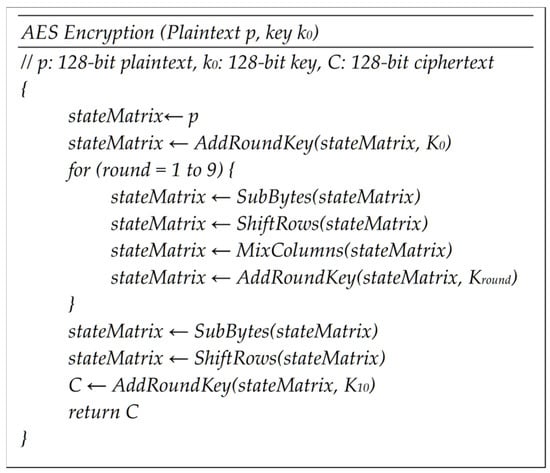
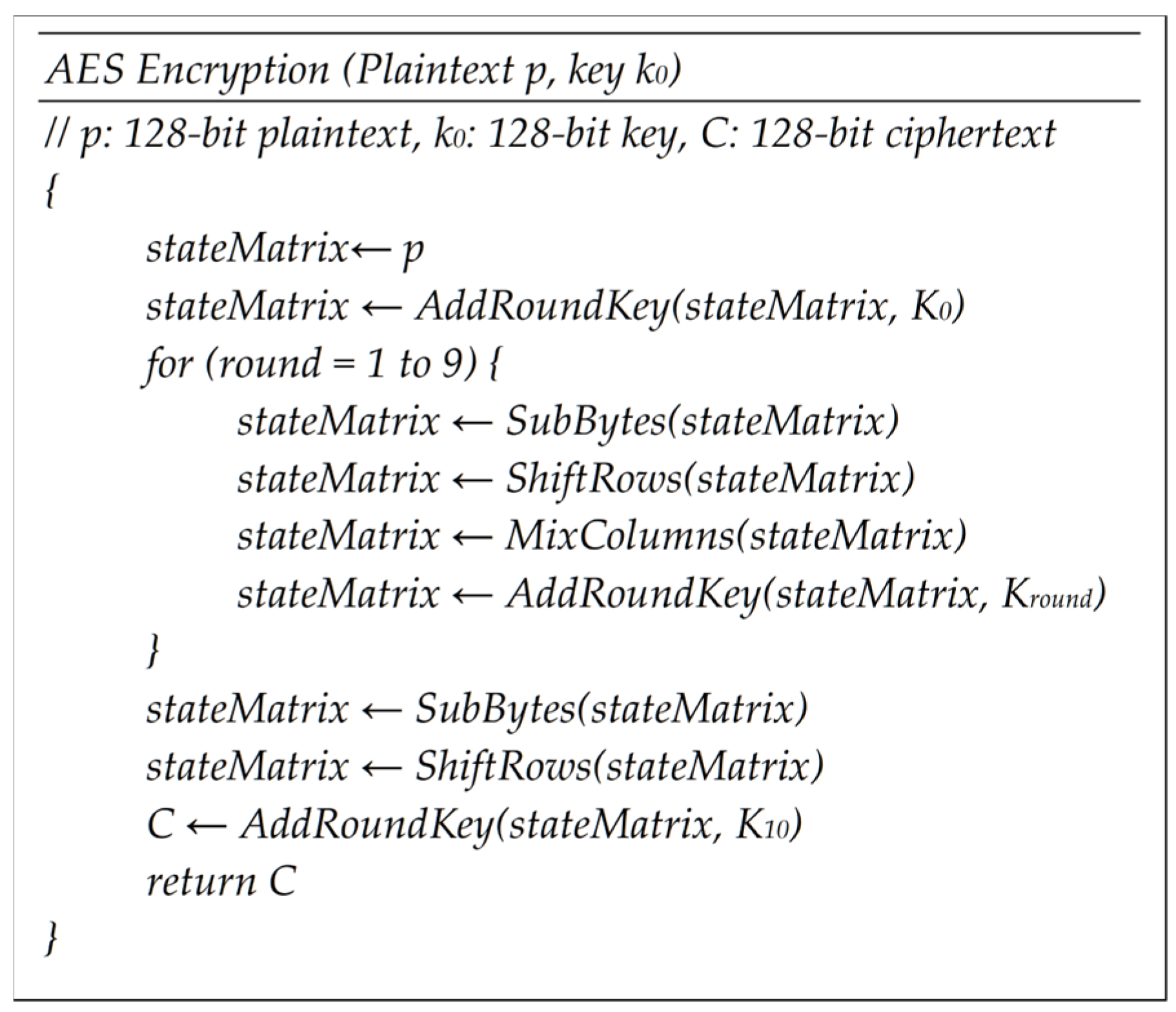
AES accommodates various data block sizes, including 128, 192, and 256-bit data blocks, with 128-bit as the basic unit. The number of rounds in the encryption process is associated with the block size: 10, 12, and 14 rounds, respectively. Since encryption and decryption processes use the same key, it simplifies the key management and enhances computational efficiency. AES processes the plaintext block over a number of rounds to produce the ciphertext, applying the following components: SubByte, ShiftRow, MixColumn, and AddRoundKey, to achieve confusion and diffusion [12]. The pseudocode for the AES encryption process is illustrated in Figure 1.
Figure 1.
AES encryption process.
3.1.2. Security
AES-128, AES-192, and AES-256 have demonstrated strong resistance to a wide spectrum of cryptanalytic techniques. AES employs 8-bit S-boxes with an MDP of 2−6 and a maximum linear bias of 2−7 that provide resilience against differential and linear cryptanalysis [26]. The MixColumns transformation ensures rapid diffusion, propagating differences across the state within four rounds. Truncated differential and boomerang attacks have been mounted on reduced-round versions, limited to six rounds, and do not compromise the full 10-, 12-, or 14-round configurations [27,28]. Related-key differential analysis has been explored, but bounds on active S-boxes prevent practical exploitation [29]. Algebraic attacks, particularly in the context of side-channel leakage, have been investigated. However, the high algebraic degree of the AES S-box combined with the complexity of its round transformations prevents effective algebraic exploitation [30].
3.2. LED
3.2.1. Description
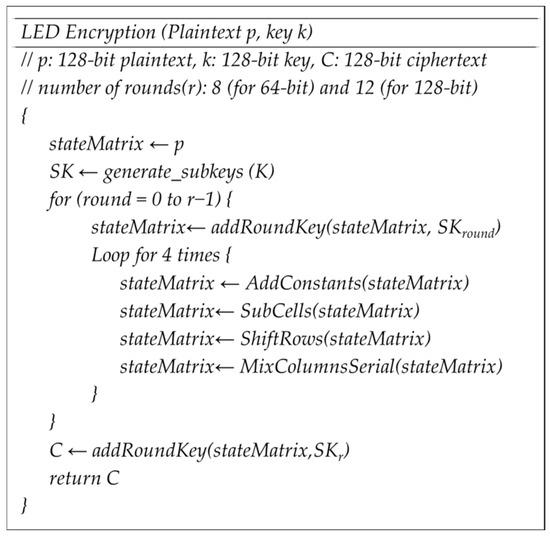
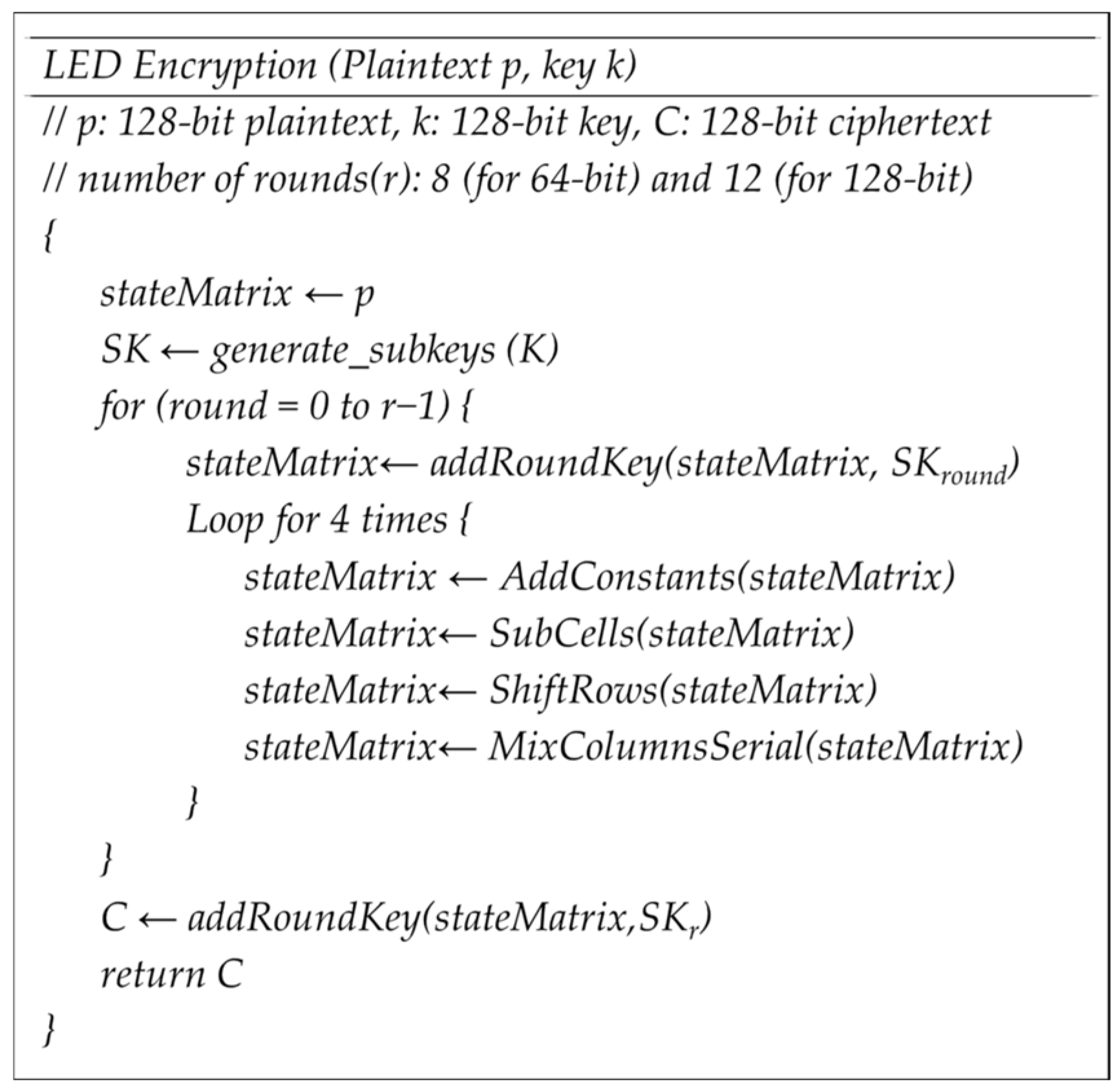
LED [11] is an AES-like lightweight block cipher designed to handle ultra-light key schedules. It aims for compact hardware implementation. It uses two primary key lengths of 64-bit and 128-bit. The cipher state matrix is arranged as a 4 × 4 grid, where each nibble corresponds to a GF(24) element given by the polynomial X4 + X + 1. LED uses lightweight AES-like operations, including AddConstants, SubCells, ShiftRows, and MixColumnsSerial, with simplified key scheduling. Its design focuses on simple substitution, permutation, and diffusion operations, making it suitable for constrained environments. The pseudocode for the LED encryption process is illustrated in Figure 2.
Figure 2.
LED Encryption Process.
3.2.2. Security
The conducted cryptanalysis on LED cipher is based on differential and linear cryptanalysis, algebraic attack, integral cryptanalysis, and rotational cryptanalysis. The differential and linear cryptanalysis on LED reveals that the path probability of four LED rounds is upper bounded by 2−50. However, this number can be reduced by 2−32 when applying the technique presented in [31]. The analysis reveals that the minimum number of active S-boxes in the case of LED 64, subkeys generation is equal to 200 S-boxes. And the differential path probability is equal to 2−400. The linear approximation probability is equal to 2−400. In the case of LED 128, the subkeys generation is equal to 300 S-boxes. And the differential path probability is equal to 2−600. The linear approximation probability is equal to 2−600. This results in a reasonable robustness level against differential and linear cryptanalysis. The algebraic analysis of LED 64 results in 10,752 equations and 4096 variables, which offer a higher level of robustness when compared to AES, which results in 6400 equations and 2560 variables. LED was analyzed against slide-attack, integral attack, and rational attack [11]. It was found that slide-attack is not applicable since LED uses a round-dependent constant, whereas an integral attack is unlikely to success, considering the high number of rounds. The rational attack also imposed a very weak threat since the use of S-boxes and a round-dependent constant removes the direct relation between the state matrices during the encryption rounds.
3.3. PRESENT
3.3.1. Description
PRESENT [32] operates on 64-bit blocks with two key variants of 80 or 128 bits. The encryption process consists of 31 rounds, and it uses a single bit-permutation table and a single 4-bit S-box. Each round includes three components: addRoundKey, sBoxLayer, and pLayer. The AddRoundKey component is to add the cipher state to the current key, which allows the algorithm to become key-permutated rather than state-permutated. The sBoxLayer component utilizes a single 4-bit S-box that transfers an input of 4 bits to a 4-bit output. The S-box design considers multiple conditions in pursuit of output avalanches and the hardware efficiency of the algorithm. This could provide very compacted results compared to the 8-bit S-box in AES. The S-box is applied 16 times in parallel and is considered the only non-linear part of the algorithm. The pLayer component provides a linear layer that can be processed with a minimum number of processing elements. It is considered a linear mixing layer that leads to direct bit permutations of the state matrix.
3.3.2. Security
The security of PRESENT has been examined using multiple cryptanalysis techniques. With the presence of the active S-boxes, a Maximum Differential Probability (MDP) of 2−2 and a linear bias of 2−2 are achieved. The security analyses highlight PRESENT’s resistance to differential and linear cryptanalysis. However, truncated differential attacks can penetrate 26 rounds [33]. No effective algebraic attacks have been demonstrated due to the S-box’s algebraic sparsity [32]. PRESENT retains a substitution layer and a bit-permutation layer, but unlike AES, it omits a full diffusion matrix. This reduces hardware complexity and makes it suitable for constrained devices, but it weakens its resistance to advanced cryptanalytic techniques.
3.4. ASCON Family
3.4.1. Description
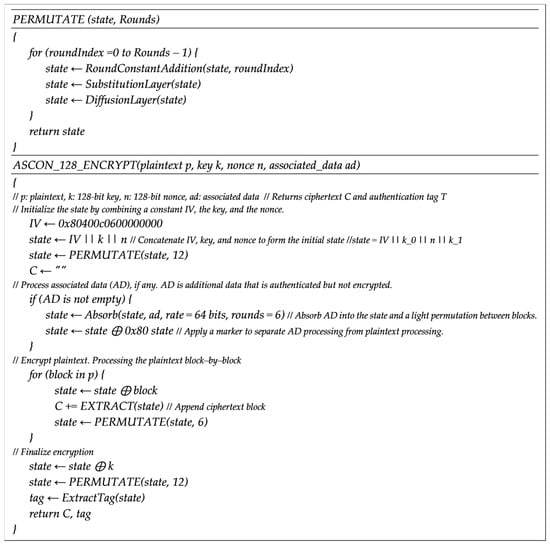
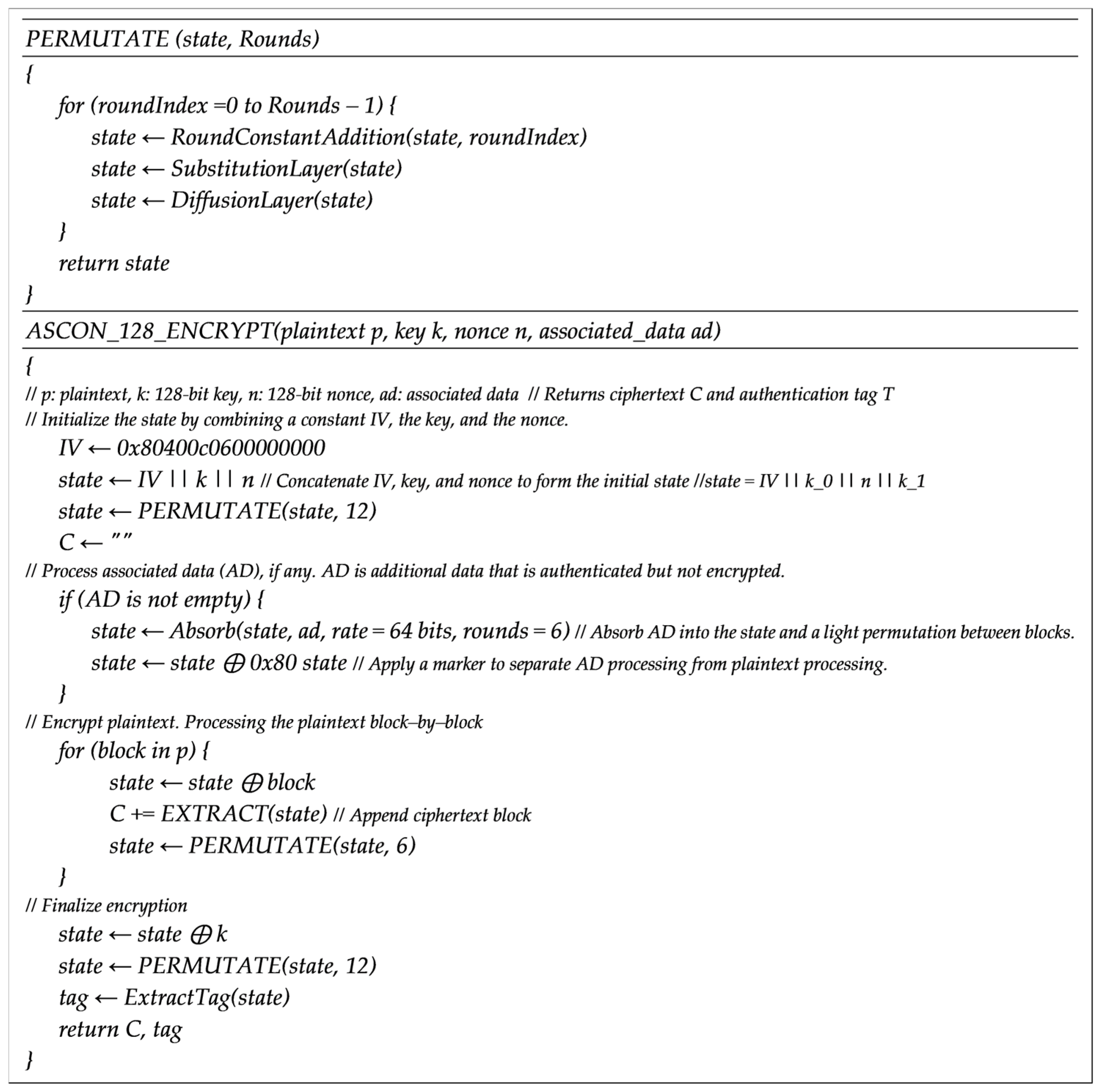
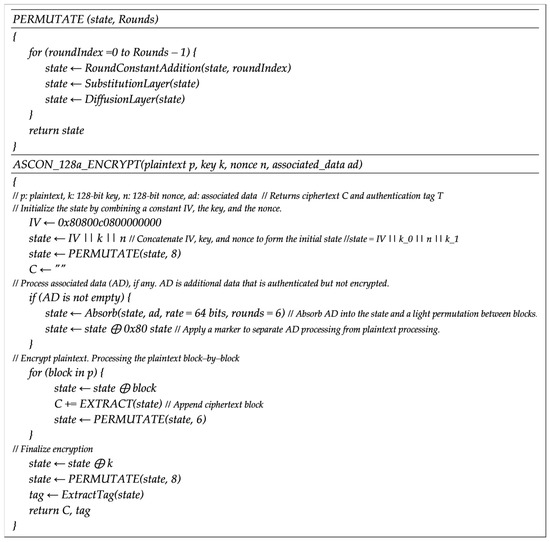
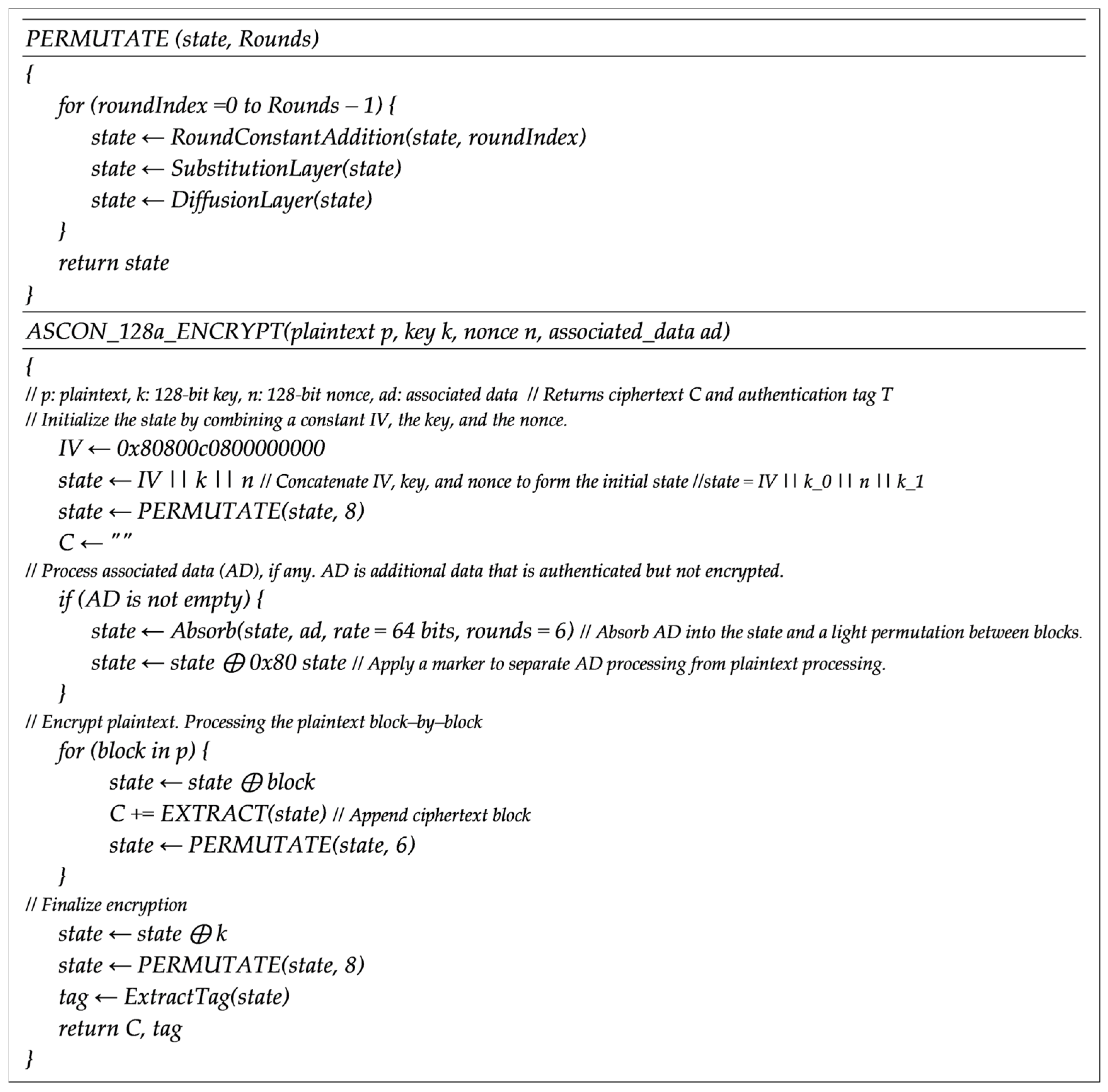
ASCON family [34] aimed to provide security for resource-constrained devices. ASCON-128 and ASCON-128a are two variants offering different trade-offs between security margin and throughput. ASCON prioritizes simplicity, compactness, and resistance to cryptanalytic [8]. ASCON design key elements include the use of sponge construction, permutation, Key and Nonce, and a 128-bit authentication tag. NIST selected the ASCON family, after a multi-round evaluation of 57 candidate algorithms, as the standard for lightweight authenticated encryption and hashing in 2023 [35]. Figure 3 and Figure 4 illustrate the pseudocode of ASCON-128 and ASCON-128a.
Figure 3.
ASCON-128 Encryption Process.
Figure 4.
ASCON-128a Encryption Process.
ASCON-128 and ASCON-128a use a 320-bit state that is divided into five 64-bit words. The encryption process includes two variants of permutation rounds, a 12-round full permutation and lighter permutations of six or eight rounds during data handling. ASCON-128 allows a 64-bit rate and 128-bit capacities, with a six-round light permutation applied during the processing of associated data and plaintext. In contrast, ASCON-128a increases the rate to 128 bits and processes data with an eight-round permutation. However, both the initial and final permutations remain 12 rounds, to guarantee integrity and confidentiality. ASCON-128a offers higher throughput than ASCON-128 but with a slightly reduced security margin [8]. ASCON uses simple bitwise operations to avoid S-box table lookups. Moreover, it has a small code size suitable for embedded systems [9]. Both variants, to prevent key reuse, use a 128-bit key and a 128-bit nonce, which is unique per encryption. Furthermore, to ensure integrity, a 128-bit authentication tag is generated.
3.4.2. Security
In terms of security, ASCON-128 and ASCON-128a have demonstrated resistance to a variety of cryptanalytic techniques. The core security of ASCON relies on its permutation function, which combines SPN and ARX operations. It uses a 5-bit S-box for substitution–permutation for each 5-bit word, which is resistant to differential and linear cryptanalysis [34]. It utilizes bitwise rotations and XOR operations to create diffusion. Although researchers have successfully mounted attacks on reduced-round versions of four or fewer rounds, these do not compromise the deployed full-round designs. Differential attacks, miss-in-the-middle strategies, and zero-sum distinguishers have all been explored, but these attacks become computationally infeasible at the whole 12-round level [9]. ASCON algorithms with full-round versions have been analyzed, with no practical vulnerabilities. However, while the reduced-round variants identified potential differential trails, these require unrealistic computational power. The 5-bit S-box has an MDP of 2−2. The combination of a low-DP S-box and iterative permutation layers disrupts differential consistency [8]. The full-round configurations of ASCON-128 and ASCON-128a show no vulnerabilities to algebraic analysis [9]. The finalization phase described in Figure 3 applies a whole permutation and integrates the key before tag generation, which strengthens resistance to forgery and chosen-ciphertext attacks. ASCON has structural features that simplify defenses against side-channel leakage. It is important to note that ASCON-128 is recommended where conservative security margins are necessary, while ASCON-128a is suited for cases that preference throughput over conservative bounds [8,9].
4. Materials and Methods
4.1. Evaluation Settings
The evaluation of ASCON-128, ASCON-128a, PRESENT, AES, and LED demonstrates their ability to achieve the desired randomness and efficiency. This is conducted through a framework of crucial metrics designed for cryptographic applications in the NIST statistical suite [3]. The evaluations were performed on a machine with an Intel Core i7-1165G7 CPU (11th Generation, quad-core, 2.80 GHz), 16 GB of RAM, and a 64-bit operating system running on an x64-based architecture. The algorithms were implemented in C, adapted from the original published source code.
The evaluated algorithms were exposed to identical settings to encrypt around 19,000 image files of diverse images with varied sizes up to 2560 KB to enrich the analysis. These images are based on two image datasets, CUB200-2011 [36] and AwA2 [37]. The rationale behind using images is that they contain a large amount of pixel data that can provide long sequences suitable for NIST randomness tests. Not to mention the strong correlation between neighboring pixels, which makes it challenging for encryption algorithms to produce a ciphertext that passes the randomness tests. Regardless of the data exchanged, whether it is text or images, the algorithms handle the data as a sequence of bits. Hence, cryptographic algorithms were evaluated based on their computation complexity and strength to ensure that they meet the security and efficiency requirements. A 95% confidence interval has been ensured for each data point in the results; however, for the sake of clarity, the error bars are not included in the figures. Table A1, Table A2, Table A3, Table A4 and Table A5 illustrate the success rates for each test and their lower and upper limits.
A randomness validation of a binary sequence is characterized by uniformity, unpredictability, and equal probabilities [38]. These characteristics are integrated into the ciphertext sequence fabric, producing a random ciphertext characterized by unpredictability and uniformity. The unpredictability ensures that predicting the subsequent bit is impossible even with knowledge of N bits within the sequence. The equal probabilities characteristic ensures that the occurrence of a zero or a one has the same probability within a binary random sequence, while uniformity requires that zeros and ones can appear at any position within the sequence, since they are uniformly distributed in the entire sequence. Following these characteristics ensures that the produced cryptographic algorithm ciphertext has the needed randomness and resilience against predictive attacks.
The metrics include the success rates of the following tests: Frequency Test, Runs Test, DFT test, CUSUM Forward test, and CUSUM Backward test. These tests are used to measure the randomness validation level in the crypto algorithms generated sequences, thereby showing their efficiency and ability to meet randomness requirements. Table 2 identifies the purpose and aspects of these tests. The subsequent subsections provide a detailed description of each test.
Table 2.
The purpose and aspect of randomness tests.
4.2. Frequency Test
The Frequency test examines whether the proportions of 0 s and 1 s are approximately equal, ensuring balanced bit distribution. A p-value of less than 0.01 means that the ratio between the ones and zeros is far from the typical ratio of 50%, and hence, the sequence is not random according to the test; otherwise, the sequence is random. The Frequency test p-value (Pfreq) is computed using Equation (1). Sobs is calculated according to Equation (2) for the sequence X. The complementary error function (erfc) is computed using Equation (3), which is a function that maps the test statistic to a p-value in the range (0, 1], where values near 1 indicate stronger evidence of randomness. These equations are explained in detail in NIST SP 800-22rev1a [3].
The Frequency test requires the tested sequence to have a minimum length of 100 bits. The test is reliable at detecting an imbalance between 0 s and 1 s. However, it only captures global balance. Therefore, a structured sequence with equal numbers of 0 s and 1 s can pass, even if it has obvious patterns. This is considered a limitation of the test, and validating randomness with this test alone is therefore insufficient; the other tests should also be included in the validation.
4.3. Runs Test
The runs test statistically evaluates the rate of change between zeros and ones to detect irregular transition patterns in a bit sequence [3]. A run refers to a sequence with consecutive identical bits. To determine if the observed number of runs deviates significantly from what would be expected by random chance, the test uses the binomial distribution to model the probability of bit transitions. The p-value for the runs test (Pruns) is calculated using Equation (4), where Vn(obs) is defined using Equation (5), where R(i) is zero if the two consecutive bits are the same, and 1 otherwise. The n denotes the sequence length, and π is the proportion of ones in the sequence.
The runs test requires the tested sequence to have a minimum length of 100 bits. The test counts only transition frequency, not transition regularity. A longer block size reduces the risk of small-sample anomalies, but it still counts only transitions. Therefore, two different structured sequences can yield similar run counts, and the limitation thus remains. Validating the randomness of the sequence should be accompanied by other tests.
4.4. Discrete Fourier Transform (DFT) Test
The DFT test is used to identify repetitive patterns within a binary sequence, to highlight deviations from ideal randomness. The binary sequence is transformed into a +1/−1 representation for spectral analysis. The sequence is examined to identify the peaks that exceed a predefined threshold. Peaks exceeding the 95% threshold are counted, with more than 5% indicating potential non-randomness. An excess of high-magnitude peaks indicates the presence of repetitive patterns, which means a non-random and periodic bias. The DFT test detects stationary periodic structures via spectral peak analysis. However, it is ineffective against non-periodic but structured sequences such as 01, 0011, 000111, and 00001111. Such sequences have no fixed period, producing a diffuse spectrum statistically similar to white noise, and may pass the DFT test undetected. Detection of such progressive structures requires linear complexity. This makes the DFT test sensitive only to stationary periodicity. Therefore, validating the randomness of the sequence should be accompanied by other tests since each test targets a specific dimension.
4.5. Cumulative Sums (CUSUM) Tests
There are two variants of the Cumulative Sums tests, namely the CUSUM Forward test and the CUSUM Backward test. The CUSUM Forward test evaluates the deviation of a binary sequence from an unbiased random walk in the forward direction. To conduct this, the binary sequence is transformed into +1/−1 representation. The cumulative sum Sk, for a binary sequence x1, x2, …, xn, is computed for each prefix of length k, as illustrated in Equation (6). The statistics in this test are derived from the maximum absolute value of Sk over all k, which reflects the largest observed excursion from the zero-baseline expected under the null hypothesis of randomness. The distribution of this maximum deviation is known for a large n, to enable the computation of a p-value. A significant difference suggests bias or errors in the sequence. If the p-value is less than 0.01, the test fails.
The CUSUM Backward test is identical to the forward variant, but applied in the reverse direction, starting with the last bit in the sequence and moving toward the first. This is to detect non-random patterns occurring toward the end of the sequence. The CUSUM Backward computes the maximal absolute deviation of the cumulative sum from zero, but in reversed sequence order, and then computes the p-value. The forward and backward tests identify localized irregularities that may be apparent only in one direction. The test fails if the p-value is below 0.01.
5. Results
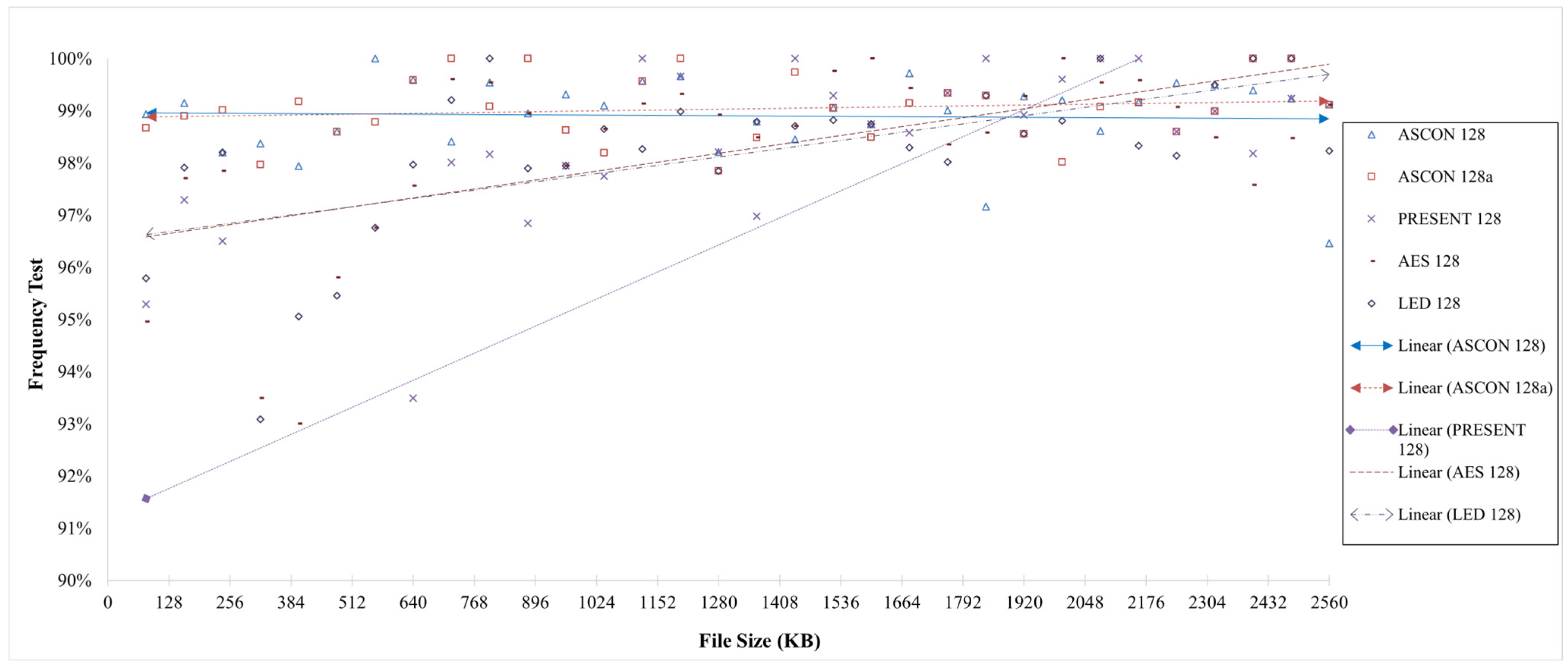
Figure 5 shows the Frequency test success rates of ASCON-128, ASCON-128a, AES, and LED, over the varied file sizes, using the trendline to reflect the performance. The variations in file size are represented on the x-axis, and the test success rates are represented on the y-axis. As the figure illustrates, ASCON-128 outperforms its counterparts across file sizes variations, with success rates mainly exceeding 98%. In contrast, AES begins with lower success rates, around 95%, but it improves as the file size increases as it operates better with redundant patterns within the plaintext. ASCON-128a exhibits outstanding performance, although there are some minor fluctuations. LED, on the other hand, shows varying performance, with a success rate that drops to 93%, representing the lowest adaptability to smaller files. As file sizes increase to around 1360 KB, the differences between the algorithms fade, as they achieve high success rates exceeding 99% for larger files. This introduces the impact of file size, where larger files enable all algorithms to reach their full potential due to the increased redundancy in larger files. PRESENT-128 shows pass rate sensitivity for the variation in file sizes, but the pass rates recover for larger files. This is due to the limited diffusion, which makes short sequences more vulnerable to detectable statistical structure. These results highlight the impact of file size variation on the algorithm performance. Although ASCON-128 and ASCON-128a demonstrate relatively stable trendlines, AES and LED demonstrate better trendlines for larger files.
Figure 5.
The Frequency test success rates for ASCON-128, ASCON-128a, PRESENT-128, AES-128, and LED-128.
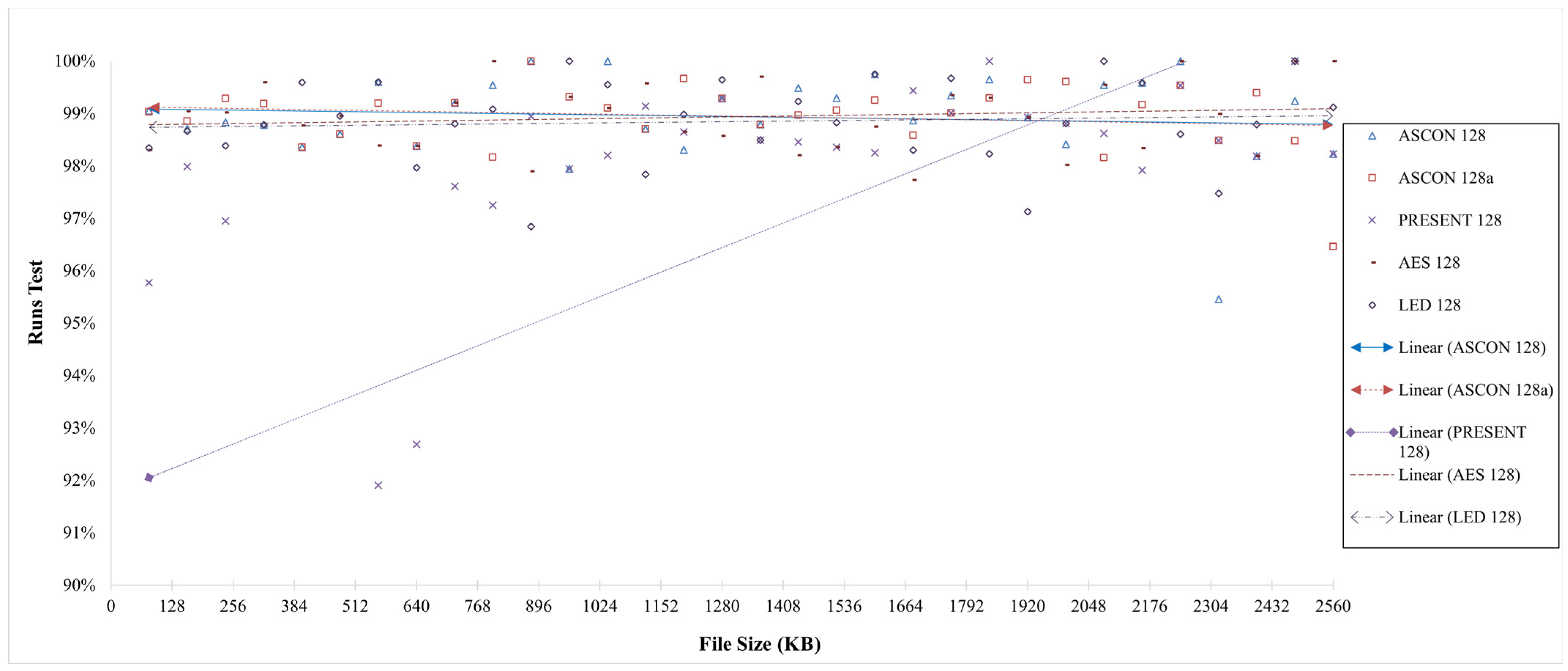
Figure 6 illustrates the success rates of the four algorithms in the runs test. The trendlines demonstrate the performance of these algorithms. ASCON-128 maintains success rates mostly above 98%, with only a few declines for larger file sizes. ASCON-128a shows similarly high performance but with greater variance across file size variations. Although ASCON-128 and ASCON-128a showed some performance drops, they quickly recovered at subsequent file sizes. AES maintains consistency and achieves success rates for large file sizes; however, it shows a few inclines. AES shows an increase in success rates, reaching 100% for larger file sizes, demonstrating improved performance with larger files and suitability for them. In contrast, LED has success rates that fluctuate more frequently as file size increases. Although it scales slightly with larger file sizes, it demonstrates more frequent drops in success rates. PRESENT-128 exhibits a clear size-dependent pattern; the pass rates reach as low as 78%, but it recovers for larger files. This behavior is consistent with its lightweight design and is affected by the small S-boxes.
Figure 6.
The Runs test success rates for ASCON-128, ASCON-128a, PRESENT-128, AES-128, and LED-128.
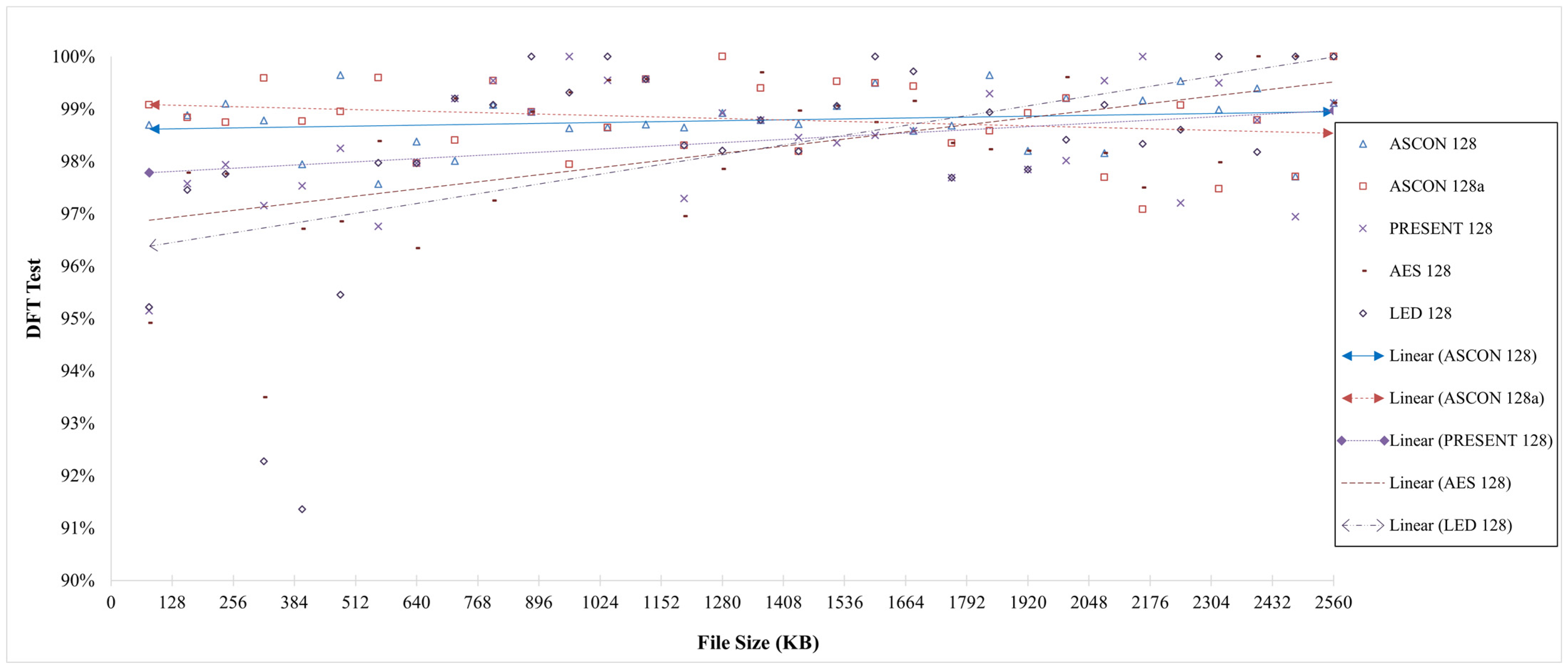
Figure 7 shows the DFT test success rates for the four algorithms, ASCON-128, ASCON-128a, AES, and LED, to demonstrate their performance across the varied file sizes. ASCON-128a shows success rates ranging from 97% to 100%, demonstrating balanced performance across file sizes, with only a few drops at large sizes. ASCON-128 demonstrates more balanced performance than ASCON-128a, achieving success rates of 98–100% across varied file sizes. In contrast, AES success rates increase with file size, stabilizing above 98% for files of 1040 KB or more. Similar performance is demonstrated by LED, however, with noticeable variability and lower performance for small to medium-sized files. However, its success rate increases significantly with larger sizes, reaching peak rates of 99–100%. This is because LED employs a minimal key schedule optimized for compact hardware implementation. The limited key diffusion and smaller block size mean that the generated ciphertext for small file sizes contains fewer independent blocks. Therefore, the diffusion properties become more evident when applied to larger data volumes. Although ASCON-128a demonstrates consistent performance, and ASCON-128 ranks closely behind it, AES and LED performance improves with increasing file size. PRESENT-128 shows generally high DFT pass rates because the DFT targets periodic and spectral peaks; its permutations usually do not create periodic spectral spikes. This does not contradict failure rates on other tests that examine different kinds of local patterns.
Figure 7.
The DFT test success rates for ASCON-128, ASCON-128a, PRESENT-128, AES-128, and LED-128.
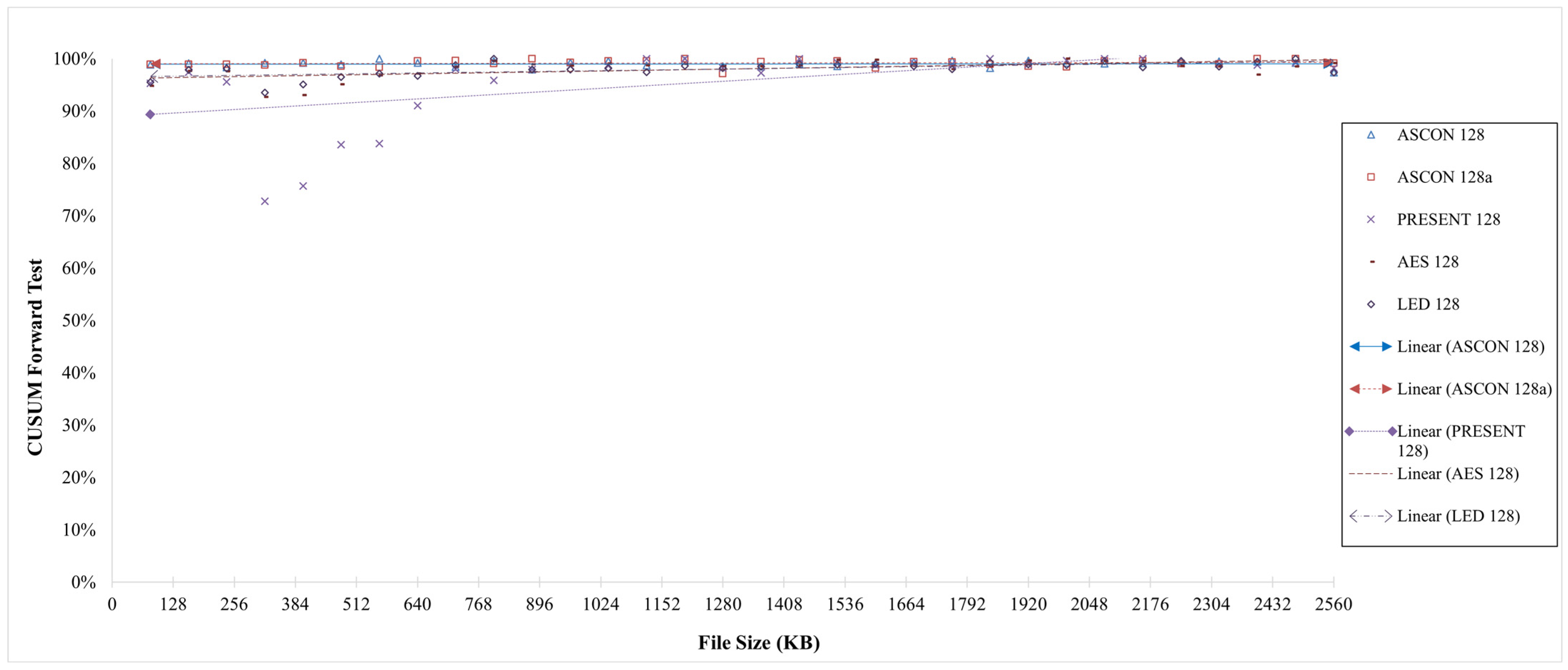
Figure 8 illustrates CUSUM Forward test success rates. As the figure shows, ASCON-128 and ASCON-128a demonstrate success rates with minimal deviation in success rate across file sizes. Their values are clustered around 99%, with some points reaching around 100%. AES and LED exhibit variation in success rates for small file sizes. AES performance improves with file size increase; it stabilizes as the size increases, making it a good alternative for encrypting larger files. ASCON-128 and ASCON-128a exhibit near flat trendlines, demonstrating high performance as they already show robustness across file sizes. AES shows a positive exponential trend, starting from lower success rates and rising consistently. This is indicative of an algorithm that benefits from increased file sizes, possibly due to a reliance on larger file sizes, which means it scales efficiently. LED has fluctuations for small file sizes. In essence, ASCON-128 and ASCON-128a perform well across a wide range of file sizes, while AES improves significantly as file size increases, and similar behavior is demonstrated by LED, but it shows many drops in success rates for small file sizes. PRESENT-128 pass rates fluctuate for small files because of limited diffusion, and its small S-boxes leave a short-range pattern that the CUSUM statistic detects is easily amplified. Short and medium inputs are more prone to detectable local patterns, whereas longer sequences mask those effects.
Figure 8.
The CUSUM Forward test success rates for ASCON-128, ASCON-128a, PRESENT-128, AES-128, and LED-128.
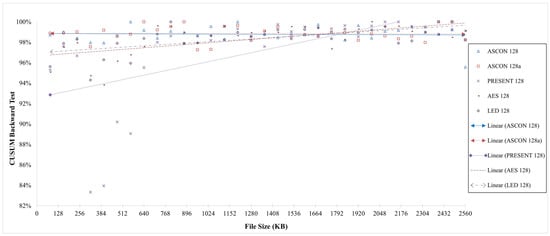
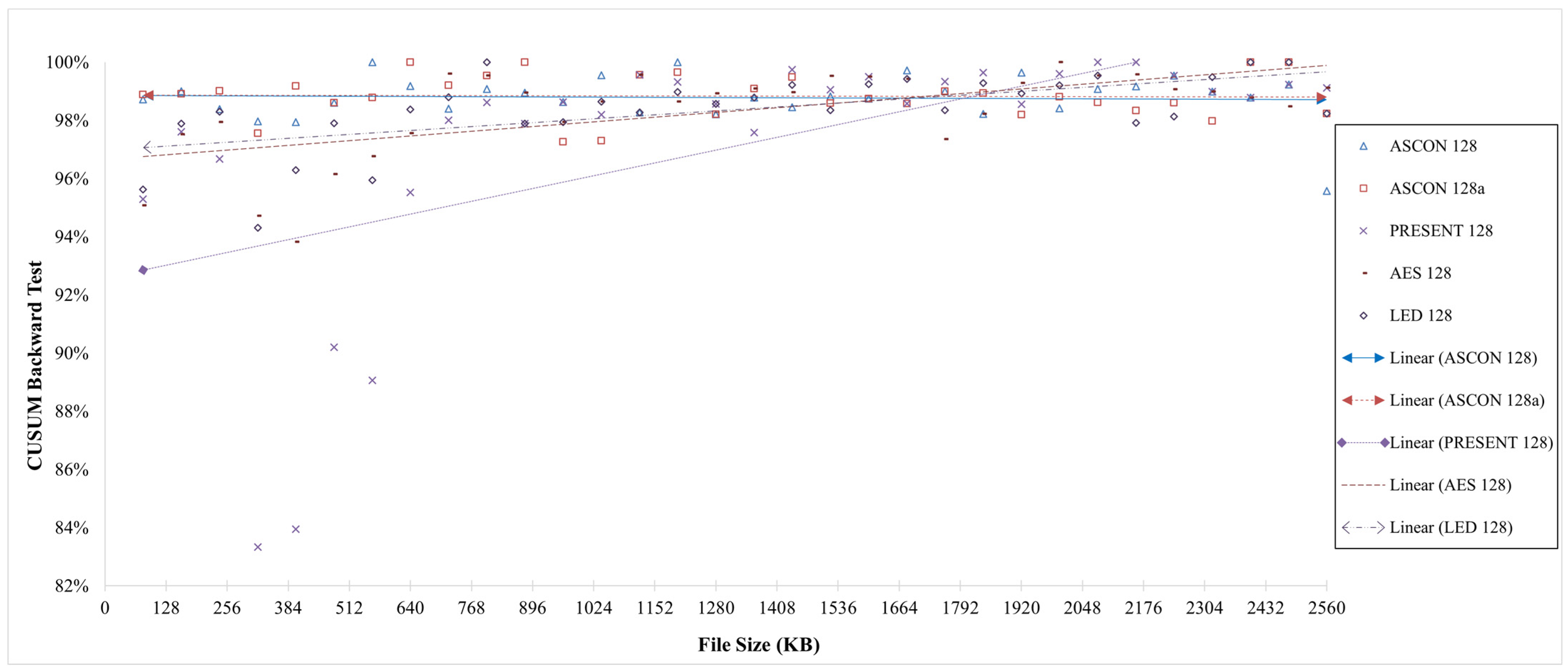
Figure 9 shows the CUSUM Backward test success rates for the varied file sizes. As the figure illustrates, ASCON-128 and ASCON-128a maintain success rates mostly ranging between 97% and 100%. Although both show a steady start, ASCON-128 shows a slight decline as the file size increases, suggesting slightly reduced adaptability to larger sizes. On the other hand, AES has a broader variance, beginning with a moderate success rate around 95% and improving as file sizes increase. It peaks at 100% at 2000 KB but shows more fluctuation than ASCON-128 and ASCON-128a for small file sizes. Similar behavior is depicted by LED with its upward trend toward larger file sizes, including multiple 100% success rates, but it fluctuates in the earlier range of small file sizes. AES scales well and improves steadily from lower success rates at smaller sizes to success rates in the range of 99% to 100% as the file size increases. LED also scales well, improving over time and maintaining high performance. AES shows a positive exponential performance rise, which shows that its performance improves with file size increases. ASCON-128 and ASCON-128a have a flat trendline but slight downward slope with larger file sizes. ASCON-128 and ASCON-128a show a relatively stable performance, although there are performance drops for large file sizes with respect to AES and LED performance. PRESENT-128 pass rates fluctuate for small files because of limited diffusion, and its small S-boxes leave a short-range pattern that the CUSUM statistic detects is easily amplified.
Figure 9.
The CUSUM Backward test success rates for ASCON-128, ASCON-128a, PRESENT-128, AES-128, and LED-128.
6. Discussion
Diffusion in AES is achieved through the MixColumns and ShiftRows operations. The round keys are generated using a combination of rotations, S-boxes substitutions, and round constants, which provide strong randomness across rounds. It employs the Rijndael expansion for key scheduling. In PRESENT, the diffusion depends on the bit-permutation using the P-box instead of a separate diffusion layer. This makes it lightweight; however, because it does not have a dedicated diffusion layer, its avalanche effect is weaker than that of AES. The round key schedule is produced by an LFSR, so it uses a subkey at every round. LED simplifies its design with smaller S-box and P-box components and a reduced diffusion layer. It does not use a schedule mechanism to produce round keys; this is simplified by XORing the master key directly with the state, saving computation resources. However, this makes it more vulnerable by limiting entropy between rounds. ASCON, on the other hand, utilizes a sponge construction with a permutation-based round function. However, the key injection is optimized and used at initialization and finalization phases. In contrast, associated data and plaintext are absorbed into the state during processing. The diffusion comes from a permutation function composed of 5-bit S-boxes, linear diffusion that includes bitwise rotations and XORs, and round constants. To conclude, AES demonstrates strong security due to its strong diffusion and key scheduling. PRESENT and LED are both lightweight implementations, but they have less avalanche strength. ASCON combines encryption and authentication in a sponge-based design that balances modern integrity guarantees with limited resources. Table 3 summarizes the main differences.
Table 3.
Confusion, diffusion, and key scheduling summary for AES, PRESENT, LED, and ASCON.
The NIST statistical suite has been extensively used to evaluate the randomness of cryptographic algorithms [4,5,6,7]. The process of selecting AES algorithm [7] involved rigorous randomness testing of the candidates, including Rijndael, Serpent, Twofish, RC6, and Mars, have been assessed with the NIST statistical test suite published in NIST SP 800-22rev1a, as a standardized battery of tests for cryptographic randomness to validate the randomness of binary sequences generated by cryptographic algorithms and pseudorandom number generators [3]. ASCON family variants are introduced as simple alternatives to provide a certain level of security while reducing the processing time as much as possible. On the other hand, AES provides multiple security levels based on data sensitivity, allowing greater choice with added complexity. LED has also demonstrated security robustness in the literature, but it has a minimal key schedule, which means it is more exposed to related-key attacks. Also, PRESENT has proven security robustness in the literature, but it showed higher variation in the randomness validation success rates. It is important to note that the security analyses of AES, ASCON, PRESENT, and LED have been thoroughly established in the literature, as discussed in Section 3. Our study does not reassess their cryptographic strength. Instead, the focus is on evaluating the impact of varying file sizes on randomness properties.
IoT networks may include constrained devices such as sensors with minimal memory and power, devices with mid-range CPUs and more memory, such as smart appliances and fully capable devices with powerful CPUs, GPUs, and large memory. Data communicated can also be categorized into regular data and sensitive data. Although the security of both categories should be guaranteed, sensitive data may require extra care to ensure their safety and guarantee their protection.
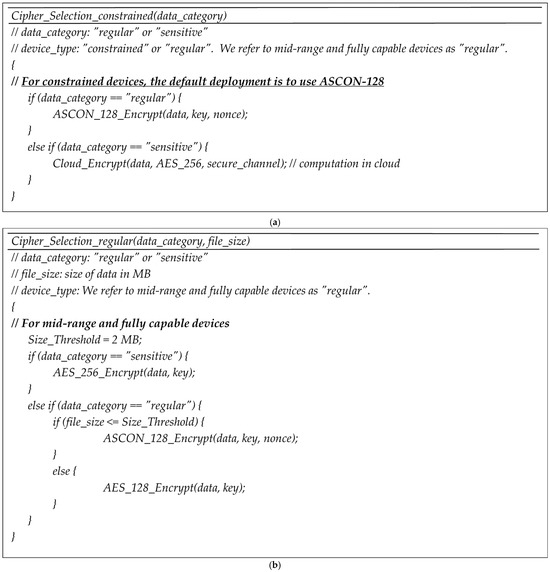
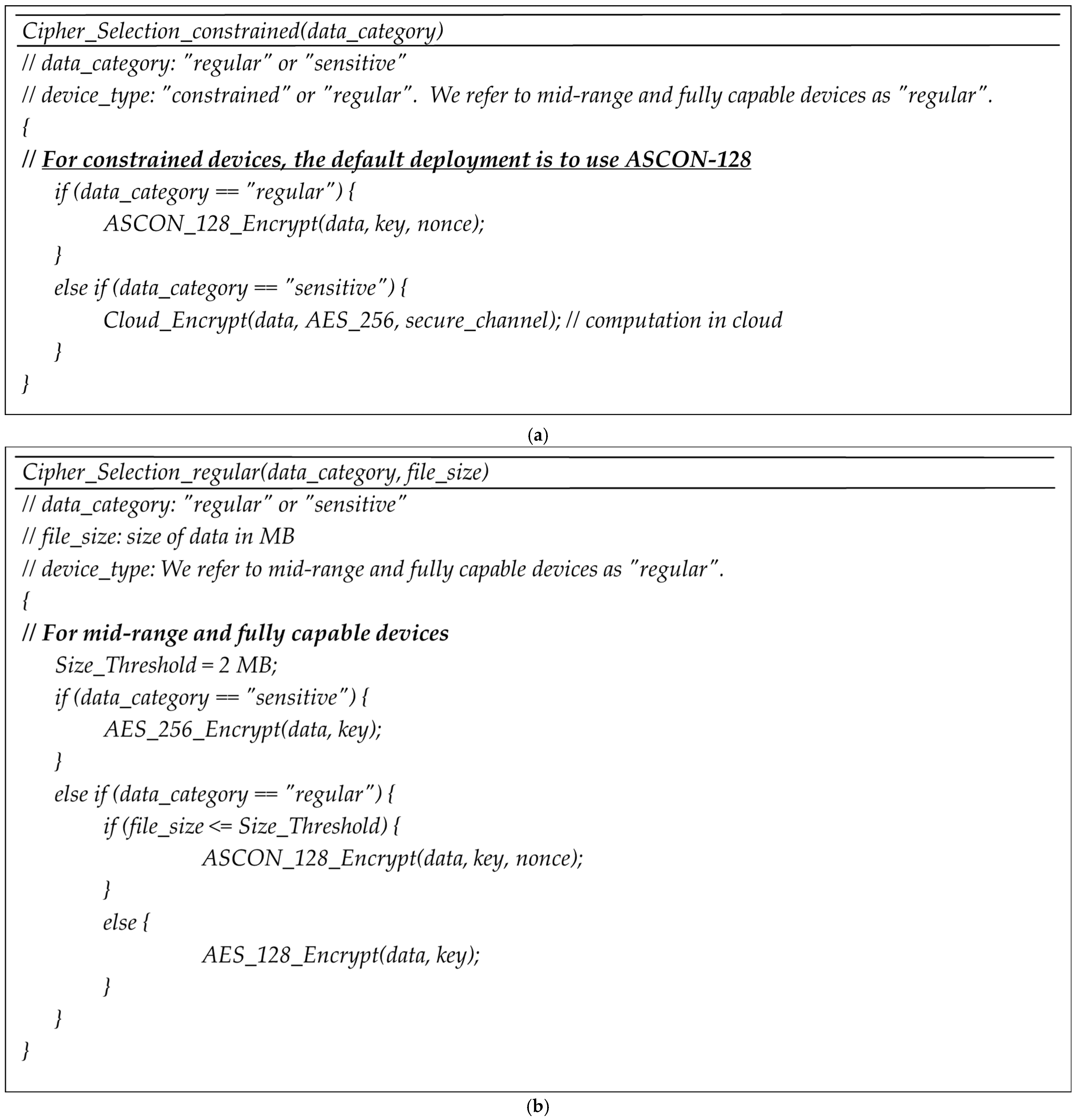
AES and ASCON have demonstrated sufficient randomness validation across various randomness tests, in addition to their integrated strong diffusion. Accordingly, LED and PRESENT are excluded from the final framework due to their performance limitations and weaker diffusion compared to AES and ASCON. We suggest a selection framework that incorporates these well-established algorithms and their validated randomness properties. The framework incorporates threefold criteria. It considers device type in terms of computational capability, data categories in terms of sensitive and regular data, and file size threshold. For device type, we refer to mid-range and fully capable devices as regular and devices with computational limitations as constrained. For constrained devices, the typical traffic is light; the default deployment is to use ASCON-128, since it prioritizes simplicity, compactness, and resistance to cryptanalytic attacks [8]. Also, in the conducted randomness evaluation, it outperformed the other ciphers for small file sizes, which aligns with this choice, since these devices typically generate low data traffic. On the other hand, for sensitive data, we recommend using more secure alternatives, such as AES-256. In such a case, a solution that uses cloud computation over a secure channel to encrypt data can be used since they have limited computational power. This is illustrated in Figure 10a. To align the suitability of selecting ASCON for constrained devices, we can consider ASCON’s energy efficiency on constrained hardware. Radhakrishnan et al. [39] confirm that ASCON achieves higher energy efficiency and lower memory usage than AES on Arduino Nano and Micro boards. Complementing these microcontroller results, at the hardware design level, Elsadek et al. [40], using a silicon-based analysis, demonstrated that the ASCON Application Specific Integrated Circuit (ASIC) fabricated on GF22FDx technology uses only 39% of AES’s area. ASCON achieves energy efficiency of 3.5 Tb/J at 0.6 V, outperforming AES by up to 25 times.
Figure 10.
Cipher-selection framework: (a) cipher selection for constrained devices; (b) cipher selection for regular devices, which includes mid-range and fully capable devices.
For mid-range and fully capable devices, sensitive data can be protected with a secure alternative, such as AES-256. However, they can incorporate encryption without relying on cloud services, since they are computationally capable. For regular data, we can use the results of the conducted randomness evaluation to select based on a file size threshold. Below the threshold, data are encrypted using ASCON-128, since it has randomness validation for these file sizes. Above this threshold, AES-128 is recommended based on the conducted evaluation. This is illustrated in Figure 10b. The selection based on file size should not incur significant computational overhead. The choice of the threshold is determined based on the randomness evaluation of produced ciphertexts, considering the intersection of the randomness tests used. Practically, this framework means that encryption schemes can be selected dynamically based on deployment constraints, rather than using a single static cipher configuration, especially in heterogeneous IoT environments where device capabilities, traffic size, and data sensitivity can vary a lot.
Limitations
It should be noted that dynamic data classification is beyond the scope of this framework. To simply this, data classification of the generated data can be configured when deploying the device. The proposed selection framework is subject to additional enhancements and evaluations. It would be interesting to explore hardware-level simulators such as gem5 simulator, as well as IoT-focused simulators, to provide both performance evaluation and realistic scenarios for adaptive encryption in IoT.
Side-channel attacks take advantage of physical leaks like power consumption, timing differences, and electromagnetic emissions. These attacks can break mathematically secure ciphers [41]. AES is robust against cryptanalysis, but it is weak against differential power analysis. Even with masking schemes, deep learning-based collision attacks may be able to obtain secret keys [42]. PRESENT leaks information that can be used through power and EM channels. Unprotected implementations always fail standard leakage tests [43]. LED is hard to break with classical cryptanalysis, but threshold implementations are needed to stop first-order side-channel leakage [44]. Even with ASCON, which was recently chosen as the NIST Lightweight Cryptography standard in 2023, it has been shown to be weak against template attacks on 32-bit microcontrollers, even with a few power traces [45]. This concludes that there is no inherently immune cipher to side-channel attacks, and secure deployment requires dedicated countermeasures such as masking and threshold implementations.
7. Conclusions
This paper proposes an analysis model for SPN-based lightweight ciphers that incorporates both the statistical analysis of randomness and performance evaluation of these ciphers to develop an adaptive encryption framework that considers constrained devices. The novelty of this study lies in the development of a randomness-driven comparative evaluation methodology and its integration into an adaptive cipher-selection framework for heterogeneous IoT environments. The findings indicate that both ASCON-128 and ASCON-128a, in general, perform better compared to AES, PRESENT, and LED in ensuring randomness integrity and computer power with respect to varying file sizes. Specifically, ASCON-128a proved to be the fastest encryptor and the most resilient to scalability issues, and is therefore best suited to high-throughput applications. AES has been shown to be highly scalable and reliable with large files, while LED and PRESENT have shown fluctuations in performance for smaller file size variations. This fact is supported by the NIST-based analysis that shows the quality of randomness to be directly proportional to the diffusion and confusion functions of the cipher, with the necessity of providing an optimized level of efficiency and security. The proposed framework allows a trade-off between security and efficiency. It considers data sensitivity, file size, and device computational limitations. As part of our future work, we plan to implement further enhancements and conduct additional evaluations of the proposed framework. We would explore hardware-level and IoT-focused simulators to support both performance evaluation and realistic scenarios for adaptive encryption in IoT. Another important direction would be the inclusion of dynamic data classification.
Author Contributions
Conceptualization, R.S.A.-Q. and M.Q.; methodology, R.S.A.-Q. and M.Q.; software, R.S.A.-Q. and M.Q.; validation, R.S.A.-Q. and M.Q.; formal analysis, R.S.A.-Q.; writing—original draft preparation, R.S.A.-Q.; writing—review and editing, R.S.A.-Q. and M.Q.; visualization, R.S.A.-Q. All authors have read and agreed to the published version of the manuscript.
Funding
This research received no external funding.
Data Availability Statement
The datasets cited in this study are publicly available. The CUB-200-2011 dataset is available at https://doi.org/10.22002/D1.20098 (accessed on 28 May 2026), and the AwA2 dataset is available at https://cvml.ista.ac.at/AwA2/ (accessed on 28 May 2026).
Acknowledgments
The authors would like to acknowledge the use of Grammarly (v1.2.264.1894) for text editing assistance, including grammar and spelling.
Conflicts of Interest
The authors declare no conflict of interest.
Abbreviations
The following abbreviations are used in this manuscript:
| IoT | Internet of Things |
| NIST | National Institute of Standards and Technology |
| SPN | Substitution–Permutation Networks |
| ARX | Add-Rotate-XOR |
| AEAD | Authenticated Encryption with Associated Data |
| MDP | Maximum Differential Probability |
| MDS | Maximum Distance Separable |
| AES | Advanced Encryption Standard |
| Erfc | complementary error function |
| CUSUM | Cumulative Sums |
| ASIC | Application Specific Integrated Circuit |
Appendix A
Table A1.
The Frequency test success rates for ASCON-128, ASCON-128a, PRESENT-128, AES-128, and LED-128, with Lower Confidence Limit (LCL), Upper Confidence Limit (UCL).
Table A2.
The Runs test success rates for ASCON-128, ASCON-128a, PRESENT-128, AES-128, and LED-128, with Lower Confidence Limit (LCL), Upper Confidence Limit (UCL).
Table A3.
The DFT test success rates for ASCON-128, ASCON-128a, PRESENT-128, AES-128, and LED-128, with Lower Confidence Limit (LCL), Upper Confidence Limit (UCL).
Table A4.
The CUSUM Forward test success rates for ASCON-128, ASCON-128a, PRESENT-128, AES-128, and LED-128, with Lower Confidence Limit (LCL), Upper Confidence Limit (UCL).
Table A5.
The CUSUM Backward test success rates for ASCON-128, ASCON-128a, PRESENT-128, AES-128, and LED-128, with Lower Confidence Limit (LCL), Upper Confidence Limit (UCL).
References
- Zhang, X.; Yang, M.; Chen, J.; Li, T.; Wang, C. RAB: A lightweight block cipher algorithm with variable key length. Peer-To-Peer Netw. Appl. 2024, 17, 2906–2920. [Google Scholar] [CrossRef] [Scilit]
- Eisenbarth, T.; Kumar, S.; Paar, C.; Poschmann, A.; Uhsadel, L. A Survey of Lightweight-Cryptography Implementations. IEEE Des. Test Comput. 2007, 24, 522–533. [Google Scholar] [CrossRef] [Scilit]
- Rukhin, A.; Soto, J.; Nechvatal, J.; Barker, E.; Leigh, S.; Levenson, M.; Banks, D.; Heckert, A.; Dray, J.; Vo, S. A Statistical Test Suite for Random and Pseudorandom Number Generators for Cryptographic Applications; National Institute of Standards & Technology: Gaithersburg, MD, USA, 2010. [Google Scholar]
- Duta, C.; Mocanu, B.-C.; Vladescu, F.-A.; Gheorghe, L. Randomness Evaluation Framework of Cryptographic Algorithms. Int. J. Cryptogr. Inf. Secur. 2014, 4, 31–49. [Google Scholar] [CrossRef] [Scilit]
- Chew, L.; Chew, N.; Norshahil, I.; Shah, M.; Azura, N.; Abdullah, N.; Hidayah, N.; Zawawi, A.; Rani, H.A.; Zakaria, A.A. Randomness Analysis on Speck Family of Lightweight Block Cipher. Int. J. Cryptol. Res. 2015, 5, 44–60. [Google Scholar]
- Alani, M.M. Testing randomness in ciphertext of block-ciphers using dieHard tests. Int. J. Comput. Sci. Netw. Secur. 2010, 10, 53–57. [Google Scholar]
- Soto, J. Randomness Testing of the AES Candidate Algorithms; NIST: Gaithersburg, MD, USA, 1999. [Google Scholar]
- Dobraunig, C.; Eichlseder, M.; Mendel, F.; Schläffer, M. Ascon v1.2: Lightweight Authenticated Encryption and Hashing. J. Cryptol. 2021, 34, 33. [Google Scholar] [CrossRef] [Scilit]
- Kaur, J.; Canto, A.C.; Kermani, M.M.; Azarderakhsh, R. A Survey on the Implementations, Attacks, and Countermeasures of the NIST Lightweight Cryptography Standard: ASCON. ACM Comput. Surv. 2025, 58, 6. [Google Scholar] [CrossRef] [Scilit]
- Qasaimeh, M.; Al-Qassas, R.S.; Ababneh, M. Software design and experimental evaluation of a reduced AES for IoT applications. Future Internet 2021, 13, 273. [Google Scholar] [CrossRef] [Scilit]
- Guo, J.; Peyrin, T.; Poschmann, A.; Robshaw, M. The LED block cipher. In Proceedings of the 13th International Workshop on Cryptographic Hardware and Embedded Systems–CHES 2011, Nara, Japan, 28 September–1 October 2011; pp. 326–341. [Google Scholar]
- NIST FIPS 197-upd1; Advanced Encryption Standard (AES). Federal Information Processing Standards Publication (FIPS); National Institute of Standards and Technology: Gaithersburg, MD, USA, 2001.
- Aboushosha, B.; Ramadan, R.A.; Dwivedi, A.D.; El-Sayed, A.; Dessouky, M.M. SLIM: A lightweight block cipher for internet of health things. IEEE Access 2020, 8, 203747–203757. [Google Scholar] [CrossRef] [Scilit]
- Feng, J.; Li, L. SCENERY: A lightweight block cipher based on Feistel structure. Front. Comput. Sci. 2022, 16, 163813. [Google Scholar] [CrossRef] [Scilit]
- Hong, D.; Sung, J.; Hong, S.; Lim, J.; Lee, S.; Koo, B.-S.; Lee, C.; Chang, D.; Lee, J.; Jeong, K. HIGHT: A new block cipher suitable for low-resource device. In Proceedings of the International Workshop on Cryptographic Hardware and Embedded Systems; Springer: Berlin/Heidelberg, Germany, 2006; pp. 46–59. [Google Scholar]
- Hong, D.; Lee, J.-K.; Kim, D.-C.; Kwon, D.; Ryu, K.H.; Lee, D.-G. LEA: A 128-bit block cipher for fast encryption on common processors. In Proceedings of the International Workshop on Information Security Applications, Jeju Island, Republic of Korea, 19–21 August 2013; pp. 3–27. [Google Scholar]
- Chen, S.; Fan, Y.; Sun, L.; Fu, Y.; Zhou, H.; Li, Y.; Wang, M.; Wang, W.; Guo, C. SAND: An AND-RX Feistel lightweight block cipher supporting S-box-based security evaluations. Des. Codes Cryptogr. 2022, 90, 155–198. [Google Scholar] [CrossRef] [Scilit]
- Avanzi, R. The QARMA block cipher family. almost MDS matrices over rings with zero divisors, nearly symmetric even-mansour constructions with non-involutory central rounds, and search heuristics for low-latency s-boxes. IACR Trans. Symmetric Cryptol. 2017, 2017, 4–44. [Google Scholar] [CrossRef] [Scilit]
- Banik, S.; Pandey, S.K.; Peyrin, T.; Sasaki, Y.; Sim, S.M.; Todo, Y. GIFT: A small present: Towards reaching the limit of lightweight encryption. In Proceedings of the Cryptographic Hardware and Embedded Systems–CHES 2017: 19th International Conference, Taipei, Taiwan, 25–28 September 2017; pp. 321–345. [Google Scholar]
- Banik, S.; Bogdanov, A.; Isobe, T.; Shibutani, K.; Hiwatari, H.; Akishita, T.; Regazzoni, F. Midori: A block cipher for low energy. In Proceedings of the Advances in Cryptology–ASIACRYPT 2015: 21st International Conference on the Theory and Application of Cryptology and Information Security, Auckland, New Zealand, 29 November–3 December 2015; Proceedings, Part II 21. pp. 411–436. [Google Scholar]
- Zhang, W.; Bao, Z.; Lin, D.; Rijmen, V.; Yang, B.; Verbauwhede, I. RECTANGLE: A bit-slice lightweight block cipher suitable for multiple platforms. Sci. China Inf. Sci. 2015, 58, 1–15. [Google Scholar] [CrossRef] [Scilit]
- Canteaut, A.; Duval, S.; Leurent, G.; Naya-Plasencia, M.; Perrin, L.; Pornin, T.; Schrottenloher, A. Saturnin: A suite of lightweight symmetric algorithms for post-quantum security. IACR Trans. Symmetric Cryptol. 2020, 2020, 160–207. [Google Scholar] [CrossRef] [Scilit]
- Cui, Y.; Xu, H.; Tan, L.; Qi, W. Automatic search of differential characteristics and improved differential cryptanalysis for PRINCE, QARMA, and MANTIS. IET Inf. Secur. 2024, 2024, 5574862. [Google Scholar] [CrossRef] [Scilit]
- Wang, S.; Liu, M.; Hou, S.; Lin, D. Differential-linear cryptanalysis of GIFT family and GIFT-based ciphers. IACR Commun. Cryptol. 2024, 1. [Google Scholar] [CrossRef] [Scilit]
- An, C.; Bai, W.; Zhang, D. Meet-in-the-middle differential fault analysis on Midori. Electron. Res. Arch. 2023, 31, 6820–6832. [Google Scholar] [CrossRef] [Scilit]
- Daemen, J.; Rijmen, V. The Design of Rijndael, 2nd ed.; Springer: Berlin/Heidelberg, Germany, 2020. [Google Scholar]
- Grassi, L.; Rechberger, C.; Rønjom, S. A new structural-differential property of 5-round AES. In Proceedings of the Annual International Conference on the Theory and Applications of Cryptographic Techniques; Springer: Berlin/Heidelberg, Germany, 2017; pp. 289–317. [Google Scholar]
- Bao, Z.; Guo, J.; List, E. Extended truncated-differential distinguishers on round-reduced AES. IACR Trans. Symmetric Cryptol. 2020, 2020, 197–261. [Google Scholar] [CrossRef] [Scilit]
- Boura, C.; Derbez, P.; Funk, M. Related-key differential analysis of the AES. IACR Trans. Symmetric Cryptol. 2023, 2023, 215–243. [Google Scholar] [CrossRef] [Scilit]
- Renauld, M.; Standaert, F.-X.; Veyrat-Charvillon, N. Algebraic side-channel attacks on the AES: Why time also matters in DPA. In Proceedings of the International Workshop on Cryptographic Hardware and Embedded Systems; Springer: Berlin/Heidelberg, Germany, 2009; pp. 97–111. [Google Scholar]
- Park, S.; Sung, S.H.; Lee, S.; Lim, J. Improving the upper bound on the maximum differential and the maximum linear hull probability for SPN structures and AES. In Proceedings of the Fast Software Encryption: 10th International Workshop, FSE 2003, Lund, Sweden, 24–26 February 2003; pp. 247–260. [Google Scholar]
- Bogdanov, A.; Knudsen, L.R.; Leander, G.; Paar, C.; Poschmann, A.; Robshaw, M.J.; Seurin, Y.; Vikkelsoe, C. PRESENT: An ultra-lightweight block cipher. In Proceedings of the Cryptographic Hardware and Embedded Systems-CHES 2007: 9th International Workshop, Vienna, Austria, 10–13 September 2007; pp. 450–466. [Google Scholar]
- Blondeau, C.; Nyberg, K. Links between truncated differential and multidimensional linear properties of block ciphers and underlying attack complexities. In Proceedings of the Advances in Cryptology–EUROCRYPT 2014: 33rd Annual International Conference on the Theory and Applications of Cryptographic Techniques, Copenhagen, Denmark, 11–15 May 2014; Proceedings 33. pp. 165–182. [Google Scholar]
- Turan, M.S.; McKay, K.A.; Chang, D.; Kang, J.; Kelsey, J. Ascon-Based Lightweight Cryptography Standards for Constrained Devices. NIST SP 800 2025, 232, 1–41. [Google Scholar]
- Turan, M.S.; McKay, K.; Chang, D.; Bassham, L.E.; Kang, J.; Waller, N.D.; Kelsey, J.M.; Hong, D. Status Report on the Final Round of the NIST Lightweight Cryptography Standardization Process; National Institute of Standards and Technology: Gaithersburg, MD, USA, 2023. [Google Scholar]
- Wah, C.; Branson, S.; Welinder, P.; Perona, P.; Belongie, S. The Caltech-UCSD Birds-200-2011 Dataset (CUB-200-2011, Version 1.0). CaltechDATA, 2022. Available online: https://authors.library.caltech.edu/records/cvm3y-5hh21 (accessed on 28 May 2026).
- Xian, Y.; Lampert, C.H.; Schiele, B.; Akata, Z. Zero-Shot Learning—A Comprehensive Evaluation of the Good, the Bad and the Ugly. IEEE Trans. Pattern Anal. Mach. Intell. 2019, 41, 2251–2265. [Google Scholar] [CrossRef] [Scilit]
- Sulak, F. Statistical Analysis of Block Ciphers and Hash Functions. Ph.D. Thesis, Middle East Technical University, Department of Cryptography, Ankara, Turkey, 2011. [Google Scholar]
- Radhakrishnan, I.; Jadon, S.; Honnavalli, P.B. Efficiency and Security Evaluation of Lightweight Cryptographic Algorithms for Resource-Constrained IoT Devices. Sensors 2024, 24, 4008. [Google Scholar] [CrossRef] [Scilit]
- Elsadek, I.; Elgendy, E.; Abouzeid, S.; Ghonem, A.Z.; Wallrabenstein, J.R.; MacLean, E.; Gardner, D.; Aftabjahani, S.; Cammarota, R.; Tawfik, E.Y. State-of-the-Art ASCON ASIC Achieving 4.3 Gbps@0.8V and 3.5Tb/J@0.6V Outperforming AES by 25 Times. IEEE Trans. Circuits Syst. I Regul. Pap. 2025, 72, 4021–4030. [Google Scholar] [CrossRef] [Scilit]
- Buhan, I.; Batina, L.; Yarom, Y.; Schaumont, P. SoK: Design tools for side-channel-aware implementations. In Proceedings of the 2022 ACM on Asia Conference on Computer and Communications Security, Nagasaki, Japan, 30 May–3 June 2022; pp. 756–770. [Google Scholar]
- Staib, M.; Moradi, A. Deep learning side-channel collision attack. IACR Trans. Cryptogr. Hardw. Embed. Syst. 2023, 2023, 422–444. [Google Scholar] [CrossRef] [Scilit]
- Mozipo, A.T.; Acken, J.M. Residual vulnerabilities to power side channel attacks of lightweight ciphers cryptography competition finalists. IET Comput. Digit. Tech. 2023, 17, 75–88. [Google Scholar] [CrossRef] [Scilit]
- Naik, M.S.; Sreekantha, D.K.; Sairam, K.V.S.S.S.S. An Efficient Low-Latency and High Throughput LED Cipher Architecture for IoT Security on a Hardware Platform. SN Comput. Sci. 2024, 5, 908. [Google Scholar] [CrossRef] [Scilit]
- You, S.C.; Kuhn, M.G.; Sarkar, S.; Hao, F. Low Trace-Count Template Attacks on 32-bit Implementations of ASCON AEAD. IACR Trans. Cryptogr. Hardw. Embed. Syst. 2023, 2023, 344–366. [Google Scholar] [CrossRef] [Scilit]

Disclaimer/Publisher’s Note: The statements, opinions and data contained in all publications are solely those of the individual author(s) and contributor(s) and not of MDPI and/or the editor(s). MDPI and/or the editor(s) disclaim responsibility for any injury to people or property resulting from any ideas, methods, instructions or products referred to in the content. |
© 2026 by the authors. Licensee MDPI, Basel, Switzerland. This article is an open access article distributed under the terms and conditions of the Creative Commons Attribution (CC BY) license.