


Abstract
Elastic closed-cell porous material is widely applied as a class of light sound insulation product. However, it is difficult to accurately predict its soundproof property due to the occurrence of the closed cells. Therefore, a combined theoretical model of Biot’s theory and acoustic field equations has been developed to predict the sound transmission loss (STL) in the mass control region. Five NBR-PVC closed-cell composites with different parameters were selected to verify the prediction model. Their STL measurement values were compared with the data calculated separately by the theoretical model and the Mass Law, whether under normal incidence or under random incidence. The results show that the Mass Law overestimates the sound insulation values of closed-cell porous material. STL prediction values from the theoretical model have more acceptable agreements to the measurement data than those from the Mass Law. The average deviation rates of the theoretical model are less than 4% under the normal incidence condition and are about 2.9% under the random incidence condition.
1. Introduction
Traditional sound insulation materials improve acoustic properties, with a higher surface density and rigidity requiring greater costs and space [1]. As a kind of light-weight functional material, elastic porous materials have been widely applied for years. According to pore connectivity [2], elastic porous materials divide open-cell foam and closed-cell foam. The elastic open-cell porous materials are mainly applied in sound absorption, while the closed-cell porous materials are effective in sound insulation, resulting from the impermeability [3,4,5,6,7].
Closed-cell porous materials have been studied due to their lower production cost and superior mechanical properties. Li [8,9] and Shi [10], etc., prepared different closed-cell porous materials and studied their properties. Pabst [11] conducted model-based predictions, cross-property predictions, and numerical calculations for the physical properties of closed-cell porous materials. However, the current research on closed-cell porous materials mainly focuses on their thermal properties, and few studies focus on their acoustic properties [12,13]. In consequence, further acoustic theoretical studies of the closed-cell porous materials become particularly necessary. For the homogenous solid material, the sound insulation property can be easily predicted according to the Mass Law in the mass control region [14,15]. Nevertheless, for the closed-cell porous materials, the sound insulation prediction of the Mass Law becomes inaccurate due to the occurrence of the closed cells [9,16].
Biot’s theory has been widely used to account for the wave propagation in open-cell porous materials and fibers [17,18,19,20]. Meanwhile, material parameters and fluid parameters play roles during the sound propagation in open-cell foams [21,22]. However, for the closed-cell porous materials, little relative motion exists between the fluid and the solid phase [16]. So, fluid parameters such as flow resistivity may be neglected. The material parameters, such as Young’s modulus, and the porosity become more important to the sound insulation of the closed-cell material.
The aim of this study is to establish a theoretical model that can effectively predict the sound insulation properties of elastic closed-cell porous materials. First, Biot’s theory was combined with the acoustic field equations to acquire the theoretical model. The final sound insulation property calculation equations are deduced by setting the boundary conditions. Second, five NBR-PVC closed-cell composites were selected as the closed-cell experiment samples. Four of the materials are used to measure the STL values under the normal incidence, and the rest are used to measure the STL values under the random incidence. Finally, the measurement results were compared with the calculation values separately from the theoretical model and the Mass Law. The theoretical model used in this study provides a way to support the engineering design and application of elastic closed-cell porous materials in noise control areas.
2. Materials and Methods
2.1. Theoretical Modeling
The theoretical model for elastic closed-cell materials is a combination of Biot’s theory and acoustic field equations. The theory and formulas are summarized as follows.
2.1.1. Acoustic Field Equations
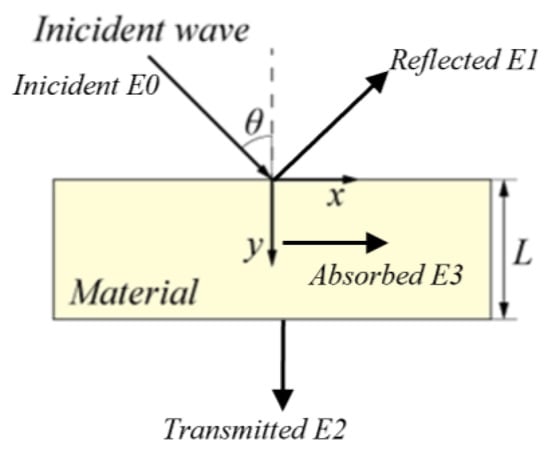
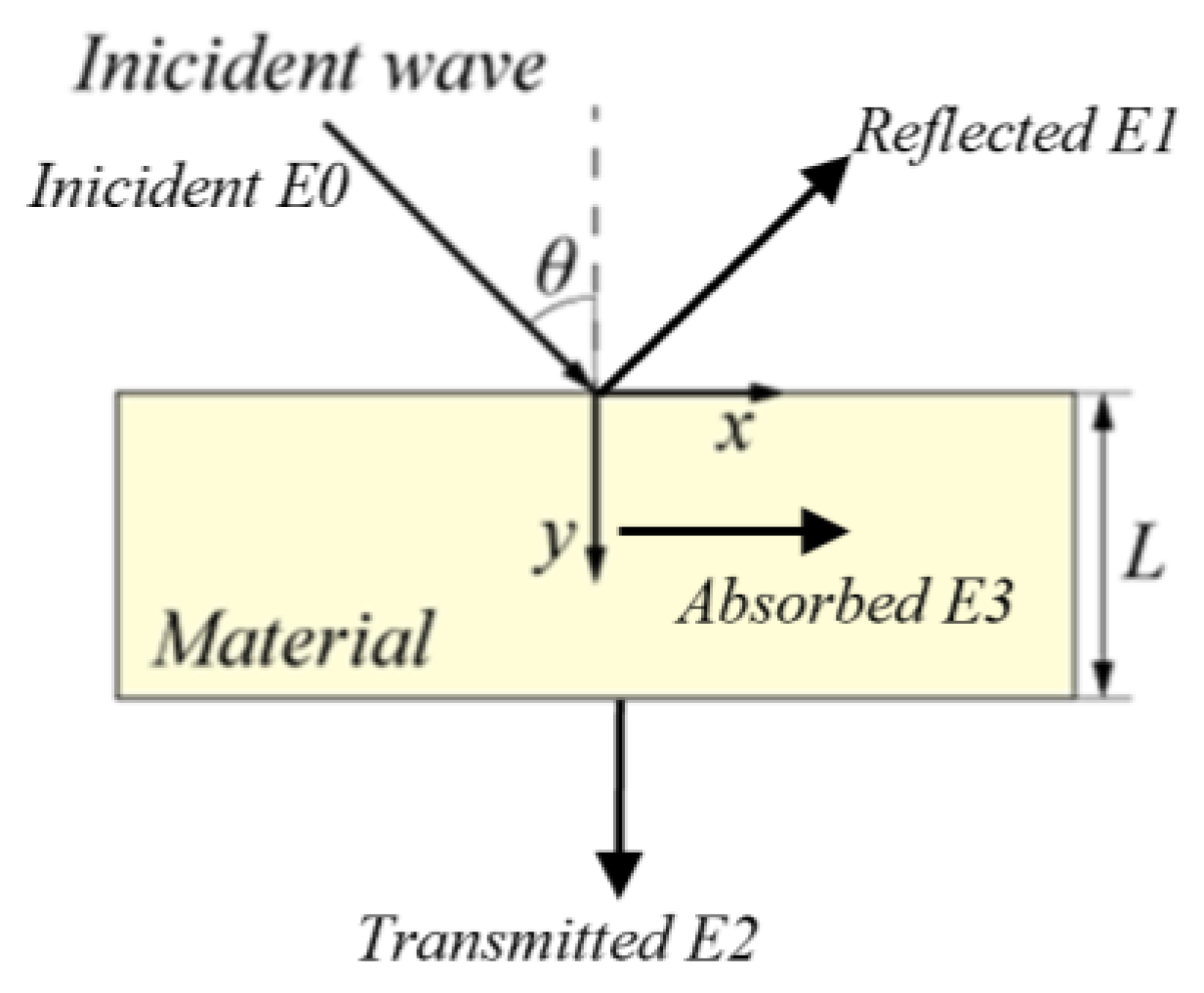
Assuming that a plane wave is incident to an infinite plate (see Figure 1), the incident wave velocity potential can be written as follows [23]:
where , , is the incident angle, is the wave number, and is the speed of sound. The velocity potential in the incident and transmitted side can be written as follows [24]:
where is the reflected wave amplitude and is the transmitted wave amplitude. The normal volume velocity and the sound pressure, respectively, in the incident and transmitted side become the following [24]:
Figure 1.
The schematic diagram of the incident wave.
2.1.2. Elastic Porous Model
According to Biot’s theory, the stress–strain relationship in the solid phase is as follows [25]:
and the relationship in the fluid phase is the following [25]:
where and are the solid and fluid volumetric strains; and are the solid and fluid vector displacement fields; is the solid strain tensor; is the shear modulus; is the solid bulk Young’s modulus ( is the Poisson’s ratio, is the static Young’s modulus, is the loss factor, equals to ); is the first Lamé constant, ; represents the coupling between the solid and fluid components; is a type of bulk modulus related to the fluid stress and strain; is the volume porosity; and is the bulk modulus of the fluid in the pores, which can be written as follows [23]:
where is the Prandtl number, is the ratio of specific heats, and are the Bessel functions of the first kind, , is the tortuosity, and is the flow resistivity.
According to the solid and fluid dynamic equations, the stress–strain relationships can be written as follows [23]:
where the mass coefficients , , and can be written as follows [23]:
where and are the solid and fluid bulk density, respectively, and is the a mass coupling parameter between the solid and fluid phases. The parameter is related to the flow resistivity, and is defined as follows [26]:
When the porous material is isotropic, a gradient operation is applied, and Equations (11) and (12) can be written as follows [23]:
Equations (17) and (18) can be rewritten as follows:
The parameters and can be expressed as follows:
According to the simultaneous Equations (21) and (22), the result is the following:
where
Equation (23) has two plane harmonic solutions, and their wave numbers are given by the following:
By applying a curl operation, Equations (11) and (12) can be written as follows [23]:
From Equations (27) and (28), the rotational wave propagation in the solid phase can be written as follows:
where the wave number is the following:
2.1.3. Solution for the Parameters
The solid volumetric strain can be assumed as follows [23]:
where . By substituting Equation (31) into Equation (22), the fluid volumetric strain is as follows:
where , and and are the following:
According to Equation (29), the solid rotational strain can be assumed as follows [23]:
where . By substituting Equation (35) into Equation (28), the fluid rotational strain is the following:
where . When the porous material is isotropic, the vector solid and fluid displacement fields can be summarized as follows [23]:
By substituting Equations (31), (32), and (37)–(40) into Equations (8) and (9), , , and can be written as follows [23]:
2.1.4. Boundary Conditions
The unknown parameters , , and – can be solved by setting boundary conditions as follows [23].
- The mean pressure acting on the fluid phase satisfies the following:
- 2.
- The normal pressure acting on the solid phase satisfies the following:
- 3.
- The normal volume velocity satisfies the continuity as follows:
- 4.
- The shear pressure acting on the solid surface satisfies the following:
After substituting the solutions into the boundary conditions, a matrix form can be written asfollows [24]:
where
The coefficient matrix is an complex matrix. The components are recorded in Appendix A.
2.1.5. Sound Transmission Loss
In the case of normal incidence, the incident angle can be seen as 0. So, in this time, the sound transmission coefficient can be calculated by the following [26]:
where is the modulus of the complex parameter .
In the case of random incidence, sound waves are directed at the material from all directions. Assuming that sound waves are evenly distributed at the incident angles, the total transmission coefficient is the average of the transmission coefficients in each direction [26].
Therefore, the sound transmission loss (STL) can be determined as follows [1]:
where the sound transmission coefficient refers to in the case of normal incidence and refers to in the case of random incidence.
2.2. The Elastic Closed-Cell Porous Samples
To verify the accuracy of the theoretical model, five NBR-PVC closed-cell composites with different densities and thicknesses prepared in the previous study [27] are selected as the experiment samples. These elastic closed-cell porous composites all have good soundproof properties.
2.2.1. Measurements
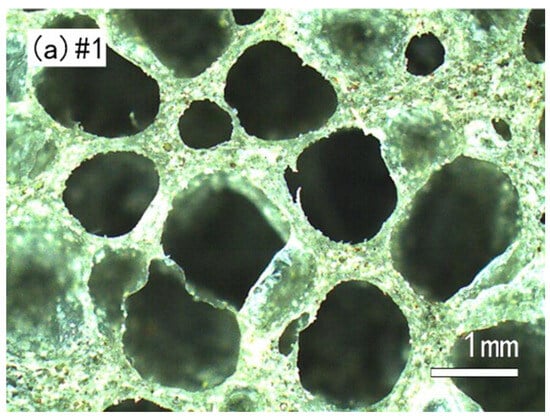
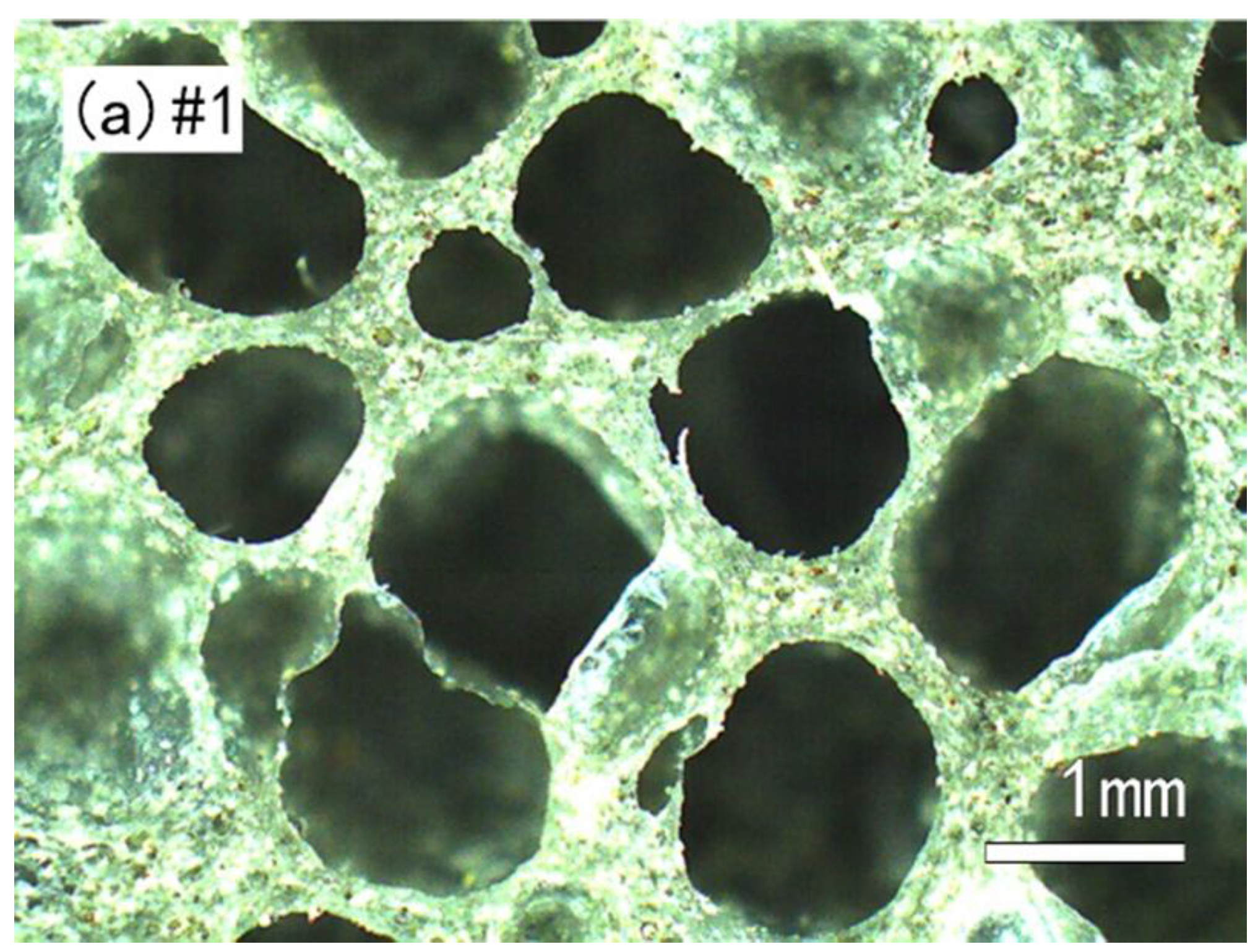
The micrograph of the NBR-PVC closed-cell composite is shown in Figure 2. The cells in the samples are unconnected. Bulk density () was obtained from the porous composite weight and the volume. Skeletal density () was measured from the bulk density of the solid composite made from the same component. The static Young’s modulus and Poisson’s ratio were measured using the tensile test machine (ZwickRoell 020, ZwickRoell, Ulm, Germany). The loss factor was measured using the dynamic mechanical analyzer (DMA Q800, TA Instruments, New Castle, Delaware, USA). To validate the STL combination equation of the elastic closed-cell porous material, the sound insulation performances under normal incidence and random incidence were measured separately using the four-microphone impedance tube according to ASTM E 2611-09 and laboratory measurements according to ISO 10140-2:2021 [28]. The laboratory measurement facility consists of two adjacent reverberant rooms with a test opening between them, into which the closed-cell porous sample with the size of 10 m2 is put.
Figure 2.
The micrograph of NBR-PVC closed-cell composite.
2.2.2. Model Calculation Parameters
The air fluid parameters and the material parameters are listed in Table 1 and Table 2, respectively. In Table 2, the measurement results of sample A to D are measured under the condition of normal incidence, where the measurement results of sample Eare measured under the condition of random incidence. The fluid parameters in Table 1 are the property parameters of air in the standard state. In Table 2, porosity () can be determined by . The solid bulk Young’s modulus, , is made complex to account for the internal frictional losses. The flow resistivity is set to be an exponentially large number to describe the impermeability of the pores, whose magnitude is several orders greater than the flow resistivity of the open-cell foams. The tortuosity of the porous materials is normally close to 1 [25].
Table 1.
The fluid parameters of air.
Table 2.
The material parameters of closed-cell porous material.
3. Results and Discussion
3.1. Comparison Between Calculations and STL Measurement Under the Normal Incidence
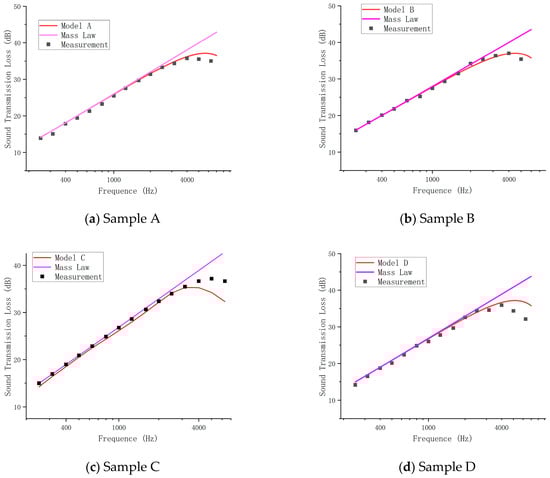
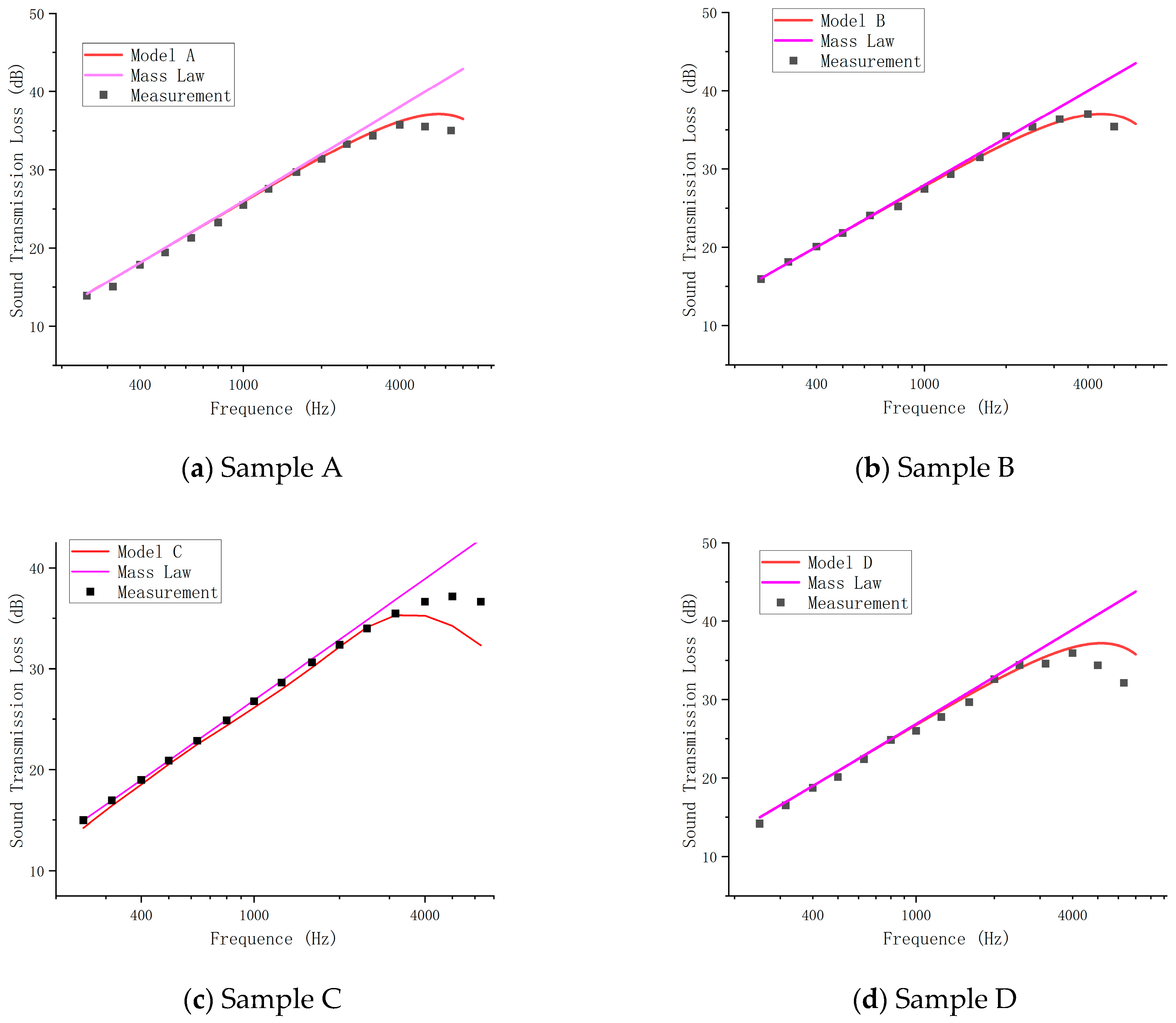
Figure 3 shows the comparison between STL measurement values and the estimation values calculated by the theoretical model and the Mass Law for four NBR-PVC closed-cell composite samples under a normal incidence. For the four closed-cell porous materials with different parameters, their STL measurement data initially followed the Mass Law, but began to deviate gradually after 2000Hz. The calculation values from the theoretical model exhibited a similar trend. As illustrated, the STL measurement values align more closely with the theoretical model predictions than with those derived from the Mass Law.
Figure 3.
The comparison of normal incidence STL measurement values and calculation values from the theoretical model and Mass Law for four NBR-PVC closed-cell composite samples (the calculation formula of the Mass Law [29] is , where refers to the areal density ()), refers to the density, and refers to the acoustic velocity.
To further elucidate these findings, a comparison of the deviations between the normal incidence STL measurement values and the calculation values from the theoretical model and Mass Law is summarized in Table 3. As shown in Table 3, the average deviation between the Mass Law and measurement values is 2.14 dB, with an average deviation rate below 16%, while the corresponding values for the theoretical model are 0.49 dB and below 4%, respectively. Within the 250–2500 Hz range, both the Mass Law and the theoretical model exhibit an excellent agreement with the measured data, showing minimal mean deviations of 1.00 dB and 0.32 dB, respectively. In contrast, the Mass Law displays a significantly larger mean deviation of 6.30 dB in the 2500–6300 Hz frequency range. The reason that explains this is that there is a sound insulation dip, which is attributed primarily to resonance effects induced by the closed-cell structure [30]. Depending on the strengths of Biot’s theory, the proposed model maintains a superior consistency with the measurement data in this high frequency range, yielding a mean deviation of only 0.97 dB.
Table 3.
The comparison of deviations between normal incidence STL measurement values and calculation values from the theoretical model and Mass Law for four NBR-PVC closed-cell composite samples.
3.2. Comparison Between Calculations and STL Measurement Under the Random Incidence
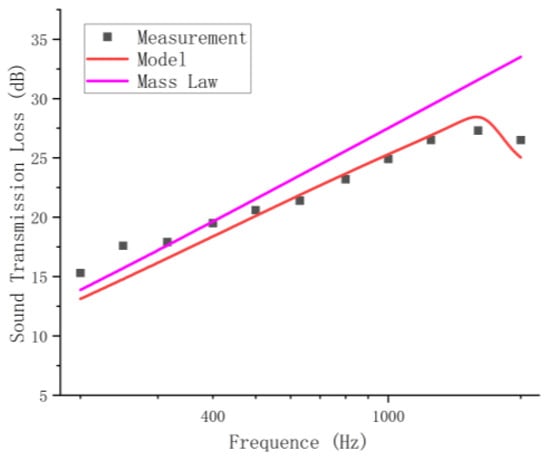
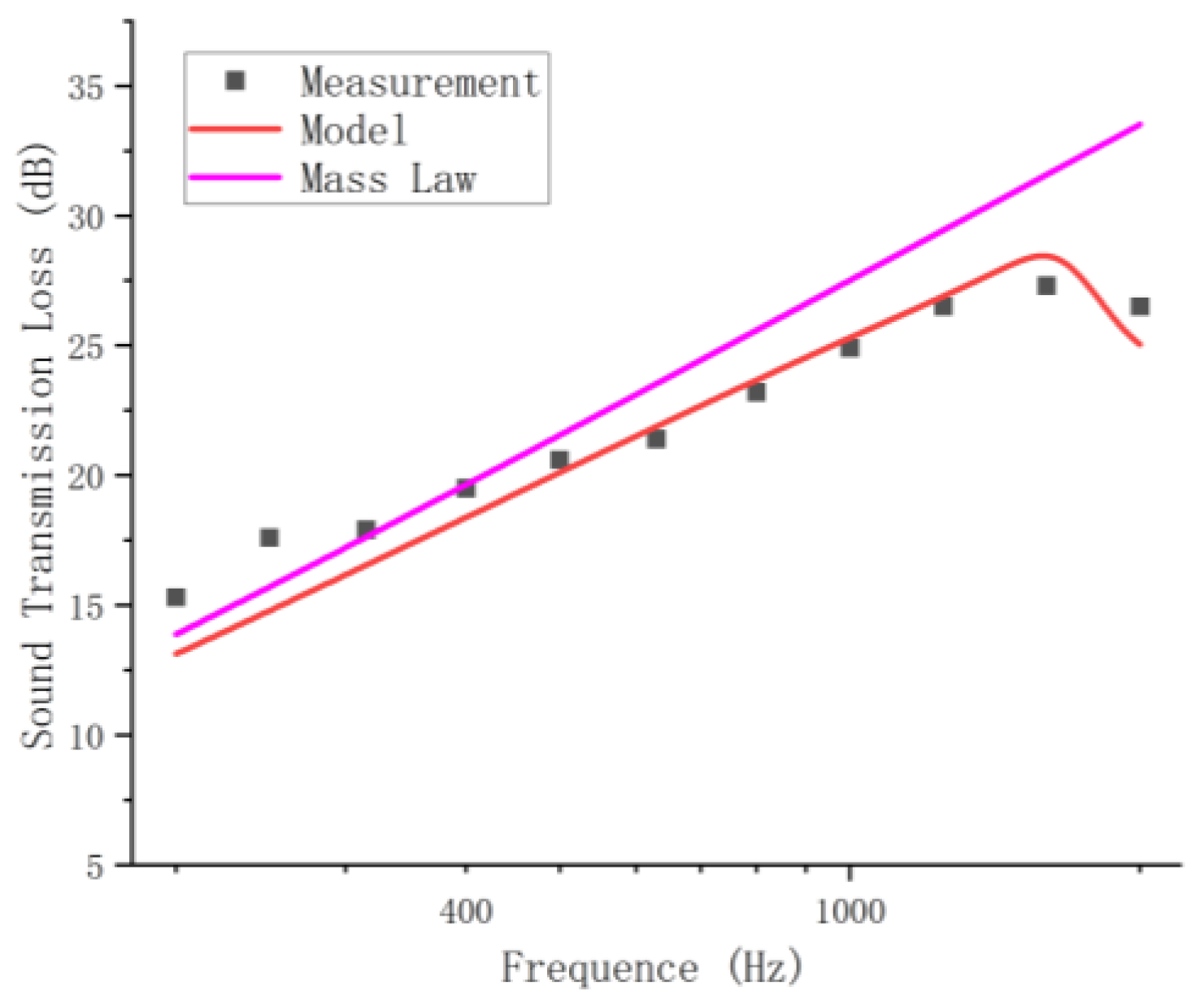
Figure 4 compares the measured and predicted STL values under a random incidence. Compared to the results under normal incidence, the measurement data are closer to the calculation values from the theoretical model than the ones from the Mass Law in the whole frequency range. The Mass Law overestimates STL by 1.7 dB on average, whereas the theoretical model shows an average deviation of 0.59 dB. Particularly in the sound insulation dip, the theoretical model clearly predicts the sound insulation value decrease. These outcomes confirm that the theoretical model more accurately represents the measured behavior under both normal and random incidence conditions.
Figure 4.
The comparison of random incidence STL measurement values and calculation values from theoretical model and Mass Law for NBR-PVC closed-cell composite sample (Mass Law calculation formula [29] is , where refers to the areal density ()), refers to the density, and refers to the acoustic velocity.
4. Conclusions
In this study, the sound transmission loss (STL) of an elastic closed-cell porous material was investigated through theoretical modeling and experimental measurements. A theoretical model was established by combining acoustic field equations with Biot’s theory under appropriate boundary conditions. The STL values of NBR-PVC closed-cell porous samples were measured and compared with predictions from both the theoretical model and the Mass Law. The results demonstrated that the theoretical model provided a better agreement with the measured data than the Mass Law both under the normal incidence and under the random incidence, particularly within the closed-cell resonance frequency range. This study offers a feasible method for predicting the sound insulation performance of elastic closed-cell porous materials. The sound insulation prediction of the elastic closed-cell porous materials in the low and high frequency range should be further studied in the future.
Author Contributions
Conceptualization, J.C.; methodology, Y.Y.; software, J.Z.; validation, J.Z.; formal analysis, L.X.; investigation, L.X.; resources, L.X.; data curation, Y.Y.; writing—original draft preparation, Y.Y.; writing—review and editing, J.C.; visualization, J.Z.; supervision, J.C.; project administration, J.C.; funding acquisition, J.C. All authors have read and agreed to the published version of the manuscript.
Funding
This research was funded by the Innovation Practice Program in Shanghai Jiao Tong University [Grants No: IPP18142].
Institutional Review Board Statement
Not applicable.
Informed Consent Statement
Not applicable.
Data Availability Statement
The datasets presented in this article are not readily available because the data are part of an ongoing study and subject to operational confidentiality. Requests to access the datasets should be directed to the authors.
Conflicts of Interest
Yining Yang is employed with Shanghai Institute of Measurement and Testing Technology Co., Ltd. (SIMT). The remaining authors declare no conflicts of interest.
Appendix A
The elements of are listed below.
| , | , |
| , | , |
| , | , |
| , | , |
| , | , |
| , | , |
| , | , |
| , | , |
| , | , |
| , | , |
| , | , |
| , | , |
| , | , |
| , | , |
| , | , |
| , | , |
| , | , |
| , | , |
| , | , |
| , | , |
| , | , |
| , | , |
| , | , |
| , | , |
| , | , |
References
- Cai, J.; Fu, Q.; Long, M.; Liao, G.; Xu, Z. The sound insulation property of composite from waste printed circuit board and unsaturated polyester. Compos. Sci. Technol. 2017, 145, 132–137. [Google Scholar] [CrossRef] [Scilit]
- Navacerrada, M.A.; Fernandez, P.; Diaz, C.; Pedrero, A. Thermal and acoustic properties of aluminium foams manufactured by the infiltration process. Appl. Acoust. 2013, 74, 496–501. [Google Scholar] [CrossRef] [Scilit]
- Guan, D.; Wu, J.H.; Wu, J.; Li, J.; Zhao, W. Acoustic performance of aluminum foams with semiopen cells. Appl. Acoust. 2015, 87, 103–108. [Google Scholar] [CrossRef] [Scilit]
- Yu, H.; Yao, G.; Wang, X.; Liu, Y.; Li, H. Sound insulation property of Al-Si closed-cell aluminum foam sandwich panels. Appl. Acoust. 2007, 68, 1502–1510. [Google Scholar] [CrossRef] [Scilit]
- Liu, J.; Bao, W.; Shi, L.; Zuo, B.; Gao, W. General regression neural network for prediction of sound absorption coefficients of sandwich structure nonwoven absorbers. Appl. Acoust. 2014, 76, 128–137. [Google Scholar] [CrossRef] [Scilit]
- Yu, H.-J.; Yao, G.-C.; Wang, X.-L.; Li, B.; Yin, Y.; Liu, K. Sound insulation property of Al-Si closed-cell aluminum foam bare board material. Trans. Nonferrous Met. Soc. China 2007, 17, 93–98. [Google Scholar] [CrossRef] [Scilit]
- Doutres, O.; Atalla, N.; Brouillette, M.; Hebert, C. Using shock waves to improve the sound absorbing efficiency of closed-cell foams. Appl. Acoust. 2014, 79, 110–116. [Google Scholar] [CrossRef] [Scilit]
- Li, C.; Ma, H.; Song, C.; Zhou, Z.; Xu, W.; Song, Q.; Ren, F. Preparation and performance of melamine-formaldehyde rigid foams with high closed cell content. Cell. Polym. 2021, 40, 183–197. [Google Scholar] [CrossRef] [Scilit]
- Li, C.; Ma, H.; Zhou, Z.; Xu, W.; Ren, F.; Yang, X. Preparation and properties of melamine-formaldehyde rigid closed-cell foam toughened by ethylene glycol/carbon fiber. Cell. Polym. 2021, 40, 55–72. [Google Scholar] [CrossRef] [Scilit]
- Shi, Y.; Hu, A.; Wang, Z.; Li, K.; Yang, S. Closed-Cell Rigid Polyimide Foams for High-Temperature Applications: The Effect of Structure on Combined Properties. Polymers 2021, 13, 4434. [Google Scholar] [CrossRef] [Scilit] [PubMed]
- Pabst, W.; Uhlirova, T.; Gregorova, E.; Wiegmann, A. Young’s modulus and thermal conductivity of closed-cell, open-cell and inverse ceramic foams model-based predictions, cross-property predictions and numerical calculations. J. Eur. Ceram. Soc. 2018, 38, 2570–2578. [Google Scholar] [CrossRef] [Scilit]
- Chen, N.; Zhang, P.; Cui, C.; Wang, N.; Wang, J.; Chen, X. Thermal Conductivity of Closed Cell Aluminum Foam. ASME J. Heat Mass Transf. 2025, 147, 101401. [Google Scholar] [CrossRef] [Scilit]
- Yang, X.; Lu, T.; Kim, T. Effective Thermal Conductivity Modelling for Closed-Cell Porous Media with Analytical Shape Factors. Transp. Porous Media 2013, 100, 211–224. [Google Scholar] [CrossRef] [Scilit]
- Gibson, L.J.; Ashby, M.F. Cellular Solids: Structure and Properties; Cambridge University Press: Cambridge, UK, 1997. [Google Scholar]
- Gibson, R.F. Principles of Composite Material Mechanics; CRC Press: Boca Raton, FL, USA, 2011. [Google Scholar]
- Chevillotte, F.; Panneton, R. Elastic characterization of closed cell foams from impedance tube absorption tests. J. Acoust. Soc. Am. 2007, 122, 2653–2660. [Google Scholar] [CrossRef] [Scilit]
- Dazel, O.; Tournat, V. Nonlinear Biot waves in porous media with application to unconsolidated granular media. J. Acoust. Soc. Am. 2010, 127, 692–702. [Google Scholar] [CrossRef] [Scilit]
- Luo, S.; Huang, Q. Resonance Variation of Double-Layer Structure Composed of Porous Material and Air Layer Based on Biot Theory. Acta Acust. United Acust. 2014, 100, 477–484. [Google Scholar] [CrossRef] [Scilit]
- Yablonik, L.R. A Simplified Method for Calculating Multilayer Sound Insulation with Layers of Fibrous Porous Material. Acoust. Phys. 2018, 64, 643–650. [Google Scholar] [CrossRef] [Scilit]
- Yang, Y.; Chen, Z.; Chen, Y.; Zhang, L.; Lu, H. Effect of physical and subsequent processing parameters of glass fiber felts on sound insulation. J. Text. Inst. 2018, 109, 614–619. [Google Scholar] [CrossRef] [Scilit]
- Biot, M.A. Theory of propagation of elastic waves in a fluid-saturated porous solid. I. Low-frequency range. Repr. J. Acoust. Soc. Am. 1956, 28, 168–178. [Google Scholar] [CrossRef] [Scilit]
- Biot, M.A. Theory of propagation of elastic waves in a fluid-saturated porous solid. II. Higher frequency range. Repr. J. Acoust. Soc. Am. 1956, 28, 179–191. [Google Scholar] [CrossRef] [Scilit]
- Bolton, J.S.; Shiau, N.M.; Kang, Y.J. Sound transmission through multi-panel structures lined with elastic porous materials. J. Sound Vib. 1996, 191, 317–347. [Google Scholar] [CrossRef] [Scilit]
- Malakooti, S.; Churu, H.G.; Lee, A.; Xu, T.; Luo, H.; Xiang, N.; Sotiriou-Leventis, C.; Leventis, N.; Lu, H. Sound insulation properties in low-density, mechanically strong and ductile nanoporous polyurea aerogels. J. Non-Cryst. Solids 2017, 476, 36–45. [Google Scholar] [CrossRef] [Scilit]
- Allard, J.F. Propagation of Sound in Porous Media: Modelling Sound Absorbing Materials, 2nd ed.; John Wiley & Sons: Hoboken, NJ, USA, 2009. [Google Scholar]
- Attenborough, K. Acoustical characteristics of porous materials. Phys. Rep. 1982, 82, 179–227. [Google Scholar] [CrossRef] [Scilit]
- Liao, G.; Cai, J.; Fu, Y.; Yang, Y.; Yu, N.; Lian, Y. Preparation of high-density metal/NBR-PVC microporous damping composite and its sound insulation performance. Acta Mater. Compos. Sin. 2018, 35, 1066–1072. [Google Scholar]
- ISO 10140-2; Acoustics-Laboratory Measurement of Sound Insulation of Building Elements. Part 2 Measurement of Airborne Sound Insulation. ISO: Geneva, Switzerland, 2021.
- Ma, D. Acoustics Handbook, 2nd ed.; Science Press: Beijing, China, 2004. [Google Scholar]
- Yang, Y.; Cai, J.; Yu, N. Sound Insulation Property of Elastic Closed-cell Foams. Noise Vib. Control. 2020, 5, 243–247. [Google Scholar]

Disclaimer/Publisher’s Note: The statements, opinions and data contained in all publications are solely those of the individual author(s) and contributor(s) and not of MDPI and/or the editor(s). MDPI and/or the editor(s) disclaim responsibility for any injury to people or property resulting from any ideas, methods, instructions or products referred to in the content. |
© 2025 by the authors. Licensee MDPI, Basel, Switzerland. This article is an open access article distributed under the terms and conditions of the Creative Commons Attribution (CC BY) license (https://creativecommons.org/licenses/by/4.0/).