Article

Evaluation of the Acoustic Noise Performance of a Switched Reluctance Motor Under Different Current Control Techniques


McMaster Automotive Resource Centre (MARC), McMaster University, Hamilton, ON L8S 4L8, Canada
*
Author to whom correspondence should be addressed.
Acoustics 2025, 7(4), 77; https://doi.org/10.3390/acoustics7040077 (registering DOI)
Submission received: 9 October 2025 / Revised: 16 November 2025 / Accepted: 28 November 2025 / Published: 30 November 2025

Abstract

In recent years, switched reluctance motors have emerged as a promising option for various applications due to their low manufacturing cost, rare-earth-free construction, and mechanical robustness. However, their widespread adoption is often limited by high torque ripple and acoustic noise. To address these challenges, this paper presents a comparative study of the acoustic noise performance of an 18/12 switched reluctance motor under various current control techniques. This comparison offers valuable insight into the motor’s vibroacoustic characteristics, which is essential for optimizing SRM performance, particularly in applications where noise reduction is critical. Dynamic simulations of an SRM are carried out in MATLAB/Simulink, and multi-physics analyses are performed in ANSYS Workbench. The multi-physics modeling includes electromagnetic, modal, and harmonic response analyses for four current control techniques evaluated across different operating speeds under light-load conditions. The simulation results are validated experimentally using an actual motor mounted on a dynamometer setup. The corresponding acoustic signatures for each control technique are presented as 2D plots of equivalent radiated power from simulations and sound power level from experimental tests. In addition, experimental waterfall diagrams are provided for each control technique.

1. Introduction

The global transition towards electrification and sustainability has significantly increased the demand for electric machines across a wide range of applications. This demand is constantly driven by the need for cleaner energy solutions, technological advancements, and the growing adoption of electrified systems in industrial and consumer products [1,2,3]. Among the various electric motor technologies available today, the switched reluctance motor (SRM) stands out for its simple and cost-effective construction, superior performance across a wide speed range, high reliability, and robustness. These characteristics make an SRM a promising candidate for diverse applications [4,5].
Historically, high torque ripple and acoustic noise have limited the broader adoption of SRMs [6,7,8,9]. To address the challenges associated with torque ripple and acoustic noise, various control strategies have been proposed in the literature. These strategies aim to reduce the torque ripple, minimize radial force harmonics, and enhance the overall performance of an SRM [10,11,12]. In [13], a selective radial-force harmonic reduction technique was presented for vibration and acoustic noise reduction in a three-phase SRM. The effectiveness of the method was validated through finite element analysis (FEA). Experimental results demonstrated a 7.1 dBA reduction in the sound pressure level (SPL) at the rated operating point. A refinement of the analytical current waveform was then proposed in [14], aiming to flatten the resultant radial force. In [15], a two-step control strategy was developed to reduce torque ripple and vibration in an SRM drive. The first step optimizes the current profile to reduce torque pulsation. The second step uses an adaptive hysteresis band controller to mitigate radial vibration. Experimental validation demonstrated that the proposed approach significantly reduces acoustic noise and torque pulsations in an 8/6 SRM.
A mathematically derived current waveform was introduced in [16] to flatten the radial-force sum and reduce torque ripple in SRMs. The derivation eliminates the need for numerical computations and includes phase shifts of harmonic components. Experimental results validated the method’s applicability to various SRMs, demonstrating effective vibration and acoustic noise reduction, even in high-torque regions.
In [17], a model predictive control (MPC) method was introduced to address the conflicting suppression of torque and radial force ripples in an SRM. The study developed torque- and force-sharing functions based on the flux-linkage curve and optimized them online by adjusting the turn-ON angle. The proposed method was then implemented to track the optimized sharing functions. A candidate voltage-vector table was then utilized to achieve balanced control of torque and radial force. Experimental results on a three-phase 12/8 SRM confirmed that the proposed method effectively reduces vibrations. In [18], a novel Torque-Sharing Function (TSF) with conduction-angle control was proposed. The new TSF combines linear and cubic TSFs in a hybrid TSF, optimizing conduction angles to significantly reduce torque ripple in a 1 HP SRM up to a speed of 2000 RPM. Simulation results showed a reduction in torque ripple from 125% to 20% using optimized conduction angles and a further reduction to 2.7% with the hybrid TSF.
Most previous studies have focused on developing new switching and current profiling techniques to reduce acoustic noise in SRMs. However, the lack of a systematic comparison of current control techniques under equivalent conditions limits practical understanding of noise generation mechanisms [19]. Since acoustic noise remains a major obstacle to the wider adoption of these motors in different applications, this study aims to reduce noise levels through the evaluation of four current control techniques at three operating speeds. The novelty lies in providing a unified simulation-based and experimental comparison under identical test conditions. The main tasks include implementing each control technique, analyzing acoustic behavior, and identifying the most effective technique for noise reduction.
The remainder of this paper is organized as follows. Section 2 describes the electrical and mechanical characteristics of the SRM under study. Section 3 presents the generalized mathematical models of the SRM drive. Section 4 outlines the four evaluated current control techniques. Section 5 details the acoustic noise modeling and multi-physics vibroacoustic analysis conducted in ANSYS Workbench. Section 6 provides the experimental validation, and conclusions are presented in Section 7.

2. Electrical and Mechanical Characteristics of the Switched Reluctance Motor Under Study

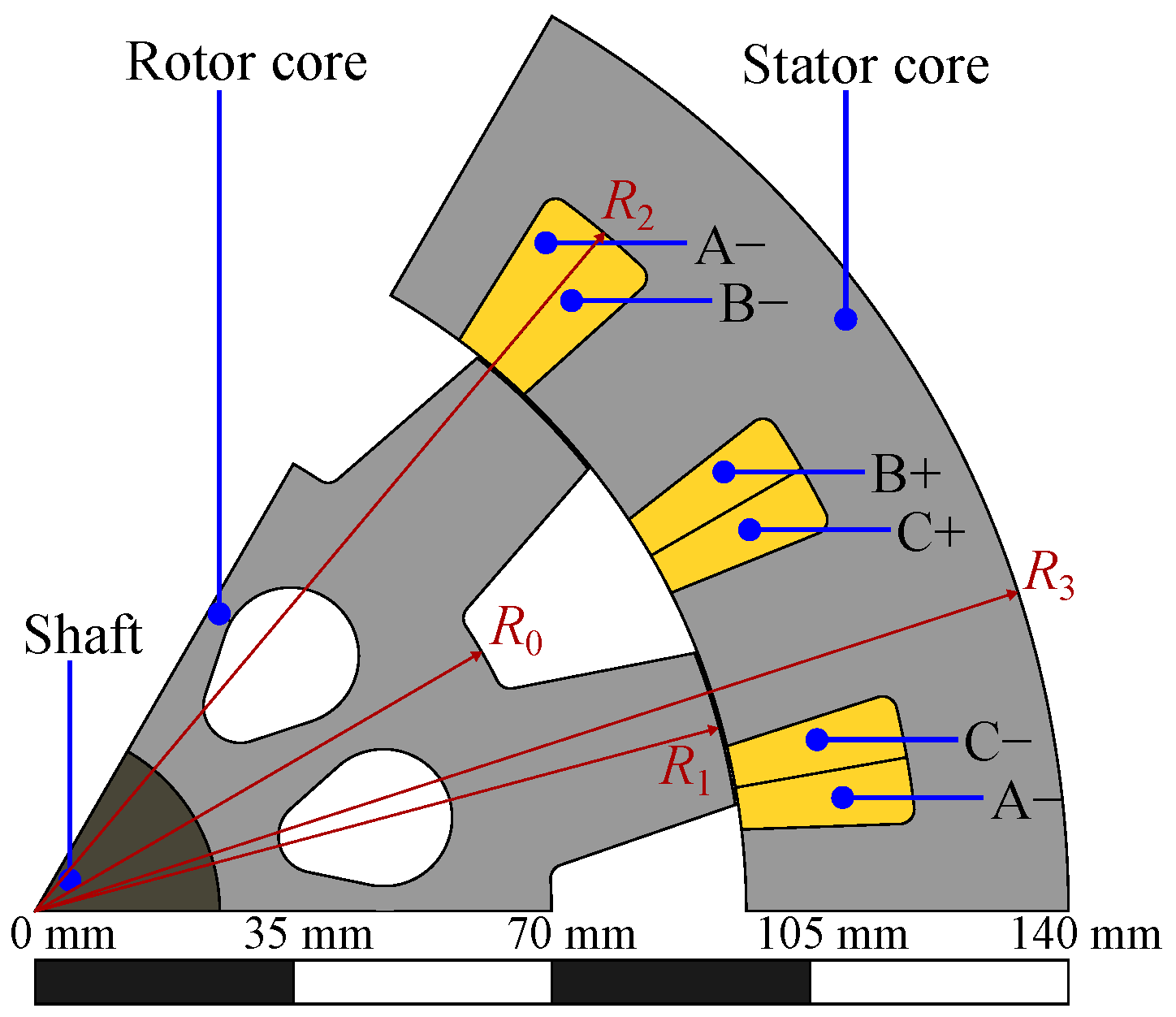
The electric motor selected for this study corresponds to a 70 kW, 18/12 SRM designed for a Light Sport Aircraft (LSA) propulsion application. The theoretical design of this machine, along with its electromagnetic and thermal validations using Altair Flux and Motor-CAD, respectively, were presented in [20]. The mechanical design and prototyping of the SRM were presented in [21], highlighting the challenges of assembling a motor with a large outer diameter and a 0.4 mm air gap. Figure 1a presents the 3D model of the SRM inlANSYS SpaceClaim. Figure 1b depicts the fully assembled prototype ready for testing. Similarly, Figure 2 shows a fractional cross-section view of the motor implemented in ANSYS Maxwell 2D for the vibroacoustic studies.
The base speed of the motor is 2600 RPM, and the maximum speed is 4000 RPM. At 2600 RPM, the motor is designed to deliver an average torque of 260 Nm. Main electrical and mechanical characteristics of the SRM are summarized in Table 1.
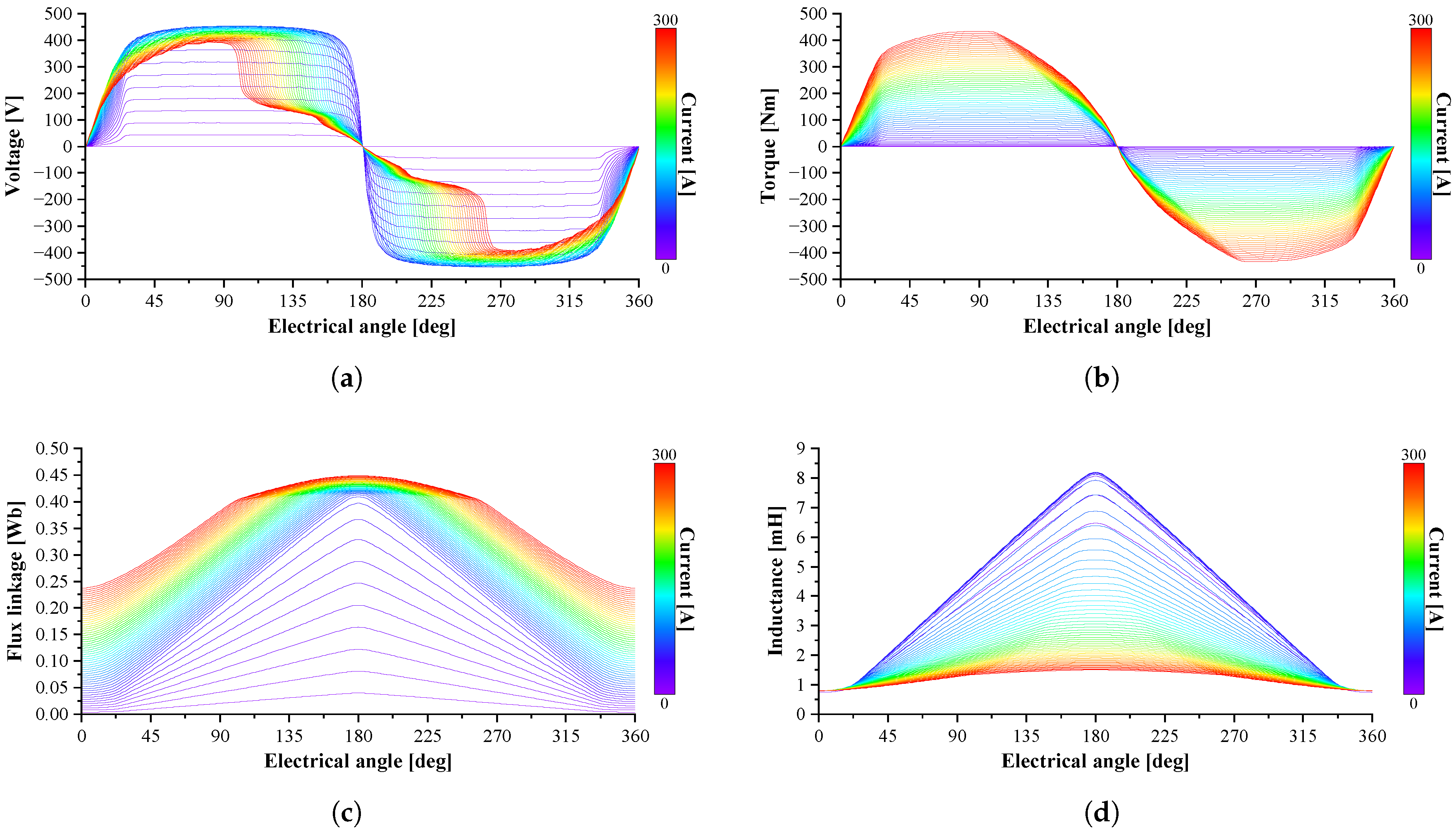
Figure 3a–c present the static characteristics of the motor [20]. For closed-loop control purposes, the phase inductance was also derived from the flux linkage and excitation current, as shown in Figure 3d. The theoretical phase inductance of the SRM is in the range of 0.74 to 8.2 mH. As the static excitation current increases, the inductance reduces due to the effect of saturation. These static characteristics are essential for the development of the dynamic model of the SRM in MATLAB/Simulink, where they are implemented as lookup tables (LUTs). In particular, the LUT for phase inductance as a function of current and electrical position is critical, as it directly influences the tuning of control gains.

3. Mathematical Models of the Asymmetric Bridge Converter

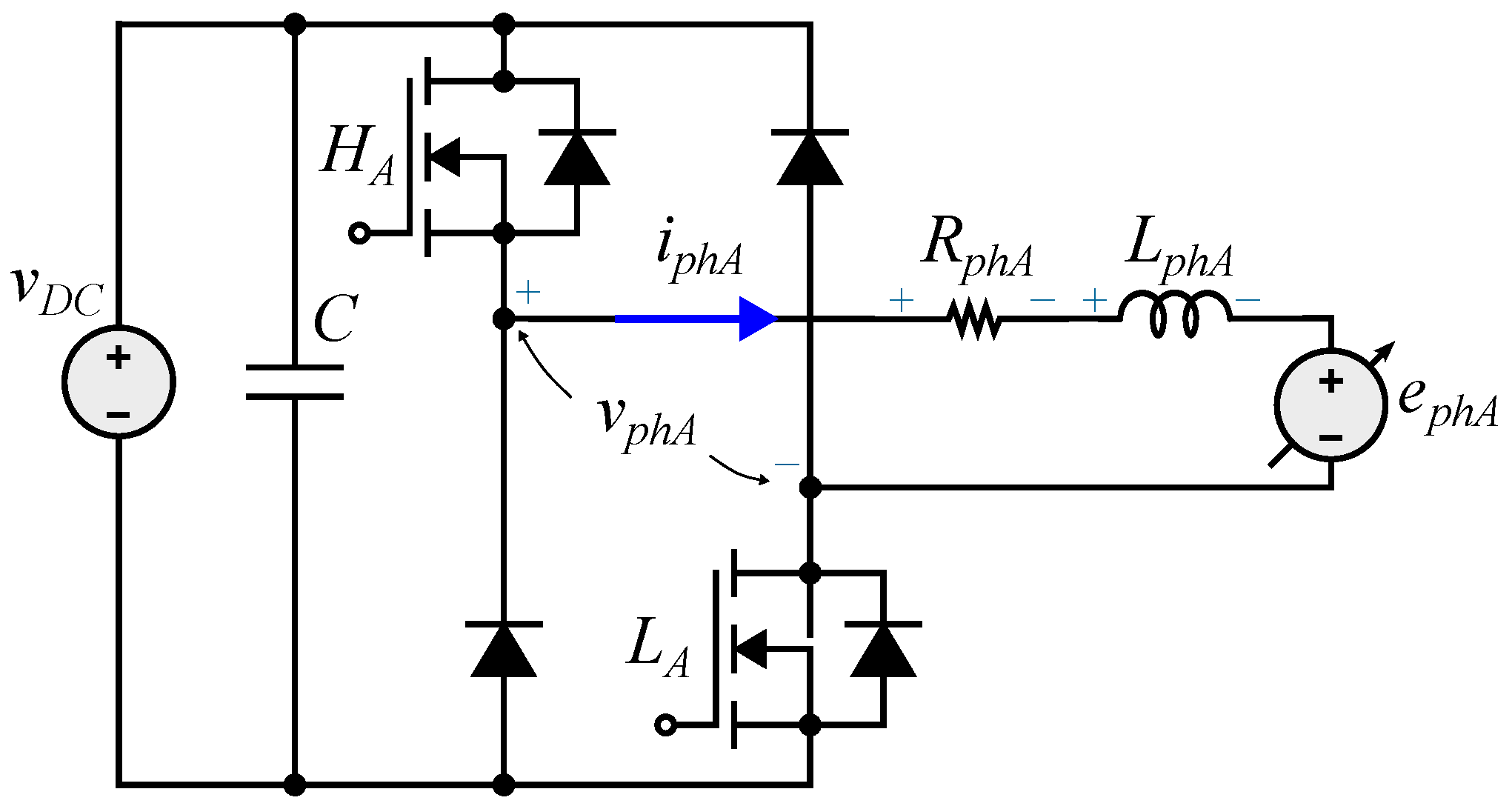
A conventional asymmetric bridge converter is selected to drive the SRM. Figure 4 illustrates the asymmetric bridge converter for one phase of the motor. The current direction is unidirectional; this means that i p h x is always positive for each phase of the converter. Representing Phase A, an SRM phase can be modeled as an RLE load with the phase resistance ( R p h A ), phase inductance ( L p h A ), and speed-dependent induced voltage ( e p h A ). The v p h A and i p h A variables represent the applied voltage and resulting current, respectively. The upper and lower transistors are controlled by digital signals H A and L A , respectively. The v D C and C variables represent the DC link voltage and the DC link capacitance, respectively.
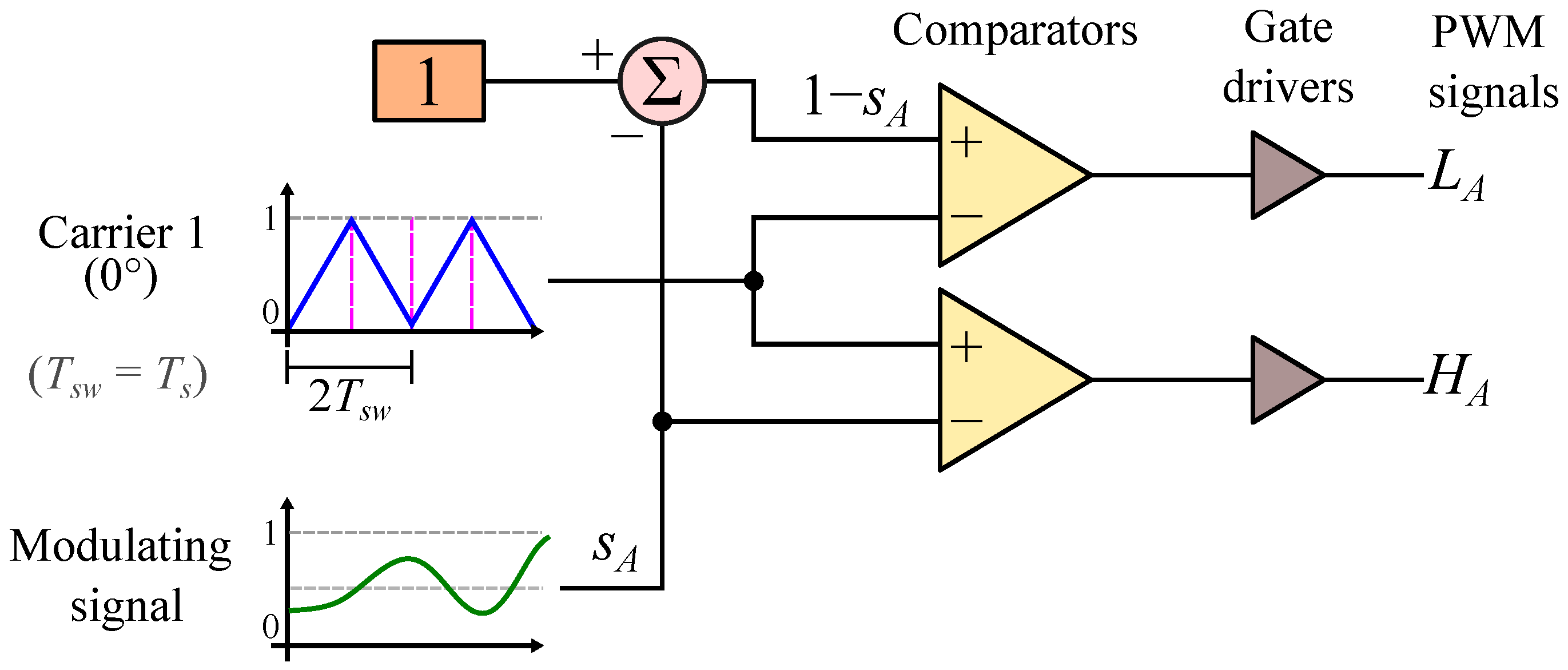
With the aim of deriving a non-linear mathematical model of this converter, a pulse-width modulation (PWM) scheme is defined to generate the control signals. In [22], a complementary PWM scheme for SRMs was introduced. As the name implies, it uses two complementary signals with a 180° phase shift to drive the transistors of one phase in the asymmetric bridge converter. Figure 5 presents a proposed equivalent implementation that requires only a single triangular carrier waveform. The modulating signals can be defined as s x within the range of [ 0 , 1 ] . The duty-cycle signals( d x ) are related to the modulating signals as follows:
s x = ( 1 d x ) / 2 d x = 1 2 s x
In this scheme, the 1 s x signals are calculated, and the logic for generating the switching signal of the bottom transistor is modified accordingly. Table 2 summarizes the four possible switching states for the asymmetric bridge converter.
When d x > 0 , the average value of the phase voltage ( v p h x ) is positive. Under this condition, switching states 1, 2, and 3 are possible, resulting in two equivalent circuit configurations. The switched mathematical equation for d x > 0 is given by
( H x ) ( L x ) v D C + R p h x i p h x + L p h x d d t i p h x + e p h x = 0 .
When d x < 0 , the average value of the phase voltage ( v p h x ) is negative, provided that i p h x > 0 . Once the phase current reaches zero, the freewheeling diodes stop conducting, and the applied phase voltage becomes zero. Under this condition, switching states 0, 1, and 2 are possible, resulting in two equivalent circuit configurations as well. The switched mathematical equation for d x < 0 is given by
( H x ¯ ) ( L x ¯ ) ( v D C ) + R p h x i p h x + L p h x d d t i p h x + e p h x = 0 .
Thus, the complete switched expression for the asymmetric bridge converter would be given by
( H x ) ( L x ) ( v D C ) ( H x ¯ ) ( L x ¯ ) ( v D C ) + R p h x i p h x + L p h x d d t i p h x + e p h x = 0 .
From (4), an averaged model can also be obtained:
d x v D C T s w + R p h x i p h x T s w + L p h x d d t i p h x T s w + e p h x T s w = 0 .
This averaged model can also be represented in differential form as follows:
d d t i p h x T s w = 1 L p h x d x v D C T s w R p h x L p h x i p h x T s w 1 L p h x e p h x T s w .

4. Current Control Techniques

4.1. Current Control Implementation Details

Four current control strategies are evaluated to compare the acoustic noise characteristics of the SRM: hysteresis control with soft switching, hysteresis control with hard switching, PWM control, and model predictive control. A sampling frequency ( f s ) of 15 kHz is applied to all control techniques. The DC voltage is set at 450 V. The analyzed operating speeds are 500, 1000, and 1500 RPM, corresponding to electrical frequencies ( f e ) of 100, 200, and 300 Hz, respectively. These yield integer f s / f e ratios of 150, 75, and 50. To ensure consistency and allow for fair comparison across all control techniques, the current reference ( I ref ) is fixed at 30 A for all speeds, while the conduction angles are kept constant at θ ON = 0 and θ OFF = 120 . For hysteresis controllers, the hysteresis band ( β ) is set to 0.5%. In PWM control, the triangular carrier has a frequency of f s / 2 , and the control algorithm is executed at f s . This results in voltage and current waveforms with a 15 kHz switching frequency.

4.2. Hysteresis Control (Soft Switching)

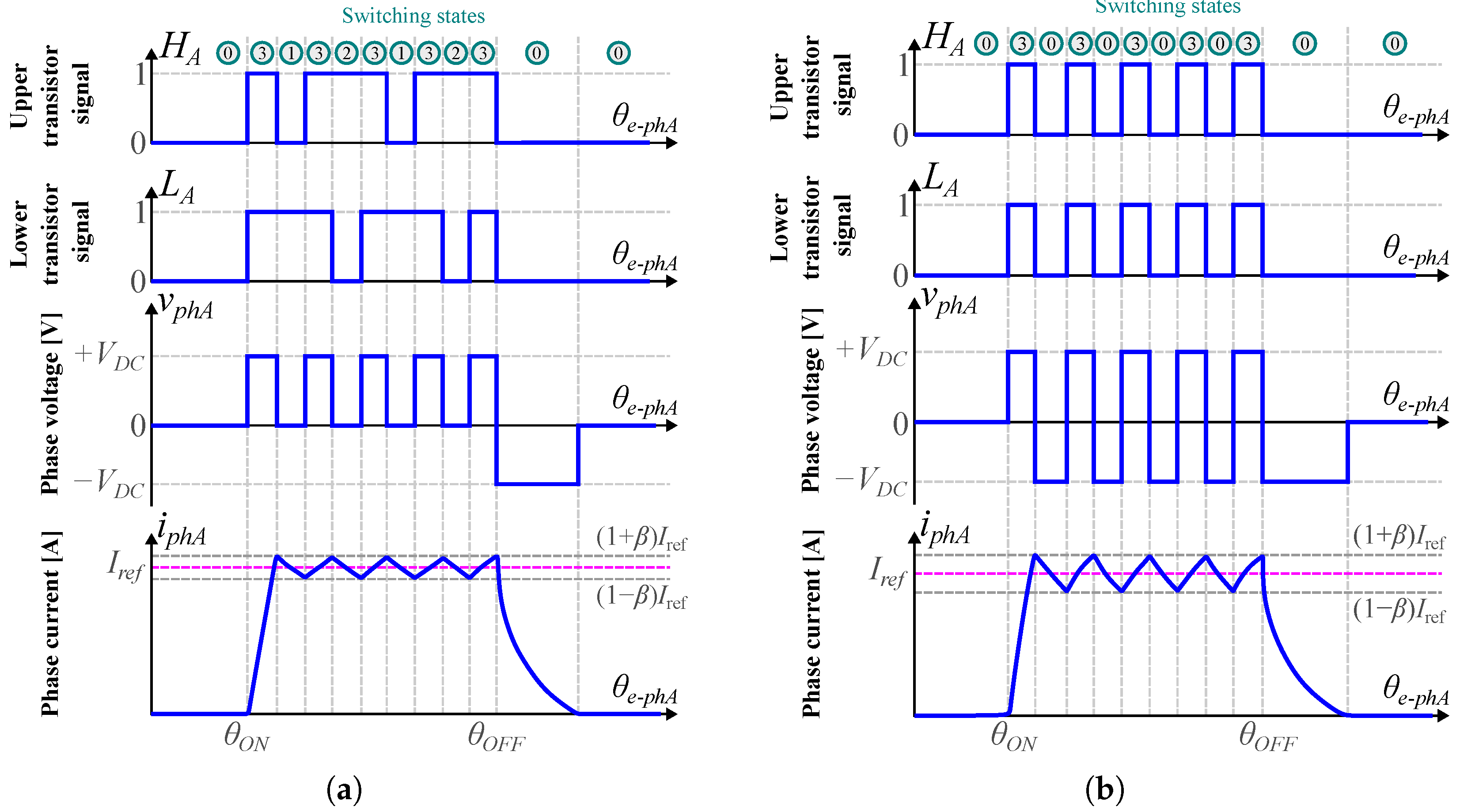
Hysteresis control maintains the phase current within a predefined hysteresis band. The upper and lower boundaries are defined as ( 1 + β ) I ref and ( 1 β ) I ref , respectively. The term I ref is the reference current, and the β parameter determines the width of the hysteresis band, ranging from 0 to 1. The switching state of an asymmetric bridge converter changes each time the phase current reaches either the upper or lower boundary, thereby keeping it within the hysteresis band. Figure 6a illustrates the switching states, transistor signals, phase voltage, and phase current for hysteresis current control with soft switching. Freewheeling states 1 and 2 are alternated in each switching cycle to balance the operation between upper and lower transistors.

4.3. Hysteresis Control (Hard Switching)

In hard switching, both switches are switched ON and OFF together [23]. Hence, possible switching states are 0 and 3. Hard switching typically results in higher current ripple due to the faster rate of phase voltage variation compared to soft switching, which can lead to higher torque ripple. Figure 6b shows the switching states, transistor signals, phase voltage, and phase current for hard switching.
For hysteresis control using either with soft or hard switching, the sampling frequency and hysteresis band can significantly affect the current and torque ripple. If the hysteresis band is small, the actual hysteresis band depends on the sampling frequency. Hysteresis control leads to variable switching frequency, which can also affect the vibroacoustic signature of an SRM.

4.4. PWM Control

The following control law is proposed for the implementation of PWM control and the canceling of non-linearities in (6), assuming a constant v D C :
d x = u x + R p h x V D C i p h x + e p h x V D C
where u x represents an auxiliary variable incorporating the proportional–integral (PI) controller:
u x = k P x ( i p h x i p h x ) + k I x ( i p h x i p h x ) d t
where k P x and k I x are the proportional and integral gains of the PI current controllers, respectively, and i p h x and i p h x are the current reference and phase feedback, respectively. Substituting (7) into (6) and simplifying terms, the following expression is obtained:
d d t i p h x = V D C L p h x u x .
The dynamics of the closed-loop system can be established by substituting (8) into (9). Then, by applying the Laplace transform, the following closed-loop transfer function is obtained, assuming R p h x and e p h x are accurate, v D C = V D C , and no voltage drop in the motor drive.
i p h x ( s ) i p h x ( s ) = V D C s k P x + k I x s 2 L p h x + s V D C k P x + V D C k I x .
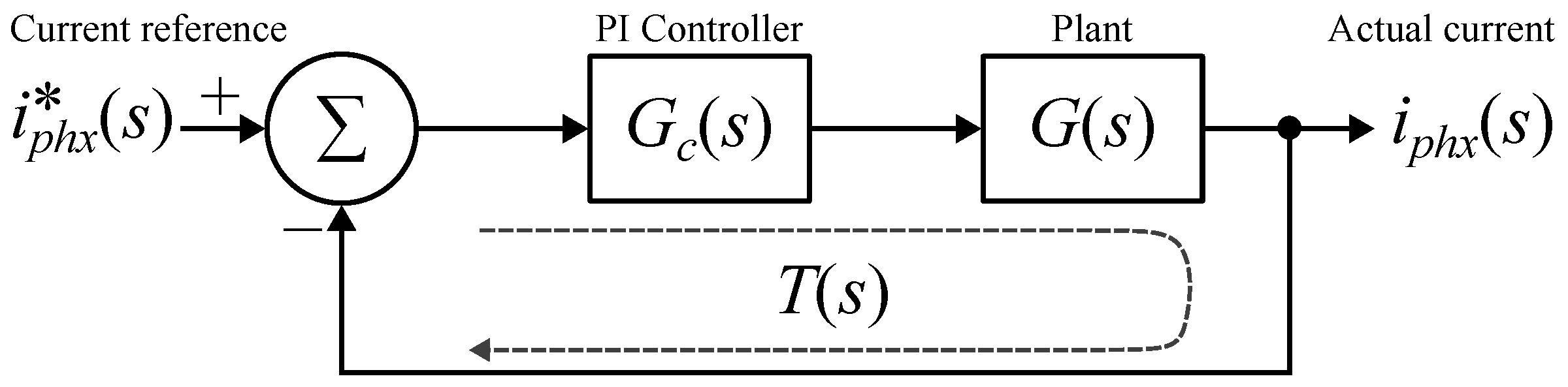
The equivalent block diagram for the system is shown in Figure 7. G c ( s ) is the transfer function of the controller, and G ( s ) is the transfer function of the system, expressed as follows:
G c ( s ) = k P x + k I x s , G ( s ) = V D C s L p h x
The open-loop transfer function ( T ( s ) ) is defined as the product of G c ( s ) and G ( s ) . In the frequency domain ( j ω ) this transfer function is expressed as follows:
T ( j ω ) = V D C L p h x j k P x ω + k I x ( j ω ) 2
with magnitude and phase values expressed as follows:
T ( j ω ) = V D C L p h x ( k P x ω ) 2 + ( k I x ) 2 ω 2
T ( j ω ) = tan 1 k P x ω k I x 180 .
In order to tune the current controller, a crossover frequency ( ω c ) equal to ω s w / 10 is selected, where ω s w represents the switching frequency in rad/s. Generally, a phase margin of φ m > 70 is desired, as the closed-loop response behavior would exhibit a fast response with almost no overshoot. The phase margin is tuned to φ m = 75 . The open-loop phase at ω c is determined as follows:
φ m = 180 + T ( j ω ) | ω = ω c T ( j ω ) | ω = ω c = φ m 180 T ( j ω ) | ω = ω c = 105 .
By evaluating (14) at ω = ω c and equating it to (15), the integral gain ( k I x ) can be determined as follows:
tan 1 k P x ω c k I x 180 = 105 tan 1 k P x ω c k I x = 75 k I x = k P x ω c tan ( 75 ) k P x ω c 3.732
Likewise, at ω = ω c , the magnitude of T ( j ω ) should be equal to 1 (or 0 dB):
T ( j ω c ) = V D C L p h x ( k P x ω c ) 2 + ( k I x ) 2 ω c 2 = 1 .
Substituting k I x from (16) into (17), an expression for k P x can be obtained as follows:
k P x L p h x ω c 1.035 V D C .
Likewise, substituting (18) into (16) yields the following:
k I x L p h x ω c 2 3.866 V D C .
The values of k P x and k I x depend on the desired control bandwidth, phase inductance, and DC link voltage. The subscript x indicates that these gains are phase-dependent. The integral action is enabled when the phase current exceeds 80% of the current reference ( I ref ) to prevent overshoot at θ ON . When the phase current falls below this threshold, the integrator is reset. The duty-cycle signal ( d x ) passes through a saturation block that constrains it within the limits of d min and d max . These values are set to ±0.98 to avoid overmodulation. Additionally, to avoid abrupt sign changes for duty-cycle values near zero due to numerical precision in the digital processor, auxiliary logic blocks are implemented to force the duty cycle to zero when it falls within the range of ( 0.001 , 0.001 ) .
For the PWM controller, the switching frequency, controller gains, accuracy of the LUTs, and variation of the DC link voltage can directly affect the current ripple. Since the switching frequency is constant, some of the acoustic noise harmonics are expected to be concentrated at the switching frequency and its harmonics.

4.5. Model Predictive Control

In order to develop finite control set model predictive control (FCS-MPC), it is necessary to discretize the switched mathematical expression in (4). Applying the forward Euler discretization method, with T s as the sampling period, discrete future currents ( k + 1 ) can be obtained:
i p h x ( k + 1 ) = k v x ( k ) v D C ( k ) Γ ( k ) + k i x ( k ) i p h x ( k ) + k e x ( k ) e p h x ( k )
where coefficients k v x k , k i x k , and k e x k are defined as
k v x ( k ) = T s / L p h x ( k ) , k i x ( k ) = 1 ( R p h x / L p h x ( k ) ) T s , k e x ( k ) = T s / L p h x ( k )
and Γ ( k ) is a combined switching function given by
Γ ( k ) = ( H x ( k ) ) ( L x ( k ) ) ( H x ( k ) ¯ ) ( L x ( k ) ¯ ) .
Future mechanical and electrical angles in radians are defined as follows:
θ m ( k + 1 ) = θ m ( k ) + ω m ( k ) T s , θ p h x ( k + 1 ) = θ p h x ( k ) + ω e ( k ) T s
where θ m is the rotor mechanical angle, θ p h x is the electrical angle for each phase, ω m is the mechanical angular frequency in rad/s, and ω e is the electrical angular frequency in rad/s. In addition, at each sampling instant, the algorithm must verify that i p h x ( k + 1 ) is greater than zero; if not, it is set to zero. The cost function is defined as in (24), considering that current regulation is the main objective. It is evaluated for all possible combinations of switching states listed in Table 2. The switching state that minimizes the cost function is selected.
g p h x ( k + 1 ) = i p h x ( k + 1 ) i p h x ( k + 1 ) 2
For the model predictive controller, the cost function, model accuracy, and sampling period can affect the current ripple. If the model does not accurately represent the system dynamics, the predictive control action may deviate from the optimal solution, leading to suboptimal performance [24].

5. Acoustic Noise Modeling and Analysis of the Motor

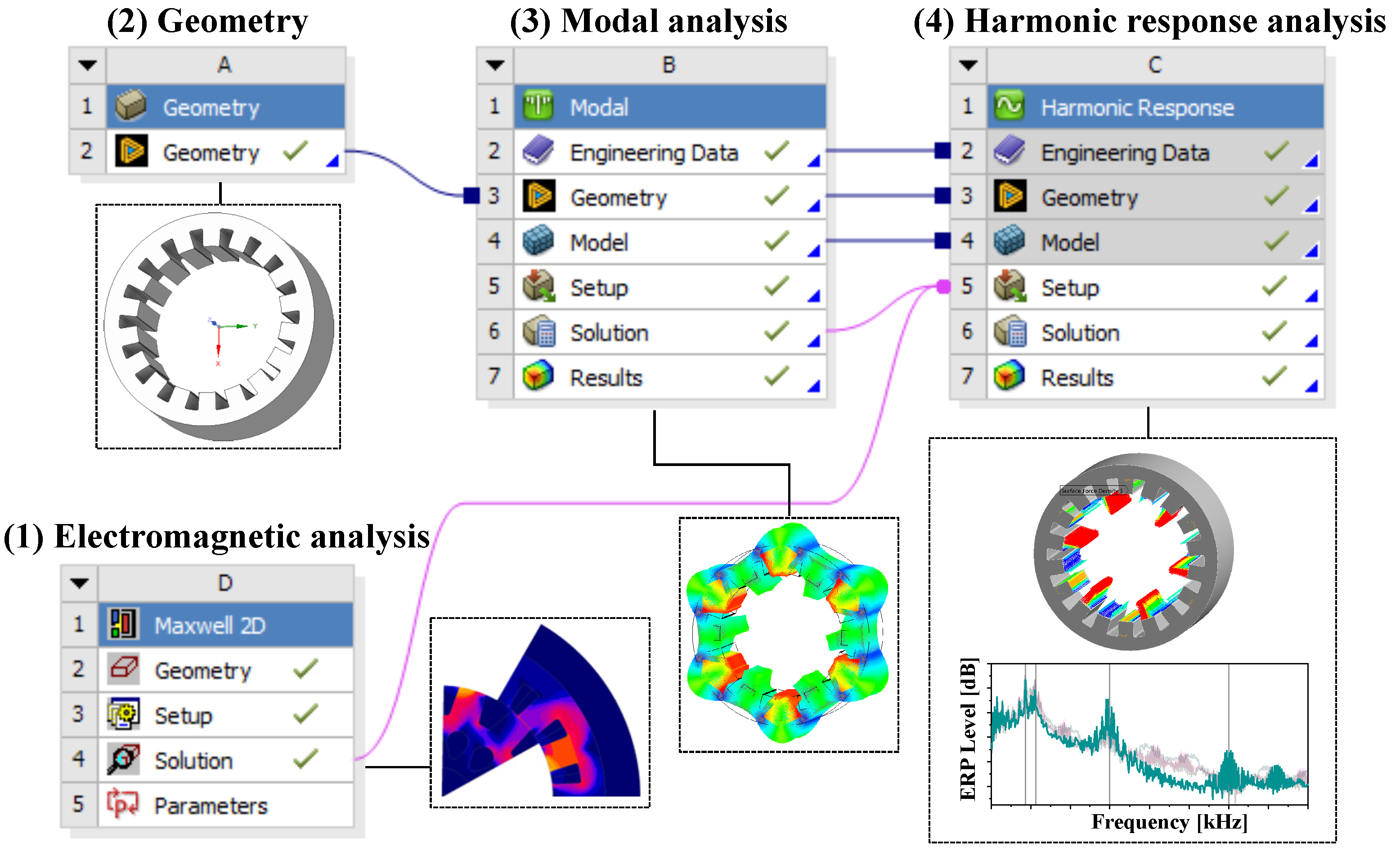
The block diagram for the vibroacoustics workflow applied to the SRM is illustrated in Figure 8. The dynamic-phase current waveforms are calculated in MATLAB/Simulink using the static characteristics of the SRM and the control parameters for each current control technique. The phase currents are fed into the Maxwell 2D model of the motor to calculate the electromagnetic forces. A 3D geometry of the stator core is implemented in ANSYS SpaceClaim for modal analysis. The vibration modes and natural frequencies of the motor are calculated based on the assigned material properties. This is followed by harmonic response analysis, which calculates the vibration response by combining modal results with harmonic forces mapped onto the stator teeth from the electromagnetic analyses. Finally, the motor’s acoustic behavior is evaluated through equivalent radiated power (ERP) levels.
Three operating speed points are defined for the vibroacoustic analysis of this motor. Table 3 presents the corresponding mechanical and electrical frequencies and periods for each operating point. The Ω m parameter denotes the mechanical speed in RPM, from which the following variables are derived:
ω m = 2 π Ω m / 60 [ rad / s ] , f m = ω m / 2 π [ Hz ] , T m = 1 / f m [ s ]
where ω m is the mechanical angular speed, f m is the mechanical frequency, and T m is the period of one full mechanical revolution. Electrical quantities are also determined according to the SRM pole configuration ( N s / N r ):
T e = T m / N r [ s ] , f e = 1 / T e [ Hz ]
where T e is the electrical period, f e is the electrical frequency, N r is the number of rotor poles, and N s is the number of stator poles.

5.1. Electromagnetic Analysis

For electromagnetic analyses, it is necessary to import external datasets of steady-state excitation currents obtained from the dynamic model of the SRM drive. Subsequently, parameters such as the number of electrical cycles and the sampling time must be defined. Defining h as the number of steps per electrical cycle and N e - cycles as the total number of electrical cycles, the following parameters should be calculated:
T sim ( FEA ) = N e - cycles T e [ s ] T s ( FEA ) = T e / h [ s ] f s ( FEA ) = 1 / T s ( FEA ) [ Hz ] f Nyquist = f s ( FEA ) / 2 [ Hz ]
where T sim ( FEA ) is the total time to be simulated, T s ( FEA ) is the sampling period, f s ( FEA ) is the sampling frequency, and f Nyquist is the maximum frequency component that can be captured in the electromagnetic analysis. Given that the sampling frequency ( f s ) for all control techniques is 15 kHz, the electromagnetic analysis is configured with a sampling frequency ( f s ( FEA ) ) greater than or equal to 2 f s to accurately capture switching effects at f s , as well as different harmonics within the audible frequency range (20 Hz to 20 kHz). Setting f s ( FEA ) equal to 108 kHz to avoid aliasing in the electromagnetic analysis, the number of steps per electrical cycle (h) can be calculated accordingly. N e - cycles is set to one electrical cycle to limit the computational time for the subsequent harmonic response analyses.
Table 4 summarizes the time and frequency settings used for each operating point. The value of h is higher at lower speeds and decreases as the speed increases. Increasing h increases the Nyquist frequency, as well as the computational time of the electromagnetic and harmonic response analyses. Similarly, using more electrical cycles improves frequency resolution at the cost of a longer computation time. In vibroacoustic simulations using FEA tools, the designer must balance accuracy and computational time.
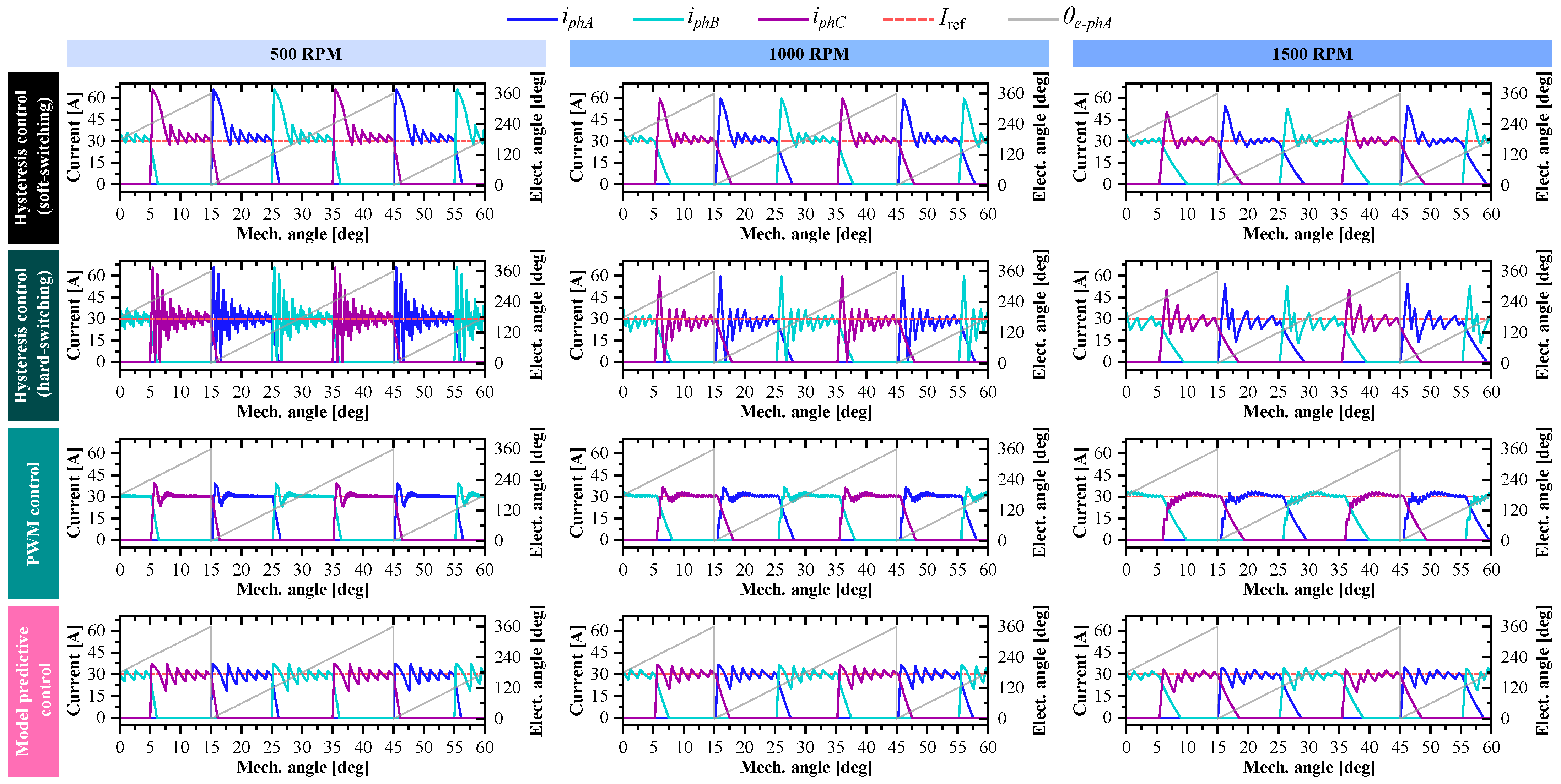
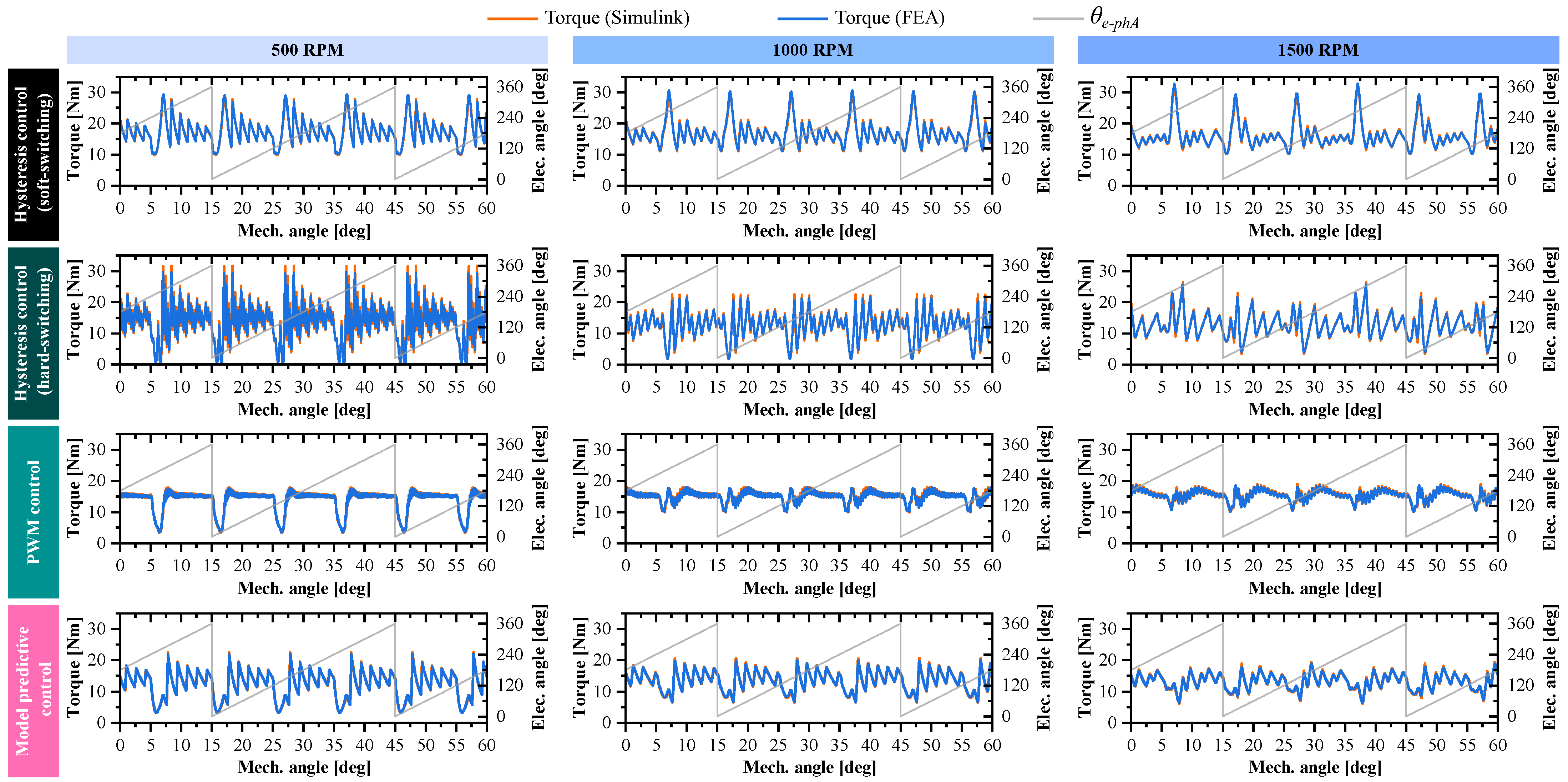
Figure 9 shows the steady-state dynamic current waveforms for each control technique at each speed. Similarly, Figure 10 presents the corresponding electromagnetic torque waveforms under the same operating conditions. According to the dynamic simulation results, the PWM current controller shows better performance with respect to current overshoot, ripple, regulation, and torque ripple. Model predictive control also performs well, exhibiting lower current variation compared to both hysteresis controllers. As shown Figure 10, the torque computed in FEA closely matches the torque obtained from the dynamic model of the SRM drive in MATLAB/Simulink.
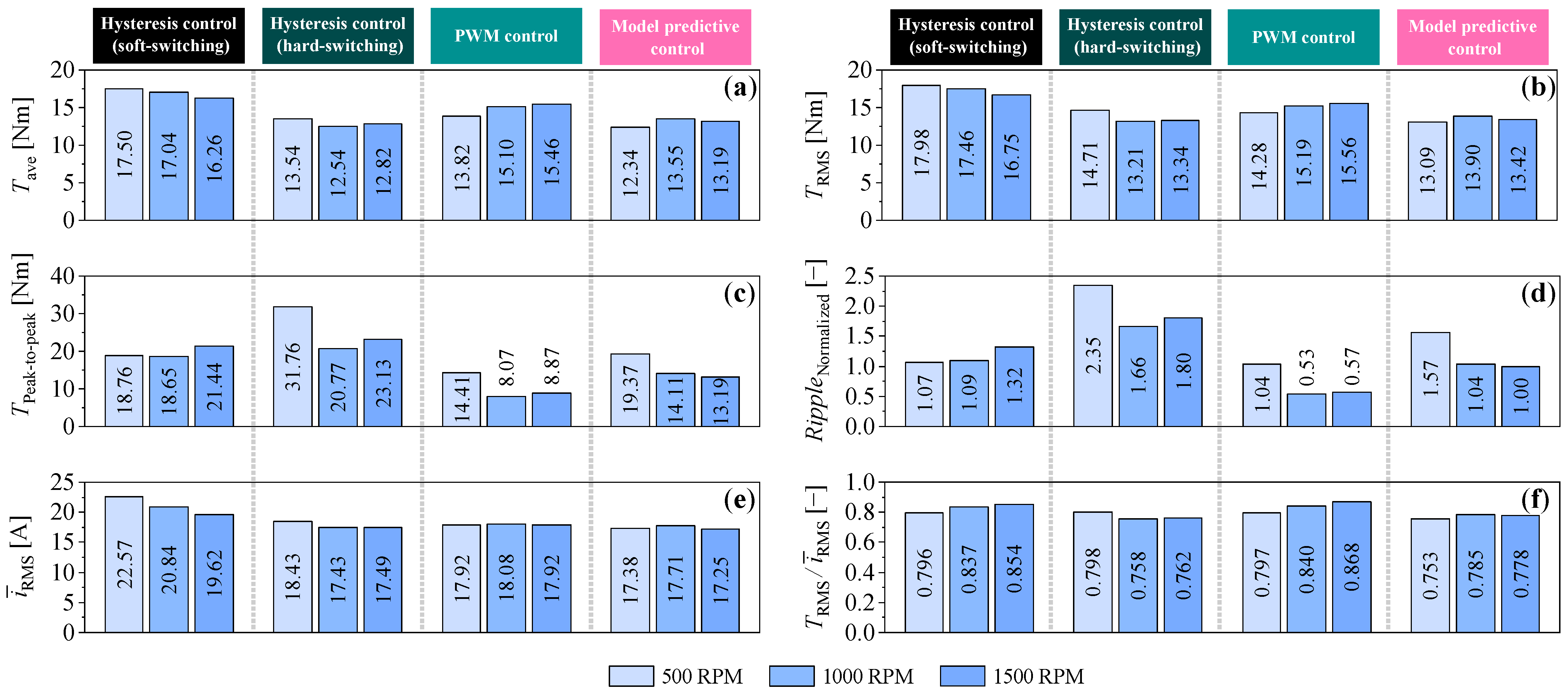
A quantitative comparison across all control techniques is achieved by computing various electromagnetic characteristics from the Simulink model over one full mechanical period ( T m ), as shown in Figure 11. The computed electromagnetic characteristics include (a) the average torque ( T ave ); (b) the RMS torque ( T RMS ); (c) the peak-to-peak torque ripple ( T Peak - to - peak ); (d) the normalized torque ripple ( R i p p l e Normalized ); (e) the average of the RMS phase currents ( i ¯ RMS ); and (f) the torque per ampere (TPA) performance ratio, which is defined as T R M S / i ¯ RMS . These electromagnetic characteristics are given expressed as follows:
T ave = 1 T m 0 T m T ( t ) d t [ Nm ] T RMS = 1 T m 0 T m T ( t ) 2 d t [ Nm ] T Peak - to - peak = T max T min [ Nm ] R i p p l e Normalized = T max T min / T ave i ¯ RMS = i p h A ( RMS ) + i p h B ( RMS ) + i p h C ( RMS ) / 3 [ A ]
where T ( t ) is the instantaneous torque and T max and T min are the maximum and minimum torque values, respectively. As shown in Figure 11a,b, across all three operating speeds, hysteresis control with soft switching consistently yields higher average and RMS torque values compared to the other control techniques. This behavior can be attributed to the current overshoot and slower decay in phase currents at the beginning of the conduction angle ( θ ON ), which results in a higher RMS phase current.
In terms of peak-to-peak torque ripple (see Figure 11c), the PWM controller exhibits the lowest values due to the lower current ripple. Model predictive control demonstrates the second best performance for 1000 and 1500 RPM. As shown in Figure 11d, the PWM controller yields the lowest normalized torque ripple, ( R i p p l e Normalized ), followed by model predictive control; hysteresis with soft switching; and finally, hysteresis with hard switching.
For the average of RMS phase currents for all phases ( i ¯ RMS ), hysteresis control with soft switching shows the highest values for all the speeds. This is due to the higher overshoot at the beginning of the conduction period, which could be reduced by using a higher sampling frequency ( f s ). Regarding T R M S / i ¯ RMS , PWM control produces more RMS torque per RMS current than the other control techniques.

5.2. Modal Analysis

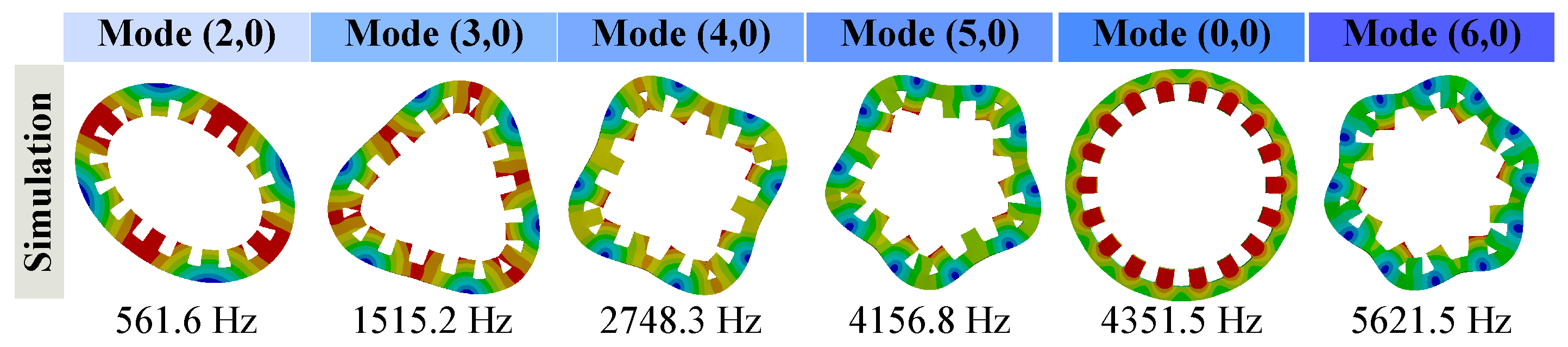
For the 18/12 SRM under study, vibration modes of (0,0) and (6,0) are particularly significant, as they can be excited by stator harmonic forces whose spatial orders align with the natural frequencies of these modes. Vibration mode (6,0) corresponds to the spatial harmonic order of N s / m = 6 , where N s is the number of stator poles and m is the number of phases. Similarly, the number of strokes is given by m N r = 36 , with N r denoting the number of rotor poles. In the vibroacoustic analysis presented in this section, only the stator core was considered, as including the windings, potting, and motor housing would greatly increase the model complexity. The modal analysis was carried out in ANSYS Workbench using the stator core modeled under free boundary conditions. Estimated isotropic material properties for HIPERCO 50A were applied, with a mass density of ρ = 7938.4 kg/m3, Young’s modulus of E = 153.8 GPa, and Poisson’s ratio of ν = 0.3 . Figure 12 shows the vibration modes and their corresponding natural frequencies. The natural frequency for vibration modes of (0,0) and (6,0) occur at 4351.5 Hz and 5621.5 Hz, respectively.

5.3. Harmonic Response Analysis

In the harmonic response analysis stage, the simulation results for ERP levels are associated with the following parameters:
N elements = ( h / 2 ) N e - cycles f spacing = f min = f e / N e - cycles [ Hz ] f max = f spacing N elements = ( h / 2 ) f e f Nyquist [ Hz ]
where N elements represents the number of elements; f spacing is the frequency spacing between elements; and f max is the maximum frequency in the analysis, which is equal to f Nyquist . In addition, to conducting this analysis, a constant harmonic damping factor is assumed. In [25], the following empirical expression commonly applied to small and medium-sized electric motors was provided:
ζ c i r c = 1 2 π 2.76 × 10 5 f c i r c + 0.062
where c i r c is the circumferential order of the vibration mode and f c i r c is the natural frequency of the vibration mode. Considering a value f c i r c equal to the natural frequency of vibration mode (0,0) ( f mode 0 = 4351.5 Hz), the damping factor would be approximately 2.89% using (30). As a conservative overestimation of the motor’s harmonic response, a 2% damping factor is applied in this study.
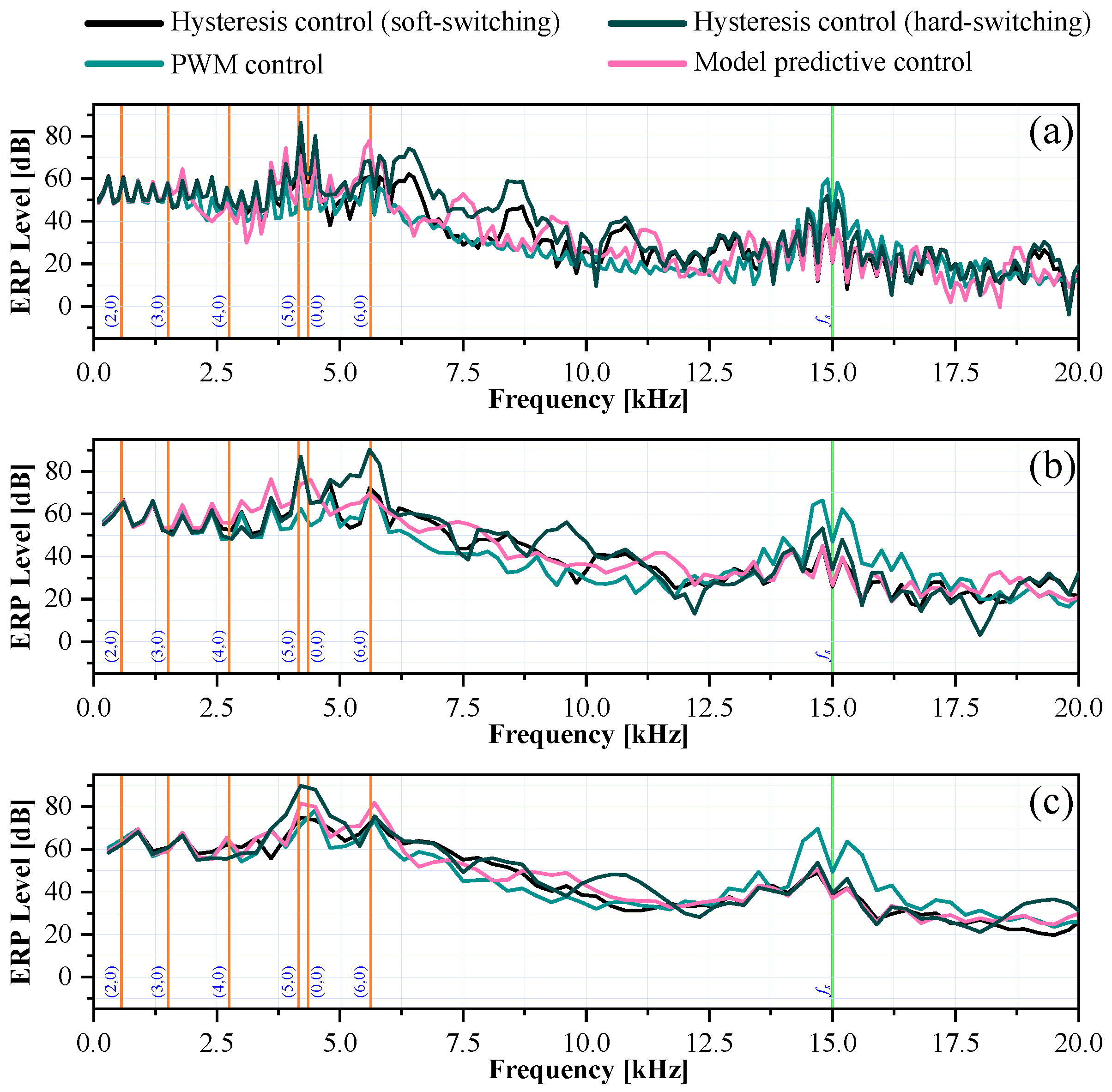
The harmonic forces obtained from the electromagnetic analyses are applied as surface force densities on the stator teeth of the SRM, enabling the calculation of the ERP on the stator’s outer surface. The simulations are carried out for 12 cases—three for each control technique. Figure 13 presents the ERP levels in decibels for each speed and current control technique. Each plot includes vertical reference lines indicating the natural frequencies of the vibration modes identified in Figure 12, along with the sampling frequency ( f s ). These references enable a direct comparison between the electromagnetic excitation introduced by the current controllers and the structural resonances of the stator core.
The results reveal that ERP peaks occur in the vicinity of vibration modes of (0,0) and (6,0). This confirms that these structural modes are highly sensitive to excitation, independent of rotational speed and control technique, and, thus, play a dominant role in shaping the machine’s vibroacoustic response. Moreover, a pronounced concentration of power is consistently observed at the sampling frequency ( f s ), with noticeably higher levels under PWM control, since the switching frequency remains fixed at 15 kHz. In contrast, control techniques with variable switching frequencies generate elevated dB levels distributed over a wider frequency spectrum. Among these, hysteresis control with hard switching consistently produces the highest ERP responses relative to the other techniques. As illustrated in Figure 11d, this technique also produces the largest normalized torque ripple. In comparison, PWM control exhibits consistently lower dB levels than the other techniques below 10 kHz, while below 2.5 kHz, the responses of all control techniques remain largely comparable. In order to provide a quantitative comparison across the different ERP levels, as shown in Figure 13, logarithmic addition is applied. This approach allows for the calculation of an overall ERP value within the audible frequency range, expressed as follows:
ERP total = 10 log 10 i = 1 N 10 ERP i / 10 [ dB ]
where N denotes the number of elements within the range of 20 Hz to 20 kHz obtained from the harmonic response analyses. Table 5 summarizes the overall ERP values for each control technique at the corresponding operating speeds. The highest overall ERP levels correspond to hysteresis control with hard switching across the different speeds.

6. Experimental Validation of Switched Reluctance Motor Current Control Techniques

The same control techniques are evaluated experimentally, and acoustic noise measurements are recorded in the form of sound power level (SWL). The subsections on dynamometer testing, experimental modal testing, and acoustic noise characterization are presented in analogy to the electromagnetic, modal, and harmonic response analyses, respectively, to maintain consistency with the simulation study. It should be noted, however, that this does not imply the experimental procedures were carried out sequentially. In particular, experimental modal testing was performed during different assembly stages of the SRM as presented in [21].

6.1. Hardware and Software Setup

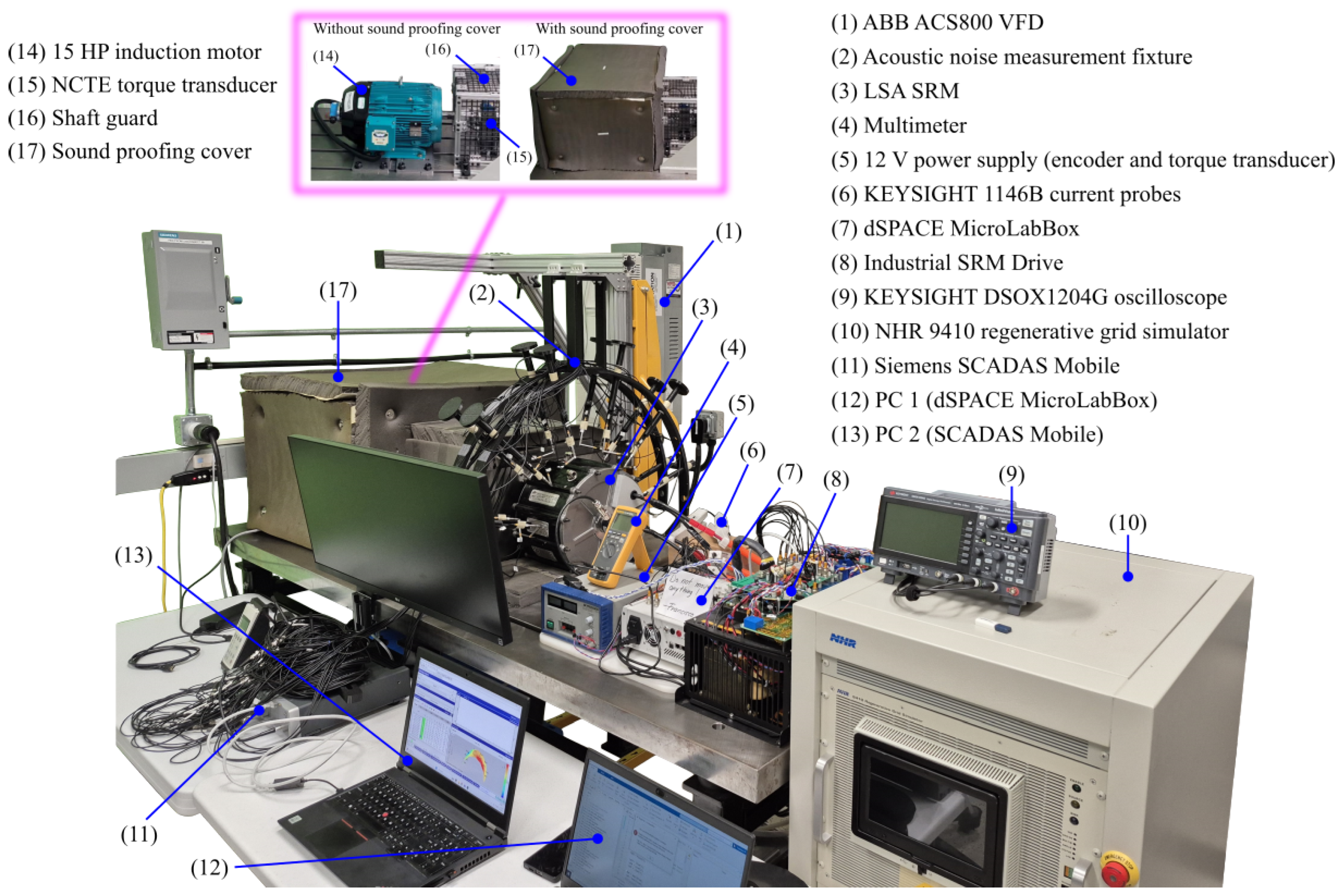
Figure 14 illustrates the developed dynamometer setup for the SRM. It includes an 15 HP induction motor and the SRM. Mechanically, both machines are mounted on a T-slot table and coupled through mechanical couplers. Positioned at the midpoint of the shaft connection, an NCTE torque transducer is installed to acquire torque measurements. The IM is driven by an ABB ACS800 VFD. The SRM is excited and controlled by an industrial SRM drive. The four current control techniques applied to the SRM are implemented in the dSPACE MicroLabBox platform.
For the experiments, the industrial SRM drive was supplied by an NHR 9410 regenerative grid simulator, with the nominal DC-link voltage set to 450 V. The induction motor and shaft guard were covered with soundproofing material to minimize external noise contributions from these components. Acoustic measurements were performed using the noise measurement fixture developed in [26], with sound intensity data acquired and processed through the Siemens SCADAS Mobile system. Additionally, phase current waveforms were captured using three KEYSIGHT 1146B current probes connected to an oscilloscope.
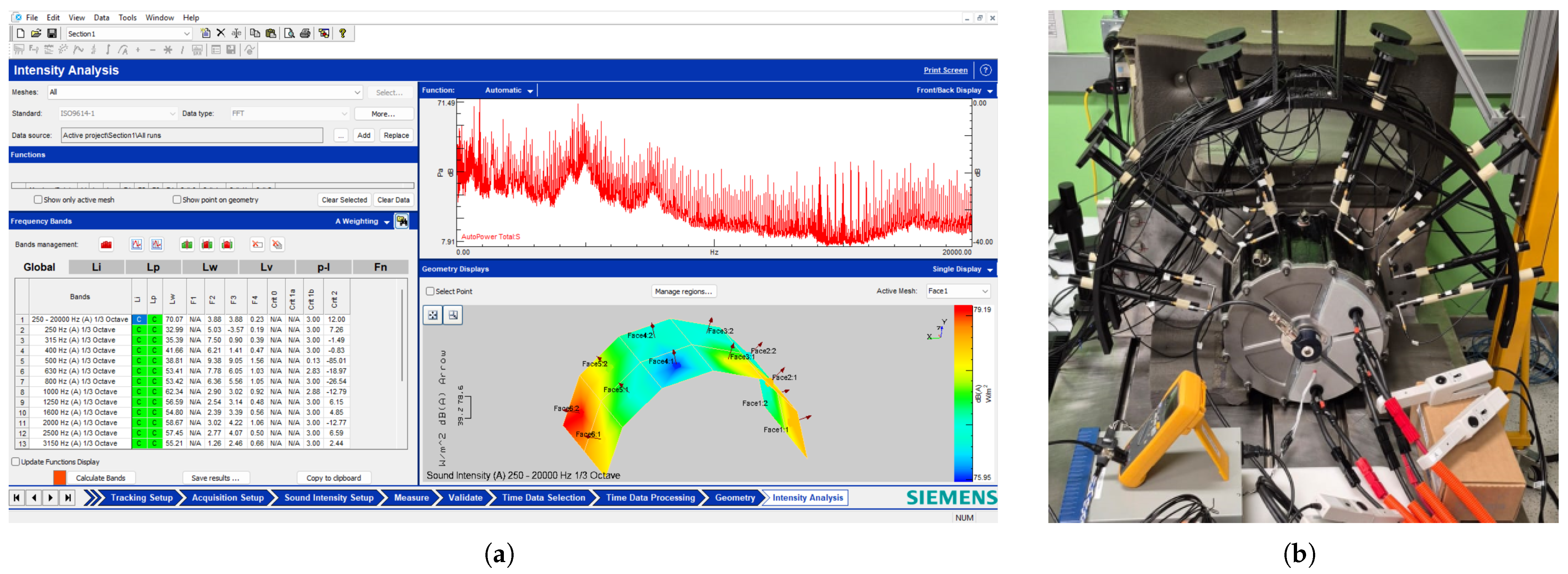
Sound intensity measurements and post-processing were performed using Simcenter Testlab Sound Intensity Testing software. In order to conduct these measurements, an imaginary surface surrounding the noise source, referred to as the acoustic mesh, was defined. Figure 15a shows the main software window, presenting the sound intensity measurements at a particular speed, together with the corresponding acoustic mesh. Depending on the number of intensity probes and measurement points, the surface is subdivided into smaller mesh elements, with each probe positioned at the center of an element. For this study, a total of 12 probes were considered. Figure 15b shows the positioning of the sound intensity probes around the SRM under test. Further details on the construction of the acoustic mesh and additional settings for this measurement fixture are provided in [19,26].

6.2. Dynamometer Testing

The SRM was tested at three operating speeds: 500 RPM, 1000 RPM, and 1500 RPM. At each speed, the four different current control techniques were evaluated. The DC-link voltage was fixed at the nominal value of the SRM, i.e., 450 V. The conduction angles, i.e., θ ON and θ OFF , were kept constant at 0° and 120°, respectively, and the current reference ( I ref ) was set to 30 A. Under these conditions, the simulated average torque values remained below 20 Nm, as illustrated in Figure 11.
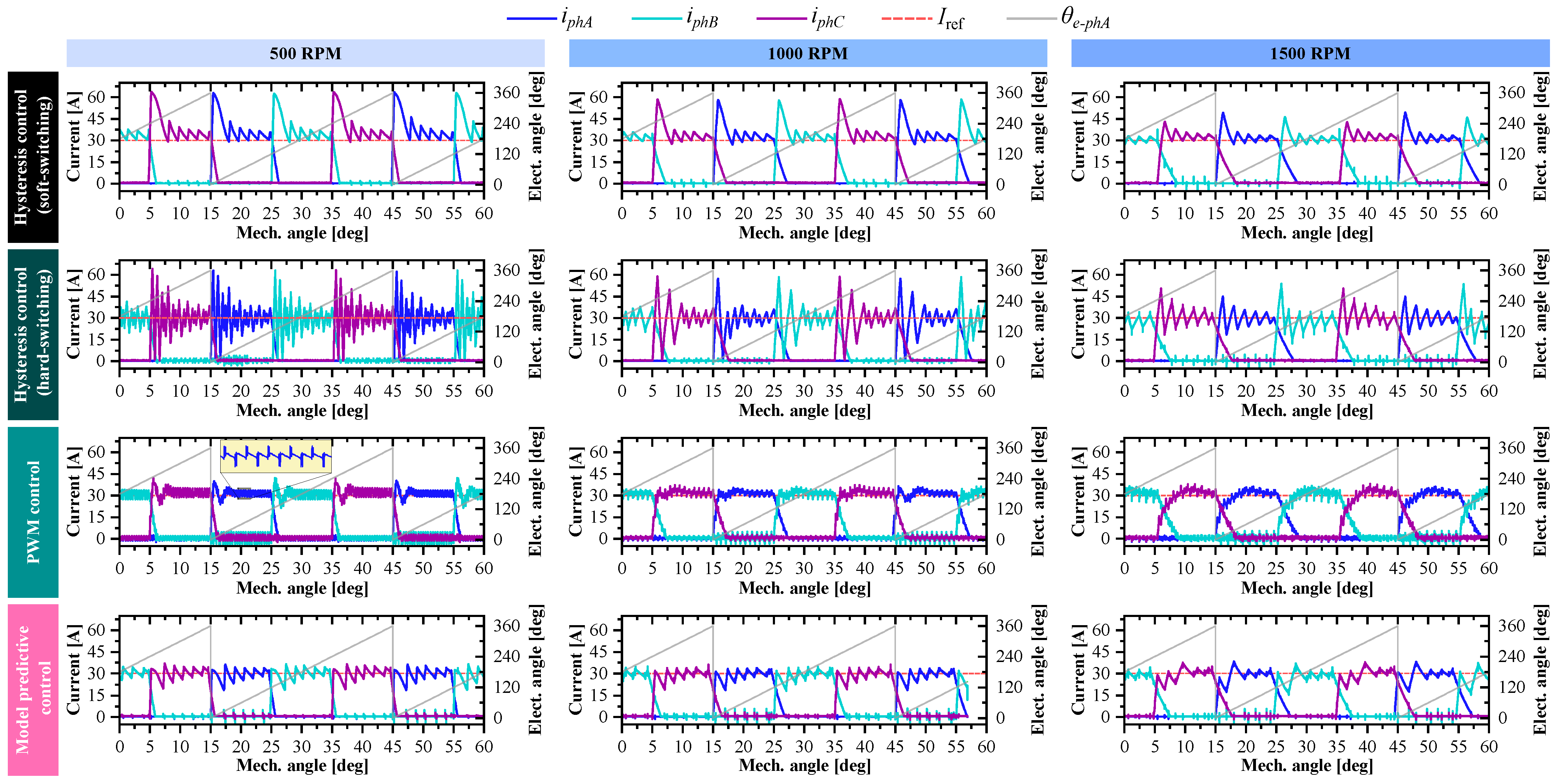
Figure 16 summarizes the experimentally measured dynamic current waveforms over two electrical cycles for each operating speed and control technique. A good correlation can be observed when comparing these waveforms with the simulated waveforms illustrated in Figure 9. Some deviations can be observed in the experimental current waveforms relative to the simulated ones. These differences can be attributed to variations in phase inductance, temperature, the electrical properties of steel, and other contributing factors.
In order to establish a quantitative comparison between the simulation and experimental results, the average torque and average RMS current values are reported in Table 6. As observed, a fairly good correlation is achieved, suggesting that the FEA-based characterization of the SRM is reasonably accurate. The absolute error for these variables is calculated as follows:
Absolute error = | Experimental value Simulated value |
From the numerical results in Table 6, a maximum absolute error of 1.72 Nm is observed for hysteresis control with hard switching at 1500 RPM. Similarly, the highest current error of 1.15 A occurs with the same control technique at 1000 RPM.

6.3. Experimental Modal Testing

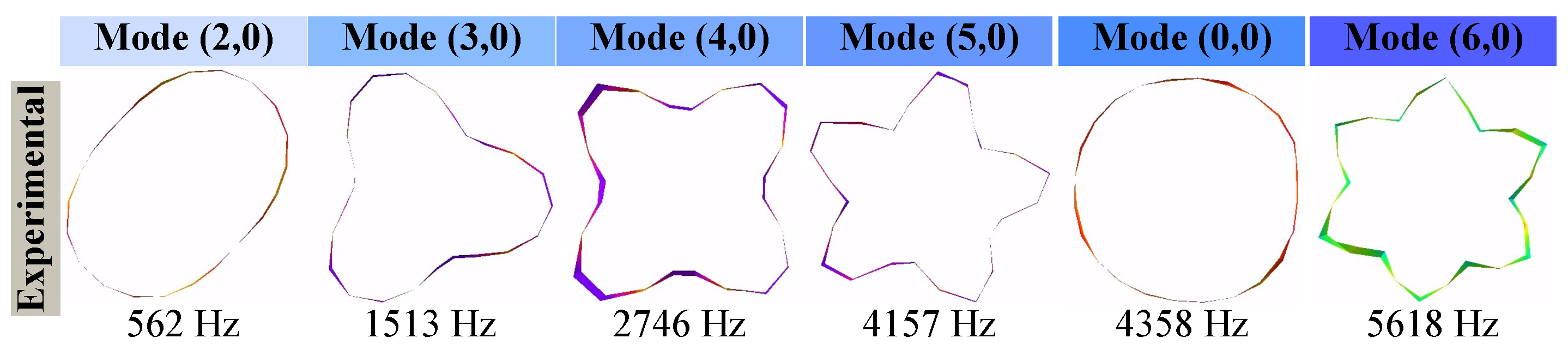
In [21], experimental modal analyses were conducted at different stages of the motor assembly. For stator-core testing, the stator core was suspended using bungee cords to replicate free boundary conditions. A total of 48 accelerometers were mounted on the outer surface of the stator—24 on each axial edge, positioned 5 mm from the edge. Mechanical excitation was applied at two distinct locations using two The Modal Shop 2025E shakers. The vibration information from the accelerometers was captured and analyzed using a Siemens Simcenter SCADAS Mobile data acquisition analyzer. The vibration modes and their corresponding natural frequencies, obtained from experimental measurements, are presented in Figure 17. A close correlation between the simulated and measured results can be observed by comparing Figure 12 with Figure 17. In particular, the experimentally measured vibration modes of (0,0) and (6,0) occur at 4358 Hz and 5618 Hz, respectively. Similarly, the SRM was tested at other stages of the assembly. Table 7 summarizes the experimental results for all stages, with the final stage, the encapsulated stator housing assembly, representing the closest condition to the actual motor mounting on a dyno setup for dynamic testing.

6.4. Acoustic Noise Characterization

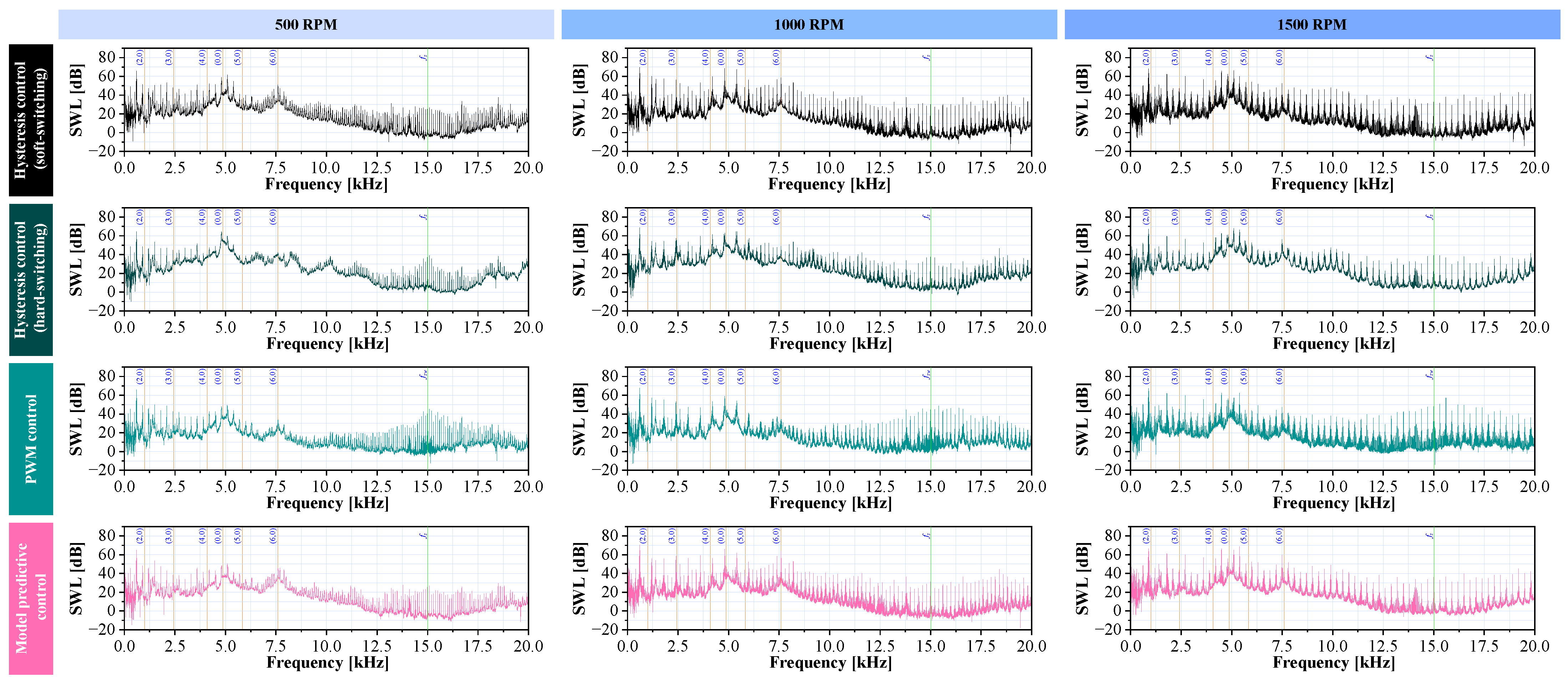
Sound intensity measurements were obtained for the four current control techniques across the different speeds. The corresponding sound power levels for each operating speed and control technique are presented in Figure 18. Compared to the simulation results presented in Figure 13, the experimental measurements provide greater detail in the audible frequency range, with a frequency resolution of 1 Hz. Significant peak values can be observed in the vicinity of vibration modes (0,0) and (6,0), as predicted by the simulation results. The natural frequencies associated with the different vibration modes shown in Figure 18 correspond to the encapsulated stator housing assembly.
The measured sound power levels were analyzed in 1 / 3 -octave bands using Simcenter Testlab software. Table 8 presents the resulting 1 / 3 -octave band sound power levels for each operating speed and control technique. By condensing thousands of data points per case, the table summarizes results for 20 of the 32 1 / 3 -octave bands defined within the audible frequency range [27]. Regardless of the mechanical speed, hysteresis control with hard switching consistently exhibits higher sound power values across the different octaves. At the 16 kHz octave band (around 15 kHz), a significant increase in power is observed for PWM control. This is attributed to the constant switching frequency of 15 kHz, which is in agreement with the ERP values presented in Figure 13.
Similarly, the overall broadband SWL within the 250 Hz to 20 kHz range can be derived from the individual octave-band levels through logarithmic addition, as defined in (31) for ERP levels (Table 9). When compared with the overall ERP values in Table 5, the results follow a similar trend. It should be re-emphasized that ERP generally represents an overestimation of the actual acoustic noise generated by the motor. Hysteresis control with hard switching is the noisiest, followed by hysteresis control with soft switching, model predictive control, and PWM control. At 1500 RPM, hysteresis control with soft switching performs slightly better than MPC.
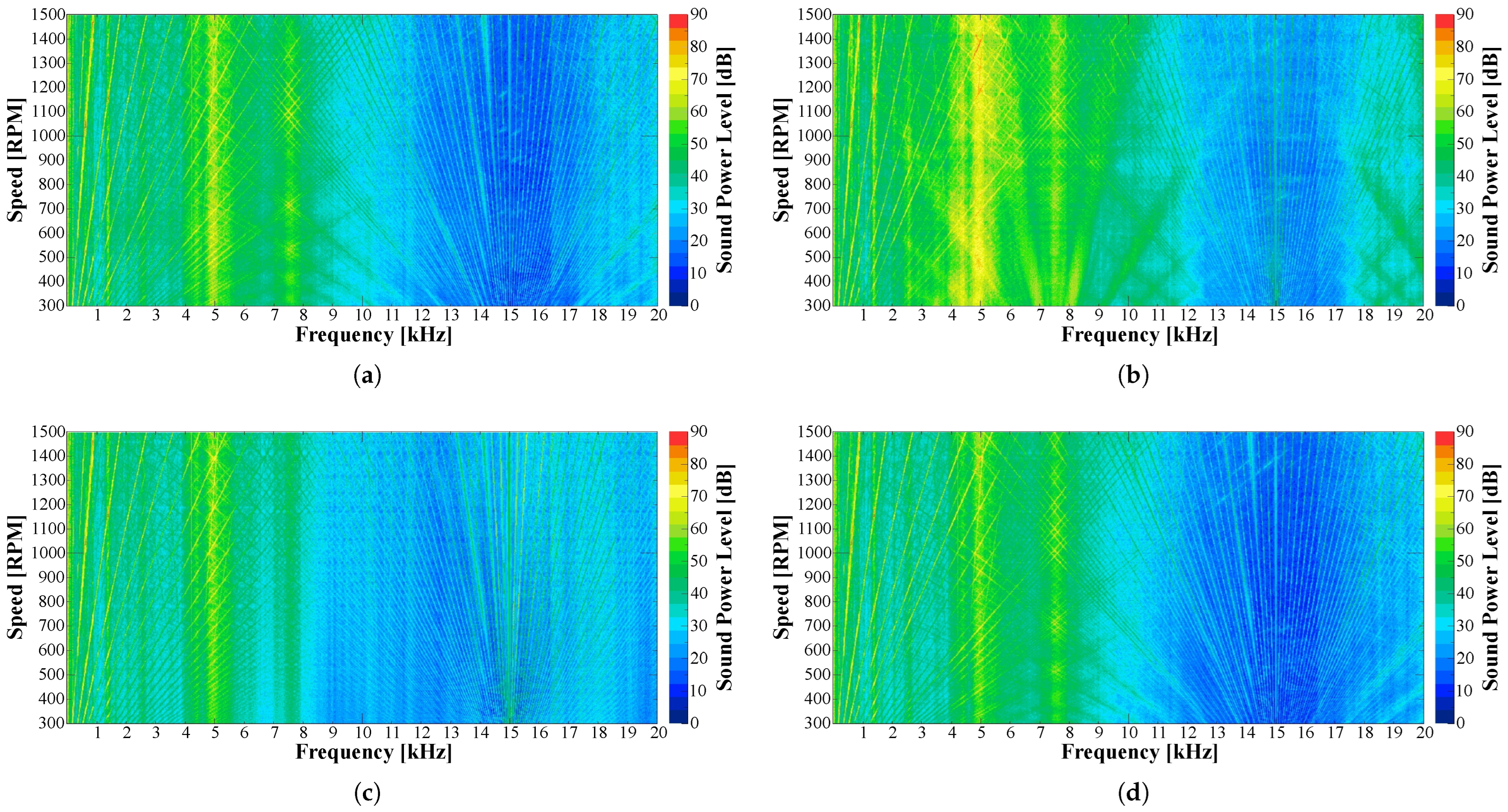
Additionally, the VFD connected to the induction motor is configured to increase the speed linearly from 300 to 1500 RPM over a defined time interval to generate the waterfall diagrams. All current control techniques operate at the nominal current reference of 30 A, with constant conduction angles pf θ ON = 0 and θ OFF = 120 . The Siemens SCADAS Mobile system records sound intensity from all probes and generates corresponding color scale plots. Figure 19 shows the waterfall diagrams for each current control technique from 300 to 1500 RPM. The dB scale ranges from 0 to 90 dB, representing the sound power level. Regardless of the control technique, two noticeable lines appear near the natural frequencies of vibration modes (0,0) and (6,0) for the encapsulated stator housing assembly, indicating resonance effects. Hysteresis control with hard switching exhibits the highest acoustic noise levels, particularly within the green-to-yellow spectrum. Distinct sets of lines are observed around 7.5 kHz, which can be attributed to the variable switching frequency characteristic of this control technique. Similar behavior, though with lower magnitude, can be observed for hysteresis control with soft switching and model predictive control. Finally, regarding acoustic noise performance, PWM control stands out as the best technique, followed by model predictive control, hysteresis control with soft switching, and hysteresis control with hard switching. For PWM control, harmonic sidebands associated with the switching frequency are clearly observed, centered at f s w .

7. Conclusions

This paper presented a comprehensive simulation and experimental analysis of the acoustic noise performance of a switched reluctance motor under four current control techniques: hysteresis control with soft switching, hysteresis control with hard switching, PWM control, and model predictive control. The results were illustrated using 2D plots of equivalent radiated power and sound power levels across different operating speeds, as well as waterfall diagrams spanning 300–1500 RPM, which highlighted the distinct vibroacoustic characteristics of each control technique. Both simulation and experimental findings indicate that hysteresis control with hard switching generates the highest noise levels, followed by hysteresis control with soft switching, model predictive control, and PWM control. Among the studied techniques, PWM control emerges as the most favorable option for achieving inherent acoustic noise reduction. The results of this work provide practical guidance for the design and selection of current control techniques in an SRM, with implications for reducing acoustic noise. Furthermore, the study lays the groundwork for future research on the optimization of control strategies and the extension of the methodology to other motor topologies.

Author Contributions

Conceptualization, F.J.-L. and B.B.; methodology, F.J.-L. and B.B.; software, F.J.-L.; validation, F.J.-L., M.M., and B.B.; formal analysis, F.J.-L., M.M., B.N.-M., and B.B.; investigation, F.J.-L. and M.M.; resources, B.B.; data curation, F.J.-L. and M.M.; writing—original draft preparation, F.J.-L.; writing—review and editing, F.J.-L.; visualization, F.J.-L. and M.M.; supervision, B.N.-M. and B.B.; project administration, B.B.; funding acquisition, B.N.-M. and B.B. All authors have read and agreed to the published version of the manuscript.

Funding

This research was undertaken, in part, thanks to funding from the Natural Sciences and Engineering Research Council of Canada (NSERC) and the Canada Foundation for Innovation (CFI).

Data Availability Statement

Data are contained within the article.

Acknowledgments

The authors gratefully acknowledge the technical support provided by Kevalkumar Bhagvanbhai, Sudesh Champika, Thisuri Indiketiya, and Charitha Abeyrathne in the development of the dynamometer setup used for this research. The authors would also like to thank ANSYS, CMC Microsystems, Altair, and MathWorks for their support with ANSYS Workbench, SolidWorks, Flux, and MATLAB/Simulink software, respectively.

Conflicts of Interest

The authors declare no conflicts of interest.

Abbreviations

The following abbreviations are used in this manuscript:
ERPEquivalent Radiated Power
FCSFinite Control Set
FEAFinite Element Analysis
LUTLookup Table
MAPDLMechanical ANSYS Parametric Design Language
MPCModel Predictive Control
NVHNoise Vibration and Harshness
PWMPulse-Width Modulation
RMSRoot Mean Square
SPLSound Pressure Level
SRMSwitched Reluctance Motor
SWLSound Power Level
TPATorque Per Ampere

References

  1. Cakal, G.; Sarlioglu, B. Two-phase immersion cooling of high-performance electric traction motors. IEEE Trans. Transp. Electrif. 2025, 11, 6866–6874. [Google Scholar] [CrossRef]
  2. Yang, P.; Shi, W.; Qiu, Y.; Li, B.; Gan, Y. Enhanced efficiency of direct-drive switched reluctance motor with reconfigurable winding topology. IEEE Access 2022, 10, 62976–62990. [Google Scholar] [CrossRef]
  3. Ouannou, A.; Brouri, A.; Giri, F.; Kadi, L.; Oubouaddi, H.; Hussien, S.A.; Alwadai, N.; Mosaad, M.I. Parameter identification of switched reluctance motor SRM using exponential swept-sine signal. Machines 2023, 11, 625. [Google Scholar] [CrossRef]
  4. Ahn, J.-W.; Lukman, G.F. Switched reluctance motor: Research trends and overview. CES Trans. Electr. Mach. Syst. 2018, 2, 339–347. [Google Scholar] [CrossRef]
  5. Cai, H.; Wang, H.; Li, M.; Shen, S.; Feng, Y.; Zheng, J. Torque ripple reduction for switched reluctance motor with optimized PWM control strategy. Energies 2018, 11, 3215. [Google Scholar] [CrossRef]
  6. Diao, K.; Sun, X.; Bramerdorfer, G.; Li, G.; Wang, Q.; Wu, L. A novel analytical design theory for switched reluctance motors incorporating nonlinear characteristics. IEEE Trans. Ind. Electron. 2025, 72, 6775–6785. [Google Scholar] [CrossRef]
  7. Andriushchenko, E.; Kallaste, A.; Mohammadi, M.H.; Lowther, D.A.; Heidari, H. Sensitivity analysis for multi-objective optimization of switched reluctance motors. Machines 2022, 10, 559. [Google Scholar] [CrossRef]
  8. Upadhyay, P.; Kumar, R. Design of two-phase switched reluctance motor (SRM) for two-wheel electric vehicle and torque-density based comparison with three-phase SRM. IEEE Trans. Ind. Appl. 2024, 60, 3912–3919. [Google Scholar] [CrossRef]
  9. Ferková, Ž.; Bober, P. Influence of the rotor geometry on efficiency and torque ripple of switched reluctance motor controlled by optimized torque sharing functions. Machines 2023, 11, 613. [Google Scholar] [CrossRef]
  10. Fang, G.; Scalcon, F.P.; Xiao, D.; Vieira, R.P.; Gründling, H.A.; Emadi, A. Advanced control of switched reluctance motors (SRMs): A review on current regulation, torque control and vibration suppression. IEEE Open J. Ind. Electron. Soc. 2021, 2, 280–301. [Google Scholar] [CrossRef]
  11. Zhu, Y.; Yao, M.; Sun, X. A review on predictive control technology for switched reluctance motor system. World Electr. Veh. J. 2023, 14, 221. [Google Scholar] [CrossRef]
  12. Lan, Y.; Benomar, Y.; Deepak, K.; Aksoz, A.; Baghdadi, M.E.; Bostanci, E.; Hegazy, O. Switched reluctance motors and drive systems for electric vehicle powertrains: State of the art analysis and future trends. Energies 2021, 14, 2079. [Google Scholar] [CrossRef]
  13. Wiguna, C.A.; Cai, Y.; Lilian, L.L.S.S.; Furqani, J.; Fujii, Y.; Kiyota, K.; Chiba, A. Vibration and acoustic noise reduction in switched reluctance motor by selective radial force harmonics reduction. IEEE Open J. Ind. Appl. 2023, 4, 23–34. [Google Scholar] [CrossRef]
  14. El-Faouri, F.S.; Cai, Y.; Chiba, A. Refinement of analytical current waveform for acoustic noise reduction in switched reluctance motor. IEEE Open J. Ind. Appl. 2024, 5, 325–337. [Google Scholar] [CrossRef]
  15. Kimpara, M.L.M.; Reis, R.R.C.; Da Silva, L.E.B.; Pinto, J.O.P.; Fahimi, B. A two-step control approach for torque ripple and vibration reduction in switched reluctance motor drives. IEEE Access 2022, 10, 82106–82118. [Google Scholar] [CrossRef]
  16. El-Faouri, F.S.; Cai, Y.; Fujii, Y.; Chiba, A. Mathematical current derivation for acoustic noise reduction in switched reluctance motors. IEEE Trans. Ind. Appl. 2024, 60, 388–399. [Google Scholar] [CrossRef]
  17. Ge, L.; Guo, J.; Mao, S.; Xiao, D.; Zhao, D.; Song, S.; De Doncker, R.W. A composite model predictive control method of SRMs with PWM-based signal for torque ripple suppression. IEEE Trans. Transp. Electrif. 2024, 10, 2469–2478. [Google Scholar] [CrossRef]
  18. Chakrabarty, S.; Kanagaraj, R. Minimizing torque ripple for switched reluctance motor through optimum torque sharing function. In Proceedings of the 2024 IEEE International Conference on Electronics, Computing and Communication Technologies (CONECCT), Bangalore, India, 12–14 July 2024; pp. 1–5. [Google Scholar]
  19. Masoumi, M.; Bilgin, B. Experimental acoustic noise and sound quality characterization of a switched reluctance motor drive with hysteresis and PWM current control. Machines 2025, 13, 82. [Google Scholar] [CrossRef]
  20. Abdollahi, M.E.; Zahid, A.; Vaks, N.; Bilgin, B. Switched reluctance motor design for a light sport aircraft application. Machines 2023, 11, 362. [Google Scholar] [CrossRef]
  21. Forsyth, A.; Ravichandran, S.; Indiketiya, T.H.; Sahu, A.K.; Pathirannahalage, S.V.; Yilmaz, B.S.; Howey, B.; Vaks, N.; Abdollahi, M.E.; Bilgin, B. Mechanical design of a switched reluctance motor with small airgap length. IEEE Access 2025, 13, 141108–141123. [Google Scholar] [CrossRef]
  22. Blaabjerg, F.; Kjaer, P.C.; Rasmussen, P.O.; Cossar, C. Improved digital current control methods in switched reluctance motor drives. IEEE Trans. Power Electron. 1999, 14, 563–572. [Google Scholar] [CrossRef]
  23. Choi, J.H.; Ahn, J.S.; Lee, J. The characteristic analysis of switched reluctance motor considering DC-link voltage ripple on hard and soft chopping modes. IEEE Trans. Magn. 2005, 41, 4096–4098. [Google Scholar] [CrossRef]
  24. Valencia, D.F.; Tarvirdilu-Asl, R.; Garcia, C.; Rodriguez, J.; Emadi, A. Vision, challenges, and future trends of model predictive control in switched reluctance motor drives. IEEE Access 2021, 9, 69926–69937. [Google Scholar] [CrossRef]
  25. Gieras, J.F.; Wang, C.; Lai, J.C. Noise of Polyphase Electric Motors; CRC Press: Boca Raton, FL, USA, 2006. [Google Scholar]
  26. Masoumi, M.; Selliah, A.; Bilgin, B. Development of an experimental acoustic noise characterization setup for electric motor drive applications. Energies 2024, 17, 5371. [Google Scholar] [CrossRef]
  27. University of Illinois Urbana-Champaign. Center Frequencies and High/Low Frequency Limits for Octave Bands, 1/2- and 1/3-Octave Bands. Available online: https://courses.physics.illinois.edu/phys406/sp2017/Lab_Handouts/Octave_Bands.pdf (accessed on 26 September 2025).
Figure 1. The exampined switched reluctance motor: (a) 3D model in ANSYS SpaceClaim; (b) final motor assembly.
Acoustics 07 00077 g001
Figure 2. Fractional 2D model of the SRM. Major dimensions are shown in Table 1.
Acoustics 07 00077 g002
Figure 3. Static characteristics for the SRM at 2600 RPM: (a) induced voltage; (b) torque; (c) flux linkage; (d) phase inductance.
Acoustics 07 00077 g003
Figure 4. Asymmetric bridge converter for one phase of an SRM.
Acoustics 07 00077 g004
Figure 5. PWM scheme with a single triangular carrier.
Acoustics 07 00077 g005
Figure 6. Switching states (see Table 2) and typical phase voltage and current waveforms for hysteresis controllers: (a) soft switching; (b) hard switching.
Acoustics 07 00077 g006
Figure 7. Block diagram of the closed-loop system.
Acoustics 07 00077 g007
Figure 8. Block diagram for the vibroacoustics workflow in ANSYS Workbench.
Acoustics 07 00077 g008
Figure 9. Dynamic current waveforms over two electrical cycles for each operating speed and control technique.
Acoustics 07 00077 g009
Figure 10. Dynamic torque waveforms over two electrical cycles for each operating speed and control technique.
Acoustics 07 00077 g010
Figure 11. Electromagnetic characteristics computed over one mechanical cycle for all speeds/control techniques: (a) average torque; (b) RMS torque; (c) peak-to-peak torque ripple; (d) normalized torque ripple; (e) average of RMS phase currents; (f) torque per ampere performance ratio.
Acoustics 07 00077 g011
Figure 12. Simulated vibration modes and their natural frequencies for the stator core.
Acoustics 07 00077 g012
Figure 13. Equivalent radiated power (ERP) levels for each operating speed and control technique: (a) 500 RPM; (b) 1000 RPM; (c) 1500 RPM. Orange vertical lines denote the natural frequencies of the vibration modes (see Figure 12). The geen vertical line denotes f s or f s w at 15 kHz.
Acoustics 07 00077 g013
Figure 14. Layout of the complete dynamometer setup.
Acoustics 07 00077 g014
Figure 15. Sound intensity measurement setup: (a) Simcenter Testlab sound intensity testing software; (b) positioning of the sound intensity probes around the SRM.
Acoustics 07 00077 g015
Figure 16. lExperimentally measured dynamic current waveforms over two electrical cycles for each operating speed and control technique.
Acoustics 07 00077 g016
Figure 17. Experimental vibration modes and their natural frequencies of the stator core.
Acoustics 07 00077 g017
Figure 18. Experimental sound power level values for each operating speed and control technique. Orange vertical lines denote the natural frequencies of the vibration modes of the stator core (see Table 7). The green vertical line denotes f s or f s w at 15 kHz.
Acoustics 07 00077 g018
Figure 19. Waterfall diagrams from 300 to 1500 RPM for each current control technique: (a) hysteresis control with soft switching; (b) hysteresis control with hard switching; (c) PWM control; (d) model predictive control.
Acoustics 07 00077 g019
Table 1. Electrical and mechanical characteristics of the SRM.
ParameterSymbolValue or Type
Number of stator poles N s 18
Number of rotor poles N r 12
Number of phasesm3
Nominal DC voltage [V] V D C 450
Base speed [RPM] Ω m ( base ) 2600
Rated average torque [Nm] T ave ( base ) 260
Maximum speed [RPM] Ω m ( max ) 4000
Phase resistance [m Ω ] R p h x  173
Rotor inner radius [mm] R 0 70
Rotor outer radius [mm] R 1 96
Slot inner radius [mm] R 2 120
Stator outer radius [mm] R 3 140
Air-gap length [mm] l g 0.4
Stack length [mm] S l 100
Electrical steel laminationHIPERCO 50A
1  x = A , B, or C indicates the corresponding phase of the SRM.
Table 2. Switching states for any phase of the asymmetric bridge converter.
StateType H x L x v phx [V]
0Active00 v D C 1
1Freewheeling010
2Freewheeling100
3Active11 v D C
1 When i p h x > 0 .
Table 3. Mechanical and electrical periods and frequencies for the analyzed operating points.
Ω m [RPM] ω m [rad/s] f m [Hz] T m [ms] T e [ms] f e [Hz]
50052.368.3312010.00100
1000104.7216.67605.00200
1500157.0825.00403.33300
Table 4. Time and frequency settings for electromagnetic analyses.
Ω m
[RPM]
h
[−]
T sim ( FEA )
[ms]
T s ( FEA )
[µs]
f s ( FEA )
[kHz]
f Nyquist
[kHz]
50054020.0018.5195427
100027010.0018.5195427
15001806.6718.5195427
Table 5. Overall ERP values for each control technique at different speeds.
Mechanical Speed →
Control Technique ↓
500 RPM
( N = 200 )
1000 RPM
( N = 100 )
1500 RPM
( N = 67 )
Hyst. control (soft switching)84.01 dB87.65 dB81.60 dB
Hyst. control (hard switching)88.28 dB92.93 dB92.46 dB
PWM control74.13 dB77.41 dB82.09 dB
Model predictive control82.39 dB82.21 dB86.74 dB
Table 6. Comparison of simulation and experimental results.
Control TechniqueMech. SpeedSimulationExperimentalAbsolute Errors
Ω m T ave i ¯ RMS T ave i ¯ RMS e T ave e i ¯ RMS
[RPM][Nm][A][Nm][A][Nm][A]
Hysteresis control50017.5022.5717.7722.940.270.37
(soft switching)100017.0420.8416.9421.030.100.19
150016.2619.6215.6919.340.570.28
Hysteresis control50013.5418.4312.5818.320.960.11
(hard switching)100012.5417.4312.7218.580.171.15
150012.8217.4914.5317.851.720.36
PWM50013.8217.9214.9618.531.150.61
control100015.1018.0815.0318.540.070.46
150015.4617.9214.2118.081.250.16
Model predictive50012.3417.3811.7317.260.610.12
control100013.5517.7111.6816.771.860.94
150013.1917.2512.0016.901.190.35
Table 7. Experimental modal frequencies at different assembly stages [21].
AssemblyVibration Modes and Natural Frequencies
(2,0)
[Hz]
(3,0)
[Hz]
(4,0)
[Hz]
(5,0)
[Hz]
(0,0)
[Hz]
(6,0)
[Hz]
Stator core56215132746415743585618
Stator + windings48515122787418943795653
Stator housing assembly109824054010550050907376
Encapsulated stator housing assembly99924324095583148707592
Table 8. 1 / 3 -octave band sound power level data for each operating speed and control technique.
1 / 3 -Octave
Bands
Hyst. Control
(Soft Switching)
Hyst. Control
(Hard Switching)
PWM
Control
Model Predictive
Control
500
RPM
1000
RPM
1500
RPM
500
RPM
1000
RPM
1500
RPM
500
RPM
1000
RPM
1500
RPM
500
RPM
1000
RPM
1500
RPM
[Hz] [dB] [dB] [dB] [dB] [dB] [dB] [dB] [dB] [dB] [dB] [dB] [dB]
25025.5124.2530.0524.0127.0433.3523.2321.8831.6222.0424.8831.63
31545.5028.9635.9244.2428.1940.1942.6029.4540.4842.2927.6738.71
40035.3638.2938.7634.7639.5140.0933.5539.7539.7632.0641.2138.47
50042.2137.1137.1841.5042.4942.2640.5338.3636.3537.8738.2937.27
63066.1569.0153.7265.5268.3359.1366.3067.3352.6065.7169.6452.17
80050.7742.8367.7248.7449.2467.5747.7943.2966.8946.5341.6166.12
100055.0237.1563.3853.3144.7762.6353.8937.3264.4653.3337.4363.97
125056.6863.5055.3057.0462.9057.7955.2662.2454.9755.4160.6554.77
160056.8047.6852.7160.7556.7456.2756.7548.9153.9660.3047.9853.25
200061.2959.5164.2158.6759.9963.4457.4858.9063.9156.4658.1263.23
250058.0760.2962.5460.6266.8462.2055.0759.1262.2352.7261.3262.44
315055.3053.9752.4063.7661.7456.5250.7254.0552.0651.4859.0451.12
400063.6164.2563.4868.3371.5770.8356.7862.3662.2760.2764.1064.26
500073.2573.4173.9280.8678.4981.0965.6469.5971.1566.3770.5875.50
630058.6461.6561.7665.3569.3168.4651.3353.6456.8056.9658.6761.34
800062.8364.0658.1665.6864.4967.4850.5652.9255.4663.2266.8764.46
10,00047.9849.4854.0455.7458.7459.7739.1543.3146.3646.8249.0654.93
12,50040.9041.7542.5646.4147.0944.0139.1444.6646.2938.1542.3741.53
16,00036.8737.3440.0540.2840.8641.5147.4650.7154.4133.3136.5239.83
20,00040.3540.8243.8947.9847.7348.5237.2040.7942.6037.9141.1544.46
Table 9. Overall SWL values for each control technique at different speeds.
Mechanical Speed →
Control Technique ↓
500 RPM
( N = 20 )
1000 RPM
( N = 20 )
1500 RPM
( N = 20 )
Hyst. control (soft switching)75.3376.1576.32
Hyst. control (hard switching)81.6580.5682.26
PWM control70.3773.1174.58
Model predictive control71.5475.1877.32
Disclaimer/Publisher’s Note: The statements, opinions and data contained in all publications are solely those of the individual author(s) and contributor(s) and not of MDPI and/or the editor(s). MDPI and/or the editor(s) disclaim responsibility for any injury to people or property resulting from any ideas, methods, instructions or products referred to in the content.