


Abstract
Degenerative changes and foot deformities are common when people get older. Foot deformities, such as hallux valgus, bunionettes and pes planus, are commonly found among older people, which may lead to changes in foot anthropometry. A decline in functional mobility and greater risk of falling are linked to foot deformities and footwear. This study therefore aims to evaluate the anthropometric measurements between healthy and deformed feet in order to determine the key foot measurements in relation to the deformed foot which can also act as indicators in current footwear sizing systems. By using a 3D handheld scanner, 11 foot anthropometric measurements are captured and used to characterise the dimensions and foot shape between healthy and deformed feet. A total of 49 elderly people between the ages of 65-95 years old, including 41 women and 8 men (mean: 81.71; SD: 7.08) are recruited for this study. The results indicate that the foot characteristics of elderly people with foot deformities are different from those without deformities, especially in the larger deformity of the degree of hallux valgus and increased width of the ball for women, and higher instep height for men. The length of the foot and ball, width and girth of the ball, and degree of hallux valgus deformity are common predictors for differentiating between healthy and deformed feet. It is also found that the current footwear sizing systems fail to accommodate the foot dimensions of elderly people in both foot length and width, which may therefore lead to foot discomfort and even limit their daily life activities.
1. Introduction
Ageing appears to be a major concern of the 21st century in almost every country. According to the World Health Organisation, one in every nine people in the world is 60 years old or older. This is expected to increase to one in every five people by 2050 [1]. Due to physical, sensory, and cognitive changes, falling and instability in balance are one of the well-recognised problems of older people. Apart from age-related loss of foot sensation that impairs the control of balancing reactions, the wearing of poorly fitted footwear has been identified as a major environmental risk factor for increasing the risk of falls [2]. On the other hand, foot morphology gradually changes with age and health conditions. Such changes may cause increased weight-bearing forces and excessively high pressures throughout the lower kinetic chain [3,4]. According to a local study, about 50% of the studied geriatric patients were found to have various types of foot deformities, including pes planus, pes cavus, hallux valgus, bunionettes and enlargement of the width and height of the feet due to toe deformities or thickened nails [5]. A recent local study revealed that about 80% of the studied elderly people have at least one foot problem and/or various types of foot deformities [6]. Deformed feet may lead to a decline in functional mobility and add to a greater risk of falling. As compared to younger people, older people tend to have flatter, longer and wider (larger circumference) feet [7]. It is difficult for the elderly to find well-fitting shoes in the market since most shoe manufacturers utilise data from the feet of young adults for their shoe designs [8]. In traditional footwear sizing systems, customers are required to take the measurement of their foot length with a measuring tape or use the Brannock device to select a suitable size for footwear. However, the feet of older people are generally broader than the shoes available in their size. Reports have indicated that around 80% of older people wear shoes that are too narrow and too short for their feet, which lead to lesser toe and hallux valgus deformities, corns on the toes and foot pain [9,10]. Despite the fact that footwear can provide support for the lower extremity muscles and foot protection from injuries, many older people may prefer walking barefoot or in socks for comfort at the risk of a ten-fold increase in falling [11,12].
In consideration of the footwear sizing and fitting problems, it is anticipated that foot shape and anthropometry can facilitate footwear manufacturers to design appropriate shoes for older people. As indicated by Tomassonic et al [13], knowledge of the metatarsophalangeal joint location can help select the most suitable footwear fabrication materials for cushioning and shock absorption to improve comfort during foot-strike. Additionally, measurements of ball width, ball girth and degree of hallux valgus can also provide useful reference in toe box design and shoe volume. In light of the increasing population of older people and their increasing demands for footwear, foot anthropometry related studies have been conducted in Brazil, Australia, Thailand, Japan, etc [3,10,14,15]. As ethnic origin and the corresponding life style can influence foot shape, a study on the foot characteristics of older adults in each nation is infeasible. To the best of our knowledge, no previous investigations have been made on measuring the foot morphology of older people in Hong Kong in relation to their deformed foot. The aim of this study is to therefore characterise the dimensions and foot shape of the elderly in Hong Kong and compare the anthropometric measurements of healthy and deformed feet. The key foot measurements that determine the deformed foot in the elderly will also be determined. Since poorly fitting footwear is a known risk factor of falls for older people, their foot shape characteristics will also be compared with the current footwear sizing systems. The findings of this study are important for improving current understanding on anthropometric measurements of the deformed foot and providing more information that will improve the fit and comfort of footwear for older people.
2. Method
2.1. Participants
A total of 49 elderly people between 65-95 years old, including 41 women and 8 men (mean: 81.71; SD: 7.08) were recruited from a local self-care residence for this study. The inclusion criteria are people who are 65 or older, and able to walk independently across a distance of at least 6 m with or without the use of a walking aid [15]. Their body mass index (BMI) ranges from 14.13 to 34.11kg/m2 (mean: 24.2; SD: 3.9). Their foot size is a European 35 to 42 (mean size 38) for the women and 37 to 44.5 (mean size 40) for the men. Their foot conditions were assessed by a physiotherapist through a physical examination to classify them with healthy or deformed feet. Amongst the 49 participants (98 feet in total) in this study, 26 (26.5%) healthy feet are found, including 20 for the women and 6 for the men. There are 72 feet (73.5%) that are diagnosed as deformed, including 62 for the women and 10 for the men. All of the participants provided written informed consent before participation in the study.
2.2. Foot Anthropometric Measurements
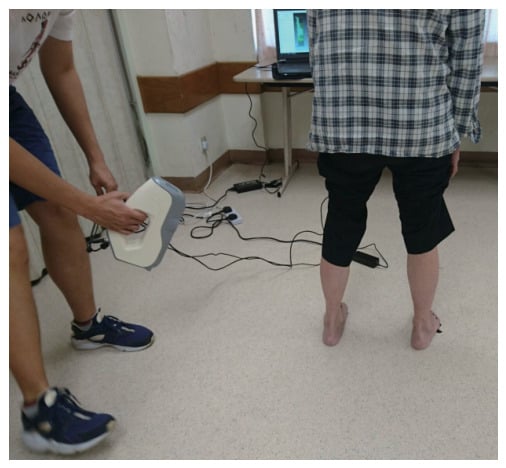
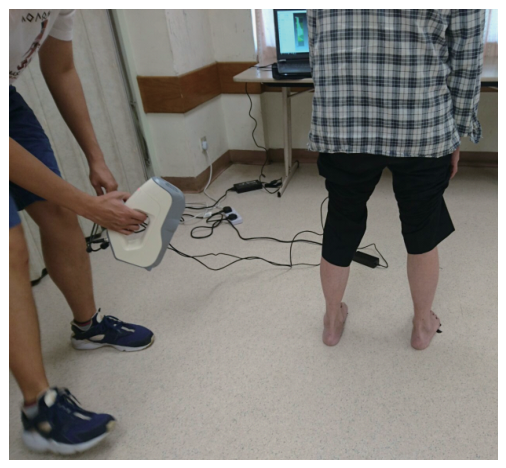
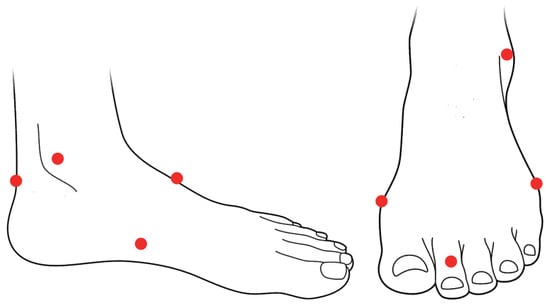
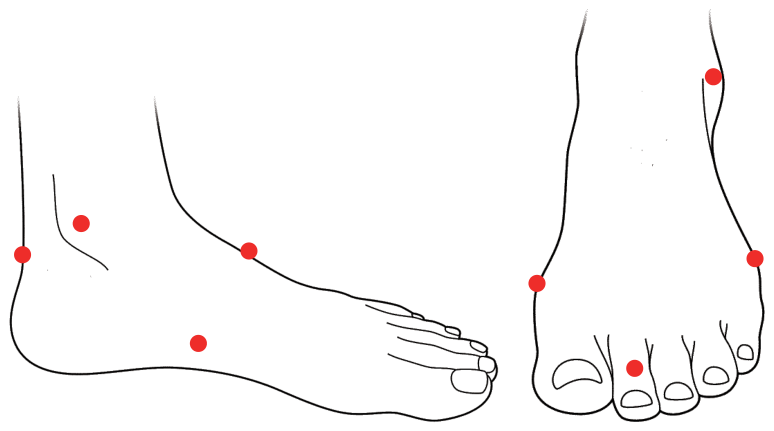
Compared to traditional measurement methods such as 2D imaging, taping and 3D digitizing, modern 3D surface scanning systems can obtain accurate and repeatable digital representations of the foot shape. A number of 3D scanning systems that enable fast, dense and easy foot measurements have been successfully used in medical, ergonomic and footwear development applications [16]. As compared to traditional caliper measurements, the use of 3D foot scanning allows a large number of participants to be scanned quickly and the foot dimensions collected are robust and efficient. In this study, all of the foot shape and characteristics are captured by using an Artec Eva 3D hand-held scanner with high 3D resolution up to 0.5mm and 1.3 Mpx for texture resolution (Artec Group, Luxembourg) (Figure 1). Eight markers were drawn on specified anatomical landmarks on each foot by the same examiner, which were visible to the laser of the scanner. These anatomical landmarks were used to characterise the external shape of each foot and facilitate the calculation of 11 anthropometric measurements (see Figure 2). During the scanning process, the subjects were given instructions to stand in their bare feet with their feet shoulder width apart (their weight evenly distributed across both feet) and place their arms by their side to separately acquire the left and right foot images. The setup for foot scanning by using the Artec Eva scanner is shown in Figure 1.
Figure 1.
Subjects being scanned using Artec Eva 3D hand-held scanner.
Figure 2.
Example of 3D foot image with eight anatomical landmarks.
2.3. Measurement Outcomes
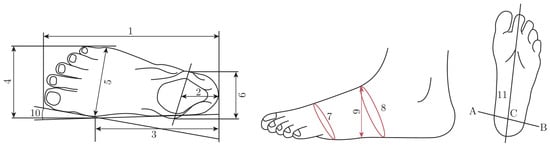
Eleven foot anthropometric measurements were taken from the 3D foot images by the same examiner through the software of Geomagic Studio 2012 and SolidWorks 2012, including the foot length (FL), heel length (HL), ball length (BL), foot width (FW) ball width (BW), bimalleolar width (BMW), ball girth (BG), instep girth (IG), instep height (IH), degree of hallux valgus deformity (HVD) and valgus index (VI), see Figure 3 and Table 1 [15,17,18]. Geomagic Studio 2012 is used to align the feet with the floor and the XYZ coordinate in order to obtain the measurements in a more accurate manner. SolidWorks 2012 is also incorporated to obtain the angular and perimeter measurements.
Figure 3.
11 Foot anthropometric measurements.
Table 1.
Details of 11 foot anthropometric measurements taken from 3D images.
2.4. Statistical Analysis
Independent T-tests were used to assess the statistical significance of the differences in the measurement outcomes between the healthy and deformed feet. The level of significance was set at 0.05. A discriminant analysis was used to determine the key foot anthropometric measurements of the deformed feet.
3. Results and Discussion
3.1. Differences Between Healthy and Deformed Feet
Table 2 shows that the male subjects with deformed feet have larger mean values for the FL, HL, BL, FW, BW, BMW, IG, IH, HVD and VI than those with healthy feet, except for BG. As compared to the healthy feet, the major mean differences in the foot dimensions are observed in the HVD (increase of 142.17%). However, a significant difference between healthy and deformed feet is only found for the IH (p=0.031). This may be because the mean value is exaggerated by some of the serious cases. For women, larger mean values are also found for deformed feet in the HL, BL, FW BW, BG, IG, HVD and VI as opposed to healthy feet, except for the FL, BMW and IH (see Table 3). The largest mean value increment is 108.71% for the HVD and the least is 0.04% for BG. Only the BW and HVD show a significant difference between the healthy and deformed feet (p=0.040, p=0.000, respectively). It is found in this study that deformed feet tend to have larger mean values for some of the foot anthropometric dimensions in terms of the width, height and degree of hallux valgus deformity. These findings are similar to those in Mickle et al. in that foot anthropometric measurements of older people are affected by foot deformities, such as an increased width of the ball, girth of the ball, first toe angle, medial ball length, etc [15]. The male subjects have a significant difference in the instep height perhaps because pes cavus is more commonly found in men, while pes planus is more common in women [19]. Custom-made semi-rigid and/or rigid insoles are required to hold the foot in its normal position since the flexible and high-arched foot may easily collapse at the arch area and appear similar to a flat foot condition. Sufficient girth at the instep level and cushioning are crucial to accommodate the high arch anatomical structure, especially for rigid high-arch foot types [20].
Table 2.
Anthropometric measurements of healthy and deformed feet amongst male subjects.
Table 3.
Anthropometric measurements of healthy and deformed feet amongst female subjects.
Results also indicated that the female subjects with a deformed foot tend to have a significant difference in the degree of hallux valgus deformity and width of the ball. These results are consistent with a study done by Saghazadeh et al. on older Japanese people in that the first toe angle is significantly greater in women due to the presence of hallux valgus, which occurs more frequently in women [14]. Big toe provides the stability of the medial portion of the foot during daily activities. Years of use and abuse, repetitive stress and even arthritis and degenerative joint changes could magnify the foot problems. In a study by Mickle et al., the older people with moderate-to-severe hallux valgus deformity have a significantly increased girth and width of the ball, medial and lateral ball lengths, heel bone and first toe angles [15]. The development of foot problems in the older population are associated with numbers of factors, such as prior occupations, congenital and/or genetic defects, degenerative joint disease and other arthritides, morphologic changes in foot structure, rotational changes in the musculoskeletal system and muscular imbalance, and endocrine diseases. Other significant factors include hard flat surfaces for ambulation, trauma, foot covering material and fabrication, foot-to-shoe-last incompatibilities, and neglect of foot and related symptoms [4,21,22,23,24]. On the other hand, environmental factors may also contribute to the epidemiology of diseases and disorders of the foot and its related structures, such as social and economic factors, customs and shoe styles, nutrition, poor foot health education, cultural barriers, low income, and flooring materials and covering [25,26].
3.2. Key Foot Measurements between Healthy and Deformed Feet
The discriminant analysis indicated that the predictors below could be used to differentiate between deformed and healthy feet (p=0.000) and the overall effect size for the analysis (η2=0.12) is small according to Cohen [27]. Table 4 presents the standardised function coefficients, which suggest that the FL, BL, BW and BG contribute most to differentiating feet with deformities from those without deformities through these predictors. The HVD tends to moderately contribute to the process of differentiating, but has relatively high correlation with the overall discriminant function. These findings are similar to those in Luximon and Goonetilleke [28] and could be explained by using their results in that the foot shape is modelled and predicted by using just length, width, height and a measure of the curvature of the metatarsal phalangeal joint, which has a mean accuracy of 2.4 mm. These findings could be used as indicators in footwear sizing systems as well as the design of geriatric footwear to provide better fitting and comfort for the elderly. The key footwear requirements for old people include heel height, heel counter stiffness and height, fixation, shoe length and width, forefoot height, tread pattern, sole hardness, sole flexion point, longitudinal sole rigidity [29,30,31]. Improvements for the footwear design should be started from the shoe last design which is the reproduction of the shape of human foot greatly affecting the fitting of the footwear [32]. For example, the findings on foot length imply that the shoe last length for older people with foot deformities should be extended to provide extra space for the toes for enhancing comfort and fit. The findings of ball and hallux valgus measurements also imply that adjustments should be made when designing shoe last/footwear for the elderly with hallux valgus. It is suggested to match the ‘flex angle’ of the forefoot with that of the anterior part of the shoe (e.g. ball width) so as to better accommodate the deformities in the forefoot. Moreover, footwear for older people with lesser toe deformities should include the toe box with increased depth to allow room for the increased heights of the first and fifth toes [15,33].
Table 4.
Differentiations in key foot anthropometric measurements.
3.3. Comparison between Footwear Sizing Systems and Foot Dimensions
Table 5 shows a comparison of current footwear sizing systems, such as pressure measuring insoles (wide fit) by the Novel® Pedar system [34], the UK footwear sizing system [35], footwear sizing system of international brands that focus on indoor footwear (Mahabis® and UGG®) [36,37], and the foot characteristics of the subjects (with/without foot deformities and both genders) in terms of the dimensions of the foot length. The measured foot length of each subject is categorised in accordance with his/her shoe size. It can be seen that the foot length of the current sizing systems, especially for indoor footwear available in the market, is consistently longer than that obtained in this study by 3.5-8.0%. As compared to the Novel® Pedar system, the width of the ball of all of the subjects is broader than the insoles at around 6-12%. The findings are somewhat different from a previous study by Menz and Morris in which 23 subjects (13.7%) wore indoor shoes that were shorter than their feet and 136 subjects (81.4%) wore indoor shoes that were more narrow than their feet [9]. However, the results indicate that the indoor shoes available in the market overall fail to accommodate the foot dimensions of older people, which may cause discomfort or eventually injury to their feet. A study done by Chantelau and Gede also found that two-thirds of 668 people with a mean age of 64 had their feet too broad for standard sized footwear available in the market [33]. Various standard sizing systems had been developed to facilitate the mass production of footwear, which only accommodate a limited number of discrete sizes. Furthermore, foot size itself is continuous, shoe sizing must be modernized in accordance with the foot characteristics of a country or region for optimal fit. The current sizing systems on the basis of two parameters, foot length and width (or ball girth) [38], fail to characterise the 3D foot shape and geometry, adversely affecting footwear fit and comfort. It is recommended that at least two dimensions should be measured on forefoot, midfoot and rear foot for more accurate foot sizing [39]. By using the principal component analysis method, Luximon and Goonetilleke suggested that foot length and flare could be well used to improve fit instead of foot length and width in a two-parameter sizing system [40]. The results in the present study also indicated that the FL and BW, which are regularly used in traditional sizing systems, should not be the only key dimensions for choosing a correct size for feet with deformities. Dimensions such as the BL, BG and HVD should also be taken into consideration.
Table 5.
Comparison of current sizing systems and foot length (mm).
4. Conclusion
To conclude, the foot characteristics of the deformed feet of the elderly are different from those of healthy feet. Shoe manufacturers should consider the gender and deformation differences in feet when designing the last measurements of footwear for older adults to better accommodate the higher instep height for men, and larger deformity in the degree of hallux valgus and increased width of the ball for women. Apart from the foot length and width of the ball, the length and girth of the ball and degree of hallux valgus deformity are common predictors used to differentiate between deformed and healthy feet. Inappropriate footwear design and sizing systems have exacerbated the foot problems of older people, resulting in poor fit and comfort. In considering that there is an increasing population of older people, a strong and large demand for well-fitting geriatric footwear should not be neglected. Knowledge of changes in the foot shape geometry this study will provide valuable foot anthropometric information for the footwear industry to improve the design of footwear or shoe last as well as sizing for older people and ultimately provide optimal fit and comfort.
Acknowledgments
We would like to thank the Innovation and Technology Fund (ITF) (ITF/Tier 3 Project ITS/359/14) for funding this research project.
References
- WHO. Ageing and life-course; World Health Organization, 2016; Available online: http://www.who.int/ageing/en/.
- Menant, J.C.; Steele, J.R.; Menz, H.B.; Munro, B.J.; Lord, S.R. Optimizing footwear for older people at risk of falls. J. Rehabil. Res. Dev. 2008, 45, 1167–1182. [Google Scholar] [CrossRef] [Scilit]
- de Castro, Paiva; Rebelatto, J.R.; Aurichio, T.R. The relationship between foot pain, anthropometric variables and footwear among older people. Appl. Ergon. 2010, 41, 93–97. [Google Scholar] [CrossRef] [Scilit] [PubMed]
- Lorimer, D.L.; French, G.; O’Donnell, M.; Burrow, J.G. Neale’s disorders of the foot: diagnosis and management, 6th ed.; Churchill Livingstone: New York, 2002. [Google Scholar]
- Dunn, J.E.; Link, C.L.; Felson, D.T.; Crincoli, M.G.; Keysor, J.J.; McKinlay, J.B. Prevalence of Foot and Ankle Conditions in a Multiethnic Community Sample of Older Adults. Am. J. Epidemiol. 2004, 159, 491–498. [Google Scholar] [CrossRef] [Scilit] [PubMed]
- Lai, T.L.; Chan, K.L.; Chung, S.L. Foot problems among elderly people in Hong Kong. Asian J. Gerontol. Geriatr. 2014, 9, 71–73. [Google Scholar]
- Scott, G.; Menz, H.B.; Newcombe, L. Age-related differences in foot structure and function. Gait Posture 2007, 26, 68. [Google Scholar] [CrossRef] [Scilit] [PubMed]
- de Castro, Paiva; Rebelatto, J.R.; Aurichio, T.R. The Effect of Gender on Foot Anthropometrics in Older People. J. Sport Rehabil. 2011, 20, 277–286. [Google Scholar] [CrossRef] [Scilit] [PubMed]
- Menz, H.B.; Morris, M.E. Footwear Characteristics and Foot Problems in Older People. Gerontology 2005, 51, 346–351. [Google Scholar] [CrossRef] [Scilit] [PubMed]
- Chaiwanichsiri, D.; Tantisiriwat, N.; Janchai, S. Proper shoe sizes for Thai elderly. The Foot 2008, 18, 186–191. [Google Scholar] [CrossRef] [Scilit] [PubMed]
- Perry, S.D.; Radtke, A.; Goodwin, C.R. Influence of footwear midsole material hardness on dynamic balance control during unexpected gait termination. Gait Posture 2007, 25, 94–98. [Google Scholar] [CrossRef] [Scilit] [PubMed]
- Mickle, K.J.; Munro, B.J.; Lord, S.R.; Menz, H.B.; Steele, J.R. Foot Pain, Plantar Pressures, and Falls in Older People: A Prospective Study. J. Am. Geriatr. Soc. 2010, 58, 19361940. [Google Scholar] [CrossRef] [Scilit] [PubMed]
- Tomassoni, D.; Traini, E.; Amenta, F. Gender and age related differences in foot morphology. Maturitas 2014. [Google Scholar] [CrossRef] [Scilit] [PubMed]
- Saghazadeh, M.; Kitano, N.; Okura, T. Gender differences of foot characteristics in older Japanese adults using a 3D foot scanner. J. Foot Ankle Res. 2015, 8. [Google Scholar] [CrossRef] [Scilit] [PubMed]
- Mickle, K.J.; Munro, B.J.; Lord, S.R.; Menz, H.B.; Steele, J.R. Foot shape of older people: Implications for shoe design. Footwear Sci. 2010, 2, 131–139. [Google Scholar] [CrossRef] [Scilit]
- Telfer, S.; Woodburn, J. The use of 3D surface scanning for the measurement and assessment of the human foot. J. Foot Ankle Res. 2010, 3, 19–19. [Google Scholar] [CrossRef] [Scilit] [PubMed]
- Fritz, B.; Schmeltzpfenning, T.; Plank, C.; Hein, T.; Grau, S. Anthropometric influences on dynamic foot shape: Measurements of plantar three-dimensional foot deformation. Footwear Sci. 2013, 5, 121–129. [Google Scholar] [CrossRef] [Scilit]
- Billis, E.; Katsakiori, E.; Kapodistrias, C.; Kapreli, E. Assessment of foot posture: Correlation between different clinical techniques. Foot 2007, 17, 65–72. [Google Scholar] [CrossRef] [Scilit]
- Chaiwanichsiri, D.; Janchai, S.; Tantisiriwat, N. Foot Disorders and Falls in Older Persons. Gerontology 2009, 55, 296–302. [Google Scholar] [CrossRef] [Scilit] [PubMed]
- Ng, E.Y.L. Foot problems and their implications for footwear design. In Handbook of Footwear Design and Manufacture; Luximon, A., Ed.; 2013; pp. 90–114. [Google Scholar]
- Helfand, A.E. Design issues in geriatric footwear. In Handbook of Footwear Design and Manufacture; Luximon, A., Ed.; Woodhead Publishing; Volume 2013, pp. 372–399.
- Helfand, A.E.; Finestone, A.J.; Newton, R.A. Foot health training guide for long-term care personnel; Health Professions Press: Baltimore, 2007. [Google Scholar]
- Menz, H.B. Foot problems in older people: assessment and management; Churchill Livingstone: Edinburgh, 2008. [Google Scholar]
- Menz, H.B.; Lord, S.R. The Contribution of Foot Problems to Mobility Impairment and Falls in Community-Dwelling Older People. J. Am. Geriatr. Soc. 2001, 49, 16511656. [Google Scholar] [CrossRef]
- Valmassy, R.L. Clinical biomechanics of the lower extremities; Mosby: St. Louis, London, 1996. [Google Scholar]
- Tyrrell, W.; Carter, G. Therapeutic footwear: a comprehensive guide; Elsevier Health Sciences, 2009. [Google Scholar]
- Cohen, J. Statistical power analysis for the behavioral sciences; L. Erlbaum Associates: Hillsdale, N. J, 1988. [Google Scholar]
- Luximon, A.; Goonetilleke, R. Foot shape modelling. Hum. Factors 2004, 46, 304–315. [Google Scholar] [CrossRef] [Scilit] [PubMed]
- Tencer, A.F.; Koepsell, T.D.; Wolf, M.E.; Frankenfeld, C.L.; Buchner, D.M.; Kukull, W.A.; Lacroix, A.Z.; Larson, E.B.; Tautvydas, M. Biomechanical Properties of Shoes and Risk of Falls in Older Adults. J. Am. Geriatr. Soc. 2004, 52, 1840–1846. [Google Scholar] [CrossRef] [Scilit] [PubMed]
- Menz, H.B.; Sherrington, C. The Footwear Assessment Form: a reliable clinical tool to assess footwear characteristics of relevance to postural stability in older adults. Clin. Rehabil. 2000, 14, 657. [Google Scholar] [CrossRef] [Scilit] [PubMed]
- Menz, H.B.; Auhl, M.; Ristevski, S.; Frescos, N.; Munteanu, S.E. Evaluation of the accuracy of shoe fitting in older people using three-dimensional foot scanning. J. Foot Ankle Res. 2014, 7. [Google Scholar] [CrossRef] [Scilit] [PubMed]
- Cheng, F.T.; Perng, D.B. A systematic approach for developing a foot size information system for shoe last design. Int. J. Ind. Ergon. 1999, 25, 171–185. [Google Scholar] [CrossRef] [Scilit]
- Chantelau, E.; Gede, A. Foot Dimensions of Elderly People with and without Diabetes mellitus – a Data Basis for Shoe Design. Gerontology 2002, 4, 241–244. [Google Scholar] [CrossRef] [Scilit] [PubMed]
- Novel. de. Pedarr Insole Catalogue; Novel GmbH, 2010. [Google Scholar]
- British Standards Institution. ISO/TS 19407; Footwear-Sizing-Conversion of sizingsystems PD. IHS, 2015.
- Mahabis Ltd. Sizing chart. 2016. Available online: http://mahabis.com/pages/sizing-chart.
- UGG Australia, Men and women sizing chart, 2016. Available online: http://www.uggaustralia.com.
- Luximon, Y.; Luximon, A. Sizing and grading of shoe lasts. In Handbook of Footwear Design and Manufacture; Luximon, A., Ed.; Woodhead Publishing, 2013; pp. 197–215. [Google Scholar]
- Goonetilleke, R.S.; Ho, C.F.; So, R.H.Y. Foot sizing beyond the 2-D Brannock method. Annu. J. IIE (HK) 1997, December (1997), 28–31. [Google Scholar]
- Luximon; Goonetilleke, R.S. Critical dimensions for footwear fitting. IEA2003 Conference, Seoul, Korea, 2003. [Google Scholar]

© 2016 Textile Bioengineering and Informatics Society. This article is an open access article distributed under the terms and conditions of the Creative Commons Attribution (CC BY) license (https://creativecommons.org/licenses/by/4.0/).