


Abstract
The aim of this paper is to find the relation between material parameters and insertion loss of different fabrics using statistical analysis. This research primarily deals with the sound absorption analysis of different uncoated and coated woven textiles fabrics used for curtains as household textiles. The analysis of surface morphology was done by scanning electron microscopy to determine the significance of surface structure onto the sound insulation property. The acoustic properties were measured by reverberation method. The maximum sound insertion loss, minimum sound insertion loss, over all sound insertion loss and percentage improvement in sound insertion loss has been discussed and suggested the woven textiles to be better sound absorber at higher frequencies. Moreover, the effect structural parameters on average sound insulation index were analyzed using SPSS software. The results revealed that warp density, linear density of warp yarn, thickness are influential parameters for the sound insulation property of uncoated fabric whereas the areal density, linear density of warp yarn and thickness influence the sound insulation property coated fabrics.
1. Introduction
Among many types of pollution, noise is also one of the pollution. Like other pollution noise also results health and hygiene problems. Longer exposure to noise may result hearing loss by damaging the nerve fibers of the inner ear. Such type of hearing loss is called as “noise-induced hearing loss”, and it cannot be corrected by medication and surgery. Blood pressure might be elevated due to exposure of noise for longer duration [1,2]. Noise may also result heart diseases [3]. Studies suggest that longer exposure to noise results blood pressure and hyper tension. Noise pollution also results Insomnia, and thus people who lives in the noisy areas cannot sleep well. Noise insulation is necessary for home. Particularly, who lives in such areas whose home is nearer to noisy areas, such as airports, industries, power generations, highways, etc.
There are many textile products at home that are commonly used for aesthetics and decorative purpose only. These products may include table covers, bed sheets, quilts, sofa covers, curtains, carpets and rugs. These products not only provide us aesthetics and beautification of our home, but also they provide sound insulation till some extent. A large research has been done on sound insulation by textile material. This sound insulation has been analyzed by nonwoven fabrics [4,5,6], woven fabrics [7,8], knitted fabrics [9], combination of non-woven and woven fabrics [10], fabrics having sound insulating fibers [11], chemically modified fabrics [12], textile composites and fabrics from recycled textile waste [13].
Weaving offers a large variety of weave designs due its different structures plain, twill, satin, etc, with all types natural or synthetic yarns or filaments; offering wide range of properties including open, light, heavy, dense etc by different weaving machines tappet, dobby, jacquard, etc [14]. Woven fabrics allow special finishes to be applied to make them soil resistant, flame retardant, water repellant, etc. Sound absorbers are essential requirement of sport halls such as acoustical banners have been investigated keeping the arena of sports [15]. The consequence of weave type [16], pick densities [17], pile height of carpet and pile density of carpet [8] has been determined on the acoustical properties of acoustic home textiles. Moreover, the different structures of woven fabrics jacquard woven (134 gram per meter square), jacquard woven (188 gram per meter square), plain woven/open structure, printed curtain, velvet with knitted backup, jacquard woven two side fabric, velvet with woven back-up, denim and one side laminated fabric used for curtains has been analyzed [14].
There are various factors that can be altered in weaving to assess their affect on the final acoustical properties. Weave type, fabric density, pile height and pile density are the factors affecting the final acoustical property of the woven fabrics. There is large variety of type of weaves available today. Type of weave not only affects the aesthetic and physical properties of the fabric but it also affects the acoustical property of the fabric. In one research, the consequence of weave type on noise reduction coefficient was studied of plain, 2/1 twill, 3/1 twill, 2/2 twill, rips and satin woven fabrics on same warp and weft density of yarns possessing same linear density and tpm, the noise reduction coefficient decreased in the respective order [16]. The different structures of woven fabrics used for curtains has been analyzed, and it has been found that plain woven/open structure holds lowest sound reduction and one side laminated holds highest sound reduction. The air permeability is considered as the main factor affecting the sound reduction negatively [14]. This suggests that weave type or fabric structure affects the sound insulation property of the fabric.
The number of warp yarns per unit width of the fabric is termed as the warp density, and the number of weft yarns per unit length of the fabric is termed as weft density. This both in general termed as fabric density. While changing other properties of the fabric, the fabric density also changes the acoustical properties of the fabric. In one study the consequence of weft density was determined, and it was maintained that incremental in noise reduction coefficient of layered fabrics was larger for the fabrics woven at lower weft densities [17]. Pile is the yarn that is deliberately inserted to be extended outward from the axis of the fabric. The piles are inserted in towel and carpets mostly. The length that is extended outward from the axis of the fabric is known as pile height and the number of piles per unit space in known as pile density. This pile also affects the acoustical property of the fabric. In one study two parameters of pile, i.e., pile height and pile density was analyzed in terms of their affect on the acoustical property of the fabric, it was finalized that pile height does not affect noise absorption co-efficient significantly, yet pile density affects positively on the noise absorption coefficient of tufted carpet, regardless of the fiber being used [8]. From the extensive survey of existing literature, it can be assumed that comparative to other sort of textiles very less research has been done on coated textile material for sound insulation.
The sound absorption in the textile may be understood by three general mechanisms that held in the fiber assemblies. Firstly, all fibrous materials possess some sort of inherent absorption property, the sound absorption may be too smaller fore lower frequencies, but for higher frequencies it is enough to be realized. Often this is also termed as viscosity resistance absorption. Viscosity resistance absorption is named after the conversion of sound energy into heat energy due to relative progress of air on fibers by air viscosity. This is observed when a fibrous assembly is hit by a sound wave; the air inside fine fibrous assembly is vibrated due to sound pressure; which is overcome by removal of energy from the sound wave. Secondly, the sound absorption may be higher even for lower frequencies, which may be further increased at higher frequency, thus the sound insulation index curve showing crest at a lower frequencies. This may be understood as the result of reverberation absorption achieved by tightly woven fabrics located at some space from the wall. The crest at a lower frequency is supposed to be due to the reverberation of the woven fabric. Thirdly, the sound reverberation absorption may be higher without offering peak for the lower frequencies. Because the higher sound reverberation frequencies are much more than lower sound reverberation frequencies.
2. Material and Experimental
2.1. Materials
The woven polyester fabrics coated and uncoated samples were donated by Hangzhou Huachen Flocking Co. Ltd. Same coating was applied onto all samples. The fabric structural parameter are presented in Table 1.
Table 1.
Structural parameters of different fabrics.
2.2. Experimental
2.2.1. Surface Morphology
The surface morphology is important to determine the acoustic behavior of the textile specimen. In order to inspect the consolidation quality and void content of coatings, Scanning Electron Microscopy (SEM) was used. The SEM analysis was done on the SEM instrument named JSM 5610 L manufactured by JEOL Electronics, Japan.
2.2.2. Structural Parameter Density of Fabric
The fabric warp and weft density was determined by using pick glass. The fabric thickness was determined on YG (B) 141D. The fabric weight per unit area was determined by using electronic digital weighing scale on Metler Toledo. The yarn count of the fabric was determined by getting the yarns from the fabric and then weighed on Metler Toledo. The fabric weaves were assessed by USB Digital Microscope manufactured by Andonstar, Shenzhen, China.
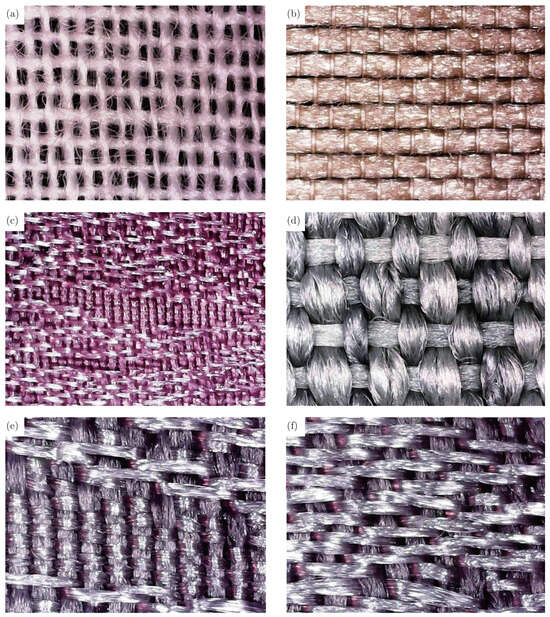
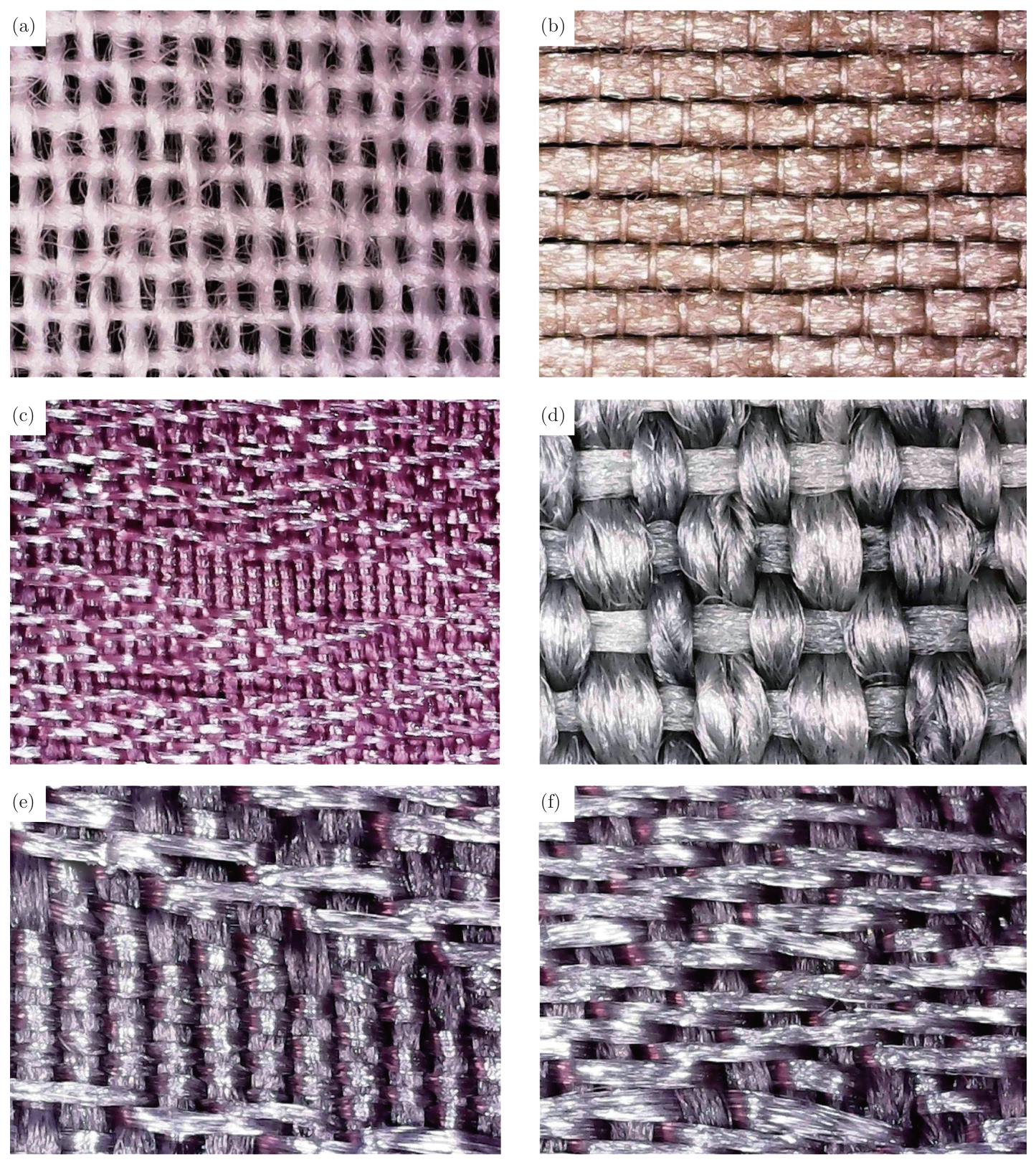
The structural parameters of all coated and uncoated samples are presented in Table 1. 1U, 2U, 3U, 4U are the original fabrics which have not been coated, and 1C, 2C, 3C, 4C are the coated fabrics. For samples which labeled by the same number, for example the 1U and 1C, are same woven fabric with the difference of uncoated and coated, so there are four groups of samples. The micro images of some woven fabrics are presented in Figure 1.
Figure 1.
Weave structures of different fabrics; (a) Plain weave of 1U fabric; (b) Plain weave of 2U fabric; (c) Combined plain and sateen weave of 3U fabric; (d) Plain weave of 4U fabric; (e) Plain weave of 3U fabric; (f) Four down one up sateen weave of 3U fabric.
2.2.3. Characterization of Sound Insulation Property
The sound insulating property of any woven textile material is principally based on two factors, the inherent property of material to damp the sound and the structure of the material to damp the sound waves. The inherent property of sound insulation is the result of softness or elastic modulus, porosity, thickness, and flow resistance. A variety of strategies have been adopted to analyze the sound insulation or sound absorption behavior of the materials. The sound absorption coefficient, noise reduction coefficients, sound absorption average, sound insulating index are most commonly used one. The sound absorption coefficient may be mathematically termed as the ratio of intensities of incident wave to reflected waves, and can be denoted by α as given below.
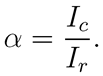
The Noise Reduction Coefficient (NRC) is the average value of the sound absorption coefficients of materials at frequencies of 250, 500, 1000 and 2000 Hz, expressed to the nearest 0.05. The Sound Absorption Average (SAA) of a material is the average value of its one third octave sound absorption coefficient values ranging from 200 to 2500 Hz. The sound insertion loss was chosen as acoustic characteristic for this research. The sound insulating properties of any material greatly vary at different frequencies. Here, the sound insertion loss generally referred to the difference of reflected sound intensity levels and transmitted sound intensity levels. As the reverberation room was used thus it is significant to determine the sound insulation of empty reverberation room which is the result of summation of the absorption coefficients of all items mounted into room. Thus, the sound insertion loss of the textile specimen was determined by subtracting the sound insertion loss of the empty room from the difference of reflected sound intensity levels and transmitted sound intensity levels obtained during the tests.
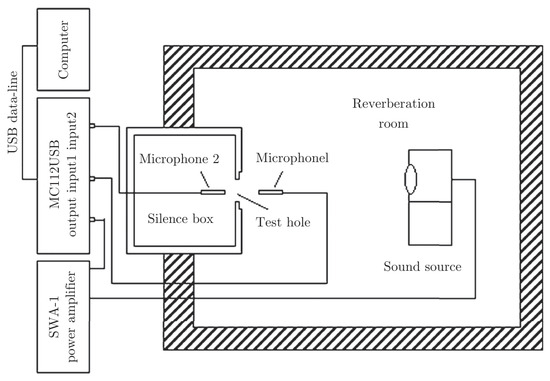
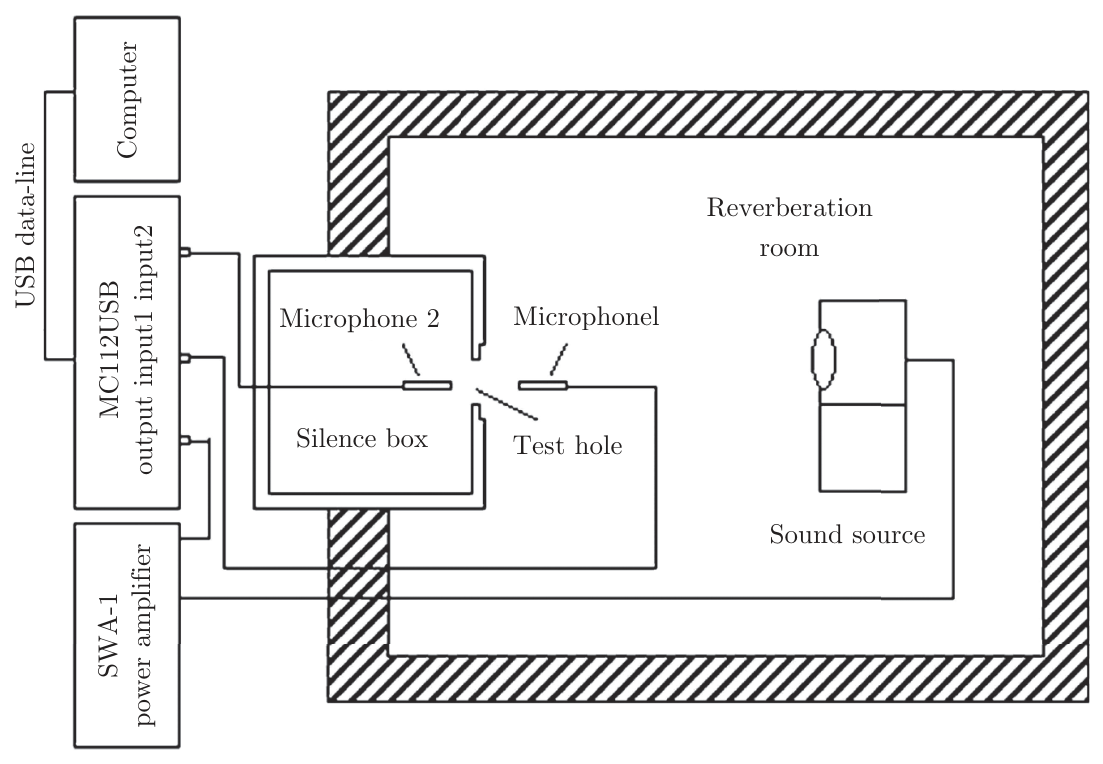
The sound insulation properties were measured by reverberation method and carried out on two-channel acoustic analyzer (BSWA VS302USB, Beijing Shengwang Co.), which is according to ISOR140-1 and ISOR140-170 measurement standard. The tests were executed at the reverberation room of Noise Laboratory at Zhejiang Sci-Tech University. The reverberation room was consisting of a sound source, two microphones, and a silence box. A power amplifier was used to generate the frequencies, and the noise level of 90 dB was maintained for all test samples. The air temperature and humidity of the reverberation room were 20C and 50% relative humidity. The measurement system is illustrated in Figure 2. The reading was taken at 24 different frequencies, to assess sound insulation at various frequencies. Initially the sound insulation efficiency of room was measured. Each sample was assessed twelve times in different directions to maximize the accuracy of results. The data is analyzed by the Spectra LAB software to analyze data. A weighting network is selected. The sound pressure level is 90dB which came from the noise source of pink background. The volume of muting box is 1000 mm ∗ 1000 mm ∗ 1000 mm.
Figure 2.
The schematic figure of sound insulation measurement system.
The adjustment of two microphones was in such a way so that one may assess the reflected sound intensity level and other may assess the transmitted sound intensity level. The original sound pressure level and free attenuation of noise without the sample are tested firstly. Then the sample (25 cm ∗ 25 cm) is fixed on the test hole, the sound pressure level and total attenuation of samples are tested. The actual sound pressure level and attenuation of noise of samples are the differences between the total one and original one.
3. Results and Discussion
3.1. Surface Morphology
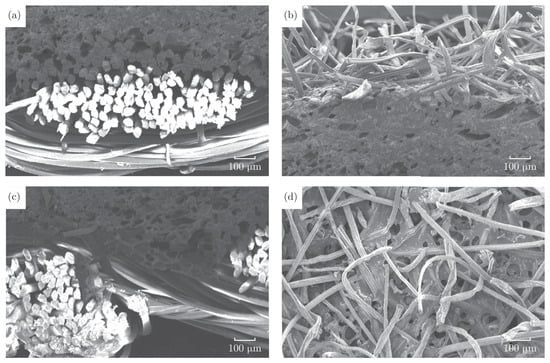
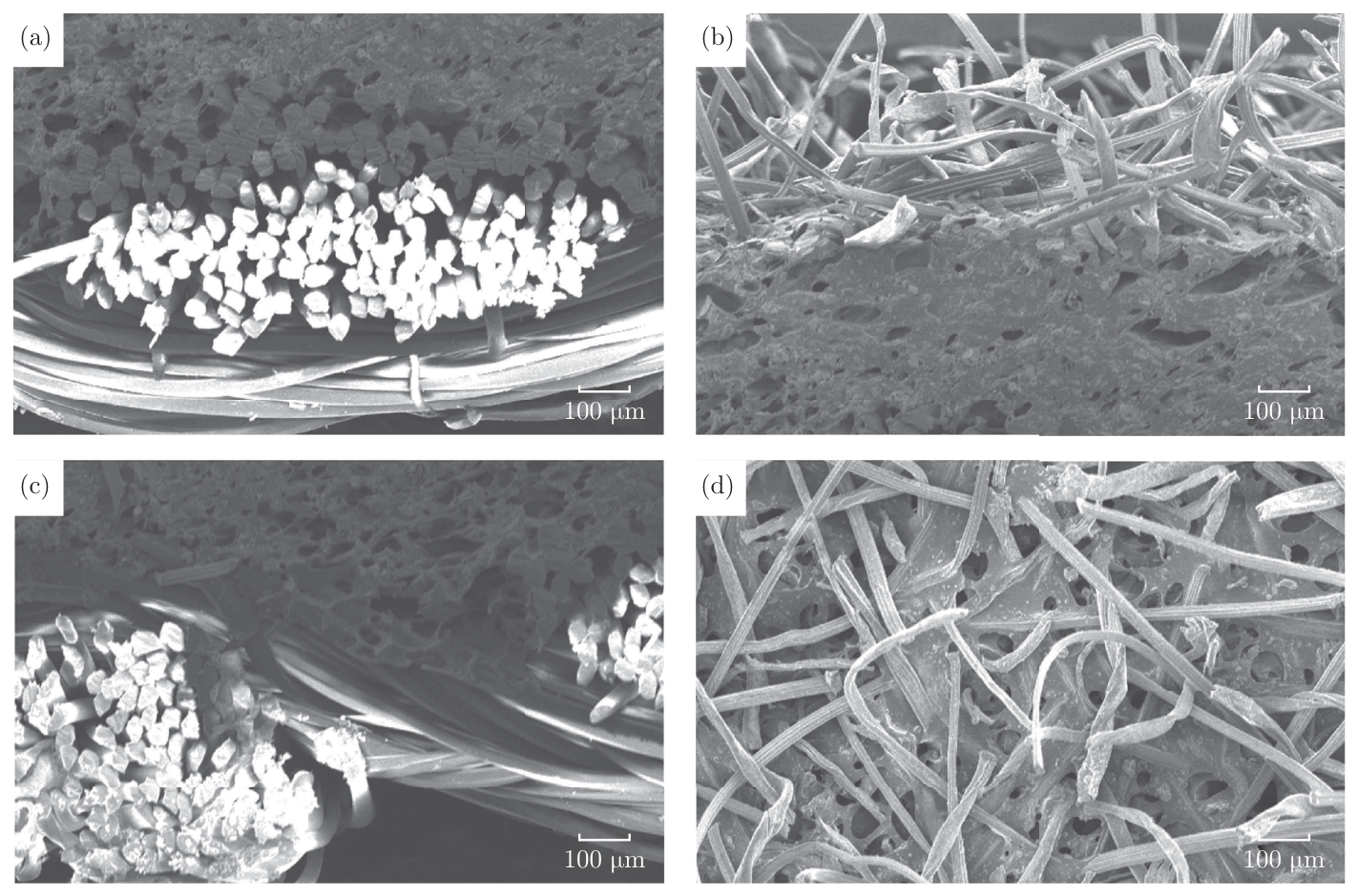
The surface morphology of one of the coated textile is presented in Figure 3, it is obvious that the coated textile material was three layered composed of woven fabric, binder and coating layer respectively. The binder inside contents small voids and thus provides a little bulkiness to coated textile material. Not only this bulkiness helps to insulate sound but also the coated layer is full of fibrous assemblies, these fibrous assemblies mitigates the sound energy and convert it into heat energy thus results the sound insulation.
Figure 3.
SEM image of coated fabric; (a) cross section image of coated fabric; (b) cross section image of coated layer and binder; (c) image of binder and one set of yarn of the woven fabric; (d) image of coated.
The binding of coated layer and binder is shown in Figure 3 (b); the binder makes this fabric completely impermeable and provides the strong bonding in between coated layer and woven fabric.
In general the sound insulation property of nonwovens are far better than woven fabrics, this is mainly due to random arrangement of the fibers in their structure. The random arrangement of fiber let the sound waves to be deflected randomly and let some of the sound waves were mitigated inside the structure and facilitates the conversion of sound energy into heat energy. The same phenomenon is observed when the coating was performed using this fibrous material. In Figure 3 (d), it is shown that the main portion of the coating is mainly fibrous material rather than adhesive. This fibrous material aided the sound insulation of these coated fabrics.
3.2. Effect of Coating on Sound Insulation Properties
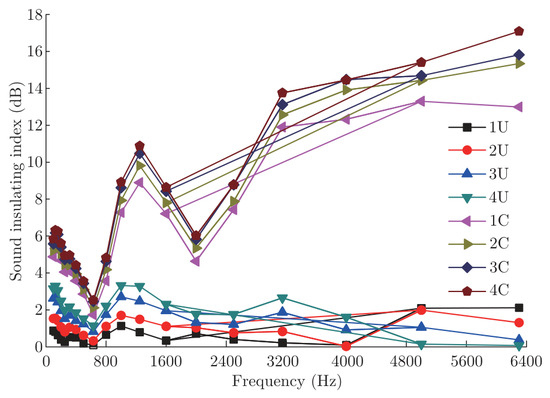
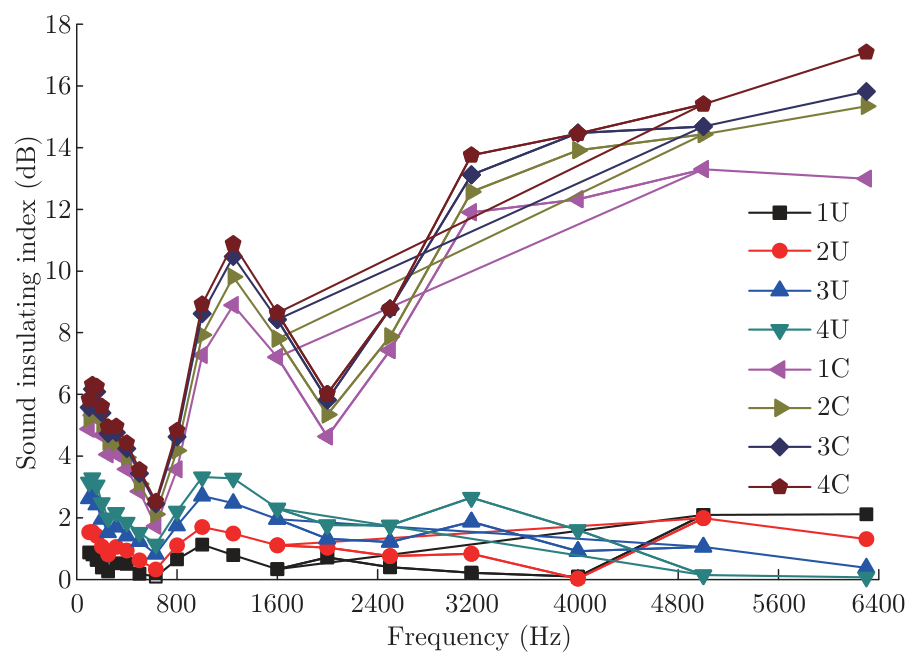
The sound insertion loss of all samples was measured for this research. The sound insertion loss of eight samples at different frequency band are shown in Figure 4. From the figure, it is obvious that the coated fabrics have higher sound insertion loss compare to original fabrics. The sound insertion loss and percent improvement in sound insertion loss were shown in Table 2.
Figure 4.
Sound insertion loss from 100 Hz to 6300 Hz.
Table 2.
Changes in sound insertion losses and weight of different uncoated and coated fabrics.
The average sound insertion loss of all the samples was determined by taking the arithmetic mean of insertion losses at different frequencies. From the data analysis it was found that the maximum average sound insertion loss of uncoated fabrics was possessed by 4U about 2.096 thus when the same fabric was coated; 4C, it also possessed the maximum average sound insertion loss about 8.065. In the same way, that the minimum average sound insertion loss of uncoated fabrics was possessed by 1U about 0.677 thus when the same fabric was coated; 1C, it also possessed the minimum average sound insertion loss about 6.629.
Percent improvement in sound insertion loss was found by determining the percentages of improvement in the values of average sound insertion loss from uncoated to coated fabrics. The maximum percent improvement in sound insertion loss was found in between 1U and 1C fabrics, the percent improvement in sound insertion loss was 89.78%, whereas the minimum percent improvement in sound insertion loss was found in between 4U and 4C fabrics, the percent improvement in sound insertion loss was 74.01%.
This result suggests that the recipe of coating be the most suitable for the 1U and 1C fabrics. It is worth notifying that for all minimum sound insulation index, maximum sound insulation index and average sound insulation index of all coated samples there is reverse relation been found in percentage improvement in sound insertion loss. In other words, 1C which is coated sample may have shown the maximum percent improvement in sound insertion loss but still it possess least values of minimum sound insulation index, maximum sound insulation index and average sound insulation index, whereas, 4C which is also coated sample that have shown the minimum percent improvement in sound insertion loss but it possess the highest values of minimum sound insulation index, maximum sound insulation index and average sound insulation index. This relation occurs linearly for other coated samples too. The comparison of weight gain percentage by coating and percentage improvement of sound insulation index suggests that the weight gain in percentage for lighter fabrics (lesser than 150 gram per square meter) was higher than weight gain in percentage for heavier fabrics (greater than 150 gram per square meter). Interestingly, for both lighter fabrics and heavier fabrics a larger number of weight gain resulted lesser percentage improvement in sound insulation index. Thus in order to enhance the sound insulation index of home textiles it is essential to optimize the weight gain of the fabric. As further increase in weight gain may result worse effect on the results of percentage improvement of sound insulation index.
3.3. Effect of Structural Parameter Density on Sound Insulation Properties
Different parameters of fabric structure affect the sound insulation property on several levels. In order to measure the influence of each factor on final property, SPSS software was used to analyze the results. The structural parameters affecting on sound insulation properties are presented in the Table 3. The data of structural parameter density was imported into SPSS software, and then processed by dimension reduction to analyze each factor. The correlation coefficient between influence factors and component is shown in Table 3. The result represents the degree of correlation between factors and component, the greater the absolute value, the stronger the relevant between them.
Table 3.
Component matrix of the results.
Because the uncoated and coated fabrics have different forming mechanism, they were analyzed respectively. There are two components extracted from data for both uncoated (F1, F2) and coated fabric (F3, F4) which are listed in Table 3. For uncoated fabric, the factors mainly influence the component F1 are warp density, linear density of warp yarn and thickness, and the factors mainly influence the component F2 are weft density and cover factor. For coated fabric, the factors mainly influence the component F3 are areal density, linear density of warp yarn and thickness, and for F4 are weft density and cover factor, just the same with F2. The relativity between the factors and components can be expressed as Eqs. (2), (3), (4) and (5).
F1 = 0.865TD + 0.948LT + 0.932T
F2 = −0.909WD + 0.904CF
F3 = 0.952GSM + 0.885LT + 0.875T
F4 = −0.953WD + 0.978CF
In order to get the values expressing the relationship between the two components and sound insulation property, the numerical value of average sound insulation and two components were fitted in multiple linear way. Because the order of magnitude difference is great, the raw data was standardized to [0, 1], the calculation formula is as follows:
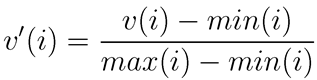
where, v’(i) is the standardized data, v(i) is the raw data, min(i) is the minimum value of raw data, max(i) is the maximum value of raw data.
After multiple linear regressions fitting, the regression equations can be obtained as Eq. (7) and (8), and Eq. (7) is for uncoated fabric, Eq. (8) is for coated fabric. For both formulas, the coefficient of the first component is larger than the second component. So we can see the warp density, linear density of warp yarn and thickness are the predominant effect factors to sound insulation property for uncoated fabrics and for coated fabrics, the areal density, linear density of warp yarn and thickness are the main effecting factors.


4. Conclusion
The woven and coated fabrics were analyzed through different means, in order to analyze the sound insulation properties. It was found that these coated fabrics are three layered composed of woven fabric, binder and coating layer in which binder has not penetrated into the fabrics’ structures but have made layer in between woven fabric and coating material making the fabric softer, bulkier and impermeable. The random arrangement of fibrous assemblies present on coated layer being the main part of coating and the bulkiness imparted by the binder deflect sound waves and promotes the conversion of sound energy into heat energy.
From the data analysis of SPSS software it can be suggested that warp density, linear density of warp yarn and thickness influence the component F1, and the weft density and cover factor factors mainly influence the component F2, of uncoated fabric. The areal density and thickness mainly influence the component F3 and weft density and cover factor influences F4 of coated fabrics. From these results, it can be concluded that the coated samples has improved their sound insulation property remarkably and can be used as noise insulating curtains.
Acknowledgments
I would like to thanks all laboratory staff of Department of Textile Engineering, Zhejiang Sci-tech University, China.
References
- Peterson, E. A.; Augenstein, J. S.; Tanis, D. C.; Augenstein, D. G. Noise raises blood pressure without impairing auditory sensitivity. Science 1981, 211, 1450–1452. [Google Scholar] [CrossRef] [Scilit]
- Lennart, H.; Martin, B.; Anders, J. Noise as a contributory factor in the development of elevated arterial pressur. Acta Med. Scand. 1980, 207, 493–498. [Google Scholar] [CrossRef] [Scilit]
- Holand, S.; Girard, A.; Laude, D.; Meyer-Bisch, C.; Elghozi, J. L. Effects of an auditory startle stimulus on blood pressure and heart rate in humans. J. Hypertens. 1999, 17, 1893–1897. [Google Scholar] [CrossRef] [Scilit]
- Hassanzadeh, S.; Hasani, H.; Zarrebini, M. Analysis and prediction of the noise reduction coefficient of lightly-needled Estabragh/polypropylene nonwovens using simplex lattice design. J. Tex. Inst. 2014, 105, 256–263. [Google Scholar] [CrossRef] [Scilit]
- Lin, J. H.; Li, T. T.; Lin, J. Y. L. M. C.; Lou, C. W. Comparative sound absorption and thermal insulation properties of compound fabrics. App. Mech. Mat. 2013, 365-366, 1066–1069. [Google Scholar] [CrossRef] [Scilit]
- Thilagavathi, G.; Pradeep, E.; Kannaian, T.; Sasikala, L. Development of natural fiber nonwovens for application as car interiors for noise control. J. Ind. Text. 2010, 39, 267–278. [Google Scholar] [CrossRef] [Scilit]
- Shoshani, Y.; Rosenhouse, G. Noise absorption by woven fabrics. App. Acoust. 1990, 30, 321333. [Google Scholar] [CrossRef] [Scilit]
- Shoshani, Y. Z.; Wilding, M. A. Effect of pile parameters on the noise absorption capacity of tufted carpets. Tex. Res. J. 1991, 61, 736–742. [Google Scholar] [CrossRef] [Scilit]
- Liu, Y.; Hu, H. Sound absorption behavior of knitted spacer fabrics. Tex. Res. J. 2010, 80, 1949–1957. [Google Scholar] [CrossRef] [Scilit]
- Shoshani, Y. Z. Effect of nonwoven backings on the noise absorption capacity of tufted carpets. Tex. Res. J. 1990, 60, 452–456. [Google Scholar] [CrossRef] [Scilit]
- Yang, S.; Yu, W.; Pan, N. Investigation of the sound-absorbing behavior of fiber assemblies. Tex. Res. J. 2011, 81, 673–682. [Google Scholar] [CrossRef] [Scilit]
- Li, S.; Wang, Y.; Ding, J.; Wu, H.; Fu, Y. Effect of shear thickening fluid on the sound insulation property of textiles. Tex. Res. J. 2014, 84, 897–902. [Google Scholar] [CrossRef] [Scilit]
- Lou, C. W.; Lin, J. H.; Su, K. H. Recycling polyester and polypropylene nonwoven selvages to produce functional sound absorption composites. Tex. Res. J. 2005, 75, 390–394. [Google Scholar] [CrossRef] [Scilit]
- Mankodi, H. R.; Mistry, P. Woven fabrics combination for acoustics of building interior. Int. J. Ind. Eng. Tech. (IJIET) 2014, 4, 19–26. [Google Scholar]
- Splain, C. W. Acoustical banners for reverberation control in sports arenas. Sound Vib. 2008, 42, 6–8. [Google Scholar]
- Soltani, P.; Zerrebini, M. The analysis of acoustical characteristics and sound absorption coefficient of woven fabrics. Tex. Res. J. 2012, 82, 875–882. [Google Scholar] [CrossRef] [Scilit]
- Soltani, P.; Zarrebini, M. Acoustic performance of woven fabrics in relation to structural parameters and air permeability. J. Tex. Inst. 2013, 104, 1011–1016. [Google Scholar] [CrossRef] [Scilit]

© 2015 Textile Bioengineering and Informatics Society. This article is an open access article distributed under the terms and conditions of the Creative Commons Attribution (CC BY) license (https://creativecommons.org/licenses/by/4.0/).