


Abstract
Around the research of garment simulation, multi-layered virtual dressing is still a difficult issue, one big reason is that the effect of penetration always appears between adjacent garments at the beginning of the virtual dressing with existing garments. In this paper, a simple system for physical based multi-layered virtual dressing is designed. At the same time, a novel method for efficiently resolving the penetration problem appeared between multi-layered garments during simulating is presented. Of the method, a filter algorithm for identifying penetration points during collision detection is provided. The experiment results show that this method is practical and easy-use with generating realistic effects.
1. Introduction
With the rapid development of computer technologies, the virtual dressing systems become more and more attractive in the practical applications. Among those researches, most researchers focus on the clothing shape and dynamic simulation [1,2,3]. However, the research of multi-layered virtual dressing is still a difficult issue. PBS (Physical Based Simulation) method can be used to construct the multi-layer clothing layer by layer in the simulation, but it is not suitable for practical virtual dressing applications because computation cost is high. As an ordinary user, they just want to review the combination of different single garment which they like. For instance, when a girl chooses a T-shirt, she may want to see which skirt is of best fit with this T-shirt, they do not care about how the T-shirt or skirt sewed. So if existing 3D garments can be selected to construct the multi-layer dressing, that will be more suitable for the daily manner. So in order to simplify the multi-layered virtual dressing process, a multi-layered virtual dressing system with existing virtual garments is important. In general, the garment models are constructed independent and without constraint relationship each other. Therefore, compare with single-layered virtual dressing, the main problem of multi-layered 3D garment virtual dressing is how to process the penetration phenomena appeared between adjacent garments at the beginning of the virtual dressing.
Those clothing simulations based on physical method are important to visualize the realistic garment. The main problems are physical model construction and collision resolving.
Especially the multi-layered virtual dressing simulation based on physical methods is more complicated. The first, massive points are on the garment surface which may potentially lead to a great of collisions. Second, different for single-layered garment simulation, during the construction of multi-layer dressing with existing garments, there are penetration occurred in multi-layered virtual dressing at the beginning of the simulation, even during the process of clothing simulation. Bridson et al. [3] presented a robust collision handle method which is widely used subsEquationently, but the limitation of these methods are not adapt to the multi-layer garment simulation because they are history-based manners which need non-penetration initial position to start simulation.
Therefore, in order to resolve these problems, in this paper, we provide a novel method based on physical method that can efficiently resolve the penetration problem occurred at the beginning of or during the process of multi-layered virtual dressing simulation. The more realistic effect of multi-layer dressing can be generated by the proposed method. This virtual multi-layer dressing system is efficient in the virtual dressing applications.
The key technique in this method is to find the areas of proximity and penetration first, then a filter is designed to distinguish between these areas during contact pairs detection. When the areas of proximity and penetration are identified, the multi-layer garment simulation based on the physical method can be proceed. The main contribution in the proposed method includes efficient penetration processing and improved physical simulation in the multi-layer dressing.
2. Related Work
Mass-spring systems are conceptually simpler and easier to implement than more physically consistent models derived from continuum mechanics using the finite element method [4]. In contrast to scientific computing, highly accurate material modeling is not always necessary for physicsbased visual applications. As a result, mass-spring systems are widely used for one to three dimensional structures, such as using in hair [5] and cloth [6], and 3D animation [7].
Regardless of whether one employs a mass-spring system or another method based on continuum mechanics, for clothing simulation applications, some collision resolving techniques are necessary. Bounding volumes can be applied to cull away a portion of non-colliding triangle pairs, such as oriented bounding box [8], k-DOPs [9], axis-aligned bounding box [10], dynamic BVH [11]. An elementary processing [12] was proposed for determining the collision state of two non-adjacent triangles. Min et al. [13] provided a method that use non-penetration filter to reduce both number of false positives and the elementary tests between the primitives and an algorithm for finding poly-depth subsEquationently. Bridson et al. [14] proposed an robust and efficient algorithm to process collisions, contact in cloth simulation. Mezger et al. [15] proposed an algorithm using the KDOPS bounding box. Most methods mentioned above handle collision and contact response in a history-based manner, i.e., these methods depend on the initial pattern of the fabric, once the initial fabric has intersected already, the entire simulation afterwords could be ruined. Volino et al. [16] proposed an algorithm in a history-free fabric configurations to recover intersecting surfaces via the Global Intersection Analysis, however, it is invalid for oriented deformable surface. Zhong reported a method that the existing garments are dressed layer by layer [17]. This method is more efficient without clothing construction for using existing garment to construct the multilayer virtual clothing and more common in the daily life, but the penetration phenomena still occurs when the fabric granularity is large size. A geometry method was reported to resolve the penetration that can obtain more natural visual result [18].
In this paper, we first design a physical based multi-layered dressing model where user could dress virtually with freely choosing existing garments to match which styles they like, and subsEquationently concern on resolving penetration problems occurred in the multi-layered virtual dressing system. The experiment results will be given in last section to verify the efficient of our method.
3. Physical Based Multi-layered Dressing Model
3.1. Multi-layered Virtual Dressing
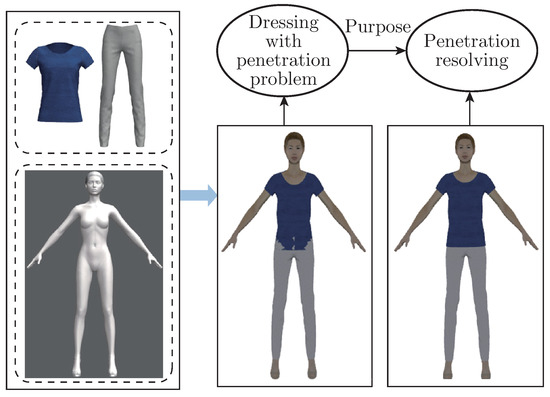
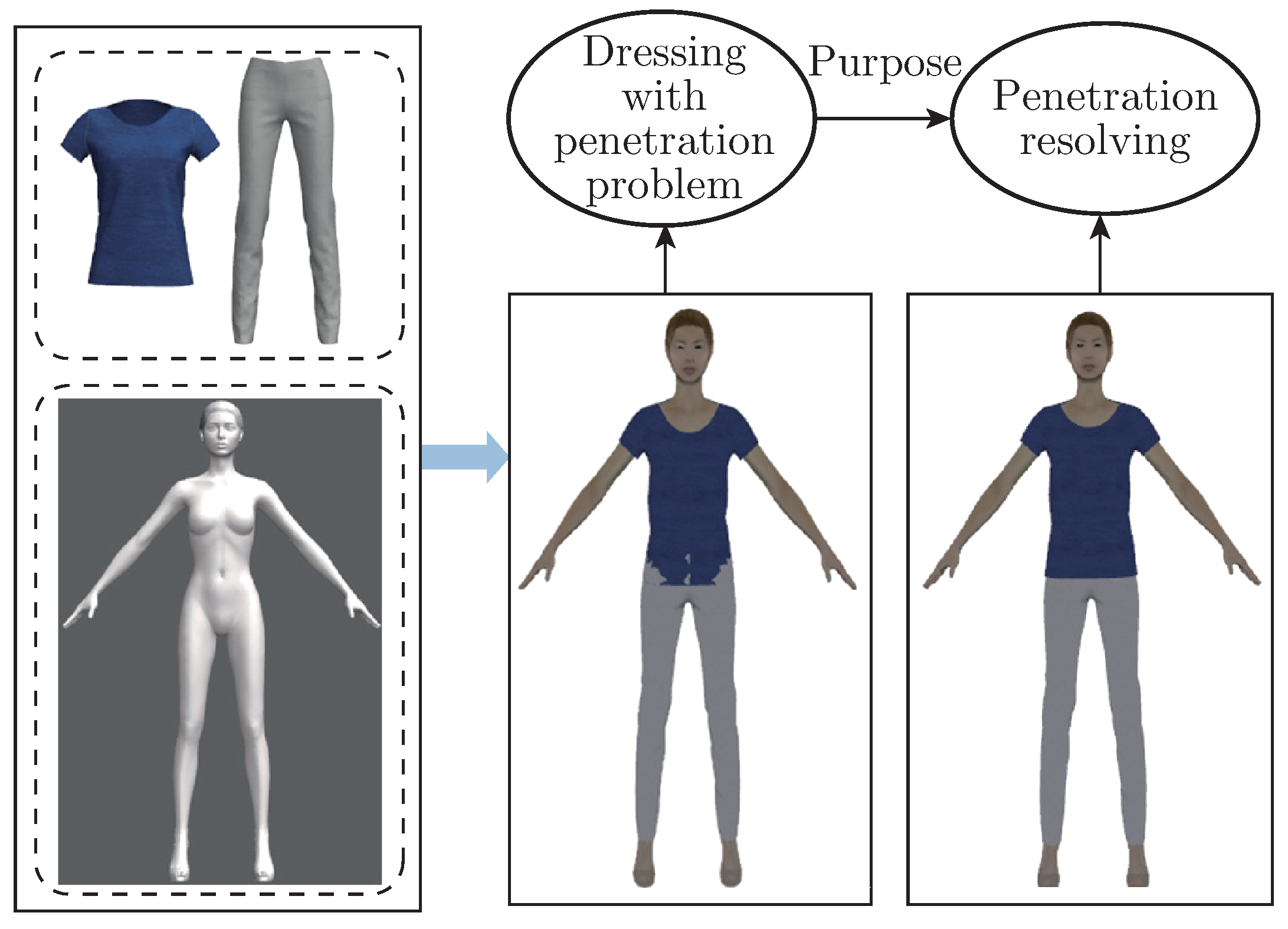
Based on the analysis about clothing modeling and the rEquationirement of virtual dressing, it is the suitable method to use the existing 3D garment to generate the multi-layered clothing for virtual dressing. That means the user can select the existing garments from the database to review the effect of multi-layered fitting. The existing 3D garment can be constructed aforehand. Considering the characteristics of flexibility and gridding in 3D garment, combine these garments together to obtain the multi-layered effect, the important problem is penetration phenomena between different garments because the these 3D garment’s geometric shapes are constructed in different situation. Figure 1 shows an example of multi-layered virtual dressing. We can see the penetration phenomena in multi-layered clothing.
Figure 1.
An example of multi-layered virtual dressing.
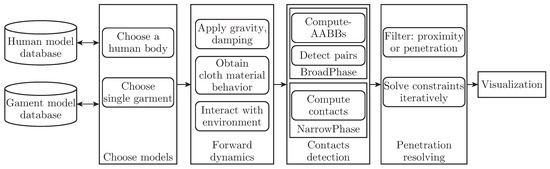
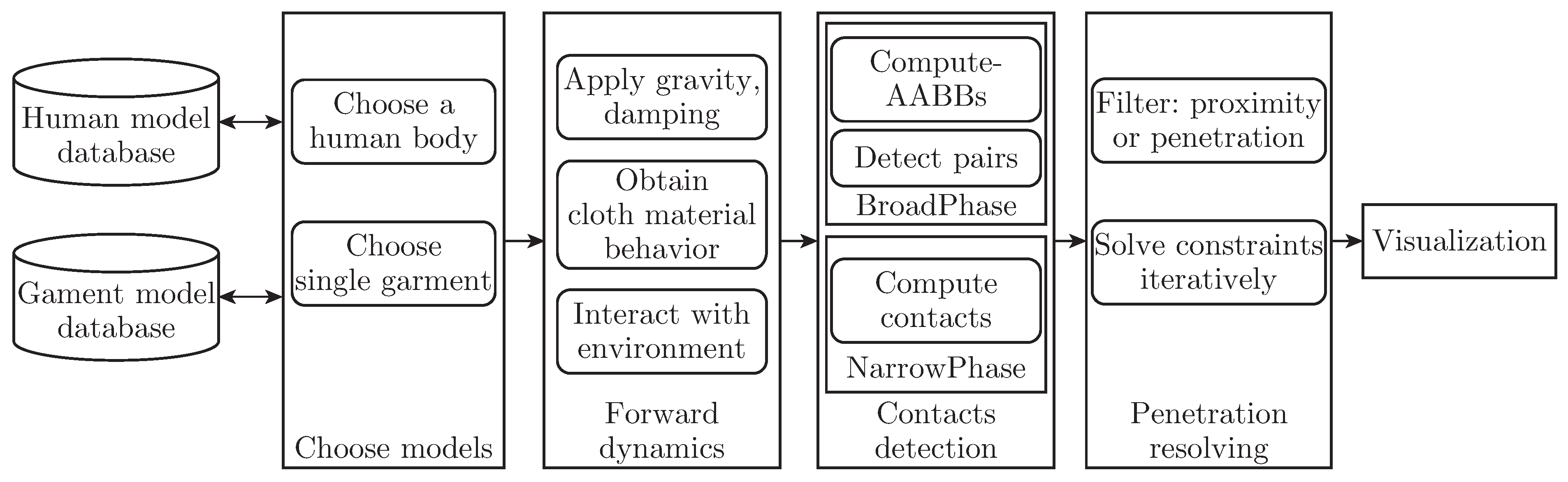
3D garment models presented in this system are based on those arbitrarily existing applicable 3D garment models, via choose one more garment and specify which is inside or outside to start simulation. Garment model can be easily captured and modelled with a triangular mesh model. Thus, the mesh models presented in this paper are triangular meshes. The architecture of the system is shown in Figure 2, which follows the flow of dressing definition, physical based simulation and visualization. From Figure 2, it can be observed that the system contain five parts to complete the virtual dressing. The middle three parts are the same important for simulating the multilayered clothing dressing and the contribution of this paper focus on these three modules. The main idea of our solver is basically a fast version of the physical based simulation [7] and related to the technique widely used in collision resolving [14], and presented a method to solve the penetration phenomena occurred between layered garment parts during simulation which plays a crucial role in multi-layered clothing dressing process.
Figure 2.
An example of multi-layered virtual dressing.
3.2. Physical Based Simulation in Multi-layer Dressing
Physics based Simulation (PBS) is widely used to model the realistic material behaviors of cloth and can produce highly realistic clothing simulation [19], e.g., the mass-spring system. Massspring based model provides a simple yet practical method for modeling a wide variety of objects, including cloth, hair, and 3D animations. Thus, in this paper, our system use standard massspring system with spring force governed by Hooke’s law and use implicit Euler method [7] for numerically integrate solving. The Hooke’s law:
is current spring length, and is the rest spring length, i is the garment layered number. And we use Newton’s second low:
We consider only wind force as external force. And the implicit Euler method:
4. Multi-layered Garments Penetration Resolving
As mentioned above, two more garments try on could lead penetration phenomena appeared between garments, i.e., intersection will occur between each surface mesh model during multi-layered virtual dressing. Thus, in this section, we will discuss the main process of the solution of penetration problem, which refer to two modules of Contacts Detection and Penetration Resolving. The main process contains contact pairs detection, penetration identification and penetration elimination.
4.1. Contact Pairs Detection
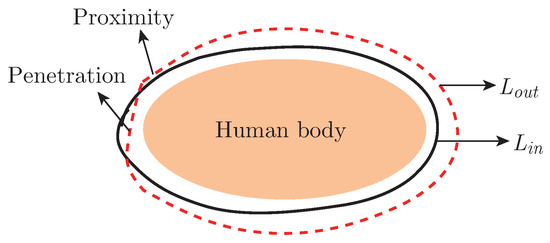
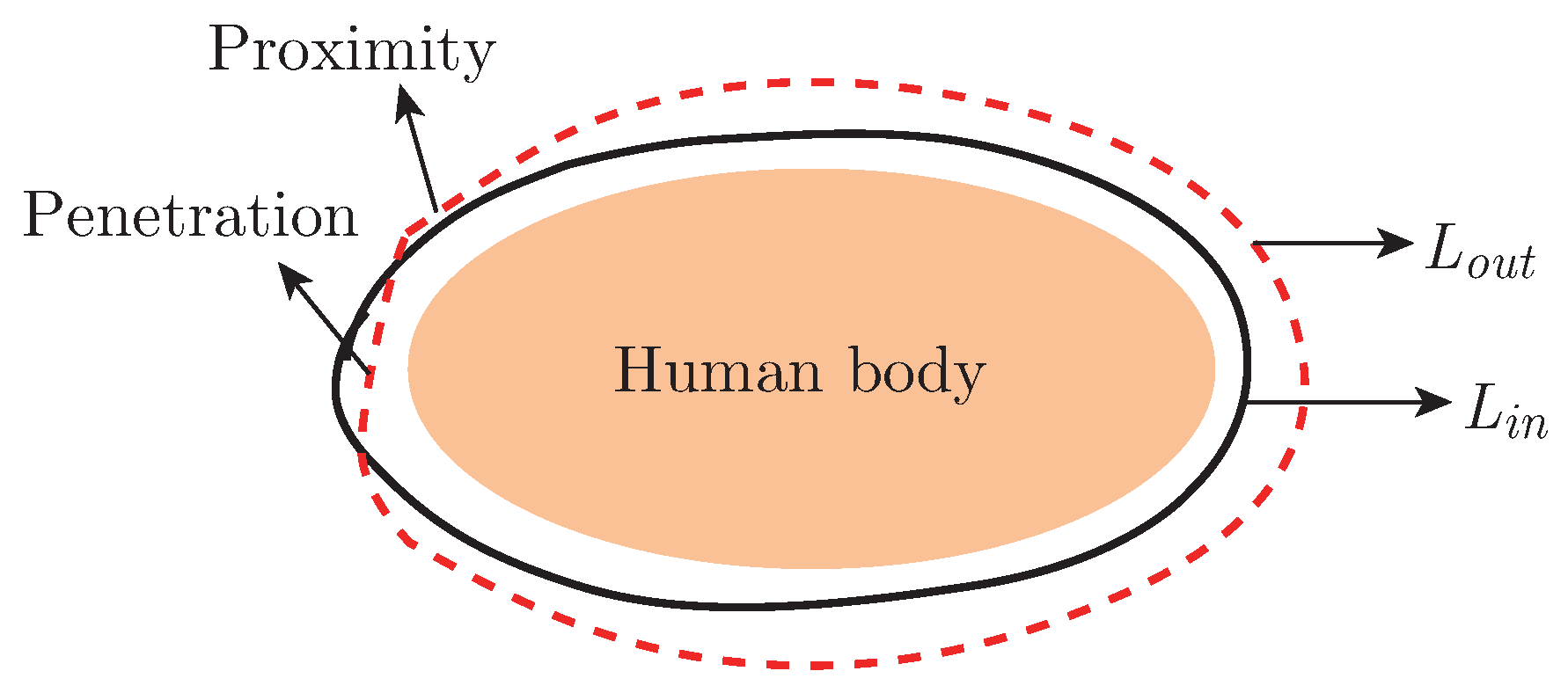
For the convenient explaining in the following, first, we define the proximity and penetration mentioned in our method. From positional relationship of human body with garments, as Figure 3 shows, the out-layer is noted as Lout and inner-layer is noted as Lin, we define the proximity that means the contact pair is extremely close each other but the garments separate each other away from right directions, and penetration represent that contact pair of the garments intersect each other or position the wrong side.
Figure 3.
Position relationship between the garments and human body.
In this paper, we use axis-aligned bounding box hierarchy trees and axis-sweep method to accelerate the process of broad phase detection, and obtain contact pairs by checking pairs (p, t) and (e1, e2) which are to check if a point xi of Lout is closer than some thickness m to a triangle T(xi, xj, xk) of Lin by projection, and an edge of Lout is closer than some thickness m to a edge of Lin by projection, the same for checking of Lin to Lout.
4.2. Filter for Identifying Penetration
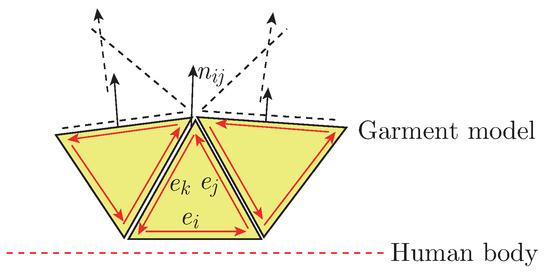
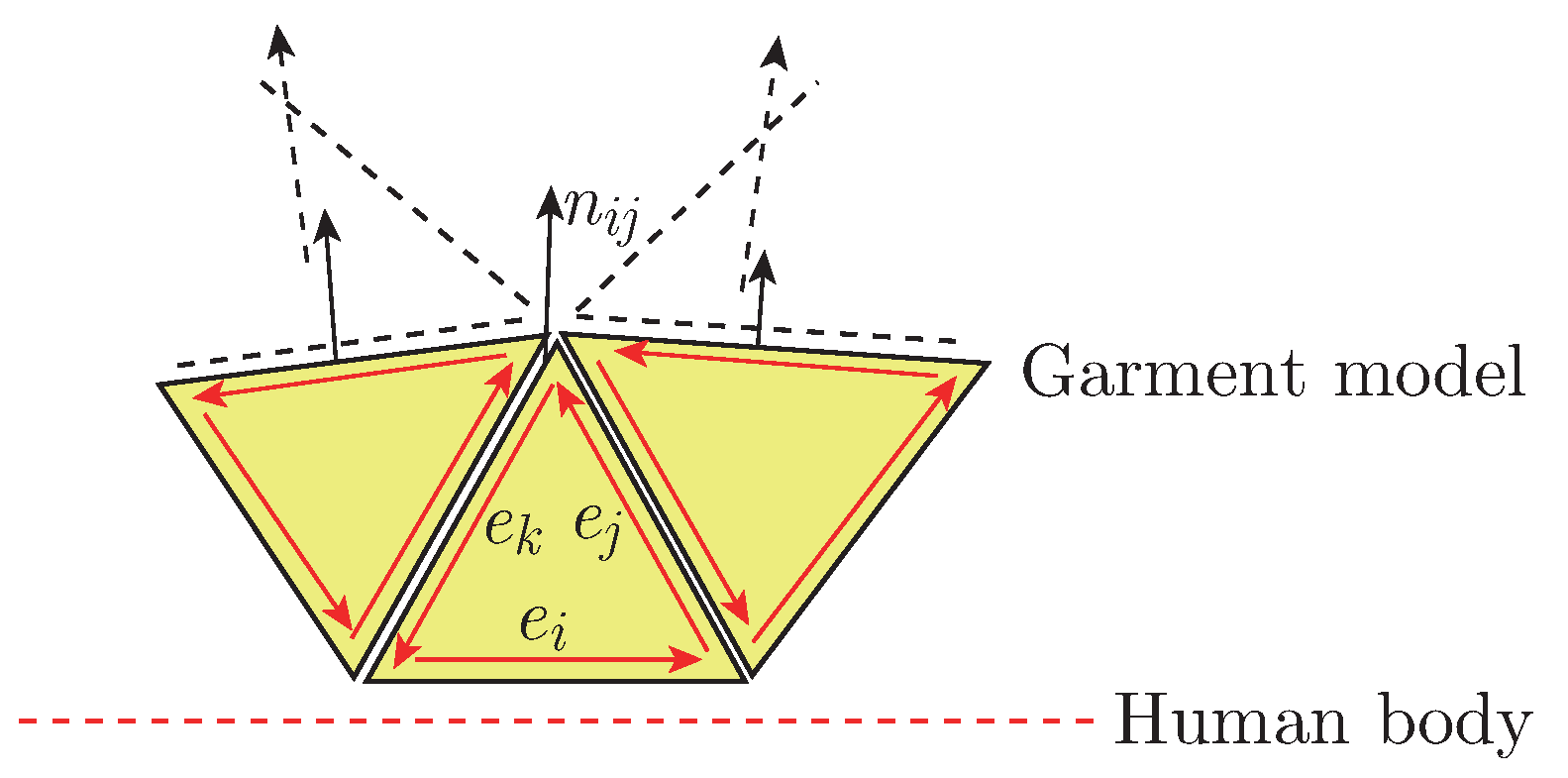
In our method, triangular mesh use half-edge data structure as connectivity representation, as Figure 4 shows. It is obvious that we can see the consistency of the directions connected edges in every triangle, in general, it is anti-clockwise direction. For a triangular mesh, the normal vectors for individual triangle t = (ei, ej, ek) can be defined in Equation (5), and the normal vectors of its vertices which is the value of spatial averages of normal vectors of N(t) in a local one-ring neighborhood can be defined in Equation (6):
Figure 4.
The normal vectors of triangular mesh using half-edge data structure.
The λi is the weight that value as area of ti. Then, we can obtain the normal vectors of triangular meshes that have the consistent direction which point to the outside from the human body, as Figure 4 shows, that ensure the correct of the filter. In the first part of this section, we have computed the contact pairs caused by proximity or penetration between the garments. Now, we can define a filter to classify the contact pairs as proximity and penetration.
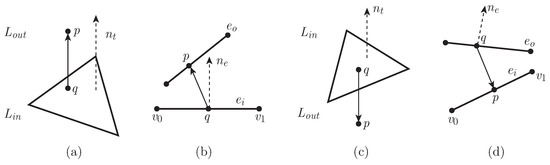
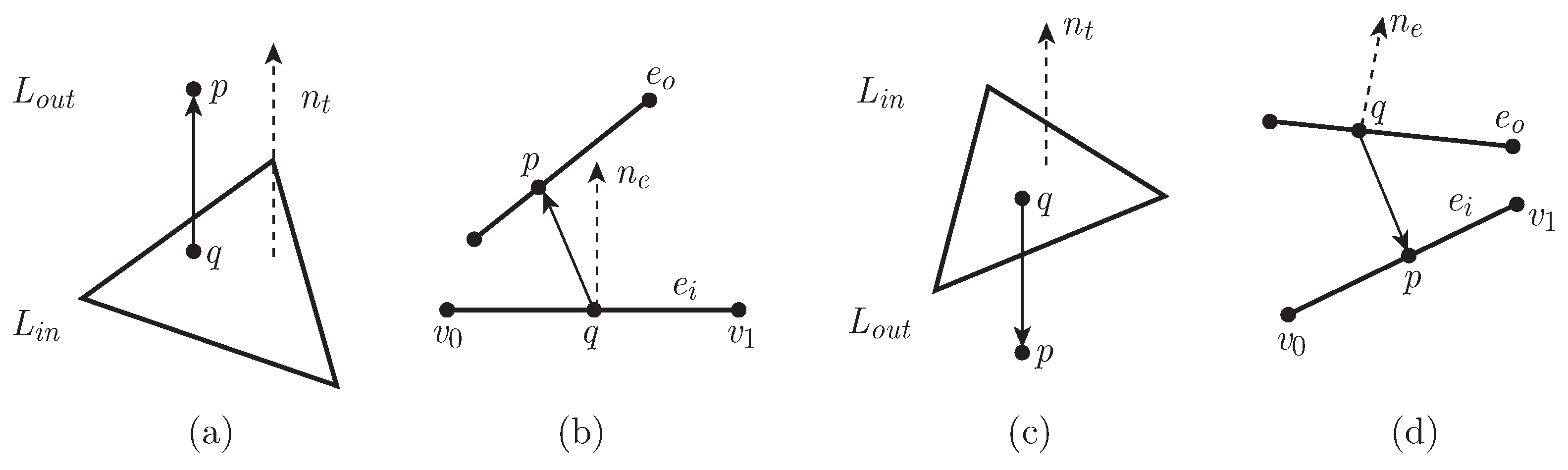
To identify if contact pair (p, q) belong to the penetration where p and q are the points lie on Lout and Lin respectively and q is the projection point of p. We denote the vector to mean p − q, and the normal is alternative N(t) or N(e), using N(t) indicates that the contact pair checked by pairs (p, t), using N(e) means checked by pairs (e1, e2), of which the N(e) is defined:
In this equation, the is the normal vector of the vertex given in Figure 5 and is the normal vector of the vertex . The ω1 and ω2 are the weights of the normals, in our experiment, it is the ratio that point q partition edge ei.
Figure 5.
An example of multi-layered virtual dressing.
In the equations above, j is the control factor which set as 1 or −1 according to the checking order in the first part of this section, pn+1 is the current position of point p and pn is the latest position of p after latest iteration, the same as q. If D1 is negative, we consider the contact pair belong to penetration, versa is proximity. For Equation (9), the value of D2 indicates the relative velocity from p to q, the negative value declares that the relative velocity goes to separate the intersection layers, and the positive one need further process which we discuss in the next part.
4.3. Process of Eliminate Penetration and Proximity
After filtering the contact pairs, we divide them into two groups, then we can correct it respectively. We have discussed the physical model using in this paper at the third section. Then, in this part we choose to use geometric response for eliminating penetration and proximity underlying the physical simulation, which act directly on the object position, velocities, and accelerations, it is efficient and can reduce the computation cost per step since physical simulation yet still cost not little time. For proximity we can process it as common collisions. As for penetration, we provide a novel method to process it.
In these equations, m represents the thickness of the garments mentioned above, the second term of these two equations represent friction force, is horizontal component of , µ is the friction coefficient. We use C1 to modify the position of the vertices for correcting penetration and C2 for correcting proximity. Since for completely eliminate penetration, we process iteratively per simulation step, and in our experiment, we choose three times iterations.
5. Result and Conclusion
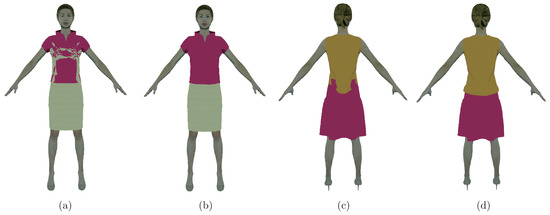
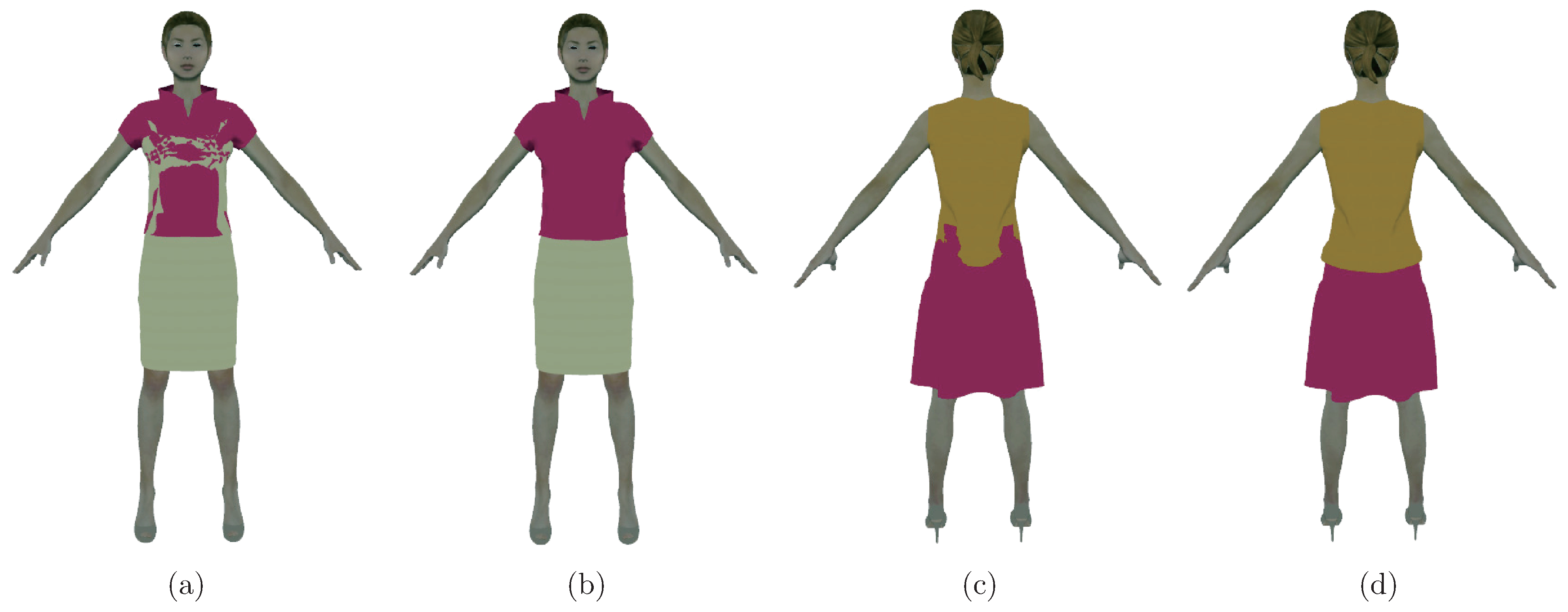
We use OpenGL toolkits to implement the visualization modules. Figure 6 shows the compare results, two types of multi-layered virtual dressing are given. In Figure 6 (a), the T-shirt can be selected as out-layer garment and the braces skirt is the inner-layer garment. In Figure 6 (c), the sleeveless shirt is out-layer garment and the short skirt is the inner-layer garment. Figure 6 (a) and Figure 6 (c) are the results without penetration process, Figure 6 (a) and Figure 6 (b) are the compare results corresponding to Figure 6 (c) and Figure 6 (d) respectively after penetration resolving using our method presented in this paper. The results show that the system can obtain visually acceptable results, which only cost less than three iterations that is only a fraction of time required for a step simulation. Moreover, we can close the filter after obtaining satisfied effects during the simulation for more efficient and robust of continued physical based simulation.
Figure 6.
(a) and (c) are the simulation results with penetration problem, (b) and (d) are the simulation results after penetration resolving using our method.
Our method is based on physical simulation models, therefore the efficiency largely rely on the quality of physical model. Since no single technique will be appropriate for completing virtual dressing simulation, we still need to make progress integrally in the future.
Acknowledgments
The authors would like to thank the people who supported this work for helping with the experimental design, and we would like to thank the anonymous reviewers for their valuable comments. This research is supported by the National Natural Science Foundation of China (No. 61379112, 61272192).
References
- Wang, H.; Ramamoorthi, R.; O’Brien, J.F. Data-driven elastic models for cloth: Modeling and measurement. ACM Transactions on Graphics 2011, 30, 1–11. [Google Scholar] [CrossRef] [Scilit]
- Feng, W.; Yu, Y.; Kim, B.-U. A deformation transformer for real-time cloth animation. ACM Transactions on Graphics (TOG) Vol. 29, No. 4, July 2010.
- Bridson, R.; Marino, S.; Fedkiw, R. Simulation of clothing with folds and wrinkles. In Proceedings of the 2003 ACM SIGGRAPH/Eurographics Symposium on Computer Animation, 26–27 July 2003. [Google Scholar]
- Bonet, J.; Wood, R.D. Nonlinear Continuum Mechanics for Finite Element Analysis; Cambridge University Press, 1997. [Google Scholar]
- Selle, A.; Lentine, M.; Fedkiw, R. A mass spring model for hair simulation. ACM Transactions on Graphics (TOG) Vol. 27, ACM, 64, 2008.
- Choi, K.J.; Ko, H.S. Stable but responsive cloth. ACM SIGGRAPH 2005 Courses, 1, 2005.
- Liu, T.; Bargteil, A.W.; O’Brien, J.F.; Kavan, L. Fast simulation of massspring systems. ACM Transactions on Graphics 2013, 32, 1–7. [Google Scholar] [CrossRef] [Scilit]
- Gottschalk, S.; Lin, M.C.; Manocha, D. OBBTree: A hierarchical structure for rapid interference detection. In Computer Graphics Proceedings, ACM SIGGRAPH; 1996; pp. 171–180. [Google Scholar]
- Mezger, J.; Kimmerle, S.; Etzmuss, O. Hierarchical techniques in collision detection for cloth animation. J. WSCG 2003, 11, 322–329. [Google Scholar]
- van den Bergen, G. Efficient collision detection of complex deformable models using AABB trees. Journal of Graphics Tools 1997, 2, 1–13. [Google Scholar] [CrossRef] [Scilit]
- Larsson, T.; Akenine-Möller, T. A dynamic bounding volume hierarchy for generalized collision detection. Computers and Graphics 2006, 30, 450–459. [Google Scholar] [CrossRef] [Scilit]
- Liu, J.D.; Ko, M.T.; Chang, R.C. Collision avoidance in cloth animation. The Visual Computer 1996, 12, 234–243. [Google Scholar] [CrossRef]
- Je, C.; Tang, M.; Lee, Y.; Lee, M.; Kim, Y. PolyDepth: Real-time penetration depth computation using iterative contact-space projection. ACM Trans. Graph. 2012, 31, 1. [Google Scholar]
- Bridson, R.; Fedkiw, R.; Anderson, J. Robust treatment of collisions, contact and friction for cloth animation. In Computer Graphics Proceedings, ACM SIGGRAPH; 2002; pp. 594–603. [Google Scholar]
- Mezger, J.; Kimmerle, S.; Etzmu, O. Hierarchical techniques in collision detection for cloth animation. Journal of WSCG 2003. [Google Scholar] [CrossRef] [Scilit][Green Version]
- Volino, P.; Magnenat-Thalmann, N. Resolving surface collisions through intersection contour minimization. ACM SIGGRAPH, 2006.
- Zhong, Y. Fast penetration resolving for multi-layered virtual garment dressing. Textile Research Journal 2009, 79, 815–821. [Google Scholar] [CrossRef] [Scilit]
- Du, H. Research and Implementation of Multi-layered Virtual Garment Simulation Algorithm. 2014.
- Guan, P. DRAPE: Dressing any person. In ACM Transactions on Graphics, Proceedings of ACM SIGGRAPH; Association for Computing Machinery; 2012, Volume 31.
© 2015 Textile Bioengineering and Informatics Society. This article is an open access article distributed under the terms and conditions of the Creative Commons Attribution (CC BY) license (https://creativecommons.org/licenses/by/4.0/).