


Abstract
At present, bra enterprises usually use under bust girth and bust differences to design bra pattern. These kind of bras do not consider the differences of breast shapes and therefore cannot not satisfy the demands of fit and comfort of different breasts. This paper firstly elaborates on the effect analysis of bra wearing to discover the differences then verifies the importance of breast characteristic parameters. Then a three dimensional laser scanner is used to measure the size of 75B of young female breast shape to collect data. In order to analyze breast shape change rule for moulded bra cup and bra structure design, basic statistics analysis, factor analysis and cluster analysis were conducted for breast data. Finally, six major characteristic parameters on breast height, bust external side slope, breast depth, under bust depth, biacromial breadth and center front point-bust inner point length were extracted for bra structure design. Also, cluster analysis was used to divided breast shapes into three shapes. The results of the paper can be used for providing technical parameters and theoretical basis for further study of bra structure design. It also explores a new direction of the development of tailored moulded bra cup and bra structure design.
1. Introduction
There are many variations of female breast shapes. Although different people may have the same bust girth and bust difference, the same size and style of bra may bring discomfort while wearing. Wearing these bras would result in a mismatch between cup and breast, leading to inappropriate pressures and discomfort for breasts. Finally it cannot achieve the requirements of the tailored bras varieties, nor provide the perfect based data for scientific and rational bra pattern design. It is known that China’s current bra standard follows a generic bra size industry standard. The classification of bra size and pattern design might only depend on the national standard in the bust and under bust girth [1]. However, these two data just reflect the laws of bust girth dimensional change. It is necessary to conduct a more detailed study for suitable moulded bra cup and bra structure design on female breast shape.
It is very important for moulded bra cup and bra structure design to reflect the proportions features on different breast shape and body to achieve the common pursuit of aesthetic effect. For example, in order to beautify the disc type breast, bra structure design should increase its breast height; In order to have enhanced beauty affect for disc type breasts, the bra structure design should raise and collapse its cups. When dealing with sagging breasts, folding methods and other more forceful ways are used to ensure that the breast is situated in an ideal location. A comfortable and suitable bra is crucial in ensuring the best position for the breast to enhance its attractiveness [2]. However, there are many women that are categorized in between the two breast shapes. More anthropometric research and detailed study are necessary for moulded bra cup and bra structure design.
Currently, anthropometric measurements and body analysis has attracted more and more attention. There was a measurement report which disclosed that 75.8% of measuring bra shape were different from actual sizes in North service-love Ergonomic Institute recorded in August 2002 [3]. 1,742 individuals were enrolled as subjects to try bra in anthropometric survey of Duan XJ investigation. It was discovered that the standard bra size only accounted for 27.9% of the consumer with an inconsistency of 72.1% for the other users [3]. The analysis of the data including bust girth, breast pitch, bust height from Wang JP showed that the results reflects 30 young women bust structural features to achieve young females bust structural features, varied laws and relative values according to ergonomic principles [4]. It was believed by Rong Z that the series of breast segmentation should not be based on the bust and bust girth. As a consequence, he introduced a new series of breast shapes by switching under bust girth and breast deep wide ratio as segment parameters [5]. Qi J considered that the breast data from girls wearing the same size bra showed larger differences. Suggestions were given for further improvements in girls bra size specifications, such as the division into age groups of statistical data analysis, new classification of the breast, and refined grading values [6]. The measurement of transverse thoracic sagittal diameter ratio RB (refer bust line bust and bust thick horizontal length ratio) of 197 women aged 18-50 from Wang HE. She divided the bust shape into high breast shape, flat breast shape and normal breast shape after cluster analysis, which included high breast shape accounting for 32%, flat breast shape accounting for 17.3%, normal breast shape accounting for 50.7% [7]. Ying BA presented a parametric study on the relationships of feature points and feature curves of moulded bra cups and model shape by analyzing modeling of digital moulded bra cup [8]. Liang SZ sliced, chosen point and computed relative bust key part about 10 breast basic shape by measuring 254 female undergraduates in Western China. The results divided basic shapes of breasts into 9 classes [9]. Moreover, a report from Jia JJ and her collaborators showed that they applied K-means Cluster analysis to classify the girls’ breast shapes into 9 types [10]. In addition, previous experimental researches [11,12,13,14] have concentrated on the assessment of the emotion space of bra and the analysis of the function of the shoulder strap, verifying the effect of sports bras on thermal regulation of the breast by exercise.
In many research fields of the moulded bra cup and bra structure design, a mapping method was put forward to construct blouse’s body block with just-fit design by Ning GH, basing on true female body sizes [10]. Chen XP proposed that bra structure design should be in conformity with the size and body shape and shoulder strap position should be in conformity with body structure characteristic. After collection of data, comparison and classification of the existing bra prototypes at home and abroad were carried out. Last but not least, bra specification should have larger coverage and suitability of the crowd, especially in the moulded bra cup and bra structure design [11].
However, the studies above were still not enough to satisfy the demands of suitable moulded bra cup and bra structure design. Moreover, according to underwear enterprises internship and expert interviews, it was inappropriate to use female with size of 75B as an intermediate code to grade patterns in current bra industrial production. The aim of this study was to analyze breast data of women’ size of 75B from a perspective of bra structure design, in order to find out the major characteristic parameters of breasts in order to provide the basic data and theoretical basis to improve suitable moulded bra cup and bra structure design.
2. Effect Analysis of Bra Wearing
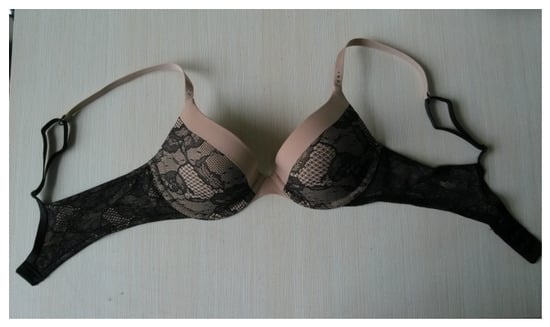
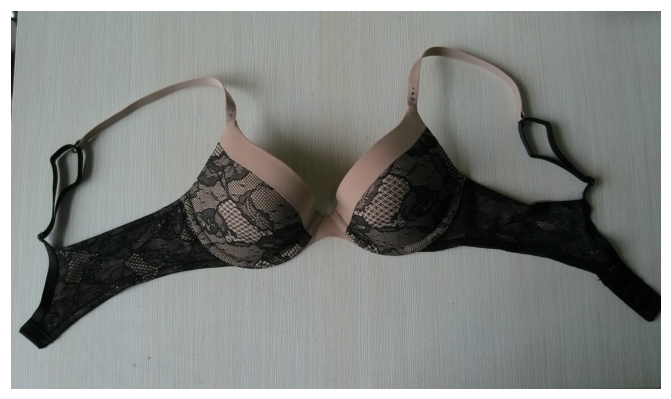
During the course of the trial, two young mature women between 18 and 25 years of age randomly were recuited as subjects, to try a three quarter cup of cradle bra. The style of bra was shown in Figure 1. The Anthropometric data of subjects’ six parts before wearing bra are presented in Table 1.
Figure 1.
The three quarter cup of cradle bra.
Table 1.
The Anthropometric data of subjects’ six parts before wearing bra.
The results showed that both subjects experienced a different wearing effect when they have same bust girths but have different busts. According to the adjustment value of shoulder strap of the back of subject A and B, the values of breast height and shoulder slope of subject A are larger than subject B. It is necessary to adjust the length of strap to make the bra suit the breasts. Subject A appears empty and unsuited at the front edge of the front loop. For the value of biacromial breadth of subject A is narrower than subject B, subject A has a poor fit effect at the gore. Moreover, the front wearing experience of subject B is better because the breast of subject A is plumper than subject B. The back of subject B appears to have a tight fitting, for its value of bust depth is larger than subject A. The results might give substantial grounds that there should be more experiments on the analysis of women’s breasts, especially the biacromial breadth, bust depth, center front point-bust inner point length and others parts which might affect the extent of breast fitting.
3. Data Collections for Detail Size of Human Breast
3.1. Measurement Methods and Measurements Projects
Three-dimensional non-contact laser body scanner and some human data supporting software were applied during the course of this experiment to collect human data. Human-section data were extracted and analyzed by interactive measurements to achieve body height, breadth, girth and some angle data.
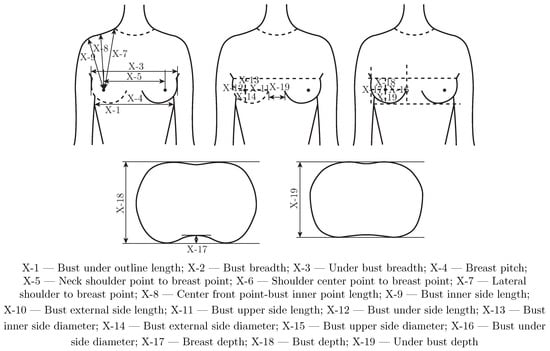
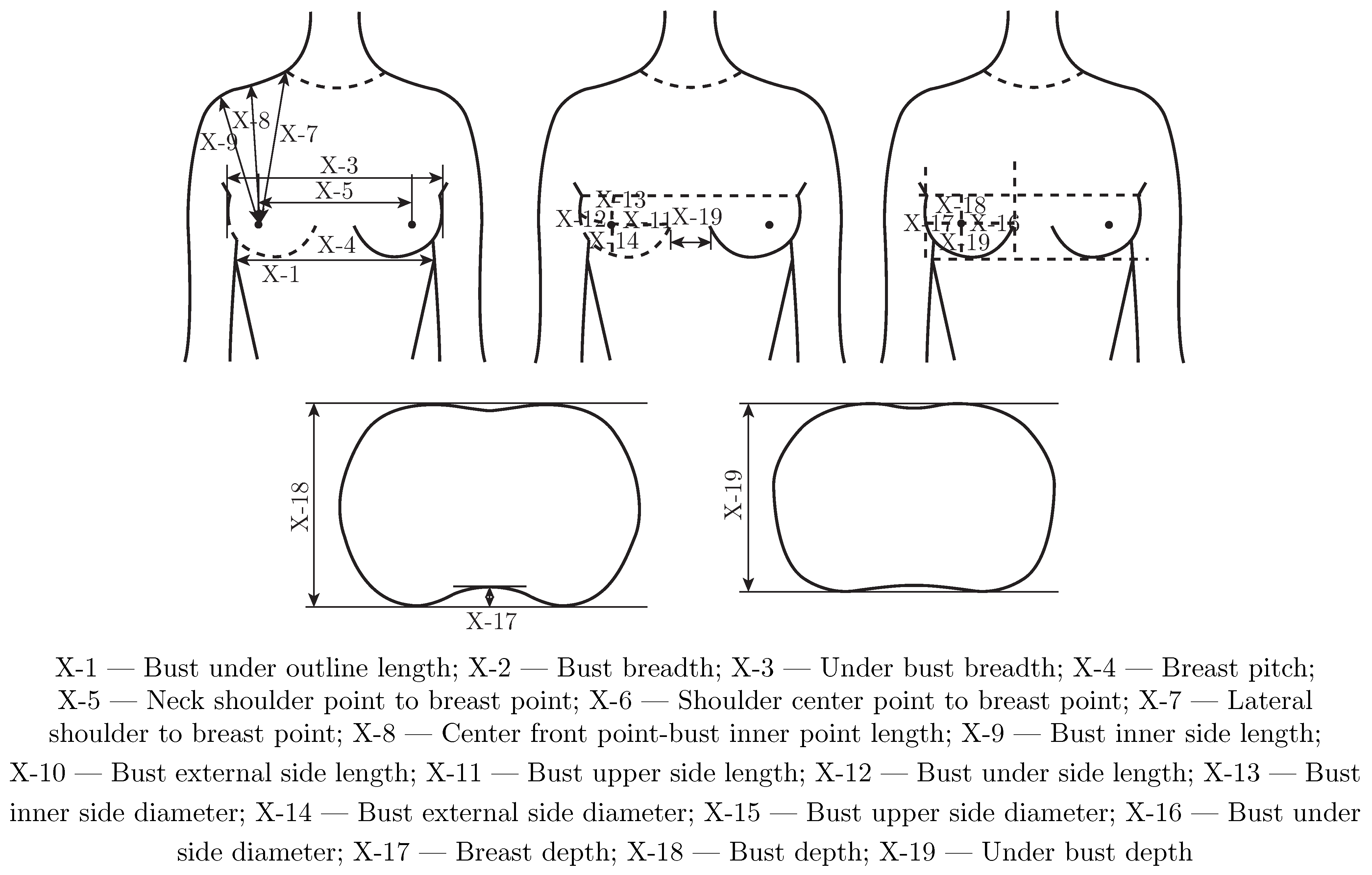
The measurement ultimately selected 40 parts, reflecting female breast shape for anthropometric measurements. The measurement methods of 19 anthropometric dimensions are shown in Table 2. Schematic diagram of the anthropometric dimensions measured are presented in Figure 2 accordingly.
Table 2.
Measurement methods of 19 anthropometric dimensions.
Figure 2.
Schematic diagrams of 19 anthropometric dimensions.
3.2. Selection of the Measurement Subjects
Body anthropometric measurement includes the subjects, ages between 18 to 24, who could wear a bra size of 75B. The corresponding under bust girth is in the range of 72.5–77.5 cm, and bust difference is in the range of 11.25–13.75 cm.
3.3. Determination of Sample Capacity
Mathematical statistics methods were used to calculate the number of subjects, basing on allowable error and standard deviation of various parts for the specified adult body garment size in the country standard size [12]. The number of samples were calculated with the value of σ/∆ of bust in the allowable error and standard deviation. The formula (1) can be expressed as follows:
where σ is the standard deviation of bust; ∆ is the max allowable error of bust. The calculation shows that the determination of the sample size is 52, and the sample size is as much as possible in the allowed time. The study ultimately chose the sample size of 66, taking into account of the sampled and measurements excludes generated invalid samples.
4. Data Analysis of Body Breast
4.1. Data Preprocessing
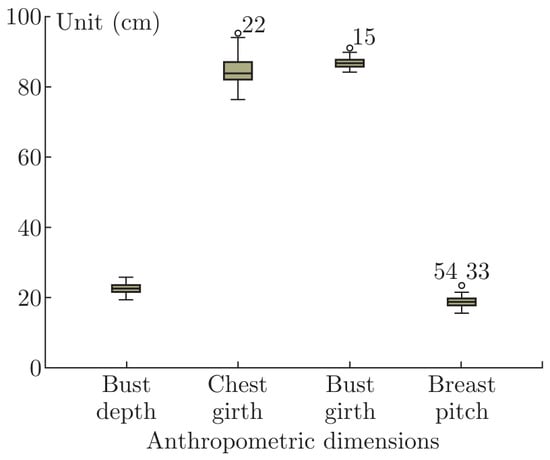
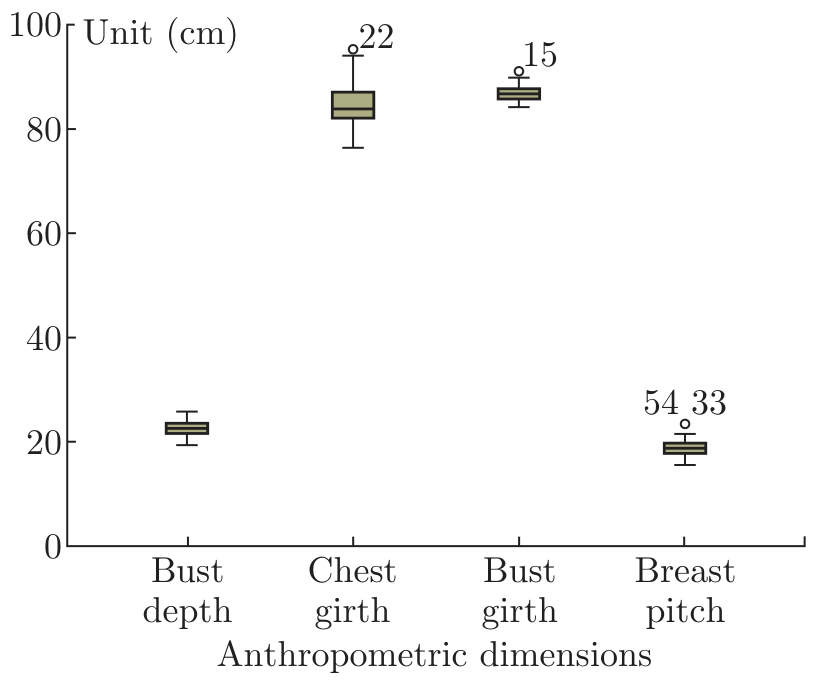
Box plot of measurements was obtained though data exploratory analysis by SPSS statistical software. All anthropometric data were analyzed of each part of the breast. As a result, the characteristics of main bust parameters of bust depth, chest girth, bust girth and breast pitch were chosen to be analyzed.
The box plot of bust depth, chest girth, bust girth and breast pitch was shown in the Figure 3. There were no extreme values in these anthropometric dimensions. However, four outliers (15, 22, 33, 54) existed. It was clear that the presence of outliers may influence the results of the analysis leading errors. The outliers would all be removed after the samples are analyzed at this experiment. As a result, the usable subjects accumulated to 60 which is 91.13% of the total number of measurements.
Figure 3.
Box plot result.
4.2. Basic Statistics Analysis
Six basic statistics on whole distance, minimum, maximum, mean, standard deviation and coefficient of variation were chosen for this experiment to describe the overall characteristics of the data concentrations and dispersion conditions. The results of some major details of Basic statistics analysis were listed as follows:
(1) The mean bust girth and under bust girth were 87.01, and 74.70 respectively. The corresponding coefficients of variation were 1.57 and 1.64. The results indicates that the degree of concentration of the coefficient variation of bust girth and under bust girth were close to the standard 75B bra shape.
(2) Associated with bust detail size, the maximum whole distance of measurement projects on bust upper side slope, bust under side slope, bust inner side slope and bust external side slope, were obviously shown in the results. This illustrated that there exists large degrees of variation of these measurements for females’ bust detail size. In particular, the greater differences would especially reflect on bust upper side slope, bust under side slope, bust inner side slope, and bust external side slope.
(3) The breast pitch’s mean was 19.06, which was 1.36 wider than the national standard spacing 17.70 cm.
(4) The coefficient variation of the maximum value of center front point-bust inner point length accounted for 62.94%, reflecting a high degree of dispersion. It is indicated that these parts could not be determined by the overall average due to the high degree of dispersion. Degree of dispersion in descending order respectively were bust upper side slope, bust under side slope, bust external side diameter, bust under side diameter, breast depth, bust upper side slope, bust upper side diameter, bust upper side length, bust external side slope and bust external side length. These parts’ coefficient variations are so large that they cannot be represented by the mean. Once more, the same shape bra size of breast shape still existed big differences.
4.3. Factor Analysis
For the sake of searching the most important factors reflecting the same bra size and shape characteristics of young female breasts; all the measurements were included in a method of factor analysis to simplify the analysis process. Then we achieved a comprehensive evaluation of the original item in different categories. Table 3 showed the Kaiser-Meyer-Olkin(KMO) and Bartlett test results. Bartlett value was 3012.005, and Sig <0.0001, namely the correlation matrix was not a matrix, so the experiment could consider to conduct factor analysis; KMO value was 0.821, which was closer to 1, meaning that it could accept the results of the factor analysis.
Table 3.
KMO and Bartlett test result.
Table 4 collectively indicated that it should be extracted with five factor variables. 83.90% of the total measurements could be accounted for the cumulative contribution rate of these five factors. It illustrated that five factors might take place of 40 original measurement projects and explain 83.90% of the original variables of body information. Moreover, the second factor variance contribution rate were 33.25% and 22.18% respectively, representing 55.43% of the cumulative contribution rate. These are the most important factors.
Table 4.
Factor eigenvalues and percentage.
In order to identify the factor, factor rotation was conducted to polarize the value of coefficient to 0 and 1. Rotated factor loading matrix coefficients were arranged in descending order. The coefficient of load factor has clearly polarized after 22 iterations convergence of rotation. The characteristic factors analysis results according to the expertise of each factor were shown in Table 5.
Table 5.
Characteristic factors analysis results.
4.4. Feature Extraction Parameters
Measurement data classification has specific understanding after factor analysis. In order to extract the main parameters of the different breast shape, the biggest variable of the relative index was chosen as the major feature parameters for the factors, The formula (2) can be expressed as follows:
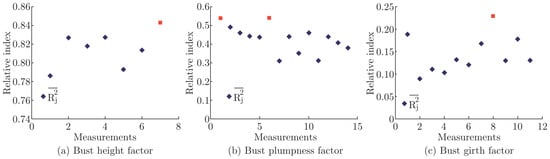
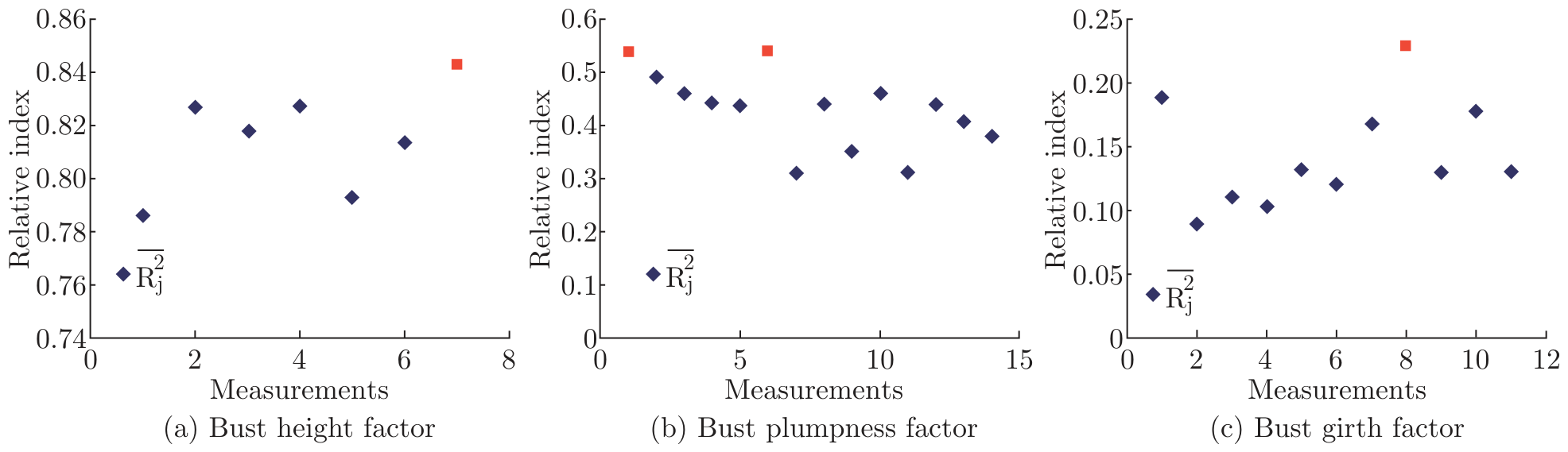
where R2j is the relative index of variable of each category; r is the correlation coefficient of indicator xj and index among other indicators; mj is the number of indicator targets at the class. Calculated for each variable in each category according to the formula of the underlying index were shown as follows Figure 4.
Figure 4.
Scattergram of relative index of bust height factor, bust plumpness factor and bust girth factor.
Through comparing the results, in the bust height factor, the value of the red square point is the maximum, which represents the measurement of breast height. Therefore, breast height is the characteristic parameters of bust height factor. In the bust plumpness factor, the two values of the red square point are the maximum, which represents the measurement of bust external side slope and breast depth. Therefore bust external side slope and breast depth is the characteristic parameters of bust plumpness factor. In the bust girth factor, the value of the red square point is at its maximum, which represents the under bust depth measurement. Therefore under bust depth is the characteristic parameters of bust girth factor.
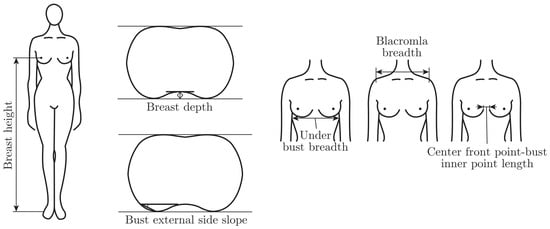
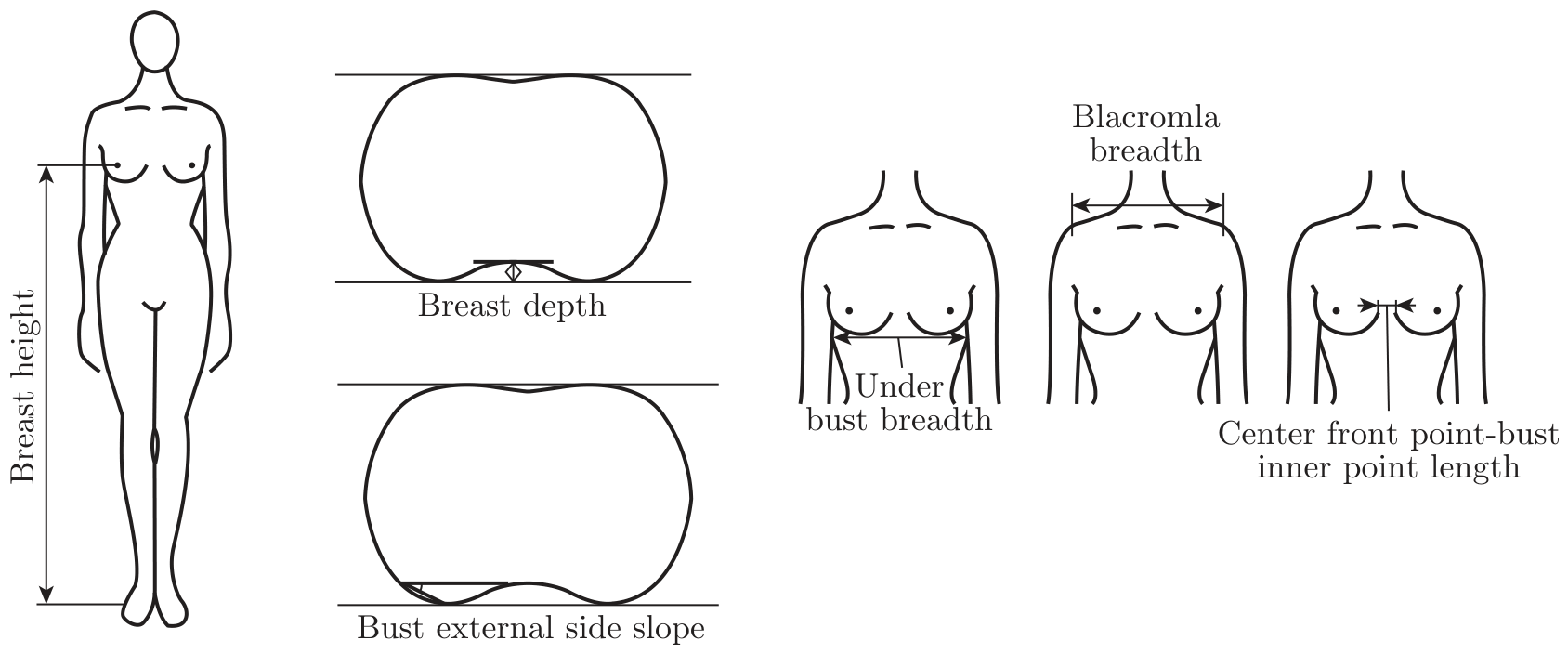
In summary, there will be different results depending on the factors chosen in the research. Breast height, bust external side slope, shoulders breadth, breast depth, under bust depth, center front point-bust inner point length were the main parameters affecting the same bra size and shape of women. These six parameters were the pivotal determination of breast shape and size. Figure 5 showed the schematic diagrams of six major characteristic parameters. In the bra product design process, it is necessary for designers and craftsmen to strictly control the bottom circumference size. In addition, they need to consider different breast shape and size bra design features. Especially the center front point-bust inner point length, the width of cup, the depth of cup, the alignment of rims arc and length of wing should be noticed in the pattern design.
Figure 5.
Schematic diagrams of six major characteristic parameter.
4.5. Cluster Analysis of Breast Shapes
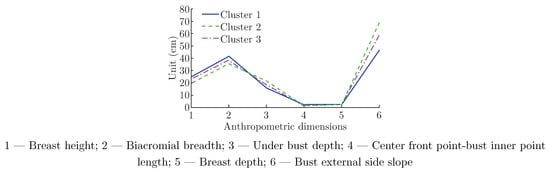
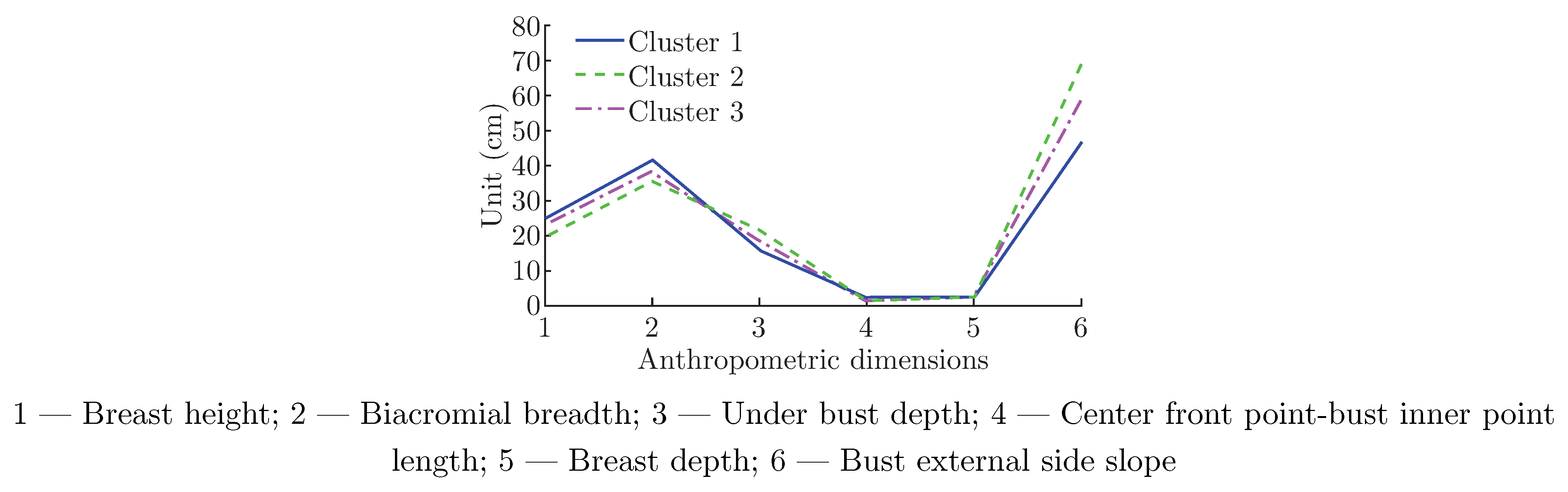
Cluster analysis of samples were used for six main characteristics parameters, based on factor analysis extraction. To use the 83.90% descriptive body characteristics of five factors on breast shape classification is more accurate and scientific than using a single measurement. Clustering results of bust detailed size of samples of wearing 75B bra was shown in Figure 6, which ultimately divided samples into three categories.
Figure 6.
The line chart of cluster result.
Figure 6 showed that the results were visualized to have comparative analysis on the cluster results. The description of breast shape and body characteristics for cluster 1 was that: the value of biacromial breadth was relatively big. The value of under bust breadth was narrow. Center front point-bust Inner point length was large. The bust external side point was large and the breast shape belonged to the hemisphere shape. The description of breast shape and body characteristics for cluster 2 was that: the value of biacromial breadth was small. The value of under bust breadth was wider. Center front point-bust Inner point length was small. The bust external side point was big and the breast had a taper shape. Lastly, the description of breast shape and body characteristics for cluster 3 was that: the means of the six main characteristics parameters were at the state of total intermediation.Then it can be divided into the moderate standard shape,
In order to provide detailed data for further bra structure design, cluster 3 was chosen as the standard 75B breast shape. Its main details size was that: The value of biacromial breadth was 38.71 cm; The value of under bust depth was 19.03 cm. The value of center front point-bust Inner point length was 1.77 cm; The value of under bust height was 23.72 cm; The breast depth was 3.44 cm and the bust external side slope was 59.11 cm. The numbers of bust shape 1 and bust shape 2 accounted for 45% of total participants, which belongs to a large consumer population that cannot be ignored.
5. Conclusion
In this study, three-dimensional laser scanner was applied to collect female breast data for the size of 75B breasts. The study put forward data analysis on basic statistics analysis, factor analysis and cluster analysis for breast data. In the analysis of basic statistics, it was discovered that the same bra size and shape of breast had a large difference at the biacromial breadth, bust breadth, bust depth and other detailed sizes of the breast. Six parameters which could distinguish characteristics of female breast shape were extracted by using factor analysis. There were respectively, breast height, bust external side slope, breast depth, under bust depth, biacromial breadth and center front point-bust inner point length. Also, three kinds of breast shapes from six indicators were clustered using cluster analysis. Finally, the study could help to conduct suitable bra structure design. In addition, it would provide basic data and theoretical basis for the moulded bra cup and bra structure design, which leads to a new direction for the basis for tailored bra development.
Acknowledgments
This work is supported by the National Natural Science Foundation of China (61303120), and the project of Shaanxi Provincial Science and Technology Department (2011HBGC-18).
References
- Piao, J.Y. The figure of breast and the design of the type and size of brassiera; Soochow University D: Suzhou, 2006. [Google Scholar]
- Wang, J.P.; Zhang, W.Y. Development of 3D female breast model library for bra design. International Forum on Textile Science and Engineering for Doctoral Candidates 2006. [Google Scholar]
- Duan, X.J.; Zhang, W.Y.; Gao, S.P. Applicability study of breast shape and bra cup structure; Beijing Institute of Clothing D: Beijing, 2004. [Google Scholar]
- Wang, J.P. Young female breast form preliminary analysis. J. Knitt. Ind. 2007, 7, 23–26. [Google Scholar]
- Zheng, R.; Yu, W.; Fan, J.T. Development of a new Chinese bra sizing system based on breast anthropometric measurements. Int. J. Ind. Ergon. 2007, 37, 697–705. [Google Scholar] [CrossRef] [Scilit]
- Qi, J.; Xu, D.M. Data analysis of chest for girls bra design; TBIS, 2013; pp. 651–655. [Google Scholar]
- Wang, H.E. Prototype study of segmentation and classification of female body shape on the basis of MTM; Donghua University D: Shanghai, 2003; Volume 12. [Google Scholar]
- Ying, B.A.; Wang, Y.; Liu, F.Y. Study on the definition of moulded bra cup features and parametric modeling. J. Fiber Bioeng. Inform. 2011, 4(4), 389–402. [Google Scholar] [CrossRef] [Scilit]
- Liang, S.Z. The study on main detailed size of bra pattern designbra structure design of western young women; Xi’an Institute of Engineering and Technology D: Xi’an, 2005. [Google Scholar]
- Jia, J.J. A research of classifying Chinese girls’ breast shapes based on 3d body measurement; TBIS, 2008; pp. 575–581. [Google Scholar]
- Xue, Y.; Zhang, R.; Ji, Y.B.; Imaoka, H. An analysis of emotion space of bra by kansei engineering methodology. J. Fiber Bioeng. Inform. 2011, 4(1), 97–103. [Google Scholar] [CrossRef] [Scilit]
- Zhou, Jie; Yu, Winnie. A study on biomechanical models of sports bra’s shoulder straps. J. Fiber Bioeng. Inform. 2013, 6(4), 441–451. [Google Scholar] [CrossRef] [Scilit]
- Ayres, B.; White, J.; Hedger, W.; Scurr, J. Female upper body and breast skin temperature and thermal comfort following exercise. Ergonomics 2013, 5(6), 1194–1202. [Google Scholar] [CrossRef] [Scilit]
- Williams, P.T. Breast cancer mortality vs exercise and breast size in runners and walkers. PLoS ONE 8. [Google Scholar] [CrossRef] [Scilit]
- Ning, G.H.; Zhang, X.; Ying, B.A. Developing blouse’s block pattern using mapping method; TBIS, 2012; pp. 502–509. [Google Scholar]
- Chen, X.P.; Sun, J.F.; Wang, Y. Analysis of bra prototype structure. J. Silk 2012, 4, 37–40. [Google Scholar]
- Miao, X.J. Application on bra pattern design bra structure design optimization of dimensional simulation of the human body; Donghua University D: Shanghai, 2006. [Google Scholar]

© 2014 Textile Bioengineering and Informatics Society. This article is an open access article distributed under the terms and conditions of the Creative Commons Attribution (CC BY) license (https://creativecommons.org/licenses/by/4.0/).