


Abstract
Through the comparative analysis of China’s national and international standard systems on chemical protective clothing (CPC), this paper summarizes the differences in classification and minimum performance requirements between several standard systems. The study provides the most basic performance assessment factors for all types of CPC. It can also be observed that the standard systems of European Standards (EN) and the International Organization for Standardization (ISO) have similar classifications and performance requirements for CPC, while China’s standard systems (GB) mainly give detailed requirements for emergency team CPC as a supplement for previous international standards.
1. Introduction
Personal protective equipment (PPE) [1] is specially designed to protect employees from serious workplace injuries or illnesses resulting from contact with chemical, radiological, physical, mechanical, electrical, or other workplace hazards. Chemical protective clothing (CPC) [2,3,4,5] is a type of PPE that protects people from chemical-related injuries in their occupational activities. It was not until 1971 that the U.S. Occupational Safety & Health Administration (OSHA) established basic personal protective apparel standards for industry. Therefore for many years, workers were left to their own devices for defense against chemical or biological hazards. Later on, the National Institute for Occupational Safety and Health (NIOSH), the National Fire Protection Association (NFPA), and various industry safety equipment associations joined in [6]. The development, manufacture, and authentication of CPC center on the developed countries and international organizations in Europe and America. These countries and regions were the first to develop CPC, so the standards they have established are relatively well developed. Currently, NFPA standards, European standards (EN), and International Organization for Standardization (ISO) standards are the main CPC standards in the world. China did not release its standards for CPC until 2009.
CPC has been widely used in fields such as heavy industry, fire fighting, national defense, and medicine. However, standards for CPC vary greatly due to differences in countries’ approaches to formulating such standards, including testing methods and the factors considered during product performance evaluations. This paper summarizes China’s national and international standard systems for CPC through a comparative analysis of the standards’ different factors for performance control in an attempt to provide a foundation for China’s reform on CPC and to improve China’s overall standardization levels.
2. Methodology
This study selected 44 standards [7,8,9,10,11,12,13,14,15,16,17,18,19,20,21,22,23,24,25,26,27,28,29,30,31,32,33,34,35,36,37,38,39,40,41,42,43,44,45,46,47,48,49,50] within six standard systems for CPC (as shown in Table 1) as the subjects, which were provided by the General Logistics Department, China Armed Forces. The comparative study of these standards involved the following aspects: (1) analysis of release dates of CPC standards in different standard systems; (2) analysis of classification of CPC in different standard systems; (3) analysis of performance factors for CPC in different standard systems to obtain the assessment factors with relatively high weights; and (4) analysis of minimum performance requirements for CPC in different standard systems.
Table 1.
List of standards for CPC used in the study.
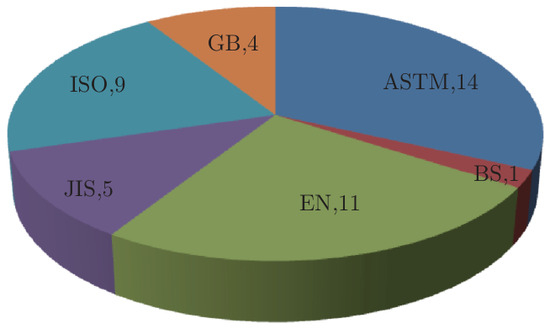
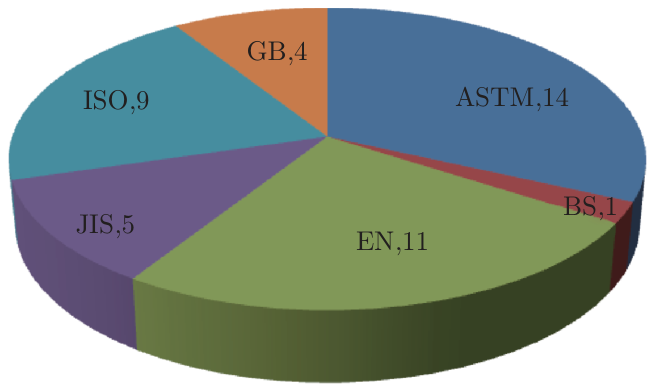
The standards used in this study involve six standard systems. They are the American Society for Testing and Materials (ASTM) standards, EN standards, British Standards (BS), ISO standards, Japanese Industrial Standards (JIS) and China standards (GB). These standard systems and their serial numbers are as shown in Table 1, while the distribution of the standards is shown in Figure 1. ASTM and EN have the larger share of standards (at 14 and 11, respectively), followed in descending order by nine ISO standards, five JIS standards, four GB standards, and one BS standard.
Figure 1.
Distribution of standards for CPC analyzed in the study.
All these standards encompass testing methods for CPC’s protection performance against chemicals, as well as CPC’s classification, performance requirements, selection, usage, and maintenance. Table 2 provides detailed information about these standards and the standard organizations.
Table 2.
Different standard systems for CPC.
3. Result and Discussion
3.1. Analysis of Release Dates of Standards on CPC in Different Standard Systems
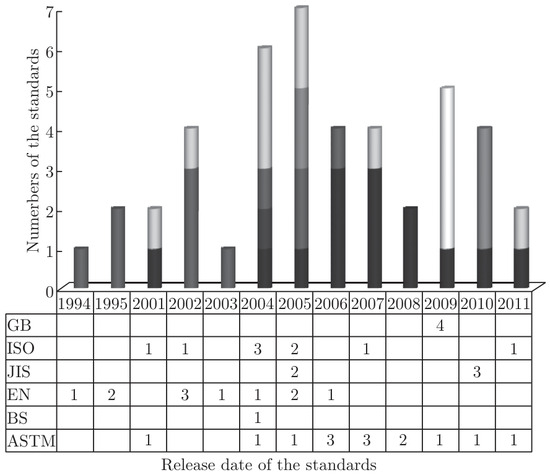
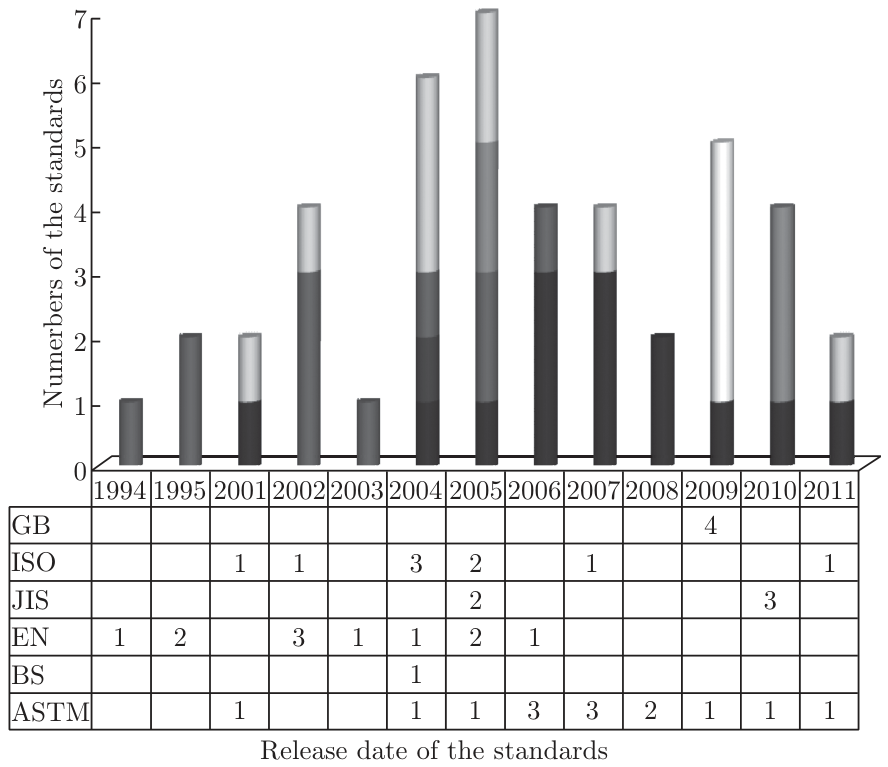
The 44 standards in Table 1 were analyzed according to year of release. The result, as shown in Figure 2, indicates the majority of international standards analyzed in the study were released mainly during 2004-2005, with a greater number in 2005. In contrast, China did not release its standards for CPC until 2009, with the introduction of GB/T 24539-2009 Protective clothing—Performance requirements of chemical protective clothing [38], GB/T 24536-2009 Protective clothing—Selection, use and maintenance of chemical protective clothing [39], GB/T 24540-2009 Protective clothing— Protective clothing against liquid acids and alkalis [40], and GB/T 23462-2009 Protective clothing— Test method for chemical protective materials to permeation by chemicals [41].
Figure 2.
Release date of standards for CPC analyzed in the study.
3.2. Classification of CPC in Different Standard Systems
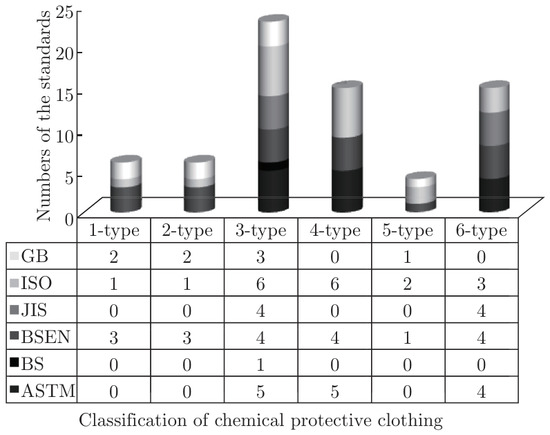
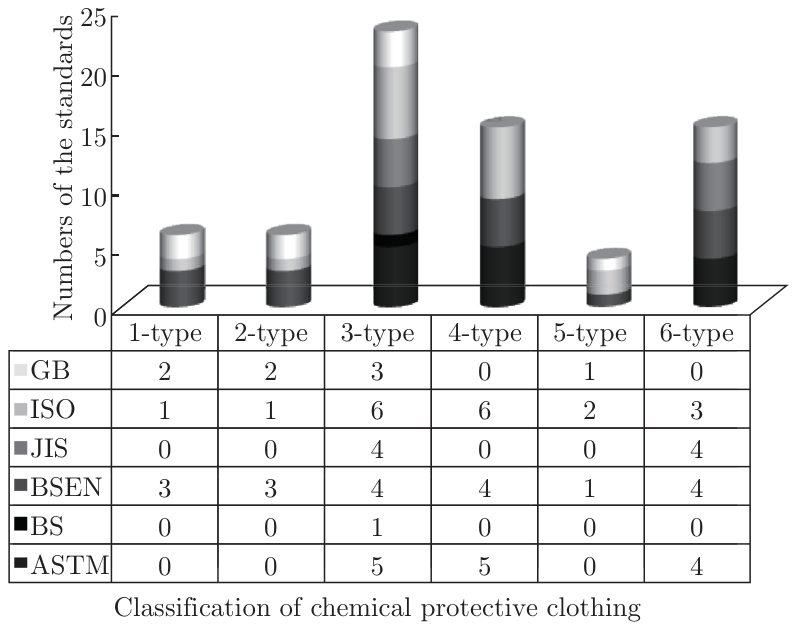
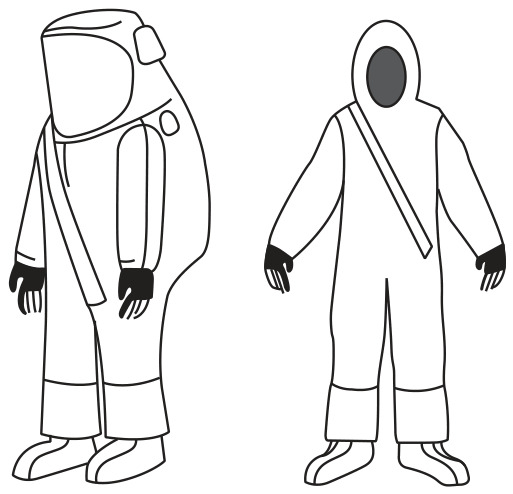
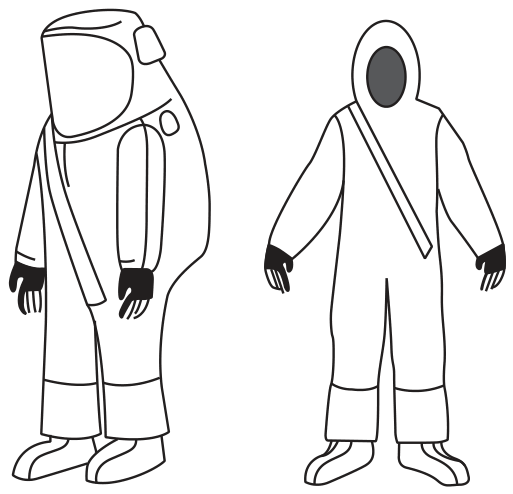
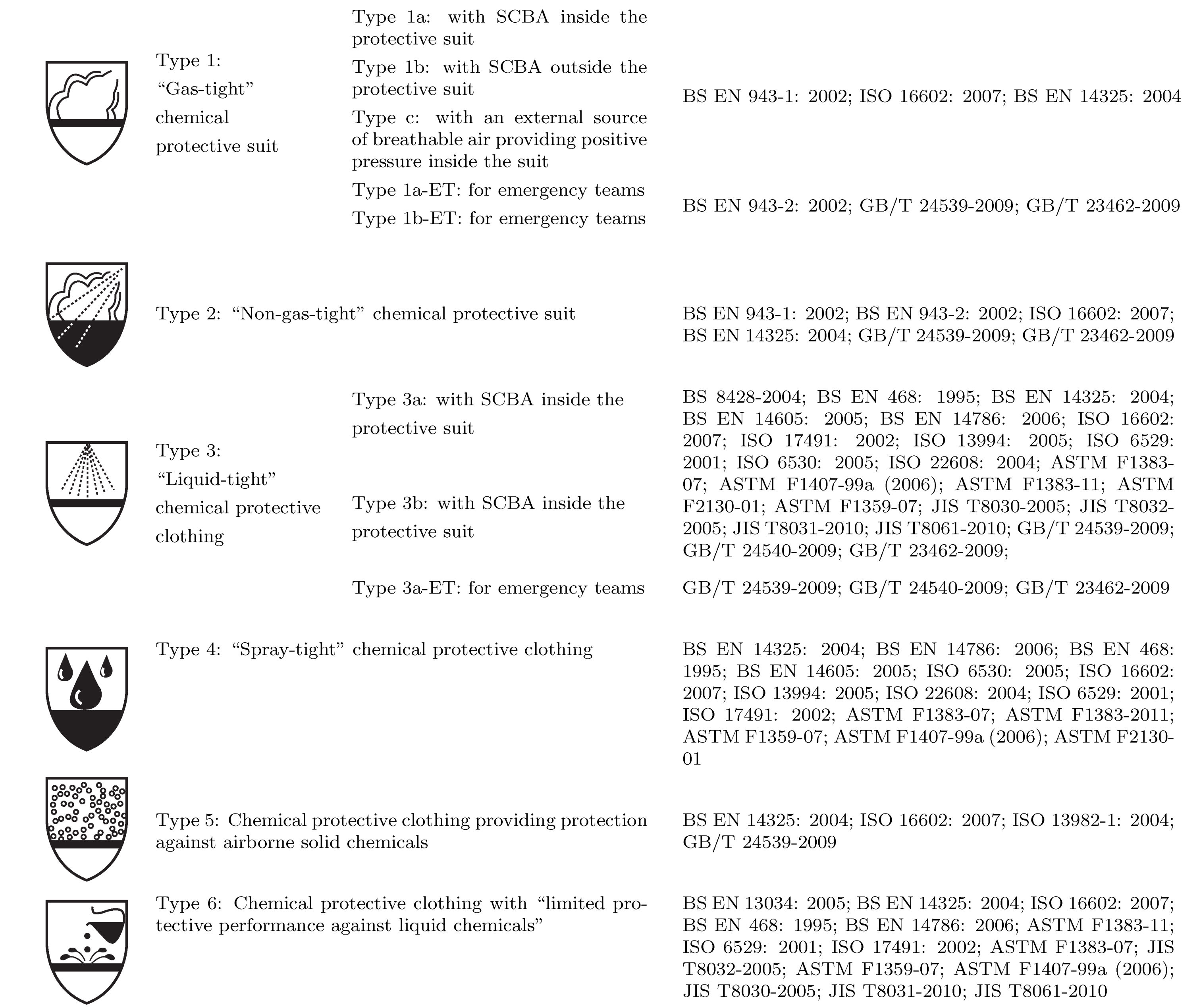
The six standard systems shown in Table 1 use different methods to classify CPC. Among them, EN and ISO standards classify CPC into six categories, though EN standards add a sub-type for emergency teams (ET). GB standards are based mainly on ISO 16602: 2002, classify CPC into four categories, and further subdivide type 2 non-gas-tight protective suits and type 3 liquidtight protective suits with the addition of the new ET sub-type. Table 3 lists the classification of standards according to the six types of CPC and gives the secondary and tertiary classification. The serial numbers corresponding to each type of CPC are also shown in Table 3. Figure 3 presents a statistical analysis of the relationship between protective clothing types and the numbers of the corresponding standards. Figure 4 shows the configurations of the SCBA (self-contained breathing apparatus) both inside and outside the CPC.
Table 3.
Classification of CPC.
Figure 3.
Classification and distribution of selected standards in terms of classification of CPC.
Figure 4.
SCBA inside (left) and outside (right) for CPC.
3.3. Performance Assessment Factors for CPC in Different Standard Systems
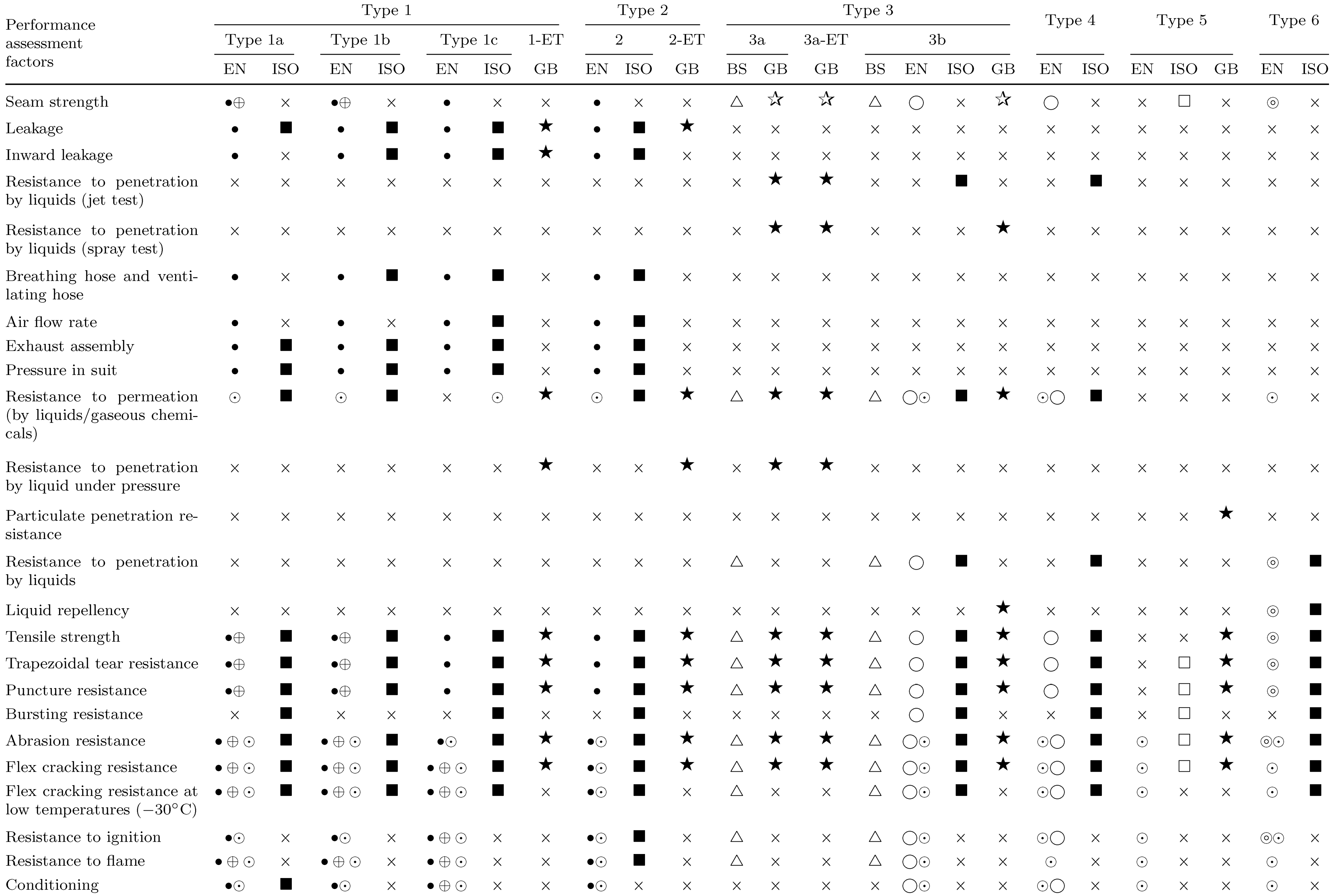
This section presents a comparison of performance assessment factors in different standard systems for the six types of CPC. Among the standards in Table 1, the study compares those that have performance requirements. ASTM and JIS standards, which concentrate mostly on test methods for resistance to permeation and how to wear and maintain CPC, do not list any specifications for performance and therefore are not discussed. To clearly distinguish assessment factors in different standard systems, the study uses different symbols to represent different standards (see Table 4). In Table 5, a comparison of performance assessment factors is shown using the symbols in Table 4 to represent different serial numbers.
Table 4.
Specification of symbols for different standards.
Table 5.
Performance assessment factors for di®erent types of CPC in di®erent standard systems.
Table 5 also shows the types of protective clothing and performance assessment factors covered by the selected standards. Based on the number of symbols, it can be observed that the corresponding standards for all types of CPC list requirements for such performance assessment factors as tensile strength, trapezoidal tear resistance, puncture resistance, bursting resistance, abrasion resistance, flex cracking resistance, flex cracking resistance at low temperatures (−30◦C), and resistance to permeation by liquids/gaseous chemicals (except type 5). Therefore, we can conclude that these performance factors are the most basic for CPC. The EN and ISO standards contain additional assessment factors. Type 1 and type 2 CPC encompass more assessment factors and are covered by more standards. GB standards primarily provide performance requirements for ET CPC.
3.4. Analysis of Minimum Performance Requirements for CPC in Different Standard Systems
Among all the performance assessment factors for CPC listed in Table 5, the minimum performance requirements are different in different standard systems. A comparative analysis of major performance factors is given as follows:
1) Seam strength: This performance assessment factor is required for all six types of CPC. The EN standards for type 4 and type 6 protective clothing specify a seam strength ≥ class 1 (above 30 N); other types of protective clothing with requirements for the performance (see Table 5) specify a seam strength ≥ class 5 (above 300 N). The ISO standards for type 5 chemical protective clothing specify a seam strength ≥ class 1 (above 30 N). The GB standards for type 3 protective clothing against liquid acids and alkalis require a seam strength ≥ 98 N, and for other protective clothing a seam strength ≥ 45 N. The ISO standards do not list any specific requirement for this performance.
2) Leakage: Among the six types of CPC, only type 1 and 2 have requirements for leakage performance (see Table 5). The EN standards require that the pressure drop shall not be greater than 300 Pa (3 mbar) in 6 min. The ISO standards specify a pressure drop ≤ 20%. The GB standards for type 1-ET protective clothing require pressure in suit ≥ 80% of test pressure.
3) Inward leakage: The ISO standards require that inward leakage shall be not greater than 0.05%. The EN standards do not have any requirement for type 1a and type 1b protective clothing on inward leakage, and specify the same requirement for type 1c as the ISO standards. The EN standards for type 5 and type 6 CPC require an inward leakage rate of 1.0 µg/(cm2*min). The GB standards for type 1-ET protective clothing require that no leakage should occur 1 h after liquid jet test, and for type 2-ET protective clothing no leakage should occur 20 min after jet test.
4) Resistance to penetration by liquids: The EN and ISO standards only set requirements for type 6 regarding performance, which pertains to resistance to penetration by liquids ≥ class 2 and ≥ class 3. The GB standards for type 3a and 3a-ET CPC specify that the total stain area caused by liquid penetration shall be less than three times the total calibrated stain area; GB/T 24540-2009 [40] standards for protective clothing against liquid acids and alkalis require that the penetration time should be more than or equal to 30 min. Other standard systems do not specify requirements for this performance.
5) Exhaust assembly: The EN and ISO standards share the same requirement for this performance assessment factor, namely within 1 min, pressure change should be less than or equal to 100 Pa. GB standards do not list a requirement for this performance.
6) Tensile strength: For type 1a, type 1b, and type 2 protective clothing, the EN standards specify a tensile strength ≥ class 3 (>100 N), and the ISO standards require a tensile strength ≥ class 4 (> 250 N). For type 1c protective clothing, the EN and ISO standards share the same requirement, a tensile strength ≥ class 3 (> 100 N). For type 3 liquid-tight protective clothing, BS standards require that tensile strength should meet class 4; EN standards require a tensile strength ≥ class 1; ISO standards require a tensile strength ≥ class 1 (> 30 N). For type 4 chemical protective clothing, ISO standards require a tensile strength ≥ class 1 (> 30 N). For type 6 protective clothing, EN and ISO standards require a tensile strength ≥ class 1.
7) Trapezoidal tear resistance: EN and ISO require that type 1 and type 2 protective clothing shall achieve at least class 3 performance (> 100 N). For type 3, BS requires that the material shall achieve at least class 3 performance, and EN and ISO require that material shall achieve at least class 1 (10 N). For type 4 chemical protective clothing, EN, ISO and GB require that material shall achieve at least class 1 performance, and GB requires that type 1-ET and type 2-ET shall achieve at least class 3 performance (> 40 N). For type 5 and type 6 chemical protective clothing, EN and ISO require that they shall achieve at least class 1 performance.
8) Puncture resistance: EN and ISO for this performance both require that type 1, type 2, and type 3 protective clothing shall achieve at least class 2 performance (puncture resistance > 10 N), and that type 4, type 5, and type 6 protective clothing shall achieve at least class 1 performance (puncture resistance > 5 N). GB standards require that type 1-ET protective clothing shall achieve at least class 3 (puncture resistance > 50 N), type 2-ET protective clothing shall achieve at least class 2, and type 3 protective clothing shall achieve at least class 1.
9) Abrasion resistance: EN standards for type 1a, type 1b, and type 2 protective clothing require that the used material shall achieve at least class 3 performance (abrasion cycles to specified damage > 500) or pressure difference within 1 min after abrasion shall not exceed 100 Pa, and ISO standards require that the used material shall achieve at least class 4 performance (abrasion cycles to specified damage > 1, 000). EN and ISO standards for type 1c protective clothing share the same requirement that the used material shall achieve at least class 3 performance (abrasion cycles to specified damage > 500). BS requires that type 3 protective clothing shall achieve at least class 4 performance. EN and ISO standards for type 3, type 4, type 5, and type 6 protective clothing require that the used material shall achieve at least class 1 performance (abrasion cycles to specified damage > 10). GB standards require that type 3 protective clothing shall stand at least 100 abrasion cycles to specified damage.
10) Flex cracking resistance: For the six types of CPC, EN and ISO set the same requirement, namely that they shall achieve at least class 1 performance (flexing cycles to specified damage > 1, 000) or the pressure change between unflexed material and flaxed material in 1 min shall not exceed 0.1 kPa. GB standards specify that type 1-ET and type 2-ET protective clothing shall achieve at least class 4 performance (flexing cycles to specified damage > 15, 000).
11) Flex cracking resistance at low temperatures (−30◦C): EN and ISO standards for type 1 and type 2 protective clothing both require that they shall achieve at least class 2 performance (flexing cycles to specified damage > 200), and for type 3 and type 4 protective clothing both require that they shall achieve at least class 1 performance (flexing cycles to specified damage > 100). BS standards require that type 3 protective clothing shall achieve at least class 2 performance (flexing cycles to specified damage > 200). EN standards for type 5 and type 6 protective clothing require that pressure difference in 1 min shall not exceed 100 Pa; ISO requires that type 5 and type 6 shall achieve at least class 1 performance (flexing cycles to specified damage > 100). GB standards do not have any requirement for this performance.
4. Conclusions
Through a comparative analysis of China’s national standards and international standard systems for CPC, it can be observed that the most basic performance assessment factors for all types of CPC are tensile strength, trapezoidal tear resistance, puncture resistance, bursting resistance, abrasion resistance, flex cracking resistance, flex cracking resistance at low temperatures (−30◦C), and resistance to permeation by liquids/gaseous chemicals (except type 5). The EN and ISO standards include additional assessment factors. But for many performance assessment factors, EN sets higher requirements than ISO. Type 1 and type 2 CPC encompass more assessment factors and are covered by more standards. ASTM and JIS standards do not list any specifications for performance, but instead focus mostly on test methods for resistance to permeation and how to wear and maintain CPC. GB standards for CPC largely were formed by revising and supplementing ISO 16602: 2002. GB standards mainly give detailed requirements for type 1ET, type 2-ET, type 3a-ET, and type 5 protective clothing, as a supplement to the previous international standards, which seldom mentioned these requirements. However, GB standards do not specify requirements for other types of protective clothing, and moreover they set quite low requirements for some performance items.
Acknowledgments
The authors would like to acknowledge the funding support from the research project 10-202 of the State Administration of Work Safety.
References
- OSHA 3151-2R; Personal protective equipment. U.S. Department of Labor: Occupational Safety and Health Administration, 2003.
- NIOSH/OSHA/EPA/USCG. Occupational safety and health guidance manual for hazardous waste site activities. Cincinnati, OH: U.S. Department of Health Services, Public Health Service, Centers for Disease Control, National Institute for Occupational Safety and Health, DHHS (NIOSH) Publication No. 85-115. 1985.
- NIOSH. Guide to industrial respiratory protection. Cincinnati, OH: U.S. Department of Health Services, Public Health Service, Centers for Disease Control, National Institute for Occupational Safety and Health, DHHS (NIOSH) Publication No. 87-116, 1987.
- Perkin, J. Chemical protective clothing, vol. I: selection and use. Appl. Ind. Hyg. 1987, 2(6), 222–230. [Google Scholar] [CrossRef] [Scilit]
- Perkin, J. Chemical protective clothing, vol. II: program considerations. Appl. Ind. Hyg. 1988, 1(3), 1–4. [Google Scholar] [CrossRef] [Scilit]
- Crull, A.W. Protective clothing and gear: body/vehicle armor, fire, chem./bio. Business Opportunity Report GB-142V. Business Communications Company, 2005; pp. 144–145.
- ASTM F 1194-99; Standard guide for documenting the results of chemical permeation testing. ASTM International: West Conshohocken, PA, 2005.
- ASTM F 1383; Standard test method for permeation of liquids and gases through protective clothing materials under conditions of intermittent contact. ASTM International: West Conshohocken, PA, 2007.
- ASTM F 1407-99a. Standard test method for resistance of chemical protective clothing materials to liquid permeation|permeation cup method. West Conshohocken, PA: ASTM International. 2006.
- ASTM F 1001-99a; Standard guide for selection of chemicals to evaluate protective clothing material. ASTM International: West Conshohocken, PA, 2006.
- ASTM F 903-03; Standard test method for resistance of materials used in protective clothing to penetration by liquids. ASTM International: West Conshohocken, PA, 2004.
- ASTM F 2130; Standard test methods for measuring repellency, retention, and penetration of pesticide formulation through protective clothing material. ASTM International: West Conshohocken, PA, 2001.
- ASTM F 1359; Standard test methods for liquid penetration resistance of protective clothing or protective ensembles under a shower spray while on a mannequin. ASTM International: West Conshohocken, PA, 2007.
- ASTM F 2053-00; Standard guide for documenting the results of airborne particle penetration testing of protective clothing materials. ASTM International: West Conshohocken, PA, 2006.
- ASTM F 1461; Standard practice for chemical protective clothing program. ASTM International: West Conshohocken, PA, 2007.
- ASTM F 2061; Standard practice for chemical protective clothing: wearing, care, and maintenance instruction. ASTM International: West Conshohocken, PA, 2008.
- ASTM F 1296; Standard guide for evaluating chemical protective clothing. ASTM International: West Conshohocken, PA, 2008.
- ASTM F 1383; Standard test method for permeation of liquids and gases through protective clothing materials under conditions of intermittent contact. ASTM International: West Conshohocken, PA, 2011.
- ASTM F 2669; Standard performance specification for protective clothing worn by operators applying pesticides. ASTM International: West Conshohocken, PA, 2009.
- ASTM F 1194-99; Standard guide for documenting the results of chemical permeation testing of materials used in protective clothing. ASTM International: West Conshohocken, PA, 2010.
- BS 8428; Protective clothing—Protection against liquid chemicals—Performance requirements for chemical protective suits with liquid-tight connections between different parts of the clothing for emergency teams (type 3-ET equipment). British Standards Institution: London, UK, 2004.
- BS EN 943-1; Protective clothing against liquid and gaseous chemicals, including liquid aerosols and solid particles—part 1: performance requirements for ventilated and non-ventilated “gas-tight” (type 1) and “non-gas-tight” (type 2) chemicals protective suits. British Standards Institution: London, UK, 2002.
- BS EN 943-2; Protective clothing against liquid and gaseous chemicals, including liquid aerosols and solid particles—part 2: performance requirements for “gas-tight” (type 1) chemical protective suits for emergency teams (ET). British Standards Institution: London, UK, 2002.
- BS EN 13034; Protective clothing against liquid chemicals—performance requirements for chemical protective clothing offering limited protective performance against liquid chemicals (type 6 and type TB[6] equipment). British Standards Institution: London, UK, 2005.
- BS EN 14605; Protective clothing against liquid chemicals—performance requirements for clothing with liquid-tight (type 3) or spray-tight (type 4) connections, including items providing protection to parts of the body only (types PB[3] and PB[4]). British Standards Institution: London, UK, 2005.
- BS EN 14325; Protective clothing against chemicals—test methods and performance classification of chemical protective clothing materials, seams, joins and assemblages. British Standards Institution: London, UK, 2004.
- BS EN 14786; Protective clothing—determination of resistance to penetration by sprayed liquid chemicals, emulsions and dispersions—atomizer test. British Standards Institution: London, UK, 2006.
- BS EN 13595-4; Protective clothing for professional motorcycle riders—jackets, trousers and onepiece or divided suits—part 4: test method for determination of impact cut resistance. British Standards Institution: London, UK, 2002.
- BS EN 1621-2; Motorcyclists’ protective clothing against mechanical impact—part 2: motorcyclists’ back protectors—requirements and test methods. British Standards Institution: London, UK, 2003.
- BS EN 464; Protective clothing—protection against liquid and gaseous chemicals, including liquid aerosols and solid particles—test method: determination of leak-tightness of gas-tight suits (internal pressure test). British Standards Institution: London, UK, 1994.
- BS EN 463. Protective clothing—protection against liquid chemicals—test method: determination of resistance to penetration by a jet liquid (jet test); British Standards Institution: London, UK, 1995. [Google Scholar]
- BS EN 468. Protective clothing—protection against liquid chemicals—test method: determination of resistance to penetration by spray (spray test); British Standards Institution: London, UK, 1995. [Google Scholar]
- JIS T 8030; Protective clothing—protection against chemicals—determination of resistance of protective clothing materials to permeation by liquids and gases. Japanese Industrial Standard Association: Tokyo, Japan, 2005.
- JIS T 8032; Protective clothing—protection against gaseous and liquid chemicals—determination of resistance of protective clothing to penetration by liquids and gases. Japanese Industrial Standard Association: Tokyo, Japan, 2005.
- JIS T 8031; Clothing for protection against liquid chemicals—determination of the resistance of protective clothing materials to penetration by liquids under pressure. Japanese Industrial Standard Association: Tokyo, Japan, 2010.
- JIS T 8061; Clothing for protection against contact with blood and body fluids—determination of resistance of protective clothing materials to penetration by blood-borne pathogens—test method using Phi-X174 bacteriophage. Japanese Industrial Standard Association: Tokyo, Japan, 2010.
- JIS T 8115; Protective clothing for protection against chemicals. Japanese Industrial Standard Association: Tokyo, Japan, 2010.
- GB 24539; Protective clothing—performance requirements of chemical protective clothing. PRC State Administration of Quality Supervision, Inspection and Quarantine: Beijing, China, 2009.
- GB 24536; Protective clothing—selection, use, maintenance of chemical protective clothing. PRC State Administration of Quality Supervision, Inspection and Quarantine: Beijing, China, 2009.
- GB 24540; Protective clothing—protective clothing against liquid acids and alkalis. PRC State Administration of Quality Supervision, Inspection and Quarantine: Beijing, China, 2009.
- GB 23462; Protective clothing—test method for chemical protective materials to permeation by chemicals. PRC State Administration of Quality Supervision, Inspection and Quarantine: Beijing, China, 2009.
- ISO 6529. Protective clothing—protection against chemicals—determination of resistance of protective clothing materials to permeation by liquids and gases; International Organization for Standardization: Geneva, Switzerland, 2001. [Google Scholar]
- ISO 6530. Protective clothing—protection against liquid chemicals—test method for resistance of materials to penetration by liquids; International Organization for Standardization: Geneva, Switzerland, 2005. [Google Scholar]
- ISO 13982-2; Protective clothing for use against solid particulates—part 2: test method of determination of inward leakage of aerosols of fine particles into suits. International Organization for Standardization: Geneva, Switzerland, 2004.
- ISO 16602; Protective clothing for protection against chemicals—classification, labeling and performance requirements. International Organization for Standardization: Geneva, Switzerland, 2007.
- ISO 17491. Protective clothing—protection against gaseous and liquid chemicals—determination of resistance of protective clothing to penetration by liquids and gases; International Organization for Standardization: Geneva, Switzerland, 2002. [Google Scholar]
- ISO 22608; Protective clothing—protection against liquid chemicals—measurement of repellency, retention, and penetration of liquid pesticide formulations through protective clothing materials. International Organization for Standardization: Geneva, Switzerland, 2004.
- ISO 13994. Clothing for protection against liquid chemicals—determination of the resistance of protective clothing materials to penetration by liquids under pressure; International Organization for Standardization: Geneva, Switzerland, 2005. [Google Scholar]
- ISO 13982-1; Protective clothing for use against solid particulates—part 1: performance requirements for chemical protective clothing providing protection to the full body against airborne solid particulates (type 5 clothing). International Organization for Standardization: Geneva, Switzerland, 2004.
- ISO 27065. Protective clothing—performance requirements for protective clothing worn by operators applying liquid pesticides; International Organization for Standardization: Geneva, Switzerland, 2011. [Google Scholar]


© 2013 Textile Bioengineering and Informatics Society. This article is an open access article distributed under the terms and conditions of the Creative Commons Attribution (CC BY) license (https://creativecommons.org/licenses/by/4.0/).