


Abstract
The moisture transmission behaviour of clothing plays an important role in determining its thermophysiological comfort. The determination of the factors involved in moisture transmission of clothing and its prediction have become a main concern for researchers for many years. An attempt has been made to review the research studies on modeling and simulation of moisture transmission through fibrous assemblies. The review work has been divided in two parts. The first part deals with moisture vapour transmission and the second with liquid water transmission through fibrous materials. The various processes involved in water vapour transmission through fibrous materials are diffusion, absorption – desorption, convection, evaporation and condensation. The models on water vapour transmission through fibrous materials are based on the mass balance equation. Some of the studies involving theoretical work on vapour transmission have been conducted on individual processes. Others consider the inter-related effects involved. Moisture vapour transmission through textile materials is coupled with heat transfer phenomena, due to its hygroscopic nature. The atmospheric conditions, the structure of the fibrous materials and the hygroscopic nature of the fibres significantly influence the processes. Amongst the available models on vapour transmission, the model developed by Li and Zhu predicts simultaneous heat and moisture transfer considering moisture sorption, condensation and capillary liquid diffusion in porous textiles and this model is best suited for determining textile clothing comfort.
1. Introduction
Clothing is generally used to cover the human body. It may work as a fashion item or as a barrier against aggressive environmental conditions, including chemical and biological hazards. The functional properties of clothing have been a concern since ancient times. The factors which influence the choice of clothing depend upon its end use. One of the most important functions of clothing is to provide thermal comfort to the wearer [1]. In regular atmospheric conditions and during normal activity levels, the heat produced by the metabolism is liberated from the body to the atmosphere by conduction, convection and radiation.
The perspiration produced by the body is used to regulate the body temperature. During high levels of activity and in higher atmospheric temperatures, the production of heat is very high and the transmission of heat from the body to the atmosphere is not sufficient to keep the body temperature in the comfort zone. In these cases, the sweat glands are activated to produce perspiration [2]. The vapour form of perspiration is known as insensible perspiration and the liquid form as sensible perspiration. When the perspiration is transferred to the atmosphere, it carries heat (both latent and sensible) thus reducing the body temperature.
The fabric being worn should allow the perspiration to pass through; otherwise it will result in discomfort. The perception discomfort in the active case depends on the degree of skin wetness. It is also important to reduce the degradation of thermal insulation caused by moisture build-up. If the ratio of evaporated sweat to produced sweat is very low, moisture will accumulate in the inner layer of the fabric system, thus reducing the thermal insulation of clothing and causing unwanted loss of body heat [3]. Therefore, both in hot and cold weather conditions and during normal and high activity levels, moisture transmission through fabrics plays a major role in maintaining the wearer’s body in comfort. Textile clothing is a capillary and porous material system with different pore sizes, and it may be saturated with both liquid and gaseous water during wear. The transport of perspiration through this material system at different temperatures is a very complex process, which involves convection, capillary flow, penetration, molecular diffusion, evaporation and solidification. Hence, a clear understanding of the processes involved in moisture transmission and the role of different processes in maintaining the body comfortable is of great importance [4,5].
The phenomenon of water vapour transmission through textile materials has been widely investigated by a number of researchers and they have provided a clearer understanding by modeling the moisture transmission phenomenon through textile materials. However, due to the complexity of fibrous structures and the complicated relationship of the various factors involved, most of the predictions remain empirical in nature. Currently, many new tools such as artificial neural networks, computational fluid dynamics, fuzzy logic and genetic algorithms are being used to simulate the actual conditions. However, before using such tools it is necessary to understand the science behind the transmission phenomena. These tools have to be used with care and experience as they are also prone to give misleading results if used with improper initial and boundary conditions and inappropriate functions.
2. Moisture Transmission through Fibrous Structures
Mass transmission through fibrous materials takes place both in liquid and vapour form. The process of moisture transport through clothing under transient humidity conditions is an important factor which influences the dynamic comfort of the wearer in practical use.
2.1. Water Vapour Transmission
Water vapour is transferred through fibrous materials in several ways: (i) Diffusion of the water vapour through the fibrous layers, (ii) Absorption, transmission and desorption of water vapour by the fibres and (iii) Transmission of water vapour by forced convection [6,7]. Diffusion of water vapour molecules through air spaces in fabrics is a major contributor to moisture vapour transport. The other transfer processes mentioned, involve smaller amounts of moisture vapour. These processes are more complex than the diffusion processes and can significantly contribute to clothing comfort [8].
2.1.1. Diffusion Process
In the diffusion process, transmission of moisture from one side to the other of a porous material takes place due to the presence of a vapour pressure gradient. The governing equation for diffusion is given by Fick’s Law [9,10].
where, JAx is the rate of moisture flux; is the concentration gradient; and DAB is the diffusion coefficient or mass diffusivity of one component diffusing through another media.
The species concentration for one-dimensional mass transfer is given by the following equation:
For three dimensional mass transfers through the element, the governing equation is
where RA is the mass produced due to some chemical reaction, CA is the moisture concentration and t is time.
The diffusion co-efficient of water vapour in air can be given as a function of temperature and pressure by the following equation [11]:
where Da is the diffusion co-efficient in bulk air (m2/sec), θ is the actual temperature (K), θ0 is the temperature at standard condition (K), P is the actual pressure (bar) and P0 is the atmospheric pressure (bar).
Water vapour can diffuse through a textile structure in two ways, simple diffusion through the air spaces between the fibres and yarns and along the fibre itself [12]. In the case of diffusion along the fibre, water vapour diffuses from the inner surface of the fabric to the fibres’ surface and then travels along the interior of the fibres and its surface, reaching the outer fabric surface. The diffusion flux through the textile material also depends on the concentration of water vapour in the inter fibre void space [13]. The equation of conservation of mass is given as:
where Ca and Cf are moisture concentrations in air and on fibres respectively, ε is the porosity of the material, k is a factor related to the diffusion co-efficient of water vapour in air in textile assembly.
In the case of hydrophilic fibre assemblies, vapour diffusion is governed by a non-Fickian, anomalous diffusion [14,15]. This is a two stage diffusion process. The two stage phenomenon has been first expressed by Nordon and David [15]. The first stage corresponds to a Fickian diffusion with a constant diffusion coefficient, but the second stage is a non-Fickian diffusion associated with viscoelastic relaxation of the fibre structure [16]:
where R1 is the first stage moisture sorption rate of fibres, R2 is the second stage moisture sorption rate of fibres, p is the proportion of uptake that occurs during the second stage.
The first stage moisture sorption rate of fibres R1 can be obtained by considering that the sorption process is a radial diffusion of moisture in a cylindrical medium, governed by the following relationship [17]:
where, Df is the diffusion coefficient of the fibre and r is the radius of the cylinder.
The second stage is much slower than the first, following an exponential relationship between the concentration gradient and the vapour flux [18,19]. The second stage sorption rate (R2) is related to the local temperature, humidity and sorption history of the fibre at each point in the fabric, which is assumed to have the following form [20,21]:
where, s1 and s2 are constants for each fibre, HA and HF are the relative humidy of air and the moisture content in the fibre respectively.
Generally, the diffusion coefficient of fibres increases with the increase in moisture concentration in them. In the case of blended fabrics absorption of moisture by the hygroscopic fibres, affects the response of the fabrics to the moisture gradient [22]. Hence, for simplification, it is better to discuss the diffusion process in non-hygroscopic and hygroscopic cases separately. Bejan et al. [23] explained a non-hygroscopic material as an inert solid phase. The effective diffusivity in that case can be determined by the following equation:
where, ε and τ are porosity and tortuosity of the fabric, Deff is the effective diffusivity of the fabric and Da is the diffusion co-efficient in bulk air.
Effective moisture diffusivity in non-woven fabrics made up of non-hygroscopic material have been predicted by them [23] using the following equation:
where, P is the optical porosity corresponding to the air fraction, s is the fibre shape factor and Vf is fibre volume fraction.
Deff = DaP + Da(1 − Vf − P)(1 − P)/(1 + sVf − P)
Due to the influence of moisture absorption, the diffusion coefficient of a hygroscopic material has been discussed in the subsequent section. The water vapour transmission through fabrics increases with the increase in moisture content and with the condensation of water in the fabric [24]. When the fabric moisture content rises above the saturation region of the fibre, liquid water will be present in the capillaries within the fabric structure or at the fibre surface. This exchange of water is called an evaporation-condensation process. Crank [25] described this process mathematically, by the following equation:
where Cfs is the moisture concentration on the fibre surface, hcf is the mass transfer coefficient at the fibre surface and Sv is the specific volume of the fabric.
2.1.2. Sorption-Desorption Process
Sorption-desorption are important processes to maintain the microclimate during transient conditions. A hygroscopic fabric absorbs water vapour from the humid air close to the sweating skin and releases it in dry air. This enhances the flow of water vapour from the skin to the environment comparatively to a fabric which does not absorb and reduces moisture built up in the microclimate [26,27]. In the absorption-desorption process an absorbing fabric works as a moisture source to the atmosphere. Considering a hygroscopic fibre as a dynamic sink, the transient behaviour of fabric is analysed by the following equation [28]:
Sorption kinetics in a diffusion process is described as
Barnes and Holcombe [26] examined the magnitude of the difference in moisture transport caused by fabric sorption and its effect on the wearer’s perception. Adsorption of water molecules takes place below a critical temperature, due to the Vander Waal’s forces between the vapour molecules and the solid surface of the structure. At higher vapour pressure and lower temperature, a higher amount is absorbed. In a thermodynamic equilibrium the chemical potential of vapour is equal to that of the absorbed film. An increase in vapour pressure causes an imbalance in chemical potential and more vapour transfers to the absorbed layer to restore the equilibrium. The amount of water vapour which can be absorbed by the materials is dependent on the fibre regain and the humidity of the atmosphere (%). In the case of absorbent fibres, e.g. wool, silk, cotton, rayon, the moisture sorption is not only dependent on regain and humidity, but also on the phenomena associated with sorption hysteresis, the effect of heat, dimensional changes and elastic recovery effects, due to the reduced swelling of the fibres. In transient conditions, the water vapour transmission through a blended fabric increases with the increase in the hygroscopic fibre percentage of the fabric [29]. This is due to the contribution of the sorption-desorption process of the hygroscopic fibre in transmitting water vapour from one side of the material to the other and also to the diffusion process involved in the transfer mechanism. In an experiment conducted by Das and Kothari [30], it has been observed that the Water Vapour Permeability (WVP) index of cotton fabrics measured by the cup method, decreases as time increases. The swelling phenomenon is likely to affect the vapour transmission by diffusion over a long period of time, resulting in a lower water permeability index. During swelling, the fibre macro-molecules or micro-fibrils are pushed apart by the absorbed water molecules, reducing the pore size between the fibres as well as the yarns, thus reducing the water vapour transmission through the fabric. Also, the distortion caused by swelling sets up internal stresses which influence the moisture sorption process. By the use of thermodynamics Morton and Hearle [14] have given a quantitative relation between swelling, moisture absorption and the mechanical properties of the fibrous material:
where V is the volume of the fibrous material, ∂p is change in force, ∂ρ is change in moisture regain and ∂x,∂y,∂z are displacements in the x,y and z directions respectively.
Downes and Mackay [31] pointed out that the kinetics of the uptake of water vapour by wool is a two stage process. The relative contributions of the two stages to the total uptake vary with the initial regain. A uniform diffusion equation for both stages of sorption has been given by Li and Luo [20,32]:
where Df(x,t) are the diffusion coefficient of the fibre that has different presentations at different stages of sorption and x is the coordinate of a fibre in the given fabric and r is cylinder radius, T(x,t) is the temperature at a given time and fibre coordinate.
2.1.3. Convection Process
Convection is a mode of moisture transfer that takes place while air is flowing over a moisture layer; the process is better described as forced convection. The process is governed by the following equation [33]:
where Qm is the mass flow by convection through the area A of the fabric along the direction of the flow, Cfab is the vapour concentration on the fabric surface and Ca is the moisture concentration in air.
Qm = −Ahm(Cfab − Ca)
The flow is controlled by the concentration difference (Cfab − Ca) and the convective mass transfer coefficient hm, which depends on the fluid properties as well as on its velocity. During the evaporation of liquid perspiration, latent heat is taken from the body, cooling it down. The role of evaporative heat transfer in maintaining thermal balance becomes more crucial with an increase in the surrounding atmospheric temperature. When a negative temperature gradient exists between the skin and the environment, evaporative heat transfer becomes the only way to cool down the body temperature. Since the latent heat of water is quite large (2500 kJ/kg), even a small amount of evaporation adds significantly to the total heat flow [34]. Wind enhances the sensible and latent loss and results in additional cooling that is desirable in periods of peak performance. In an experimental work it has been found that under windy condition the convection process plays a major role in water vapour transmission through fabrics and the moisture vapour transmission rate of cotton fabrics increases with wind speed [30].
In the steady state, the latent heat lost by water due to evaporation is equal to the heat that comes to the water from the surrounding air, making it cooler. In that case the energy balance equation at the air-water interface is as follows:
where qconv is the convective heat transfer from the surrounding air to the water and qevap is the heat taken from the water due to evaporation.
qconv = qevap
When internal ventilation coefficients are known at the skin, then the steady periodic time averaged sensible and latent heat losses per unit area from the skin are calculated, respectively, as [35]:
where, Qs and QL is the sensible and latent heat of ventilation respectively, Tsk is the skin temperature, Ta is the air temperature, Psk is the skin vapour pressure, Pa is the air vapour pressure, hc(skin−air), hm(skin−air) is the mass transfer coefficient between the skin and the air layer, hfg is the heat of evaporation of water.
3. Modeling of Moisture Vapour Transmission
Prior to mathematical modeling of moisture transmission through fibrous materials (porous media), the dependency of the relevant material characteristics and the mass and energy balance at equilibrium must be considered [36]. A general mathematical model on heat and mass transfer through porous media is constructed by using the conservation equations of heat and mass transfer. The models developed on vapour and liquid transmission also contemplate the heat transfer. Heat and mass conservation equations in porous media are coupled and, in general, solved by using the values of temperature and moisture content from previous iterations to calculate the source terms.
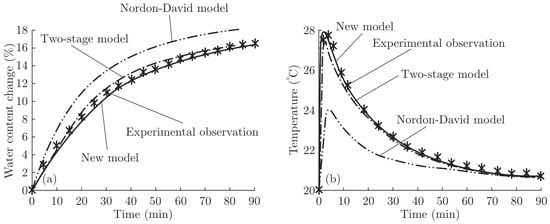
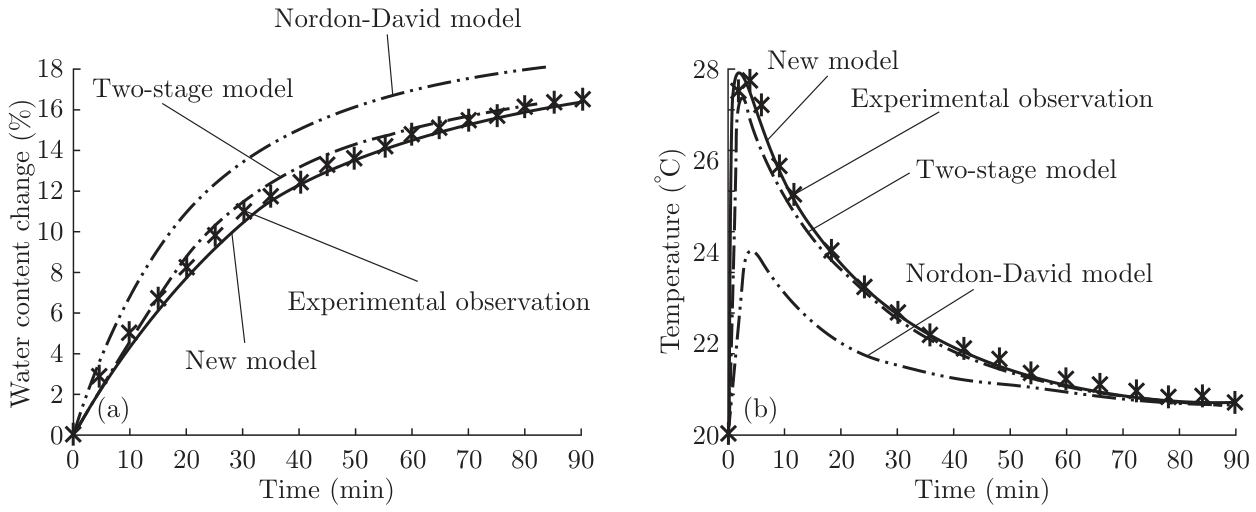
Several models have been developed by researchers with the objective of better understanding the diffusion phenomenon through textile materials. Wehner et al. [20] presented two mathematical models of the diffusion of vapour through a textile material, considering that: (1) The moisture diffusion within fibres is very rapid; (2) The moisture diffusion within fibres is very slow. Their model considers both the moisture flux through the air and the diffusion through the fibre interior. However, in this model the non-Fickian diffusion through the fibres, which occurs at a later stage, has not been considered. Li et al. [19,20] have considered the two stage sorption process. They have explained two sets of variables of the diffusion coefficient: a moisture content dependent coefficient for the 1st stage and a time dependent coefficient for the 2nd stage. They have used the equations of conservation of mass and energy and the sorption rate equation. The experimental verification of the model has been done conducting an experiment of water uptake of wool fabric during sorption using a sorption cell apparatus, developed by them. Their model fits well with the experimental data as shown in Figure 1 [20,6].
Figure 1.
Theoretical prediction of water uptake (a) and temperature (b) at the fabric surface in comparison with experimental observations.
The theoretical prediction from this model shows that the moisture diffusion into a hygroscopic fabric during humidity transient conditions is largely determined by two processes, i.e. the moisture sorption of the fibre and the coupling effect of heat transfer in the fabric. The model provides useful information to understand the science of thermal comfort in hygroscopic materials in transient conditions. Based on the two stage model of coupled heat and moisture transfer the warm/ cool effect upon contact has been studied [37]. The model can be applied to the case of the practical wearer in which regular contact between the skin and the fabric occurs with respect to the warm/ cool effect. These models consider moisture flow in vapour form only and the interaction of heat due to sorption phenomenon. The mathematical model of simultaneous heat and moisture transfer developed by Li and Zhu [38], considers moisture of sorption, condensation and capillary liquid diffusion in porous textiles. During the development of this model it has been hypothesized that liquid transport by capillary action is coupled with the process of moisture sorption in textile fibres. The authors have taken a series of complex coupling effects between heat transfer and moisture transfer processes, including heat transfer by conduction and moisture transfer by water vapour diffusion, liquid capillary action and moisture sorption of fibres. They have developed an equation describing liquid diffusion behaviour, in the form of the diffusion coefficient:
where Dl is the liquid diffusivity, ε is the porosity of the textile material, ε1 is the volume fraction of the liquid phase, dc is the largest effective radius of the capillary, determined by the pore size distribution in the fabrics, σ is the density of the fibre, φ is the contact angle, β is the average angle of capillaries in fabrics and η is the viscosity of the liquid.
In order to validate the model porous materials made of polyester and wool fibre have been used. The model is found to fit the experimental data well, for both hydrophobic and hydrophilic materials. The model is suitable for the study of clothing comfort and processing technologies in textiles and clothing, where liquid water transport becomes significant.
The heat released or absorbed within a hygroscopic textile layer with the change in humidity or temperature, is often physiologically very significant. The equilibrium amount of moisture absorbed by a fibre assembly is a function of relative humidity and temperature. Le and Ly [39] developed a model for the interactive heat and mass transfer during the forced convection of steam through an absorbing fibrous media. They have calculated the changes in temperature of the condensing front due to the flow of steam. They have used Darcy’s law of fluid flow to describe the steam penetration through the media, but only the forced convectional flow of moisture, which is in the gas phase, has been considered. Nishimura and Matsuo [40] have numerically simulated the moisture transmission through a fibre assembly using a very simple approach. They have considered the fibre assembly consisting of two rectangular areas occupied by fibrous material and air space. Their model can predict the changes in moisture concentration distribution with time and the absorption rate from the air space in the fibrous material. Luo and Xu [41] have presented a 2D model based on Fick’s second law and the mass conservation law to understand the internal process of heat and moisture transfer in fibrous media:
where C denotes the moisture concentration, Da is the diffusion co-efficient through air and Df is the diffusion co-efficient through the fibre. Eq. (21) denotes the air space and Eq. (22) denotes the fibrous material; these equations are dimensionless (the dimensionless parameters are indicated by asterisks).
Gibson and Charmchi [42] have developed a mathematical model of the convection and diffusion processes in textiles with inclusion of humidity dependent air permeability. They developed a set of partial differential equations to describe time dependant heat and mass transfer through porous hygroscopic materials, incorporating different important factors such as swelling of the fibre due to water imbibition and the heat of sorption evolved when the water is absorbed by the polymer matrix, in the appropriate conservation and transport equations.
The gas phase of the continuity equation is described as:

The gas phase of the convection/diffusion equation is described as:

The total thermal energy equation is described as:

The gas phase equation of motion for the porous media is described as:
 where T is the temperature, K is the thermal conductivity, µ is the gas viscosity, V is the volume, p is the pressure.
They have used the controlled volume finite difference method to solve the system of equations representing the convection/diffusion process and for the experimental purpose the Dynamic Moisture Permeable Cell (DMPC) has been used to validate the theoretical results. Their approximation for the humidity dependant permeability works well for the situation where the high humidity flow is being forced through the fabric, but does not match the experimental data as closely, in the case of low humidity flow. They have also developed a model using the volume average technique to predict the transient temperature changes and equilibration time during vapour transmission through a hygroscopic porous material, in the presence of convective flow [43]. The movements of air under clothing may be seen as an inner wind. Its velocity is a parameter difficult to be measured. It depends on the measuring site and on the air gap width. Body movement and wind speed both play important roles on the intrinsic air speed value. Backward and forward motions of clothing relatively to the body, during exercise and in a windy environment create a pumping effect [44]. The air penetrates through the pores and apertures, stays some time under the garment, then is evacuated and replaced by another volume of the ambient air. With the increase in the activity level, the time the air is trapped becomes shorter leading to increased convective mass losses. The convection coefficient in an air gap is a linear relation of the square root of the intrinsic wind speed [45]:
where, hcl is the convection coefficient in Wm−2K−1 and vin is the intrinsic velocity.
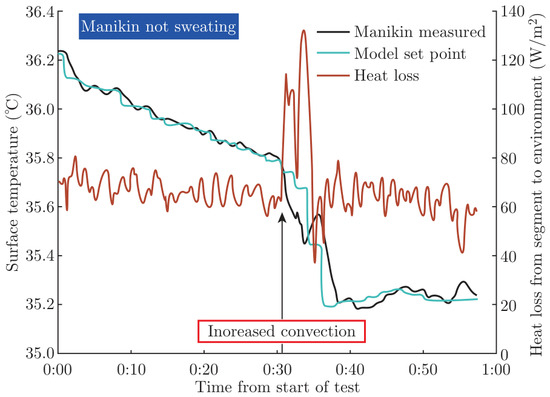
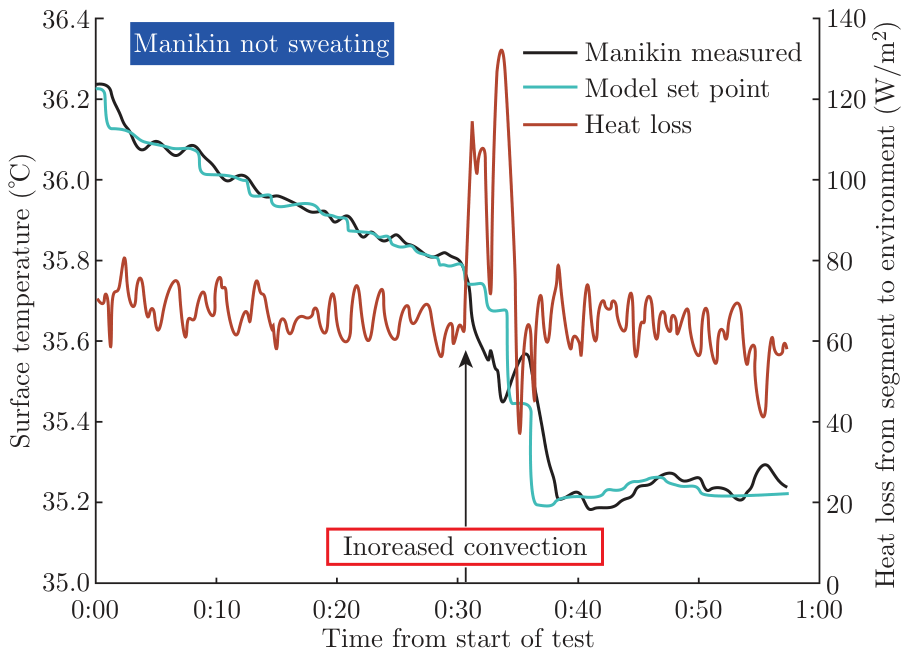
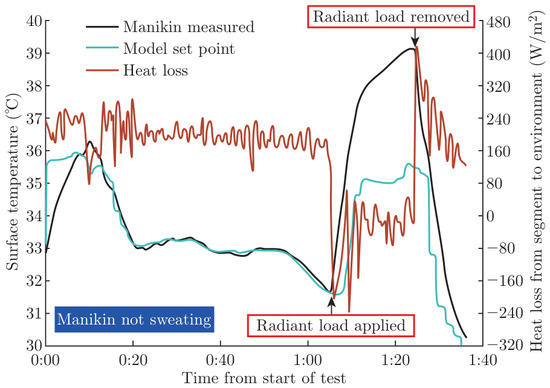
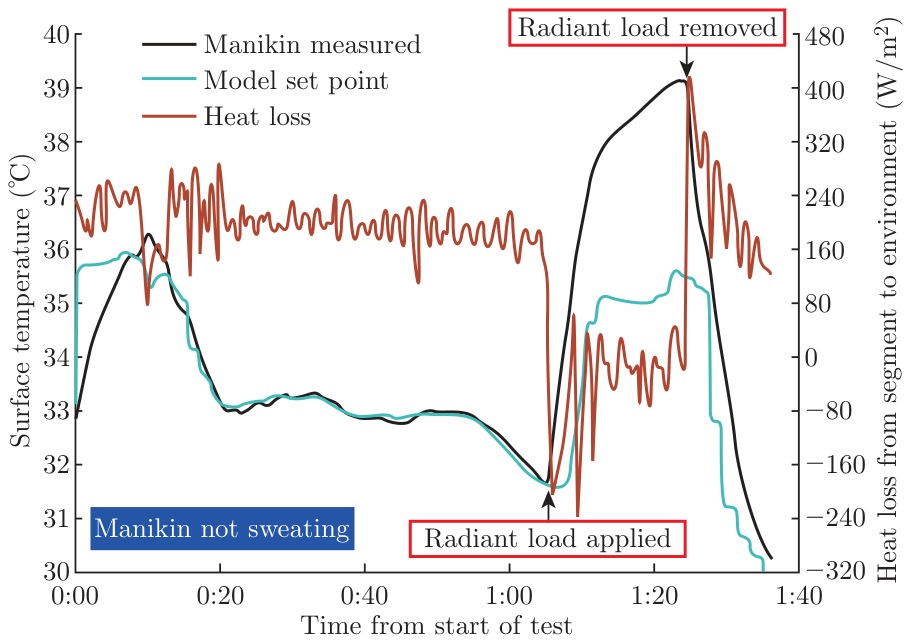
Rugh et al. [46] have investigated the effect of forced convection on heat flow using a physical model (manikin) of a human body including heating and sweating. Curves obtained from their experimental results have been given bellow in Figure 2 and Figure 3, thus reflecting the important role played by convection in reducing body temperature.
Figure 2.
Forced convection cooling of a segment.
Figure 3.
Radiant heating of a segment.
In a recent study, Irandoukht and Irandoukht [47] have developed a set of statistical models to relate the water vapour resistance with the structural properties of the fabric. They have used non-linear regression models in which fibre volume fraction, air permeability and threads per unit length were considered as hyperbolic variables, and thickness, mass and warp and weft yarn linear density were found to have a linear influence. The work reveals that non-linear models can predict water vapour resistance better than linear ones. A statistical model has been developed by Lee and Obendorf [48] to predict the moisture vapour transport through woven fabrics in relation to conventional textile geometry parameters and the inherent nature of fibers. Statistical analyses revealed that fabric thickness, fabric cover factor, mean flow pore diameter of fabric and moisture regain of fibre were significant parameters affecting water vapour transmission through woven fabrics. The influence of yarn twist factor and yarn packing factor were shown to be insignificant at the 5% significance level for those experimental conditions. An empirical model developed by Das et al. [49] using the Box-Behnken design method on water vapour transmission through blended fabrics, concluded that yarn count, yarn twist and fibre blend percentage influence the water vapour transmission considerably at 5% significance level.
4. Modeling of Coupled Heat and Moisture Transfer
In moisture transmission through textile materials, both mass transfer and heat transfer processes must be taken into account. The coupled heat and moisture transfer in textile fabrics has been widely recognised as being very important for understanding the dynamic thermal comfort of clothing during wear. Moisture transmission through textiles is highly interrelated with the heat transfer phenomena, due to its hygroscopic nature. During the transmission of water molecules through textile materials, they are absorbed by fibre molecules and heat of absorption is generated. Clothing heat and vapour transfer resistances are important inputs for standards and models dealing with thermal comfort, heat- and cold-stress [2,44].
The mechanism of transient diffusion of heat and moisture into a fibrous assembly was first proposed and analyzed by Henry [13]. He developed a system of differential equations to describe the processes involved, derived from the conservation of mass and heat transfer:

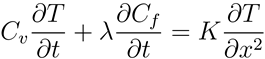 where, Ca and Cf are the water vapour concentration in the air filling the inter-fibrous pores and in the fibres of the fabric respectively, Cv is the volumetric heat capacity of the fabric, ε is the porosity of the fabric, Da the diffusion coefficient of water vapour in air, T is the temperature and K is the thermal conductivity of the fabric.
Using these two basic equations Nordon and David [15] have developed a model of coupled diffusion of moisture and heat in hygroscopic textile materials. They proposed an exponential relationship between the rate of change of water content in the fibres and the absolute difference between the relative humidity of the air and that with which the fibre would be in equilibrium. They have considered a two stage sorption process of the hygroscopic materials and expressed the equation for the two stage sorption taking the relative humidity difference into account. They have taken a parameter S which controls the pseudo equilibrium towards which the first stage of sorption tends. They have taken two rate constants k1 and k2, appropriate for first and second stage sorption:


Here HA and HF are the humidity of the air and that of the fibres in the fabric respectively, k1,k2 and k3 are rate constants for mass transfer, σ is the density of the fibre, CF is concentration of moisture on the fibre and S is a parameter controlling pseudo equilibrium.
Absorption of water is followed by the liberation of heat, known as heat of absorption [30]. Barker [50] proposed a numerical model of heat and moisture transfer through protective clothing during a flash exposure considering a multilayer garment formation. The combined thermal energy for all phases was expressed as
 where ρ is the effective fabric density, cp is the effective specific heat of the fabric, T is the temperature, t is time, ∆hl is the enthalpy of transition from bound water to free liquid water, ∆hvap is the enthalpy of evaporation per unit mass, ˙msv is the mass flux of vapour out of the fibre, x is the linear horizontal coordinate, keff is the effective thermal conductivity of the fabric, γ is the extinction of the fabric, qrad is the incident radiation heat flux from the flame into the fabric.
They found that the temperature of the fabric layers and the total heat flux transferred from the skin is significantly influenced by the amount and distribution of moisture in the protective clothing. The amount of heat produced is dependent on the absorption capacity of the material. This heat is basically the heat of solution, which occurs in case of exothermic reaction. It results from the interactive forces between the fibre molecules and the water molecules. Heat effect and the moisture absorption in hygroscopic materials, such as textile fibres, are inseparably interrelated. The evolved heat may be expressed in various ways. The differential heat of sorption, Q (sometimes called heat of absorption), is the heat evolved when one gram of water is absorbed by the infinite mass of the material at a given moisture regain. It is expressed in joules per gram (of water absorbed). The water may be absorbed from water vapour to give the value Qv, or from liquid water to give the value Ql. Due to the absorption of moisture by the fibre assemblies, the heat involved has a huge effect on the thermodynamics of the system. It influences the diffusion process of the moisture transmission. The heat of sorption produced increases the temperature of the fibrous assemblies. According to Cassie [51], if a textile material is engrossed in humid atmosphere, the time required for the fibres to come to equilibrium with this atmosphere is negligible compared to the time required for the dissipation of heat generated or absorbed when the regain changes.With an increase in humidity, the heat transfer efficiency of the material increases. During the transient stages of moisture sorption and diffusion, the heat transfer process is coupled with four different forms of moisture transfer due to the heat released or absorbed during sorption/desorption and evaporation/condensation which in turn are affected by the efficiency of heat transfer and the length of the transient stage is dependent on the heat transfer process [52]. The coupling effect between moisture diffusion and heat transfer depends on a number of fibre properties, such as moisture absorption capacities (isotherm), water vapour diffusion coefficient, fibre diameter, fibre density and heat of sorption [53]. The heat of wetting of cellulosic fibres depends to some extent on the moisture regain and the crystalline structure and it decreases proportionally with an increase in the degree of crystallinity of the fibres [54]. Two transient phenomena, buffering and chilling, are associated with the simultaneous heat and moisture vapour transport through fibre assemblies [51]. The cooling effect or buffering effect is experienced due to perspiration in hot climates and the chilling effect is associated with the after exercise sweating in cool climates. At a sudden increase in relative humidity in the climate, fabrics absorb moisture maintaining a microclimatic condition and generating heat. This gives rise to a thermostatic or buffering action for the person wearing the fabric in clothing [55]. The cooling effect was first postulated by Spencer-Smith [56] who hypothesized that there would be a cooling effect at the onset of perspiration in hot climates, whereas in the case of cold climates it would result in a ‘post exercise chilling effect’ [57]. This may reduce the working performance, even causing hypothermia. When water vapour (vapour perspiration) comes in contact with a cold wall (clothing), it condensates and reduces the thermal insulation of clothing. Condensation is associated with the coupled heat and moisture transfer in phase change.
In both the liquid and gaseous phases the heat transfer is described by the following microscale equation [58]:
 where β = {1,g} stands for the liquid and the gas phase
Tβ is the temperature of the phase β
vβi is the velocity of the phase β
(ρcp)βis the temperature of the phase β
λβ is the thermal conductivity of the phase β assumed as isotropic.
In the solid phase the heat transfer is governed by conduction only:
 where Ts is the temperature of the solid phase.
Ogniewicz and Tien [59] were the first contributors on this subject using theoretical modeling and numerical analysis and for this purpose they have assumed that heat is transmitted by conduction and convection and the condensate is in a pendular state. The analysis was limited to a quasi-steady state, as the temperature and vapour concentration remain unchanged with time, before the condensate becomes mobile. Motakef, Shapiro and their team [60,61] have analyzed the unsteady heat and moisture transport processes through the calculation of quasisteady fields in time-varying domains. Murata [62] analyzed the heat and water vapour transfer with condensation in a fibrous insulation slab both theoretically and experimentally. It was considered that one side of the fibrous slab is exposed to high temperature and high humidity, and the other side bounded by a cold surface. The model depicts the phenomenon which may occur for work wear used in extreme cold weather climate. Murata’s model considers that condensation occurs on the cold surface and in the interior of the fibrous insulation, and the condensate falls away due to gravity. Bouddour et al. [58] revisited the model of heat and water vapour transfer in wet porous media in the presence of evaporation–condensation by using the homogenization method of asymptotic for a periodic structure.
Fan et al. [63,64] have developed a numerical model on heat and moisture transfer with sorption and phase change through multi-layered fibrous battings based on their experimental results, conducted at −20◦C on a novel sweating guarded hot plate. The theory and the experimental results have been used for better understanding the phenomenon of condensation of perspiration and its evaporation, which causes the post exercise chill discomfort. Their model considers that the moisture movement is induced by partial water vapour pressure, a super saturation state in the condensing region as well as by the dynamic moisture absorption by the fibrous material and the movement of the liquid condensate. They have assumed that there is no liquid water movement. The model predicts condensation increases from the inner region to the outer region of the batting. The following mathematical equations have been established based on the conservation of heat energy and mass balance for the coupled heat and mass transfer in the fibrous batting zone on occurrence of condensation and sorption:
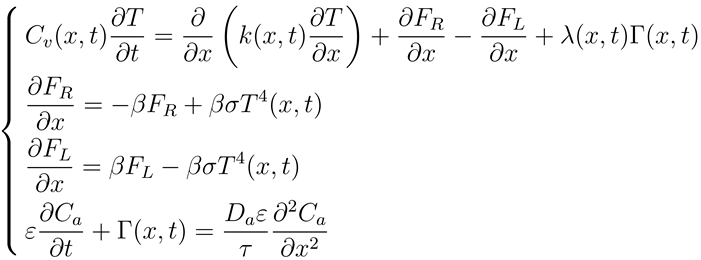 where FR is the total thermal radiation incident, FL is the corresponding flux, λ(x,t) is the heat of (de) sorption, latent heat of vaporization or latent heat of fusion, k is the effective thermal conductivity of the fabric, β is the absorption constant, T is the temperature, t is time and σ is the Boltzmann constant. Γ(x,t) is (de) sorption rate, condensation rate or freezing rate.
5. Summary
Moisture vapour transmission through fibrous materials is a highly complicated phenomenon, involving many processes and factors. The diversity and complexity of the parameters involved makes it hard to describe moisture vapour transport in relation to these factors. The importance of moisture vapour transmission through fabrics in maintaining clothing comfort has been highlighted in this article. Theoretical equations/models related to moisture vapour transmission through fabrics have been discussed. The diffusion and coupled liquid-vapour transmission have been ascertained to influence moisture transmission though textiles to a great extent. The twostage sorption model coupled with condensed water movement presented by Li et al. has been found to be most suited for predicting the water vapour transfer behaviour of textile material in transient condition. Also, the numerical model on heat and moisture transfer along-with sorption and phase change, proposed by Fan et al. provides a better understanding of the condensation of perspiration and its evaporation. In a standard atmospheric condition porosity and tortuosity of a porous media and the hygroscopic nature of the fibre are found to be the key factors influencing the transfer behaviour. The effect of fibre shape factor and fabric structure in terms of interlacement index can be incorporated in the calculation for modeling the water vapour transmission behaviour of fabrics. In order to avoid errors in the prediction, the structure of the porous material and the boundary conditions have to be properly defined in the calculation.
Appendix: Notation Used
| JAx | Rate of moisture flux |
| Concentration gradient | |
| t | Time |
| T | Temperature |
| DAB | Diffusion coefficient or mass diffusivity |
| Da | Diffusion co-efficient in bulk air |
| θ | Absolute temperature (K) |
| θ0 | Temperature at standard condition (K) |
| P | Actual pressure (bar) |
| P0 | Atmospheric pressure (bar) |
| Ca | Moisture concentration in air |
| Cf | Moisture concentration on fibre |
| ε | Porosity of textile material |
| ε1 | Volume fraction of liquid phase |
| R1 | First stage moisture sorption rate of fibre |
| R2 | Second stage moisture sorption rate of fibre |
| p | Proportion of uptake that occurs during second stage |
| Df | Diffusion co-efficient of fibre |
| γ | Cylinder radius |
| HA | Relative humidity of air |
| HF | Moisture content of fibre |
| τ | Tortuosity of fabric |
| Deff | Effective diffusivity of fabric |
| s | Fibre shape factor |
| Vf | Fibre volume fraction |
| Cfs | Moisture concentration on fibre surface |
| Cfab | Moisture concentration on fabric surface |
| hcf | Mass transfer coefficient at the fibre surface |
| Sv | Specific volume of fabric |
| V | Volume of fibrous material |
| T (x,t) | Temperature at a given time and fibre coordinate |
| Qm | Mass flow by convection |
| qconv | Convective heat transfer |
| qevap | Heat taken by evaporation |
| Qs | Sensible heat of ventilation |
| QL | Latent heat of ventilation |
| Tsk | Skin temperature |
| Ta | Air temperature |
| Ts | Temperature of solid phase |
| Psk | Skin vapour pressure |
| Pa | Air vapour pressure |
| hfg | Heat of evaporation of water |
| Dl | Liquid diffusivity |
| dc | Largest effective radius of capillary |
| σ | Fibre density |
| ρ | Effective fabric density |
| φ | Contact angle |
| β | Average angle of capillaries in fabric |
| η | Viscosity of liquid |
| µ | Viscosity of gas |
| pa | Partial air pressure |
| pv | Partial pressure of water vapour |
| ps | Partial pressure of saturated vapour |
| v=hv¯i | Apparent gas phase flow |
| Vσ(t) | Volume of solid phase contained within the averaging volume |
| Vγ(t) | Volume of gas phase contained within the averaging volume |
| V | Averaging volume |
| hcl | Convection coefficient |
| vin | Intrinsic velocity |
| Cv | Volumetric heat capacity of fabric |
| K | Thermal conductivity of fabric |
| ∆hl | Enthalpy of transition from bound water to free liquid water |
| ∆hvap | Enthalpy of evaporation per unit mass |
| m˙sv | Mass flux of vapour out of the fibre |
| x | Linear horizontal coordinate |
| keff | Effective thermal conductivity of fabric |
| qrad | Incident radiation heat flux from flame to fabric |
| cp | Effective specific heat of fabric |
| Ts | Temperature of the solid phase |
| Tβ | Temperature of the phase β |
| λβ | Thermal conductivity of the phase β assumed as isotropic |
| vβi | Velocity of the phase β |
References
- Bhattacharjee, D.; Das, B. Modeling and Simulation of Heat and Mass Transfer Properties of Textile Materials, chapter in the book entitled “Modeling and Simulation in Fibrous Materials: Techniques and Applications”. ISBN 978-1-62100-116-4; Patanaik, A., Ed.; Nova Science Publishers, Inc, New York, 2012; pp. 217–258. [Google Scholar]
- Havenith, G.; Holmer, I.; Den Hartog, E.A.; Parsons, K.C. Clothing evaporative heat resistance – proposal for improved representation in standards and models. Ann. Occup. Hyg. 1999, 43, 339–346. [Google Scholar] [CrossRef] [Scilit]
- Chen, Y. S.; Fan, J.; Zhang, W. Clothing thermal insulation during sweating. Text. Res. J. 2003, 73, 152–157. [Google Scholar] [CrossRef] [Scilit]
- Saville, B.P. Comfort in physical testing of textiles. In The Textile Institute; Woodhead Publishing Limited: Cambridge, UK, 1999; p. 227. [Google Scholar]
- Das, B. Studies on moisture transmission through fabrics. Ph.D. Thesis, Indian Institute of Technology, New Delhi, India, 2009; pp. 1–204. [Google Scholar]
- Das, B.; Das, A.; Kothari, V.K.; Fanguiero, R.; Araujo, M. Moisture transmission through textiles, Part I: Processes involved in moisture transmission and the factors at play. Autex Res. J. 2007, 7, 100–110. [Google Scholar]
- Das, A.; Alagirusamy, R. ISBN NO. 1 84569 789 8; Science in clothing comfort. Woodhead Publishing India Pvt. Ltd.: New Delhi, January 2010.
- Prahsarn, C. Factors influencing liquid and vapour transport in knit fabrics. Ph.D. thesis, North Carolina State University, Raleigh, 2001. [Google Scholar]
- Sachdeva, R.C. Fundamentals of Engineering Heat and Mass Transfer, ISBN-13: 9788122421385, 3rd Edn ed; New Age International (P) Ltd: India, 2008; pp. 595–597. [Google Scholar]
- Pause, B. Measuring the water vapour permeability of coated fabrics and laminates. J. Coat. Fabr. J. Coat. Fab. 1996, 25, 311–320. [Google Scholar] [CrossRef] [Scilit]
- Jost, W. Diffusion in Solid, Liquids and Gases; ISBN: 0123907500, 3rd Edn ed; Academic Press: NY, USA, 1960; pp. 423–425. [Google Scholar]
- Fohr, J.P.; Couton, D.; Treguier, G. Dynamic heat and water transfer through layered fabrics. Text. Res. J. 2002, 72, 1–12. [Google Scholar] [CrossRef] [Scilit]
- Henry, P.S.H. Diffusion in absorbing media. Proc. R. Soc. 1939, 171A., 115–141. [Google Scholar]
- Morton, W.E.; Hearle, J.W.S. ISBN-10: 1870812417Physical Properties of Textile Fibres, 3rd Edn ed; The Textile Institute: Manchester, U.K., 1997. [Google Scholar]
- Nordon, P.; David, H.G. Coupled diffusion of moisture and heat in hygroscopic textile materials. Int. J. Heat Mass Transf. 1967, 10, 853–865. [Google Scholar] [CrossRef] [Scilit]
- Li, Y.; Holcombe, B.V. Mathematical modeling of heat and moisture transfer in a human-clothing environment system. Text. Res. J. 1998, 86, 389–397. [Google Scholar] [CrossRef] [Scilit]
- Crank, J. The Mathematics of Diffusion; ISBN-13: 9780198534112, 2nd Edn. ed; Oxford University Press, USA, 1980; pp. 36–75. [Google Scholar]
- Nordon, P.; Mackay, B.H.; Downes, J.G.; Mcmahon, G.B. Text. Res. J. 1960, 30, 761–770.
- Li, Y.; Holcombe, B.V. A two-stage sorption model of the coupled diffusion of moisture and heat in wool fabrics. Text. Res. J. 1992, 62, 211–217. [Google Scholar] [CrossRef] [Scilit]
- Li, Y.; Luo, Z.X. An improved mathematical simulation of the coupled diffusion of moisture and heat in wool fabric. Text. Res. J. 1999, 69, 760–768. [Google Scholar] [CrossRef] [Scilit]
- Das, B.; Das, A.; Kothari, V.K. Book on “Moisture Transmission through Textile Fabrics”; Lambert Academic Publishing, Germany (LAP, Germany), 2010; ISBN No. 978-3-8383-9744-3. [Google Scholar]
- Wehner, J.A.; Miller, B.; Rebenfeld, L. Dynamics of water vapour transmission through fabric barriers. Text. Res. J. 1988, 58, 581–592. [Google Scholar] [CrossRef] [Scilit]
- Bejan, A.; Dincer, I.; Lorente, S.; Miguel, A.F.; Reis, A.H. Porous and complex flow structures in modern technologies, 1st Edn ed; Springer-Verlag: NY, 2004; ISBN -10: 0387202250. [Google Scholar]
- Adler, M.M.; Walsh, W.K. Mechanism of transient moisture transport between fabrics Text. Res. J. 1984, 54, 334–343. [Google Scholar] [CrossRef] [Scilit]
- Crank, J. The mathematic of diffusion; Clarendon press: Oxford, UK, 1975. [Google Scholar]
- Barnes, J.C.; Holcombe, B.V. Moisture sorption and transport in clothing during wear. Text. Res. J. 1996, 66, 777–786. [Google Scholar] [CrossRef] [Scilit]
- Kim, J.O. Dynamic moisture vapour transfer through textiles, Part III: Effect of film characteristics on micro climate moisture and temperature. Text. Res. J. 1999, 69, 193–202. [Google Scholar]
- Suprun, N. Dynamics of moisture vapour and liquid water transfer through composite textile structures. Int. J. Cloth. Sci. Tech. 2003, 15, 218–223. [Google Scholar] [CrossRef] [Scilit]
- Das, B.; Das, A.; Kothari, V.K.; Fanguiero, R.; Araujo, M. Moisture flow through blended fabrics – Effect of hydrophilicity. J. Eng. Fibers Fabr. 2009, 4, 20–28. [Google Scholar] [CrossRef] [Scilit]
- Das, S.; Kothari, V.K. Moisture transmission behaviour of cotton fabrics. J. Fibre Text. Res. 2012, 37, 151–156. [Google Scholar]
- Downes, J.G.; Mackay, B.H. Sorption kinetics of water vapor in wool fibers. J. Polym. Sci. 1958, 28, 45–67. [Google Scholar] [CrossRef] [Scilit]
- Li, Y.; Luo, Z.X. Physical mechanisms of moisture diffusion into hygroscopic fabrics during humidity transients. J. Text. Inst. 2000, 91, 302–316. [Google Scholar] [CrossRef] [Scilit]
- Incropera, F.P.; DeWitt, D.P. Fundamentals of heat of mass transfer, 4th Edn ed; John Wiley and Sons: NY, 1996; ISBN 9780471517290. [Google Scholar]
- Schneider, A.M.; Hoschke, B.N. Heat transfer through moist fabrics. Text. Res. J. 1992, 62, 1–66. [Google Scholar] [CrossRef] [Scilit]
- Ghaddar, N.; Ghali, K.; Jones, B. Convection and ventilation in fabric layers, in the book “Thermal and moisture transport in fibrous materials” edited by Pan N. In ISBN: 1845690575; Gibson, P., Ed.; Woodhead Pub. Ltd.: Cambridge, England, 2006; pp. 271–307. [Google Scholar]
- Das, B.; Das, A.; Kothari, V.K.; Fangueiro, R.; M. de Araujo, M. Moisture transmission through textiles, Part II: Evaluation methods and mathematical modelling. Autex Res. J. 2007, 7, 194216. [Google Scholar]
- Li, Y.; Holcombe, B.V.; Scheider, A.M.; Apcar, F. Mathematical modeling of the coolness to the touch of hygroscopic fabrics. J. Tex. Inst. 1993, 84, 267–273. [Google Scholar] [CrossRef] [Scilit]
- Li, Y.; Zhu, Q. Simultaneous heat and moisture transfer with moisture sorption, condensation and capillary liquid diffusion in porous textiles. Text. Res. J. 2003, 73, 515–524. [Google Scholar] [CrossRef] [Scilit]
- Le, C.V.; Ly, N.G. Heat and moisture transfer in textile assemblies, Part I: Steaming of wool, cotton, nylon and polyester fabric bed. Text. Res. J. 1995, 65, 203–212. [Google Scholar]
- Nishimura, T.; Matsuo, T. Numerical simulation of moisture transmission through a fiber assembly. Text. Res. J. 2000, 70, 103–107. [Google Scholar] [CrossRef] [Scilit]
- Luo, X.; Xu, Q. A new numerical implementation on 2D heat and moisture transfer through fabric. Appl. Math. Comp. 2006, 174, 1135–1150. [Google Scholar] [CrossRef] [Scilit]
- Gibson, P.; Charmchi, M. Modelling convection/diffusion processes in porous textiles with inclusion of humidity-dependent air permeability. Int. Comm. Heat Mass Trans. 1997, 24, 709724. [Google Scholar] [CrossRef] [Scilit]
- Gibson, P.W.; Charmchi, M. The use of volume-averaging techniques to predict temperature transients due to water vapour sorption in hygroscopic porous polymer materials. J. Apply Poly. Sci. 1997, 64, 493–505. [Google Scholar] [CrossRef]
- Berger, X.; Sari, H. A new dynamic clothing model. Part 1: Heat and mass transfers. Int. J. Therm. Sci. 2000, 39, 673–683. [Google Scholar] [CrossRef] [Scilit]
- Fan, J.; Luo, Z.; Wen, X. Modeling heat and moisture transfer through fibrous insulation with phase change and mobile condensates. Int. J. Heat Mass Trans. 2002, 45, 4045–4055. [Google Scholar] [CrossRef] [Scilit]
- Rugh, J.P.; Farrington, R.B.; Bharathan, D.; Vlahinos, A.; Burke, R. Predicting human thermal comfort in a transient non uniform thermal environment. Eur. J. Appl. Physiol. 2004, 92, 721–729. [Google Scholar] [CrossRef] [Scilit] [PubMed]
- Irandoukht, S.; Irandoukht, A. Development of the predictive models for the fabric water vapor resistance. J. Eng. Fibers Fabr. 2011, 6, 40–49. [Google Scholar] [CrossRef] [Scilit]
- Lee, S.; Obendorf, S.K. Statistical modeling of water vapour transport through woven fabrics. Text. Res. J. 2012, 82, 211–219. [Google Scholar] [CrossRef] [Scilit]
- Das, B.; Das, A.; Kothari, V.K.; Fanguiero, R.; Araujo, M. Studies on moisture transmission properties of PV blended fabrics. J. Text. Inst. 2009, 100, 588–597. [Google Scholar] [CrossRef] [Scilit]
- Barker, R.L. Modeling of thermal protection outfits for fire exposures, NTC Project No. F01-NS50, National Textile Center Annual Report. 2003. [PubMed]
- Cassie, A.B.D.; Atkins, B.E.; King, G. Thermoplastic action of textile fibres. Nature 1939, 143, 162. [Google Scholar] [CrossRef] [Scilit]
- Chen, Y.S.; Fan, J.; Zhang, W. Clothing thermal insulation during sweating. Text. Res. J. 2003, 73, 152–157. [Google Scholar] [CrossRef] [Scilit]
- Li, Y. Fabric wetting factors. Text. Asia. 1999, 6, 39–41. [Google Scholar]
- Mizutani, C.; Tsujii, Y.; Bertoniere, N. Effect of fibre structure on heat of wetting of cotton and regenerated cellulosic fibres. Text. Res. J. 1999, 69, 559–564. [Google Scholar] [CrossRef] [Scilit]
- Kim, J. O. Dynamic moisture vapour transfer through textiles, Part III: Effect of film characteristics on micro climate moisture and temperature. Text. Res. J. 1999, 69, 193–202. [Google Scholar]
- Spencer-Smith, J.L. The buffering effect of hygroscopic clothing. Text. Res. J. 1966, 36, 855–856. [Google Scholar] [CrossRef] [Scilit]
- Woodcock, A.M. Moisture transfer in textile system. Text. Res. J. 1966, 36, 855–856. [Google Scholar]
- Bouddour, J.L.; Auriault, M.; Mhamdi-Alaoui; Bloch, J.F. Heat and mass transfer in wet porous media in presence of evaporation-condensation. Int. J. Heat Mass Trans. 1998, 15, 2263–2277. [Google Scholar] [CrossRef] [Scilit]
- Ogniewicz, Y.; Tien, C.L. Analysis of condensation in porous insulation. J. Heat Mass Trans. 1981, 24, 421–429. [Google Scholar] [CrossRef] [Scilit]
- Motakef, S.; El-Maher, M.A. Simultaneous heat and mass transfer with phase change in a porous slab. Int. J. Heat Mass Trans. 1986, 29, 1503–1512. [Google Scholar] [CrossRef] [Scilit]
- Shapiro, A.P.; Motakef, S. Unsteady heat and mass transfer with phase change in porous slab: analytical solutions and experimental results. J. Heat Mass Trans. 1990, 33, 163–173. [Google Scholar] [CrossRef] [Scilit]
- Murata, K. Heat and mass transfer with condensation in a fibrous insulation slab bounded on one side by a cold surface. Int. J. Heat Mass Trans. 1995, 38, 3253–3262. [Google Scholar] [CrossRef] [Scilit]
- Fan, J.; Luo, Z.; Li, Y. Heat and moisture transfer with sorption and condensation in porous clothing assemblies and numerical simulation. Int. J. Heat Mass Trans. 2000, 43, 2989–3000. [Google Scholar] [CrossRef] [Scilit]
- Fan, J.; Cheng, X.Y. Heat and moisture transfer with sorption and phase change through clothing assemblies, Part II: Theoritical modelling, simulation and comparison with experimental results. Text. Res. J. 2005, 75, 187–196. [Google Scholar] [CrossRef] [Scilit]
© 2012 Textile Bioengineering and Informatics Society. This article is an open access article distributed under the terms and conditions of the Creative Commons Attribution (CC BY) license (https://creativecommons.org/licenses/by/4.0/).