


Abstract
This research carries out non-touched anthropometric measurements on 200 male university students aged from 19–26. 10 measurements relevant to the body neck were drawn in considering the necessary measurements in the pattern design of the fashion collar, This research utilizes the SPSS software to carry out a frequency distribution analysis and cluster analysis for the sample. 5 characteristic indices were elected in a statistical approach. These characteristic indices provide more reference measurements to the structural design of the men’s fashion collar, it can be used to serve as the establishment of specification series for men’s wear and for ready-to-wear production.
1. Introduction
Apparel’s fitness is an important factor which affects apparel’s comfort. Currently, the analysis of different body characteristic parameters, the establishment of a national human database, the existing modification and amendment of clothing size standards and other research are very hot topics aiming to enhance apparel’s fitness and comfort.
As we know, when we carrry out the apparel collar’s pattern design, many detailed sizes of body neck must be used. But after we check with the “national apparel size standard” [1], we only discovered that only one size relates to the neck, i.e., theroot neck circumference. In fact, there is an obvious difference of body neck among different individuals in terms of shape and configuration. Even if two guys have the same size in neck circumference, their neck widths, neck lengths, and mid-neck circumferences and other sizes may not be the same. Therefore the acquisitions of detailed body sizes are very important for apparel collar design [2].
Furthermore, apparel design needs the support of human body data. The design of apparel collar must accord to body neck sizes. In order to have more objective understanding of the human neck, we have to digitalize the body neck’s characteristics. In this research, we carried out experiments to discover the key indices which can distinguish the body neck characteristics, and offers a theoretical foundation for apparel collar’s fitness [3].
2. The Basic Principles for Choosing Body Characteristic Indices
According to the basic selection principles of national sizes standard, we have to adhere to the following principles when selecting the body characteristic indices suitable to apparel MTM [4].
(1) The body characteristic indices have to meet the objective of changing laws of human body types and garments to practically produce experience and conditions, and must be easily measured and obtained.
(2) Have mass coverage and have maximum effect to respond and distinguish the crowd.
(3) Though them, we can simply and easily figure out the sizes of the items which are not easy to obtain through body measurements.
(4) Facilitate application and promotion.
(5) Have the ability to connect with domestic and international standards.
3. Experiment on Anthropometric Measurement of 3D
3.1. Equipment
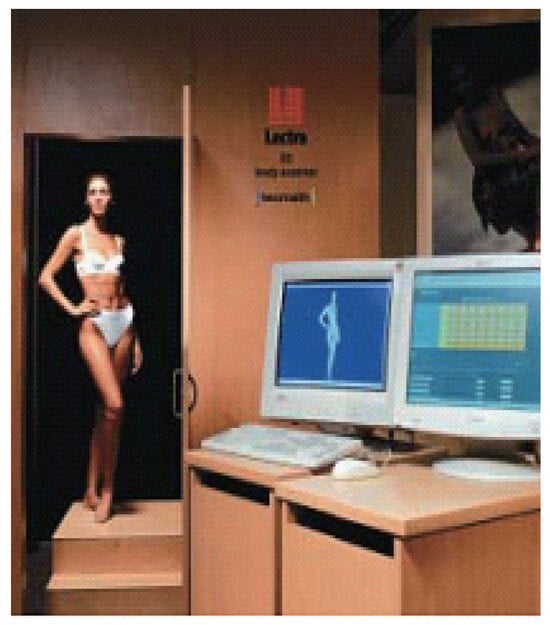
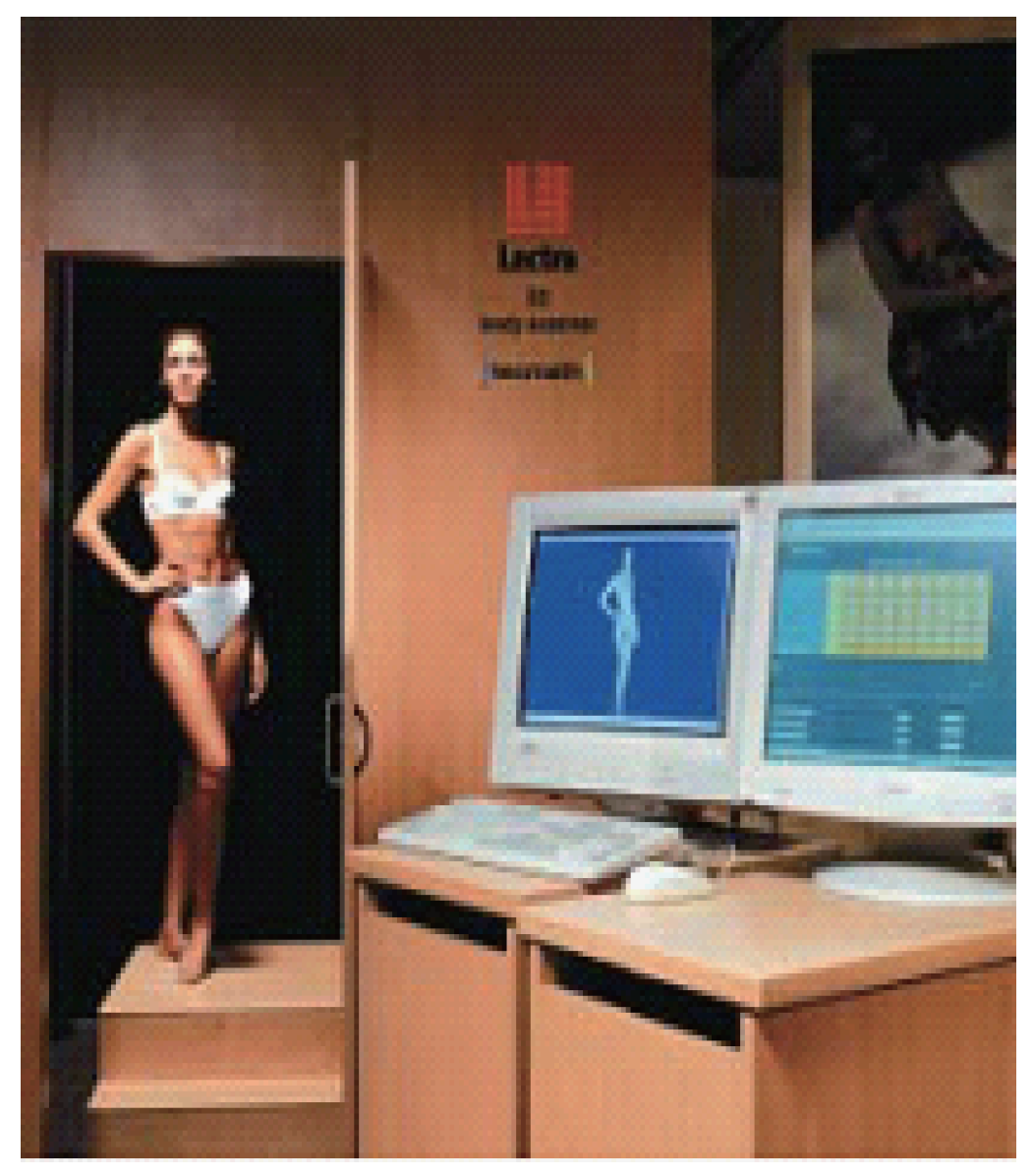
This experiment utilizes the non-touched 3D human body laser scanner made by German TecMath Corporation to carry on human body data acquisition. This scanner can scan the 2.1 m high region in 8∼10 seconds, the resolution may reach 5 mm, measuring accuracy for ±2 mm (Figure 1).
Figure 1.
Non-touched 3D human body laser scanner.
3.2. Scope of Experiment
The survey was conducted on200 male university students aged from 19∼26 years old.
3.3. The Establishment of Body Measurement Item
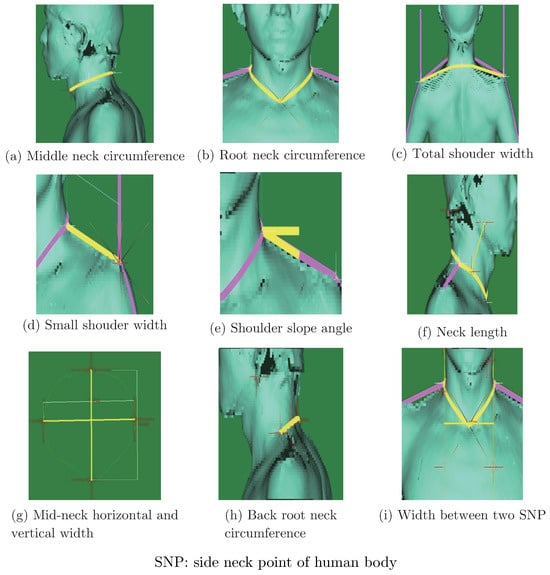
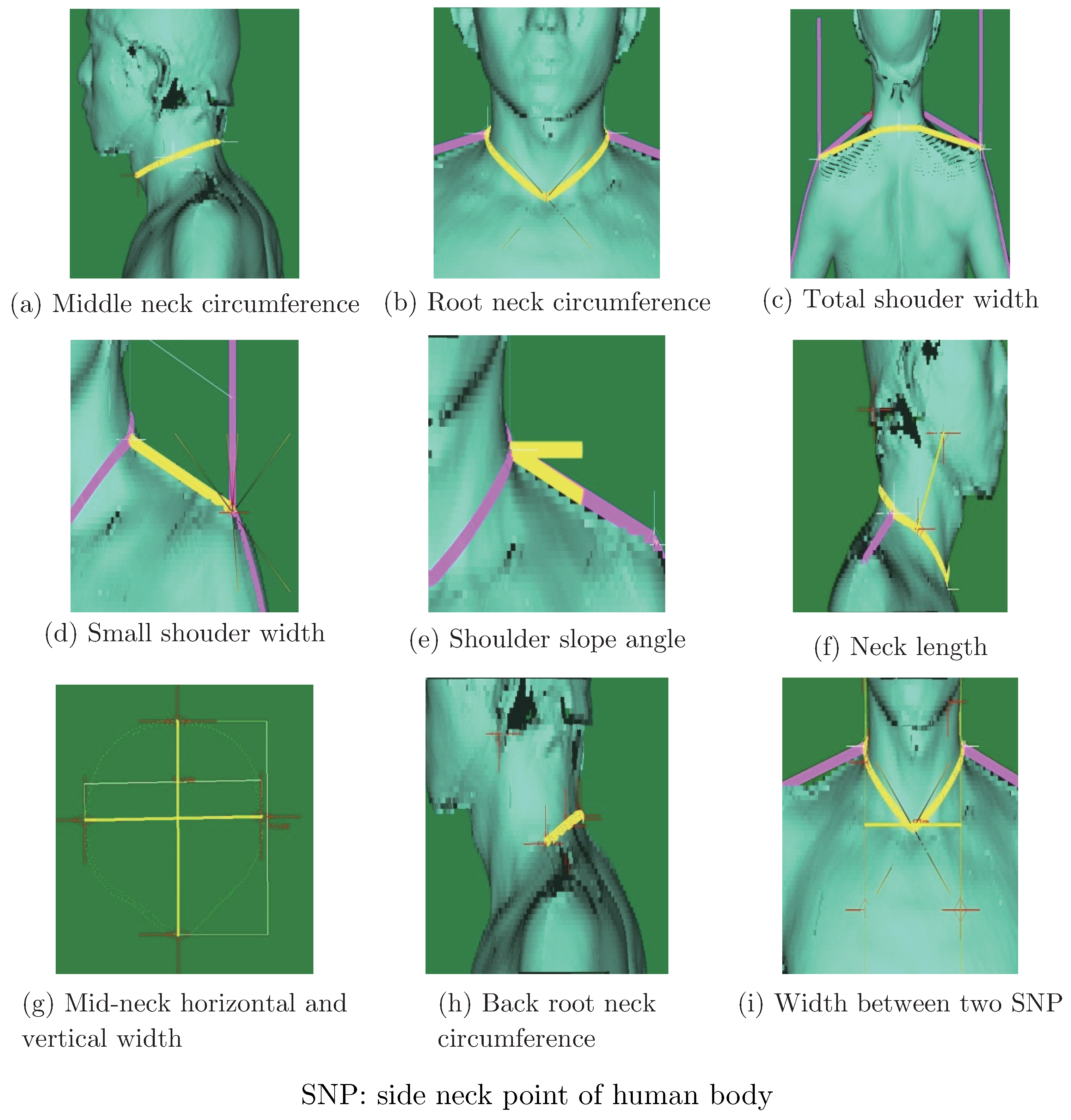
Referring to the correlative measurements of collar pattern design, this research obtained data of 10 measurements, in which the detailed items can be seen in Figure 2. The positions demonstrated in Chart (a) to chart (e) are the sizes that the scanner system reports, and the positions from chart (f) to chart (i) are obtained by the three dimensional digitized human body interaction measurement.
Figure 2.
Digital human measured positions.
4. Body Data Analysis
4.1. Frequency Distribution Analysis
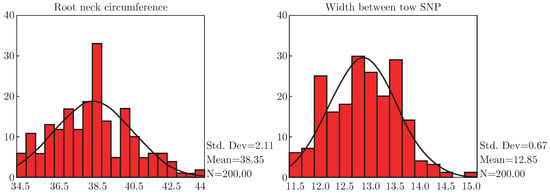
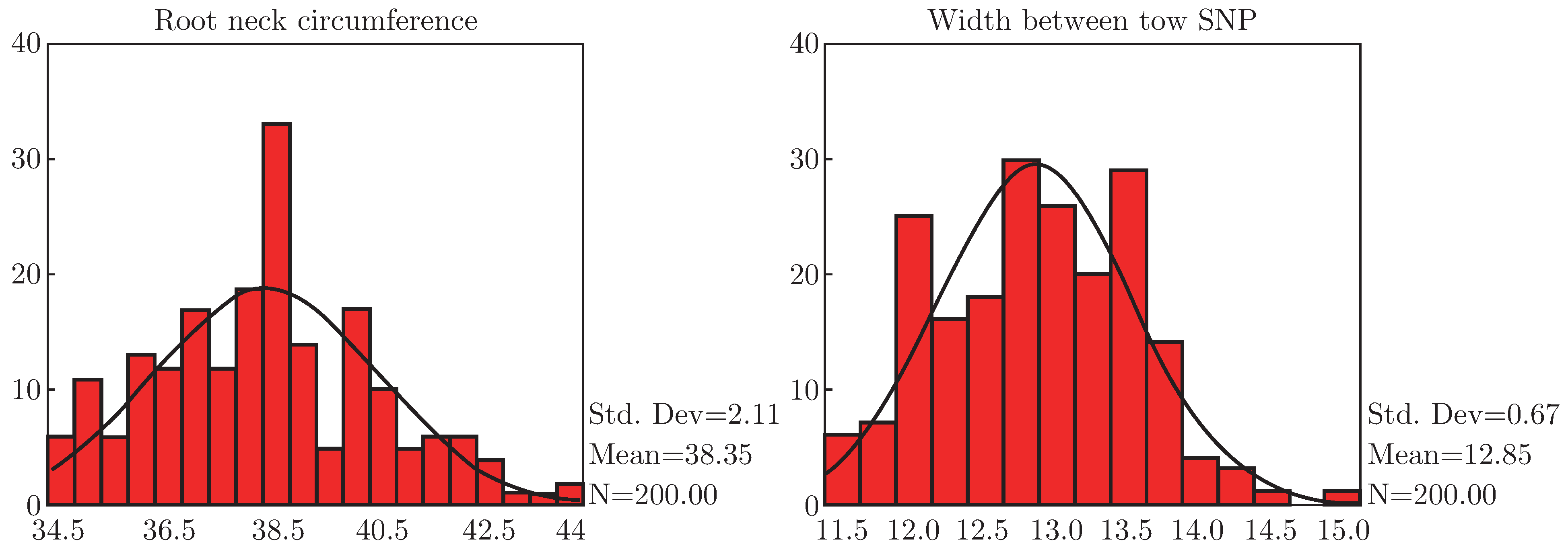
This research first carries out a frequency distribution analysis to each data group of items. Figure 3 shows the result of frequency distribution analysis. (This paper only shows two items, the root neck circumference and width between the two SNP. The other items all meet the normal distribution). As we can see from Figure 3, the distribution meets the normal distribution, and the mean value of root neck circumference of this group of sample is 38.31 cm, and 72.36% of the sample’s root neck circumference is around 36–40 cm, whilst 78.63% of the sample’s width between two SNP is around 12–14 cm.
Figure 3.
Frequency distribution analyses.
4.2. Cluster Analysis
Cluster analysis is also called group analysis. It is a common mathematical method which studies on making reasonable classifications to objective things.
There are many items that can reflect the body neck’s characteristics, and in order to find out the representative items which can reflect the body neck’s most important characteristics from so many items, and to enable them to serve to apparel MTM, it is necessary to carry out a cluster analysis on these measured items. This research uses SPSS statistics software R type clustering to the variables.
Table 1 shows the variables cluster Agglomeration Schedule. Firstly, when item 5 merges with item 10, their correlation coefficient is 0.812. Secondly, when item 2 merges with item 4, their correlation coefficient is 0.759; When the item containing item 4 is merged with the item containing item 5, the correlation coefficient is 0.385<0.5. Thus we can consider the first 6 merging steps as effective.
Table 1.
Cluster Agglomeration Schedule.
After clustering, 10 variables in this research are divided into four categories.
First category: root neck circumference, mid neck circumference, width between two SNP, mid-neck horizontal and vertical width.
Second category: total shoulder width, small shoulder width.
Third category: neck length.
Fourth category: shoulder slope angle.
4.3. Characteristic Indices Extraction
4.3.1. The Extraction of the Basic Parts of Young Men’S Neck
We took national standard which takes three basic positions for the classification of the human body into account, and finally concluded that two basic parts are selected for the human neck is feasible. Which two basic measurements should be selected? We have first to comply with the following principles.
1. Matching the objective laws of body neck’s shape transformation and actual experience ofclothing production and conditions.
2. To meet the needs of the people; making as many people possible to fit in the classificationof the similar neck type whilst keeping other major measurements of the body neck derived from the basic measurements within the scope of permissible error.
3. As close as possible with the national standards.
4. Selecting with scientific methods.
Under the guidance of the above principles, and combining with the distribution of statistical selection theory, we concluded that in order to accurately reflect changes in the human neck, the basic measurements of the neck with the largest change should be selected, i.e.,. selecting the measurements that have the largest standard deviation. After analysis, the “root neck circumference” and the “middle neck circumference” had the largest standard deviations, so we selected those two measurements as the basic measurements of neck.
4.3.2. The Extraction of Other Characteristics Indices of Young Men’s Neck
From the cluster analysis, it is necessary to select one or more important items as characteristic indices from each category. There are two basic ways for selecting the indices, (1) selecting the indices which are easier to obtain. (2) if difficult to select, we have to according to the formula based on statistics:
In this formula r is the correlation coefficient between item xj and other similar item, mj is the items number of the category which item xj in, and we have to find out which characteristic index has the biggest [5].
(1) Pearson correlation analysis
Take the first category for example, we conducted a correlation analysis to the items in the first category, and established the correlation matrix table. Table 2 shows pearson correlation coefficients, two-tailed T inspection results, and effective participation of amount N.
Table 2.
Standard deviation of each measurement.
Table 3.
Pearson correlation analysis.
(2) Calculate correlation coefficients between each designated item and all other items in this category, then calculate the average value of these correlation coefficients.
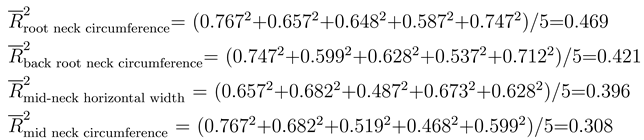

(3) Compare six average values in this group. root neck circumference=0.469, is the biggest value in this category, so we chose the root neck circumference as the characteristic index of body neck.
Applying the same analysis method to the other categories if the items are more than one, we finally obtained 4 characteristic indices of the body neck. They are: root neck circumference, total shoulder width, neck longth and shoulder slope angle. Comprehensively considering the basic parts and the characteristics parts of the human neck, we finally have 5 characteristic indices, in which they are: root neck circumference, middle neck circumference, total shoulder width, neck length and shoulder slope angle.
By measuring these body sizes and collecting the data, the apparel size standard can be consummated, and the fitness of apparel collar design will be enhanced.
5. Conclusion
In this research, non-contact anthropometric body measurement was conducted on 200 male university students by using the advanced 3D human scanner. 10 measurements relevant to the neck were drawn by considering the necessary measurements in the pattern design of the fashion collar. SPSS software was used to conduct a frequency distribution analysis and cluster analysis on the sample data, and then 5 characteristic indices were elected in a statistical approach. These characteristic indices provide more reference measurements to the structure design of a men’s fashion collar and can be used for the establishment of specifications for men’s wear and ready-to-wear productions.
Acknowledgments
Great acknowledgment is made to the Shaanxi Research Center of Clothing Engineering & Technology for providing me experiment environment.
References
- Dai, H. Apparel size standard system and application. Press China Text. 2001, 10–11. [Google Scholar]
- The National Standard GB/T1335.1-1997 apparel size-menState Bureau of Technical Supervision. 1997; pp. 11–13.
- Zhang, W.B. Apparel arts and crafts (pattern design fascicule); Chinese textiles publish company: BEIJING, 2002; pp. 105–106. [Google Scholar]
- He, Y.; Zou, F.Y. The research of apparel specification based on MTM. J. Zhejiang Coll. Eng. 2004, 1–2. [Google Scholar]
- Su, J.M. Application and development guide of statistical software SPSS 12.0 for windows. Press Electron. Ind. 2004, 315–321. [Google Scholar]

© 2012 Textile Bioengineering and Informatics Society. This article is an open access article distributed under the terms and conditions of the Creative Commons Attribution (CC BY) license (https://creativecommons.org/licenses/by/4.0/).