


Abstract
This study is a theoretical investigation of the liquid water transport coupled with moisture and heat transfer in porous polymer materials. The solid surface zeta potential and the fiber diameter are investigated to reveal the mechanisms of the coupling effects. Based on the Poisson- Boltzmann equation for electric double layers and Navier-Stokes equation of liquid flows, a mathematical model to simulate the complex coupled heat and moisture transfer in porous polymer materials is reported in this paper.
1. Introduction
Porous polymer materials are widely used in many fields, such as artificial skins in tissue engineering. So far, the coupled heat and liquid moisture transfer in porous polymer materials have aroused wide concern. Pores with various sizes, which can be considered as interconnecting micro-channels with different diameters, exist from the porous polymer materials. The flows in porous materials are generally a complex process which involves simultaneous, coupled heat and mass transfers. The heat transfer mechanisms in porous polymer materials include conduction by the solid material of the fibers, conduction by intervening air, radiation and convection. Meanwhile, the heat transfer process is coupled with phase changes, such as moisture sorption, moisture desorption, evaporation and condensation. Liquid and moisture transfer mechanisms include water vapor diffusion in the void spaces and liquid diffusion by capillary action. The rearrangement of the charges on the solid surface and the balancing charges in the liquid is called the electrical double layer (EDL). It has been proved that the flows in micro-scale are quite different from those in macro-scale. Generally for macro-channel flow the EDL can be neglected due to the very small thickness of the EDL compared with the characteristic size of macro-channels. However, for the micro-channel flow the thickness of the EDL is compared with the characteristic size of flow channels. It means that the EDL effects must be taken into account in micro-channel flow.
A couple of scholars, such as Li and Zhu , have made numerous research in this field [1,2,3,4,5,6,7,8,9,10,11]. A satisfactory model to simulate the couple heat and mass transfer in porous materials has been established by Li and Zhu and a great number of meaningful conclusions have been made. But the resistance effect of EDL on the coupled heat and liquid moisture transfer in porous polymer materials is seldom taken into account. The electroosmosis phenomenon of the electrolytic solution which flows through micro-channels comprising a bunch of cylinders was researched [12] and it was shown that the EDL has a significant effect on the flow field and the smaller the ratio of the channel diameter to the thickness of EDL is, the bigger the effect of EDL is. The heat effect of the electro osmotic flow in capillaries was studied [13] and it was pointed out that the EDL has a crucial effect on the heat transfer in capillaries as well.
In this paper, taking the resistance effect of the EDL into account, an improved model is deduced from the basic equations, including Poisson-Boltzmann equation for electric double layers and Navier-Stokes equation for liquid flows. The diffusion coefficient of the electrolytic solution and a dimensionless number that aims to describe the resistance effect of the EDL are obtained through theoretical derivation. With specification of initial and boundary conditions, the distribution of the moisture content and the temperature in the porous polymer materials with different solid surface zeta potentials and fiber diameters are numerically computed. Effects of the solid surface zeta potential and fiber diameter on the coupled heat and liquid moisture transfer in porous polymer materials are discussed. The comparison with a series of experimental measurements shows the superiority of this model in resolving the coupled heat and liquid moisture transfer in porous polymer materials. The results illustrate that the heat and moisture transfer process is influenced by the solid surface zeta potential and the fiber diameter of the porous polymer materials.
2. Numerical model
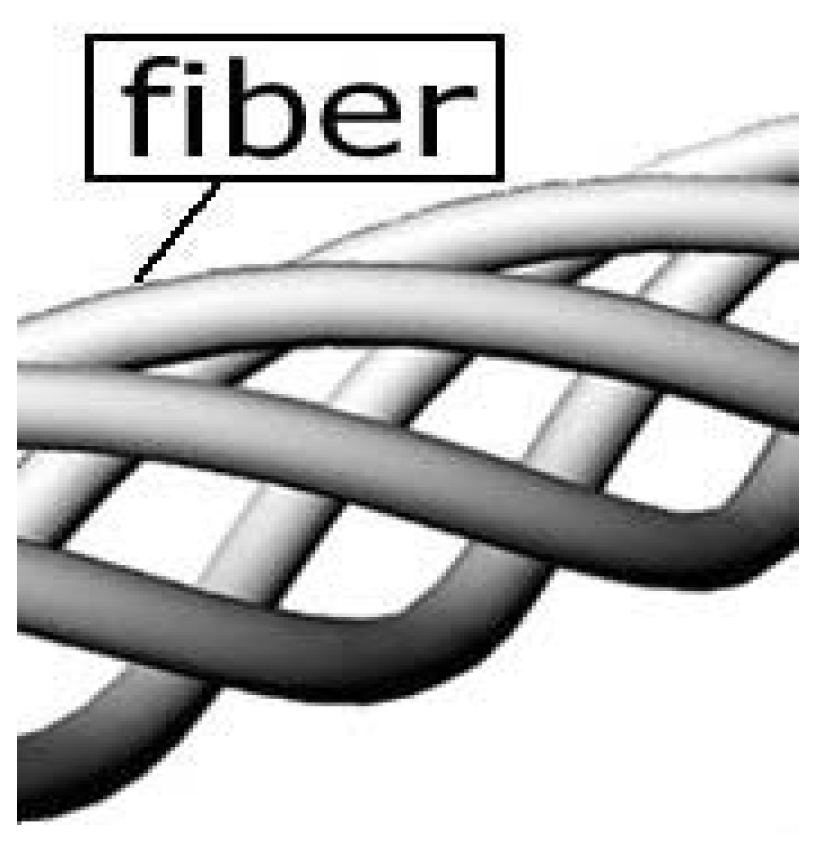
This paper lays emphasis on the porous polymer materials that is considered as containing a countless number of yarns woven out of fibers. The yarn is made up of a cluster of fibers twisted up. The capillaries are formed by these pores in yarns woven into porous polymer materials. The electrolyte solution flows from the regions of higher electrolyte solution concentration to regions of lower electrolyte solution concentration due to the fiber-liquid molecular attraction at its surface, which is determined by the surface tension and the effective capillary pore distribution. The liquid flow is coupled with heat transfer, moisture transfer and phase changes such as evaporation and condensation. The following assumptions are made in this model:
1. Local thermal is assumed to be equal among all phases due to the relatively low velocities considered and the small dimension of the constituting fibers.
2. The inertia of each phase in porous polymer materials is ignored because of the relatively low velocities.
3. Swelling of fibers while making porous polymer materials is neglected.
Figure 1.
Structure of porous polymer materials.
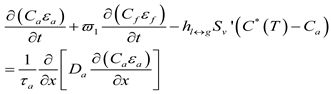
When the electrolyte solution diffuses in porous polymer materials resulting from capillary action, the mass balance of the water vapor is established by equation (1), the mass balance of the liquid moisture is established by equation (2) and the energy balance is established by equation (3). The governing equations can be expressed as
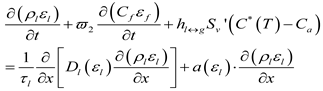
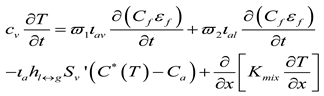
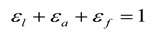
Sorption and desorption of moisture by the fibers obey the Fickian law:

The momentum equation subject to an electrical body force is as follows:
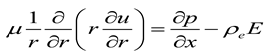
Based on the Poisson-Boltzmann Equation, the electrostatic potential Ψ and charge density ρe obey the following equations:
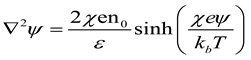

The diffusion coefficient of the liquid water is expressed as [10]:
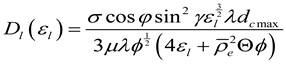 where
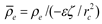 is dimensionless expression of the charge density
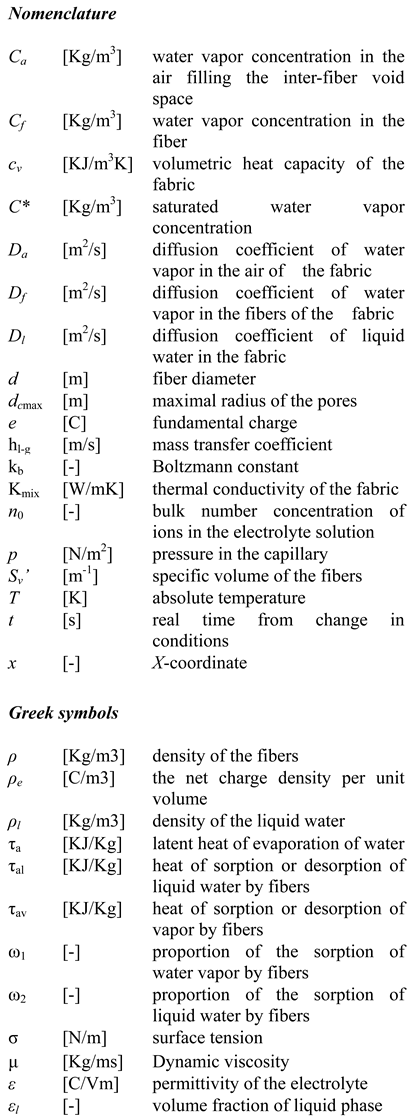
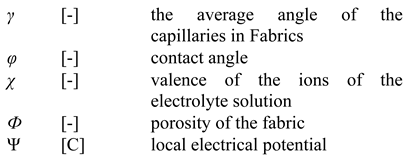
 is a dimensionless number to describe the resistance effect of the EDL, which is proportional to the square of the liquid dielectric constant and the solid surface zeta potential, and inversely proportional to the liquid dynamic viscosity, electric conductivity and the square of the effective pore size. According to the expression of Θ, we know that the magnitude of Θ is affected by the solid surface zeta potential and the maximum the radius of the pores in porous polymer materials and the bigger the magnitude of Θ is, the more significant the resistance effect of EDL is.
is dimensionless expression of the charge density is a dimensionless number to describe the resistance effect of the EDL, which is proportional to the square of the liquid dielectric constant and the solid surface zeta potential, and inversely proportional to the liquid dynamic viscosity, electric conductivity and the square of the effective pore size. According to the expression of Θ, we know that the magnitude of Θ is affected by the solid surface zeta potential and the maximum the radius of the pores in porous polymer materials and the bigger the magnitude of Θ is, the more significant the resistance effect of EDL is. 3. Computational and experimental Results
According to the improved mathematical model established above, the solid surface zeta potential and the fiber diameter are investigated to reveal the mechanisms of the coupling effects on the coupled heat and mass transfer in porous polymer materials. The porous polymer materials are suspended in containers filled with water at T1=21°C. The initial conditions are: T0=22°C and RH=70%. At the time t=0 a sudden boundary condition changes at the surface x=0 to RH=100% and T1=21°C. The relative humidity and temperature of the air surrounding the materials at x=5cm are 70% and 22°C respectively that is the same as the initial conditions. In order to research the effects of the solid surface zeta potential and fiber diameter on the simultaneous and coupled heat and mass transfer in porous polymer materials, the distribution of the moisture content and the temperature in porous polymer materials with different solid surface zeta potentials and fiber diameters are obtained.
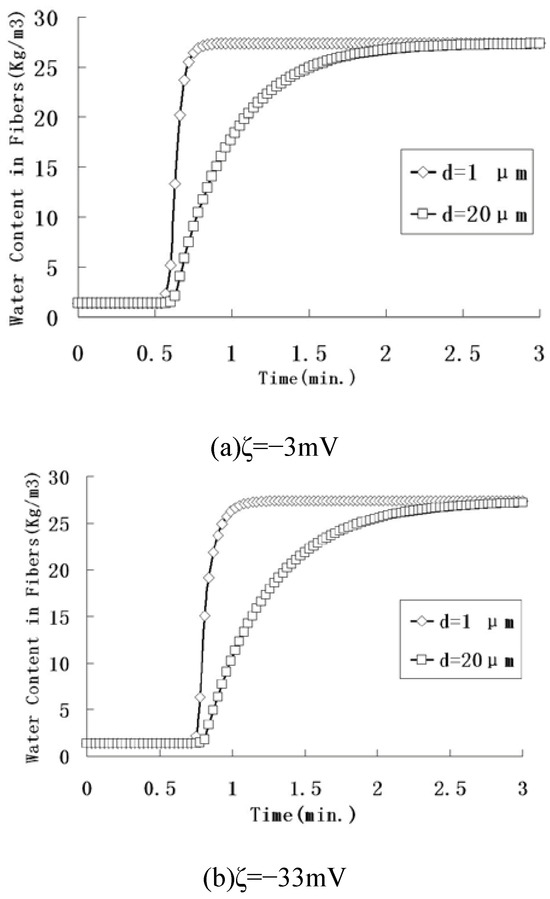
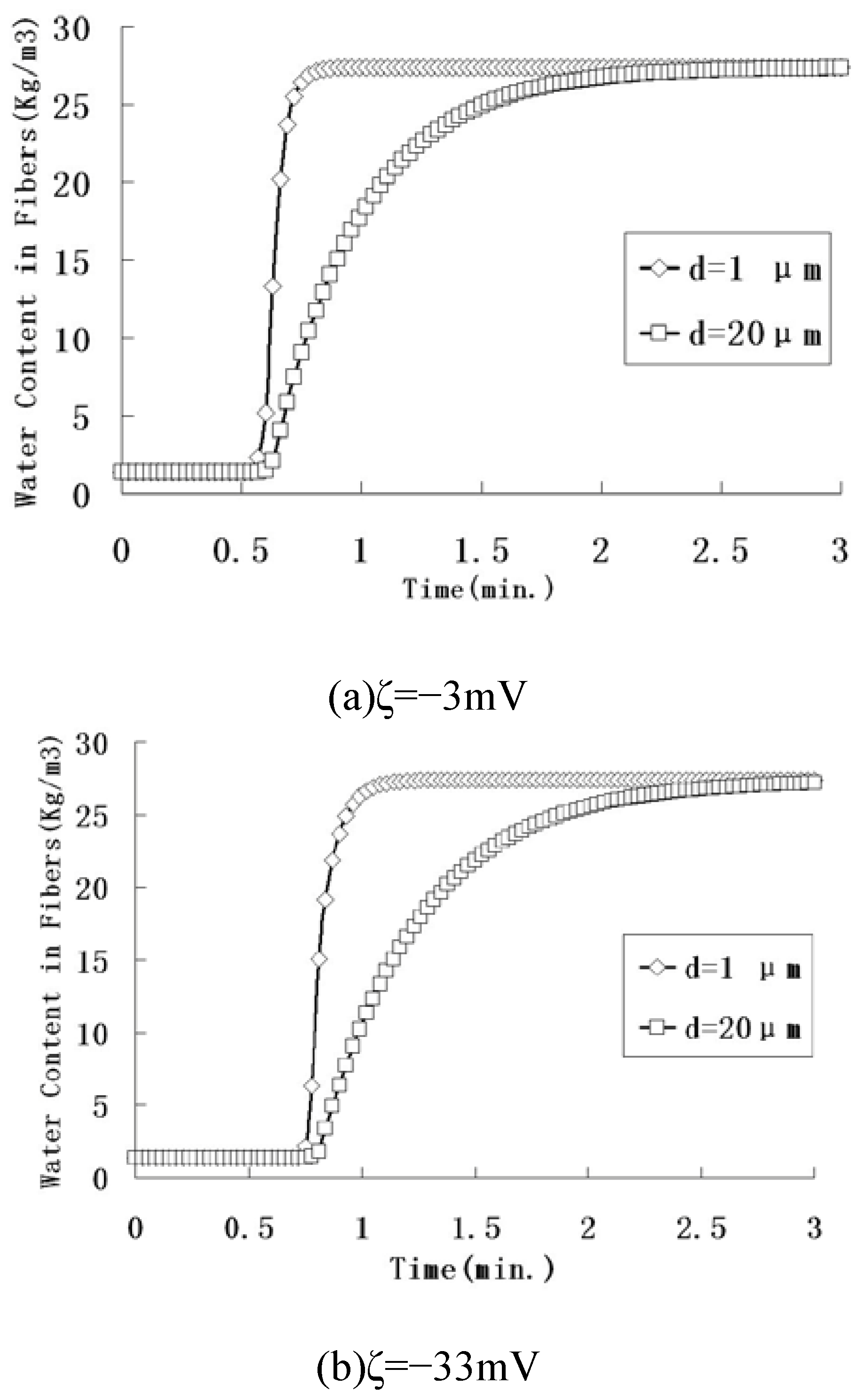
Figure 2 shows the distribution of the moisture content in fibers of the watch-point which is located at x=2cm as shown in Figure 3. With the flows of the electrolyte solution due to capillary action, the electrolyte solution reaches at the watch-point quickly and the moisture sorption by the fibers almost starts at the same time. Comparatively, the electrolyte solution reaches the watch-point of the porous polymer materials with ζ=−3mV at 0.6min which is shorter than 0.75min cost by the material with ζ=−33mV. According to the definition of the dimensional number Θ, the larger the absolute value of zeta potential is, the larger the magnitude of Θ is, and consequently the smaller the coefficient of diffusion is. In other words, for the porous polymer materials of same fiber diameter, the larger solid surface zeta potential means more obvious resistance effect of EDL and vice versa.
Figure 2.
Distribution of moisture content in fibers of the watch-point.
Figure 3.
Experimental installation.
The liquid flow is obviously affected by EDL. However, the effect of fiber diameters is not clear. The process of the moisture diffusion into fibers is a relatively slow process. It is found that the distribution of the moisture content in fibers is closely related with the fiber diameters and the EDL does not have significant influences on the sorption of the moisture by the fibers. The moisture content of the porous polymer materials with fiber diameter d=1μm due to the sorption of moisture by fibers takes shorter time to reach the equilibrium state than that with fiber diameter d=20μm. The moisture content in fibers with fiber diameter d=1μm reaches equilibrium in almost 0.1min, while the moisture content in fibers with fiber diameter d=20μm reaches equilibrium in more than 1.5min. The distribution of the water content in fibers is obviously affected by fiber diameters and the resistance effect of EDL is not quite clear.
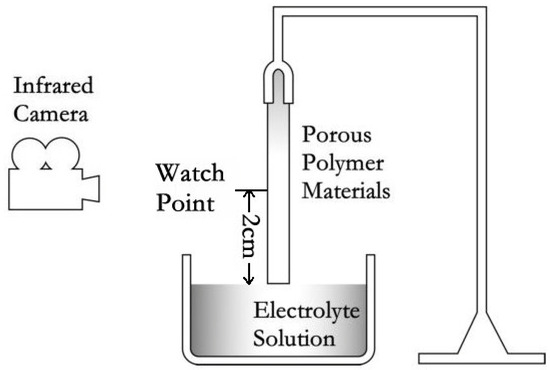
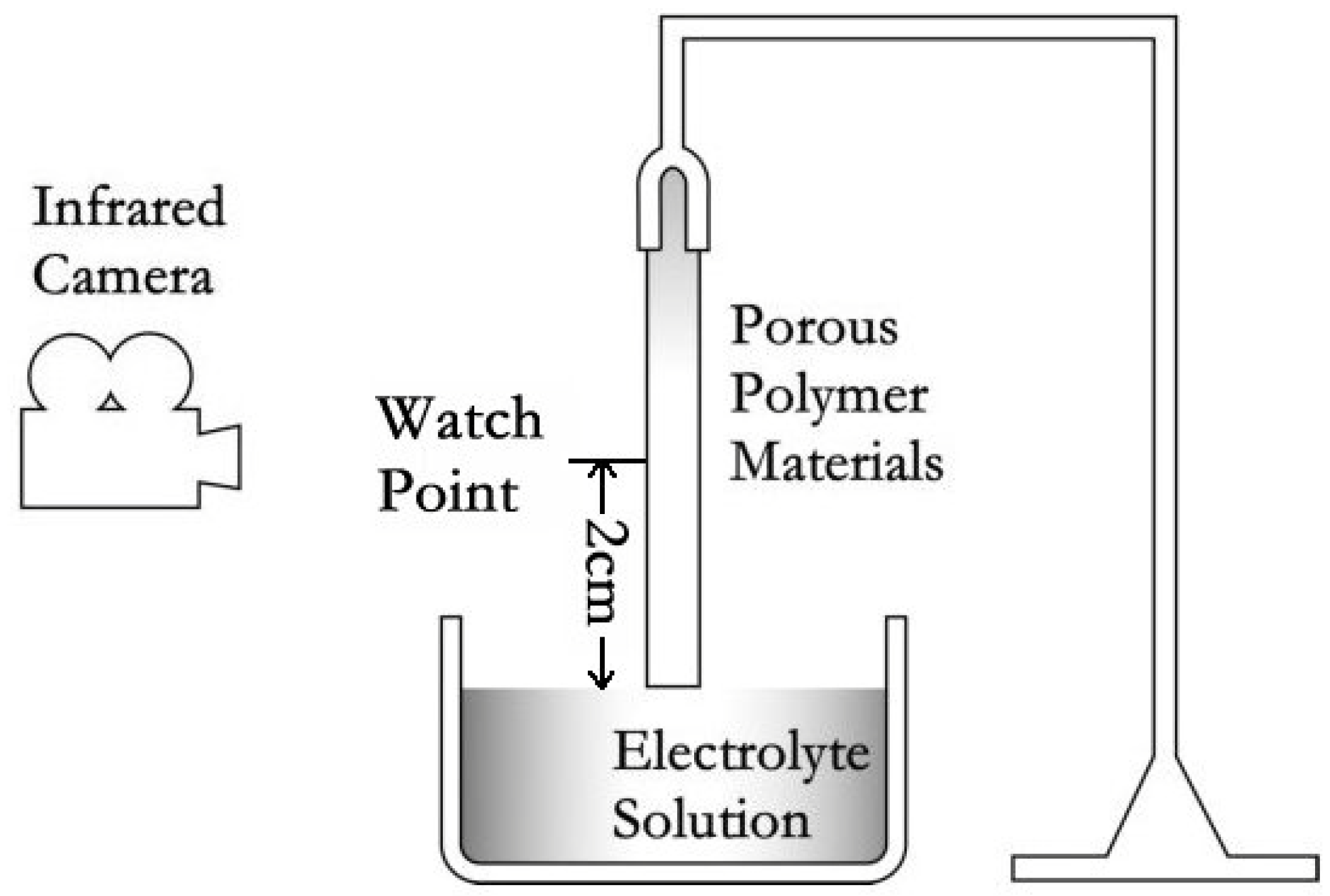
In order to verify our mathematical model, a series of experiments are carried out with porous polymer materials with different solid surface zeta potentials and fiber diameters. The porous polymer material sample is suspended in containers filled with the electrolyte solution at T1=21°C. Then as a result of the capillary action, the electrolyte solution penetrates into the porous polymer materials. The experimental installation is shown in Figure 3.
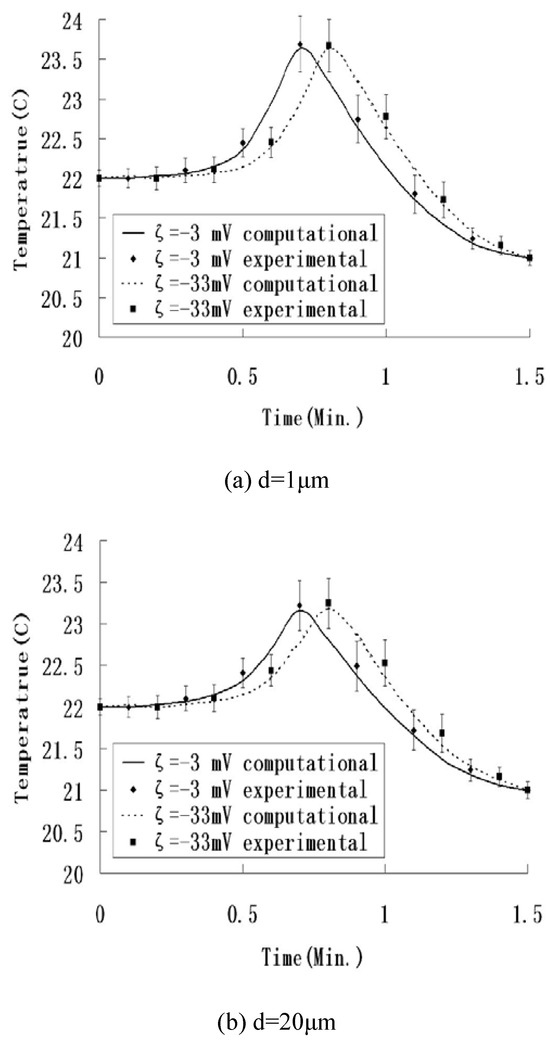
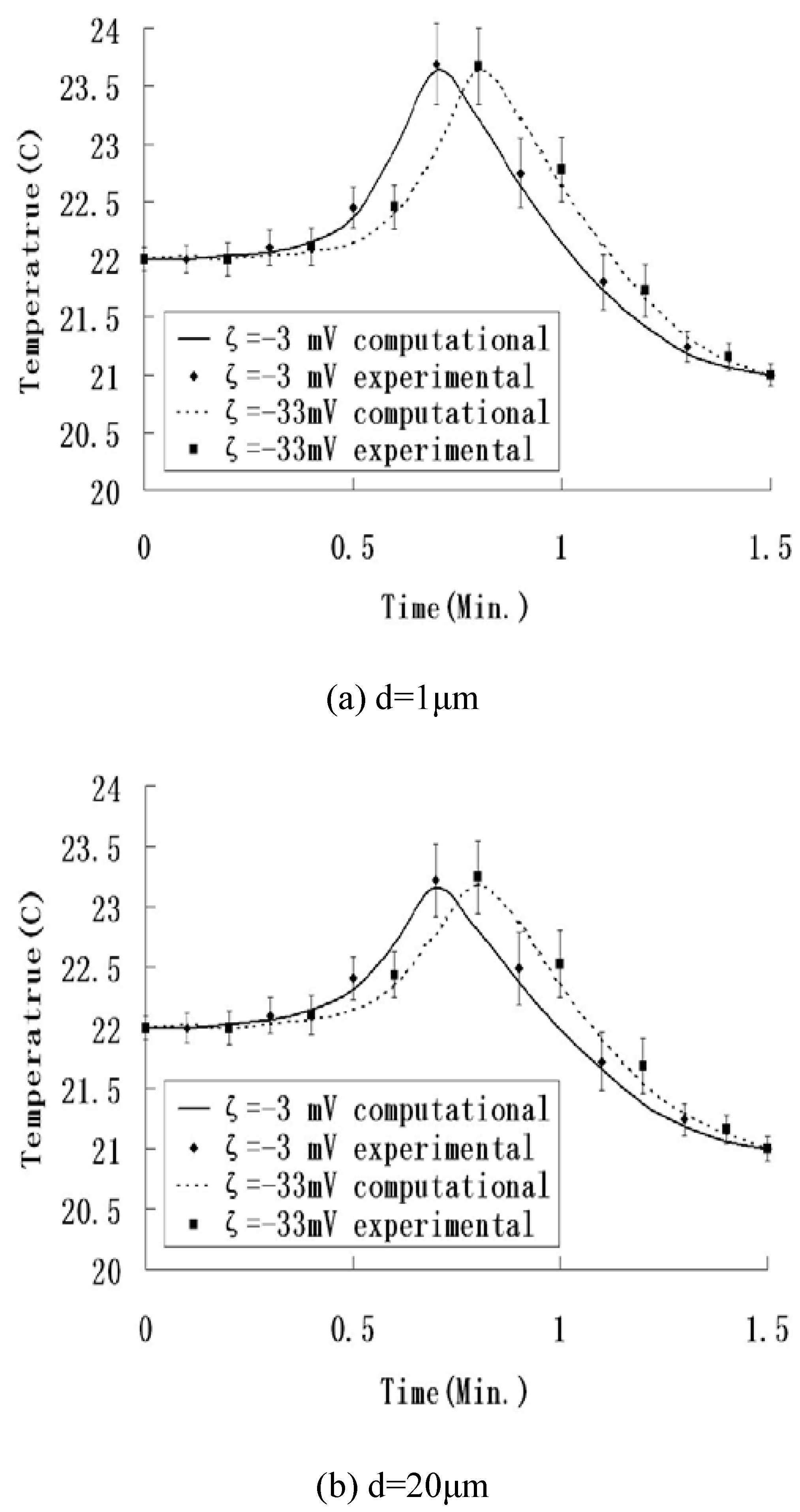
The watch-point is located at x=5cm and its temperature is measured by an infrared camera. The comparisons between computational and experimental results of the distributions of temperature at the watch-point are shown in Figure 4. At the beginning, the temperature is the same as the initial value. Due to capillary action, liquid reaches the watch-point and then fibers almost absorb moisture at the same time. The initial rise in temperature is due to the heat released during moisture sorption by the fibers. The heat absorbed during the evaporation of liquid water also affects the temperature. The temperature gradually declines to a value which is same as that of the temperature of the liquid due to the coupling effects of moisture sorption by fibers and evaporation of liquid water. The maximum temperature of the porous polymer materials with a larger solid surface zeta potential comes relatively in longer time than that with a smaller solid surface zeta potential. It is proved that the larger the solid surface zeta potential is, the more obvious the resistance effect of EDL is. Because EDL resists the liquid flows and the electrolyte solution reaches the watch-point in a longer time and the maximum temperature is reached later comparatively. By comparing Figure 4(a) and Figure 4(b), the smaller the fiber diameter is, the larger the maximum temperature is, because the heat of adsorption is inversely proportional to the fiber diameters and the smaller the fiber diameter is, more heat is released during the moisture sorption of fibers. The predictions of temperature changes at the watch-point are compared with experimental measurements, a good agreement is observed between the two.
Figure 4.
Comparison between computational and experimental results of temperature.
4. Conclusion
This study is a theoretical investigation of the liquid water transport coupled with moisture and heat transfer in porous polymer materials. The solid surface zeta potential and the fiber diameter are investigated to reveal the mechanisms of the coupling effects. Based on the Poisson-Boltzmann equation for electric double layer and Navier-Stokes equation for liquid flows, a mathematical model to simulate the complex coupled heat and moisture transfer in porous polymer materials is presented and a dimensionless number Θ is given to describe the resistance effect of the EDL, which is proportional to the square of the liquid dielectric constant and the solid surface zeta potential, and inversely proportional to the liquid dynamic viscosity, electric conductivity and the square of the effective pore size. With specification of initial and boundary conditions, the distributions of the moisture content and the temperature in the porous polymer materials with different solid surface zeta potentials and fiber diameters are numerically computed. Comparison of these results with a series of experimental measurements shows the superiority of this model in investigating the coupled heat and liquid moisture transfer in porous polymer materials. The results illustrate that the heat and moisture transfer process is influenced by the solid surface zeta potential and the fiber diameter of the porous polymer materials.
References
- Li, Y.; Li, F.Z.; Zhu, Q.Y. Numerical simulation of virus diffusion in facemask during breathing cycles. Int. J. Heat Mass Transf. 2005, 48, 4229–4242. [Google Scholar] [CrossRef] [Scilit] [PubMed]
- Zhu, Q.Y.; Li, Y. Effects of pore size distribution and fiber diameter on the coupled heat and liquid moisture transfer in porous fibrous media. Int. J. Heat Mass Transf. 2003, 46, 5099–5111. [Google Scholar] [CrossRef] [Scilit]
- Li, Y.; Zhu, Q.Y.; Yeung, K.W. Influence of thickness and porosity on the coupled heat and liquid moisture transfer in porous fibrous media. Text. Res. J. 2002, 46, 435–446. [Google Scholar] [CrossRef] [Scilit]
- Li, Y.; Zhu, Q.Y. Simultaneous heat and moisture transfer with moisture sorption, condensation and capillary liquid diffusion in porous fibrous media. Text. Res. J. 2003, 37, 515–524. [Google Scholar] [CrossRef] [Scilit]
- Li, Y.; Zhu, Q.Y. A model of coupled liquid moisture and heat transfer in porous textiles with consideration of gravity. Numer. Heat Transf. A 2003, 43, 501–523. [Google Scholar] [CrossRef] [Scilit]
- Zhu, Q.Y.; Li, Y. Mathematical model of the heat and moisture transfer in porous organic textiles. Chin. J.Comput. Mech. 2003, 20, 641–648. [Google Scholar]
- Li, Y.; Luo, Z. An improved mathematical simulation of the coupled diffusion of moisture and heat in wool fabric. Text. Res. J. 1999, 69, 760–768. [Google Scholar] [CrossRef] [Scilit]
- Li, Y.; Holcombe, B.V. A two-stage sorption model of the coupled diffusion of moisture and heat in wool fabrics. Text. Res. J. 1992, 62, 211–217. [Google Scholar] [CrossRef] [Scilit]
- Li, Y.; Plante, B.V.; Holcombe, B.V. Fiber hygroscopicity and perceptions of dampness partⅡ: physical mechanisms. Text. Res. J. 1995, 65, 316–324. [Google Scholar]
- Zhu, Q.Y.; Li, Y. Numerical simulation of the transient heat and liquid moisture transfer through porous textiles with consideration of electric double layer. Int. J. Heat Mass Transf. 2010, 53(7-8), 1417–1425. [Google Scholar] [CrossRef] [Scilit]
- Zhu, Q.Y.; Xie, M.H.; Yang, J.; Li, Y. Investigation of the 3D model of coupled heat and mass moisture transfer in hygroscopic porous fibrous media. Int. J. Heat Mass Transf. 2010, 53, 3914–3927. [Google Scholar] [CrossRef] [Scilit]
- Hsu, J.P.; Ting, C.C.; Lee, D.J.; Tseng, S.; Chen, C.J.; Su, A. Residence time distribution for electrokinetic flow through a microchannel comprising a bundle of cylinders. J. Colloid Interface Sci. 2007, 307, 265–271. [Google Scholar] [CrossRef] [Scilit] [PubMed]
- Xuan, X.C.; Sinton, D.; Li, D.Q. Thermal end effects on electroosmotic flow in a capillary. Int. J. Heat Mass Transf. 2004, 47, 3145–3157. [Google Scholar] [CrossRef] [Scilit]
© 2010 Textile Bioengineering and Informatics Society. This article is an open access article distributed under the terms and conditions of the Creative Commons Attribution (CC BY) license (https://creativecommons.org/licenses/by/4.0/).