


Abstract
This paper focuses on the development of a multi-structural computational scheme for textile thermal engineering design, which plays an important role in translating complex mathematical models into computational algorithms and to implement computational simulation of clothing wearing system consisting of human body, clothing and external environment. In this paper, the integrated models for simulating the clothing wearing system is introduced and the descretization process of the partial differential equations involved in the mathematical models is reported. Based on the descretized equation assemblies, the multi-dimensional algorithms for computational simulation are developed for clothing thermal engineering design. Furthermore, the influence of the physical properties of clothing on the simulation results is analyzed to guide the user to design the thermal performance of clothing.
1. Introduction
Clothing thermal engineering design is a model-based and simulation-based technique to develop the thermal performance of clothing meeting with the thermal biological requirements of the human body for various wearing situations. It is the application of a systematic and quantitative way of designing and engineering of clothing with the inter-disciplinary combination of physical, physiological, mathematical, computational software science, and engineering principles [1]. The key part of this technique is the simulation capacity to computationally simulate the thermal behaviors involved in the clothing wearing system consisting of wearer, clothing and wearing scenario. With the simulation capacity, the CAD system can be developed and offered to the users to design, simulate, view and evaluate the thermal performance of clothing during the wearing period, and thus to obtain feedback to iteratively improve their designs before making any real samples. This innovative technique has many advantages, which can not be obtained from the conventional design approach. Clothing thermal engineering design is based on the scientific models and computational simulation, which offers much more reliance than the experience-based conventional approach. Meanwhile, clothing thermal engineering design can greatly speed up the design cycle by virtual simulation and preview of the thermal performance of designed clothing.
This paper focuses on the development of a multistructural computational scheme for clothing thermal engineering design. This scheme is applied to translate the mathematical models describing the thermal behaviors in the clothing wearing system into computational algorithms and to implement the computational simulation in the clothing thermal engineering design. Firstly, the integrated mathematical models describing the clothing wearing system are introduced, and then the partial differential equations in the mathematical models are descrtized. Based on the solution of the models, a multi-structural scheme is developed for clothing thermal engineering design. Furthermore, the influence of the physical properties of clothing on the simulation results is analyzed to guide the user to design the thermal performance of clothing.
2. Integrated Mathematical Models
The thermal behaviors, which happen in the clothing wearing system, involves various heat and moisture transfer process in textile materials and biological thermoregulations in human body. Specifically, they may be regarded as follows [2].
1) Heat and moisture transfer behaviors in fibers, fabrics and garments including their interactions and the influence of phase change materials and various functional treatments;
2) Thermoregulatory behaviors of human body responding to various external environments;
3) Interactions between the boundaries of clothing, human body and environment.
Before the development of the simulation capacity for clothing thermal engineering design, the mathematical models is necessary to be developed and integrated to numerically express these thermal behaviors. There have been many mathematical models reported in the literatures for simulating the heat and moisture transfer processes in textile materials and the thermal biological regulation behaviors of the body [3,4,5,6,7,8,9,10]. By judging the potential/suitability of these models to be directly integrated to the engineering design process for general application purposes [11], such as, whether the model was developed with clear physical meanings and the parameters in the models are related to the real structural and physical properties/process of the materials, and whether there is close interactions between the human body models and clothing models so as to enable the integration between them with smooth communication sockets, the mathematical models are selected and integrated to simulate the clothing wearing system for clothing thermal engineering design. The main equations of them are listed as follows:
Fabric vapour moisture governing equation
Fabric liquid water governing equation
Fabric heat transfer governing equation
Fabric dry air pressure governing equation:
Fiber moisture absorption/desportion model:
Human body thermal regulatory model:
The detailed descriptions of the development and integration of these mathematical models can be found in the literatures [7,8,12]. The human body thermal regulatory model is one-dimensional considering the body as two-node concentric shells (core and skin). The partial differential equations in these models are required to be discretized firstly to obtain their numerical solutions, while the algebraic equations do not need special solution method.
3. Discretization of the Partial Differential Equations
The finite volume method is adopted to spatially discretize these partial differential equations. In this method, the volume integrals in a partial differential equation that contain a divergence term are converted to surface integrals and the equation is always kept conservative during the discretization process. In order to get the discretized form of these coupled differential equations, the fabric material is geometrically meshed on the thickness direction and a small volume surrounding each point in the mesh is chosen. The differential equations are integrated on all the small volumes and are evaluated as algebraic equations.
In the discretization process, the implicit method is utilized as the time integration method rather than the explicit method. Though the explicit method is point wise independent and has no need for linearization, it is demanding on the stability of the scheme size [13]. The implicit method, though needs linear algebraic equations, has the advantage of unconditional stability, which allows the usage of large time step and has the flexibility in adapting the time step for controlling the accuracy of solution.
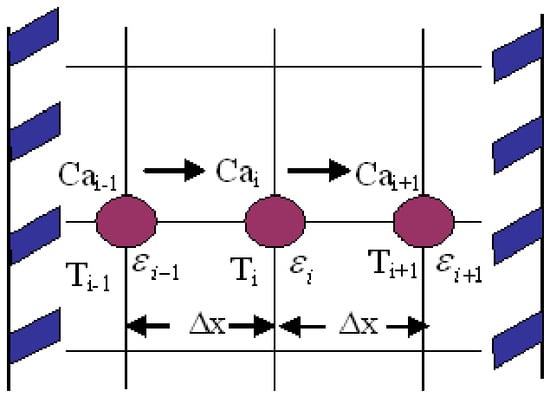
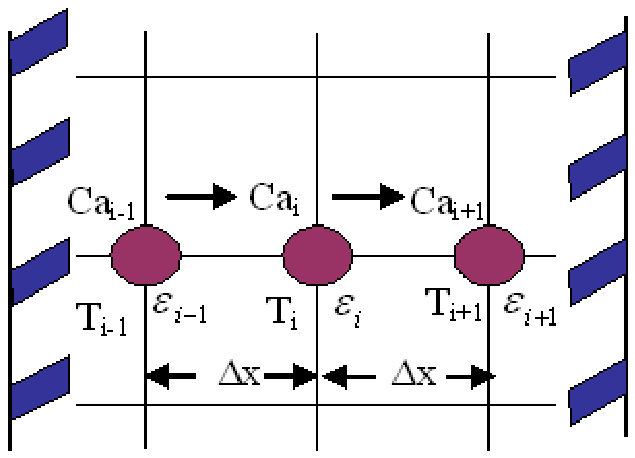
In the meshed domain (seen in Fig. 1), considering a control volume Ω with space (), the differential equation assemblies can be discretized by integral values as follows:
Figure 1.
Meshed control volume for equation discretization.
For Equation (1), it can be re-written as:
where,
Then Equation (1) can be expressed in the integral form:
Then the integral value is discreted as:
Similarly, the Equation (2) can be discreted as:
where,
The Equation (3) can be discreted as:
where,
The Equation (4) can be discreted as:
The Equation (5) can be discretized as:
Where
With the discretized form of the partial differential equations, their numerical solutions can be obtained by constructing the solution matrix.
4. Multi-structural Computational Algorithms
With the numerical solutions of the integrated models, the computational scheme for implementing the computational simulation can be developed. Since the thermoregulatory model of the human body is onedimensional and predicts the thermal status of the human body on the whole, the thermal interactions between the models of clothing and human body consequently happen on the whole. The computation of heat and moisture behaviors in clothing which covers the body skin is needed on the whole, which generates thermal values of the clothing to interact with the thermoregulatory system of human body. The predicted thermal performance of clothing wearing system is thus viewed on the whole.
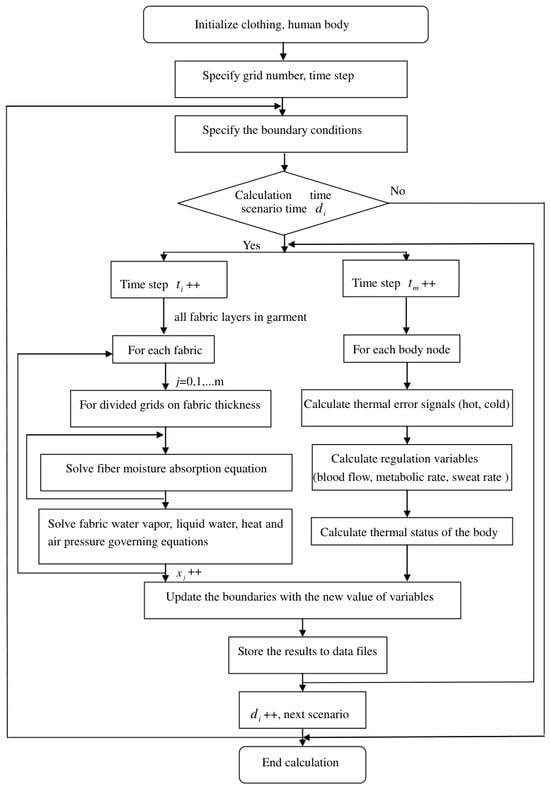
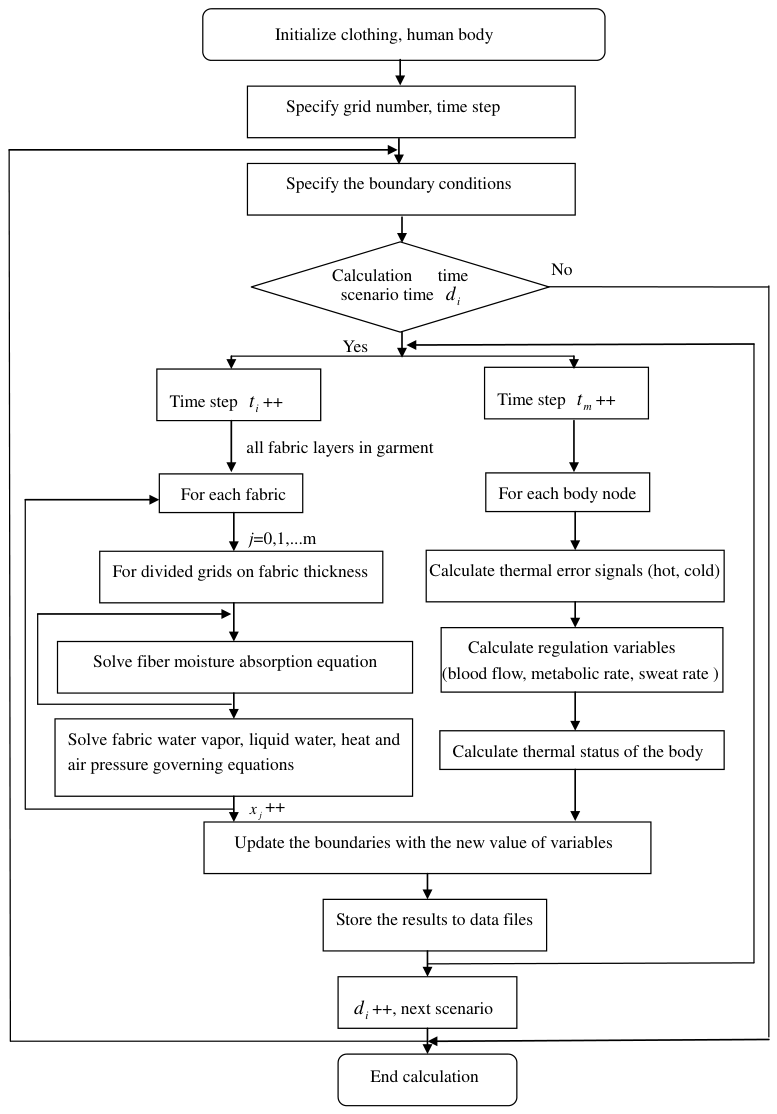
Fig. 2 shows the structure of the one-dimensional computational scheme, which illustrates the algorithm for simulating the clothing wearing system with a flowchart diagram. The computational simulation is iteratively implemented for all the wearing scenarios. In each scenario, the simulation of the garment and the human body is structured respectively. Since the garment is designed following the principle of fiber fabric garment, the simulation of the garment is a hierarchical iterative structure, in which the simulation is on the unit of fabric so that the garment is subdivided into joined composed fabrics, and is detailed to all the fibers used in each fabric. While, the simulation of the human body is in a linear structure, in which the simulation is performed sequentially from the core node to skin node. The simulation results generated from the models of clothing and human body are utilized to update the boundary conditions in each time step.
Figure 2.
One-dimensional computational algorithms.
Due to the big thermal mass of the body, the solution of the thermoregulatory model is not very sensitive to the time step. The calculation frequency of the thermoregulatory model is ten times smaller than that of the fabric model. For the garment, at the interval of time step, the computational simulation is iteratively performed for each grid subdividing the composed fabrics along thickness directory and each grid subdividing the involved fiber along radius directory. In the iterative simulation of the garment, the solution matrix can be constructed with the discretized equations for the coupled governing equations of water vapor, liquid water, and heat and air pressure of the fabric. Before this happens, the fiber moisture absorption/desorption model is solved and utilized in the calculation of the coefficients for solving the fabric models. The mesh information including the grid number of fabric and the grid number of fiber plays an important role in determining the solution domain and accuracy of the simulation results.
5. Influence on the Simulation Results
The accuracy of simulation results of the thermal models during the iterative computation depends on many coefficients. Basically, the simulation results are influenced by the physical properties of clothing and the physiological properties of human body. In the clothing thermal engineering design, we place the focus on the influence of physical properties of clothing on the simulation results, which are related to the textile materials and garment design, to guide the design of the thermal performance of clothing. These physical properties include the water vapor diffusion coefficient (Dfab), effective thermal conductivity (Kt), liquid water diffusion coefficient (Dl), thickness (L) and porosity of the fabric (ε).
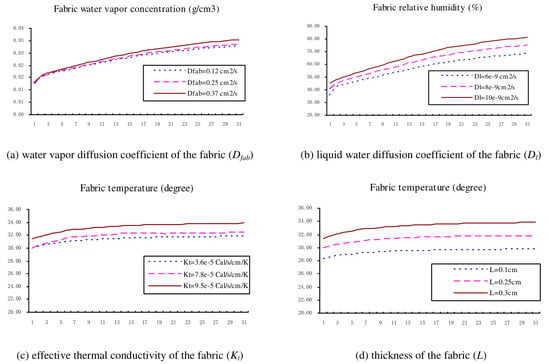
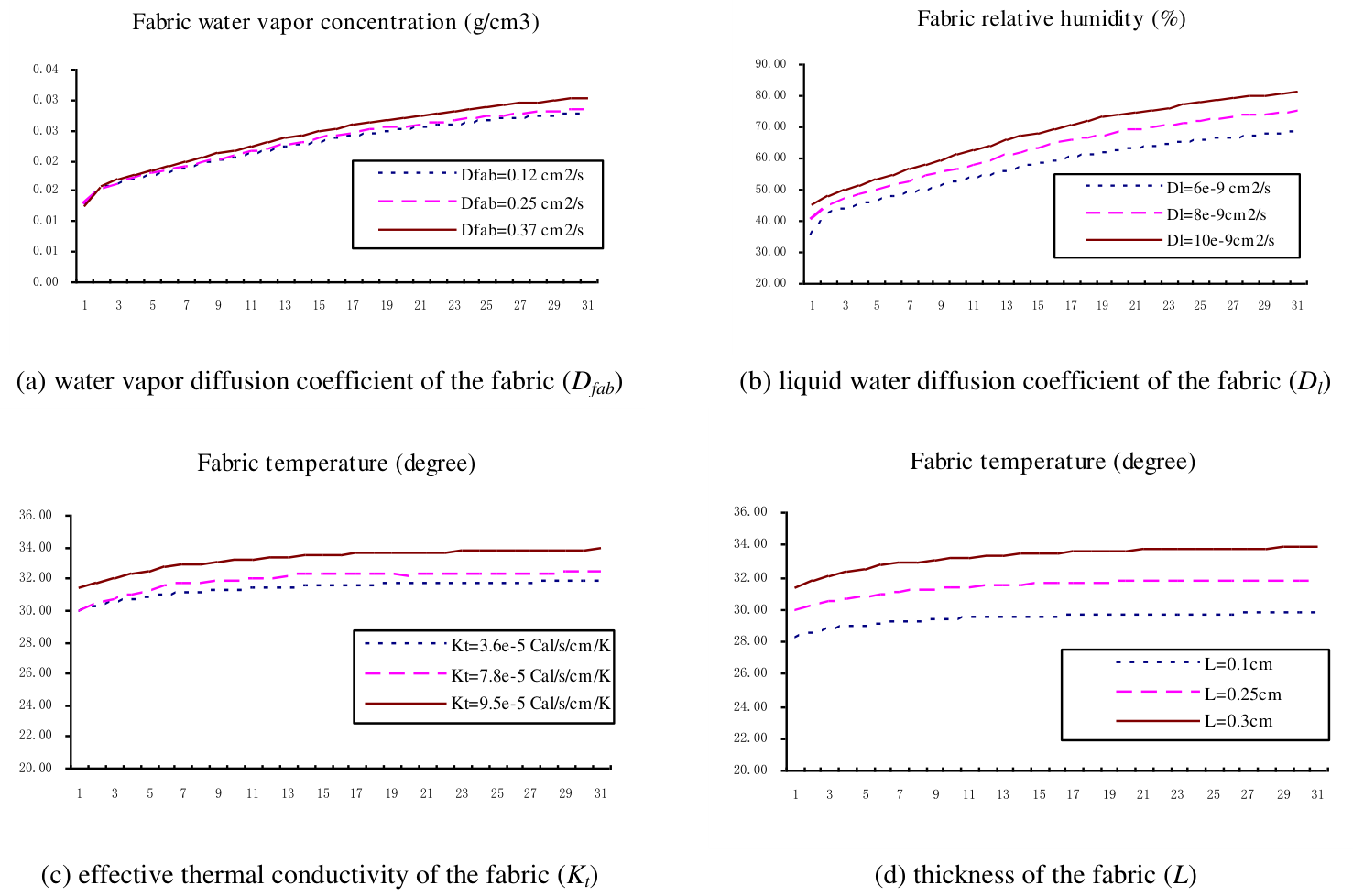
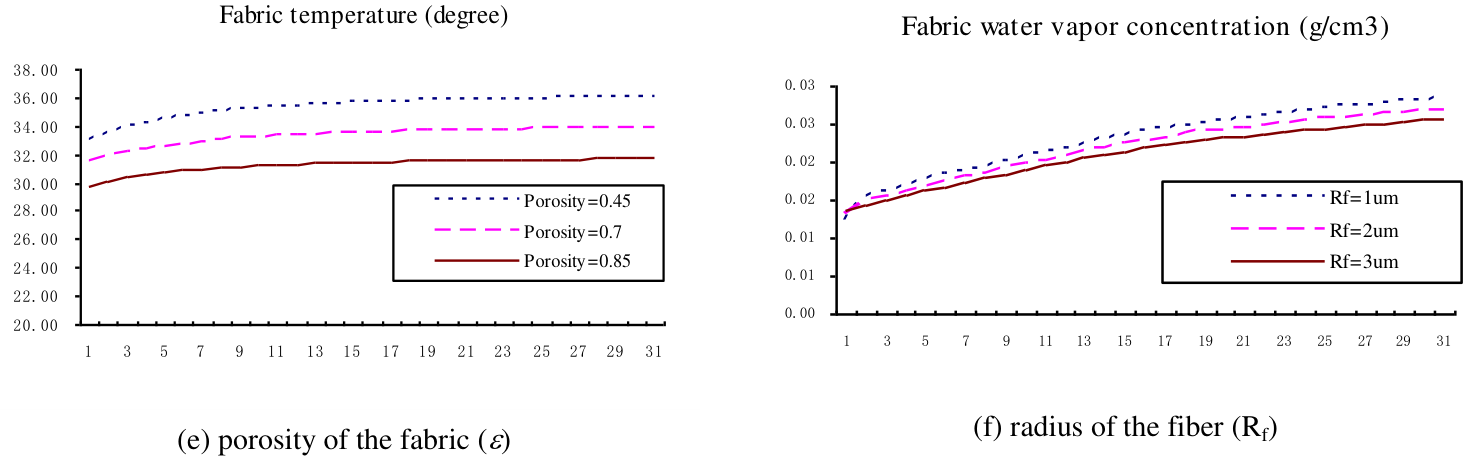
The water vapor diffusion coefficient of fabric (Dfab) indicates the moisture diffusion velocity and determines the water vapor concentration in the fabric.
With increasing Dfab, the water vapor concentration in the fabric becomes higher until the saturation of moisture regains within the fibers. Since the fabric is composed by the fiber with air enclosed, Dfab is mainly determined by the water vapor coefficients of fiber and air.
The liquid water diffusion coefficient (Dl) indicates the velocity of liquid water diffusing through the fabric. With increasing Dl, the liquid water content will also become higher by capillary actions. As Dl is determined by a number of factors: surface tension (γ), contact angle (θ), effective capillary angle (α), liquid viscosity (ul), largest effective radius of the pore in fabrics (dc) and volume fraction of liquid water (εl). When the contact angle is greater than 90 °C, Dl is small and indicates that the liquid water cannot diffuse into the fabric, and the water content of fabric is very low. Furthermore, the evaporation process and the moisture absorption of fibers are further influenced by the liquid water diffusion. When the liquid water cannot diffuse into the fabric, evaporation can just occur at the fabric’s lower surface and the moisture absorption of fibers is mainly determined by water vapor transport. When there is liquid diffusion in the fabric, evaporation can occur throughout the fabric and the moisture absorption of fibers is mainly determined by liquid transport [14].
The effective thermal conductivity of fabric (Kt) directly determines the transfer rate of heat flux through the fabric. With increasing Kt, the temperature of fabric is decreased to be within a smaller gradient. Kt is defined as a fractional sum of the thermal conductivity of air and wetted fabrics. In order to increase the thermal insulation function of clothing, it is a common method to decrease Kt by various methods, such as increasing the porosity of fabric since the thermal conductivity of air is much lower than that of fibers.
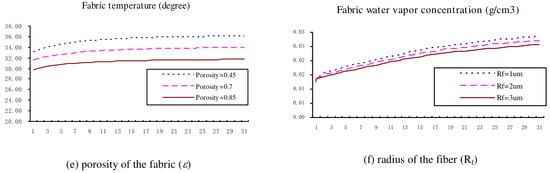
The thickness of fabric (L) has significantly influenced on the distribution of water vapor concentration, liquid water fraction volume and temperature. With greater thickness, the fabric has higher thermal and mass resistances to the heat and moisture transfer processes, and it can hence obtain obvious gradients of water vapor concentration, liquid water fraction volume and temperature through fabric thickness. The porosity of fabric (ε) has an important influence on liquid diffusion process and heat transfer process, as well as on water vapor diffusion process. Therefore, if the fabric has greater porosity, it will have more noticeable gradients of liquid water volume fraction and temperature.
In order to offer the reader a quantitive understanding of the influence of these properties on the thermal performance of clothing, computational experiments were carried out to show the influenced thermal values of the clothing while changing these coefficients. The clothing utilized in the computational experiments is a one-layer garment with basic physical properties, as shown in Table 1. The wearing protocol in the computational experiments is specified as a male person with 175 cm height, 65 kg weight wearing this garments has a slow running (2 Met) in an environment with 20 °C temperature and 60% RH for 30 minutes.
Table 1.
Basic properties of the garment with one-layer fabric.
Fig. 3 shows the thermal values of clothing in terms of the water vapour concentration (g/cm3), relative humidity (%), temperature (degree) of the fabric influenced by these properties (Dfab, Dl, Kt, L, ε and Rf) through computational experiments. In each case, the focused property is varied while others are fixed to show the influence of this property. It can be observed that the thermal values of clothing are influenced by the physical mechanisms discussed above when the property is specified with different values.
Figure 3.
Influence of physical properties on the thermal performance of clothing.
6. Conclusion
This paper has reported on the development of a multi-structural computational scheme for clothing thermal engineering design. The integrated mathematical models describing the clothing wearing system has been introduced and descrtized to obtain the numerical solution. Based on that, the multistructural scheme has been developed for clothing thermal engineering design and the influence of the physical properties of clothing on the simulation results has been analyzed. This scheme acts as an important role in realizing the simulation capacity of the clothing thermal engineering design.
Acknowledgments
The authors would like to acknowledge the ITF/HKRITA for providing funding support to this research through project ITP/030/08TP.
References
- Li, Y. Computational textile engineering. In Studies in Computational Intelligence; Zeng, X., Li, Y., Ruan, D., Keohl, L., Eds.; 2007; Volume 55, pp. 203–221. [Google Scholar]
- Li, Y. The science of clothing comfort. In The Textile Institute; 2001. [Google Scholar]
- Farnworth, B. Mechanisms of heat flow through clothing insulation. Text. Res. J. 1983, 53, 717–725. [Google Scholar] [CrossRef] [Scilit]
- Holcombe; Li, Y. A two-stage sorption model of the coupled diffusion of moisture and heat in wool fabric. Text. Res. J. 1992, 62, 211–217. [Google Scholar] [CrossRef] [Scilit]
- Li, Y.; Luo, Z.X. An improved mathematical simulation of the coupled diffusion of moisture and heat in wool fabric. Text. Res. J. 1999, 69(10), 760–768. [Google Scholar] [CrossRef] [Scilit]
- Fan, J.; Luo, Z.; Li, Y. Heat and moisture transfer with sorption and condensation in porous clothing assemblies and numerical simulation. J. Heat Mass Transf. 2000, 43(16), 2989–3000. [Google Scholar] [CrossRef] [Scilit]
- Li, Y.; Zhu, Q.Y.; Luo, Z.X. Numerical simulation of heat transfer coupled with moisture sorption and liquid transport in porous textiles. The 6th Asian Textile Conference, 2001. [Google Scholar]
- Li, Y.; Zhu, Q.Y. Simultaneous heat and moisture transfer with moisture sorption, condensation and capillary liquid diffusion in porous textiles. TEXT. RES J. 2003, 73(6), 515–524. [Google Scholar] [CrossRef] [Scilit]
- Wang, Z.; Li, Y.; Yeung, C.Y.; Kwok, Y.L. Influence of waterproof fabrics on coupled heat and moisture transfer in a clothing system. J. Soc. Fiber Sci. Technol. 2003, 59(5), 187–195. [Google Scholar] [CrossRef] [Scilit]
- Zhu, Q.Y.; Li, Y. Effects of pore size distribution and fiber diameter on the coupled heat and liquid moisture transfer in porous textiles. Int. J. Heat Mass Transf. 2003, 46, 5099–5111. [Google Scholar] [CrossRef] [Scilit]
- Mao, A.H.; Li, Y.; Wang, W.R.; Lou, X.N. Establishment of computational models for clothing engineering design. WSEAS Trans. Comput. 2008, 17(6), 770–780. [Google Scholar] [CrossRef] [Scilit] [PubMed]
- Li, Y.; Luo, Z.X. An improved mathematical simulation of the coupled diffusion of moisture and heat in wool fabric. Tex. Res. J. 1999, 69(10), 760–768. [Google Scholar] [CrossRef] [Scilit]
- Zhong, W.X.; Zhuang, X.L.; Zhu, J. A self-adaptive time integration algorithm for solving partial differential equations. Appl. Math. Comput. 1998, 89, 295–312. [Google Scholar] [CrossRef] [Scilit]
- Li, Y.; Zhu, Q.Y.; Yeung, K.W. Influence of thickness and porosity on coupled heat and liquid moisture transfer in porous textiles. Text. Res. J. 2002, 72, 435–446. [Google Scholar] [CrossRef] [Scilit]

© 2010 Textile Bioengineering and Informatics Society. This article is an open access article distributed under the terms and conditions of the Creative Commons Attribution (CC BY) license (https://creativecommons.org/licenses/by/4.0/).