


Abstract
The flammability of materials remains a primary limitation to their practical use because of the dangers they pose to integrity, thermal safety, and human health. Raising the temperature of human tissue to only 44 °C causes the onset of skin burns. Flammability results from flammable material pyrolysis (heat-supported oxidation), producing flammable gases that combust. The primary objective of this article is to characterise the state of the art of flame retardancy and present the basic physicochemical aspects of materials’ flammability, mechanisms of combustion, and peculiarities of textile materials as porous bodies influencing their burning. The paper comprehensively discusses the basic mechanisms and approaches to flammability suppression. It presents recent trends in flame retardancy, including different flame-retardant substances, nanoparticles, sustainable flame-retardant agents derived from eco-friendly, natural, and bio-based sources, and proper waste materials.
1. Introduction
According to ISO 13943 (2017) and ASTM E176-18a (2021) standards, a material is flammable if it is susceptible to easy ignition and rapid flaming combustion. The flammability of polymeric materials (i.e., plastics, foams, and, in particular, textiles) has long been considered a major hazard to humans. The hazards associated with material flammability include not only combustion (ignition, release of volatile products, and matter decomposition), but also heat generation, flame spread, smoke development, and toxicity. The toxicity of combustion products is one of the main causes of death in fires [1].
Heating organic polymers above a critical temperature induces pyrolysis, producing volatile, flammable gases that lead to subsequent combustion.
Several physical and chemical processes act simultaneously and sequentially to support combustion. To disrupt the physicochemical processes that support combustion and inhibit flame spread, materials (additives) must undergo different reactions at high temperatures, thereby slowing the processes that support combustion. These materials can act synergistically and influence the basic mechanisms limiting the flammability of polymeric materials.
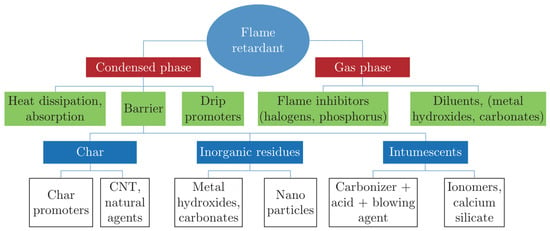
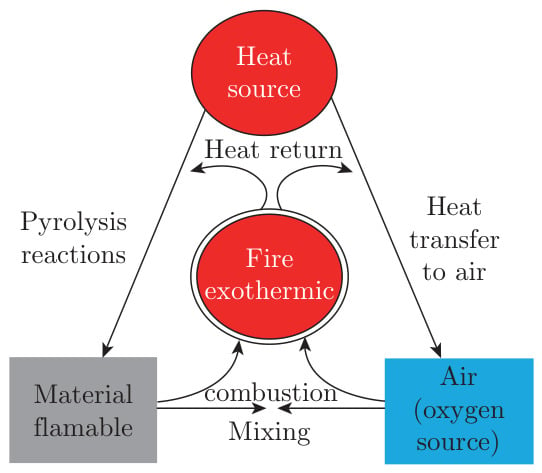
Classical flame-retardant materials based on halogen-containing compounds such as Br, Cl, and F [1] are now being replaced by environmentally friendly bio-based flame retardants [2] or nanoparticles, such as carbon nanotubes (CNTs) [3] (see Figure 1).
Figure 1.
Classification of common flame retardants according to their functions.
The current trend also involves using environmentally friendly methods to reduce polymer flammability through a combination of mechanisms [4,5].
Textile flammability is a major problem that limits their use in clothing, housing, and technical applications. Common flame-retardant additives include mineral compounds, halogenated compounds, phosphorus-based compounds, nitrogen-based compounds, silicon-based compounds, inorganic waste (e.g., fly ash), water-containing inorganic salts, and micrometric particles. Today, flame retardants are also derived from sustainable biobased materials, organic wastes, and nanoparticles. Several approaches reduce flammability; however, they have limitations due to insufficient protective effect, skin-related health problems, and ecological harm. Flame-retardant agents also negatively affect the comfort and end-use properties of textile structures, such as drapeability and stiffness.
Producing textiles with enhanced flame retardancy is essential to ensure functionality and safety in applications ranging from clothing and furnishings to protective materials and industrial products. These textile-based structures are important components in homes, hospitals, transport vehicles, and public spaces.
Hybrid flame retardant systems (HSFR) using a combination of functional additives, especially particulate additives, and nano-additives are investigated at the laboratory scale for their potential benefits, including their types of action and possible synergies [3]. Researchers are investigating and gradually validating new nanocomposite particles (NCFR) of double-layered hydroxides (LDH) fixed on a solid support, such as microcrystalline cellulose (MCC). Bio-based and waste-based materials (promoting char formation and suppressing flammability to create sustainable finishes) are also being developed [6].
Some material compositions, such as ammonium polyphosphate/pentaerythritol/calcium carbonate and various types of nanoparticles, are also verified as additives, especially for forming surface intumescent layers and limiting the diffusion paths of gaseous hydrolysis products [7]. For the same purpose, layered structures such as expanded graphite and synthetic ceramic plates (Laponite) are used. Attention is also focused on particle additives based on proteins from waste raw materials (casein, waste wool, waste natural silk), inorganic (nano) particles from waste raw materials (basalt, fly ash, glass), and combinations of these particles with intumescent systems [7]. The aim is also to use HSFR systems to limit the production of unacceptable amounts of toxic smoke and hazardous combustion products.
The basic parameters for a successful, commercially acceptable flame retardant are minimal or no adverse effects on the physiological and aesthetic properties of textile materials, ease of application, and durability against severe washing, cleaning, and drying cycles.
This article focuses on the characterisation of the current state of the art and further developments in the flammability of polymeric materials, especially fibrous structures. It presents main techniques and recent trends for increasing the flame retardancy of different textile structures.
2. Flammability of Materials
When polymers are heated, intermolecular bonds break and free volume increases between the glass transition temperature (Tg) and the melting temperature (Tm) or decomposition temperature (Tr). At higher temperatures, main-chain bonds break (depolymerisation), and the chains decompose into solid, liquid, and gaseous products (pyrolysis). Flammable gases ignite either from an external source or when the temperature reaches the autoignition temperature (Tz). This usually results in combustion accompanied by further development of thermal energy and infrared radiation. If the energy generated by the combustion of gaseous pyrolysis products exceeds the energy required to pyrolyse the material, the flame generated by ignition continues to burn even after the ignition source is removed [4].
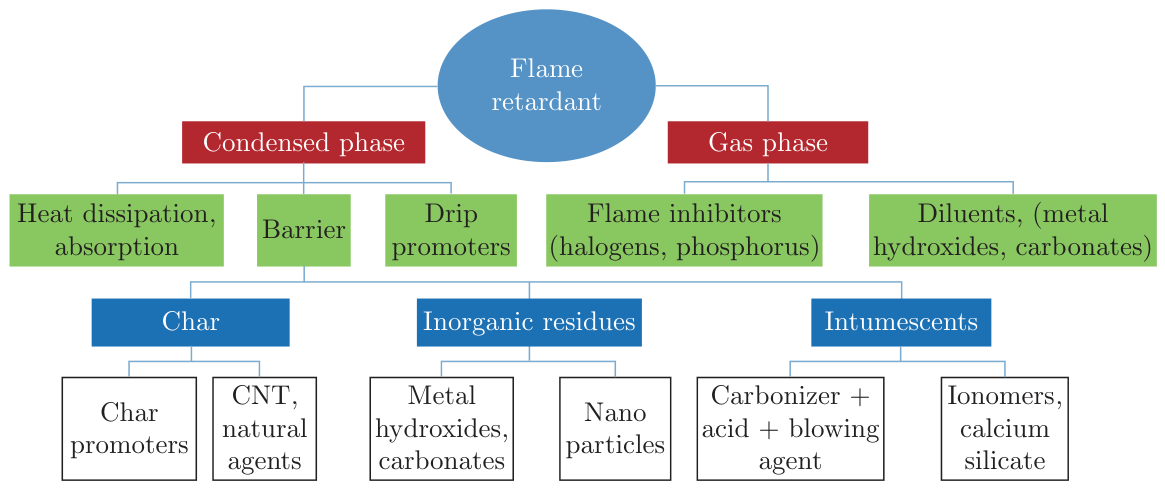
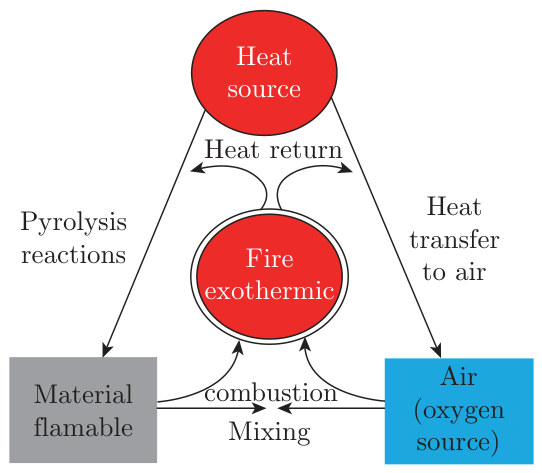
Combustion is generally an exothermic process that requires three components: a heat source, oxygen, and a material that produces flammable gases (see Figure 2).
Figure 2.
Components of combustion.
Combustion of polymeric materials involves heat and mass transfer/diffusion, fluid dynamics, and degradation chemistry. With a sufficiently high heat source (to induce bond scission), polymers decompose, or “pyrolyse,” evolving flammable volatiles. They combine with air (oxygen), which propagates the fuel combustion through branching reactions.
The book [4] presents a theoretical description of combustion dynamics. The book [5] comprehensively discusses the engineering aspects of fire protection. Higher temperatures promote the thermal decomposition of polymers, which forms gaseous flammable products (thermodynamically driven) and is controlled by complex kinetic processes. The main processes that allow combustion are end-chain scission (polystyrene, polymethyl methacrylate); random chain scission (polyethene, polyamides, polyesters, polyisoprene, etc.); chain stripping (PVC, Polyacrylonitrile, Polyvinylalcohol, cellulose, etc.); and char formation (Polyacrylonitrile, cellulose, etc.) [5].
Incident heat flux is a major factor in classifying materials as thermally thick or thin. The thermal thickness of polymers also depends on their material properties and dimensions. A thermally thick material has a physical thickness always greater than the depth of thermal diffusion at the time of ignition [8]. This behaviour occurs at high heat fluxes (i.e., at high heating rates). Thermally thin materials have a physical thickness always lower than the depth of thermal diffusion at the time of ignition. This behaviour occurs at low heat fluxes (i.e., low heating rates) near their critical heat flux for ignition [9]. Most commonly used materials behave as thermally thick materials under practical fire conditions [5].
The flammability of materials is predicted by engineering models based on materials’ physical properties such as thermal conductivity k [kW/m/K], density ρ [kg/m3] and heat capacity cp [kJ/kg/K] (also used as the product k ∗ ρ ∗ cp, called thermal inertia), and their melting point Tm [5].
A basic characteristic related to polymer flame dynamics is called the thermal response parameter, TRP, which is very useful for engineering calculations to assess ignition and fire propagation for thermally thick material conditions. A relation [9] defines this parameter.
 where Tig is the surface ignition temperature (K), and T0 is the ambient temperature (K).
Physical properties of selected polymeric materials relevant to combustion (see [5]) are given in the Table 1.
Table 1.
Physical properties of selected polymers (extracted from [5]).
Basic steps of heating during combustion are [5,7]:
- (1)
- Heat absorption and water loss from the polymeric structure.
- (2)
- Flammable gases are formed by the thermal decomposition (pyrolysis) of polymers.
- (3)
- Flammable gases ignite (radical reaction between flammable gases and oxygen in the gaseous phase).
- (4)
- Combustion generates heat, which further supports the formation of flammable gases.
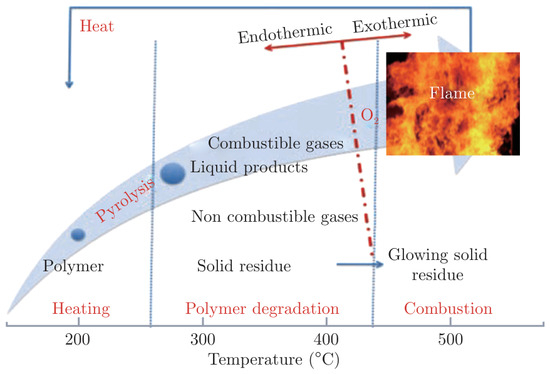
Flammable gases (pyrolysis products) can burn. Polymers with a higher number of hydrogen bonds (e.g., cellulose) are more flammable. Polymers containing aromatic rings or halogen groups (Cl, F) are less flammable. Figure 3 shows how temperature affects the physicochemical changes of materials in an oxygen-containing environment.
Figure 3.
Changes in materials and combustion due to heating in an oxygen-containing environment.
Below the ignition temperature, low-molecular-weight compounds are first released, usually between the glass transition temperature Tg and the melting point Tm (or degradation temperature Td), followed by depolymerisation and pyrolysis (at temperature Tp). Simultaneously, chains degrade, releasing solid, liquid, and gaseous components. Typical combustion temperatures for different polymeric fibres are presented, e.g., in the book [10].
At ignition by an external source or by self-ignition, the combustible pyrolysis gases ignite. Autoignition temperature requires only heat to be present, leading to spontaneous combustion. In contrast, both the flash point and the fire point require an external ignition source to initiate combustion.
Ignition time is the time from contact between the ignition source (heat) and the potential fuel to the start of combustion. This time depends on oxygen availability, the type of combustible material, and the rate of heat supply [11]. Material thickness also plays a role.
The ignition time of homogeneous materials is directly proportional to the surface temperature at ignition, thickness, specific gravity, and heat capacity, and inversely proportional to the heat flux towards the surface. Some materials burn easily and quickly, and transport heat more quickly. The energy required for ignition is low for these materials. For example, the minimum ignition energy for hydrocarbons is only about 0.2 mJ/mol.
The flash point is the lowest temperature at which flammable gases released from a heated compound ignite in the presence of an external ignition source (see Table 2) [12].
Table 2.
Flash points, heat of combustion, and LOI of typical fibres.
Another factor affecting material flammability is the heat of combustion ∆H [kJ·kg−1] (see Table 2). Fire intensity is commonly quantified, rather than by temperature, using the radiant incident heat flux (RIHF [kW/m2]). There exists a relation between RIHF and fire type [4]:
- −
- Small smouldering: RIHF range 2–10 kW/m2
- −
- Garbage burning: RIHF range 10–50 kW/m2
- −
- Room fire: RIHF range 50–100 kW/m2
- −
- Standard fire: RIHF ∼ 85 kW/m2
- −
- Smouldering fire: RIHF >100 kW/m2
- −
- Gas burner burning: RIHF range 150–300 kW/m2
It was found that a properly worn firefighter can safely operate at up to 3 kW/m2, and people without protective clothing at up to 1.5 kW/m2 [12]. These values define the maximum allowable distance from fire.
During combustion, the substrate burns after separation from the inflammable source if the energy released during burning exceeds the energy required for pyrolysis (reaction of the material with air). A normal flame emits infrared radiation at wavelengths of 1–10 micrometres, with a maximum around 2.5 micrometres, and relatively little radiation below 2 micrometres. The flame of a burning polymeric material emits infrared radiation at temperatures of 600 to 1 000 °C. Infrared absorption in polymeric materials therefore affects heat transfer and the rate of flame spreading.
Products of polymer thermal decomposition include flammable and nonflammable gases and solid residues. The flammable gases are typically low-molecular-weight substances such as alkanes, alkenes, alkynes, aldehydes, ketones, and ethers. The noncombustible gases commonly include water vapour and carbon dioxide. The solid residue consists of carbonaceous or inorganic substances, or a combination of both [13]. Carbonaceous char after thermal decomposition is typical of cellulose-based materials, protein-based materials, and aramids. Thermal decomposition of polyolefins, polyesters, and polyamides does not produce any residues. The amount of residue formed during thermal decomposition is influenced by certain additives, such as phosphorus-based substances, which react with the substrate and accelerate char formation. Inorganic additives, such as silica-based materials, form protective glassy layers that can insulate inner layers from further decomposition. Thermal decomposition of polymers occurs via one or more mechanisms, including chain scission, chain stripping, or crosslinking [14].
The hazards associated with material flammability include not only ignition, combustion of volatile products, and decomposition, but also heat generation from combustion, flame spread, smoke development, and smoke toxicity. The toxicity of combustion products is one of the main causes of death in fires. The concentration of carbon monoxide in real fires is around 7 500 ppm, which leads to loss of consciousness after only 4 minutes. Other toxic gases usually play only a minor role (e.g., HCN is present in concentrations of 5–7 ppm) [15].
3. Combustibility of Fibres
To express the flammability of fibres, the LOI value is used, which corresponds to the amount of oxygen in a nitrogen-oxygen mixture required for combustion [10]. Fibres with an LOI of 27–28 or higher do not burn in air at all. Fibres with an LOI greater than 21 exhibit poor flammability. LOI values for selected fibres are given in the Table 2. It is evident that cellulosic fibres are more or less flammable. The main factors of textile fibres that are related to their combustion behaviour are [10]:
- −
- ease of ignition, flame propagation speed, heat release rate, thermal precipitation,
- −
- melt formation and its dripping, structure of residues after combustion (charring),
- −
- smoke emissions and possible emissions of toxic gases.
When heating fibres in the presence of oxygen, the following processes occur [1,10,13]:
- heat absorption and thermal decomposition (pyrolysis),
- generation of flammable gases due to thermal decomposition of fibres,
- ignition of flammable gas (radical reaction between flammable gas and oxygen),
- development of the heat of combustion, which further increases the generation of flammable gases.
Fibres with a high number of hydrogen atoms (e.g., natural cellulosic fibres and viscose) are highly flammable. Fibres with aromatic units and those containing halogens (Cl, F) are less flammable.
The combustion process of fibres can be divided into three time-based phases. The first phase is the so-called induction period (including smouldering) before the flame appears, followed by a rapid temperature rise. The second phase is steady combustion (controlled by air ventilation) at a temperature usually in the range of 800–1 000 °C. The last phase is the afterburning, when the combustible material is gradually destroyed.
The pyrolysis usually comprises two stages. In the range of 350–550 °C, softening and tar formation often occur. In the second pyrolysis stage, which often starts at 550 °C, the tar is carbonised to final char, and gases very rich in hydrogen are produced [16].
During pyrolysis, chain scission and degradation reactions occur. Thermal decomposition occurs due to radical reactions and oxidation. First, peroxide groups form, releasing free oxygen radicals. Chain scission subsequently occurs, in which C—C bonds are gradually broken, and gases are formed [16].
Pyrolysis produces non-flammable gases (CO2 and nitrogen oxides), a charred, tar-like liquid residue, and flammable gases (CO, hydrogen, and oxidizable organic molecules). At higher temperatures, tar pyrolysis also occurs, further increasing the proportions of both non-flammable and flammable gases.
At combustion temperatures, flammable gases react with oxygen in a series of reactions involving the formation and recombination of free radicals. These reactions are strongly exothermic and produce significant heat and light. The heat generated in this way supports further pyrolysis, thereby supplying more flammable gases. Flammability is more influenced by the rate of release of thermal energy than by the total amount of heat [16]. When heat is applied to fibres, both physical and chemical changes occur at different rates. Physical changes in thermoplastic fibres include a state change when the melting temperature (Tm) is exceeded. Chemical changes occur from the pyrolysis temperature (Tp) through charring to the release of volatile compounds or gases.
Due to the influence of oxidation processes at the combustion temperature, reactive radicals (OH∗, H∗) are formed and oxidise flammable gases to non-flammable ones with the release of heat and light (flame).
According to burning behaviour, textile materials are usually divided into the following groups:
- −
- materials made of natural fibres (cellulosic origin) and their standard blends with syntheticfibres, which are flammable under normal conditions in air.
- −
- limitedly flammable materials such as wool fibres and their blends with synthetic fibres, modacrylic fibres, and flame-retardant viscose or acetate fibres,
- −
- organic fibres that are not easily flammable, but can withstand temperatures up to 500 °C, such as aromatic polyamides, PVC, polyimides, polyphenylene sulfides, etc.),
- −
- inorganic fibres that are practically non-flammable and can withstand temperatures up to1 000 °C (carbon, glass, ceramic, and metal fibres).
Limiting the flammability of chemical and synthetic fibres is commonly achieved by adding suitable additives to polymers. Restrictions on the rate of flame spread (which most synthetic fibres meet) and on dimensional stability during heat exposure (which most synthetic fibres do not meet) are also important. For these reasons, specialised fibres with higher thermal resistance are necessary. Even within this group, differences in thermal conductivity limit the use of certain fibre types. For example, aramid fibres, due to their high thermal conductivity, are not suitable as protection against drops of molten metal.
Thermal protection is also affected by the type, cohesion, and mechanical stability of the residues after combustion (char). In thicker textiles made of non-thermoplastic fibres, a continuous surface char layer forms, providing good thermal insulation and limiting flame spread.
Flame-retardant treatment is applied either directly to the fibres or as a finishing operation. For natural fibres, flame-retardant treatment is only possible in the finishing phase. To prepare synthetic fibres with limited flammability, copolymerization with monomers containing flameretardant compounds, or mixing these compounds with the polymer melt or solution before spinning, is used. Both methods can be combined [1,10,13].
4. Flammability of Textiles
Textiles go through several phases during combustion. During surface ignition, the textile is not yet heated to the maximum temperature, but sufficient flammable gases are already available. The textile is gradually heated to higher temperatures associated with flame spread (fire outbreak). From the flash point, the textile temperature rises sharply; the fire penetrates the textile, and combustion becomes fully developed.
Several factors influence textile burning, from the material type and construction to the presence of specific substances (flame retardants) and combustion conditions (combustion source intensity, oxygen availability, etc.). Some compounds or treatments produce so-called self-extinguishing textiles, which burn in contact with a direct flame but extinguish quickly (1–2 seconds) after the flame is removed.
To determine the conditions for combustion, it is appropriate to monitor heat loss (a linear function of the difference between the combustion-zone temperature and the ambient temperature) and heat generation in the combustion zone (a sigmoidal function of temperature) simultaneously. At the temperature where these two functions intersect (around the inflexion point on the heat-generation curve), spontaneous ignition occurs. It is therefore evident that under conditions of sufficiently high heat loss, even materials that are highly flammable under other conditions will not burn. An overview of the basic principles for reducing the flammability of textiles and composites is given, for example, in [1] and in the books [10,11,13]. [Book [17] discusses the application of thermal protective textiles in firefighter uniforms. Suppressing textile flammability leads to systems that provide permanent effects, are non-toxic, and do not negatively affect end-use properties or comfort. The actual effect of reducing flammability depends closely on the textile’s application. In general, clothing textiles with reduced flammability must also have good thermal insulation, integrity after thermal exposure, and comfort.
When choosing the type of material or non-flammable treatment, it is necessary to consider the required fastness (in washing and maintenance), the amount of active substance, the impact on the environment, and the principle of reducing flammability itself in the context of their target use (several combustion products that reduce the flammability of textiles are highly toxic). A cautionary tale is tris(dibromopropyl) phosphate, which was required in the USA for children’s nightwear in the 1970s and was quickly withdrawn from the market because of its mutagenic and carcinogenic effects.
For standard clothing purposes, resistance to medium levels of thermal radiation (e.g., a burning match or cigarette) is usually required. Using fibres with limited flammability has significantly reduced fires in furniture textiles.
According to the English standard (BS 3176), buildings are divided into areas based on fire risk, and textiles (carpet, curtains, furniture textiles) must meet a certain level of protection against ignition and burning. All household furniture textiles must also resist ignition by cigarettes. When designing a solution for protection against elevated temperatures, it is necessary to determine which types of heat transport are considered. In contact with a hot surface, heat is transported by conduction. Without contact, heat spreads through the air by convection and by thermal radiation (a flow proportional to the fourth power of the temperature). In some applications (e.g., in foundries), it is necessary to protect against all three types of heat spread.
The problem is that textiles that protect the wearer against external heat or flame usually also protect against internal overheating. They do not allow heat to dissipate from the human body, causing so-called “thermal stress” and reducing comfort. Insulation against heat is also commonly accompanied by reduced air permeability and moisture transport. One solution is to use fabrics made from a fibre blend containing a hydrophilic component (especially with a high content of FR-type viscose fibres).
In general, clothing textiles with limited flammability should have good thermal insulation properties, integrity after thermal exposure, and sufficient comfort.
To produce textiles resistant to fire or high temperatures, manufacturers often use special flameresistant fibres. In addition to radiant heat, manufacturers should also consider heat spread by convection or contact with a direct flame (e.g., firefighter clothing). The problem is that protective clothing must not only provide protection (against fire) but also meet the conditions imposed on clothing textiles (comfort when worn, the possibility of washing or cleaning). These requirements commonly lead to a comprehensive solution for protective textiles, from underwear and socks to outer protective layers (capable of reflecting thermal radiation). In technical textiles, the need for comfort is eliminated, which often makes it easier to achieve limited flammability.
Especially for textiles for protective clothing against high temperatures or flame, it is also necessary to monitor:
- (a)
- the influence of the textile structure and the shape of the clothing on the behaviour duringburning (thermal exposure),
- (b)
- the intensity of the heat source,
- (c)
- the expected amount of oxygen in the environment (or its supply).
In many cases, fire-resistant treatments reduce the hand of textiles and can also negatively affect colour shade.
Because most textile structures are in close contact with humans, it is also necessary to address problems related to the toxicity of flame retardants themselves or their combustion products (such as toxic gases). Generally, toxicity problems include [18]:
- −
- halogenated aromatic compounds generate polyhalogenated dioxins and furans. The hexa –or the penta-brominated compounds (HBCD or DBDPO) are most dangerous,
- −
- dust that contains antimony oxide,
- −
- phosphorus, antimony, and zirconium compounds in the wastewater,
- −
- halogenated organic flame retardants in the wastewater (they are often slowly biodegradable),– formaldehyde released during the curing of permanent flame-retardant finishes on cellulose.
Some flame-retardant agents produce toxic combustion gases, especially those based on halogens and several heavy metals. Also, conventional formaldehyde- and organohalogen-based flame retardants were banned due to their high toxicity.
The flammability of a textile material is therefore a very complex phenomenon. It depends on many factors, such as the polymer composition, textile construction (i.e., fabric pattern, yarn construction, porosity), fabric density, additives in the fibre, the type of chemical treatment, and the test conditions [19,20]. All textiles can burn if they are exposed to the right conditions: flame, heat, oxygen concentration, and sufficient exposure time. Oxygen availability from surrounding air and pores in the structure (textile porosity) is a critical factor in determining fabric flammability. Fabric porosity is generally composed of three components:
- Macro - porosity related to the spaces between warp and weft yarns.
- Meso-porosity related to the arrangement of fibres in yarns (packing density).
- Micro porosity related to voids and pores in fibers.
Fabric construction plays an important role because it determines the amount of air present, the active surface area, and the flow of air through the fabric [21]. Especially for fabrics, the basic structural parameters are the weft sett DC [1/m], the warp sett DM [1/m], the areal weight WP (kg·m−2), and the fabric thickness tW [m]. For an idealised arrangement of yarns in a fabric, the thickness tW is given by tW = dC +dM, where dC is the diameter of the weft yarns and dM is the diameter of the warp yarns.
From the values of planar weight WP, fabric thickness tW, and known density of fibers ρf, it is then simple to compute the “volume” porosity Pv
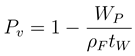
Interestingly, fabric thickness varies over a relatively narrow range, whereas areal mass varies over a much wider range. Total volume porosity is therefore relatively high. For typical plain cotton fabrics constructed from yarns of fineness in the range 15–45 tex, with a thickness in the range 0.4–0.8 mm, and an areal mass in the range 50–150 g/m2. The volume porosity range of these fabrics is 0.75–0.90%. The volume fraction of the fibrous phase in heavy fabrics and small thicknesses is nearly 15%. This corresponds to a total volume porosity of 85%. Low planar mass and high thickness result in a fibre content below 5%, i.e., porosity is over 95%.
The porosity of a yarn is related to its packing density µ = S/SC, where S is the area of the fibres in the yarn cross-section, and Sc is the total area of a circle with a diameter equal to the supporting part of the yarn, which contains 85% of the fibres [22].
Cotton and other natural cellulose fibres have a lower tendency to form yarns due to their geometry and stiffness compared to synthetic fibres. Cotton yarns therefore have a higher porosity compared to yarns made, e.g., of polypropylene. In contrast, polypropylene yarns, despite higher packing density (lower porosity), have a larger diameter due to their lower density, which is reflected in higher areal weight and fabric thickness, as well as in lower porosity. These conclusions apply to yarns and fabrics with the same construction, achieved using the same technology and design parameters.
In general, textiles that allow easy access to oxygen, such as light fabrics and open-structured knitwear (curtains), burn more easily than densely packed, heavy textiles (floor and wall coverings). Because flammable gases released by the decomposition of textile materials burn, the fire spreads most readily vertically (another reason curtains and draperies are so flammable).
Textile fabrics with a hairy surface (e.g., fleece) and fabrics with high surface hairiness (some fibre segments protrude from the fabric surface) burn quickly, and flames propagate faster. The hazard with these fabrics involves the phenomenon of ‘surface flash’ when a flame spreads rapidly over the fabric surface. This flash is not dangerous if the flame’s intensity is insufficient to ignite the base fabric.
Some synthetic-polymer-based textile fabrics lack sufficient active groups to attract flameretardant agents directly, and their hydrophobicity limits penetration of polar liquids containing these agents. This is typical for water-soluble flame retardants, such as cationic polyelectrolytes, polyphosphates, chitosan, and polyethyleneimine, or nanosized agents that form stable dispersions in water, such as anionic nanoclays and carbon nanotubes. In these cases, special procedures such as sol-gel, coating, photo-grafting, or plasma-grafting are used [23].
5. Flame Retardancy of Textiles
An overview of the basic principles of reducing textile flammability is given, for example, in the paper [1] and the books [3,10,13].
The standard method for reducing flammability is to intervene in the processes occurring in the flame. Usually, this involves replacing the highly reactive radicals H∗ and ∗OH with less reactive radicals that form non-flammable gases. Compounds containing chlorine or bromine are usually used; at higher temperatures, they form the corresponding acids (HCl, HBr), which generate less reactive radicals and release non-flammable gases. Two basic approaches reduce flammability [24]. Physical methods for the reduction of flammability are:
- −
- cooling materials below the combustion temperature (e.g., use Al(OH)3),
- −
- dilution of the concentration of flammable gases,
- −
- formation of a protective carbonised layer on the surface (phosphorus and boron compounds).
Chemical methods for flammability reduction are:
- −
- gas phase reactions causing interruption of the radical combustion mechanism and cooling ofthe system,
- −
- solid phase reactions leading to the formation of a charred layer on the surface, e.g., as aresult of dehydration associated with the formation of double bonds (phosphorus compounds).
Reduction of flammability can be practically supported, e.g., by the following ways:
- −
- use of thicker and denser textile structures with low porosity,
- −
- use of special polymer additives,
- −
- appropriate polymer modifications, grafting of active compounds, or copolymerization beforespinning of fibres,
- −
- textile structures finishing using low molecular weight substances, polymeric substances, and in situ polymerisation or grafting [24] (as tetrakis hydroxymethylphosphonium chloride for cotton).
Several basic mechanisms reduce flammability [10,13], but in practice, fire retardants are often used in combination [24].
A. Cooling the surface of textiles
Compounds that require a large amount of heat to decompose, thereby reducing textile temperature below the pyrolysis point, are used. Common compounds are mostly inorganic salts of magnesium (e.g., MgCO3·3H2O), aluminium (e.g., aluminium hydroxide, Al(OH)3), and calcium (e.g., calcium sulfate, CaSO4·2H2O). These compounds decompose at temperatures between about 100 °C and 300 °C, releasing water and CO2. A disadvantage of classic additives is reduced fibre mechanical properties. Therefore, nanoparticles have recently been used advantageously, as they increase compatibility with the polymer fibre (comparable dimensions to polymer chains) and, conversely, improve mechanical characteristics [3].
B. Creating a surface intumescent layer
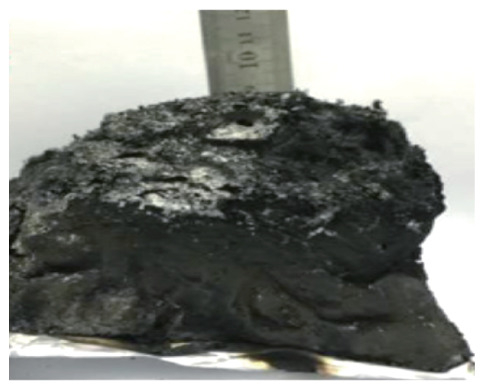
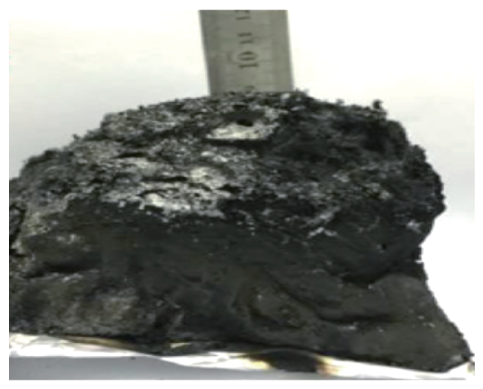
This layer can form below the pyrolysis temperature of fibres (boric acid and its salts) or, at higher temperatures, from classic carbonised residues and particles from layered inorganic structures such as expanded graphite and silica clays (ceramic plates). The formation of an intumescent (swelling) carbonised layer on the textile surface is used advantageously (Figure 4).
Figure 4.
Formation of an intumescent (swollen) char layer on the surface of the material due to fire [25].
Several intumescent systems create a thick carbon foam on the fabric surface that insulates against heat and fire. Most of these systems consist of ammonium polyphosphate (to achieve a strongly acidic pH), melamine and its compounds (a foaming agent), and pentaerythritol compounds (which form the charred structure). At high temperatures (210 °C), phosphoric acid is released, which forms cyclic phosphates with pentaerythritol. Between 280–330 °C, these structures decompose, and the material swells. This effect is further supported by the foaming agent (melamine), which releases gaseous products at 270–400 °C.
A crosslinked char foam layer forms. To increase the thermal resistance of this layer, it is also advantageous to use inorganic nanoparticles (e.g., fly ash, silica, basalt, carbon). The use of ammonium polyphosphate and calcium carbonate to reduce polypropylene flammability is described [26].
C. Formation of char residues
Generally, polymers are divided into groups based on whether they form char residues. The tendency to form char residues is related to the processes during pyrolysis:
- Polymers where chain cracking and volatile residues are formed during pyrolysis. Here, theformation of char residues is negligible. Examples are polyethene (PE), polypropylene (PP), and polystyrene (PS).
- Polymers where atoms and groups from the chains (hydrogen and side groups) are separatedduring pyrolysis, form a larger proportion of charred residues. Examples are polyvinyl chloride (PVC), polyvinyl alcohol (PVA), and polyacrylonitrile (PAN).
- Polymers containing aromatic nuclei, where chain scission and crosslinking occur duringpyrolysis, form a large amount of char residues. Examples are aromatic polyamides, polyester (PET), and polycarbonates (PC).
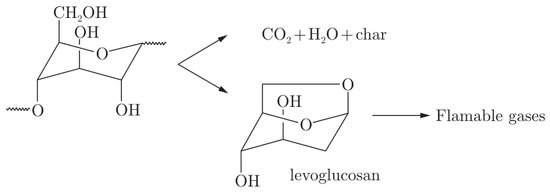
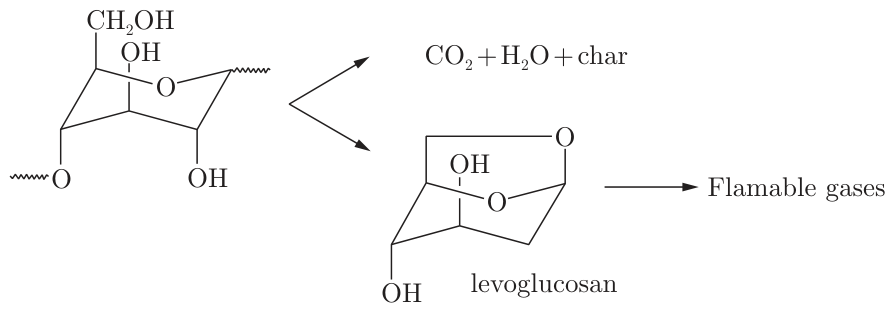
Char formation significantly impacts pyrolysis processes because it consumes material that could otherwise be used to produce flammable gases. For example, cellulose can be thermally degraded either by dehydration reactions that form water, CO2, and char, or by reactions that form levoglucosan and then flammable gases (see Figure 5).
Figure 5.
Methods of thermal degradation of cellulose.
A significant linear relationship was found between the LOI index and char residue content (wt% at 850 °C) [16]. Carbonised residues formed at temperatures between 300 and 1 500 °C form an insulating layer on the surface, limiting further degradation. Char residues are mainly amorphous carbon, which is partially graphitised at higher temperatures (increasing the stability of char residues).
Char residue formation occurs in several phases. First, polymer chains crosslink, followed by the formation and connection of aromatic rings, the formation of amorphous char residue, and its graphitisation. Various additives greatly influence char residue formation. Compounds of boron (ammonium borates or zinc borates) and phosphorus (ammonium phosphates) are very effective.
Silicones are often used as flame retardants because of their high thermal stability and heat resistance [27]. Silicon-based flame retardant agents migrate to the surface of the exposed material during combustion, forming a thermally stable char layer. The resulting viscosity of the degrading polymer and the silicon-based flame retardant complex is the main factor in forming a protective char layer [27]. Combining organosilicon and phosphorus-based flame retardants leverages the effects of both ceramic and char layers. Char is also formed when biobased materials, clays, and nanoparticles are used as fillers [28,29].
Some biobased materials come from biomass, including biological matter such as plants, animals, and microorganisms. Biomass contains carbohydrates, proteins, lipids, and phenolic compounds, some of which can be used for flame-retardant purposes [30]. Other sources of biobased flame-retardant materials include herb extracts or other natural products [31], or are agents from plants or animals (protein-based) [30].
Examples of biobased flame-retardant systems include starch [32], phytic acid [32], chitosan [32], hydrophobins [33], whey protein [34], casein [33], deoxyribonucleic acid [35], chicken feathers [36], lignins [37], banana pseu-dostem sap [38], pomegranate rind extract [39], coconut shell extract [40] etc. [30].
They are used directly as flame retardants or in combination with traditional phosphorus or nitrogen-based flame retardants. The mechanism of action is essentially char formation.
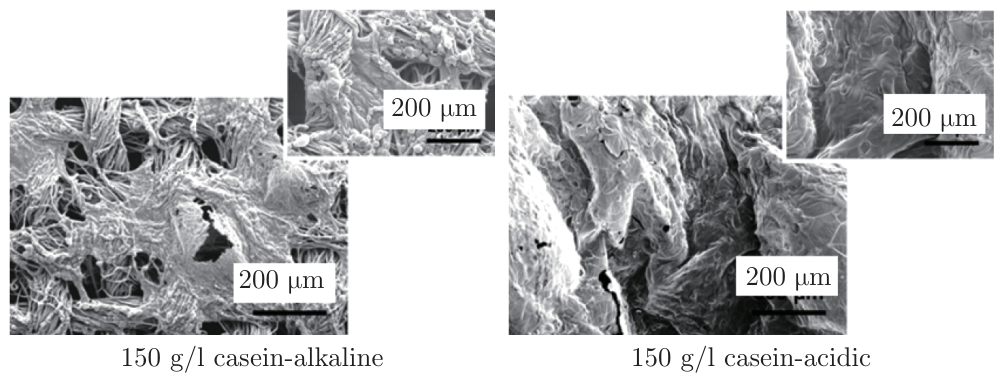
Some biobased materials also contain phosphorus-rich components, which can act as effective flame retardants for cotton fabric because they dehydrate cellulose during combustion, enhancing char behaviour and resulting in a shorter burn length and smaller burn area than fabrics coated with the same concentrations of alkaline casein solutions [7,41].
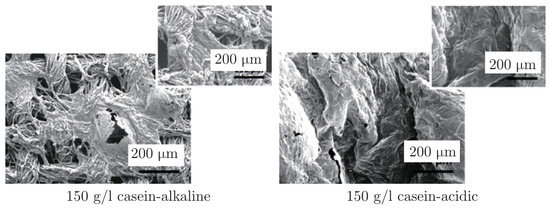
The char residues of fabrics coated with acidic casein solutions showed the formation of more expanded globular micrometric structures (see Figure 6).
Figure 6.
SEM magnifications of char residues of burnt casein-coated cotton fabrics [7].
The emergence of additional bubbles in char residues of fabrics coated with acidic casein solutions was attributed to ammonia release from the protonation of casein protein macromolecules at acidic pH. Casein could therefore perform several functions such as catalysed dehydration, accelerated charring, and intumescent char formation.
- Biobased flame retardants have plenty of advantages, such as sustainability, synergic effects, and environmental friendliness, but also some weak points:
- They do not have a constant composition dependent on growing conditions
- Pollutants can change their properties in the air, soil, water, etc.
- Their effects are generally lower and not fully sufficient for flame-retardant textiles
- Their effect is not durable and quickly disappears after washing
- Required concentrations of bio-based agent are usually very high
- They often change the colour of textile products
- They are attached to the surface of textile materials by weak electrostatic forces mainly
- Their use for hydrophobic materials is very limited
- Their composition is very complex, and side chemicals are present
- They are responsible for harsh hands and lower comfort
Plant extracts also contain minerals, secondary metabolites, and various salts.
D. Dilution of flammable gases
Diluting flammable gases with non-flammable gases formed during pyrolysis is a simple way to reduce combustion. This is how organic compounds containing phosphorus work on cellulose fibres, for example. Their thermal decomposition produces phosphoric acid, which reacts with the hydroxyl groups of cellulose as a crosslinker and releases water. Other compounds, such as calcium carbonate, also have the same effect.
Halogenated flame retardants release halogen radicals (X∗) that form hydrogen halides (HX), which react with the highly reactive gaseous free hydrogen and hydroxyl radicals, forming hydrogen (H2) and water (H2O) [42].
The effectiveness of halogenated flame retardants usually depends on the halogen atom and increases in the order fluorine < chlorine < bromine < iodine. [42].
Halogenated flame retardants can be substituted with non-toxic phosphorus-based compounds.
The active radicals HPO·2, PO·, PO·2, and HPO· react with (H·) and (OH·) radicals decreasing the exothermic oxidation reactions. Phosphorus-based flame retardants also prevent flame propagation by releasing phosphoric acid on thermal degradation [27].
Nitrogen-based flame retardants are released at high temperatures, non-flammable volatiles, such as ammonia, diluting the combustible gas mixture [42].
E. Reduction of the release of flammable gases
A simple way to reduce the release of flammable gases is to increase their diffusion path length from the fibres (reducing the diffusion rate of flammable gases), e.g., by using nanoparticles as additives in fibres or attaching them to their surface [3]. It can be easily deduced that the number of smaller spherical particles of diameter d formed by dividing one big spherical particle of diameter D is equal to the cube of the ratio D/d. The number of smaller particles with the same total volume (mass) is therefore significantly higher, and the particle-free volumes through which flammable gases can penetrate are reduced. This increases diffusion path and therefore slows the delivery of flammable gases to the burning site.
Another advantage of nanoparticles is their compatibility with polymer-chain dimensions, which improves interactions and increases the number of mutual contacts. This results in higher thermal stability and a reduced rate of thermal energy release during combustion [3]. Small particles in the polymer substrate also help form compact charred residues, limiting textile breakdown. Therefore, flame-retardant nanoparticles have an additional positive effect on flammability reduction compared to larger particles. Smaller particles can be used at lower concentrations while achieving the same effect [3].
Special layered nanostructures (platelets) that occur in nature, e.g., in kaolin and other silica clays, are of interest. Plate-shaped nanoparticles are often composed of silica clays of layered silicates [43]. They also capture oxygen and hydrogen radicals, which drive exothermic reactions during pyrolysis. The individual layers of silica clays are about 1 nm thick, and their diameter (transverse dimension) is about 100 nm. Their relative surface area is about 750 m2/g. In the polymer, the plates first separate (intercalation) and then disperse in the structure (exfoliation).
Only 2–6% of clays are sufficient to reduce thermal energy release by 60–80% [44]. The system’s permeability is also reduced by about 20%. It is usually assumed that the main mechanism of flammability reduction in nanocomposites with silica clays is the formation of charred residues on the material surface [45].
A further significant reduction in flammability can be achieved by combining silica clays with conventional flame-retardant additives (e.g., halogen compounds) [3]. However, some silica clay plates surround additive particles and are thus partially passivated [45].
Various carbon nanostructures (see [46]) are also often used to create surface barriers and increase the diffusion path of flammable pyrolysis products [47]. One of the best carbon structures is expandable graphite (EG). Because it exfoliates easily in a polymer matrix, it forms obstacles to gas-molecule diffusion [48]. EG is a type of graphite intercalation compound, prepared by treating graphite particles with concentrated sulfuric acid in the presence of strong oxidising agents, such as hydrogen peroxide or potassium permanganate. To reduce flammability, a nanocomposite containing carbon nanotubes (CNT) can also be used. CNTs not only have excellent mechanical properties but also high thermal conductivity (more than 3 000 W·m−1·K−1). The properties of CNT depend on the arrangement of carbon atoms (chirality) and their dispersion in the structure [49]. An important mechanism for reducing flammability is the formation of char residue, similar to that of silica clays. Interestingly, depending on concentration, the char residues coalesce and form a network of interconnected CNTs (around 0.5 to 1%) [49].
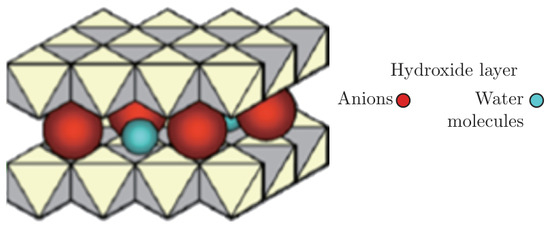
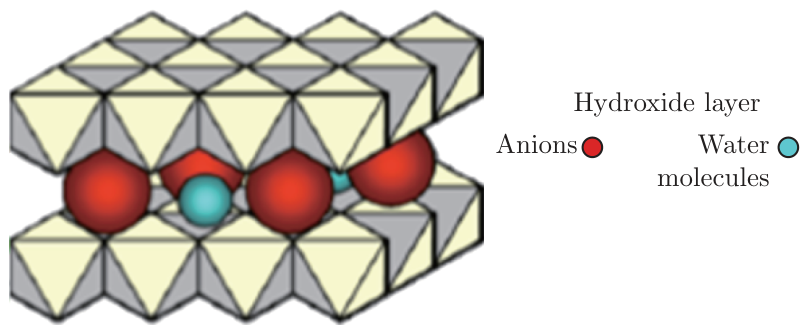
An interesting group of materials is layered double hydroxides (LDH), see Figure 7.
Figure 7.
Structure of LHS [50,51].
LDH use as an additive for reducing the flammability of cotton is described, for example, in [52]. During combustion, LDHs absorb heat and release water and CO2, which lowers the substrate temperature and promotes the formation of a surface foam structure from the char residues [50]. LDHs can be relatively easily incorporated into other nanostructures (e.g., graphene) [53]. Many types of double-layer hydroxides have been described for use in a variety of applications. The bond between the hydroxide layers and the interlayer anions is relatively weak. Thus, double-layer hydroxides can serve as host structures for intercalating other additives.
LDHs have also been combined with other flame retardants to exploit different ways of reducing flammability and achieve synergistic effects for flame retardancy [25].
6. Future Viewpoints
Flame-retardant finishing is crucial for textile substrates to prevent fire-related accidents. However, most existing flame retardants adversely affect the environment and human health because of their inherent toxicity and unsafe nature [54].
New flame retardants should exhibit equivalent or superior performance and properties compared with classical ones.
- Any new flame retardant should not emit formaldehyde during application or use.
- Any new flame retardant should provide comparable textile service-life features, such as durability, hand, comfort, tensile properties, appearance, and aesthetics.
- Any new flame retardant should have an overall cost-effectiveness comparable to existing chemicals and preferably be less costly.
- Any new flame retardant should be sustainable and possess equivalent or even lower toxicity and environmental impact.
- Air permeability of the treated textiles should be maintained, irrespective of the potentially high amounts of chemicals required to achieve flame-retardant effects.
- Any new flame retardant should not cause any alteration in the colour of the fabrics.
- The contribution of nanostructures to flame-retardant performance depends strictly on their chemical structure and geometry. Three widely investigated nano materials are [27]:
- Particulate materials: such as organoclay, carbon nanotubes, metal oxides, polyhedral oligosilsesquioxane (POSS), and spherical silica nanoparticles.
- Fibrous structures, such as carbon nanotubes and sepiolite, are characterised by elongated forms with two nanometric dimensions.
- Layered materials: such as nanoclays (e.g., montmorillonite (MMT))
The flame-retardant features of nanocomposites can be characterised as condensed-phase-active.
Because of environmental and sustainability concerns, more research is needed to address potential issues through systematic, sustained solutions.
From an environmental perspective, efficient methods should be proposed to identify greener, innovative alternative textile structures. Having improved durability and flame retardancy.
7. Conclusion
The use of various techniques to reduce flammability remains a major focus, both in new principles and materials (today mainly nanomaterials [55]) and in specific applications. The flammability of textile structures is a fundamental problem limiting their use in clothing, housing, and technical applications. Currently, strategies for textile flame retardancy are shifting toward sustainable, functional, primarily particulate and nanosystem-based systems.
Increasingly stringent ecotoxicological regulations significantly limit the use of less-flammable textile structures. All new flame-retardant systems should therefore be assessed not only for implementation but also for compliance with current EU ecotoxicological regulations.
Several approaches reduce flammability; however, they have limitations, including insufficient protective effect, health and environmental harm from fire-retardant agents, and negative impacts on the environment and end-use properties of textile structures, including comfort. Disrupting the physicochemical processes of combustion and inhibiting flame spread requires materials (additives) that respond differently to high temperatures, thereby slowing these processes and enhancing combustion resistance. These materials can act synergistically to influence the fundamental mechanisms that limit the flammability of polymeric materials.
This article proposes novel technologies and innovative products to address current challenges in flame retardancy. This will help develop cleaner substitutes for highly harmful conventional flame-retardant finishing agents and explore new opportunities for the textile industry, research, and development.
This article discusses the general physicochemical aspects of material flammability, primarily in polymeric materials. It briefly discusses the origin of textile structures and porosity and their influence on flammability. Basic physical and chemical processes that occur during heating of organic polymers above a critical temperature (such as pyrolysis reactions, the formation of volatile, flammable gases, and processes in flame) that support combustion are presented. The basic mechanisms for reducing the flammability of textile materials are explained in detail.
References
- Horrocks, A.R. Flame-retardant Finishing of Textiles. Rev. Prog. Colouration Relat. Top. 1986, 16, 62–101. [Google Scholar] [CrossRef] [Scilit]
- Wang, M.; Yin, G.-Z.; Yang, Y.; Fu, W.; D’ıaz Palencia, J.L.; Zhao, J.; Wang, N.; Jiang, Y.; Wang, D.-Y. Bio-Based Flame Retardants to Polymers: A Review. Adv. Ind. Eng. Polym. Res. 2023, 6, 132–155. [Google Scholar] [CrossRef] [Scilit]
- Ali, S.W.; Basak, S.; Shukla, A. Nanoparticles: A Potential Alternative to Classical Fire Retardants for Textile Substrates. In Handbook of Nanomaterials for Manufacturing Applications; Elsevier, 2020; pp. 265–278. [Google Scholar]
- Oppenheim. A. K. Dynamics of Combustion Systems, 2nd ed.; Springer Berlin Heidelberg: Berlin, Heidelberg, 2008; ISBN 978-3-540-77363-4. [Google Scholar]
- DiNenno, P.J.; Drysdale, Dougal.; Beyler, C.L.; Walton, W.Douglas.; Custer, R.L.P.; Hall, J.R.; Watts, J.M. SFPE Handbook of Fire Protection Engineering; National Fire Protection Association? Society of Fire Protection Engineers, 2002; ISBN 0877654514. [Google Scholar]
- Sheik, J.N.; Teli, M.D. Sustainable Textile Chemical Processing; CRC Press, 2024; ISBN 97810326 29902. [Google Scholar]
- Faheem, S.; Baheti, V.; Tunak, M.; Wiener, J.; Militky, J. Comparative Performance of Flame Retardancy, Physiological Comfort, and Durability of Cotton Textiles Treated with Alkaline and Acidic Casein Suspension. J. Ind. Text. 2019, 48, 969–991. [Google Scholar] [CrossRef]
- Mowrer, F.W. An Analysis of Effective Thermal Properties of Thermally Thick Materials. Fire Saf. J. 2005, 40, 395–410. [Google Scholar] [CrossRef] [Scilit]
- Khan, M.; De Ris, J.; Ogden, S. Effect of Moisture on Ignition Time of Cellulosic Materials. Fire Saf. Sci. 2008, 9, 167–178. [Google Scholar] [CrossRef] [Scilit]
- Alongi, Jenny.; Horrocks, A.Richard.; Carosio, Federico.; Malucelli, Giulio. Update on Flame Retardant Textiles?: State of the Art, Environmental Issues and Innovative Solutions; Smithers Rapra Publishing, 2013; ISBN 9781909030176. [Google Scholar]
- Mouritz, A.P.; Gibson, A.G. Fire Properties of Polymer Composite Materials; Springer, 2010; ISBN 9789048173518. [Google Scholar]
- HEUS, R.; DENHARTOG, E.A. Maximum Allowable Exposure to Different Heat Radiation Levels in Three Types of Heat Protective Clothing. Ind. Health 2017, 55, 529–536. [Google Scholar] [CrossRef][Green Version]
- Horrocks, A.Richard.; Price, Dennis. Fire Retardant Materials; CRC Press?: Woodhead, 2009; ISBN 1855734192. [Google Scholar]
- Wilkie, C.A.; Morgan, A.B. Fire Retardancy of Polymeric Materials; CRC Press, 2024; p. 775. ISBN 9781003380689. [Google Scholar]
- Morgan, A.B.; Wilkie, C.A. Flame Retardant Polymer Nanocomposites; Wiley-Interscience, 2007; ISBN 9780470109038. [Google Scholar]
- van Krevelen, D.W. Some Basic Aspects of Flame Resistance of Polymeric Materials. Polymer (Guildf) 1975, 16, 615–620. [Google Scholar] [CrossRef] [Scilit]
- Song, Guowen.; Mandal, Sumit.; Rossi, R.M. Thermal Protective Clothing for Firefighters; Woodhead Publishing, 2017; ISBN 9780081012864. [Google Scholar]
- Schindler, W.D.; Hauser, P.J. Chemical Finishing of Textiles; CRC? Woodhead, 2004; ISBN 9781855739055. [Google Scholar]
- Nair, G. P. Flammability in Textiles and Routes to Flame Retardant Textiles II. Colourage 2000, 39–44. [Google Scholar]
- Ozcan, G.; Dayioglu, H.; Candan, C. Effect of Gray Fabric Properties on Flame Resistance of Knitted Fabric. Text. Res. J. 2003, 73, 883–891. [Google Scholar] [CrossRef] [Scilit]
- Hendrix, J. E.; Drake, G. L.; Reeves, W. A. Effects of Fabric Weight and Construction on OI Values for Cotton Cellulose. J. Fire Flammabl. 1972, 38–45. [Google Scholar]
- Neck’a? Bohuslav; Das; Dipayan. Theory of Structure and Mechanics of Yarns; Woodhead Publishing India Pvt. Limited, 2018; ISBN 9789385059889. [Google Scholar]
- Ghosh, J.; Rupanty, N.S.; Noor, T.; Asif, T.R.; Islam, T.; Reukov, V. Functional Coatings for Textiles: Advancements in Flame Resistance, Antimicrobial Defense, and Self-Cleaning Performance. RSC Adv. 2025, 15, 10984–11022. [Google Scholar] [CrossRef] [Scilit] [PubMed]
- Rouette, H.K. Encyclopedia of Textile Finishing; Springer, 2002; ISBN 3540650318. [Google Scholar]
- Qiu, S.; Ma, C.; Wang, X.; Zhou, X.; Feng, X.; Yuen, R.K.K.; Hu, Y. Melamine-Containing Polyphosphazene Wrapped Ammonium Polyphosphate: A Novel Multifunctional Organic-Inorganic Hybrid Flame Retardant. J. Hazard. Mater. 2018, 344, 839–848. [Google Scholar] [CrossRef] [Scilit] [PubMed]
- Deodhar, S.; Shanmuganathan, K.; Fan, Q.; Wilkie, C.A.; Costache, M.C.; Dembsey, N.A.; Patra, P.K. Calcium Carbonate and Ammonium Polyphosphate-based Flame Retardant Composition for Polypropylene. J. Appl. Polym. Sci. 2011, 120, 1866–1873. [Google Scholar] [CrossRef] [Scilit]
- Laoutid, F.; Bonnaud, L.; Alexandre, M.; Lopez-Cuesta, J.-M.; Dubois, Ph. New Prospects in Flame Retardant Polymer Materials: From Fundamentals to Nanocomposites. Mater. Sci. Eng. R Rep. 2009, 63, 100–125. [Google Scholar] [CrossRef] [Scilit]
- Le Bras, M. Fire Retardancy of Polymers?: New Applications of Mineral Fillers; Royal Society of Chemistry, 2005; ISBN 0854045821. [Google Scholar]
- Hull, T.Richard.; Kandola, B.K. Fire Retardancy of Polymers?: New Strategies and Mechanisms; Royal Society of Chemistry, 2009; ISBN 1847559212. [Google Scholar]
- Costes, L.; Laoutid, F.; Brohez, S.; Dubois, P. Bio-Based Flame Retardants: When Nature Meets Fire Protection. Mater. Sci. Eng. R Rep. 2017, 117, 1–25. [Google Scholar] [CrossRef] [Scilit]
- Basak, S.; Samanta, K.K.; Chattopadhyay, S.K. Fire Retardant Property of Cotton Fabric Treated with Herbal Extract. J. Text. Inst. 2015, 106, 1338–1347. [Google Scholar] [CrossRef]
- Quan, Y.; Zhang, W.; Marquez, J.A.D.; Guo, L.; Tanchak, R.; Shen, R.; Wang, Q. Sustainable Biomass-Based Flame Retardants: Recent Advances in Starch, Phytic Acid, and Chitosan Systems for Polymeric Materials. Emerg. Manag. Sci. Technol. 2025, 5, 0–0. [Google Scholar] [CrossRef] [Scilit]
- Alongi, J.; Carletto, R.A.; Bosco, F.; Carosio, F.; Di Blasio, A.; Cuttica, F.; Antonucci, V.; Giordano, M.; Malucelli, G. Caseins and Hydrophobins as Novel Green Flame Retardants for Cotton Fabrics. Polym. Degrad. Stab. 2014, 99, 111–117. [Google Scholar] [CrossRef] [Scilit]
- Bosco, F.; Carletto, R.A.; Alongi, J.; Marmo, L.; Di Blasio, A.; Malucelli, G. Thermal Stability and Flame Resistance of Cotton Fabrics Treated with Whey Proteins. Carbohydr. Polym. 2013, 94, 372–377. [Google Scholar] [CrossRef] [Scilit] [PubMed]
- Bosco, F.; Casale, A.; Mollea, C.; Terlizzi, M.E.; Gribaudo, G.; Alongi, J.; Malucelli, G. DNA Coatings on Cotton Fabrics: Effect of Molecular Size and PH on Flame Retardancy. Surf. Coat. Technol. 2015, 272, 86–95. [Google Scholar] [CrossRef] [Scilit]
- Wang, X.; Lu, C.; Chen, C. Effect of Chicken-feather Protein-based Flame Retardant on Flame Retarding Performance of Cotton Fabric. J. Appl. Polym. Sci. 2014, 131. [Google Scholar] [CrossRef] [Scilit]
- Shukla, A.; Sharma, V.; Basak, S.; Ali, S.W. Sodium Lignin Sulfonate: A Bio-Macromolecule for Making Fire Retardant Cotton Fabric. Cellulose 2019, 26, 8191–8208. [Google Scholar] [CrossRef]
- Basak, S.; Samanta, K.K.; Chattopadhyay, S.K.; Narkar, R.S.; Mahangade, R. Flame Retardant Cellulosic Textile Using Bannana Pseudostem Sap. Int. J. Cloth. Sci. Technol. 2015, 27, 247–261. [Google Scholar] [CrossRef] [Scilit]
- Basak, S.; Ali, S.W. Leveraging Flame Retardant Efficacy of Pomegranate Rind Extract, a Novel Biomolecule, on Ligno-Cellulosic Materials. Polym. Degrad. Stab. 2017, 144, 83–92. [Google Scholar] [CrossRef] [Scilit]
- Teli, M.; Pandit, P. Development of Thermally Stable and Hygienic Colored Cotton Fabric Made by Treatment with Natural Coconut Shell Extract. J. Ind. Text. 2018, 48, 87–118. [Google Scholar] [CrossRef] [Scilit]
- Ginger, M.R.; Grigor, M.R. Comparative Aspects of Milk Caseins. Comp. Biochem. Physiol. B Biochem. Mol. Biol. 1999, 124, 133–145. [Google Scholar] [CrossRef] [Scilit] [PubMed]
- Levchik, S. V. Introduction to Flame Retardancy and Polymer Flammability. In Flame Retardant Polymer Nanocomposites; Wiley, 2007; pp. 1–29. [Google Scholar]
- Pufr, R.; B.J. Nanokompozity Polyamidus Vrstevnaty’mi Silik’aty. Chem. Listy 2010, 104, 138146. [Google Scholar]
- Patra, P.K.; Warner, S. B.; Kim, Y. K.; Fan, Q.; Calvert, P. D.; Adanur, S. Nano Engineered Fire Resistant Composite Fibers, NTC Project No: M02-MD08; 2002. [Google Scholar]
- Samyn, F.; Bourbigot, S.; Jama, C.; Bellayer, S.; Nazare, S.; Hull, R.; Fina, A.; Castrovinci, A.; Camino, G. Characterisation of the Dispersion in Polymer Flame Retarded Nanocomposites. Eur. Polym. J. 2008, 44, 1631–1641. [Google Scholar] [CrossRef] [Scilit]
- Barhoum, Ahmed.; Deshmukh, Kalim. Handbook of Functionalized Carbon Nanostructures?: From Synthesis Methods to Applications; Springer, 2024; ISBN 9783031321504. [Google Scholar]
- Dittrich, B.; Wartig, K.; Hofmann, D.; Mu¨lhaupt, R.; Schartel, B. Carbon Black, Multiwall Carbon Nanotubes, Expanded Graphite and Functionalized Graphene Flame Retarded Polypropylene Nanocomposites. Polym. Adv. Technol. 2013, 24, 916–926. [Google Scholar] [CrossRef] [Scilit]
- Wang, X.; Kalali, E.N.; Wan, J.-T.; Wang, D.-Y. Carbon-Family Materials for Flame Retardant Polymeric Materials. Prog. Polym. Sci. 2017, 69, 22–46. [Google Scholar] [CrossRef] [Scilit]
- Kashiwagi, T.; Du, F.; Winey, K.I.; Groth, K.M.; Shields, J.R.; Bellayer, S.P.; Kim, H.; Douglas, J.F. Flammability Properties of Polymer Nanocomposites with Single-Walled Carbon Nanotubes: Effects of Nanotube Dispersion and Concentration. Polymer (Guildf) 2005, 46, 471–481. [Google Scholar] [CrossRef] [Scilit]
- Sobhana, S.S.L.; Bogati, D.R.; Reza, M.; Gustafsson, J.; Fardim, P. Cellulose Biotemplates for Layered Double Hydroxides Networks. Microporous Mesoporous Mater. 2016, 225, 66–73. [Google Scholar] [CrossRef] [Scilit]
- Jakub’ıkov’a, B.; K.F. Possibilities of Using Layered Double Hydroxides in Medical Applications. Chem. Listy 2010, 104, 906–912. [Google Scholar]
- Barik, S.; Khandual, A.; Behera, L.; Badamali, S.K.; Luximon, A. Nano-Mg–Al-Layered Double Hydroxide Application to Cotton for Enhancing Mechanical, UV Protection and Flame Retardancy at Low Cytotoxicity Level. Cellulose 2017, 24, 1107–1120. [Google Scholar] [CrossRef] [Scilit]
- Lee, I.; Jeong, G.H.; An, S.; Kim, S.-W.; Yoon, S. Facile Synthesis of 3D MnNi-Layered Double Hydroxides (LDH)/Graphene Composites from Directly Graphites for Pseudocapacitor and Their Electrochemical Analysis. Appl. Surf. Sci. 2018, 429, 196–202. [Google Scholar] [CrossRef] [Scilit]
- Cheremisinoff, N.P. Dust Explosion and Fire Prevention Handbook: A Guide to Good Industry Practices; John Wiley and Sons, Inc., 2014; ISBN 9781118773567. [Google Scholar]
- Huo, S.; Guo, Y.; Yang, Q.; Wang, H.; Song, P. Two-Dimensional Nanomaterials for FlameRetardant Polymer Composites: A Mini Review. Adv. Nanocomposites 2024, 1, 240–247. [Google Scholar] [CrossRef] [Scilit]

© 2026 Textile Bioengineering and Informatics Society. This article is an open access article distributed under the terms and conditions of the Creative Commons Attribution (CC BY) license (https://creativecommons.org/licenses/by/4.0/).