


Abstract
This study aimed to investigate the impact of varying fibre compositions and fabric constructions on the elastic behaviour of compression fabrics. Knitted fabrics used as compression garments are subjected to deformation due to various loads used to extend the fabrics during wear. The loads to extend the fabrics are influenced by fabric constructions, strain levels and fabric directions. In this study, the strain of fabrics was measured using a commercial tensile testing machine (LR30K Lloyd) according to ASTM D496. Each sample was cycled five times between zero and the specified strain to replicate the repeated use of compression garments. In addition, the fabric was also heat-set and laundered to evaluate the impact of these treatments on the elastic behaviour of the fabric. The results indicated that different fabric constructions exhibited different elastic properties (P < 0.05), with 1×1 rib fabric demonstrating the highest load in the wale direction and terry fabric displaying the highest load in the course direction. Fibre composition in single jersey fabrics significantly affected (P < 0.05) their load requirements for extension, with 8% elastane displaying the highest resistance to stretching. Heat-setting positively affected the load capacity of the fabrics (24%-47%), enhancing the dimensional stability and strength. However, laundering after heat-setting decreased the load capacity (6%-32%), negatively affecting fabric deformation and shape retention. These findings aim to lay the groundwork for the importance of careful selection of fabric attributes and post-processing treatments for optimising the elastic properties of compression fabrics.
1. Introduction
Compression fabrics are used for medical, sports and body-shaping [1]. In the medical field, compression garments are used for scar management of burn patients, orthopaedic support and management of arthritis disease [2,3,4,5]. Most medical compression garments, such as stockings, gloves, sleeves, and bodysuits, are designed and manufactured for specific body regions with an engineered compression gradient. These materials are used over a specified time, depending on the need [5]. Due to their elastic nature, they generally provide a certain amount of pressure on the body parts for therapy treatment [6]. Some advantages of compression garments for sports ap- plications in the market have been reported, for example, to improve blood flow, improve muscle oxygenation, reduce fatigue, improve recovery, reduce muscle oscillation, and reduce muscle injury [6,7]. In sports, it has become a popular tool for athletes to enhance performance in competi- tion, reduce post-exercise trauma, reduce muscle soreness and reduce recovery time after exercise and training [8,9]. Additionally, Machado-Sousa et al. (2019) [10] reported that compression garments can even improve proprioception (body awareness) in athletes during exercise. These advantages were reported based on the fact that the compression garment is used as a principle for aerodynamics to reduce drag in high-speed sports and resist the impact force of muscle caused during running or jumping, thus decreasing unnecessary muscle vibration and applying pressure on specific muscle to increase blood flow [1,11].
In developing compression garments, knitted construction with different stretch properties must be chosen, arranged and used for that particular body part. Fabric extensibility and ability to maintain stretching force influence the effectiveness of compression. The degree of pressure exerted by the garment depends on the garment design in terms of reduction factors and physical and mechanical characteristics, such as the fabrics’ elastic behaviour and the material’s thickness and density [12,13]. Knitted construction also influences fabric density, even with the same parameters, such as knitting machine type, gauge diameter, and machine speed [13]. In line with this, Lia et al. (2015) [15] also reported that structural parameters of fabrics significantly affect compression properties. This emphasises the importance of considering fabric construction and fibre compositions when designing compression garments.
Compression garments are designed to be smaller than the actual body measurement by 10- 50% measurements following fabric extensibility [4,16]. Incorporating elastane yarns in knitted fabric improves stress-strain properties and fabric stretch and recovery [17,18]. The addition of elastane yarns in the fabric enhances fit, stretchability and good shape retention of a garment throughout wear. It also provides better strength characteristics [19]. For medical compression garments, the constant stretching of compression fabric will alleviate the effectiveness of the garment, resulting in a loss of ability to exert appropriate pressure on the patient, thus reducing treatment effectiveness. Elastane yarn is usually processed with other ground yarn due to its higher extensibility and lower breaking strength. The percentage of additional elastane increases the weight of the fabric, and simultaneously, the course per inch and wales per inch becomes higher, thus increasing the stitch density and mass per unit area [20]. The presence of elastane in the knitted structure is expected to enhance stretch and recovery, flexibility and comfort in pressure garments [21].
However, since elastane fibres have a memory effect, they tend to revert to their original shape after being stretched and dimensionally unstable. Elastane yarn has a random molecular structure with many polymer bonds; thus, when working with elastane-containing fabrics, heat setting is often required during the finishing stage of grey fabric to give the fibres a rigid permanent structure and to lock the fabric properties, such as width, weight, and stretch and recovery [22]. During heat setting, the inter molecules of elastane are broken, and the polymer chains are rearranged. To ensure an effective and efficient heat-setting process, parameters for optimisation, such as temperature, time and fabric width extension, must be chosen and meticulously monitored [23].
This study evaluated the effects of fibre compositions, knitting constructions, and heat-setting treatment on the elastic properties of compression fabrics. It is not yet clear how these charac- teristics impact the fabric’s properties. The results of this research are expected to contribute to a better understanding of how the properties of compression fabrics can be optimised for better performance and comfort.
2. Materials and Methods
This study used two types of yarns: cotton (30 Ne) and elastane (40 Ne). Based on previous research, combining these two yarns could produce excellent elastic fabrics [3]. Three different types of weft-knitted structures and three different fibre compositions were chosen as the con- structions for this study. The knitted fabrics were produced on a circular knitted machine, and the machine’s specifications are given in Table 1. The details of the fabric specifications are presented in Table 2. All the fabric samples were divided into two groups: the control group and the heat-setting group. The heat-setting group was further divided into two groups. One group underwent a laundering process, and another group was unwashed to measure the impact of laundering on elastic properties. In total, three groups of fabrics were evaluated in this research, which are control sample (S1, S2, S3, R1 and T1), unwashed heat-set (H group: S1H, S2H, S3H, R1H and T1H), and washed heat-set (HL group: S1HL, S2HL, S3HL, R1HL, and T1HL). The experimental results were analysed and compared, and an analysis of variance was performed to determine if there were statistically significant differences among the means of each group.
Table 1.
Knitting machine specifications.
Table 2.
Constructions and compositions of fabric samples.
2.1. Heat-setting Treatment
Fabrics containing elastane yarn or fibre have poor dimensional stability and tend to crease and curl extensively. Heat-setting treatment rearranges and relaxes the molecular chains, thus signif- icantly improving the dimensional stability of elastane-blended knitted fabrics [24]. According to our preliminary study [23], heat-setting treatment was applied. The parameters are 190 °C, 75 seconds of process time, and 13.5% width extension.
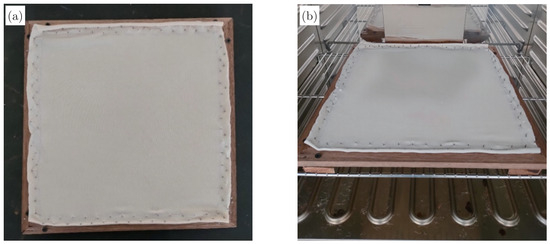
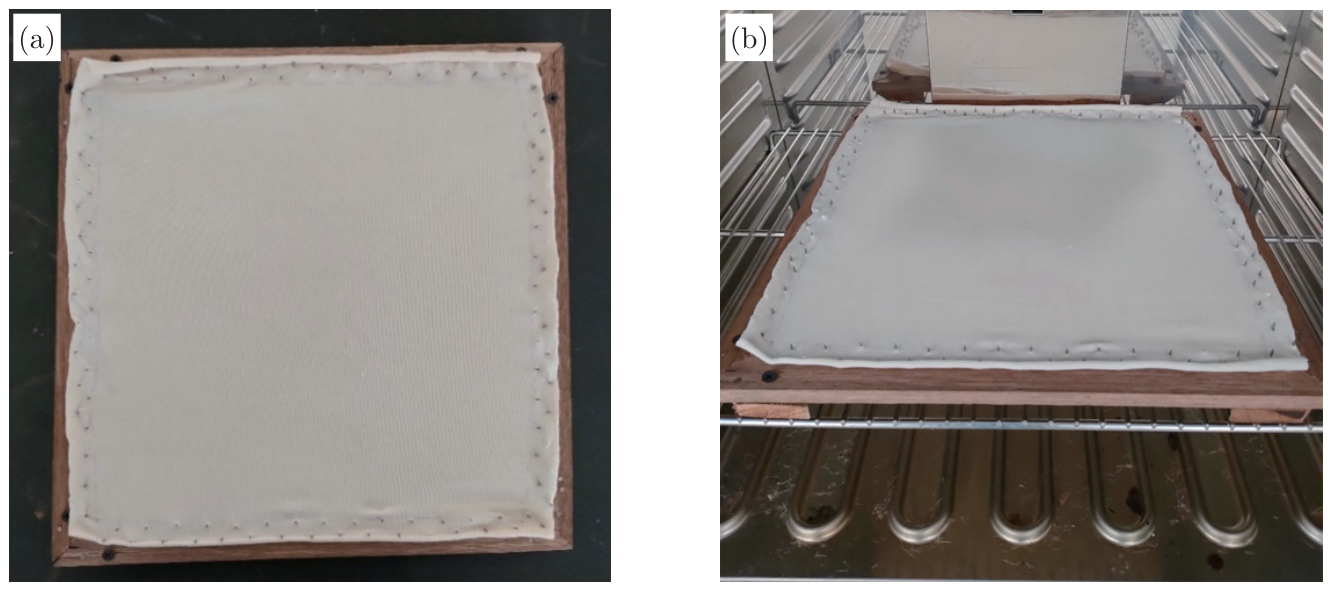
Before the heat-setting process, the fabric samples were stretched onto a frame with a size of 300 mm×300 mm (Figure 1(a)). To achieve the 13.5% width extension as per the parameters of heat-set, the sample was cut to 260 mm×300 mm. Next, the fabric samples were put into the oven (Figure 1(b)). The heat-setting process was done using Universal electronic oven. Then, the sample was taken out, and time was given to relax before removing the fabric from the frame.
Figure 1.
Sample fabric (a) stretched by 13.5% width extension; (b) in the oven.
2.2. Laundering Treatment
After the heat-setting process, one group of fabrics (HL group: S1HL, S2HL, S3HL, R1HL, and T1HL) went through the laundering process. This step examines the effect of laundering on knitted fabrics’ physical and mechanical properties. The fabrics were washed for ten laundering cycles, and the laundering effect was studied by comparing the heat-set unwashed fabrics and the heat-set washed fabrics.
The laundering method was conducted according to the previous study [24], with minor modi- fications, where no heating was employed during washing and rinsing. Laundering was performed using a top-load washing machine branded Toshiba (Model: AW-A820M). Each wash cycle in- cluded wash, rinse, and spin. The detergent used for fabric washing was 0.1 g/L, while the material-to-liquor ratio was maintained at 1:10. For each sample, the washing cycle was repeated for 10 cycles. Samples were dried using the flat-dry method. After laundering, the samples were conditioned at 21 ± 2 °C with a relative humidity of 65 ± 3% for 24 hours before proceeding to the subsequent stage. Laundering was carried out using an upper loading machine under normal agitation.
2.3. Determination of Fabric's Physical Properties
The properties tested in this research were mass per unit area, thickness, and density. Mass per unit area was measured in g/m2 using the ASTM D3776 Standard Method. The thickness of fabrics was measured using a fabric thickness gauge at ten di®erent locations according to the ASTM D1777 standard. The average thickness of fabric samples was then calculated.
2.4. Investigation of Fabric’s Elastic Behaviour
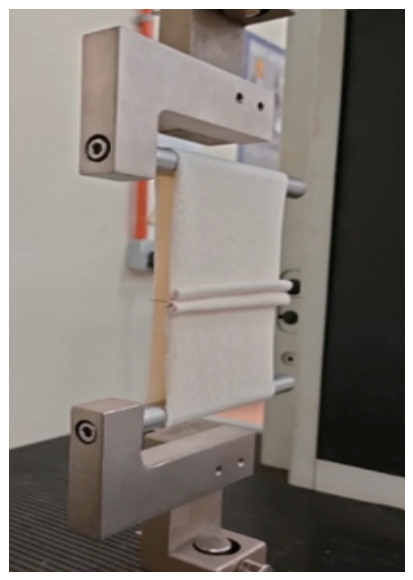
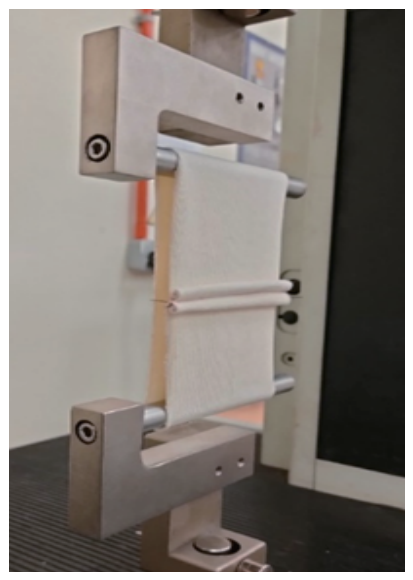
The fabric samples were cut to 290 mm×75 mm. Two gauge marks were marked on the sample, 250 mm×75 mm apart, approximately the same distance from the fabric samples. Then, a loop was formed by folding the samples before sewing them along the gauge mark using a single- needle stitch. The test sample was conditioned in the standard atmosphere, 21 ± 2 °C & 65 ± 3% relative humidity at least 24 hours before testing. The fabric tension decay was conducted using a commercial tensile machine - LR30K Lloyd instrument by the standard test method for fabric tension and elongation (ASTM D4964). Under zero load, the samples were manually placed onto the looped bars of the tensile machine, and their position was adjusted around the bar so that the seam lay halfway between the bars (Figure 2). The specimen was extended and retracted at a 500 mm/min rate. To simulate the repeated use of compression garments, the samples were cycled five times between zero and the specified extension. After cycling five times, the load and strain level data were recorded. The test was repeated five times for every strain level using different samples in both course and wale directions. In this experiment, 10%, 15%, and 20% strain levels were utilised following the standard reduction factors commonly used for producing compression garments for glove application, as stated by [25].
Figure 2.
Looped fabric sample mounted on the looped bar of the tensile machine.
3. Results and Discussion
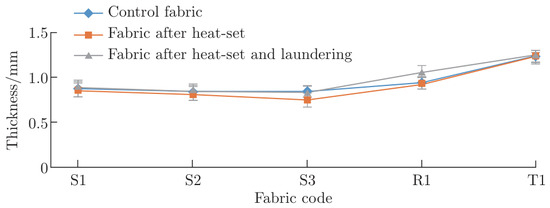
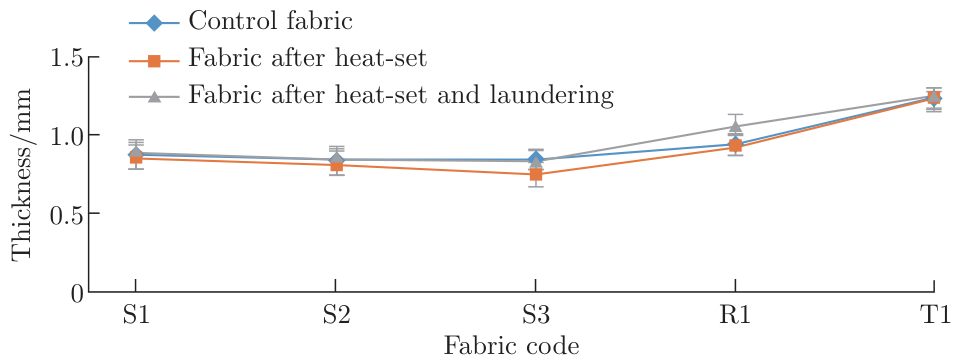
Table 3 and Figure 3 show the average fabric thickness for the three groups of fabrics: control fabric, fabric after heat-set treatment and fabric after heat-set treatment and laundering. Fabric T1, the terry structure, recorded the highest thickness (1.23 mm) and fabric S3, single jersey fabric, recorded the lowest thickness (0.75 mm). Analysis of variance found that for each type of group (control fabric, fabric after heat-set treatment and fabric after heat-set treatment and laundering), there are significant differences between each type of fabric (S1, S2, S3, R1, T1). When comparing the treatment effect for each fabric code, only fabric S3 and R1 showed significant differences (P< 0.05), which means the heat-setting and laundering thus affect the thickness of the fabric. This is supported by a study conducted by [26], where heat-setting and laundering affect fabric properties. Heat-setting could cause shrinkage and compaction of fibres, leading to decreased fabric thickness.
Table 3.
Average fabric thickness (mm) for control fabric, fabric after heat-set and fabric after heat-set and laundering (HL).
Figure 3.
Fabric thickness (mm) for control fabric, fabric after heat-set and fabric after heat-set and laundering (HL).
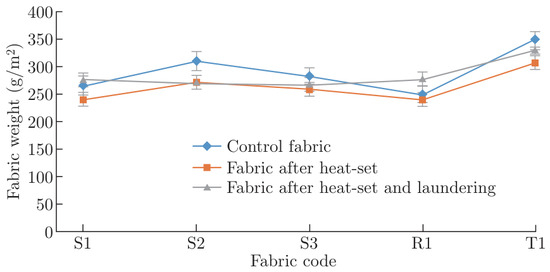
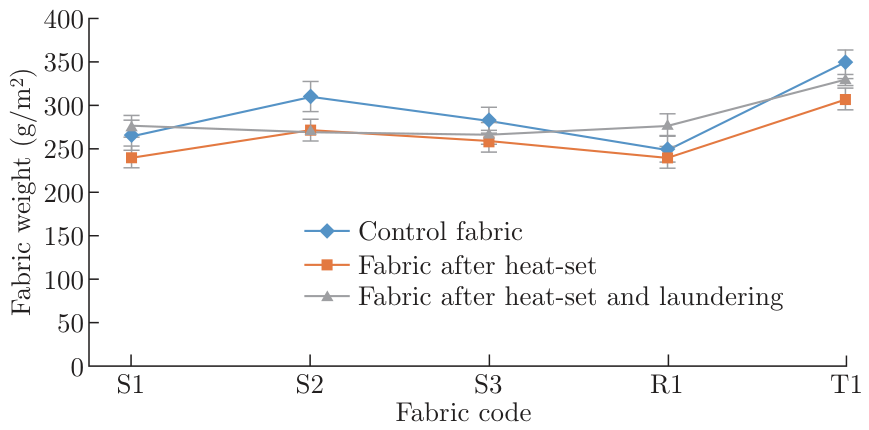
Table 4 and Figure 4 show the average fabric weight for the three groups of fabrics. Similar to the observation seen in the thickness of fabric, Fabric T1, which is the terry structure, recorded the highest fabric weight (348.01 g/m2). Significant differences exist between the samples of each type of fabric sample for the control fabric. However, the differences in fabric weight between each sample fabric are not significant for the groups of fabric after heat-set and fabric after heat-set and laundering. The effect of treatment for each fabric code was further compared, and only fabrics S1, S2 and R1 showed significant differences (P < 0.05). Heat-setting treatment followed by specific finishing treatments, such as laundering, could reduce fabric weight beyond the initial decrease from heat-setting treatment alone [27].
Table 4.
Average fabric weight (g/m2) for control fabric, fabric after heat-set and fabric after heat-set and laundering (HL).
Figure 4.
Fabric weight (g/m2) for control fabric, fabric after heat-set and fabric after heat-set and laun- dering (HL).
3.1. Effects of 10%, 15% and 20% Strain Levels on Different Knitted Constructions (Control Fabrics)
Table 5 shows the maximum load of knitted fabric constructions at different strain percentages in wale and course directions. Different fabric constructions recorded different loads at 10%, 15% and 20% strain in both wale and course directions. It was evident that the higher the strain level, the greater the load on the fabric. It is a general physical property of elastic fabric [28]. Sample R1 recorded the highest load in the wale direction, while T1 recorded the highest load in the course direction. The load required to extend R1 at 10%, 15% and 20% strains in the wale direction are 5.11 N, 7.81 N and 10.60 N, respectively. At the same time, the load required to extend T1 at 10%, 15% and 20% strain in the course direction are 3.36 N, 4.93 N and 6.41 N, respectively. The results indicate that using R1 in the wale direction and T1 in the course direction will create more significant pressure when extended, putting more compression on the patient’s body. Inversely, R1 required extending the lowest load in the course direction. This could be explained by the fact that rib structure has better course direction stretch properties than other knitted structures [29]. This is because fabrics with high extension properties need a low load to extend, thus lowering their strength (load) [30]. This result also shows that rib knitted fabric has a lower load (N) to extend in the course direction than its wale direction.
Table 5.
Maximum load (N) of different knitted fabrics construction at 10%, 15% and 20% strain in the course and wale directions.
The analysis of variance was performed to measure the main effect of different fabric constructions at various strain levels and strain directions. The main effect of fabric construction, fabric direction, and strain level is significant (P-value < 0.05), meaning that the fabric construction, fabric direction, and strain level significantly influenced the maximum load of the fabrics. The interactions between the independent variables are also tested. The interaction between fabric construction and fabric direction (Fabric construction*Fabric direction) is significant (P-value < 0.05), indicating that the effect of fabric direction on the maximum load of the fabrics depends on the fabric construction. The interaction between fabric construction and strain level (Fabric construction*Strain level) is also significant (P-value < 0.05), suggesting that the effect of strain level on the maximum load of the fabrics depends on the fabric construction. The interaction between fabric direction and strain level (Fabric direction*Strain level) is significant (P-value < 0.05), indicating that the effect of strain level on the maximum load of the fabrics depends on the fabric direction. The three-way interaction between fabric construction, fabric direction, and strain level (Fabric construction*Fabric direction*Strain level) is significant (P-value < 0.05), suggesting that the effect of strain level on the maximum load of the fabrics depends on both fabric construction and fabric direction.
3.2. Effects of 10%, 15% and 20% Strain Levels on Different Fibre Compositions (Control Fabrics)
Table 6 shows the maximum load of different fibre compositions at 10%, 15% and 20% strain in course and wale directions. Fabric S2 with 8% elastane yarn requires the most load extended at all strain levels and in both directions. The load needed to extend S1 at 10% strain was 2.64 N. For S2, the load required to extend it at 10% strain was 4.46 N, and the load needed to extend S3 at 10% strain was 2.98 N. This implies that a pressure garment made from fibre composition in S2 would generate more pressure on a user’s body than compression fabric made from fabric S1 or S3, assuming that the same amount of stretch is applied.
Table 6.
Maximum load (N) of different ¯bre compositions at 10%, 15% and 20% strain in course and wale directions.
The analysis of variance was performed again to measure the main effect of different fibre compositions at different strain levels and strain directions. The main effect of fibre compositions, fabric direction, and strain level is significant (P-value < 0.05), meaning that the maximum load of the fabrics significantly influences the fibre compositions, fabric direction, and strain level. Fibre compositions and fabric direction are significant (P-value < 0.05), and fibre compositions and strain levels are significant (P-value < 0.05), indicating that the effect of fabric direction and strain levels on the maximum load of the fabrics depends on the fibre compositions. The three- way interaction between fibre compositions, fabric direction, and strain level is also significant (P-value < 0.05), suggesting that the effect of strain level on the maximum load of the fabrics depends on both fibre compositions and fabric direction. A previous study which examined the impact of using different elastane ratios found that fabrics’ physical and mechanical properties were significantly affected by the structure’s tightness and amount of spandex [31].
3.3. Elastic Properties of Control Fabric, Heat-setting Fabrics and After-laundry Fabric
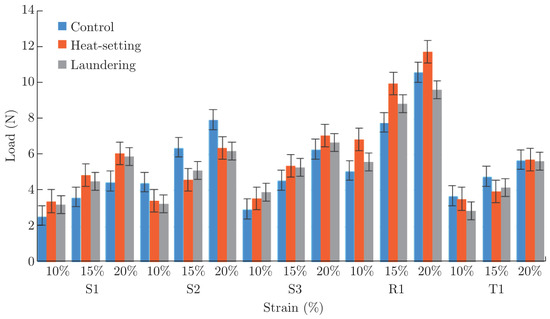
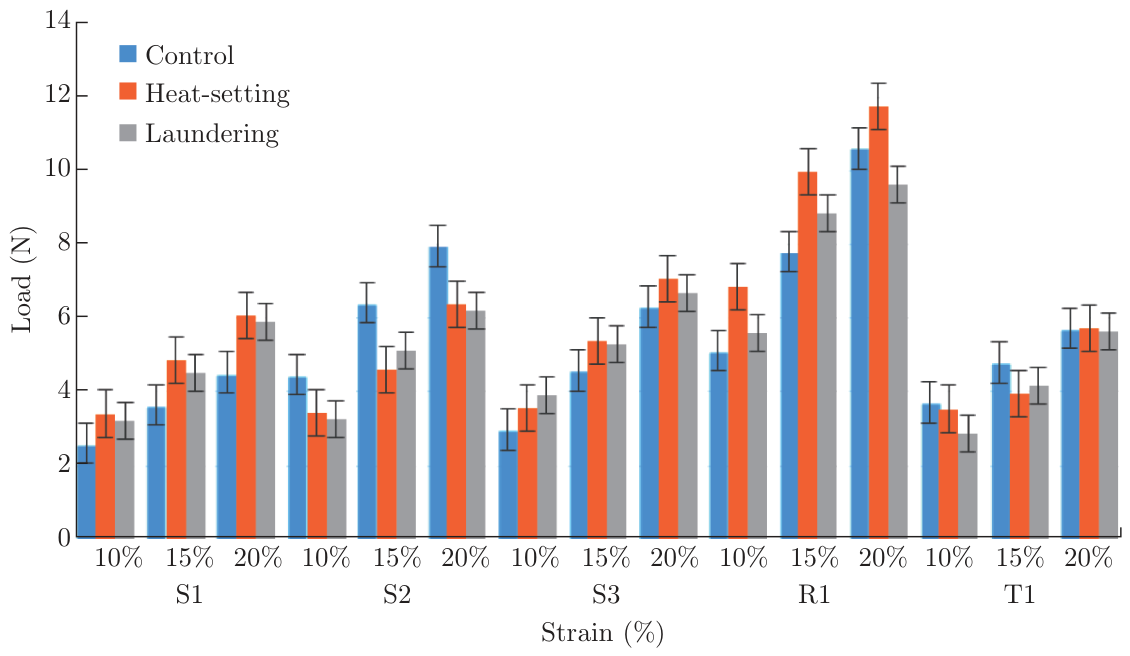
Figure 5 shows the elastic properties of control fabric, fabric after heat-setting, and fabric after laundry in the width direction. It can be observed that heat-setting had a significant effect on the load of the fabrics. The load increased after heat-setting for all fabric samples compared to the control sample. The percentage increase in load varied between fabric samples and strain levels. For S1, the load increased by an average of 35 % after heat-setting at all strain levels.
Figure 5.
Elastic properties of fabrics for control after heat-setting and after laundering.
Similarly, S2 showed an average load increase of 33% after heat-setting at all strain levels. The same trend was observed for S3, R1, and T1, which showed average load increases of 36%, 44%, and 31%, respectively. This suggests that the heat-setting process could be beneficial for increasing the durability of the compression fabric. The heat-setting process can also reduce shrinkage during laundering, ensuring the glove maintains its shape and size over time.
After laundering, the load slightly decreased compared to the heat-setting fabric for all fabric samples. The percentage decrease in load varied between fabric samples and strain levels. For S1, the load decreased by an average of 8% after laundering at all strain levels compared to the heat-setting fabric. For S2, the load decreased by an average of 18%. Meanwhile, for S3, the load decreased by an average of 9%. The same trend was observed for samples R1 and T1, which showed average load decreases of 15% and 12% after laundering compared to the heat-setting fabric. Laundering had a negative impact on the load capacity of the fabrics, particularly at higher strain levels. This suggests that laundering may weaken the fabric, reduce its ability to withstand deformation and maintain its shape over time. The negative impact of laundering may be due to the mechanical action of the washing process, which can cause friction and stress on the fabric fibres, as well as the use of detergents and high temperatures, which can weaken the fibres.
The results from this study indicate that heat-setting can significantly increase the load of the fabrics, but laundering can decrease the load. It is parallel to past research, where heat- setting improves the dimensional stability of fabric by optimising the strength properties of cotton elastane fabric within moderately rigid limits [32]. The load of fabric increases while being stretched. However, the elastic properties of fabrics can be negatively affected by laundering. Constant laundering could impact the fabric’s ability to return to its original shape quickly after being stretched and withstand deformation [33].
4. Conclusion
This study assessed the effects of heat-setting and laundering on the physical and elastic char- acteristics of weft-knitted fabrics with different fibre compositions and fabric constructions. Five types of fabrics were examined and revealed distinct elastic behaviours. At 10%, 15%, and 20% strains, the results indicated that different knitted fabric constructions exhibited distinctive elastic properties (P < 0.05). The 1×1 rib and terry fabrics demonstrated superior stretch and pressure exertion in the wale and course directions. Fibre compositions in single jersey fabrics significantly affected (P < 0.05) their load requirements for extension, with 8% elastane displaying the highest resistance to stretching. Heat-setting treatment enhanced fabric durability and stability by 24% to 47%, but it reduced load capacity after laundering, accentuating the need to consider meticu- lously fabric selection for prolonged use. In summary, this research provides valuable insights into the complex interactions between fabric properties, fabric construction, and types of treatment, such as heat-setting and laundering. The findings of this study have practical implications for optimising performance in the development of compression fabric. This study’s limitation is the limited fibre composition for other types of fabric structures, such as ribs and terry. Therefore, future research can include these fabric structures to explore the elastic properties further.
Acknowledgments
This research was supported by the Ministry of Higher Education (MOHE) through the Fun- damental Research Grant Scheme (FRGS/1/2018/TK05/UTHM/03/4/) and partially sponsored by Universiti Tun Hussein Onn Malaysia.
References
- Wang, L.; Felder, M.; Cai, J.Y. Study of properties of medical compression garment fabrics. JFBI 2011, 4, 15–22. [Google Scholar] [CrossRef] [Scilit]
- Gokarneshan, N. Design of Compression/Pressure Garments for Diversified Medical Applications. Biomed. J. Sci. Tech Res. 2017, 1, 806–813. [Google Scholar] [CrossRef] [Scilit]
- Nasir, S.H.; Troynikov, O.; Massy-Westropp, N. Arthritis patients’ experience and perception of ther- apeutic gloves. Int. J. Fash. Des. Technol. Educ. 2017, 11, 233–242. [Google Scholar] [CrossRef] [Scilit]
- Xiong, Y.; Tao, X. Compression garments for medical therapy and sports. J. Polym. 2018, 10, 1–19. [Google Scholar] [CrossRef] [Scilit] [PubMed]
- Ghorbani, E.; Hasani, H.; Jafari, N.R. Finite element modelling the mechanical performance of pressure garments produced from elastic weft knitted fabrics. J. Text. Inst. 2019, 110, 724–731. [Google Scholar] [CrossRef] [Scilit]
- Daia, X.; Caia, J.; Wangb, G.; Lub, A.M. Effect of Compression Tights on Performance During Intense Pedalling Exercise. J. Fiber Bioeng. Inform. 2014, 7(4), 527–533. [Google Scholar] [CrossRef] [Scilit]
- Born, D.P.; Sperlich, B.; Holmberg, H.C. Bringing light into the dark: Effects of compression clothing on performance and recovery. Int. J. Sport Physiol. 2013, 8, 4–18. [Google Scholar] [CrossRef] [Scilit] [PubMed]
- Duffield, R.; Portus, M. Comparison of three types of full-body compression garments on throwing and repeat-sprint performance in cricket players. Br. J. Sport Med. 2007, 41, 409–414. [Google Scholar] [CrossRef] [Scilit] [PubMed]
- Fu, W.; Liu, Y.; Fang, Y. Research advancements in humanoid compression garments in sports. Int. J. Adv. Robot Syst. 2013, 10, 66. [Google Scholar] [CrossRef] [Scilit] [PubMed]
- Machado-Sousa, J. P.; Silva, I. S.; Marques, V. R.; Tavares, R. Effects of compression garments on neuromuscular function during exercise. J. Fiber Bioeng. Inform. 2019, 12(4), 291–299. [Google Scholar]
- Lin, J.H.; He, C.H.; Lee, M.C.; Chen, Y.S.; Lou, C.W. Sports protective elastic knits: structure design and property evaluations. J. Text. Ins. 2020, 111, 424–433. [Google Scholar] [CrossRef] [Scilit]
- Thao, N.X.; Toan, D. V. Effect of structural parameters on the elastic properties of warp-knitted spacer fabrics for compression garments. J. Fiber Bioeng. Inform. 2021, 13(3), 201–208. [Google Scholar]
- Nasir, S.H.; Troynikov, O. Therapeutic gloves for arthritis: development of a design framework. Int. J. Fash. Des. Technol. Educ. 2019, 12, 346–355. [Google Scholar] [CrossRef] [Scilit]
- Woods, S.; Sosa, E.M.; Kurowski-Burt, A.; Fleming, M.; Matheny, K.; Richardson, A.; Scott, H.; Perry, B.; Zornes, I. Effects of wearing of metacarpal gloves on hand dexterity, function, and perceived comfort: A pilot study. Appl. Ergon. 2021, 97, 103538. [Google Scholar] [CrossRef] [Scilit] [PubMed]
- Li, M.; Yang, H.; Liu, P.; Du, Z. Effect of structural parameters on compression performance of warp- knitted spacer fabric. J. Fiber Bioeng. Inform. 2015, 8(2), 267–276. [Google Scholar] [CrossRef] [Scilit]
- Yu, A.; Yick, K.L.; Ng, S.P.; Yip, J. Case study on the effects of fit and material of sports gloves on hand performance. Appl. Ergon. 2019, 75, 17–26. [Google Scholar] [CrossRef] [Scilit] [PubMed]
- P´erez-Soriano, P.; Sanchis-Sanchis, R.; Jimenez-Perez, I.; Gil-Calvo, M.; Priego Quesada, J. I.; Aparicio, I. Compression Garments in Sport. In Materials in Sports Equipment; 2019; pp. 487–520. [Google Scholar]
- Jariyapunya, N.B. Predictive modelling of compression garments for elastic fabric and the effects of pressure sensor thickness. J. Text. Inst. 2019, 110(8), 1132–1140. [Google Scholar] [CrossRef] [Scilit]
- Ertekin, G.; O˘glakcio˘glu, N.; Marmarali, A. Strength and comfort characteristics of cotton/elastane knitted fabrics. Tekst. Ve Mu¨hendis 2018, 25(110), 146–153. [Google Scholar]
- Akter, N.; Repon, M.R.; Rashid, M.A.; Shiddique, M.N.A. Performance analysis of spandex incorporated single jersey fabrics for sportswear. Indian J. Sci. Technol. 2020, 13, 1998–2009. [Google Scholar] [CrossRef] [Scilit]
- O’Riordan, S.F.; McGregor, R.; Halson, S.L.; Bishop, D.J.; Broatch, J.R. Sports compression garments improve resting markers of venous return and muscle blood flow in male basketball players. J. Sport Health Sci. 2023, 12(4), 513–522. [Google Scholar] [CrossRef] [Scilit] [PubMed]
- Mousavi, G.; Varsei, M.; Rashidi, A.; Ghazisaeidi, R. Experimental evaluation of the compression garment produced from elastic spacer fabrics through real human limb. J. Ind. Text. 2022, 3593S–3612S. [Google Scholar] [CrossRef] [Scilit]
- Huzaisham, N.A.; Nasir, S.H.; Mohd Idris, M.K.; Rodriguez, C.Q. Heat-setting parameters optimisation of cotton/elastane fabric using response surface methodology. IJFTR 2023, 48, 27–34. [Google Scholar] [CrossRef] [Scilit]
- Senthilkumar, M. Effect of spandex input tension, spandex linear density and cotton yarn loop length on dynamic elastic behavior of cotton/spandex knitted fabrics. J. Text. Appar. Technol. Manag 2012, 7. [Google Scholar]
- Onofrei, E.; Rocha, A.M.; Catarino, A. The influence of knitted fabrics’ structure on the thermal and moisture management properties. JEFF 2011, 6. [Google Scholar] [CrossRef] [Scilit]
- Gulrajani, M.L. (Ed.) Advances in the dyeing and finishing of technical textiles; Elsevier, 8 Feb 2013. [Google Scholar]
- El-Sayed, N.A.; Fahmy, H.M.; Hassan, T.M.; Mohamed, Z.E. Effect of cellulase treatment on the extent of post-finishing and dyeing of cotton fabrics. J. Mater. Process. Technol. 2005, 160(1), 99–106. [Google Scholar] [CrossRef] [Scilit]
- Kankariya, N.; Laing, R.M.; Wilson, C.A. Textile-based compression therapy in managing chronic oedema: Complex interactions. Phlebology 2021, 36(2), 100–113. [Google Scholar] [CrossRef] [Scilit] [PubMed]
- Peng, J.; Jiang, G.; Xia, F.; Cong, H.; Dong, Z. Deformation and geometric modeling in three-dimensional simulation of fancy weft-knitted fabric. Text. Res. J. 2020, 90, 1527–1536. [Google Scholar] [CrossRef] [Scilit]
- Shen, Y.; Dong, Z.; Cong, H. Structure modeling in three-dimensional simulation of weft-knitted seamless kneepads. Text. Res. J. 2022, 92, 608–617. [Google Scholar] [CrossRef] [Scilit]
- Eryuruk, S.H.; Gidik, H.; Koncar, V.; Kalaoglu, F.; Tao, X.; Saglam, Y. Heat and moisture transfer prop- erties of a firefighter clothing with a new fire-resistant underwear. J. Ind. Text. 2022, 51((3) suppl, 4480S–513S. [Google Scholar] [CrossRef] [Scilit]
- Islam, S. Attaining optimum strength of cotton-spandex woven fabric by apposite heat-setting temperature. J. Inst. Eng. 2019, 100, 601–606. [Google Scholar] [CrossRef] [Scilit]
- Li, J.; Li, S.; Su, Y. stretchable strain sensors based on deterministic-contact-resistance braided struc- tures with high performance and capability of continuous production. Adv. Funct. Mater. 2022, 32. [Google Scholar] [CrossRef] [Scilit]

© 2024 Textile Bioengineering and Informatics Society. This article is an open access article distributed under the terms and conditions of the Creative Commons Attribution (CC BY) license (https://creativecommons.org/licenses/by/4.0/).