


Abstract
The global economy has experienced a downturn due to the COVID-19 epidemic, and the entire apparel industry has been hit hard. However, in the post-epidemic era, the digital trend of the world has become more pronounced. The virtual consumer market and virtual fashion took this opportunity to overgrow. More and more people are willing to spend money on virtual products. In a way, virtual fashion is the acceleration and continuation of future fashion trends. The most crucial difference between virtual and physical fashion is that the latter does not undergo physical production. Instead, virtual clothing can be purchased and “worn” immediately. More and more fashion brands have paused traditional fashion shows in favor of visuals such as video game collaborations, mobile apps, virtual icons, virtual showrooms, and virtual clothing brands. This paper compares and analyzes ten international brands associated with virtual fashion through data collection and case studies. It shows that with the help of modern cutting-edge technology, the traditional apparel industry has ushered in a new transformation point. New virtual fashion will gradually enter our daily life from the experimental field, driving the transformation of the apparel industry.
1. Introduction
Affected by the COVID-19 pandemic, the world economy has been gravely wounded and experienced a decline. According to the United Nations’ World Economic Situation and Prospects 2020 and 2021, the global economy shrank by 4.3% in 2020, more than 2.5 times that of the 2009 global financial crisis. The latest report predicts that the global economy will rebound by 4.7% in 2021, offsetting the 2020 losses. Global GDP will shrink by nearly 1% in 2021. The United Nations indicates that due to the COVID-19 pandemic. The global apparel market fell by 15.2% in 2020 compared to 2019, with a total loss of 297 billion US dollars [1].
Some professional researches have been conducted on the software, including CLO, VR, AR technology, or virtual technology. Some papers [2,3,4] focus on the theoretical part, are not combined with the latest reality background-COVID, and lack actual case analysis. It is slightly inadequate in practical operations and applications. Others have mainly studied marketing models [5,6,7], Or lack of support for the sudden economic downturn in the offline fashion industry [8,9,10].
Therefore, this paper includes video game collaborations, mobile apps, virtual icons, virtual showrooms, and virtual clothing brands. Each aspect will analyze in international virtual fashionrelated cases with examples, a total of 30 cases. Analysis of the clothing industry’s development trend in the post-epidemic era is made through many cases and data analysis. The conclusions drawn are as follows: In the post-pandemic era, the fashion industry should pay attention to potential opportunities for cooperation with mobile game marketing and design; in-depth research and development of AR and VR technologies, increase investment in scientific research, and seize market opportunities; focus on broadening horizons. Companies appropriately tilted their marketing focus on online channels, developing e-commerce, and simultaneously positioning offline physical stores more as display and concept expression. In the post-epidemic era, the trend towards digitization of the world has become more pronounced. In this situation, the virtual consumer market and virtual fashion are growing excessively. More and more people are willing to spend money on virtual products. With the application of modern cutting-edge technologies, the traditional apparel industry has come to a new point of transformation. The new virtual fashion will gradually become involved in our daily life from the experimental field and drive the transformation of the apparel industry. The online virtual approach can provide an exemplary showcase and promotion channel for more new design brands and rejuvenate old international brands with the help of cutting-edge technology. After the pandemic, virtual fashion can also enable consumers and apparel industry players to rethink the whole apparel industry. In the future, everyone will consume more rationally and have a greater sense of social responsibility in the apparel sector. At the same time, they will also be more susceptible to visual and online social media influences being stimulated to spend.
2. Method
Before the case analysis, it is necessary to define the virtual. Virtual fashion refers to the use of high-tech technologies, such as VR (Virtual Reality includes computers, electronic information, and simulation technology. The primary realization method is that the computer simulates the virtual environment to give people a sense of environmental immersion), CLO (3D clothing platemaking virtual test Clothing system), CGI technology (Computer-generated imagery), and other fashion activities that imitate real models, clothing, scenes, etc. It should be noted that “virtual fashion” is different from the concept of “online”. “Virtual things” do not exist in reality but can be transformed into things that exist in reality, while “online” is through the Internet. Moreover, “online” uses the Internet as a channel to promote things that already exist in reality.
This part collects more than ten virtual fashion cases covering many countries worldwide, such as China, the United States, Japan, and other countries. It is divided into five parts: video game collaborations, mobile apps, virtual icons, virtual showrooms, and virtual clothing brands.
2.1. Cooperation with the Video Games
2.1.1. Animal Crossing × Multiple Fashion Brands
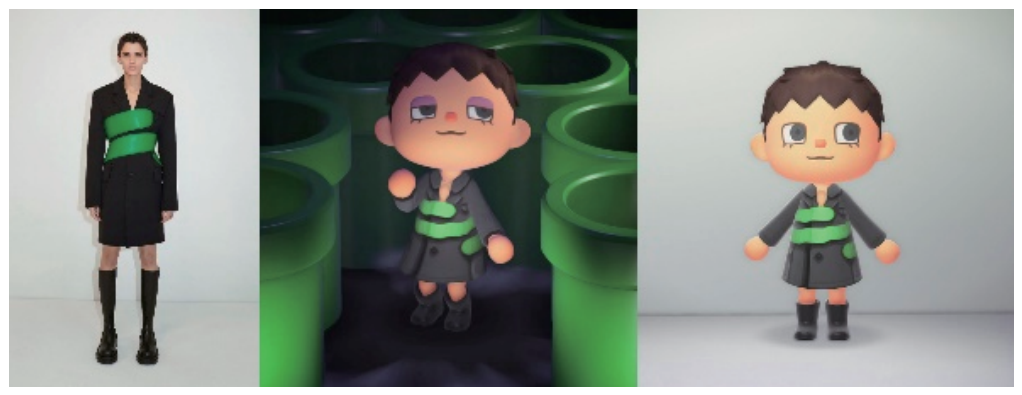
On March 20, 2020, the simulation business game “Animal Crossing” broke the sales record for the first week in Switch game history as soon as it was launched. By the end of April, its global sales had reached 14.31 million copies [11]. At present, more than 20 fashion and non-fashion brands and platforms worldwide have built “Brand Island” in this game to promote themselves. For example, the Chinese brand JNBY, the internationally renowned cross-border e-commerce NET-A-PORTER, Valentino’s luxury brand, and the famous GQ magazine. Among them, the e-commerce NET-A-PORTER has re-engraved the spring and summer new products of several Chinese designer brands in the game. These products not only appear in the game but can also be purchased in real life. The web designer Shel Orrock and Richmond Young have been playing the game since 2002, and in 2014, they created the @crossingtherunway account. Their crossover works include Chanel, Balenciaga, JW Anderson, etc., and so far, they have 12000 followers on Instagram.
Figure 1.
Bottega veneta pre-fall 2021 #16 in animal crossing.
2.1.2. Moschino × the Sims 4
Moschino collaborated with the lifestyle simulation game The sims to launch a capsule series in April 2019. The Moschino × The Sims collaboration is now available to shop online. Creative director Jeremy Scott designed and produced ready-to-wear garments with Moschino’s iconic patterns, such as teddy bears and vintage chains. Moschino-branded Freezer Bunny hoodie is the iconic flagship product in this collaboration.
2.1.3. The Louis Vuitton × League of Legends
As a world-renowned online game, “League of Legends” attracts the attention of many fans every year when the World Championship is held. Its heroic design also allows players from all over the world to immerse themselves in this virtual world. In 2019, Louis Vuitton and Riot Games launched the League of Legends series of products, covering clothing, footwear, and accessories to continue its exclusive Prestige skin. The capsule contained unique and original references from the “League of Legends” world and was designed by Nicolas Ghesqui`ere, the art director of Louis Vuitton’s female collection. The series is sold online and offline at the same time [12].
The universe inspired Nicolas Ghesqui`ere from the online multiplayer battle arena video game. The new Louis Vuitton signature was also displayed throughout the series, inspired by the ring of the “League of Legends” character Ziana. The derby platform takes inspiration from the “League of Legends” champions in a camo motif.
There are various ready-to-wear in the series and iconic Louis Vuitton shoes, including Archlight sneakers, Star cross-country boots, and Beaubourg thick-soled Derby shoes. The products include ready-to-wear handbags and shoes, such as Archlight sneakers, Star cross-country boots, and Beaubourg platform derby.
2.1.4. Urban Revivo × Shining NIKKI
The Love NIKKI-Dress UP Queen series of games is a dress-up development game launched by China Paper Stacking Company, which Chinese female consumers widely love. During the epidemic, Valentine’s Day 2020, Shining NIKKI will cooperate with URBAN REVIVO on Valentine’s Day in 2020, and the store will launch the same clothing as NIKKI. The exposure of Weibo linked with Shining NIKKI released by the official Weibo has increased by a thousand times compared with other Weibo. The number of plays on the official account of the video software bilibili reached 101000 as of June 18, 2020.
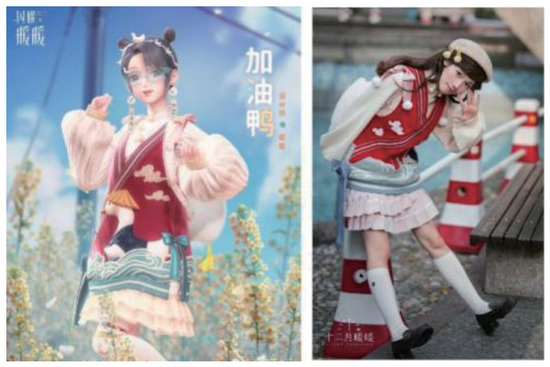
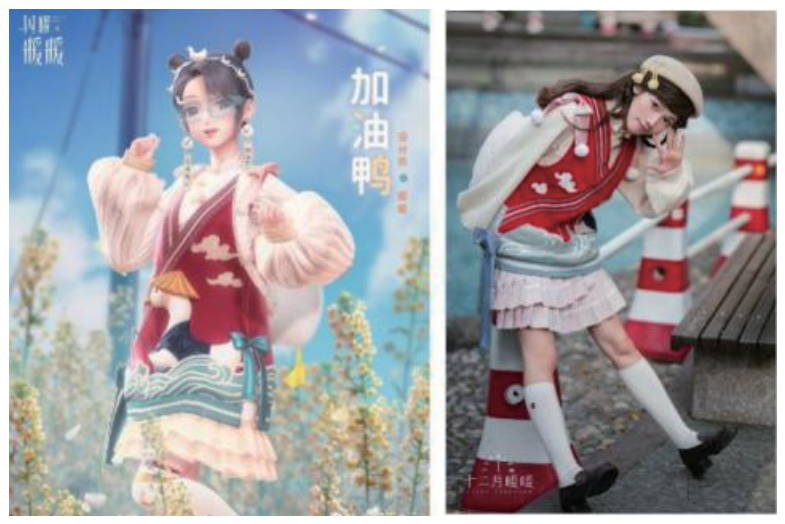
Also, Love NIKKI-Dress UP Queen has designed costumes corresponding to the online design competition variety show “Goddess’s New Clothes” in the game and launched a tailored suit “Moonlight Guanshan” in collaboration with the National Peking Opera Theater × Shining NIKKI . The online shopping platform for virtual clothing-Taobao Store, “December NIKKI”, turns virtual clothing in the game into actual clothing purchased in reality. As shown in Figure 2, the left side is the virtual clothing in the game, and the right side is the clothing produced and sold.
Figure 2.
Comparison of the 3D virtual version and the actual sale version of the shining NIKKI “Cheer Duck” suit.
2.1.5. NIKE × Fortnite
NIKE has turned the idea of exclusively selling sneakers in the field of online games into reality. Falling into the real world is known for causing long queues, causing a brand buzz, and driving high resale prices of the products offered, creating an exclusive and consumer hype engine. NIKE hopes to reach with approximately 250 million registered players. “Fortnite” audience copy [13]. In May 2019, NIKE launched two Jordan virtual sneakers specially designed for the game. Players will change the game characters into Jordan brand clothing and start a racing parkour showdown on the street. Epic and Fortnite collaborated with NIKE Air Jordans for an in-game collaborative campaign. The partnership included cosmetic items purchasable in in-game stores and loot drops that could contain branded apparel and Downtown Drop for a limited time. The exclusive NIKE Air Jordan outfits are available in the Hang Time Bundle, purchased via the in-game shop for 1800 V-Bucks. The bundle includes two outfits, Grind and Clutch, and includes the iconic NIKE Air Jordan 1s trainers. Additionally, the skin also comes with a challenge pack, which can unlock different color options [14].
2.2. Mobile Apps
This part selects global clothing brands, including social media software, VR technology, virtual fashion bloggers, and online fashion week as case studies. Retailers need to understand how to integrate social media into CRM (customer relationship management) strategies and satisfy the needs of social networkers who engage brands in social media to maximize their profits and create keen brand awareness [15]. The clothing retail industry is facing the COVID-19 epidemic. Under such circumstances, it is necessary to change your marketing channels and focus on capital investment flexibly.
2.2.1. Gucci and other Brands × Drest
Drest and Gucci have cooperated to launch a modeling game application based on modeling models such as Unia Pakhomova. The user becomes a professional stylist in a fashion magazine and shoulders the mission of making a designer look suitable for his avatar. Besides, if people like what they see, users can purchase clothes through the program. The fashion games involve styles and allow gamers to participate in the entire creative process of fashion editorials. Provide users with dress codes, seasonal themes, and other information (such as colors), and then they must create a look at them. As players level up in the game, they can dress up their avatars and choose from various locations and backgrounds to purchase in the App or take photos as a reward. Players can also combine their appearances in a mood board form. Users can choose from five avatars of different sizes. The clothing selection covers about 130 high-end brands, including Burberry, Gucci, Prada, Stella McCartney, and Valentino [16].
Figure 3.
Unia Pakhomova, the face of Gucci, will appear as a game avatar in Drest.
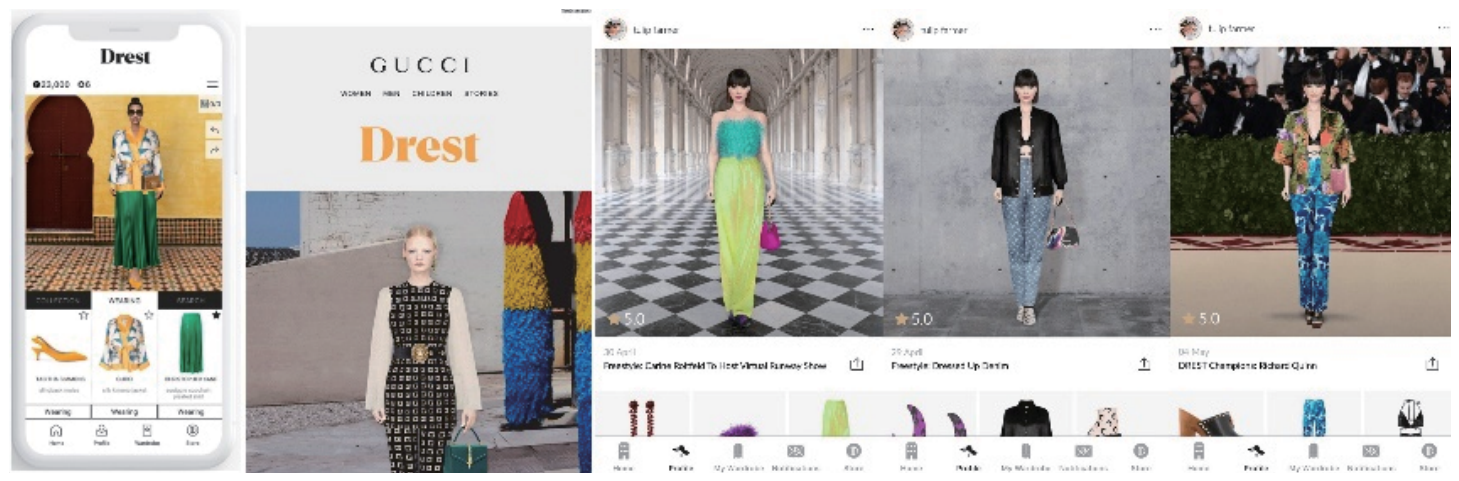
According to Drest, pieces from the company’s fall 2019 collection will appear as cosmetic items within the game. Over the first four weeks, the center of the games on themes of time and place, including “Sixties London”, “Seventies Paris Rive Gauche”, “Eighties New York”, and “Nineties L.A”. Gameplay involves dressing up avatars for on-location photo shoots, with more backgrounds available for purchase or as rewards for progressing through the game. The so-called “still” games allow people to look together in a mood board using the in-game features.
2.2.2. NIKE × Zepeto
Users can create their virtual cartoon images through the software, dress them up, and take photos with friends or even strangers to socialize. NIKE has also cooperated with Zepeto; the store includes some co-branded shoes, Air Max 720, and even On Air’s winning shoes from Tokyo, Japan. At the same time, NIKE clothing and even accessories such as hats and socks were also readily available. Virtual clothes can be purchased by recharging virtual currency in the game with real money.
2.3. Virtual Icons
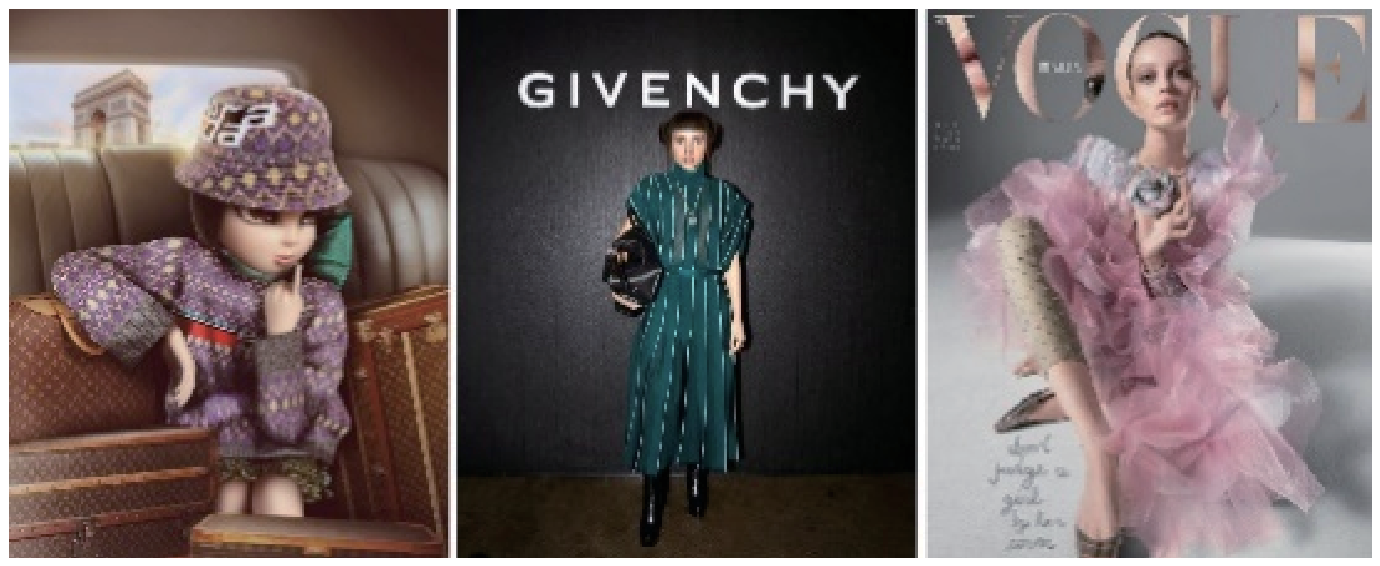
Virtual icons Lil Miquela, Noonoour, etc., participated in advertisement campaigns with Givenchy, Prada activities. The well-known fashion magazine NYLON China also chose the mobile game “Glory of the King” virtual idol men’s group Unlimited King as the cover character. In March 2020, the cover of “Vogue Italia” used an unusual model: Ida, a virtual model created by Computer Graphic. This is the first time in the magazine’s history that the cover is dedicated to a “Nonexistent girl”.
Figure 4.
Instagram’s popular virtual icons (from left to right, Noonoouri, Lil Miquela, and Ida).
2.4. Virtual Showroom
As a result of the COVID-19 epidemic, many public places were blocked off. Virtual Showroom was developed, mainly using AR, VR, and other technologies to make customers interact with the brand. It is often used in scenarios such as beauty and clothing fitting.
2.4.1. NuOrder
NuORDER’s platform serves as the digital extension to the market’s most prominent fashion, apparel, and outdoor events. In addition to digital line sheets and catalogs, NuORDER’s virtual showroom technology provides brands and buyers with all the tools they need to conduct commerce online [17]. On NuOrder, brands and buyers can quickly sort and subdivide products by color, size, category, or other tags, build a digital shopping cart, and place an order without ever dipping focaccia into a ceramic dish of olive oil. It is a seamless alternative to market week— which is not a week at all but many—when retailers hit the road with Excel spreadsheets and budgets to shop the collections and determine the products that will define a season’s sales. Now all of it happens with the ease of ordering from Amazon Prime [18].
2.4.2. Dior Maison and Dior Eyes
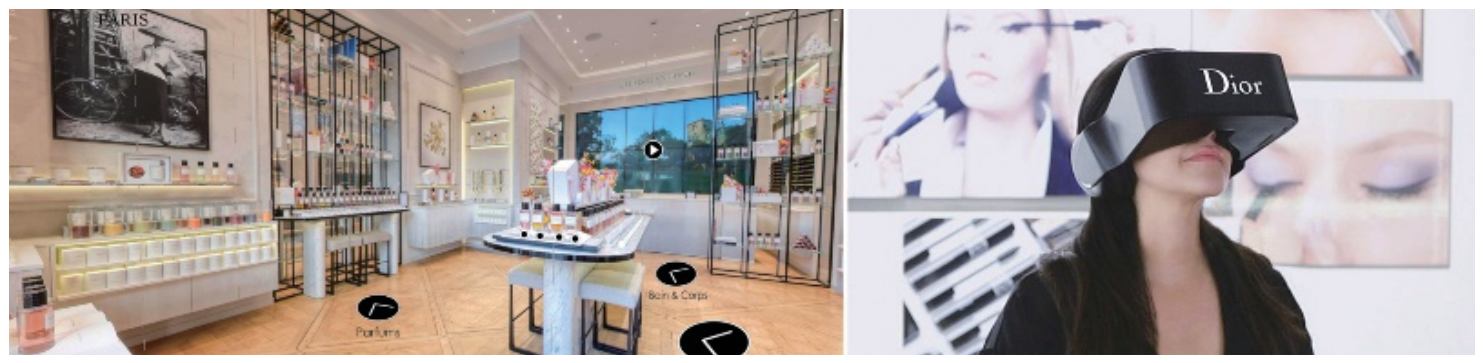
Dior launched Dior Maison, a 3D virtual beauty boutique, in mid-February 2020. Customers can rotate through 360 degrees for a shopping experience and learn more about the products before buying. It is an excellent way for European cities to blockade themselves during the epidemic and offers customers an innovative shopping experience.
At the same time, Dior also launched Dior Eyes, its new virtual reality headset. It provides consumers with an immersive experience into the backstage of Dior’s latest runway show. The headset is equipped with HD image resolution and integrated, holistic audio to create a 3D immersive backstage world of the fashion show, including a sense of 360° vision.
Figure 5.
Dior’s virtual beauty boutique——Dior Maison (left) and Dior Eyes (right).
2.5. Virtual Clothing Brand
Virtual clothing from design to production to delivery is done online, and the sale is also virtual. However, because of its novel and particular form, exaggerated design, and eye-catching effect, it is also loved by many media netizens. Since the outbreak of the COVID-19 epidemic, the number of brands g that do virtual clothing is also increasing, and the technology is becoming more and more mature.
2.5.1. Fabricant
In May 2019, the world’s first digital haute couture designed by The Fabricant was sold through the blockchain for $9500. The Amsterdam virtual fashion company Fabricant has completed the design of the skirt. The way the dress is worn is a bit special. The company will take a photo of the customer and then use augmented reality technology to put a virtual dress on the customer to share the photo on social media.
2.5.2. Catty Taylor
3D designer Catty Taylor focuses on creating digital clothing styles, and the clothing display effects produced will be promoted on social media. Many brands are rushing to cooperate with them, such as Balenciaga, Burberry, NIKE, a cold wall, Vetements, Off-White.
2.5.3. Carlings
The Norwegian-based brand Carlings has made 3D design and employee training efforts to produce 3D products, with 120 million euros in 2018. They are well-known for their denim collections and are among the first brands to set foot to sell virtual 3D collections with prices ranging from 10 Euros to 30 Euros [19]. Consumers purchasing services need to submit personal photos. Then technicians will create personal 3D images in virtual costumes based on this.
Norway-based brand Carlings made 120 million euros in revenue in 2018. It invests its efforts in 3D design and training employees to produce 3D collections. They were the first brands to stampede into selling virtual 3D collections and items from 10 euros to 30 euros apiece for their denim lines. Carlings CEO Ronny Mikalsen said he sees 3D collections as the future and a sustainable solution for the world, currently inundated with excess clothing waste. The digital clothing industry, currently driven by a legion of millennials interested in social networking, is expected to drive those sales and represent one percent of the fashion market share at $25 billion. Fortnite, the top money-making, free-to-play game, reportedly made an estimated $2.4 billion in 2018.
2.5.4. Tribute Brand
In the digital age, Tribute Brand is a Croatia-based company dedicated to making “contactless web fashion”. They combine fashion and virtual technology to enable their customers to purchase digital clothing that eliminates waste, size restrictions, and gender stereotypes. Customers first select a “garment” they want to purchase from their online store. Tribute Brands works with the image CGI technology (Computer-generated imagery) after receiving the order. Through a series of digital technology processes, Tribute ultimately renders the virtual garment on a photo provided by the customer.
All of Tribute Brand’s apparel is virtual, with prices ranging from $29 to $699. Each design on the platform is available on a first-come, first-served basis and is limited to 100 pieces, with some unique styles limited to just three pieces.
Figure 6.
Tribute Brand’s dresses for women (left), a screenshot of the official website (center), and a menswear collaboration with Jean Paul Gaultier (right).
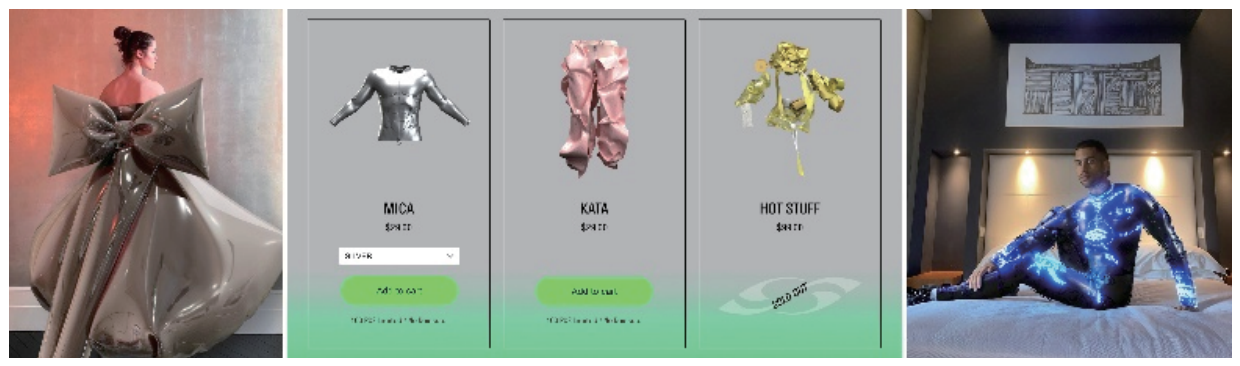
In addition to this, Tribute brands have collaborated exclusively with two of the biggest names in luxury fashion - Jean Paul Gaultier and Sacai.
3. Results & Discussion
Based on the fashion brands listed above, the cooperation between the clothing industry and virtual reality technology has brought positive feedback from the market to the brands during the post-epidemic period.
First, because virtual fashion is operated virtually, it can be adjusted in real-time, which can reduce the waste of raw materials and practice sustainable clothing principles; second, virtual fashion can often predict a clothing’s production outcome in advance, which is beneficial to a harmonious customer relationship through more efficient communication; thirdly, wearing different personal customized virtual clothes can meet the demands of modern people’s social platforms.
3.1. Cooperation with the Games
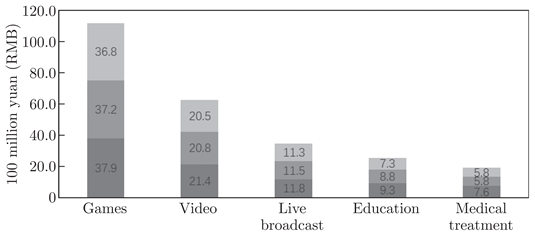
First of all, according to the data provided by China Mobile Internet Database during the February 2020 epidemic, the industry with the highest increase in daily active users during the Spring Festival holiday in 2020 compared to the price, before accounting for costs, is the gaming industry, reaching a 20% growth. The 2020 Spring Festival The WeChat Mini Program, which has the most significant increase in daily active users during the holidays, is still in the game industry, reaching 38%. According to the data compiled by the Prospective Industry Research Institute, in 2019, the proportion of China Virtual Reality Industry’s application in the game field reached 36.8%. It is expected to account for 37.2% and 37.9% in 2020 and 2021, respectively, slowly increasing year by year. Compared with the second “video” field, which accounts for 20.5%-21.4%, the game field is about 16.3%-16.5% higher. The Internet field is the field most frequently contacted by users.
Table 1.
Statistics of the proportion of applications in China’s virtual reality industry.
According to the “2020 China E-sports Industry Research Report”, the number of e-sports users in 2019 is 470 million, and in 2020 it will reach 520 million. In 2021, the number of this group will reach 550 million. The rise of mobile e-sports has made more and more female users come into contact with e-sports. In 2019, the proportion of female users in the Chinese e-sports group was 24%, increasing to 36% in 2020. The increase in the proportion of female users in the game field means that among e-sports users, the number of users willing to pay for clothing is increasing, and the potential customer group is gradually increasing. Cooperation with the games is a win-win business opportunity for the apparel industry and the game industry.
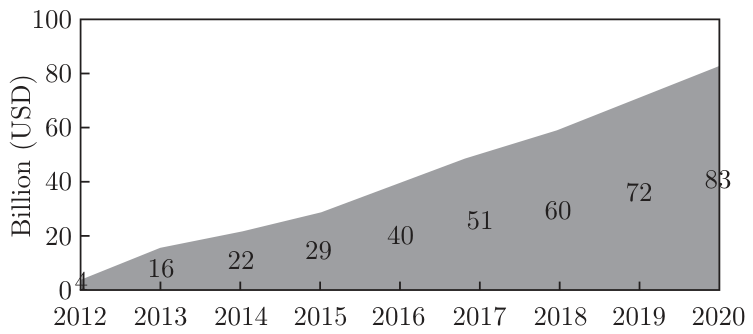
In China, cut to 2020, 63 percent of American mobile gamers are womenand women have always been the main force of consumption in the fashion industry. This once again proves the possibility of the fashion industry being combined with the game industry. Moreover, worldwide consumers’ spending on mobile games reached 60billion in 2018. This figure will continue to grow in the future, bringing in more revenue (Table 3).
Survey data from Statista shows that of 1,013 individuals aged 19-49, 44% were “very interested” in VR, while 26% of people were “quite interested”. Right now, gaming seems to be the big winner with VR and AR. During the post-epidemic period, the real economy has been severely hit. Online digital technologies such as VR and AR are bound to develop. Young and middle-aged people have shown a strong interest in virtual technologies conducive to developing and promoting virtual fashion. Further data from Statista shows that revenues generated from VR gaming sales will reach an estimated $22.9 billion by 2020, up from the $660 million generated in 2015.
As for the brands mentioned in the previous method, the cooperation between the fashion industry and the game has increased sales and expanded its exposure during the post-pandemic period of the market downturn, especially for the younger generation of Z consumers. They did good publicity. The following table shows the economic benefits of brands through the design of virtual clothing for game characters.
3.2. Mobile Application Activities and Virtual Avatars
With the powerful functions of mobile phones and the development of the Internet, people spend more time on mobile phones than in previous years, and this phenomenon has been exacerbated during the pandemic. According to a survey conducted by Nielsen, an information and market measurement company, 54% of respondents said that their spending on unplanned shopping increased last year, and 80% of them said that social recommendations such as friend recommendations and social media groups had stimulated impulse buying. According to a McKinsey research report, among the WeChat users surveyed, most of the consumption of clothing and beauty, which accounts for 25% to 30% of the total consumption, is impulsive. Coincidentally, on January 9, 2020, the industry authoritative Tencent Advertising TMI Tencent Marketing Insight and Boston Consulting Group jointly released the “2020 China Social Retail” White Paper, which shows that 56% of women are more likely to be interested in social media than men 45% of consumers; only 19% of consumers are loyal to the brand; 61% of consumers are easily planted by novel content.
The above data shows that during the pandemic, governments worldwide have called on citizens to isolate themselves at home to reduce contact with others when they go out. Therefore, people’s time to use mobile phones to socialize at home has been lengthened, and many offline activities have been changed to online activities. The original consumers have lost contact with the brand’s physical stores, and browsing information on the Internet has become the primary way to communicate. Compared with offline content, online content is mainly media-based, making users more likely to be attracted by novel content and generate impulsive consumption, especially in clothing and beauty products with apparent visual effects, in the eyes. This also means that if some new brands or niche brands can grasp online marketing characteristics, they can also usher in a company’s turning point.
Table 2.
Worldwide consumers’ spending on mobile games.
Moreover, with return rates for online retail at least 20% higher than brick-and-mortar store returns, virtual try-on is the perfect solution for foods and retailers struggling to get consumers into their stores until there is a coronavirus cure. Compared with physical store returns, the return rate of online retail is at least 20% higher. Virtual changing rooms are the perfect solution for brands and retailers to bring consumers into the store before in-person contact resumes.
3.3. Virtual Economy
According to China Electronic Information Industry Development Research Institute, the European virtual reality market will grow from 2.5 billion US dollars from 2017 to 2018 To US$4.73 billion. The Prospective Industry Research Institute predicts that by 2020, the European virtual reality market will reach US$11.35 billion [20].
Table 3.
Cooperation with the game.
Whether it is China or Europe, where the virtual economy is currently at the top of the world, its market size increases year by year. In the future, under the influence of the new crown pandemic, the market size of the virtual economy will continue to expand. Virtual economy is manifested in clothing. There are probably development directions such as mobile games, mobile social applications, virtual catwalks, virtual avatars, virtual showrooms, and virtual clothing.
4. Conclusion
Vrbanic, a designer from Croatia, highlights an often-overlooked advantage of wearing online fashion: “In the real world, there are things people are afraid to wear. Nevertheless, digital fashion offers enough freedom to try unconventional clothing in a comfortable environment”.
First, in the virtual world, concepts such as race, gender, and size are non-existent, clothing is inclusive, and wearers are more accessible than in the real world. Virtual clothing brands bring ease of use and freshness to their customers, catering to fashion lovers who like to dress boldly but are afraid to wear exaggerated clothing in reality.
Second, the fashion industry has been ranked as the second most polluting industry globally, and more and more luxury brands are going green and using natural raw materials. However, even when clothing is made from natural materials, its fragile nature and short life cycle create another kind of waste in disguise. On the contrary, the entire ’production’ process of virtual fashion takes place online, solving the worries of environmental pollution while reducing the problem of discarding old clothes.
Virtual fashion is a global call for diversity in the fashion industry, reducing mass consumption and mass waste and helping the garment industry grow sustainably.
Acknowledgments
This work was supported by the China Education Association for International Exchange (the China-CEEC Joint Education Project of Higher Education Institutions - Sustainable Surface Treatment for Garment and Design Innovation - 201911, ZX202005070044).
References
- Kaiser, C.; Fischer, T.; Schmeltzpfenning, T.; et al. Case Study: Mass Customisation of Individualized Orthotics - The FASHION-ABLE Virtual Development and Production Framework. Procedia CIRP 2014, 21, 105–110. [Google Scholar] [CrossRef] [Scilit]
- Kawaf, F.; Stanbulluoglu, D.I. Online fashion shopping paradox: The role of customer reviews and facebook marketing. J. Retail. Consum. Serv. 2019, 48, 144–153. [Google Scholar] [CrossRef] [Scilit]
- Lee, S.H.N.; Chow, P.S. Investigating consumer attitudes and intentions toward online fashion renting retailing. J. Retail. Consum. Serv. 2020, 52. [Google Scholar] [CrossRef] [Scilit]
- Khandual, A.; Pradhan, S. Fashion Brands and Consumers Approach Towards Sustainable Fashion. In Fast Fashion, Fashion Brands and Sustainable Consumption; 2019; pp. 37–54. [Google Scholar]
- Armando, E.; Craparotta, G. A Meta-Model for Fashion Retail Category Sales Forecasting. In Business Models and ICT Technologies for the Fashion Supply Chain; 2019; pp. 79–93. [Google Scholar]
- Rovai, S. Digitalisation, luxury fashion and “Chineseness”: The influence of the Chinese context for luxury brands and the online luxury consumers experience. J. Glob. Fash. Mark. 2018, 9(2), 116–128. [Google Scholar] [CrossRef] [Scilit]
- De Silva, R.K.J.; Rupasinghe, T.D.; Apeagyei, P. A collaborative apparel new product development process model using virtual reality and augmented reality technologies as enablers. Int. J. Fash. Des. Technol. Educ. 2018, 12(1), 1–11. [Google Scholar] [CrossRef] [Scilit]
- Herz, M.; Rauschnabel, P.A. Understanding the diffusion of virtual reality glasses: The role of media, fashion and technology. Technol. Forecast. Soc. Change 2019, 138, 228–242. [Google Scholar] [CrossRef] [Scilit]
- Porterfield, A.; Lamar, T.A.M. Examining the effectiveness of virtual fitting with 3D garment simulation. Int. J. Fash. Des. Technol. Educ. 2016, 10(3), 320–330. [Google Scholar] [CrossRef] [Scilit]
- Sayem, A.S.M.; Kennon, R.; Clarke, N. Resizable trouser template for virtual design and pattern flattening. Int. J. Fash. Des. Technol. Educ. 2012, 5(1), 55–65. [Google Scholar] [CrossRef] [Scilit]
- Park, H.H.; Jeon, J.O.; Sullivan, P. How does visual merchandising in fashion retail stores affect consumers’ brand attitude and purchase intention? Int. Rev. Retail Distrib. Consum. Res. 2014, 25(1), 87–104. [Google Scholar] [CrossRef] [Scilit]
- Young Kim, E.; Mattila, P. Introduction: Fashion and smart virtual reality. J. Glob. Fash. Mark. 2014, 5(4), 267–268. [Google Scholar] [CrossRef] [Scilit]
- Nantel, J. My virtual model: Virtual reality comes into fashion. J. Interact. Mark. 2004, 18(3), 73–86. [Google Scholar] [CrossRef] [Scilit]
- Rich, F.; Maura, G.; Carson, G.; Aaron, R. Redefining value and affordability in retail’s next normal [J/OL]. 2020-06-15) [2020-06-18. Available online: https://www.mckinsey.com/industries/retail/our-insights/redefining-value-and-affordability-in-retails-next-normal.
- Young, K.E.; Mattila, P. Introduction: Fashion and smart virtual reality. J. Glob. Fash. Mark. 2014, 5(4), 267–268. [Google Scholar] [CrossRef] [Scilit]
- Nast, C. Fashion Is Building a Virtual Future, Starting With Its Showrooms. Vogue. 2021. Available online: https://www.vogue.com/article/fashion-is-building-a-virtual-future-starting-with-itsshowrooms (accessed on 1 October 2021).
- NuORDER. The Global Digital Trade Shows Platform | NuORDER. 2021. Available online: https://www.nuorder.com/dts/ (accessed on 1 October 2021).
- The McKinsey Consumer Goods and Organization Practices, Ayush Agnihotri, Bryan Logan, Kristi Weaver, Oren Eizenman, Kate Lloyd George, and Lauren Ratner. Consumer organization and operating models for the next normal [J/OL]. (2020-05-19)[2020-06-18]. Available online: https://www.mckinsey.com/industries/consumer-packaged-goods/our-insights/consumer-organization-and-operating-mo-dels-for-the-next-normal.
- Maximilian, B.; Stefan, E.; Boris, E.; Stephanie, P. Albert Serrano. A perfect storm for fashion marketplaces [J/OL]. 2020-06-8) [2020-06-18. Available online: https://www.mckinsey.com/industries/retail/our-insights/a-perfect-storm-for-fashion-marketplaces.
- National data. Cumulative growth of total retail sales of consumer goods (%) [EB/OL].
- Redaccion, E.C. Negocios: E-commerce: Cu’anto gastan los peruanos que compran por Internet; El Comercio [J/OL]: Lima, Peru, (2018-11-19) [2020-07-14]; Available online: https://elcomercio.pe/economia/negocios/e-commercegastan-peruanos-compran-internet-noticia-nndc-559358.
- Cavero, J. Nos vamos de Cybercompras? Peru: IPSOS [J/OL]. (2020-18-02) [2020-07-14]. Available online: https://www.ipsos.com/es-pe/nos-vamos-decybercompras.
© 2022 Textile Bioengineering and Informatics Society. This article is an open access article distributed under the terms and conditions of the Creative Commons Attribution (CC BY) license (https://creativecommons.org/licenses/by/4.0/).