


Abstract
The e-commerce pre-sale model for apparel is a kind of marketing method for retailers to generate actual consumption through online consumers’ payment of deposits or full payments. The online apparel’s re-sale model, an effective competition, can effectively reduce inventory, predict production and increase the actual profits of enterprises. Based on the perceived value of consumers, SPSS21.0 and AMOS21.0 are used to analyze the collected information, verify the hypotheses of the initial model of consumers’ purchase intention under the pre-sale model, and then make modifications. The relationship among variables can be revealed and this paper explains the performance of the influence of pre-sale mode on consumers’ purchase intention, by analyzing correlations among perceived benefit, perceived sacrifice and perceived value, as well as the impact on purchase intention.
1 Introduction
E-commerce pre-sale is that online enterprises release product information through online shopping platform, gather scattered consumption needs in a certain period of time, and form a single product production order. According to the order quantity, companies determine the elastic inventory and quickly carry out production and delivery [1]. In the pre-sale framework, consumers can obtain products at a reasonable price, but they need to wait for production and logistics time. The longer the waiting time is, the worse the consumer value experience is. From the perspective of the enterprise, the pre-sale mode can accurately grasp the actual consumer demand, which is conducive to making a reasonable procurement and production plan, avoiding inventory accumulation, reducing the cost caused by demand uncertainty [2], and reducing the opportunity cost loss caused by inventory shortage [3]. The pre-sale mode can also reduce the cost of the introduction period for product life cycle. In 2018, the pre-sale sales volume of clothing in China’s whole network accounted for 33.2%, and the number of pre-sale SKUs increased to 6.2% from 3.6% compared with the same period last year [4].
2 Literature Review
2.1 Perceived Value
The perceived value of consumers was firstly stated by Drucker in his book “The Practice of Management” in 1954: “What consumers buy and consume is not product but value”. The perceived value can better reflect consumers’ purchase intention, so as to achieve the purpose of predicting consumer behaviour. Zeithaml (1988) and Day (1994) put forward the theory of perceived value from the perspective of consumers. They considered that the perceived value of consumers was the evaluation of products or services produced by consumers after weighing the perceived benefit and perceived sacrifice [5, 6]. Philip Kotler (2003) divided the total value of consumers into four aspects: the product value, the service value, the image value and the personnel value [7]. Roger (1997) pointed that the perceived value of customers was affected by economic interests, perceived interests and emotional interests. The economic interest refers to the monetary value, the perceived interest refers to the interest of perception for products or brands, and the emotional interest refers to the corporate and brand image [8]. The research of Sweeney and Soutar (2001) expanded the dimensions for perceived value of consumers, and proposed four dimensions – the price value, the quality value, the emotional value and the social value. Their research analysed the psychological experience that affects consumers’ perceived value from the perspective of physical products, brand experience and brand attitude [9]. Yang (2002) proposed that the perceived value was composed of the perceived benefit and perceived sacrifice. Enterprises could enhance the perceived value by improving the perceived benefit of consumers [10].
In the research of the relationship between perceived value and purchase intention, Gounaris (2007) constructed the customer perceived value (CPV) and analyzed the influence of CPV on satisfaction and loyalty, word-of-mouth behavioral intention, repurchase intention, and cross purchase [11]. Dodds (1991) used a conceptual framework to assume that external clues could affect the buyers’ perception and purchase intention. The result revealed that the price had a positive effect on the perceived quality, and a negative impact on the perceived value and purchase intention [12]. Yang (2017) displayed the influence of perceived benefit and perceived sacrifice on the purchase perceived value and consumption intention [13]. The result of established structural equation model revealed that the perceived benefit, purchase cost and perceived risk collectively affected the perceived value and purchase intention (Wang, 2007) [14]. An and Wang (2017) used regression analysis to analyze the questionnaire, and concluded that product function value, hedonic value, discount strength, information quality and reputation in the purchase situation had an impact on consumers’ purchase intention [15].
2.2 Pre-sale
Different scholars have different research conclusions on the form of pre-sale, the value of pre-sale mode to enterprises and the pricing strategy of pre-sale products. Sun Caihong (2017) studied the development status of online pre-sale, divided it into four types: Crowdfunding pre-sale, Scarcity pre-sale, Centralized pre-sale and Customized pre-sale, and analyzed its characteristics and application scope [16]. From the perspective of enterprise strategies, retailers had studied the pre-sale model including the pricing, inventory, ordering and pre-sale time. Loginova (2016) found when the diversification of the consumer valuation and the uncertainty of the market scale are low, the pre-sale model cannot promote sales [17]. Seref (2016) analysed the profit difference between pre-sale and spot-sale from the perspective of profits [18]. Bernd Skiera (2014) established the price analysis model of advance sale in order to obtain the best pricing strategy [19]. Qu Shuo (2016) analyzed the price of pre-sale goods from the perspective of enterprise profit and purchase cost. When the purchase cost of unit product is within a specific range, the discount budget strategy adopted by the seller can ensure a higher total profit of the enterprise. When the purchase cost is without this range, the spot sales mode is superior to the pre-sale mode [20]. Wang (2015) constructed a pre-sale model and analysed two factors related to the price strategy: the market size and the informed purchaser size [21]. According to Lee’s (2010) research, the optimal price and share of the pre-sale period depend on the price sensitivity during the normal sales period [22]. Avlonitis(2000) found that the market information could be accurately obtained in advance through pre-sale model to solve the actual capacity problem [23]. Xu et al. (2017) used the example experiment to discover the optimal ordering strategy in different circumstances of the pre-sale period [24]. Moreover, Chu (2018) explored the impact of pre-sale duration on the retailers’ market basis and consumer valuation [25]. Wang Yanan (2016) explored the relationship between the consumer valuation level and the proportion of the final payment in the sales period, and the expected volume of products sold and the total profit in the sales period of e-commerce enterprises [26].
2.3 Perceived Benefit and Perceived Sacrifice
For the study of perceived benefit and perceived sacrifice, scholars had studied from many aspects. Philip Kotler put forward the concept of “the consumer delivered value” in his book “Marketing Management” in 1994. The consumer delivered value is the difference between the total value of consumers and the total cost of consumers. The consumer cost includes currency cost, time cost, energy cost and physical cost. Wood and Scheer (1996) proposed that the cost includes not only tangible monetary expenditure, but also intangible cost: the spiritual cost, in other words the perceived risk. The perceived risk is regarded as one of the costs that must be paid to obtain a product. The profits, monetary cost and perceived risk will affect the consumers’ purchase intention through the overall process of transaction evaluation [27]. Liu Wanwan (2014) analyzed the impact of consumer valuation uncertainty and consumer strategic behavior on the establishment of pre-sale price of enterprises [28]. Yang Xiangdong (2017) studied the relationship among the form of price display, the degree of price change and the level of price interval on the purchase intention of consumers in the online pre-sale environment [29]. Kotler (1998) put forward that the perceived value is the game between the values of revenue which are obtained by consumers from their get or used products and the cost paid by customers to get the products. He also stated that the cost they pay includes not only the monetary cost, but also the time cost and energy cost [30]. In the early research, scholars mainly focused on the impact of drawing up commodity price setting on the perceived sacrifice of consumers. While there are few studies related to the effect of perceived benefit on the perceived sacrifice.
2.4 Purchase Intention
The researches on perceived benefit, perceived sacrifice and perceived value are to find out their influence on the purchase intention. Scholars’ researches on the purchase intention display a variety of characteristics. In the research of purchase intention, Spears (2004) proposed the concept of purchase intention [31]. Xu (2015) surveyed the success factors of “Double 11 Online Shopping Festival” from the viewpoint of consumers, and displayed that the perceived price benefit and product benefit were important factors which affected the purchase intention of consumers, and the price risk and product risk were the most serious obstacles which influenced the customers’ attitude [32]. The relationship among brand awareness, perceived quality, initial brand attitude and purchase intention was also researched (Jung, 2016) [33]. Wu (2016) analyzed the impact of product quality, service quality, purchase cost and purchase risk on the purchase intention [34]. Based on the trading environment of e-retailing and constructed the framework of consumers’ purchase intention, Pan (2010) draw the conclusion that the perceived risk negatively affected the purchase intention [35]. Wuyue (2011) introduced the factors of time preference and social preference into the online pre-sale mechanism to simulate and optimize the model of the online pre-sale mechanism [36]. Nocke (2011) indicated that customers with different expected values had diverse purchase behaviour [37]. Li (2017) researched the relationship among consumers’ purchase intention, external situational factors, and emotional and cognitive factors [38]. Through the establishment of framework, Shan (2017) revealed that the consumers’ purchase intention for pre-sale goods was related to the information quality and reputation in products and circumstances [1]. Wang Xiayang (2015) found that in the pre-sale of new products, the consumers’ behaviour of choice is affected by the price, the product availability and the value evaluation of products by consumers. This study shows that the perceived value and perceived cost affect the purchase decision together [39]. Albesa investigated the main factors and motivations that affect the channel choice of consumers, including the perceived convenience, social relations, channel knowledge and individual factors [40]. The previous researches of scholars seldom analyse the influence on consumers’ purchase intention from the aspect of e-commerce pre-sale in the clothing industry.
3 Hypotheses and Modelling
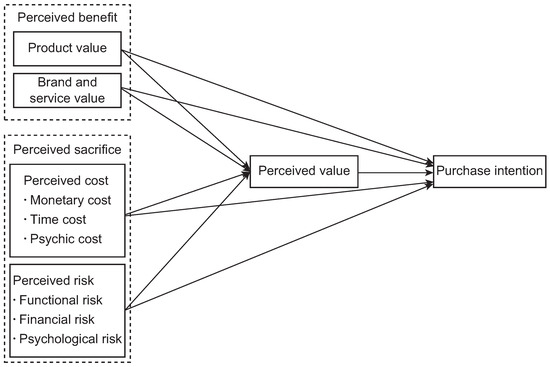
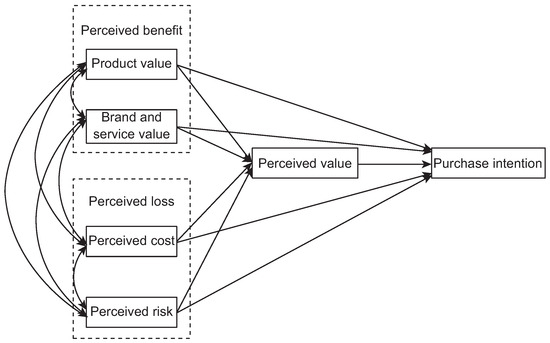
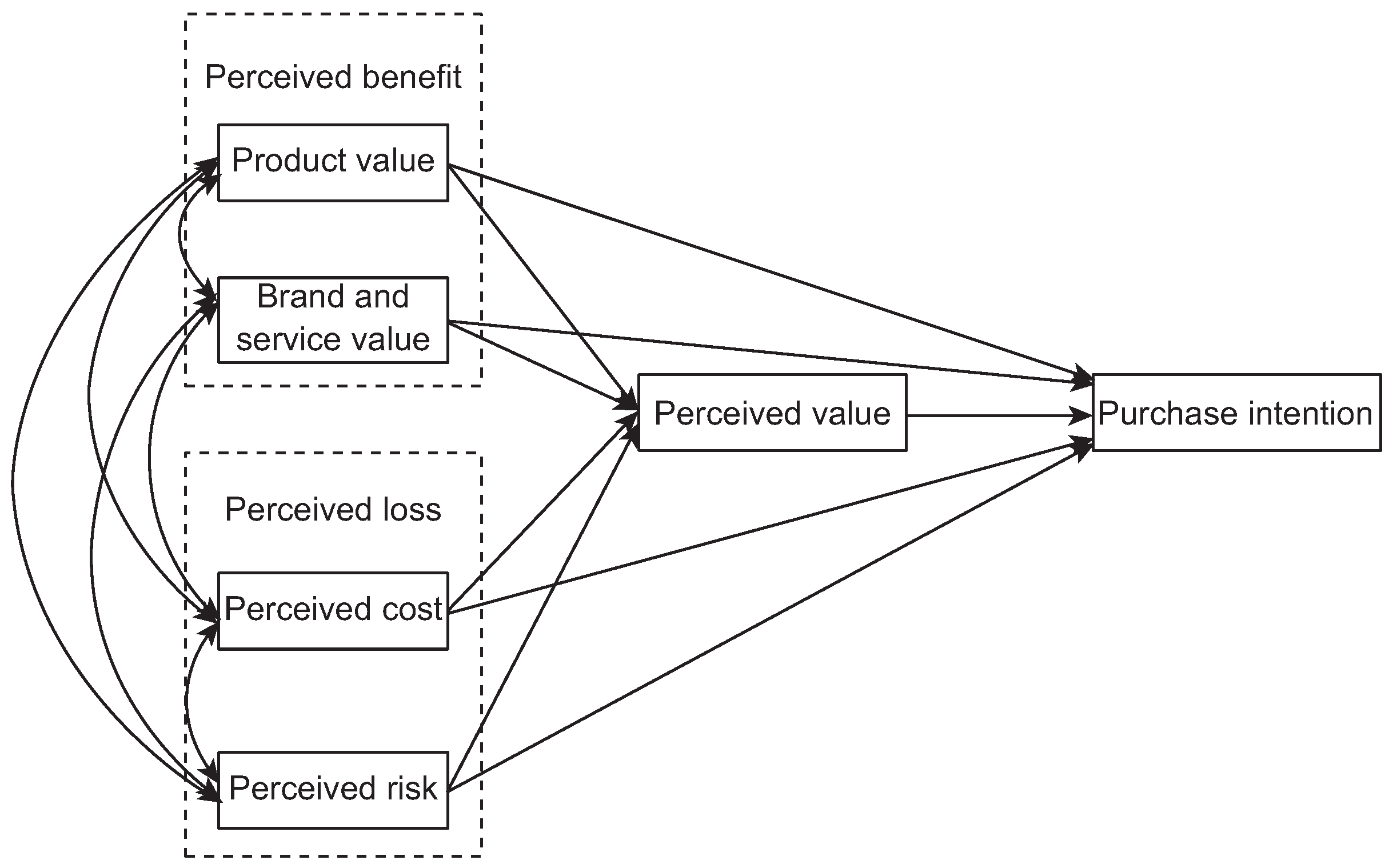
Based on the above literature and the situation of e-commerce pre-sale for apparel, the relevant variables are selected and determined, including the perceived benefit, perceived sacrifice, perceived value, purchase intention, product value, brand service value, perceived cost, and perceived risk. The definition of variables is displayed in Table 1.
Table 1.
Variable definitions for the influencing factor model of consumers’ purchase decision under the mode of apparel e-commerce.
Fig. 1.
The initial research model.
According to the above literature and analysis, hypotheses are proposed.
H1:
The value of e-commerce pre-sale for apparel products is positively correlated with the customer perceived value.
H2:
The value of e-commerce pre-sale for apparel products is positively correlated with the customer purchase intention.
H3:
The brand service value of e-commerce pre-sale for apparel is positively correlated with the customer perceived value.
H4:
The brand service value of e-commerce pre-sale for apparel is positively correlated with the customer purchase intention.
H5:
The perceived cost of e-commerce pre-sale for apparel products is negatively correlated with the customer perceived value.
H6:
The perceived cost of e-commerce pre-sale for apparel products is negatively correlated with the customer purchase intention.
H7:
The perceived risk of e-commerce pre-sale for apparel products is negatively correlated with the customer perceived value.
H8:
The perceived risk of e-commerce pre-sale for apparel products is negatively correlated with the customer purchase intention.
H9:
The perceived value of e-commerce pre-sale for apparel products is positively correlated with the customer purchase intention.
4 Research Design and Empirical Analysis
4.1 Research Method
In this study, correlation analysis and path analysis is used. Correlation analysis is an analysis for the influencing factors of the consumer perceived value and purchase intention under the model of e-commerce pre-sale for apparel. Path analysis is used to analyse the causality and strength among multiple variables. The research steps are as follows: 1) defining independent and dependent variables; 2) constructing one structural equation model; 3) designing and forming one questionnaire; 4) testing data: 5) modifying and fitting the model. The reliability and validity of questionnaires are analyzed by SPSS21.0. The structural equation model is constructed by AMOS21.0. Data are imported and revised based on relevant indicators. Then the model is fitted by the maximum likelihood method.
4.2 Pre-questionnaire Design and Formal Questionnaire Formation
During the period of “Double Eleventh” in 2018, online purchases by consumers in Guangdong, ranking first, accounted for 18.1% of total purchases in China [3]. Consumers’ purchases in Guangdong are representative and thereby these consumers were selected as the research objects.
The measurement part of questionnaires includes the product value, brand service value, perceived cost, perceived risk, perceived value, and purchase intention. The Likert five-point scale is used in this study. According to the degree of agreement with each question, options are designed from 1 to 5 and the each number represents “very disagreement”, “disagreement”, “general”, “agreement”, and “very agreement”.
The questionnaire consists of two parts. The main body of the questionnaire is the first part, which is used to measure variables in the research framework. The second part is the basic information of respondents. In order to ensure the validity and scientific of the questionnaire, the pre-questionnaire is formed after research, design and test. Questionnaires are randomly distributed on the street, and 52 valid questionnaires are collected. According to the feedback of respondents on the spot and taking the value of Cornbrash’s Alpha > 0.7 as the revised standard [41], the final questionnaire is determined after deleting and modifying the items with low contribution rate.
4.3 Data Collection of Formal Questionnaire
There are 300 questionnaires distributed. 266 questionnaires are collected and 227 questionnaires are valid. 202 online questionnaires are filled out and 39 online questionnaires of them are excluded due to consistent answers and too short answer time. The filling rate of valid questionnaire is 80.7%. 64 questionnaires are collected offline and the filling rate of valid questionnaires is 100%. According to the demand of analysis and research, the sample size should be 5 to 10 times of the number questions in one questionnaire. There are 28 questions in this questionnaire and 227 samples have achieved the reasonable sample size. The following related analysis is carried out.
4.4 Descriptive Statistical Analysis of Samples
The number of valid samples in this survey is 227. Men account for 25.1% and the age group of them is mainly focused on 18 to 30 years old; this age group is students in universities or salaried people who have certain buying power and are willing to accept new things; these samples, having undergraduate course certificate or above, account for 71.3%; 81.5% of them buy clothes online 1 to 4 times monthly and 71.3% of them spend less than 500 Yuan in one month. Woman account for 74.9%, the age group is mainly focused on 18 to 30 years old. They like to try new product, can accept certain risks in purchase process, and willing to try out new models of pre-sale mode.
4.5 Reliability and Validity
According to the analysis of reliability and validity, the following results are obtained, as shown in Table 2.
Table 2.
The reliability and validity analysis results.
Instruction of abbreviation of “measurement indexes” column in Table 2. PRO1-PRO6: 6 indicators of product value measurement.
EMO1-EMO5: 5 indicators of brand service value measurement.
COS1-COS3: 3 indicators of cost.
RIS1-RIS5: 5 indicators of purchasing risk VAL1-VAL4: 4 indicators of perceived value.
INT1-INT3: 3 indicators of purchasing intention.
The standard factor load of each variable is greater than 0.6. The overall value of Cornbrash’s Alpha is 0.91 and the value of Cornbrash’s Alpha for each latent variable is greater than the standard value (0.7). The CR values of all latent variables in this study are greater than 0.7, which indicates that this questionnaire has good construct reliability. COS4 and COS5 in the perceived cost are deleted because they lead to low CR and AVE of the potential variable. The AVE value of each latent variable basically achieves or is higher than the recommended value of 0.5, and the KMO value is greater than 0.6. The convergence validity is acceptable and the following step of analysis is carried out.
4.6 Fitting Model and Verifying Hypotheses
4.6.1 Setting and Fitting Model
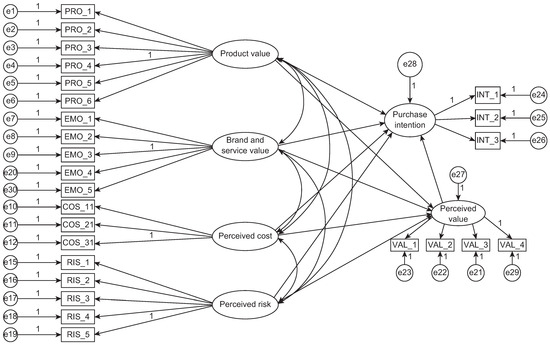
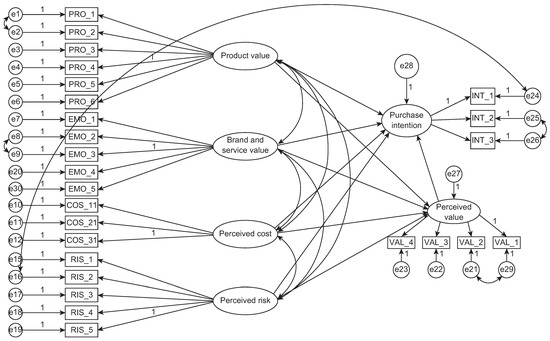
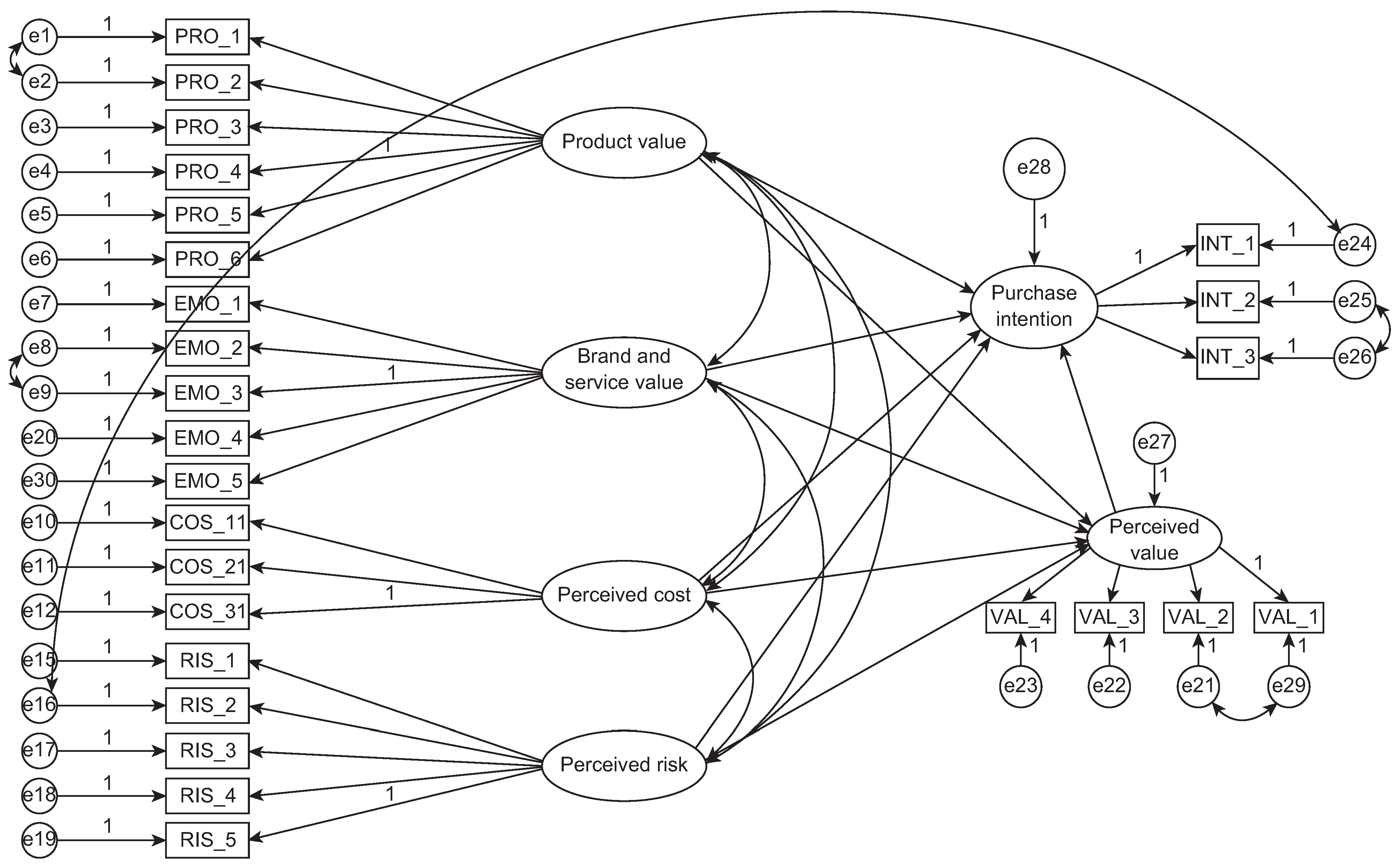
In this research, the structural equation model is used to measure and calculate the observed variables, and then the relationship among measured variables is explored. The structural equation model is correspondently constructed by the observational variables (total items) and potential variables (the product value, brand service value, perceived cost, perceived risk, purchase intention and perceived value), as shown in Fig. 2.
Fig. 2.
The structural equation analysis model.
Then the maximum likelihood estimation method is used to test the model. The absolute fitting indexes (the value of chi-square, GFI, AGFI, RMR, and RMSEA) and the value-added fitting indexes (the value of NFI and CFI) for above model are displayed in the following Table 3 and the relevant parameters in references are compared [13].
Table 3.
The results of fitting model.
From the above table, it can be seen that GFI, AGFI and NFI basically meet the requirements, but RMR, CFI and RMSEA do not meet the standards, indicating that the fitness of the model is not ideal and thereby the model needs to be revised.
4.6.2 Setting and Fitting Model
The model can be modified by deleting paths with insignificant path coefficients or increasing paths between residual items with larger MI values and latent variables [42]. As shown in Fig. 3, the correlations between e8 & e9, and e16 & e24 are established according to the instructions in order to obtain better fitting results.
Fig. 3.
The modified structural equation analysis model.
The revised structural equation model is fitted again, and the fitting index values are displayed in Table 4.
Table 4.
The fitting results of modified model.
It can be seen from the table that the above indicators are basically higher than the critical value, which shows that the modified model has a good fitting and can be tested for model hypotheses.
4.6.3 Verifying Research Hypotheses
The relationship between independent and dependent variables is tested. The specific results are illustrated in Table 5.
Table 5.
The estimation results of path coefficient.
The paths in the table reflect the relationship among variables. Hypotheses H1, H2, H5 and H6 are valid, and Hypotheses H3, H4, H7, H8 and H9 are not valid.
According to the above analysis, under the mode of apparel e-commerce, the perceived value and purchase intention are significantly positive, the product value and perceived value are significantly positive, the brand service value and purchase intention are significantly positive, and the perceived cost and perceived value are significantly negative. The relationship between product value and purchase intention is not significant as well as the relationship between perceived cost and purchase intention [43].
4.6.4 Testing Mediating Effect
Referring to Wen Zhonglin et al. [44], Y=cX+e1, M=aX+e2, Y=c′X+bM+e3, the coefficient C of product value, perceived cost and purchase intention is not significant. So the analysis of mediating effect is stopped. But a of brand service value and purchase intention is significant, and b is not significant. Thus the sobel test is carried out and the final result is not significant. In other words, the mediating effect of perceived value between the brand service value and purchase intention is not significant.
5 Analysis of the Correlation between Perceived Benefit and Perceived Sacrifice
From the perspective of perceived benefit and perceived sacrifice, the above research analyses the perceived value and purchase intention of consumers, and draws a conclusion. However, in the actual process of consumers’ purchase, there is a correlation between perceived benefit and perceived sacrifice. The product value and brand value can reduce the perceived risk of consumers in the purchase decision-making process, thus affecting the purchase intention. On this basis, using the same operation and empirical verification, starting from the relationship between independent variables, the following new assumptions are proposed.
H10:
The product value is positively correlated with the brand service value.
H11:
The brand service value is positively correlated with the perceived cost.
H12:
The product value is positively correlated with the perceived cost.
H13:
The perceived risk is positively correlated with the product value.
H14:
The perceived risk is positively correlated with the brand service value.
H15:
The perceived risk is positively correlated with the perceived cost.
The research model is modified, as shown in the Fig. 4.
Fig. 4.
The research model.
The relevant values between independent variables are obtained, as shown in Table 6.
Table 6.
The estimation results of path coefficient among independent variables.
From the above analysis, there are two measures of consumer perceived benefit: product value and brand service value which are positively correlated and interaction. The brand service value is negatively related to the perceived cost, and the product value is negatively related to the perceived cost. The higher the perceived brand service value and product value are, the lower the perceived cost is. High quality and famous brand goods are more likely to bring consumers high cost-effective psychological experience. The relationship between perceived risk and the other three independent variables is not significant. The research shows that the value of clothing products and brands will enhance the threshold of perceived cost and reduce the sensitivity of perceived cost, but will not change or reduce the perceived risk of consumers.
6 Conclusion
Based on the perceived value, this research studies the influencing factors of consumers’ purchase-decision psychology under the mode of apparel e-commerce through correlation analysis and path analysis. The following conclusions are drawn.
The product value and brand service value are negative significant with the perceived cost; the perceived cost and perceived value are negative significant; the perceived value and purchase intention are positive significant. Enterprises can stimulate consumers’ purchase intention by improving product quality and enriching service experience.
The perceived risk and perceived value are not related, as well as the perceived risk and purchase intention. The perceived cost and perceived value are significantly negative. These conclusions indicate that the online pre-sale mode does not increase the risk experience of consumers, and the consumers’ purchase intention is significantly related to perceived profit and perceived cost.
References
- Shan, M.Y.; Yang, P.; Zhang, R.L. The influencing factors of consumers’ purchasing intention under the network pre-sale mode. Econ. Surv. 2014, 31, 98–102. [Google Scholar]
- Fisher, M.; Raman, A. Reducing the cost of demand uncertainty through accurate response to early sales. Oper. Res. 1996, 44, 87–99. [Google Scholar] [CrossRef] [Scilit]
- Oksana, L. Pricing strategies in advance selling: should a retailer offer a pre-order price guarantee. Rev. Ind. Organ. 2016, 49, 465–489. [Google Scholar] [CrossRef] [Scilit]
- Seref, M.M.H.; Seref, O.; Alptekinoglu, A.; Erenguc, S.S. Advance selling to strategic consumers. Comput. Manag. Sci. 2016, 13, 597–626. [Google Scholar] [CrossRef] [Scilit]
- Zeithaml, V.A. Consumer perceptions of price, quality and value a means-end model and synthesis of evidence. Journey Mark. 1988, 52, 2–22. [Google Scholar] [CrossRef] [Scilit]
- Day, G.S. The capabilities of market-driven organizations. J. Mark. 1994, 58, 37–52. [Google Scholar] [CrossRef] [Scilit] [PubMed]
- Philip, K. Marketing Management, 11th ed.; Shanghai People’s Publishing House, 2003. [Google Scholar]
- Roger, J.B. Market-based Management: Strategies for Growing Customer Value And Profitability; Pretice-Hall: New York, 1997. [Google Scholar]
- Sweeney, J.C.; Soutar, G.N. Consumer perceived value: the development of a multiple item scale. Journey Retail. 2001, 77, 203–220. [Google Scholar] [CrossRef] [Scilit]
- Yang, L.; Wang, Y.G. Analysis of customer value and its driving factors. Manag. World 2002, 6, 146–147. [Google Scholar]
- Gounaris, S.P. The relationships of customer-perceived value, satisfaction, loyalty and behavioral intentions. J. Relatsh. Mark. 2009, 6, 63–87. [Google Scholar] [CrossRef] [Scilit]
- Dodds, W.B.; Monroe, K.B.; Grewal, D. Effect of price, brand and store information on buyers’ product evaluation. Journey Mark. Res. 1991, 28, 307–319. [Google Scholar] [CrossRef] [Scilit]
- Yang, X.Y.; Jiang, Y.Y.; Ma, S.R. Research on the influencing factors of consumption intention of network cultural products. J. Xi’an Jiaotong Univ. 2017, 37, 95–103. [Google Scholar]
- Wang, C.; Li, Y.J.; Ye, Q. Research on purchasing decision-making based on consumer perceived value in internet environment. Forecasting 2007, 26, 21–25, 60. [Google Scholar]
- An, J.W.; Wang, M. A Study on the influencing factors of consumers’ purchase intention of online pre-sale products. J. Commer. Econ. 2017, 3, 55–57. [Google Scholar]
- Sun, C.H. Research on the development status and types of online pre-sale. Manag. Obs. 2017, 4, 35–37. [Google Scholar]
- Oksana, L. Pricing strategies in advance selling: should a retailer offer a pre-order price guarantee. Rev. Ind. Organ. 2016, 49, 465–489. [Google Scholar] [CrossRef] [Scilit]
- Seref, M.M.H.; Seref, O.; Alptekinoglu, A.; Erenguc, S.S. Advance selling to strategic consumers. Comput. Manag. Sci. 2016, 13, 597–626. [Google Scholar] [CrossRef] [Scilit]
- René, S.; Bernd, S. Effect of time preferences on optimal prices and profitability of advance selling. Cost. Need Solute 2014, 1, 131–142. [Google Scholar] [CrossRef] [Scilit]
- Qv, S. Study on the pre-sale strategy considering the uncertainty of consumer valuation, Beijing Jiaotong Universit, Beijing, 2016.
- Wang, X.H.; Zeng, C. A model of advance selling with consumer heterogeneity and limited capacity. J. Mark. 2016, 117, 137–165. [Google Scholar] [CrossRef] [Scilit]
- Khai, S.L. Information acquisition for capacity planning via pricing and advance selling: When to Stop and Act. Oper. Res. 2010, 58, 1328–1349. [Google Scholar] [CrossRef] [Scilit]
- George, J.; Avlonitis Nikolaos, G. Panagopoulos, Selling and sales management: An introduction to the special section and recommendations on advancing the sales research agenda. Ind. Mark. Manag. 2000, 39, 1045–1048. [Google Scholar]
- Xu, H.X.; Zhang, J.L.; Gong, Y.M.; Wu, X. Research on order strategy of online pre-sale products. J. Syst. Eng. 2017, 32, 843–854. [Google Scholar]
- Zhu, S.Y. Research on retailer pricing-inventory decision–making considering pre-sale time, Beijing Jiaotong University, Beijing, 2018.
- Wang, Y.N. Research on product pricing strategy under E-commerce pre-sale mode, Southeast University, Jiangsu, 2016.
- Wood, C.M.; Scheer, L.K. Incorporating perceived risk into model of consumer deal assessment and purchase intent. Adv. Consum. Res. 1996, 23, 399–404. [Google Scholar]
- Liu, W.W. Research on pre-sale strategy based on strategic consumers. Shanghai Manag. Sci. 2014, 6, 60–62. [Google Scholar]
- Yang, X.D. The influence of price setting factors on consumers’ purchase intention. J. Commer. Econ. 2017, 18, 30–32. [Google Scholar]
- Kotler, P.; Armstrong, G. Introduction to Marketing, 4th ed.; Huaxia Press: Beijing, 1998. [Google Scholar]
- Spears, N.; Singh, S.N. Measuring attitude toward the brand and purchase intentions. Journey Curr. Issue Res. Advert. 2004, 26, 53–66. [Google Scholar] [CrossRef] [Scilit]
- Xu, Y.; Chong, T.W.; Krilavi, T.; Man, K. Perceived benefits, risks and trust on online shopping festival. Inf. Softw. Technol. 2015, 2, 225–235. [Google Scholar] [CrossRef] [Scilit]
- Jung, N.Y.; Seock, Y.Y. The impact of corporate reputation on brand attitude and purchase intention. Fash. Text. 2016, 6, 3–20. [Google Scholar] [CrossRef] [Scilit]
- Wu, S.Y. Research on the influencing factors of consumers’ purchasing intention on clothing network, Zhejiang University, Hangzhou, 2016.
- Pan, Y.; Zhang, X.; Gao, L. Research on the factors affecting consumer’s purchasing intention in online retail: an analysis based on trust and perceived risk. China Ind. Econ. 2010, 7, 115–124. [Google Scholar]
- Wu, Y. Research on online pre-sale mechanism based on customer behavior, Tianjin University, Tianjin, 2011.
- Volker, N.; Martin, P.; Frank, R. Advance-purchase discounts as a price discrimination device. J. Econ. Theory 2011, 146, 141–162. [Google Scholar] [CrossRef] [Scilit]
- Li, Y.T. Research on the formation mechanism of consumer’s purchasing intention under C2B presale mode, Donghua University, Shanghai, 2017.
- Wang, X.Y. Research on the influencing mechanism of new product pre-sale and enterprise pricing strategy based on the perspective of consumer choice. Contemp. Econ. Manag. 2015, 37, 13–19. [Google Scholar]
- Albesa, J.G. Interaction channel choice in a multichannel environment, an empirical study. Int. J. Bank. Mark. 2007, 25, 490–506. [Google Scholar] [CrossRef] [Scilit]
- Peterson, R.A. A meta-analysis of cronbach’s coeffient alpha. J. Consum. Res. 1994, 2, 381–391. [Google Scholar]
- Zhen-xin, S. Research on the impact of consumer perceived product innovation on brand loyalty, Xi’an University, Xi’an, 2017.
- Li, S.; Rui-Chen, L.; Guan-Di, L. Research on consumer purchasing decision-making of apparel presale mode on E-commerce platform in Guangdong. In Proceedings of theTextile Bioengineering and Informatics Symposium Proceedings, 2019; pp. 480–488. [Google Scholar]
- Wen, Z.L.; Hou, J.T.; Zhang, L. Comparison and application of regulatory effect and intermediary effect. Acta Psychol. Sin. 2005, 37, 268–274. [Google Scholar]

© 2020 Textile Bioengineering and Informatics Society. This article is an open access article distributed under the terms and conditions of the Creative Commons Attribution (CC BY) license (https://creativecommons.org/licenses/by/4.0/).