


Abstract
Natural fragrant microcapsules with ethyl cellulose (EC) as a shell and lavender oil as a core were prepared by emulsify-solvent diffusion method. The characters, including particle size, encapsulation efficiency and oil loading capacity, were tested and analyzed by using orthogonal design. The processing parameters of the ratio of an oil phase to water phase, the ratio of core material to shell material, concentration of PVA and stirring speed were evaluated. The morphology and structure features of microcapsules were studied by SEM, FT-IR and etc. The results showed that the microcapsules were in sphere shape and most of the particle size was about 1μm with a good formation. Encapsulation efficiency and the oil loading capacity are high with a satisfied fragrant releasing rate. This product shows a promising application on garment as well as functional textile industry.
1. Introduction
Many fragrant fabrics have been developed nowadays due to the reason of enjoying a healthy life style, and these novel products often possess additional functionalities which are good for human health. Recently, people pay great attention to medical effect of “forest bath”, aromatic therapy, plant sterilization and fragrant plant essential oil. Not only does plant essential oil gives off a pleasant smell, but also the functions of antiseptic, antiphlogistic and emotional calming. The health care function of natural fragrant fabrics can satisfy people fashion, comfortable life style as well as health needs. Underwears incorporated with fragrant fabrics can provide a comprehensive effect of anti-bacterial, stimulate nerves system to make people calm, awakening and so on [1,2,3,4]. Indoor textiles treated by the technology, such as sheet, quilts, curtain, carpet can eliminate fatigue, improve sleep quality, also a romantic atmosphere for family can be provided [8,9,10]. The concept of "forest bath” was firstly put forward by Japanese scientists in the fragrant product development.
Microencapsulation has become a mainstream technology of fragrant finishing. In late 1980s, KANEBO.Ltd, Japan, developed fragrant fabrics by using microencapsulation technology, and a series products of ‘incense of flower’ caused an enormous effect on global market [5,6,7]. The SNC208 nano microcapsule was made by HERST groups, in which natural plants and plant’s extracted essence were used. Microcapsule particle size is only in a range of 20 ~ 100 nm; the product had been applied on textile finishing, net printing and coating process [11,12,13,14,15].
A new emulsify-solvent diffusion method is reported in this paper, ethyl cellulose (EC) is selected as a shell material. The Microencapsulation process and processing parameters, including particle size, encapsulation efficiency and the oil loading capacity are analyzed.
2. Experiment
2.1. Materials
Natural fragrance oils (lavender flavour): Dry lavender was bought from traditional Chinese medicine store, then grinded to fine particles;
Natural fragrance oils were extracted with n-hexane solvent by an ultrasonic device and distillation. The ratio of lavender to the solvent was 1:12, and extracting process lasted for 2h with temperature of 50oC, the power ultrasonic device was 80W.
Ethyl cellulose (EC), BR degree, purchased from Chinese medicine and chemicals Co. LTD;
OP-10, AR, Tianjin HongYan chemicals plant; Ethyl acetate, AR, Tianjin DengFeng chemical reagent plant;Polyvinyl alcohol PVA, NO 6 of Tianjin chemical reagent plant; Distilled water, selfpreparation. Magnetic stirrer, model 85-2, Shanghai Pudong physical optics instrument plant; KQ-100E ultrasonic generator; Kunshan ultrasonic instruments Co. LTD.
2.2. Preparation of Natural Fragrant Microcapsule
Natural fragrant microcapsule preparation process is described by the following steps.
A. Ethyl cellulose and ethyl acetate with proper weight were put into a conical flask with cover, heating and stirred to dissolve them, then cooled down to the room temperature. Lavender oil was added and stirred to form an oil phase. Dissolve polyvinyl alcohol (PVA) in a saturated ethyl acetate (10%) water solution; a small amount of emulsifier was then added to make a water phase. Put the oil phase slowly to the water phase with stirring, and the oil-in-water emulsion was finished.
B. Diffusion and capsule formation:
put the oil-in-water emulsion slowly onto distilled water, magnetic stirrer was used at the room temperature; the stirring speed was controlled continuously, so ethyl acetate could constantly diffuse in water to reduce the organic solvent. Therefore, the ethyl cellulose was slowly forced to separate out from the emulsion and deposited onto the interface of the oil droplets. Microcapsule of the lavender essence oil enclosed by ethyl cellulose (EC) was prepared accordingly.
In this study, the ratio of oil phase to water phase, the ratio of core material to shell material, concentration of PVA, concentration of emulsifier and stirring rate were evaluated by a number of index, such as particle size, encapsulation efficiency (EE%) and the oil loading capacity.
2.3. Characterizations
2.3.1. Particle Size and Its Distribution
A drop of microcapsule suspension was added onto a glass slide and made it dry, the microcapsule was observed by an optical microscope; To get a mean size and size distribution, 500 individual microcapsules were selected randomly and accurate measurements were taken for statistics analysis.
2.3.2. Encapsulation Efficiency and The Oil Loading Capacity
Three microcapsule samples were weighed accurately. Then rinse them by ethanol, followed by grinding them with a mortar to completely dissolve the fragrance oils. Leave aside for a moment, then filtrated by a filter paper. The filtrate was measured for the optical absorbance at 340nm wavelength by ultraviolet spectrophotometer according to the standard curve spectrophotometry. The oil content of microcapsule can be calculated by a regression equation. The encapsulation efficiency (EE%) and the oil loading capacity can be determined by the following formula.
2.3.3. The Morphology Observation
Put the fragrance microcapsule onto a glass slide, drying at vacuum, and coated by a layer of gold. Then its appearance observation could be obtained by RMRAY - 1000B scanning electron microscope (SEM).
2.3.4. FTIR Spectrum
To investigate the chemical structure of lavender oil microcapsules with an ethyl cellulose shell, the rinsed fragrance microcapsule and the shell material EC were tested by Nicolet5700 infrared spectrometer (FTIR) respectively.
2.3.5. The Core Releasing Rate of Microcapsule
An amount of weighted microcapsule was extracted in 95% ethanol with a Soxhlet extractor for 3 hours. Then the extracted ethanol/ essence oil solution was put into a 100 ml volumetric flask. The absorbance of the solution was tested by an ultraviolet spectrophotometer at a wavelength of 340nm. The concentration of the essential oil can be calculated by a regression equation. Make one measurement once a week. Meanwhile, a quantitative oil extract was sprayed onto the EC powders, take one measurement in two days by the soxhlet and measure the absorbance by the UV spectrophotometry. The remains of fragrance oils could be calculated according to the regression equation. The curve of releasing time against retention rate could be obtained.
3. Results and Discussion
3.1. The Influence of The Ratio of Oil to Water Phase
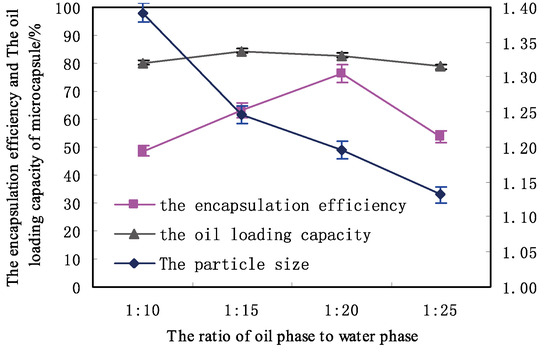
The ratio of oil to water phase is crucial on preparation of microcapsule. To study its effectiveness on properties of microcapsules, such as mean particle size, the encapsulation efficiency (EE%) and the oil loading capacity, 1:25, 1:20, 1:15 and 1:10 were selected in the study. The results are shown in Figure 1.
Figure 1.
The influence of ratio of oil to water phase to the properties of size, EE% and oil loading capacity.
The size distribution of the microcapsules is mainly in the range of 0.8 ~ 1.4 um. The average particle size increases as the oil phase increased due to the reason that it is more difficult for a oil phase scattering in a water phase as the oil phase is increasing. A stable emulsion system cannot be formed easily and the chance of coalescence between droplets will increase. Hence, microcapsule size is increased too. In order to get a stable oil/ water emulsion, the selection of ratio of oil phase to water phase cannot be too high.
The encapsulation efficiency was the highest as the ratio of oil to water phase was 1:20; while oil loading capacity reached its highest when the ratio was 1:15. By comparing the three index of the mean size, encapsulation efficiency and oil loading capacity comprehensively, the ratio of oil phase to water phase should be selected as 1:20 to get a better quality.
3.2. The Influence of Core/ Shell Ratio
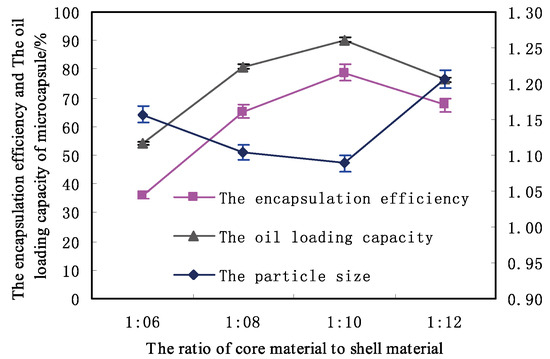
Microcapsule particle size and the thickness of shell are believed to be dependent on the ratio of core to shell material, and it greatly influences the encapsulation efficiency. In order to successfully encapsulate the core essential oil, a proper core/ shell ratio must be decided. Four different core/ shell ratios were selected in the study to evaluate the effectiveness on the microencapsulation process. The influences of Core/shell ratio to the properties of particle size, EE% and oil loading capacity are shown in Figure 2.
Figure 2.
The influence of core/shell ratio on particle size, the encapsulation efficiency (EE%) and the oil loading capacity.
As shown in Figure 2, the average particle size decrease with the increase of core/shell ratio from 1/6 to1/10. However, it reaches its highest position when the core/shell ratio is 1/12. Both the encapsulation efficiency and the oil loading capacity are increased as core/shell ratio increased from 1:6 to 1:10, as it reaches its highest and then decreases. By comparing the three indexes comprehensively, a better quality of the microcapsule can be provided as the core/shell ratio is selected as 1:10. A higher Core/shell ratio will lead a thinner microcapsule shell and microcapsules are fragile, lower EE% and oil loading capacity are attributed to an easy leakage of core material.
3.3. The Influence of PVA
For spherical droplets, Einstein formula is described as follow:
a—for radius of a droplet. D—the diffusion coefficient. T—Temperature. η—viscosity coefficient—modified coefficient.
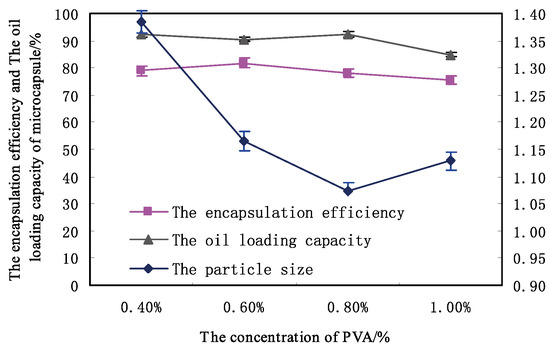
Therefore, the diffusion coefficient of droplets D will decrease with the increase of viscosity emulsion. The frequency of particle collisions and coalescence rate will be reduced. the stability of the emulsion can be improved by increasing the amount of droplets in the suspension. PVA was used to make the system stable by increasing the viscosity of water phase. Four concentrations of PVA was selected as 0.4, 0.6, 0.8 and 1.0 % in the experiment. The results show that the particle size, the encapsulation efficiency and the oil loading capacity varies with different PVA concentration as shown in Figure 3.
Figure 3.
The influence of PVA concentration on particle size, the encapsulation efficiency and the oil loading capacity.
As shown in Figure 3, particle size is decreased with the increase of PVA concentration. However, for encapsulation efficiency and the oil loading capacity, the influrence of PVA concentration is not obvious. So the concentration of PVA was chosen as 0.8% as an optimum condition.
3.4. The Influence of Emulsifier
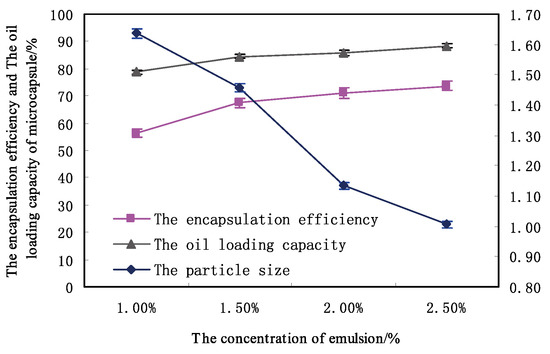
Different concentrations of emulsifier OP - 10 were used to prepare the fragrant microcapsule. The influence of OP-10 to mean particle size, the encapsulation efficiency and the oil loading capacity is shown in Figure 4.
Figure 4.
The influence of the concentration of emulsifiers to particle size, encapsulation efficiency and the oil loading capacity.
The concentration of emulsifier is crucial for the microencapsulation process. With the increase of concentration of emulsifier, the size distribution becomes narrow and the mean particle size also decreased gradually. The mean microcapsule particle size was decreased from 15 to 10 µm as the concentration of emulsifier increase from 1.0% to 2.5%.
The encapsulation efficiency and the oil loading capacity also increased with the increase of emulsifiers. However, as the concentration of was higher than 2.0% this changes became lower. A lower Gibbs free energy system can be provided with a high activity of emulsifier and made particle size become smaller. On the contrary, a high level of emulsifier will make the shell thickness thinner and increase the surface area, so that the releasing rate of the fragrance microcapsule will be increased. Therefore, a reasonable concentration was selected as 2.0%.
3.5. Influence of Stirring Rate
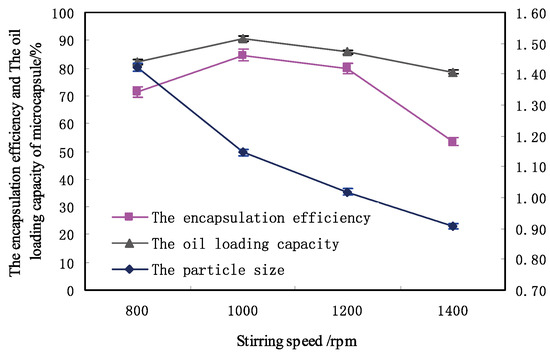
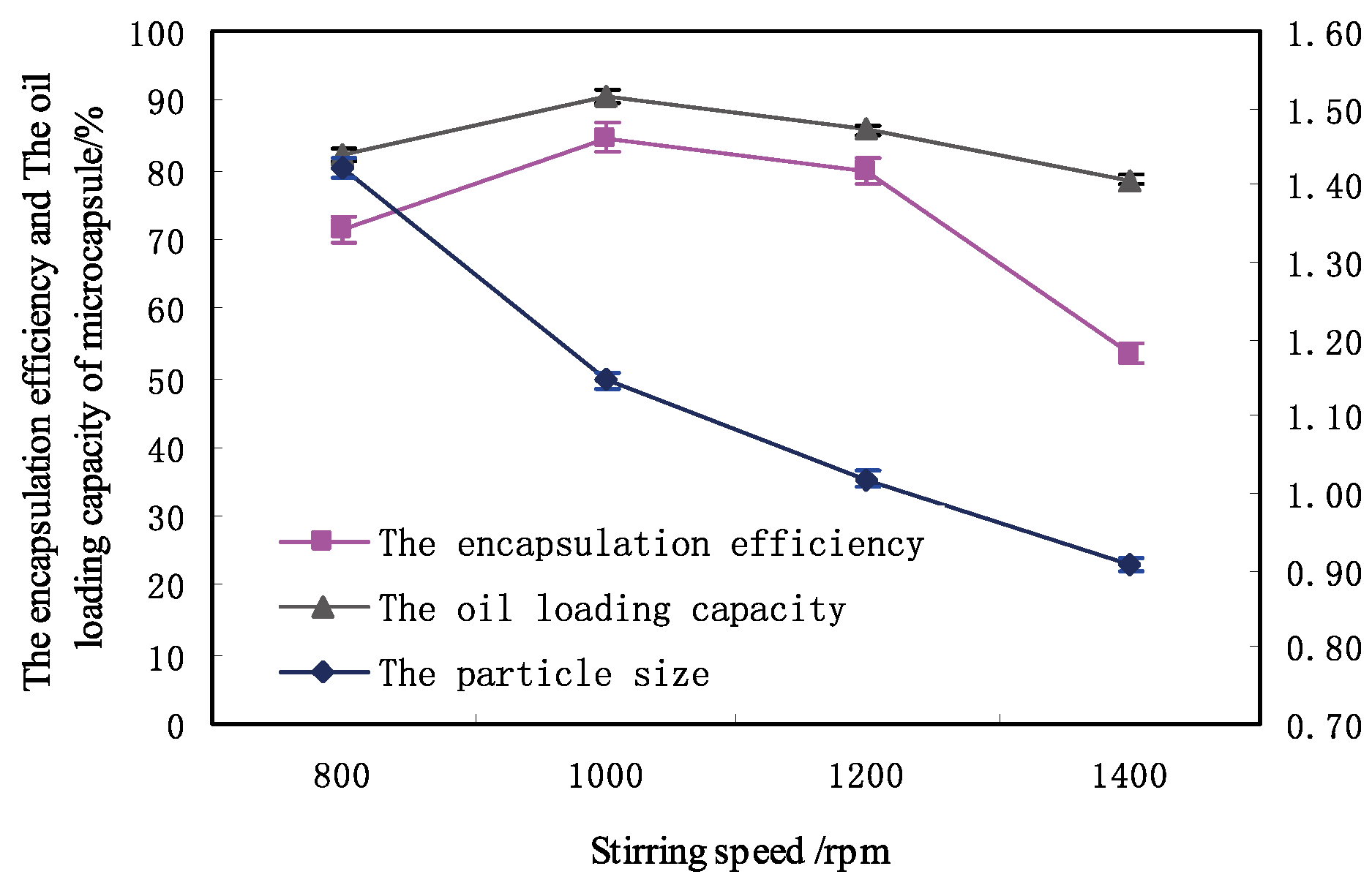
The variance of mean particle size, the encapsulation efficiency and the oil loading capacity with different stirring speed is shown in Figure 5.
Figure 5.
The influence of different stirring speed to the properties of particle size, encapsulation efficiency and the oil loading capacity.
From the observation shown in Figure 5, we see that along with the increase of stirring speed, particle size of microcapsules gradually decrease. However, the encapsulation efficiency and the oil loading capacity were decreased at a higher stirring speed, This may be associated with that high stirring speed often leads to an unstable system, and even causes deformation or broken. Therefore, the stirring speed was 1000rpm as considered to be the optimal condition.
3.6. The Morphology Analysis of Microcapsule
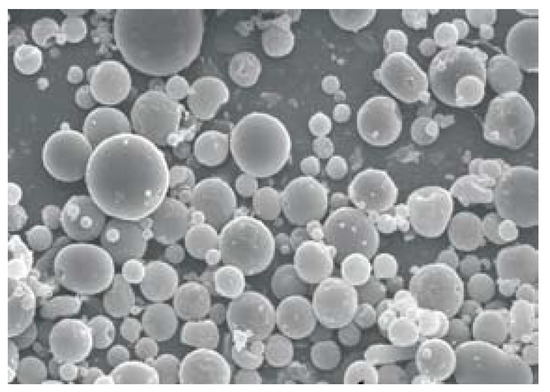
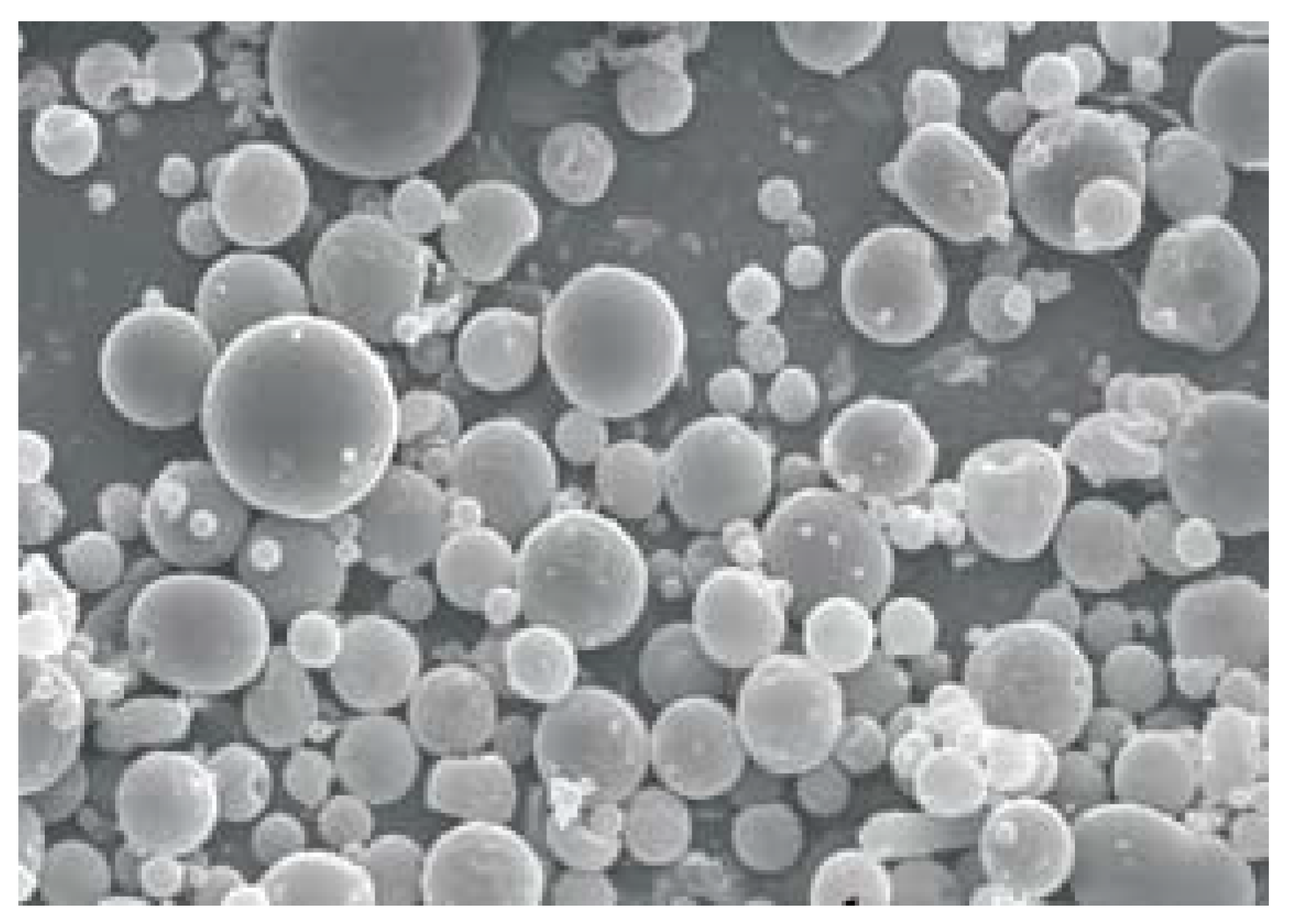
The SEM image of the fragrant microcapsule magnified 10,000 times is shown in Figure 6. By observation, the microcapsules are approximate spheres; the surface morphology is smooth without coacervation.
Figure 6.
The SEM image of the fragrance microcapsules.
3.7. FTIR Spectrum Analysis
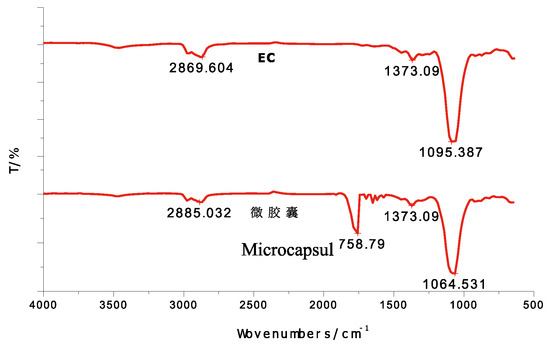
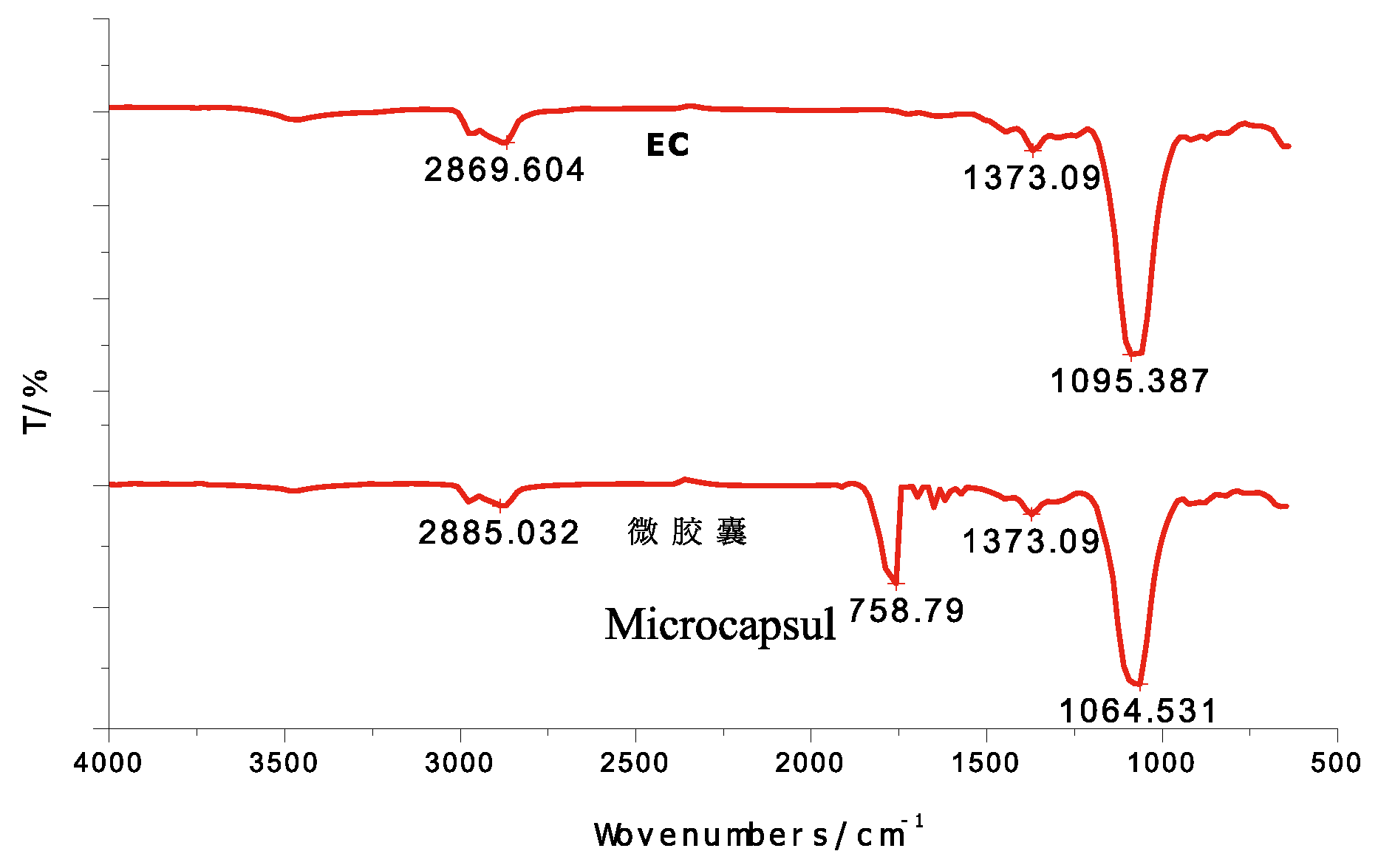
FTIR infrared spectra measurements of fragrant microcapsule and EC are shown in Figure 7. it indicates that the absorption characteristics peaks of EC are covered from 500-4000cm-1. For small molecules, whenever the mass fraction of it is less than 25%, their characteristic absorption peaks can be easily covered by EC and this makes it difficult to be identified. If molecule groups, such as -COOH, - COOR, C = O and etc, are existed in a polymer, absorption peaks will appear at near 1700cm-1 due to stretching vibration of chemical bonds, and some variations on spectrum shape, position and intensity will provide some evidence on whether a foreign molecule group enters into a vacancy and their interactions. The main composition of Lavender essential oil are linalyl acetate, linalool, lavandulol, leaf alcohol isobutyrate, and so on, which consists of molecule groups of - COOR, C = O and so on. Their characteristic absorption peaks can be identified by the infrared spectra at 1740-1755cm-1 due to strong stretching vibration absorption. In our FTIR measurement, a strong absorption peak appeared at 1758cm-1 in the spectrum of clean microcapsules; while, no peak appear in the spectrum of EC at the same position. The variation in peak shape, peak position indicated that EC does successfully packet lavender essential oil and the fragrance microcapsules have been formed.
Figure 7.
FTIR spectra of natural fragrant microcapsule and EC shell material.
3.8. The Releasing Rate
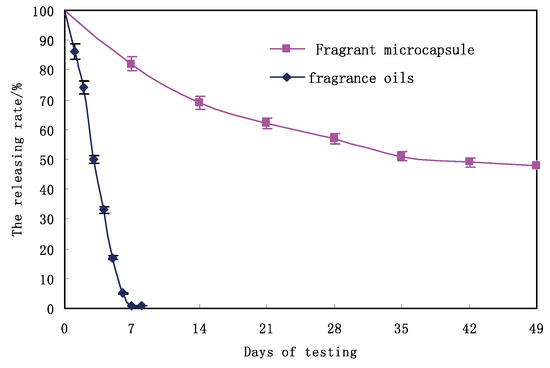
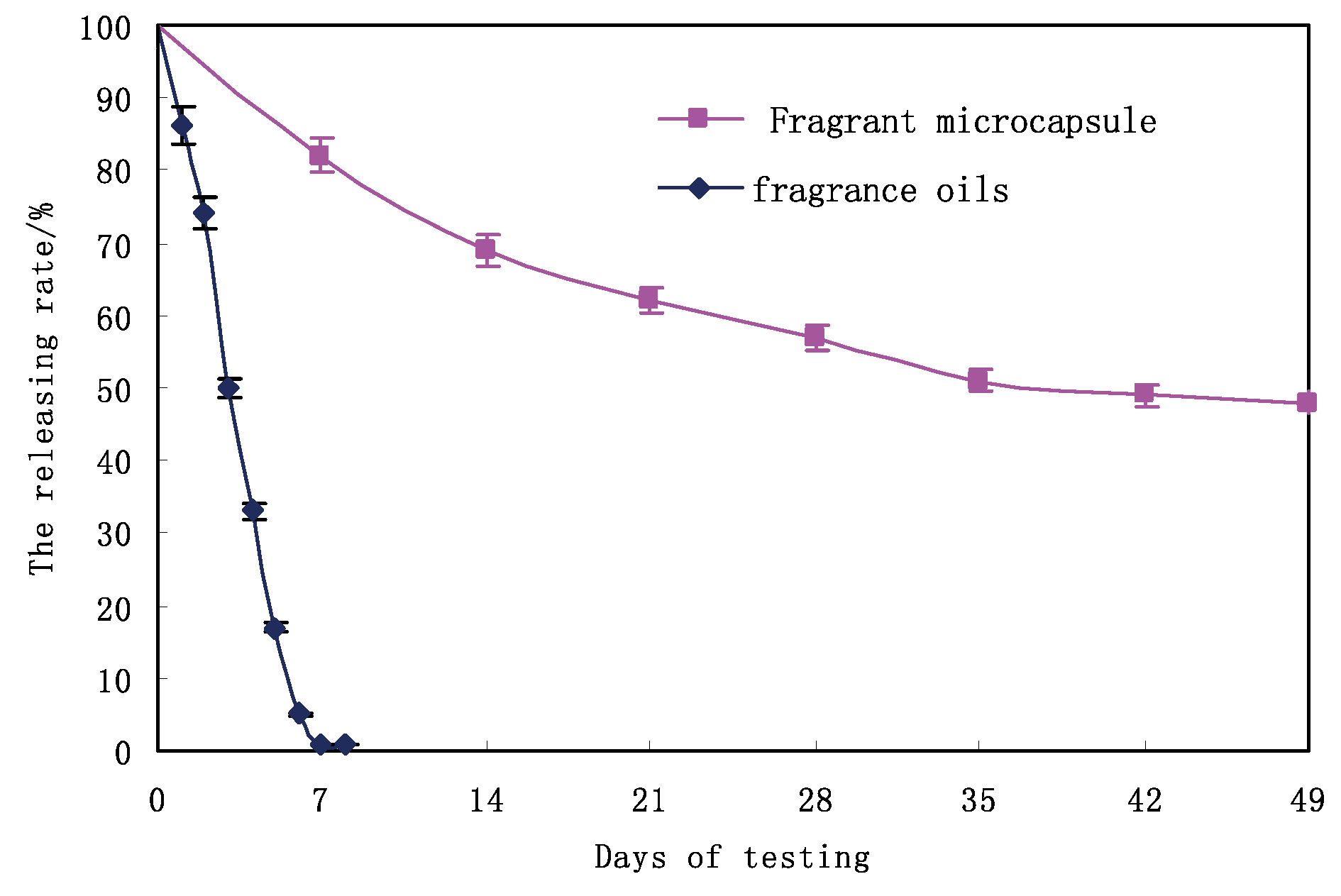
The releasing rate of fragrant microcapsules and fragrance oils are shown in Figure 8.
Figure 8.
The releasing rate of fragrant microcapsule and fragrance oils.
After the microencapsulation process, the life lengths of fragrance oils releasing are greatly extended as the fragrance oils in microcapsule can be kept about 50% after 2 months. On the contrary, almost no essential oil residual remains on the direct sprayed fabric in 7th days. It can be proved that a good slow-release effect can be achieved by the microencapsulation process.
4. Conclusion
Natural fragrant microcapsules have been prepared using lavender extract fragrance as core material and EC as shell by Emulsify-solvent diffusion technique. By analysis of the particle size, the encapsulation efficiency and the oil loading capacity of microcapsule, the optimal parameter combinations were achieved as follows: the ratio of oil to water phase is 1:20, the ratio of core material to shell material is 1:10, the concentration of PVA is 0.8%, the concentration of emulsion is 2% and stirring speed is 1000 rpm. The particle size of microcapsule is around 1um, the encapsulation efficiency and the oil loading capacity of microcapsule is 84.63% and 90.54% respectively. Microcapsules are in sphere shape without coacervation.
The preparation can be carried out at room temperature; this action avoids the loss of core material at high temperature. This method is easy to handle with a low cost, and suitable for industrial mass production. By comparing with the mixture of fragrance oils and EC shell material the releasing rate of microcapsules can be greatly decreased and the life length of fragrance oil is prolonged greatly.
5. Acknowledgements
The authors express gratitude to The education house of Shannxi Province Science Foundation (06JC15), special foundation item of the key academic subjects development of shaanxi province, and the opening item(NO:200807.) of ChangZhou Key Laboratory of New Textile Materialfor fund support.
References
- Gamiz, G.L.; Castro, M.D. Continuous subcritical water extraction of plant essential oil:Comparison with conventional techniques. Talanta 2000, 51, 1179–1185. [Google Scholar] [CrossRef] [Scilit]
- Song, Q.W.; Li, Y.; Marcus, Y.; Xing, J.W. Investigation on super-cooling of silver nano composite pcm microcapsules. J. Fiber Bioeng. Inf. 2008, 1, 239248. [Google Scholar] [CrossRef] [Scilit]
- Chen, A.Z.; Li, Y.; Chen, D.; Hu, J.Y. Preparation of 5-fluorouracil-SiO2-poly(L-lactide) microcapsules by a novel supercritical technique. Textile Bioengineering and Informatics Symposium Proceedings, 2008; pp. 68–74. [Google Scholar]
- Fernandez, P.L.; Jimenez, C.M.; Castro, M.D. HPLC determination of catechins and caffeine in Tea. Differ. Green Black Instant Teas Anal. 2000, 125, 481–485. [Google Scholar] [CrossRef] [Scilit]
- Savitha, K.; Rajesh, B.; Rekha, S. Microencapsuation of cardamom oleoresin:Evaluation of blends of gumarabic,maltodextrin and a modified starch as wall materials. Carbonhydrate Polym. 2005, 61, 95–102. [Google Scholar]
- Dowding, P.J.; Atkin, R.; Vincent, B.; et al. Oil core/ polymer shell microcapsules by internal phase separation from emulsion droplets.:Controlling the release profile of active molecules. Langmuir 2005, 21, 5278–5284. [Google Scholar] [CrossRef] [Scilit]
- Hao, L.C.; Yu, W.D. Preparation and characterization of new phase change material microcapsules suitable for thermal insulating fabrics. Textile Bioengineering and Informatics Symposium Proceedings, 2008; pp. 426–430. [Google Scholar]
- Donadel, M.; Goncalves, C.; et al. Determination of amlodipine in pharmaceutical dosage forms by liquid chromatography and ultraviolet spectrophotometry. J. AOAC Int. 2006, 89, 359–364. [Google Scholar] [CrossRef] [Scilit]
- Chen, A.Z.; Li, Y.; Chen, D.; Hu, J.Y. Development of core-Shell microcapsules by a novel supercritical CO2 process. J. Mater. Sci. Mater. Med. 2009, 20, 751–758. [Google Scholar] [CrossRef] [Scilit]
- Hoda, F.; Marx, F.; Abdalla, E.; et al. Effect of extraction techniques on the chemical composition and antioxidant activity of Eucalyptus camaldulensis var.brevirostris leaf oils. Z. Fur Leb. Forsch. A 1999, 208, 212–216. [Google Scholar] [CrossRef] [Scilit]
- Chen, Li; Shuilin, Zhou. Effects of catalyst and core materials on the morphology and particle size of microcapsules. Int. J. Polym. Mater. 2004, 53, 385–393. [Google Scholar] [CrossRef] [Scilit]
- Chen, A.Z.; Li, Y.; Chau, F.T.; Lau, T.Y.; Hu, J.Y.; Zhao, Z.; Mok, D.K.W. Microencapsulation of puerarin nanoparticles by poly(l-lactide) in a supercritical CO2 process. Acta Biomater. 2009, 12, 26–29. [Google Scholar] [CrossRef] [Scilit]
- Zhoug, Yi; Feng, Jihong; Chen, Shuilin. Dyeing of polyester using microencapsulated disperse dyes in the absence of auxiliaries. Color Technol. 2005, 121, 76–80. [Google Scholar] [CrossRef] [Scilit]
- Hong, K.; Park, S. Polyurea. Microcapsules with Different Structures Preparation and Properties[J]. J. Applies Polym. Sci. 2000, 78, 894898. [Google Scholar] [CrossRef] [Scilit]
- Wang, J.M.; Xu, X.W.; Zhou, Y. The Anti-virus Properties of Nano-Chinese Medicine Microcapsule Finished Fabrics. Textile Bioengineering and Informations Symposium Proceedings, 2008; pp. 61–67. [Google Scholar]
© 2009 Textile Bioengineering and Informatics Society. This article is an open access article distributed under the terms and conditions of the Creative Commons Attribution (CC BY) license (https://creativecommons.org/licenses/by/4.0/).