


Abstract
This research deals with a non-invasive system that can be used to harvest waste mechanical energy and utilise this energy to suppress tremors. Hand tremors can emanate from medical conditions such as Parkinson disease and Arthritis. These tremors can be distinguished from other vibrations due to the associated frequency spectra. Mechanical signals are picked up by piezoelectric sensors before the generated voltage is filtered, converted and stored, or used directly to suppress the tremor. Two system level methods used for the suppression of tremor are discussed. As the device is proposed for glove structures, material flexibility is of key significance thus not hindering the bearer’s motor functions. Conventional piezoelectric ceramic materials are recognised for their high piezoelectric coefficients in comparison to flexible piezoelectric polymer films. However, ceramic materials are rigid, heavy and offer limited opportunities for forming and shaping. Ceramic based piezoelectric materials in fine fibre form across a range of diameters (10-250µm) were used in this research. When integrated into composite structures the resulting materials retained all the qualities of bulk piezoelectric ceramics (electrical, mechanical, chemical) and mitigated the disadvantages of weight and brittleness. Various piezoelectric fibre composites and piezoelectric polymer film structures were compared, and the potential for their exploitation in glove based power harvesting and tremor suppression structures assessed.
1. Introduction—Piezoelectricity and Materials
Jacques and Pierre Curie discovered the phenomenon of piezoelectricity in 1880, a category of smart materials that exhibit unique and interrelated properties. Application of stress to a piezoelectric crystal generates an equivalent electric charge; conversely applying a voltage induces a shape change.
The concept of utilising piezoelectric materials for energy generation has been studied greatly over past decades. Hausler [1] proposed an implantable physiological power supply using PVDF films. Umeda et al. [2] looked at using impact energy from a steel ball dropped onto a plate with a piezoelectric material attached. Elvin et al. [3] theoretically and experimentally investigated the use of self powered PVDF strain sensors.
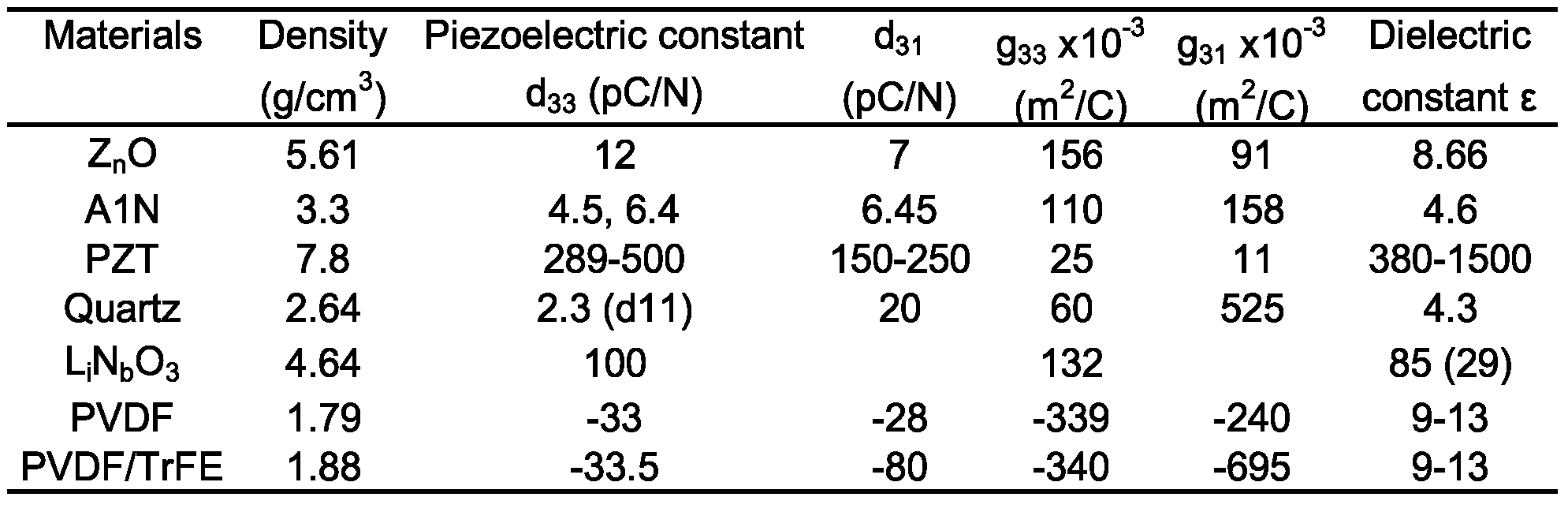
Two common piezoelectric materials are polymers (polyvinylidene fluoride, PVDF) and ceramics (lead zirconate titanate, PZT). The polymer materials are soft and flexible; however have lower dielectric and piezoelectric properties than ceramics. Conventional piezoelectric ceramic materials are rigid, heavy and tend to be in block form. Ceramic materials can therefore add mass and stiffness to bonded structures, especially when working with flexible/lightweight materials. This property and their fragile nature limit possibilities for wearable devices. Comparisons between several piezoelectric materials are presented in Table 1.
Table 1.
Comparison of piezoelectric materials.
Ceramic fibres can be produced in the diameter range of 10-250µm with a low cost method [4]. When formed into composite structures they posses all the qualities of conventional ceramics (electrical, mechanical, chemical) and mitigate problems such as weight and brittleness.
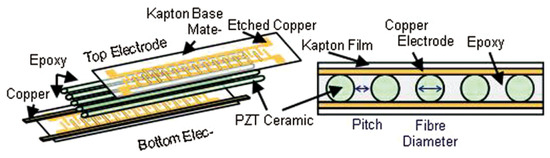
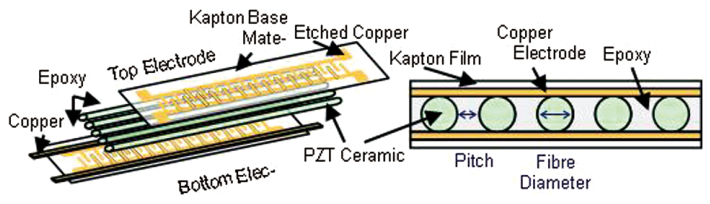
The piezoelectric fibre composites (PFCs) consist of unidirectional aligned piezoelectric fibres embedded in an epoxy matrix and sandwiched between two copper clad polymeric laminates (Figure 1). The PFCs [5] have higher efficiency than traditional bulk piezoelectric ceramic materials, due to there large length to area ratio [6]. Typically, when in fibrous form crystalline materials have much higher strengths, and the polymer shell of the PFC allow the fibres to withstand impacts and harsh environments far better than monolithic piezoelectric ceramic materials. The technique of applying interdigitated electrodes takes advantage of the higher d33 piezoelectric constant where full electrode coverage of top and bottom of the sample makes use of the lower d31 response, highlighted in Table 1. A test method and data has been reported for interdigitated electrode configurations of several line widths and spacing ratios [7]. Concluding that output strain per volt progressively increases as electrode spacing decreases (however narrowest spacing ratios are prone to voltage breakdown), with single crystal fibres again increasing the free strain actuation [8].
Figure 1.
Piezoelectric fibre composite.
2. Power Harvesting
One ambient vibration source is human movement; Starner [9] explored the possibility of acquiring energy exhausted from everyday activities, such as: breathing, blood pressure and walking. Calculating that approximately 60-70W of power is lost during walking and by using a piezoelectric material in a shoe with a conversion efficiency of 12.5%; 8.4W of power could be harvested.
Intelligent clothing with flexible piezoelectric materials integrated into fabrics, may be capable of collecting a portion of the mechanical energy associated with everyday activities, e.g. piezoelectric materials embedded in shoes [10,11,12].
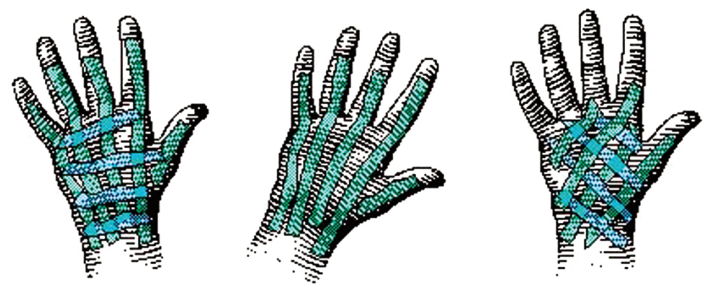
An overview of a patented device used in the suppression of tremors [13] is presented. The device contains a means of detecting the tremors and means of counteracting the detected tremors. Both sensing and actuating mechanisms employ the piezoelectric effect. Piezoelectric materials are incorporated into glove structures. In addition to sensing and suppressing vibrations, these materials can harvest a portion of the mechanical energy associated with everyday hand movement.
Advances in low power electronics have provided means for powering devices solely from piezoelectric harvested energy, especially with the advent of PFCs. Numerous applications of wireless sensor networks and self-powered systems have emerged, however energy harvesting is not a new concept: hand cranked radios, shake powered flashlights, wind farms and solar energy have found commercialisation in multiple occasions. Through the use of standard electronic techniques the acquired power can be converted, stored and regulated. It is possible to scale the extracted power output using multimode excitation and multiform materials.
In the proposed device the PFCs act as micro power generators, whenever flexed or stretched through normal hand motion a voltage is generated proportional to the stress induced in the material. The voltage produced may be fed through the conducting polymer fibre to a rectification circuit and then used to charge a capacitor, battery or related storage medium, additionally the generated voltage may be used on-line, as per needs.
3. Vibration Suppression
Piezoelectric vibration suppression can be characterised as one of the following: 1) shunting the energy developed on passive electrical elements, 2) employing active control systems and 3) hybrid semiactive methods combining shunted and active control.
The piezoelectric effect provides specific materials with the ability to act as both sensors and actuators. When piezoelectric materials are used in passive vibration suppression, a force strains the piezoelectric material which through the direct piezoelectric effect generates a voltage. This voltage (electrical energy) is dissipated through a resistive circuit, degradation or transfer of energy generated by a piezoelectric material will result in a reduction of vibrations.
Head Sport AG have built an entire Intelligence© protect line based on PFCs. Skis with a combination of power conversion and control electronics are able to actively control torsional stability, without the aid of an external power source. PFCs within the frame of the Head Intelligence© and Protector© tennis racket can actively control vibrations resulting from ball strike, leading to a racket that can reduce the effects of tennis elbow [14]. The mechanical energy of a ball impact is converted to electrical energy. This is electrically conducted to and stored in an inductor and released back to the PFCs, in real time, optimal phase and waveform for most effective damping, again independent of an external power source. K2 skis use a resistor capacitor shunt circuit to dissipate vibration energy absorbed by piezoelectric materials embedded in the device. Active control experts developed the Copper Head ACX bat, where shunted piezoelectric materials reduce sting during impact and gives the bat a greater sweet spot.
4. Device Overview
Approximately 70% of sufferer’s of Parkinson’s disease experience a slight tremor in the hand or foot on one side of the body. It appears as a beating or oscillating movement, usually in the range of a few Hertz (Hz).
Many methods have been devised to reduce the effect of Parkinson’s disease the majority of which are invasive such as medication and brain stimulation. The proposed patented device incorporates piezoelectric materials into glove structures worn by sufferers. It is a non-invasive and non-hazardous technique, the detection and suppression of tremor is conducted by measuring the mechanical vibration produced by body parts at low frequencies. The measured quantity is proportional to the force and magnitude of the tremor. Tremors are detectable since the vibrations generated during tremor are at different frequency spectra to normal body movements. Considering the fact that the device may function in a multitude of environments where different external forces are acting, suitable electronic circuitry can also compensate for any reflections encountered. The detected tremors can be controlled using one of the following two mechanisms.
Figure 2.
Piezoelectric fibre composite placement in glove structures.
4.1. Active Control Device
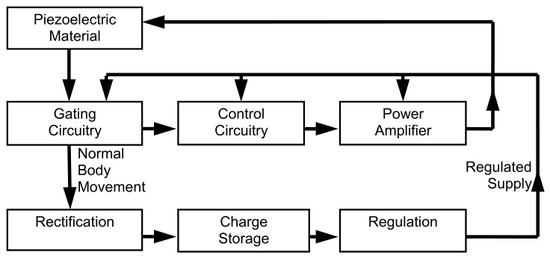
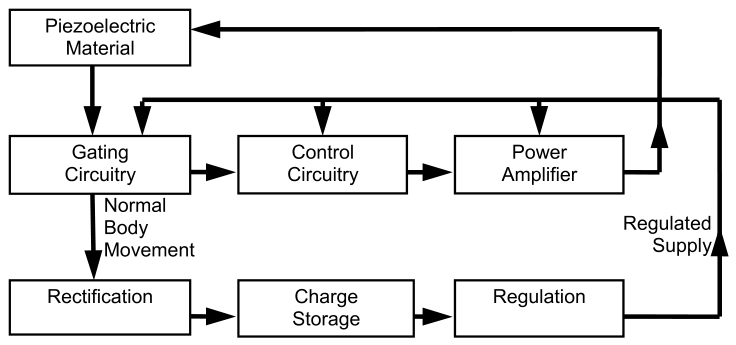
Gating circuitry is used to monitor the waveform, distinguishing whether the movement is of normal body function or tremor. The gate result allows the generated charge to be collected and stored or fed back via control and amplification circuitry to a second tandem piezoelectric material to actuate at the relevant phase and frequency to suppress the tremor.
If the generated charge is not of an amplitude and frequency to suggest resting tremor, the signal is rectified in order to remove the negative portion of the waveform and fed to a storage capacitor or relevant medium where it can be accumulated. Only when the control and amplification circuitry requires activation, the storage medium releases charge via a regulator.
When the piezoelectric generated charge is of amplitude and frequency to suggest resting tremor, suppression circuitry is activated. The signal is in real time inverted and amplified before being fed back a second PFC to actuate, inducing a force on the glove to suppress the vibratory signal. For a block diagram of system operation see Figure 3.
Figure 3.
Active vibration suppression and energy harvesting circuit.
4.2. Semi-active Control Device
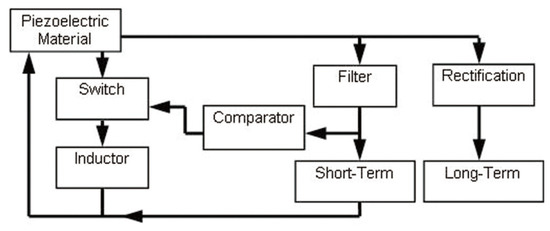
The second proposed solution manipulates the generated charge in real time to suppress the associated tremors; the system level diagram of this approach is given in Figure 4. The voltage waveform is fed directly into a comparator which monitors this signal with a phase shifted version of the same signal. This circuitry generates peak detection that is used to drive a switching element when the peak of the representative waveform is reached. The switch connects the piezoelectric element to an inductor leading to an inversion and amplification in the generated charge and causing the piezoelectric material to generate a counteracting force.
Figure 4.
Semi-active vibration suppression and energy harvesting circuit.
5. Discussion of Results and Conclusions
Results have been published comparing the most common flexible piezoelectric materials for energy harvesting applications [15]. PFCs produce approximately five times the voltage in comparison to polymer films, with bimorph materials further increasing the charge generated. However bimorph materials offer a reduced flexibility due the metal centre shim limiting integration into wearable devices. It was also shown that PFC fibre diameter has an effect on the charge generated, with larger fibres yielding greater output. This is because the thicker fibres cause the composites to be stressed by a greater amount.
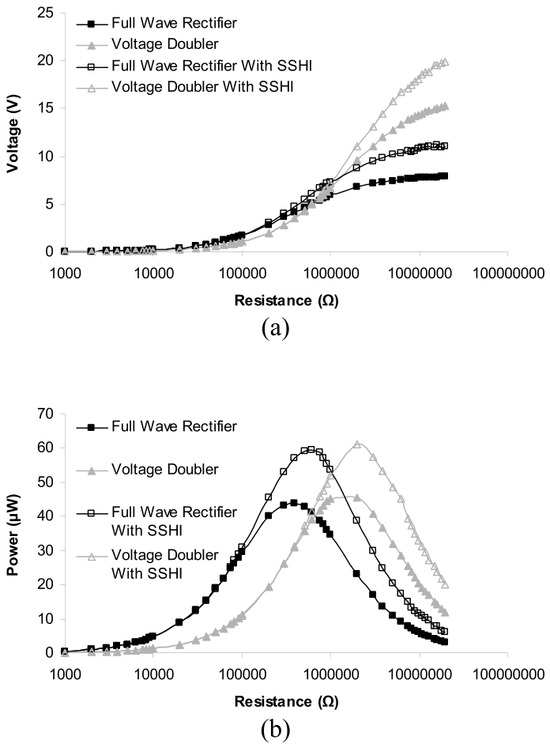
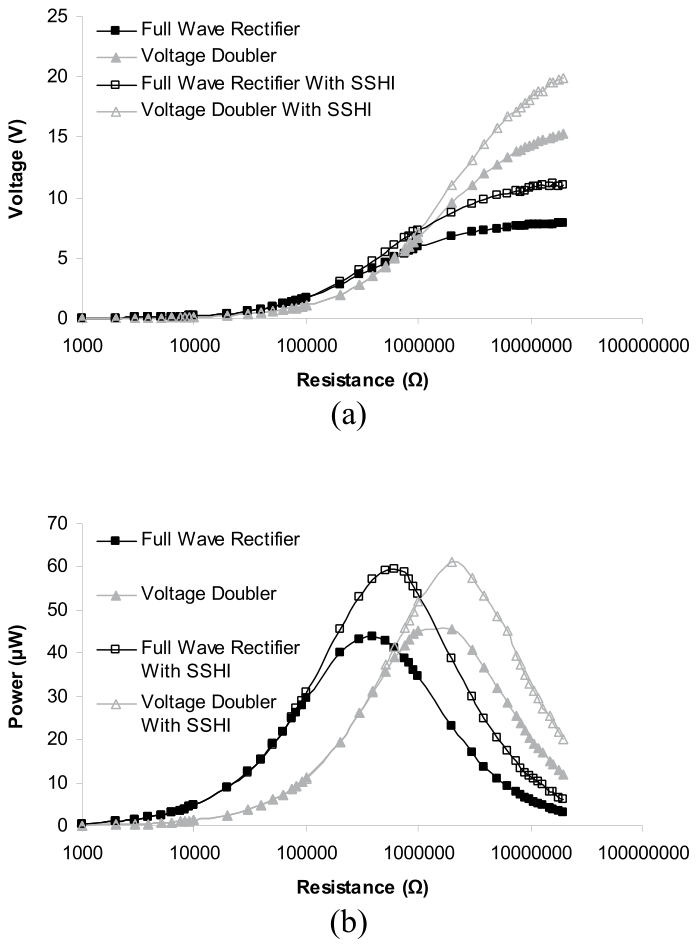
It is highlighted that PFCs can improve the functionality of the proposed device, in terms of a flexible piezoelectric material that can efficiently extract mechanical energy from movement/ tremor. The results from [15] are in agreement to the piezoelectric coefficients as stated in Table 1, therefore the PFCs will exert a greater counteracting force than the polymer films aiding in a greater reduction of tremor. The graphs of Figure 5 show how utilising the semi-active technique can remove more energy from a vibrating system. A single PFC was excited in a cantilever configuration to exert a longitudinal stress in the material, as per hand movements. The excitation frequency was in the range of a few hertz such as the frequency spectra of fast hand movements. The generated charge was regulated and stored via one of the given methods, before being dissipated across a variable resistive load in order to determine the power extracted from the structure. The results show that the voltage doubling rectification circuit is cable of generating greater voltages in comparison to standard full wave rectification but no more mechanical energy is extracted from the system. The semi-active technique is able to manipulate the bending of the device rather than passively collect and dissipate the mechanical energy. This manipulation can extract greater energy in comparison to standard piezoelectric power harvesting methods. Therefore by utilising the semi-active damping we are able to remove more mechanical energy and reduce a greater quantity of the tremor.
Figure 5.
Comparison of PFCs in terms of (a) voltage and (b) power, with and without the semiactive damping technique.
Literature suggests that ceramic materials have greater piezoelectric properties, however for incorporation into wearable devices, it is required that the materials have a textile nature. Monolithic piezoelectric ceramic materials are brittle and fragile, preventing normal body functions. PFCs have the flexibility of piezoelectric polymer materials due to the polyimide outer layers.
This work has shown that PFCs can improve the amount of harvested energy in comparison to piezoelectric polymer films and this energy extraction can be further enhanced through the use of semiactive vibration damping techniques, thereby providing a discrete and no invasive method of vibration suppression.
6. Acknowledgements
The authors would like to acknowledge the help and support of the EPSC DTA award for their backing to the project.
References
- Hausler, E.; Stien, L. Implantable physiological power supply with PVDF film. Ferroelectrics 1989, 60, 277282. [Google Scholar]
- Umdea, M.; Nakamura, K.; Ueha, S. Analysis of the transformation of mechanical impact energy to electric energy using piezoelectric vibrator. Jpn. Jo Appl. Phys. 1996, 35, 3267–3273. [Google Scholar] [CrossRef] [Scilit]
- Elvin, N.G.; Elvin, A.A.; Spector, M. A self-powered mechanical strain energy sensor. Smart Mater. Struct. 2001, 10, 293–299. [Google Scholar] [CrossRef] [Scilit]
- Cass, R.B.; Khan, A.; Mohammadi, F. Innovative ceramic-fiber technology energizes advanced cerametrics. Am. Ceram. Soc. Bull. 2003, 82, 14–15. [Google Scholar]
- Williams, R.B.; Park, G.; Inman, D.J.; Wilkie, W.K. An overview of composite actuators with piezoceramic fibers. Proc IMAC-XX: Conf on Structural Dynamics (Los Angeles, CA) , 2002. [Google Scholar]
- Mohammadi, F.; Khan, A.; Cass, R.B. Power generation from piezoelectric lead zirconate titanate fiber composites. Mater. Res. Soc. Symp. Proc. 2003, 736, 263–270. [Google Scholar] [CrossRef] [Scilit]
- Werlink, R.J.; Bryant, R.G.; Manos, D. NASA Technical Report NASA/TM-2002-211434; Macro fiber piezocomposite actuator poling study. 2002.
- Wilkie, W.K.; Inman, D.J.; Lloyd, J.; High, J.W. Anisotropic piezocomposite actuator incorporating machined PMN-PT single crystal fibers. Proc Actuatr 2002—8th Int Conf on New Actuators (Bremen, Germany), 2002. [Google Scholar]
- Starner, T.; Paradiso, J.A. Human generated power for mobile electronics. In Low Power Electronics; CRC Press, 2004; pp. 1–35. [Google Scholar]
- Information on. Available online: http://www.advancedcerametrics.
- Kymissis, J.; Kendall, C.; Parasiso, J.A.; Gershenfeld, N. Parasitic power harvesting in shoes. Proc 2nd IEEE Int Conf on Wearable Computers, 1998. [Google Scholar]
- Shenck, N.S.; Paradiso, J.A. Energy scavenging with shoe-mounted piezoelectrics. IEEE Micro 2001, 21, 30–42. [Google Scholar] [CrossRef] [Scilit]
- Siores, E.; Swallow, L.M. Detection and suppression of muscle tremors. UK Patent No. GB0623905.7, 2006. [Google Scholar]
- Kotze, J.; Lammer, H.; Cottey, R.; Zirngible, W. A study into the effects of active Piezo fibre rackets on tennis elbow; Report from the Institute of Orthopaedics and Sports Medicine: Munich, Germany, 2003. [Google Scholar]
- Swallow, L.M.; Luo, J.K.; Siores, E.; Patel, I.; Dodds, D. A piezoelectric fibre composite based energy harvesting device for potential wearable applications. Smart Mater. Struct. 2008, 17, 025017–025023. [Google Scholar] [CrossRef] [Scilit]

© 2009 Textile Bioengineering and Informatics Society. This article is an open access article distributed under the terms and conditions of the Creative Commons Attribution (CC BY) license (https://creativecommons.org/licenses/by/4.0/).