


Abstract
Temperature-sensitive polymer membranes were prepared by combination of shape memory hydrophilic polyurethane (SMPU) and thermo-sensitive poly(N-isopropylacrylamide-co-sodium acrylate) [poly(NiPAAm-co-SA)] hydrogel micro-particles through composite coating method. These two intelligent polymer components endowed the composite membranes with “double switch” on the water vapor permeability. Poly(NiPAAm-co-SA) hydrogel micro-particles exhibited a reversible volume transition at lower critical solution temperature (LCST) around 34-36 °C in the experiment. The size of gel particles varied more than 10-fold between temperature above and below LCST. It is likely acted as a sensor of temperature and as an switch to regulate the water vapor permeability of composite membranes. Moreover, there was also a dramatic increase in water vapor permeability (WVP) with an increase in temperature from 35 to 40 °C for the shape memory hydrophilic polyurethane basement membranes. Two different procedures for WVP test were employed to simulate different application situations of the composite membranes. The temperature-sensitive water vapor permeability of composite polymer membranes was investigated by varying the content of hydrogel micro-particles. All of the temperaturesensitive membranes could have water vapor permeability controlled in response to temperature changes.
1. Introduction
Nowadays, textile industry shows a huge interest in environmentally responsive or stimuli-responsive materials which could be incorporated into technical textiles [1,2]. Poly(N-isopropylacrylamide) hydrogel (PNiPAAm]) attracts lots of researchers as a best known thermosensitive polymeric network, which exhibits a reversible volume transition at a transition temperature or lower critical solution temperature (LCST) of approximately 33 °C [3,4]. UV grafting of NiPAAm on polymer substrates and plasma polymerization of NiPAAm on polyethylene and polypropylene membranes have been reported in the literature [5,6,7,8,9,10,11]. The grafted gels acted as a sensor of temperature and as a valve to regulate the water vapor permeability of the membranes. All the membranes mentioned above benefit from additional functionality related to the change of the hydrogels properties across the lower critical solution temperature (LCST).
In this paper, we prepared temperature-sensitive composite membranes by combination temperatureresponsive poly(NiPAAm-co-SA) hydrogel microparticles with thermo-sensitive polyurethane substrates using composite coating method. The water vapor permeability of obtained composite membranes can be controlled by the two temperaturesensitive components with the temperature variation. This investigation is aim to provide a smart thermosensitive membranes with “double switch” on the water vapor permeability for textile producers. There is no doubt that temperature-sensitive textiles produced by polymer will play a significant role in the realization of the smart textile of tomorrow.
2. Experimental
2.1. Materials
N-isopropylacrylamide (NiPAAm) monomer (WUJING Chemical Co., China) was used as supplied. Sodium acrylate (SA) was synthesized from acrylic acid and sodium hydroxide. N, N’ -Methylenebisacrylamide(BIS), Tetramethylethylene diamine (TEMED), and ammonium persulfate (APS) were purchased from Sinopharm Chemical Reagent Co.(China) and used as received.
Toluene-2, 4-dissocyanate (TDI;extra pure), 1, 4-butanediol (BDO, chemical pure), N, N-dimethylformamide (DMF, analytical pure), dimethylolpropionic acid (DMPA, chemical pure) and triethylamine (TEA, chemical pure) were purchased from Sinopharm Chemical Reagent Co. China and used as supplied. Poly(butylenes adipate) glycol (PBAG, industrial grade, =2000) was supplied by Lianying Polymer Co. Shanghai, China and used as received. Water for experiment was deionized water.
2.2. Preparation of Thermo-Sensitive Composite Membranes
Segmented shape memory polyurethanes were synthesized in two steps. Soft segment PBAG with molecular weight (  ) 2000 (g/mole) were dried at 120 °C under vacuum for 2h before use. Hard segments TDI and BDO were used with PBAG to prepare segmented polyurethanes. A 500ml round bottom, three-necked flask equipped with a mechanical stirrer, nitrogen inlet and condenser was used as a reactor to prepare the polyurethanes. One mole of dehydrated PBAG with four mole TDI was reacted at 70 °C for 1.5h. Then, the NCO-terminated pre-polymer was mixed with chain extension BDO at 70 °C for another 2h. Ionomers were obtained by neutralizing the COOH groups of DMPA with TEA.
Table 1 showed the basic formulation of the present experiment of shape memory polyurethane.
Table 1.
The basic formulation and DSC results of shape memory polyurethane.
Poly(NiPAAm-co-SA) hydrogels with mole ratio 98:2 were synthesized using BIS as crosslinking agent. APS and TEMED were used as initiator and accelerator by free radical polymerization. The hydrogels were prepared as follows. NiPAAm and BIS [5% (mol/mol) to NiPAAm] were dissolved in deionized water with the solution concentration 5% by weight. The solution was nitrogen bubbled for 10 min, and then SA solution was added and bubbled with nitrogen for another 5 min. APS [2% (mol/mol) to NiPAAm] and TEMED [5% (mol/mol) to NiPAAm] were subsequently mixed into the aqueous solutions and bubbled with nitrogen for 5 min. The whole reaction was conducted in water bath at required temperature of 35 °C for 1h with nitrogen protection, and then stayed at room temperature (18 °C) for 1 day. The resulting hydrogels were separated from the vessel and purified by immersing in deionized water for one week to remove unreacted chemicals and fully swell. The water was replaced 3~4 times every day. A total of 100 g equilibrated swelling hydrogels with 20mL deionized water were made into micro-particles by SDF400 Intelligent Dispersion Ball Mill (Weite, China). The obtained micro-particles were screened in order to get the micro-particles with uniform size. From the phenomena of the hydrogels dramatically deswelling and color changing from transparent to opaque around the LCST, the LCST of poly(NiPAAm-co-SA) hydrogels in the experiment were defined at the range of 34-36 °C
The composite membranes were prepared as follow. Firstly, a layer of hydrogel particles was coated on the horizontal glass plate evenly. Secondly, a layer of shape memory polyurethane was coated on the hydrogel layer carefully in order to form continuous surface of the substrate membrane. Thirdly, another layer of hydrogel particles was coated on the top of shape memory polyurethane coating. Keep the composite coating at room temperature for 10 min. The membranes were further dried at 70 °C under vacuum for the next 24h. The weight percentage of hydrogel particles to shape memory polyurethane was 5 and 10% where respectively. The testing composite membrane polyurethane (PU204) and poly(NiPAAm-co-SA) samples were donated as PU+x% NP particles, PU and NP particles presented shape memory hydrogel micro-particles, x% indicated the weight percent of hydrogel particles to shape memory polyurethane.
2.3. Testing Methods
2.3.1. Differential Scanning Calorimetry (DSC)
Differential scanning calorimeter (DSC) test (DSC204F1, Netzsch, Germany) was carried out over a temperature range from -60 °C to 200 °C and at a heating rate of 5 °C/min in order to investigate the thermal properties of the SMPUs.
2.3.2. Thickness Measurement of Membranes
The thicknesses of obtained membranes were measured according to ASTM D1777-96 (2007) [12] by Digital Fabric Thickness Gauge (Hongda, China) in air conditioning room. An average of 3 different measurements was recorded as the thickness for each membrane sample.
2.3.3. Water Vapor Permeability (WVP)
Water vapor permeability was measured according to ASTM method E 96-80B [13]. Round bottomed stainless steel cups with a diameter of 60mm and a height of 20mm were filled with 10mL deionized water. Membrane samples were placed over the top of the cups, and secured with rubber bands and metal ring shaped clamps. Finally, the cups were wrapped with polytetrafluoroethylene sealing tape to ensure perfect sealing. The WVP of the membranes at 20, 25, 30, 35, 40, 45 or 50 °C were measured using the formula below with a constant relative humidity of 50%. An average of 3 different measurements was recorded as the WVP result for each sample.
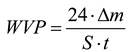
Where WVP is the water vapor permeability per meter square per day, g/(m2 ·day);  m is the weight difference of the test assembly in two measurements, g; S is the area of test surface, m2; and t is test time, h.
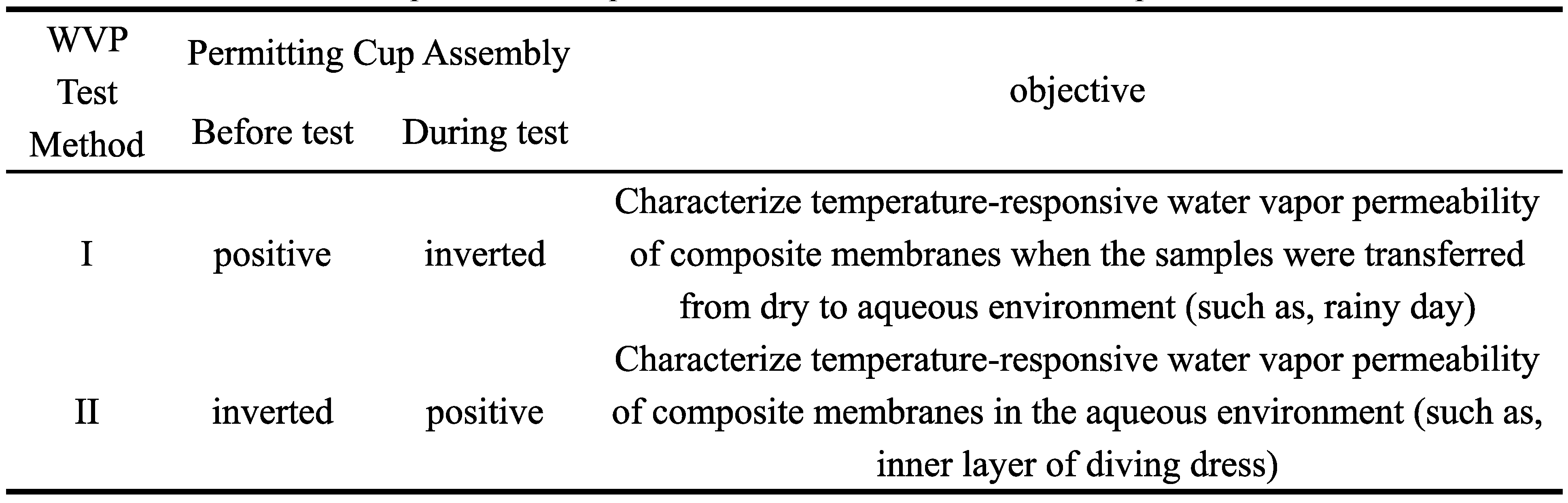
Two testing methods were designed for the water vapor permeability measurement in order to investigate the responsive behavior of composite membranes on the water vapor permeability with the variation of temperature in different application environment. The specific descriptions of method I and II were presented in Table 2.
Table 2.
The specific description of WVP measurement of composite membranes.
3. Results and Discussion
3.1. Surface Morphology of Composite Membranes
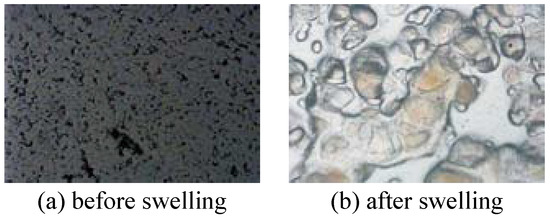
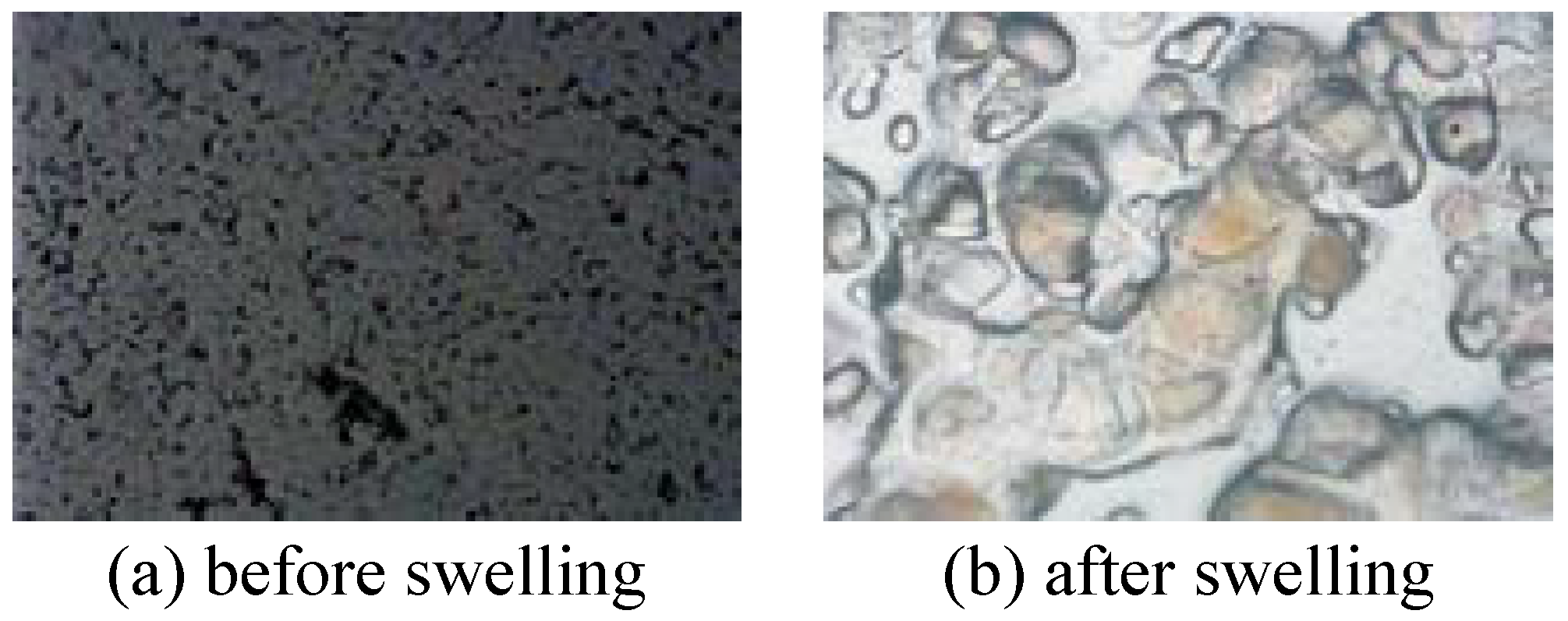
The surface morphology of composite membranes before and after swelling were shown in Figure 1 As seen in Figure 1a, the dry hydrogel particles distributed evenly in the polymer substrate membranes. The micropores were attributed by the deswelling of hydrogel particles at the temperature higher than the LSCT of hydrogels, which provided permitting passages for water vapor. Figure 1b showed the surface morphology of composite membranes after swelling at the temperature lower than the LCST. The gel particles swelled dramatically, and it was hardly to find the pores on the surface. As a result, the permitting passages were closed by the swollen gel particles. The water vapor permeability of composite membranes dropped down largely, whereas the waterproof property was enhanced greatly. The drastic size change of hydrogel particles with the variation of temperature endowed the composite membranes with one switch on water vapor permeability.
Figure 1.
Surface morphology comparison of composite membranes before and after swelling.
3.2. Thickness Measurements of Composite Membranes
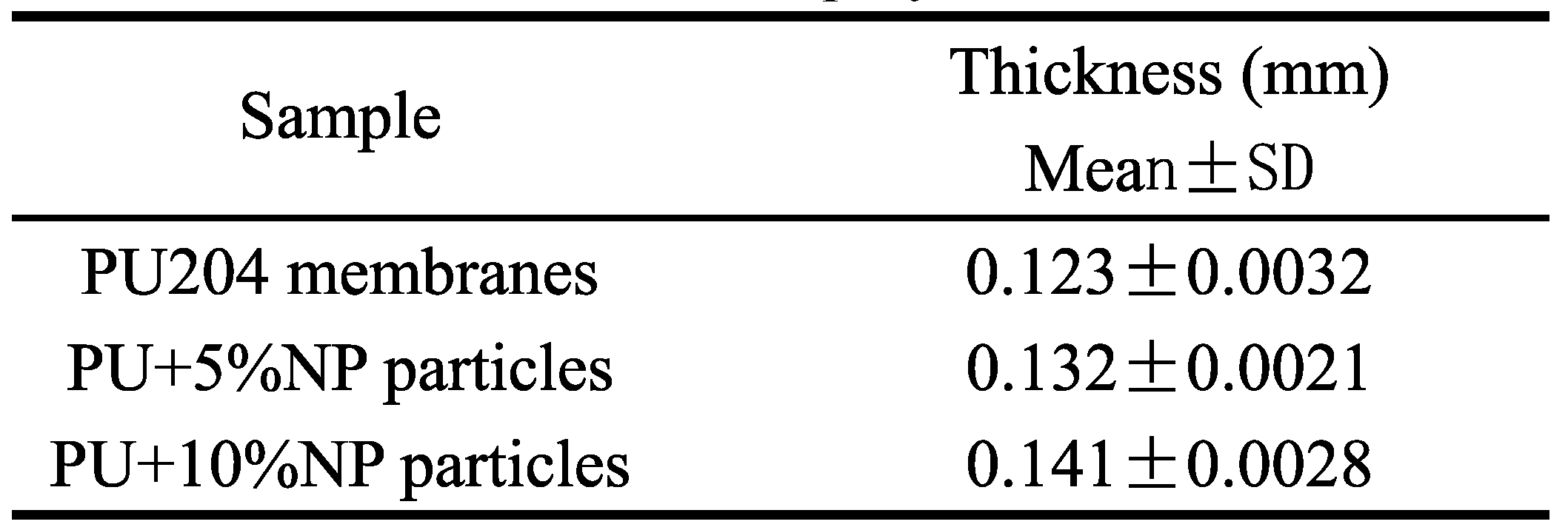
The thicknesses of membranes were listed in Table 3. Five membranes were measured and the average result was used as the thickness of membranes. The composite membranes were a little thicker than polyurethane membranes as the introduction of hydrogel micro-particles. With more micro-particles were used, the thicknesses of composite membranes increased. However, the thickness of membranes was not considered when the water vapor permeability was investigated in the experiment because of the little difference of the membrane samples.
Table 3.
Thicknesses of polymer membranes.
3.3. Water Vapor Permeability of Composite Membranes
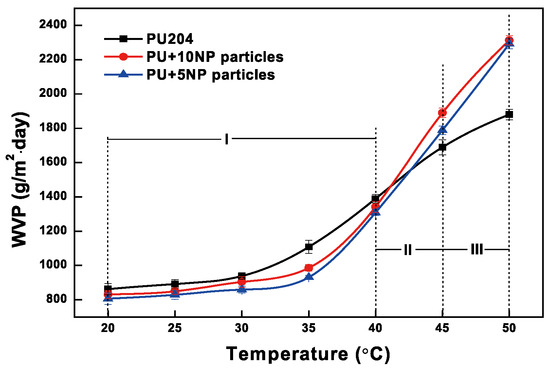
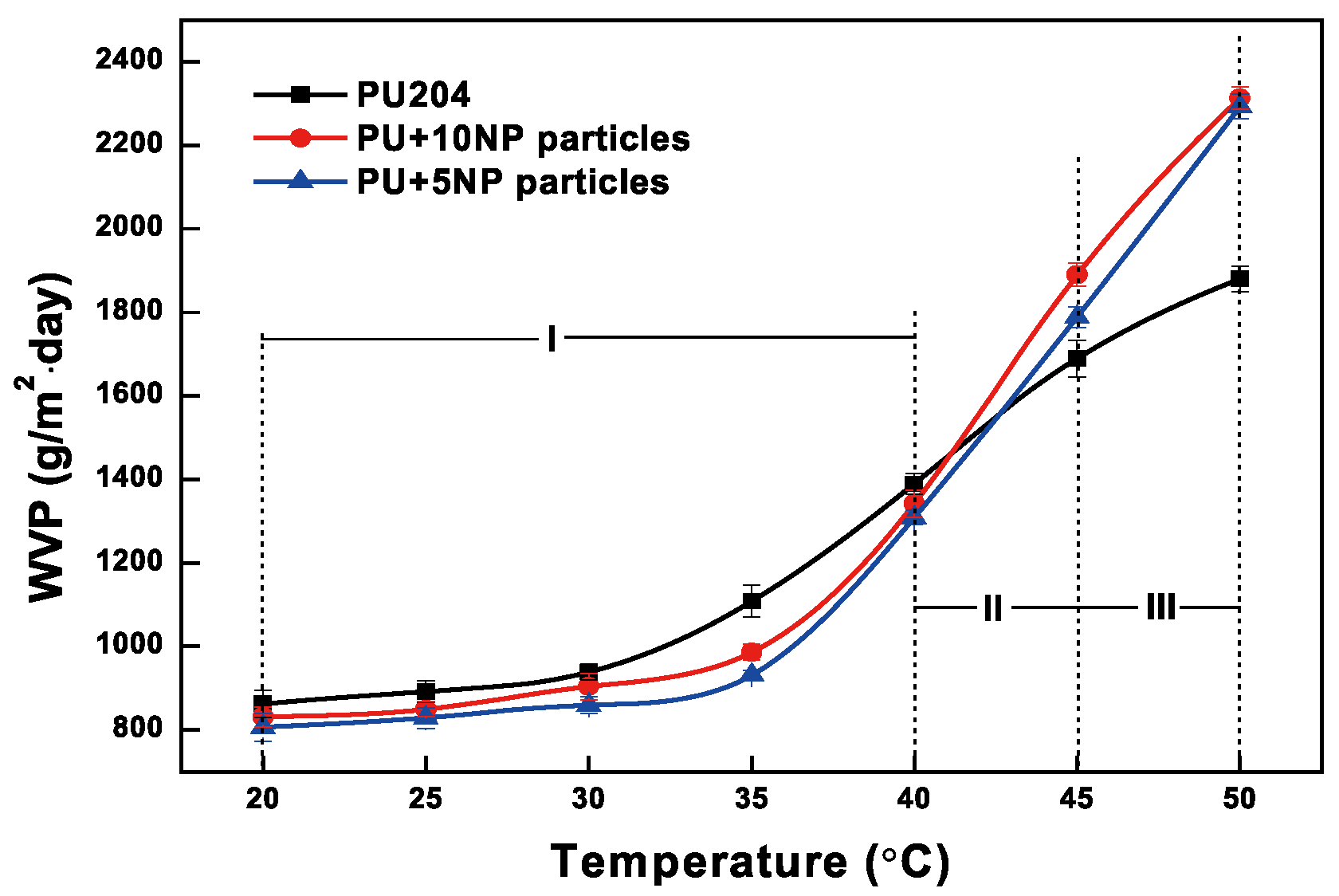
The water vapor permeability of composite membranes measured by method I was shown in Figure 2 The testing temperature range was divided into three zones.
Figure 2.
Water vapor permeability of composite membranes (method I).
The LCST of poly(NiPAAm-co-SA) hydrogels was located in temperature zone I (20-40 °C). From this figure, we can see the WVP of composite membranes was lower than PU 204 in temperature zone I. At the initial stage of WVP testing by method I, the hydrogel particles swelled quickly as soon as the permitting cup assembly was reverted, consequently, the micropores in the membranes were closed by the swollen gel particles. The WVP didn’t change a lot from 20 to 30 °C as the temperature didn’t reach to the trigger temperature of these two component polymers, which proved that the waterproofness of the composite membranes at colder temperatures was good. When the temperature rose to the LCST (34-36 °C) of hydrogels, the micro-particles begun to deswell, the permitting passage opened gradually and the WVP of composite membranes increased for the first time. Consequently, the water vapor permeability of the composite membranes increased fast. In zone I, the WVP of PU204 also showed a rising trend after 30 °C as the soft segment melting temperature (Ts, m)of PU204 started at 31.3 °C. For polyurethane membranes, the WVP increased with the temperature rising, which was contributed by the enhanced molecular motion of molecular chains.
With the temperature reached zone II, the WVP of composite membranes showed a trend of exceeding PU204, and the WVP of composite membranes increased with the increasing amount of hydrogel particles. As the phase transition temperature (Ts, m) 39.4 °C of shape memory polyurethane was located in the junctional zone between temperature zone I and II. Another abrupt increase of WVP happened around this temperature, which was contributed by the enhanced molecular motion of soft segment at soft segment crystal melting temperature (Ts, m). The enhanced segmental mobility made the soft segment into a larger volume which resulted in an increase in free volume of shape memory polyurethanes and permitted the water vapor molecules to transmit through the polymer films easily [14]. The drastic increase of WVP of shape memory polyurethane membranes at Ts, m endowed the composite membranes another switch on the water vapor permeability. Meanwhile, the gel particles were deswelling continuously, which was another reason of the increasing WVP of composite membranes.
In temperature zone III, the WVP of composite membranes exceeded PU 204 as a result of the gradually deswell of the gel particles in composite membranes in response to the increasing temperature. The thermo-sensitive WVP of shape memory polyurethane caused the increase of WVP of composite membranes as well.
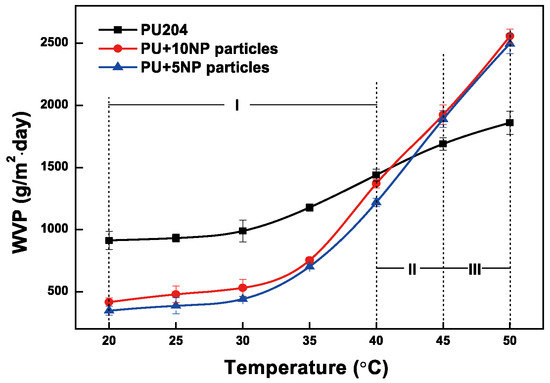
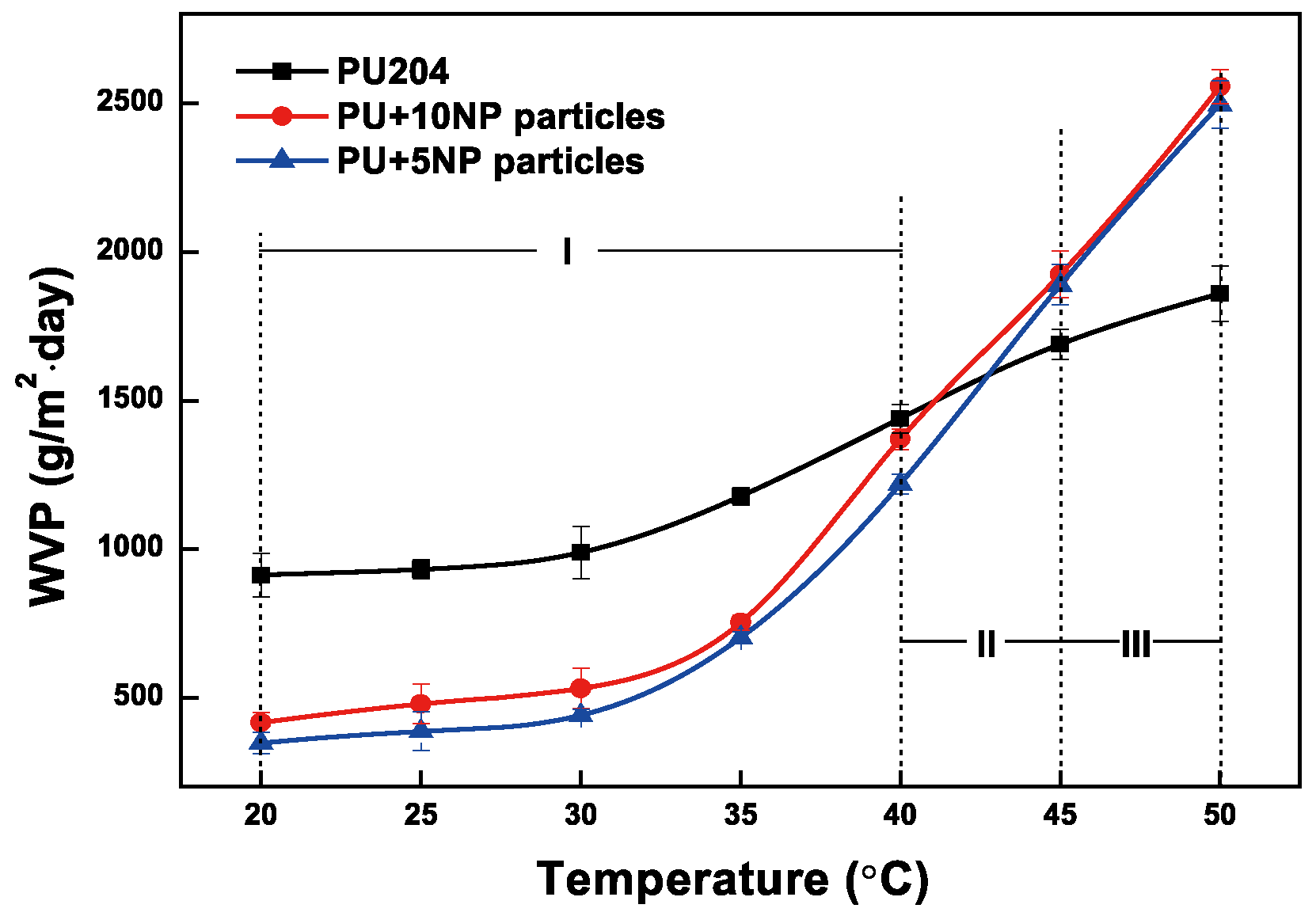
The water vapor permeability of composite membranes measured by method II was shown in Figure 3 As the permitting cup assembly was reverted before test, the hydrogel particles were fully swollen, the WVP of composite membranes was lower when compared with PU204 and also the data of composite membranes measured by method I, which proved that the waterproofness of composite membranes was enhanced greatly with fully swollen particles. In the test temperature area, the change of WVP of composite membranes by method II was similar to method I, which was not explained in detail here.
Figure 3.
Water vapor permeability of composite membranes (method II).
From the comparison of Figure 2 and Figure 3, we can see the measured WVP curves of the composite membranes were different as the initial condition of the hydrogel particles. However, with the temperature increased during the test, the final data of these two figures were similar. This proved that the initial condition of the composite membranes can be changed for different applications.
4. Conclusion
Intelligent composite membranes with “double switch” on the water vapor permeability were prepared by combination two kinds of thermosensitive polymers using multi-coating method. The results showed that the water vapor permeability of the composite membranes had two remarkable changes with the temperature variation. The poly(NiPAAm-co-SA) micro-particles and the shape memory polyurethanes are likely acted as two sensors of temperature and as two switches to regulate the water vapor permeability of composite membranes.
The method employed to produce the composite membranes in this experiment is multi-coating method for research aim. But it is not restricted to this method and some other methods are also can be used to incorporate these two smart components, such as UV grafting or plasma polymerization.
The intelligent composite membranes can be applied in textile and garment industry, which could endow the fabric with more function. As we can see, the temperature-sensitive textiles produced by polymers have a promising future of the smart textiles.
References
- Crespy, D.; Rossi, M.R. Temperature-responsive polymers with LCST in the physiological range and their applications in textiles. Polym. Int. 2007, 56, 14611468. [Google Scholar] [CrossRef] [Scilit]
- Park, Y.S.; Ito, Y.; Imanishi, Y. Permeation control through porous membranes immobilized with thermosensitive polymer. Langmuir 1998, 14, 910914. [Google Scholar] [CrossRef] [Scilit]
- Hirokawa, Y.; Tanaka, T. Volume phase transition in a nonionic gel. J. Chem. Phys. 1984, 81, 6379–80. [Google Scholar] [CrossRef] [Scilit]
- Hirose, H.; Shibayama, M. Kinetics of volume phase transition in poly(N-isopropylacrylamide-co-acrylic acid) gels. Macromolecules 1998, 31, 5336–42. [Google Scholar] [CrossRef] [Scilit]
- Chu, L.Y.; Niitsuma, T.; Yamaguchi, T.; Nakao, S.I. Thermo-responsive transport through porous membranes with grafted PNIAM gates. AICHE J. 2003, 49, 896–909. [Google Scholar] [CrossRef] [Scilit]
- Huang, J.; Wang, X.L.; Chen, X.Z.; Yu, X.H. Temperaturesensitive membranes prepared by the plasma-induced graft polymerization of N-isopropylacrylamide into porous polyethylene membranes. J. Appl. Polym. Sci. 2003, 89, 3180–3187. [Google Scholar] [CrossRef] [Scilit]
- Liang, L.; Shi, M.; Viswanathan, V.V.; Peurrung, L.M.; Young, J.S. Temperature sensitive polypropylene membranes prepared by plasma polymerization. J. Membr. Sci. 2000, 177, 97–108. [Google Scholar] [CrossRef] [Scilit]
- Iwata, H.; Oodate, M.; Uyama, Y.; Amemiya, H.; Ikada, Y. Preparation of temperature-sensitive membranes by graft polymerization onto a porous membrane. J. Membr. Sci. 1991, 55, 119–130. [Google Scholar] [CrossRef] [Scilit]
- Kim, B.K.; Lee, S.Y.; Lee, J.S.; Baek, S.H.; Choi, Y.J.; Lee, J.O.; Xu, M. Polyurethane ionomers having shape memory effects. Polymer 1998, 39, 2803–2808. [Google Scholar] [CrossRef] [Scilit]
- Jeong, H.M.; Ahn, B.K.; Cho, S.M.; Kim, B.K. Water vapor permeability of shape memory polyurethane with amorphous reversible phase. J. Polym. Sci. Pol. Phys. 2000, 38, 3009–3013. [Google Scholar] [CrossRef] [Scilit]
- Jeong, H.M.; Ahn, B.K.; Kim, B.K. Temperature sensitive water vapor permeability and shape memory effect of polyurethane with crystalline reversible phase and hydrophilic segments. Polym. Int. 2000, 49, 1714–1721. [Google Scholar] [CrossRef] [Scilit]
- American Standards of Testing Method D1777-96 for Thickness of textile materials.
- American Standards of Testing Method for Water vapor transmission of materials.
- Mondal, S.; Hu, J.L. Water vapor permeability of cotton fabrics coated with shape memory polyurethane. Carbohyd Polym. 2007, 67, 282–289. [Google Scholar] [CrossRef] [Scilit]


© 2008 Textile Bioengineering and Informatics Society. This article is an open access article distributed under the terms and conditions of the Creative Commons Attribution (CC BY) license (https://creativecommons.org/licenses/by/4.0/).